
Article

Stakeholder Perspectives on Zoo Sound Environments and Associated Impacts on Captive Animal Behaviour, Management and Welfare


1
Centre for Research in Animal Behaviour, Psychology, University of Exeter, Exeter EX4 4QG, UK
2
WWT, Slimbridge Wetlands Centre, Slimbridge GL2 7BT, UK
3
Department of Sociology, Philosophy and Anthropology, University of Exeter, Exeter EX4 4RJ, UK
*
Author to whom correspondence should be addressed.
J. Zool. Bot. Gard. 2025, 6(3), 47; https://doi.org/10.3390/jzbg6030047
Submission received: 15 July 2025 / Revised: 10 September 2025 / Accepted: 15 September 2025 / Published: 16 September 2025

Abstract

Although long neglected, sound is now an increasing topic of interest in zoo and aquarium science. Research has examined the impact of sounds, from various sources, on zoo-housed species, noting that the influence of sound is varied and very context specific. The zoo’s sound environment is influenced by the animals, the built environment, vegetation, climatic, temporal and seasonal factors, equipment use, husbandry practices, and human presence. Different sounds can dominate an enclosure at certain times. This article discusses a workshop involving 12 zoo professionals, held in March 2020, that explored how sound is considered or overlooked in zoo animal management. Although insights are based on a small group, limiting generalisability, the findings highlight areas where further understanding is required and should encourage research extension to other groups of stakeholders. Delegates emphasised that the auditory needs of animals are often underappreciated and that the influence of sound depends on the species involved and how the sound may be perceived. Delegates highlighted the importance of species- and individual-specific approaches, predictability, and how animals have (any) control over sounds experienced in their enclosure. Routine operational sounds, such as closing gates or doors, may inadvertently stress animals, suggesting the need to consider sound in enclosure design and husbandry schedules. Outputs also stated that sound, when carefully managed, can act as enrichment through (for example) structured auditory cues or naturalistic sounds if ecologically relevant. Overall, our findings support integrating sound measurement into broader welfare assessment frameworks and enclosure planning, and they identify practical applications including sound mitigation, enrichment strategies, and staff training. Future research should include a wider range of species (especially understudied taxa), consider the experiences of a wider stakeholder demographic, and evaluate how sound is management in complex or high-traffic areas of the zoo.
Keywords: zoo; aquarium; sound environment; animal welfare; animal behaviour zoo; aquarium; sound environment; animal welfare; animal behaviour
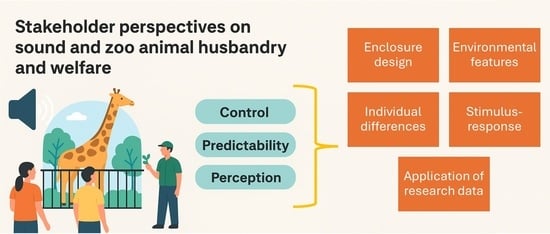
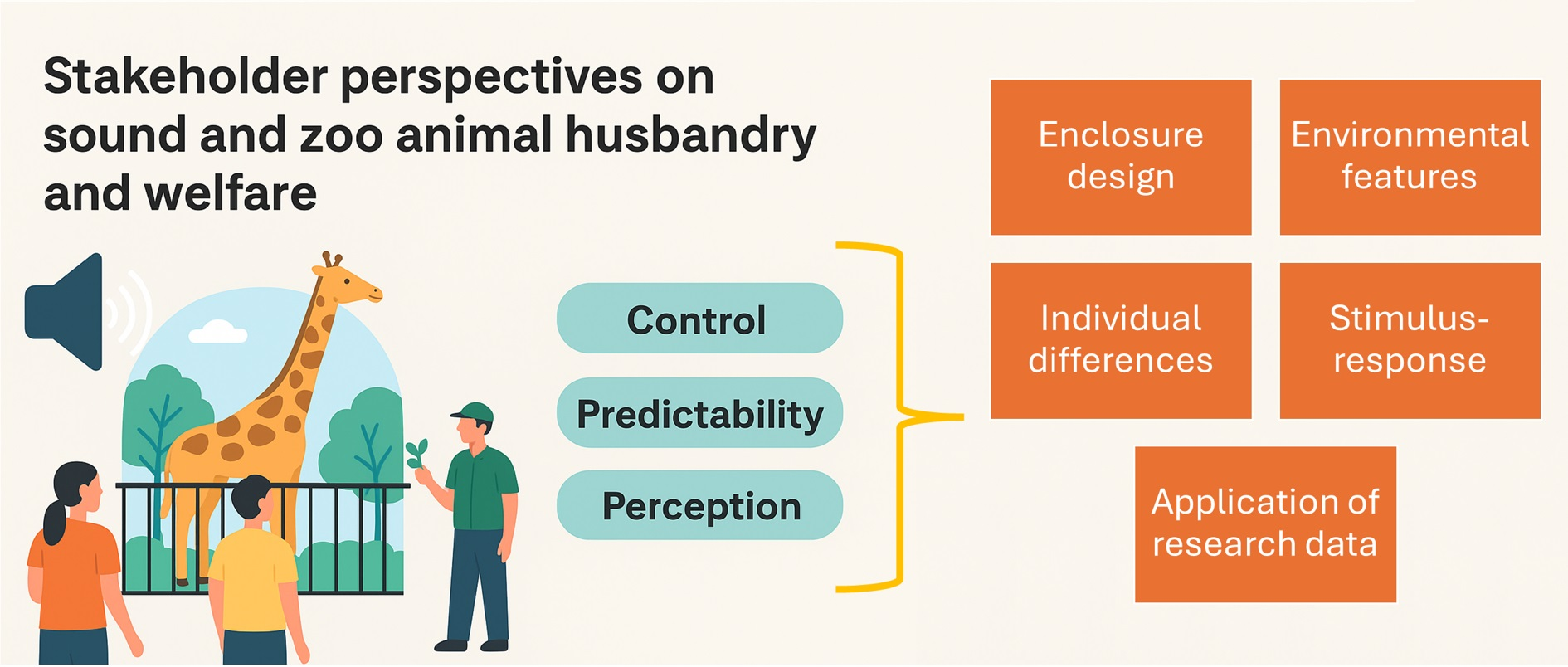
Graphical Abstract