Review

Harnessing Living Therapies: The Role of CAR-T Cells, Oncolytic Viruses, and Bacteria in Cancer Treatment


by
Shukur Wasman Smail
1,2,3,*,
Abdullah Hayder Flaih
2,
Blnd Azad Ismail
2,
Akhter Ahmed Ahmed
2,
Ahmed Abdulrazzaq Bapir
4,
Fikry Ali Qadir
2 and
Christer Janson
3,*
1
College of Pharmacy, Cihan University-Erbil, Erbil 44001, Kurdistan Region, Iraq
2
Department of Biology, College of Science, Salahaddin University-Erbil, Erbil 44001, Kurdistan Region, Iraq
3
Department of Medical Science, Respiratory Medicine, and Allergology, Uppsala University and Uppsala University Hospital, SE-751 85 Uppsala, Sweden
4
Department of Medical Laboratory Technology, Erbil Health and Medical Technical College, Erbil Polytechnic University, Erbil 44001, Kurdistan Region, Iraq
*
Authors to whom correspondence should be addressed.
Immuno 2026, 6(2), 34; https://doi.org/10.3390/immuno6020034
Submission received: 23 March 2026 / Revised: 2 May 2026 / Accepted: 7 May 2026 / Published: 12 May 2026
(This article belongs to the Section Cancer Immunology and Immunotherapy)

Abstract

Living therapies, including chimeric antigen receptor T (CAR-T) cells, oncolytic viruses (OVs), and bacteria-based platforms, are emerging as promising approaches in cancer treatment because they can directly target tumors and modulate anti-tumor immunity. This narrative review summarizes current knowledge on these therapies, focusing on their mechanisms of action, therapeutic applications, major limitations, and recent advances in genetic engineering, synthetic biology, and delivery systems. CAR-T cell therapy has shown substantial clinical success in hematological malignancies through the genetic redirection of T cells against tumor-associated antigens, although its efficacy in solid tumors remains limited by antigen heterogeneity and the immunosuppressive tumor microenvironment (TME). OVs selectively infect and lyse malignant cells while also stimulating local and systemic immune responses, and engineered OVs may further enhance therapeutic activity by reshaping the TME. Bacteria-based therapies exploit the natural tumor-targeting ability of selected strains, particularly in hypoxic regions, to deliver therapeutic agents and activate immune responses. Despite encouraging progress, safety concerns, immune-related barriers, and tumor complexity remain major challenges. Overall, integrating living therapies with modern biotechnological advances and existing treatment modalities may support more personalized and synergistic strategies for cancer management.

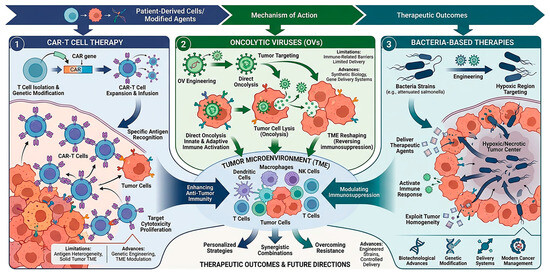
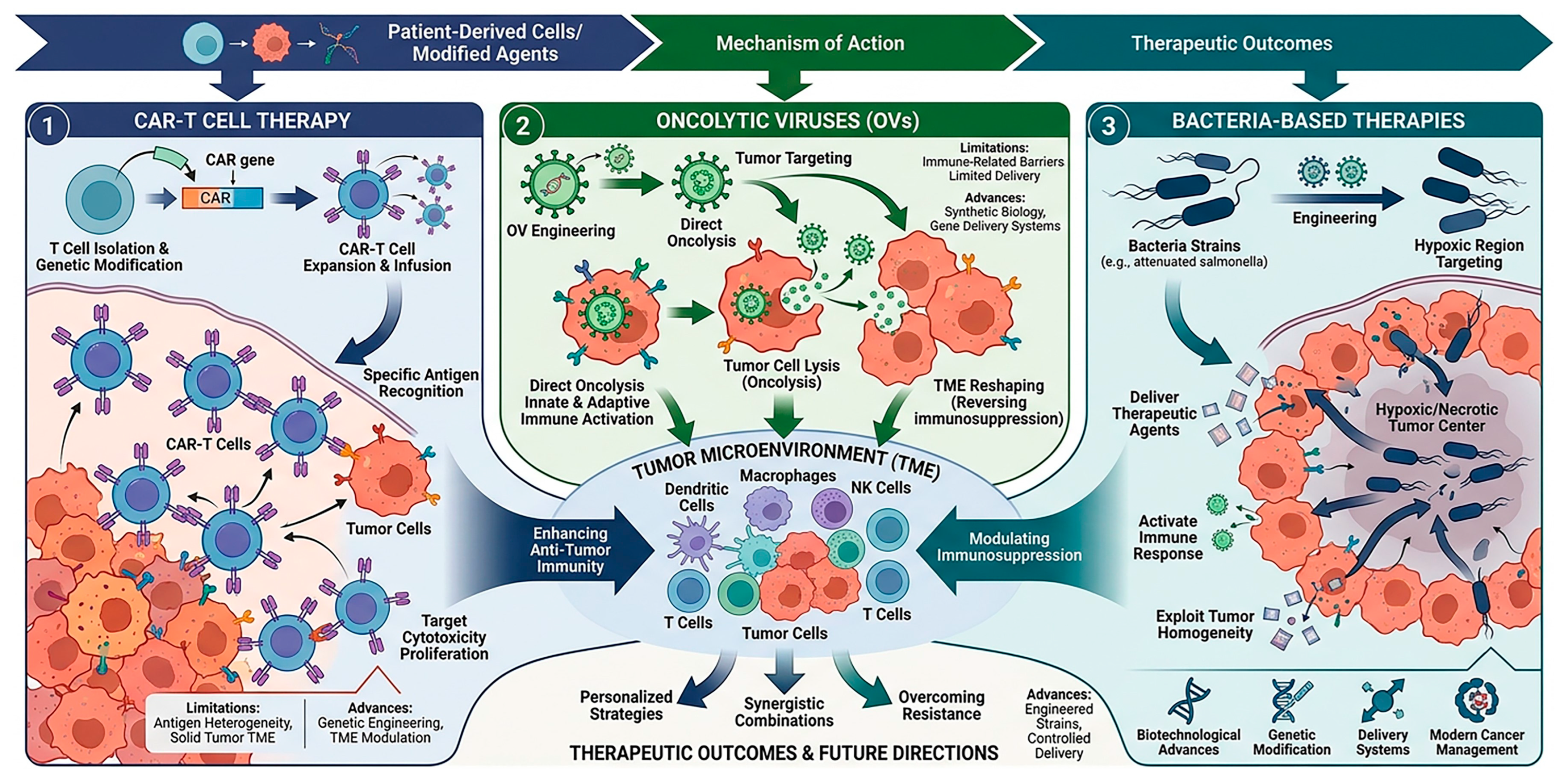
Graphical Abstract

1. Introduction

Cancer remains a significant health challenge worldwide, with approximately 20 million new cases and 10 million deaths recorded in 2022 alone [1]. Although conventional therapies, including radiation therapy, chemotherapy, and surgery, have become more sophisticated, many of these methods are invasive, non-specific, and often fail owing to cancer resistance and recurrence. Because of these difficulties, there has been increasing interest in more specialized and adaptable treatments, notably those that use immunotherapy to stimulate the body’s intrinsic defenses [2].
Living therapies that use cells, viruses, or microbes to specifically target and destroy cancer cells while stimulating the immune system are now in the spotlight in this field because they avoid many of the limitations of conventional therapies. Oncolytic virus (OV), bacteria-based cancer, and chimeric antigen receptor T (CAR-T) cell therapies have a powerful therapeutic potential. Certain blood malignancies can be effectively treated with CAR-T cells, including the modification of a patient’s own T cells to identify and combat tumor-specific antigens [3]. Oncolytic viruses are naturally occurring or genetically modified viruses that can specifically target and destroy cancer cells while triggering immune responses against tumors [4]. Additionally, bacteria-based therapy delivers therapeutic agents directly to tumors, particularly in hypoxic environments, by utilizing live bacteria that are frequently designed for natural tumor targeting [5].
Each of these treatments shows a unique therapeutic potential; however, there is no comprehensive review that collects them under the common umbrella of biologically active or living cancer treatments. Thus, this study aimed to present a comprehensive overview of oncolytic viruses, bacteria-based therapy, and CAR-T cell therapy, emphasizing their mechanics, clinical uses, difficulties, and potential future prospects as combined fronts in the battle against cancer.

2. Bacteria-Based Cancer Therapy

The utilization of some bacterial strains to attack and colonize tumor microenvironments (TMEs), which differentiates them from conventional therapeutic agents, has been exploited in bacteria-based cancer therapy. These bacteria have several mechanisms that contribute to their therapeutic effects, including tumor colonization, direct toxin release, and immune stimulation. Their intrinsic tumor tropism is necessary for their mechanism of action to facilitate more targeted therapeutic delivery than systemic treatments [5,6].
The hypoxic and immunosuppressive conditions observed in TMEs are the main factors that promote tumor colonization. These characteristics also make the TME a favorable habitat for some bacterial genera, such as Salmonella, Escherichia, and Clostridium [7,8,9]. These bacteria are further protected by the hypoxic environment, which has oxygen concentrations as low as 1–4% as opposed to 5–8% in normal tissue [10]. Bacterial growth in the center of the tumor is further promoted by disordered tumor vasculature and the loss of nutrients from dying tumor cells. Both passive capture in the vasculature and active chemotaxis toward particular chemical cues and hypoxic zones are ways in which bacteria can reach the tumor [11]. Bacterial motility permits the spread of bacteria within the tumor tissue once they are present, and additional multiplication may result in significant bacterial densities within the TME [12].
Another important element in bacteria-based cancer therapy (BBCT) is the direct release of toxins. Potent toxins produced by several bacterial genera can kill cancer cells directly [13]. For instance, phospholipases and hemolysins released by Clostridium species attack the membranes of tumor cells [14,15]. Furthermore, Listeria infection may cause cancer cell death by inducing nicotinamide adenine dinucleotide phosphate (NADP+) oxidase and increasing intracellular calcium levels [16]. These toxins are very effective in decreasing tumor mass because they directly affect cancer cells, together with other bacterial metabolites produced during lysis. As shown in an engineered strain of Salmonella, modified bacteria can also express particular therapeutic proteins, such as TNF-related apoptosis-inducing ligand (TRAIL), to cause apoptosis [17].
Immune activation is the third most crucial mechanism underlying the therapeutic activity of these bacteria. Pathogen-associated molecular patterns (PAMPs), such as flagellin and lipopolysaccharide (LPS), are immunogenic [5]. Proinflammatory cytokines are released when immune cell pattern recognition receptors (PRRs) recognize PAMPs, helping in the recruitment and activation of innate immune cells at the tumor site [14]. For example, flagellin can stimulate the release of IL-12, a crucial cytokine implicated in anti-tumor responses, and promote the maturation of antigen-presenting cells (APCs). Additionally, tumor antigens released by bacteria-mediated tumor lysis can be presented by APCs to trigger an adaptive immune response [18]. Innate and adaptive immunity function simultaneously to generate a potent anti-tumor response that is essential for successful cancer treatment.
Another approach involves the utilization of quorum sensing in cancer cells. Quorum sensing is a phenomenon that involves mass communication between bacteria by expressing signaling molecules known as autoinducers. These signaling molecules have been shown to have therapeutic potential against cancer cells. A study investigating the role of the D-retroenantiomer (SYPGWSW) derived from Clostridium acitobutylicum against intracranial glioma in mice showed that it has anti-angiogenic and anti-tumor properties. This study employed PEGylated micelles that were surface-modified with these peptides and showed excellent tumor accumulation [19].
Developments in synthetic biology have facilitated genetic and metabolic modification of microbes for more effective and targeted therapeutic outcomes [20]. To improve protection and effectiveness, genetic circuits that regulate bacterial behaviors, such as growth and payload release, have been developed. For example, regulated expression of therapeutic genes within tumor cores is made possible by quorum-sensing systems [21]. To improve their therapeutic activity, microorganisms can be modified to generate or secrete particular payloads in a controlled manner, such as prodrug-converting enzymes, checkpoint inhibitors, and cytokines [12,22].
Chowdhury et al. engineered Escherichia coli with a quorum-sensing-based genetic circuit that enables density-dependent self-lysis within the TME. As the bacterial population expands, the accumulation of signaling molecules (acyl-homoserine lactone) activates a lysis gene once a threshold concentration is reached. This leads to controlled bacterial rupture and the localized release of anti-CD47 nanobodies. The released nanobodies enhance anti-tumor immunity by promoting T-cell infiltration and activation within the tumor site in mice [23].

2.1. Fundamental Principles of Bacteria-Based Cancer Therapy

BBCT is founded on the ability of certain bacterial species to preferentially localize and proliferate within tumor tissues rather than healthy organs. This selectivity arises from the distinct characteristics of the TME, which differ markedly from normal tissues [5]. Solid tumors commonly exhibit hypoxia, necrosis, acidic pH, disorganized vasculature, and localized immunosuppression. These conditions collectively create a favorable niche for obligate and facultative anaerobic bacteria, including Salmonella, Clostridium, and Escherichia coli, while healthy, well-oxygenated tissues with intact immune surveillance are less permissive to bacterial survival and replication [5,24]. In addition, the leaky and irregular tumor vasculature promotes passive bacterial accumulation, whereas necrotic regions provide nutrients that support bacterial growth [25,26]. Importantly, tumor targeting is selective but not absolute, and depends on both microbial properties and host immune status [5].
BBCT utilizes live bacteria or their derivatives as targeted delivery systems capable of homing to tumor sites, penetrating deep tissues, and locally releasing therapeutic agents while simultaneously activating host immune responses [27]. Bacterial delivery to tumors can be achieved through multiple routes, including intravenous (IV), intratumoral, and, less commonly, oral or intraperitoneal administration [28,29]. Following systemic delivery, tumor localization is not solely dependent on hypoxia but involves a combination of passive and active processes. Passive entrapment occurs within the abnormal tumor vasculature, while active targeting is mediated by chemotaxis toward tumor-associated metabolites and signaling molecules released from hypoxic and necrotic regions [30,31]. Bacterial motility, often driven by flagella, further facilitates deep penetration and dissemination within tumor tissues, enabling colonization of regions that are typically inaccessible to conventional therapies [32].
Once established within the tumor, bacteria induce tumor regression through multiple complementary mechanisms. Direct cytotoxic effects include the production of bacterial toxins, competition for nutrients, and induction of apoptosis or autophagy in cancer cells [5,29]. In parallel, bacterial components such as LPS and flagellin act as PAMPs, activating innate immune responses and promoting the recruitment of immune cells to the tumor site [33]. This process enhances antigen presentation and stimulates adaptive immunity, including cytotoxic T-cell responses against tumor cells [33]. Advances in synthetic biology have further expanded these mechanisms by enabling engineered bacteria to deliver therapeutic payloads such as cytokines, prodrug-converting enzymes, and immune checkpoint inhibitors directly within the TME, thereby increasing therapeutic precision and reducing systemic toxicity [34].

2.2. Engineered and Natural Bacteria as Cancer Therapeutics

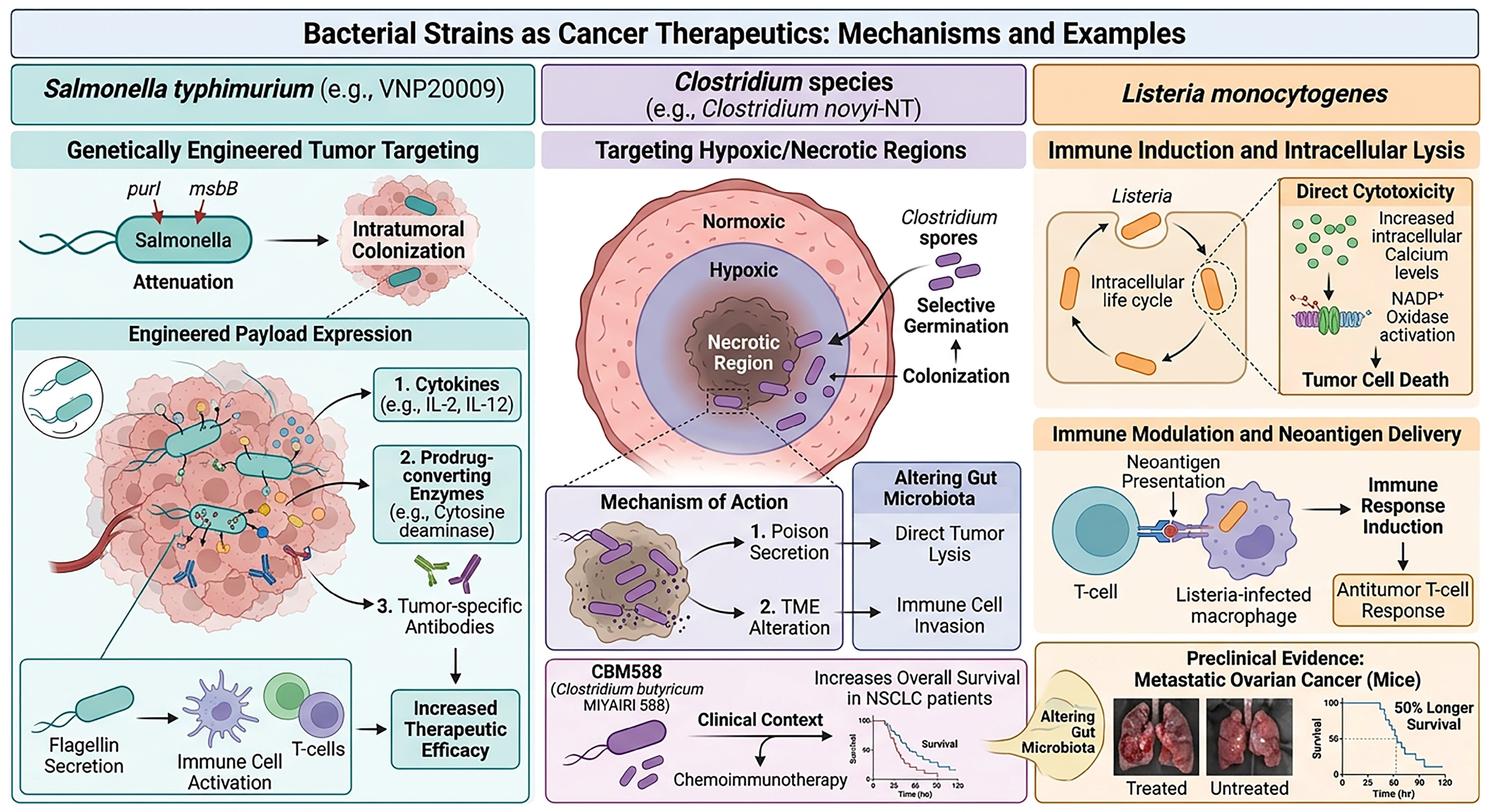
Several bacterial strains have been modified to target the cancer cells. Among the most researched are strains of Salmonella, Clostridium, and Listeria [15,16,35]. As strains of Salmonella typhimurium, especially VNP20009, can target tumors and can be genetically engineered, they have been the subject of extensive research. Attenuation through purI and msbB deletion reduces toxicity [36]. VNP20009 has shortcomings; however, it underscores the necessity for additional strain tuning. In addition, engineered strains are being created to express a variety of payloads, such as prodrug-converting enzymes, cytokines, and even antibodies specific to tumors [37]. Flagellin, which is secreted by modified strains, promotes immune cell activation and invasion [38]. These are intended to increase the therapeutic efficacy of Salmonella strains.
Clostridium species, particularly Clostridium novyi-NT, are characterized by their ability to colonize hypoxic/necrotic regions of tumors. By secreting different poisons, they can directly destroy tumor cells, as exhibited especially in experimental animals [15]. Clostridium spores can selectively germinate in the TME and lyse neighboring cells [39,40]. Research is being conducted on Clostridium species as a standalone treatment in conjunction with other treatments. To determine how the Clostridium butyricum MIYAIRI 588 strain (CBM588) affected the treatment results, 106 patients with advanced non-small-cell lung cancer (NSCLC) receiving chemoimmunotherapy combinations were retrospectively examined. According to the results, CBM588 considerably increased the overall survival of these patients, especially those with low PD-L1 expression (<1%). Additionally, CBM588 was linked to improved survival, even in individuals using antibiotics and/or proton pump inhibitors, which can alter the gut microbiota. These findings imply that altering the gut microbiota using CBM588 may increase the effectiveness of chemotherapeutic combinations in NSCLC [41].
Another well-known strain, Listeria monocytogenes, can direct the immune system and kill cancer cells directly by activating NADP+ oxidase and increasing intracellular calcium levels, which have cytotoxic effects. It also has an inherent tumor tropism [16]. Additionally, Listeria species serve as vectors for the delivery of neoantigens and the induction of an immune response that targets cancer cells [42]. Listeria-TT+GEM has been shown to decrease metastatic ovarian cancer in mice, with a 50% longer survival period than in saline mice [43]. The mechanisms of action of these bacteria are summarized in Table 1 and Figure 1.

2.3. Challenges and Limitations of Bacterial-Based Cancer Therapy

BBCT holds considerable promise; however, its path to becoming a mainstream cancer treatment is fraught with challenges and limitations [44]. The primary concern revolves around bacterial toxicity, which can lead to severe infections, adverse effects, and even death [44]. To mitigate these risks, researchers have engineered attenuated and genetically modified bacterial strains; however, this approach also reduces the bacteria’s anti-cancer effectiveness [44]. Furthermore, the host immune response can prematurely eliminate therapeutic bacteria, thereby reducing their efficacy [45]. The inherent heterogeneity of tumors at both molecular and histological levels presents a significant obstacle, as a single agent is unlikely to suffice as a cure [44,45]. This underscores the need for combinatorial approaches to achieve more effective cancer treatments [44].
While bacteria can target hypoxic tumor regions, their targeting efficiency is not uniform and may vary depending on bacterial strain, TME heterogeneity, and host immune responses [46]. The choice of safe bacteria is not always optimal, which can limit their therapeutic impact [11,47,48]. Additionally, the short half-life of bacterial peptides and proteins, combined with the instability of DNA, creates a hurdle for sustained therapeutic effects [44]. The progress of BBCT in clinical practice is hampered by the lack of clinical data, as very few studies have advanced to clinical trials. This lack of clinical evidence, as well as unanswered questions about guaranteeing efficacy and minimizing infection risks, impedes the translation of BBCT into common cancer treatments [49]. Furthermore, the cultural stigma associated with using microorganisms in therapy is a barrier that must be overcome; the lack of validated biomarkers to guide the use of bacterial therapies, and the absence of standardized protocols for production, administration, and monitoring add further layers of complexity [49,50,51,52,53].
Specific bacterial challenges also exist, such as the trade-off between reducing bacterial virulence and preserving the therapeutic potency [44]. The need to create attenuated strains that effectively balance safety and efficacy, as well as to consider microbe-associated molecular patterns (MAMPs) during adaptation to bacterial strains, are important issues [5]. Combining bacteriotherapy with other cancer treatments has the potential for synergistic effects; however, this increases the complexity of therapeutic strategies [54,55]. Furthermore, the risk of systemic bacterial infection is a noteworthy concern in bacteria-mediated cancer therapy [39].
To address these multifaceted challenges and limitations, there is a need for advanced genetic engineering to produce customized bacterial strains with reduced toxicity and improved anti-tumor properties [44,56]. Improved methods for enhancing bacterial targeting, penetration, and intratumoral delivery of therapeutic agents remain an active area of development [57,58]. A vital step is to conduct more clinical trials to evaluate the safety and effectiveness of BBCT in humans.
To address these multifaceted challenges and limitations, advanced genetic engineering strategies have been developed to produce customized bacterial strains with reduced toxicity and enhanced anti-tumor efficacy. Toxicity reduction is primarily achieved through virulence attenuation, including deletion or downregulation of virulence genes and surface virulence factors (e.g., LPS), which reduces systemic inflammation and sepsis risk [59,60]. In addition, deep rough LPS mutants (ΔrfaD/ΔrfaG) and msbB mutants of Salmonella show markedly reduced pathogenicity while retaining tumor targeting [59].
Nutritional auxotrophy is also employed, such as aroA mutations, allowing bacteria to preferentially grow in nutrient-rich tumor environments but not in normal tissues [59,60]. Furthermore, conditional gene circuits and tumor-responsive regulatory systems, including quorum-sensing-controlled designs, can restrict bacterial growth and virulence to the TME [9], improving safety and control. To enhance anti-tumor efficacy and tumor penetration, bacteria can be engineered with surface targeting ligands such as arginine, glycine, and aspartic acid (RGD) peptides, tumor antigens, or antibodies/aptamers to improve binding to tumor cells and reduce off-target accumulation [9,61]. Tumor-responsive or externally triggered expression systems (e.g., hypoxia-, metabolite-, light-, heat-, or ultrasound-inducible promoters) can be used to locally produce cytotoxins, cytokines, checkpoint inhibitors, or suicide genes within tumors [59,61]. In addition, engineered bacteria can modulate the TME by expressing immune-activating molecules such as IL-2, STING agonists, flagellin, or anti-programmed cell death ligand 1 (PD-L1) antibodies to enhance T-cell and natural killer (NK)-cell responses [60,61]. Metabolic reprogramming strategies, such as conversion of tumor ammonia into L-arginine, can further enhance immune infiltration and synergize with immunotherapy [62]. Finally, expression of extracellular matrix-degrading enzymes such as hyaluronidase or nattokinase can improve stromal penetration and facilitate deeper distribution of therapeutic agents [63].

3. Chimeric Antigen Receptor-T Cell and Therapy

3.1. CAR-T Cell Definition, Fundamental Mechanism, and Engineering

CAR-T therapy represents a form of adoptive cellular immunotherapy in which patient-derived T lymphocytes are genetically engineered to express synthetic receptors targeting tumor-associated antigens [64,65]. CARs are recombinant cell surface receptors engineered to recognize specific antigens in a T-cell receptor (TCR)-independent manner [65,66]. The fundamental mechanism involves ex vivo genetic modification of autologous T cells to express these synthetic receptors, which integrate antigen-recognition and intracellular signaling domains [67]. The critical advantage of CAR-T therapy lies in its major histocompatibility complex (MHC)-independent antigen recognition [64,65,68]. This MHC-independent recognition allows CAR-T cells to target cancer cells without requiring antigen presentation through the MHC pathway, thereby overcoming a common mechanism of tumor immune evasion [65,69]. T cells are genetically engineered using viral vectors (such as lentiviruses) or non-viral platforms to introduce CAR-encoding genes [64]. Upon CAR activation, the receptor assembles a signaling complex similar to the physiological immune synapse, triggering downstream activation cascades [64]. The basic mechanism of tumor targeting involves CAR recognition of specific antigens on tumor cell surfaces, leading to T-cell activation and subsequent elimination of cancer cells through cytotoxic functions [65,66,69]. CAR-T cells mediate tumor destruction through multiple pathways, including perforin-granzyme-dependent cytolysis, Fas ligand/tumor necrosis factor-alpha-induced apoptosis, and cytokine release (primarily IL-2 and interferon-gamma (IFN-γ) [67].
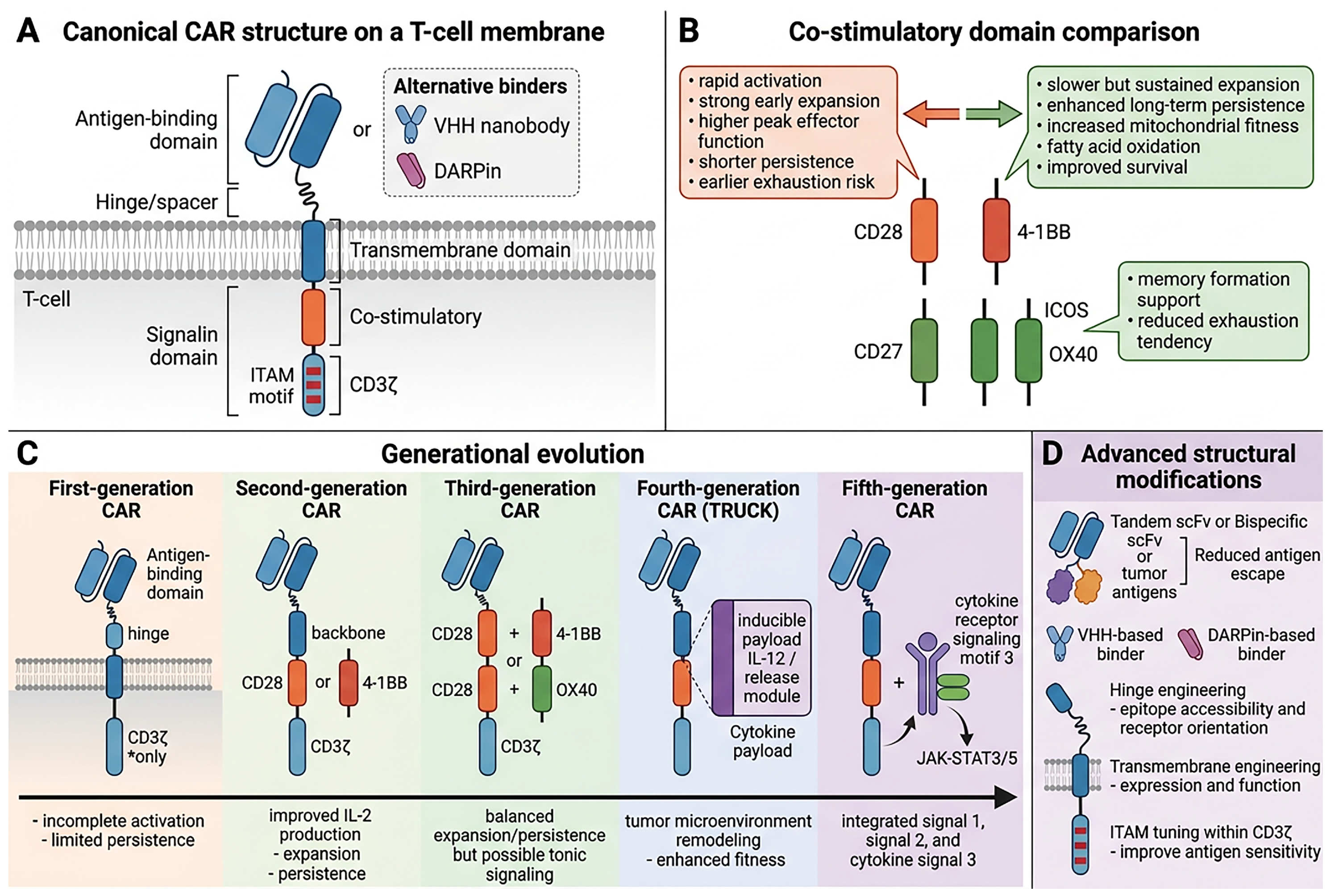
The structural architecture of CARs consists of four essential domains: an extracellular antigen-binding domain, a hinge/spacer region, a transmembrane domain, and an intracellular signaling domain [64,65,68]. As it has been shown in Table 2. The choice of co-stimulatory domains profoundly affects CAR-T cell function. CD28 co-stimulation promotes rapid T-cell expansion but can lead to shorter-lived responses, while 4-1BB enhances long-term persistence and survival through increased mitochondrial metabolism and fatty acid oxidation [64]. Alternative co-stimulatory domains including CD27, ICOS, and OX40 have been incorporated to enhance memory formation and reduce exhaustion [65,69]. Novel structural modifications include the use of alternative protein scaffolds such as nanobodies and DARPins to enhance stability and specificity [65], tandem scFvs to recognize multiple antigens simultaneously and reduce antigen escape [70], and variable heavy domains (VHHs) to improve targeting [71]. Hinge engineering affects CAR orientation and epitope accessibility, while transmembrane domain sequences influence CAR expression and function [65]. Fine-tuning of immunoreceptor tyrosine-based activation motifs (ITAMs) improves antigen sensitivity [65].

3.2. Evolution of CAR-T Cell Generations

The progression from first- to fifth-generation CARs reflects systematic efforts to enhance T-cell persistence, proliferation, and anti-tumor activity (Figure 2). First-generation CARs containing only the CD3ζ chain resulted in incomplete activation and limited persistence [64,69]. Second-generation CARs, incorporating co-stimulatory domains like CD28 or 4-1BB, demonstrated improved expansion and persistence, enabling IL-2 production and reducing exhaustion [64,69]. The balance between CD28 and 4-1BB co-stimulation is critical: CD28 promotes rapid activation with potential for earlier exhaustion, whereas 4-1BB promotes sustained endurance with lower peak expansion but enhanced metabolic fitness [69]. Third-generation CARs combined two co-stimulatory domains to balance expansion and persistence, though some exhibited excessive tonic signaling [64]. Fourth-generation CARs, termed T cells redirected for universal cytokine-mediated killing (TRUCKs), incorporated inducible payloads to enhance CAR-T fitness and remodel the TME [64,65]. A proposed fifth-generation CAR integrates three synergistic signals: TCR/CD3ζ activation, CD28 costimulation, and cytokine-mediated JAK-STAT3/5 signaling [64]. Table 3 and Figure 2 summarize the generations of CAR T-cells.

3.3. Clinical Outcomes of CAR-T Cell Therapy in Hematological Malignancies

Significant progress has been made in treating hematological malignancies with this therapy. For example, for the treatment of acute lymphoblastic leukemia (ALL), the first FDA-approved CAR-T cell therapy was developed for the treatment of this type of leukemia [73] as summarized in Table 4. CAR-T therapy has demonstrated remarkable success in hematological malignancies, particularly in CD19- and B-cell maturation antigen (BCMA)-targeted treatments, with high response rates and durable remissions in refractory cases [64,65]. A recent study showed that Tisagenlecleucel which is a FDA approved CAR-T cell therapy [74] infusion demonstrates promising efficacy and safety in young children and infants with relapsed or refractory B-cell precursor ALL, the study involved 38 patients aged younger than 3 years and 35 of them received the treatment, and the treatment was generally well-tolerated, and the study highlights Tisagenlecleucel as a good option for B-cell precursor ALL [75,76]. Several FDA-approved therapies have significantly improved patient outcomes, as summarized in Table 4.

FDA-Approved CAR-T and TCR-T Cell Therapies

The FDA has approved several CAR-T cell therapies [71], some of which are included in Table 5. They were trialed on cancer patients, targeting either CD19 or BCMA [77]. Four of these drugs target CD19, which are Axicabtegene Clolecel, Brexucabtagene autoleucel, tisagenlecleucel (Kymriah), and Lisocabtagene maraleucel [78], while the remaining drugs target BCMA, which are decabtagene vicleucel [79] and ciltacabtagene autoleucel [77,80,81,82].
Current approved CAR-T therapies are predominantly autologous derived from the patient’s own T cells which entails significant logistical challenges including lengthy manufacturing timelines (typically 3–4 weeks), high per-patient costs, and the risk of manufacturing failure in heavily pre-treated patients with lymphopenic T-cell repertoires. Allogeneic (‘off-the-shelf’) CAR-T cells, derived from healthy donors and manufactured at scale, offer a potential solution to these challenges. Key engineering hurdles include preventing graft-versus-host disease (GvHD) by disrupting the endogenous TCR (typically via CRISPR-Cas9-mediated T cell receptor alpha constant (TRAC) knockout) and avoiding host-versus-graft rejection by deleting HLA class I molecules or incorporating immune evasion mechanisms. Early-phase clinical trials of allogeneic anti-CD19 CAR-T cells (ALLO-501A, CB-010) have shown initial responses, although persistence remains a challenge compared to autologous products [83,84]. Despite these limitations, allogeneic platforms represent a critical direction for democratizing access to CAR-T cell therapies globally.
Beyond CAR-T cells, TCR-T cell therapies represent a complementary adoptive cell therapy modality. Afami-cel (afami-cel; Adaptimmune), the first FDA-approved TCR-T cell therapy, was approved in 2024 for patients with unresectable or metastatic synovial sarcoma who have received prior chemotherapy, based on an objective response rate of approximately 37% in the SPEARHEAD-1 trial [85]. TCR-T cells differ from CAR-T cells in that they recognize intracellular peptide antigens presented by MHC molecules, thus broadening the range of targetable tumor antigens. This distinction is important because CAR-T cells recognize surface antigens in the human leukocyte antigen (HLA)-independent manner, whereas TCR-engineered products enable targeting of intracellular antigens presented by HLA molecules, thereby broadening the therapeutic landscape for solid tumors [86,87].
Table 5. CAR-T cell therapies approved by the FDA and the clinical trials leading to their approval.
TherapyTarget AntigenIndicationsKey TrialOutcomesReferences
Tisagenlecleucel (Kymriah)CD19LBCLJULIETDemonstrated durable responses and a manageable safety profile in relapsed/refractory aggressive B-cell lymphomas, offering a favorable risk-benefit profile compared to conventional salvage chemotherapy.[81]
Axicabtagene ciloleucel (Yescarta)CD19LBCLZUMA-1High durable response rates in refractory large B-cell lymphoma, with a safety profile characterized by neurologic events, cytokine release syndrome, and myelosuppression.[88]
Lisocabtagene maraleucelCD19LBCLTRANSCEND NHL-001Patients with large B-cell lymphoma (LBCL) exhibited a high overall response rate, with notable outcomes encompassing complete response durability, response rates, progression-free survival, and overall survival.[78]
Idecabtagene vicleucelBCMAMultiple MyelomaKarMMa-2 (Cohort 2a)Showed strong responses in early-relapsing patients, with some maintaining remission for over 18 months. Side effects were manageable, supporting its use earlier in treatment.[79]
Ciltacabtagene autoleucelBCMAMultiple MyelomaCARTITUDE-1This therapy induced rapid, profound, and durable responses in patients with multiple myeloma who had undergone extensive prior treatments, while maintaining a manageable safety profile, thereby justifying its clinical approval.[82]
Brexucabtagene autoleucel (Tecartus)CD19Mantle cell lymphoma; adult B-ALLZUMA-2/ZUMA-3Showed high response rates with durable remissions in relapsed/refractory mantle cell lymphoma and meaningful activity in adult relapsed/refractory B-ALL.[89]
Obecabtagene autoleucel (Aucatzyl)CD19Adult relapsed/refractory B-cell precursor ALLFELIXProduced a high incidence of durable response in adults with relapsed/refractory B-cell ALL, with a low incidence of severe immune-related toxic effects.[90]
Afamitresgene autoleucel (Tecelra)MAGE-A4HLA-restricted unresectable or metastatic synovial sarcomaSPEARHEAD-1Produced durable responses in heavily pretreated patients with HLA-A*02-positive, MAGE-A4-expressing synovial sarcoma.[85]
CD19, cluster of differentiation 19; HLA, human leukocyte antigen; ALL, acute lymphoblastic leukemia; B-ALL, B-cell precursor acute lymphoblastic leukemia; LBCL, large B-cell lymphoma; MAGE-A4, Melanoma-associated antigen A4.

3.4. Applications of CAR-T Therapy in Solid Tumors

3.4.1. Applications of CAR-T Therapy in Neuro-Oncology

Among the earliest clinical efforts to apply CAR-T cell therapy in solid tumors, glioblastoma has served as an important model because of its aggressive biological behavior and poor clinical prognosis. Glioblastoma is the most common and aggressive primary malignant brain tumor, and several CAR-T cell targets have been investigated in glioblastoma and high-grade glioma. These targets are summarized in Table 6. Brown et al. reported a clinical study in which CAR-T cells targeting IL13Rα2 were administered to a patient with recurrent glioblastoma. The treatment produced a notable antitumor response, although disease recurrence eventually occurred, highlighting both the therapeutic potential and current limitations of CAR-T cell therapy in solid tumors.
The patient had an overall survival of 11 months, full tumor regression of 7.5 months, and no serious toxicity; nonetheless, recurrence occurred because of limited T-cell persistence and antigen loss [91,92]. In a separate study, Choi et al. conducted an experiment in which they enrolled three patients with recurrent glioblastoma; the participants’ tumors expressed variant III of the epidermal growth factor receptor (EGFR) [93]. Choi et al. manufactured T-cells obtained from patients via leukapheresis and transduced T-cells with the CARv3- T-cell-engaging antibody molecule (TEAM)-E vector, an anti-EGFRvIII signal chain variable, and a bispecific antibody called the TEAM-E, tethering T-cells to glioblastoma cells [94]. This showed transient responses in two patients, suggesting feasibility, which implies that this promising therapy still requires optimization and research to be used for treating solid tumors [93,94]. However, there are still numerous obstacles and challenges [93]. Immunosuppressive cells, extracellular matrix, and the heterogeneous microenvironment of solid tumors contribute to tumor progression and therapeutic resistance [95].
Table 6. Summary of CAR T cell targets in glioblastoma and high-grade glioma.
TargetExpression in GlioblastomaNotesClinical SummaryReferences
IL13Rα2>75%Specifically designed to exploit IL13Rα2′s tumor-restricted expression and high-affinity binding.IL13Rα2-targeted CAR T-cell therapy showed 7.5-month regression and 11-month median survival. Challenges: antigen loss, limited T-cell persistence.[91,92]
EGFRvIII45%CAR-T targets a GBM-specific EGFR mutation not found in normal tissueHave limited efficacy; issues include antigen downregulation and lack of durable response.[94]
HER2VariableHER2-CAR T-cell therapy faces safety concerns due to HER2 expression in normal tissues; modified CAR designs (e.g., FRP5, lower-affinity scFv, virus-specific T cells) aim to reduce toxicity.Initial CAR-T use caused fatal cytokine storm in a non-GBM patient.
Second generation of HER2 CAR T-cell exhibited minimal toxicity.
[96,97]
EphA2HighSecond-generation EphA2-CAR T cells effectively reduced tumor burden in glioma-bearing mouse models, supporting their potential as a therapeutic approach.A clinical trial (NCT02575261) was initiated to assess safety and efficacy in EphA2 + GBM but was withdrawn for unknown reasons.[98]
GD2HighGD2-CAR T cells showed potent antigen-dependent cytotoxicity and cytokine release in preclinical glioma models, including patient-derived xenografts.Still-ongoing trials (NCT04099797) are assessing safety and efficacy of GD2-CAR T therapy in high-grade glioma and DIPG.[99]
B7-H3High in tumorsB7-H3 CAR T cells using both 4-1BBζ and CD28ζ signaling domains have shown strong anti-tumor activity in glioma and other tumors.Previous mAb and CAR-T studies demonstrated safety and efficacy in CNS tumors and glioma models.[100]
ChlorotoxinSpecific to glioblastomaCLTX-CAR is a peptide-based CAR targeting GBM via MMP2 binding, with potent anti-tumor activity and minimal off-target toxicity in preclinical models.Preclinical results show tumor regression without systemic toxicity, introducing toxin-based CAR design strategy.[101]
CAR-T, chimeric antigen receptor T-cell; GBM, glioblastoma multiforme; IL13Rα2, interleukin-13 receptor alpha 2; EGFRvIII, epidermal growth factor receptor variant III; GD2, disialoganglioside GD2; EphA2, ephrin type-A receptor 2; B7-H3 (CD276), B7 homolog 3 protein; HER2, human epidermal growth factor receptor 2; EGFR, epidermal growth factor receptor; CD28ζ, CD28 zeta chain; 4-1BBζ, 4-1BB zeta chain; DIPG, Diffuse Intrinsic Pontine Glioma; CNS, Central Nervous System; CLTX, Chlorotoxin.

3.4.2. Applications of CAR-T Therapy in Non-CNS Solid Tumors

Beyond glioblastoma, CAR-T cell therapy is under active investigation in several other solid tumor types (Table 7). In melanoma, GD2-targeting CAR-T cells have been explored based on the high and relatively homogeneous expression of GD2 on melanoma cells; third-generation anti-GD2 CAR-T cells (GD2-CART01) demonstrated durable remissions in a phase I/II trial in children with high-risk neuroblastoma, a finding that informs the rationale for extending this strategy to adult melanoma [102]. In pancreatic ductal adenocarcinoma (PDAC), mesothelin is the most studied target. A phase I trial of anti-mesothelin CAR-T cells (NCT03323944) confirmed acceptable tolerability, although clinical efficacy was limited by CAR-T cell exhaustion driven by transcription factors ID3 and SOX4; double knockout of these factors in preclinical xenograft models significantly prolonged relapse-free survival, identifying a promising engineering avenue [103]. In ovarian cancer, mesothelin-directed CAR-T cells (M28z and MBBz constructs) significantly prolonged survival in orthotopic mouse models; coinhibitory pathways (PD-1/PD-L1 and LAG3/HLA-DR) were identified as key barriers to persistence, supporting combination strategies with checkpoint blockade [104]. Folate receptor alpha (FRα), HER2, MUC16, and B7-H3 are additional targets currently being evaluated in early-phase ovarian cancer trials [105]. These experiences collectively illustrate that the immunosuppressive and physically restrictive TME of solid tumors is the central barrier shared across tumor types, and that addressing it through combinatorial or engineered CAR-T platforms will be essential for efficacy beyond hematological malignancies.
Table 7. Selected CAR-T cell targets in non-CNS solid tumors.
Cancer TypeTarget AntigenKey FindingsReferences
Pancreatic cancerMesothelinPhase I (NCT03323944): tolerable, limited efficacy; T-cell exhaustion via ID3/SOX4[103]
Ovarian cancerMesothelinProlonged survival in orthotopic models; PD-1/LAG3 barriers identified[104]
Ovarian cancerFRα, HER2, MUC16, B7-H3Multiple early-phase clinical trials ongoing[105]
Melanoma/NeuroblastomaGD2Phase I/II (GD2-CART01): durable remissions in neuroblastoma; rationale for melanoma[102]
Abbreviations: B7-H3, B7 homolog 3 protein; CAR-T, chimeric antigen receptor T-cell therapy; FRα, folate receptor alpha; GD2, disialoganglioside 2; HER2, human epidermal growth factor receptor 2; ID3, inhibitor of DNA binding 3; LAG3, lymphocyte activation gene 3; MUC16, mucin 16/cancer antigen 125; NCT, National Clinical Trial identifier; PD-1, programmed cell death protein 1; SOX4, SRY-box transcription factor 4.

3.4.3. Beyond Cancer: The Therapeutic Potential of CAR-T Cells in Autoimmune Diseases

Beyond oncology, CAR-T cell therapy is now being actively explored in autoimmune diseases, representing a paradigm shift in the field. The core strategy involves directing CAR-T cells against autoreactive B cells or plasma cells that drive autoimmune pathology. Anti-CD19 CAR-T cells have induced drug-free remission in patients with severe systemic lupus erythematosus (SLE), idiopathic inflammatory myositis, and systemic sclerosis in a landmark case series by Mackensen et al. [106] and in subsequent larger cohorts by [107]. More recently, CAR-T cells targeting BCMA have been investigated in SLE to deplete long-lived autoreactive plasma cells, and chimeric autoantibody receptor (CAAR) T cells engineered to express the target autoantigen on their surface and kill autoreactive B cells are in early-phase trials for pemphigus vulgaris. These applications demonstrate that the same principles underlying tumor-directed CAR-T therapy antigen-specific depletion of pathological cell populations can be extended to immune-mediated diseases, potentially offering durable remission without long-term immunosuppression.

3.5. CAR-T Cell Therapy in Cancer: Evidence from Clinical Trials

Table 5 summarizes key clinical trials and FDA-approved CAR-T cell therapies, which were approved by the FDA. A total of 119 patients were enrolled in the pivotal ZUMA-1 trial, a multicenter clinical trial that examined the long-term effects of the drug axicabtagene ciloleucel on adult patients with relapsed or refractory large B-cell lymphoma and revealed that the treatment resulted in sustained clinical responses, an overall survival exceeding two years, and a long-term safety profile that remained manageable [108]. An additional clinical study assessing the impact of Lisocabtagene maraleucel on patients with ALL, non-Hodgkin lymphoma (NHL), or chronic lymphocytic leukemia (CLL) reported the occurrence of cytopenias, hypogammaglobulinemia, late infections, subsequent malignancies, GVHD, as well as some immune-mediated complications, including pneumonitis. According to Corderia et al., many of the late-onset events identified within this cohort were not that severe and were likely attributable to treatments administered before or after CAR-T therapy, indicating that CD19-targeted CAR-T immunotherapy maintains a favorable long-term safety profile [109]. These findings are derived from clinical trials in patients with hematological malignancies, where CAR-T therapy has demonstrated the most consistent efficacy to date.

3.6. Challenges and Limitations of Using CAR-T Therapy

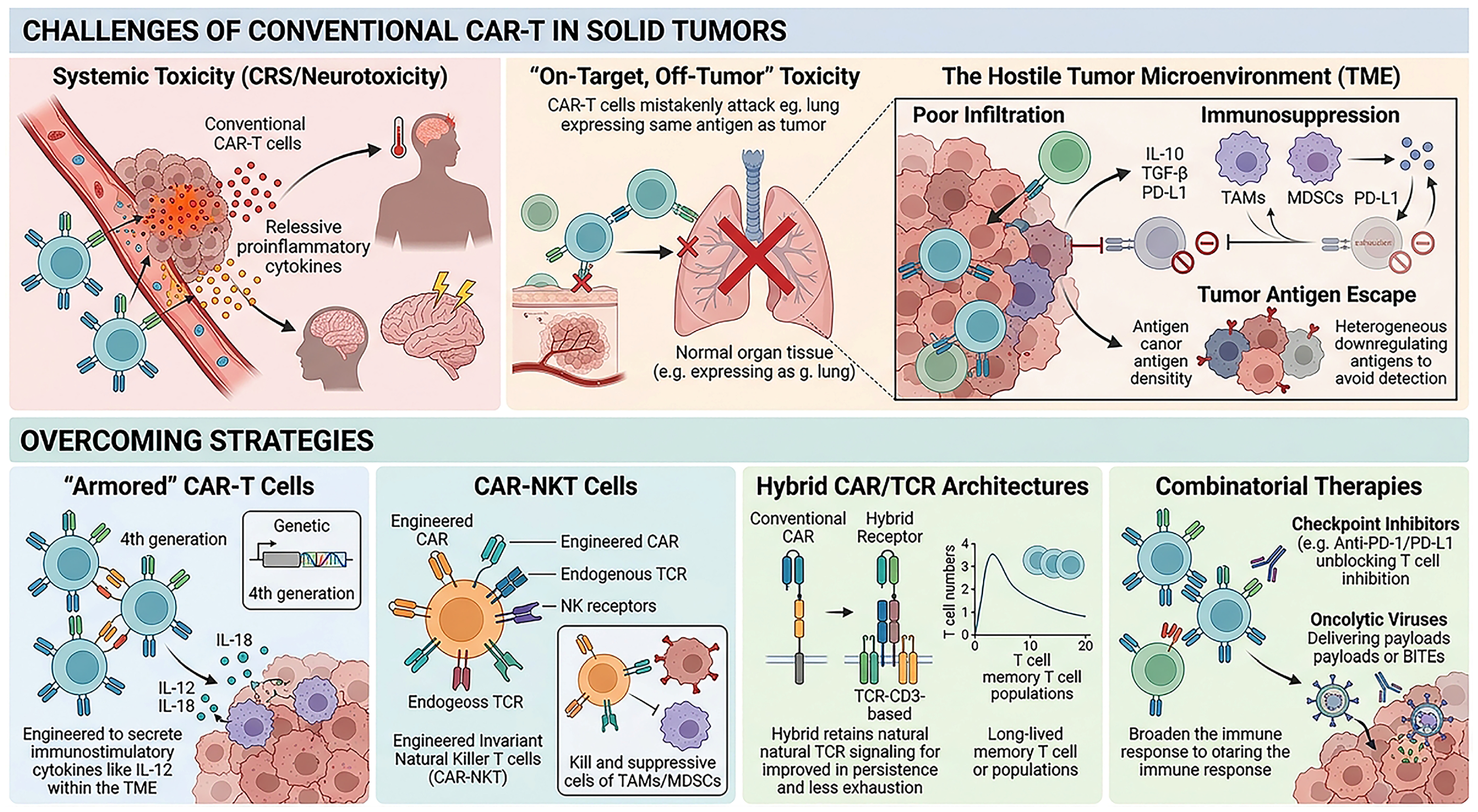
CAR-T therapy, which has shown remarkable success in treating certain cancers, has several challenges and limitations [110]. A major challenge involves the risk of severe side effects including cytokine release syndrome (CRS) and neurotoxicity (Figure 3). CRS arises from the extensive release of inflammatory molecules by CAR-T cells, manifesting as fever, low blood pressure, and potential organ dysfunction, and can be life-threatening in some cases [111,112]. Neurotoxicity, another common complication, can manifest as decreased consciousness, confusion, seizures, and brain edema, which require careful monitoring and management, often involving intensive medical care and the use of drugs like tocilizumab [113,114]. An additional limitation that has been noticed is the on-target, off-tumor toxicity, wherein the CAR-T cells will target normal tissues that express the same antigen, given that most tumor-associated antigens are not exclusively found on malignant cells [115]. This can lead to significant side effects, highlighting the need for more specific target antigens or the use of multiple-antigen complex CAR structures [116].
Furthermore, tumor escape mechanisms pose a significant challenge [110].
Cancer cells can evade CAR-T cell recognition through antigen downregulation or low antigen levels, which are often associated with the TME [117]. The TME drives tumor heterogeneity and promotes immune escape through various mechanisms, including the release of immunosuppressive cytokines such as IL-10 and transforming growth factor beta (TGF-β), and the increased expression of inhibitory receptors such as PD-L1 [3]. Combination therapies using checkpoint inhibitors may be necessary to overcome these mechanisms [110]. Utilizing CAR-T cell therapies for solid tumors is associated with more difficulties and challenges compared to hematologic cancers, primarily because of the distinct immunosuppressive nature of their microenvironment and their pronounced heterogeneity, which hinders effective CAR-T cell infiltration and activity (Figure 3) [93].

3.7. Strategies to Overcome the Challenges and Limitations of CAR-T Cell Therapy

Several engineering strategies have been developed to allow CAR-T cells to function within the hostile solid tumor TME. Armored CAR-T cells, also called fourth-generation or TRUCKs, are designed to co-express immunostimulatory transgenes alongside the CAR construct [118]. The best-characterized example involves engineering CAR-T cells to constitutively or conditionally secrete IL-12. In a syngeneic ovarian peritoneal carcinomatosis model, IL-12-armored CAR-T cells directed against Muc16ecto outperformed standard second-generation CARs (Figure 3): tumor-bearing mice treated with the armored cells remained tumor-free for over 100 days, compared with a median overall survival of 46 days in the non-armored group (p = 0.008). Mechanistically, armored cells depleted tumor-associated macrophages and resisted PD-L1-induced inhibition [119]. More recent work using CRISPR-mediated knock-in of IL-12 under the control of a tumor-restricted NR4A2 promoter achieved potent antitumor efficacy with a favorable safety profile by restricting cytokine secretion to the tumor site, thereby mitigating systemic toxicity, a key concern with earlier constitutive expression systems [120]. Beyond IL-12, armored platforms incorporating IL-2 superkines, IL-18, IL-33, dominant-negative TGF-β receptors, and secreted anti-PD-1 or anti-PD-1/TGF-β trap proteins have all shown preclinical promise in remodeling the immunosuppressive TME and enhancing CAR-T cell persistence and effector function [118,121,122]. Beyond cytokine armouring, bispecific T-cell engagers (BiTEs) represent a complementary approach: they redirect endogenous, non-engineered T cells to tumor-associated antigens and can be combined with CAR-T cells or encoded within oncolytic viral vectors to broaden the anti-tumor immune response. The TEAM-E construct described in the Choi et al. study is a notable instance of this BiTE strategy integrated directly into the CAR-T cell platform. Combining BiTEs with checkpoint inhibitors or oncolytic viruses has been proposed as a means of maintaining endogenous T-cell activity in tumors where CAR-T infiltration is limited [123].
To overcome tumor-microenvironment-associated resistance, recent strategies extend beyond conventional CAR-T cells to CAR-engineered innate-like effectors. In particular, allogeneic CAR-Invariant natural killer T (NKT) cells have shown the capacity to simultaneously target tumor cells and immunosuppressive elements within the TME; recent studies demonstrated improved persistence, selective depletion of suppressive cells, and attenuation of tumor immune evasion through combined CAR, TCR, and NK-receptor activity [124,125]. Other emerging platforms include CAR-NK cells, which may offer lower rates of severe CRS and neurotoxicity; CAR-macrophages, which may improve tumor infiltration and phagocytic remodeling of the TME (Figure 3); and CAR-engineered unconventional T-cell populations such as NKT and mucosal-associated invariant T cells (MAIT cells), which combine innate-like tissue trafficking with rapid effector responses and may be particularly attractive for solid tumors [126,127,128,129].
NKT cells have emerged as a particularly promising alternative cellular platform for CAR engineering in the context of solid tumors. Unlike conventional T cells, NKT cells possess intrinsic tissue-homing capacity, multi-modal cytotoxic mechanisms mediated simultaneously by their CAR, endogenous TCR, and NK receptors, and a unique ability to deplete immunosuppressive cells within the TME, most notably CD1d+ tumor-associated macrophages (TAMs) and myeloid-derived suppressor cells (MDSCs), via their invariant TCR. This dual targeting capacity allows CAR-NKT cells to attack both antigen-positive tumor cells and the immunosuppressive cellular infrastructure of the TME simultaneously, a conceptually distinct advantage over conventional CAR-T cells.
In a phase I/II clinical trial, GD2-targeting CAR-NKT cells in pediatric patients with relapsed or refractory neuroblastoma demonstrated durable antitumor responses and a favorable safety profile, with no dose-limiting toxicities or grade ≥ 3 CRS, a notable contrast to CAR-T cell toxicity profiles [130]. Mechanistically, a recent comprehensive preclinical study employing spatiotemporal transcriptomic profiling across multiple solid tumor models and longitudinal time points revealed striking pharmacokinetic and pharmacodynamic differences between CAR-T and CAR-NKT cells: CAR-NKT cells demonstrated superior tumor localization, prolonged in vivo persistence, and reduced terminal exhaustion compared to CAR-T cells. Critically, the two modalities exhibited divergent immune checkpoint dependencies: CAR-T cells showed enhanced antitumor activity when combined with TIGIT blockade, whereas CAR-NKT cells responded more robustly to CD96 blockade, an innate immune checkpoint, providing a mechanistic foundation for rational design of tailored combinatorial strategies for each platform [125].
A distinct and promising strategy to address CAR-T cell exhaustion and poor persistence in solid tumors involves the development of hybrid receptor architectures that combine features of both CARs and TCRs. While CAR-T cells recognize tumor-associated antigens in an MHC-independent manner, a feature that confers broad targeting flexibility, this MHC-independence comes at the cost of the full TCR signaling cascade, which is critical for the formation of long-lived memory T cell populations. In contrast, TCR-T cells, which engage peptide-MHC complexes through the authentic TCR–CD3 complex, maintain superior in vivo persistence and resist exhaustion more effectively than CAR-T cells upon repeated tumor antigen exposure in solid tumor models. To bridge this gap, Liu et al. (2024) developed a novel ‘hybrid-TCR’ architecture, a fusion receptor composed of an antibody-derived antigen-binding domain linked to TCR components that retains MHC-restricted recognition of tumor peptide–MHC complexes while incorporating the precision of antibody-based target engagement [131]. In preclinical solid tumor models, hybrid-TCR T cells demonstrated markedly improved in vivo maintenance compared to conventional CAR-T cells and achieved complete tumor suppression, overcoming the rapid population contraction that limits standard CAR-T cell therapy in solid tumors [131]. This hybrid receptor strategy represents a conceptually important advance: by restoring MHC-dependent TCR signaling while retaining antibody-like specificity, it may offer a path toward CAR-like targeting flexibility with TCR-like persistence, a combination that could substantially expand the therapeutic window of engineered T cell therapy for solid tumors.

3.8. Beyond CAR-T: Emerging CAR-Engineered Immune Cell Platforms

While CAR-T cells have dominated the field, other immune cell types are now being engineered with CARs to leverage their distinct biological properties. CAR-NK cells use NK cells as the cellular chassis, which offers several potential advantages: NK cells do not cause GvHD even in allogeneic settings (due to the absence of a rearranged TCR), have a more favorable safety profile with lower risk of CRS, and can be manufactured from cord blood or induced pluripotent stem cells (iPSC)-derived sources for off-the-shelf use [132]. A phase I/II trial of cord blood-derived anti-CD19 CAR-NK cells in CLL and lymphoma reported responses in 7 of 11 patients (73%) without GvHD or CRS [133]. CAR-NKT cells combine innate-like cytotoxicity with CD1d-restricted recognition of immunosuppressive cells in the TME [130]. CAR-macrophages (CAR-M) represent a particularly novel direction for solid tumors: macrophages can penetrate deep into solid tumor stroma a key barrier for T and NK cells and, when engineered to express anti-HER2 CARs, have demonstrated significant antitumor activity in preclinical solid tumor models and entered a first-in-human trial (CT-0508; NCT04660929) [134]. CAR-MAIT cells are an emerging platform of interest given their abundance in peripheral blood, tissue-homing properties, and innate-like effector functions; early preclinical data suggest they can be engineered with CARs and exhibit potent cytotoxicity, though clinical data are lacking [135]. Together, these platforms complement CAR-T cell therapy and may prove particularly useful in settings where T-cell-based approaches face intrinsic limitations.

4. Oncolytic Virus Therapy

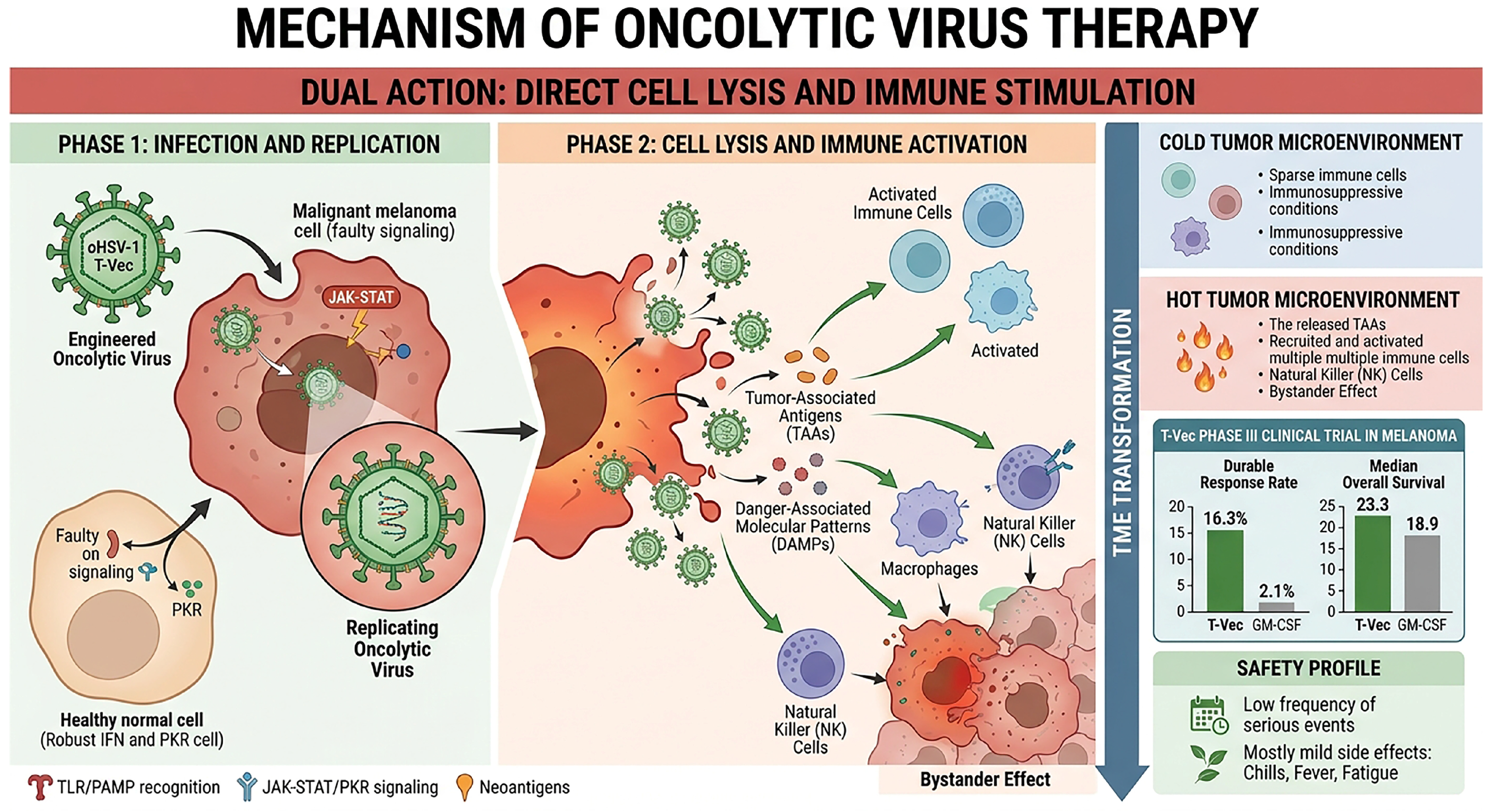
OVs represent a distinctive category of therapeutic agents that infect and replicate within neoplastic cells, leading to their destruction, while simultaneously triggering an immune response. This dual mechanism offers a promising approach for cancer treatment; a landmark moment in the field occurred in 2015 with the FDA approval of talimogene laherparepvec (T-Vec) [136]. This marked the first instance of an oncolytic virus approved for clinical application that specifically targeted malignant melanoma. The development of the genetically modified oncolytic herpes simplex virus type 1 (oHSV-1) represents a significant breakthrough in oncology, highlighting the therapeutic potential of OVs. In a Phase III clinical trial involving patients with unresectable stage IIIB–IV melanoma, the intralesional administration of T-Vec demonstrated notable efficacy. Compared to subcutaneous granulocyte-macrophage colony-stimulating factor (GM-CSF), T-Vec significantly improved durable response rates (16.3% vs. 2.1%, p < 0.001) and overall response rates (26.4% vs. 5.7%). Median overall survival (OS) also tended to increase with T-Vec treatment (23.3 months vs. 18.9 months, p = 0.051), with the greatest benefits observed in treatment-naïve patients and those classified within stage IIIB, IIIC, or IVM1a. Along with a low frequency of grade 3/4 events, the drug showed a good safety profile, marked by mostly mild side effects, including weariness, chills, and fever. No treatment-related adverse events resulting in death were recorded [137].

4.1. Mechanism of Action of Oncolytic Viruses in Cancer Therapy

OVs mainly lyse cancer cells, a process mediated by receptor targeting, viral replication efficiency, and host antiviral responses, thereby eradicating tumors [138]. The lytic potential of this virus is affected by dosage, tropism, and susceptibility of cancer cells to cell death pathways, including apoptosis, necrosis, and pyroptosis [4]. IFNs initiate the activation of the JAK-STAT signaling cascade and protein kinase R (PKR), whereas Toll-like receptors (TLRs), through the recognition of PAMPs, similarly trigger these pathways. Collectively, these mechanisms inhibited viral replication in healthy cells [139,140,141,142]. However, cancer cells can exhibit faulty IFN signaling and PKR activation, which fuels uncontrolled viral growth [143]. Engineered OVs, including those incorporating tumor-specific promoters, enhance selective viral replication within tumor cells while limiting replication in normal tissues [139].
Following tumor cell lysis, OVs release tumor-associated antigens (TAAs) and danger-associated molecular patterns (DAMPs), thereby stimulating both innate and adaptive immune responses [144]. This process involves activation of cytotoxic T lymphocytes, macrophages, and NK [145,146,147]. These antigens elicit an adaptive immune response capable of mediating tumor regression, both at the primary site and distant metastatic locations [144]. Furthermore, OVs play a crucial role in the reshaping of the TME. Cold TMEs, characterized by a low infiltration of inflammatory immune cells, immunosuppressive conditions, and limited treatment responsiveness, can be transformed into immunologically active, hot environments by OVs, thereby enhancing immune cell infiltration and improving therapeutic outcomes [148,149]. This is achieved by increasing inflammatory cytokines and immune cell infiltration [149], promoting new cancer neoantigens, and advancing tumor cell identification [150,151]. Even in cases of non-direct viral infection, this impact can help to produce a bystander effect wherein surrounding tumor cells die [152]. Figure 4 shows the mechanism by which OV kills cancer cells and modulates TME.

4.2. Oncolytic Viruses in Cancer Therapy: Current Clinical Trials

OVs are gaining recognition as a promising category of cancer immunotherapies, with numerous clinical trials assessing their therapeutic potential as standalone agents or in combination with other modalities (Table 8). A prominent focus of current research is the combination of OVs and checkpoint inhibitors. For instance, a phase 1/2 trial evaluated the efficacy of administering intratumoral DNX-2401 along with pembrolizumab in patients with recurrent glioblastoma [153]. Although the objective response rate in this trial did not exceed the prespecified control, there was a significant improvement in the 12-month overall survival, indicating that the combination therapy may offer clinical benefit, with treatment responses correlating with prolonged survival. Similarly, a randomized Phase II study involving patients with advanced melanoma demonstrated that the combination of T-VEC and ipilimumab resulted in significantly higher objective and durable response rates than ipilimumab monotherapy, with sustained benefits observed over 5 years [154].
The use of OVs is currently under investigation across a range of other solid tumor types. VCN-01, an oncolytic adenovirus expressing hyaluronidase, has shown preclinical promise for disrupting the tumor stroma and facilitating drug delivery in pancreatic cancer. Clinical results demonstrated tolerance and disease stabilization in injected lesions, associated with evidence of stromal disruption [155]. Furthermore, ONCOS-102, an oncolytic adenovirus engineered to express GM-CSF, demonstrated favorable modulation of the TME, characterized by enhanced T-cell infiltration, and a corresponding trend toward improved overall survival in patients with malignant pleural mesothelioma when combined with chemotherapy [156]. Some studies have failed to show the added benefits of oncolytic viruses. For example, a Phase I trial testing IV V937, both alone and with pembrolizumab, demonstrated a manageable safety profile but did not achieve greater therapeutic efficacy than pembrolizumab alone in treating non-small-cell lung and urothelial cancers [157]. In another Phase II study, the combination of JX-594 and metronomic cyclophosphamide in patients with advanced soft tissue sarcoma demonstrated an acceptable systemic safety profile but did not achieve the primary efficacy endpoint, despite significant upregulation of immune-related biomarkers [158]. Finally, a phase 1 trial of VSV-IFNβ-TYRP1 in metastatic uveal melanoma confirmed the safety of both intratumoral and IV administrations. Although no definitive tumor shrinkage was observed on imaging, the virus induced a dose-dependent immune response targeting TYRP1 and other melanoma-specific antigens [159]. Table 8 summarizes all clinical trials mentioned.

4.3. Challenges and Limitations of Oncolytic Virus-Based Cancer Therapy

The promise of OV in cancer treatment is undeniable; however, successful clinical translation is contingent upon overcoming a multitude of interconnected challenges. These hurdles include physical barriers in the TME, complex interactions with the host immune system, and practical limitations of administration. Direct intratumoral injection, which is advantageous for accessibility and local efficacy, is often constrained by the location, size, and multiplicity of tumors [160]. In contrast, systemic approaches, such as IV delivery, intended to reach widespread disease, encounter hurdles from viral dilution in the circulation and rapid clearance by the immune system [161]. The very fabric of the TME itself presents another obstacle: the extracellular matrix (ECM) hinders not only the spread of OVs within the tumor mass, but also the infiltration of the patient’s own immune cells, limiting both direct oncolytic activity and the synergistic induction of anti-tumor immune responses [162,163].
The delicate balance between inducing a potent anti-tumor response and preventing premature viral clearance represents another major area of concern. Although OV infection triggers immunogenic cell death and initiates an immune response that benefits tumor eradication [164], the host immune system can also quickly neutralize OVs. Pre-existing immunity to common viruses, such as adenoviruses, results in neutralizing antibodies that impair OV infection and efficacy [165], emphasizing the critical need for strategies to circumvent early immune responses and maintain OV persistence at tumor sites. Approaches have focused on transient immune suppression [166] and engineered OVs capable of modulating their surroundings and immune environment with expressed elements, such as chemokine-binding proteins, to modulate immune responses [167]. Cellular carriers have been explored for their tumor-targeting and protection capabilities [166].

5. Convergence of Living Therapies: Rationale and Prospects for Triple Combination of CAR-T Cells, Oncolytic Viruses, and Bacteria-Based Therapy

Each of the three living therapy platforms reviewed here addresses a distinct aspect of the cancer-immunity cycle, yet each is also limited by a set of complementary weaknesses. CAR-T cell therapy delivers precision antigen-specific cytotoxicity but is hindered by poor infiltration, rapid exhaustion, and the immunosuppressive barrier of the TME. Oncolytic viruses selectively lyse tumor cells, release tumor-associated antigens, and convert immunologically ‘cold’ TMEs into ‘hot’ ones, but their spread is constrained by pre-existing antiviral immunity and the physical matrix of the tumor stroma. Bacteria preferentially colonize hypoxic tumor cores inaccessible to conventional agents, stimulate innate immunity through PAMPs, and can be engineered to deliver therapeutic payloads locally with precision, but are limited by systemic toxicity risks and heterogeneous colonization efficiency. The mechanistic complementarity of these three platforms provides a compelling biological rationale for their combined use [168]. CAR-T cell immunotherapy still cannot be relied on solely in treating solid tumors [93]. There have been attempts to increase the efficacy of CAR-T cells in treating solid tumors; for example, the combination of CAR-T with OV has shown synergistic effects; the OV may enhance the TME, facilitate CAR-T infiltration into the tumors, and augment overall anti-tumor efficacy in preclinical animal models [169,170,171,172,173].
The central rationale is that OVs can transform immunologically cold TMEs, characterized by sparse T-cell infiltration, abundant immunosuppressive cells, and limited inflammatory signaling, into hot environments that are permissive to CAR-T cell entry and activity [174,175]. This transformation is achieved through several coordinated mechanisms. First, OV-mediated lysis of tumor cells, TAAs and DAMPs, triggering innate immune activation and maturation of antigen-presenting cells that prime and amplify the adaptive anti-tumor response [144]. Second, OVs substantially increase the intratumoral concentration of pro-inflammatory cytokines (IFN-γ, TNF-α) and chemokines, which remodel the physical and immunological barriers that restrict CAR-T infiltration [169,176]. Third, engineered OVs can deliver CAR-T-relevant payloads directly to the TME: in a preclinical study published in Science Translational Medicine, an oncolytic vaccinia virus encoding truncated CD19 (OV19t) conferred de novo CD19 expression on solid tumor cells, enabling targeted killing by CD19-specific CAR-T cells across multiple mouse tumor models, a strategy that elegantly bypasses the lack of uniform tumor-specific antigens that limits CAR-T therapy in most solid cancers [177]. A fourth mechanism involves the use of OVs expressing chemokines to actively recruit CAR-T cells: a recombinant Newcastle disease virus (rNDV) engineered to express CCL19 promoted significant CAR-T cell infiltration into orthotopic lung cancer and synergistically extended median survival from 22 to 36 days compared to either monotherapy, while transcriptomic profiling confirmed remodeling of the TME toward an immune-activating state [176]. Clinical trials are still ongoing (NCT03740256), but it has shown efficacy in animal models [134,178]. Together, these findings argue that CAR-T cells and OVs are best understood not as competing modalities but as complementary partners, with OVs conditioning the TME to enable the CAR-T effector phase.
Engineered bacteria extend the combination logic further by acting as autonomous, TME-responsive delivery vehicles that reshape the immunological landscape to benefit both OV spread and CAR-T activity. Bacteria expressing chemokines such as CXCL16 and CCL20 actively recruit CD8\T cells and dendritic cells into the tumor, amplifying adaptive immunity independently of OV-mediated lysis [179]. Separately, attenuated Salmonella VNP20009 engineered to secrete PD-1 and T-cell immunoglobulin and mucin domain-containing protein 3 (TIM-3) single-chain antibodies has been shown to colonize hypoxic tumor cores and release checkpoint inhibitors in situ, directly reviving exhausted CAR-T cells, one of the principal mechanisms of CAR-T failure in solid tumors [180]. A structurally distinct approach demonstrated by Singer et al. [181] introduced Salmonella typhimurium engineered to transcribe and deliver an oncolytic viral genome inside tumor cells, effectively launching a viral infection from within the bacterium and establishing bacterial control over viral maturation as a built-in safety mechanism. Together, these strategies illustrate that the three platforms can cooperate in a mechanistically integrated, rather than merely additive, fashion: bacteria colonize the anaerobic tumor core and pre-condition the TME; OVs lyse tumor cells, release antigens, and recruit immune effectors; and CAR-T cells, arriving in a now-inflamed and antigen-rich environment, sustain targeted cytotoxicity with reduced exhaustion [168]. A 2025 review by Niu et al. [182] catalogued this tripartite integration as a defining frontier of precision bacterial cancer therapy, noting that programmable gene circuits allow bacteria to act as autonomous hubs that spatiotemporally coordinate payload release with the activity of co-administered cell therapies and viruses. Clinical translation remains early-stage, with key hurdles including the complexity of manufacturing three distinct biological agents, compounding safety profiles (CRS, viral dissemination, and bacteremia), and the absence of established regulatory frameworks for multi-component living therapies. Nonetheless, the mechanistic rationale is strong and preclinical evidence across pairwise combinations is consistently encouraging, positioning the convergence of CAR-T cells, oncolytic viruses, and bacteria as one of the most compelling frontiers in next-generation cancer immunotherapy [168].

6. Conclusions

Living therapies such as CAR-T cells, OVs, and BBCT redefine the possibilities of cancer care. These approaches offer a shift from broad cytotoxic strategies to precision-targeted immune-driven interventions. Collectively, they demonstrate the potential to address treatment-resistant tumors, reshape the TME, and stimulate long-lasting immune responses. Although significant progress has been made, such as the FDA approval of CAR-T cell therapies and the clinical use of BCG in bladder cancer, key challenges remain. These include improving safety profiles, overcoming the physical and immunological barriers of solid tumors, and ensuring consistent clinical efficacy. Moreover, logistical hurdles such as manufacturing, delivery, and patient-specific customization must be addressed for broader applications. Nonetheless, with continued advancements in genetic engineering, synthetic biology, and combinatorial treatment strategies, living therapies are no longer a distant hope but an emerging reality. Their future lies in thoughtful integration with existing modalities, refined personalization, and robust clinical validation, paving the way for more effective and enduring cancer treatment.

Author Contributions

S.W.S. conceptualized the review, supervised the project, and contributed to the drafting and critical revision of the manuscript. B.A.I., A.H.F., A.A.A., A.A.B. and F.A.Q. contributed equally to the literature review, data collection, and initial drafting of the manuscript. C.J. provided expert guidance, critical revisions, and final approval for the manuscript. All authors have read and agreed to the published version of the manuscript.

Funding

The authors acknowledge financial support from Uppsala University under support/grant number 2345812, which covered the article processing charges (APC) for this manuscript.

Data Availability Statement

No new data were created or analyzed in this study.

Acknowledgments

Uppsala University, Sweden, financially supports the present research. We are thankful for its support. Generative AI tools were not used for data analysis or interpretation. Where applied in the writing process, such tools were only used to improve readability and language under strict human oversight. All content was carefully reviewed, verified, and edited by the authors, who take full responsibility for the work.

Conflicts of Interest

The authors declare no conflicts of interest.

References

  1. Bray, F.; Laversanne, M.; Sung, H.; Ferlay, J.; Siegel, R.L.; Soerjomataram, I.; Jemal, A. Global cancer statistics 2022: GLOBOCAN estimates of incidence and mortality worldwide for 36 cancers in 185 countries. CA Cancer J. Clin. 2024, 74, 229–263. [Google Scholar] [CrossRef]
  2. Cha, J.H.; Chan, L.C.; Song, M.S.; Hung, M.C. New Approaches on Cancer Immunotherapy. Cold Spring Harb. Perspect. Med. 2020, 10, a036863. [Google Scholar] [CrossRef]
  3. Kasakovski, D.; Xu, L.; Li, Y. T cell senescence and CAR-T cell exhaustion in hematological malignancies. J. Hematol. Oncol. 2018, 11, 91. [Google Scholar] [CrossRef]
  4. Seymour, L.W.; Fisher, K.D. Oncolytic viruses: Finally delivering. Br. J. Cancer 2016, 114, 357–361. [Google Scholar] [CrossRef]
  5. Duong, M.T.; Qin, Y.; You, S.H.; Min, J.J. Bacteria-cancer interactions: Bacteria-based cancer therapy. Exp. Mol. Med. 2019, 51, 1–15. [Google Scholar] [CrossRef]
  6. Coley, W.B. Contribution to the Knowledge of Sarcoma. Ann. Surg. 1891, 14, 199–220. [Google Scholar] [CrossRef]
  7. Park, S.H.; Zheng, J.H.; Nguyen, V.H.; Jiang, S.N.; Kim, D.Y.; Szardenings, M.; Min, J.H.; Hong, Y.; Choy, H.E.; Min, J.J. RGD Peptide Cell-Surface Display Enhances the Targeting and Therapeutic Efficacy of Attenuated Salmonella-mediated Cancer Therapy. Theranostics 2016, 6, 1672–1682. [Google Scholar] [CrossRef]
  8. Anderson, J.C.; Clarke, E.J.; Arkin, A.P.; Voigt, C.A. Environmentally controlled invasion of cancer cells by engineered bacteria. J. Mol. Biol. 2006, 355, 619–627. [Google Scholar] [CrossRef] [PubMed]
  9. Gurbatri, C.R.; Arpaia, N.; Danino, T. Engineering bacteria as interactive cancer therapies. Science 2022, 378, 858–864. [Google Scholar] [CrossRef] [PubMed]
  10. Bigos, K.J.; Quiles, C.G.; Lunj, S.; Smith, D.J.; Krause, M.; Troost, E.G.; West, C.M.; Hoskin, P.; Choudhury, A. Tumour response to hypoxia: Understanding the hypoxic tumour microenvironment to improve treatment outcome in solid tumours. Front. Oncol. 2024, 14, 1331355. [Google Scholar] [CrossRef]
  11. Forbes, N.S. Engineering the perfect (bacterial) cancer therapy. Nat. Rev. Cancer 2010, 10, 785–794. [Google Scholar] [CrossRef] [PubMed]
  12. Raman, V.; Van Dessel, N.; Hall, C.L.; Wetherby, V.E.; Whitney, S.A.; Kolewe, E.L.; Bloom, S.M.K.; Sharma, A.; Hardy, J.A.; Bollen, M.; et al. Intracellular delivery of protein drugs with an autonomously lysing bacterial system reduces tumor growth and metastases. Nat. Commun. 2021, 12, 6116. [Google Scholar] [CrossRef]
  13. Trivanović, D.; Pavelić, K.; Peršurić, Ž. Fighting cancer with bacteria and their toxins. Int. J. Mol. Sci. 2021, 22, 12980. [Google Scholar] [CrossRef]
  14. Felgner, S.; Kocijancic, D.; Frahm, M.; Heise, U.; Rohde, M.; Zimmermann, K.; Falk, C.; Erhardt, M.; Weiss, S. Engineered Salmonella enterica serovar Typhimurium overcomes limitations of anti-bacterial immunity in bacteria-mediated tumor therapy. Oncoimmunology 2018, 7, e1382791. [Google Scholar] [CrossRef]
  15. Bettegowda, C.; Huang, X.; Lin, J.; Cheong, I.; Kohli, M.; Szabo, S.A.; Zhang, X.; Diaz, L.A., Jr.; Velculescu, V.E.; Parmigiani, G.; et al. The genome and transcriptomes of the anti-tumor agent Clostridium novyi-NT. Nat. Biotechnol. 2006, 24, 1573–1580. [Google Scholar] [CrossRef]
  16. Kim, S.H.; Castro, F.; Paterson, Y.; Gravekamp, C. High efficacy of a Listeria-based vaccine against metastatic breast cancer reveals a dual mode of action. Cancer Res. 2009, 69, 5860–5866. [Google Scholar] [CrossRef]
  17. Liang, K.; Zhang, R.; Luo, H.; Zhang, J.; Tian, Z.; Zhang, X.; Zhang, Y.; Ali, M.K.; Kong, Q. Optimized Attenuated Salmonella Typhimurium Suppressed Tumor Growth and Improved Survival in Mice. Front. Microbiol. 2021, 12, 774490. [Google Scholar] [CrossRef]
  18. Zheng, J.; Nguyen, V.; Jiang, S.; Park, S.; Tan, W.; Hong, S.; Shin, M.; Chung, I.; Hong, Y.; Bom, H. Two-step enhanced cancer immunotherapy with engineered Salmonella typhimurium secreting heterologous fiagellin. Sci. Transl. Med. 2017, 9, eaak9537. [Google Scholar] [CrossRef] [PubMed]
  19. Ran, D.; Mao, J.; Zhan, C.; Xie, C.; Ruan, H.; Ying, M.; Zhou, J.; Lu, W.L.; Lu, W. d-Retroenantiomer of Quorum-Sensing Peptide-Modified Polymeric Micelles for Brain Tumor-Targeted Drug Delivery. ACS Appl. Mater. Interfaces 2017, 9, 25672–25682. [Google Scholar] [CrossRef] [PubMed]
  20. Yu, B.; Yang, M.; Shi, L.; Yao, Y.; Jiang, Q.; Li, X.; Tang, L.H.; Zheng, B.J.; Yuen, K.Y.; Smith, D.K.; et al. Explicit hypoxia targeting with tumor suppression by creating an “obligate” anaerobic Salmonella Typhimurium strain. Sci. Rep. 2012, 2, 436. [Google Scholar] [CrossRef]
  21. Din, M.O.; Danino, T.; Prindle, A.; Skalak, M.; Selimkhanov, J.; Allen, K.; Julio, E.; Atolia, E.; Tsimring, L.S.; Bhatia, S.N.; et al. Synchronized cycles of bacterial lysis for in vivo delivery. Nature 2016, 536, 81–85. [Google Scholar] [CrossRef] [PubMed]
  22. Camacho, E.; Mesa-Pereira, B.; Medina, C.; Flores, A.; Santero, E. Engineering Salmonella as intracellular factory for effective killing of tumour cells. Sci. Rep. 2016, 6, 30591. [Google Scholar] [CrossRef] [PubMed]
  23. Chowdhury, S.; Castro, S.; Coker, C.; Hinchliffe, T.E.; Arpaia, N.; Danino, T. Programmable bacteria induce durable tumor regression and systemic antitumor immunity. Nat. Med. 2019, 25, 1057–1063. [Google Scholar] [CrossRef]
  24. Fan, J.Y.; Huang, Y.; Li, Y.; Muluh, T.A.; Fu, S.Z.; Wu, J.B. Bacteria in cancer therapy: A new generation of weapons. Cancer Med. 2022, 11, 4457–4468. [Google Scholar] [CrossRef]
  25. Kunjalwar, R.; Keerti, A.; Chaudhari, A.; Sahoo, K.; Meshram, S. Microbial Therapeutics in Oncology: A Comprehensive Review of Bacterial Role in Cancer Treatment. Cureus 2024, 16, e70920. [Google Scholar] [CrossRef]
  26. Mackie, G.M.; Copland, A.; Takahashi, M.; Nakanishi, Y.; Everard, I.; Kato, T.; Oda, H.; Kanaya, T.; Ohno, H.; Maslowski, K.M. Bacterial cancer therapy in autochthonous colorectal cancer affects tumor growth and metabolic landscape. JCI Insight 2021, 6, e139900. [Google Scholar] [CrossRef]
  27. Wang, C.; Feng, Q.; Shi, S.; Qin, Y.; Lu, H.; Zhang, P.; Liu, J.; Chen, B. The Rational Engineered Bacteria Based Biohybrid Living System for Tumor Therapy. Adv. Healthc. Mater. 2024, 13, e2401538. [Google Scholar] [CrossRef]
  28. Ijaz, M.; Hasan, I.; Chaudhry, T.H.; Huang, R.; Zhang, L.; Hu, Z.; Tan, Q.; Guo, B. Bacterial derivatives mediated drug delivery in cancer therapy: A new generation strategy. J. Nanobiotechnol. 2024, 22, 510. [Google Scholar] [CrossRef]
  29. Liu, Y.; Niu, L.; Li, N.; Wang, Y.; Liu, M.; Su, X.; Bao, X.; Yin, B.; Shen, S. Bacterial-mediated tumor therapy: Old treatment in a new context. Adv. Sci. 2023, 10, 2205641. [Google Scholar] [CrossRef] [PubMed]
  30. Shi, H.; Chen, L.; Liu, Y.; Wen, Q.; Lin, S.; Wen, Q.; Lu, Y.; Dai, J.; Li, J.; Xiao, S.; et al. Bacteria-Driven Tumor Microenvironment-Sensitive Nanoparticles Targeting Hypoxic Regions Enhances the Chemotherapy Outcome of Lung Cancer. Int. J. Nanomed. 2023, 18, 1299–1315. [Google Scholar] [CrossRef]
  31. Xiao, S.; Shi, H.; Zhang, Y.; Fan, Y.; Wang, L.; Xiang, L.; Liu, Y.; Zhao, L.; Fu, S. Bacteria-driven hypoxia targeting delivery of chemotherapeutic drug proving outcome of breast cancer. J. Nanobiotechnol. 2022, 20, 178. [Google Scholar] [CrossRef]
  32. Toley, B.J.; Forbes, N.S. Motility is critical for effective distribution and accumulation of bacteria in tumor tissue. Integr. Biol. 2012, 4, 165–176. [Google Scholar] [CrossRef]
  33. Zhou, M.; Tang, Y.; Xu, W.; Hao, X.; Li, Y.; Huang, S.; Xiang, D.; Wu, J. Bacteria-based immunotherapy for cancer: A systematic review of preclinical studies. Front. Immunol. 2023, 14, 1140463. [Google Scholar] [CrossRef]
  34. Gurbatri, C.R.; Lia, I.; Vincent, R.; Coker, C.; Castro, S.; Treuting, P.M.; Hinchliffe, T.E.; Arpaia, N.; Danino, T. Engineered probiotics for local tumor delivery of checkpoint blockade nanobodies. Sci. Transl. Med. 2020, 12, eaax0876. [Google Scholar] [CrossRef]
  35. Toso, J.F.; Gill, V.J.; Hwu, P.; Marincola, F.M.; Restifo, N.P.; Schwartzentruber, D.J.; Sherry, R.M.; Topalian, S.L.; Yang, J.C.; Stock, F.; et al. Phase I study of the intravenous administration of attenuated Salmonella typhimurium to patients with metastatic melanoma. J. Clin. Oncol. 2002, 20, 142–152. [Google Scholar] [CrossRef]
  36. Low, K.B.; Ittensohn, M.; Le, T.; Platt, J.; Sodi, S.; Amoss, M.; Ash, O.; Carmichael, E.; Chakraborty, A.; Fischer, J.; et al. Lipid A mutant Salmonella with suppressed virulence and TNFalpha induction retain tumor-targeting in vivo. Nat. Biotechnol. 1999, 17, 37–41. [Google Scholar] [CrossRef] [PubMed]
  37. Nemunaitis, J.; Cunningham, C.; Senzer, N.; Kuhn, J.; Cramm, J.; Litz, C.; Cavagnolo, R.; Cahill, A.; Clairmont, C.; Sznol, M. Pilot trial of genetically modified, attenuated Salmonella expressing the E. coli cytosine deaminase gene in refractory cancer patients. Cancer Gene Ther. 2003, 10, 737–744. [Google Scholar] [CrossRef]
  38. Phan, T.X.; Nguyen, V.H.; Duong, M.T.; Hong, Y.; Choy, H.E.; Min, J.J. Activation of inflammasome by attenuated Salmonella typhimurium in bacteria-mediated cancer therapy. Microbiol. Immunol. 2015, 59, 664–675. [Google Scholar] [CrossRef] [PubMed]
  39. Weerakkody, L.R.; Witharana, C. The role of bacterial toxins and spores in cancer therapy. Life Sci. 2019, 235, 116839. [Google Scholar] [CrossRef]
  40. Roberts, N.J.; Zhang, L.; Janku, F.; Collins, A.; Bai, R.Y.; Staedtke, V.; Rusk, A.W.; Tung, D.; Miller, M.; Roix, J.; et al. Intratumoral injection of Clostridium novyi-NT spores induces antitumor responses. Sci. Transl. Med. 2014, 6, 249ra111. [Google Scholar] [CrossRef] [PubMed]
  41. Tomita, Y.; Sakata, S.; Imamura, K.; Iyama, S.; Jodai, T.; Saruwatari, K.; Hamada, S.; Akaike, K.; Anai, M.; Fukusima, K.; et al. Association of Clostridium butyricum Therapy Using the Live Bacterial Product CBM588 with the Survival of Patients with Lung Cancer Receiving Chemoimmunotherapy Combinations. Cancers 2023, 16, 47. [Google Scholar] [CrossRef]
  42. Ding, Y.D.; Shu, L.Z.; He, R.S.; Chen, K.Y.; Deng, Y.J.; Zhou, Z.B.; Xiong, Y.; Deng, H. Listeria monocytogenes: A promising vector for tumor immunotherapy. Front. Immunol. 2023, 14, 1278011. [Google Scholar] [CrossRef] [PubMed]
  43. Gabor, L.R.; Khouri, O.R.; Lin, K.; Nevadunsky, N.; Kuo, D.Y.-S.; Gravekamp, C. Abstract 4203: Tumor-targeted delivery of a neoantigen surrogate by non-pathogenic Listeria reduces metastatic ovarian cancer. Cancer Res. 2022, 82, 4203. [Google Scholar] [CrossRef]
  44. Gupta, K.H.; Nowicki, C.; Giurini, E.F.; Marzo, A.L.; Zloza, A. Bacterial-Based Cancer Therapy (BBCT): Recent Advances, Current Challenges, and Future Prospects for Cancer Immunotherapy. Vaccines 2021, 9, 1497. [Google Scholar] [CrossRef] [PubMed]
  45. Zahaf, N.I.; Schmidt, G. Bacterial Toxins for Cancer Therapy. Toxins 2017, 9, 236. [Google Scholar] [CrossRef]
  46. Staedtke, V.; Sun, N.; Bai, R. Hypoxia-targeting bacteria in cancer therapy. Semin. Cancer Biol. 2024, 100, 39–48. [Google Scholar] [CrossRef]
  47. Van Mellaert, L.; Barbé, S.; Anné, J. Clostridium spores as anti-tumour agents. Trends Microbiol. 2006, 14, 190–196. [Google Scholar] [CrossRef]
  48. Wei, M.Q.; Ellem, K.A.; Dunn, P.; West, M.J.; Bai, C.X.; Vogelstein, B. Facultative or obligate anaerobic bacteria have the potential for multimodality therapy of solid tumours. Eur. J. Cancer 2007, 43, 490–496. [Google Scholar] [CrossRef]
  49. Tang, Q.; Peng, X.; Xu, B.; Zhou, X.; Chen, J.; Cheng, L. Current Status and Future Directions of Bacteria-Based Immunotherapy. Front. Immunol. 2022, 13, 911783. [Google Scholar] [CrossRef]
  50. Fukumura, D.; Kloepper, J.; Amoozgar, Z.; Duda, D.G.; Jain, R.K. Enhancing cancer immunotherapy using antiangiogenics: Opportunities and challenges. Nat. Rev. Clin. Oncol. 2018, 15, 325–340. [Google Scholar] [CrossRef]
  51. Jain, R.K. Antiangiogenesis strategies revisited: From starving tumors to alleviating hypoxia. Cancer Cell 2014, 26, 605–622. [Google Scholar] [CrossRef]
  52. Lu-Emerson, C.; Duda, D.G.; Emblem, K.E.; Taylor, J.W.; Gerstner, E.R.; Loeffler, J.S.; Batchelor, T.T.; Jain, R.K. Lessons from anti-vascular endothelial growth factor and anti-vascular endothelial growth factor receptor trials in patients with glioblastoma. J. Clin. Oncol. 2015, 33, 1197–1213. [Google Scholar] [CrossRef] [PubMed]
  53. Jain, R.K.; Duda, D.G.; Willett, C.G.; Sahani, D.V.; Zhu, A.X.; Loeffler, J.S.; Batchelor, T.T.; Sorensen, A.G. Biomarkers of response and resistance to antiangiogenic therapy. Nat. Rev. Clin. Oncol. 2009, 6, 327–338. [Google Scholar] [CrossRef]
  54. Mi, Z.; Feng, Z.C.; Li, C.; Yang, X.; Ma, M.T.; Rong, P.F. Salmonella-Mediated Cancer Therapy: An Innovative Therapeutic Strategy. J. Cancer 2019, 10, 4765–4776. [Google Scholar] [CrossRef]
  55. Platt, J.; Sodi, S.; Kelley, M.; Rockwell, S.; Bermudes, D.; Low, K.B.; Pawelek, J. Antitumour effects of genetically engineered Salmonella in combination with radiation. Eur. J. Cancer 2000, 36, 2397–2402. [Google Scholar] [CrossRef]
  56. Sedighi, M.; Zahedi Bialvaei, A.; Hamblin, M.R.; Ohadi, E.; Asadi, A.; Halajzadeh, M.; Lohrasbi, V.; Mohammadzadeh, N.; Amiriani, T.; Krutova, M.; et al. Therapeutic bacteria to combat cancer; current advances, challenges, and opportunities. Cancer Med. 2019, 8, 3167–3181. [Google Scholar] [CrossRef]
  57. Yin, T.; Diao, Z.; Blum, N.T.; Qiu, L.; Ma, A.; Huang, P. Engineering Bacteria and Bionic Bacterial Derivatives with Nanoparticles for Cancer Therapy. Small 2022, 18, e2104643. [Google Scholar] [CrossRef] [PubMed]
  58. Song, J.; Zhang, Y.; Zhang, C.; Du, X.; Guo, Z.; Kuang, Y.; Wang, Y.; Wu, P.; Zou, K.; Zou, L.; et al. A microfluidic device for studying chemotaxis mechanism of bacterial cancer targeting. Sci. Rep. 2018, 8, 6394. [Google Scholar] [CrossRef]
  59. Wei, X.; Du, M.; Chen, Z.; Yuan, Z. Recent Advances in Bacteria-Based Cancer Treatment. Cancers 2022, 14, 4945. [Google Scholar] [CrossRef]
  60. Zhang, S.; Li, R.; Xu, Y.; Liu, R.; Sun, D.; Dai, Z. Engineered bacteria: Strategies and applications in cancer immunotherapy. Fundam. Res. 2025, 5, 1327–1345. [Google Scholar] [CrossRef]
  61. Liu, Z.; Wang, L.; Wu, P.; Yuan, L. Precision tumor treatment utilizing bacteria: Principles and future perspectives. Appl. Microbiol. Biotechnol. 2025, 109, 2. [Google Scholar] [CrossRef]
  62. Canale, F.P.; Basso, C.; Antonini, G.; Perotti, M.; Li, N.; Sokolovska, A.; Neumann, J.; James, M.J.; Geiger, S.; Jin, W.; et al. Metabolic modulation of tumours with engineered bacteria for immunotherapy. Nature 2021, 598, 662–666. [Google Scholar] [CrossRef]
  63. Thomas, S.C.; Madaan, T.; Kamble, N.S.; Siddiqui, N.A.; Pauletti, G.M.; Kotagiri, N. Engineered Bacteria Enhance Immunotherapy and Targeted Therapy through Stromal Remodeling of Tumors. Adv. Healthc. Mater. 2022, 11, e2101487. [Google Scholar] [CrossRef]
  64. Patiño-Escobar, B. CAR-T Therapy: Molecular Fundamentals, Clinical Challenges, and Emerging Perspectives. Rev. Colomb. Hematol. Oncol. 2026, 13, 198–223. [Google Scholar] [CrossRef]
  65. Garcia-Robledo, J.E.; Cabrera-Salcedo, S.; Brandauer, A.M.; Romano, F.; Rengifo-Martinez, J.; Toro-Pedroza, A.; Victoria, J.S.; Rios-Serna, L.J.; Loukanov, A.; Cardona, A.F.; et al. Engineering the next generation of CAR T-cells: Precision modifications, logic gates and universal strategies to overcome exhaustion and tumor resistance. Front. Oncol. 2025, 15, 1698442. [Google Scholar] [CrossRef]
  66. Brookens, S.K.; Posey, A.D., Jr. Chimeric Antigen Receptor T-Cell Therapy: Current Perspective on T Cell-Intrinsic, T Cell-Extrinsic, and Therapeutic Limitations. Cancer J. 2023, 29, 28–33. [Google Scholar] [CrossRef]
  67. Saini, S.; Suresh, N.; Dwivedi, S.; Bansal, A.; Shekhar, S.; Agrawal, R.; Kushwaha, S.S.; Sharma, P.; Dutta, V. From concept to cure: Molecular mechanisms, clinical triumphs, and future horizons of chimeric antigen receptor T-cell therapy. Indian J. Precis. Med. Mol. Med. 2025, 1, 9–15. [Google Scholar] [CrossRef]
  68. Dagar, G.; Gupta, A.; Masoodi, T.; Nisar, S.; Merhi, M.; Hashem, S.; Chauhan, R.; Dagar, M.; Mirza, S.; Bagga, P. Harnessing the potential of CAR-T cell therapy: Progress, challenges, and future directions in hematological and solid tumor treatments. J. Transl. Med. 2023, 21, 449. [Google Scholar] [CrossRef]
  69. Rafiq, S.; Hackett, C.S.; Brentjens, R.J. Engineering strategies to overcome the current roadblocks in CAR T cell therapy. Nat. Rev. Clin. Oncol. 2020, 17, 147–167. [Google Scholar] [CrossRef]
  70. Al-Hussaniy, H.A.; Ali, S.S.A.; Ahmed, M.S.; Rasheed, H.A.; Ali, K.A.; Al-Abdeen, S.H.Z.; Al-Tameemi, Z.S. Chimeric antigen receptor (CAR) T cell therapy: Current landscape, challenges, and future horizons in hematologic and solid tumors. Pharmacia 2025, 72, 1–8. [Google Scholar] [CrossRef]
  71. Khan, S.H.; Choi, Y.; Veena, M.; Lee, J.K.; Shin, D.S. Advances in CAR T cell therapy: Antigen selection, modifications, and current trials for solid tumors. Front. Immunol. 2024, 15, 1489827. [Google Scholar] [CrossRef]
  72. Zheng, Z.; Li, S.; Liu, M.; Chen, C.; Zhang, L.; Zhou, D. Fine-tuning through generations: Advances in structure and production of CAR-T therapy. Cancers 2023, 15, 3476. [Google Scholar] [CrossRef]
  73. Haslauer, T.; Greil, R.; Zaborsky, N.; Geisberger, R. CAR T-Cell Therapy in Hematological Malignancies. Int. J. Mol. Sci. 2021, 22, 8996. [Google Scholar] [CrossRef]
  74. Moretti, A.; Ponzo, M.; Nicolette, C.A.; Tcherepanova, I.Y.; Biondi, A.; Magnani, C.F. The Past, Present, and Future of Non-Viral CAR T Cells. Front. Immunol. 2022, 13, 867013. [Google Scholar] [CrossRef]
  75. Ghorashian, S.; Jacoby, E.; De Moerloose, B.; Rives, S.; Bonney, D.; Shenton, G.; Bader, P.; Bodmer, N.; Quintana, A.M.; Herrero, B. Tisagenlecleucel therapy for relapsed or refractory B-cell acute lymphoblastic leukaemia in infants and children younger than 3 years of age at screening: An international, multicentre, retrospective cohort study. Lancet Haematol. 2022, 9, e766–e775. [Google Scholar] [CrossRef]
  76. Maude, S.L.; Laetsch, T.W.; Buechner, J.; Rives, S.; Boyer, M.; Bittencourt, H.; Bader, P.; Verneris, M.R.; Stefanski, H.E.; Myers, G.D.; et al. Tisagenlecleucel in Children and Young Adults with B-Cell Lymphoblastic Leukemia. N. Engl. J. Med. 2018, 378, 439–448. [Google Scholar] [CrossRef]
  77. Cappell, K.M.; Kochenderfer, J.N. Long-term outcomes following CAR T cell therapy: What we know so far. Nat. Rev. Clin. Oncol. 2023, 20, 359–371. [Google Scholar] [CrossRef]
  78. Abramson, J.S.; Palomba, M.L.; Gordon, L.I.; Lunning, M.; Wang, M.; Arnason, J.; Purev, E.; Maloney, D.G.; Andreadis, C.; Sehgal, A.; et al. Two-year follow-up of lisocabtagene maraleucel in relapsed or refractory large B-cell lymphoma in TRANSCEND NHL 001. Blood 2024, 143, 404–416. [Google Scholar] [CrossRef]
  79. Usmani, S.; Patel, K.; Hari, P.; Berdeja, J.; Alsina, M.; Vij, R.; Raje, N.; Leleu, X.; Dhodapkar, M.; Reshef, R.; et al. KarMMa-2 Cohort 2a: Efficacy and Safety of Idecabtagene Vicleucel in Clinical High-Risk Multiple Myeloma Patients with Early Relapse after Frontline Autologous Stem Cell Transplantation. Blood 2022, 140, 875–877. [Google Scholar] [CrossRef]
  80. Ayala Ceja, M.; Khericha, M.; Harris, C.M.; Puig-Saus, C.; Chen, Y.Y. CAR-T cell manufacturing: Major process parameters and next-generation strategies. J. Exp. Med. 2024, 221, e20230903. [Google Scholar] [CrossRef]
  81. Schuster, S.J.; Tam, C.S.; Borchmann, P.; Worel, N.; McGuirk, J.P.; Holte, H.; Waller, E.K.; Jaglowski, S.; Bishop, M.R.; Damon, L.E.; et al. Long-term clinical outcomes of tisagenlecleucel in patients with relapsed or refractory aggressive B-cell lymphomas (JULIET): A multicentre, open-label, single-arm, phase 2 study. Lancet Oncol. 2021, 22, 1403–1415. [Google Scholar] [CrossRef]
  82. Berdeja, J.G.; Madduri, D.; Usmani, S.Z.; Jakubowiak, A.; Agha, M.; Cohen, A.D.; Stewart, A.K.; Hari, P.; Htut, M.; Lesokhin, A.; et al. Ciltacabtagene autoleucel, a B-cell maturation antigen-directed chimeric antigen receptor T-cell therapy in patients with relapsed or refractory multiple myeloma (CARTITUDE-1): A phase 1b/2 open-label study. Lancet 2021, 398, 314–324. [Google Scholar] [CrossRef]
  83. Benjamin, R.; Jain, N.; Maus, M.V.; Boissel, N.; Graham, C.; Jozwik, A.; Yallop, D.; Konopleva, M.; Frigault, M.J.; Teshima, T.; et al. UCART19, a first-in-class allogeneic anti-CD19 chimeric antigen receptor T-cell therapy for adults with relapsed or refractory B-cell acute lymphoblastic leukaemia (CALM): A phase 1, dose-escalation trial. Lancet Haematol. 2022, 9, e833–e843. [Google Scholar] [CrossRef] [PubMed]
  84. Chiesa, R.; Georgiadis, C.; Syed, F.; Zhan, H.; Etuk, A.; Gkazi, S.A.; Preece, R.; Ottaviano, G.; Braybrook, T.; Chu, J.; et al. Base-Edited CAR7 T Cells for Relapsed T-Cell Acute Lymphoblastic Leukemia. N. Engl. J. Med. 2023, 389, 899–910. [Google Scholar] [CrossRef]
  85. D’Angelo, S.P.; Araujo, D.M.; Abdul Razak, A.R.; Agulnik, M.; Attia, S.; Blay, J.Y.; Carrasco Garcia, I.; Charlson, J.A.; Choy, E.; Demetri, G.D.; et al. Afamitresgene autoleucel for advanced synovial sarcoma and myxoid round cell liposarcoma (SPEARHEAD-1): An international, open-label, phase 2 trial. Lancet 2024, 403, 1460–1471. [Google Scholar] [CrossRef]
  86. Barnett, K.K.; Johnson, A.R.; Das, A.; Lee, C.J.; Wang, C.; Wang, X.; Cho, E.S.; Kluetz, P.G.; Fashoyin-Aje, L.A. FDA Approval Summary: Afamitresgene Autoleucel for Adults with HLA-Restricted, MAGE-A4-Positive Unresectable or Metastatic Synovial Sarcoma after Prior Chemotherapy. Clin. Cancer Res. 2025, 31, 3112–3117. [Google Scholar] [CrossRef]
  87. Dupont, M.; Dufresne, A.; Brahmi, M.; Romeo, C.; Blay, J.Y. An evaluation of afamitresgene autoleucel for the treatment of advanced synovial sarcoma and myxoid round cell liposarcoma. Expert. Rev. Anticancer. Ther. 2026, 4, 1–10. [Google Scholar] [CrossRef] [PubMed]
  88. Neelapu, S.S.; Locke, F.L.; Bartlett, N.L.; Lekakis, L.J.; Miklos, D.B.; Jacobson, C.A.; Braunschweig, I.; Oluwole, O.O.; Siddiqi, T.; Lin, Y.; et al. Axicabtagene Ciloleucel CAR T-Cell Therapy in Refractory Large B-Cell Lymphoma. N. Engl. J. Med. 2017, 377, 2531–2544. [Google Scholar] [CrossRef] [PubMed]
  89. Bouchkouj, N.; Lin, X.; Wang, X.; Przepiorka, D.; Xu, Z.; Purohit-Sheth, T.; Theoret, M. FDA Approval Summary: Brexucabtagene Autoleucel for Treatment of Adults With Relapsed or Refractory B-Cell Precursor Acute Lymphoblastic Leukemia. Oncologist 2022, 27, 892–899. [Google Scholar] [CrossRef]
  90. Roddie, C.; Sandhu, K.S.; Tholouli, E.; Logan, A.C.; Shaughnessy, P.; Barba, P.; Ghobadi, A.; Guerreiro, M.; Yallop, D.; Abedi, M.; et al. Obecabtagene Autoleucel in Adults with B-Cell Acute Lymphoblastic Leukemia. N. Engl. J. Med. 2024, 391, 2219–2230. [Google Scholar] [CrossRef]
  91. Brown, C.E.; Alizadeh, D.; Starr, R.; Weng, L.; Wagner, J.R.; Naranjo, A.; Ostberg, J.R.; Blanchard, M.S.; Kilpatrick, J.; Simpson, J.; et al. Regression of Glioblastoma after Chimeric Antigen Receptor T-Cell Therapy. N. Engl. J. Med. 2016, 375, 2561–2569. [Google Scholar] [CrossRef]
  92. Brown, C.E.; Badie, B.; Barish, M.E.; Weng, L.; Ostberg, J.R.; Chang, W.C.; Naranjo, A.; Starr, R.; Wagner, J.; Wright, C.; et al. Bioactivity and Safety of IL13Ralpha2-Redirected Chimeric Antigen Receptor CD8+ T Cells in Patients with Recurrent Glioblastoma. Clin. Cancer Res. 2015, 21, 4062–4072. [Google Scholar] [CrossRef]
  93. Jenkins, M.R.; Drummond, K.J. CAR T-Cell Therapy for Glioblastoma. N. Engl. J. Med. 2024, 390, 1329–1332. [Google Scholar] [CrossRef]
  94. Choi, B.D.; Gerstner, E.R.; Frigault, M.J.; Leick, M.B.; Mount, C.W.; Balaj, L.; Nikiforow, S.; Carter, B.S.; Curry, W.T.; Gallagher, K.; et al. Intraventricular CARv3-TEAM-E T Cells in Recurrent Glioblastoma. N. Engl. J. Med. 2024, 390, 1290–1298. [Google Scholar] [CrossRef]
  95. Scarfo, I.; Maus, M.V. Current approaches to increase CAR T cell potency in solid tumors: Targeting the tumor microenvironment. J. Immunother. Cancer 2017, 5, 28. [Google Scholar] [CrossRef]
  96. Morgan, R.A.; Yang, J.C.; Kitano, M.; Dudley, M.E.; Laurencot, C.M.; Rosenberg, S.A. Case report of a serious adverse event following the administration of T cells transduced with a chimeric antigen receptor recognizing ERBB2. Mol. Ther. 2010, 18, 843–851. [Google Scholar] [CrossRef]
  97. Ahmed, N.; Brawley, V.S.; Hegde, M.; Robertson, C.; Ghazi, A.; Gerken, C.; Liu, E.; Dakhova, O.; Ashoori, A.; Corder, A.; et al. Human Epidermal Growth Factor Receptor 2 (HER2) -Specific Chimeric Antigen Receptor-Modified T Cells for the Immunotherapy of HER2-Positive Sarcoma. J. Clin. Oncol. 2015, 33, 1688–1696. [Google Scholar] [CrossRef]
  98. Chow, K.K.; Naik, S.; Kakarla, S.; Brawley, V.S.; Shaffer, D.R.; Yi, Z.; Rainusso, N.; Wu, M.F.; Liu, H.; Kew, Y.; et al. T cells redirected to EphA2 for the immunotherapy of glioblastoma. Mol. Ther. 2013, 21, 629–637. [Google Scholar] [CrossRef]
  99. Mount, C.W.; Majzner, R.G.; Sundaresh, S.; Arnold, E.P.; Kadapakkam, M.; Haile, S.; Labanieh, L.; Hulleman, E.; Woo, P.J.; Rietberg, S.P.; et al. Potent antitumor efficacy of anti-GD2 CAR T cells in H3-K27M(+) diffuse midline gliomas. Nat. Med. 2018, 24, 572–579. [Google Scholar] [CrossRef]
  100. Majzner, R.G.; Theruvath, J.L.; Nellan, A.; Heitzeneder, S.; Cui, Y.; Mount, C.W.; Rietberg, S.P.; Linde, M.H.; Xu, P.; Rota, C.; et al. CAR T Cells Targeting B7-H3, a Pan-Cancer Antigen, Demonstrate Potent Preclinical Activity Against Pediatric Solid Tumors and Brain Tumors. Clin. Cancer Res. 2019, 25, 2560–2574. [Google Scholar] [CrossRef]
  101. Wang, D.; Starr, R.; Chang, W.C.; Aguilar, B.; Alizadeh, D.; Wright, S.L.; Yang, X.; Brito, A.; Sarkissian, A.; Ostberg, J.R.; et al. Chlorotoxin-directed CAR T cells for specific and effective targeting of glioblastoma. Sci. Transl. Med. 2020, 12, eaaw2672. [Google Scholar] [CrossRef] [PubMed]
  102. Jiang, C.; Xu, H.; Shentu, J.; Duan, S. GD2-CAR T Cell Therapy for H3K27M (+) Diffuse Intrinsic Pontine Glioma: A Phase I Clinical Trial and Mechanistic Insights. Immunology 2026, 177, 247–251. [Google Scholar] [CrossRef] [PubMed]
  103. Aznar, M.A.; Good, C.R.; Barber-Rotenberg, J.S.; Agarwal, S.; Wilson, W.; Watts, A.; Zhang, Z.; Gonzales, D.; Donahue, G.; Hwang, W.T.; et al. Clinical and molecular dissection of CAR T cell resistance in pancreatic cancer. Cell Rep. Med. 2025, 6, 102301. [Google Scholar] [CrossRef]
  104. Schoutrop, E.; El-Serafi, I.; Poiret, T.; Zhao, Y.; Gultekin, O.; He, R.; Moyano-Galceran, L.; Carlson, J.W.; Lehti, K.; Hassan, M.; et al. Mesothelin-Specific CAR T Cells Target Ovarian Cancer. Cancer Res. 2021, 81, 3022–3035. [Google Scholar] [CrossRef]
  105. Cutri-French, C.; Nasioudis, D.; George, E.; Tanyi, J.L. CAR-T Cell Therapy in Ovarian Cancer: Where Are We Now? Diagnostics 2024, 14, 819. [Google Scholar] [CrossRef]
  106. Mackensen, A.; Muller, F.; Mougiakakos, D.; Boltz, S.; Wilhelm, A.; Aigner, M.; Volkl, S.; Simon, D.; Kleyer, A.; Munoz, L.; et al. Anti-CD19 CAR T cell therapy for refractory systemic lupus erythematosus. Nat. Med. 2022, 28, 2124–2132. [Google Scholar] [CrossRef]
  107. Mougiakakos, D.; Kronke, G.; Volkl, S.; Kretschmann, S.; Aigner, M.; Kharboutli, S.; Boltz, S.; Manger, B.; Mackensen, A.; Schett, G. CD19-Targeted CAR T Cells in Refractory Systemic Lupus Erythematosus. N. Engl. J. Med. 2021, 385, 567–569. [Google Scholar] [CrossRef]
  108. Frank, M.J.; Hossain, N.M.; Bukhari, A.; Dean, E.; Spiegel, J.Y.; Claire, G.K.; Kirsch, I.; Jacob, A.P.; Mullins, C.D.; Lee, L.W.; et al. Monitoring of Circulating Tumor DNA Improves Early Relapse Detection After Axicabtagene Ciloleucel Infusion in Large B-Cell Lymphoma: Results of a Prospective Multi-Institutional Trial. J. Clin. Oncol. 2021, 39, 3034–3043. [Google Scholar] [CrossRef]
  109. Cordeiro, A.; Bezerra, E.D.; Hirayama, A.V.; Hill, J.A.; Wu, Q.V.; Voutsinas, J.; Sorror, M.L.; Turtle, C.J.; Maloney, D.G.; Bar, M. Late Events after Treatment with CD19-Targeted Chimeric Antigen Receptor Modified T Cells. Biol. Blood Marrow Transplant. 2020, 26, 26–33. [Google Scholar] [CrossRef]
  110. Zhao, L.; Cao, Y.J. Engineered T Cell Therapy for Cancer in the Clinic. Front. Immunol. 2019, 10, 2250. [Google Scholar] [CrossRef] [PubMed]
  111. Norelli, M.; Camisa, B.; Barbiera, G.; Falcone, L.; Purevdorj, A.; Genua, M.; Sanvito, F.; Ponzoni, M.; Doglioni, C.; Cristofori, P. Monocyte-derived IL-1 and IL-6 are differentially required for cytokine-release syndrome and neurotoxicity due to CAR T cells. Nat. Med. 2018, 24, 739–748. [Google Scholar] [CrossRef]
  112. Giavridis, T.; van der Stegen, S.J.; Eyquem, J.; Hamieh, M.; Piersigilli, A.; Sadelain, M. CAR T cell–induced cytokine release syndrome is mediated by macrophages and abated by IL-1 blockade. Nat. Med. 2018, 24, 731–738. [Google Scholar] [CrossRef] [PubMed]
  113. Wang, Z.; Guo, Y.; Han, W. Current status and perspectives of chimeric antigen receptor modified T cells for cancer treatment. Protein Cell 2017, 8, 896–925. [Google Scholar] [CrossRef]
  114. Hay, K.A.; Hanafi, L.A.; Li, D.; Gust, J.; Liles, W.C.; Wurfel, M.M.; Lopez, J.A.; Chen, J.; Chung, D.; Harju-Baker, S.; et al. Kinetics and biomarkers of severe cytokine release syndrome after CD19 chimeric antigen receptor-modified T-cell therapy. Blood 2017, 130, 2295–2306. [Google Scholar] [CrossRef]
  115. Wang, Z.; Han, W. Biomarkers of cytokine release syndrome and neurotoxicity related to CAR-T cell therapy. Biomark. Res. 2018, 6, 4. [Google Scholar] [CrossRef]
  116. Barrett, D.M.; Grupp, S.A.; June, C.H. Chimeric Antigen Receptor- and TCR-Modified T Cells Enter Main Street and Wall Street. J. Immunol. 2015, 195, 755–761. [Google Scholar] [CrossRef]
  117. Brodt, P. Role of the Microenvironment in Liver Metastasis: From Pre-to Prometastatic Niches. Clin. Cancer Res. 2016, 22, 5971–5982. [Google Scholar] [CrossRef] [PubMed]
  118. Yang, D.D.; Macmorland, W.; Arnold, J.N. Current strategies for armoring chimeric antigen receptor T-cells to overcome barriers of the solid tumor microenvironment. Front. Immunol. 2025, 16, 1643941. [Google Scholar] [CrossRef]
  119. Yeku, O.O.; Purdon, T.J.; Koneru, M.; Spriggs, D.; Brentjens, R.J. Armored CAR T cells enhance antitumor efficacy and overcome the tumor microenvironment. Sci. Rep. 2017, 7, 10541. [Google Scholar] [CrossRef] [PubMed]
  120. Beavis, P.A. 240 CRISPR engineering of armored CAR T cells enables tumor-restricted payload delivery with enhanced safety and efficacy. J. Immunother. Cancer 2024, 12, A1–A1683. [Google Scholar] [CrossRef]
  121. Prasad, K.; Cross, R.S.; Jenkins, M.R. Progress in the development of cytokine armoured CAR T cells. Nat. Rev. Immunol. 2026. [Google Scholar] [CrossRef]
  122. Chen, X.; Yang, S.; Li, S.; Qu, Y.; Wang, H.Y.; Liu, J.; Dunn, Z.S.; Cinay, G.E.; MacMullan, M.A.; Hu, F.; et al. Secretion of bispecific protein of anti-PD-1 fused with TGF-beta trap enhances antitumor efficacy of CAR-T cell therapy. Mol. Ther. Oncolytics 2021, 21, 144–157. [Google Scholar] [CrossRef] [PubMed]
  123. Zhu, W.M.; Middleton, M.R. Combination therapies for the optimisation of Bispecific T-cell Engagers in cancer treatment. Immunother. Adv. 2023, 3, ltad013. [Google Scholar] [CrossRef]
  124. Li, Y.R.; Zhou, Y.; Yu, J.; Kim, Y.J.; Li, M.; Lee, D.; Zhou, K.; Chen, Y.; Zhu, Y.; Wang, Y.C.; et al. Generation of allogeneic CAR-NKT cells from hematopoietic stem and progenitor cells using a clinically guided culture method. Nat. Biotechnol. 2025, 43, 329–344. [Google Scholar] [CrossRef] [PubMed]
  125. Li, Y.R.; Li, Z.; Zhu, Y.; Li, M.; Chen, Y.; Lee, D.; Ochoa, C.J.; Singh, T.; DiBernardo, G.; Guo, W.; et al. Overcoming ovarian cancer resistance and evasion to CAR-T cell therapy by harnessing allogeneic CAR-NKT cells. Med 2025, 6, 100804. [Google Scholar] [CrossRef] [PubMed]
  126. Li, Y.R.; Zhu, Y.; Chen, Y.; Yang, L. The clinical landscape of CAR-engineered unconventional T cells. Trends Cancer 2025, 11, 520–539. [Google Scholar] [CrossRef]
  127. Amoozgar, B.; Bangolo, A.; Mansour, C.; Elias, D.; Mohamed, A.; Thor, D.C.; Ehsanullah, S.U.; Tran, H.H.; Aguilar, I.K.; Weissman, S. Engineering Innate Immunity: Recent Advances and Future Directions for CAR-NK and CAR-Macrophage Therapies in Solid Tumors. Cancers 2025, 17, 2397. [Google Scholar] [CrossRef]
  128. Huang, T.; Bei, C.; Hu, Z.; Li, Y. CAR-macrophage: Breaking new ground in cellular immunotherapy. Front. Cell Dev. Biol. 2024, 12, 1464218. [Google Scholar] [CrossRef]
  129. Bohineust, A.; Tourret, M.; Derivry, L.; Caillat-Zucman, S. Mucosal-associated invariant T (MAIT) cells, a new source of universal immune cells for chimeric antigen receptor (CAR)-cell therapy. Bull. Cancer 2021, 108, S92–S95. [Google Scholar] [CrossRef]
  130. Heczey, A.; Courtney, A.N.; Montalbano, A.; Robinson, S.; Liu, K.; Li, M.; Ghatwai, N.; Dakhova, O.; Liu, B.; Raveh-Sadka, T.; et al. Anti-GD2 CAR-NKT cells in patients with relapsed or refractory neuroblastoma: An interim analysis. Nat. Med. 2020, 26, 1686–1690. [Google Scholar] [CrossRef]
  131. Liu, M.; Akahori, Y.; Imai, N.; Wang, L.; Negishi, K.; Kato, T.; Fujiwara, H.; Miwa, H.; Shiku, H.; Miyahara, Y. MAGE-A4 pMHC-targeted CAR-T cells exploiting TCR machinery exhibit significantly improved in vivo function while retaining antigen specificity. J. Immunother. Cancer 2024, 12, e010248. [Google Scholar] [CrossRef]
  132. Liu, E.; Tong, Y.; Dotti, G.; Shaim, H.; Savoldo, B.; Mukherjee, M.; Orange, J.; Wan, X.; Lu, X.; Reynolds, A.; et al. Cord blood NK cells engineered to express IL-15 and a CD19-targeted CAR show long-term persistence and potent antitumor activity. Leukemia 2018, 32, 520–531. [Google Scholar] [CrossRef]
  133. Liu, E.; Marin, D.; Banerjee, P.; Macapinlac, H.A.; Thompson, P.; Basar, R.; Nassif Kerbauy, L.; Overman, B.; Thall, P.; Kaplan, M.; et al. Use of CAR-Transduced Natural Killer Cells in CD19-Positive Lymphoid Tumors. N. Engl. J. Med. 2020, 382, 545–553. [Google Scholar] [CrossRef]
  134. Klichinsky, M.; Ruella, M.; Shestova, O.; Lu, X.M.; Best, A.; Zeeman, M.; Schmierer, M.; Gabrusiewicz, K.; Anderson, N.R.; Petty, N.E.; et al. Human chimeric antigen receptor macrophages for cancer immunotherapy. Nat. Biotechnol. 2020, 38, 947–953. [Google Scholar] [CrossRef] [PubMed]
  135. Toubal, A.; Nel, I.; Lotersztajn, S.; Lehuen, A. Mucosal-associated invariant T cells and disease. Nat. Rev. Immunol. 2019, 19, 643–657. [Google Scholar] [CrossRef]
  136. Poh, A. First Oncolytic Viral Therapy for Melanoma. Cancer Discov. 2016, 6, 6. [Google Scholar] [CrossRef]
  137. Andtbacka, R.H.; Kaufman, H.L.; Collichio, F.; Amatruda, T.; Senzer, N.; Chesney, J.; Delman, K.A.; Spitler, L.E.; Puzanov, I.; Agarwala, S.S.; et al. Talimogene Laherparepvec Improves Durable Response Rate in Patients With Advanced Melanoma. J. Clin. Oncol. 2015, 33, 2780–2788. [Google Scholar] [CrossRef]
  138. Uchida, H.; Marzulli, M.; Nakano, K.; Goins, W.F.; Chan, J.; Hong, C.S.; Mazzacurati, L.; Yoo, J.Y.; Haseley, A.; Nakashima, H.; et al. Effective treatment of an orthotopic xenograft model of human glioblastoma using an EGFR-retargeted oncolytic herpes simplex virus. Mol. Ther. 2013, 21, 561–569. [Google Scholar] [CrossRef]
  139. Xia, T.; Konno, H.; Barber, G.N. Recurrent Loss of STING Signaling in Melanoma Correlates with Susceptibility to Viral Oncolysis. Cancer Res. 2016, 76, 6747–6759. [Google Scholar] [CrossRef] [PubMed]
  140. Xia, T.; Konno, H.; Ahn, J.; Barber, G.N. Deregulation of STING Signaling in Colorectal Carcinoma Constrains DNA Damage Responses and Correlates With Tumorigenesis. Cell Rep. 2016, 14, 282–297. [Google Scholar] [CrossRef] [PubMed]
  141. Meurs, E.; Chong, K.; Galabru, J.; Thomas, N.S.; Kerr, I.M.; Williams, B.R.; Hovanessian, A.G. Molecular cloning and characterization of the human double-stranded RNA-activated protein kinase induced by interferon. Cell 1990, 62, 379–390. [Google Scholar] [CrossRef]
  142. Elde, N.C.; Child, S.J.; Geballe, A.P.; Malik, H.S. Protein kinase R reveals an evolutionary model for defeating viral mimicry. Nature 2009, 457, 485–489. [Google Scholar] [CrossRef]
  143. Clemens, M.J. Targets and mechanisms for the regulation of translation in malignant transformation. Oncogene 2004, 23, 3180–3188. [Google Scholar] [CrossRef]
  144. Kaufman, H.L.; Kohlhapp, F.J.; Zloza, A. Oncolytic viruses: A new class of immunotherapy drugs. Nat. Rev. Drug Discov. 2015, 14, 642–662. [Google Scholar] [CrossRef] [PubMed]
  145. Sathaiah, M.; Thirunavukkarasu, P.; O’Malley, M.E.; Kavanagh, M.A.; Ravindranathan, R.; Austin, F.; Guo, Z.S.; Bartlett, D.L. Oncolytic poxvirus armed with Fas ligand leads to induction of cellular Fas receptor and selective viral replication in FasR-negative cancer. Cancer Gene Ther. 2012, 19, 192–201. [Google Scholar] [CrossRef] [PubMed]
  146. Gaddy, D.F.; Lyles, D.S. Oncolytic vesicular stomatitis virus induces apoptosis via signaling through PKR, Fas, and Daxx. J. Virol. 2007, 81, 2792–2804. [Google Scholar] [CrossRef]
  147. Zamarin, D.; Holmgaard, R.B.; Subudhi, S.K.; Park, J.S.; Mansour, M.; Palese, P.; Merghoub, T.; Wolchok, J.D.; Allison, J.P. Localized oncolytic virotherapy overcomes systemic tumor resistance to immune checkpoint blockade immunotherapy. Sci. Transl. Med. 2014, 6, 226ra232. [Google Scholar] [CrossRef]
  148. Serafini, N.; Jarade, A.; Surace, L.; Goncalves, P.; Sismeiro, O.; Varet, H.; Legendre, R.; Coppee, J.Y.; Disson, O.; Durum, S.K.; et al. Trained ILC3 responses promote intestinal defense. Science 2022, 375, 859–863. [Google Scholar] [CrossRef] [PubMed]
  149. Duan, X.; Chan, C.; Lin, W. Nanoparticle-Mediated Immunogenic Cell Death Enables and Potentiates Cancer Immunotherapy. Angew. Chem. Int. Ed. Engl. 2019, 58, 670–680. [Google Scholar] [CrossRef]
  150. Kanerva, A.; Nokisalmi, P.; Diaconu, I.; Koski, A.; Cerullo, V.; Liikanen, I.; Tahtinen, S.; Oksanen, M.; Heiskanen, R.; Pesonen, S.; et al. Antiviral and antitumor T-cell immunity in patients treated with GM-CSF-coding oncolytic adenovirus. Clin. Cancer Res. 2013, 19, 2734–2744. [Google Scholar] [CrossRef]
  151. Bridle, B.W.; Stephenson, K.B.; Boudreau, J.E.; Koshy, S.; Kazdhan, N.; Pullenayegum, E.; Brunelliere, J.; Bramson, J.L.; Lichty, B.D.; Wan, Y. Potentiating cancer immunotherapy using an oncolytic virus. Mol. Ther. 2010, 18, 1430–1439. [Google Scholar] [CrossRef]
  152. Schietinger, A.; Philip, M.; Liu, R.B.; Schreiber, K.; Schreiber, H. Bystander killing of cancer requires the cooperation of CD4(+) and CD8(+) T cells during the effector phase. J. Exp. Med. 2010, 207, 2469–2477. [Google Scholar] [CrossRef]
  153. Nassiri, F.; Patil, V.; Yefet, L.S.; Singh, O.; Liu, J.; Dang, R.M.A.; Yamaguchi, T.N.; Daras, M.; Cloughesy, T.F.; Colman, H.; et al. Oncolytic DNX-2401 virotherapy plus pembrolizumab in recurrent glioblastoma: A phase 1/2 trial. Nat. Med. 2023, 29, 1370–1378. [Google Scholar] [CrossRef]
  154. Chesney, J.A.; Puzanov, I.; Collichio, F.A.; Singh, P.; Milhem, M.M.; Glaspy, J.; Hamid, O.; Ross, M.; Friedlander, P.; Garbe, C.; et al. Talimogene laherparepvec in combination with ipilimumab versus ipilimumab alone for advanced melanoma: 5-year final analysis of a multicenter, randomized, open-label, phase II trial. J. Immunother. Cancer 2023, 11, e006270. [Google Scholar] [CrossRef]
  155. Bazan-Peregrino, M.; Garcia-Carbonero, R.; Laquente, B.; Alvarez, R.; Mato-Berciano, A.; Gimenez-Alejandre, M.; Morgado, S.; Rodriguez-Garcia, A.; Maliandi, M.V.; Riesco, M.C.; et al. VCN-01 disrupts pancreatic cancer stroma and exerts antitumor effects. J. Immunother. Cancer 2021, 9, e003254. [Google Scholar] [CrossRef]
  156. Ponce, S.; Cedres, S.; Ricordel, C.; Isambert, N.; Viteri, S.; Herrera-Juarez, M.; Martinez-Marti, A.; Navarro, A.; Lederlin, M.; Serres, X.; et al. ONCOS-102 plus pemetrexed and platinum chemotherapy in malignant pleural mesothelioma: A randomized phase 2 study investigating clinical outcomes and the tumor microenvironment. J. Immunother. Cancer 2023, 11, e007552. [Google Scholar] [CrossRef] [PubMed]
  157. Rudin, C.M.; Pandha, H.S.; Zibelman, M.; Akerley, W.L.; Harrington, K.J.; Day, D.; Hill, A.G.; O’Day, S.J.; Clay, T.D.; Wright, G.M. Phase 1, open-label, dose-escalation study on the safety, pharmacokinetics, and preliminary efficacy of intravenous Coxsackievirus A21 (V937), with or without pembrolizumab, in patients with advanced solid tumors. J. Immunother. Cancer 2023, 11, e005007. [Google Scholar] [CrossRef] [PubMed]
  158. Toulmonde, M.; Cousin, S.; Kind, M.; Guegan, J.P.; Bessede, A.; Le Loarer, F.; Perret, R.; Cantarel, C.; Bellera, C.; Italiano, A. Randomized phase 2 trial of intravenous oncolytic virus JX-594 combined with low-dose cyclophosphamide in patients with advanced soft-tissue sarcoma. J. Hematol. Oncol. 2022, 15, 149. [Google Scholar] [CrossRef]
  159. Smith, K.E.R.; Peng, K.W.; Pulido, J.S.; Weisbrod, A.J.; Strand, C.A.; Allred, J.B.; Newsom, A.N.; Zhang, L.; Packiriswamy, N.; Kottke, T.; et al. A phase I oncolytic virus trial with vesicular stomatitis virus expressing human interferon beta and tyrosinase related protein 1 administered intratumorally and intravenously in uveal melanoma: Safety, efficacy, and T cell responses. Front. Immunol. 2023, 14, 1279387. [Google Scholar] [CrossRef]
  160. Roy, D.G.; Bell, J.C. Cell carriers for oncolytic viruses: Current challenges and future directions. Oncolytic Virotherapy 2013, 2, 47–56. [Google Scholar] [CrossRef] [PubMed]
  161. Shalhout, S.Z.; Miller, D.M.; Emerick, K.S.; Kaufman, H.L. Therapy with oncolytic viruses: Progress and challenges. Nat. Rev. Clin. Oncol. 2023, 20, 160–177. [Google Scholar] [CrossRef] [PubMed]
  162. Valkenburg, K.C.; de Groot, A.E.; Pienta, K.J. Targeting the tumour stroma to improve cancer therapy. Nat. Rev. Clin. Oncol. 2018, 15, 366–381. [Google Scholar] [CrossRef]
  163. Everts, A.; Bergeman, M.; McFadden, G.; Kemp, V. Simultaneous Tumor and Stroma Targeting by Oncolytic Viruses. Biomedicines 2020, 8, 474. [Google Scholar] [CrossRef] [PubMed]
  164. Riera Romo, M. Cell death as part of innate immunity: Cause or consequence? Immunology 2021, 163, 399–415. [Google Scholar] [CrossRef] [PubMed]
  165. Ye, X.; Xiao, L.; Zheng, X.; Wang, J.; Shu, T.; Feng, Y.; Liu, X.; Su, W.; Wang, Q.; Li, C.; et al. Seroprevalence of Neutralizing Antibodies to Human Adenovirus Type 4 and 7 in Healthy Populations From Southern China. Front. Microbiol. 2018, 9, 3040. [Google Scholar] [CrossRef]
  166. Shin, D.H.; Nguyen, T.; Ozpolat, B.; Lang, F.; Alonso, M.; Gomez-Manzano, C.; Fueyo, J. Current strategies to circumvent the antiviral immunity to optimize cancer virotherapy. J. Immunother. Cancer 2021, 9, e002086. [Google Scholar] [CrossRef]
  167. Altomonte, J.; Wu, L.; Chen, L.; Meseck, M.; Ebert, O.; Garcia-Sastre, A.; Fallon, J.; Woo, S.L. Exponential enhancement of oncolytic vesicular stomatitis virus potency by vector-mediated suppression of inflammatory responses in vivo. Mol. Ther. 2008, 16, 146–153. [Google Scholar] [CrossRef]
  168. Mahasa, K.J.; Ouifki, R.; Eladdadi, A.; Pillis, L. A combination therapy of oncolytic viruses and chimeric antigen receptor T cells: A mathematical model proof-of-concept. Math. Biosci. Eng. 2022, 19, 4429–4457. [Google Scholar] [CrossRef]
  169. Bommareddy, P.K.; Shettigar, M.; Kaufman, H.L. Integrating oncolytic viruses in combination cancer immunotherapy. Nat. Rev. Immunol. 2018, 18, 498–513. [Google Scholar] [CrossRef]
  170. Guedan, S.; Alemany, R. CAR-T Cells and Oncolytic Viruses: Joining Forces to Overcome the Solid Tumor Challenge. Front. Immunol. 2018, 9, 2460. [Google Scholar] [CrossRef]
  171. Nishio, N.; Diaconu, I.; Liu, H.; Cerullo, V.; Caruana, I.; Hoyos, V.; Bouchier-Hayes, L.; Savoldo, B.; Dotti, G. Armed oncolytic virus enhances immune functions of chimeric antigen receptor-modified T cells in solid tumors. Cancer Res. 2014, 74, 5195–5205. [Google Scholar] [CrossRef] [PubMed]
  172. Herbst, R.S.; Soria, J.C.; Kowanetz, M.; Fine, G.D.; Hamid, O.; Gordon, M.S.; Sosman, J.A.; McDermott, D.F.; Powderly, J.D.; Gettinger, S.N.; et al. Predictive correlates of response to the anti-PD-L1 antibody MPDL3280A in cancer patients. Nature 2014, 515, 563–567. [Google Scholar] [CrossRef]
  173. Yarchoan, M.; Hopkins, A.; Jaffee, E.M. Tumor Mutational Burden and Response Rate to PD-1 Inhibition. N. Engl. J. Med. 2017, 377, 2500–2501. [Google Scholar] [CrossRef]
  174. Fretwell, E.C.; Houldsworth, A. Oncolytic Virus Therapy in a New Era of Immunotherapy, Enhanced by Combination with Existing Anticancer Therapies: Turn up the Heat! J. Cancer 2025, 16, 1782–1793. [Google Scholar] [CrossRef] [PubMed]
  175. Lovatt, C.; Parker, A.L. Oncolytic Viruses and Immune Checkpoint Inhibitors: The “Hot” New Power Couple. Cancers 2023, 15, 4178. [Google Scholar] [CrossRef]
  176. Liu, M.; Li, C.; Feng, L.T.; Zhang, R.Y.; Li, W.L.; Wang, L.; Yang, H.J.; Li, Q.; Liu, Z.K.; Yong, Y.L.; et al. hCCL19-expressing recombinant Newcastle disease virus boosts CAR T cell infiltration and efficacy in solid tumor. J. Immunother. Cancer 2025, 13, e011783. [Google Scholar] [CrossRef]
  177. Park, A.K.; Fong, Y.; Kim, S.I.; Yang, J.; Murad, J.P.; Lu, J.; Jeang, B.; Chang, W.C.; Chen, N.G.; Thomas, S.H.; et al. Effective combination immunotherapy using oncolytic viruses to deliver CAR targets to solid tumors. Sci. Transl. Med. 2020, 12, eaaz1863. [Google Scholar] [CrossRef]
  178. Ma, R.; Lu, T.; Li, Z.; Teng, K.Y.; Mansour, A.G.; Yu, M.; Tian, L.; Xu, B.; Ma, S.; Zhang, J.; et al. An Oncolytic Virus Expressing IL15/IL15Ralpha Combined with Off-the-Shelf EGFR-CAR NK Cells Targets Glioblastoma. Cancer Res. 2021, 81, 3635–3648. [Google Scholar] [CrossRef] [PubMed]
  179. Savage, T.M.; Vincent, R.L.; Rae, S.S.; Huang, L.H.; Ahn, A.; Pu, K.; Li, F.; de Los Santos-Alexis, K.; Coker, C.; Danino, T.; et al. Chemokines expressed by engineered bacteria recruit and orchestrate antitumor immunity. Sci. Adv. 2023, 9, eadc9436. [Google Scholar] [CrossRef]
  180. Wei, Y.; Zhang, Z.; Xue, T.; Lin, Z.; Chen, X.; Tian, Y.; Li, Y.; Jing, Z.; Fang, W.; Fang, T.; et al. In Situ Synthesis of an Immune-Checkpoint Blocker from Engineered Bacteria Elicits a Potent Antitumor Response. ACS Synth. Biol. 2024, 13, 1679–1693. [Google Scholar] [CrossRef]
  181. Singer, Z.S.; Pabon, J.; Huang, H.; Sun, W.; Luo, H.; Grant, K.R.; Obi, I.; Coker, C.; Rice, C.M.; Danino, T. Engineered bacteria launch and control an oncolytic virus. Nat. Biomed. Eng. 2026, 10, 490–500. [Google Scholar] [CrossRef] [PubMed]
  182. Niu, L.; Deng, Z.; Jin, Y.; Guan, N.; Ye, H. Engineering oncolytic bacteria as precision cancer therapeutics: Design principles, therapeutic strategies, and translational perspectives. Protein Cell 2026, 17, 279–303. [Google Scholar] [CrossRef]
Figure 1. Bacterial strains as cancer therapeutics: mechanisms and representative examples. (Left) Salmonella typhimurium (VNP20009) is genetically attenuated (purI, msbB deletion) for intratumoral colonization and engineered to express cytokines (IL-2, IL-12), prodrug-converting enzymes, and tumor-specific antibodies, with flagellin secretion driving immune cell and T-cell activation. (Middle) Clostridium spp. (e.g., C. novyi-NT) selectively germinate in hypoxic/necrotic tumor regions, causing direct tumor lysis and TME remodeling; CBM588 additionally modulates gut microbiota to improve survival in NSCLC patients on chemoimmunotherapy. (Right) Listeria monocytogenes induces tumor cell death via intracellular Ca2+ elevation and NADP+ oxidase activation, and delivers neoantigens through infected macrophages to stimulate antitumor T-cell responses, achieving ~50% longer survival in a preclinical ovarian cancer model. IL, interleukin; NSCLC, non-small-cell lung cancer; TME, tumor microenvironment; NADP+, nicotinamide adenine dinucleotide phosphate; CBM588, Clostridium butyricum MIYAIRI 588.
Immuno 06 00034 g001
Figure 2. Structural architecture and generational evolution of chimeric antigen receptor (CAR) T-cells: (A) The canonical CAR construct comprises an extracellular antigen-binding domain (scFv, or alternative VHH/DARPin binders), hinge/spacer, transmembrane domain, co-stimulatory module, and CD3ζ chain with ITAMs. (B) Co-stimulatory domain comparison: CD28 drives rapid, high-peak activation with shorter persistence, while 4-1BB favors sustained expansion and metabolic fitness; CD27, ICOS, and OX40 further support memory formation and reduced exhaustion. (C) Generational evolution from 1st-generation (CD3ζ only; limited persistence) to 5th-generation CARs integrating cytokine receptor signaling (JAK-STAT3/5) for combined antigen, co-stimulatory, and cytokine signals. (D) Advanced structural modifications including bispecific scFv to reduce antigen escape, alternative binders, hinge and transmembrane engineering, and ITAM tuning for enhanced antigen sensitivity. CAR, chimeric antigen receptor; scFv, single-chain variable fragment; VHH, variable domain of heavy chain of heavy-chain antibody (nanobody); DARPin, designed ankyrin repeat protein; ITAM, immunoreceptor tyrosine-based activation motif; IL, interleukin; TRUCK, T-cell redirected for universal cytokine killing; JAK-STAT, Janus kinase–signal transducer and activator of transcription; ICOS, inducible T-cell co-stimulator; CD3ζ, CD3 zeta chain; CD28, cluster of differentiation 28; 4-1BB (CD137), tumor necrosis factor receptor superfamily member 9; OX40: tumor necrosis factor receptor superfamily member 4.
Immuno 06 00034 g002
Figure 3. Challenges of conventional CAR-T cell therapy in solid tumors and overcoming strategies. (Top) Three major barriers limit CAR-T efficacy: (1) systemic toxicity, including CRS and neurotoxicity from proinflammatory cytokine release; (2) on-target, off-tumor toxicity, where CAR-T cells attack antigen-expressing normal tissues; and (3) hostile TME, characterized by poor infiltration, immunosuppression via IL-10, TGF-β, and PD-L1 from TAMs and MDSCs, and tumor antigen escape. (Bottom) Four overcoming strategies: (1) armored CAR-T cells engineered to secrete IL-12/IL-18 within the TME; (2) CAR-NKT cells co-expressing CAR, TCR, and NK receptors to eliminate TAMs and MDSCs; (3) hybrid CAR/TCR architectures incorporating TCR-CD3 signaling for improved persistence and long-lived memory; and (4) combinatorial therapies pairing CAR-T with checkpoint inhibitors (anti-PD-1/PD-L1) or oncolytic viruses delivering BiTEs. CAR, chimeric antigen receptor; CRS, cytokine release syndrome; TME, tumor microenvironment; IL, interleukin; TGF-β, transforming growth factor-beta; PD-L1, programmed death-ligand 1; TAM, tumor-associated macrophage; MDSC, myeloid-derived suppressor cell; NKT, natural killer T-cell; TCR, T-cell receptor; NK, natural killer; BITE, bispecific T-cell engager; PD-1, programmed cell death protein 1.
Immuno 06 00034 g003
Figure 4. Mechanism of oncolytic virus therapy: dual action of direct cell lysis and immune stimulation. (Phase 1: Infection and Replication) The engineered OV (oHSV-1 T-Vec) selectively infects tumor cells with defective JAK-STAT/PKR signaling via TLR/PAMP recognition, while sparing healthy cells with intact IFN/PKR responses. (Phase 2: Cell Lysis and Immune Activation) Tumor lysis releases TAAs, DAMPs, and neoantigens, activating NK cells and macrophages and producing a bystander effect that converts the TME from an immunosuppressive cold to an immune-active hot state. (Right panels) In a Phase III melanoma trial, T-Vec achieved a durable response rate of 16.3% vs. 2.1% and median overall survival of 23.3 vs. 18.9 months compared to GM-CSF, with predominantly mild adverse effects. oHSV-1, oncolytic herpes simplex virus type 1; T-Vec, talimogene laherparepvec; JAK-STAT, Janus kinase–signal transducer and activator of transcription; PKR, protein kinase R; IFN, interferon; TLR, toll-like receptor; TAA, tumor-associated antigen; DAMP, danger-associated molecular pattern; NK, natural killer; TME, tumor microenvironment; GM-CSF, granulocyte-macrophage colony-stimulating factor.
Immuno 06 00034 g004
Table 1. Bacteria with therapeutic activity against cancer.
Bacterial SpeciesMechanism of ActionStrain/ExampleReferences
Salmonella typhimuriumExpressing prodrug-converting enzymes, cytokines, tumor-specific antibodiesVNP20009[36,38]
flagellin secretion[37,38]
Clostridium novyi-NTColonization of hypoxic tumor regions; direct tumor lysis via toxin secretion[15,39,40]
Clostridium butyricumAlters gut microbiota to improve treatment efficacyMIYAIRI 588 (CBM588)[41]
Listeria monocytogenesActivates NADP+ oxidase, increases intracellular Ca2+; direct cytotoxicity; tumor tropism[16,42]
Listeria-TT + GEMDelivery of neoantigens and the induction of an immune response that targets cancer cells[43]
NADP+, nicotinamide adenine dinucleotide phosphate; CBM588, Clostridium butyricum MIYAIRI 588 strain; VNP20009, attenuated Salmonella typhimurium strain VNP20009.
Table 2. A brief summary of CAR T-cell structure.
ComponentStructureFunctionDesign Considerations
Antigen-binding domainSingle-chain variable fragment (scFv) from antibody VH and VL chains connected by flexible linker [65,68].Recognizes tumor-associated antigens [64].Human-derived scFv sequences reduce immunogenicity [72]; affinity optimization determines target binding.
Hinge/SpacerLinks scFv to transmembrane region [65].Affects antigen accessibility and receptor flexibility [65].Hinge length influences antigen access and epitope accessibility [64,65].
Transmembrane domainHydrophobic alpha helix from CD28, CD8α, or other proteins [64,68].Anchors CAR in T-cell membrane; influences stability and expression [65,66]Derived from CD3ζ, CD4, CD8, or CD28 [68,69].
Intracellular signalingCD3ζ activation domain containing ITAMs plus co-stimulatory domains (CD28, 4-1BB, OX40) [64].Initiates T-cell activation, proliferation, and cytotoxic activity [65].Co-stimulatory domain selection influences persistence and metabolic programming [64,65].
Abbreviations: VH, Variable region of Heavy chain; VL, Variable region of Light chain; CAR, chimeric antigen receptor; scFv, single-chain variable fragment; CD3ζ, CD3 zeta chain; CD28, cluster of differentiation 28; 4-1BB (CD137), tumor necrosis factor receptor superfamily member 9; CD4, cluster of differentiation 4; CD8, cluster of differentiation 8; CD8α: CD8 alpha; ITAM, immunoreceptor tyrosine-based activation motif; OX40: tumor necrosis factor receptor superfamily member 4.
Table 3. Generations of CAR T-cells.
GenerationKey FeaturesCo-Stimulatory DomainsFunctional ImprovementsLimitations Addressed
FirstBasic scFv-CD3ζ fusion [68]None [66]Limited proliferation and persistence [64,65].Insufficient co-stimulatory signals [68,70]
SecondAddition of single co-stimulatory domain [64,65].CD28 or 4-1BB [64,65].Enhanced proliferation, persistence, and IL-2 production [64,65].Improved expansion potential and cytokine secretion [70]
ThirdTwo co-stimulatory domains (e.g., CD28 + 4-1BB) [64,65,68].CD28 with 4-1BB or CD3ζ-CD28-4-1BB [65,68]Greater anti-tumor potency, enhanced activation and cytokine production [66,68]Better expansion and memory differentiation [68]
Fourth (TRUCKs)Inducible transgene expression systems [64,68].Plus cytokine secretion (IL-12, IL-15) [68]Modified local immune environment, enhanced T-cell proliferation [65,68]Enhanced fitness and TME remodeling [64].
FifthAdditional intracellular domains and IL-2 receptor signaling [68]JAK-STAT pathway activation [64].Enhanced antigen-dependent signaling and modular design [68,71]Biotin-binding immunoreceptors or synthetic universal receptors [65]
CD3ζ, CD3 zeta chain; CD28, cluster of differentiation 28; 4-1BB (CD137), tumor necrosis factor receptor superfamily member 9; IL, interleukin; TRUCK, T cells redirected for universal cytokine-mediated killing; TME, tumor microenvironment; JAK, Janus kinase; STAT, signal transducer and activator of transcription; scFv, single-chain variable fragment.
Table 4. Summary of FDA-approved CAR-T cell therapies, their target antigens, and clinical outcomes across major hematological malignancies.
Malignancy TypeFDA-Approved ProductsTarget AntigenClinical OutcomesDuration of Response
B-cell acute lymphoblastic leukemiaTisagenlecleucel (Kymriah) [64,68]CD19 [68]70–90% durable responses [6]; durable complete remission rates 70–90% [68]Median overall survival 12.9 months [68]
Diffuse large B-cell lymphomaAxicabtagene ciloleucel (Yescarta), Lisocabtagene maraleucel (Breyanzi) [64].CD19 [68]54.5% complete remissions [69]; improved overall survival [65]Sustained clinical responses [68]
Follicular lymphomaApproved products for FLCD19 [65]Long-lasting remissions [65]Durable remissions [65]
Mantle cell lymphomaBrexucabtagene autoleucel (Tecartus) [71]CD19 [64]Long-lasting remissions [65]Durable responses [65]
Multiple myelomaIdecabtagene vicleucel (Abecma) [68], Ciltacabtagene autoleucel (Carvykti) [68]BCMA [68]Improved progression-free survival [65]; significant clinical benefits [71]Durable remissions in heavily pretreated patients [64]
Chronic lymphocytic leukemiaApproved products for CLL [65]CD19 [65]57% response rate [68]Sustained clinical responses [68]
FDA, U.S. Food and Drug Administration; BCMA, B-cell maturation antigen; CD19, cluster of differentiation 19; CLL, chronic lymphocytic leukemia; FL, follicular lymphoma.
Table 8. Clinical trials of oncolytic viruses against cancer.
Oncolytic VirusCancer TypeTherapeutic OutcomeReferences
DNX-2401 + PembrolizumabRecurrent glioblastomaImproved 12-month overall survival despite not meeting objective response rate benchmark[139]
T-VEC + IpilimumabAdvanced melanomaSignificant improvement in objective and durable response rates; sustained benefit over 5 years[140]
VCN-01Pancreatic cancerTolerated; disease stabilization and stromal disruption observed[141]
ONCOS-102 + ChemotherapyMalignant pleural mesotheliomaIncreased T-cell infiltration; trend towards improved overall survival[142]
V937 ± PembrolizumabNon-small-cell lung cancer, urothelial cancerManageable safety; efficacy not superior to pembrolizumab alone[143]
JX-594 + CyclophosphamideAdvanced soft tissue sarcomaSafe; immune markers upregulated but failed primary efficacy endpoint[144]
VSV-IFNβ-TYRP1Metastatic uveal melanomaSafe; dose-dependent immunogenicity but no objective radiographic responses[145]
T-Vec, talimogene laherparepvec; DNX-2401 (tasadenoturev), oncolytic adenovirus; VCN-01, oncolytic adenovirus expressing hyaluronidase; ONCOS-102, oncolytic adenovirus expressing GM-CSF; V937 (Coxsackievirus A21), oncolytic coxsackievirus; JX-594 (pexastimogene devacirepvec), oncolytic vaccinia virus expressing GM-CSF; VSV-IFNβ-TYRP1, vesicular stomatitis virus expressing interferon-beta and tyrosinase-related protein 1; TYRP1, tyrosinase-related protein 1.
Disclaimer/Publisher’s Note: The statements, opinions and data contained in all publications are solely those of the individual author(s) and contributor(s) and not of MDPI and/or the editor(s). MDPI and/or the editor(s) disclaim responsibility for any injury to people or property resulting from any ideas, methods, instructions or products referred to in the content.