Article

PEPlife2: An Updated Repository of the Half-Life of Peptides and Proteins

1
Department of Computational Biology, Indraprastha Institute of Information Technology, Okhla Phase 3, New Delhi 110020, India
2
Cancer Data Science Laboratory, National Cancer Institute, National Institutes of Health, Bethesda, MD 20892, USA
*
Author to whom correspondence should be addressed.
Immuno 2026, 6(2), 26; https://doi.org/10.3390/immuno6020026
Submission received: 30 January 2026 / Revised: 30 March 2026 / Accepted: 5 April 2026 / Published: 8 April 2026

Abstract

This manuscript presents an updated version of PEPlife, a manually curated database that provides extensive information on peptide half-life. The updated version, PEPlife2, contains 4500 total entries, including 2300 newly curated entries and 2200 entries from the previous PEPlife database. These entries correspond to 1673 unique peptide sequences and 257 unique protein sequences where different entries may refer to the same peptide/protein sequence, the half-life of which was evaluated using different experimental assays. Each entry contains detailed information, including experimental methods used to determine half-life, chemical modifications, biological activity, routes of administration, and other relevant data. In addition to unmodified peptide sequences, PEPlife2 includes cyclic peptides and chemically modified peptides, such as those with N- and C-terminal modifications. To provide structural insights, peptide and protein structures were sourced from the Protein Data Bank (PDB) or predicted using PEPstrMOD. PEPlife2 integrates advanced analytical tools including BLAST (version 2.7.1), Smith–Waterman and CLUSTALW. This database provides a valuable resource for peptide and protein therapeutics research, particularly in the design of immunotherapeutics and vaccines.

1. Introduction

Peptide-based therapeutics is an immensely growing field; its market growth was estimated to be around USD 45.67 billion in 2023 and projected to reach USD 80.4 billion by 2032, expanding at a CAGR of ~5.63% from 2024 to 2032 [1]. Such rapid advancements and a growing number of FDA-approved peptide-based drugs underscore the increased necessity for peptide research [2]. Currently, approximately 150 peptides are categorized under clinical trials, with nearly 260 peptides administered to human patients and approximately 400 under investigation in preclinical research [3]. Yet many of these are limited by poor in vivo stability, and thus a short half-life, primarily due to their susceptibility to enzymatic degradation, which limits bioavailability and clinical efficacy. There are many in silico and experimental strategic approaches to determine peptide half-life [4]. Therefore, in general, most peptides have a short in vivo half-life (t1/2 of 2–30 min) due to proteolytic degradation; molecules of less than ~30 kDa are subjected to rapid excretion via renal filtration. The ability to extend peptides’ half-life is clearly desirable in order for their therapeutic potential to be realized without the need for high doses and frequent administration [5].
To overcome these limitations, multiple strategies have been developed to improve peptide stability. One commonly used approach is PEGylation, in which polyethylene glycol (~20–40 kDa) is attached to peptides or proteins to increase their half-life. However, PEGylation has become less popular in recent years due to concerns about immunogenicity and limited clinical success [6]. In contrast, peptide lipidation or acylation has emerged as one of the most successful and widely adopted strategies. The conjugation of peptides with fatty acids enables strong binding to human serum albumin (HSA), significantly extending plasma half-life from minutes to days [7]. In addition to acylation, other molecular modification strategies include cyclization, substituting L-amino acids with D-amino acids, and the development of hybrid (fusion) peptides, all of which can enhance stability and half-life [5,8]. Additionally, successful examples highlight the importance of stabilization; for example, semaglutide contains structural modifications that improve the half-life of GLP-1, including a substitution at the N-terminal (Ala8) to protect from degradation by DPP4 [9]. Alternative approaches, such as genetic fusion with antibody Fc domains or HSA (67 kDa), have also been used as promising strategies to replace PEGylation [10]. Physical modification strategies have also been explored; for example, coating amphiphilic peptides onto gold nanorods has been shown to extend the blood circulation half-life in mice [11]. Collectively, these strategies highlight the major importance of peptide/protein half-life, and consequently, extensive experimental and computational efforts have been devoted to developing and optimizing approaches to enhance peptide and protein stability [4,12,13,14,15].
In recent years, peptides have gained significant attention due to their high efficacy, diverse biological activities, and minimal side effects, making them promising therapeutic agents [16,17]. Despite their advantages, unmodified peptides are often unstable and prone to rapid enzymatic degradation, resulting in short half-life and limited in vivo efficacy [18]. Peptide stability plays a crucial role in immunology, influencing antigen persistence, immune-cell activation, systemic exposure, dosing frequency, and clinical translatability. For example, conjugated or hybrid peptides have demonstrated enhanced dendritic-cell maturation, cytokine production, immunoglobulin responses and significantly improved half-life compared to their parent peptides [8]. Similarly, in peptide vaccines, increased peptide persistence enhances T-cell priming and antitumor activity, whereas in antimicrobial peptides and cytokine-based therapies, short half-life remains a major limitation. For example, cytokines such as IL-2 exhibit very short half-lives, and extensive engineering efforts are required to prolong their exposure and improve therapeutic efficacy [8,18]. By integrating peptide and protein sequence, structure, and experimentally validated half-life data, PEPlife2 provides a systematic framework to explore the relationship between peptide stability and function. This enables researchers to identify sequences associated with rapid degradation and evaluate stabilization strategies such as cyclization, D-amino acid substitution, and conjugation techniques (e.g., lipidation or PEGylation). Thus, PEPlife2 serves as a valuable resource for advancing immunology-driven peptide research and therapeutic development. In 2016, we developed the PEPlife database, which compiled 2200 experimentally validated entries, including 1193 unique peptides and 37 unique proteins [14]. Over the past decade, PEPlife has been widely used and cited in the scientific community. Moreover, datasets derived from PEPlife have been used to develop a computational method for predicting peptide half-life [4,12]. However, despite its extensive utility, the database has not been updated since 2016. Therefore, there is a strong need to update it to benefit researchers working in peptide and protein therapeutics.

2. Material and Methodology

2.1. Data Curation

The PEPlife database, originally released in 2015, has now been updated by incorporating newly published information from 2016 onwards, including data not captured in the previous version. For this update, we systematically collected information from both research publications and granted patents using PubMed and The Lens database, respectively. To retrieve relevant publications from PubMed (https://pubmed.ncbi.nlm.nih.gov/ (accessed on 15 December 2025)), we used the query “(half-life [Title/Abstract]) AND (peptide [Title/Abstract]) NOT Review”, and screened studies published between May 2016 and November 2024. All information was manually extracted from identified research articles and patents, and only peptides/proteins with experimentally measured half-life values were included in the database.
In this updated version, we incorporate new peptides/proteins (unmodified as well as synthesized/modified), experimental assays, species, media, physical modification, and various half-life measurements. During the initial PubMed search (on June 2024) we retrieved 1243 articles. After preliminary screening, we excluded review articles and publications lacking relevant half-life information. In total, approximately 950 articles were scrutinized to extract the required fields, and 449 articles were finally curated and included in PEPlife2. In addition, patents were mined from “The Lens” (https://www.lens.org/ (accessed on 15 December 2025)) resulting in 291 patents (as of June 2024). Following manual screening, 81 patents containing relevant half-life information were selected and curated for inclusion in the updated database. In PEPlife2, experimentally determined structures were first retrieved from the Protein Data Bank (PDB) whenever available. For sequences with 5 to 40 residues lacking experimentally determined structures, tertiary structures were predicted using the PEPstrMOD webserver, which supports both unmodified and modified amino acid residues. For longer peptides (>40 residues), structure prediction was performed using I-TASSER, and the resulting structures were further analyzed using DSSP to derive secondary structure information. PEPstrMOD employs molecular dynamics simulations implemented in AMBER (version 11) and GROMACS (version 4.6.5), utilizing the Forcefield_FFNCAA, Forcefield_FFPTM, and SwissSideChain libraries for modeling non-natural amino acids and post-translational modifications [19]. In addition, SMILES representations were generated using cheminformatics tools based on the peptide sequence and validated through automated format checking to ensure structural consistency.

2.2. Database Architecture and Web Interface

The PEPlife2 database was implemented using Apache (version 2.4.63) as the HTTP server and MySQL (version 5.7.31) as the database management system. The web interface was designed as a responsive frontend compatible with tablets, smartphones, and desktops, and was developed using HTML (version 5), CSS (Bootstrap 5.3.5), PHP (version 5.6.40), and JavaScript (version 12.22.9). A user-friendly interface with search and retrieval functions was implemented using PHP. The web interface provides multiple modules, including search, browsing, analysis tools, and data download, enabling users to efficiently retrieve and analyze peptide half-life information. The overall framework of PEPlife2 is illustrated in Figure 1.

2.3. Data Content

PEPlife2 provides extensive information on peptide and protein half-life along with associated fields including: (1) PubMed ID (PMID), (2) peptide/protein sequence, (3) peptide name, (4) sequence length, (5) N-terminal modification, (6) C-terminal modification, (7) structural type (linear/cyclic), (8) chirality, (9) chemical modification, (10) peptide origin, (11) biological activity, (12) experimentally determined half-life, (13) assay type used for half-life determination, (14) sample or biological system used for testing, (15) patent ID (if applicable), (16) route of administration, (17) physical modification, and (18) SMILES representation of the peptide. When multiple half-life values were reported for the same peptide under different experimental conditions, each half-life value was recorded as a separate entry in the database.
The peptide/protein sequences curated in PEPlife2 were further used to generate additional annotations such as tertiary structure and SMILES. In PEPlife2, peptide and protein structures were represented by 2D structural images. These structures were determined through searching the Protein Data Bank (PDB), and a structure was assigned if an exact match was identified. For peptides longer than five residues without experimentally determined structure, tertiary structures were predicted using the PEPstrMOD webserver [19]. In total, we obtained 432 structures of unmodified sequences and 349 structures of modified sequences. However, sequences containing complex modifications like hydrocinnamate or chondroitin sulfate were excluded from structure prediction due to an unavailability of force field parameters. For longer peptides (>40 residues), structure prediction was conducted using I-TASSER [20]. For very short peptides (<5 residues), a linear conformation was adopted by setting backbone dihedral angles (ϕ and ψ) to 180°, followed by energy minimization and molecular dynamics (MD) simulations for refinement. The secondary structures of all peptides were derived from their tertiary structures using DSSP (Define Secondary Structure of Proteins) software [21]. DSSP assigns each residue into one of eight structural states: Beta-bridge (B), Loop (C), Extended strand (E), 3/10 helix (G), Alpha-helix (H), Pi-helix (I), Bend (S), and Turn (T).

2.4. Browsing Tool

The browsing module allows users to explore entries based on categories such as peptide length, organism, media, type of modification, assay type, and publication year. In addition, the search module enables users to retrieve entries using keywords such as peptide name, sequence, modification type, or physical formulation strategy.

2.5. Analysis Tools

Various bioinformatics tools have been integrated to analyze query sequences against PEPlife2 entries. For similarity search, both BLAST and Smith–Waterman were implemented [22,23,24]. “Peptide Mapping” was included for peptide similarity analysis and peptide mapping. The “Sequence Alignment” page aligns the query sequence with PEPlife2 entries using the CLUSTALW [https://www.genome.jp/tools-bin/clustalw] (accessed on 31 March 2026) tool. Additionally, the “Structural Alignment” module allows users to upload a query PDB file and align it against PEPlife2 PDB structures using the MUSTANG tool [25].

3. Results and Discussion

PEPlife2 is an updated version of the previously developed PEPlife database. The updated database contains 4500 total entries, including 2300 newly curated entries extracted from both research articles and patents, along with 2200 entries from the original PEPlife database. Among these, 81 entries do not have associated peptide or protein sequence information, but were retained in the database because they contain valuable experimental information related to peptide half-life. These entries correspond to 1673 unique peptide sequences and 257 unique protein sequences. Sequences of ≤50 amino acids were considered peptides, whereas sequences longer than 50 amino acids were categorized as proteins. In many cases, the same peptide/protein sequence appears multiple times in the database because its half-life was measured under different experimental conditions, such as assay type, biological system, species, or formulation. Among newly curated entries, 2046 entries were obtained from 449 research articles, while 254 entries were extracted from 81 granted patents.
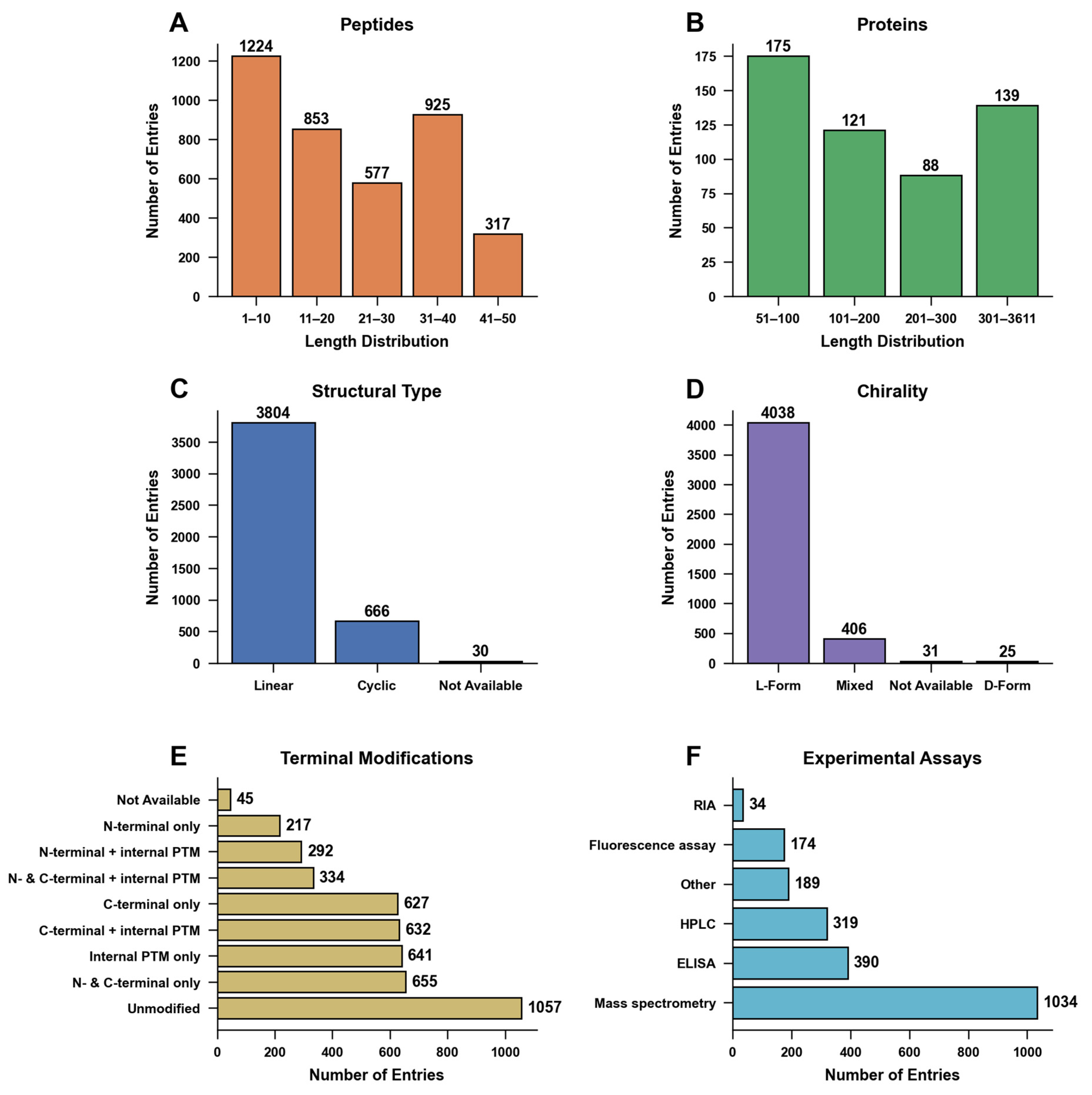
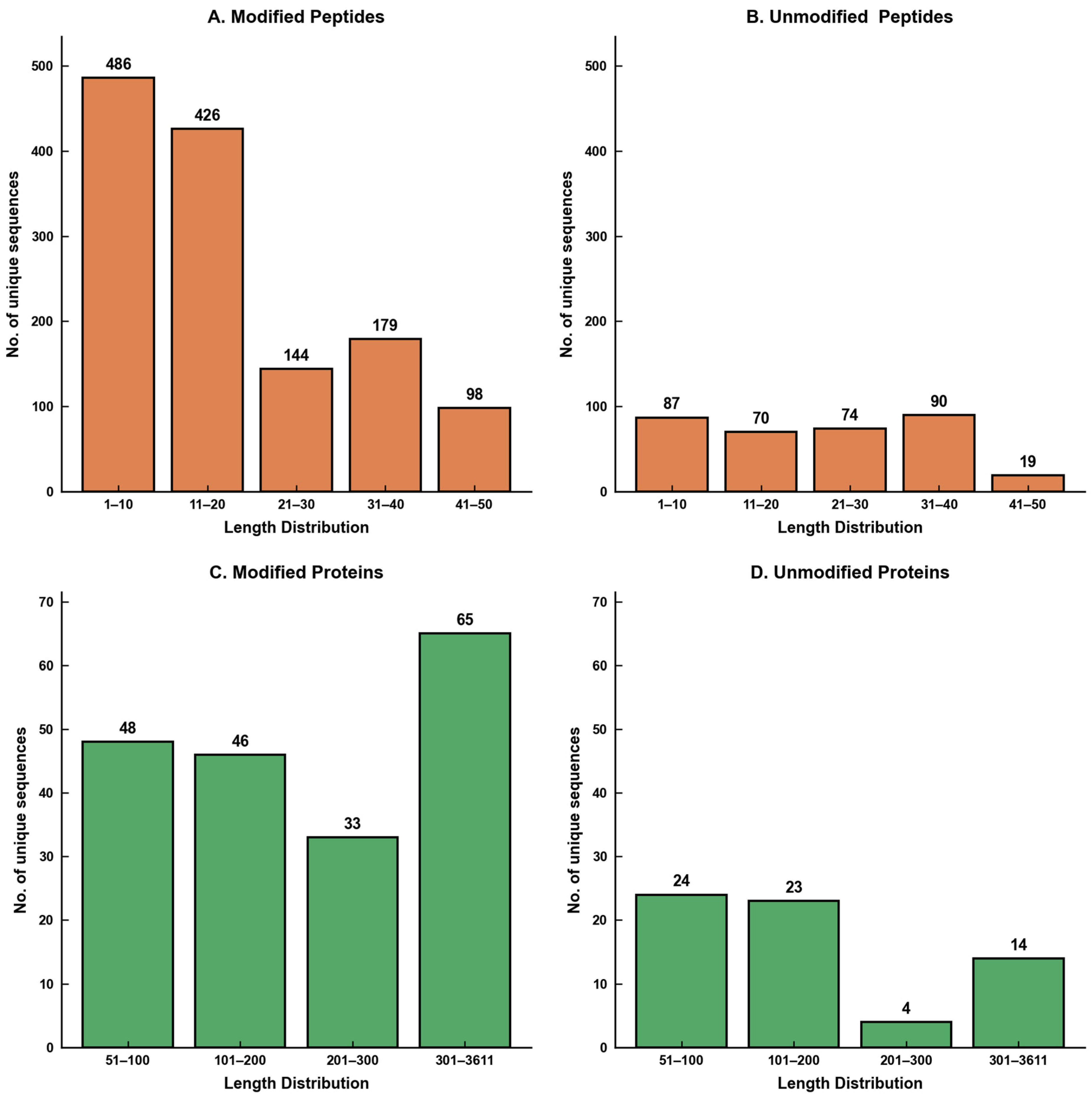
The PEPlife2 database includes sequences of different lengths, ranging from single-residue peptides to proteins containing more than 3600 residues. Analysis of sequence length distribution shows that the majority of entries correspond to peptides within the 1–50 residue range (Figure 2A), while longer sequences categorized as proteins fall within the 51 to 3611 residue range (Figure 2B). Structurally, most entries correspond to linear peptides, whereas a smaller proportion represent cyclic peptides, and a few entries lack structural information (Figure 2C). In terms of chirality, the majority of sequences are composed of L-amino acids, while a smaller number include D-amino acids, mixed chirality sequences, or entries where chirality information is not available (Figure 2D). These distributions highlight the diversity of peptide and protein entries included in the PEPlife2 database. Terminal and post-translational modifications are frequently observed in the PEPlife2 dataset. Specifically, entries include sequences containing only N-terminal modifications, only C-terminal modifications, and both N- and C-terminal modifications. In addition, several sequences contain internal post-translational modifications (PTMs), either alone or in combination with terminal modifications (e.g., N-terminal + PTM, C-terminal + PTM, or N- and C-terminal + PTMs). Some entries correspond to unmodified peptide/protein sequences without any reported modifications (Figure 2E). These categories allow users to distinguish between peptides/proteins with terminal modifications, post-translational modifications, or combinations of both. A variety of experimental assays have been used to measure peptide half-life, among which mass spectrometry-based methods are the most commonly used (48%), followed by ELISA (18%), HPLC (15%), fluorescence-based assays (8%), RIA (2%), and other experimental methods (9%) (Figure 2F). Figure 3 shows the length distributions of unique peptide and protein sequences, where unique sequences represent distinct amino acid sequences present in the database.
In most entries, peptide half-life values are reported as quantitative measurements extracted from the original literature or patents. However, in a small number of cases, the original sources reported qualitative descriptions such as “stability increased” or “extended half-life” without providing exact numerical values. These entries were retained in PEPlife2 because they provide valuable information regarding chemical modifications or formulation strategies that enhance peptide stability. To ensure transparency, the corresponding literature or patent references are provided for each entry so that users can consult the original sources for additional experimental details.
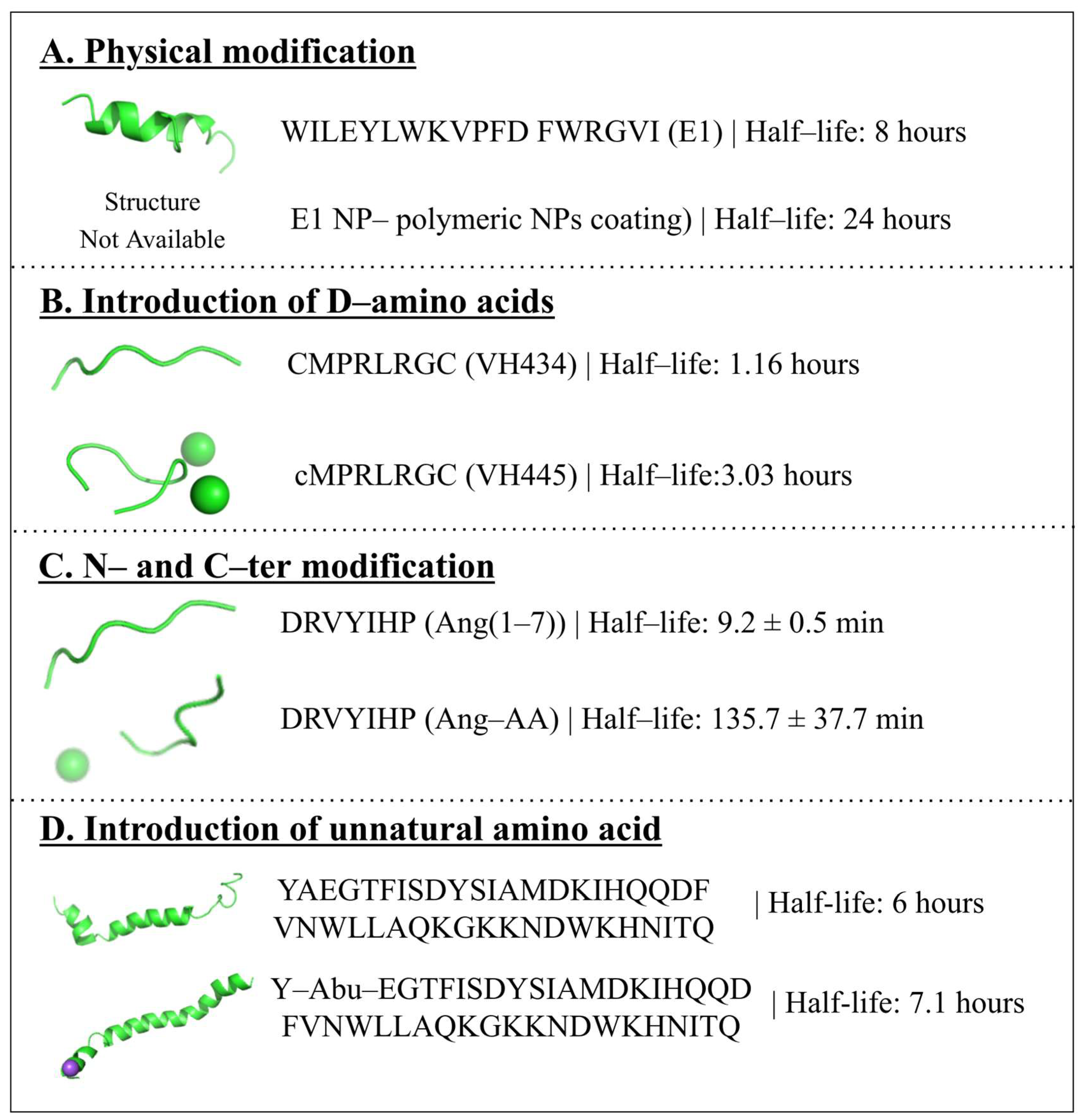
Our database includes various chemical modifications aimed at enhancing the stability of peptides or proteins, such as PEGylation, Fc-conjugation, amino acid replacements (e.g., Lys substitutions followed by fatty acid conjugation), D-amino acid substitutions, non-natural amino acid substitutions (e.g., Abu, aminoisobutyric acid; Sar, sarcosine; pGlu, pyroglutamate), cyclization, amidation, acetylation, and others. The effects of these chemical modifications are detailed in Figure 4. For example, physical modification of E1 NPs (polymeric nanoparticles coated with GC containing the HIV-1 fusion inhibitor peptide E1) extended their half-life from 8 h to 24 h compared to their unmodified form, E1. Similarly, terminal modifications like N-terminal acetylation and C-terminal amidation significantly improved the half-life of peptide Ang (1–7), increasing it from approximately 9 min to 135 min when compared to its unmodified form. Incorporating D-amino acids into VH445 enhanced its half-life from 1.16 h to 3.03 h compared to the unmodified VH434. Furthermore, unnatural amino acids, such as Abu, also contributed to longer half-life, with Abu extending the half-life from 6 h to 7.5 h [26,27,28]. Additionally, we incorporated the MAP (Modification and Annotation in Proteins) [29] format that introduces tags within the sequence for residue-level modification, such as chemical modifications, non-standard amino acids, binding sites, and mutations.

4. Comparison with the Previous PEPlife Version

The previous PEPlife database (2016, covering data up to 2015) has 2200 data entries covering 1193 unique peptides. For each peptide, the columns are peptide name, sequence, half-life, modifications, experimental assay yielding half-life value, biological nature and biological activity. For 2016–2024, the updated PEPlife2 includes 4500 entries from 449 articles and 81 patents. PEPlife2 introduces several new features that were not available in the previous version, including the inclusion of physical modifications (i.e., hydrogels), which are now commonly used for increasing the half-life of peptide/proteins. In addition, PEPlife2 includes fields that are not part of PEPlife. For instance, there is no need to download Jalview (a sequence and structure alignment program), which was previously required; now users can view results directly on specific pages. In addition, there is updated information on the types of half-life (such as distribution half-life and activity half-life) as well as on physical modifications to facilitate effective characterization and exploration of these categories. Thus, PEPlife2 is a far more extensive and user-friendly database that will better enhance understanding of peptide stability and modifications than the previous PEPlife database.

5. Relevant Therapeutic Databases

Several databases have been developed for peptide research, including therapeutic peptide databases. Existing databases such as THPdb/THPdb2 primarily focus on FDA-approved therapeutic peptides and proteins, including pharmacological and clinical information [2,30], while databases such as SATPdb provide structurally annotated therapeutic peptides [31]. Similarly, antimicrobial peptide databases such as DBAASP, DRAMP, and APD mainly focus on the sequence, structure, and biological activity of antimicrobial peptides [32,33,34]. Other resources, such as DCTPep, focus on cancer-related peptides [35]. However, PEPlife2 emphasizes experimentally determined peptide and protein half-life data along with associated modifications and experimental conditions.

6. Conclusions

We present PEPlife2, an updated version of the PEPlife database, which expands the dataset to 4500 total entries including 2300 newly curated entries and 2200 existing entries from the original PEPlife database. The updated database provides large-scale information on experimentally determined peptide and protein half-life along with associated sequence properties, modifications and experimental conditions. The PEPlife2 database is freely accessible at https://webs.iiitd.edu.in/raghava/peplife2/ (accessed on 15 December 2025), where users can retrieve data directly through the web interface or programmatically via the provided API. We believe that this updated resource will be valuable for researchers working in peptide therapeutics, pharmacokinetics and peptide-based drug design. To ensure the long-term utility of the database, we plan to periodically update PEPlife2 by incorporating newly published peptide and protein half-life data from the literature and patents. In addition, further improvements will enhance usability and maintain the sustainability of the resource for the scientific community.

7. Limitations

In some cases, the database includes modified peptides for which the corresponding half-life of the unmodified (native) peptide was not reported in the original literature or patents. As PEPlife2 aims to provide an extensive repository of experimentally reported half-life data, such entries were retained even when the native counterpart was not available. While direct comparison between modified and unmodified peptides would be useful for evaluating the impact of modifications on stability, the inclusion of these entries still provides valuable information regarding chemical modification strategies and formulation approaches used to improve peptide stability. In some cases, the literature or patents reported qualitative improvements in peptide stability without providing precise numerical half-life values. While such entries were included to capture experimentally reported stability-enhancing modifications, the absence of quantitative measurements may limit direct comparison between modified and unmodified peptides. Users are therefore encouraged to consult the original references for detailed experimental information. We made a concerted effort to provide large-scale information on the half-life of proteins and peptides; however, certain peptides could not be included due to their absence in patents or other publications. Additionally, the unavailability of force field libraries for complex chemical modifications resulted in some structures being excluded. Despite meticulous data analysis, absolute precision cannot be guaranteed, as the possibility of human error remains. With the release of PEPlife2 (https://webs.iiitd.edu.in/raghava/peplife2/ (accessed on 15 December 2025)), we aim to enhance both the quality and scope of the database to assist the scientific community.

Author Contributions

U.A., G.P.S.R. and N.K. manually collected the data. U.A., K.C. and R.T. manually curated and analyzed the data. N.K., U.A. and S.P. developed the backend and frontend of the webserver. U.A., N.K. and G.P.S.R. prepared the manuscript. N.K., U.A., K.C., R.T., S.P. and G.P.S.R. reviewed the manuscript. G.P.S.R. conceived and coordinated the project. All authors have read and agreed to the published version of the manuscript.

Funding

The current work was supported by a Department of Biotechnology (DBT) grant, India, BT/PR40158/BTIS/137/24/2021.

Data Availability Statement

The database PEPlife2 is available free of cost at “https://webs.iiitd.edu.in/raghava/peplife2/ (accessed on 15 December 2025)”. The dataset can be downloaded in CSV format, which allows easy integration with spreadsheet software such as Microsoft Excel and bioinformatics analysis pipelines. The dataset can also be accessed programmatically through the API by selecting the query field available at https://webs.iiitd.edu.in/raghava/peplife2/api/rest.html (accessed on 15 December 2025). The dataset is distributed under the Creative Commons Attribution License (CC BY), allowing reuse with appropriate citation of the original source.

Acknowledgments

Authors are thankful to the University Grants Commission (UGC), Department of Science and Technology (DST-INSPIRE), for fellowships and financial support, the Indraprastha Institute of Information Technology (IIITD) for fellowships and financial support, and the Department of Computational Biology, IIITD, New Delhi, for infrastructure and facilities. We would like to acknowledge that figures were created using BioRender.com. bioRxiv doi: https://doi.org/10.1101/2025.05.13.653654.

Conflicts of Interest

The authors declare no competing financial or non-financial interests.

References

  1. Kuril, A.K.; Saravanan, K.; Subbappa, P.K. Analytical Considerations for Characterization of Generic Peptide Product: A Regulatory Insight. Anal. Biochem. 2024, 694, 115633. [Google Scholar] [CrossRef] [Scilit]
  2. Usmani, S.S.; Bedi, G.; Samuel, J.S.; Singh, S.; Kalra, S.; Kumar, P.; Ahuja, A.A.; Sharma, M.; Gautam, A.; Raghava, G.P.S. THPdb: Database of FDA-Approved Peptide and Protein Therapeutics. PLoS ONE 2017, 12, e0181748. [Google Scholar] [CrossRef] [Scilit] [PubMed]
  3. Rastogi, S.; Shukla, S.; Kalaivani, M.; Singh, G.N. Peptide-Based Therapeutics: Quality Specifications, Regulatory Considerations, and Prospects. Drug Discov. Today 2019, 24, 148–162. [Google Scholar] [CrossRef] [Scilit] [PubMed]
  4. Mathur, D.; Singh, S.; Mehta, A.; Agrawal, P.; Raghava, G.P.S. In Silico Approaches for Predicting the Half-Life of Natural and Modified Peptides in Blood. PLoS ONE 2018, 13, e0196829. [Google Scholar] [CrossRef] [Scilit] [PubMed]
  5. Penchala, S.C.; Miller, M.R.; Pal, A.; Dong, J.; Madadi, N.R.; Xie, J.; Joo, H.; Tsai, J.; Batoon, P.; Samoshin, V.; et al. A Biomimetic Approach for Enhancing the in Vivo Half-Life of Peptides. Nat. Chem. Biol. 2015, 11, 793–798. [Google Scholar] [CrossRef] [Scilit]
  6. Sun, B.; Willard, F.S.; Feng, D.; Alsina-Fernandez, J.; Chen, Q.; Vieth, M.; Ho, J.D.; Showalter, A.D.; Stutsman, C.; Ding, L.; et al. Structural Determinants of Dual Incretin Receptor Agonism by Tirzepatide. Proc. Natl. Acad. Sci. USA 2022, 119, e2116506119. [Google Scholar] [CrossRef] [Scilit]
  7. Hu, H.; Ransdell, A.S.; Qu, H.; Durbin, J.D.; Valenzuela, F.A.; Hernandez-Buquer, S.; Gonciarz, M.D. Probing the Binding Mechanism of Acylated Peptides to Human Serum Albumin. ACS Chem. Biol. 2023, 18, 1158–1167. [Google Scholar] [CrossRef] [Scilit]
  8. Wang, J.; Tang, Y.; Zhao, X.; Ding, Z.; Ahmat, M.; Si, D.; Zhang, R.; Wei, X. Molecular Hybridization Modification Improves the Stability and Immunomodulatory Activity of TP5 Peptide. Front. Immunol. 2024, 15, 1472839. [Google Scholar] [CrossRef] [Scilit]
  9. Tan, Q.; Akindehin, S.E.; Orsso, C.E.; Waldner, R.C.; DiMarchi, R.D.; Müller, T.D.; Haqq, A.M. Recent Advances in Incretin-Based Pharmacotherapies for the Treatment of Obesity and Diabetes. Front. Endocrinol. 2022, 13, 838410. [Google Scholar] [CrossRef] [Scilit]
  10. Kontermann, R. (Ed.) Therapeutic Proteins; Wiley-VCH Verlag: Weinheim, Germany, 2012. [Google Scholar]
  11. Li, Y.-J.; Zhang, L.; Yang, P.-P.; Zhang, K.; Gong, X.-F.; Hou, D.-Y.; Cao, H.; Wu, X.-C.; Liu, R.; Lam, K.S.; et al. Bioinspired Screening of Anti-Adhesion Peptides against Blood Proteins for Intravenous Delivery of Nanomaterials. Nano Lett. 2022, 22, 8076–8085. [Google Scholar] [CrossRef] [Scilit]
  12. Tan, X.; Liu, Q.; Fang, Y.; Yang, S.; Chen, F.; Wang, J.; Ouyang, D.; Dong, J.; Zeng, W. Introducing Enzymatic Cleavage Features and Transfer Learning Realizes Accurate Peptide Half-Life Prediction across Species and Organs. Brief. Bioinform. 2024, 25, bbae350. [Google Scholar] [CrossRef] [Scilit]
  13. Glassman, P.M. Development of a Predictive Algorithm for the Efficacy of Half-Life Extension Strategies. Int. J. Pharm. 2024, 660, 124382. [Google Scholar] [CrossRef] [Scilit] [PubMed]
  14. Mathur, D.; Prakash, S.; Anand, P.; Kaur, H.; Agrawal, P.; Mehta, A.; Kumar, R.; Singh, S.; Raghava, G.P.S. PEPlife: A Repository of the Half-Life of Peptides. Sci. Rep. 2016, 6, 36617. [Google Scholar] [CrossRef] [Scilit] [PubMed]
  15. Sharma, A.; Singla, D.; Rashid, M.; Raghava, G.P.S. Designing of Peptides with Desired Half-Life in Intestine-like Environment. BMC Bioinform. 2014, 15, 282. [Google Scholar] [CrossRef] [Scilit] [PubMed]
  16. Zhang, L.; Wei, X.; Zhang, R.; Petitte, J.N.; Si, D.; Li, Z.; Cheng, J.; Du, M. Design and Development of a Novel Peptide for Treating Intestinal Inflammation. Front. Immunol. 2019, 10, 1841. [Google Scholar] [CrossRef] [Scilit]
  17. Wei, X.; Zhang, L.; Yang, Y.; Hou, Y.; Xu, Y.; Wang, Z.; Su, H.; Han, F.; Han, J.; Liu, P.; et al. LL-37 Transports Immunoreactive cGAMP to Activate STING Signaling and Enhance Interferon-Mediated Host Antiviral Immunity. Cell Rep. 2022, 39, 110880. [Google Scholar] [CrossRef] [Scilit]
  18. Diao, L.; Meibohm, B. Pharmacokinetics and Pharmacokinetic-Pharmacodynamic Correlations of Therapeutic Peptides. Clin. Pharmacokinet. 2013, 52, 855–868. [Google Scholar] [CrossRef] [Scilit]
  19. Singh, S.; Singh, H.; Tuknait, A.; Chaudhary, K.; Singh, B.; Kumaran, S.; Raghava, G.P.S. PEPstrMOD: Structure Prediction of Peptides Containing Natural, Non-Natural and Modified Residues. Biol. Direct 2015, 10, 73. [Google Scholar] [CrossRef] [Scilit]
  20. Yang, J.; Yan, R.; Roy, A.; Xu, D.; Poisson, J.; Zhang, Y. The I-TASSER Suite: Protein Structure and Function Prediction. Nat. Methods 2015, 12, 7–8. [Google Scholar] [CrossRef] [Scilit]
  21. Kabsch, W.; Sander, C. Dictionary of Protein Secondary Structure: Pattern Recognition of Hydrogen-Bonded and Geometrical Features. Biopolymers 1983, 22, 2577–2637. [Google Scholar] [CrossRef] [Scilit]
  22. Kaur, D.; Arora, A.; Patiyal, S.; Raghava, G.P.S. Hmrbase2: A Comprehensive Database of Hormones and Their Receptors. Hormones 2023, 22, 359–366. [Google Scholar] [CrossRef] [Scilit]
  23. Altschul, S.F.; Gish, W.; Miller, W.; Myers, E.W.; Lipman, D.J. Basic Local Alignment Search Tool. J. Mol. Biol. 1990, 215, 403–410. [Google Scholar] [CrossRef]
  24. Smith, T.F.; Waterman, M.S. Identification of Common Molecular Subsequences. J. Mol. Biol. 1981, 147, 195–197. [Google Scholar] [CrossRef] [Scilit] [PubMed]
  25. Konagurthu, A.S.; Whisstock, J.C.; Stuckey, P.J.; Lesk, A.M. MUSTANG: A Multiple Structural Alignment Algorithm. Proteins 2006, 64, 559–574. [Google Scholar] [CrossRef] [Scilit] [PubMed]
  26. Veronese, F.M.; Pasut, G. PEGylation, Successful Approach to Drug Delivery. Drug Discov. Today 2005, 10, 1451–1458. [Google Scholar] [CrossRef] [Scilit] [PubMed]
  27. De Filippis, V.; De Antoni, F.; Frigo, M.; Polverino de Laureto, P.; Fontana, A. Enhanced Protein Thermostability by Ala → Aib Replacement. Biochemistry 1998, 37, 1686–1696. [Google Scholar] [CrossRef] [Scilit]
  28. Pharmchem, N.I. The Role of L-Norleucine in Custom Peptide Synthesis and Drug Discovery. Available online: https://www.nbinno.com/article/pharmaceutical-intermediates/role-l-norleucine-custom-peptide-synthesis-drug-discovery-rp (accessed on 31 October 2025).
  29. Shendre, A.; Mehta, N.K.; Rathore, A.S.; Kumar, N.; Patiyal, S.; Raghava, G.P.S. MAP Format for Representing Chemical Modifications, Annotations, and Mutations in Protein Sequences: An Extension of the FASTA Format. arXiv 2025, arXiv:2505.03403. [Google Scholar] [CrossRef] [Scilit]
  30. Jain, S.; Gupta, S.; Patiyal, S.; Raghava, G.P.S. THPdb2: Compilation of FDA Approved Therapeutic Peptides and Proteins. Drug Discov. Today 2024, 29, 104047. [Google Scholar] [CrossRef] [Scilit]
  31. Singh, S.; Chaudhary, K.; Dhanda, S.K.; Bhalla, S.; Usmani, S.S.; Gautam, A.; Tuknait, A.; Agrawal, P.; Mathur, D.; Raghava, G.P.S. SATPdb: A Database of Structurally Annotated Therapeutic Peptides. Nucleic Acids Res. 2016, 44, D1119–D1126. [Google Scholar] [CrossRef] [Scilit]
  32. Pirtskhalava, M.; Amstrong, A.A.; Grigolava, M.; Chubinidze, M.; Alimbarashvili, E.; Vishnepolsky, B.; Gabrielian, A.; Rosenthal, A.; Hurt, D.E.; Tartakovsky, M. DBAASP v3: Database of Antimicrobial/Cytotoxic Activity and Structure of Peptides as a Resource for Development of New Therapeutics. Nucleic Acids Res. 2021, 49, D288–D297. [Google Scholar] [CrossRef] [Scilit]
  33. Ma, T.; Liu, Y.; Yu, B.; Sun, X.; Yao, H.; Hao, C.; Li, J.; Nawaz, M.; Jiang, X.; Lao, X.; et al. DRAMP 4.0: An Open-Access Data Repository Dedicated to the Clinical Translation of Antimicrobial Peptides. Nucleic Acids Res. 2025, 53, D403–D410. [Google Scholar] [CrossRef] [Scilit]
  34. Wang, G.; Schmidt, C.; Li, X.; Wang, Z. APD6: The Antimicrobial Peptide Database Is Expanded to Promote Research and Development by Deploying an Unprecedented Information Pipeline. Nucleic Acids Res. 2026, 54, D363–D374. [Google Scholar] [CrossRef] [Scilit]
  35. Sun, X.; Liu, Y.; Ma, T.; Zhu, N.; Lao, X.; Zheng, H. DCTPep, the Data of Cancer Therapy Peptides. Sci. Data 2024, 11, 541. [Google Scholar] [CrossRef] [Scilit]
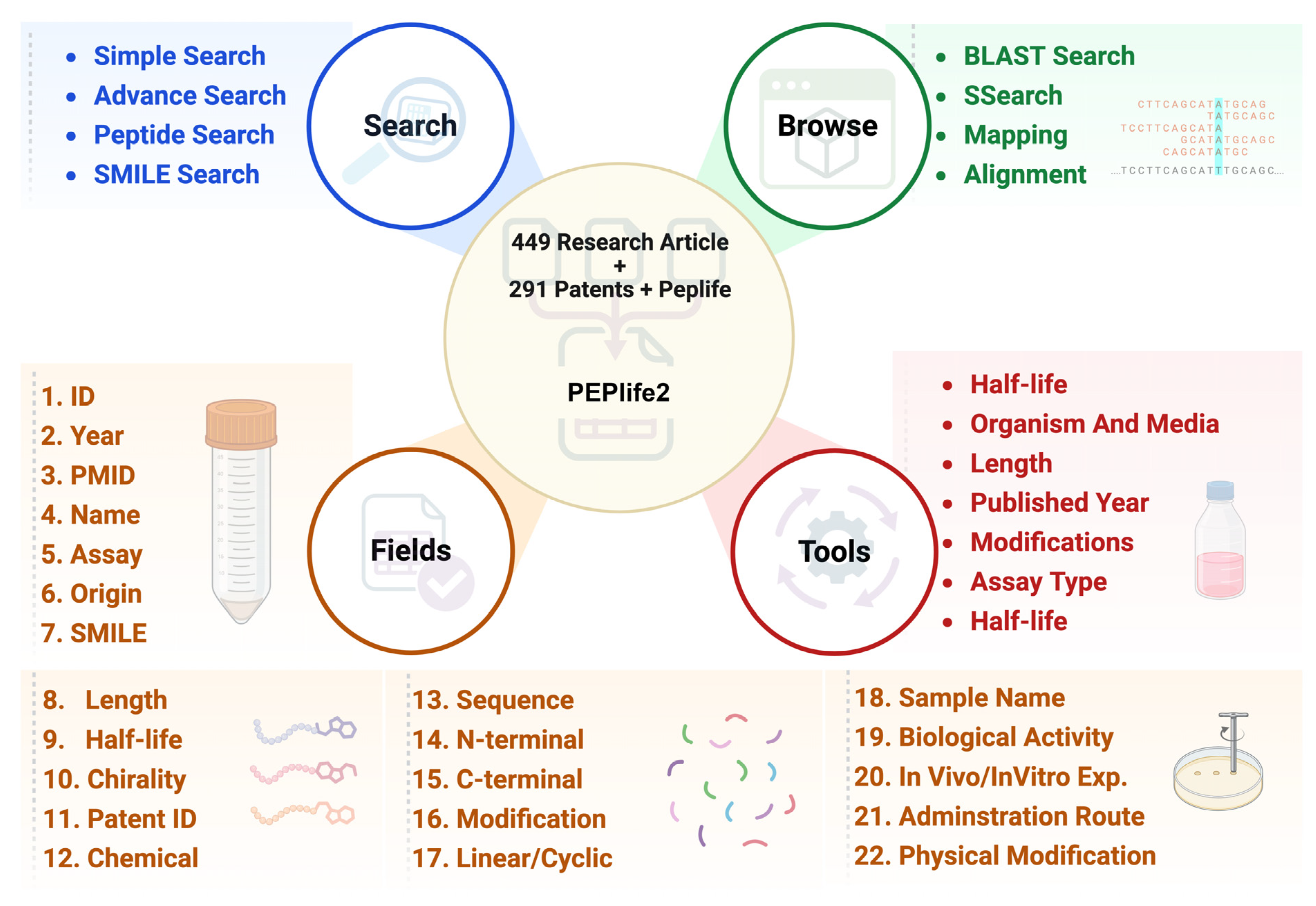
Figure 1. The complete architecture of PEPlife2.
Immuno 06 00026 g001
Figure 2. Statistical distribution of peptide entries in the PEPlife2 database. (A) Length distribution of peptide sequences across different residue ranges. (B) Length distribution of protein sequences across different residue ranges. (C) Structural classification of peptide entries in PEPlife2, including linear peptides entries, cyclic peptides and entries with unavailable structural information. (D) Distribution of entries based on chirality, including L-form, D-form, mixed chirality, and entries with unavailable chirality information. (E) Distribution of peptide entries based on modification types, including N-terminal only, C-terminal only, both N- and C-terminal modifications, internal post-translational modifications (PTMs), and combinations of terminal and internal modifications. Unmodified sequences are also included. (F) Distribution of experimental assay types used for half-life determination, including mass spectrometry, ELISA, HPLC, fluorescence assays, RIA, and other methods.
Immuno 06 00026 g002
Figure 3. The length distribution of unique peptide and protein sequencesin the PEPlife2 database. (A) Distribution of modified peptide sequences across different length ranges. (B) Distribution of unmodified peptide sequences across different length ranges. (C) Distribution of modified protein sequences across different length ranges. (D) Distribution of unmodified protein sequences across different length ranges. The x-axis represents sequence length (amino acids) and the y-axis represents the number of unique sequences.
Immuno 06 00026 g003
Figure 4. Examples of strategies used to improve half-life. Green spheres indicate sites of structural modification or introduced functional groups. (A) Physical modification through nanoparticle coating of peptide E1. (B) Introduction of D-amino acids into sequences to enhance stability. (C) N- and C-terminal modifications that improve peptide half-life. (D) Incorporation of unnatural amino acids into peptide sequences to increase stability.
Immuno 06 00026 g004
Disclaimer/Publisher’s Note: The statements, opinions and data contained in all publications are solely those of the individual author(s) and contributor(s) and not of MDPI and/or the editor(s). MDPI and/or the editor(s) disclaim responsibility for any injury to people or property resulting from any ideas, methods, instructions or products referred to in the content.