
Immune Evasion in Pancreatic Ductal Adenocarcinoma: Mechanistic Insights and Emerging Strategies to Reinvigorate Anti-Cancer Immunity


Abstract
1. Introduction
2. Immunobiology of Pancreatic Ductal Adenocarcinoma
2.1. The Immunologically “Cold” Phenotype of PDAC
2.2. Oncogenic Signalling and Tumour Suppressor Mutations Shape the Immune Microenvironment
2.3. Loss of MHC Class I Expression and Antigen Presentation Cell Defects
2.4. Impaired Interferon Signalling and Immune Pathway Silencing
3. Tumour Microenvironment (TME) and Stromal–Immune Crosstalk
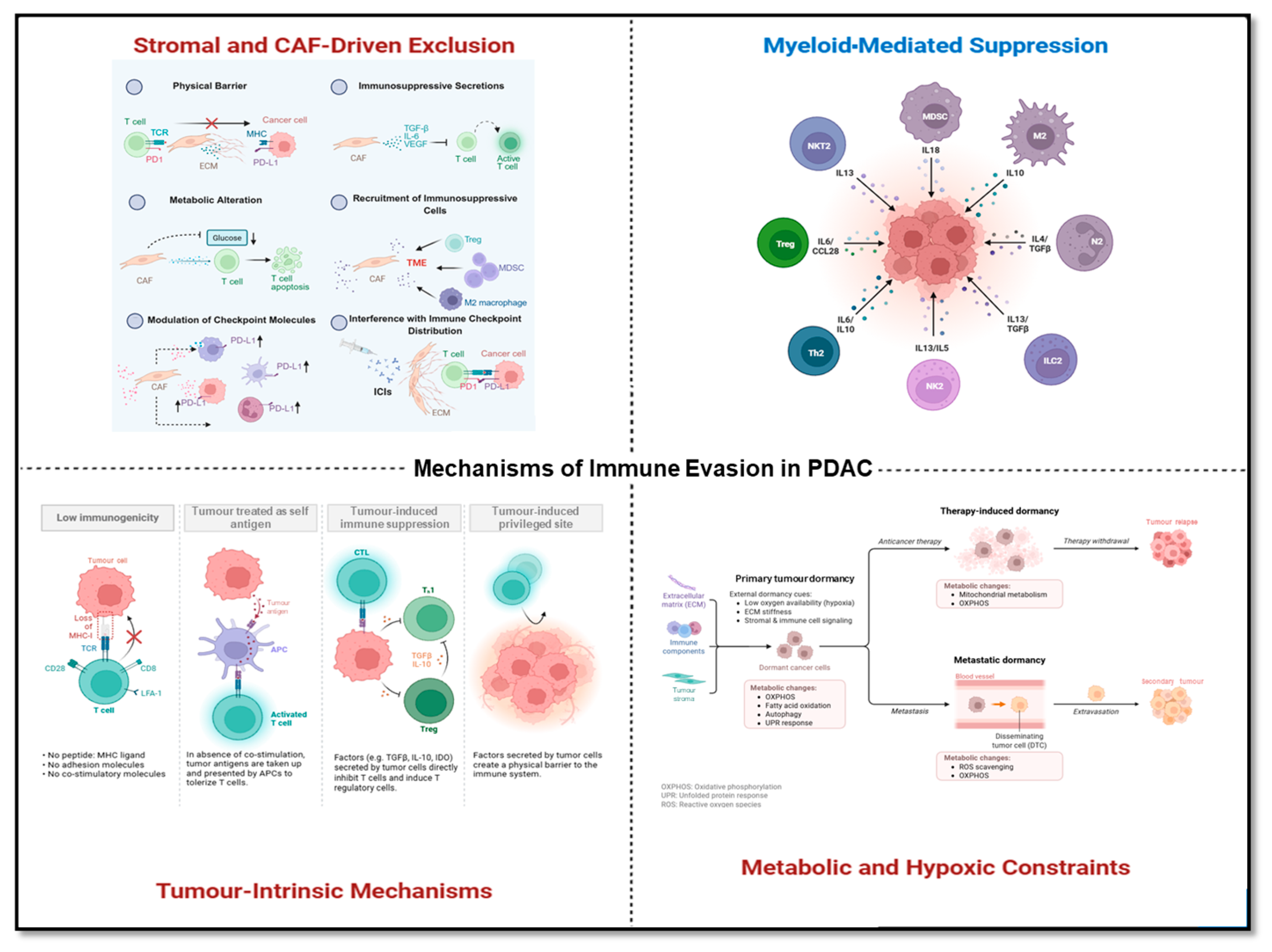
3.1. The Desmoplastic Stroma: Barrier and Modulator
3.2. Immunosuppressive Cell Populations
3.3. Cytokine and Chemokine Milieu Reinforce Immune Suppression
3.4. Metabolic and Hypoxic Constraints
4. Mechanisms of Immune Escape
4.1. Antigen Presentation and Immunoediting
4.2. Checkpoint Ligand Upregulation and Immune Exhaustion
4.3. Stromal Sequestration and Immune Exclusion
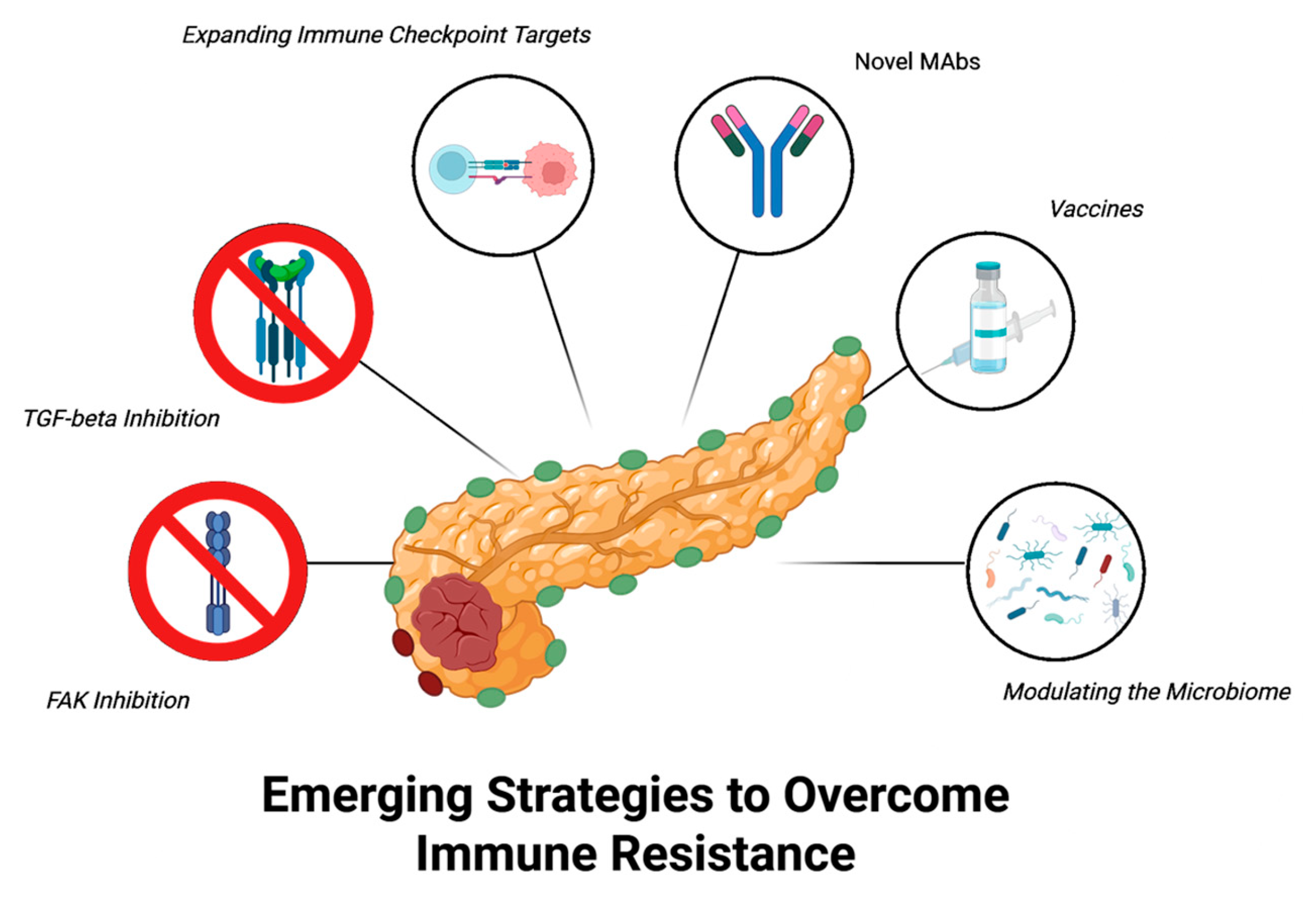
5. Emerging Strategies to Overcome Immune Resistance (Figure 2)

5.1. Focal Adhesion Kinase (FAK) Inhibition
5.2. Targeting TAMs with Anti-CSF1R Antibodies
5.3. TGF-β Inhibition
5.4. Expanding Immune Checkpoint Targets Beyond PD-1/CTLA-4
5.5. Cancer Vaccines and Adoptive Cell Therapies
5.6. Modulating the Microbiome and Tumour Metabolism
6. Integrative Approaches to Transform “Cold” into “Hot” PDAC
6.1. Combining Cytotoxic Therapy with Immune Therapy
6.2. Radiotherapy as an Immune Primer
6.3. DNA Damage Response and Replication Stress Modulation
- cGAS-STING pathway
7. Biomarkers
7.1. CA19.9
7.2. Exosomal mRNA
7.3. Molecular Diagnosis of Cyst Fluid
7.4. Transcriptomic Subtypes
7.5. Markers of DDR Deficiency and Replication Stress
7.6. Circulating Tumour Cells (CTCs) and Liquid Biopsy

| Serum | Pancreatic Juice | Urinary | Faecal | Salivary | |
|---|---|---|---|---|---|
| Proteins/ glycoproteins | CA19.9 [117], C242 [118], DUPAN [119], TGF-B [120], (MIC-1/GDF15) [121], ICAM-1 [122], MMP-7 and MMP-12 [123], MUC1, MUC4, MUC5AC and MUC16 [124], DKK-1 [125] | CA19.9 [126], REG1A and REG1B [126], MMP [127] | REG1A [128] MMP [129] | Adnab-9 [130] | Polyamines [131] |
| Exosomes | Exosomes [132] | Exosomes [133] | |||
| Liquid biopsy | CTC [134] | KRAS mutation [135] | KRAS mutation [136] | ||
| ctDNA [137] | Telomerase activity [138] | ||||
| miRNA | miRNAs [139] | miRNA [140] | miRNA [141] | miRNA [140] | miRNA [142] |
| Trial | Site | Aim |
|---|---|---|
| NCT06574373 [143] | Serum | Identify and validate biomarkers capable of distinguishing between low-risk and high-risk IPMN progression to PDAC. |
| NCT05853198 [144] | Serum | Evaluation of ctDNA across various treatment courses in patients with PDAC to assess its efficacy as a prognostic and predictive marker of treatment response. |
| NCT06694792 [145] | Cyst | To analyse exosomes, somatic/germline genetic variability, metabolomics and transcriptome profile to identify new biomarkers; to use nonparametric epidemiologic approaches and machine learning algorithms to compute a progression score to offer clinicians an innovative tool towards the goal of a personalised medicine approach using the invasive cyst biomarker detection (INCITE) consortium between the participant centres to collectively enrol an adequate number of patients to fulfil the previous aims. |
| NCT07030348 [146] | Pancreatic juice | Identify biomarkers for the early diagnosis of pancreatic cancer through duodenal pancreatic juice, which can be easily obtained through an endoscopy. |
| NCT05475366 [67] | Tissue & Serum (PACsign) | Assess the clinical value of 5 transcriptomic signatures prognostic of chemotherapeutic sensitivity to improve the objective response rate (ORR) of first line (L1). Chemotherapy regimen (FOLFIRINOX vs. Gem-nabP) will be selected based on transcriptomic signatures applied to the pre-therapeutic liver biopsy of newly diagnosed PDAC patients. |
| NCT06706700 [147] | Serum & cyst (EMI-IPMN) | To identify pre-operative biological and/or radiological/endosonographic biomarker(s) able to distinguish low- versus high-risk IPMN for cancer progression. |
| NCT06305728 [148] | Serum & pancreatic cyst plus MRI | Look at whether a combination of the following types of imaging with blood tests can detect PDAC in pancreatic cysts: the ImmunoPET scan (immune positron emission tomography scan) with the imaging agent 89Zr-DFO-HuMab-5B1; the HP MRI scan (hyperpolarised pyruvate magnetic resonance imaging scan. |
| NCT04449406 [149] | Urinary & serum | Establish the accuracy of a urinary biomarker panel (LYVE1, REG1B, TFF1), and affiliated PancRISK score alone or in combination with plasma CA19-9 for early detection of pancreatic ductal adenocarcinoma (PDAC). |
| NCT06605404 [150] | Serum & tissue | Collect clinical information, blood, and tumour tissue samples from participants diagnosed with stage I, stage II, or operable stage III cancer in select solid tumours, including exocrine pancreatic cancer. |
| NCT03334708 [151] | Serum | Develop a minimally invasive test to diagnose pancreatic cancer at early stages of disease and monitor response to treatment. |
| NCT05743049 [152] | Serum | Collection of blood samples from patients with a diagnosis of pancreatic adenocarcinoma for evaluation of circulating biomarkers. |
| NCT02000089 [153] | Serum & pancreatic juice (CAPS5) | Evaluate pancreatic fluid mutations and circulating pancreatic epithelial cells as accurate markers of neoplasia by comparing their prevalence in cases with sporadic pancreatic neoplasia to healthy and disease controls. |
| NCT04406831 [154] | Serum | To assess miRNAs as a diagnostic and predictive test. |
| NCT05802407 [155] | Serum | Assess the prognostic value of baseline MRD and the role of MRD dynamic changes after treatment in guiding treatment. Peripheral blood derived from participants will be obtained for MRD test before adjuvant chemotherapy initiation and at the first imaging assessment after chemotherapy. |
8. Future Perspectives
8.1. Vaccination Against Tumour Antigen
- 1.
- Whole-cell vaccines:
- 2.
- Peptide vaccines:
- 3.
- DNA vaccines:
- 4.
- Microorganism-based vaccines (viral or bacterial vectors):
- Challenges in vaccine therapy:
- Although cancer vaccine therapy is conceptually attractive and clinically promising, it faces several significant challenges that limit widespread implementation and consistent efficacy. One major barrier is technological complexity. Personalised vaccine approaches require sophisticated tumour sequencing, advanced bioinformatic pipelines for neoantigen identification, scalable and timely vaccine manufacturing, and robust platforms to monitor vaccine-induced immune responses. These processes are resource-intensive, costly, and difficult to standardise across centres.
- Patient selection and response assessment represent additional challenges. Conventional radiological response criteria, such as RECIST, may not adequately capture vaccine-induced immune responses, including delayed responses or pseudo-progression, potentially underestimating clinical benefit [164]. Furthermore, it remains unclear whether vaccine-induced T cells can sustain durable effector function within the immunosuppressive tumour microenvironment of PDAC, or whether repeated booster vaccinations are required to maintain effective anti-tumour immunity [165].
8.2. Monoclonal and Bispecific Antibodies
8.3. CAR-Based Therapies
9. Conclusions
Supplementary Materials
Author Contributions
Funding
Institutional Review Board Statement
Data Availability Statement
Conflicts of Interest
References
- Kleeff, J.; Korc, M.; Apte, M.; La Vecchia, C.; Johnson, C.D.; Biankin, A.V.; Neale, R.E.; Tempero, M.; Tuveson, D.A.; Hruban, R.H.; et al. Pancreatic cancer. Nat. Rev. Dis. Primers 2016, 2, 16022. [Google Scholar] [CrossRef]
- Leiphrakpam, P.D.; Chowdhury, S.; Zhang, M.; Bajaj, V.; Dhir, M.; Are, C. Trends in the Global Incidence of Pancreatic Cancer and a Brief Review of its Histologic and Molecular Subtypes. J. Gastrointest. Cancer 2025, 56, 71. [Google Scholar] [CrossRef]
- Park, W.; Chawla, A.; O’Reilly, E.M. Pancreatic Cancer: A Review. JAMA 2021, 326, 851–862. [Google Scholar] [CrossRef] [PubMed]
- Lafaro, K.J.; Melstrom, L.G. The Paradoxical Web of Pancreatic Cancer Tumor Microenvironment. Am. J. Pathol. 2019, 189, 44–57. [Google Scholar] [CrossRef] [PubMed]
- Liang, C.; Shi, S.; Liang, D.; Ji, S.; Zhang, B.; Qin, Y.; Xu, J.; Ni, Q.; Yu, X. Complex roles of the stroma in the intrinsic resistance to gemcitabine in pancreatic cancer: Where we are and where we are going. Exp. Mol. Med. 2017, 49, e406. [Google Scholar] [CrossRef] [PubMed]
- Di Federico, A.; Mosca, M.; Pagani, R.; Carloni, R.; Frega, G.; De Giglio, A.; Rizzo, A.; Ricci, D.; Tavolari, S.; Di Marco, M.; et al. Immunotherapy in Pancreatic Cancer: Why do We Keep Failing? A Focus on Tumor Immune Microenvironment, Predictive Biomarkers and Treatment Outcomes. Cancers 2022, 14, 2429. [Google Scholar] [CrossRef]
- Awosika, J.A.; Gulley, J.L.; Pastor, D.M. Deficient Mismatch Repair and Microsatellite Instability in Solid Tumors. Int. J. Mol. Sci. 2025, 26, 4394. [Google Scholar] [CrossRef]
- Ahmad-Nielsen, S.A.; Bruun Nielsen, M.F.; Mortensen, M.B.; Detlefsen, S. Frequency of mismatch repair deficiency in pancreatic ductal adenocarcinoma. Pathol. Res. Pract. 2020, 216, 152985. [Google Scholar] [CrossRef]
- Ju, Y.; Xu, D.; Liao, M.-M.; Sun, Y.; Bao, W.-D.; Yao, F.; Ma, L. Barriers and opportunities in pancreatic cancer immunotherapy. npj Precis. Oncol. 2024, 8, 199. [Google Scholar] [CrossRef]
- Wang, L.; Geng, H.; Liu, Y.; Liu, L.; Chen, Y.; Wu, F.; Liu, Z.; Ling, S.; Wang, Y.; Zhou, L. Hot and cold tumors: Immunological features and the therapeutic strategies. MedComm 2023, 4, e343. [Google Scholar] [CrossRef]
- Mota Reyes, C.; Demir, E.; Çifcibaşı, K.; Istvanffy, R.; Friess, H.; Demir, I.E. Regulatory T Cells in Pancreatic Cancer: Of Mice and Men. Cancers 2022, 14, 4582. [Google Scholar] [CrossRef]
- Tang, Y.; Xu, X.; Guo, S.; Zhang, C.; Tang, Y.; Tian, Y.; Ni, B.; Lu, B.; Wang, H. An increased abundance of tumor-infiltrating regulatory T cells is correlated with the progression and prognosis of pancreatic ductal adenocarcinoma. PLoS ONE 2014, 9, e91551. [Google Scholar] [CrossRef] [PubMed]
- Group Young Researchers In Inflammatory Carcinogenesis; Wandmacher, A.M.; Mehdorn, A.-S.; Sebens, S. The Heterogeneity of the Tumor Microenvironment as Essential Determinant of Development, Progression and Therapy Response of Pancreatic Cancer. Cancers 2021, 13, 4932. [Google Scholar] [CrossRef] [PubMed]
- Liu, W.; Wang, X.; Wu, W. Role and functional mechanisms of IL-17/IL-17R signaling in pancreatic cancer (Review). Oncol. Rep. 2024, 52, 144. [Google Scholar] [CrossRef] [PubMed]
- Ma, P.; Beatty, P.L.; McKolanis, J.; Brand, R.; Schoen, R.E.; Finn, O.J. Circulating Myeloid Derived Suppressor Cells (MDSC) That Accumulate in Premalignancy Share Phenotypic and Functional Characteristics with MDSC in Cancer. Front. Immunol. 2019, 10, 1401. [Google Scholar] [CrossRef]
- Kemp, S.B.; Pasca di Magliano, M.; Crawford, H.C. Myeloid Cell Mediated Immune Suppression in Pancreatic Cancer. Cell Mol. Gastroenterol. Hepatol. 2021, 12, 1531–1542. [Google Scholar] [CrossRef]
- Lawlor, R.T.; Mattiolo, P.; Mafficini, A.; Hong, S.-M.; Piredda, M.L.; Taormina, S.V.; Malleo, G.; Marchegiani, G.; Pea, A.; Salvia, R.; et al. Tumor Mutational Burden as a Potential Biomarker for Immunotherapy in Pancreatic Cancer: Systematic Review and Still-Open Questions. Cancers 2021, 13, 3119. [Google Scholar] [CrossRef]
- Karamitopoulou, E. Tumour microenvironment of pancreatic cancer: Immune landscape is dictated by molecular and histopathological features. Br. J. Cancer 2019, 121, 5–14. [Google Scholar] [CrossRef]
- Sperb, N.; Tsesmelis, M.; Wirth, T. Crosstalk between Tumor and Stromal Cells in Pancreatic Ductal Adenocarcinoma. Int. J. Mol. Sci. 2020, 21, 5486. [Google Scholar] [CrossRef]
- Bayne, L.J.; Beatty, G.L.; Jhala, N.; Clark, C.E.; Rhim, A.D.; Stanger, B.Z.; Vonderheide, R.H. Tumor-derived granulocyte-macrophage colony-stimulating factor regulates myeloid inflammation and T cell immunity in pancreatic cancer. Cancer Cell 2012, 21, 822–835. [Google Scholar] [CrossRef]
- Pylayeva-Gupta, Y.; Lee, K.E.; Hajdu, C.H.; Miller, G.; Bar-Sagi, D. Oncogenic Kras-induced GM-CSF production promotes the development of pancreatic neoplasia. Cancer Cell 2012, 21, 836–847. [Google Scholar] [CrossRef] [PubMed]
- Zhang, Z.; Zhang, H.; Liao, X.; Tsai, H.-I. KRAS mutation: The booster of pancreatic ductal adenocarcinoma transformation and progression. Front. Cell Dev. Biol. 2023, 11, 1147676. [Google Scholar] [CrossRef] [PubMed]
- Mahadevan, K.K.; LeBleu, V.S.; Ramirez, E.V.; Chen, Y.; Li, B.; Sockwell, A.M.; Gagea, M.; Sugimoto, H.; Sthanam, L.K.; Tampe, D.; et al. Elimination of oncogenic KRAS in genetic mouse models eradicates pancreatic cancer by inducing FAS-dependent apoptosis by CD8+ T cells. Dev. Cell 2023, 58, 1562–1577.e8. [Google Scholar] [CrossRef] [PubMed]
- Bailey, P.; Chang, D.K.; Nones, K.; Johns, A.L.; Patch, A.-M.; Gingras, M.-C.; Miller, D.K.; Christ, A.N.; Bruxner, T.J.C.; Quinn, M.C.; et al. Genomic analyses identify molecular subtypes of pancreatic cancer. Nature 2016, 531, 47–52. [Google Scholar] [CrossRef]
- McCubrey, J.A.; Yang, L.V.; Abrams, S.L.; Steelman, L.S.; Follo, M.Y.; Cocco, L.; Ratti, S.; Martelli, A.M.; Augello, G.; Cervello, M. Effects of TP53 Mutations and miRs on Immune Responses in the Tumor Microenvironment Important in Pancreatic Cancer Progression. Cells 2022, 11, 2155. [Google Scholar] [CrossRef]
- Zhang, C.; Liu, J.; Liang, Y.; Wu, R.; Zhao, Y.; Hong, X.; Lin, M.; Yu, H.; Liu, L.; Levine, A.J.; et al. Tumour-associated mutant p53 drives the Warburg effect. Nat. Commun. 2013, 4, 2935. [Google Scholar] [CrossRef]
- Maddalena, M.; Mallel, G.; Nataraj, N.B.; Shreberk-Shaked, M.; Hassin, O.; Mukherjee, S.; Arandkar, S.; Rotkopf, R.; Kapsack, A.; Lambiase, G.; et al. TP53 missense mutations in PDAC are associated with enhanced fibrosis and an immunosuppressive microenvironment. Proc. Natl. Acad. Sci. USA 2021, 118, e2025631118. [Google Scholar] [CrossRef]
- Sodir, N.M.; Kortlever, R.M.; Barthet, V.J.A.; Campos, T.; Pellegrinet, L.; Kupczak, S.; Anastasiou, P.; Swigart, L.B.; Soucek, L.; Arends, M.J.; et al. MYC Instructs and Maintains Pancreatic Adenocarcinoma Phenotype. Cancer Discov. 2020, 10, 588–607. [Google Scholar] [CrossRef]
- Muthalagu, N.; Monteverde, T.; Raffo-Iraolagoitia, X.; Wiesheu, R.; Whyte, D.; Hedley, A.; Laing, S.; Kruspig, B.; Upstill-Goddard, R.; Shaw, R.; et al. Repression of the Type I Interferon Pathway Underlies MYC- and KRAS-Dependent Evasion of NK and B Cells in Pancreatic Ductal Adenocarcinoma. Cancer Discov. 2020, 10, 872–887. [Google Scholar] [CrossRef]
- Pandha, H.; Rigg, A.; John, J.; Lemoine, N. Loss of expression of antigen-presenting molecules in human pancreatic cancer and pancreatic cancer cell lines. Clin. Exp. Immunol. 2007, 148, 127–135. [Google Scholar] [CrossRef]
- Hegde, S.; Krisnawan, V.E.; Herzog, B.H.; Zuo, C.; Breden, M.A.; Knolhoff, B.L.; Hogg, G.D.; Tang, J.P.; Baer, J.M.; Mpoy, C.; et al. Dendritic Cell Paucity Leads to Dysfunctional Immune Surveillance in Pancreatic Cancer. Cancer Cell 2020, 37, 289–307.e9. [Google Scholar] [CrossRef]
- Taylor, B.C.; Balko, J.M. Mechanisms of MHC-I Downregulation and Role in Immunotherapy Response. Front. Immunol. 2022, 13, 844866. [Google Scholar] [CrossRef] [PubMed]
- Gao, C.; Xiao, C.; Wang, M.; Liang, X.; Qin, C.; Zhang, H.; Bai, R.; Zhang, R.; Feng, W.; Yang, J.; et al. HIF-1 Transcriptionally Regulates Basal Expression of STING to Maintain Cellular Innate Immunity. J. Immunol. 2024, 213, 494–505. [Google Scholar] [CrossRef] [PubMed]
- Sun, L.; Wu, J.; Du, F.; Chen, X.; Chen, Z.J. Cyclic GMP-AMP synthase is a cytosolic DNA sensor that activates the type I interferon pathway. Science 2013, 339, 786–791. [Google Scholar] [CrossRef] [PubMed]
- Suzuki, Y.; Sato, T.; Sugimori, M.; Kanemaru, Y.; Onodera, S.; Tsuchiya, H.; Nakamori, Y.; Tsuyuki, S.; Ikeda, A.; Ikeda, R.; et al. Activation of STING in pancreatic cancer-associated fibroblasts exerts an antitumor effect by enhancing tumor immunity. Sci. Rep. 2024, 14, 17071. [Google Scholar] [CrossRef]
- Cho, C.; Mukherjee, R.; Peck, A.R.; Sun, Y.; McBrearty, N.; Katlinski, K.V.; Gui, J.; Govindaraju, P.K.; Puré, E.; Rui, H.; et al. Cancer-associated fibroblasts downregulate type I interferon receptor to stimulate intratumoral stromagenesis. Oncogene 2020, 39, 6129–6137. [Google Scholar] [CrossRef]
- Anderson, N.M.; Simon, M.C. The tumor microenvironment. Curr. Biol. 2020, 30, R921–R925. [Google Scholar] [CrossRef]
- Apte, M.V.; Wilson, J.S.; Lugea, A.; Pandol, S.J. A starring role for stellate cells in the pancreatic cancer microenvironment. Gastroenterology 2013, 144, 1210–1219. [Google Scholar] [CrossRef]
- de Visser, K.E.; Joyce, J.A. The evolving tumor microenvironment: From cancer initiation to metastatic outgrowth. Cancer Cell 2023, 41, 374–403. [Google Scholar] [CrossRef]
- Laklai, H.; Miroshnikova, Y.A.; Pickup, M.W.; Collisson, E.A.; Kim, G.E.; Barrett, A.S.; Hill, R.C.; Lakins, J.N.; Schlaepfer, D.D.; Mouw, J.K.; et al. Genotype tunes pancreatic ductal adenocarcinoma tissue tension to induce matricellular fibrosis and tumor progression. Nat. Med. 2016, 22, 497–505. [Google Scholar] [CrossRef]
- Tormoen, G.W.; Crittenden, M.R.; Gough, M.J. Role of the immunosuppressive microenvironment in immunotherapy. Adv. Radiat. Oncol. 2018, 3, 520–526. [Google Scholar] [CrossRef]
- Tie, Y.; Tang, F.; Wei, Y.-Q.; Wei, X.-W. Immunosuppressive cells in cancer: Mechanisms and potential therapeutic targets. J. Hematol. Oncol. 2022, 15, 61. [Google Scholar] [CrossRef]
- Lv, Q.; Zhang, Y.; Gao, W.; Wang, J.; Hu, Y.; Yang, H.; Xie, Y.; Lv, Y.; Zhang, H.; Wu, D.; et al. CSF1R inhibition reprograms tumor-associated macrophages to potentiate anti-PD-1 therapy efficacy against colorectal cancer. Pharmacol. Res. 2024, 202, 107126. [Google Scholar] [CrossRef] [PubMed]
- Biffi, G.; Tuveson, D.A. Diversity and Biology of Cancer-Associated Fibroblasts. Physiol. Rev. 2021, 101, 147–176. [Google Scholar] [CrossRef] [PubMed]
- Pan, D.; Li, X.; Qiao, X.; Wang, Q. Immunosuppressive tumor microenvironment in pancreatic cancer: Mechanisms and therapeutic targets. Front. Immunol. 2025, 16, 1582305. [Google Scholar] [CrossRef] [PubMed]
- De Santis, M.C.; Bockorny, B.; Hirsch, E.; Cappello, P.; Martini, M. Exploiting pancreatic cancer metabolism: Challenges and opportunities. Trends Mol. Med. 2024, 30, 592–604. [Google Scholar] [CrossRef]
- Ou, Z.; Lu, Y.; Xu, D.; Luo, Z. Hypoxia mediates immune escape of pancreatic cancer cells by affecting miR-1275/AXIN2 in natural killer cells. Front. Immunol. 2023, 14, 1271603. [Google Scholar] [CrossRef]
- Qin, C.; Yang, G.; Yang, J.; Ren, B.; Wang, H.; Chen, G.; Zhao, F.; You, L.; Wang, W.; Zhao, Y. Metabolism of pancreatic cancer: Paving the way to better anticancer strategies. Mol. Cancer 2020, 19, 50. [Google Scholar] [CrossRef]
- Fischer, K.; Hoffmann, P.; Voelkl, S.; Meidenbauer, N.; Ammer, J.; Edinger, M.; Gottfried, E.; Schwarz, S.; Rothe, G.; Hoves, S.; et al. Inhibitory effect of tumor cell-derived lactic acid on human T cells. Blood 2007, 109, 3812–3819. [Google Scholar] [CrossRef]
- Łuksza, M.; Sethna, Z.M.; Rojas, L.A.; Lihm, J.; Bravi, B.; Elhanati, Y.; Soares, K.; Amisaki, M.; Dobrin, A.; Hoyos, D.; et al. Neoantigen quality predicts immunoediting in survivors of pancreatic cancer. Nature 2022, 606, 389–395. [Google Scholar] [CrossRef]
- Zhang, Y.; Velez-Delgado, A.; Mathew, E.; Li, D.; Mendez, F.M.; Flannagan, K.; Rhim, A.D.; Simeone, D.M.; Beatty, G.L.; Pasca di Magliano, M. Myeloid cells are required for PD-1/PD-L1 checkpoint activation and the establishment of an immunosuppressive environment in pancreatic cancer. Gut 2017, 66, 124–136. [Google Scholar] [CrossRef] [PubMed]
- Saka, D.; Gökalp, M.; Piyade, B.; Cevik, N.C.; Arik Sever, E.; Unutmaz, D.; Ceyhan, G.O.; Demir, I.E.; Asimgil, H. Mechanisms of T-Cell Exhaustion in Pancreatic Cancer. Cancers 2020, 12, 2274. [Google Scholar] [CrossRef] [PubMed]
- Blando, J.; Sharma, A.; Higa, M.G.; Zhao, H.; Vence, L.; Yadav, S.S.; Kim, J.; Sepulveda, A.M.; Sharp, M.; Maitra, A.; et al. Comparison of immune infiltrates in melanoma and pancreatic cancer highlights VISTA as a potential target in pancreatic cancer. Proc. Natl. Acad. Sci. USA 2019, 116, 1692–1697. [Google Scholar] [CrossRef] [PubMed]
- Sleightholm, R.L.; Neilsen, B.K.; Li, J.; Steele, M.M.; Singh, R.K.; Hollingsworth, M.A.; Oupicky, D. Emerging roles of the CXCL12/CXCR4 axis in pancreatic cancer progression and therapy. Pharmacol. Ther. 2017, 179, 158–170. [Google Scholar] [CrossRef]
- Roth, S.; Zamzow, K.; Gaida, M.M.; Heikenwälder, M.; Tjaden, C.; Hinz, U.; Bose, P.; Michalski, C.W.; Hackert, T. Evolution of the immune landscape during progression of pancreatic intraductal papillary mucinous neoplasms to invasive cancer. eBioMedicine 2020, 54, 102714. [Google Scholar] [CrossRef]
- Kanteti, R.; Batra, S.K.; Lennon, F.E.; Salgia, R. FAK and paxillin, two potential targets in pancreatic cancer. Oncotarget 2016, 7, 31586–31601. [Google Scholar] [CrossRef]
- Canel, M.; Sławińska, A.D.; Lonergan, D.W.; Kallor, A.A.; Upstill-Goddard, R.; Davidson, C.; von Kriegsheim, A.; Biankin, A.V.; Byron, A.; Alfaro, J.; et al. FAK suppresses antigen processing and presentation to promote immune evasion in pancreatic cancer. Gut 2023, 73, 131–155. [Google Scholar] [CrossRef]
- Wang-Gillam, A.; Lim, K.-H.; McWilliams, R.; Suresh, R.; Lockhart, A.C.; Brown, A.; Breden, M.; Belle, J.I.; Herndon, J.; Bogner, S.J.; et al. Defactinib, Pembrolizumab, and Gemcitabine in Patients with Advanced Treatment Refractory Pancreatic Cancer: A Phase I Dose Escalation and Expansion Study. Clin. Cancer Res. 2022, 28, 5254–5262. [Google Scholar] [CrossRef]
- Gomez-Roca, C.; Cassier, P.; Zamarin, D.; Machiels, J.-P.; Perez Gracia, J.L.; Stephen Hodi, F.; Taus, A.; Martinez Garcia, M.; Boni, V.; Eder, J.P.; et al. Anti-CSF-1R emactuzumab in combination with anti-PD-L1 atezolizumab in advanced solid tumor patients naïve or experienced for immune checkpoint blockade. J. Immunother. Cancer 2022, 10, e004076. [Google Scholar] [CrossRef]
- Przystal, J.M.; Becker, H.; Canjuga, D.; Tsiami, F.; Anderle, N.; Keller, A.-L.; Pohl, A.; Ries, C.H.; Schmittnaegel, M.; Korinetska, N.; et al. Targeting CSF1R Alone or in Combination with PD1 in Experimental Glioma. Cancers 2021, 13, 2400. [Google Scholar] [CrossRef]
- Liu, L.; Huang, X.; Shi, F.; Song, J.; Guo, C.; Yang, J.; Liang, T.; Bai, X. Combination therapy for pancreatic cancer: Anti-PD-(L)1-based strategy. J. Exp. Clin. Cancer Res. 2022, 41, 56. [Google Scholar] [CrossRef]
- Bloom, M.; Shaikh, A.R.; Sun, Z.; Bashir, B.; Snook, A.E. Cancer Vaccination and Immune-Based Approaches in Pancreatic Cancer. Cancers 2025, 17, 2356. [Google Scholar] [CrossRef] [PubMed]
- Gulhati, P.; Schalck, A.; Jiang, S.; Shang, X.; Wu, C.-J.; Hou, P.; Ruiz, S.H.; Soto, L.S.; Parra, E.; Ying, H.; et al. Targeting T cell checkpoints 41BB and LAG3 and myeloid cell CXCR1/CXCR2 results in antitumor immunity and durable response in pancreatic cancer. Nat. Cancer 2023, 4, 62–80. [Google Scholar] [CrossRef] [PubMed]
- Ganju, V.; Marx, G.; Pattison, S.; Amaro-Mugridge, N.B.; Zhao, J.-T.; Williams, B.R.G.; MacDiarmid, J.A.; Brahmbhatt, H. Phase I/IIa Trial in Advanced Pancreatic Ductal Adenocarcinoma Treated with Cytotoxic Drug-Packaged, EGFR-Targeted Nanocells and Glycolipid-Packaged Nanocells. Clin. Cancer Res. 2024, 30, 304–314. [Google Scholar] [CrossRef] [PubMed]
- Schöffski, P.; Tan, D.S.W.; Martín, M.; Ochoa-de-Olza, M.; Sarantopoulos, J.; Carvajal, R.D.; Kyi, C.; Esaki, T.; Prawira, A.; Akerley, W.; et al. Phase I/II study of the LAG-3 inhibitor ieramilimab (LAG525) ± anti-PD-1 spartalizumab (PDR001) in patients with advanced malignancies. J. Immunother. Cancer 2022, 10, e003776. [Google Scholar] [CrossRef]
- Sasikumar, P.G.; Sudarshan, N.S.; Adurthi, S.; Ramachandra, R.K.; Samiulla, D.S.; Lakshminarasimhan, A.; Ramanathan, A.; Chandrasekhar, T.; Dhudashiya, A.A.; Talapati, S.R.; et al. PD-1 derived CA-170 is an oral immune checkpoint inhibitor that exhibits preclinical anti-tumor efficacy. Commun. Biol. 2021, 4, 699. [Google Scholar] [CrossRef]
- Rojas, L.A.; Sethna, Z.; Soares, K.C.; Olcese, C.; Pang, N.; Patterson, E.; Lihm, J.; Ceglia, N.; Guasp, P.; Chu, A.; et al. Personalized RNA neoantigen vaccines stimulate T cells in pancreatic cancer. Nature 2023, 618, 144–150. [Google Scholar] [CrossRef]
- Noelle, R.J.; Lines, J.L.; Lewis, L.D.; Martell, R.E.; Guillaudeux, T.; Lee, S.W.; Mahoney, K.M.; Vesely, M.D.; Boyd-Kirkup, J.; Nambiar, D.K.; et al. Clinical and research updates on the VISTA immune checkpoint: Immuno-oncology themes and highlights. Front. Oncol. 2023, 13, 1225081. [Google Scholar] [CrossRef]
- Beatty, G.L.; Delman, D.; Yu, J.; Liu, M.; Li, J.H.; Zhang, L.; Lee, J.W.; Chang, R.B.; Bahary, N.; Kennedy, E.P.; et al. Treatment Response in First-Line Metastatic Pancreatic Ductal Adenocarcinoma Is Stratified By a Composite Index of Tumor Proliferation and CD8 T-Cell Infiltration. Clin. Cancer Res. 2023, 29, 3514–3525. [Google Scholar] [CrossRef]
- Conroy, T.; Desseigne, F.; Ychou, M.; Bouché, O.; Guimbaud, R.; Bécouarn, Y.; Adenis, A.; Raoul, J.-L.; Gourgou-Bourgade, S.; de la Fouchardière, C.; et al. FOLFIRINOX versus gemcitabine for metastatic pancreatic cancer. N. Engl. J. Med. 2011, 364, 1817–1825. [Google Scholar] [CrossRef]
- Conroy, T.; Hammel, P.; Hebbar, M.; Ben Abdelghani, M.; Wei, A.C.; Raoul, J.-L.; Choné, L.; Francois, E.; Artru, P.; Biagi, J.J.; et al. FOLFIRINOX or Gemcitabine as Adjuvant Therapy for Pancreatic Cancer. N. Engl. J. Med. 2018, 379, 2395–2406. [Google Scholar] [CrossRef] [PubMed]
- Wu, M.-Y.; Shen, M.; Xu, M.-D.; Yu, Z.-Y.; Tao, M. FOLFIRINOX regulated tumor immune microenvironment to extend the survival of patients with resectable pancreatic ductal adenocarcinoma. Gland. Surg. 2020, 9, 2125–2135. [Google Scholar] [CrossRef] [PubMed]
- Peng, H.; James, C.A.; Cullinan, D.R.; Hogg, G.D.; Mudd, J.L.; Zuo, C.; Takchi, R.; Caldwell, K.E.; Liu, J.; De Nardo, D.G.; et al. Neoadjuvant FOLFIRINOX Therapy is Associated with Increased Effector T Cells and Reduced Suppressor Cells in Patients with Pancreatic Cancer. Clin. Cancer Res. 2021, 27, 6761–6771. [Google Scholar] [CrossRef] [PubMed]
- de Sousa Cavalcante, L.; Monteiro, G. Gemcitabine: Metabolism and molecular mechanisms of action, sensitivity and chemoresistance in pancreatic cancer. Eur. J. Pharmacol. 2014, 741, 8–16. [Google Scholar] [CrossRef]
- Li, F.; Hu, G.; Jiang, Z.; Guo, J.; Wang, K.; Ouyang, K.; Wen, D.; Zhu, M.; Liang, J.; Qin, X.; et al. Identification of NME5 as a contributor to innate resistance to gemcitabine in pancreatic cancer cells. FEBS J. 2012, 279, 1261–1273. [Google Scholar] [CrossRef]
- Qi, R.; Bai, Y.; Li, K.; Liu, N.; Xu, Y.; Dal, E.; Wang, Y.; Lin, R.; Wang, H.; Liu, Z.; et al. Cancer-associated fibroblasts suppress ferroptosis and induce gemcitabine resistance in pancreatic cancer cells by secreting exosome-derived ACSL4-targeting miRNAs. Drug Resist. Updates 2023, 68, 100960. [Google Scholar] [CrossRef]
- Jia, Q.; Zhu, Y.; Yao, H.; Yin, Y.; Duan, Z.; Zheng, J.; Ma, D.; Yang, M.; Yang, J.; Zhang, J.; et al. Oncogenic GALNT5 confers FOLFIRINOX resistance via activating the MYH9/ NOTCH/ DDR axis in pancreatic ductal adenocarcinoma. Cell Death Dis. 2024, 15, 767. [Google Scholar] [CrossRef]
- Hegazi, A.; Rager, L.E.; Watkins, D.E.; Su, K.-H. Advancing Immunotherapy in Pancreatic Cancer. Int. J. Mol. Sci. 2024, 25, 11560. [Google Scholar] [CrossRef]
- Royal, R.E.; Levy, C.; Turner, K.; Mathur, A.; Hughes, M.; Kammula, U.S.; Sherry, R.M.; Topalian, S.L.; Yang, J.C.; Lowy, I.; et al. Phase 2 trial of single agent Ipilimumab (anti-CTLA-4) for locally advanced or metastatic pancreatic adenocarcinoma. J. Immunother. 2010, 33, 828–833. [Google Scholar] [CrossRef]
- Marabelle, A.; Le, D.T.; Ascierto, P.A.; Di Giacomo, A.M.; De Jesus-Acosta, A.; Delord, J.-P.; Geva, R.; Gottfried, M.; Penel, N.; Hansen, A.R.; et al. Efficacy of Pembrolizumab in Patients with Noncolorectal High Microsatellite Instability/Mismatch Repair–Deficient Cancer: Results from the Phase II KEYNOTE-158 Study. J. Clin. Oncol. 2020, 38, 1–10. [Google Scholar] [CrossRef]
- O’Reilly, E.M.; Oh, D.-Y.; Dhani, N.; Renouf, D.J.; Lee, M.A.; Sun, W.; Fisher, G.; Hezel, A.; Chang, S.-C.; Vlahovic, G.; et al. Durvalumab with or without Tremelimumab for Patients with Metastatic Pancreatic Ductal Adenocarcinoma: A Phase 2 Randomized Clinical Trial. JAMA Oncol. 2019, 5, 1431–1438. [Google Scholar] [CrossRef] [PubMed]
- Aglietta, M.; Barone, C.; Sawyer, M.B.; Moore, M.J.; Miller, W.H.; Bagalà, C.; Colombi, F.; Cagnazzo, C.; Gioeni, L.; Wang, E.; et al. A phase I dose escalation trial of tremelimumab (CP-675,206) in combination with gemcitabine in chemotherapy-naive patients with metastatic pancreatic cancer. Ann. Oncol. 2014, 25, 1750–1755. [Google Scholar] [CrossRef] [PubMed]
- Kamath, S.D.; Kalyan, A.; Kircher, S.; Nimeiri, H.; Fought, A.J.; Benson, A.; Mulcahy, M. Ipilimumab and Gemcitabine for Advanced Pancreatic Cancer: A Phase Ib Study. Oncologist 2020, 25, e808–e815. [Google Scholar] [CrossRef] [PubMed]
- Mukherji, R.; Debnath, D.; Hartley, M.L.; Noel, M.S. The Role of Immunotherapy in Pancreatic Cancer. Curr. Oncol. 2022, 29, 6864–6892. [Google Scholar] [CrossRef]
- Stocken, D.D.; Büchler, M.W.; Dervenis, C.; Bassi, C.; Jeekel, H.; Klinkenbijl, J.H.G.; Bakkevold, K.E.; Takada, T.; Amano, H.; Neoptolemos, J.P.; et al. Meta-analysis of randomised adjuvant therapy trials for pancreatic cancer. Br. J. Cancer 2005, 92, 1372–1381. [Google Scholar] [CrossRef]
- Ren, F.; Xu, Y.-C.; Wang, H.-X.; Tang, L.; Ma, Y. Adjuvant chemotherapy, with or without postoperative radiotherapy, for resectable advanced pancreatic adenocarcinoma: Continue or stop? Pancreatology 2012, 12, 162–169. [Google Scholar] [CrossRef]
- Katz, M.H.G.; Shi, Q.; Meyers, J.; Herman, J.M.; Chuong, M.; Wolpin, B.M.; Ahmad, S.; Marsh, R.; Schwartz, L.; Behr, S.; et al. Efficacy of Preoperative mFOLFIRINOX vs mFOLFIRINOX Plus Hypofractionated Radiotherapy for Borderline Resectable Adenocarcinoma of the Pancreas. JAMA Oncol. 2022, 8, 1263–1270. [Google Scholar] [CrossRef]
- Janssen, Q.P.; van Dam, J.L.; van Bekkum, M.L.; Bonsing, B.A.; Bos, H.; Bosscha, K.P.; Bouwense, S.A.W.; Brouwer-Hol, L.; Bruynzeel, A.M.E.; Busch, O.R.; et al. Neoadjuvant FOLFIRINOX versus neoadjuvant gemcitabine-based chemoradiotherapy in resectable and borderline resectable pancreatic cancer (PREOPANC-2): A multicentre, open-label, phase 3 randomised trial. Lancet Oncol. 2025, 26, 1346–1356. [Google Scholar] [CrossRef]
- Janssen, Q.P.; van Dam, J.L.; Kivits, I.G.; Besselink, M.G.; van Eijck, C.H.J.; Homs, M.Y.V.; Nuyttens, J.J.M.E.; Qi, H.; van Santvoort, H.J.; Wei, A.C.; et al. Added Value of Radiotherapy Following Neoadjuvant FOLFIRINOX for Resectable and Borderline Resectable Pancreatic Cancer: A Systematic Review and Meta-Analysis. Ann. Surg. Oncol. 2021, 28, 8297–8308. [Google Scholar] [CrossRef]
- Xu, Y.; Chen, J.; Qiu, Y.; Du, J. Radiotherapy and immune microenvironment crosstalk in pancreatic cancer: A comprehensive review of current insights and future directions. Front. Immunol. 2025, 16, 1619946. [Google Scholar] [CrossRef]
- Zhu, M.; Yang, M.; Zhang, J.; Yin, Y.; Fan, X.; Zhang, Y.; Qin, S.; Zhang, H.; Yu, F. Immunogenic Cell Death Induction by Ionizing Radiation. Front. Immunol. 2021, 12, 705361. [Google Scholar] [CrossRef] [PubMed]
- Zebertavage, L.K.; Alice, A.; Crittenden, M.R.; Gough, M.J. Transcriptional Upregulation of NLRC5 by Radiation Drives STING- and Interferon-Independent MHC-I Expression on Cancer Cells and T Cell Cytotoxicity. Sci. Rep. 2020, 10, 7376. [Google Scholar] [CrossRef] [PubMed]
- Lhuillier, C.; Rudqvist, N.-P.; Elemento, O.; Formenti, S.C.; Demaria, S. Radiation therapy and anti-tumor immunity: Exposing immunogenic mutations to the immune system. Genome Med. 2019, 11, 40. [Google Scholar] [CrossRef] [PubMed]
- Wang, N.-H.; Lei, Z.; Yang, H.-N.; Tang, Z.; Yang, M.-Q.; Wang, Y.; Sui, J.-D.; Wu, Y.-Z. Radiation-induced PD-L1 expression in tumor and its microenvironment facilitates cancer-immune escape: A narrative review. Ann. Transl. Med. 2022, 10, 1406. [Google Scholar] [CrossRef]
- Wang, F.; Xia, X.; Yang, C.; Shen, J.; Mai, J.; Kim, H.-C.; Kirui, D.; Kang, Y.; Fleming, J.B.; Koay, E.J.; et al. SMAD4 Gene Mutation Renders Pancreatic Cancer Resistance to Radiotherapy through Promotion of Autophagy. Clin. Cancer Res. 2018, 24, 3176–3185. [Google Scholar] [CrossRef]
- Shah, A.; Ganguly, K.; Rauth, S.; Sheree, S.S.; Khan, I.; Ganti, A.K.; Ponnusamy, M.P.; Kumar, S.; Jain, M.; Batra, S.K. Unveiling the resistance to therapies in pancreatic ductal adenocarcinoma. Drug Resist. Updates 2024, 77, 101146. [Google Scholar] [CrossRef]
- Brown, J.S.; O’Carrigan, B.; Jackson, S.P.; Yap, T.A. Targeting DNA Repair in Cancer: Beyond PARP Inhibitors. Cancer Discov. 2017, 7, 20–37. [Google Scholar] [CrossRef]
- Stracker, T.H.; Usui, T.; Petrini, J.H.J. Taking the time to make important decisions: The checkpoint effector kinases Chk1 and Chk2 and the DNA damage response. DNA Repair 2009, 8, 1047–1054. [Google Scholar] [CrossRef]
- Aarts, M.; Sharpe, R.; Garcia-Murillas, I.; Gevensleben, H.; Hurd, M.S.; Shumway, S.D.; Toniatti, C.; Ashworth, A.; Turner, N.C. Forced mitotic entry of S-phase cells as a therapeutic strategy induced by inhibition of WEE1. Cancer Discov. 2012, 2, 524–539. [Google Scholar] [CrossRef]
- Do, K.; Doroshow, J.H.; Kummar, S. Wee1 kinase as a target for cancer therapy. Cell Cycle 2013, 12, 3159–3164. [Google Scholar] [CrossRef]
- House, M.G.; Herman, J.G.; Guo, M.Z.; Hooker, C.M.; Schulick, R.D.; Lillemoe, K.D.; Cameron, J.L.; Hruban, R.H.; Maitra, A.; Yeo, C.J. Aberrant hypermethylation of tumor suppressor genes in pancreatic endocrine neoplasms. Ann. Surg. 2003, 238, 423–431, discussion 431–432. [Google Scholar] [CrossRef]
- Li, J.-Y.; Han, C.; Zheng, L.-L.; Guo, M.-Z. Epigenetic regulation of Wnt signaling pathway gene SRY-related HMG-box 17 in papillary thyroid carcinoma. Chin. Med. J. 2012, 125, 3526–3531. [Google Scholar]
- Dreyer, S.B.; Upstill-Goddard, R.; Paulus-Hock, V.; Paris, C.; Lampraki, E.-M.; Dray, E.; Serrels, B.; Caligiuri, G.; Rebus, S.; Plenker, D.; et al. Targeting DNA Damage Response and Replication Stress in Pancreatic Cancer. Gastroenterology 2021, 160, 362–377.e13. [Google Scholar] [CrossRef] [PubMed]
- Brault, M.; Olsen, T.M.; Martinez, J.; Stetson, D.B.; Oberst, A. Intracellular Nucleic Acid Sensing Triggers Necroptosis through Synergistic Type I IFN and TNF Signaling. J. Immunol. 2018, 200, 2748–2756. [Google Scholar] [CrossRef] [PubMed]
- Sen, T.; Rodriguez, B.L.; Chen, L.; Corte, C.M.D.; Morikawa, N.; Fujimoto, J.; Cristea, S.; Nguyen, T.; Diao, L.; Li, L.; et al. Targeting DNA Damage Response Promotes Antitumor Immunity through STING-Mediated T-cell Activation in Small Cell Lung Cancer. Cancer Discov. 2019, 9, 646–661. [Google Scholar] [CrossRef] [PubMed]
- Murthy, A.M.V.; Robinson, N.; Kumar, S. Crosstalk between cGAS–STING signaling and cell death. Cell Death Differ. 2020, 27, 2989–3003. [Google Scholar] [CrossRef]
- Mohseni, G.; Li, J.; Ariston Gabriel, A.N.; Du, L.; Wang, Y.-S.; Wang, C. The Function of cGAS-STING Pathway in Treatment of Pancreatic Cancer. Front. Immunol. 2021, 12, 781032. [Google Scholar] [CrossRef]
- Tian, X.; Ai, J.; Tian, X.; Wei, X. cGAS-STING pathway agonists are promising vaccine adjuvants. Med. Res. Rev. 2024, 44, 1768–1799. [Google Scholar] [CrossRef]
- Berger, A.C.; Garcia, M.; Hoffman, J.P.; Regine, W.F.; Abrams, R.A.; Safran, H.; Konski, A.; Benson, A.B.; MacDonald, J.; Willett, C.G. Postresection CA 19-9 predicts overall survival in patients with pancreatic cancer treated with adjuvant chemoradiation: A prospective validation by RTOG 9704. J. Clin. Oncol. 2008, 26, 5918–5922. [Google Scholar] [CrossRef]
- Vicentini, C.; Calore, F.; Nigita, G.; Fadda, P.; Simbolo, M.; Sperandio, N.; Luchini, C.; Lawlor, R.T.; Croce, C.M.; Corbo, V.; et al. Exosomal miRNA signatures of pancreatic lesions. BMC Gastroenterol. 2020, 20, 137. [Google Scholar] [CrossRef]
- Melton, S.D.; Genta, R.M.; Souza, R.F. Biomarkers and molecular diagnosis of gastrointestinal and pancreatic neoplasms. Nat. Rev. Gastroenterol. Hepatol. 2010, 7, 620–628. [Google Scholar] [CrossRef]
- Collisson, E.A.; Bailey, P.; Chang, D.K.; Biankin, A.V. Molecular subtypes of pancreatic cancer. Nat. Rev. Gastroenterol. Hepatol. 2019, 16, 207–220. [Google Scholar] [CrossRef]
- Iyer, M.K.; Fletcher, A.A.; Okoye, J.O.; Shi, C.; Chen, F.; Kanu, E.N.; Eckhoff, A.M.; Bao, M.; Pasca di Magliano, M.; Frankel, T.L.; et al. Spatial Transcriptomics of Intraductal Papillary Mucinous Neoplasms Reveals Divergent Indolent and Malignant States. Clin. Cancer Res. 2025, 31, 1796–1808. [Google Scholar] [CrossRef] [PubMed]
- Belli, C.; Boscolo Bielo, L.; Repetto, M.; Crimini, E.; Scalia, R.; Diana, A.; Orefice, J.; Ascione, L.; Pellizzari, G.; Fusco, N.; et al. Deleterious alterations in homologous recombination repair genes and efficacy of platinum-based chemotherapy in biliary tract cancers. Oncologist 2024, 29, 707–715. [Google Scholar] [CrossRef] [PubMed]
- Li, Z.; Qin, C.; Zhao, B.; Li, T.; Zhao, Y.; Zhang, X.; Wang, W. Circulating tumor cells in pancreatic cancer: More than liquid biopsy. Ther. Adv. Med. Oncol. 2024, 16, 17588359241284935. [Google Scholar] [CrossRef] [PubMed]
- Lewis, A.R.; Valle, J.W.; McNamara, M.G. Pancreatic cancer: Are “liquid biopsies” ready for prime-time? World J. Gastroenterol. 2016, 22, 7175–7185. [Google Scholar] [CrossRef]
- Abe, T.; Koi, C.; Kohi, S.; Song, K.-B.; Tamura, K.; Macgregor-Das, A.; Kitaoka, N.; Chuidian, M.; Ford, M.; Dbouk, M.; et al. Gene Variants that Affect Levels of Circulating Tumor Markers Increase Identification of Patients with Pancreatic Cancer. Clin. Gastroenterol. Hepatol. 2020, 18, 1161–1169.e5. [Google Scholar] [CrossRef]
- Omiya, K.; Oba, A.; Inoue, Y.; Kobayashi, K.; Wu, Y.H.A.; Ono, Y.; Sato, T.; Sasaki, T.; Ozaka, M.; Sasahira, N.; et al. Serum DUPAN-2 could be an Alternative Biological Marker for CA19-9 Nonsecretors with Pancreatic Cancer. Ann. Surg. 2023, 277, e1278–e1283. [Google Scholar] [CrossRef]
- Dong, D.; Jia, L.; Zhang, L.; Ma, N.; Zhang, A.; Zhou, Y.; Ren, L. Periostin and CA242 as potential diagnostic serum biomarkers complementing CA19.9 in detecting pancreatic cancer. Cancer Sci. 2018, 109, 2841–2851. [Google Scholar] [CrossRef]
- Zhao, J.; Liang, Y.; Yin, Q.; Liu, S.; Wang, Q.; Tang, Y.; Cao, C. Clinical and prognostic significance of serum transforming growth factor-beta1 levels in patients with pancreatic ductal adenocarcinoma. Braz. J. Med. Biol. Res. 2016, 49, e5485. [Google Scholar] [CrossRef]
- Kempf, T.; von Haehling, S.; Peter, T.; Allhoff, T.; Cicoira, M.; Doehner, W.; Ponikowski, P.; Filippatos, G.S.; Rozentryt, P.; Drexler, H.; et al. Prognostic utility of growth differentiation factor-15 in patients with chronic heart failure. J. Am. Coll. Cardiol. 2007, 50, 1054–1060. [Google Scholar] [CrossRef] [PubMed]
- Markocka-Maczka, K. Concentration of serum soluble forms of ICAM-1 (sVCAM-1) and VCAM-1 (sVCAM-1) in patients with chronic pancreatitis and in patients with pancreatic carcinoma. Wiad. Lek. 2003, 56, 147–151. [Google Scholar] [PubMed]
- Kahlert, C.; Fiala, M.; Musso, G.; Halama, N.; Keim, S.; Mazzone, M.; Lasitschka, F.; Pecqueux, M.; Klupp, F.; Schmidt, T.; et al. Prognostic impact of a compartment-specific angiogenic marker profile in patients with pancreatic cancer. Oncotarget 2014, 5, 12978–12989. [Google Scholar] [CrossRef] [PubMed]
- Kaur, S.; Kumar, S.; Momi, N.; Sasson, A.R.; Batra, S.K. Mucins in pancreatic cancer and its microenvironment. Nat. Rev. Gastroenterol. Hepatol. 2013, 10, 607–620. [Google Scholar] [CrossRef]
- Liu, D.-J.; Xie, Y.-X.; Liu, X.-X.; Huo, Y.-M.; Yang, M.-W.; Fu, X.-L.; Liu, W.; Yang, J.-Y.; Li, J.; Hua, R.; et al. The role of Dickkopf-1 as a potential prognostic marker in pancreatic ductal adenocarcinoma. Cell Cycle 2017, 16, 1622–1629. [Google Scholar] [CrossRef]
- Porterfield, M.; Zhao, P.; Han, H.; Cunningham, J.; Aoki, K.; Von Hoff, D.D.; Demeure, M.J.; Pierce, J.M.; Tiemeyer, M.; Wells, L. Discrimination between adenocarcinoma and normal pancreatic ductal fluid by proteomic and glycomic analysis. J. Proteome Res. 2014, 13, 395–407. [Google Scholar] [CrossRef]
- Tian, M.; Cui, Y.-Z.; Song, G.-H.; Zong, M.-J.; Zhou, X.-Y.; Chen, Y.; Han, J.-X. Proteomic analysis identifies MMP-9, DJ-1 and A1BG as overexpressed proteins in pancreatic juice from pancreatic ductal adenocarcinoma patients. BMC Cancer 2008, 8, 241. [Google Scholar] [CrossRef]
- Radon, T.P.; Massat, N.J.; Jones, R.; Alrawashdeh, W.; Dumartin, L.; Ennis, D.; Duffy, S.W.; Kocher, H.M.; Pereira, S.P.; Guarner, L.; et al. Identification of a Three-Biomarker Panel in Urine for Early Detection of Pancreatic Adenocarcinoma. Clin. Cancer Res. 2015, 21, 3512–3521. [Google Scholar] [CrossRef]
- Roy, R.; Zurakowski, D.; Wischhusen, J.; Frauenhoffer, C.; Hooshmand, S.; Kulke, M.; Moses, M.A. Urinary TIMP-1 and MMP-2 levels detect the presence of pancreatic malignancies. Br. J. Cancer 2014, 111, 1772–1779. [Google Scholar] [CrossRef]
- Tobi, M.; Hatfield, J.; Adsay, V.; Galagan, K.; Kozarek, R.; Inagaki, M.; Kasai, S.; Tokusashi, Y.; Obara, T.; Hruban, R.H.; et al. Prognostic significance of the labeling of Adnab-9 in pancreatic intraductal papillary mucinous neoplasms. Int. J. Pancreatol. 2001, 29, 141–150. [Google Scholar] [CrossRef]
- Asai, Y.; Itoi, T.; Sugimoto, M.; Sofuni, A.; Tsuchiya, T.; Tanaka, R.; Tonozuka, R.; Honjo, M.; Mukai, S.; Fujita, M.; et al. Elevated Polyamines in Saliva of Pancreatic Cancer. Cancers 2018, 10, 43. [Google Scholar] [CrossRef] [PubMed]
- Lai, X.; Wang, M.; McElyea, S.D.; Sherman, S.; House, M.; Korc, M. A microRNA signature in circulating exosomes is superior to exosomal glypican-1 levels for diagnosing pancreatic cancer. Cancer Lett. 2017, 393, 86–93. [Google Scholar] [CrossRef] [PubMed]
- Zheng, J.; Hernandez, J.M.; Doussot, A.; Bojmar, L.; Zambirinis, C.P.; Costa-Silva, B.; van Beek, E.J.A.H.; Mark, M.T.; Molina, H.; Askan, G.; et al. Extracellular matrix proteins and carcinoembryonic antigen-related cell adhesion molecules characterize pancreatic duct fluid exosomes in patients with pancreatic cancer. HPB 2018, 20, 597–604. [Google Scholar] [CrossRef] [PubMed]
- Zhang, Y.; Wang, F.; Ning, N.; Chen, Q.; Yang, Z.; Guo, Y.; Xu, D.; Zhang, D.; Zhan, T.; Cui, W. Patterns of circulating tumor cells identified by CEP8, CK and CD45 in pancreatic cancer. Int. J. Cancer 2015, 136, 1228–1233. [Google Scholar] [CrossRef]
- Terasawa, H.; Kinugasa, H.; Ako, S.; Hirai, M.; Matsushita, H.; Uchida, D.; Tomoda, T.; Matsumoto, K.; Horiguchi, S.; Kato, H.; et al. Utility of liquid biopsy using urine in patients with pancreatic ductal adenocarcinoma. Cancer Biol. Ther. 2019, 20, 1348–1353. [Google Scholar] [CrossRef]
- Haug, U.; Hillebrand, T.; Bendzko, P.; Löw, M.; Rothenbacher, D.; Stegmaier, C.; Brenner, H. Mutant-enriched PCR and allele-specific hybridization reaction to detect K-ras mutations in stool DNA: High prevalence in a large sample of older adults. Clin. Chem. 2007, 53, 787–790. [Google Scholar] [CrossRef][Green Version]
- Eissa, M.A.L.; Lerner, L.; Abdelfatah, E.; Shankar, N.; Canner, J.K.; Hasan, N.M.; Yaghoobi, V.; Huang, B.; Kerner, Z.; Takaesu, F.; et al. Promoter methylation of ADAMTS1 and BNC1 as potential biomarkers for early detection of pancreatic cancer in blood. Clin. Epigenet. 2019, 11, 59. [Google Scholar] [CrossRef]
- Nakashima, A.; Murakami, Y.; Uemura, K.; Hayashidani, Y.; Sudo, T.; Hashimoto, Y.; Ohge, H.; Oda, M.; Sueda, T.; Hiyama, E. Usefulness of human telomerase reverse transcriptase in pancreatic juice as a biomarker of pancreatic malignancy. Pancreas 2009, 38, 527–533. [Google Scholar] [CrossRef]
- Sun, X.; Zhou, X.; Zhang, Y.; Zhu, X.; Liu, H. Systematic Review and Meta-Analysis of Diagnostic Accuracy of miRNAs in Patients with Pancreatic Cancer. Dis. Markers 2018, 2018, 6292396. [Google Scholar] [CrossRef]
- Sadakari, Y.; Ohtsuka, T.; Ohuchida, K.; Tsutsumi, K.; Takahata, S.; Nakamura, M.; Mizumoto, K.; Tanaka, M. MicroRNA expression analyses in preoperative pancreatic juice samples of pancreatic ductal adenocarcinoma. JOP 2010, 11, 587–592. [Google Scholar]
- Debernardi, S.; Massat, N.J.; Radon, T.P.; Sangaralingam, A.; Banissi, A.; Ennis, D.P.; Dowe, T.; Chelala, C.; Pereira, S.P.; Kocher, H.M.; et al. Noninvasive urinary miRNA biomarkers for early detection of pancreatic adenocarcinoma. Am. J. Cancer Res. 2015, 5, 3455–3466. [Google Scholar] [PubMed]
- Gao, S.; Chen, L.-Y.; Wang, P.; Liu, L.-M.; Chen, Z. MicroRNA expression in salivary supernatant of patients with pancreatic cancer and its relationship with ZHENG. Biomed. Res. Int. 2014, 2014, 756347. [Google Scholar] [CrossRef] [PubMed]
- Carmine, C. Identification of New Theranostic Biomarkers of Pancreatic Tumor Progression. 2025. Available online: https://clinicaltrials.gov/study/NCT06574373 (accessed on 10 February 2026).
- Azienda Ospedaliera Universitaria Integrata Verona. Circulating Tumor DNA as Surgical Biomarker in Patients with PancrEatic Adenocarcinoma for Statement of Resectability (CASPERR). 2023. Available online: https://clinicaltrials.gov/study/NCT05853198 (accessed on 10 February 2026).
- Crippa, S. Integration of Multiomics Markers for Invasive IPMNs Identification Through the Set-up of the INvasive Cyst bIomarkers Detection (INCITE) Consortium. 2025. Available online: https://clinicaltrials.gov/study/NCT06694792 (accessed on 10 February 2026).
- Park, D.H. Early Diagnosis of Pancreatic Cancer Duodenal Fluid-Based Biomarker Exploratory Study. 2025. Available online: https://clinicaltrials.gov/study/NCT07030348 (accessed on 10 February 2026).
- Crippa, S. Definition of Radiological and Endocrine/metabolic/inflammatory Biomarker(s) to Identify Highgrade Dysplasia/invasive Carcinoma in Patients with Intraductal Papillary Mucinous Neoplasms of the Pancreas. 2024. Available online: https://clinicaltrials.gov/study/NCT06706700 (accessed on 10 February 2026).
- Memorial Sloan Kettering Cancer Center. Hyperpolarized C Pyruvate Magnetic Resonance Imaging, and Blood-Based Biomarkers for Early Detection of Pancreatic Adenocarcinoma in Patients with Intraductal Papillary Mucinous Neoplasms. 2025. Available online: https://clinicaltrials.gov/study/NCT06305728 (accessed on 10 February 2026).
- Queen Mary University of London. Early Detection of Pancreatic Adenocarcinoma (PDAC) Using a Panel of Biomarkers (UroPanc). 2024. Available online: https://clinicaltrials.gov/study/NCT04449406 (accessed on 10 February 2026).
- Paradigm Health. Pan-tumor MRD Study. 2025. Available online: https://clinicaltrials.gov/study/NCT06605404 (accessed on 10 February 2026).
- Memorial Sloan Kettering Cancer Center. A Study of Blood Based Biomarkers for Pancreas Adenocarcinoma. Available online: https://clinicaltrials.gov/study/NCT03334708 (accessed on 10 February 2026).
- Abramson Cancer Center at Penn Medicine. Collection of Circulating Biomarkers in Pancreatic Cancer. 2025. Available online: https://clinicaltrials.gov/study/NCT05743049 (accessed on 10 February 2026).
- Johns Hopkins University. The Cancer of the Pancreas Screening-5 (CAPS5) Study. 2025. Available online: https://clinicaltrials.gov/study/NCT02000089 (accessed on 10 February 2026).
- Frank, R. The Role of MicroRNA in the Diagnosis, Prognosis and Response to Treatment in Pancreatic Cancer. 2024. Available online: https://clinicaltrials.gov/study/NCT04406831 (accessed on 10 February 2026).
- Peking Union Medical College Hospital The Value of Molecular Residual Disease Monitoring Based on ctDNA in Resected Pancreatic Cancer (MAP-02). 2023. Available online: https://clinicaltrials.gov/study/NCT05802407 (accessed on 10 February 2026).
- Saito, H.; Dubsky, P.; Dantin, C.; Finn, O.J.; Banchereau, J.; Palucka, A.K. Cross-priming of cyclin B1, MUC-1 and survivin-specific CD8+ T cells by dendritic cells loaded with killed allogeneic breast cancer cells. Breast Cancer Res. 2006, 8, R65. [Google Scholar] [CrossRef] [PubMed]
- Thomas, A.M.; Santarsiero, L.M.; Lutz, E.R.; Armstrong, T.D.; Chen, Y.-C.; Huang, L.-Q.; Laheru, D.A.; Goggins, M.; Hruban, R.H.; Jaffee, E.M. Mesothelin-specific CD8+ T cell responses provide evidence of in vivo cross-priming by antigen-presenting cells in vaccinated pancreatic cancer patients. J. Exp. Med. 2004, 200, 297–306. [Google Scholar] [CrossRef]
- Toubaji, A.; Achtar, M.; Provenzano, M.; Herrin, V.E.; Behrens, R.; Hamilton, M.; Bernstein, S.; Venzon, D.; Gause, B.; Marincola, F.; et al. Pilot study of mutant ras peptide-based vaccine as an adjuvant treatment in pancreatic and colorectal cancers. Cancer Immunol. Immunother. 2008, 57, 1413–1420. [Google Scholar] [CrossRef]
- Bodles-Brakhop, A.M.; Draghia-Akli, R. DNA vaccination and gene therapy: Optimization and delivery for cancer therapy. Expert. Rev. Vaccines 2008, 7, 1085–1101. [Google Scholar] [CrossRef]
- Dodson, L.F.; Hawkins, W.G.; Goedegebuure, P. Potential targets for pancreatic cancer immunotherapeutics. Immunotherapy 2011, 3, 517–537. [Google Scholar] [CrossRef]
- Kaufman, H.L.; Kim-Schulze, S.; Manson, K.; DeRaffele, G.; Mitcham, J.; Seo, K.S.; Kim, D.W.; Marshall, J. Poxvirus-based vaccine therapy for patients with advanced pancreatic cancer. J. Transl. Med. 2007, 5, 60. [Google Scholar] [CrossRef]
- Morse, M.A.; Hobeika, A.C.; Osada, T.; Berglund, P.; Hubby, B.; Negri, S.; Niedzwiecki, D.; Devi, G.R.; Burnett, B.K.; Clay, T.M.; et al. An alphavirus vector overcomes the presence of neutralizing antibodies and elevated numbers of Tregs to induce immune responses in humans with advanced cancer. J. Clin. Investig. 2010, 120, 3234–3241. [Google Scholar] [CrossRef]
- Wood, L.M.; Paterson, Y. Attenuated Listeria monocytogenes: A powerful and versatile vector for the future of tumor immunotherapy. Front. Cell Infect. Microbiol. 2014, 4, 51. [Google Scholar] [CrossRef]
- Wu, D.-W.; Jia, S.-P.; Xing, S.-J.; Ma, H.-L.; Wang, X.; Tang, Q.-Y.; Li, Z.-W.; Wu, Q.; Bai, M.; Zhang, X.-Y.; et al. Personalized neoantigen cancer vaccines: Current progression, challenges and a bright future. Clin. Exp. Med. 2024, 24, 229. [Google Scholar] [CrossRef]
- Sethna, Z.; Guasp, P.; Reiche, C.; Milighetti, M.; Ceglia, N.; Patterson, E.; Lihm, J.; Payne, G.; Lyudovyk, O.; Rojas, L.A.; et al. RNA neoantigen vaccines prime long-lived CD8+ T cells in pancreatic cancer. Nature 2025, 639, 1042–1051. [Google Scholar] [CrossRef] [PubMed]
- Hassan, R.; Bullock, S.; Premkumar, A.; Kreitman, R.J.; Kindler, H.; Willingham, M.C.; Pastan, I. Phase I study of SS1P, a recombinant anti-mesothelin immunotoxin given as a bolus I.V. infusion to patients with mesothelin-expressing mesothelioma, ovarian, and pancreatic cancers. Clin. Cancer Res. 2007, 13, 5144–5149. [Google Scholar] [CrossRef] [PubMed]
- Kreitman, R.J.; Hassan, R.; FitzGerald, D.J.; Pastan, I. Phase I Trial of Continuous Infusion Anti-Mesothelin Recombinant Immunotoxin SS1P. Clin. Cancer Res. 2009, 15, 5274–5279. [Google Scholar] [CrossRef]
- Ho, M.; Feng, M.; Fisher, R.J.; Rader, C.; Pastan, I. A novel high-affinity human monoclonal antibody to mesothelin. Int. J. Cancer 2011, 128, 2020–2030. [Google Scholar] [CrossRef]
- Wilkie, S.; Burbridge, S.E.; Chiapero-Stanke, L.; Pereira, A.C.P.; Cleary, S.; van der Stegen, S.J.C.; Spicer, J.F.; Davies, D.M.; Maher, J. Selective expansion of chimeric antigen receptor-targeted T-cells with potent effector function using interleukin-4. J. Biol. Chem. 2010, 285, 25538–25544. [Google Scholar] [CrossRef]
- Bakhtiari, S.H.A.; Rahbarizadeh, F.; Hasannia, S.; Ahmadvand, D.; Iri-Sofla, F.J.; Rasaee, M.J. Anti-MUC1 nanobody can redirect T-body cytotoxic effector function. Hybridoma 2009, 28, 85–92. [Google Scholar] [CrossRef]
- A Study of ELI-002 7P in Subjects with KRAS/NRAS Mutated. Available online: https://clinicaltrials.gov/study/NCT05726864 (accessed on 9 December 2025).
- QUILT-2.025 NANT Neoepitope Yeast Vaccine (YE-NEO-001): Adjuvant Immunotherapy Using a Personalised Neoepitope Yeast-Based Vaccine To Induce T-Cell Responses In Subjects W/Previously Treated Cancers. Available online: https://clinicaltrials.gov/study/NCT03552718 (accessed on 9 December 2025).
- Th-1 Dendritic Cell Immunotherapy Plus Standard Chemotherapy for Pancreatic Adenocarcinoma (DECIST). Available online: https://clinicaltrials.gov/study/NCT04157127 (accessed on 9 December 2025).
- Platform Study of Neoadjuvant and Adjuvant Immunotherapy for Patients with Resectable Adenocarcinoma of the Pancreas. Available online: https://clinicaltrials.gov/study/NCT02451982 (accessed on 9 December 2025).
- Comparing Neoadjuvant/Adjuvant GVAX vs a mKRASvax Given with Anti-PD-1 and Anti-CD137. Last Update 3 December 2025. Available online: https://clinicaltrials.gov/study/NCT06782932 (accessed on 8 December 2025).
- Boost GVAX Pancreas Vaccine with or Without CY in Patients with Pancreas Cancer. Available online: https://clinicaltrials.gov/study/NCT01088789 (accessed on 8 December 2025).
- Pooled Mutant KRAS-Targeted Long Peptide Vaccine Combined with Nivolumab and Ipilimumab for Patients with Resected Mismatch Repair Protein (MMR-p) Colorectal and Pancreatic Cancer. Available online: https://clinicaltrials.gov/study/NCT04117087 (accessed on 9 December 2025).
- Radiotherapy with Sequential Chemotherapy Combined with PD-1 Inhibitor and Thymalfasin for BRPC. Available online: https://clinicaltrials.gov/study/NCT06573398 (accessed on 9 December 2025).
- A Neoadjuvant Study of Tislelizumab and SX-682 for Resectable Pancreas Cancer. Available online: https://clinicaltrials.gov/study/NCT05604560 (accessed on 9 December 2025).
- Modulation of the Gut Microbiome with Pembrolizumab Following Chemotherapy in Resectable Pancreatic Cancer. Available online: https://clinicaltrials.gov/study/NCT054462496 (accessed on 9 December 2025).
- NEO-Adjuvant Chemo-Immunotherapy in Pancreatic Cancer (NEO-IMPACT). Available online: https://clinicaltrials.gov/study/NCT06094140 (accessed on 9 December 2025).
- Hypofractionated Radiotherapy + Chemotherapy + Camrelizumab as Neoadjuvant Therapy for Pancreatic Cancer. Available online: https://clinicaltrials.gov/study/NCT06435260 (accessed on 9 December 2025).
- Study of Pembrolizumab with or Without Defactinib Following Chemotherapy as a Neoadjuvant and Adjuvant Treatment for Resectable Pancreatic Ductal Adenocarcinoma. Available online: https://clinicaltrials.gov/study/NCT03727880 (accessed on 9 December 2025).
- Oncolytic Virus Plus Anti-PD1 and Chemotherapy as Preoperative Therapy for Patients with BRPC/LAPC. Available online: https://clinicaltrials.gov/study/NCT06346808 (accessed on 9 December 2025).
- Phase 2 Futibatinib in Combination with PD-1 Antibody-Based Standard of Care in Solid Tumours. Available online: https://www.clinicaltrials.gov/NCT05945823 (accessed on 10 December 2025).
- Study of DECOY20 with or Without Tislelizumab in Patients with Advanced Solid Tumours. Available online: https://clinicaltrials.gov/study/NCT05651022 (accessed on 10 December 2025).
- Vaccine Therapy and Sargramostim in Treating Patients with Pancreas Cancer That Cannot Be Removed by Surgery. Available online: https://clinicaltrials.gov/study/NCT00669734 (accessed on 10 December 2025).
- Irreversible Electroporation & Pembrolizumab Immunotherapy in Locally Advanced Pancreatic Cancer. Available online: https://clinicaltrials.gov/study/NCT06378047 (accessed on 9 December 2025).
- OSE2101+FOLFIRI, or FOLFIRI Maintenance After FOLFIRINOX-Based Induction Therapy in Advanced or Metastatic PDAC (TEDOPAM). Available online: https://clinicaltrials.gov/study/NCT03806309 (accessed on 9 December 2025).
- PD-1 Combined with Chemotherapy and PULSAR in LAPC and Local Recurrence Patients. Available online: https://clinicaltrials.gov/study/NCT06359275 (accessed on 9 December 2025).
- Maintenance Combinatorial Myeloid Immunotherapy for Unresectable Pancreatic Cancer (IGNITE). Available online: https://clinicaltrials.gov/study/NCT07199764 (accessed on 9 December 2025).
- SBRT Combined with Zimberelimab (GLS-010) in Locally Advanced Pancreatic Cancer (SPARK-1 Study). Available online: https://clinicaltrials.gov/study/NCT06009029 (accessed on 9 December 2025).
- An Exploratory Clinical Study of HRS-4642 in Combination with Immunotherapy and Chemotherapy for Pancreatic Cancer. Available online: https://clinicaltrials.gov/study/NCT06938282 (accessed on 9 December 2025).
- Intra-Tumoral Mitazalimab (CD40 Antibody) with Irreversible Electroporation (IRE) in Locally Advanced Pancreas Cancer. Available online: https://clinicaltrials.gov/study/NCT06205849 (accessed on 10 December 2025).
- Dostarlimab for Locally Advanced or Metastatic Cancer (Non-Colorectal/Non-Endometrial) with Tumour dMMR/MSI (Pan-MSI-ACSE). Available online: https://clinicaltrials.gov/study/NCT06333314 (accessed on 10 December 2025).
- Atezolizumab Combined with BDB001 AnD Immunogenic Radiotherapy in Patients with Advanced Solid Tumors (AGADIR). Available online: https://clinicaltrials.gov/study/NCT03915678 (accessed on 9 December 2025).
- Pembrolizumab with Olaparib as Combined Therapy in Metastatic Pancreatic Cancer. Available online: https://clinicaltrials.gov/study/NCT05093231 (accessed on 10 December 2025).
- Investigation of a Therapeutic Vaccine (ACIT-1) in Cancer. Available online: https://www.clinicaltrials.gov/study/NCT03096093 (accessed on 10 December 2025).
- HTL0039732 in Participants with Advanced Solid Tumours. Available online: https://www.clinicaltrials.gov/study/NCT05944237 (accessed on 10 December 2025).
- INCB106385 Alone or in Combination with Immunotherapy in Advanced Solid Tumours. Available online: https://www.clinicaltrials.gov/study/NCT04580485 (accessed on 9 December 2025).
- CAR T Cell Immunotherapy for Pancreatic Cancer. Available online: https://www.clinicaltrials.gov/study/NCT03323944 (accessed on 8 December 2025).
- Nivolumab + Ipilimumab + Radiation in MSS Pancreatic Cancer. Available online: https://www.clinicaltrials.gov/study/NCT04361162 (accessed on 8 December 2025).
- Switch Maintenance in Pancreatic. Available online: https://www.clinicaltrials.gov/study/NCT05419479 (accessed on 12 December 2025).
- A Clinical Trial to Evaluate EDV Nanocell Therapy with Gemcitabine and Nab-Paclitaxel in Pancreatic Cancer (Carolyn-USA). Available online: https://clinicaltrials.gov/study/NCT07049055 (accessed on 9 December 2025).
- CD318-Targeted CAR-T Cell Therapy in Patients with Pancreatic Cancer (ResCPa) (ResCPa). Available online: https://clinicaltrials.gov/study/NCT07153289 (accessed on 9 December 2025).
- Endoscopic Ultrasound Radiofrequency Ablation and Immunotherapy Pembrolizumab for Locally Advanced Unresectable and Metastatic Pancreatic Duct Adenocarcinoma (PANCARDINAL-2). Available online: https://www.clinicaltrials.gov/study/NCT06831136 (accessed on 9 December 2025).
- Anlotinib Plus Benmelstobart and AG in First-Line Treatment of Advanced Metastatic Pancreatic Cancer (ALTER-PA-001). Available online: https://www.clinicaltrials.gov/study/NCT06621095 (accessed on 9 December 2025).
- Combining Anti-PD-L1 Immune Checkpoint Inhibitor Durvalumab with TLR-3 Agonist Rintatolimod in Patients with Metastatic Pancreatic Ductal Adenocarcinoma for Therapy Efficacy (DURIPANC). Available online: https://www.clinicaltrials.gov/study/NCT05927142 (accessed on 9 December 2025).
- Phase 2 Study of TTX-030 and Chemotherapy with or Without Budigalimab for 1L mPDAC Patients. Available online: https://www.clinicaltrials.gov/study/NCT06119217 (accessed on 9 December 2025).
- Chemo4METPANC Combination Chemokine Inhibitor, Immunotherapy, and Chemotherapy in Pancreatic Adenocarcinoma. Available online: https://www.clinicaltrials.gov/study/NCT04543071 (accessed on 9 December 2025).
- Combination Immunotherapy Plus Standard-of-Care Chemotherapy Versus Standard-of-Care Chemotherapy for the Treatment of Locally Advanced or Metastatic Pancreatic Cancer. Available online: https://clinicaltrials.gov/study/NCT04390399 (accessed on 9 December 2025).
- Multi-Agent Low Dose Chemotherapy GAX-CI Followed by Olaparib and Pembro in Metastatic Pancreatic Ductal Cancer. Available online: https://clinicaltrials.gov/study/NCT04753879 (accessed on 9 December 2025).
- A Study of Botensilimab in Participants with Metastatic Pancreatic Cancer. Available online: https://clinicaltrials.gov/study/NCT05630183 (accessed on 12 December 2025).
- Penpulimab Combined with Anlotinib and Nab-Paclitaxel Plus Gemcitabine as First-Line Treatment for Advanced Metastatic Pancreatic Cancer (RCT-PAAG). Available online: https://clinicaltrials.gov/study/NCT06051851 (accessed on 9 December 2025).
- NC410 and FOLFIRINOX in Combination with Nivolumab with or Without Ipilimumab in Patients with Untreated Metastatic Pancreatic Cancer. Available online: https://clinicaltrials.gov/study/NCT06941857 (accessed on 9 December 2025).
- Nivolumab with Ipilimumab Combined with TGFβ-15 Peptide Vaccine and Radiotherapy for Pancreatic Cancer (CheckVAC). Available online: https://clinicaltrials.gov/study/NCT05721846 (accessed on 9 December 2025).
- Immunotherapy Using Tumour-Infiltrating Lymphocytes for Patients with Metastatic Cancer. Available online: https://clinicaltrials.gov/study/NCT01174121 (accessed on 9 December 2025).
- KRAS-Targeted Vaccine Combined with Balstilimab and Botensilimab for Patients with Stage IV MMR-p colorectal Cancer and Pancreatic Ductal Cancer. Available online: https://clinicaltrials.gov/study/NCT06411691 (accessed on 9 December 2025).
- A Clinical Trial Testing the Safety of BNT327 (an Investigational Drug) and How Well it Works When Combined with Chemotherapy for People Who Have Not Been Treated Yet for Pancreatic Cancer. Available online: https://clinicaltrials.gov/study/NCT07255404 (accessed on 9 December 2025).
- Testing the Addition of Pembrolizumab, an Immunotherapy Cancer Drug to Olaparib Alone as Therapy for Patients with Pancreatic Cancer That Has Spread with Inherited BRCA Mutations. Available online: https://clinicaltrials.gov/study/NCT04548752 (accessed on 9 December 2025).
- A Study of Evofosfamide in Combination with Zalifrelimab and Balstilimab. Available online: https://clinicaltrials.gov/study/NCT06782555 (accessed on 9 December 2025).
- Dose Escalation/Expansion Study of Mavrostobart (PT199), an Anti-CD73 MAb, Administered Alone and in Combination with a PD-1 Inhibitor or Chemotherapy (the MORNINGSTAR Study). Available online: https://clinicaltrials.gov/study/NCT05431270 (accessed on 9 December 2025).
- A Study of Metastatic Gastrointestinal Cancers Treated with Tumor Infiltrating Lymphocytes in Which the Gene Encoding the Intracellular Immune Checkpoint CISH Is Inhibited Using CRISPR Genetic Engineering. Available online: https://clinicaltrials.gov/study/NCT04426669 (accessed on 9 December 2025).


| Strategy Category | Representative Agents | Disease Setting | Key Aim/Rationale | Example Trials |
|---|---|---|---|---|
| Cancer vaccines (KRAS/neoantigen/GVAX) | KRAS-targeted peptide or mRNA vaccines, GVAX ± cyclophosphamide, yeast-based neoepitope vaccines | Adjuvant, neoadjuvant, metastatic | Enhance tumour-specific T-cell priming; most effective in low-disease-burden settings | NCT05726864, NCT03552718, NCT02451982, NCT06782932, NCT04117087, NCT05968326 |
| Checkpoint inhibition (PD-1/PD-L1 ± CTLA-4) | Pembrolizumab, nivolumab, durvalumab, camrelizumab, toripalimab, dostarlimab | All stages | Overcome T-cell exhaustion; limited efficacy as monotherapy in PDAC | NCT06094140, NCT03323944, NCT06333314 |
| Dual or novel checkpoint combinations | PD-1 + CTLA-4, TIGIT, LAG-3, VISTA combinations | Mostly metastatic | Address adaptive immune resistance | NCT05419479, NCT07049055, NCT05927142 |
| Chemotherapy + immunotherapy | FOLFIRINOX or gem-nabP + ICIs | Neoadjuvant, metastatic | Induce immunogenic cell death and TME remodelling | NCT06051851, NCT06621095, NCT04543071 |
| Radiotherapy-based immune priming | SBRT or hypofractionated RT + ICIs | Neoadjuvant, locally advanced, metastatic | Promote antigen release and STING activation | NCT06573398, NCT06378047, NCT06009029, NCT06843551 |
| Innate immune activation (TLR, CD40, STING) | TLR agonists, CD40 agonists, Dectin-1 | Locally advanced, metastatic | Enhance dendritic cell priming and macrophage reprogramming | NCT05651022, NCT06205849, NCT07199764 |
| Stromal and TME targeting | FAK inhibitors, CXCR1/2 inhibitors, hypoxia-targeted agents | Neoadjuvant, metastatic | Reduce immune exclusion and suppressive stroma | NCT03727880, NCT05604560, NCT06782555 |
| DDR-based strategies | PARP inhibitors, ATR/WEE1 combinations + ICIs | Biomarker-selected metastatic | Increase genomic instability and tumour immunogenicity | NCT05093231, NCT04548752, NCT04753879 |
| Cellular therapies (CAR-T, TILs) | Mesothelin CAR-T, CD318 CAR-T, engineered TILs | Advanced/metastatic | Direct tumour targeting | NCT03323944, NCT07153289, NCT04426669 |
| Oncolytic and viral-based therapies | Oncolytic viruses + ICIs + chemotherapy | Neoadjuvant, locally advanced | Promote immunogenic tumour cell lysis | NCT06346808 |
Disclaimer/Publisher’s Note: The statements, opinions and data contained in all publications are solely those of the individual author(s) and contributor(s) and not of MDPI and/or the editor(s). MDPI and/or the editor(s) disclaim responsibility for any injury to people or property resulting from any ideas, methods, instructions or products referred to in the content. |
© 2026 by the authors. Licensee MDPI, Basel, Switzerland. This article is an open access article distributed under the terms and conditions of the Creative Commons Attribution (CC BY) license.
Share and Cite
Matini, E.; Abouelela, E.; Ogunbiyi, O.; Suwaidan, A.A. Immune Evasion in Pancreatic Ductal Adenocarcinoma: Mechanistic Insights and Emerging Strategies to Reinvigorate Anti-Cancer Immunity. Immuno 2026, 6, 15. https://doi.org/10.3390/immuno6010015
Matini E, Abouelela E, Ogunbiyi O, Suwaidan AA. Immune Evasion in Pancreatic Ductal Adenocarcinoma: Mechanistic Insights and Emerging Strategies to Reinvigorate Anti-Cancer Immunity. Immuno. 2026; 6(1):15. https://doi.org/10.3390/immuno6010015
Chicago/Turabian StyleMatini, Elvis, Enas Abouelela, Olabisi Ogunbiyi, and Ali Abdulnabi Suwaidan. 2026. "Immune Evasion in Pancreatic Ductal Adenocarcinoma: Mechanistic Insights and Emerging Strategies to Reinvigorate Anti-Cancer Immunity" Immuno 6, no. 1: 15. https://doi.org/10.3390/immuno6010015
APA StyleMatini, E., Abouelela, E., Ogunbiyi, O., & Suwaidan, A. A. (2026). Immune Evasion in Pancreatic Ductal Adenocarcinoma: Mechanistic Insights and Emerging Strategies to Reinvigorate Anti-Cancer Immunity. Immuno, 6(1), 15. https://doi.org/10.3390/immuno6010015