1. Introduction
The global burden of anxiety, depression, and stress represents a major public health challenge, with significant impacts on functioning, quality of life, and academic and occupational performance. Approximately 13% of the population lives with a mental disorder, with anxiety and depressive disorders among the most prevalent conditions [
1]. This burden was further exacerbated by the COVID-19 pandemic, as global prevalence rates of anxiety and depression increased markedly during its first year [
2], with estimates suggesting a rise of approximately 25% [
3]. Despite the availability of evidence-based psychological treatments, a substantial gap remains between the demand for mental health care and access to services. This gap has intensified the need for scalable, cost-effective interventions that can be widely disseminated without compromising clinical benefit.
Against this backdrop, digital mental health interventions have gained increasing attention as a promising strategy to expand access to care [
4]. Online and technology-mediated approaches offer advantages such as flexibility, reduced costs, and the potential to reach underserved populations [
5]. Accumulating evidence suggests that digital interventions, particularly those based on cognitive-behavioral therapy (CBT), are effective in reducing symptoms of anxiety and depression, with systematic reviews and meta-analyses indicating comparable outcomes to in-person CBT [
6,
7]. However, important questions remain regarding their implementation in routine practice and their comparability across delivery formats, particularly in group-based interventions and real-world contexts, where evidence remains more limited and presents unique challenges [
8].
The growing interest in precision mental health further emphasizes the importance of tailoring interventions to individual needs, preferences, and contextual factors [
9,
10,
11]. Within this framework, the mode of delivery (e.g., online versus in-person), in addition to the type of intervention, may represent a relevant dimension for optimizing engagement, accessibility, and outcomes. Differences in individual characteristics, contextual constraints, and treatment preferences may influence how participants respond to different formats of care, reinforcing the need for more flexible and personalized approaches [
12]. Understanding whether different delivery modalities yield comparable outcomes is therefore essential for informing resource allocation decisions and matching individuals to the most appropriate format of care. This issue is particularly relevant in the context of increasing demand for scalable and accessible mental health care solutions.
CBT-based psychoeducation represents a structured and adaptable intervention approach that is particularly well suited for scalable implementation and flexible delivery across formats. As a core component of CBT, psychoeducation aims to enhance individuals’ understanding of the cognitive model and support the identification and modification of maladaptive thoughts, emotions, and behaviors [
13]. This approach has been shown to reduce symptoms of anxiety, depression, and psychological distress [
13,
14]. When delivered in group formats, psychoeducational interventions can increase reach and cost-effectiveness while maintaining fidelity to evidence-based principles. However, there remains limited evidence directly comparing outcomes across delivery modalities, particularly in naturalistic and group-based contexts.
University students represent a population at elevated risk for emotional distress due to academic pressures, developmental transitions, and psychosocial demands [
15]. In this context, they constitute a particularly relevant group for investigating the effectiveness of scalable and flexible intervention formats. At the same time, they may benefit from accessible interventions, including those delivered digitally. Investigating the effectiveness of scalable, group-based interventions in this population is therefore of clear clinical and public health relevance. The present quasi-experimental study with a pre–post design evaluated a CBT-based psychoeducation protocol delivered in group settings and compared outcomes between online and in-person modalities among university students. Specifically, the study examined changes in anxiety, depression, and stress symptoms and whether these changes differed according to the mode of delivery.
2. Materials and Method
This study used a quasi-experimental pre–post intervention design with a comparative component (online versus in-person delivery) and no control group.
2.1. Participants
Participants were not randomly assigned to conditions (see Procedures for details). The final sample consisted of 104 undergraduate and graduate students from a public university in southern Brazil. All participants were aged 18 years or older and were enrolled in programs across the humanities, biological sciences, natural sciences and exact sciences. Students were excluded if they were temporarily withdrawn from the university (e.g., due to academic leave or health-related reasons) or if they were engaged in psychotherapy during the data collection period.
An a priori sample size calculation was conducted using G*Power (version 3.1.9.7) for a repeated-measures ANOVA design (two groups × two measurements). Assuming a small-to-moderate effect size (ηp2 = 0.04), a significance level of 5% (α = 0.05), and statistical power of 95% (1 − β = 0.95), the estimated minimum sample size was 80 participants. The final sample of 104 participants exceeded this requirement.
2.2. Measures
The following instruments were administered prior to the intervention: a sociodemographic and health questionnaire, the Depression, Anxiety and Stress Scale (DASS-21), the Beck Depression Inventory–II (BDI-II), and the Hamilton Anxiety Rating Scale (HAM-A). The sociodemographic and health questionnaire included items on age, sex, academic program, and mental health-related variables, such as medication use, prior diagnoses, and current participation in individual or group psychotherapy.
The DASS-21 is a widely used self-report measure designed to assess the severity of symptoms of depression, anxiety, and stress [
16]. The Brazilian Portuguese version validated by Vignola and Tucci was used in this study [
17]. It consists of 21 items rated on a 4-point Likert scale ranging from 0 (“Did not apply to me at all”) to 3 (“Applied to me very much or most of the time”) over the past week. Scores are calculated by summing items within each subscale and multiplying the resulting scores by two, following the standard DASS-21 scoring procedure recommended by Lovibond and Lovibond [
16] to ensure comparability with the original 42-item DASS. Severity is then classified as normal, mild, moderate, severe, or extremely severe according to established cut-off scores.
The BDI-II is a 21-item self-report instrument used to assess the presence and severity of depressive symptoms [
18]. The Brazilian Portuguese version validated by Gomes-Oliveira et al. was used [
19]. Items evaluate cognitive and behavioral aspects of depression and are rated on a 4-point scale ranging from 0 to 3, with higher scores indicating greater symptom severity. Total scores are obtained by summing all items and are categorized into minimal (0–13), mild (14–19), moderate (20–28), and severe depression (29–63), based on established cut-offs.
The HAM-A is a clinician-rated scale designed to assess the severity of anxiety symptoms [
20]. Anxiety severity was assessed using the Brazilian Portuguese version of the Hamilton Anxiety Rating Scale (HAM-A). Although the HAM-A does not have a single psychometric validation study in Brazil, its use and translation are described in standardized mental health assessment manuals for the Brazilian population [
21]. It consists of 14 items covering both psychological and somatic symptoms of anxiety. Each item is rated on a 5-point scale ranging from 0 (“Not present”) to 4 (“Very severe”). Total scores range from 0 to 56 and are interpreted using established thresholds indicating no anxiety, mild, moderate, or severe anxiety [
20].
Internal consistency for all instruments was examined in the present sample. For the DASS-21, Cronbach’s alpha coefficients were α = 0.90 (Depression), α = 0.84 (Anxiety), and α = 0.83 (Stress) at baseline, and α = 0.88, α = 0.81, and α = 0.79 at post-intervention, respectively. The BDI-II showed excellent internal consistency (α = 0.90 at baseline and α = 0.91 at post-intervention), while the HAM-A demonstrated good internal consistency at both time points (α = 0.88 at baseline and α = 0.88 at post-intervention).
2.3. Intervention
In addition to the assessment measures, a structured psychoeducational protocol targeting depression, anxiety, and stress was administered. The intervention consisted of four weekly sessions, each lasting 90 min, delivered in a group format. The protocol was designed to provide participants with information about the signs and symptoms of depression, anxiety, and stress, as well as cognitive-behavioral strategies to manage these conditions [
22]. The content was based on core principles of CBT, including the identification of maladaptive thoughts, emotional regulation, and behavioral coping strategies. A summary of the objectives and techniques implemented in each session is presented in
Table 1.
2.4. Procedures
This study was approved by the University Research Ethics Committee (CAAE: 57811222.3.0000.0121; Approval No. 5.426.521; Approval Date: 24 May 2022). Undergraduate and graduate students were recruited via institutional email announcements of a psychoeducational intervention study. Two recruitment waves were conducted: the first in September 2022 and the second in March 2023. The interval between the initial online screening assessment and the subsequent in-person pre-intervention assessment ranged from approximately 2 to 6 months, depending on the recruitment wave and participants’ availability for group participation.
A total of 1143 individuals expressed interest and completed an online screening, which included the sociodemographic and health questionnaire and the DASS-21 via Google Forms. All respondents who provided contact information were invited to attend an individual in-person interview aimed at aligning expectations for group participation and assessing suitability for a group-based intervention. Of these, 246 individuals attended the interview and completed the pre-intervention assessment. Non-participation at this stage was primarily due to non-response to the invitation or scheduling constraints.
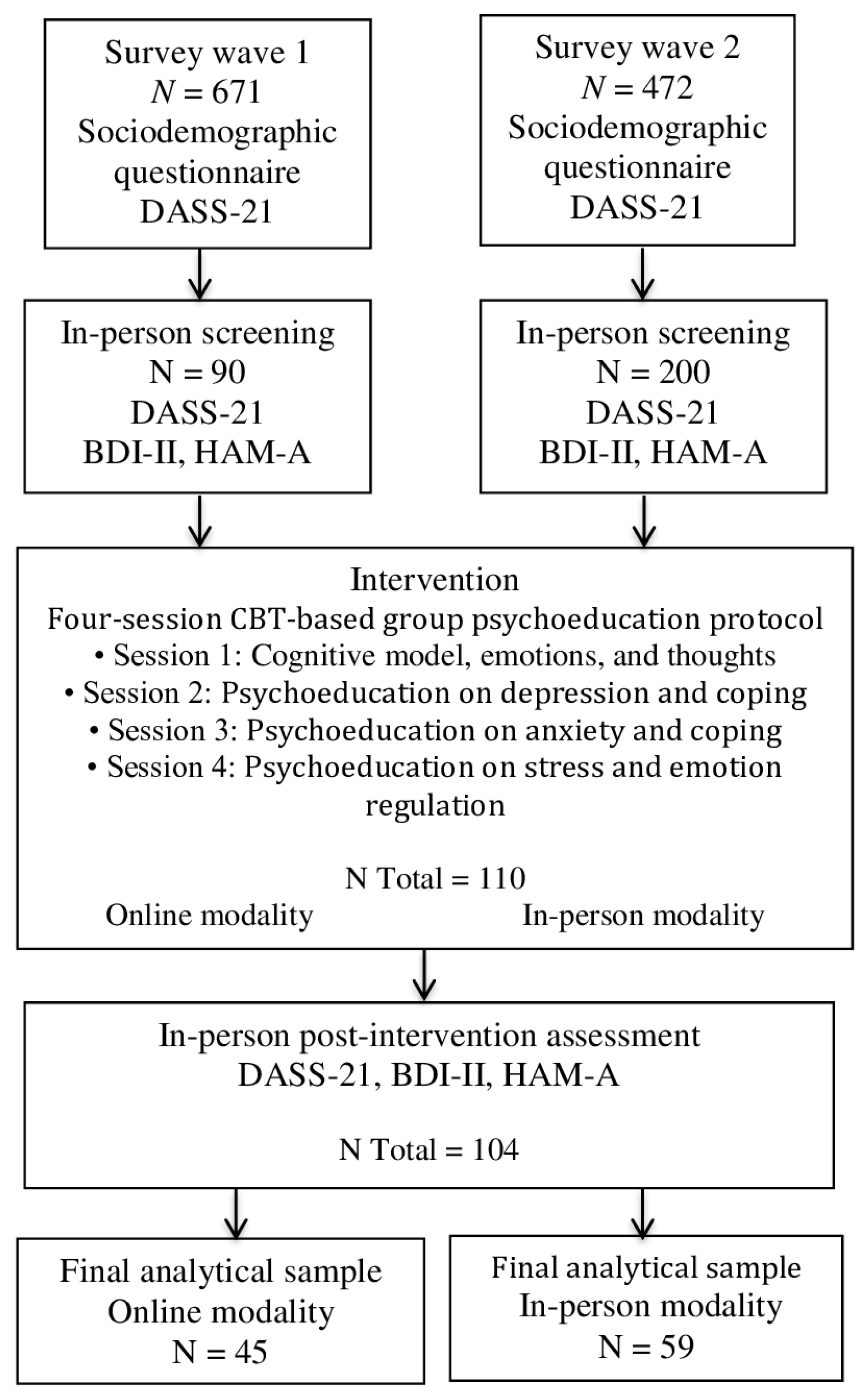
Immediately after the interview, participants completed the DASS-21 again and, for the first time, the HAM-A and BDI-II. The psychoeducational intervention began approximately one week after the pre-intervention assessment and consisted of four weekly sessions delivered over a four-week period. Of the 246 individuals assessed at this stage, 110 attended at least 75% of the sessions (minimum of three sessions). Among these, 104 participants completed the post-intervention assessments and were included in the final analytical sample (see participant flow diagram and study procedures in
Figure 1).
To minimize social desirability bias, interviews were conducted by members of the research team who were not involved in intervention delivery. All assessments (DASS-21, BDI-II, and HAM-A) were administered by trained senior undergraduate psychology students. Therapists responsible for delivering the psychoeducational groups were not involved in data collection. Assessors were blind to intervention modality (online versus in-person), although blinding to assessment time point was not feasible. Inter-rater reliability was not formally assessed.
The psychoeducational protocol was delivered using the same structure and content across both modalities: either online (via a secure link shared through a messaging platform) or in person (in a university classroom). Group allocation was determined by scheduling availability and logistical considerations rather than participant preference or randomization. Each group included up to 20 participants and was facilitated by a therapist, a co-therapist, and an observer, all trained in cognitive-behavioral therapy and group psychoeducation. Three online groups and five in-person groups were conducted. The intervention followed a structured manual developed by the authors to ensure standardization across sessions. Although no formal fidelity checklist was used, adherence to the protocol was supported through training and ongoing supervision provided by the protocol developers.
Approximately one week after completion of the final session, participants completed the DASS-21, HAM-A, and BDI-II again during individual in-person assessments. The DASS-21 was therefore collected at three time points (screening, pre-intervention, and post-intervention), while the HAM-A and BDI-II were administered at pre- and post-intervention only.
All data were fully anonymized prior to analysis, with identifiable information stored separately from research data. Although structured protocols for acute risk assessment (e.g., standardized evaluation of suicidal ideation) were not formally implemented, participants presenting clinically significant distress during screening or pre-intervention assessments were identified by trained assessors and advised to seek appropriate mental health support services within the university or public health system. Two participants presenting severe depressive symptoms during the individual interview were referred for individual psychological care at the university’s psychology training clinic. The informed consent procedure included authorization for the use of anonymized data for research purposes, and the study was approved by the institutional ethics committee.
2.5. Data Analysis
Data from the questionnaire and psychometric scales were analyzed using descriptive and inferential statistics. Descriptive analyses included frequencies, means, and standard deviations. Scale scores were calculated according to the respective scoring guidelines to obtain total scores.
Chi-square and t-tests were used to verify the equivalence of the groups assigned to the different intervention modalities immediately before the start of the psychoeducation protocol (pre-test), as well as between groups with and without a mental disorder diagnosis. The same statistical tests were used to analyze attrition bias by comparing completers and non-completers on baseline demographic and clinical variables. No data imputation method was used, so only data from participants who had all completed assessments (survey, pre- and post-test in the case of the DASS and pre- and post-test for the BDI-II and HAM-A) were used (complete case analysis).
To evaluate the effects of the intervention in the total sample, as well as by delivery modality (online vs. in-person) and the moderating effect of the presence of a mental disorder diagnosis, repeated-measures ANOVAs were conducted. The repeated-measures ANOVAs included two between-subjects factors (delivery modality: online vs. in-person, and presence of a previous mental disorder diagnosis: yes vs. no) and one within-subjects factor (time: screening, pre-intervention, and post-intervention for the DASS-21; and pre-intervention and post-intervention for the BDI-II and HAM-A). Sphericity (Mauchly’s test) was assumed for the Anxiety and Stress subscales of the DASS-21. For the depression subscale, Mauchly’s test (W = 0.933) indicated a violation of the assumption (
χ2(2) = 6.843,
p = 0.033). The Huynh–Feldt correction (ε = 0.983) was applied to adjust the ANOVA degrees of freedom. For the BDI-II and HAM-A, because the within-subjects factor included only two levels (pre and post), the assumption of sphericity is automatically satisfied. Effect sizes for the ANOVAs were estimated using partial eta squared (
ηp2), interpreted as small (0.01–0.039), medium (0.06–0.11), and large (>0.14), following Lenhard and Lenhard [
23].
3. Results
3.1. Sample Characteristics
Of the 246 individuals assessed at pre-intervention, 110 attended at least 75% of the intervention sessions, and 104 participants completed the post-intervention assessments and were included in the final analysis. Of these, 59 received the intervention in the in-person modality and 45 in the online modality.
The mean age of participants was 28 years (SD = 9.03). The majority were female (n = 70, 67.3%), undergraduate students (n = 54, 51.9%), single (n = 57, 54.8%), and reported a monthly income of up to BRL 1000 (n = 29, 27.9%). More than half of the participants (n = 57, 54.8%) reported having a mental health diagnosis. The most frequently reported conditions were anxiety (13.5%), comorbid anxiety and depression (12.5%), and depression (7.7%).
At baseline, the online and in-person groups were comparable with respect to sex distribution (χ2 = 3.358, p = 0.187) and the presence of a mental health diagnosis (χ2 = 1.761, p = 0.185). No significant differences were observed between the groups regarding age (t = 1.715, p = 0.090) or pre-intervention symptoms of depression (t = 1.064, p = 0.290), anxiety (t = 0.113, p = 0.910), and stress (t = 0.141, p = 0.884), as measured by the DASS-21. No significant differences were observed for depression assessed by the BDI-II (t = 0.477, p = 0.634) and anxiety assessed by the HAM-A (t = 0.002, p = 0.999). Similarly, participants with and without a mental health diagnosis did not differ significantly in baseline levels of depression (t = 1.749, p = 0.083), anxiety (t = 0.123, p = 0.903), or stress (t = 0.443, p = 0.659) as measured by the DASS-21, nor depression assessed by the BDI-II (t = 0.803, p = 0.424) and anxiety assessed by the HAM-A (t = 0.596, p = 0.553).
The potential for attrition bias was examined by comparing completers and non-completers on baseline demographic and clinical characteristics. No significant differences were found regarding sex distribution (χ2 = 1.193, p = 0.275) or baseline symptoms of depression, anxiety, and stress measured by the DASS-21 (all p > 0.05), suggesting that attrition was not systematically associated with these variables.
A significant difference was observed in attrition rates between intervention modalities. The online modality showed a dropout rate of 70.2% (106 dropouts out of 151 participants initially screened), whereas the in-person modality showed a dropout rate of 37.9% (36 dropouts out of 95 participants initially screened), suggesting greater challenges in participant retention and adherence in the online format.
3.2. Changes in Anxiety, Depression, and Stress According to Delivery Modality (Online vs. In-Person) and Mental Health Diagnosis
The DASS-21 was administered at three time points (screening, pre-intervention, and post-intervention) allowing the assessment of symptom trajectories over time. The repeated-measures ANOVA revealed statistically significant reductions across the three time points in severity levels for depressive (F(1.967, 196.665) = 30.268, p ≤ 0.001; ηp2 = 0.232), anxiety (F(2, 200) = 22.271, p ≤ 0.001; ηp2 = 0.182), and stress symptoms (F(2, 200) = 20.812, p ≤ 0.001; ηp2 = 0.172), with large effect sizes (ηp2 > 0.14). Symptom severity classifications shifted from moderate at baseline to mild at post-intervention.
Bonferroni comparisons revealed that all symptom domains showed reductions following the intervention compared to both screening and pre-intervention assessments. No significant differences were observed between screening and pre-intervention scores (p > 0.05), indicating that symptom severity remained stable prior to the intervention and that observed improvements were observed following the intervention period.
The analyses also examined whether symptom trajectories differed according to delivery modality (online vs. in-person) and the presence of a prior mental health diagnosis. Participants received the intervention either online (n = 45) or in person (n = 59). No significant group (modality) effect was observed for any measure, despite a marginal effect for depressive symptoms (F(1, 100) = 3.707, p = 0.057; ηp2 = 0.036).
Regarding mental health diagnosis status, a significant between-subjects effect was observed for depressive symptoms (F(1, 100) = 6.651, p = 0.011; ηp2 = 0.062), indicating that participants with a prior mental health diagnosis reported higher levels of depressive symptoms across assessment points. No significant modality × diagnosis interaction effects were observed.
A significant time × group (modality) interaction was found only for depression (F(1.967, 196.665) = 4.003,
p = 0.020;
ηp2 = 0.038), with a small effect size. Bonferroni post hoc analysis revealed that participants allocated to the in-person modality reported higher baseline severity of depressive symptoms at the screening assessment. This difference was no longer present at the pre-intervention assessment. Apart from this finding, changes over time did not differ significantly between delivery modalities. Taken together, these findings indicate that both online and in-person participants exhibited similar patterns of change in anxiety, depression, and stress symptoms. No significant time × diagnosis or time × modality × diagnosis interactions were identified for any outcome. Detailed results are presented in
Table 2.
Findings from the BDI-II and HAM-A were consistent with those observed for the DASS-21. As shown in
Table 3, a significant main effect of time was observed, with mean symptom severity decreasing from pre- to post-intervention for both the BDI-II (F(1, 100) = 49.931,
p ≤ 0.001;
ηp2 = 0.333) and the HAM-A (F(1, 100) = 49.907,
p ≤ 0.001;
ηp2 = 0.333). No significant main effects of delivery modality or prior mental health diagnosis were observed for either measure, and no significant interaction between delivery modality and prior mental health diagnosis was found. Similarly, no significant modality × time, diagnosis × time, or modality × diagnosis × time interactions were observed, indicating that changes in symptom severity did not differ according to delivery modality or prior mental health diagnosis (
p > 0.05). Accordingly, both the online and in-person groups exhibited reductions over time in depressive and anxiety symptoms, regardless of the presence or absence of a prior mental health diagnosis.
4. Discussion
The present study aimed to compare the effects of a CBT-based psychoeducational protocol delivered in group settings across online and in-person modalities on the severity of anxiety, depression, and stress symptoms. The findings showed significant reductions across all three symptom domains, with moderate to large effect sizes, with similar reductions observed in both delivery formats. However, this study did not examine moderators of treatment response or mechanisms associated with precision mental health approaches; therefore, interpretations are limited to overall symptom changes observed across modalities. These findings are consistent with the potential utility of brief, structured, group-based CBT psychoeducational interventions within stepped-care models. Reductions in symptom severity observed during the intervention period may be associated with a reduction in the risk of symptom progression, although causal inferences cannot be drawn from the present design.
Low-intensity interventions are typically characterized by features such as the use of structured materials, limited duration, and the possibility of delivery by trained non-specialists [
24]. In the present study, these characteristics were partially reflected in the use of between-session tasks provided to participants. Although each session lasted 90 min (exceeding the duration commonly described for low-intensity formats), the intervention remained focused on psychoeducation, which supports its classification as a brief CBT-based psychoeducational intervention. The extended session length can be attributed to the group-based format, which requires additional time to accommodate participant interaction and engagement. Importantly, such brief structured interventions are designed to be scalable and potentially delivered by a broader range of trained providers. While the present study was conducted by psychologists, the protocol may be adaptable to other contexts and professionals, supporting its potential for wider dissemination.
Data collection took place during 2022 and 2023, a period corresponding to the post-acute phase of the COVID-19 pandemic in Brazil. Although residual psychosocial effects of the pandemic on mental health outcomes cannot be entirely excluded, both recruitment waves were conducted under comparable institutional and academic conditions. Additionally, no meaningful differences in baseline symptom severity or sociodemographic characteristics were observed between the two waves, suggesting that participants were clinically comparable across time periods. Therefore, it is unlikely that temporal variation related to the pandemic context differentially influenced the observed outcomes or the comparison between online and in-person modalities.
Findings consistent with the present study have been reported in international research on group-based and low-intensity CBT interventions. For example, a randomized controlled trial conducted in Australia found that unguided, low-intensity CBT led to significant reductions in anxiety and depression during the COVID-19 pandemic [
25]. Similarly, a randomized controlled trial by Green et al. [
26] evaluating a group CBT protocol for perinatal anxiety showed greater reductions in anxiety and related symptoms in the intervention group compared to a waitlist control condition.
Overall, these findings suggest that psychoeducational and group-based CBT interventions, often conceptualized as low-intensity approaches, are associated with reductions in psychological symptoms. In addition to symptom improvement, such interventions may also support the development of coping skills, potentially helping to prevent symptom escalation over time. Further supporting the use of group formats, a comprehensive review by Rosendahl et al. [
27], synthesizing three decades of research on psychotherapy across a range of mental disorders, concluded that group interventions yield outcomes comparable to those of individual therapy.
In contrast, a study conducted in China examining CBT-based psychoeducation among patients with COVID-19 reported reductions in anxiety, depression, and stress symptoms in both intervention and control groups, with greater (but not statistically significant) improvements in the intervention group [
28]. Together, these findings underscore the need for further research on psychoeducational interventions across different delivery formats and populations, particularly given the mixed evidence regarding their comparative effects.
Regarding the delivery modality examined in the present study, the same psychoeducational protocol had previously been tested in a pilot sample of university students, yielding similar reductions in symptom severity with large effect sizes following four 90-min online sessions [
29]. The current study extends these preliminary findings by including a larger sample and directly comparing online and in-person delivery formats. Importantly, except for a difference in depression at screening stage, which disappeared at pre-test, no significant interaction was observed between time and group, indicating that reductions in anxiety, depression, and stress symptoms occurred similarly across both modalities. These findings suggest similar patterns of symptom change across delivery formats. However, because the study was not designed as an equivalence or non-inferiority trial, these results should not be interpreted as evidence that the two modalities are equivalent.
Despite these comparable clinical outcomes across modalities, differences in retention rates were observed and warrant consideration when interpreting the findings. The online modality showed substantially higher attrition compared to the in-person format. Although attrition analyses indicated that dropout was not associated with baseline levels of depression, anxiety, stress, or sex distribution, suggesting no evidence of systematic attrition bias, the higher dropout rate in the online group suggests greater engagement and adherence challenges in this delivery format. The absence of significant baseline differences between completers and non-completers provides some support for the robustness of the observed findings among participants who completed the protocol. These findings highlight that, although similar patterns of symptom reduction were observed across modalities, implementation factors such as participant retention may differ according to the mode of delivery and should be considered when interpreting the feasibility and scalability of online interventions.
Consistent with these findings, prior Brazilian studies have also demonstrated the potential of online CBT-based psychoeducational interventions. For example, an online group intervention targeting anxiety and stress during the COVID-19 pandemic reported reductions in anxiety symptoms and improvements in emotion regulation skills following brief sessions [
30]. Similarly, another study that adapted an in-person psychoeducational protocol to an online format found reductions in depression, anxiety, and stress symptoms, as measured by the DASS-21, along with positive qualitative feedback highlighting increased accessibility and perceived social support [
31]. Additionally, a systematic review examining synchronous internet-based CBT interventions for social anxiety disorder concluded that core components such as psychoeducation and exposure can be effectively adapted to online formats [
32]. Together, these findings reinforce the potential of digitally delivered, group-based interventions to expand access to mental health care while maintaining clinical benefits.
In the international context, the present findings are consistent with emerging evidence on online and hybrid psychoeducational interventions. A study conducted in Greece by Karagiozi et al. [
33] compared online and in-person group-based psychoeducational interventions among caregivers of individuals with dementia, assessing outcomes such as anxiety, depression, and perceived burden. Over a four-month intervention period, no significant differences were found between delivery modalities, while both formats were associated with reductions in anxiety, depression, and caregiver burden. Similarly, a Canadian study [
34] evaluated an eight-week online group-based psychoeducational intervention for university students, integrating CBT principles and mindfulness practices. The program combined synchronous and asynchronous components, including videos, discussion forums, and videoconferencing. The results indicated significant reductions in depression and anxiety symptoms, although no significant changes were observed in stress levels.
Finally, evidence regarding treatment adherence further supports the comparability of online and in-person modalities. A study conducted in Spain compared in-person and videoconferencing psychotherapy in terms of clinical outcomes, adherence, and efficiency across a sample of 174 participants. The findings indicated no significant differences in adherence between modalities, with both formats being associated with similar clinical improvements [
35]. Consistent with these findings, a systematic review and meta-analysis including 1418 participants across 20 studies concluded that online and in-person CBT produce equivalent overall effects [
6]. Together, these results reinforce the viability of digitally delivered interventions as flexible and scalable alternatives to traditional formats. The similar patterns of symptom reduction observed across modalities in the present study are consistent with the possibility that psychoeducational interventions may be adapted to different delivery formats according to accessibility and participant preferences. However, future randomized equivalence or non-inferiority studies are necessary to determine whether equivalence between delivery formats can be established.
5. Conclusions and Clinical Implications
Overall, the present findings are consistent with a growing body of literature supporting the use of brief, structured, group-based CBT-based psychoeducational interventions for reducing symptoms of anxiety, depression, and stress. As a structured and cost-effective approach, this type of intervention can be delivered by trained professionals across a range of settings, facilitating broader dissemination and scalability. Notably, the intervention consisted of only four sessions, yet the observed effect sizes ranged from moderate to large, suggesting potentially meaningful symptom reductions.
The results also indicate that the protocol was associated with moderate to large reductions in symptom severity across both delivery formats. Notably, online delivery offers additional advantages by reducing geographical barriers and expanding access to care. No statistically significant differences in symptom change were observed between delivery formats. The absence of significant differences in symptom change between delivery formats may suggest that some therapeutic group processes were maintained in the online format, such as group cohesion, social support, and a sense of belonging, although these factors were not directly assessed in the present study.
Despite these contributions, some limitations should be acknowledged. Not all assessment instruments were administered at every time point, limiting the comparability of certain measures across the study phases. Additionally, no follow-up assessment was conducted, preventing conclusions about the maintenance of treatment gains over time. The absence of a control group also limits causal inference, as the quasi-experimental pre–post design relied on within-subject comparisons. It should also be noted that participants were nested within intervention groups and facilitators; however, this clustering structure was not statistically modeled in the analyses. In this regard, the observed improvements may reflect nonspecific therapeutic factors, expectancy effects, regression to the mean, or natural symptom fluctuations. The substantial attrition observed throughout recruitment and intervention may also represent a limitation as it can indicate self-selection bias, potentially limiting generalizability.
Furthermore, adherence to between-session (homework) practice was not systematically monitored at the individual level. Although each session included a group-based review of assigned exercises, during which participants were invited to voluntarily share their experiences and engagement with the tasks, no structured or quantitative measure of homework adherence was implemented. This limits the ability to examine the extent to which variability in between-session practice may have influenced intervention outcomes.
Despite limitations, a methodological strength should also be considered. The stability observed between the screening and pre-intervention DASS-21 assessment provides evidence against simple temporal effects and strengthens the study design, even in the absence of a control group. This methodological strategy provides some support for the interpretation that the observed symptom reductions were associated with the intervention period rather solely reflecting spontaneous remission or natural recovery over time. Future studies should aim to include comprehensive assessments across all time points, incorporate follow-up evaluations, and employ controlled designs to strengthen the evidence base. Finally, further research is needed to examine the generalizability of this protocol across diverse populations and institutional contexts, including private universities and other community settings.
With caution regarding generalizations, these findings may have important implications for public health and educational settings. The implementation of group-based psychoeducational protocols may serve as an accessible entry point to mental health care, particularly in university contexts and training clinics, where demand for individual therapy often exceeds capacity. Such interventions may help reduce waiting lists and provide timely support for individuals experiencing psychological distress. The protocol may also be adapted and implemented in other contexts, including public health systems and workplace settings, further supporting its scalability and real-world applicability.