Article

Problematic Social Media Use and Mental Health: The Mediating Role of Mindfulness

1
Health Department, St. Gallen University of Teacher Education, Seminarstrasse 27, 9400 Rorschach, Switzerland
2
Media Effects Lab, University of Teacher Education NMS Bern, Nägeligasse 5/7, 3011 Bern, Switzerland
*
Author to whom correspondence should be addressed.
Psychiatry Int. 2026, 7(3), 134; https://doi.org/10.3390/psychiatryint7030134
Submission received: 11 March 2026 / Revised: 1 June 2026 / Accepted: 3 June 2026 / Published: 11 June 2026
(This article belongs to the Special Issue The Impact of Social Media on Mental Health)

Abstract

Problematic social media use is associated with adolescents’ mental health, yet mechanisms remain underexplored. This study tested whether dispositional mindfulness mediates associations between problematic social media use and symptoms of depression, anxiety, and stress. In a school-based sample of 892 students aged 10–14 years in Switzerland, participants completed an anonymous online classroom survey. Problematic social media use, mindfulness, and symptoms of depression, anxiety and stress were examined using structural equation modeling with robust maximum likelihood estimation and cluster-robust inference for nested data structure. Model fit was acceptable (CFI = 0.921; RMSEA = 0.052). PSMU predicted lower mindfulness (β = −0.50, p < 0.001), and mindfulness was negatively related to depression (β = −0.54), anxiety (β = −0.60), and stress (β = −0.63; all ps < 0.001). Indirect effects of PSMU via mindfulness were significant for all outcomes (β = 0.27–0.32, ps < 0.001). Direct effects of PSMU remained for anxiety (β = 0.18, p < 0.001) and stress (β = 0.14, p = 0.002) but not depression (β = 0.07, p = 0.161). Overall, findings suggest mindfulness might be an important pathway linking dysregulated social media engagement to adolescent distress. Longitudinal and experimental research is needed to clarify temporal ordering.

1. Introduction

The pervasive integration of social media into everyday life has introduced novel opportunities and challenges for adolescents’ mental health. Platforms such as Instagram, TikTok, and Snapchat provide adolescents with access to peers, opportunities for identity exploration, and new avenues for self-expression [1,2,3]. Yet concerns have grown about their potential to exacerbate internalizing symptoms such as depression and anxiety during a developmental period characterized by heightened socio-emotional sensitivity and ongoing identity formation [4,5]. In this context, problematic social media use (PSMU) has emerged as a particularly relevant construct for distinguishing dysregulated patterns of engagement from frequent or intensive social media use per se. This distinction is important because many adolescents use social media extensively for developmentally normative and potentially adaptive purposes, including peer affiliation, identity exploration, entertainment, and social support. Following recent conceptual work, PSMU is best understood not simply as “high use” but as a pattern of impaired self-regulation characterized by symptoms such as loss of control, preoccupation, salience, mood modification, withdrawal-like experiences, relapse, conflict, and negative consequences in everyday functioning [6,7]. At the same time, the concept should be used cautiously, as the diagnostic status of PSMU remains debated and researchers have cautioned against pathologizing common adolescent media practices [7]. Meta-analytic reviews nevertheless show that PSMU is modestly but reliably associated with mental health issues and subjective well-being [8,9]. However, these associations are far from uniform, pointing to the need for models that capture the mechanisms by which social media engagement translates into mental health outcomes. Several studies have sought to identify such mechanisms, with Fear of Missing Out (FoMO) and social comparison among the most frequently examined processes. Although closely related in social media contexts, these constructs refer to theoretically distinct mechanisms. FoMO describes an affectively charged concern that others may be having rewarding social experiences from which one is absent; it is therefore primarily anticipatory and motivational, fostering urges to remain continuously connected, monitor social updates, and avoid exclusion [10,11]. Social comparison, by contrast, refers to an evaluative cognitive process in which individuals assess their own attributes, appearance, achievements, social status, or belonging relative to others. In social media environments, such comparisons are often upward and based on selectively positive or idealized portrayals, thereby increasing vulnerability to self-criticism and negative affect [11,12,13]. Thus, FoMO may primarily explain why adolescents feel compelled to check and remain connected, whereas social comparison helps explain how the content they encounter may shape self-evaluation and emotional vulnerability.
While these pathways are important, mindfulness has received comparatively little attention as a potential mechanism. Mindfulness is commonly defined as a non-judgmental awareness of the present moment, combining attentional focus on one’s environment with acceptance-based regulation of internal states [14,15]. Although mindfulness is often measured as a dispositional characteristic, it is increasingly understood as both a momentary state and a trait-like tendency that develops through repeated states of mindful awareness. From this perspective, dispositional mindfulness does not represent a fixed personality attribute but rather the habitual availability of present-centered attention, decentering, and non-judgmental acceptance across situations [16,17]. Recurrent experiences that support sustained attention, awareness of internal states, and reflective rather than automatic responding may therefore contribute to the consolidation of mindfulness as a relatively stable self-regulatory capacity. Conversely, repeated exposure to environments that fragment attention, promote cue-reactive responding, or intensify self-evaluative affect may plausibly interfere with these developmental processes, particularly during adolescence, when attentional control and socio-emotional regulation are still maturing [4,18]. Research shows that higher mindfulness is associated with lower depression and higher well-being [16,19]. In the context of social media, problematic engagement may distract users from their immediate surroundings, fragment attentional resources, and reduce mindful awareness [20,21]. Moreover, the very design of social media platforms with infinite scrolls, notifications, and algorithmic reinforcements capitalizes on attentional vulnerabilities, promoting compulsive checking and undermining present-moment focus [22,23]. A recent meta-analysis of mindfulness and PSMU (k = 14; N = 5355) found a medium-sized association (r ≈ −0.37), but the underlying studies were predominantly cross-sectional, limiting directional inference [24]. In addition, social comparison and FoMO dynamics can foster self-judgment and evaluative rumination, processes that stand in direct opposition to the non-judgmental stance central to mindfulness [25]. Indeed, empirical evidence confirms that higher FoMO is associated with lower mindfulness, which in turn predicts greater depressive symptoms [25].
To date, however, the literature has predominantly conceptualized mindfulness as an antecedent or protective factor rather than as a potential consequence of problematic digital engagement. This emphasis is theoretically plausible, as mindfulness involves the capacity to attend to present-moment experience with openness and non-judgment, thereby supporting attentional control, emotion regulation, and reduced automatic reactivity [14,15,17,26]. Within digital media contexts, these regulatory capacities may be particularly relevant because social media platforms are designed around rapid feedback, social cues, variable rewards, and continuous opportunities for comparison and interaction. Individuals with lower mindfulness may therefore be more susceptible to cue-driven checking, affect-regulation motives, and repetitive use patterns, whereas higher mindfulness may help users notice urges to engage, tolerate discomfort or boredom, and disengage from automatic scrolling or compulsive monitoring. Empirically, this protective-factor perspective is supported by converging findings across related domains of problematic technology use. Lower dispositional mindfulness has been associated with greater vulnerability to problematic mobile phone use, nomophobia, compulsive social media use, and Facebook addiction [27,28,29,30]. Although these studies differ in samples, platforms, and specific outcome constructs, they collectively suggest that mindfulness may reduce problematic engagement through several interrelated pathways: improved self-regulation, lower social anxiety, more stable self-esteem, and reduced reliance on digital media for avoidance or affect repair. In this sense, mindfulness can be understood as a psychological resource that helps individuals remain aware of internal states and behavioral impulses before these develop into habitual or dysregulated use patterns.
At the same time, a smaller but theoretically important line of research points to the reverse possibility: problematic or highly engaging social media environments may themselves undermine mindfulness. From this perspective, dysregulated social media engagement is not only an outcome of reduced self-regulation but may also contribute to the erosion of present-centered awareness. Repetitive checking, cognitive preoccupation with online interactions, and persistent responsiveness to platform cues may fragment attention and pull users away from immediate embodied experience. Similarly, exposure to socially evaluative content may foster self-judgment, rumination, and affective reactivity, all of which are conceptually opposed to the non-judgmental and accepting stance central to mindfulness. Initial empirical evidence is consistent with this possibility. Studies examining social media addiction or intensive social media engagement have found that lower mindfulness may mediate associations with emotional exhaustion or depressive symptoms [31,32]. These findings remain limited, and most available evidence is cross-sectional, meaning that causal direction cannot yet be established. Nevertheless, they raise an important conceptual possibility for adolescent research: mindfulness may not only be a stable trait that protects against problematic use but also a self-regulatory capacity that can be weakened by dysregulated engagement with highly stimulating and socially evaluative digital environments. This possibility is particularly relevant in adolescence, when cognitive control, socio-emotional sensitivity, and identity-related self-evaluation are still developing.
Building on this emerging perspective, the present study examines mindfulness as a theoretically plausible mediator linking problematic social media use to symptoms of depression, anxiety, and stress in adolescence. Adolescents are developmentally predisposed to be especially vulnerable to attentional capture and social reinforcement due to the imbalance between socio-emotional reactivity and still-developing cognitive control [4,18]. High engagement in social media environments characterized by constant stimulation, social feedback, and comparison may therefore not only be filtered through pre-existing levels of dispositional mindfulness but may also shape the repeated attentional and affective states from which trait-like mindfulness develops. Over time, such engagement could plausibly undermine mindful awareness by reinforcing cue-reactive attention, automatic checking, and evaluative self-focus, thereby weakening self-regulation and amplifying stress reactivity. Finally, it is important to recognize that social media is not inherently harmful. Adolescents often experience positive effects, such as social connectedness, opportunities for identity exploration, and peer support, particularly among marginalized youth [1,9]. The critical distinction lies between adaptive and problematic patterns of use. By examining mindfulness as a mediator, the present study responds to recent calls for theory-driven, process-level, and developmentally sensitive research [33] and advances understanding of the psychological mechanisms by which social media may influence adolescent mental health.

2. Materials and Methods

2.1. Participants and Procedures

Participants were drawn from a larger school-based study conducted in the German-speaking part of Switzerland. The analytic sample consisted of 892 children and adolescents aged 10 to 14 years (M = 11.42, SD = 0.74). Eligibility criteria were enrolment in one of the participating classrooms, being within the target age range of the study, and provision of parental informed consent as well as student assent. Students were nested in 79 classrooms (mean cluster size k ¯ ≈ 11.29), motivating cluster-robust inference. Of the total sample, 52.9% identified as female and 47.1% as male. Regarding language spoken at home, 63.8% of participants reported speaking German or Swiss German always, 29.9% reported speaking it sometimes, and 6.3% reported never speaking German or Swiss German at home. In terms of maternal country of birth, 62.7% of mothers were born in Switzerland and 37.3% in another country. With respect to parental country of birth, 47.1% of participants had at least one parent born outside of Switzerland, while 52.9% reported that both parents were born in Switzerland. These demographic distributions are broadly consistent with population-level statistics for school-aged youth in Switzerland [34]. Data collection took place in spring 2024 using a standardized online questionnaire administered during regular class sessions. Teachers followed scripted instructions to ensure procedural consistency across schools. Informed consent was obtained from both participants and their legal guardians prior to data collection, in accordance with Swiss ethical guidelines and data protection legislation. Participation was entirely voluntary and anonymous.

2.2. Measures

Problematic social media use was assessed with the Bergen Social Media Addiction Scale (BSMAS) [35]. The BSMAS consists of six items covering the core addiction components (salience, tolerance, mood modification, relapse, withdrawal, conflict), rated on a 5-point Likert scale ranging from 1 (very rarely) to 5 (very often). The scale has demonstrated adequate reliability and construct validity in previous research with adolescent and young samples [6,35].
Dispositional mindfulness was measured using the Child and Adolescent Mindfulness Measure (CAMM) [36,37], comprising 10 items (e.g., “I get upset with myself for having certain thoughts”) rated on a 5-point Likert scale from 1 (never true) to 5 (always true). All CAMM items are negatively worded in the sense that endorsement reflects lower mindfulness, such as difficulties accepting internal experiences or remaining aware of the present moment. To facilitate interpretation and ensure that higher latent scores represented higher mindfulness, all items were reverse-coded prior to analysis. Consequently, higher values on the recoded CAMM indicate greater dispositional mindfulness, whereas lower values indicate lower mindfulness. The CAMM has demonstrated good reliability and construct validity in child and adolescent samples [36,37].
Mental Health symptoms were assessed via the German version of the Depression Anxiety Stress scales for Youth [38,39]. The scales each include seven items, each rated on a 4-point Likert scale from 0 (did not apply to me at all) to 3 (applied to me very much or most of the time). The DASS-Y has been validated in youth samples and shows good internal consistency and factorial and convergent validity [38,39].

2.3. Statistical Analysis

Before testing the structural model, all variables and cases were screened for missing values, normality, outliers, implausible values, duplicate entries, and excessive missingness on the core study variables. Because the survey was administered in supervised classroom settings using standardized instructions, no additional exclusion criteria based on response time or attention-check items were applied. No cases showed response patterns that warranted exclusion on these grounds. Missing data rates were low across all scales (0–1.0%), and Little’s MCAR test [40] indicated that data were missing completely at random (χ2(6) = 7.75, p = 0.257). Participants with occasional item-level missing values were retained in the analytic sample, and missing data were handled using full information maximum likelihood estimation in the structural equation models.
The hypothesized mediation model was tested using structural equation modeling. The model specified (a) the association between problematic social media use and mindfulness, (b) the associations between mindfulness and depression, anxiety, and stress, (c) the direct associations between problematic social media use and depression, anxiety, and stress, and (d) the indirect associations between problematic social media use and each mental health outcome via mindfulness. Data preparation and all analyses were performed using RStudio Version 2024.12.1 [41] and R 4.4.0 [42] with the lavaan package [43]. Structural models were estimated using the robust maximum likelihood (MLR) estimator. MLR was selected over the weighted least squares mean and variance adjusted (WLSMV) estimator for several methodological reasons. Although the items were measured on 4-point and 5-point Likert scales, simulation studies indicate that items with four or more categories can be treated as approximately continuous when using robust estimators such as MLR, resulting in negligible bias in parameter estimates [44]. Additionally, unlike WLSMV, MLR permits the use of full information maximum likelihood (FIML) to handle missing data under the missing at random (MAR) assumption, which yields more efficient and less biased estimates than listwise deletion or pairwise procedures [45,46]. Model fit was evaluated using multiple established indices: the Comparative Fit Index (CFI), Tucker–Lewis Index (TLI), Root Mean Square Error of Approximation (RMSEA) with 90% confidence intervals, and the Standardized Root Mean Square Residual (SRMR). Following conventional recommendations, model fit was considered acceptable when CFI and TLI values were ≥0.90, with values ≥0.95 indicating good fit; RMSEA values ≤ 0.08 were deemed acceptable, with ≤0.06 reflecting good fit; and SRMR values ≤ 0.08 were interpreted as acceptable [47]. We accounted for the nested data structure by using cluster-robust inference (students nested within classes), thereby adjusting standard errors and tests of significance for non-independence of observations. No post hoc model modifications were applied.

3. Results

3.1. Descriptive Statistics

As shown in Table 1, all study variables demonstrated adequate variability and good internal consistencies, with Cronbach’s α ranging from 0.795 to 0.936 and McDonald’s ω from 0.799 to 0.943. Mindfulness scores were moderate on average, while problematic social media use as well as symptoms of depression, anxiety and stress were generally low, as expected in this non-clinical adolescent sample. All study variables were significantly intercorrelated (see Table 1).

3.2. Structural Model and Mediation Effects

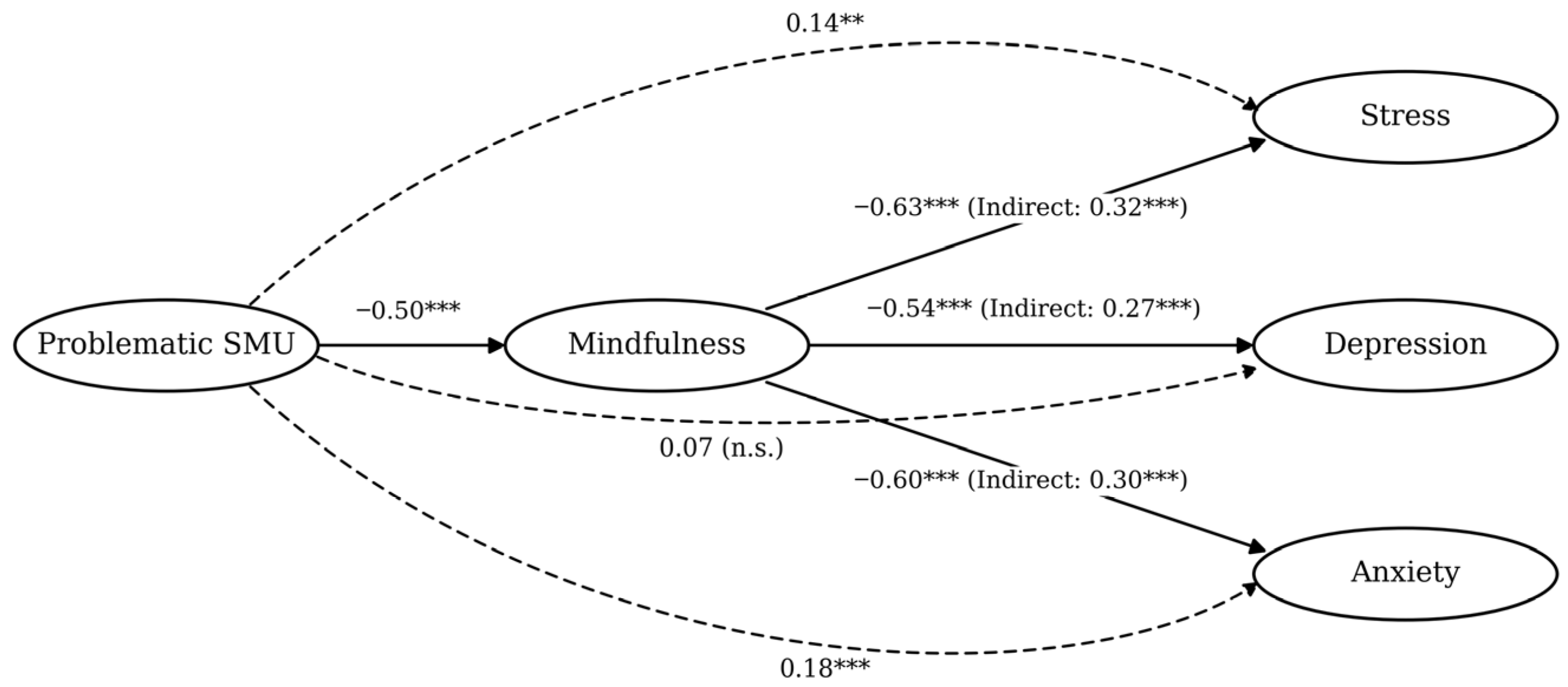
The hypothesized structural equation model demonstrated acceptable fit to the data (Yuan-Bentler scaled χ2(619) = 1560.52, p < 0.001; CFI = 0.921; TLI = 0.915; RMSEA = 0.052 (90% CI [0.049, 0.055]); SRMR = 0.057). Standardized factor loadings ranged from 0.52 to 0.79 for problematic social media use, 0.55 to 0.80 for mindfulness, 0.54 to 0.90 for depression, 0.64 to 0.84 for anxiety, and 0.69 to 0.82 for stress. As depicted in Figure 1, problematic social media use significantly predicted lower levels of mindfulness (β = −0.50, p < 0.001). In turn, mindfulness was negatively associated with stress (β = −0.63, p < 0.001), depression (β = −0.54, p < 0.001), and anxiety (β = −0.60, p < 0.001). Beyond these associations, problematic social media use showed additional direct effects on stress (β = 0.14, p = 0.002) and anxiety (β = 0.18, p < 0.001), but not on depression (β = 0.07, p = 0.161). Indirect effects of problematic social media use via mindfulness were significant for all outcomes, with standardized estimates of β = 0.32 (p < 0.001) for stress, β = 0.27 (p < 0.001) for depression, and β = 0.30 (p < 0.001) for anxiety. As depicted in Figure 1, these indirect effects are reported in parentheses alongside the respective mindfulness–outcome paths. The model explained 51% of the variance in stress, 33% in depression, and 50% in anxiety.

4. Discussion

The present study examined whether mindfulness mediates the association between problematic social media use and adolescents’ mental health symptoms. Using a large school-based sample of 10- to 14-year-olds, structural equation modeling showed that PSMU was strongly associated with lower mindfulness, and that lower mindfulness was, in turn, robustly linked to higher depression, anxiety, and stress. Indirect effects via mindfulness were significant for all outcomes, while direct effects of PSMU remained for anxiety and stress but not for depression. Overall, the findings align with process-oriented perspectives arguing that the impact of digital technology is better understood through psychological mechanisms than through global screen-time metrics alone [5,26,48].

4.1. Mindfulness as an Important Mechanism Linking PSMU to Internalizing Symptoms

A central contribution of this study is that it positions mindfulness as an explanatory pathway between PSMU and mental health symptoms in early adolescence. Mindfulness is typically conceptualized as a present-centered, non-judgmental awareness of experience that supports adaptive self-regulation [14,17]. Mechanistic accounts emphasize that mindfulness operates through improved attentional control, emotion regulation, and reduced automatic reactivity [49]. This interpretation is also consistent with state-to-trait accounts of mindfulness, which suggest that dispositional mindfulness can be shaped over time through repeated momentary states of attention, awareness, and acceptance [17]. Although the present study assessed mindfulness as a dispositional construct, the observed association between PSMU and lower mindfulness may therefore be interpreted as potentially reflecting accumulated disruptions in the attentional and emotion-regulatory states from which trait-like mindfulness develops. In this sense, problematic social media engagement may not only be filtered through pre-existing levels of mindfulness but may also interfere with the repeated practice of present-centered attention and non-judgmental awareness, contributing to the development and maintenance of dispositional mindfulness. The strong negative associations observed here between mindfulness and stress, anxiety, and depression are consistent with this theoretical framework and with broader evidence that mindfulness is reliably linked to lower psychological distress and better well-being across age groups [14,17].
Our results further indicate that PSMU is associated with lower levels of mindfulness. A plausible mechanistic interpretation is that problematic engagement interferes with two core processes through which mindfulness supports mental health: attentional control and emotion regulation. First, PSMU is characterized by salience, cognitive preoccupation, loss of control, and repeated checking, all of which may weaken sustained, self-directed attention. Social media platforms provide frequent external cues, including notifications, social feedback, algorithmically curated content, and variable rewards, that continuously invite attentional shifts. When adolescents become preoccupied with online interactions or feel compelled to monitor updates, attentional resources may be repeatedly redirected away from the present situation toward anticipated or ongoing digital stimulation. This pattern is not equivalent to a clinical attention-deficit problem, but rather reflects state-like attentional fragmentation and reduced capacity to maintain intentional focus, both of which are incompatible with mindful awareness. Second, PSMU may interfere with emotion regulation. Research on media use for coping and digital emotion regulation shows that digital technologies, including social media, are commonly used to manage affective states, reduce loneliness, and regulate boredom or stress [50,51,52,53,54]. Problematic use often involves mood modification, avoidance of unpleasant affect, fear of missing out, and heightened sensitivity to social feedback. In the short term, checking social media may therefore reduce boredom, loneliness, or uncertainty; over time, however, reliance on social media for affect regulation may limit adolescents’ opportunities to tolerate uncomfortable internal states, reappraise social stressors, or disengage from ruminative thoughts. Moreover, socially evaluative content and continuous availability demands may increase vigilance, self-comparison, and perceived pressure to respond. These processes are particularly relevant for stress and anxiety, as both are closely linked to heightened arousal, threat monitoring, and difficulties regulating uncertainty. Thus, PSMU may contribute to internalizing symptoms partly by disrupting the attentional and emotion-regulatory capacities that mindfulness normally supports.
This pattern is consistent with the idea that problematic engagement, characterized by salience, withdrawal, conflict, and loss of control, may erode present-moment awareness by fostering repetitive checking, cognitive preoccupation, and attentional fragmentation [35,55]. In adjacent research on media multitasking, heavier multitasking has been linked to greater distractibility and reduced filtering of irrelevant information, suggesting that persistent engagement with multiple streams of digital content can be associated with a less selective attentional style [21]. Although media multitasking is not identical to PSMU, some studies converge on the idea that digitally driven attentional capture can undermine sustained attention, an important foundation of mindfulness [21,49].
In addition, conceptual work highlights that certain platform features (e.g., “like” feedback, infinite feeds, push notifications) may foster habitual, cue-driven use patterns that compete with mindful engagement [20,22]. From this view, repeated exposure to highly reinforcing digital environments could gradually shift attention away from embodied, present-centered experience toward externally cued, reward-oriented checking routines, precisely the kind of attentional and self-regulatory pattern that mindfulness theories would predict to be detrimental for emotional well-being [17,49].

4.2. Why Direct Effects Remained for Anxiety and Stress (But Not Depression)

Beyond the indirect pathway, PSMU retained small but significant direct associations with stress and anxiety, whereas the direct path to depression was non-significant. One interpretation is that anxiety and stress may be more proximally affected by everyday social media dynamics, including constant social availability, heightened social-evaluative concerns, and perceived pressure to respond [5,56]. Indeed, adolescent stress reactivity is sensitive to peer evaluation and social demands, which are salient in online interaction contexts [57,58]. In contrast, depressive symptoms may emerge more indirectly and may depend more strongly on downstream processes such as sustained rumination, learned helplessness, or enduring social withdrawal, pathways that could be partly captured here through the mindfulness mechanism [14,49].

4.3. Integrating the Findings with Existing Social Media and Well-Being Research

The broader literature generally shows small-to-modest links between social media variables and adolescent well-being, with substantial heterogeneity across individuals and contexts [5,48,59]. Our results help explain such heterogeneity by indicating that PSMU may affect mental health partly by depleting a self-regulatory resource (mindfulness) that is strongly protective against internalizing symptoms [17,49]. This fits with perspectives emphasizing that digital effects depend on how adolescents engage (e.g., compulsive vs. intentional use), rather than the mere presence of digital technology [26,48]. Importantly, the present study operationalized PSMU via a validated addiction-component framework [6,55], which may be particularly relevant for understanding mental health risk compared to general frequency or duration measures. Prior work on problematic Facebook use similarly distinguishes between normative use and dysregulated patterns, with problematic forms showing clearer links to well-being outcomes [60]. In this sense, our findings strengthen the argument that focusing on problematic, loss-of-control patterns can yield more clinically meaningful insights into adolescent mental health than focusing on time-based indicators alone [5,48].

4.4. Practical Implications: Mindfulness as an Intervention Target in Digital Contexts

Because mindfulness was modeled as a mediator, the applied implications differ from accounts that treat mindfulness primarily as an antecedent of problematic use. The found pattern is most consistent with a self-regulatory erosion interpretation, but this should not be understood as an attention-deficit problem in the clinical sense. Rather, compulsive social media use may reduce mindfulness through a combination of attentional capture, cognitive preoccupation, and emotion-regulatory depletion. Repeated checking and responsiveness to platform cues can impose a continuous cognitive load, as adolescents must repeatedly shift attention between offline demands and online social information. At the same time, preoccupation with notifications, peer feedback, or missed interactions may keep social media mentally active even when the device is not being used. This persistent cue-reactivity leaves fewer cognitive resources for present-moment awareness, decentering, and reflective self-regulation. In parallel, using social media to manage boredom, stress, loneliness, or social uncertainty may weaken opportunities to practice adaptive emotion regulation. In this sense, mindfulness may become “exhausted” not because adolescents lack attentional capacity in general, but because problematic use repeatedly recruits attention and affect regulation in ways that undermine intentional awareness and non-judgmental acceptance. Accordingly, mindfulness-based approaches are best conceptualized here not only as a tool to prevent PSMU, but as a plausible secondary-prevention lever: strengthening mindful attention and acceptance may help interrupt the possible downstream cascade from PSMU to distress by restoring regulatory capacity in adolescents already experiencing dysregulated use patterns. School-based mindfulness interventions have shown small-to-moderate benefits for youth stress-related outcomes and socio-emotional functioning [19,61], and, under the present model, could also be framed as buffering the mental-health consequences of problematic digital engagement rather than simply discouraging use.
At the same time, the mediator framing suggests that prevention may need to extend beyond individual coping skills alone. If problematic engagement can weaken mindful awareness, it may also be useful to consider the digital conditions that foster attentional capture, such as intrusive notifications, infinite scrolling, autoplay functions, salient social feedback, and engagement-optimized recommender systems [20,22,23]. From this perspective, mindfulness-based approaches and platform-level considerations are not mutually exclusive. Individual-level interventions may help adolescents recognize urges to check, respond more reflectively to social feedback, and disengage from automatic scrolling, whereas design-level changes could potentially reduce the frequency and intensity of cues that promote repetitive, cue-reactive use. Accordingly, the present findings do not imply that responsibility should rest solely with adolescents. Rather, they suggest that digital well-being may be supported most effectively when individual self-regulatory skills are complemented by environments that make intentional engagement easier. Future research should therefore examine whether reducing intrusive prompts, increasing friction around repetitive checking, or providing more meaningful options to pause algorithmically curated feeds can help preserve adolescents’ attentional and emotion-regulatory resources. Broader platform-level and policy approaches may thus represent relevant downstream implications of this line of research, although the present cross-sectional findings cannot determine which specific design or governance strategies would be most effective. Finally, debates and interventions should not imply that social media is uniformly harmful. Reviews emphasize that social network sites can also provide social support and opportunities for connection [26,48]. Thus, the most constructive application of the present findings may be to promote intentional and mindful engagement (e.g., noticing urges to check, recognizing emotional triggers, reducing autopilot scrolling) rather than advocating abstinence [14,49].

4.5. Limitations and Future Directions

Several limitations warrant consideration. First, the cross-sectional design precludes causal inference and is particularly restrictive for mediation claims. Cross-sectional indirect effects can be biased and may emerge even when the true temporal ordering differs (e.g., mindfulness → PSMU → distress) or when reciprocal processes operate, which is plausible given theories of self-regulation and attentional control [17,49]. Future research should therefore test competing causal graphs using longitudinal designs with at least three waves and within-person approaches (e.g., random-intercept cross-lagged models, intensive longitudinal/EMA designs) to separate stable between-person differences from dynamic within-person couplings [5,59]. Complementary experimental or quasi-experimental work manipulating attention-capture features (e.g., notification schedules) would further strengthen causal interpretation. Second, all constructs were assessed via self-report, which may inflate associations due to shared method variance and response styles. Although latent modeling and differentiated direct effects mitigate this concern to some extent, future studies should triangulate with objective digital-trace indicators (e.g., logged app use, notification frequency) and behavioral measures of attention or inhibitory control [21,48]. Third, unmeasured confounding remains possible (e.g., trait negative affectivity, self-control/ADHD symptoms, family stress, sleep), underscoring the need for longitudinal designs with baseline adjustment and sensitivity analyses (e.g., robustness checks for omitted-variable bias) to strengthen causal interpretation. Finally, the sample was drawn from a specific regional and cultural context (German-speaking Switzerland), and findings may not generalize to older adolescents, other cultural settings, or clinical populations. Replications across contexts and developmental stages are needed, particularly because digital platform norms and adolescent social media practices vary across countries and cohorts [5,48].

5. Conclusions

In sum, the present findings suggest that mindfulness might be a pathway linking problematic social media use to depression, anxiety, and stress in early adolescence. By highlighting mindfulness as a potentially erodible resource in the context of PSMU, the study contributes to mechanism-focused accounts of digital well-being and identifies promising leverage points for prevention and digital health interventions [19,61]. Future longitudinal and experimental research is needed to clarify directionality and to determine whether strengthening mindfulness can buffer adolescents against the mental health risks associated with problematic social media engagement [14,49].

Author Contributions

Conceptualization, F.K. and A.N.; methodology, F.K. and A.N.; software, F.K. and A.N.; validation, F.K. and A.N.; formal analysis, F.K. and A.N.; investigation, F.K. and A.N.; resources, F.K. and A.N.; data curation, F.K. and A.N.; writing—original draft preparation, F.K.; writing—review and editing, F.K. and A.N.; visualization, F.K.; supervision, A.N.; project administration, A.N. All authors have read and agreed to the published version of the manuscript.

Funding

This research received no external funding.

Institutional Review Board Statement

The study was conducted in accordance with the Declaration of Helsinki. The study protocol was reviewed by the Institutional Review Board (ethics body) of the University of Teacher Education NMS Bern, which confirmed that the project is exempt from mandatory approval by a cantonal research ethics committee under Swiss law because it was designed as an anonymous, non-interventional survey study, with no collection of biological material. In accordance with the Swiss Federal Act on Research involving Human Beings (Human Research Act; HRA, SR 810.30), research involving anonymously collected or anonymized health-related data is outside the scope of the Act; therefore, no official protocol code/approval number is issued for this category of research.

Informed Consent Statement

Informed consent was obtained from participants’ parents/legal guardians, and assent was obtained from the children.

Data Availability Statement

The data are subject to a temporary embargo because additional analyses and planned publications by the study team are ongoing. During the embargo period, the dataset is not publicly available. Data, codebook, and analysis scripts may be made available to qualified researchers upon reasonable request, subject to a data use agreement (including purpose limitation). The embargo will be lifted after completion of the study team’s planned publications (anticipated: 31 December 2029).

Conflicts of Interest

The authors declare no conflicts of interest.

References

  1. Marciano, L.; Ostroumova, M.; Schulz, P.J.; Camerini, A.-L. Digital media use and adolescents’ mental health during the COVID-19 pandemic: A systematic review and meta-analysis. Front. Public Health 2022, 9, 793868. [Google Scholar] [CrossRef]
  2. Agyapong-Opoku, N.; Agyapong-Opoku, F.; Greenshaw, A.J. Effects of social media use on youth and adolescent mental health: A scoping review of reviews. Behav. Sci. 2025, 15, 574. [Google Scholar] [CrossRef]
  3. Kross, E.; Verduyn, P.; Sheppes, G.; Costello, C.K.; Jonides, J.; Ybarra, O. Social media and well-being: Pitfalls, progress, and next steps. Trends Cogn. Sci. 2021, 25, 55–66. [Google Scholar] [CrossRef] [PubMed]
  4. Casey, B.J.; Heller, A.S.; Gee, D.G.; Cohen, A.O. Development of the emotional brain. Neurosci. Lett. 2019, 693, 29–34. [Google Scholar] [CrossRef] [PubMed]
  5. Orben, A. Teenagers, screens and social media: A narrative review of reviews and key studies. Soc. Psychiatry Psychiatr. Epidemiol. 2020, 55, 407–414. [Google Scholar] [CrossRef] [PubMed]
  6. Andreassen, C.S.; Billieux, J.; Griffiths, M.D.; Kuss, D.J.; Demetrovics, Z.; Mazzoni, E.; Pallesen, S. The relationship between addictive use of social media and video games and symptoms of psychiatric disorders: A large-scale cross-sectional study. Psychol. Addict. Behav. 2016, 30, 252–262. [Google Scholar] [CrossRef]
  7. Montag, C.; Demetrovics, Z.; Elhai, J.D.; Grant, D.; Koning, I.; Rumpf, H.-J.; Spada, M.M.; Throuvala, M.; van den Eijnden, R. Problematic social media use in childhood and adolescence. Addict. Behav. 2024, 153, 107980. [Google Scholar] [CrossRef] [PubMed]
  8. Huang, C. A meta-analysis of the problematic social media use and mental health. Int. J. Soc. Psychiatry 2022, 68, 12–33. [Google Scholar] [CrossRef]
  9. Marciano, L.; Lin, J.; Sato, T.; Saboor, S.; Viswanath, K. Does social media use make us happy? A meta-analysis on social media and positive well-being outcomes. SSM—Ment. Health 2024, 6, 100331. [Google Scholar] [CrossRef]
  10. Dempsey, A.E.; O’Brien, K.D.; Tiamiyu, M.F.; Elhai, J.D. Fear of missing out (FoMO) and rumination mediate relations between social anxiety and problematic Facebook use. Addict. Behav. Rep. 2019, 9, 100150. [Google Scholar] [CrossRef]
  11. Reer, F.; Tang, W.Y.; Quandt, T. Psychosocial well-being and social media engagement: The mediating roles of social comparison orientation and fear of missing out. New Media Soc. 2019, 21, 1486–1505. [Google Scholar] [CrossRef]
  12. Nesi, J.; Prinstein, M.J. Using social media for social comparison and feedback-seeking: Gender and popularity moderate associations with depressive symptoms. J. Abnorm. Child Psychol. 2015, 43, 1427–1438. [Google Scholar] [CrossRef] [PubMed]
  13. McComb, C.A.; Gobin, K.C.; Mills, J.S. The effects of social media exposure to upward comparison targets on self-evaluations and emotions: A meta-analysis. Media Psychol. 2023, 26, 612–635. [Google Scholar] [CrossRef]
  14. Kabat-Zinn, J. Mindfulness-based interventions in context: Past, present, and future. Clin. Psychol. Sci. Pract. 2003, 10, 144–156. [Google Scholar] [CrossRef]
  15. Keng, S.-L.; Smoski, M.J.; Robins, C.J. Effects of mindfulness on psychological health: A review of empirical studies. Clin. Psychol. Rev. 2011, 31, 1041–1056. [Google Scholar] [CrossRef] [PubMed]
  16. Brown, K.W.; Ryan, R.M. The benefits of being present: Mindfulness and its role in psychological well-being. J. Personal. Soc. Psychol. 2003, 84, 822–848. [Google Scholar] [CrossRef]
  17. Brown, K.W.; Ryan, R.M.; Creswell, J.D. Mindfulness: Theoretical foundations and evidence. Psychol. Inq. 2007, 18, 211–237. [Google Scholar] [CrossRef]
  18. Steinberg, L. A social neuroscience perspective on adolescent risk-taking. Dev. Rev. 2008, 28, 78–106. [Google Scholar] [CrossRef]
  19. Zoogman, S.; Goldberg, S.B.; Hoyt, W.T.; Miller, L. Mindfulness interventions with youth: A meta-analysis. Mindfulness 2015, 6, 290–302. [Google Scholar] [CrossRef]
  20. Montag, C.; Diefenbach, S. Towards Homo Digitalis: Important research issues for psychology and the neurosciences at the dawn of the Internet of Things and the digital society. Sustainability 2018, 10, 415. [Google Scholar] [CrossRef]
  21. Ophir, E.; Nass, C.; Wagner, A.D. Cognitive control in media multitaskers. Proc. Natl. Acad. Sci. USA 2009, 106, 15583–15587. [Google Scholar] [CrossRef] [PubMed]
  22. Montag, C.; Hegelich, S. Understanding detrimental aspects of social media use: Will the real culprits please stand up? Front. Sociol. 2020, 5, 599270. [Google Scholar] [CrossRef]
  23. Sindermann, C.; Montag, C.; Elhai, J.D. The design of social media platforms—Initial evidence on relations between personality, fear of missing out, design element-driven increased social media use, and problematic social media use. Technol. Mind Behav. 2022, 3, 524–538. [Google Scholar] [CrossRef]
  24. Meynadier, J.; Malouff, J.M.; Loi, N.M.; Schutte, N.S. Lower mindfulness is associated with problematic social media use: A meta-analysis. Curr. Psychol. 2024, 43, 3395–3404. [Google Scholar] [CrossRef]
  25. Baker, Z.G.; Krieger, H.; LeRoy, A.S. Fear of missing out: Relationships with depression, mindfulness, and physical symptoms. Transl. Issues Psychol. Sci. 2016, 2, 275–282. [Google Scholar] [CrossRef]
  26. Verduyn, P.; Ybarra, O.; Résibois, M.; Jonides, J.; Kross, E. Do social network sites enhance or undermine well-being? A critical review. Soc. Issues Policy Rev. 2017, 11, 274–302. [Google Scholar] [CrossRef]
  27. Volkmer, S.A.; Lermer, E. Unhappy and addicted to your phone?—Higher mobile phone use is associated with lower well-being. Comput. Hum. Behav. 2019, 93, 210–218. [Google Scholar] [CrossRef]
  28. Arpaci, I.; Baloğlu, M.; Özteke Kozan, H.İ.; Kesici, Ş. Individual differences in the relationship between attachment and nomophobia among college students: The mediating role of mindfulness. J. Med. Internet Res. 2017, 19, e404. [Google Scholar] [CrossRef]
  29. Apaolaza, V.; Hartmann, P.; D’Souza, C.; Gilsanz, A. Mindfulness, compulsive mobile social media use, and derived stress: The mediating roles of self-esteem and social anxiety. Cyberpsychol. Behav. Soc. Netw. 2019, 22, 388–396. [Google Scholar] [CrossRef]
  30. Eşkisu, M.; Çam, Z.; Gelibolu, S.; Rasmussen, K.R. Trait mindfulness as a protective factor in connections between psychological issues and Facebook addiction among Turkish university students. Stud. Psychol. 2020, 62, 213–231. [Google Scholar] [CrossRef]
  31. Sriwilai, K.; Charoensukmongkol, P. Face it, don’t Facebook it: Impacts of social media addiction on mindfulness, coping strategies and the consequence on emotional exhaustion. Stress Health 2016, 32, 427–434. [Google Scholar] [CrossRef]
  32. Jones, A.; Hook, M.; Podduturi, P.; McKeen, H.; Beitzell, E.; Liss, M. Mindfulness as a mediator in the relationship between social media engagement and depression in young adults. Personal. Individ. Differ. 2022, 185, 111284. [Google Scholar] [CrossRef]
  33. Valkenburg, P.M.; Beyens, I.; Pouwels, J.L.; van Driel, I.I.; Keijsers, L. Social media browsing and adolescent well-being: Challenging the “passive social media use hypothesis”. J. Comput.-Mediat. Commun. 2022, 27, zmab015. [Google Scholar] [CrossRef]
  34. Federal Statistical Office (FSO). Population by Migration Status. Available online: https://www.bfs.admin.ch/bfs/en/home/statistics/population/migration-integration/by-migration-status.html (accessed on 1 May 2026).
  35. Andreassen, C.S.; Torsheim, T.; Brunborg, G.S.; Pallesen, S. Development of a Facebook addiction scale. Psychol. Rep. 2012, 110, 501–517. [Google Scholar] [CrossRef]
  36. Greco, L.A.; Baer, R.A.; Smith, G.T. Assessing mindfulness in children and adolescents: Development and validation of the Child and Adolescent Mindfulness Measure (CAMM). Psychol. Assess. 2011, 23, 606–614. [Google Scholar] [CrossRef] [PubMed]
  37. de Bruin, E.I.; Zijlstra, B.J.; Bögels, S.M. The meaning of mindfulness in children and adolescents: Further validation of the Child and Adolescent Mindfulness Measure (CAMM) in two independent samples from the Netherlands. Mindfulness 2014, 5, 422–430. [Google Scholar] [CrossRef]
  38. Szabo, M.; Lovibond, P.F. Development and psychometric properties of the DASS-youth (DASS-Y): An extension of the Depression Anxiety Stress Scales (DASS) to adolescents and children. Front. Psychol. 2022, 13, 766890. [Google Scholar] [CrossRef] [PubMed]
  39. Kruse, F.; Nagel, A.; Bermudez, T.; Nabi, R. The German Depression Anxiety Stress Scales for Youth (DASS-Y): Structure, Convergent Validity, and Measurement Invariance by Gender, Age, and Language (German-English). SSRN 2026. Available online: https://papers.ssrn.com/sol3/papers.cfm?abstract_id=6255658 (accessed on 1 May 2026).
  40. Little, R.J.A. A test of missing completely at random for multivariate data with missing values. J. Am. Stat. Assoc. 1988, 83, 1198–1202. [Google Scholar] [CrossRef]
  41. RStudio. Integrated Development Environment for R; Posit Software, PBC: Boston, MA, USA, 2025. [Google Scholar]
  42. R Core Team. R: A Language and Environment for Statistical Computing; R Foundation for Statistical Computing: Vienna, Austria, 2024; Available online: https://www.R-project.org/ (accessed on 1 May 2026).
  43. Rosseel, Y. lavaan: An R package for structural equation modeling. J. Stat. Softw. 2012, 48, 1–36. [Google Scholar] [CrossRef]
  44. Rhemtulla, M.; Brosseau-Liard, P.É.; Savalei, V. When can categorical variables be treated as continuous? Psychol. Methods 2012, 17, 354–373. [Google Scholar] [CrossRef]
  45. Enders, C.K.; Bandalos, D.L. The relative performance of full information maximum likelihood estimation for missing data in structural equation models. Struct. Equ. Model. 2001, 8, 430–457. [Google Scholar] [CrossRef] [PubMed]
  46. Asparouhov, T.; Muthén, B. Weighted Least Squares Estimation with Missing Data (Technical Appendix); Muthén & Muthén: Los Angeles, CA, USA, 2010; Available online: https://www.statmodel.com/download/GstrucMissingRevision.pdf (accessed on 1 May 2026).
  47. Hu, L.-T.; Bentler, P.M. Cutoff criteria for fit indexes in covariance structure analysis: Conventional criteria versus new alternatives. Struct. Equ. Model. 1999, 6, 1–55. [Google Scholar] [CrossRef]
  48. Dienlin, T.; Johannes, N. The impact of digital technology use on adolescent well-being. Dialogues Clin. Neurosci. 2020, 22, 135–142. [Google Scholar] [CrossRef] [PubMed]
  49. Hölzel, B.K.; Lazar, S.W.; Gard, T.; Schuman-Olivier, Z.; Vago, D.R.; Ott, U. How does mindfulness meditation work? Proposing mechanisms of action from a conceptual and neural perspective. Perspect. Psychol. Sci. 2011, 6, 537–559. [Google Scholar] [CrossRef]
  50. Hollenstein, T.; Faulkner, K. Adolescent digital emotion regulation. J. Res. Adolesc. 2024, 34, 1341–1351. [Google Scholar] [CrossRef]
  51. Scott, R.A.; Zimmer-Gembeck, M.J.; Gardner, A.A.; Hawes, T.; Modecki, K.L.; Duffy, A.L.; Farrell, L.J.; Waters, A.M. Daily use of digital technologies to feel better: Adolescents’ digital emotion regulation, emotions, loneliness, and recovery, considering prior emotional problems. J. Adolesc. 2024, 96, 539–550. [Google Scholar] [CrossRef] [PubMed]
  52. Shi, Y.; Koval, P.; Kostakos, V.; Goncalves, J.; Wadley, G. “Instant Happiness”: Smartphones as tools for everyday emotion regulation. Int. J. Hum.-Comput. Stud. 2023, 170, 102958. [Google Scholar] [CrossRef]
  53. Wadley, G.; Smith, W.; Koval, P.; Gross, J.J. Digital emotion regulation. Curr. Dir. Psychol. Sci. 2020, 29, 412–418. [Google Scholar] [CrossRef]
  54. Wolfers, L.N.; Schneider, F.M. Using media for coping: A scoping review. Commun. Res. 2021, 48, 1210–1234. [Google Scholar] [CrossRef]
  55. Griffiths, M.D.; Kuss, D.J.; Demetrovics, Z. Social networking addiction: An overview of preliminary findings. In Behavioral Addictions: Criteria, Evidence, and Treatment; Rosenberg, K.P., Feder, L.C., Eds.; Academic Press: San Diego, CA, USA, 2014; pp. 119–141. [Google Scholar] [CrossRef]
  56. Keles, B.; McCrae, N.; Grealish, A. A systematic review: The influence of social media on depression, anxiety and psychological distress in adolescents. Int. J. Adolesc. Youth 2020, 25, 79–93. [Google Scholar] [CrossRef]
  57. Blakemore, S.-J.; Mills, K.L. Is adolescence a sensitive period for sociocultural processing? Annu. Rev. Psychol. 2014, 65, 187–207. [Google Scholar] [CrossRef]
  58. Crone, E.A.; Dahl, R.E. Understanding adolescence as a period of social–affective engagement and goal flexibility. Nat. Rev. Neurosci. 2012, 13, 636–650. [Google Scholar] [CrossRef]
  59. Orben, A.; Dienlin, T.; Przybylski, A.K. Social media’s enduring effect on adolescent life satisfaction. Proc. Natl. Acad. Sci. USA 2019, 116, 10226–10228. [Google Scholar] [CrossRef] [PubMed]
  60. Marino, C.; Gini, G.; Vieno, A.; Spada, M.M. The associations between problematic Facebook use, psychological distress and well-being among adolescents and young adults: A systematic review and meta-analysis. J. Affect. Disord. 2018, 226, 274–281. [Google Scholar] [CrossRef]
  61. Dunning, D.L.; Griffiths, K.; Kuyken, W.; Crane, C.; Foulkes, L.; Parker, J.; Dalgleish, T. The effects of mindfulness-based interventions on cognition and mental health in children and adolescents: A meta-analysis of randomized controlled trials. J. Child Psychol. Psychiatry 2019, 60, 244–258. [Google Scholar] [CrossRef] [PubMed]
Figure 1. Structural equation model linking problematic social media use, mindfulness, and symptoms of depression, anxiety, and stress. Standardized coefficients are shown. Solid arrows represent the indirect mediation pathway via mindfulness, whereas dashed arrows represent direct effects of problematic social media use on the mental health outcomes. Indirect effects of problematic social media use via mindfulness are presented in parentheses next to the corresponding mindfulness–outcome paths. ** p < 0.01, *** p < 0.001; n.s. = not significant.
Psychiatryint 07 00134 g001
Table 1. Descriptive Statistics, Internal Consistencies, and Intercorrelations of Study Variables.
VariableMSDαω12345
BSMAS1.510.520.7950.799
CAMM2.351.110.9220.929−0.44 ***
Depression1.310.570.9360.9430.30 ***−0.54 ***
Anxiety1.460.650.9200.9270.40 ***−0.62 ***0.66 ***
Stress1.740.730.9230.9290.40 ***−0.64 ***0.60 ***0.68 ***
*** p < 0.001.
Disclaimer/Publisher’s Note: The statements, opinions and data contained in all publications are solely those of the individual author(s) and contributor(s) and not of MDPI and/or the editor(s). MDPI and/or the editor(s) disclaim responsibility for any injury to people or property resulting from any ideas, methods, instructions or products referred to in the content.