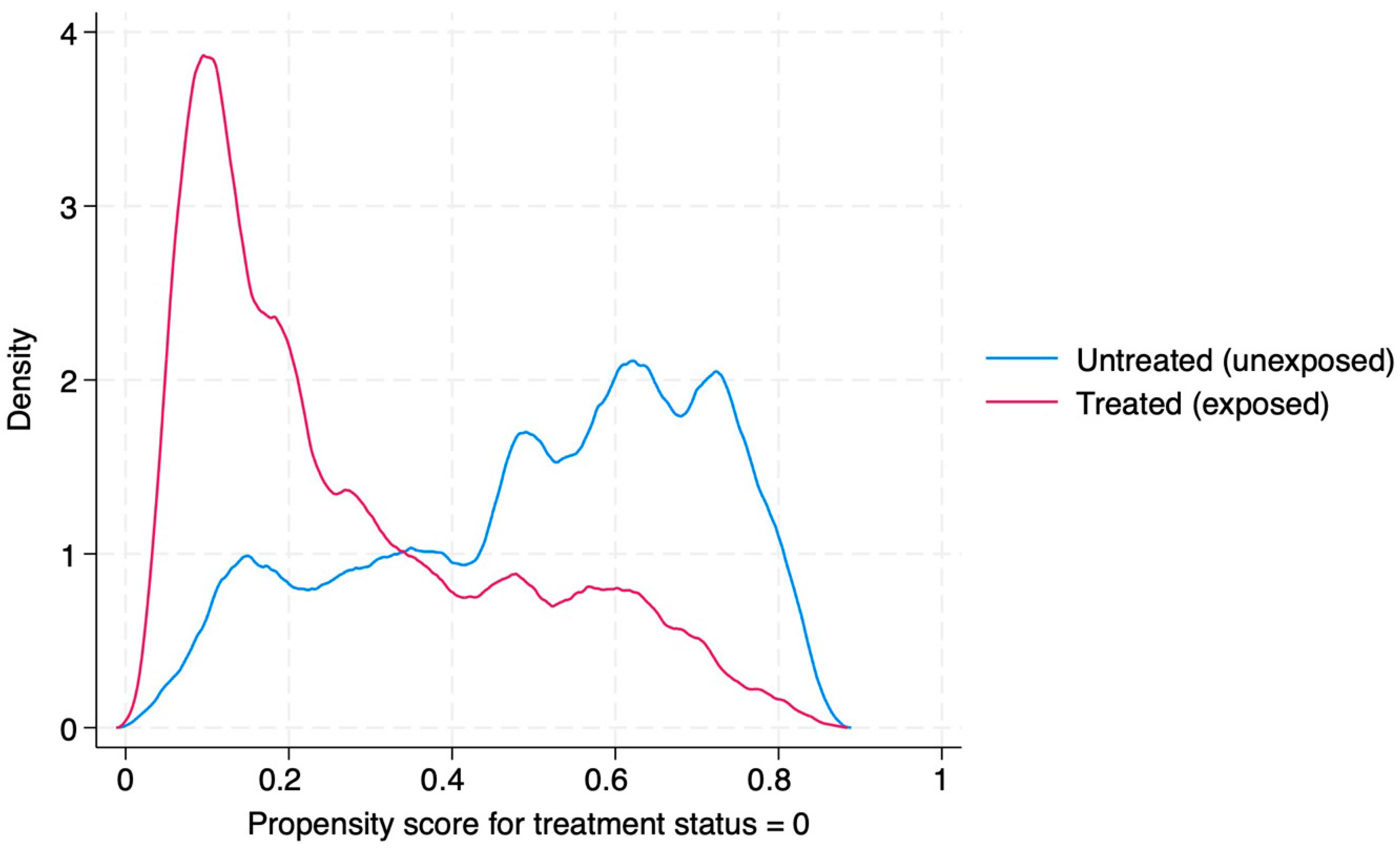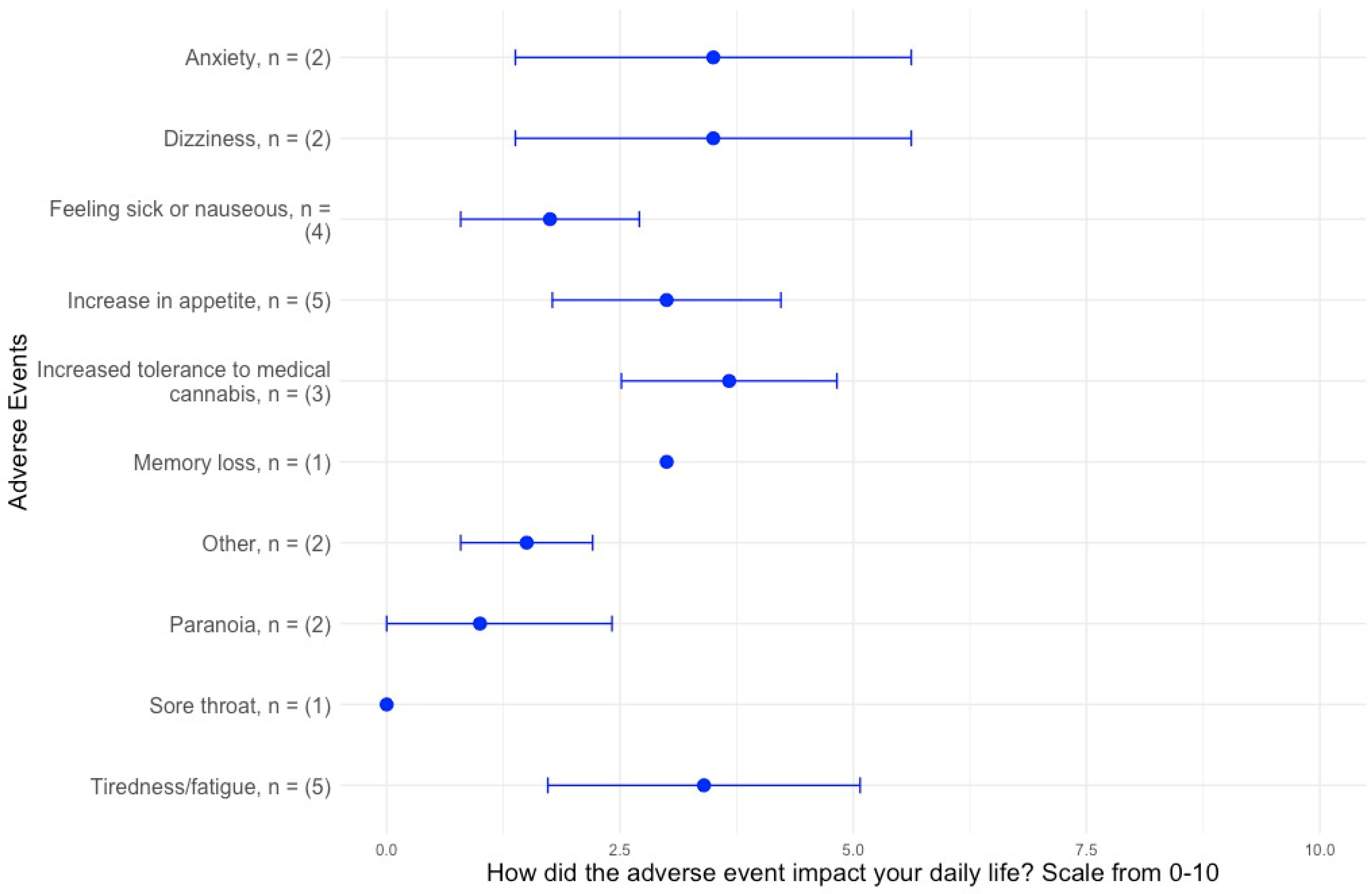


Impact of Medical Cannabis Treatment on Healthcare Utilization Among PTSD Patients: A Retrospective Cohort Study


Abstract
1. Introduction
1.1. Medical Cannabis and PTSD
1.2. Current Contribution
2. Methods
2.1. Exposure and Outcome Data
2.2. Covariates
2.3. Statistical Approach
3. Results
4. Discussion
4.1. Limitations
4.2. Implications for Clinical and Academic Practice
4.3. Conclusions
Author Contributions
Funding
Institutional Review Board Statement
Informed Consent Statement
Data Availability Statement
Conflicts of Interest
References
- National Center for PTSD. How Common Is PTSD in Adults? Available online: https://www.ptsd.va.gov/understand/common/common_adults.asp (accessed on 9 September 2024).
- Bryant, R.A. Post-Traumatic Stress Disorder: A State-of-the-Art Review of Evidence and Challenges. World Psychiatry 2019, 18, 259–269. [Google Scholar] [CrossRef]
- Pacella, M.L.; Hruska, B.; Delahanty, D.L. The Physical Health Consequences of PTSD and PTSD Symptoms: A Meta-Analytic Review. J. Anxiety Disord. 2013, 27, 33–46. [Google Scholar] [CrossRef]
- Marciniak, M.D.; Lage, M.J.; Dunayevich, E.; Russell, J.M.; Bowman, L.; Landbloom, R.P.; Levine, L.R. The Cost of Treating Anxiety: The Medical and Demographic Correlates That Impact Total Medical Costs. Depress. Anxiety 2005, 21, 178–184. [Google Scholar] [CrossRef]
- Elhai, J.D.; North, T.C.; Frueh, B.C. Health Service Use Predictors among Trauma Survivors: A Critical Review. Psychol. Serv. 2005, 2, 3–19. [Google Scholar] [CrossRef]
- Kartha, A.; Brower, V.; Saitz, R.; Samet, J.H.; Keane, T.M.; Liebschutz, J. The Impact of Trauma Exposure and Post-Traumatic Stress Disorder on Healthcare Utilization Among Primary Care Patients. Med. Care 2008, 46, 388–393. [Google Scholar] [CrossRef] [PubMed]
- Polusny, M.A.; Ries, B.J.; Schultz, J.R.; Calhoun, P.; Clemensen, L.; Johnsen, I.R. PTSD Symptom Clusters Associated with Physical Health and Health Care Utilization in Rural Primary Care Patients Exposed to Natural Disaster. J. Trauma. Stress 2008, 21, 75–82. [Google Scholar] [CrossRef]
- Jadhakhan, F.; Evans, D.W.; Falla, D. The Role of Post-Trauma Stress Symptoms in the Development of Chronic Musculoskeletal Pain and Disability: A Systematic Review. Eur. J. Pain 2023, 27, 183–200. [Google Scholar] [CrossRef] [PubMed]
- Goldstein, E.; McDonnell, C.; Atchley, R.; Dorado, K.; Bedford, C.; Brown, R.L.; Zgierska, A.E. The Impact of Psychological Interventions on Posttraumatic Stress Disorder and Pain Symptoms: A Systematic Review and Meta-Analysis. Clin. J. Pain 2019, 35, 703. [Google Scholar] [CrossRef]
- Dahlby, L.; Kerr, T. PTSD and Opioid Use: Implications for Intervention and Policy. Subst. Abuse Treat. Prev. Policy 2020, 15, 22. [Google Scholar] [CrossRef]
- Peck, K.R.; Nighbor, T.D.; Price, M. Examining Associations between Impulsivity, Opioid Use Disorder, and Posttraumatic Stress Disorder: The Additive Relation between Disorders. Exp. Clin. Psychopharmacol. 2021, 30, 486. [Google Scholar] [CrossRef]
- Boehnke, K.F.; Dean, O.; Haffajee, R.; Hosanagar, A. US Trends in Registration for Medical Cannabis and Reasons for Use from 2016–2020: An Observational Study. Ann. Intern. Med. 2022, 175, 945–951. [Google Scholar] [CrossRef]
- Boehnke, K.F.; Sinclair, R.; Gordon, F.; Hosanagar, A.; Roehler, D.R.; Smith, T.; Hoots, B. Trends in U.S. Medical Cannabis Registrations, Authorizing Clinicians, and Reasons for Use From 2020 to 2022. Ann. Intern. Med. 2024, 177, 458–466. [Google Scholar] [CrossRef]
- Boehnke, K.F.; Gangopadhyay, S.; Clauw, D.J.; Haffajee, R.L. Qualifying Conditions of Medical Cannabis License Holders in the United States. Health Aff. 2019, 38, 295–302. [Google Scholar] [CrossRef]
- Doucette, M.L.; Casarett, D.J.; Hemraj, D.; Grelotti, D.J.; Macfarlan, D.L.; Fisher, E. Towards a Comprehensive Understanding of Medical Conditions among Medical Cannabis Patients in a Large Database: A Descriptive Analysis. Popul. Med. 2024, 6, 26. [Google Scholar] [CrossRef]
- Hill, M.N.; Gorzalka, B.B. The Endocannabinoid System and the Treatment of Mood and Anxiety Disorders. CNS Neurol. Disord. Drug Targets 2009, 8, 451–458. [Google Scholar] [CrossRef] [PubMed]
- Pervanidou, P.; Chrousos, G.P. Neuroendocrinology of Post-Traumatic Stress Disorder. Prog. Brain Res. 2010, 182, 149–160. [Google Scholar] [CrossRef] [PubMed]
- Sarapas, C.; Cai, G.; Bierer, L.M.; Golier, J.A.; Galea, S.; Ising, M.; Rein, T.; Schmeidler, J.; Müller-Myhsok, B.; Uhr, M.; et al. Genetic Markers for PTSD Risk and Resilience among Survivors of the World Trade Center Attacks. Dis. Markers 2011, 30, 101–110. [Google Scholar] [CrossRef]
- Yehuda, R. Status of Glucocorticoid Alterations in Post-Traumatic Stress Disorder. Ann. N. Y. Acad. Sci. 2009, 1179, 56–69. [Google Scholar] [CrossRef] [PubMed]
- Di, S.; Malcher-Lopes, R.; Halmos, K.C.; Tasker, J.G. Nongenomic Glucocorticoid Inhibition via Endocannabinoid Release in the Hypothalamus: A Fast Feedback Mechanism. J. Neurosci. 2003, 23, 4850–4857. [Google Scholar] [CrossRef]
- Hill, M.N.; Karatsoreos, I.N.; Hillard, C.J.; McEwen, B.S. Rapid Elevations in Limbic Endocannabinoid Content by Glucocorticoid Hormones in Vivo. Psychoneuroendocrinology 2010, 35, 1333–1338. [Google Scholar] [CrossRef]
- Evanson, N.K.; Tasker, J.G.; Hill, M.N.; Hillard, C.J.; Herman, J.P. Fast Feedback Inhibition of the HPA Axis by Glucocorticoids Is Mediated by Endocannabinoid Signaling. Endocrinology 2010, 151, 4811–4819. [Google Scholar] [CrossRef] [PubMed]
- Hill, M.N.; McLaughlin, R.J.; Pan, B.; Fitzgerald, M.L.; Roberts, C.J.; Lee, T.T.-Y.; Karatsoreos, I.N.; Mackie, K.; Viau, V.; Pickel, V.M.; et al. Recruitment of Prefrontal Cortical Endocannabinoid Signaling by Glucocorticoids Contributes to Termination of the Stress Response. J. Neurosci. 2011, 31, 10506–10515. [Google Scholar] [CrossRef]
- Hill, M.N.; Bierer, L.M.; Makotkine, I.; Golier, J.A.; Galea, S.; McEwen, B.S.; Hillard, C.J.; Yehuda, R. Reductions in Circulating Endocannabinoid Levels in Individuals with Post-Traumatic Stress Disorder Following Exposure to the World Trade Center Attacks. Psychoneuroendocrinology 2013, 38, 2952–2961. [Google Scholar] [CrossRef]
- Rehman, Y.; Saini, A.; Huang, S.; Sood, E.; Gill, R.; Yanikomeroglu, S. Cannabis in the Management of PTSD: A Systematic Review. AIMS Neurosci. 2021, 8, 414–434. [Google Scholar] [CrossRef]
- Pillai, M.; Erridge, S.; Bapir, L.; Nicholas, M.; Dalavaye, N.; Holvey, C.; Coomber, R.; Barros, D.; Bhoskar, U.; Mwimba, G.; et al. Assessment of Clinical Outcomes in Patients with Post-Traumatic Stress Disorder: Analysis from the UK Medical Cannabis Registry. Expert Rev. Neurother. 2022, 22, 1009–1018. [Google Scholar] [CrossRef]
- Lynskey, M.T.; Athanasiou-Fragkouli, A.; Thurgur, H.; Schlag, A.K.; Nutt, D.J. Medicinal Cannabis for Treating Post-Traumatic Stress Disorder and Comorbid Depression: Real-World Evidence. BJPsych Open 2024, 10, e62. [Google Scholar] [CrossRef]
- Cahill, S.P.; Lunn, S.E.; Diaz, P.; Page, J.E. Evaluation of Patient Reported Safety and Efficacy of Cannabis from a Survey of Medical Cannabis Patients in Canada. Front. Public Health 2021, 9, 626853. [Google Scholar] [CrossRef]
- Sznitman, S.R.; Meiri, D.; Amit, B.H.; Rosenberg, D.; Greene, T. Posttraumatic Stress Disorder, Sleep and Medical Cannabis Treatment: A Daily Diary Study. J. Anxiety Disord. 2022, 92, 102632. [Google Scholar] [CrossRef]
- Nacasch, N.; Avni, C.; Toren, P. Medical Cannabis for Treatment-Resistant Combat PTSD. Front. Psychiatry 2023, 13, 1014630. [Google Scholar] [CrossRef] [PubMed]
- Roitman, P.; Mechoulam, R.; Cooper-Kazaz, R.; Shalev, A. Preliminary, Open-Label, Pilot Study of Add-On Oral Δ9-Tetrahydrocannabinol in Chronic Post-Traumatic Stress Disorder. Clin. Drug Investig. 2014, 34, 587–591. [Google Scholar] [CrossRef] [PubMed]
- Krediet, E.; Janssen, D.G.; Heerdink, E.R.; Egberts, T.C.; Vermetten, E. Experiences with Medical Cannabis in the Treatment of Veterans with PTSD: Results from a Focus Group Discussion. Eur. Neuropsychopharmacol. 2020, 36, 244–254. [Google Scholar] [CrossRef] [PubMed]
- LaFrance, E.M.; Glodosky, N.C.; Bonn-Miller, M.; Cuttler, C. Short and Long-Term Effects of Cannabis on Symptoms of Post-Traumatic Stress Disorder. J. Affect. Disord. 2020, 274, 298–304. [Google Scholar] [CrossRef] [PubMed]
- Doucette, M.L.; Hemraj, D.; Bruce, D.; Fisher, E.; Macfarlan, D.L. Medical Cannabis Patients Under the Age of 21 in the United States: Description of Demographics and Conditions from a Large Patient Database, 2019–2023. AHMT 2024, 15, 63–72. [Google Scholar] [CrossRef]
- Konnert, C.; Wong, M. Age Differences in PTSD among Canadian Veterans: Age and Health as Predictors of PTSD Severity. Int. Psychogeriatr. 2015, 27, 297–304. [Google Scholar] [CrossRef] [PubMed]
- Tillmann, B.W.; Fu, L.; Hill, A.D.; Scales, D.C.; Fowler, R.A.; Cuthbertson, B.H.; Wunsch, H. Acute Healthcare Resource Utilization by Age: A Cohort Study. PLoS ONE 2021, 16, e0251877. [Google Scholar] [CrossRef] [PubMed]
- Kaur, S.; Stechuchak, K.M.; Coffman, C.J.; Allen, K.D.; Bastian, L.A. Gender Differences in Health Care Utilization Among Veterans with Chronic Pain. J. Gen. Intern. Med. 2007, 22, 228–233. [Google Scholar] [CrossRef]
- Gaffey, A.E.; Burg, M.M.; Rosman, L.; Portnoy, G.A.; Brandt, C.A.; Cavanagh, C.E.; Skanderson, M.; Dziura, J.; Mattocks, K.M.; Bastian, L.A.; et al. Baseline Characteristics from the Women Veterans Cohort Study: Gender Differences and Similarities in Health and Healthcare Utilization. J. Women’s Health 2021, 30, 944–955. [Google Scholar] [CrossRef]
- Husaini, B.A.; Sherkat, D.E.; Levine, R.S.; Craun, C.; Hull, P.; Cain, V.; Killbourne, B. Age Differences in the Influence of Race, Ses, and Psychiatric Morbidity on Healthcare Utilization and Expenditures. Res. Healthc. Financ. Manag. 2004, 9, 29–49. [Google Scholar]
- Rosenblum, M.S.; Engle, J.L.; Piper, M.E.; Kaye, J.T.; Cook, J.W. Motives for Smoking in Those With PTSD, Depression, and No Psychiatric Disorder. J. Dual Diagn. 2020, 16, 285–291. [Google Scholar] [CrossRef]
- Fu, S.S.; McFall, M.; Saxon, A.J.; Beckham, J.C.; Carmody, T.P.; Baker, D.G.; Joseph, A.M. Post-Traumatic Stress Disorder and Smoking: A Systematic Review. Nicotine Tob. Res. 2007, 9, 1071–1084. [Google Scholar] [CrossRef]
- Debell, F.; Fear, N.T.; Head, M.; Batt-Rawden, S.; Greenberg, N.; Wessely, S.; Goodwin, L. A Systematic Review of the Comorbidity between PTSD and Alcohol Misuse. Soc. Psychiatry Psychiatr. Epidemiol. 2014, 49, 1401–1425. [Google Scholar] [CrossRef]
- Smith, N.D.L.; Cottler, L.B. The Epidemiology of Post-Traumatic Stress Disorder and Alcohol Use Disorder. Alcohol Res. Curr. Rev. 2018, 39, 113. [Google Scholar] [CrossRef]
- Back, S.E.; Jones, J.L. Alcohol Use Disorder and PTSD: An Introduction. Alcohol. Clin. Exp. Res. 2018, 42, 836. [Google Scholar] [CrossRef]
- Shami, E.; Tabrizi, J.S.; Nosratnejad, S. The Effect of Health Insurance on the Utilization of Health Services: A Systematic Review and Meta-Analysis. Galen Med. J. 2019, 8, e1411. [Google Scholar] [CrossRef]
- LeBeau, R.; Mischel, E.; Resnick, H.; Kilpatrick, D.; Friedman, M.; Craske, M. Dimensional Assessment of Posttraumatic Stress Disorder in DSM-5. Psychiatry Res. 2014, 218, 143–147. [Google Scholar] [CrossRef] [PubMed]
- Von Korff, M.; DeBar, L.L.; Krebs, E.E.; Kerns, R.D.; Deyo, R.A.; Keefe, F.J. Graded Chronic Pain Scale Revised: Mild, Bothersome, and High Impact Chronic Pain. Pain 2020, 161, 651–661. [Google Scholar] [CrossRef]
- Moriarty, D.G.; Zack, M.M.; Kobau, R. The Centers for Disease Control and Prevention’s Healthy Days Measures—Population Tracking of Perceived Physical and Mental Health over Time. Health Qual. Life Outcomes 2003, 1, 37. [Google Scholar] [CrossRef] [PubMed]
- Słoczyński, T.; Uysal, S.D.; Wooldridge, J.M. Doubly Robust Estimation of Local Average Treatment Effects Using Inverse Probability Weighted Regression Adjustment; IZA—Institute of Labor Economics: Bonn, Germany, 2022. [Google Scholar]
- Wooldridge, J.M. Inverse Probability Weighted Estimation for General Missing Data Problems. J. Econom. 2007, 141, 1281–1301. [Google Scholar] [CrossRef]
- Robins, J.M.; Rotnitzky, A. Semiparametric Efficiency in Multivariate Regression Models with Missing Data. J. Am. Stat. Assoc. 1995, 90, 122–129. [Google Scholar] [CrossRef]
- Stuart, E.A. Matching Methods for Causal Inference: A Review and a Look Forward. Stat. Sci. Rev. J. Inst. Math. Stat. 2010, 25, 1. [Google Scholar] [CrossRef]
- Imai, K.; Ratkovic, M. Covariate Balancing Propensity Score. J. R. Stat. Soc. Ser. B Stat. Methodol. 2014, 76, 243–263. [Google Scholar] [CrossRef]
- Rosenbaum, P.R.; Rubin, D.B. The Central Role of the Propensity Score in Observational Studies for Causal Effects. Biometrika 1983, 70, 41–55. [Google Scholar] [CrossRef]
- Glynn, A.N.; Quinn, K.M. An Introduction to the Augmented Inverse Propensity Weighted Estimator. Political Anal. 2010, 18, 36–56. [Google Scholar] [CrossRef]
- Robins, J.M. Robust Estimation in Sequentially Ignorable Missing Data and Causal Inference Models. Proc. Am. Stat. Assoc. Sect. Bayesian Stat. Sci. 1999, 1999, 6–10. [Google Scholar]
- Robins, J.M.; Rotnitzky, A.; Zhao, L.P. Estimation of Regression Coefficients When Some Regressors Are Not Always Observed. J. Am. Stat. Assoc. 1994, 89, 846–866. [Google Scholar] [CrossRef]
- Funk, M.J.; Westreich, D.; Wiesen, C.; Stürmer, T.; Brookhart, M.A.; Davidian, M. Doubly Robust Estimation of Causal Effects. Am. J. Epidemiol. 2011, 173, 761–767. [Google Scholar] [CrossRef] [PubMed]
- Belloni, A.; Chernozhukov, V.; Hansen, C. High-Dimensional Methods and Inference on Structural and Treatment Effects. J. Econ. Perspect. 2014, 28, 29–50. [Google Scholar] [CrossRef]
- StataCorp. Stata Statistical Software: Release 18; StataCorp LLC: College Station, TX, USA, 2023. [Google Scholar]
- Sherin, J.E.; Nemeroff, C.B. Post-Traumatic Stress Disorder: The Neurobiological Impact of Psychological Trauma. Dialogues Clin. Neurosci. 2011, 13, 263. [Google Scholar] [CrossRef]
- Williams, T.; Phillips, N.J.; Stein, D.J.; Ipser, J.C. Pharmacotherapy for Post Traumatic Stress Disorder (PTSD). Cochrane Database Syst. Rev. 2022, 2022, CD002795. [Google Scholar] [CrossRef]
- Burback, L.; Brémault-Phillips, S.; Nijdam, M.J.; McFarlane, A.; Vermetten, E. Treatment of Posttraumatic Stress Disorder: A State-of-the-Art Review. Curr. Neuropharmacol. 2023, 22, 557. [Google Scholar] [CrossRef] [PubMed]
- Doucette, M.L.; Hemraj, D.; Macfarlan, D.L.; Chin, J.; Fisher, E. The Cost-Effectiveness of Adjunctive Medical Cannabis Therapy in the Treatment of Moderate Post-Traumatic Stress Disorder. Clin. Drug Investig. 2024, 45, 207–220. [Google Scholar] [CrossRef]
- Doucette, M.L.; Hemraj, D.; Fisher, E.; Macfarlan, D.L. Measuring the Impact of Medical Cannabis Law Adoption on Employer-Sponsored Health Insurance Costs: A Difference-in-Difference Analysis, 2003–2022. Appl. Health Econ. Health Policy 2024, 23, 119–129. [Google Scholar] [CrossRef]
- Cook, A.C.; Sirmans, E.T.; Stype, A. Medical Cannabis Laws Lower Individual Market Health Insurance Premiums. Int. J. Drug Policy 2023, 119, 104143. [Google Scholar] [CrossRef] [PubMed]
- Graham, M.; Martin, J.H.; Lucas, C.J.; Murnion, B.; Schneider, J. Cannabidiol Drug Interaction Considerations for Prescribers and Pharmacists. Expert Rev. Clin. Pharmacol. 2022, 15, 1383–1397. [Google Scholar] [CrossRef] [PubMed]
- Hasin, D.S.; Kerridge, B.T.; Saha, T.D.; Huang, B.; Pickering, R.; Smith, S.M.; Jung, J.; Zhang, H.; Grant, B.F. Prevalence and Correlates of DSM-5 Cannabis Use Disorder, 2012–2013: Findings from the National Epidemiologic Survey on Alcohol and Related Conditions–III. AJP 2016, 173, 588–599. [Google Scholar] [CrossRef] [PubMed]
- Cornelius, J.R.; Kirisci, L.; Reynolds, M.; Clark, D.B.; Hayes, J.; Tarter, R. PTSD Contributes to Teen and Young Adult Cannabis Use Disorders. Addict. Behav. 2010, 35, 91–94. [Google Scholar] [CrossRef]
- Fischer, B.; Russell, C.; Sabioni, P.; van den Brink, W.; Le Foll, B.; Hall, W.; Rehm, J.; Room, R. Lower-Risk Cannabis Use Guidelines: A Comprehensive Update of Evidence and Recommendations. Am. J. Public Health 2017, 107, e1–e12. [Google Scholar] [CrossRef]
- Sznitman, S.R.; Bretteville-Jensen, A.L. Public Opinion and Medical Cannabis Policies: Examining the Role of Underlying Beliefs and National Medical Cannabis Policies. Harm Reduct. J. 2015, 12, 46. [Google Scholar] [CrossRef]



| Exposed | Unexposed | Total | Test Statistic | Missing | |
|---|---|---|---|---|---|
| 1261 (64.8%) | 685 (35.2%) | 1946 | |||
| Demographics | |||||
| Sex | |||||
| Female | 717 (57.4%) | 301 (44.0%) | 1018 (52.7%) | <0.001 | 13 |
| Male | 532 (42.6%) | 383 (56.0%) | 915 (47.3%) | ||
| Race/ethnicity | |||||
| All other race/ethnicities | 357 (28.3%) | 288 (42.0%) | 645 (33.2%) | <0.001 | 1 |
| White non-Hispanic | 903 (71.7%) | 397 (58.0%) | 1300 (66.8%) | ||
| Current Smoking Status | |||||
| No | 944 (74.9%) | 488 (71.2%) | 1432 (73.6%) | 0.084 | |
| Yes | 317 (25.1%) | 197 (28.8%) | 514 (26.4%) | ||
| No Alcoholic Drinks in the past 7 days? | |||||
| No | 742 (58.8%) | 322 (47.0%) | 1064 (54.7%) | <0.001 | |
| Yes | 519 (41.2%) | 363 (53.0%) | 882 (45.3%) | ||
| Age, Mean (SE) | 41.92 (0.365) | 37.68 (0.497) | 40.43 (13.16) | <0.001 | |
| Health Status | |||||
| PTSD severity | |||||
| Mild/Moderate | 158 (23.7%) | 796 (65.4%) | 954 (50.6%) | <0.001 | 62 |
| Severe/Extreme | 508 (76.3%) | 422 (34.6%) | 930 (49.4%) | ||
| Quality of life, in number of unhealthy weeks | |||||
| Two or fewer unhealthy weeks per month | 132 (19.3%) | 610 (48.4%) | 742 (38.1%) | <0.001 | |
| Three or more unhealthy weeks per month | 553 (80.7%) | 651 (51.6%) | 1204 (61.9%) | ||
| Chronic pain severity | |||||
| No or mild chronic pain | 862 (69.6%) | 377 (55.4%) | 1239 (64.6%) | <0.001 | 27 |
| Bothersome or high chronic pain | 377 (30.4%) | 303 (44.6%) | 680 (35.4%) | ||
| Health Insurance? | |||||
| No | 190 (15.1%) | 163 (23.8%) | 353 (18.1%) | <0.001 | |
| Yes | 1071 (84.9%) | 522 (76.2%) | 1593 (81.9%) | ||
| Healthcare Utilization | |||||
| Visit urgent care 1 or more times | |||||
| No | 1210 (96.0%) | 624 (91.1%) | 1834 (94.2%) | <0.001 | |
| Yes | 51 (4.0%) | 61 (8.9%) | 112 (5.8%) | ||
| Visit emergency room 1 or more times | |||||
| No | 1200 (95.2%) | 616 (89.9%) | 1816 (93.3%) | <0.001 | |
| Yes | 61 (4.8%) | 69 (10.1%) | 130 (6.7%) | ||
| Become hospitalized 1 or more times | |||||
| No | 1229 (97.5%) | 652 (95.2%) | 1881 (96.7%) | <0.001 | |
| Yes | 32 (2.5%) | 33 (4.8%) | 65 (3.3%) | ||
| Average Treatment Effect | Probability of Healthcare Utilization | Percent Difference (%) | |||||
|---|---|---|---|---|---|---|---|
| Coefficient | Standard Error (SE) | ||||||
| Healthcare Utilization | Treated | SE | Untreated | SE | |||
| Urgent Care | −0.024 * | 0.0117 | 0.0432 | 0.007 | 0.0671 | 0.010 | 35.62% |
| Emergency Room | −0.027 * | 0.0124 | 0.0498 | 0.007 | 0.0767 | 0.010 | 35.07% |
| Hospitalized | −0.010 | 0.00931 | 0.0281 | 0.005 | 0.0381 | 0.008 | 26.25% |
| Standardized Differences | Variance Ratio | p-Value | |||
|---|---|---|---|---|---|
| Model Diagnostics | Raw | Weighted | Raw | Weighted | |
| Number of observations | 1847 | 1847.00 | |||
| Treated observations | 1185 | 924.6 | |||
| Control observations | 662 | 922.4 | |||
| Covariate Balance Diagnostics | |||||
| Demographics | |||||
| Age | 0.331 | −0.068 | 0.971 | 0.826 | 0.212 |
| Sex | −0.271 | −0.028 | 0.992 | 0.998 | |
| Race/Ethnicity | 0.293 | 0.012 | 0.833 | 0.992 | |
| Smoking Status | −0.058 | 0.031 | 0.940 | 1.035 | |
| Drinking Status | −0.247 | 0.040 | 0.972 | 1.009 | |
| PTSD Severity | |||||
| Severe/Extreme PTSD | −0.932 | 0.001 | 1.236 | 1.000 | |
| Quality of Life, measured in unhealthy weeks | |||||
| Three or more unhealthy weeks per month | −0.648 | −0.017 | 1.600 | 1.009 | |
| Chronic Pain Status | |||||
| Bothersome or High Chronic Pain | −0.291 | −0.033 | 0.862 | 0.984 | |
| Coefficient | Standard Error | |
|---|---|---|
| Propensity Score Matching | ||
| Urgent care | −0.0263 * | 0.013 |
| Emergency Room | −0.0274 * | 0.013 |
| Hospitalized | −0.00975 | 0.008 |
| Augmented Inverse Probability Weighting | ||
| Urgent care | −0.0244 * | 0.012 |
| Emergency Room | −0.0272 * | 0.012 |
| Hospitalized | −0.00964 | 0.009 |
| Inverse Probability Weighting with Machine Learning | ||
| Urgent care | −0.0237 * | 0.012 |
| Emergency Room | −0.0260 * | 0.012 |
| Hospitalized | −0.00871 | 0.009 |
| Average Treatment Effect | Probability of Healthcare Utilization | Model Diagnostics | ||||||||
|---|---|---|---|---|---|---|---|---|---|---|
| Coefficient | Standard Error (SE) | Exposed | SE | Un-Exposed | SE | % Change | Participant Loss | % of Total Participants Lost | Covariate Balance, p-Value | |
| Tolerance 0.05 | ||||||||||
| Urgent Care | −0.0245 | 0.012 | 0.0439 | 0.007 | 0.0684 | 0.010 | 35.82% | 29 | 1.6% | 0.142 |
| Emergency Room | −0.0278 | 0.013 | 0.0506 | 0.007 | 0.0784 | 0.011 | 35.46% | |||
| Hospitalized | −0.0105 | 0.010 | 0.0285 | 0.005 | 0.039 | 0.008 | 26.92% | |||
| Tolerance 0.075 | ||||||||||
| Urgent Care | −0.0269 | 0.013 | 0.0453 | 0.007 | 0.0722 | 0.010 | 37.26% | 131 | 7.1% | 0.083 |
| Emergency Room | −0.0292 | 0.013 | 0.0531 | 0.007 | 0.0824 | 0.011 | 35.56% | |||
| Hospitalized | −0.0107 | 0.010 | 0.0303 | 0.006 | 0.041 | 0.008 | 26.10% | |||
| Tolerance 0.1 | ||||||||||
| Urgent Care | −0.0299 | 0.013 | 0.047 | 0.008 | 0.0769 | 0.011 | 38.88% | 255 | 13.8% | 0.233 |
| Emergency Room | −0.0337 | 0.014 | 0.0546 | 0.008 | 0.0883 | 0.012 | 38.17% | |||
| Hospitalized | −0.0116 | 0.011 | 0.0321 | 0.006 | 0.0437 | 0.009 | 26.54% | |||
Disclaimer/Publisher’s Note: The statements, opinions and data contained in all publications are solely those of the individual author(s) and contributor(s) and not of MDPI and/or the editor(s). MDPI and/or the editor(s) disclaim responsibility for any injury to people or property resulting from any ideas, methods, instructions or products referred to in the content. |
© 2026 by the authors. Licensee MDPI, Basel, Switzerland. This article is an open access article distributed under the terms and conditions of the Creative Commons Attribution (CC BY) license.
Share and Cite
Doucette, M.L.; Macfarlan, D.L.; Kasabuski, M.; Chin, J.; Fisher, E. Impact of Medical Cannabis Treatment on Healthcare Utilization Among PTSD Patients: A Retrospective Cohort Study. Psychiatry Int. 2026, 7, 128. https://doi.org/10.3390/psychiatryint7030128
Doucette ML, Macfarlan DL, Kasabuski M, Chin J, Fisher E. Impact of Medical Cannabis Treatment on Healthcare Utilization Among PTSD Patients: A Retrospective Cohort Study. Psychiatry International. 2026; 7(3):128. https://doi.org/10.3390/psychiatryint7030128
Chicago/Turabian StyleDoucette, Mitchell L., D. Luke Macfarlan, Mark Kasabuski, Junella Chin, and Emily Fisher. 2026. "Impact of Medical Cannabis Treatment on Healthcare Utilization Among PTSD Patients: A Retrospective Cohort Study" Psychiatry International 7, no. 3: 128. https://doi.org/10.3390/psychiatryint7030128
APA StyleDoucette, M. L., Macfarlan, D. L., Kasabuski, M., Chin, J., & Fisher, E. (2026). Impact of Medical Cannabis Treatment on Healthcare Utilization Among PTSD Patients: A Retrospective Cohort Study. Psychiatry International, 7(3), 128. https://doi.org/10.3390/psychiatryint7030128