Review

Educational Approaches to Violence Risk Assessment and Management in Psychiatry and Psychology: A Scoping Review


by
Désirée Muller-Mallet
1,
Béatrice Ouellon
1,
Lionel Cailhol
1,2,3,
Stéphanie Borduas Pagé
1,2 and
Alexandre Hudon
1,2,3,4,5,*
1
Department of Psychiatry and Addictology, Université de Montréal, Montreal, QC H3T 1J4, Canada
2
Department of Psychiatry, Institut Universitaire en Santé Mentale de Montréal, Montreal, QC H1N 3M5, Canada
3
Centre de Recherche de l’Institut Universitaire en Santé Mentale de Montréal, Montreal, QC H1N 3V2, Canada
4
Department of Psychiatry, Institut National de Psychiatrie Légale Philippe-Pinel, Montreal, QC H1C 1H1, Canada
5
Centre de Recherche en Pédagogie de la Santé, Université de Montréal, Montreal, QC H3T 1J4, Canada
*
Author to whom correspondence should be addressed.
Psychiatry Int. 2026, 7(3), 126; https://doi.org/10.3390/psychiatryint7030126 (registering DOI)

Submission received: 13 January 2026 / Revised: 24 April 2026 / Accepted: 29 May 2026 / Published: 5 June 2026

Abstract

Workplace violence and hetero-aggressive behavior represent significant occupational hazards in mental health settings, particularly for psychiatry and psychology trainees who are frequently exposed yet often insufficiently prepared. This scoping review aimed to map and critically describe existing educational approaches to violence risk assessment, prevention, and management in mental health training programs, with a focus on psychiatry and psychology education. A scoping review identified 17 eligible studies examining curricular content, pedagogical modalities, and training outcomes related to violence education. Included studies encompassed surveys, curricular descriptions, and educational interventions employing didactic, simulation-based, and blended learning formats. Overall, the literature revealed variability and fragmentation in training, with most programs lacking structured or longitudinal curricula. Didactic approaches improved conceptual understanding but were consistently perceived as insufficient for skill acquisition and confidence. In contrast, blended and simulation-based modalities, particularly those using standardized patients and structured debriefing, were associated with greater gains in applied skills, confidence, and perceived clinical readiness. Core competencies emphasized across curricula included de-escalation strategies, violence risk assessment frameworks, communication skills, and, less consistently, legal and institutional considerations. These findings highlight persistent educational gaps and support the integration of experiential, longitudinal, and system-informed training models to better prepare mental health trainees for violence-related clinical challenges.

1. Introduction

Violence in Healthcare, specifically in the mental health sector, in psychiatric or emergency department settings mostly in Asian and North American countries [1,2], is a concerning issue in public and occupational health according to the World Health Organization (WHO) [3,4,5,6]. Systematic reviews and meta-analyses from 2019 and 2021 show that up to 61.9% healthcare workers, physicians and nurses particularly, experience any form of violence (physical, verbal or threats) primarily from patients or visitors [1,2]. More directly, a 2023 umbrella review highlights that psychiatric ward professionals, nurses in particular, are the most impacted workers, with an overall violence prevalence of 78.9% [7]. Furthermore, a 2021 systematic review focuses on aggressive behaviour on psychiatric wards, whose prevalence varies from 8 to 76%. Hetero-aggressive risk factors in psychiatric wards subdivide into 3 categories: patient, environmental, and staff [8]. The latter includes qualification, job satisfaction, and quality of interactions with patients. In contrast, good leadership and interprofessional collaboration were highlighted as protective factors [8]. These findings draw attention to the high risk of aggression in the mental health sector, and stress the importance of providing proper education in accurately identifying, addressing and reducing violence risk without stigmatizing psychiatric patients, to better equip the next generation of mental health workers: psychology and psychiatry students.
Various incentives and recommendations have been established to help manage the heteroaggressive risk in the mental health sector, involving different aspects, such as assessment, management, and prevention. Hence, WHO developed framework guidelines and a prevention guide to address workplace violence in the health sector [9,10]. Since risk assessment is critical to violence prevention efforts, especially in the psychiatric and forensic fields, administrative organizations in North America, such as the American Psychiatric Association (APA), the Joint Commission or the Occupational Safety and Health Administration (OSHA), propose standard frameworks and practical tools to assess and prevent risk of violence in a clinical environment [11,12,13,14,15]. Conjointly, the Canadian Academy of Psychiatry and the Law (CAPL) in the CAPL Violence Risk Assessment Guidelines describe juridical and psychiatric principles, as well as structured standard assessment methodologies. These standards include the HCR-20 (Historical-Clinical-Risk Management-20), PCL-R (Psychopathy Checklist–Revised), START (Short-Term Assessment of Risk and Treatability), and VRAG-R (Violence Risk Appraisal Guide-Revised) [11,16,17]. The HCR-20 is one of the first violence risk assessment protocols developed under the Structured Professional Judgment (SPJ) model [18]. Moreover, psychiatric treatment guidelines encourage the use of violence risk assessment instruments, such as the Brøset Violence Checklist (BVC15) and the Dynamic Appraisal of Situational Aggression (DASA16), primarily used in clinics by nurses [17,19]. In forensic psychiatry, the Aggressive Incidents Scale (AIS), coupled to the HARM-FV (Hamilton Anatomy of Risk Management-Forensic Version), provide a standardized method of recording, evaluate and predict aggressive incidents to better manage the hetero- aggressive risk within clinical psychiatric settings [20]. Despite the existing frameworks and tools, what about the actual available trainings for mental health students in psychiatry or psychology programs? Literature shows that medical education is strongly embedded within pedagogical frameworks whose aim is to foster the transition of students from the academic “know how” to clinical competence, referring to Miller’s Pyramid principles [21]. However, little literature describes medical program curricula for trainees in these fields regarding violence assessment and prevention in clinical settings, including Psychiatry or Psychology residency programs [12,13]. Those curricula’s objectives are aligned with recommendations and guidelines from professional organizations (AMA, CAPL, AAMC, APA, OSHA) but do not provide clear set up or implementation details [22,23,24]. Typically, a curriculum includes de-escalation techniques, risk assessment, and aggression management [18,25].
With a broader scope, literature shows evidence of violence assessment and prevention curricula in nursing programs, since nurses are particularly vulnerable in terms of Work Place Violence (WPV) [14,26]. Guidelines and literature in the nursing field suggest a learning curriculum focused on de-escalation and management skills, early identification of risk factors and types of violence, and interactive, practical experiential learning (simulation-based, scenario-based, or role-playing combined with e-learning or didactic courses) as teaching methods in a safe environment. In addition, they suggest benefits for an additional curriculum at an organizational level, including reporting policy knowledge, structured support systems, a supportive clinical environment, role modeling, and environmental safety measures.
Prevention and education about violence and hetero-aggressive risk are central to mental health practice, especially in psychiatry, the domain of interest of this review [18]. However, the literature does not provide an overview of up-to-date teaching methods or the standard educational curriculum before the emergence and effectiveness of different approaches. This scoping review is therefore intended as a first step toward obtaining an overview of how violence and hetero-aggressive risk are taught to mental health students, inside and outside the framework of psychiatry. The results will highlight existing teaching approaches (didactic courses, workshops, experience-based trainings, de-escalation programs, etc.). This work will enable us to catalog more effectively, compare different curricula and methodologies, and analyze their effectiveness and impact in serving the mental health student population. Identifying and analyzing these methods will enable us to pave the way for their practical application in medical education, with a view to developing a targeted course in forensic psychiatry. We also wish to report on current knowledge to lay the groundwork for new studies or analyses related to the teaching methods highlighted.

2. Materials and Methods

2.1. Search Strategies

A comprehensive literature search was conducted across four electronic databases: PubMed (MEDLINE), Embase, PsycINFO, and Google Scholar. Each database was searched from inception to October 2025. These sources were selected to ensure broad coverage of medical, psychological, educational, and interdisciplinary literature relevant to mental health training and violence prevention. To enhance completeness, the reference lists of included articles and relevant review papers were manually screened for additional eligible studies not captured by the database searches. Search strategies were developed iteratively using a combination of controlled vocabulary terms (MeSH, Emtree, APA Thesaurus descriptors) and free-text keywords. The search strategy was structured around three core conceptual domains: (1) forensic or legal aspects of psychiatry and psychology, (2) violence, aggression, or hetero-aggressive risk, and (3) education, training, or curriculum development. Boolean operators were used to combine terms within and across these domains, and database-specific syntax was applied to optimize retrieval. The search strategy was refined in collaboration with a health sciences librarian with expertise in psychiatry and mental health research. They are presented in Supplementary Materials Table S1. The PRISMA-Scr checklist is also presented as Supplementary Material [27]. This scoping review was not preregistered.

2.2. Study Eligibility

Studies were considered eligible if they examined educational, training, or curricular approaches addressing the assessment, prevention, or management of hetero-aggressive behavior or violence in mental health contexts. Eligible populations included learners in psychiatry or psychology, such as medical students, psychiatry residents, fellows, graduate psychology trainees, or early-career mental health professionals. Educational settings encompassed undergraduate and postgraduate medical education programs, psychology training programs, and hospital-based training initiatives. They structured continuing education activities embedded within mental health services, including general psychiatry and forensic-informed contexts.
A broad range of study designs was eligible for inclusion, including quantitative, qualitative, and mixed-methods empirical studies, program evaluations, educational interventions, implementation studies, curriculum descriptions, and scoping or narrative reviews. To be included, studies were required to describe at least one educational modality related to violence risk assessment or prevention, such as didactic courses, workshops, simulations, de-escalation training, online learning modules, or integrated curricular components. Eligible articles needed to report information on educational content, instructional format, implementation context, or learner-level or system-level outcomes (e.g., knowledge acquisition, skills development, confidence, behavioral change, or perceived effectiveness). Given the emerging nature of the field, descriptive reports, commentaries, and perspective papers with a clear focus on educational practices were also included. Only publications available in English or French and published from database inception onward were eligible.
Studies were excluded if they focused exclusively on clinical risk assessment or violence management without an educational or training component, or if they addressed violence solely as a background clinical issue. Articles limited to outpatient, community-based, or non-mental-health settings were excluded unless they explicitly involved mental health training populations. Single case reports, conference abstracts without full text, and publications lacking sufficient methodological or contextual detail were also excluded. These eligibility criteria were defined a priori and applied consistently throughout the screening process.

2.3. Data Extraction

Data extraction was conducted using a standardized data-charting form developed a priori and implemented in Microsoft Excel (Microsoft 365). For each included study, the following information was systematically extracted: (1) bibliographic characteristics, including author(s), year of publication, and country or region; (2) study characteristics, including study design and educational setting; (3) target learner population (e.g., medical students, psychiatry residents, psychology trainees, fellows, or mixed mental health learners); (4) clinical or institutional context in which the educational activity was delivered (e.g., general psychiatry, forensic-informed settings, inpatient or academic environments); (5) educational modality and format (e.g., course, workshop, simulation, online training, de-escalation program, or integrated curriculum); (6) violence-related competencies addressed, such as hetero-aggressive risk assessment, aggression management, de-escalation strategies, or violence prevention principles; (7) methods used to evaluate the educational intervention, including learner-level, behavioral, or system-level outcomes; and (8) key findings and conclusions reported by the authors, including perceived effectiveness, implementation challenges, and identified gaps.
One reviewer performed data extraction and was subsequently reviewed by a second reviewer to ensure completeness and accuracy. Any discrepancies were resolved through discussion and consensus.

2.4. Data Analysis

Data analysis followed an iterative, primarily descriptive approach consistent with the scoping review methodology. Extracted data were examined using an inductive analytic process to identify recurrent patterns across educational modalities, target learner groups, and instructional contexts. Through repeated review of the charted data and consensus discussions between reviewers, key analytical categories were developed to capture the main dimensions of violence-related education in mental health training. These categories included the type of educational modality, pedagogical approach, competencies addressed (e.g., violence risk assessment, de-escalation, aggression management), implementation context, and evaluation strategies, as well as Miller’s pyramid stage in terms of student’s acquired level of competence. We also conducted a specific analysis on each article on the level of granularity on how the curricula address the varying biopsychosocial profiles and propose a tailored approach to the trainee, and another on the existence of an implementation cost analysis.
The resulting analytical framework was used to organize both the tabular presentation of results and the narrative synthesis. Rather than aggregating outcomes quantitatively, findings were synthesized thematically to highlight common approaches, areas of convergence and divergence across studies, and gaps in the existing literature.

2.5. Quality Assessment

To characterize the methodological rigor and reporting quality of the included studies, a structured critical appraisal was undertaken. Study quality was assessed using the Joanna Briggs Institute (JBI) essential appraisal tools, with the specific checklist selected based on each study’s design. Appropriate JBI instruments were applied for quantitative, qualitative, mixed-methods studies, educational program evaluations, text and opinion papers, and scoping or narrative reviews. Appraisal criteria addressed key domains such as clarity of study objectives, adequacy of participant selection, transparency and reproducibility of educational interventions, appropriateness of outcome measures, and coherence of analytical approaches.
Each study was appraised independently by two reviewers. Any discrepancies were resolved through discussion until consensus was achieved. Consistent with the objectives of a scoping review, no studies were excluded based on quality appraisal. Instead, appraisal findings were used to inform interpretation of the results and to contextualize the strength, limitations, and consistency of the evidence across different educational modalities and study designs.

3. Results

3.1. Description of the Identified Studies

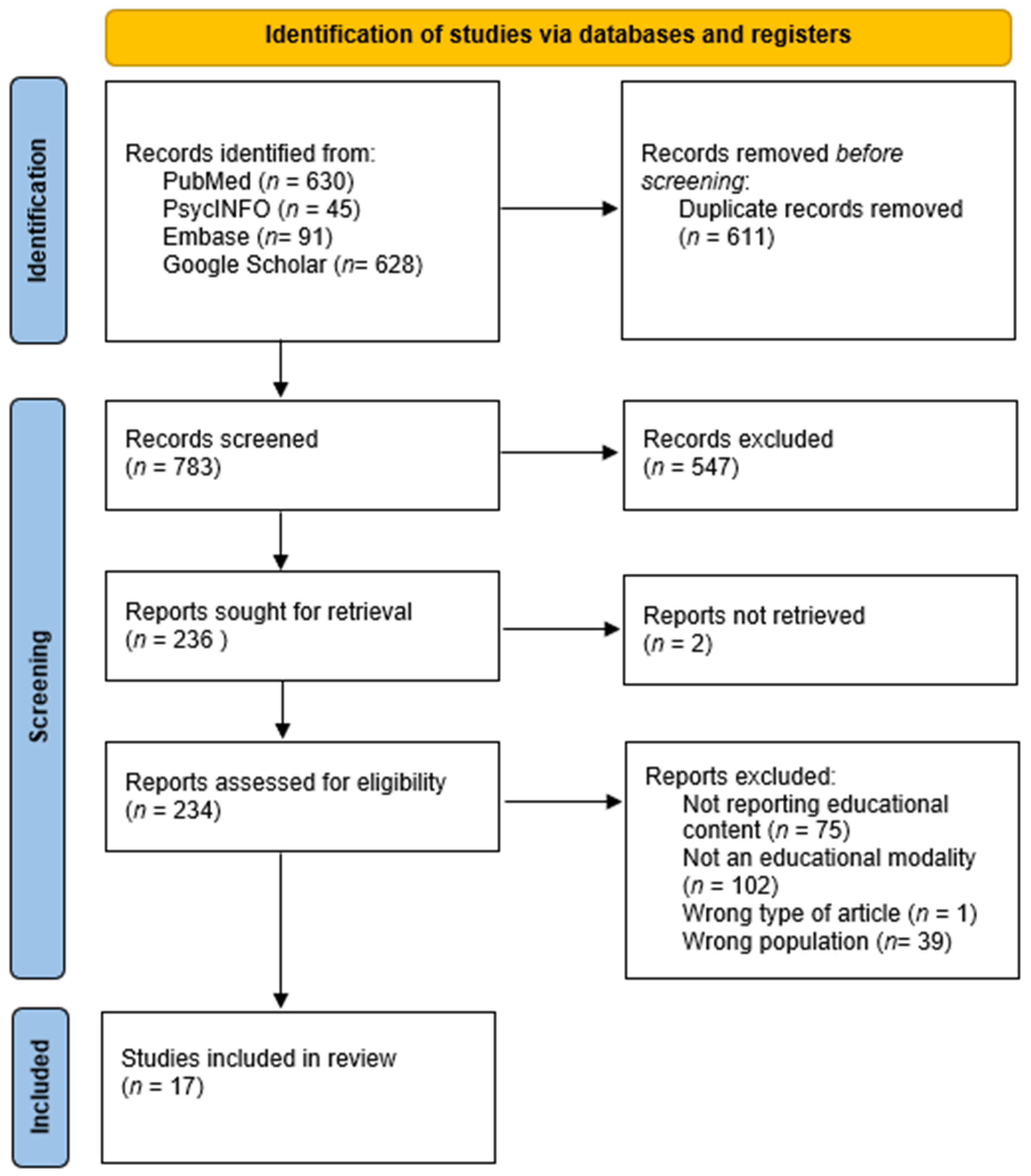
The literature search yielded a total of 1394 records across the four databases, including PubMed (n = 630), PsycINFO (n = 45), Embase (n = 91), and Google Scholar (n = 628). After removing 611 duplicate records, 783 unique records remained for title and abstract screening. Of these, 547 records were excluded for failing to meet the inclusion criteria. Full-text reports were sought for 6 records; 2 could not be retrieved. A total of 234 full-text articles were assessed for eligibility. Following detailed evaluation, 217 articles were excluded for the following reasons: absence of educational content related to violence or aggression (n = 75), lack of a defined educational modality (n = 102), inappropriate study type (n = 1), or ineligible target population (n = 39). A total of 17 studies met all inclusion criteria and were retained for analysis. A detailed overview of the characteristics, key findings and quality assessment of each included study is presented in Supplementary Table S2, and the study selection process is summarized in the PRISMA flow diagram (Figure 1).

3.2. Overview of the Included Studies

The included studies represented a heterogeneous body of literature encompassing educational program evaluations, descriptive curricular reports, qualitative studies, mixed-methods research, and narrative or scoping reviews. Most studies targeted psychiatry trainees or psychology trainees at the undergraduate or postgraduate level, with educational activities delivered in academic, hospital-based, or clinically integrated training contexts. Educational modalities varied widely and included didactic courses, workshops, simulation-based training, de-escalation programs, and blended or online learning formats. Across studies, instructional content focused on competencies related to violence risk assessment, recognition of hetero-aggressive behavior, aggression management, and de-escalation strategies. A summary of the identified modalities is reported in Table 1.

3.3. Current State of Training: Surveys of Exposure, Preparedness, and Perceived Gaps

Several studies used survey methodologies to document existing training experiences, exposure to violence, and perceived preparedness among mental health trainees. Across these studies, a consistent finding was the absence of a structured, longitudinal curriculum addressing hetero-aggressive risk and violence. In addition, when mapped to Miller’s Pyramid, the articles remain predominantly concentrated at intermediary levels, such as the “SHOWS” or “KNOWS HOW” level reflecting case-based and didactic approaches to simulation-based training. Evidence at the “DOES” level, capturing performance and confidence in real clinical settings, remains limited.”
Currier et al. [28] examined psychiatry residents’ experiences with domestic violence screening and training, highlighting limited prior education, where only 28% reported previous training experience, marked variability in screening practices, especially regarding patients’ gender gap in screening, and a persistent lack of knowledge regarding referral resources. However, residents reported greater recognition of domestic violence when training had been received, yet overall confidence and consistency remained low. Similarly, Price et al. [29] surveyed residents’ training and attitudes related to firearm injury prevention, identifying widespread recognition of the relevance and benefits of firearm screening but no clearly articulated or standardized curriculum to support this competency, in terms of standard teaching material, guidelines, faculty expertise, or existing guidelines. The study identified a shortcoming in previous training or in training sustainability, with only 11% of residents reporting having training in firearm injury prevention for more than 1 year.
Broader exposure to violence and its impact on trainee confidence was documented by Gately et al. [30], who reported high rates of verbal assault and witnessing violence among students, coupled with uniformly low confidence in coping and managing aggressive behavior. Although students with inpatient experience demonstrated relatively higher confidence and more favorable perceptions of training, scores remained below neutral thresholds for both inpatient and outpatient settings.
Schwartz et al. [31] reported comparable findings, with frequent exposure to threats and assaults, limited formal training, and strong support among trainees for the development of a structured curriculum combining didactic teaching and simulation, whose 71% recognize benefits from a well-organized course or seminar designed for residents on managing violent patients.
Kleespies et al. [32] provided a national perspective from psychology training programs, showing that while suicide risk assessment was widely addressed, training in other-directed violence risk assessment and management was inconsistently included and often limited to ethics seminars or general coursework. Indeed, this study reports that only 10% of the programs that propose a risk assessment curriculum address the hetero-aggressive topic. Notably, clinical internship directors rated training in hetero-aggressive risk as more important than did graduate program directors, underscoring a disconnect between academic curricula and clinical realities.
It is noted that these first four studies unanimously reflect learners’ desire to receive training to improve their knowledge of violence prevention and risk recognition, and show a broader perception of inadequacy, insufficiency, or lack of training across all modalities. In this vein, Kleespies et al. [32] show significant support for mental health program directors for providing or continuing education in violence risk assessment and management.

3.4. Teaching Violence Risk Assessment: Academically Oriented Approaches

Several studies focused specifically on teaching violence risk assessment using predominantly academic or discussion-based formats. These interventions typically emphasized conceptual frameworks, structured tools, and clinical reasoning rather than experiential learning.
McNiel et al. [12] described a didactic intervention centered on the HCR-20 framework, combining lectures on violence risk factors with small-group discussions using clinical vignettes. Participants were guided through identifying historical, clinical, and risk management factors, estimating risk levels, and formulating intervention plans, as well as instruction on medico-legal documentation.
This study noted clear improvements in participants’ ability to assess violence risk, produce higher-quality and better-structured clinical documentation, and increase their confidence, knowledge, and skills in managing violent behavior.
Khan et al. [33] reported a similar model that integrates large-group teaching on violence risk assessment and de-escalation with facilitated small-group discussions focused on personal experiences, safety concerns, and professional roles in violence prevention.
With this teaching modality, Khan et al. [33] highlighted the value of early exposure to violence risk assessment, particularly through large-group sessions, as well as of normalizing emotional responses and addressing forensic aspects. However, limitations included time constraints, discomfort for some learners in small groups, and a need for more transparent structure and guidance during small-group activities.
Storey et al. [34] evaluated a structured violence threat assessment training program using pre- and post-training vignette-based assessments, lecture and group discussion, and the use of specific risk assessment tools. This one-week structured curriculum covers a wide range of violence types (general violence, sexual violence, Intimate Partner Violence, stalking, child abuse or neglect, group violence, school and workplace violence) and key symptoms of mental disorder with their association with violence. Although delivered to a broader criminal justice audience, the program provided detailed insights into pedagogical strategies for teaching risk-factor identification, structured judgment, and risk-management planning.
Across these studies, academic approaches were effective at conveying foundational knowledge but were often presented as insufficient in isolation for addressing skill acquisition and confidence.

3.5. From Theory to Practice: Transition Toward Simulation-Based Training

One study explicitly compared academic instruction with simulation-based learning. Williams et al. [35] contrasted a standardized patient (SP), a simulation-based approach to addressing acute agitation, with traditional guideline reading. This study shows that simulation-based training markedly enhances residents’ self-confidence and knowledge compared to guide-based approaches. Participants particularly valued the realistic scenarios and individualized, real-time feedback. The findings further suggest that, despite being underutilized in psychiatry, simulation and experiential learning are more effective and engaging than passive traditional instructional formats, such as on-call psychiatry booklets, for teaching de-escalation and restraint-related competencies in managing acutely agitated patients.
This transition toward simulation was reflected in studies that adopted blended pedagogical models, combining didactic preparation with experiential components.

3.6. Blended Approaches Incorporating Standardized Patients and Simulation

A substantial proportion of included studies evaluated blended educational interventions integrating didactic teaching with simulation using standardized patients. Shenai et al. [36] described a program that combines a de-escalation primer with simulated inpatient and outpatient aggression scenarios, followed by structured debriefing involving both faculty and SP feedback, which emphasizes general de-escalation practice. Viarani et al. [37] similarly implemented an online preparatory module paired with SP-based simulations and faculty-led debriefings, emphasizing communication, verbal de-escalation strategies, and understanding causes of agitation.
Rickert et al. [38] focused on firearm-related violence prevention, integrating brief didactic teaching on legal frameworks and counseling strategies with SP scenarios tailored to trainee specialties. Participants, most with no prior exposure, demonstrated marked gains in resource knowledge, confidence, and awareness of the legal framework, with simulations confirming strong application of taught skills. Sowden et al. [39] randomized participants to simulation-based training on agitation management versus unrelated scenarios, with standard clinical vignettes and SP-based performance assessment, demonstrating superior performance and confidence among those exposed to violence-focused simulation.
Several programs extended simulation through videotaped feedback. Vestal et al. [40] and Salles et al. [41] incorporated recorded simulations into multi-step training models, enabling reflective observation, guided feedback, and repeated practice. These settings offer a safe, experiential environment with real-time feedback. These approaches emphasized not only technical skills but also professional attitude, communication, and situational awareness.
Simulation-based training was highly valued by participants for its realism, safe practice environment, and direct feedback, thereby enhancing engagement and learning. Authors demonstrated significant gains in comfort, competency, and attitudes in managing agitation, particularly in using verbal de-escalation strategies and patient understanding. They highlighted further recommendations for maintaining and reinforcing the sustainability of skills. They seem to outperform traditional didactic methods in preparing residents for real-world clinical responsibilities.

3.7. Integrating Environment, Protocols, and Legal Frameworks

A smaller subset of studies explicitly embedded violence education within broader institutional and systemic frameworks. Feinstein et al. [42] described a comprehensive prevention program combining situational awareness, violence risk assessment tools, de-escalation strategies, discharge planning checklists, legal considerations, and large-scale simulation exercises involving safety protocols and devices. This study proposed a structured prevention program followed by an annual live violence threat simulation exercise, developed and debriefed by a joint multidisciplinary team, to develop and maintain skills in a joint multi-layer approach. Schwartz et al. [31] and Gately et al. [30] similarly emphasized the importance of institutional policies, reporting mechanisms, psychological support, and post-incident processes as core curricular components.
Across these studies, violence education was framed not solely as an individual clinical skill but as a competency requiring familiarity with environmental design, organizational policies, legal obligations, and interprofessional coordination.

3.8. Core Competencies Emphasized Across Curricula

Across the 17 studies, several recurring educational priorities emerged. De-escalation strategies were central to nearly all interventions, whether taught didactically, practiced through simulation, or reinforced via feedback. Violence risk assessment, including structured tools and clinical judgment, was emphasized primarily in academically oriented programs and integrated models. Training on restraints (both physical and pharmacological) appeared less consistently, but was addressed in simulation-based contexts.
Additional competencies included communication strategies (particularly around firearms and domestic violence), knowledge of safety protocols, documentation practices, referral pathways, and post-incident reporting and support systems. Notably, many authors highlighted the need for repeated exposure, refresher sessions, and longitudinal integration, citing the limitations of one-time training interventions.
Many authors stress the importance of developing a training curriculum that addresses the demonstration, monitoring, maintenance, and sustainability of long-term multidisciplinary knowledge, acquired or updated, and the value of involving an interdisciplinary team rather than operating in silos or closed environments.

3.9. Quality Assessment of the Included Studies

Overall, the methodological quality of the included studies was heterogeneous and generally reflected the exploratory and practice-oriented nature of the field. Survey-based studies were typically well described in terms of objectives and populations but frequently relied on self-reported measures, cross-sectional designs, and non-validated instruments, limiting causal inference and generalizability. Descriptive and curricular reports provided detailed accounts of educational content and implementation but often lacked explicit evaluation frameworks, comparison groups, or standardized outcome measures. Simulation-based and blended training studies demonstrated stronger methodological rigor, particularly when pre–post designs, performance-based assessments, or structured debriefing processes were employed; however, most remained limited by small sample sizes, short follow-up periods, and an emphasis on proximal outcomes such as confidence or knowledge rather than sustained behavioral change or clinical impact.
Across study types, common limitations included incomplete reporting of sampling strategies, variability in outcome definitions, and limited attention to long-term effectiveness or skill retention. Nevertheless, most studies were transparent in describing their educational interventions and contextual constraints, supporting their value for mapping existing practices and informing curriculum development.

4. Discussion

4.1. Principal Findings

Mental health students are significantly exposed to violence in its many forms, whether verbal, physical, or with agitated patients. Despite the shared recognition of the importance of the assessment, prevention, or management of violence in this population, these studies highlight the absence, inadequacy, inconsistency, or non-standardization of training concerning these competencies.
This corpus reveals persistent qualitative deficiencies in education, including low confidence, inconsistent screening practices, and limited knowledge of referral pathways, legal frameworks, and institutional protocols. It is particularly noted in the fields of domestic violence, firearm injury prevention, and hetero-aggressive violence. However, these studies demonstrate that various educational interventions may efficiently bridge the gap.
Indeed, these papers examine a variety of educational methods, which appear to be unequally effective. Didactic approaches alone improve fundamental knowledge and clinical reasoning; however, blended models that incorporate experiential learning seem to consistently deliver better results in applied skills, confidence, and clinical performance [43].
Based on a didactic core, these blended modalities combine simulation, standardized patients, structured debriefings, and real-time feedback. They show benefits in risk identification and assessment, clinical reasoning, effective use of de-escalation and management strategies, and quality of documentation, often with medium-to-large effects. These teaching methods may also improve qualitative outcomes, such as greater learner satisfaction, superior comfort and perceived competence in assessing and managing violence risk. Training sessions have also shown a stronger clinical relevance by preparing learners for realistic situations they may encounter in practice, but confronted within a safe environment.
These findings suggest that mental health program educators and students acknowledge the necessity of better preparation, clinical competencies, and longitudinal learning concerning violence. They recognize the need for realistic, structured experiential training, skill-focused and embedded within institutional frameworks. This training should be delivered early and repeatedly to build sustainable competence and clinical readiness.

4.2. Parallel with Literature

As previously discussed, studies highlight deficits in the academic preparation of mental health trainees, frequently exposed to violence in clinical settings. Literature argues that identifying risk factors for violence should not depend solely on individual intuition but rather be identified and addressed according to structured best practice and robust frameworks, as proposed in a 2013 meta-analysis for patients with psychosis [44]. Furthermore, meta-analyses from 2023 and 2024 demonstrate that structured professional judgement tools significantly outperform unstructured clinical assessment of violence [45,46].
Analyzed studies showed a lack of confidence among students in their own ability to deal with hetero-aggressive situations, which reveals their vulnerability when structured training and tools are not in place. Also, the heterogeneity of medical students’ levels and socio-economic backgrounds may weaken their ability and confidence to face challenging realities without adequate support, which underlines their need of a proper training. A 2025 systematic review corroborates this finding and demonstrates the effectiveness of structured WPV prevention programs in improving healthcare professionals’ confidence [47]. Hence, unsupervised and unstructured training for mental health students seems no longer to be the optimal approach to violence prevention.
Moreover, concerning psychiatry residency, North American educational authorities favor structured pedagogical frameworks distinguishing the various levels of learning, with a tailored gradation in acquiring competencies through residency. From learning how to detect, assess, intervene in acute cases, to master how to prevent violence, approaches to addressing hetero-agressive risk would benefit from an adapted-to-level structure, competency-based, which would render the acquisition of skills to be more effective and sustainable [48,49,50].
Previous findings have established simulation-based models and blended learning approaches [37,40] as the most effective strategies to palliate these educational deficiencies. These models are validated by 2005 and 2011 systematic and meta-analytic reviews [51,52]. Indeed, they allow trainees to progress through the well-known Miller’s Pyramid [21] concept: to transition from initial “know how” towards tangible clinical competencies, transforming initial fears [33] into concrete procedural skills.
In addition, the previously mentioned 2025 meta-analysis illustrates that such training increases subjective confidence and significantly reduces the incidence of physical injuries among clinicians in hospital settings [47].
Some results reported the added value of clinical vignettes [39] and real-time feedback, corroborated by a 2024 systematic review in nursing, which found that simulation-based education enhances self-efficacy, develops safety reflexes, and maintains empathy [53].
Various studies have depicted beneficial inter-professional collaboration in training programs (e.g., mixing academics, nursing, emergency, psychiatry, or criminal justice professionals). They emphasize the need to address violence risk assessment and management not only at the individual level, but also to integrate them into interdisciplinary and environmental approaches. The literature also supports the idea that reducing actual WPV depends on a strong organisational safety culture [54], which is embedded into the holistic framework of values of the Okanagan Charter deployed in Canadian universities [55]. In addition to an inter-professional collaborative framework, institutional initiatives emphasize the importance of training healthcare professionals to reduce risk through best practices and a more humane approach. These programs, such as Project BETA, encourage the development of a safety culture and the empathetic management of complex patients. The goal is to validate competency in de-escalating risk through a structured training, while ensuring the safety of both trainees and patients. Therefore, the focus is not only placed on the caregiver’s clinical performance, but also on the patient experience [56,57].
Beyond equipping trainees to manage occupational risk, training in violence risk assessment and management also contributes to patient safety. Coercive interventions, such as physical and pharmacological restraint, are associated with significant physical and psychological harm, and remain scrutinized in clinical practice [58,59]. In contrast, violence management strategies, such as verbal de-escalation, reduce the use of restrictive measures and improve safety outcomes for both patients and clinicians [60,61]. Furthermore, violent episodes often involve impaired decision-making capacity, where clinicians find themselves having to balance ensuring immediate safety with respecting patient autonomy. By emphasizing collaborative strategies that support patients in regaining self-control, these approaches reframe agitation management as a therapeutic process rather than a purely coercive response [56]. However, existing training programs tend to emphasize risk management and staff protection, giving limited attention to how these ethical dilemmas are addressed. Training should therefore be understood not only as a means of protection for healthcare workers, but also as a key component of ethical, patient-centered care.
Stigmatization in mental health can be understood through the framework proposed by Graham Thornicroft, which conceptualizes stigma as a dynamic interplay between deficits in knowledge (ignorance), negative attitudes (prejudice), and discriminatory behaviours [62]. In clinical contexts, training programmes that emphasise risk and dangerousness may inadvertently reinforce these dimensions by shaping how trainees perceive and respond to patients with mental illness. However, this also highlights the potential for training to act as a corrective lever: approaches that integrate recovery-oriented perspectives, patient experience and reflective practice may help to challenge stigmatising assumptions and promote more balanced, patient-centred responses. Therefore, the impact of training on stigma depends on its design, particularly whether it explicitly addresses clinicians’ assumptions, integrates patient perspectives, and provides opportunities for reflection on practice.
Consistent with these considerations, encouraging short- and medium-term results have been seen with the available data on the long-term impact of violence management strategies. However, little high-quality data is available on their sustainability beyond 12 months. Reported impacts include sustained increases in staff confidence in their intervention capabilities [63] and reductions in coercive practices [64,65]. However, the impact on the overall frequency of violent incidents remains uncertain [61].

4.3. Limitations

The main limitations of this scoping review remain on the variety of studies, the small number of research articles, and their inherent limitations.
Most studies had small, homogeneous samples, often limited to a single residency program, which severely limits the external validity and interprofessional and/or cultural diversity. Even if the main focus of this article is about psychiatry and psychology trainees, other populations would benefit from this generalization (e.g., toxicomania or emergency professionals) which is a major limitation in this case.
In addition, blending of residency levels, lack of level variety among analyzed populations, and lack or blended data concerning prior training or clinical experience introduces significant confounding variables regarding prior clinical experience, and strongly contributes to sampling bias.” In addition, potential biases, such as selection and social desirability, were introduced by the voluntary participation and the reliance on self-reported outcomes, since only few studies incorporated objective assessments of skills or performance. Training interventions were typically first-time, one-session sessions, with minimal refresher or follow-up, and skills transfer into real clinical practice was rarely evaluated. These findings limit their generalizability and long-term impact on retention and scalability.
Moreover, fidelity, reproducibility, and comparability of interventions were further affected by the variability in scenario realism, standardized patient diversity, and turnover. Several studies lacked methodological details, and most reported mainly qualitative results, which limits the objective evaluation of educational impact. The use of context-specific settings limited broader applicability. Despite the fact that studies integrated in their curriculum different types of diagnoses, patients, and situations, the variety of biopsychosocial profiles was mainly used as background and not as the main focus of the exercise. None of the studies proposed detailed tailored approaches modulated to the variety of patient populations, which could be an asset to consider, to add finesse and granularity in building clinical competencies in specific populations, not just general tools.
Additionally, in terms of feasibility, some programs and trainings required substantial resources (e.g., inter-professional participants, budget, institutional buy-in) and logistical support, a significant constraint for pedagogical implementation or scalability, especially considering simulation based or blended approaches None of the studies gave the exact training implementation costs nor conducted a cost-benefits analysis. This omission restrains their real applicability and the potential scaling-up of these gold-standard interventions in standard clinical settings.
Overall, these limitations highlight the need for simulation-based programs that are tailored, experiential, and iterative, with minimal budget and logistics, allowing learners to practice, receive feedback, and consolidate skills in realistic and diverse clinical scenarios.

4.4. Recommendations

Considering these findings, several recommendations can guide the development of educational approaches to violence risk assessment and management for integration into mental health curricula.
Experiential learning, such as simulation-based learning, should be prioritized as a pedagogical modality. Indeed, experiential learning approaches appear to offer meaningful educational benefits, as they reflect the diversity of clinical settings and patient presentations, engaging trainees in a “real-time” clinical experience. Training programs should combine didactic sessions on structured VRA tools, de-escalation techniques, and communication strategies, tailored to the resident level. They should be followed by senior or expert demonstrations (e.g., real-time videos), supervised simulation practice, and structured debriefing in a psychologically safe environment. This structure allows clear long-term objectives, individualized feedback, and enables reflection on decision-making, collaboration, and clinical efficiency, while lowering stress from simulated violence.
When using SPs (gold standard in experiential learning), cultural and sociodemographic diversity should be ensured to enhance realism and reduce bias. To preserve fidelity, clinical realism, participant safety, and reproducibility, scenarios should be regularly updated and iteratively revised. Innovative alternatives could be considered to render the exercise even more accurate to clinical reality. Hence, involving patients-partners as their own “experiential experts” would offer multi-dimensional benefits in terms of patient’s and therapist’s experiencial learning, and debriefing, in a collaborative and realistic manner.
Improving clinical competencies, confidence, and long-term retention are essential educational goals. Hence, training programs should include follow-up and refresher sessions to support longitudinal retention of skills, maintain up-to-date clinical competencies, and enable transfer to practice. Post-event feedback sessions are known to be a part of existing pedagogical approaches; therefore, other educational methods could be directly implemented in clinical settings, in addition to the upfront proposed curriculum. Systematic debriefing post-event or weekly senior debriefing sessions to build on real learning opportunities could be an asset in increasing confidence, comfort and experiencial learning. To integrate a continuum of “knows” to “shows” to “does”, core values of Miller’s medical training, would enable programs to anchor competencies in a long-term and clinical approach.
Programs should also consider practical constraints, such as resources, costs, and logistics, to allow implementation and scalability. To minimise the impact on budget and resources, recurring participants could be involved in SPs or teaching roles, as well as recruiting patients-partners. Another option would be to create a shared didactic video bank to support demonstration of key skills, such as de-escalation techniques, or more innovatively, support training with a simulated AI interface. Integrating training routines into existing curricula and multidisciplinary frameworks would increase collaborative engagement, credibility, clinical sustainability, and institutional buy-in.
To provide a thorough evaluation of learning outcomes, evaluation should combine objective performance measures (e.g., evaluated clinical vignettes, SP assessments) with more subjective measures (e.g., self-assessment of confidence or comfort).
To prepare mental health students to manage aggression effectively, training designs should be structured, realistic, adaptable, and experience-based, while ensuring feasibility and lasting educational impact.

5. Conclusions

To conclude, this scoping review highlights the various educational approaches to assessment, prevention, and management of the hetero-aggressive risk and violence for mental health students, despite an identified educational lack of structured or institutionally endorsed curriculum.
Indeed, this review underlines important gaps in the published educational literature, reflecting limited reporting, heterogeneity, and lack of standardization in described training approaches related to violence risk assessment and management and associated learner outcomes. A spectrum of educational modalities was identified to remediate this issue. This range stretches from academically oriented approaches, predominantly emphasizing conceptual frameworks, structured tools, and clinical reasoning in academic or discussion formats, towards experiential learning in blended pedagogical models. This last approach, combining didactic preparation with experiential components, such as simulation-based modalities with standardized patients, has been associated with a greater educational impact, with gains in knowledge, confidence, and clinical performance.
Moreover, core competencies are essential to master the following: de-escalation techniques, structured violence risk assessment tools, communication strategies, and knowledge of the legal framework.
This scoping review emphasizes the importance of adopting a long-term, multidisciplinary vision that encompasses clinical reality and inter-professional diversity in a sustainable way. However, the limited number of studies, size, and variability in findings and methodologies support the need for further research to refine curricula in violence risk assessment, prevention, and management.
Future studies should establish a clear, standardized curriculum embedded within institutional frameworks, core competencies, and a long-term pedagogical vision, which could lay the foundations for tailored training. They should aim to explore in detail the impact of blended modalities on educational benefits, but also to consider a clear resource and feasibility implementation plan. In addition, future research should consider integrating innovative and up-to-date educational modalities, such as patients-partners, artificial intelligence or virtual reality, to enhance experiential learning within a safe environment.
Furthermore, future studies will need to explore how these educational modalities will evolve and adapt to a continuously changing environment. A main avenue would be to investigate the role and extent of predictive AI in assisting healthcare, especially regarding violence risk assessment and prediction. Other options would be to examine students’ readiness regarding new forms of virtual violence or ability to navigate in a moving forensic environment. This understanding of the shifting character of pedagogical tools and legal frameworks in response to cultural and technological changes is key when attempting to engage students and institutions in their learning experience, while remaining faithful to clinical realities, contributing to better outcomes for individuals, patients, the inter-professional community, and institutions.

Supplementary Materials

The following supporting information can be downloaded at: https://www.mdpi.com/article/10.3390/psychiatryint7030126/s1, Table S1: Search queries; Table S2: Details of the identified studies; PRISMA-Scr: PRISMA-Scr checklist.

Author Contributions

Conceptualization, D.M.-M. and A.H.; methodology, D.M.-M. and A.H.; formal analysis, D.M.-M. and A.H.; investigation, A.H.; resources, A.H.; data curation, D.M.-M., B.O. and A.H.; writing—original draft preparation, D.M.-M., B.O., L.C., S.B.P. and A.H.; writing—review and editing, D.M.-M., B.O., L.C., S.B.P. and A.H.; visualization, A.H.; supervision, A.H.; project administration, A.H.; funding acquisition, A.H. All authors have read and agreed to the published version of the manuscript.

Funding

This study was indirectly funded by the Fondation de l’Insitut universitaire en santé mentale de Montréal and l’Institut de la valorisation des données (IVADO).

Institutional Review Board Statement

Not applicable.

Informed Consent Statement

Not applicable.

Data Availability Statement

No new data were created or analyzed in this study.

Conflicts of Interest

The authors declare no conflicts of interest.

Abbreviations

The following abbreviations are used in this manuscript:
WPVWorkPlace Violence
VRAViolence Risk Assessment
WHOWorld Health Organization
AMAAmerican Medical Association
CAPLCanadian Academy of Psychiatry and the Law
AAMCAssociation of American Medical Colleges
APAAmerican Psychiatric Association
OSHAOccupational Safety and Health Administration
HCR-20Historical Clinical Risk Management-20
SPStandardized Patient
AIArtificial Intelligence

References

  1. Liu, J.; Gan, Y.; Jiang, H.; Li, L.; Dwyer, R.; Lu, K.; Yan, S.; Sampson, O.; Xu, H.; Wang, C.; et al. Prevalence of workplace violence against healthcare workers: A systematic review and meta-analysis. Occup. Environ. Med. 2019, 76, 927–937. [Google Scholar] [CrossRef]
  2. Aljohani, B.; Burkholder, J.; Tran, Q.K.; Chen, C.; Beisenova, K.; Pourmand, A. Workplace violence in the emergency department: A systematic review and meta-analysis. Public Health 2021, 196, 186–197. [Google Scholar] [CrossRef] [PubMed]
  3. Lim, M.C.; Jeffree, M.S.; Saupin, S.S.; Giloi, N.; Lukman, K.A. Workplace violence in healthcare settings: The risk factors, implications and collaborative preventive measures. Ann. Med. Surg. 2022, 78, 103727. [Google Scholar] [CrossRef]
  4. Occupational Safety and Health Administration. Preventing Workplace Violence: A Road Map For Healthcare Facilities. 2015. Available online: https://osha.washington.edu/sites/default/files/documents/Caring%20for%20Caregivers%20Report.pdf (accessed on 4 December 2025).
  5. Chappell, D.; Di Martino, V. Violence at Work, 3rd ed.; International Labour Office: Geneva, Switzerland, 2006. [Google Scholar]
  6. World Health Organization. Preventing Violence Against Health Workers. Available online: https://www.who.int/activities/preventing-violence-against-health-workers (accessed on 4 December 2025).
  7. Rossi, M.F.; Beccia, F.; Cittadini, F.; Amantea, C.; Aulino, G.; Santoro, P.; Borrelli, I.; Oliva, A.; Ricciardi, W.; Moscato, U.; et al. Workplace violence against healthcare workers: An umbrella review of systematic reviews and meta-analyses. Public Health 2023, 221, 50–59. [Google Scholar] [CrossRef] [PubMed]
  8. Weltens, I.; Bak, M.; Verhagen, S.; Vandenberk, E.; Domen, P.; van Amelsvoort, T.; Drukker, M. Aggression on the psychiatric ward: Prevalence and risk factors. A systematic review of the literature. PLoS ONE 2021, 16, e0258346. [Google Scholar] [CrossRef]
  9. World Health Organization; International Labour Office. Framework Guidelines for Addressing Workplace Violence in the Health Sector. 2022. Available online: https://www.who.int/publications/i/item/9221134466 (accessed on 15 December 2025).
  10. World Health Organization. Preventing Violence: A Guide to Implementing the Recommendations of the World Report on Violence and Health. 2003. Available online: https://www.who.int/publications/i/item/9241592079 (accessed on 15 December 2025).
  11. Douglas, K.S.; Hart, S.D.; Groscup, J.L.; Litwack, T.R. Assessing violence risk. In The Handbook of Forensic Psychology, 4th ed.; Weiner, I.B., Otto, R.K., Eds.; John Wiley & Sons, Inc.: Hoboken, NJ, USA, 2014; pp. 385–441. [Google Scholar]
  12. McNiel, D.E.; Chamberlain, J.R.; Weaver, C.M.; Hall, S.E.; Fordwood, S.R.; Binder, R.L. Impact of clinical training on violence risk assessment. Am. J. Psychiatry 2008, 165, 195–200. [Google Scholar] [CrossRef]
  13. Tishler, C.L.; Gordon, L.B.; Landry-Meyer, L. Managing the violent patient: A guide for psychologists and other mental health professionals. Prof. Psychol. Res. Pract. 2000, 31, 34–41. [Google Scholar] [CrossRef]
  14. Hopkins, M.; Fetherston, C.M.; Morrison, P. Aggression and violence in healthcare and its impact on nursing students: A narrative review of the literature. Nurse Educ. Today 2018, 62, 158–163. [Google Scholar] [CrossRef]
  15. Registered Nurses’ Association of Ontario. Preventing Violence, Harassment and Bullying Against Health Workers; Best Practice Guideline; RNAO: Toronto, ON, Canada, 2019. [Google Scholar]
  16. Douglas, K.S.; Reeves, K.A. Historical-Clinical-Risk Management-20 (HCR-20) Violence Risk Assessment Scheme: Rationale, application, and empirical overview. In Handbook of Violence Risk Assessment; Otto, R.K., Douglas, K.S., Eds.; Routledge: Abingdon, UK; Taylor & Francis Group: Abingdon, UK, 2020; pp. 147–185. [Google Scholar]
  17. Hvidhjelm, J.; Berring, L.L.; Whittington, R.; Woods, P.; Bak, J.; Almvik, R. Short-term risk assessment in the long term: A scoping review and meta-analysis of the Broset Violence Checklist. J. Psychiatr. Ment. Health Nurs. 2023, 30, 637–648. [Google Scholar] [CrossRef] [PubMed]
  18. Canadian Academy of Psychiatry and the Law. Canadian Guidelines for Forensic Psychiatry Assessment and Report Writing: Violence Risk Assessment. 2021. Available online: https://www.capl-acpd.org/wp-content/uploads/2023/05/04-Violence-Risk-Assessment-Guidelines-EN-Web.pdf (accessed on 4 December 2025).
  19. Lantta, T.; Kontio, R.; Daffern, M.; Adams, C.E.; Valimaki, M. Using the Dynamic Appraisal of Situational Aggression with mental health inpatients: A feasibility study. Patient Prefer. Adherence 2016, 10, 691–701. [Google Scholar] [CrossRef]
  20. Cook, A.N.; Moulden, H.M.; Mamak, M.; Lalani, S.; Messina, K.; Chaimowitz, G. Validating the Hamilton Anatomy of Risk Management-Forensic Version and the Aggressive Incidents Scale. Assessment 2018, 25, 432–445. [Google Scholar] [CrossRef]
  21. Miller, G.E. The assessment of clinical skills/competence/performance. Acad. Med. 1990, 65, S63–S67. [Google Scholar] [CrossRef]
  22. Arriola Vigo, J.A.; American Psychiatric Association. Resource Document on Prevention of Patient Assaults on Mental Healthcare Employees in Psychiatric Healthcare Settings; APA: Washington, DC, USA, 2024. [Google Scholar]
  23. Buchanan, A.; Binder, R.; Norko, M.; Swartz, M. Resource Document on Psychiatric Violence Risk Assessment. Am. J. Psychiatry 2012, 169, 3. [Google Scholar] [CrossRef] [PubMed]
  24. Occupational Safety and Health Administration. Workplace Violence—Prevention Programs. Available online: https://www.osha.gov/workplace-violence/prevention-programs (accessed on 4 December 2025).
  25. Provost, S.; MacPhee, M.; Daniels, M.A.; Naimi, M.; McLeod, C. A Realist Review of Violence Prevention Education in Healthcare. Healthcare 2021, 9, 339. [Google Scholar] [CrossRef]
  26. Hallett, N.; Gayton, A.; Dickenson, R.; Franckel, M.; Dickens, G.L. Student nurses’ experiences of workplace violence: A mixed methods systematic review and meta-analysis. Nurse Educ. Today 2023, 128, 105845. [Google Scholar] [CrossRef] [PubMed]
  27. Tricco, A.C.; Lillie, E.; Zarin, W.; O’Brien, K.K.; Colquhoun, H.; Levac, D.; Moher, D.; Peters, M.D.J.; Horsley, T.; Weeks, L.; et al. PRISMA Extension for Scoping Reviews (PRISMAScR): Checklist and Explanation. Ann. Intern. Med. 2018, 169, 467–473. [Google Scholar] [CrossRef]
  28. Currier, G.W.; Barthauer, L.M.; Begier, E.; Bruce, M.L. Training and experience of psychiatric residents in identifying domestic violence. Psychiatr. Serv. 1996, 47, 529–530. [Google Scholar] [CrossRef]
  29. Price, J.H.; Thompson, A.J.; Khubchandani, J.; Mrdjenovich, A.J.; Price, J.A. Firearm anticipatory guidance training in psychiatric residency programs. Acad. Psychiatry 2010, 34, 417–423. [Google Scholar] [CrossRef] [PubMed]
  30. Gately, L.A.; Stabb, S.D. Psychology Students’ Training in the Management of Potentially Violent Clients. Prof. Psychol. Res. Pract. 2005, 36, 681–687. [Google Scholar] [CrossRef]
  31. Schwartz, T.L.; Park, T.L. Assaults by patients on psychiatric residents: A survey and training recommendations. Psychiatr. Serv. 1999, 50, 381–383. [Google Scholar] [CrossRef]
  32. Kleespies, P.M.; Feinman, A.; AhnAllen, C.G.; Hausman, C.; Thach, T.; Woodruff, J.; Loomis, S.; Bongar, B. A national survey of doctoral psychology education and training in suicide risk and violence risk assessment and management. Suicide Life Threat. Behav. 2023, 53, 666–679. [Google Scholar] [CrossRef] [PubMed]
  33. Khan, J.S.; Stolar, A.; Idicula, S.; Pershern, L.S.; Coverdale, J. Addressing Residents’ Fears of Violence: One Program’s Residency Workshop to Address Fears of Violence and Teach Violence Risk Assessment. Acad. Psychiatry 2023, 47, 488–489. [Google Scholar] [CrossRef]
  34. Storey, J.E.; Gibas, A.L.; Reeves, K.A.; Hart, S.D. Evaluation of a violence risk (threat) assessment training program for police and other criminal justice professionals. Crim. Justice Behav. 2011, 38, 554–564. [Google Scholar] [CrossRef]
  35. Williams, J.C.; Balasuriya, L.; Alexander-Bloch, A.; Qayyum, Z. Comparing the Effectiveness of a Guide Booklet to Simulation-Based Training for Management of Acute Agitation. Psychiatr. Q. 2019, 90, 861–869. [Google Scholar] [CrossRef]
  36. Shenai, N.; Fulmer, V.; Gowl, C.; See, J.; Peterson, R.; Van Deusen, R. A Verbal De-escalation Standardized Patient Workshop for Third- and Fourth-Year Medical Students. MedEdPORTAL 2024, 20, 11417. [Google Scholar] [CrossRef]
  37. Virani, S.J.N.; Kuo, C.; Keeva, M.; Boita, C.; Raysin, A. Avoiding the Chill Pill- Results from a Simulation-Based Verbal De-escalation Training for Psychiatry Residents in a Community Mental Health Center. J. Intern. Med. Emerg. Res. 2023, 4, 27–44. [Google Scholar] [CrossRef]
  38. Rickert, C.G.; Felopulos, G.; Shoults, B.; Hathi, S.; Scott-Vernaglia, S.E.; Currier, P.; Masiakos, P.T.; Sacks, C.A. Development and Implementation of a Novel Case-Based Gun Violence Prevention Training Program for First-Year Residents. Acad. Med. 2022, 97, 1479–1483. [Google Scholar] [CrossRef]
  39. Sowden, G.L.; Vestal, H.S.; Stoklosa, J.B.; Valcourt, S.C.; Peabody, J.W.; Keary, C.J.; Nejad, S.H.; Caminis, A.; Huffman, J.C. Clinical Case Vignettes: A Promising Tool to Assess Competence in the Management of Agitation. Acad. Psychiatry 2017, 41, 364–368. [Google Scholar] [CrossRef] [PubMed]
  40. Vestal, H.S.; Sowden, G.; Nejad, S.; Stoklosa, J.; Valcourt, S.C.; Keary, C.; Caminis, A.; Huffman, J. Simulation-Based Training for Residents in the Management of Acute Agitation: A Cluster Randomized Controlled Trial. Acad. Psychiatry 2017, 41, 62–67. [Google Scholar] [CrossRef] [PubMed]
  41. Salles, J.; Birmes, P.; Schmitt, L.; Bastiani, B.; Soto, M.; Lafont-Rapnouil, S.; Mathur, A.; Bougon, E.; Arbus, C.; Yrondi, A. Teaching emergency situations during a psychiatry residency programme using a blended learning approach: A pilot study. BMC Med. Educ. 2021, 21, 473. [Google Scholar] [CrossRef]
  42. Feinstein, R.E.; Yager, J. A Live Threat Violence Simulation Exercise for Psychiatric Outpatient Departments: A Valuable Aid to Training in Violence Prevention. Acad. Psychiatry 2018, 42, 598–604. [Google Scholar] [CrossRef]
  43. Niedermier, J.; Kasick, D. Maintaining Personal Safety: Understanding and Addressing Aggression and Violence in the Health Care Setting. MedEdPORTAL 2018, 14, 10722. [Google Scholar] [CrossRef]
  44. Witt, K.; van Dorn, R.; Fazel, S. Risk factors for violence in psychosis: Systematic review and meta-regression analysis of 110 studies. PLoS ONE 2013, 8, e55942. [Google Scholar] [CrossRef]
  45. Viljoen, J.L.; Goossens, I.; Monjazeb, S.; Cochrane, D.M.; Vargen, L.M.; Jonnson, M.R.; Blanchard, A.J.E.; Li, S.M.Y.; Jackson, J.R. Are risk assessment tools more accurate than unstructured judgments in predicting violent, any, and sexual offending? A meta-analysis of direct comparison studies. Behav. Sci. Law. 2025, 43, 75–113. [Google Scholar] [CrossRef] [PubMed]
  46. Wertz, M.; Schobel, S.; Schiltz, K.; Rettenberger, M. A comparison of the predictive accuracy of structured and unstructured risk assessment methods for the prediction of recidivism in individuals convicted of sexual and violent offense. Psychol. Assess. 2023, 35, 152–164. [Google Scholar] [CrossRef] [PubMed]
  47. Chung, Y.F.; Chang, Y.C.; Fetzer, S.J.; Tessmer, L.; Tsai, M.H.; Feng, J.Y. The Effectiveness of Workplace Violence Prevention Education Training Programs on Healthcare Professionals’ Confidence: A Systematic Review and Meta-Analysis. Int. Nurs. Rev. 2025, 72, e70107. [Google Scholar] [CrossRef] [PubMed]
  48. Accreditation Council for Graduate Medical Education (ACGME). The Psychiatry Milestones 2.0; ACGME Reports; ACGME: Chicago, IL, USA, 2020. [Google Scholar]
  49. Royal College of Physicians and Surgeons of Canada. Psychiatry Competencies: Competence by Design (CBD). 2021. Available online: www.royalcollege.ca (accessed on 4 December 2025).
  50. Frank, J.R.; Snell, L.S.; Cate, O.T.; Holmboe, E.S.; Carraccio, C.; Swing, S.R.; Harris, P.; Glasgow, N.J.; Campbell, C.; Dath, D.; et al. Competency-based medical education: Theory to practice. Med. Teach. 2010, 32, 638–645. [Google Scholar] [CrossRef] [PubMed]
  51. McGaghie, W.C.; Issenberg, S.B.; Cohen, E.R.; Barsuk, J.H.; Wayne, D.B. Does simulation-based medical education with deliberate practice yield better results than traditional clinical education? A meta-analytic comparative review of the evidence. Acad. Med. 2011, 86, 706–711. [Google Scholar] [CrossRef]
  52. Issenberg, S.B.; McGaghie, W.C.; Petrusa, E.R.; Lee Gordon, D.; Scalese, R.J. Features and uses of high-fidelity medical simulations that lead to effective learning: A BEME systematic review. Med. Teach. 2005, 27, 10–28. [Google Scholar] [CrossRef]
  53. Mitchell, M.; Newall, F.; Bernie, C.; Brignell, A.; Williams, K. Simulation-based education for teaching aggression management skills to healthcare providers in acute healthcare settings: A systematic review. Int. J. Nurs. Stud. 2024, 158, 104842. [Google Scholar] [CrossRef]
  54. Heckemann, B.; Zeller, A.; Hahn, S.; Dassen, T.; Schols, J.M.; Halfens, R.J. The effect of aggression management training programmes for nursing staff and students working in an acute hospital setting. A narrative review of current literature. Nurse Educ. Today 2015, 35, 212–219. [Google Scholar] [CrossRef]
  55. Squires, V.; London, C. The Okanagan Charter: Evolution of Health Promotion in Canadian Higher Education. Can. J. High. Educ. 2021, 51, 99–113. [Google Scholar] [CrossRef]
  56. Richmond, J.S.; Berlin, J.S.; Fishkind, A.B.; Holloman, G.H.; Zeller, S.L.; Wilson, M.P.; Rifai, M.A.; Ng, A.T. Verbal De-escalation of the Agitated Patient: Consensus Statement of the American Association for Emergency Psychiatry Project BETA De-escalation Workgroup. West. J. Emerg. Med. 2012, 13, 17–25. [Google Scholar] [CrossRef] [PubMed]
  57. Duxbury, J.; Whittington, R. Causes and management of patient aggression and violence: Staff and patient perspectives. J. Adv. Nurs. 2005, 50, 469–478. [Google Scholar] [CrossRef]
  58. Price, O.; Armitage, C.J.; Bee, P.; Brooks, H.; Lovell, K.; Butler, D.; Cree, L.; Fishwick, P.; Grundy, A.; Johnston, I.; et al. De-escalating aggression in acute inpatient mental health settings: A behaviour change theory-informed, secondary qualitative analysis of staff and patient perspectives. BMC Psychiatry 2024, 24, 548. [Google Scholar] [CrossRef]
  59. Kersting, X.A.K.; Hirsch, S.; Steinert, T. Physical Harm and Death in the Context of Coercive Measures in Psychiatric Patients: A Systematic Review. Front. Psychiatry 2019, 10, 400. [Google Scholar] [CrossRef] [PubMed]
  60. Im, D.D.; Bukhman, A.K.; Joseph, J.W.; Dziobek, J.C.; Grant, J.; Clifford, K.C.; Kim, I.; Chen, P.C.; Schmelzer, N.A.; Powell, R.; et al. Code De-Escalation: Decreasing restraint use during agitation management in a community hospital emergency department. Am. J. Emerg. Med. 2024, 76, 193–198. [Google Scholar] [CrossRef] [PubMed]
  61. Price, O.; Papastavrou Brooks, C.; Johnston, I.; McPherson, P.; Goodman, H.; Grundy, A.; Cree, L.; Motala, Z.; Robinson, J.; Doyle, M.; et al. Development and evaluation of a de-escalation training intervention in adult acute and forensic units: The EDITION systematic review and feasibility trial. Health Technol. Assess. 2024, 28, 1–120. [Google Scholar] [CrossRef] [PubMed]
  62. Thornicroft, G.; Rose, D.; Kassam, A.; Sartorius, N. Stigma: Ignorance, prejudice or discrimination? Br. J. Psychiatry 2007, 190, 192–193. [Google Scholar] [CrossRef] [PubMed]
  63. Gupta, I.; Eid, S.M.; Harris, C.M.; Kauffman, R.; Washburn, C.; Singh, A.; Gundareddy, V.P.; Kisuule, F. Prevalence of Workplace Violence and Effects of De-escalation Training Among Hospitalists: A Pilot Study. J. Community Hosp. Intern. Med. Perspect. 2023, 13, 1–5. [Google Scholar] [CrossRef]
  64. Ye, J.; Xia, Z.; Wang, C.; Liao, Y.; Xu, Y.; Zhang, Y.; Yu, L.; Li, S.; Lin, J.; Xiao, A. Effectiveness of CRSCE-Based De-escalation Training on Reducing Physical Restraint in Psychiatric Hospitals: A Cluster Randomized Controlled Trial. Front. Psychiatry 2021, 12, 576662. [Google Scholar] [CrossRef] [PubMed]
  65. Daguman, E.I.V.; Yoxall, J.; Lakeman, R.; Hutchinson, M. Maximising relational capabilities and minimising restrictive practices in acute mental health units: The Safe Steps for De-escalation evaluation. Front. Psychiatry 2025, 16, 1676743. [Google Scholar] [CrossRef] [PubMed]
Figure 1. PRISMA-Src Flowchart for the identified studies.
Psychiatryint 07 00126 g001
Table 1. Summary of main findings in relation to the study objective.
DomainKey FindingsIllustrative Studies
(Examples)
Contribution to Study
Objective
Existence of trainingMost training programs reported some exposure to violence-related topics, but few described a formal, structured, or longitudinal curriculum. Training was often optional, brief, or embedded within broader courses.Currier; Price; Gately; Kleespies; SchwartzDemonstrates that teaching on violence risk exists but is inconsistently organized and rarely institutionalized.
Perceived adequacy
of training
Learners consistently reported insufficient preparation and low confidence in managing aggressive or violent situations, despite frequent exposure to threats or assaults. Inpatient experience improved confidence modestly but did not eliminate gaps.Gately; Schwartz; Currier; KleespiesHighlights the mismatch between clinical exposure to violence and perceived readiness, reinforcing the need for improved training models.
Violence risk assessment (VRA)VRA teaching was primarily theoretical, focusing on risk factors, structured tools, and clinical judgment. Suicide risk was more consistently addressed than hetero-aggressive violence.Kleespies; McNiel; Khan; StoreyShows that VRA is taught mainly at a conceptual level, with limited integration of applied or experiential learning.
Didactic-only
approaches
Lecture-based or discussion-based formats effectively conveyed foundational knowledge but were perceived as insufficient for skill acquisition or confidence building.Niedermier; McNiel; Khan Identifies limits of purely academic approaches in preparing trainees for real-world violence management.
Simulation-based
training
Simulation using standardized patients improved confidence, perceived competence, and applied knowledge compared with passive learning strategies.Williams; SowdenSupports simulation as a key modality for teaching applied violence-related skills.
Blended educational
models
Programs combining didactics, simulation, and structured debriefing were associated with higher learner engagement and more comprehensive competency coverage.Shenai; Viarani; Rickert; Vestal; SallesIdentifies blended learning as a promising approach for integrating theory and practice in violence education.
De-escalation and
communication skills
De-escalation strategies were central across most curricula, taught through lectures, simulations, and feedback. Communication around firearms and domestic violence required specific, non-judgmental approaches.Currier; Rickert; Williams; Shenai; FeinsteinConfirms de-escalation and communication as core competencies across educational modalities.
Restraints and acute
agitation
Physical and pharmacological restraint training appeared mainly in simulation-based contexts and was less consistently addressed than de-escalation.Williams; Sowden; VestalReveals uneven coverage of restraint-related skills and a reliance on experiential teaching for these competencies.
Institutional, legal, and
environmental factors
Few programs integrated safety protocols, legal frameworks, documentation, or environmental design into training, despite their clinical relevance.Feinstein; Rickert; Schwartz; GatelyHighlights a critical gap between individual skill training and system-level violence prevention education.
Feedback, debriefing,
and repetition
Structured debriefing, feedback from faculty and standardized patients, and repeated exposure were consistently identified as essential for learning and retention.Shenai; Viarani; Rickert; Salles; VestalIdentifies feedback and repetition as key pedagogical elements supporting effective violence education.
Curricular
recommendations
Multiple studies proposed structured, staged curricula combining early didactics with recurrent simulation and institutional integration. Schwartz; Gately; KleespiesProvides converging recommendations for future curriculum development aligned with the study objective.
Disclaimer/Publisher’s Note: The statements, opinions and data contained in all publications are solely those of the individual author(s) and contributor(s) and not of MDPI and/or the editor(s). MDPI and/or the editor(s) disclaim responsibility for any injury to people or property resulting from any ideas, methods, instructions or products referred to in the content.