
AI-Assisted Precision Psychotherapy: Toward a Process-Based Framework of Therapeutic Interaction


Abstract
1. Introduction
1.1. Variability in Psychotherapy Outcomes
1.2. Emergence of Precision Medicine, Precision Psychiatry, and Precision Psychotherapy
1.3. The Gap in Psychotherapy
1.4. Aim of the Article
2. The Concept of Precision Psychotherapy
Conceptual Definitions
3. Current Approaches to Precision Psychotherapy
3.1. Predictive Modeling and Machine Learning
3.2. Mechanisms of Change Approaches
3.3. Enhanced Psychotherapy and Digital Augmentation
3.4. The Process Gap in Precision Psychotherapy
3.5. AI-Based Analysis of Psychotherapy Process
4. A Dimensional Model of Therapeutic Interaction
4.1. The Dimensional Model of Mental Activity
4.2. Implications for AI-Based Process Analysis
4.3. Clinical Example: Dimensional Mismatch and Premature Interpretation in Psychotherapeutic Dialogue
5. Clinical and Research Implications
5.1. Implications for Therapist Training
5.2. Implications for Clinical Trials
5.3. Ethical Considerations
6. Limitations
7. Conclusions
Funding
Institutional Review Board Statement
Informed Consent Statement
Data Availability Statement
Conflicts of Interest
References
- Cuijpers, P.; Miguel, C.; Ciharova, M.; Harrer, M.; Basic, D.; Cristea, I.A.; de Ponti, N.; Driessen, E.; Hamblen, J.; Larsen, S.E.; et al. Absolute and relative outcomes of psychotherapies for eight mental disorders: A systematic review and meta-analysis. World Psychiatry Off. J. World Psychiatr. Assoc. 2024, 23, 267–275. [Google Scholar] [CrossRef] [Scilit] [PubMed] [PubMed Central]
- Harrer, M.; Miguel, C.; van Ballegooijen, W.; Ciharova, M.; Plessen, C.Y.; Kuper, P.; Sprenger, A.A.; Buntrock, C.; Papola, D.; Cristea, I.A.; et al. Effectiveness of psychotherapy: Synthesis of a “meta-analytic research domain” across world regions and 12 mental health problems. Psychol. Bull. 2025, 151, 600–667. [Google Scholar] [CrossRef] [Scilit] [PubMed]
- Mulder, R.; Murray, G.; Rucklidge, J. Common versus specific factors in psychotherapy: Opening the black box. Lancet Psychiatry 2017, 4, 953–962. [Google Scholar] [CrossRef] [Scilit] [PubMed]
- Firth, N.; Saxon, D.; Stiles, W.B.; Barkham, M. Therapist and clinic effects in psychotherapy: A three-level model of outcome variability. J. Consult. Clin. Psychol. 2019, 87, 345–356. [Google Scholar] [CrossRef] [Scilit] [PubMed]
- Krause, M. Lessons from ten years of psychotherapy process research. Psychother. Res. J. Soc. Psychother. Res. 2024, 34, 261–275. [Google Scholar] [CrossRef] [Scilit] [PubMed]
- García-Foncillas, J.; Argente, J.; Bujanda, L.; Cardona, V.; Casanova, B.; Fernández-Montes, A.; Horcajadas, J.A.; Iñiguez, A.; Ortiz, A.; Pablos, J.L.; et al. Milestones of Precision Medicine: An Innovative, Multidisciplinary Overview. Mol. Diagn. Ther. 2021, 25, 563–576. [Google Scholar] [CrossRef] [Scilit] [PubMed]
- König, I.R.; Fuchs, O.; Hansen, G.; von Mutius, E.; Kopp, M.V. What is precision medicine? Eur. Respir. J. 2017, 50, 1700391. [Google Scholar] [CrossRef] [Scilit] [PubMed]
- Češková, E.; Šilhán, P. From Personalized Medicine to Precision Psychiatry? Neuropsychiatr. Dis. Treat. 2021, 17, 3663–3668. [Google Scholar] [CrossRef] [Scilit] [PubMed] [PubMed Central]
- Scala, J.J.; Ganz, A.B.; Snyder, M.P. Precision Medicine Approaches to Mental Health Care. Physiology 2023, 38, 82–98. [Google Scholar] [CrossRef] [Scilit] [PubMed] [PubMed Central]
- Cevoli, F.; Manji, H.K.; Miller, A.H.; Penninx, B.W.J.H.; Kas, M.; Pariante, C.; De Picker, L.; Swieboda, P.; Leboyer, M. Implementing Precision Medicine in Psychiatry. JAMA Psychiatry 2026, 83, 207. [Google Scholar] [CrossRef] [Scilit]
- Koch, E.; Pardiñas, A.F.; O’cOnnell, K.S.; Selvaggi, P.; Collados, J.C.; Babic, A.; Marshall, S.E.; Van der Eycken, E.; Angulo, C.; Lu, Y.; et al. How Real-World Data Can Facilitate the Development of Precision Medicine Treatment in Psychiatry. Biol. Psychiatry 2024, 96, 543–551. [Google Scholar] [CrossRef] [Scilit] [PubMed] [PubMed Central]
- Lutz, W.; Vehlen, A.; Schwartz, B. Data-informed psychological therapy, measurement-based care, and precision mental health. J. Consult. Clin. Psychol. 2024, 92, 671–673. [Google Scholar] [CrossRef] [Scilit] [PubMed]
- Taubitz, F.S.; Büdenbender, B.; Alpers, G.W. What the future holds: Machine learning to predict success in psychotherapy. Behav. Res. Ther. 2022, 156, 104116. [Google Scholar] [CrossRef] [Scilit] [PubMed]
- Bennemann, B.; Schwartz, B.; Giesemann, J.; Lutz, W. Predicting patients who will drop out of out-patient psychotherapy using machine learning algorithms. Br. J. Psychiatry J. Ment. Sci. 2022, 220, 192–201. [Google Scholar] [CrossRef] [Scilit] [PubMed]
- Penedo, J.M.G.; Rubel, J.; Meglio, M.; Bornhauser, L.; Krieger, T.; Babl, A.; Muiños, R.; Roussos, A.; Delgadillo, J.; Flückiger, C.; et al. Using machine learning algorithms to predict the effects of change processes in psychotherapy: Toward process-level treatment personalization. Psychotherapy 2023, 60, 536–547. [Google Scholar] [CrossRef] [Scilit] [PubMed]
- Borsboom, D. A network theory of mental disorders. World Psychiatry 2017, 16, 5–13. [Google Scholar] [CrossRef] [Scilit]
- Avramopoulos, D.; Kapogiannis, D.; Leoutsakos, J.-M.; Lyketsos, C.G.; Mahairaki, V.; Nowrangi, M.; Oishi, K.; Oh, E.S.; Rosenberg, P.B.; Samus, Q.; et al. Developing Treatments for Alzheimer’s and Related Disorders with Precision Medicine: A Vision. Adv. Exp. Med. Biol. 2021, 1339, 395–402. [Google Scholar] [CrossRef] [Scilit] [PubMed] [PubMed Central]
- Zipfel, S.; Lutz, W.; Schneider, S.; Schramm, E.; Delgadillo, J.; Giel, K.E. The Future of Enhanced Psychotherapy: Towards Precision Psychotherapy. Psychother. Psychosom. 2024, 93, 230–236. [Google Scholar] [CrossRef] [Scilit]
- Kind, A.; Fink, S.; Walter, H. What is Precision Psychotherapy? J. Med. Philos. 2026, in press. [Google Scholar] [CrossRef] [Scilit]
- Vieira, S.; Liang, X.; Guiomar, R.; Mechelli, A. Can we predict who will benefit from cognitive-behavioural therapy? A systematic review and meta-analysis of machine learning studies. Clin. Psychol. Rev. 2022, 97, 102193. [Google Scholar] [CrossRef] [Scilit] [PubMed]
- Curtiss, J.; DiPietro, C. Machine learning in the prediction of treatment response for emotional disorders: A systematic review and meta-analysis. Clin. Psychol. Rev. 2025, 120, 102593. [Google Scholar] [CrossRef] [Scilit] [PubMed] [PubMed Central]
- Chekroud, A.M.; Bondar, J.; Delgadillo, J.; Doherty, G.; Wasil, A.; Fokkema, M.; Cohen, Z.; Belgrave, D.; DeRubeis, R.; Iniesta, R.; et al. The promise of machine learning in predicting treatment outcomes in psychiatry. World Psychiatry Off. J. World Psychiatr. Assoc. 2021, 20, 154–170. [Google Scholar] [CrossRef] [Scilit] [PubMed] [PubMed Central]
- Hofmann, S.G.; Hayes, S.C. The Future of Intervention Science: Process-Based Therapy. Clin. Psychol. Sci. 2019, 7, 37–50. [Google Scholar] [CrossRef] [Scilit]
- Kazdin, A.E. Mediators and Mechanisms of Change in Psychotherapy Research. Annu. Rev. Clin. Psychol. 2007, 3, 1–27. [Google Scholar] [CrossRef] [Scilit]
- Solomonov, N. Targeting mechanisms of change as a path to precision psychotherapy for community settings. Psychother. Res. J. Soc. Psychother. Res. 2025, 1–11. [Google Scholar] [CrossRef] [Scilit]
- Boswell, J.F. Intervention strategies and clinical process in transdiagnostic cognitive-behavioral therapy. Psychotherapy 2013, 50, 381–386. [Google Scholar] [CrossRef] [Scilit] [PubMed]
- Hehlmann, M.I.; Moggia, D.; Schwartz, B.; Driver, C.; Eberhardt, S.; Lutz, W. Outcome prediction in psychological therapy with continuous time dynamic modeling of affective states and emotion regulation. J. Consult. Clin. Psychol. 2024, 92, 517–530. [Google Scholar] [CrossRef] [Scilit] [PubMed]
- Mink, F.; Lutz, W.; Hehlmann, M.I. Ecological Momentary Assessment in psychotherapy research: A systematic review. Clin. Psychol. Rev. 2025, 117, 102565. [Google Scholar] [CrossRef] [Scilit] [PubMed]
- Delgadillo, J.; de Jong, K.; Lucock, M.; Lutz, W.; Rubel, J.; Gilbody, S.; Ali, S.; Aguirre, E.; Appleton, M.; Nevin, J.; et al. Feedback-informed treatment versus usual psychological treatment for depression and anxiety: A multisite, open-label, cluster randomised controlled trial. Lancet Psychiatry 2018, 5, 564–572. [Google Scholar] [CrossRef] [Scilit] [PubMed]
- Janse, P.D.; de Jong, K.; Veerkamp, C.; van Dijk, M.K.; Hutschemaekers, G.J.M.; Verbraak, M.J.P.M. The effect of feedback-informed cognitive behavioral therapy on treatment outcome: A randomized controlled trial. J. Consult. Clin. Psychol. 2020, 88, 818–828. [Google Scholar] [CrossRef] [Scilit] [PubMed]
- Fedor, S.; Lewis, R.; Pedrelli, P.; Mischoulon, D.; Curtiss, J.; Picard, R.W. Wearable Technology in Clinical Practice for Depressive Disorder. N. Engl. J. Med. 2023, 389, 2457–2466. [Google Scholar] [CrossRef] [Scilit]
- Yim, S.J.; Lui, L.M.; Lee, Y.; Rosenblat, J.D.; Ragguett, R.-M.; Park, C.; Subramaniapillai, M.; Cao, B.; Zhou, A.; Rong, C.; et al. The utility of smartphone-based, ecological momentary assessment for depressive symptoms. J. Affect. Disord. 2020, 274, 602–609. [Google Scholar] [CrossRef] [Scilit] [PubMed]
- Torous, J.; Linardon, J.; Goldberg, S.B.; Sun, S.; Bell, I.; Nicholas, J.; Hassan, L.; Hua, Y.; Milton, A.; Firth, J. The evolving field of digital mental health: Current evidence and implementation issues for smartphone apps, generative artificial intelligence, and virtual reality. World Psychiatry Off. J. World Psychiatr. Assoc. 2025, 24, 156–174. [Google Scholar] [CrossRef] [Scilit] [PubMed] [PubMed Central]
- Grenyer, B.F.S.; Marceau, E.M. Helping patients master core conflictual relationship themes in psychotherapy. J. Clin. Psychol. 2022, 78, 386–395. [Google Scholar] [CrossRef] [Scilit] [PubMed] [PubMed Central]
- Jen Der Pan, P.; Fan, A.C.; Bhat, C.S.; Chang, S.S.H. Associations among self-concept, verbal behaviors, and group climate early in the group counseling process. Psychol. Rep. 2012, 111, 739–754. [Google Scholar] [CrossRef] [Scilit] [PubMed]
- Lord, S.P.; Can, D.; Yi, M.; Marin, R.; Dunn, C.W.; Imel, Z.E.; Georgiou, P.; Narayanan, S.; Steyvers, M.; Atkins, D.C. Advancing methods for reliably assessing motivational interviewing fidelity using the motivational interviewing skills code. J. Subst. Abus. Treat. 2015, 49, 50–57. [Google Scholar] [CrossRef] [Scilit] [PubMed] [PubMed Central]
- Malgaroli, M.; Hull, T.D.; Zech, J.M.; Althoff, T. Natural language processing for mental health interventions: A systematic review and research framework. Transl. Psychiatry 2023, 13, 309. [Google Scholar] [CrossRef] [Scilit] [PubMed] [PubMed Central]
- Laricheva, M.; Liu, Y.; Shi, E.; Wu, A. Scoping review on natural language processing applications in counselling and psychotherapy. Br. J. Psychol. 2024, 117, 677–701. [Google Scholar] [CrossRef] [Scilit] [PubMed]
- Goldberg, S.B.; Flemotomos, N.; Martinez, V.R.; Tanana, M.J.; Kuo, P.B.; Pace, B.T.; Villatte, J.L.; Georgiou, P.G.; Van Epps, J.; Imel, Z.E.; et al. Machine learning and natural language processing in psychotherapy research: Alliance as example use case. J. Couns. Psychol. 2020, 67, 438–448. [Google Scholar] [CrossRef] [Scilit] [PubMed] [PubMed Central]
- Atzil-Slonim, D.; Juravski, D.; Bar-Kalifa, E.; Gilboa-Schechtman, E.; Tuval-Mashiach, R.; Shapira, N.; Goldberg, Y. Using topic models to identify clients’ functioning levels and alliance ruptures in psychotherapy. Psychotherapy 2021, 58, 324–339. [Google Scholar] [CrossRef] [Scilit] [PubMed]
- Shapira, N.; Lazarus, G.; Goldberg, Y.; Gilboa-Schechtman, E.; Tuval-Mashiach, R.; Juravski, D.; Atzil-Slonim, D. Using computerized text analysis to examine associations between linguistic features and clients’ distress during psychotherapy. J. Couns. Psychol. 2021, 68, 77–87. [Google Scholar] [CrossRef] [Scilit] [PubMed]
- Atzil-Slonim, D.; Eliassaf, A.; Warikoo, N.; Paz, A.; Haimovitz, S.; Mayer, T.; Gurevych, I. Leveraging natural language processing to study emotional coherence in psychotherapy. Psychotherapy 2024, 61, 82–92. [Google Scholar] [CrossRef] [Scilit] [PubMed]
- Mendlovic, S. Mapping mental life: The dimensional model as a framework for theory, practice, and research. Front. Psychol. 2026, 17, 1737465. [Google Scholar] [CrossRef] [Scilit]
- Mendlovic, S. Using an AI-Based System for Dimensional Deliberate Practice in Psychodynamic Psychotherapy. BRAIN Broad Res. Artif. Intell. Neurosci. 2025, 16, 449–463. [Google Scholar] [CrossRef] [Scilit]
- Kapel Lev Ari, R.; Amsalem, D.; Mendovic, S. Assessing Microprocess Clinical Discrimination in Psychodynamic Psychotherapy: A Vignette-Based Approach with Expert Consensus and Sensitivity to Structured Exposure. Submitted for publication.
- Gendlin, E.T. A theory of personality change. In Personality Change; Wiley: New York, NY, USA, 1964; pp. 100–148. [Google Scholar]
- Safran, J.D.; Muran, J.C. Negotiating the Therapeutic Alliance: A Relational Treatment Guide; Guilford Press: New York, NY, USA, 2000. [Google Scholar]
- Safran, J.D.; Muran, J.C. Has the concept of the therapeutic alliance outlived its usefulness? Psychother. Theory Res. Pract. Train. 2006, 43, 286–291. [Google Scholar] [CrossRef] [Scilit]
- Castonguay, L.G.; Goldfried, M.R.; Wiser, S.; Raue, P.J.; Hayes, A.M. Predicting the effect of cognitive therapy for depression: A study of unique and common factors. J. Consult. Clin. Psychol. 1996, 64, 497–504. [Google Scholar] [CrossRef]
- Yirmiya, K.; Fonagy, P. Mentalizing Without a Mind: Psychotherapeutic Potential of Generative AI. J. Med. Internet Res. 2025, 27, e79156. [Google Scholar] [CrossRef] [Scilit] [PubMed] [PubMed Central]
- American Psychological Association Practice of Telepsychology. 2024. Available online: https://www.apa.org/practice/guidelines/telepsychology-revision.pdf (accessed on 15 January 2026).
- Putica, A.; Khanna, R.; Bosl, W.; Saraf, S.; Edgcomb, J. Ethical decision-making for AI in mental health: The Integrated Ethical Approach for Computational Psychiatry (IEACP) framework. Psychol. Med. 2025, 55, e213. [Google Scholar] [CrossRef] [Scilit] [PubMed] [PubMed Central]
- Mendlovic, S. Responsible AI Integration Framework for Psychotherapy. BRAIN Broad Res. Artif. Intell. Neurosci. 2025, 16, 424. [Google Scholar] [CrossRef] [Scilit]


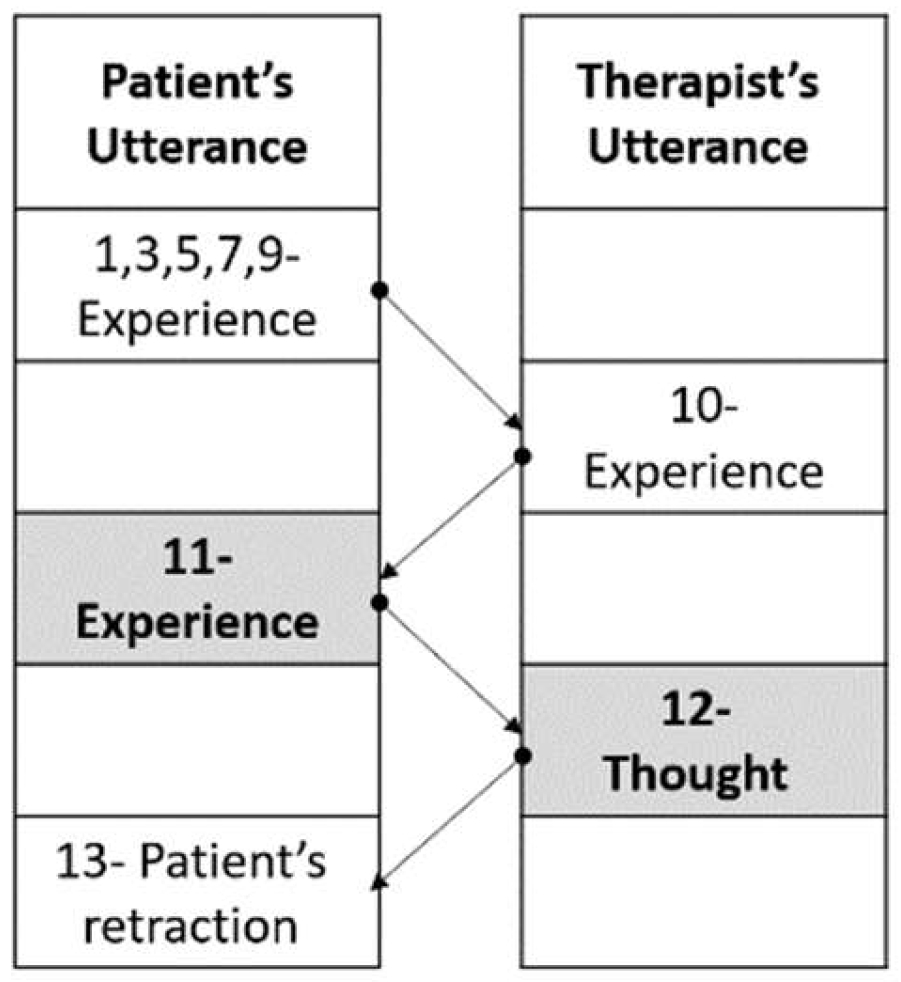
| Utterance | Speaker | Utterance | Dimension | Remark |
|---|---|---|---|---|
| 1 | Patient | I’m not sure how to say this… there’s just this tight feeling in my chest when I think about going back home. | Experience | |
| 2 | Therapist | Stay with that for a moment. What does that feeling seem like from the inside? | None | (Question/facilitative intervention) |
| 3 | Patient | It’s strange… almost like something is pressing down. | Experience | |
| 4 | Therapist | Pressing down? | None | (Question/facilitative intervention) |
| 5 | Patient | Yes… like I can’t quite breathe fully. | Experience | |
| 6 | Therapist | What happens as you notice it right now? | None | (Question/facilitative intervention) |
| 7 | Patient | It gets a bit stronger when I talk about it. | Experience | |
| 8 | Therapist | Stronger in your chest? | None | (Question/facilitative intervention) |
| 9 | Patient | Yes… it feels heavy… maybe a little sad. | Experience | |
| 10 | Therapist | Sad. | Experience | |
| 11 | Patient | Yes… but it’s not exactly sadness… it’s more like something is about to come up. | Experience | |
| 12 | Therapist | Perhaps you are interpreting your reaction in a way that relates to unresolved issues with your father. | Thought | |
| 13 | Patient | …No, that doesn’t feel right. | Experience | (Patient’s retraction) |
| 14 | Therapist | What doesn’t feel right about it? | None | (Question/facilitative intervention) |
| 15 | Patient | I don’t know… the feeling I was talking about is gone now. | Experience | (Patient’s retraction) |
Disclaimer/Publisher’s Note: The statements, opinions and data contained in all publications are solely those of the individual author(s) and contributor(s) and not of MDPI and/or the editor(s). MDPI and/or the editor(s) disclaim responsibility for any injury to people or property resulting from any ideas, methods, instructions or products referred to in the content. |
© 2026 by the author. Licensee MDPI, Basel, Switzerland. This article is an open access article distributed under the terms and conditions of the Creative Commons Attribution (CC BY) license.
Share and Cite
Mendlovic, S. AI-Assisted Precision Psychotherapy: Toward a Process-Based Framework of Therapeutic Interaction. Psychiatry Int. 2026, 7, 124. https://doi.org/10.3390/psychiatryint7030124
Mendlovic S. AI-Assisted Precision Psychotherapy: Toward a Process-Based Framework of Therapeutic Interaction. Psychiatry International. 2026; 7(3):124. https://doi.org/10.3390/psychiatryint7030124
Chicago/Turabian StyleMendlovic, Shlomo. 2026. "AI-Assisted Precision Psychotherapy: Toward a Process-Based Framework of Therapeutic Interaction" Psychiatry International 7, no. 3: 124. https://doi.org/10.3390/psychiatryint7030124
APA StyleMendlovic, S. (2026). AI-Assisted Precision Psychotherapy: Toward a Process-Based Framework of Therapeutic Interaction. Psychiatry International, 7(3), 124. https://doi.org/10.3390/psychiatryint7030124