1. Introduction
Suicidal behavior remains one of the most complex and sensitive public health problems, situated at the intersection of medical, social, and psychosocial factors [
1]. Despite the relative stability or even decline in suicide mortality rates in a number of countries [
2], suicide continues to make a substantial contribution to premature mortality, especially among the working-age and older populations [
3], and is also accompanied by a significant number of suicide attempts, creating a hidden burden on the healthcare system [
4].
The international literature emphasizes that completed suicides and suicide attempts are related, but not identical, phenomena. They differ in age structure, the set of preceding factors, the choice of methods, and the likelihood of a lethal outcome [
5,
6]. An analysis limited to suicide mortality alone does not allow a full assessment of the scale of suicidal behavior and constrains the development of targeted preventive measures, whereas comparing completed suicides and attempts provides a basis for more accurate risk stratification [
7].
For the Republic of Kazakhstan, available scientific publications and analytical reports mainly focus either on the level of suicide mortality or on specific risk determinants in particular population groups (adolescents, working-age men, the influence of socio-economic factors) [
8,
9,
10].
At the same time, comprehensive studies that simultaneously analyze completed suicides and suicide attempts within a single analytical framework, assessing regional differences and the probability of a lethal outcome, remain limited [
11]. In particular, there is a lack of data reflecting the current situation in recent years and enabling assessment of heterogeneity in suicidal behavior across the country’s regions.
The age dimension deserves special attention. International studies show that with increasing age, the probability of a lethal outcome of a suicidal episode increases [
12]; however, for Kazakhstan, these patterns are more often described fragmentarily and without direct comparison with suicide attempts [
8,
13]. Similarly, the contribution of medical, family, and socio-psychological factors to the likelihood of a completed suicide compared with an attempt remains insufficiently quantified at the population level.
In the context of implementing programs for mental health protection and the prevention of suicidal behavior, there is a growing need for analytical data that allow not only assessment of overall trends, but also identification of groups at increased risk of a lethal outcome, as well as regions with different structures of suicidal behavior. Such a study is important both for the development of preventive strategies and for optimizing patient pathways and the allocation of psychiatric and crisis care resources [
14].
In this regard, the present study is aimed at a comprehensive assessment of trends in completed suicides and suicide attempts in the Republic of Kazakhstan in 2023–2024, with an analysis of regional and age differences, as well as factors associated with a higher probability of a lethal outcome.
2. Materials and Methods
2.1. Study Design
A nationwide population-based retrospective observational study was performed based on official registered data on suicidal behavior of the population of the Republic of Kazakhstan for 2023–2024. The study is population-based and covers all registered cases of completed suicides and suicide attempts in the country during the specified period.
2.2. Data Sources
De-identified episode-level data on officially registered suicidal events in the Republic of Kazakhstan for 2023–2024 were obtained from the Republican Scientific and Practical Center for Mental Health of the Ministry of Health of the Republic of Kazakhstan. The dataset covered all 17 regions and the three cities of republican significance, and therefore was treated as nationwide. For each registered episode, the database contained information on outcome (completed suicide or suicide attempt), year of registration, sex, age group, region of residence, and recorded antecedent factors/circumstances. No direct personal identifiers were available to the researchers.
2.3. Study Population
All cases of suicidal behavior registered in 2023–2024 were included in the analysis (n = 15,478), including 7102 completed suicides and 8376 suicide attempts.
Participants’ age ranged from 5 years and older. Standard age stratification was used for the analysis: 5–14, 15–24, 25–34, 35–44, 45–54, 55–64, 65–74, and 75 years and older.
2.4. Measures and Definitions
A completed suicide was defined as a suicidal act with a fatal outcome.
A suicide attempt was defined as intentional self-harm with suicidal motivation without a fatal outcome.
The main calculated indicators included both the absolute number of completed suicides and attempts and rates per 100,000 population. In addition, the ratio of suicide attempts to completed suicides and the proportion of completed suicides among all suicidal episodes were assessed.
2.5. Regional Analysis
Regional analysis was conducted for all regions of the Republic of Kazakhstan and cities of republican significance (Astana, Almaty, Shymkent). Rates per 100,000 population were calculated using official data on the population size of the regions for 2023/2024.
2.6. Classification of Recorded Antecedent Factors and Circumstances
Recorded antecedent factors and circumstances were analyzed in two formats: (1) as individual recorded factors in the bivariate analysis, and (2) as aggregated factor groups in the grouped analysis. To improve comparability between the individual-factor and grouped analyses, the individual factors in are presented in the same order as the aggregated categories used.
Aggregated factor groups were constructed based on the classification available in the registry and used for analytical purposes. The aggregated factor groups were defined as follows. Medical factors included severe somatic diseases. Socio-economic factors included severe financial hardship, unfavorable housing conditions, loss of social status, and extortion. Family/relationship factors included breakdown of family relationships (divorce), conflict with relatives, conflict with spouse, and conflict with parents. Interpersonal/psychosocial factors included “other”, loneliness, fear of punishment or shame, conflicts related to study/work, loss of a loved one, unwanted pregnancy, and involvement in a religious sect. Violence-related factors included physical violence, domestic violence, bullying, and sexual violence. Cases in which antecedent factors could not be established at registration were analyzed as a separate category (“factors not established”).
2.7. Statistical Analysis
Data were processed using IBM SPSS Statistics version 27.0. Descriptive statistics were used to present absolute values and relative indicators. Completed suicides and attempts were compared by calculating odds ratios (ORs) and 95% confidence intervals (95% CIs). The 15–24-year age group was selected as the reference group in the analysis of age-related risk of a fatal outcome. To assess the trend in the probability of completed suicide with increasing age, the χ2 test for trend (Cochran–Armitage) was used. A multivariable binary logistic regression analysis was additionally performed with completed suicide (vs. suicide attempt) as the dependent variable. In the demographic model, year, sex, and age group were included as predictors. In adjusted factor-group analyses, each factor group was entered in a separate model with adjustment for age group, sex, year, and region. All p-values were two-sided; the level of statistical significance was set at p < 0.05.
3. Results
In 2023–2024 in the Republic of Kazakhstan, a decrease in the total number of completed suicides was registered from 3694 to 3408 cases (−7.7%). Among men, the number of completed suicides decreased from 2928 to 2690 (−8.1%); among women, from 766 to 718 (−6.3%); among minors, from 204 to 175 (−14.2%). The number of suicide attempts overall also decreased from 4340 to 4036 (−7.0%). Among men, the number of attempts decreased from 2882 to 2581 (−10.4%), whereas among women the indicator remained virtually unchanged (1458 and 1455; −0.2%). At the same time, among minors, an increase in the number of attempts was noted from 376 to 453 cases (+20.5%) (
Table 1).
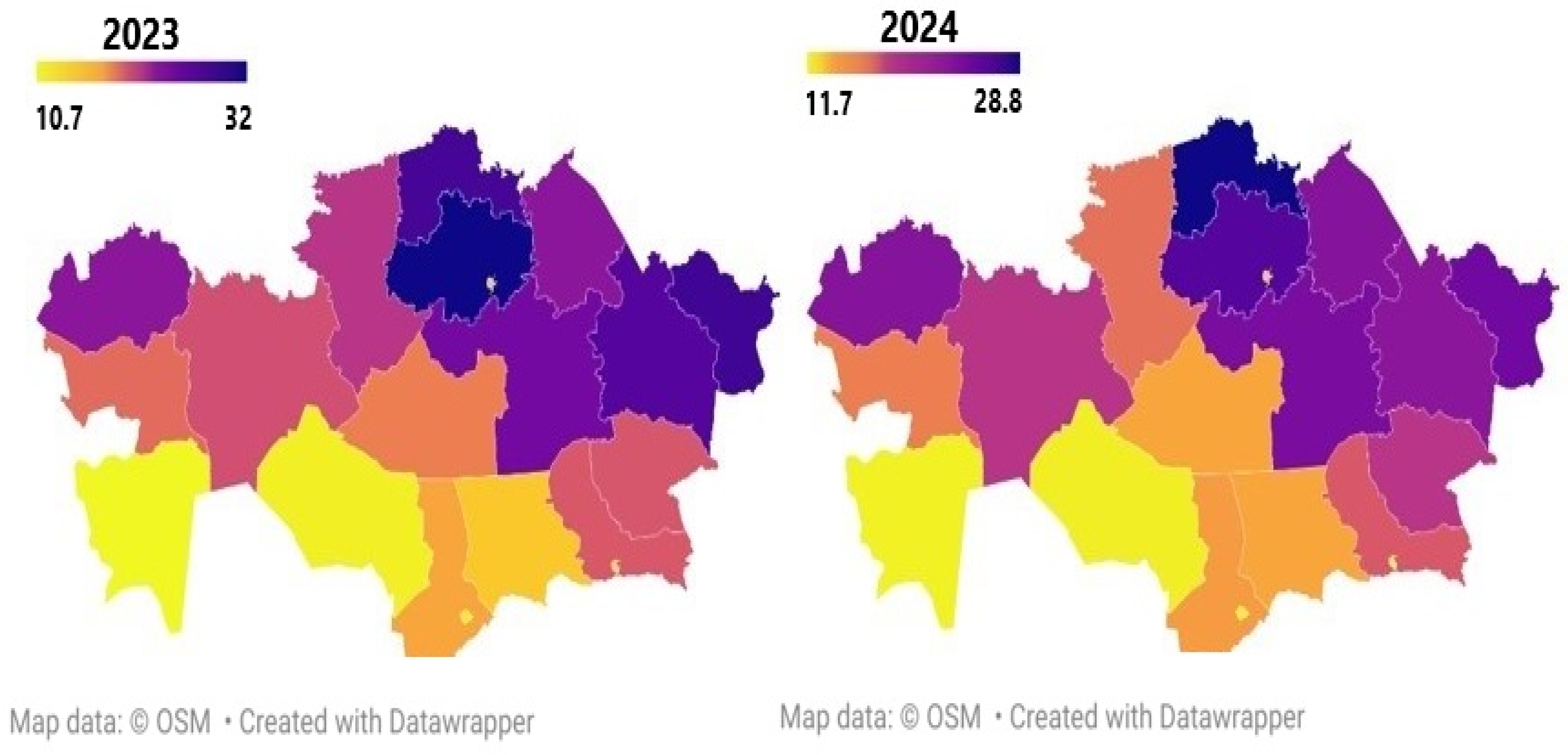
In 2023–2024 in the Republic of Kazakhstan, a decrease in the rate of completed suicides was recorded from 18.6 to 17.2 per 100,000 population (
Table 2,
Figure 1). In 2024, the highest rates of completed suicides per 100,000 population were registered in North Kazakhstan Region (28.8 per 100,000 population), Akmola Region (26.4 per 100,000 population), East Kazakhstan Region (24.6 per 100,000 population), and Karaganda Region (24.1 per 100,000 population). The lowest levels were noted in Almaty city (11.7 per 100,000 population), Shymkent city (11.7 per 100,000 population), and Mangystau Region (11.9 per 100,000 population). The national average in 2024 was 17.2 per 100,000 population.
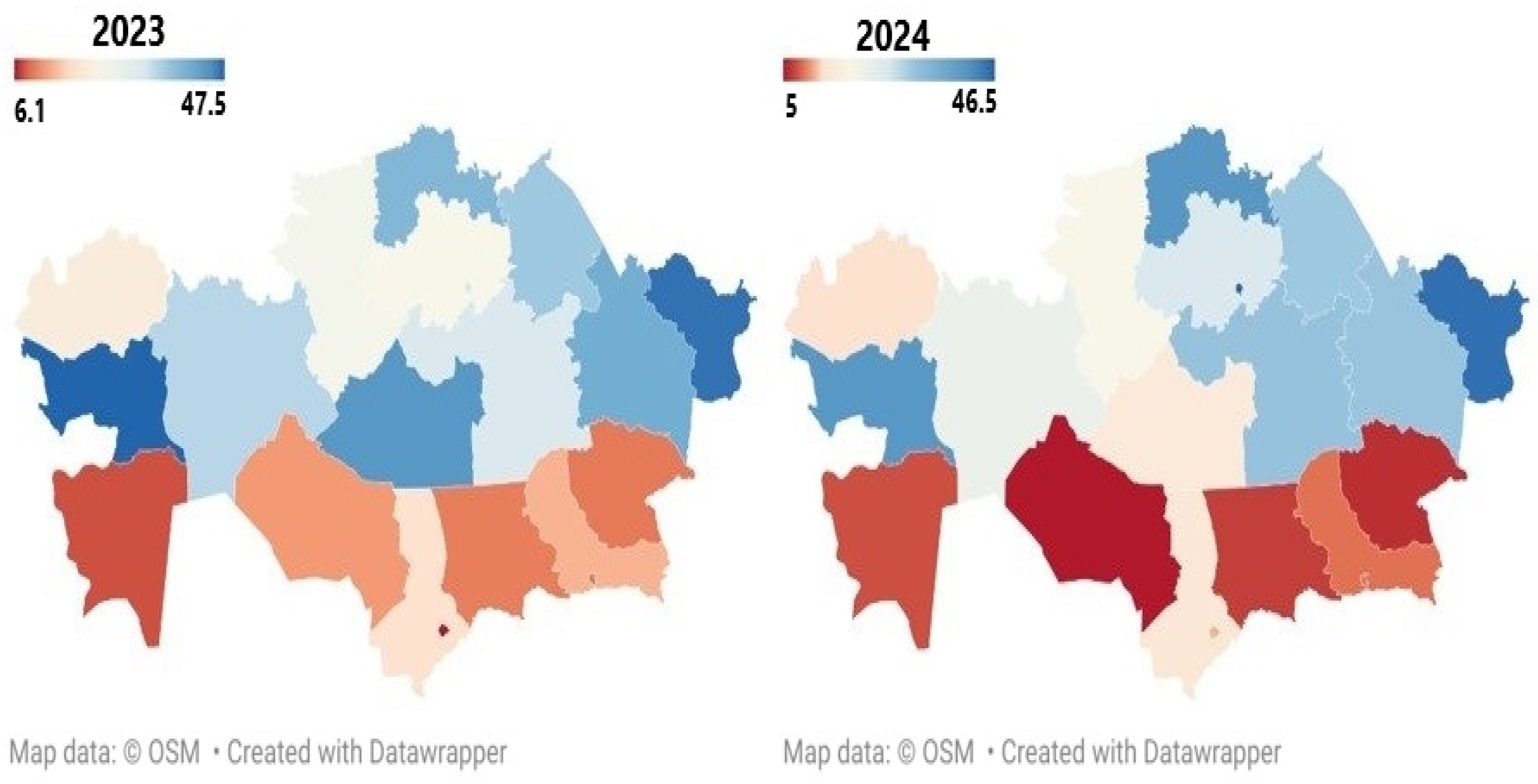
The rate of suicide attempts overall also decreased from 21.9 per 100,000 population in 2023 to 20.4 per 100,000 population in 2024 (
Figure 2). In 2024, the maximum rates of suicide attempts were registered in Astana city (46.5 per 100,000 population), East Kazakhstan Region (45.3 per 100,000 population), North Kazakhstan Region (41.0 per 100,000 population), and Atyrau Region (40.8 per 100,000 population). The lowest levels of attempts were noted in Kyzylorda Region (5.0 per 100,000 population), Zhetysu Region (5.9 per 100,000 population), and Zhambyl Region (6.7 per 100,000 population). The national average in 2024 was 20.4 per 100,000 population.
Age analysis of suicidal behavior for 2023–2024 (n = 15,478) revealed a statistically significant dependence of the probability of a fatal outcome on age (p < 0.001). The proportion of completed suicides among all suicidal episodes increased consistently from 26.4% in the 15–24 age group (660 completed, 1843 attempts) to 67.7% in the 75 years and older group (1371 completed, 653 attempts).
In the 25–34 age group, the proportion of completed suicides was 29.8% (930 and 2195, respectively; OR = 1.18 (1.05–1.33);
p = 0.005), in the 35–44 group—40.1% (1122 and 1675; OR = 1.87 (1.66–2.10);
p < 0.001). Starting from the 45–54 group, a sharp increase in the risk of a fatal outcome was observed: the proportion of completed suicides reached 57.2% (1108 and 829; OR = 3.73 (3.29–4.24);
p < 0.001), in the 55–64 group—64.3% (952 and 528; OR = 5.03 (4.38–5.78);
p < 0.001), in the 65–74 group—63.3% (895 and 519; OR = 4.82 (4.19–5.54);
p < 0.001). The maximum values were recorded in the 75 years and older group (OR = 5.86 (5.15–6.67);
p < 0.001). In the child group aged 5–14 years, the proportion of completed suicides was 32.3% (64 and 134), and the association with a fatal outcome was borderline (OR = 1.33 (0.98–1.82);
p = 0.069). Overall, the proportion of completed suicides among all suicidal episodes was 45.9% (7102 out of 15,478) (
Table 3).
For 2023, bivariate analysis (
Table 4) revealed marked differences in the associations of individual factors with the likelihood of completed suicide versus suicide attempt. The likelihood of a fatal outcome was significantly higher in episodes in which preceding factors were not established (OR = 1.92; 95% CI 1.75–2.10;
p < 0.001) and in episodes associated with severe somatic diseases (OR = 2.22; 95% CI 1.57–3.13;
p < 0.001).
Among socio-economic factors, no statistically significant differences were observed for severe financial hardship (OR = 1.15; 95% CI 0.92–1.45; p = 0.226), loss of social status (OR = 0.98; 95% CI 0.30–3.21; p = 0.972), or extortion (OR = 0.39; 95% CI 0.04–3.77; p = 0.417). Unfavorable housing conditions were more often associated with attempts than with completed suicides (OR = 0.68; 95% CI 0.47–0.97; p = 0.035).
Family/relationship factors showed a consistent inverse association with completed suicide, indicating their predominance among attempts. This pattern was observed for breakdown of family relationships (divorce) (OR = 0.59; 95% CI 0.44–0.79; p < 0.001), conflict with relatives (OR = 0.31; 95% CI 0.24–0.41; p < 0.001), conflict with spouse (OR = 0.28; 95% CI 0.21–0.38; p < 0.001), and conflict with parents (OR = 0.17; 95% CI 0.10–0.31; p < 0.001).
Within the interpersonal/psychosocial category, the factor “other” was significantly more common among attempts (OR = 0.87; 95% CI 0.80–0.96; p = 0.003), as were fear of punishment or shame (OR = 0.36; 95% CI 0.19–0.69; p = 0.002) and conflicts related to study/work (OR = 0.29; 95% CI 0.11–0.78; p = 0.014). No statistically significant differences were identified for loneliness (OR = 1.11; 95% CI 0.91–1.36; p = 0.305), loss of a loved one (OR = 0.93; 95% CI 0.55–1.55; p = 0.767), or involvement in a religious sect (OR = 0.48; 95% CI 0.20–1.17; p = 0.105). Unwanted pregnancy was rare and therefore was not interpreted analytically.
Violence-related factors were generally infrequent and were characterized by wide confidence intervals. No statistically significant differences were found for physical violence (OR = 1.44; 95% CI 0.59–3.47; p = 0.420), bullying (OR = 0.59; 95% CI 0.11–3.21; p = 0.539), or sexual violence (OR = 0.94; 95% CI 0.44–2.01; p = 0.873). In contrast, domestic violence was significantly more often associated with suicide attempts than with completed suicides (OR = 0.10; 95% CI 0.04–0.21; p < 0.001).
In 2023, the aggregated analysis showed substantial differences in the strength of association of individual groups of factors with the likelihood of completed suicide compared with attempts. The most pronounced positive association was identified for medical factors represented by severe somatic diseases (OR = 2.22; 95% CI 1.57–3.13), indicating a more than twofold increase in the probability of a fatal outcome in the presence of this group of factors.
Socio-economic factors overall did not demonstrate a significant relationship with a fatal outcome (OR = 0.98; 95% CI 0.81–1.18), indicating their approximately equal representation among completed suicides and attempts. In contrast, family-relational factors were substantially more often associated with suicide attempts than with completion (OR = 0.31; 95% CI 0.27–0.37). A similar, though less pronounced, trend was observed for interpersonal and psychosocial factors (OR = 0.85; 95% CI 0.78–0.93; p < 0.001).
Despite the low frequency of events, violence-related factors in aggregated form were statistically significantly more often noted in suicide attempts (OR = 0.33; 95% CI 0.22–0.49;
p < 0.001) (
Table 5).
For 2024, bivariate analysis (
Table 6) showed a pattern broadly similar to that observed in 2023. The likelihood of a fatal outcome was significantly higher in episodes with factors not established (OR = 2.29; 95% CI 2.08–2.52;
p < 0.001) and in episodes associated with severe somatic diseases (OR = 2.64; 95% CI 1.91–3.65;
p < 0.001).
Among socio-economic factors, no statistically significant differences were observed for severe financial hardship (OR = 1.04; 95% CI 0.83–1.31; p = 0.720), loss of social status (OR = 0.74; 95% CI 0.24–2.26; p = 0.596), or extortion (OR = 0.30; 95% CI 0.03–2.65; p = 0.247). Unfavorable housing conditions, however, were significantly more common among attempts than among completed suicides (OR = 0.59; 95% CI 0.40–0.86; p = 0.006).
Family/relationship factors again showed a stable inverse association with completed suicide, indicating their predominance among attempts. This was observed for breakdown of family relationships (divorce) (OR = 0.46; 95% CI 0.34–0.63; p < 0.001), conflict with relatives (OR = 0.25; 95% CI 0.19–0.34; p < 0.001), conflict with spouse (OR = 0.23; 95% CI 0.17–0.32; p < 0.001), and conflict with parents (OR = 0.12; 95% CI 0.06–0.21; p < 0.001).
Within the interpersonal/psychosocial category, the factor “other” was marginally but significantly more frequent among attempts (OR = 0.90; 95% CI 0.82–1.00; p = 0.040). Fear of punishment or shame (OR = 0.21; 95% CI 0.11–0.42; p < 0.001), conflicts related to study/work (OR = 0.18; 95% CI 0.07–0.42; p < 0.001), and involvement in a religious sect (OR = 0.35; 95% CI 0.14–0.88; p = 0.020) were also more often associated with attempts. No statistically significant differences were observed for loneliness (OR = 1.10; 95% CI 0.90–1.35; p = 0.342) or loss of a loved one (OR = 1.07; 95% CI 0.68–1.68; p = 0.780). Unwanted pregnancy was rare and therefore was not interpreted analytically.
Violence-related factors remained infrequent in 2024. Domestic violence was strongly associated with suicide attempts rather than completed suicides (OR = 0.06; 95% CI 0.02–0.14; p < 0.001), and bullying was also more common among attempts (OR = 0.12; 95% CI 0.02–0.92; p = 0.015). No statistically significant differences were found for physical violence (OR = 0.99; 95% CI 0.43–2.29; p = 0.975) or sexual violence (OR = 0.70; 95% CI 0.32–1.52; p = 0.361).
In
Table 7, the aggregated (group-level) analysis compares completed suicides versus suicide attempts in 2024 and shows which broader factor groups are differentially associated with a fatal outcome. The odds of a completed suicide were significantly higher in episodes with medical factors (severe somatic diseases; OR = 2.64; 95% CI 1.91–3.65;
p < 0.001). In contrast, family/relationship factors (OR = 0.24; 95% CI 0.20–0.28;
p < 0.001), interpersonal/psychosocial factors (OR = 0.84; 95% CI 0.77–0.93;
p < 0.001), and violence-related factors (OR = 0.22; 95% CI 0.14–0.33;
p < 0.001) were significantly more common among attempts. Socio-economic factors did not differ significantly between completed suicides and attempts (OR = 0.87; 95% CI 0.72–1.06;
p = 0.168).
In the multivariable logistic regression model (
Table 8) including year, sex, and age group, the odds of completed suicide versus suicide attempt did not differ significantly between 2023 and 2024 (aOR = 0.98; 95% CI 0.91–1.05;
p = 0.572). Male sex was independently associated with higher odds of a fatal outcome compared with female sex (aOR = 1.89; 95% CI 1.74–2.05;
p < 0.001). A clear age gradient was observed: compared with the 15–24-year group, the adjusted odds of completed suicide increased significantly from age 35 years onward and were highest in the 75+ group (aOR = 4.79; 95% CI 4.16–5.51;
p < 0.001), whereas the associations for the 5–14 and 25–34 age groups were not statistically significant.
In adjusted analyses controlling (
Table 9) for age, sex, year, and region, medical factors represented by severe somatic diseases remained positively associated with completed suicide versus suicide attempt (aOR = 1.93; 95% CI 1.49–2.50;
p < 0.001). Episodes with unestablished factors were also more likely to result in a fatal outcome (aOR = 1.76; 95% CI 1.61–1.92;
p < 0.001). In contrast, family/relationship factors (aOR = 0.33; 95% CI 0.29–0.38;
p < 0.001), violence-related factors (aOR = 0.30; 95% CI 0.21–0.42;
p < 0.001), and interpersonal/psychosocial factors (aOR = 0.90; 95% CI 0.82–0.99;
p = 0.027) were more strongly associated with suicide attempts, while socio-economic factors did not show a statistically significant association with outcome (aOR = 0.95; 95% CI 0.82–1.10;
p = 0.503).
4. Discussion
The present study demonstrates multidirectional changes in suicidal behavior in the Republic of Kazakhstan in 2023–2024. Although the overall number and rate of both completed suicides and suicide attempts declined, the structure of suicidal behavior became more complex, which does not allow the observed reduction to be interpreted as an unequivocally favorable trend. In particular, the increase in registered suicide attempts among minors, alongside a decrease in completed cases, should be interpreted cautiously. At least two non-mutually exclusive explanations are plausible. First, the increase may reflect a real rise in suicidal ideation, psychological distress, or non-fatal self-harm among adolescents. Second, it may reflect improved recognition and registration of non-lethal episodes through schools, counseling services, emergency care, and other contact points. Because non-fatal suicidal behavior is especially sensitive to help-seeking and detection mechanisms, the observed increase in attempts among minors cannot be attributed solely either to a true worsening of suicidal behavior or to improved case ascertainment alone [
15,
16].
The regional analysis revealed pronounced territorial heterogeneity both in the level of completed suicides and in the frequency of attempts. Substantial differences in the ratio of attempts to completed suicides suggest the influence of factors beyond individual-level risk, including access to emergency medical care, patterns of help-seeking, differences in the lethality of methods used, and the completeness of attempt registration [
17]. In this context, regions and cities with relatively high attempt rates but lower lethality may reflect more effective mechanisms of detection and rescue, whereas areas with a low attempt-to-completed ratio may reflect either more lethal suicidal episodes or under-ascertainment of non-fatal attempts.
At the same time, the observed regional heterogeneity should be interpreted with caution. It may reflect not only true territorial differences in suicidal behavior, but also differences in the detection and registration of non-fatal attempts, availability of emergency and psychiatric care, patterns of service utilization, and interagency ascertainment practices. For this reason, regional contrasts in the attempt-to-completed ratio should not be interpreted solely as direct differences in lethality.
A further consideration is that the higher completed suicide rates observed in some northern and eastern regions are unlikely to be explained by a single determinant. A plausible hypothesis is that these differences reflect a combined influence of alcohol-related patterns, socio-economic stressors, climatic and seasonal conditions, and regional variation in access to and use of mental health and emergency services [
8,
13]. However, the present study was not designed to test these ecological determinants directly. Therefore, such interpretations should be regarded as hypotheses requiring dedicated multilevel or region-focused analyses rather than as causal conclusions.
The observed regional heterogeneity is likely to be multifactorial and should be interpreted in a broader contextual framework. International studies suggest that geographic variation in suicidal behavior is often associated with differences in socio-economic conditions, alcohol consumption patterns, availability and accessibility of mental health and emergency services, and cultural norms related to help-seeking and stigma [
7,
8,
13]. In the context of Kazakhstan, these factors may interact with regional disparities in healthcare infrastructure, urban–rural differences, and variation in interagency detection and registration practices. Therefore, the observed regional differences likely reflect not only variation in underlying risk, but also differences in case ascertainment and service accessibility [
7,
17].
The increase in suicide attempts among minors is of particular concern and may also have multiple explanations. International evidence indicates that rising trends in non-fatal self-harm among adolescents may be linked to increasing psychological distress, social and academic pressures, and improved detection of non-fatal episodes through schools, primary care, and emergency services [
15,
16]. In the present study, the increase in attempts among minors, accompanied by a decrease in completed suicides, may reflect both a real increase in distress and a greater likelihood of identification and reporting of non-lethal episodes. This pattern is broadly consistent with findings from other settings, where improved awareness and surveillance may increase the detection of suicide attempts without a corresponding rise in mortality [
15,
16].
An important methodological issue is the differential ascertainment of fatal and non-fatal suicidal episodes. Completed suicides are more likely to be registered because they usually involve police, forensic, and administrative procedures, whereas non-fatal attempts may remain undocumented due to concealment by relatives, failure to seek medical attention, or incomplete referral into mental health services. This difference in detection probability may bias direct comparisons between fatal and non-fatal episodes and is particularly relevant when interpreting age-specific and regional attempt-to-completed ratios.
The age analysis showed a clear and statistically significant increase in the probability of a fatal outcome with increasing age. A particularly marked rise was observed after age 45, which is consistent with epidemiological and clinical concepts regarding the role of somatic burden, social isolation, and reduced opportunities for timely intervention in older age groups [
18]. The age-related increase in lethality likely reflects not only biological aging, but also a shift in the profile of suicidal episodes from more conflict-related and externally visible crises to more medically burdened and less observable trajectories, thereby narrowing the window for rescue [
19,
20]. At the same time, the age gradient described here is a population-level pattern and does not preclude individual variation or rare events in younger groups. In the 5–14-year age group, the small absolute number of cases implies statistical instability and requires cautious interpretation [
21].
An additional issue that could not be directly addressed in the present dataset is the method used in suicidal acts. Because lethality is strongly influenced by the chosen method, the higher completion rate among older adults may reflect both greater physical vulnerability and a tendency to use more lethal means. In the absence of method-specific data, these mechanisms cannot be disentangled in the present analysis. This should be considered an important direction for future registry-based studies with forensic linkage.
The analysis of factors associated with the outcome of suicidal behavior revealed substantial differences between completed suicides and attempts. Severe somatic diseases showed the strongest positive association with a fatal outcome, supporting the clinical relevance of physical illness as an important correlate of suicidal lethality [
22,
23]. By contrast, family-relational and interpersonal conflicts, including divorce and conflicts with relatives, spouses, and parents, were more often associated with suicide attempts. This may reflect a comparatively more “open” type of crisis, in which distress becomes visible earlier and the probability of intervention before death is greater [
24].
Importantly, these patterns remained materially similar in multivariable analyses adjusting for year, sex, age group, and region. The age gradient persisted after adjustment, with significantly higher adjusted odds of completed suicide from midlife onward and the highest odds observed in the 75+ group. Severe somatic diseases also remained positively associated with a fatal outcome after adjustment, whereas family/relationship and violence-related factors remained more strongly associated with suicide attempts. This supports the robustness of the main findings, although residual confounding and registration bias cannot be fully excluded.
Of particular concern is the high proportion of completed suicides classified as “factors not established”. An important aspect of this finding is the difference in the availability of information between non-fatal and fatal suicidal behavior. In cases of suicide attempts, antecedent factors can often be identified through direct communication with the individual, including clinical interviews and psychosocial assessment, which allows a more complete understanding of precipitating circumstances.
In contrast, for completed suicides, the reconstruction of antecedent factors is substantially more challenging. Direct patient interview is impossible, suicide notes are absent in many cases, and available information depends on indirect sources such as relatives, witnesses, medical records, and police or forensic reports. These sources may be incomplete or affected by recall bias and social stigma, which limits the accuracy of post-event characterization [
25].
In this context, the high proportion of cases classified as having “factors not established” should be interpreted not only as reflecting potentially unmeasured determinants, but also as an indicator of limitations in routine data collection and post-event investigation. The observed association between this category and a higher likelihood of fatal outcome may therefore partly reflect differences in ascertainment between fatal and non-fatal cases.
These findings underscore the need to improve the reconstruction of circumstances surrounding completed suicides. In particular, structured approaches such as psychological autopsy, which involve systematic collection of information from multiple sources, may help to better identify the psychosocial and clinical antecedents of suicide and reduce the proportion of cases with unestablished factors [
26]. In the context of Kazakhstan, this challenge may be further amplified by social stigma, limited disclosure by relatives, and the primary focus of post-mortem procedures on legal and forensic classification rather than comprehensive psychosocial reconstruction [
25].
The aggregated analysis confirmed that medical factors had a stronger association with completed suicides than with suicide attempts. In particular, the registry category of severe somatic diseases was positively associated with fatal outcomes, which is consistent with previous evidence showing that serious physical illness may increase suicide risk [
27]. By contrast, family/relationship, interpersonal/psychosocial, and violence-related factors were more frequently represented among suicide attempts, suggesting that these episodes may more often occur in the context of acute, externally visible psychosocial crises. Socio-economic factors did not show an independent statistically significant association with fatal outcome, which may indicate a more indirect effect operating through other clinical and psychosocial pathways, or may reflect limitations of the available classification system.
Overall, the findings suggest that the reduction in total registered suicidal behavior in Kazakhstan is accompanied by increasing structural complexity. Suicidal lethality appears to be stratified by age, sex, region, and the nature of recorded antecedent factors. These results support differentiated prevention strategies: strengthening integrated medical and psychosocial care for older adults and patients with severe somatic diseases; improving early detection, counseling, and referral systems for minors; and enhancing the quality of interagency registration and reconstruction of the circumstances surrounding fatal cases. At the same time, the observed increase in attempts among minors should be interpreted in a balanced way, as it may reflect both a true increase in distress and improved detection of previously hidden non-fatal episodes.