1. Introduction
Mental health problems in children and adolescents are very frequent and can affect their development and autonomy in adulthood [
1]. Although most children and adolescents live without significant difficulties, about 20% manifest psychiatric disorders [
2]. Although many adult mental illnesses reveal symptoms or begin in adolescence, early diagnosis is a decisive factor for good evolution and development [
1].
The mental health of children and adolescents is closely related to family functioning [
1]. The family helps us to learn significant dimensions of interaction, namely language, body contacts, communication and interpersonal relationships; furthermore, it is considered an institutionalized group, as it is the pillar of our social life [
3]. In this way, the family has primordial functions regarding the development and protection of its members (internal function) and in the socialization, adaptation and transmission of a certain culture (external function) [
4].
Although parents represent the main agents of a child’s socialization [
5] and provide the necessary confidence for the child to explore him or herself, others and the environment [
6], it is essential to identify their characteristics, as well as evaluating the consequences of their educational actions, as it may lead to problems in the children’s development [
5].
Moreover, according to the present literature, educational actions are linked to parenting styles [
5,
7]. Studies based on the theoretical model on parenting educational styles developed by Diane Baumrind [
8] have shown that the democratic parenting style is considered the most adaptive and the one that promotes healthier development [
1,
9], and the permissive and authoritarian are two dysfunctional extremes [
1,
9]. In this sense, Baumrind [
8] describes the democratic style as parents who have very high levels of demand and control their children’s behaviors through rigid models. Despite this type of imposition, they adapt their behavior, considering the point of view and opinions of their children [
8,
10,
11]. Thus, in this type of style, there is flexibility and a response to the needs of children, but, at the same time, there are standards and restrictions that must be followed [
8,
10,
11]. Following this parenting style, parents are affectionate and sensitive and they are available and support their children in their interests, but, at the same time, they present control and rational explanations about their decisions or the impositions of rules, which stimulates the autonomy, dialogue and independence of the children [
8,
10,
11]. Regarding the permissive style, it is identified when parents do not present punitive behaviors and accept the child’s wishes and actions, have excessive tolerance and avoid exercising control [
8,
10,
11]. In this sense, given that there is no follow-up of behavioral models and few demands are made by the children, this type of parenting style is considered to involve the existence of affection and response to the needs of the children, but, on the other hand, it shows no impositions of certain behavioral patterns [
8,
10,
11]. On the other hand, the authoritarian style is characterized by high levels of power and low levels of support, affection, and communication and little commitment [
8,
11,
12]. In this way, these parents emphasize obedience and respect for authority through behavioral control based on a pre-defined sovereign pattern of conduct. In this type of style, punishments and coercive measures are used to control the discordant behaviors that children display in the face of the behavioral models that parents believe to be the “most correct” [
8,
11,
12].
Furthermore, previous studies indicate that one of the factors associated with mental health problems in children and adolescents is the mental health of parents, who in turn have an impairment in their ability to adequately educate their children [
13,
14]. Thus, it seems relevant to explore the personality traits of parents, as they significantly influence child development, more specifically the personality traits that constitute the Dark Triad. In this way, the Dark Triad integrates three personality traits that are closely linked to the propensity for violence, aggressiveness and are considered socially aversive, namely, Machiavellianism, psychopathy and narcissism [
15,
16,
17,
18], also sharing some characteristics such as manipulation, lack of empathy, selfishness, lack of affection, and insensitivity [
19].
Moreover, Machiavellianism is characterized by the absence of affection in interpersonal relationships and by not showing concerns with morality [
20]. Machiavellianism is a personality trait that is also defined when an individual presents a deceitful, materialistic, selfish, emotionless, and manipulative posture [
19,
20] as well as a lack of empathy towards those around him [
21]. It is also characterized by deception, exploitation, the presentation of cynicism, and domination [
22], with the purpose of using all possible means to achieve intended goals [
23], since these are individuals who are successful in persuading others [
24]. A study conducted by Ojha [
25] showed that Machiavellian fathers manipulate their children to satisfy their own needs. In the same sense, the study carried out by Láng [
26] showed that Machiavellian mothers, when they feel that they are losing control over their adolescent children, tend to exhibit overprotective parental behavior to maintain or regain control. The same study demonstrated that parents with Machiavellian personality traits showed a significant positive correlation with parental rejection behavior [
26].
In turn, the study conducted by Ručević [
18] revealed that high levels of psychopathic traits in parents predicted less affection, interest, and availability, and more rejection and neglect. The study conducted by Cox et al. [
27] presented evidence that individuals with psychopathic traits who are self-centered and impulsive tend to be more likely to use a permissive parenting style as they may be less likely to worry about rules and focus more on their needs and desires. The same study also showed that only egocentric fathers were more likely to use authoritarian parenting, as it was associated with a low expression of affection and the use of punishment, and this association was explained by the manipulation that characterizes these individuals. In the same vein, a study conducted by Krupić et al. [
28] demonstrated that psychopathic parenting tendencies, assessed through the Big Five Inventory, were positively associated with authoritarian and permissive parenting styles.
Narcissism is characterized by an individual who acts without feeling and tends to be seductive and cunning, in order to obtain power, control and domination over everything around him [
29,
30,
31]. He is also characterized as selfish and focused on his own interests [
19,
29,
32] and has a lack of empathy [
33]. Narcissistic parents tend to control, dominate and manipulate their children [
34], as their relationship is based on the fulfillment of a certain function that narcissistic parents impose on their children and, therefore, there is only one-sided power in making decisions [
35]. Narcissistic parents also tend to exhibit parental possessiveness, rejection, inconsistent discipline and low affection [
36], as well as affective unavailability towards their children, which, consequently, leads them to not respond adequately to their needs [
37].
Among the various existing educational practices, physical punishment is still at the heart of our culture as a disciplinary and punitive practice [
38]. Thus, physical punishment is characterized by a parental disciplinary response using physical force, with the aim of interrupting unwanted behavior; this practice is considered a kind of sanction, reprimand or warning [
38,
39]. Although this practice is recognized as a negative experience for children, most parents value this form of punishment as something “normal”, to control the “incorrect” behaviors that come from children [
39]. The practice is globally well accepted, as it is justified through the cultures of various regions of the world, including Portugal, since it demonstrates tolerance and condescension in the execution of physical violence [
38,
40,
41,
42,
43]. Although there are legal prohibitions on physical punishment, which promote the child’s right to protection from abuse [
44], they are not sufficient and the practices continue to receive broad social legitimacy [
40].
This practice also has serious repercussions for the health of children and adolescents, both in terms of health in general (e.g., fractures and injuries) and in terms of mental health problems (e.g., anxiety, social isolation, depression and suicide), which in turn have repercussions on their adult life (e.g., depression, alcoholism, aggressive and criminal acts, and antisocial behavior) [
41,
45,
46,
47,
48,
49,
50].
When an individual has beliefs about physical punishment and accepts violence as a disciplinary method, there is a greater probability that they will use physical punishment as an educational practice [
38]. Thus, the higher the acceptance of physical punishment, the greater the possibility of it becoming a disciplinary method, which can lead to a significant rise in violence to physical abuse [
38]. A recent study conducted by Chen et al. [
47] showed that parents who believe that physical punishment is an effective form of parenting are more likely to use physical punishment on their children.
Some research reveals that parents who are physically abusive also use excessive and irrational physical discipline towards their children [
51,
52], which can be expressed through physical abuse [
53,
54], or physical punishment [
41]. The traits that comprise the Dark Triad, identified in adulthood, are significantly associated with aggression [
55]. Machiavellian individuals can be highly insensitive parents with parental habits that may present neglect and/or physical abuse [
25,
56]. A study conducted by Leedom et al. [
57] showed that parents with psychopathic personality traits can have negative and even violent interactions with their children, which leads to inappropriate parenting. Another study found that parents with psychopathic traits who showed less affection and more manipulation exhibited greater neglect, rejection, and aggression towards their children [
18]. In addition, fathers’ parenting behaviors, compared to those of mothers who have psychopathy, are characterized by less affection, communication, and supervision, and less time spent with their children [
36]. In relation to narcissistic parents, research has shown that they tend to have high parental possessiveness, rejection, inconsistent discipline and low affection for their children [
36], even with the absence of physical aggression, it was possible to verify negative effects on symptoms of childhood trauma [
58]. In addition, a study showed that, although narcissistic mothers play a primary role in their children’s well-being, narcissistic fathers play an important role in the way children interact and their perception of other people [
59].
In view of the above studies, and given the scarcity of empirical evidence of the association between the concepts addressed and their relevance in the areas of mental health, such as psychology and psychiatry, the main objective of this study is to investigate the relationship between parenting styles, beliefs about physical punishment and the personality traits that constitute the Dark Triad. To this end, the following specific objectives were defined: (i) to explore the association between parenting styles and the personality traits that constitute the Dark Triad (ii) to analyze the association between beliefs about physical punishment and the personality traits that make up the Dark Triad; and (iii) to test the mediating effect of beliefs about physical punishment between Dark Triad traits and parenting styles. In view of the proposed objectives, the following hypotheses were elaborated: H1: it is expected that authoritarian and/or permissive parenting styles are positively associated with the personality traits that constitute the Dark Triad; H2: it is expected that there is a positive association between beliefs about physical punishment and the personality traits that make up the Dark Triad; and H3: beliefs about physical punishment are expected to play a mediating role in the relationship between Dark Triad traits and parenting styles.
2. Method
2.1. Participants
In the present study, initially, the sample consisted of 311 participants, which was higher than the initially calculated size (300 participants). However, after the sample was cleaned, it was reduced to 290 participants, comprising parents of school-age children/adolescents between 7 and 16 years old: 231 (79.7%) female and 59 (20.3%) males, aged between 28 and 66 years old (M = 42.92; SD = 68.61). All participants were selected non-randomly, for convenience, given that they were recruited in schools in northern Portugal.
Regarding marital status, 16 participants were single (5.5%), 211 were married (72.8%), 20 were divorced (6.9%), 3 were widowed (1.0%), and 40 were in a civil partnership (13.8%).
Regarding schooling, 3 participants have the 1st Cycle (1st to 4th year) (1.0%), 5 the 2nd Cycle (5th to 6th year) (1.8%), 32 the 3rd Cycle (7th to 9th year) (11.0%), 100 Secondary Education (10th to 12th year) (34.5%), 104 a Bachelor’s Degree (35.9%), 36 a Master’s Degree (12.4%) and, finally, 10 had a PhD (3.4%).
Regarding current employment situations, 31 were unemployed (10.7%), 226 were employed (77.9%), 30 were self-employed (10.4%) and 3 were on sick leave (1.0%).
2.2. Instruments
In the present research, a Sociodemographic Questionnaire was used with the aim of gathering information about the participants: namely, age, gender, marital status, education and socioeconomic status.
The
Dark Triad Dirty Dozen Scale (TN-12) was originally developed by Jonason and Webster [
60] and validated for the Portuguese population by Pechorro et al. [
61]. This instrument consists of 12 items and a five-point Likert-type response scale (from 1—“
Strongly Disagree” to 5—“
Strongly Agree”). This scale aims to measure the personality traits that make up the Dark Triad and is divided into three dimensions, namely, Machiavellianism (4 items) (e.g., “
I’ve used fraud or lies to achieve my goals”), Psychopathy (4 items) (e.g., “
I tend to have no remorse”) and Narcissism (4 items) (e.g., “I tend to want others to look up to me.”) The version developed by Pechorro et al. [
61] presented
Cronbach’s alpha of 0.58, 0.54, and 0.74 for the dimensions of Machiavellianism, Psychopathy, and Narcissism, respectively. In the present study, the instrument presented adequate psychometric characteristics, with a Cronbach’s alpha of 0.79 in the Machiavellianism dimension, 0.62 in the Psychopathy dimension and 0.82 in the Narcissism dimension. The value of each dimension is calculated based on the sum of all items. The confirmatory factor analysis showed adequate adjustment indices, χ
2/df = 2.854;
p = 0.000; GFI = 0.92; CFI = 0.92; RMSEA = 0.08.
The
Parenting Styles and Dimensions Questionnaire (QEDP)—
Short Version was originally developed by Robinson et al. [
62] and validated for the Portuguese population by Miguel et al. [
5]. This instrument consists of 32 items, being rated on a five-point
Likert scale (from 1—“
Never” to 5—“
Always”). The QEDP is composed of three dimensions, with the aim of evaluating the three types of parenting styles outlined in Baumrind’s [
8] typology, namely, the Democratic parenting style (15 items) (e.g., “
I respond to the feelings and needs of my child”), the Authoritarian parenting style (12 items) (e.g., “
I laugh and criticize when my child’s behavior does not meet my expectations”) and the Permissive parenting style (5 items) (e.g., “
I say punishments to my child but I don’t really apply them”). The version developed by Miguel et al. [
5] presented Cronbach’s alpha values of 0.91, 0.86 and 0.75 for the Democratic, Authoritarian and Permissive dimensions, respectively. In the present study, the instrument presented adequate psychometric characteristics, with a Cronbach’s alpha of 0.86 in the Democratic dimension, 0.82 in the Authoritarian dimension, and 0.61 in the Permissive dimension. The value of each dimension is calculated based on the sum of all items. The confirmatory factor analysis showed adequate adjustment indexes, χ
2/df = 2.884;
p = 0.000; GFI = 0.93; CFI = 0.94; RMSEA = 0.08.
The
Scale of Beliefs about Physical Punishment (ECPF) was originally developed and validated for the Portuguese population by Machado et al. [
63]. This scale consists of 21 items, being rated on a five-point
Likert scale (from 1—“
Strongly Disagree” to 5—“
Strongly Agree”), with the objective of evaluating parental conceptions regarding the educational practices that parents have with their children, at the level of tolerance/acceptance of physical punishment as an educational strategy. It is composed of four factors, namely, Factor 1—“
Legitimation of physical punishment for its normality and necessity” (9 items), which is composed of a set of beliefs that legitimize physical violence, seen as an educational strategy, appealing to its necessity and predicting the negative effects of its absence, being seen as something acceptable, necessary and normal in an effective education (e.g., “
A beating never hurt anyone”); Factor 2—“
Legitimization of physical punishment due to its centrality and necessity” (10 items), which considers physical punishment as a central strategy in the child’s education and certain abusive behaviors as still admissible, also taking into account the belief that violence is effective against certain forms of child misbehavior (e.g., “
Hitting is often the only solution to bad behavior”); Factor 3—“
Legitimization of physical punishment by the punitive role and authority of the father” (5 items) includes items that have a traditional and patriarchal conception of family roles, where the father is the figure responsible for authority and discipline in the family (e.g., “
Who is the authority in a house is the father”); Factor 4—“
Legitimization of physical punishment by parental authority” (4 items), which encompasses a family conception guided by values of parental authority and by the child’s obligation to obey and display good behavior (e.g., “
A child has no wants”; “
has an obligation to obey his parents at all times”). The version developed by Machado et al. [
63] presented a Cronbach’s alpha of 0.84 for the dimension “
Legitimation of physical punishment by its normality and necessity”, 0.85 for the dimension “
Legitimation of physical punishment by its centrality and necessity”, 0.81 for the dimension “
Legitimation of physical punishment by the punitive role and authority of the father” and 0.84 for the dimension “
Legitimization of physical punishment by parental authority”. In the present study, the instrument presented adequate psychometric characteristics, obtaining a Cronbach’s alpha of 0.90 for the dimension “
Legitimation of physical punishment by its normality and necessity”, 0.92 for the dimension “
Legitimation of physical punishment by its centrality and necessity”, 0.79 for the dimension “
Legitimation of physical punishment by the punitive role and authority of the father” and 0.60 for the dimension “
Legitimation of physical punishment by the punitive role and authority of the father” and 0.60 for the dimension “
Legitimization of physical punishment by parental authority”. The value of each dimension is calculated based on the sum of all items.
Confirmatory factor analysis was not performed in this questionnaire as there are items that are repeated in the dimensions that constitute it, and the AMOS program does not have the functionality to calculate the adjustment indices when the questionnaires are of this nature.
2.3. Procedures
In a first phase, bibliographic research was carried out, using scientific databases (B-on, Scielo, ScienceDiret, PubMed, SAGEjournals and EBSCO) and books with scientific relevance to the subject under study, in order to develop a complete theoretical framework.
Subsequently, the objectives of the investigation were outlined, the methodology to be used and the evaluation instruments were defined. In the selection of the instruments, the variables under study, the validation for the Portuguese population and the psychometric qualities were taken into account. Thus, contact was made with the authors of the Portuguese validations of the instruments in order to obtain authorization for their application. After its authorization, the research protocol was drawn up, which included the informed consent document and the instruments to be used. Given its conclusion, it was sent to the Ethics and Data Protection Committee of UTAD, requesting its opinion, in order to ensure that the investigation protocol met all the necessary requirements for its advancement. After a favorable opinion was issued, contacts were established with school principals, where the objectives of the study were explained and the dissemination of the link to parents was articulated. It should be noted that the link was prepared on the LimeSurvey platform, given its ease in collecting the sample in view of the pandemic situation that the country was going through at the time of data collection. To obtain a significant sample, the link was also disseminated on social networks and some questionnaires were filled out in person, always following the ethical assumptions underlying the practice of research: namely, informed consent, confidentiality, anonymity and voluntariness. The maximum time for the application of the instruments did not exceed 15 min.
2.4. Data Analysis Strategies
The present study is of a quantitative, cross-sectional and correlational methodological nature, with the general objective of verifying the relationship between the variables under study, corroborating the results with conclusions previously investigated by the scientific community [
64].
Statistical analysis was performed using the Statistical Package for Social Sciences (SPSS) version 27. After entering the data into the program, the sample was cleaned to exclude missing values and outliers. The identification of multivariate outliers was achieved from the analysis of the Mahalanobis distance. The Mahalanobis distance makes it possible to use the mean and variance for each variable to identify participants with values that are significantly far from the overall mean of the sample [
65]. The internal consistency of the instruments was also calculated using Cronbach’s alpha values.
Then, using the AMOS program (IBM SPSS AMOS, version 26), confirmatory factor analyses of the instrument models were carried out to confirm their adequacy, using the maximum likelihood estimation method. To verify the suitability of the model for the data of the present research, measures to evaluate the fit were used, namely, ratio chi square statistics/degrees of freedom (χ
2/df), comparative fit index (CFI), goodness of fit index (GFI) and root mean square error of approximation (RMSEA). According to Marôco [
66], χ
2/df values higher than 5 are considered bad, between 3 and 5 poor, between 1 and 2 good, and values of approximately 1 are considered very good. When the GFI and CFI values present values lower than 0.8, they are considered bad, between 0.8 and 0.9 poor, between 0.9 and 0.95 good, and equal to or greater than 0.95 very good. On the other hand, the RMSEA value is not considered acceptable if it presents a value greater than 0.10, it is acceptable between 0.06 and 0.10 and it is very good if it presents a value equal to or less than 0.05.
Subsequently, the variables of each instrument were categorized according to the original authors. Then, the assumptions of the normality of the data were verified, the values of asymmetry and flattening were observed, and the statistical information regarding the Kolmogorov–Smirnov test was subsequently analyzed. Non-parametric statistical analyses were then used, as the assumptions of normality were not ensured [
64].
Regarding the statistical analysis of the data, this was elaborated through descriptive analysis (calculation of frequencies, means and standard deviation). Subsequently, correlational analyses were performed to determine the degree of association between the variables. Cohen [
67] established classifications to interpret the intensity of the correlations found, with values from 0.10 to 0.29 being considered a small correlation, 0.30 to 0.49 moderate correlation and 0.50 to 1 a strong correlation.
Finally, a medication analysis was carried out using the Bootstraping method, using the AMOS program, to assess the indirect effect of the independent variables (Dark Triad) on the dependent variable (Parenting Styles) through the mediating variable (Beliefs about Physical Punishment), understanding how the latter influences the previously existing relationship of the other variables. The Sobel test was also used to calculate the total indirect effects of the simple mediations performed.
3. Results
3.1. Analysis of the Variables Under Study
In the present investigation, the normality of the distributions of the dimensions of the Dark Triad, Parenting Styles and Beliefs about Physical Punishment was analyzed. After the analysis, it was found that the assumption of normality was not ensured for most of the dimensions of the Dark Triad (Psychopathy, Narcissism), Parenting Styles (Democratic and Authoritarian) and Beliefs about Physical Punishment (Legitimization of physical punishment by its normality and necessity, Legitimation of physical punishment by its centrality and necessity, Legitimization of physical punishment by the punitive role and authority of the father and Legitimization of physical punishment by parental authority), and, in the dimensions Machiavellianism of the Dark Triad and Permissive in Parental Styles, they were ensured. However, the assumption of the linear relationship between the dimensions of the Dark Triad and the Parenting Styles, as well as between the dimensions of the Dark Triad and the Beliefs about Physical Punishment, was not assured. Thus, the non-parametric option, Spearman’s rs, was used. The analyses were calculated using parcels according to the different dimensions of each scale, that is, using the factor values.
3.2. Association Between the Dark Triad and Parenting Styles
In order to test hypothesis (H1), which aims to explore the association between the dimensions of the Dark Triad (Machiavellianism, Psychopathy and Narcissism) and the dimensions of Parenting Styles (Democratic, Authoritarian and Permissive), correlational analyses were performed between the different dimensions, as shown in
Table 1.
Regarding the association between the Machiavellianism dimension and the Democratic Parenting Style dimension, a significant negative correlation was observed (rs = −0.13, p < 0.05); it was of small magnitude. Regarding the association between the Machiavellianism dimension and the dimensions of the Authoritarian and Permissive Parenting Styles, significant positive correlations were found (rs Authoritarian = 0.28, rs Permissive = 0.23, p < 0.01); they were of small magnitudes.
With regard to the Psychopathy dimension, a significant negative correlation was observed in the association with the Democratic Parenting Style dimension (rs = −0.20, p < 0.01). In the association between the Psychopathy dimension and the Authoritarian Parenting Style dimension, there was a significant positive correlation (rs = 0.14, p < 0.05). On the other hand, in the association between the Psychopathy dimension and the Permissive Parenting Style dimension, a non-significant positive correlation was observed (rs = 0.10). All correlations between psychopathy and parenting styles were of small magnitude.
Regarding the Narcissism dimension, significant positive correlations were observed in the associations with the dimensions of Authoritarian and Permissive Parenting Styles (rs Authoritarian = 0.20, rs Permissive = 0.18, p < 0.01). Finally, the association between the Narcissism dimension and the Democratic Parenting Style dimension showed a significant negative correlation (rs = −0.20, p < 0.01). All correlations between narcissism and parenting styles were of small magnitude.
3.3. Association Between the Dark Triad and Beliefs About Physical Punishment
In order to test hypothesis (H2), which aims to analyze the association between the dimensions of the Dark Triad (Machiavellianism, Psychopathy and Narcissism) and the dimensions of Beliefs about Physical Punishment (Legitimation of physical punishment by its normality and necessity, Legitimation of physical punishment by its centrality and necessity, Legitimation of physical punishment by the punitive role and authority of the father and Legitimation of physical punishment by parental authority), correlational analyses were performed between the different dimensions, as shown in
Table 2.
Regarding the association between the Machiavellianism dimension and the dimension of the legitimation of physical punishment as normal and necessary, a significant positive correlation was found (rs = 0.13, p < 0.05). The same result was obtained in the association between the Machiavellianism dimension and the legitimation of physical punishment dimension due to its centrality and necessity (rs = 0.13, p < 0.05). On the other hand, in the association between the Machiavellianism dimension and the legitimation of physical punishment by the punitive role and authority of the father, a positive correlation was verified, although it was not significant (rs = 0.11). Finally, a significant positive correlation was found between the Machiavellianism dimension and the legitimation of physical punishment by parental authority (rs = 0.13, p < 0.05).
In relation to the Psychopathy dimension, significant positive correlations were observed with all dimensions of the scale of Beliefs about Physical Punishment, namely, legitimation of physical punishment by its normality and necessity (rs = 0.21, p < 0.01), legitimation of physical punishment by its centrality and necessity (rs = 0.25, p < 0.01), legitimation of physical punishment by the punitive role and authority of the father (rs = 0.28, p < 0.01) and legitimation of physical punishment by parental authority (rs = 0.20, p < 0.01).
Regarding the Narcissism dimension, significant positive correlations were found with the legitimation of physical punishment by its normality and necessity (rs = 0.23, p < 0.05), the legitimation of physical punishment by its centrality and necessity (rs = 0.24, p < 0.01) and the legitimation of physical punishment by the punitive role and authority of the father (rs = 0.19, p < 0.01). However, there is a non-significant positive correlation in the association between the Narcissism dimension and the legitimation of physical punishment by parental authority (rs = 0.09).
All the correlations observed between the dimensions of the Dark Triad and Beliefs about Physical Punishment scales showed small magnitudes.
3.4. Mediating Effect of Beliefs About Physical Punishment on the Association Between the Dark Triad and Parenting Styles
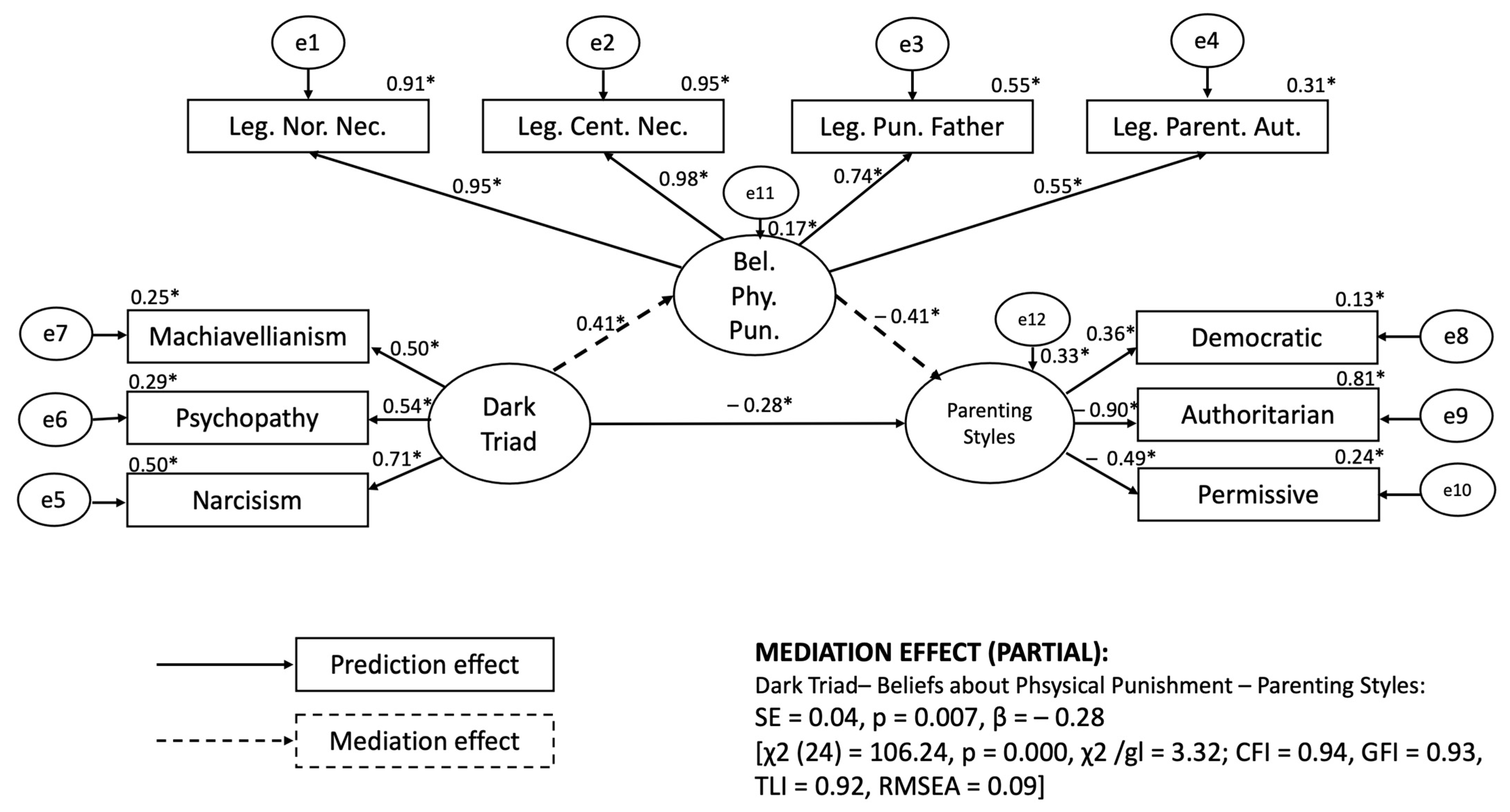
To test the hypothesis (H3) that aims to reveal the predictive effect of the Dark Triad on Parenting Styles, as well as the mediating role of Beliefs about Physical Punishment in this relationship, a structural equation model was produced using the AMOS program.
In the model referring to the Dark Triad, Beliefs about Physical Punishment and Parenting Styles, some predictive effects were found. It was found that the Dark Triad negatively predicts Parenting Styles (β = −0.49; p < 0.001). In turn, the Dark Triad positively predicts Beliefs about Physical Punishment (β = 0.41; p < 0.001) and Beliefs about Physical Punishment negatively predict Parenting Styles (β = −0.41; p < 0.001).
In this sense, after the introduction of the mediating variable Beliefs about Physical Punishment and by using the Bootstrapping procedure, it was possible to verify that the initial connection between the Dark Triad and the Parenting Styles lost magnitude (βinitial = −0.49; βfinal = −0.28), and decreased significance (
p = 0.007), with a partial negative mediation (SE = 0.04,
p = 0.007, β = −0.28), in which the Beliefs about Physical Punishment assumed a partial mediation with a negative effect on the association between the Dark Triad and the Parenting Styles. In the structural equation model, latent variables were used to estimate direct and indirect effects, as shown in
Table 3,
Table 4 and
Table 5. The model presented adequate adjustment indices (χ
2 (24) = 106.24,
p = 0.000, χ
2/gl = 3.32; CFI = 0.94, GFI = 0.93, TLI = 0.92, RMSEA = 0.09) (
Figure 1).
To understand the mediation effect, a simple mediation analysis was carried out with the variable Democratic Parenting Style as the dependent variable, the variable Beliefs about Physical Punishment as mediator and the variable Dark Triad as independent variable. The results of the regressions can be seen in
Table 3. The model explains 18.9% of the total variance of the Democratic Parenting Style variable and the total indirect effects are −0.11, being statistically significant. The significance of indirect values was calculated using the Sobel test (
p < 0.001). This is a partial mediation, since the effect of the Dark Triad on the Democratic Parenting Style, when the mediating variable is added, is reduced; however, it remains significant, going from −0.256 to −0.144.
A simple mediation analysis was also carried out with the variable Authoritarian Parenting Style as the dependent variable, the variable Beliefs about Physical Punishment as mediator and the variable Dark Triad as the independent variable. The results of the regressions can be seen in
Table 4. The model explains 23.5% of the total variance of the Authoritarian Parenting Style variable and the total indirect effects are 0.12, being statistically significant. The significance of indirect values was calculated using the Sobel test (
p < 0.001). This is a partial mediation, since the effect of the Dark Triad on the Authoritarian Parenting Style, when the mediating variable is added, is reduced; however, it remains significant, going from 0.308 to 0.188.
Finally, a simple mediation analysis was carried out with Permissive Parenting Style as the dependent variable, Beliefs about Physical Punishment as mediator and the Dark Triad as the independent variable. The results of the regressions can be seen in
Table 5. The model explains 6.1% of the total variance of the variable Permissive Parenting Style and the total indirect effects are 0.01, being statistically significant. The significance of indirect values was calculated using the Sobel test (
p < 0.001). This is a partial mediation, since the effect of the Dark Triad on the Permissive Parenting Style, when the mediating variable is added, is reduced, but remains significant, from 0.247 to 0.241.
4. Discussion
The present investigation aimed to explore the association between parenting styles and personality traits that constitute the Dark Triad, to analyze the association between beliefs about physical punishment and personality traits that are part of the Dark Triad, and to test the mediating effect of beliefs about physical punishment between Dark Triad traits and parenting styles.
Regarding the first objective, and in view of the analysis of the associations between the dimensions of the Dark Triad and the Parenting Styles, it was observed, as expected, that the Machiavellianism dimension is positively and statistically significant associated with the Authoritarian and Permissive Parenting Styles. In view of these associations, it is possible to say that parents with Machiavellian personality traits tend to adopt authoritarian or permissive parenting styles. The association of the Machiavellianism dimension with the Authoritarian Parenting Style can be explained by the characteristics of the Machiavellian personality trait, as these individuals tend to present an absence of affection in interpersonal relationships [
20], domination [
22] and a lack of empathy towards those around them [
21]. According to the definition of the authoritarian parenting style, parents have high levels of power and low levels of support, affection, and communication and little commitment, as well as control over unwanted behaviors that come from their children [
8]. This result is also in line with a study that concluded that Machiavellian fathers tend to exhibit parental behavior of rejection [
26].
In terms of the association of the Machiavellianism dimension with the Permissive Parenting Style, this can be explained by the presence of other characteristics that individuals with Machiavellian traits present, namely, manipulation and deceptive posture [
19,
20], use of deception and presentation of cynicism [
22], and use of all possible means to achieve intended goals [
23]. This result is in line with research that has shown that Machiavellian fathers tend to manipulate their children to satisfy their own needs [
25] and mothers with Machiavellian traits tend to exhibit overprotective parenting behavior when they feel they are losing control over their adolescent children [
26]. In view of the research mentioned above and taking into account the definition of the permissive parenting style, it is possible to explain the association obtained to the extent that these individuals may adopt this type of parenting style in order to feel that they are in control, to the extent that the responses to the needs of the children and the absence of impositions of certain behavioral patterns will make them feel that there is more closeness and, consequently, that they have greater control over their children.
Regarding the Psychopathy dimension, it is positively associated with the Authoritarian Parenting Style. This means that, when we are dealing with parents with psychopathic personality traits, they tend to opt for authoritarian parenting styles. Some studies have shown this same association; the study by Cox et al. [
27] showed that parents with psychopathic traits who have egocentrism tend to use authoritarian parenting, since it was also associated with a low expression of affection and the use of punishment, and this association was explained by the manipulation that characterizes these individuals. Another study conducted by Krupić et al. [
28] also demonstrated that psychopathic parenting tendencies, assessed by the Big Five Inventory, were positively associated with the authoritarian parenting style.
Another expected result was the positive association between the Narcissism dimension and the Authoritarian and Permissive Parenting Styles. In view of this result, it is possible to say that parents with narcissistic personality traits tend to opt for authoritarian or permissive parenting styles. The association of the Narcissism dimension with the Authoritarian Parenting Style can be explained by the way narcissistic parents tend to be involved with their children. Previous studies show that narcissistic parents tend to control, dominate and manipulate their children [
34], since their relationship is based on the fulfillment of a certain function parents impose on their children and, therefore, there is only one side with decision-making power [
35]. In addition, narcissistic parents also exhibit rejection and low affection [
36], as well as affective unavailability [
37].
Regarding the association of the Narcissism dimension with the Permissive Parenting Style, this may be explained by some characteristics of the narcissistic personality trait, as well as by some behaviors that parents with this type of personality trait exhibit towards their children. In this way, these individuals are characterized by being cunning and seductive, in order to obtain power, control and domination over everything around them [
29,
30,
31]; they are also characterized as selfish, focused on their own interests [
19,
29,
32], and lacking in empathy [
33]. Studies have also shown that narcissistic parents tend to want to dominate, control and manipulate their children [
34], as well as exhibiting parental possessiveness and inconsistent discipline [
36].
All dimensions of the Dark Triad are negatively associated with the dimension of the Democratic Parenting Style. This result suggests that parents with personality traits that constitute the Dark Triad tend not to adopt a democratic parenting style. This is explained by the characteristics that share the traits of the Dark Triad, namely, manipulation, insensitivity, and a lack of empathy and affection [
19]. This represents the opposite of parents who opt for a democratic parenting style, insofar as, when presenting impositions, they take into account the point of view and opinions of their children and are affectionate parents who are available to their children [
8].
Regarding the second objective, the results indicate that all dimensions of the personality traits that make up the Dark Triad have positive associations with Beliefs about Physical Punishment. With regard to the dimensions legitimation of physical punishment by its normality and necessity and legitimation of physical punishment by its centrality and necessity, they present positive associations with the dimensions Machiavellianism, Psychopathy and Narcissism. Considering these associations, it is possible to affirm that Machiavellian, psychopathic and narcissistic parents have legitimizing beliefs in physical violence, which is seen as an educational strategy that is necessary and normal for an effective education, as well as the admission of certain abusive behaviors, and a belief that violence is effective in the face of children’s bad behaviors [
63]. Research has shown that, when individuals have beliefs about physical punishment and accept violence as a disciplinary method, there is a high probability of using physical punishment as an educational practice [
38,
47]. These results are in line with the existing literature: Machiavellian individuals can be very insensitive parents with parental habits that may present neglect and/or physical abuse [
25,
56]. Psychopathic parents can have negative and even violent interactions with their children [
57], as well as aggression [
18], and narcissistic parents also tend to use physical aggression towards their children [
58].
The dimension legitimation of physical punishment by the punitive role and authority of the father is positively associated with the dimensions of Psychopathy and Narcissism. These findings suggest that psychopathic and narcissistic parents present beliefs about the traditional and patriarchal conception of family roles, where the father is the figure responsible for family authority and discipline [
63]. These results can be explained because fathers’ parenting behaviors, compared to those of mothers who have psychopathy, are characterized by less affection, communication and supervision [
36]; moreover, narcissistic fathers play an important role in the way children interact and their perceptions of other people, despite the fact that narcissistic mothers play an important role in the well-being of their children [
59].
The dimension legitimation of physical punishment by parental authority is positively associated with the dimensions of Machiavellianism and Psychopathy. Given this result, it is confirmed that Machiavellian and psychopathic parents have family conception guided by values of parental authority and by the child’s obligation to obey and show good behavior [
63]. These results can be explained by the sharing of the characteristics of these two personality traits: that is, both traits present manipulation, domination and control [
20].
With respect to the last objective, we observed that the traits of the Dark Triad exert a predictive effect on parenting styles. In addition, Dark Triad traits predict beliefs about physical punishment and, in turn, beliefs about physical punishment predict parenting styles. As such, the personality traits that constitute the Dark Triad (Machiavellianism, Psychopathy and Narcissism) can function as risk factors for the development of beliefs about physical punishment and for the parenting styles adopted. Regarding the relationship between the traits of the Dark Triad and parenting styles, we verified the existence of a partial mediation exercised by the beliefs about physical punishment in the association between both variables. In this way, we verified that parents with Dark Triad personality traits who have beliefs about physical punishment tend to opt for authoritarian and permissive parenting styles over a democratic parenting style. This result reflects the preponderance that the traits of the Dark Triad present in the development of beliefs about physical punishment, which, in turn, develop less competence in the option of adopting parenting styles. In addition, for all parenting styles, we found that the indirect effects were statistically significant, demonstrating that the strength of the relationship between the Dark Triad and the parenting styles is now affected indirectly via beliefs about physical punishment. Some research has shown that all the personality traits that make up the Dark Triad share some characteristics in common, such as manipulation, selfishness, insensitivity, and a lack of empathy and affection [
19], and they are closely linked to the propensity for violence and aggressiveness [
15,
16,
17,
18]. Another study showed that, when an individual has beliefs about physical punishment and acceptance of violence as a disciplinary method, there is a greater probability of their using physical punishment as an educational practice [
38]. In addition, research has shown that permissive and authoritarian parenting styles are considered two dysfunctional extremes [
1,
9]. Although the variables mentioned have not been linked in any other study, it is possible to draw some conclusions, particularly regarding how beliefs about physical punishment influence parents with Dark Triad personality traits in the adoption of parenting styles. They in turn opt for dysfunctional styles and, consequently, cause damage to the healthy development of children and adolescents.
Practical Implications, Limitations and Future Research
The present research aims to make a positive contribution to the growth of knowledge, in the areas of psychology and psychiatry, about the personality traits that integrate the Dark Triad identified in parents and the parenting styles they adopt, as well as existing beliefs about physical punishment. It should be noted that no studies were found in the Portuguese context that explored the variables of the present investigation. Given the lack of literature, this study is innovative, since there are no previous investigations of associations between the variables. This study can also help to prevent the development of psychiatric disorders (mental, emotional or behavioral).
Considering the associations found, the results are in line with the hypotheses raised, which leads to marked concerns regarding the damage to the healthy development of children and adolescents and, consequently, to future adults. The results obtained suggest that the presence of the personality traits that constitute the Dark Triad are associated with how parents educate their children and their beliefs about physical punishment. Even though empirical evidence shows the damage that educational methods and physical punishment cause in the lives of children and adolescents, there is still a long way to go to remedy these practices. In addition, these practices have long been instilled in our society and are socially accepted, which makes it difficult to increase alternative educational practices.
Thus, these results are pertinent to the extent that they can contribute to psychoeducational interventions by specialists in the field, both at the level of clinical consultation (e.g., psychologists, pediatricians and family doctors) and at the school level (e.g., parents/caregivers and the school community) and in psychiatry. In addition, they can contribute to the development of intervention programs with families, in order to raise awareness of the magnitude of these problems and their consequences, demystify some beliefs and provide alternative tools for more adaptive practices.
However, it is pertinent to highlight some limitations inherent to this study, namely the sample size, which is not representative of the Portuguese population; the lack of gender equity; the sample being taken from a non-clinical population, meaning that the participants do not have a clinical diagnosis; the questionnaires being partially completed in an online format, which did not allow for the control of the appearance of possible doubts, despite the fact that an e-mail was provided for this purpose; and its nature as a cross-sectional study, which did not allow for the establishment of cause–effect relationships.
In the future, it would be appropriate for research to use larger and gender-equitable samples, including specific clinical/forensic context samples and individuals with diagnoses of personality disorders that constitute the Dark Triad and/or other disorders. It would also be relevant to carry out longitudinal and intergenerational studies, which integrate the perspective of the children, to demystify some of the factors that harm the parent–filial relationship and the intergenerational transmission of beliefs and educational practices, as well as the perspective of both parents. In this way, the research can contribute to creating or improving intervention programs, preventing the development of problems in children and adolescents and helping parents with psychopathology through interventions carried out by health professionals (e.g., psychologists, psychiatrists).