Article

Coping Strategies and Their Protective Role Against Post-Traumatic Stress Disorder in the Immediate Aftermath of the 2023 Türkiye Earthquakes: A Multicenter Primary Care Study


1
Department of Family Medicine, Çukurova University Faculty of Medicine, Adana 01330, Türkiye
2
Department of Biostatistics, Çukurova University Faculty of Medicine, Adana 01330, Türkiye
*
Author to whom correspondence should be addressed.
Psychiatry Int. 2026, 7(2), 73; https://doi.org/10.3390/psychiatryint7020073

Submission received: 3 January 2026 / Revised: 24 February 2026 / Accepted: 30 March 2026 / Published: 3 April 2026

Abstract

We aimed to investigate factors associated with post-earthquake coping strategies and to examine the relationship between coping styles and post-traumatic stress disorder (PTSD) symptom levels. This multicenter cross-sectional study was conducted among individuals presenting to 22 primary health centers in the Adana and Osmaniye provinces of Türkiye between 13 and 17 March 2023. Data were collected using a structured sociodemographic form, the Posttraumatic Stress Disorder Checklist for DSM-5 (PCL-5), and the Coping with Earthquake Stress Scale. The mean age of the participants (n = 434) was 38.27 ± 13.84 years, and 63.4% were female. The prevalence of probable PTSD was 32.95%. A weak negative correlation was found between PCL-5 scores and positive reappraisal scores (r = −0.192, p < 0.01), whereas no significant associations were observed between PTSD symptom scores and other coping strategies. Positive reappraisal scores were positively correlated with both religious coping (r = 0.248) and seeking social support (r = 0.316) (p < 0.01). Individuals who experienced family-related losses reported higher religious coping scores. These findings suggest that positive reappraisal may be associated with lower PTSD symptom levels in the early post-disaster period, highlighting the potential importance of adaptive cognitive coping strategies in primary care settings.

1. Introduction

A disaster is defined as a serious disruption of the functioning of a community or society caused by hazardous events interacting with conditions of exposure, vulnerability, and capacity, leading to significant human, material, economic, and environmental losses [1]. Natural disasters may be classified as slow-onset events (e.g., drought, desertification, sea-level rise) or sudden-onset events (e.g., earthquakes, floods, volcanic eruptions) that cause rapid and often widespread destruction. In recent decades, the frequency and severity of natural disasters have increased, partly due to climate change, urbanization, and population growth in vulnerable regions [2]. These trends highlight the importance of preparedness and resilience strategies to mitigate disaster-related impacts.
Disasters are complex events that disrupt not only physical infrastructure but also the psychological and social fabric of affected communities. According to the United Nations Office for Disaster Risk Reduction, a disaster is defined as a serious disruption of the functioning of a community or society due to hazardous events interacting with exposure, vulnerability, and capacity, leading to significant human, material, economic, and environmental losses [1]. This definition underscores that disasters are not solely the result of hazardous events; rather, they emerge from the dynamic interaction between hazards and pre-existing structural, social, and individual vulnerabilities. Consequently, disaster impact is shaped by socioeconomic inequality, health system capacity, urban planning practices, and the resilience of communities [2].
Natural disasters may be categorized into slow-onset events, such as drought, desertification, sea-level rise, and epidemics, and sudden-onset events, such as earthquakes, floods, volcanic eruptions, landslides, and technological accidents. Sudden-onset disasters are characterized by their rapid occurrence and the limited time available for preparation or response. Earthquakes, in particular, represent one of the most destructive forms of sudden-onset disasters due to their unpredictability and their capacity to cause immediate mass casualties, infrastructural collapse, and prolonged disruption of essential services.
Over recent decades, the global burden of disasters has increased. Climate change, rapid and unplanned urbanization, environmental degradation, and population growth in hazard-prone regions have amplified both exposure and vulnerability. These structural changes have led to more frequent and more severe disaster-related losses worldwide. Beyond the immediate toll of mortality and injury, disasters generate long-term public health consequences that may persist for months or years after the event. Therefore, disaster response must extend beyond emergency medical care and encompass sustained psychosocial and community-based interventions.
On 6 February 2023, two major earthquakes with magnitudes of 7.8 and 7.5 struck the south-eastern region of Türkiye within a 24-h period. The earthquakes affected 11 provinces, impacted approximately 15 million individuals, and resulted in over 50,000 fatalities and more than 100,000 injuries [3]. Beyond extensive physical destruction, such large-scale disasters generate profound psychological and social consequences.
The most visible consequences of earthquakes are physical injuries, crush syndrome, amputations, and destruction of homes and healthcare infrastructure. However, the invisible psychological consequences may be equally profound and, in many cases, more enduring. Exposure to life-threatening events, witnessing death or severe injury, losing family members, experiencing displacement, and enduring repeated aftershocks can all contribute to substantial psychological distress. Furthermore, disasters often undermine individuals’ sense of safety, predictability, and control—core psychological constructs essential for emotional stability [4].
Although physical injuries are immediately visible, mental health consequences may be less apparent in the acute phase. Following natural disasters, increased rates of post-traumatic stress disorder (PTSD), depression, anxiety disorders, sleep disturbances, substance use disorders, and complicated grief reactions have been reported [5]. A growing body of literature indicates that natural disasters are associated with increased prevalence of post-traumatic stress disorder (PTSD), major depressive disorder, generalized anxiety disorder, sleep disturbances, substance use disorders, and complicated grief reactions. Meta-analytic evidence demonstrates substantial variability in PTSD prevalence following disasters, ranging from approximately 4% to over 60%, depending on the severity of exposure, methodological differences, timing of assessment, and sociocultural context. This variability highlights the importance of contextualized, setting-specific research to better understand mental health trajectories after disasters [6,7].
PTSD is characterized by intrusive re-experiencing of traumatic events, avoidance of trauma-related reminders, negative alterations in cognition and mood, and hyperarousal symptoms such as irritability and sleep disturbance. While acute stress reactions are common in the immediate aftermath of disasters, longitudinal research suggests that most individuals demonstrate natural recovery over time. Nevertheless, a subset of survivors develops persistent PTSD symptoms associated with significant functional impairment, reduced quality of life, increased physical health problems, and heightened suicide risk. Identifying modifiable factors that influence this trajectory remains a priority for disaster mental health research.
Importantly, psychological outcomes after disasters are not solely determined by exposure severity. Individual-level factors (e.g., prior trauma history, pre-existing psychiatric conditions, coping style), interpersonal factors (e.g., social support, family cohesion), and systemic factors (e.g., access to healthcare, economic stability) interact dynamically to shape post-disaster adjustment. Among these, coping strategies represent a particularly salient and potentially modifiable psychological process.
Healthcare systems play a central role in disaster response. In large-scale events where mental health professionals may themselves be affected, primary care settings often serve as the first and most accessible point of contact for affected populations [8,9,10,11,12]. Primary care providers are therefore uniquely positioned to identify psychological distress early, screen for PTSD symptoms, and facilitate timely referral and psychosocial support. However, evidence suggests that disaster preparedness and mental health training in primary care remain limited in many settings [10,11,12]. Understanding psychological processes in individuals presenting to primary care in the early post-disaster period is therefore of clinical importance.
Coping strategies represent a key psychological process influencing post-traumatic adjustment. Theoretical frameworks distinguish between problem-focused, emotion-focused, and meaning-focused coping strategies, each of which may differentially affect psychological outcomes. In disaster contexts, coping responses may evolve over time, and strategies that are adaptive in the early phase may differ from those that are beneficial during longer-term recovery. Religious coping, seeking social support, and positive cognitive reappraisal have been examined in prior research; however, findings regarding their associations with PTSD symptoms remain inconsistent. Moreover, many studies have been conducted months after disasters or within highly exposed epicenter populations, whereas evidence from early post-disaster periods in primary care settings is comparatively limited.
Importantly, much of the existing literature on post-disaster PTSD and coping has been conducted either several months or years after disasters or within hospital-based or highly exposed epicenter populations. Comparatively fewer studies have focused on individuals presenting to primary care during the early post-disaster period, particularly within 4–6 weeks following the traumatic event. This early window is clinically significant, as acute stress responses begin to consolidate, and early interventions may alter longer-term trajectories. Understanding coping strategies during this transitional phase may provide valuable insight into which psychological processes are associated with elevated or reduced PTSD symptom levels.
The February 2023 earthquakes in Türkiye created an opportunity to examine these dynamics within a large, diverse population exposed to a high-magnitude disaster. Investigating coping strategies in individuals presenting to primary care centers during the early recovery period may inform the development of targeted psychosocial interventions and training programs for frontline healthcare providers. Moreover, identifying coping styles that are associated with lower PTSD symptom severity may contribute to preventive strategies and resilience-building initiatives [13].
Therefore, the present multicenter cross-sectional study aims to examine coping strategies and their associations with PTSD symptom levels 4–6 weeks after the February 2023 earthquakes in Türkiye, focusing specifically on individuals presenting to primary care centers. By situating this investigation within the early post-disaster period and within real-world primary care settings, this study seeks to contribute to the broader understanding of psychological adjustment following large-scale natural disasters and to inform disaster preparedness and mental health integration strategies in frontline healthcare systems.

2. Materials and Methods

2.1. Ethics Approval

Ethical approval for this study was obtained from the Çukurova University Faculty of Medicine Non-interventional Clinical Research Ethics Committee (Approval code: 131, Approval date: 10 March 2023). Prior to the initiation of data collection, additional administrative authorization was secured from the Provincial Health Directorates of Adana and Osmaniye, ensuring compliance with regional healthcare governance requirements.
All study procedures were conducted in strict accordance with internationally accepted ethical standards for human research. The study adhered to the principles outlined in the 1964 Declaration of Helsinki and its subsequent amendments, as well as to relevant national regulations governing biomedical and psychosocial research. Particular attention was paid to safeguarding participant autonomy, confidentiality, and psychological well-being, given the sensitive post-disaster context in which the research was conducted.
Written informed consent was obtained from all participants prior to their inclusion in the study. Participants were informed both verbally and in writing about the study objectives, procedures, voluntary nature of participation, confidentiality measures, and their right to withdraw at any time without any impact on the healthcare services they were receiving. To minimize potential distress and protect privacy, questionnaires were administered anonymously, and no identifying personal data (e.g., names, national identification numbers, or contact information) were recorded. Data were stored securely and were accessible only to authorized members of the research team.
Furthermore, formal permission to use the validated Turkish versions of all measurement instruments was obtained from the respective adaptation authors, ensuring compliance with intellectual property and ethical research standards.

2.2. Study Design and Participants

This multicenter cross-sectional study was conducted between 13 March and 17 March 2023, approximately 4–6 weeks following the February 6 earthquakes, in 22 family health units located in the provinces of Adana and Osmaniye, Türkiye. These provinces were selected due to their direct exposure to the earthquakes and their substantial population displacement and healthcare burden during the early recovery phase.
The cross-sectional design was chosen to capture psychological responses and coping strategies during a critical early post-disaster window, a period in which acute stress reactions may begin to consolidate into more persistent symptom patterns. Conducting the study within primary care settings allowed for the inclusion of individuals presenting for diverse medical reasons, thereby enhancing ecological validity and reflecting real-world healthcare utilization patterns.
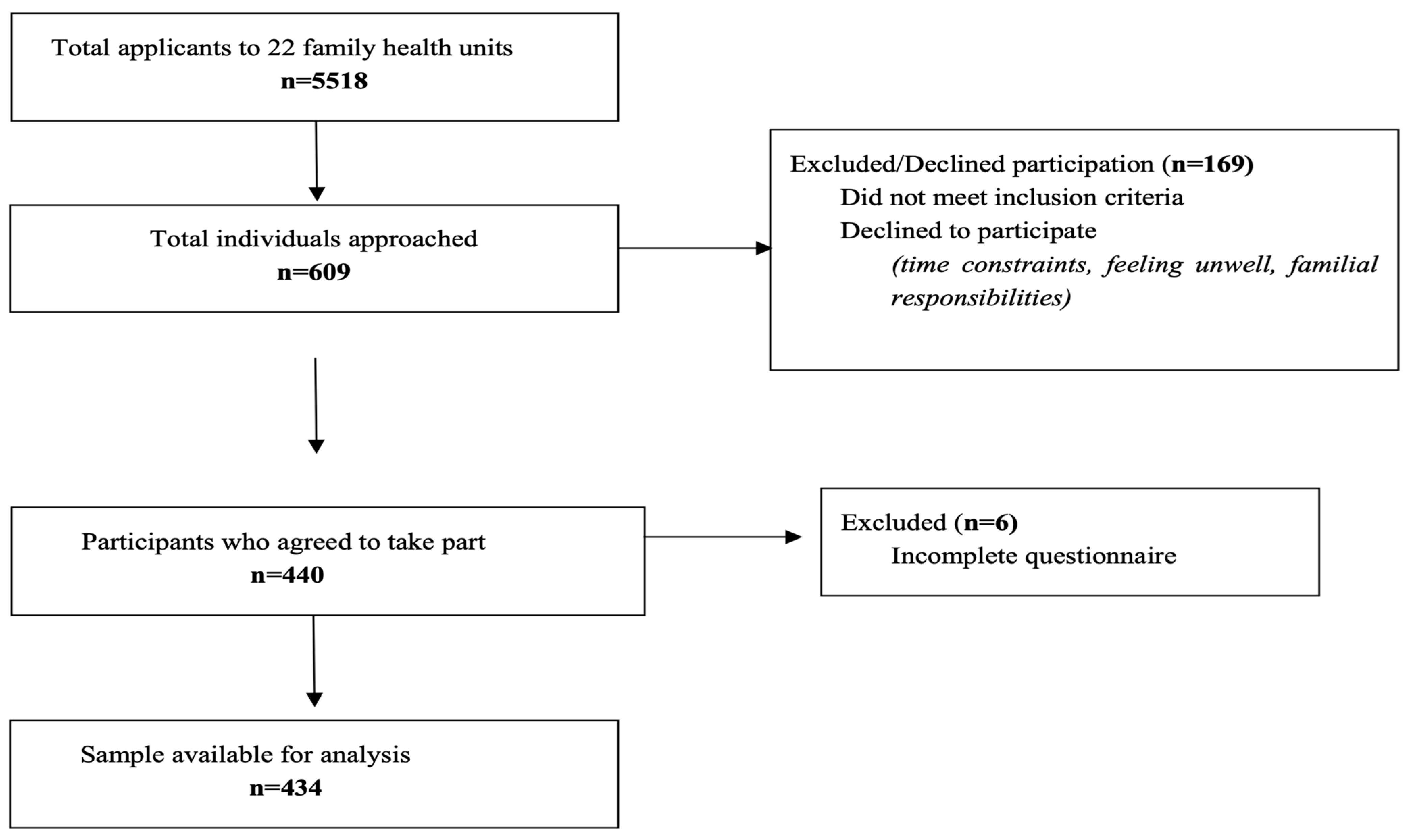
During the 5-day study period, a total of 5518 individuals presented to the participating health centers. A systematic time-based sampling approach was employed to reduce selection bias and ensure proportional representation across daily patient flow. From each family health unit, four eligible applicants per day (two in the morning session and two in the afternoon session) were consecutively invited to participate. Over five consecutive days, this strategy yielded a planned target sample size of 440 participants (22 units × 4 participants × 5 days).
A total of 609 individuals were approached to achieve the intended sample size. Of these, 169 individuals either declined participation or did not meet the inclusion criteria, resulting in 440 consenting participants. Following data cleaning procedures, six questionnaires were excluded due to incomplete or inconsistent responses, yielding a final analytical sample of 434 participants. The participant recruitment and retention process is illustrated in Figure 1.
Inclusion criteria were:
  • Age 18 years or older;
  • Ability to read and understand Turkish.
Individuals who did not meet these criteria or who declined participation were replaced by the next eligible applicant within the same time block to maintain the sampling framework.
Participants were approached face-to-face by trained physicians or research staff after completion of their clinical visit to ensure that medical care was not disrupted. The study was explained in a standardized manner to minimize interviewer bias. Participants completed the questionnaires in a designated quiet area within the health center to preserve privacy and reduce environmental distractions.

2.3. Measures

A structured questionnaire developed by the research team was used to collect data on sociodemographic characteristics (e.g., age, sex, marital status, educational level, employment status), medical history, and earthquake-related experiences (e.g., property damage, injury, loss of relatives, displacement status). The questionnaire was developed based on a review of prior disaster mental health research to ensure coverage of variables commonly associated with post-traumatic stress outcomes.

2.3.1. Posttraumatic Stress Disorder Checklist for DSM-5 (PCL-5)

PTSD symptoms were assessed using the 20-item PTSD Checklist for DSM-5 (PCL-5) [14]. The instrument evaluates four symptom clusters: re-experiencing, avoidance, negative alterations in cognition and mood, and hyperarousal. The Turkish version was validated by Boysan et al., with reported reliability coefficients ranging from 0.79 to 0.92 across its subscales [15]. For consistency with these validation studies, a cut-off score of ≥47 was used to indicate probable PTSD.

2.3.2. Coping with Earthquake Stress Scale (CESS)

Coping strategies were assessed using the 16-item Coping with Earthquake Stress Scale (CESS), which comprises three subdimensions: religious coping (RC), positive reappraisal (PRA), and seeking social support (SSS). Items are rated on a Likert-type scale reflecting the extent to which each strategy is used. The Turkish version was validated by Yöndem and Altay [16]. A higher score indicates greater use of the respective coping strategy. The reported internal consistency coefficients (Cronbach’s alpha) are 0.85 for RC, 0.69 for PRA, and 0.74 for SSS.
All questionnaires were administered in paper format within the health centers. Participants completed the forms independently in a quiet area, with a researcher available for clarification if necessary. The average completion time was approximately 20 min.

2.4. Statistical Analysis

Statistical analyses were performed using IBM SPSS Statistics Version 20.0. Categorical variables are presented as frequencies and percentages, and continuous variables as means ± standard deviations. The normality of continuous variables was assessed using the Shapiro–Wilk test. Participants were categorized into probable PTSD and non-PTSD groups based on the PCL-5 cut-off score. Independent samples t-tests were conducted to compare coping strategy scores between the groups. Effect sizes (Cohen’s d) were calculated where appropriate. Pearson correlation coefficients were used to examine associations between PTSD symptom scores and coping subscale scores. Logistic regression analysis was performed to identify independent predictors of probable PTSD. Variables with p < 0.25 in the univariate analyses were entered into the multivariate model. Linear regression analyses were conducted separately for each coping subscale to identify associated factors. Multicollinearity diagnostics were examined prior to model interpretation. Statistical significance was set at p < 0.05.

3. Results

A total of 434 participants were included in the final analysis. Their mean age was 38.27 ± 13.84 years (range: 18–80), and 63.4% were female. Detailed sociodemographic, medical, and earthquake-related characteristics are presented in Table 1.

3.1. Prevalence of Probable PTSD and Correlation Analyses

Based on the PCL-5 cut-off score (≥47), the prevalence of probable PTSD was 32.95%. Correlation analyses demonstrated a weak negative association between PCL-5 scores and positive reappraisal (PRA) scores (r = −0.192, p < 0.01). No significant correlations were observed between PCL-5 scores and religious coping (RC) or seeking social support (SSS) scores. Positive reappraisal scores were positively correlated with religious coping (r = 0.248, p < 0.01) and seeking social support (r = 0.316, p < 0.01).

3.2. Group Comparisons Based on Probable PTSD Status

The participants were categorized into probable PTSD and non-PTSD groups according to the PCL-5 cut-off score. Individuals with probable PTSD had significantly lower positive reappraisal scores compared to those without probable PTSD (p < 0.05). No statistically significant differences were observed between the groups in their religious coping or seeking social support scores.

3.3. Predictors of Probable PTSD

Multivariate logistic regression analysis was conducted to identify independent predictors of probable PTSD (Table 2). After adjustment, lower positive reappraisal scores, female sex, prior psychiatric medication use, a history of previous trauma, and not residing at home following the earthquakes were significantly associated with higher odds of probable PTSD.

3.4. Factors Associated with Coping Strategy Scores

Separate linear regression models were constructed for each coping subscale.

3.4.1. Religious Coping

Higher religious coping scores were significantly associated with older age (β = 0.030), lower educational attainment (primary school or below: β = 2.442; elementary school: β = 1.912; high school: β = 1.823), being married (β = 1.045), family loss (β = 2.515), and close friend loss (β = −1.047) (adjusted R2 = 0.268, p < 0.001) (Table 3).

3.4.2. Positive Reappraisal

Higher positive reappraisal scores were significantly associated with the absence of psychiatric illness (β = −1.256), no or minor housing damage (β = 3.811 and β = 3.482, respectively), and the absence of close friend loss (β = −0.871) (adjusted R2 = 0.092, p < 0.001) (Table 4).

3.4.3. Seeking Social Support

Higher seeking social support scores were significantly associated with older age (β = 0.053), female sex (β = 0.855), and not being at home at the time of the earthquakes (β = 0.743). Lower scores were associated with lower educational attainment, post-earthquake psychiatric medication use (β = −2.329), and previous trauma history (β = −0.799) (adjusted R2 = 0.099, p < 0.001) (Table 5).

4. Discussion

This study examined coping strategies and their associations with PTSD symptom levels among individuals presenting to primary care centers 4–6 weeks after the February 2023 earthquakes in Türkiye. The primary finding was that positive reappraisal was negatively associated with PTSD symptom scores, whereas religious coping and seeking social support were not significantly associated with PTSD symptom levels during this early post-disaster period.
The prevalence of probable PTSD in this sample (32.95%) was lower than the rates reported in studies conducted in more central and severely affected regions following the same earthquakes, where prevalence estimates ranged from approximately 45% to nearly 70% [11,12,13]. Several factors may explain this difference. First, participants in the present study were recruited from primary care settings in provinces affected by the earthquakes but not located at their epicenter. Second, these individuals presented for a variety of health-related reasons and may represent a broader community-based population rather than a highly exposed subgroup. Third, differences in the timing of assessment, sampling strategies, and methodological approaches may have contributed to variability in the reported prevalence rates. Accordingly, the findings likely reflect early symptom levels in a real-world primary care context.
Consistent with the prior literature, female sex, previous psychiatric medication use, a history of trauma exposure, and displacement from home were associated with higher odds of probable PTSD [6]. These findings align with established vulnerability factors in disaster-related mental health research.
Religious coping has been conceptualized as a multidimensional construct encompassing both adaptive and maladaptive forms [17,18,19,20,21]. In the present study, religious coping scores were not significantly associated with PTSD symptom levels. Although some post-disaster studies have reported protective associations of positive religious coping [22,23], others have found no significant relationship [24]. This variability across studies may relate to differences in timing, the perceived exposure intensity, the cultural context, and the distinction between positive and negative forms of religious coping. Because individual religiosity and negative religious coping were not directly assessed in this study, further research is needed to clarify how these dimensions interact with post-disaster psychological adjustment.
Positive reappraisal, a meaning-focused coping strategy involving constructive cognitive reinterpretation of stressful events [25,26,27], was the only coping dimension negatively associated with PTSD symptom scores. Individuals without psychiatric illness, without severe housing damage, and without close friend loss reported higher positive reappraisal scores. Prior research suggests that meaning-making and cognitive flexibility may contribute to adaptive adjustment following trauma, particularly during early recovery phases [28,29]. However, the cross-sectional design of the present study does not allow for conclusions regarding directionality.
Seeking social support was associated with several sociodemographic and exposure-related factors but was not significantly associated with PTSD symptom levels. Previous research has reported mixed findings regarding the relationship between social support and PTSD [21,22,23,24,30]. Social support may operate through complex and bidirectional mechanisms, and its effects may vary depending on the timing, type of support, and broader contextual factors. In large-scale disasters where entire communities are affected, informal support networks may themselves be compromised, and formal institutional support systems may play a critical role in recovery. The social support dimension measured in this study reflects interpersonal support-seeking tendencies and does not capture structural or governmental forms of support.
The coping dimensions assessed in this study were interrelated but conceptually distinct. Positive reappraisal was positively correlated with both religious coping and seeking social support, suggesting that these strategies may co-occur in some individuals. However, religious coping and seeking social support were not significantly correlated with each other, indicating potentially different coping patterns within the sample.
This study has several strengths. It was conducted in the early post-disaster period within primary care settings, where large segments of the community seek medical attention. The multicenter design and inclusion of 22 family health units enhance the ecological validity of the findings. By examining multiple coping dimensions simultaneously, this study contributes to a more integrated understanding of early post-disaster coping in frontline healthcare contexts.
Several limitations should be considered. The cross-sectional design precludes causal inference, and coping strategies and PTSD symptoms may evolve over time. This study was conducted in provinces affected by the earthquakes but not located at their epicenter, and the exposure intensity may have differed from that in more severely devastated regions. Selection bias is possible, as the characteristics of individuals who declined participation were not systematically recorded. Individuals with more severe avoidance symptoms may have been underrepresented, and help-seeking patterns may have influenced participation. Additionally, the coping instrument primarily assessed adaptive strategies; maladaptive coping mechanisms such as avoidance, denial, substance use, and somatization were not directly measured. Future longitudinal studies incorporating both adaptive and maladaptive coping dimensions are warranted.

5. Conclusions

In conclusion, approximately one-third of individuals presenting to primary care within 4–6 weeks after the earthquakes met criteria for probable PTSD. Among the coping strategies examined, only positive reappraisal was associated with lower PTSD symptom levels. These findings underscore the importance of early psychological screening in primary care settings following large-scale disasters. Interventions aimed at supporting adaptive cognitive coping strategies may be considered within early psychosocial support frameworks; however, longitudinal research is needed to clarify their potential role in reducing persistent post-traumatic symptoms.

Author Contributions

Conceptualization, Z.Y.Ö. and A.N.T.; methodology, Z.Y.Ö. and İ.Ü.; software, İ.Ü.; validation, Z.Y.Ö., A.N.T., and H.K.; formal analysis, İ.Ü.; investigation, Z.Y.Ö., A.N.T., and S.Ö.; resources, H.K.; data curation, A.N.T. and S.Ö.; writing—original draft preparation, Z.Y.Ö. and A.N.T.; writing—review and editing, Z.Y.Ö., H.K., and S.Ö.; visualization, A.N.T.; supervision, Z.Y.Ö.; project administration, Z.Y.Ö.; funding acquisition, Z.Y.Ö. All authors have read and agreed to the published version of the manuscript.

Funding

This research received no external funding.

Institutional Review Board Statement

The study was conducted in accordance with the Declaration of Helsinki and approved by the Çukurova University Faculty of Medicine Non-interventional Clinical Research Ethics Committee (Approval code: 131; Approval date: 10 March 2023).

Informed Consent Statement

Informed consent was obtained from all subjects involved in this study.

Data Availability Statement

The data presented in this study are available upon request from the corresponding author. The data are not publicly available due to privacy and ethical restrictions.

Acknowledgments

We would like to thank those whose names are listed below for their help during the data collection: Ali Velipaşaoğlu, Elif Can Çaylı, Erhan Düşünmez, Erkan Tiyekli, Esra Yıldız, Fatma Tuğba Ünal Kültür, Gökhan İşçi, Hasan Çaldır, İbrahim Şimşek, İbrahim Turgut, İlker Selekoğlu, Macide Bengü İmadoğlu, Maide Mağara, Mehmet Ali Sarıtürk, Merve Tetik, Muhammet Avcı, Murat Gezer, Musa Emre Karkin, Neval Özçullu Yazargan, Onurcan Kaya, Ömer Faruk Ökten, Seda Kete, and Yusuf Ozan Yıldırım.

Conflicts of Interest

The authors declare no conflicts of interest. The funders had no role in the design of the study; in the collection, analyses, or interpretation of data; in the writing of the manuscript; or in the decision to publish the results.

References

  1. United Nations Office for Disaster Risk Reduction (UNDRR). Terminology on Disaster Risk Reduction; UNDRR: Geneva, Switzerland, 2017; Available online: https://www.undrr.org/terminology (accessed on 29 March 2026).
  2. Ritchie, H.; Roser, M. Natural Disasters. Our World in Data. 2023. Available online: https://ourworldindata.org/natural-disasters (accessed on 29 March 2026).
  3. Disaster and Emergency Management Presidency (AFAD). Türkiye Earthquake Situation Report, 2023. Available online: https://deprem.afad.gov.tr (accessed on 29 March 2026).
  4. Heanoy, E.Z.; Brown, N.R. Impact of natural disasters on mental health: Evidence and implications. Healthcare 2024, 12, 1812. [Google Scholar] [CrossRef]
  5. Goldmann, E.; Galea, S. Mental health consequences of disasters. Annu. Rev. Public Health 2014, 35, 169–183. [Google Scholar] [CrossRef]
  6. Tang, B.; Deng, Q.; Glik, D.; Dong, J.; Zhang, L. A meta-analysis of risk factors for post-traumatic stress disorder in adults and children after earthquakes. Int. J. Environ. Res. Public Health 2017, 14, 1537. [Google Scholar] [CrossRef] [PubMed]
  7. Galea, S.; Nandi, A.; Vlahov, D. The epidemiology of post-traumatic stress disorder after disasters. Epidemiol. Rev. 2005, 27, 78–91. [Google Scholar] [CrossRef] [PubMed]
  8. Ehrenreich, J.H. Coping with Disasters: A Guidebook to Psychosocial Intervention; Mental Health Workers Without Borders: New York, NY, USA, 2001. [Google Scholar]
  9. Turkish Psychiatric Association. Disaster Mental Health Report; Turkish Psychiatric Association: Ankara, Türkiye, 2023; Available online: https://psikiyatri.org.tr/TPDData/Uploads/files/PATActivitiesforthe13February2023.pdf (accessed on 25 February 2026).
  10. Kaya, E.; Halaçlı, B.; Yıldırım, M.; Topeli, A. Management of critically ill patients following earthquake disasters. Turk. J. Med. Sci. 2025, 55, 813–825. [Google Scholar] [CrossRef] [PubMed]
  11. Tekin, A.; Yetkin Tekin, A.; Göçüm, E.; İnce, Z.; Kapıcı, Y.; Karamustafalıoğlu, O. Posttraumatic stress disorder and related risk factors among earthquake survivors after earthquakes in Turkey: A 1-year follow-up study. Psychol. Trauma 2025, 17, 1369–1376. [Google Scholar] [CrossRef]
  12. Alpay, E.H.; Redican, E.; Hyland, P.; Karatzias, T.; Shevlin, M. Correlates of posttraumatic stress disorder in the aftermath of the February 2023 earthquake in Turkey. J. Loss Trauma 2024, 29, 605–622. [Google Scholar] [CrossRef]
  13. Bilge, Y.; Emiral, E.; Demirci, H. Early aftermath of February 6 earthquakes in Turkey: PTSD, PTG, and resilience. J. Loss Trauma 2023, 29, 221–242. [Google Scholar] [CrossRef]
  14. Weathers, F.W.; Litz, B.T.; Herman, D.S.; Huska, J.A.; Keane, T.M. The PTSD Checklist (PCL): Reliability, validity, and diagnostic utility. In Proceedings of the 9th Annual Meeting of the International Society for Traumatic Stress Studies, San Antonio, TX, USA, 24–27 October 1993. [Google Scholar]
  15. Boysan, M.; Ozdemir, P.G.; Ozdemir, O.; Selvi, Y.; Yılmaz, E.; Kaya, N. Psychometric properties of the Turkish version of the PTSD Checklist for DSM-5 (PCL-5). Psychiatry Clin. Psychopharmacol. 2017, 27, 300–310. [Google Scholar] [CrossRef]
  16. Yöndem, Z.D.; Altay, E.R. Validity and reliability of the Earthquake Stress Coping Scale. Turk. Psychol. Couns. Guid. J. 2008, 30, 60–75. [Google Scholar]
  17. Lau, C.Y.H.; Tov, W. Effects of positive reappraisal and self-distancing on the meaningfulness of everyday negative events. Front. Psychol. 2023, 14, 1093412. [Google Scholar] [CrossRef]
  18. Bentzen, J.S. Acts of God? Religiosity and natural disasters across subnational world districts. Econ. J. 2019, 129, 2295–2321. [Google Scholar] [CrossRef]
  19. Aslam, M.; Weill, L.; Iqbal, H. Do mountains move faith? Econ. Model. 2022, 117, 106077. [Google Scholar] [CrossRef]
  20. Akca, A.; Bilgehan, T.; Karşıgil, P.; Dünder, E.; Ayaz-Alkaya, S. Physical symptoms and coping strategies with earthquake stress among adults living in tent cities. J. Adv. Nurs. 2025, 81, 3848–3858. [Google Scholar] [CrossRef] [PubMed]
  21. Pargament, K.I.; Smith, B.W.; Koenig, H.G.; Perez, L. Patterns of positive and negative religious coping with major life stressors. J. Sci. Study Relig. 1998, 37, 710–724. [Google Scholar] [CrossRef]
  22. Gerber, M.M.; Boals, A.; Schuettler, D. The unique contributions of positive and negative religious coping to posttraumatic growth and PTSD. Psychol. Relig. Spirit. 2011, 3, 298–306. [Google Scholar] [CrossRef]
  23. García, F.E.; Páez, D.; Reyes-Reyes, A.; Álvarez, R. Religious coping as moderator of psychological responses to stressful events. Religions 2017, 8, 62. [Google Scholar] [CrossRef]
  24. Bakay, H.; Isik, B.; Gica, S.; Ak, M. Predictors of persistent post-traumatic stress symptoms after 2023 Maras earthquake. Psychiatr. Q. 2025, 97, 215–229. [Google Scholar] [CrossRef]
  25. Çağlar, A. The mediating role of difficulties in emotion regulation and earthquake stress coping. Psychiatr. Q. 2025, 96, 201–212. [Google Scholar] [CrossRef]
  26. Peker, A.; Cengiz, S. The effect of uncertainties created by the February 6 earthquakes on post-traumatic stress. Acta Psychol. 2025, 258, 105159. [Google Scholar] [CrossRef]
  27. Candan, Z.A.; Aydin, A.; Altan, F.; Unalan, D.; Filik, T. The relation between earthquake stress coping strategies and post-earthquake trauma level. Medicine 2025, 104, e43345. [Google Scholar] [CrossRef]
  28. Taylor, S.E. Social support: A review. In The Oxford Handbook of Health Psychology; Oxford University Press: Oxford, UK, 2011; pp. 189–214. [Google Scholar]
  29. Demir Erbil, D.; Hazer, O.; Akçam, E.; Akkoyun, S. Examination of earthquake stress coping strategies. Turk. J. Earthq. Res. 2024, 6, 434–451. [Google Scholar] [CrossRef]
  30. Fardin, A.; Shokoufeh, A. Social support and post-traumatic stress disorder in earthquake survivors: A systematic review. Soc. Work Ment. Health 2020, 18, 501–514. [Google Scholar] [CrossRef]
Figure 1. Flow diagram of participants.
Psychiatryint 07 00073 g001
Table 1. Sociodemographic factors, medical history, and earthquake-related characteristics of the participants.
Characteristicn%
SexFemale27563.4
Male15936.6
Marital StatusMarried28966.6
Single14533.4
EducationPrimary school/lower10524.2
Middle/high school18843.3
Higher education14132.5
EmploymentNot working20447
Working23053
Living ArrangementsExtended family37085.3
Single/with friend/partner6414.7
Income LevelLow9121
Medium/high34379
ChildrenYes28464.4
No15034.6
Reason for AdmissionPreventive services9622.1
Complaint33877.9
Past Disaster ExperiencesPresent11326
None32174
Past TraumasPresent11326
None32174
Chronic DiseasePresent11426.3
None32073.7
Psychiatric Illness HistoryYes419.4
No39390.6
Psychiatric Medication Usage HistoryYes4610.6
No38889.4
Need for Psychiatric SupportYes173.9
No41796.1
Starting Psychiatric MedicationYes163.7
No41896.3
Injury Requiring TreatmentYes112.5
No42397.5
Injured First-Degree Family MemberYes286.5
No40693.5
Injured or Deceased First-Degree RelativeYes8519.6
No34980.4
Injured or Deceased Close FriendYes10023
No33477
Extent of the Damage to the Participant’s HomeNo damage22652.1
Low17139.4
Moderate–severe378.5
Table 2. Regression analysis to determine significant predictors of PTSD.
Parameter 95% Confidence Interval
pOdds RatioLowerUpper
One-unit decrease in positive reappraisal score0.0291.0781.0071.152
Being female0.0013.5622.1745.836
Psychiatric medication usage before the earthquakes0.0412.0111.033.926
History of previous trauma0.0311.6931.0492.732
Not living at home after the earthquakes0.021.7811.0972.891
Table 3. Regression analysis findings for religious coping dimension.
ParameterBSig.95% Confidence IntervalEffect Size
Lower BoundUpper BoundPartial Eta Squared
Constant term13.79<0.00111.9615.6190.346
Age0.030.020.0050.0550.013
Gender (Ref = Male)0.5270.09−0.0831.1370.007
Education level (Ref = Higher education)
   Primary school or below2.442<0.0011.6053.2780.073
   Elementary school1.912<0.0010.9632.8610.036
   High school1.823<0.0011.1032.5420.056
Marital status (Ref = Single)1.0450.0050.3161.7740.019
Living with (Ref = Single)
   Elementary family (spouse + children)0.0730.92−1.3591.5050
   Extended family−0.10.924−2.1711.970
   A parent−0.2290.801−2.0151.5570
   A friend−3.3660.025−6.304−0.4280.012
   Spouse−0.7230.423−2.4961.050.002
   Extended family without children−0.2220.893−3.4613.0170
   A sibling−2.8580.12−6.4590.7430.006
   Fiancé−5.8560.001−9.455−2.2570.024
Loss or injury in family (Ref = None)
   Injured1.3820.147−0.4883.2510.005
   Lost2.5150.0011.0873.9430.028
Loss or injury of close friends
   Injured−0.8630.103−1.90.1750.006
   Lost−1.0470.012−1.862−0.2330.015
Table 4. Regression analysis findings for positive reappraisal dimension.
ParameterBSig.95% Confidence IntervalEffect Size
Lower BoundUpper BoundPartial Eta Squared
Constant term13.842<0.00110.62517.0580.144
Age0.054<0.0010.0330.0740.057
Psychiatric illness −1.2560.015−2.267−0.2450.014
(Ref = None)
Condition of the house (Ref = Collapsed)
   Undamaged3.8110.0150.7296.8920.014
   Minorly damaged3.4820.0270.4016.5620.011
   Damaged2.9930.072−0.276.2560.008
   Heavily damaged3.5160.058−0.1197.150.008
Loss or injury of close friends
   Injured−0.5310.319−1.5770.5160.002
   Lost−0.8710.039−1.7−0.0430.01
Table 5. Regression analysis findings for the dimension on social support seeking.
ParameterBSig.95% Confidence IntervalEffect Size
Lower BoundUpper BoundPartial Eta Squared
Constant term12.111<0.00111.07913.1420.556
Age0.053<0.0010.0320.0750.051
Gender (Ref = Male)0.8550.0030.2831.4280.02
Education level (Ref = Higher education)
   Primary school or below−0.9870.011−1.75−0.2250.015
   Elementary school−1.4160.001−2.284−0.5480.024
   High school−1.0170.003−1.681−0.3530.021
Medicine for psychiatric illness after earthquakes (Ref = None)−2.3290.001−3.727−0.930.025
Previous trauma (Ref = None)−0.7990.01−1.409−0.190.015
At home when the earthquakes occurred (Ref = No)−0.7430.016−1.35−0.1370.013
Disclaimer/Publisher’s Note: The statements, opinions and data contained in all publications are solely those of the individual author(s) and contributor(s) and not of MDPI and/or the editor(s). MDPI and/or the editor(s) disclaim responsibility for any injury to people or property resulting from any ideas, methods, instructions or products referred to in the content.