Article

The Prevalence of Subclinical ADHD and Its Associations with Negative Affect Among Medical Students—A Cross-Sectional Study and an Exploratory Neurofeedback Pilot Study


1
Department of Behavioural Sciences, Medical School, University of Pécs, 12 Szigeti Street, 7624 Pécs, Hungary
2
Institute of Physiology, Medical School, University of Pécs, 12 Szigeti Street, 7624 Pécs, Hungary
3
Szentágothai Research Centre, University of Pécs, 20 Ifjúság Street, 7624 Pécs, Hungary
4
Department of Psychiatry and Psychotherapy, Medical School, University of Pécs, 2 Rét Street, 7623 Pécs, Hungary
5
Erzgebirgsklinikum—Haus Zschopau, Klinik für Psychiatrie und Psychotherapie, Alte Marienberger Str. 52, 09405 Zschopau, Germany
6
Institute of Psychology, Károli Gáspár University of the Reformed Church, 9 Kálvin Square, 1091 Budapest, Hungary
7
Hungarian ADHD Neurodiversity Foundation (MANDRA), Orenda Psychological Center, 19 Krisztina Boulevard, 1122 Budapest, Hungary
*
Author to whom correspondence should be addressed.
Psychiatry Int. 2026, 7(2), 59; https://doi.org/10.3390/psychiatryint7020059
Submission received: 5 December 2025 / Revised: 31 January 2026 / Accepted: 26 February 2026 / Published: 9 March 2026

Abstract

Background: Attention-Deficit/Hyperactivity Disorder (ADHD) has been less frequently and extensively investigated in university students than in children, despite substantial evidence demonstrating its significant impact on academic performance and negative affect, such as anxiety. We conducted two studies to address this gap. Methods: The objective of our first study (n = 233) was to assess the prevalence of subclinical ADHD among medical students and examine its associations with comorbid mental health conditions, such as Depression, Anxiety and Stress (DASS-21). In the second pilot intervention study (n = 16), we compared the ratio of negative and positive emotions (PANAS) and anxiety (STAI-S-5) before and after neurofeedback-based relaxation training in two groups of students: one with high scores and another with low scores on the Adult ADHD Self-Report Scale (ASRS). Results: According to our results, more than 50% of students showed risk for ADHD symptoms, and linear regression analyses revealed a strong association between ADHD symptoms and the prevalence of negative affect. Interestingly, no significant differences were found in ADHD and DASS scale scores between students who were falling behind and those progressing in line with the curriculum. Further results of the second study were inconclusive in several areas. In the examined group, a significant increase was observed in one of the core symptoms of ADHD—mind wandering—by the end of the intervention, compared to the baseline. Additionally, frustration levels were significantly higher at the second measurement point among participants with higher ASRS scores. Conclusions: Compared to the literature, it can be concluded that while longer interventions tend to be effective, two sessions are insufficient to reduce symptom.

1. Introduction

Attention-Deficit/Hyperactivity Disorder (ADHD) is a neurodevelopmental disorder characterized by deficits in behavioral inhibition, resulting in trait-like impairments in attentional focus maintenance and shifting, activity regulation, emotional stability, and executive functions such as planning and prioritization. The core symptoms of ADHD include inattention, hyperactivity, and impulsivity [1,2]. Traditionally, ADHD has been recognized as a childhood-onset condition that gradually improves with development [3,4]. However, the developmental trajectories differ between the sexes. Boys are more likely to exhibit higher levels of hyperactivity and impulsivity leading to earlier recognition and diagnosis due to the disruptive nature of their externalized behavior, while girls predominantly display inattentive symptoms that are internalized causing delayed detection [5,6]. Recent evidence indicates that ADHD frequently persists into adulthood [7,8,9,10] despite the fact that symptoms of hyperactivity and impulsivity decrease after childhood [11]. Longitudinal studies suggest that approximately 50% to 66% of individuals diagnosed with ADHD in childhood continue to experience symptoms into adulthood, affecting a substantial proportion of the population [1,12]. The prevalence of ADHD has been widely studied; in the United States, it has been estimated at 4.4% [13], while a global meta-regression analysis determined an average prevalence of approximately 5.29% [14]. Despite being a highly manageable condition with appropriate diagnosis and intervention, ADHD often remains undetected in adults, leading to substantial impairments in psychosocial functioning. Although ADHD is mostly known as a male-dominated diagnosis, it is important to highlight that gender differences in prevalence decrease with age narrowing down the differences in male-to-female ratio in prevalence from 3–4:1 in childhood to 1.5–2:1 in adulthood as male hyperactivity remits [15,16]. Undiagnosed or untreated ADHD has been associated with an increased risk of comorbid conditions, including anxiety, depression, and substance use disorders [7,8,9,10,17,18,19,20]. In adulthood, emotional dysregulation remains a prominent feature [21,22,23,24,25,26,27], with affected individuals frequently reporting feelings of being overwhelmed, impatience, sadness, or anger, often in response to relatively minor stressors [28]. These emotional responses may appear exaggerated or inappropriate in relation to the given situation [29]. Neurologically, emotion dysregulation in ADHD is associated with structural and functional abnormalities in the frontostriatal and frontolimbic circuits [25,30]. A key mechanism is the impaired top-down regulation of the amygdala by the prefrontal cortex (PFC) [31]. In neurotypical individuals, the PFC exerts inhibitory control over emotional responses generated in the limbic system; however, in ADHD, this connectivity is often diminished, leading to heightened emotional reactivity and difficulty modulating responses to frustration or stress [30,31]. This neurobiological deficit explains why medical students with ADHD symptoms may experience disproportionate emotional distress compared to their peers when facing academic challenges.
The distinction between clinical and subclinical ADHD primarily lies in the severity of functional impairment. While clinical ADHD requires significant impairment across multiple life settings, subclinical ADHD involves individuals who report high symptom frequency but fall below the diagnostic threshold [32]. In cases of subclinical ADHD, the full diagnostic criteria are not met; however, one or more symptoms of the disorder regularly appear and significantly impact the individual’s life. Several studies support the notion that ADHD has a more dimensional rather than categorical nature [7,20,32]. In medical students, subclinical symptoms are particularly relevant as these individuals often use high cognitive reserves to maintain academic performance, which may mask their underlying executive dysfunction while increasing internal distress [33,34]. Recent studies report ADHD prevalence in medical students ranging widely from 1.7% to 45%, depending on the type of data collection [35,36,37]. A study conducted among university students with subclinical ADHD found a positive correlation between symptom severity and stress. These students reported less frequent constructive and successful conflict resolution in their romantic relationships, leading to lower relationship satisfaction—a pattern also observed in populations diagnosed with ADHD [38].
Given these considerations, it is particularly relevant to investigate ADHD symptoms in medical students, as their academic and professional responsibilities require sustained attention, cognitive flexibility, and effective stress management. Ensuring the well-being of medical students is critical, as they will be required to make independent, high-stakes decisions in their professional careers. Extensive research has demonstrated that this population exhibits elevated rates of depression, anxiety, and burnout, influenced by both endogenous factors (e.g., personality traits, gender) and exogenous factors (e.g., academic workload, sociodemographic background) [34,39,40,41,42]. A global review of medical students’ mental health found that the prevalence of anxiety ranged from 7.7% to 65.5%, depression from 6.0% to 66.5%, and psychological distress from 12.2% to 96.7% [43]. On the other hand, medical students represent a highly selected population who have successfully navigated competitive academic environments, which may create a form of survivor bias while this could suggest lower rates of clinically impairing ADHD, the extreme workload and sustained performance pressure may nonetheless contribute to elevated levels of subclinical attentional difficulties and psychological distress [35].
ADHD is most commonly characterized as a neurobiological condition involving the frontostriatal pathway, particularly disruptions in the prefrontal cortex, which is the last area of the brain to mature [44]. One of the most consistent findings from EEG research related to the disorder is an increased relative theta (4–8 Hz) power along with reduced beta (12–30 Hz) oscillations. This phenomenon is related to the fact that individuals with ADHD commonly experience excessive spontaneous mind wandering (MW) [45,46,47], which reflects an involuntary shift of attention away from the current task [47]. The theta/beta ratio (TBR) reflects the degree of MW, as lower-frequency waves (such as theta and delta) decrease less during task performance compared to the typical population, while beta waves show a smaller increase in response to stimuli [48]. In a 2022 meta-analysis out of 15 studies reviewed, 8 found greater increases in event-related theta oscillations compared to the control group, while only 2 studies reported the opposite. In 5 out of 9 studies, the strength of beta oscillations in ADHD-diagnosed participants decreased less in response to stimuli compared to the control group [49]. The reduction in the theta/beta ratio is associated with decreased anxiety-cognition and cognitive performance anxiety [50], which can indirectly reduce stress, a secondary benefit in ADHD, given that increased stress and anxiety are symptoms of the disorder. Changes in the ratio of frontal theta/beta oscillations are particularly significant because they reflect the level of MW, a core symptom of ADHD, during rest. Additionally, there is a presumed positive correlation between this ratio and less effective attentional focus, and a negative correlation with changes in attentional control [51].
Neurofeedback (NF) is a form of biofeedback that enables individuals to regulate brain activity through real-time monitoring of neural oscillations. The process involves measuring brain waves and providing immediate feedback, typically in the form of auditory and/or visual signals [52,53,54,55]. When brain activity aligns with the desired pattern, positive reinforcement is provided, whereas deviations from the target state result in corrective feedback [56]. Subsequent case studies provided preliminary evidence for its efficacy in enhancing behavioral and cognitive functioning in children with ADHD [57]. The theoretical foundations of NF align with models of neuroplasticity and conceptualizations of ADHD as a disorder of neural dysregulation, arousal modulation, and hypoactivation of specific brain regions. ADHD has been widely characterized as a condition involving insufficient neurotransmitter activity, leading to inefficient neural communication and impaired cognitive control [58]. The efficacy of NF is primarily attributed to bioelectrical self-regulation through operant conditioning. Reinforcement mechanisms facilitate more efficient neuronal communication by rewarding desirable neural patterns, thereby promoting adaptive brain function [59]. In this regard, NF exhibits parallels with pharmacological interventions, particularly stimulant medications, which enhance neurotransmitter availability and utilization [60].
Given the fact that ADHD is increasingly prevalent and affects academic performance among medical students, and that, to our knowledge, no research has yet been conducted on the short-term effects of neurofeedback, our study aimed to address this gap. In our pilot study, we aimed to explore the prevalence and mental health consequences of ADHD in our medical school sample, as well as to exploratively examine short-term neurophysiological and emotional responses to a brief (two-session) neurofeedback relaxation protocol, in students with high levels of subclinical ADHD, compared to the low-symptom group.
In the first phase of our research, we examined the prevalence of subclinical ADHD among medical students in the University of Pécs and whether it was associated with negative affect (stress, depression, and anxiety). Specifically, we hypothesize that (1) university students show a higher level of ADHD than is shown in the literature and that (2) individuals with higher ADHD symptomatology will exhibit increased levels of negative affect. Furthermore, (3) we posit that students who are not progressing according to the standard curriculum—such as those who have had a passive semester or repeated a semester—will exhibit higher total scores on the Adult ADHD Self-Report Scale (ASRS) screening items compared to their peers following the curriculum.
The second study aimed to compare the results of psychological factor assessments taken before and after a relaxation training based on the neurofeedback method, analyzing groups with high and low ASRS scores. We hypothesized that (1) the high-ASRS group would exhibit higher levels of anxiety and negative emotions both before and after the training compared to the low-ASRS group. (2) Neurofeedback training would lead to a reduction in anxiety and negative emotional states in both groups. (3) Based on the theoretical introduction, one of the main symptoms of ADHD is the inadequate regulation of frustration resulting from emotional dysregulation. Since the experimental task requires goal-oriented action organization and long-term attentional control, it is worth comparing the perceived frustration of the examined group with that of the control group. Thus, we hypothesize that during the task, the high-ASRS group would report higher levels of frustration than the low-ASRS group. (4) Among young adults who score high on the ASRS, the ratio of theta/beta oscillations (MW) measured in the frontal brain regions will decrease as a result of the neurofeedback-based mindfulness training intervention. Evidence supports that theta/beta ratios (TBR) might be a biomarker of prefrontal cortically mediated attentional control, anxiety-cognition interactions, as well as self-reported trait attentional control. Slow theta frequency band and fast beta frequency band are also observed during mind wandering episodes and in ADHD patients (37). It is important to note that although described as “relaxation-based”, the protocol was grounded in mindfulness-oriented attentional training, which involves active focused awareness rather than passive hypoarousal. Mindfulness practices have been associated with modulation of frontal midline theta and beta activity during sustained attention and cognitive control, rather than simple increases in resting theta [61,62].

2. Materials and Methods

2.1. First Study

2.1.1. Participants and Procedure

Both studies were conducted in accordance with the Declaration of Helsinki and approved by the Regional Research Ethics Committee. Data collection for the first study was conducted through online self-report questionnaires, which were distributed to students via email. A convenience sampling method was employed to recruit participants. Participation in both studies was voluntary and anonymous. All participants received informed consent information in written form before taking part in the research. In the first study, informed consent was obtained digitally, while in the second study, participants provided their written consent on paper. Initially, the questionnaire was shared with all students enrolled in the Faculty of Medicine at the University of Pécs. First questionnaire data collection occurred during 25 November 2023, and 30 April 2024 while the second neurofeedback pilot was conducted during June 2024. Participation in the study was voluntary and anonymous, with all data handled confidentially. Students who expressed interest in receiving individual feedback on their results and in participating in the 2nd study provided an email address for this purpose. Out of 233 students with an average age of 22.83 (SD = 3.64), a total of 141 requested personalized feedback. The minimal sample size was calculated using the RaoSoft® sample size calculator (Raosoft, http://www.raosoft.com/samplesize.html) based on the total number of students in the Medical Faculty, including dentistry students, which was approximately 1100 during the data collection period. The sample size was determined with a 90% confidence level and a 5% margin of error. Based on these parameters, the minimal required sample size was calculated to be 218 participants. All individuals aged 18 and older were eligible to participate, regardless of their language. The exclusion criterion was Incomplete responses to the questionnaire; however, no such cases were observed during data collection.

2.1.2. Questionnaires Used in the First Study

In our research, we collected data on various sociodemographic variables, including gender, age, year of enrollment, number of active semesters, and total years of university attendance. Based on these data, we were able to determine which participants were progressing according to the curriculum and which had fallen behind.
To assess mental health, we employed the Adult ADHD Self-Report Scale (ASRS), developed by the World Health Organization (WHO) [63]. This 18-item questionnaire evaluates the severity of hyperactivity/impulsivity and attention-deficit symptoms, with responses rated on a five-point Likert scale based on symptom frequency over the past six months. The first six items serve as a screening tool, while the total score indicates symptom severity [64]. Other classification provides a more nuanced picture of ADHD symptomatology, where the High Positive group reflects the strongest indication of ADHD risk (i.e., high ASRS symptom burden group), while the Low Negative group represents the least. Low Positive and High Negative groups represent the milder indications concerning ADHD symptoms. The gradation enables a more detailed understanding of symptom distribution beyond a simple binary categorization [65,66,67]. Participants were allocated to groups based on their ASRS total scores using the established cut-off value. Importantly, this categorization was not intended to represent clinical diagnostic status. Rather, the “high ASRS” group reflects students with a high current burden of self-reported attentional and hyperactivity-related symptoms at the time of assessment. Throughout the study, this grouping is therefore interpreted as a symptom-severity stratification rather than as an identification of individuals with confirmed ADHD. Internal consistency of the ASRS was acceptable to excellent in the present sample. Cronbach’s alpha was 0.777 for Part A (items 1–6) and 0.910 for the total scale. The hyperactive/impulsive subscale demonstrated good reliability (α = 0.832), while the attention-deficit subscale showed excellent internal consistency (α = 0.884). Additionally, we utilized the Depression, Anxiety, and Stress Scale-21 (DASS-21), a shortened version of the original 42-item DASS [68,69]. This tool assesses depression, anxiety, and stress based on emotional experiences within the past week, with higher scores indicating poorer mental health and a higher level of negative affect [70]. For the DASS-21, internal consistency indices were also high. Cronbach’s alpha was 0.898 for the Depression subscale, 0.843 for the Anxiety subscale, and 0.841 for the Stress subscale, indicating good to excellent reliability across all three domains.

2.2. Second Study

2.2.1. Participants and Procedure

The participants were selected from those who had previously completed the Adult ADHD Self-Report Scale (ASRS) administered by the research group and had agreed to potentially participate in an experimental procedure. For inclusion, participants were randomly selected from the top and bottom thirds of the total scores obtained on the ASRS questionnaire as part of the larger study. The selected participants generated an 8-character unique code based on their personal information, and the experimenter and evaluator were always different, ensuring that the nature of the study was double-blind. A total of 16 individuals were selected for the experimental phase, all of whom were students at the University of Pécs Medical School, ranging from first to sixth year. Eight participants were assigned to the control group and eight to the experimental group. Two individuals (one from each group) dropped out between the two interventions, so their data were not included in the analyses. Among the 14 participants who completed the study, there were 4 men and 10 women; their average age was 22.5 years (SD = 0.65), with the youngest participant being 19 and the oldest 27 at the time of data collection. In terms of the ASRS total score, the average for the examined group was 53.3 (SD = 9.5), while for the control group it was 25.9 (SD = 4.6). In the first part of the study, the students received a pre-intervention questionnaire package. Later, they were informed via a pre-recorded audio file about what they would see and hear, and at the beginning of the experiment, they could adjust the volume to their preference. The research team tried to adapt the conditions as closely as possible to a meditation setting and synchronize the measurements, e.g., using darkened curtains and the same empty room. In the subsequent intervention phase of the experiment, a standard 30 min neurofeedback session was preceded and followed by 2 min baseline and post-line periods, during which participants had to focus on a projected dark background. Exactly one week elapsed between the two measurement points, and the study proceeded step-by-step in the same manner. After the 34 min were completed, the post-intervention questionnaires were administered.

2.2.2. Questionnaires Used in the Second Study

Pre-Intervention Questionnaires
The Spielberger State-Trait Anxiety Inventory—Short Version (STAI-S-5) is one of the most widely used tools for measuring anxiety. It was originally published by Spielberger [71], and its valid Hungarian version has existed since 1983 [72]. In our study, we used the 5-item state anxiety scale developed and validated by Zsido et al. Respondents rated the statements on a 4-point Likert scale (1 = not at all, 4 = very much) based on their current feelings [73]. Internal consistency was excellent for the STAI with Cronbach’s alpha values of 0.87 and 0.91 for its respective scales. The Positive and Negative Affect Schedule (PANAS) [74] measures positive and negative emotions while distinguishing between emotional states and traits. The Hungarian translation was done by Sándor Rózsa and Natasa Kő [75]. The test consists of 20 items, 10 of which measure positive affect and 10 measure negative affect. Responses are provided on a 5-point Likert scale (1 = very slightly/not at all, 5 = very much), referring to experiences from the past week [76]. Across all measurement time points, Cronbach’s alpha values for the PANAS Positive Affect subscale ranged from 0.775 to 0.905, while the Negative Affect subscale ranged from 0.830 to 0.893, indicating consistently good to excellent internal reliability. In addition, a screening questionnaire was used to identify outliers regarding sleep quality. For sleep quality, we used the Athens Insomnia Scale (AIS) an 8-item self-report tool [77]. The first 5 items measure nighttime insomnia symptoms, while the last 3 assess daytime consequences. Responses are provided on a 4-point Likert scale (0 = no problem, 3 = very severe problem), with higher scores indicating poorer sleep quality [77,78]. No participants reached a critical level on this questionnaire; therefore, the results are not confounded by sleep quality (α = 0.88).
Post-Intervention Questionnaires
The NASA Task Load Index (NASA-TLX) is a multidimensional scale designed to assess task load during or immediately after task execution [79]. It consists of six subscales: mental demand, physical effort, time pressure, performance, effort, and frustration. Respondents rated their experiences on a 21-point visual scale between two endpoints (low and high intensity) [80]. In addition, PANAS and STAI-S-5 were also administered in this phase as the research examines changes in the positive/negative affectivity ratio, and the total score for the STAI-S-5, which aims to measure the development of state anxiety.

2.2.3. Neurofeedback Tool and Software

Muse 2 Headband
We used Muse 2 headband (InteraXon Inc., Toronto, ON, Canada) for the neurofeedback tests. The headband is an electroencephalogram (EEG) device with four measurement points—two temporal and two frontal—that transmit data to the software at a frequency of approximately 50 measurements per second (Hz). Its advantages include being portable and affordable, making it a viable solution for use in homes, schools, and other environments where intervention options are limited, especially when combined with the appropriate software.
Semse Aware Software
Semse Aware (version 0.5) is a neurofeedback-based software that projects pleasant images of locations corresponding to the chosen themes. The images become sharper depending on the participant’s level of attentional focus at that moment (this was the feedback), while continuously playing nature sounds that aid relaxation. The application is comparable to Muse’s own meditation app [81], but it uses visual feedback instead of auditory feedback. Research related to the latter has found the application successful in reducing somatic symptoms and has also observed significant improvements in attention and cognitive performance [82]. The measurements were conducted using two themes of the software: ‘Forest’ and ‘Coast’ (see Supplementary Material S1).

2.3. Data Analysis

The data collected in our studies were processed using the “IBM SPSS Statistics Version 28” and the JASP (Jeffreys’s Amazing Statistics Program) statistical software. The distribution of results for all questionnaires in the first study was assessed using the Kolmogorov–Smirnov and Shapiro–Wilk tests. In the first study, the majority of the data exhibited a significant deviation from normality (p < 0.05), indicating that the sample could not be considered normally distributed. Given this violation of the assumption of normality, non-parametric tests were employed, specifically the Mann–Whitney U test for group comparisons. Furthermore, R-ANOVA and independent sample t-tests were applied in the second study, where the data showed normal distribution. To assess ’mind wandering’, the study used the average theta/beta ratios from the frontal regions (channels FP1 and FP2) at baseline and post-line, each calculated over 2 min periods. First, within-session comparisons were made between baseline and post-line values, followed by a comparison between the baseline of the first session and the post-line of the second session. Additionally, movement-related artifacts were minimized through participant instruction and manual exclusion of documented noisy segments prior to analysis. We considered the results to be statistically significant if the p-value was less than 0.05. If p < 0.01, we identified strong significance, and if p < 0.07, we considered the result to be approached significance.

3. Results

3.1. Results of the First Study

A total of 233 students participated in the study, with 68 male respondents. The age of the respondents ranged from 17 to 42 years, with a mean age of 22.91 (SD = 3.32). Among them, 150 students were enrolled in the Hungarian program, while 83 students participated in the English and German programs combined, resulting in a 35.6% foreign respondent rate. Of the total respondents, 23 (9.9%) were dental students, while the remaining 210 (90.1%) were medical students. The majority of responses were from students in their first year (n = 60; 25.8%) and fourth year (n = 59; 25.3%). The first method used a cut-off score of 12 points to distinguish between risk and non-risk categories. Using this criterion, 130 students (55.6%) scored above the threshold, indicating an elevated risk for ADHD symptoms. The second approach divided the sample into four categories based on symptom severity: Low Negative: 52 students (22.3%); High Negative: 68 students (29.2%); Low Positive: 65 students (27.9%) and High Positive: 48 students (20.6%) (Table 1). Using the first approach, we found significant differences in DASS scores. High levels of ADHD showed higher levels of Depression (U = 4380; p < 0.001), Anxiety (U = 3713; p < 0.001), and Stress (U = 3510; p < 0.001). The students were categorized into two groups based on whether they were progressing according to the curriculum at the time of completing the questionnaire. The distribution between the groups was unequal, with 50 students (21.5%) classified as “delayed”, meaning they were not progressing according to the standard curriculum timeline. Interestingly, no significant differences were found in ADHD (U = 4438; p > 0.05) and DASS scale scores (Udepression = 4634; Uanxiety = 4410; Ustress = 4569; p > 0.05) between students who were falling behind and those progressing according to the curriculum.

3.2. Results of the Second Study

As the STAI and PANAS data met the assumption of normality, we used R-ANOVA for the within-subjects design and t-tests for the between-subjects design. No significant between-subject differences were observed for anxiety levels; however, repeated measures ANOVA (R-ANOVA) revealed a marginal main effect on ”session” [F(1,15) = 4.89; p = 0.043]. Notably, anxiety levels increased in both groups by the second session.
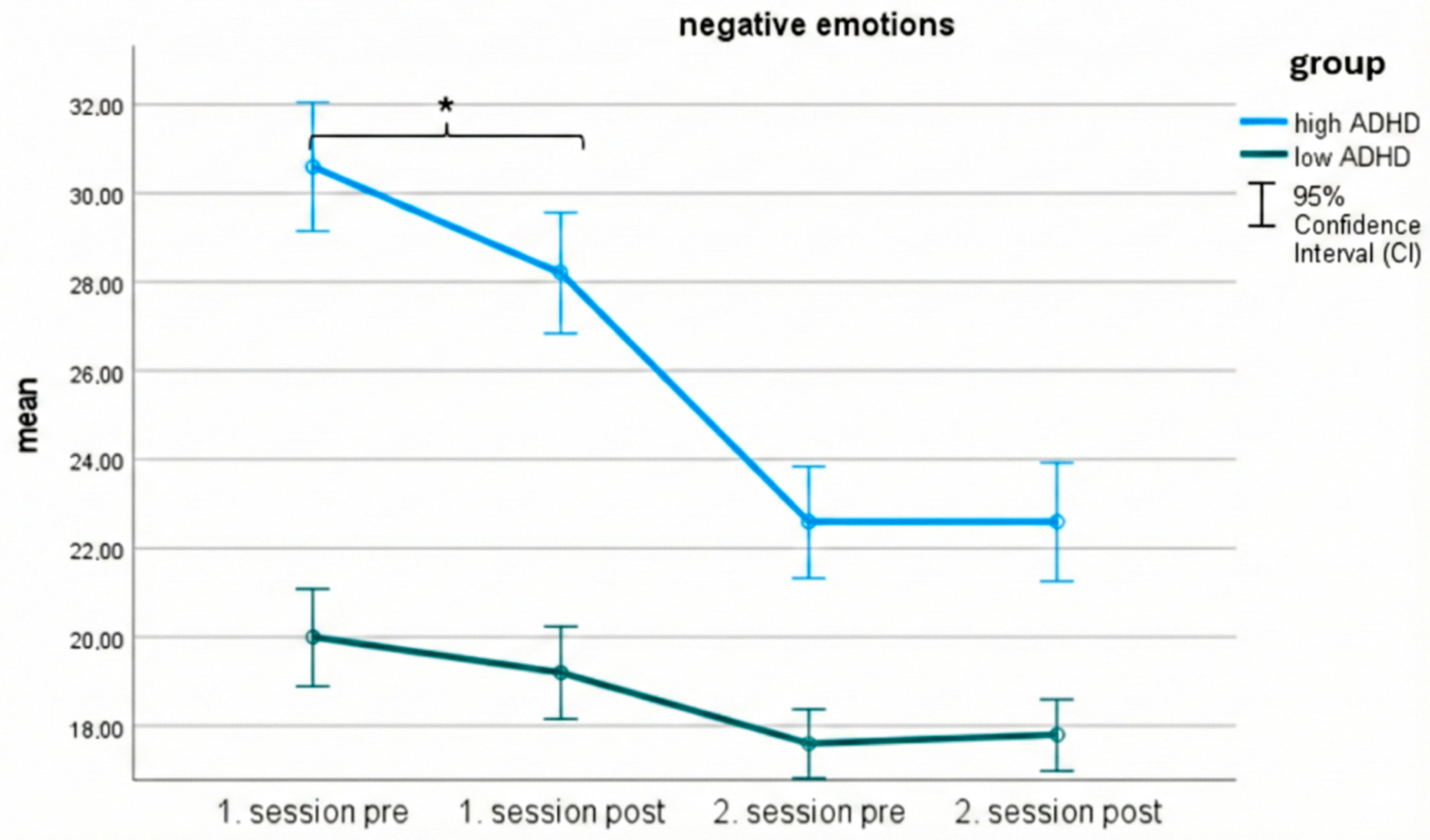
For the PANAS, a significant within-subject main effect of „valence” (positive vs. negative affect) was identified [F(1,8) = 11.19; p = 0.01], along with a significant group × valence interaction [F(1,8) = 10.59; p = 0.012]. Between-subject differences were present only for negative affect, primarily during the first session [tpre(9) = 2.54; p = 0.032 and tpost(12) = 2.49; p = 0.028], while by the second session, only an approached significance remained [tpre(14) = 2.04; p = 0.062 and tpost(13) = 1.85; p = 0.085]. Levene’s test for Equality of Variances was not significant (Figure 1).
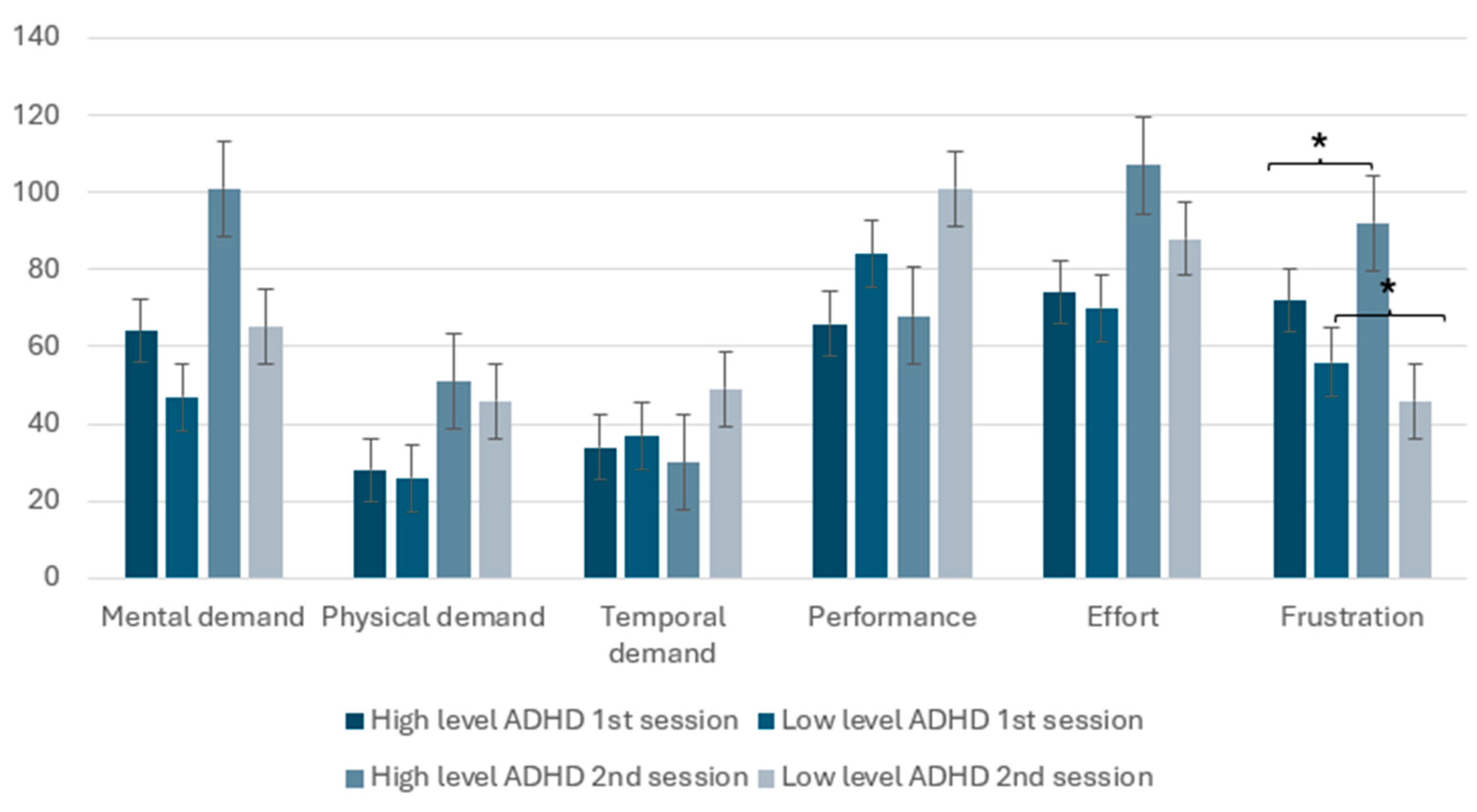
For the NASA Task Load Index frustration subscale, the Shapiro–Wilk test indicated that the assumption of normality was met for both groups at both time points. Therefore, independent sample t-test was used to compare the groups. After the first measurement, the intervention group showed a higher mean frustration score (m = 8.38) compared to the control group (m = 6.64), although this difference was not statistically significant [t(12) = 0.77; p = 0.46]). However, following the second measurement, a significant difference emerged between the two groups [t(14) = 2.28; p = 0.044]). Between the two time points, the frustration score increased in the intervention group (high ADHD risk), while it slightly decreased in the control group. At the second measurement, an approached significance was also found between the groups on the mental demand subscale [t(14) = 2.01; p = 0.064] (Figure 2).
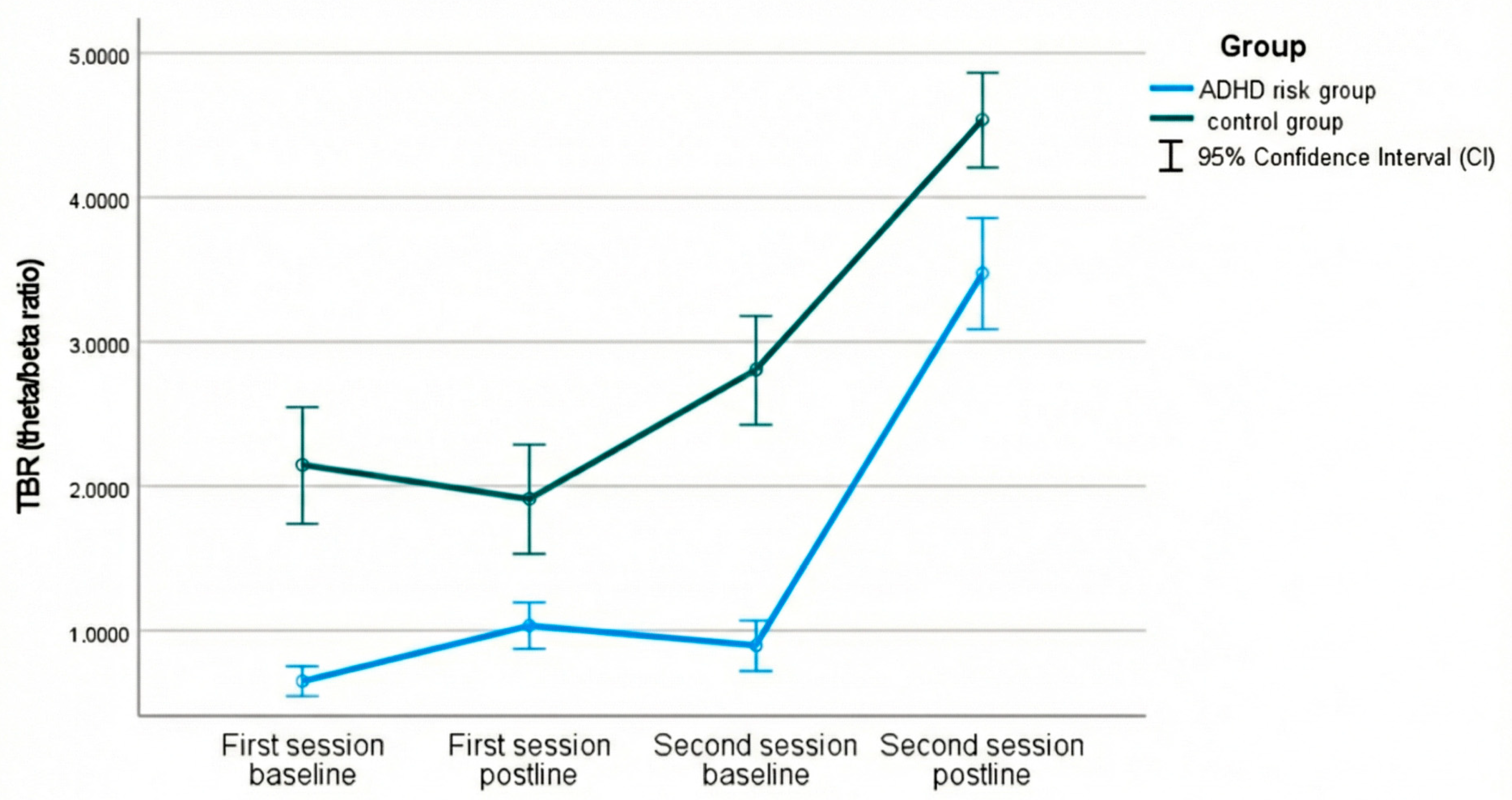
Mind wandering was assessed using the 2 min averages of the frontal theta/beta ratio during the baseline and post-line periods. Initially, comparisons were made within each session, followed by a comparison between the baseline of the first session and the post-line of the second session. Little’s MCAR test suggested that the missing data was random in the data during the whole experiment (Chi-square (873) = 103,991, p = 1.000) and the data analyzed in the risk group as well (Chi-square (12) = 7546, p = 0.820). Based on the Shapiro–Wilk test, normal distribution could not be assumed. Therefore, the Friedman test was used to examine within-group differences, analyzing each EEG channel separately. In the risk group, the Friedman test indicated no statistically significant differences between measurements on either channel (Chi-squareFP1 (3) = 6600, pFP1 = 0.086; Chi-squareFP2 (3) = 6360, pFP2 = 0.095). However, pairwise comparisons were conducted to test Hypothesis 4 regarding the cumulative effect of the intervention using the Wilcoxon test revealed significant differences in both channels when comparing the pre-intervention theta/beta ratio from the first session to the post-intervention ratio from the second session (ZFP1 = −2.201, pFP1 = 0.028; ZFP2 = −2.023, pFP2 = 0.043; Table 2). When comparing mean values, a significant increase was observed in both cases, rather than a decrease (Figure 3). In the control group, there was no significant change. This suggests that in the risk group, contrary to the control, the number of distracting thoughts may increase during task performance.

4. Discussion

In the first phase of our research, we aimed to assess the prevalence of ADHD symptoms among medical students. We placed particular emphasis on assessing the risk of ADHD in this population, including subclinical presentations, as the manifestation of ADHD symptoms in adults differs considerably from those observed in children. Moreover, the disorder’s symptoms clearly impact academic and occupational performance, as well as the individual’s relationship with themselves and others [38]. Our findings revealed a notably high prevalence of ADHD symptoms (more than 50%), which exceeds the general findings in the literature [13,14]. Several factors may contribute to this finding. First, the demanding nature of medical education—with its high academic workload, constant performance pressure, and irregular sleep patterns—may exacerbate attention difficulties and executive dysfunction, anxiety, leading to elevated self-reported symptoms [34]. Second, increased awareness and reduced stigma surrounding mental health may result in greater willingness among students to report difficulties [83]. Additionally, the self-report nature of the screening tool might capture transient stress-related cognitive symptoms (e.g., inattention, restlessness) that resemble ADHD but may not reflect clinically diagnosable cases. Also, some individuals may be drawn to the medical field due to personal experiences with neurodiversity, including undiagnosed ADHD, which could also contribute to the elevated rates observed [33]. However, it is also important to note, and also a limitation, that the Adult ADHD Self-Report Scale (ASRS) is not a diagnostic tool and cannot be used to establish a clinical diagnosis. In addition to that, other studies using the questionnaire for exploring ADHD symptoms among medical students applied a stricter criteria system to separate the participants showing symptoms from those who were asymptomatic, as there is no universally approved cut-off scores available. According to a recent systematic review focusing on the prevalence estimates in medical students there is an inconsistency regarding the applied cut-off values for the ASRS [36]. Out of the 29 studies 5 examined ADHD symptoms with this measurement tool, but the cut-off scores were either unclear or determined at the values of >17 or >13 points [84,85,86,87,88]. In this study the rule of >12 points was applied, following the instructions of the Hungarian version validated on university students [64]. It should be emphasized that the grouping used in the intervention phase was not diagnostic in nature. The “high ADHD risk” group comprised students reporting elevated symptom levels on the ASRS at the time of measurement and should be interpreted as representing high current symptom burden rather than clinically confirmed ADHD. This distinction is critical for the interpretation of the neurofeedback findings. The objective of Study 2 was to examine whether short-term emotional and neurophysiological responses to the intervention vary as a function of symptom severity, not to evaluate treatment effects in a diagnostically defined ADHD population. However, high scores on the ASRS can serve as an indication to the individual or the referring professional that the respondent may be at elevated risk for ADHD, and that a clinical diagnosis is more likely. Nonetheless, a structured clinical interview is essential for accurate diagnosis [64]. Another limitation of the study is that convenience sampling was applied, hence the gender ratios are not balanced. It is well known that women are more likely to voluntarily complete questionnaires [89,90], which aligns with the fact, that only 30.5% of the participants is male. Notwithstanding this, the vast majority of samples in other cross-sectional studies are not representative either [36,91]. Thus, due to the limited sample size which would have substantially reduced statistical power gender was not included as a covariate in the main analyses. However, future studies with larger samples should examine potential gender differences more explicitly.
Our results revealed a strong and statistically significant correlation between ADHD symptom severity and elevated levels of depression, anxiety, and stress, as measured by the DASS-21. This finding aligns with a substantial body of research emphasizing the high comorbidity rates between ADHD and various affective disorders. Previous studies have consistently reported that individuals with ADHD are at increased risk for internalizing symptoms, particularly anxiety and mood disorders [8,10,18]. The overlapping cognitive and emotional dysregulation observed in ADHD—such as difficulties in attention control, emotional regulation, and executive functioning—may contribute to the development or exacerbation of comorbid psychological conditions [7]. These findings underscore the importance of screening for comorbid affective symptoms in populations at risk for ADHD, especially in academic settings where stress levels are inherently high [19,92,93,94].
Our second hypothesis—that among the medical students at our university whether they are progressing according to the official curriculum or are so-called “delayed” students (i.e., not following the standard curriculum)—would result in significant differences in ASRS screening scores, was not confirmed. Based on this, it can be stated that all subgroups appeared to be equally affected in terms of subclinical ADHD risk. This may suggest that the academic and psychological demands of medical training exert a similarly high level of pressure across all student groups, regardless of their background or stage of study progression [95,96]. Additionally, shared environmental and institutional stressors—such as workload, exam frequency, and performance expectations—could contribute uniformly to ADHD-like symptom expression among students [97,98]. This suggests that academic delay in medical school is likely to be multifactorial, shaped by institutional structure, examination policies, burnout, affective symptoms, and learning strategies, which may overshadow the contribution of attentional symptoms in cross-sectional analyses. Moreover, given the highly selected nature of medical student populations, individuals with elevated ADHD symptoms may compensate effectively and maintain academic progression despite increased psychological burden. In the second part of our study, we conducted a two-session neurofeedback-based relaxation training. The aim was to explore differences between students categorized into high-risk and low-risk groups. Our findings indicate that students with a higher risk for ADHD experienced more intense negative emotional states both before and after the first session, compared to their peers with lower ASRS scores. However, within-group analyses did not confirm a significant effect of the training on negative affect. Although the observed decrease in negative affect was not statistically significant, an improvement in scores was noted, raising the question of whether the potential benefits of the training might become evident with more than two sessions. Our results also support a fundamental assumption regarding ADHD—that affected individuals have lower frustration tolerance, particularly given that completing the task required high levels of attentional capacity, sustained concentration, and task organization [21,22,27]. Notably, anxiety appeared to increase slightly between the two measurement points in both groups, which may partly reflect the excitement or tension related to task preparation—a common reaction among perfectionistic medical students [99,100,101]. The observed increase in anxiety may also be attributable to characteristics of the intervention. The neurofeedback task required sustained attention, continuous performance monitoring, and active regulation in response to real-time feedback, which may be cognitively demanding and potentially frustrating during early sessions. In addition, ambiguity or limited transparency of the feedback signal may have contributed to uncertainty or performance-related tension. While individual personality traits may play a moderating role, task-related demands and design features of the intervention likely represent important contributors to the short-term increase in anxiety observed in both groups. Thus, this may reflect an initial performance-related activation rather than a detrimental effect of the intervention itself. In highly performance-oriented environments such as medical education—where tasks are frequently associated with evaluation and achievement pressure—engaging in a structured training context may initially activate performance focus and stress responses [102]. Importantly, it should be acknowledged that two measurement points are insufficient to draw firm conclusions in this regard. Also, the hypothesis that anxiety levels would be higher in the group with higher ASRS scores and that the training would reduce anxiety was not supported by the data. This may cast doubt on the applicability of the software as a tool in ADHD-related cases, especially as it was not specifically developed for treating the disorder. Additionally, the increasing theta/beta ratio implies that in the high-level ADHD group mind wandering (the number of distracting thoughts) may increase during task performance. MW is an important measure, since it draws focus away while performing a task and reduced top-down attentional control over thoughts. In any case, it can be stated that the present, extremely short intervention proved ineffective in treating ADHD symptoms with a relaxation neurofeedback task. It should be acknowledged that two measurement points are insufficient to draw conclusions regarding therapeutic efficacy or long-term trajectories. However, the present design was not intended to approximate standard clinical neurofeedback protocols, but to characterize initial emotional and neurophysiological responses to first exposure. Such early-phase reactions are highly relevant for feasibility and adherence, as they may influence motivation and dropout before longer-term learning-related benefits can emerge. Nevertheless, the findings may shed light on the underlying dynamics during the initial phase of a longer intervention.
Scientifically validated standard TBR-based neurofeedback protocols for ADHD treatment generally consist of 30–40 sessions [103]. Dehghanpour and Einalou have already successfully tested a shorter neurofeedback-based treatment on children with ADHD, where the reduction in the theta/beta ratio was found to be significant, although this study also involved 10 sessions [104]. A plausible explanation for the results discussed below is that the initial few sessions tested in the present study may not improve—or may even worsen—certain dimensions. This pattern was also observed in early stages of TBR training and might explain the significant increase in mind wandering found in the experimental group. In conclusion, the short-term effects observed in this pilot phase may differ from the well-established long-term benefits of neurofeedback. It is possible that the initial sessions increase self-monitoring and effort awareness, which may temporarily evoke frustration—particularly in individuals with elevated ADHD traits—highlighting the importance of preparing participants for this early adjustment phase to prevent premature dropout. Interestingly, the short-term increase in Theta/Beta Ratio (TBR) and the elevated frustration observed in the high ADHD-risk group may therefore reflect an early adaptation phase rather than a genuine deterioration of attentional functioning. Neurofeedback is understood as a gradual operant learning process, and brief exposure may initially amplify perceived difficulty before regulatory improvements emerge [105]. Thus, the observed short-term effects may represent a transitional neuroregulatory response rather than evidence that the relaxation protocol is inherently unsuitable for individuals with elevated ADHD traits. While cortical hypoarousal models would predict that increasing relaxation could be counterproductive in some ADHD presentations, the present two-session design cannot distinguish transient adjustment effects from stable protocol-induced reinforcement; this requires longer training and additional EEG markers beyond TBR. Fairburn and Patel highlight the potential of digital technologies in the treatment of mental disorders [106]. These tools are particularly important given that access to empirically supported psychological treatments does not exceed 50% in any country, and certain digital tools can be operated with minimal training, without the need for a professional’s presence. Most digital treatments appear as alternatives to cognitive behavioral therapy (CBT) [107]), which is a successful therapeutic method for ADHD. As noted by Zylowska and colleagues, a controlled clinical trial is needed in order for an application similar to the neurofeedback tool used in this study to be officially recognized as a treatment for ADHD—contingent upon the success of the research procedure—just as has been the case with tools for depression and anxiety [108]. Nevertheless, neurofeedback is still not among the most commonly used therapies in either the EU or the USA.
Additionally, it would be worthwhile to investigate whether personality traits beyond the total score on the Adult ADHD Self-Report Scale (ASRS) might influence outcomes—either in the experimental or control group—such as trait anxiety.
Further research into subclinical ADHD may be crucial for the treatment of individuals belonging to this often neglected group, as well as for gaining a better understanding of the disorder’s etiology. The findings from such research could be particularly valuable for educators in higher education, helping them recognize that students suffering from ADHD symptomatology—even without a formal diagnosis—may face significant challenges not only related to core ADHD symptoms, but also in terms of executive functioning and externalizing behaviors [32].
The study has several limitations. First, due to the pilot nature of the research, the sample size was small, which limited the statistical power of the omnibus tests. Consequently, the Friedman test yielded marginal significance (p < 0.10). And while a priori planned contrasts identified relevant effects, these findings should be interpreted as preliminary trends that warrant confirmation in adequately powered future studies. The second limitation to note is the lack of differentiation between ADHD subtypes or symptom clusters. Furthermore, although participants were informed via email before participation to avoid excessive caffeine intake on the day of the study, refrain from alcohol consumption the night before, and get sufficient sleep, future iterations could benefit from greater consideration of environmental variables. Given the use of convenience sampling and voluntary participation, self-selection bias may have contributed to inflated prevalence estimates, as students experiencing attentional or emotional difficulties may have been more likely to participate and request feedback. Furthermore, since data collection took place during the examination period, elevated stress, burnout, and sleep deprivation may have inflated ASRS scores, potentially leading to an overestimation of subclinical ADHD risk in this cohort. In highly demanding academic settings such as medical school, ASRS scores may therefore index stress-related, burnout-associated cognitive strain (“pseudo-ADHD”) rather than neurodevelopmental ADHD accompanied by functional impairment as defined by DSM-5 criteria. Consequently, the present results should be interpreted as reflecting elevated subclinical symptom burden under chronic stress. Furthermore, stimulant use—including caffeine, nicotine, and prescription cognitive enhancers such as methylphenidate, which are prevalent in medical student populations—may influence both attentional performance and EEG parameters, thereby potentially confounding neurophysiological findings [109]. The cross-sectional design further limits causal inference regarding the contribution of ADHD symptoms to academic delay, as progression status is shaped by multiple contextual and institutional factors that extend beyond individual cognitive traits and therefore require careful consideration. Controlling these factors could support a better understanding of the intervention’s mechanism and reduce their influence on results—especially when paired with a larger sample size. Furthermore, sample sizes varied slightly between the experimental and control groups due to occasional missing responses from participants, which were at times overlooked by the experimenter. Also, the short duration of the intervention represents limitations. This study aimed to conduct a pilot investigation to test our methodology and core concepts. A further limitation concerns our reliance on the theta/beta ratio (TBR) as the primary neurophysiological marker. Although historically associated with ADHD, the diagnostic specificity and predictive validity of TBR have been increasingly questioned in recent large-scale and meta-analytic studies, suggesting that it should be interpreted with caution and ideally complemented by additional EEG markers [110]. These insights may help refine future measurements and guide the design of more comprehensive studies. Based on the results and their interpretation, it is advisable to extend the research to a larger sample size and a longer time frame, involving more sessions. This would allow for longer-term follow-up and the development of a more precise neurofeedback-based intervention strategy. Another limitation with the intervention is the missing data, due to the headband used in the experiment, which had a tendency of disconnection. Importantly, headband disconnection resulted in missing data rather than distorted EEG recordings, as the system automatically terminates data acquisition when signal quality falls below threshold. Analyzing and understanding how brainwave patterns change as a result of training in students with high versus low ASRS scores goes beyond the scope of the current study. However, one of our future objectives is to examine how neurofeedback-based relaxation training affects ASRS scores themselves.

5. Conclusions

This pilot study explored the prevalence and correlates of subclinical ADHD among medical students and examined the short-term effects of neurofeedback-based relaxation training on emotional and cognitive variables. The results revealed a surprisingly high proportion of students exceeding the ASRS threshold, suggesting that subclinical ADHD symptoms may be more prevalent in this population than previously documented. A significant association between ADHD symptoms and elevated depression, anxiety, and stress levels was identified, supporting existing literature on the emotional burden of ADHD.
Contrary to our hypothesis, no significant differences in ADHD symptom severity were observed based on curriculum progression status, indicating that the academic environment may impose uniform psychological demands regardless of individual background. The second phase of the study showed that students at higher risk for ADHD reported more intense negative emotional states and frustration. However, the short, two-session neurofeedback intervention did not lead to statistically significant improvements in anxiety, affectivity, or frontal theta/beta ratios. In fact, an increase in mind-wandering activity was observed, potentially indicating that more sessions are required before beneficial effects emerge.
Overall, while the present findings suggest that neurofeedback may not yield measurable improvements in such a brief timeframe, the study provides valuable insights for refining future interventions. Longer, standardized protocols and larger, more diverse samples are needed to fully evaluate the therapeutic potential of neurofeedback for managing ADHD-related symptoms in university populations. Importantly, the high prevalence of subclinical ADHD symptoms in medical students highlights the urgent need for enhanced screening, support systems, and targeted interventions in academic settings.

Supplementary Materials

The following supporting information can be downloaded at: https://www.mdpi.com/article/10.3390/psychiatryint7020059/s1, S1: Neurofeedback Device and Software. Figure S1: The Muse device used for measuring brainwaves; Figure S2: Visual feedback provided by the software on brainwave patterns; Figure S3: Two example software themes (left: forest; right: coast); Table S1: The variables collected by Semse Aware software.

Author Contributions

Á.K., A.T.-B. and K.P., as student researchers, coordinated the research and collected the data. B.M. and R.J. contributed to drafting and editing the manuscript. B.G. supervised the study, provided professional guidance, and finalized the manuscript. I.G. provided additional professional supervision. All authors have read and agreed to the published version of the manuscript.

Funding

This research received no external funding.

Institutional Review Board Statement

The study was conducted in accordance with the Declaration of Helsinki, the first study was approved by the Regional Research Ethics Committee (Regionális Kutatásetikai Bizottság), approval number: 9232—PTE 2022, approval date: 5 October 2022, and the second study was approved by the United Psychological Research Ethics Committee (Egyesített Pszichológiai Kutatási Etikai Bizottság, EPKEB), approval number EPKEB 2024-29, approval date: 24 April 2024.

Informed Consent Statement

Informed consent was obtained from all subjects involved in the study.

Data Availability Statement

The data that support the findings of this study are available from the corresponding author upon reasonable request.

Acknowledgments

We are particularly grateful to all the people who have helped us with our article.

Conflicts of Interest

The authors declare no conflicts of interest.

Abbreviations

The following abbreviations are used in this manuscript:
ADHDAttention-Deficit/Hyperactivity Disorder
ASRSAdult ADHD Self-Report Scale
CBTcognitive behavioral therapy
DASS-21Depression, Anxiety, and Stress Scale-21
MWMind wandering
PANASPositive and Negative Affect Schedule
STAI-S-5The Spielberger State-Trait Anxiety Inventory—Short Version
TBRtheta/beta ratio

References

  1. APA. Diagnostic and Statistical Manual of Mental Disorders: DSM-5-TRTM, 5th ed.; American Psychiatric Association, Ed.; text revision; American Psychiatric Association Publishing: Washington, DC, USA, 2022; ISBN 978-0-89042-576-3. [Google Scholar]
  2. Roberts, W.; Milich, R.; Barkley, R. Primary Symptoms, Diagnostic Criteria, Subtyping, and Prevalence of ADHD. In Attention-deficit Hyperactivity Disorder: A Handbook for Diagnosis and Treatmen; The Guilford Press: New York, NY, USA, 2015; pp. 51–80. [Google Scholar]
  3. Moffitt, T.E.; Houts, R.; Asherson, P.; Belsky, D.W.; Corcoran, D.L.; Hammerle, M.; Harrington, H.; Hogan, S.; Meier, M.H.; Polanczyk, G.V.; et al. Is Adult ADHD a Childhood-Onset Neurodevelopmental Disorder? Evidence From a Four-Decade Longitudinal Cohort Study. Am. J. Psychiatry 2015, 172, 967–977. [Google Scholar] [CrossRef] [Scilit] [PubMed]
  4. Young, S.; Gudjonsson, G.H. Growing Out of ADHD: The Relationship Between Functioning and Symptoms. J. Atten. Disord. 2008, 12, 162–169. [Google Scholar] [CrossRef] [Scilit]
  5. Murray, A.L.; Ushakova, A.; Speyer, L.; Brown, R.; Auyeung, B.; Zhu, X. Sex/Gender Differences in Individual and Joint Trajectories of Common Mental Health Symptoms in Early to Middle Adolescence. JCPP Adv. 2022, 2, e12057. [Google Scholar] [CrossRef] [Scilit]
  6. Quinn, P.O.; Madhoo, M. A Review of Attention-Deficit/Hyperactivity Disorder in Women and Girls: Uncovering This Hidden Diagnosis. Prim. Care Companion CNS Disord. 2014, 16, 27250. [Google Scholar] [CrossRef] [Scilit]
  7. Asherson, P.; Buitelaar, J.; Faraone, S.V.; Rohde, L.A. Adult Attention-Deficit Hyperactivity Disorder: Key Conceptual Issues. Lancet Psychiatry 2016, 3, 568–578. [Google Scholar] [CrossRef] [Scilit]
  8. Ginsberg, Y.; Quintero, J.; Anand, E.; Casillas, M.; Upadhyaya, H.P. Underdiagnosis of Attention-Deficit/Hyperactivity Disorder in Adult Patients: A Review of the Literature. Prim. Care Companion CNS Disord. 2014, 16, 13r01600. [Google Scholar] [CrossRef] [Scilit] [PubMed]
  9. Kooij, J.J.S.; Bijlenga, D.; Salerno, L.; Jaeschke, R.; Bitter, I.; Balázs, J.; Thome, J.; Dom, G.; Kasper, S.; Nunes Filipe, C.; et al. Updated European Consensus Statement on Diagnosis and Treatment of Adult ADHD. Eur. Psychiatry 2019, 56, 14–34. [Google Scholar] [CrossRef] [Scilit]
  10. Rivas-Vazquez, R.A.; Diaz, S.G.; Visser, M.M.; Rivas-Vazquez, A.A. Adult ADHD: Underdiagnosis of a Treatable Condition. J. Health Serv. Psychol. 2023, 49, 11–19. [Google Scholar] [CrossRef] [Scilit]
  11. Faheem, M.; Akram, W.; Akram, H.; Khan, M.A.; Siddiqui, F.A.; Majeed, I. Gender-Based Differences in Prevalence and Effects of ADHD in Adults: A Systematic Review. Asian J. Psychiatry 2022, 75, 103205. [Google Scholar] [CrossRef] [Scilit] [PubMed]
  12. Turgay, A.; Goodman, D.W.; Asherson, P.; Lasser, R.A.; Babcock, T.F.; Pucci, M.L.; Barkley, R. ADHD Transition Phase Model Working Group Lifespan Persistence of ADHD: The Life Transition Model and Its Application. J. Clin. Psychiatry 2012, 73, 192–201. [Google Scholar] [CrossRef] [Scilit]
  13. Kessler, R.C.; Adler, L.; Barkley, R.; Biederman, J.; Conners, C.K.; Demler, O.; Faraone, S.V.; Greenhill, L.L.; Howes, M.J.; Secnik, K.; et al. The Prevalence and Correlates of Adult ADHD in the United States: Results From the National Comorbidity Survey Replication. Am. J. Psychiatry 2006, 163, 716–723. [Google Scholar] [CrossRef] [Scilit] [PubMed]
  14. Polanczyk, G.; De Lima, M.S.; Horta, B.L.; Biederman, J.; Rohde, L.A. The Worldwide Prevalence of ADHD: A Systematic Review and Metaregression Analysis. Am. J. Psychiatry 2007, 164, 942–948. [Google Scholar] [CrossRef]
  15. Martin, J. Why Are Females Less Likely to Be Diagnosed with ADHD in Childhood than Males? Lancet Psychiatry 2024, 11, 303–310. [Google Scholar] [CrossRef] [Scilit] [PubMed]
  16. Ramtekkar, U.P.; Reiersen, A.M.; Todorov, A.A.; Todd, R.D. Sex and Age Differences in Attention-Deficit/Hyperactivity Disorder Symptoms and Diagnoses: Implications for DSM-V and ICD-11. J. Am. Acad. Child Adolesc. Psychiatry 2010, 49, 217–228.e3. [Google Scholar] [CrossRef] [Scilit]
  17. Barbuti, M.; Maiello, M.; Spera, V.; Pallucchini, A.; Brancati, G.; Maremmani, A.; Perugi, G.; Maremmani, I. Challenges of Treating ADHD with Comorbid Substance Use Disorder: Considerations for the Clinician. J. Clin. Med. 2023, 12, 3096. [Google Scholar] [CrossRef] [Scilit]
  18. Fu, X.; Wu, W.; Wu, Y.; Liu, X.; Liang, W.; Wu, R.; Li, Y. Adult ADHD and Comorbid Anxiety and Depressive Disorders: A Review of Etiology and Treatment. Front. Psychiatry 2025, 16, 1597559. [Google Scholar] [CrossRef] [Scilit]
  19. Gudjonsson, G.H.; Sigurdsson, J.F.; Smari, J.; Young, S. The Relationship Between Satisfaction with Life, ADHD Symptoms, and Associated Problems Among University Students. J. Atten. Disord. 2009, 12, 507–515. [Google Scholar] [CrossRef] [Scilit]
  20. Katzman, M.A.; Bilkey, T.S.; Chokka, P.R.; Fallu, A.; Klassen, L.J. Adult ADHD and Comorbid Disorders: Clinical Implications of a Dimensional Approach. BMC Psychiatry 2017, 17, 302. [Google Scholar] [CrossRef] [Scilit]
  21. Barkley, R.A.; Murphy, K.R.; Fischer, M. ADHD in Adults: What the Science Says; Guilford Press: New York, NY, USA, 2008; ISBN 978-1-60918-075-1. [Google Scholar]
  22. Beheshti, A.; Chavanon, M.-L.; Christiansen, H. Emotion Dysregulation in Adults with Attention Deficit Hyperactivity Disorder: A Meta-Analysis. BMC Psychiatry 2020, 20, 120. [Google Scholar] [CrossRef] [Scilit]
  23. Corbisiero, S.; Stieglitz, R.-D.; Retz, W.; Rösler, M. Is Emotional Dysregulation Part of the Psychopathology of ADHD in Adults? ADHD Atten. Deficit Hyperact. Disord. 2013, 5, 83–92. [Google Scholar] [CrossRef] [Scilit] [PubMed]
  24. Hirsch, O.; Chavanon, M.; Riechmann, E.; Christiansen, H. Emotional Dysregulation Is a Primary Symptom in Adult Attention-Deficit/Hyperactivity Disorder (ADHD). J. Affect. Disord. 2018, 232, 41–47. [Google Scholar] [CrossRef] [Scilit]
  25. Shaw, P.; Stringaris, A.; Nigg, J.; Leibenluft, E. Emotion Dysregulation in Attention Deficit Hyperactivity Disorder. Am. J. Psychiatry 2014, 171, 276–293. [Google Scholar] [CrossRef] [Scilit]
  26. Soler-Gutiérrez, A.-M.; Pérez-González, J.-C.; Mayas, J. Evidence of Emotion Dysregulation as a Core Symptom of Adult ADHD: A Systematic Review. PLoS ONE 2023, 18, e0280131. [Google Scholar] [CrossRef] [Scilit]
  27. Surman, C.B.H.; Biederman, J.; Spencer, T.; Miller, C.A.; McDermott, K.M.; Faraone, S.V. Understanding Deficient Emotional Self-Regulation in Adults with Attention Deficit Hyperactivity Disorder: A Controlled Study. ADHD Atten. Deficit Hyperact. Disord. 2013, 5, 273–281. [Google Scholar] [CrossRef] [Scilit]
  28. Retz, W.; Stieglitz, R.-D.; Corbisiero, S.; Retz-Junginger, P.; Rösler, M. Emotional Dysregulation in Adult ADHD: What Is the Empirical Evidence? Expert Rev. Neurother. 2012, 12, 1241–1251. [Google Scholar] [CrossRef] [Scilit]
  29. Brown, T. Attention Deficit Disorder: The Unfocused Mind in Children and Adults; Yale University Press Health and Wellness Series; Yale University Press: New Haven, CT, USA, 2005; ISBN 978-0-300-10641-1. [Google Scholar]
  30. Faraone, S.V.; Banaschewski, T.; Coghill, D.; Zheng, Y.; Biederman, J.; Bellgrove, M.A.; Newcorn, J.H.; Gignac, M.; Al Saud, N.M.; Manor, I.; et al. The World Federation of ADHD International Consensus Statement: 208 Evidence-Based Conclusions about the Disorder. Neurosci. Biobehav. Rev. 2021, 128, 789–818. [Google Scholar] [CrossRef] [Scilit]
  31. Arnsten, A.F.T. Stress Signalling Pathways That Impair Prefrontal Cortex Structure and Function. Nat. Rev. Neurosci. 2009, 10, 410–422. [Google Scholar] [CrossRef] [Scilit] [PubMed]
  32. Brown, A.J.; Casey, B.M. Subclinical ADHD-Symptoms Are Associated with Executive-Functioning and Externalizing Problems in College Students without ADHD-Diagnoses. J. Educ. Dev. Psychol. 2016, 6, 204. [Google Scholar] [CrossRef] [Scilit]
  33. Godfrey-Harris, M.; Shaw, S.C.K. The Experiences of Medical Students with ADHD: A Phenomenological Study. PLoS ONE 2023, 18, e0290513. [Google Scholar] [CrossRef] [Scilit] [PubMed]
  34. Dyrbye, L.N.; Thomas, M.R.; Shanafelt, T.D. Systematic Review of Depression, Anxiety, and Other Indicators of Psychological Distress Among U.S. and Canadian Medical Students. Acad. Med. 2006, 81, 354–373. [Google Scholar] [CrossRef] [Scilit]
  35. Im, D.S.; Tamarelli, C.M. Attention Deficit Hyperactivity Disorder in Medical Learners and Physicians and a Potentially Helpful Educational Tool. Adv. Med. Educ. Pract. 2023, 14, 435–442. [Google Scholar] [CrossRef] [Scilit]
  36. Lee, N.Y.W.; Zhang, M.W.B. Systematic Review on Prevalence of ADHD, Possible ADHD or ADHD Symptoms in Medical Students. Front. Psychiatry 2025, 16, 1684727. [Google Scholar] [CrossRef] [Scilit]
  37. Motilal, S.; Chotak, A.; Hoosaney, F.; Kistow, E.; Ramlogan, S.; Ramsingh, R.; Sankar, S.; Singh, V.; Nagapen, R. Prevalence of Self-Reported Attention-Deficit/Hyperactivity Disorder Symptoms and Factors Affecting Attention Span Among Medical Students: A Cross-Sectional Study. Cureus 2025, 17, e95911. [Google Scholar] [CrossRef] [Scilit]
  38. Overbey, G.A.; Snell, W.E.; Callis, K.E. Subclinical ADHD, Stress, and Coping in Romantic Relationships of University Students. J. Atten. Disord. 2011, 15, 67–78. [Google Scholar] [CrossRef] [Scilit] [PubMed]
  39. Horváth-Sarródi, A.; Berényi, K.; Gács, B.; Gerencsér, G.; Tisza, B.B.; Pozsgai, É.; Kiss, I. Mental Health Trajectories in Medical Students: The Impact of Academic Repetition on Depressive Symptoms and Self-Rated Health. J. Clin. Med. 2025, 14, 8447. [Google Scholar] [CrossRef] [Scilit] [PubMed]
  40. Khosravi, M. Factors Affecting Medical Students’ Academic Burnout: A Moderation Analysis. Ital. J. Med. 2023, 17, 1659. [Google Scholar] [CrossRef] [Scilit]
  41. Lipienné Krémer, I.; Harmath, Á.; Dió, M.; Soósné Kiss, Z. A Kiégési Szindróma Vizsgálata Neonatalis Intenzív Osztályok Szakápolói És Orvosai Körében. Orv. Hetil. 2022, 163, 1268–1274. [Google Scholar] [CrossRef] [Scilit]
  42. Pálfi, K.; Major, J.; Horváth-Sarródi, A.; Deák, A.; Fehér, G.; Gács, B. Adaptive Emotion Regulation Might Prevent Burnout in Emergency Healthcare Professionals: An Exploratory Study. BMC Public Health 2024, 24, 3136. [Google Scholar] [CrossRef] [Scilit]
  43. Hope, V.; Henderson, M. Medical Student Depression, Anxiety and Distress Outside N Orth A Merica: A Systematic Review. Med. Educ. 2014, 48, 963–979. [Google Scholar] [CrossRef] [Scilit] [PubMed]
  44. Arnsten, A.F.T. ADHD and the Prefrontal Cortex. J. Pediatr. 2009, 154, I-S43. [Google Scholar] [CrossRef] [Scilit]
  45. Bozhilova, N.S.; Michelini, G.; Kuntsi, J.; Asherson, P. Mind Wandering Perspective on Attention-Deficit/Hyperactivity Disorder. Neurosci. Biobehav. Rev. 2018, 92, 464–476. [Google Scholar] [CrossRef] [Scilit]
  46. Seli, P.; Carriere, J.S.A.; Smilek, D. Not All Mind Wandering Is Created Equal: Dissociating Deliberate from Spontaneous Mind Wandering. Psychol. Res. 2015, 79, 750–758. [Google Scholar] [CrossRef] [Scilit]
  47. Seli, P.; Smallwood, J.; Cheyne, J.A.; Smilek, D. On the Relation of Mind Wandering and ADHD Symptomatology. Psychon. Bull. Rev. 2015, 22, 629–636. [Google Scholar] [CrossRef] [Scilit]
  48. Bozhilova, N.; Kuntsi, J.; Rubia, K.; Asherson, P.; Michelini, G. Event-Related Brain Dynamics during Mind Wandering in Attention-Deficit/Hyperactivity Disorder: An Experience-Sampling Approach. NeuroImage Clin. 2022, 35, 103068. [Google Scholar] [CrossRef] [Scilit]
  49. Michelini, G.; Salmastyan, G.; Vera, J.D.; Lenartowicz, A. Event-Related Brain Oscillations in Attention-Deficit/Hyperactivity Disorder (ADHD): A Systematic Review and Meta-Analysis. Int. J. Psychophysiol. 2022, 174, 29–42. [Google Scholar] [CrossRef] [Scilit] [PubMed]
  50. Putman, P.; Verkuil, B.; Arias-Garcia, E.; Pantazi, I.; Van Schie, C. EEG Theta/Beta Ratio as a Potential Biomarker for Attentional Control and Resilience against Deleterious Effects of Stress on Attention. Cogn. Affect. Behav. Neurosci. 2014, 14, 782–791. [Google Scholar] [CrossRef] [Scilit] [PubMed]
  51. Van Son, D.; De Rover, M.; De Blasio, F.M.; Van Der Does, W.; Barry, R.J.; Putman, P. Electroencephalography Theta/Beta Ratio Covaries with Mind Wandering and Functional Connectivity in the Executive Control Network. Ann. N. Y. Acad. Sci. 2019, 1452, 52–64. [Google Scholar] [CrossRef] [Scilit]
  52. Arns, M.; Heinrich, H.; Strehl, U. Evaluation of Neurofeedback in ADHD: The Long and Winding Road. Biol. Psychol. 2014, 95, 108–115. [Google Scholar] [CrossRef] [Scilit] [PubMed]
  53. Davelaar, E.J. Mechanisms of Neurofeedback: A Computation-Theoretic Approach. Neuroscience 2018, 378, 175–188. [Google Scholar] [CrossRef] [Scilit]
  54. Ros, T.; Baars, B.J.; Lanius, R.A.; Vuilleumier, P. Tuning Pathological Brain Oscillations with Neurofeedback: A Systems Neuroscience Framework. Front. Hum. Neurosci. 2014, 8, 1008. [Google Scholar] [CrossRef] [Scilit]
  55. Tosti, B.; Corrado, S.; Mancone, S.; Di Libero, T.; Rodio, A.; Andrade, A.; Diotaiuti, P. Integrated Use of Biofeedback and Neurofeedback Techniques in Treating Pathological Conditions and Improving Performance: A Narrative Review. Front. Neurosci. 2024, 18, 1358481. [Google Scholar] [CrossRef] [Scilit]
  56. Marzbani, H.; Marateb, H.; Mansourian, M. Methodological Note: Neurofeedback: A Comprehensive Review on System Design, Methodology and Clinical Applications. Basic Clin. Neurosci. J. 2016, 7, 143–158. [Google Scholar] [CrossRef] [Scilit]
  57. Lubar, J.F.; Bahler, W.W. Behavioral Management of Epileptic Seizures Following EEG Biofeedback Training of the Sensorimotor Rhythm. Biofeedback Self-Regul. 1976, 1, 77–104. [Google Scholar] [CrossRef] [Scilit] [PubMed]
  58. Da Silva, B.S.; Grevet, E.H.; Silva, L.C.F.; Ramos, J.K.N.; Rovaris, D.L.; Bau, C.H.D. An Overview on Neurobiology and Therapeutics of Attention-Deficit/Hyperactivity Disorder. Discov. Ment. Health 2023, 3, 2. [Google Scholar] [CrossRef] [Scilit] [PubMed]
  59. Gevensleben, H.; Moll, G.H.; Rothenberger, A.; Heinrich, H. Neurofeedback in Attention—Deficit/Hyperactivity Disorder—Different Models, Different Ways of Application. Front. Hum. Neurosci. 2014, 8, 846. [Google Scholar] [CrossRef] [Scilit] [PubMed]
  60. Butnik, S.M. Neurofeedback in Adolescents and Adults with Attention Deficit Hyperactivity Disorder. J. Clin. Psychol. 2005, 61, 621–625. [Google Scholar] [CrossRef] [Scilit]
  61. Cahn, B.R.; Polich, J. Meditation States and Traits: EEG, ERP, and Neuroimaging Studies. Psychol. Bull. 2006, 132, 180–211. [Google Scholar] [CrossRef] [Scilit]
  62. Lomas, T.; Ivtzan, I.; Fu, C.H.Y. A Systematic Review of the Neurophysiology of Mindfulness on EEG Oscillations. Neurosci. Biobehav. Rev. 2015, 57, 401–410. [Google Scholar] [CrossRef] [Scilit]
  63. Kessler, R.C.; Adler, L.; Ames, M.; Demler, O.; Faraone, S.; Hiripi, E.; Howes, M.J.; Jin, R.; Secnik, K.; Spencer, T.; et al. The World Health Organization Adult ADHD Self-Report Scale (ASRS): A Short Screening Scale for Use in the General Population. Psychol. Med. 2005, 35, 245–256. [Google Scholar] [CrossRef] [Scilit]
  64. Kapitány-Fövény, M. Felnőtt ADHD Önértékelő Skála. In Kérdőíves Módszerek a Klinikai és Egészségpszichológiai Kutatásban és Gyakorlatban; Medicina Könyvkiadó: Budapest, Hungary, 2021; pp. 389–394. [Google Scholar]
  65. Arias, V.B.; Esnaola, I.; Rodríguez-Medina, J. Identifying Potentially Marker Symptoms of Attention-Deficit/Hyperactivity Disorder. PeerJ 2018, 6, e4820. [Google Scholar] [CrossRef] [Scilit]
  66. Asherson, P.; Trzaskowski, M. Attention-Deficit/Hyperactivity Disorder Is the Extreme and Impairing Tail of a Continuum. J. Am. Acad. Child Adolesc. Psychiatry 2015, 54, 249–250. [Google Scholar] [CrossRef] [Scilit] [PubMed]
  67. Levy, F.; Hay, D.A.; McSTEPHEN, M.; Wood, C.; Waldman, I. Attention-Deficit Hyperactivity Disorder: A Category or a Continuum? Genetic Analysis of a Large-Scale Twin Study. J. Am. Acad. Child Adolesc. Psychiatry 1997, 36, 737–744. [Google Scholar] [CrossRef] [Scilit]
  68. Henry, J.D.; Crawford, J.R. The short-form version of the Depression Anxiety Stress Scales (DASS-21): Construct validity and normative data in a large non-clinical sample. Br. J. Clin. Psychol. 2011, 44, 227–239. [Google Scholar] [CrossRef] [Scilit]
  69. Szabó, M. The Short Version of the Depression Anxiety Stress Scales (DASS-21): Factor Structure in a Young Adolescent Sample. J. Adolesc. 2010, 33, 1–8. [Google Scholar] [CrossRef] [Scilit]
  70. Rózsa, S.; Kő, N.; Nagy, P. A Gyermekpszichiátriában Alkalmazott Kérdőívek, Interjúk És Tünetbecslő Skálák, 2020th ed.; Állami Egészségügyi Ellátó Központ: Budapest, Hungary, 2020. [Google Scholar]
  71. Spielberger, C.D.; Gorsuch, R.L.; Lushene, R.E. Manual for the State-Trait Anxiety Inventory, 1970th ed.; Consulting Psychologists Press: Mountain View, CA, USA, 1970. [Google Scholar]
  72. Sipos, K.; Sipos, M. The Development and Validation of the Hungarian Form of the State-Trait Anxiety Inventory. Ser. Clin. Community Psychol. Stress Anxiety 1983, 2, 27–39. [Google Scholar]
  73. Zsido, A.N.; Teleki, S.A.; Csokasi, K.; Rozsa, S.; Bandi, S.A. Development of the Short Version of the Spielberger State—Trait Anxiety Inventory. Psychiatry Res. 2020, 291, 113223. [Google Scholar] [CrossRef] [Scilit] [PubMed]
  74. Watson, D.; Clark, L.A.; Tellegen, A. Development and Validation of Brief Measures of Positive and Negative Affect: The PANAS Scales. J. Pers. Soc. Psychol. 1988, 54, 1063–1070. [Google Scholar] [CrossRef]
  75. Rózsa, S.; Kő, N.; Krekó, K.; Unoka, Z.; Csorba, B.; Fecskó, E.; Kulcsár, Z. A mindennapos testi tünetek attribúciója: Tünetinterpretáció Kérdőív hazai adaptációja. Pszichológia 2008, 28, 53–80. [Google Scholar] [CrossRef] [Scilit]
  76. Gyollai, A.; Simor, P.; Koteles, F.; Demetrovics, Z. Psychometric Properties of the Hungarian Version of the Original and the Short Form of the Positive and Negative Affect Schedule (PANAS). Neuropsychopharmacol. Hung. 2011, 13, 73–79. [Google Scholar]
  77. Soldatos, C.R.; Dikeos, D.G.; Paparrigopoulos, T.J. Athens Insomnia Scale: Validation of an Instrument Based on ICD-10 Criteria. J. Psychosom. Res. 2000, 48, 555–560. [Google Scholar] [CrossRef] [Scilit]
  78. Fusz, K.; Faludi, B.; Pusztai, D.; Sebők, N.; Oláh, A. Insomnia és elalvást segítő szokások felmérése felnőttek körében. Orv. Hetil. 2016, 157, 1955–1959. [Google Scholar] [CrossRef] [Scilit] [PubMed]
  79. Hart, S.G. NASA Task Load Index (TLX): Paper and Pencil Package (Version 1.0); NASA Ames Research Center: Moffett Field, CA, USA, 1986. [Google Scholar]
  80. Hart, S.G. NASA-Task Load Index (NASA-TLX): 20 Years Later. Proc. Hum. Factors Ergon. Soc. Annu. Meet. 2026, 50, 904–908. [Google Scholar] [CrossRef] [Scilit]
  81. InteraXon Inc. Muse: Choose Your Muse; InteraXon Inc.: Toronto, ON, USA, 2019. [Google Scholar]
  82. Hunkin, H.; King, D.L.; Zajac, I.T. Wearable Devices as Adjuncts in the Treatment of Anxiety-related Symptoms: A Narrative Review of Five Device Modalities and Implications for Clinical Practice. Clin. Psychol. Sci. Pract. 2019, 26, 70. [Google Scholar] [CrossRef] [Scilit]
  83. Hankir, A.K.; Northall, A.; Zaman, R. Stigma and Mental Health Challenges in Medical Students. BMJ Case Rep. 2014, 2014, bcr2014205226. [Google Scholar] [CrossRef] [Scilit]
  84. Ahmed, H.A.A.; Naser, S.M.; Basiony, R.M.; Shiba, H.A.A. Exploring Attention Deficit Hyperactivity Disorder Prevalence and Its Relation to Video Game Addiction among Egyptian Medical Students: A Cross-Sectional Study. Clin. Epidemiol. Glob. Health 2024, 28, 101652. [Google Scholar] [CrossRef] [Scilit]
  85. Shen, Y.; Chan, B.S.M.; Liu, J.; Meng, F.; Yang, T.; He, Y.; Lu, J.; Luo, X.; Zhang, X.Y. Estimated Prevalence and Associated Risk Factors of Attention Deficit Hyperactivity Disorder (ADHD) among Medical College Students in a Chinese Population. J. Affect. Disord. 2018, 241, 291–296. [Google Scholar] [CrossRef] [Scilit]
  86. Shi, M.; Liu, L.; Sun, X.; Wang, L. Associations between Symptoms of Attention-Deficit/Hyperactivity Disorder and Life Satisfaction in Medical Students: The Mediating Effect of Resilience. BMC Med. Educ. 2018, 18, 164. [Google Scholar] [CrossRef] [Scilit]
  87. Zafar, M.; Alhelali, A.Y.S.; Alfuwis, M.S.M.; Alshammari, W.Z.A. Relationship between Attention Deficit Hyperactive Disorders with Life Satisfaction among Medical Students in City of Hail, KSA. J. Educ. Health Promot. 2023, 12, 437. [Google Scholar] [CrossRef] [Scilit]
  88. Ashor, A.W. Variable Influence of the Degree of Smoking Dependence on Adult Attention Deficit/Hyperactivity Disorder in Iraqi Medical Students. Neurosciences 2012, 17, 241–247. [Google Scholar]
  89. Otufowora, A.; Liu, Y.; Young, H.; Egan, K.L.; Varma, D.S.; Striley, C.W.; Cottler, L.B. Sex Differences in Willingness to Participate in Research Based on Study Risk Level Among a Community Sample of African Americans in North Central Florida. J. Immigr. Minor. Health 2021, 23, 19–25. [Google Scholar] [CrossRef] [Scilit]
  90. Becker, R. Gender and Survey Participation An Event History Analysis of the Gender Effects of Survey Participation in a Probability-Based Multi-Wave Panel Study with a Sequential Mixed-Mode Design. Methods 2022, 16, 3–32. [Google Scholar] [CrossRef]
  91. Sabir, H.; Khan, M.; Imran, K.; Nisa, Z.-U.; Amer, S.A. The Prevalence of Undiagnosed Attention-Deficit/Hyperactivity Disorder among Undergraduate Medical Students: A Survey from Pakistan. BMC Psychiatry 2024, 24, 845. [Google Scholar] [CrossRef] [Scilit]
  92. Erdal, K.; Adami, G.; Gelléri, P.; Dettmers, J. Stress and Burnout in University Students with ADHD-like Symptoms: The Role of Memory Bias and Daily Stress. Int. J. Educ. Res. Open 2025, 9, 100497. [Google Scholar] [CrossRef] [Scilit]
  93. Sahmurova, A.; Arikan, S.; Gursesli, M.C.; Duradoni, M. ADHD Symptoms as a Stressor Leading to Depressive Symptoms among University Students: The Mediating Role of Perceived Stress between ADHD and Depression. Int. J. Environ. Res. Public Health 2022, 19, 11091. [Google Scholar] [CrossRef] [Scilit] [PubMed]
  94. Sedgwick-Müller, J.A.; Müller-Sedgwick, U.; Adamou, M.; Catani, M.; Champ, R.; Gudjónsson, G.; Hank, D.; Pitts, M.; Young, S.; Asherson, P. University Students with Attention Deficit Hyperactivity Disorder (ADHD): A Consensus Statement from the UK Adult ADHD Network (UKAAN). BMC Psychiatry 2022, 22, 292. [Google Scholar] [CrossRef] [Scilit]
  95. Dyrbye, L.N.; Thomas, M.R.; Shanafelt, T.D. Medical Student Distress: Causes, Consequences, and Proposed Solutions. Mayo Clin. Proc. 2005, 80, 1613–1622. [Google Scholar] [CrossRef] [Scilit]
  96. Atkinson, S.R. Elevated Psychological Distress in Undergraduate and Graduate Entry Students Entering First Year Medical School. PLoS ONE 2020, 15, e0237008. [Google Scholar] [CrossRef] [Scilit]
  97. Kötter, T.; Pohontsch, N.J.; Voltmer, E. Stressors and Starting Points for Health-Promoting Interventions in Medical School from the Students’ Perspective: A Qualitative Study. Perspect. Med. Educ. 2015, 4, 128–135. [Google Scholar] [CrossRef] [Scilit]
  98. Voltmer, E.; Köslich-Strumann, S.; Voltmer, J.-B.; Kötter, T. Stress and Behavior Patterns throughout Medical Education—A Six Year Longitudinal Study. BMC Med. Educ. 2021, 21, 454. [Google Scholar] [CrossRef] [Scilit] [PubMed]
  99. Eley, D.S.; Bansal, V.; Leung, J. Perfectionism as a Mediator of Psychological Distress: Implications for Addressing Underlying Vulnerabilities to the Mental Health of Medical Students. Med. Teach. 2020, 42, 1301–1307. [Google Scholar] [CrossRef] [Scilit] [PubMed]
  100. Henning, K.; Ey, S.; Shaw, D. Perfectionism, the Impostor Phenomenon and Psychological Adjustment in Medical, Dental, Nursing and Pharmacy Students. Med. Educ. 1998, 32, 456–464. [Google Scholar] [CrossRef] [Scilit]
  101. Thomas, M.; Bigatti, S. Perfectionism, Impostor Phenomenon, and Mental Health in Medicine: A Literature Review. Int. J. Med. Educ. 2020, 11, 201–213. [Google Scholar] [CrossRef] [Scilit] [PubMed]
  102. Jaqsilyqovna, N.A. The Importance of Motivation and Goal Orientation in Medical Education. J. Appl. Sci. Soc. Sci. 2025, 15, 795–799. [Google Scholar]
  103. Enriquez-Geppert, S.; Smit, D.; Pimenta, M.G.; Arns, M. Neurofeedback as a Treatment Intervention in ADHD: Current Evidence and Practice. Curr. Psychiatry Rep. 2019, 21, 46. [Google Scholar] [CrossRef] [Scilit] [PubMed]
  104. Dehghanpour, P.; Einalou, Z. Evaluating the Features of the Brain Waves to Quantify ADHD Improvement by Neurofeedback. Technol. Health Care 2017, 25, 877–885. [Google Scholar] [CrossRef] [Scilit] [PubMed]
  105. Sherlin, L.H.; Arns, M.; Lubar, J.; Heinrich, H.; Kerson, C.; Strehl, U.; Sterman, M.B. Neurofeedback and Basic Learning Theory: Implications for Research and Practice. J. Neurother. 2011, 15, 292–304. [Google Scholar] [CrossRef] [Scilit]
  106. Fairburn, C.G.; Patel, V. The Impact of Digital Technology on Psychological Treatments and Their Dissemination. Behav. Res. Ther. 2017, 88, 19–25. [Google Scholar] [CrossRef] [Scilit]
  107. Andersson, G. The Internet and CBT: A Clinical Guide; CRC Press: Boca Raton, FL, USA, 2014; ISBN 978-0-429-25307-2. [Google Scholar]
  108. Zylowska, L.; Ackerman, D.L.; Yang, M.H.; Futrell, J.L.; Horton, N.L.; Hale, T.S.; Pataki, C.; Smalley, S.L. Mindfulness Meditation Training in Adults and Adolescents With ADHD: A Feasibility Study. J. Atten. Disord. 2008, 11, 737–746. [Google Scholar] [CrossRef] [Scilit]
  109. Advokat, C. What Are the Cognitive Effects of Stimulant Medications? Emphasis on Adults with Attention-Deficit/Hyperactivity Disorder (ADHD). Neurosci. Biobehav. Rev. 2010, 34, 1256–1266. [Google Scholar] [CrossRef] [Scilit]
  110. Arns, M.; Conners, C.K.; Kraemer, H.C. A Decade of EEG Theta/Beta Ratio Research in ADHD: A Meta-Analysis. J. Atten. Disord. 2013, 17, 374–383. [Google Scholar] [CrossRef] [Scilit]
Figure 1. The level of negative emotions during the two sessions in the high and the low-level groups. Points represent group means at each measurement time point; error bars indicate 95% confidence intervals. Asterisks denote statistically significant differences (p < 0.05).
Psychiatryint 07 00059 g001
Figure 2. The average NASA Task Load Index scores after the first and second measurements in the experimental (high level ADHD) and control (low level ADHD) groups. Bars represent group means; error bars indicate 95% confidence intervals. Asterisks denote statistically significant differences (p < 0.05).
Psychiatryint 07 00059 g002
Figure 3. Changes in theta/beta ratio (TBR) across sessions in the ADHD-risk and control groups. Values represent group means; error bars indicate 95% confidence intervals.
Psychiatryint 07 00059 g003
Table 1. Distribution of participants across four categories based on symptom severity.
CategoryNumber of StudentsPercentage (%)
Above Threshold (ADHD Risk)13055.6
Below Threshold (12 points)10444.4
Low Negative5222.3
High Negative6829.2
Low Positive6527.9
High Positive4820.6
Note: ADHD risk classification based on threshold scores and distribution across four symptom severity groups in the student sample (n = 233).
Table 2. Summary of the statistical significance from pairwise comparisons regarding the cumulative effect of the intervention using Wilcoxon tests.
1. Session
(1–2. Measurement)
2. Session
(3–4. Measurement)
1. Measurement–4. Measurement
ADHD group (FP1)0.1730.3100.028
ADHD group (FP2)0.1730.3450.043
Control group (FP1)0.8861.0000.612
Control group (FP2)0.3980.6000.310
Disclaimer/Publisher’s Note: The statements, opinions and data contained in all publications are solely those of the individual author(s) and contributor(s) and not of MDPI and/or the editor(s). MDPI and/or the editor(s) disclaim responsibility for any injury to people or property resulting from any ideas, methods, instructions or products referred to in the content.