Article

Gender Differences in the Impact of Autism Spectrum Traits and Camouflaging on Mental Health and Work Functioning: A Structural Equation Modeling Approach


1
Department of Public Health Nursing, Division of Health Science, Graduate School of Medicine, Tohoku University, 2-1 Seiryo-machi, Aoba-ku, Sendai 980-8575, Japan
2
Institute of Medicine, University of Tsukuba, 1-1-1 Tennodai, Tsukuba 305-8575, Japan
3
Abeno Ward Health and Welfare Center, 1-1-40 Fumosato, Abeno-ku, Osaka 545-8501, Japan
*
Author to whom correspondence should be addressed.
Psychiatry Int. 2026, 7(1), 38; https://doi.org/10.3390/psychiatryint7010038
Submission received: 26 October 2025 / Revised: 12 December 2025 / Accepted: 28 January 2026 / Published: 10 February 2026

Abstract

In white-collar workplaces, individuals with autism spectrum disorder (ASD) traits may experience psychological strain and reduced productivity. This study examined structural relationships among ASD traits, social camouflaging, psychological distress, and work functioning impairment, with a focus on gender differences using a secondary analysis of data from an online survey of 543 Japanese white-collar workers (284 men, 259 women). Validated instruments were used to assess ASD traits, camouflaging, psychological distress, and work functioning impairment. Multi-group structural equation modeling by gender was applied using a NIOSH-inspired model. Men scored higher on the Imagination subscale of ASD traits, whereas women scored higher on Attention Switching and Assimilation. ASD traits were indirectly associated with work impairment through psychological distress, while the direct path between ASD traits and work impairment became negative when distress was controlled, indicating a statistical suppression pattern that was more pronounced among women. Assimilation was significantly associated with psychological distress in women but not in men, although the gender difference was at the trend level. The findings indicate a cross-sectional, context-dependent association between ASD traits and work functioning and highlight the importance of considering both gender and workplace context in non-clinical working populations.

1. Introduction

Autism Spectrum Disorder (ASD) is a neurodevelopmental condition characterized by difficulties in social interaction and behavioral flexibility [1,2]. In recent years, the diversity inherent in the spectrum nature of ASD has been increasingly emphasized [3]. The prevalence of ASD varies by region and time period; according to the U.S. Centers for Disease Control and Prevention, the estimated prevalence among 8-year-old children was 1 in 36 as of 2020 [4], up from 1 in 59 in 2014 [5]. This upward trend has been attributed to several factors, including changes in diagnostic criteria from the American Psychiatric Association’s Diagnostic and Statistical Manual of Mental Disorders (DSM)-IV to DSM-5 [3,6], wider dissemination of early screening, and increased awareness within healthcare and educational systems [7]. However, some studies suggest that the rising prevalence may not be fully explained by improved diagnostics alone, pointing instead to the possibility of a true increase in ASD incidence [8].
The DSM-5 stipulates four criteria for diagnosing ASD: (A) persistent deficits in social communication and interaction, (B) restricted, repetitive patterns of behavior, interests, or activities (at least two symptoms), (C) symptoms must be present in early developmental periods (although they may be masked later), and (D) the symptoms must cause clinically significant impairment in social, occupational, or other important areas of functioning [9]. While these refined criteria have improved diagnostic clarity, concerns remain. Volkmar and Reichow noted that the DSM-5 may narrow the definition of ASD, potentially excluding individuals who do not fit the prototypical profile [10]. For example, Wiggins et al. reported that while DSM-5 shows high sensitivity (0.95) and specificity (0.78) for typical cases, it may be less effective in identifying atypical or milder presentations [11]. This limitation is particularly relevant for females, who often present with subtler symptoms or rely on compensatory social strategies [12], making them more likely to be overlooked under the DSM-5 framework [13].
ASD research has historically been skewed toward male participants. Approximately 70% of neuroimaging studies have focused exclusively on males or included very few females [7]. In general, male participants far outnumber females in ASD research, resulting in a significant gender imbalance that has hindered the accumulation of knowledge about ASD in women [13]. In females, ASD traits are often misinterpreted as shyness or anxiety, leading to delays in referral and diagnosis, particularly in milder cases [14]. Women are also more likely to engage in “camouflaging” behaviors, i.e., strategies to hide or “mask” their ASD traits in order to conform to social expectations [15]. Such behaviors may make individuals appear socially adept, even to trained professionals, thereby increasing the risk of misdiagnosis or missed diagnosis. These tendencies are thought to be influenced by both biological sex differences and culturally reinforced gender norms [16,17]. Importantly, camouflaging behavior is not exclusive to women. Individuals of both sexes with high cognitive functioning and/or superficial social skills may go undiagnosed, as their ASD traits are often perceived as personality quirks [17]. For men, cultural expectations that emphasize endurance and self-reliance, along with limited emotional expression, may further contribute to delays in diagnosis and support [18]. Taken together, the evidence suggests that a significant number of individuals with strong ASD traits remain undiagnosed and may experience gender-specific social difficulties [19].
Cassidy et al. demonstrated that frequent social camouflaging among adults is strongly associated with psychological problems such as burnout, anxiety, and depression, and may even elevate the risk of suicidal ideation [20]. Qualitative studies have also reported that prolonged camouflaging threatens self-identity, induces emotional exhaustion, and leads to social alienation [17]. While camouflaging behaviors are observed regardless of formal ASD diagnosis, the psychological impacts on undiagnosed individuals with strong ASD traits remain underexplored. These individuals are often excluded from clinical or support systems, potentially resulting in unrecognized and accumulated psychological burden. In Japan, only a handful of quantitative studies have addressed this issue [21,22,23]. In contemporary Japanese society, individuals with strong ASD traits may engage in excessive self-regulation to adapt to their surroundings, whether or not they have received a formal diagnosis [21,22,23], and this intense camouflaging is likely to contribute to poor mental health outcomes [17].
Individuals with ASD traits often encounter difficulties in high-pressure environments such as workplaces or schools where strong social adaptability is implicitly required. In white-collar settings, where implicit skills such as “reading the air” (in Japanese, kuuki-wo-yomu, the ability to intuit social context and others’ feelings) and managing interpersonal relationships are highly valued, many individuals likely adopt camouflaging strategies that may become excessive and psychologically burdensome [24]. Such environments heighten the risk of interpersonal stress-related outcomes, including absenteeism [25], presenteeism [26], and, over time, reduced productivity, job turnover, or serious mental health problems [27].
To date, most existing studies have focused on diagnosed individuals, leaving the experiences of undiagnosed or subthreshold populations comparatively underexplored. Our previous study sought to address this gap by examining whether workers with strong ASD traits, especially those who socially camouflage, face greater mental and physical burdens leading to reduced workplace functioning and productivity compared with workers with low ASD traits [21]. Although our previous study noted that the proportion of males was slightly higher in the high ASD trait group, this difference was not statistically significant, and no significant gender differences were found across the measured variables, suggesting that gender was not a distinguishing factor at the descriptive level [21]. However, given established evidence that men and women may differ in the expression of ASD traits and in the psychological consequences of camouflaging, a more granular structural analysis was warranted to determine whether gender-specific pathways might nonetheless be present [27,28,29,30]. This points to the possibility that gender-specific mechanisms could exist that are not detectable through descriptive analyses alone and thus warrant a more sophisticated structural examination. Indeed, few empirical studies have examined gender differences in the relationships between ASD traits, camouflaging, mental health, and work productivity among non-diagnosed populations.
Accordingly, this study examines the relationships among autistic traits, social camouflaging, psychological distress, and presenteeism in a non-clinical Japanese working population using gender-stratified structural models. Building on our previous study using the same dataset, we further focus on whether these associations differ structurally between men and women. In particular, this study aims to empirically clarify whether distinct gender-specific structural patterns exist in the associations among autistic traits, mental health, and work functioning within real-world workplace settings. Through this approach, the present study explores gender-differentiated structural aspects of the relationship between autistic traits and work functioning in a non-clinical Japanese workforce, a topic that has not been sufficiently examined in prior research.

2. Materials and Methods

2.1. Sample and Data Collection

This study is a secondary analysis of data originally collected through a cross-sectional online survey described in our previous study [21]. The target population comprised Japanese white-collar workers (aged 20–69 years) registered as monitors with Cross Marketing Inc. (Tokyo, Japan), a major marketing research company in Japan. Individuals engaged in white-collar occupations were chosen because such employment frequently requires advanced communication skills and flexible task management abilities, which are likely to pose particular challenges for individuals with pronounced ASD traits. Exclusion criteria were as follows: (1) having a clinical diagnosis of a developmental disorder; (2) currently undergoing treatment for a psychiatric or other medical condition; (3) working part-time; (4) inability to complete the survey in Japanese; or (5) difficulty responding to an online questionnaire.

2.2. Ethical Considerations

Participation in this research was entirely voluntary. Participants were informed that they would not incur any disadvantage by declining to participate, that they were not obligated to answer any questions they wished to skip, and that withdrawal of responses would not be possible once submitted. The study description also emphasized that all data would be handled under strict confidentiality and that no identifying information would be disclosed. Approval for the study was granted by the Ethics Committee of the Institute of Medicine, University of Tsukuba (Approval No. 2016, 1 August 2024).

2.3. Measures

A detailed description of questionnaire survey is given in the original study [21]. In brief, the survey included items collecting sociodemographic information (gender, age, marital status, highest educational attainment, job type, employment status, and job position) and six validated instruments. Autistic traits were assessed using the Japanese 16-item short form of the Autism-Spectrum Quotient (AQ-J-16), a validated adaptation of Baron-Cohen’s 50-item AQ [31,32]. Items are rated on a four-point Likert scale and scored 0–1, with higher totals indicating stronger autistic traits; internal consistency in this study was acceptable (Cronbach’s α = 0.789). Social camouflaging was measured with the Japanese version of the Camouflaging Autistic Traits Questionnaire (CAT-Q-J), which captures three domains of camouflaging, namely, compensation, masking, and assimilation, and has shown high reliability (Cronbach’s α = 0.925) [15,33]. Work functioning (particularly presenteeism) was evaluated with the Work Functioning Impairment Scale (WFun), a seven-item scale developed in Japan to assess the degree to which health problems impair job performance, with higher scores reflecting greater impairment (Cronbach’s α = 0.935) [34,35]. Psychological distress was measured using the Japanese version of the Kessler Psychological Distress Scale (K6), a six-item screening tool for depression and anxiety, with scores ranging from 0 to 24 and has shown excellent reliability (Cronbach’s α = 0.940) [36,37]. Occupational stress was assessed using the quantitative and qualitative job demands subscales (three items each) of the Brief Job Stress Questionnaire (BJSQ), which are commonly used indicators of workplace stress in Japanese occupational health research. Items were rated on a four-point Likert scale, and internal consistency in the present sample was acceptable (Cronbach’s α = 0.827) [38,39]. The stress reaction subscale of the BJSQ was not used because psychological distress was assessed separately using the K6. Workplace social capital (WSC) was measured using the validated Japanese version of the original eight-item Workplace Social Capital Scale developed by Kouvonen et al. [40,41]. This version has been widely used in occupational and public health research in Japan and evaluates trust, reciprocity, fairness, and supportive social networks in the workplace. Items were rated on a five-point Likert scale, with higher scores indicating stronger workplace social capital; internal consistency in the present study was high (Cronbach’s α = 0.87) [42].

2.4. Data Analysis

Whereas the original study divided respondents into groups according to ASD trait levels and reported results accordingly [21], the present study reanalyzed the same dataset by gender. Pearson’s χ2 tests were conducted to examine gender differences in basic characteristics. For the study measures, mean scores and standard deviations were calculated separately for men and women, and independent-sample t tests were performed.
Multi-group structural equation modeling (SEM) was used to estimate path coefficients separately for men and women and to test gender differences in specific structural paths. Prior to these analyses, measurement invariance across gender was examined using multi-group confirmatory factor analyses (MG-CFA) for the K6, AQ-J16, CAT-Q, WFun, WSC, and occupational stress (quantitative and qualitative workload). All analyses were performed using IBM SPSS Statistics (version 29.0; IBM Corp., Armonk, NY, USA) and R (version 4.5.0; R Foundation for Statistical Computing, Vienna, Austria) with the lavaan package (version 0.6-19; Yves Rosseel, Ghent University, Belgium) and the semTools package (version 0.5-7; Terrence D. Jorgensen et al.), specifying gender (1 = male, 2 = female) as the grouping variable.
For scales with subdimensions (AQ-J16, four factors; CAT-Q, three factors; WSC, three factors), invariance of the factor structure was examined for each subscale. Measurement invariance was tested sequentially at the levels of configural, metric, and scalar invariance. Model fit was evaluated based on changes in fit indices between models, with thresholds of ΔCFI < 0.01, ΔRMSEA < 0.015, and ΔSRMR < 0.030. When scalar invariance was not supported, partial invariance models were estimated by allowing minimal parameters to be freely estimated, guided by modification indices, to improve model fit.
Subsequently, SEM was conducted to examine associations between workplace factors, mental health, and presenteeism, using a NIOSH-inspired, adapted model that focused primarily on individual-difference and relational variables rather than core job stressors [43]. In the model, quantitative and qualitative workload were specified as occupational stressors, and WSC was included as a buffer factor. ASD traits and social camouflaging behaviors (compensation, masking, assimilation) were positioned as personal factors, and their associations with mental health (K6) and presenteeism (WFun) were examined.
Age was initially included as a covariate for K6 and WFun; however, its inclusion did not improve overall model fit and all structural paths involving age were nonsignificant. For reasons of parsimony and model stability, age was therefore excluded from the final model.
Regarding occupational stressors, the latent factor for quantitative workload derived from the BJSQ consistently produced a negative variance estimate, indicating a potential Heywood case. Alternative specifications were examined, including fixing the residual variance, modeling an observed composite score, and simplifying the latent structure; however, none yielded a stable or theoretically coherent solution. When modeled alone, qualitative workload also showed poor model fit. Given these methodological constraints and to ensure model stability, both workload variables were excluded from the final SEM.
To address potential concerns regarding omitted structural covariates, additional sensitivity analyses were conducted using multiple regression models in which age, employment type, and job position were retained as covariates. These analyses were performed separately by gender, and the results reported in the Supplementary Materials (Tables S1–S3). Because the survey was administered in a forced-response online format, no missing data were present in the dataset, and all 543 cases were included in the analyses without imputation or case-wise deletion.

2.5. Model Evaluation

To test for structural differences by gender, multi-group SEM was conducted. No overall gender differences in model structure were found. However, even when global structural invariance is not supported, specific path coefficients may differ across groups, as noted prior in the methodological literature [44,45]. Therefore, individual path coefficients were tested for equality across gender groups to allow for a more fine-grained examination.

3. Results

3.1. Participant Characteristics

Chi-square test results for participant characteristics are presented in Table 1. The total sample (N = 543) consisted of 284 men and 259 women. Significant gender differences were observed in several sociodemographic variables. The mean age was significantly higher among men (M = 47.5, SD = 12.2) compared with women (M = 45.0, SD = 13.3; p = 0.022). Regarding marital status, the proportion of married individuals was lower among men (33.8%) than women (46.3%), whereas the proportion of unmarried individuals was higher among men (p < 0.001). Educational attainment also differed significantly: men were more likely to have a university degree or higher, while women more frequently reported junior college-level education (p < 0.001).
In terms of occupation, men were more often employed in managerial positions (22.2%) or as professionals/technical workers (37.7%), while women were more likely to work in clerical positions (55.2%; p < 0.001). Employment status also differed, with men more often holding permanent positions (90.8%) and women more often employed on a non-regular basis (contract or temporary staff; p = 0.001). Regarding job position, women were more frequently in non-supervisory roles (85.3%), whereas men were more frequently in section chief or higher positions (p < 0.001).

3.2. Gender Differences in Scale Scores

As shown in Table 2, comparisons of mean values revealed that men scored significantly higher than women on the AQ-J16 subscale “Imagination” (p < 0.001), indicating greater difficulty with flexible or imaginative thinking, whereas women scored higher on “Attention Switching” (p = 0.045), reflecting greater difficulty in shifting attention between tasks, and on the CAT-Q subscale “Assimilation” (p = 0.032). No other significant gender differences were observed across the measures. These findings were considered as supplementary evidence for the subsequent structural equation modeling analyses. Zero-order Pearson correlations among all study variables were additionally calculated separately for men and women and are presented in Table S3.

3.3. Measurement Invariance

Measurement invariance across gender was examined for all study measures using multi-group confirmatory factor analysis (MG-CFA). Model comparisons were evaluated based on changes in fit indices (ΔCFI < 0.01, ΔRMSEA < 0.015, and ΔSRMR < 0.030), rather than absolute fit alone, in accordance with current methodological recommendations. SRMR values, which were specified a priori as evaluation criteria, are now explicitly reported in Table 3.
For K6, WFun, and WSC, configural, metric, and scalar invariance were supported based on change-based criteria. Although several RMSEA values exceeded the conventional 0.10 threshold, ΔCFI, ΔRMSEA, and ΔSRMR consistently supported invariance. These scales are unidimensional and include a relatively small number of indicators, a condition known to inflate RMSEA values; therefore, invariance decisions were based primarily on change indices rather than absolute RMSEA.
For the CAT-Q-J subscales (Compensation, Masking, and Assimilation), full scalar invariance was not achieved under complete equality constraints. Partial scalar invariance was therefore tested by freeing a minimal number of item intercepts based on score tests. Compensation and Masking achieved acceptable partial scalar invariance after freeing three item intercepts each. In contrast, the Assimilation subscale showed poor absolute fit already at the configural level, and both metric and scalar invariance remained unsupported even under partial constraints. Accordingly, Assimilation was treated as an observed composite score in subsequent analyses, and related findings should be interpreted with caution.
Regarding the AQ-J16, neither the overall four-factor structure nor several subscales achieved full scalar invariance. Based on modification indices, partial scalar invariance was tested by freeing nine intercepts (aqj_2, aqj_4, aqj_6, aqj_10, aqj_11, aqj_13, aqj_14, aqj_15, aqj_16). Although changes in fit indices satisfied the predefined partial invariance criteria, absolute model fit remained modest (CFI < 0.70). In addition, the Social Skills subscale was excluded from MG-CFA because it consisted of only two indicators and was not statistically identifiable as a latent factor. Given these limitations and the dichotomous scoring of AQ-J16 items, which is known to depress CFI estimates, AQ-J16 was entered into the SEM as an observed total score rather than as a latent multi-factor construct.
Finally, we clarified that the subsequent multi-group SEM was conducted using observed total and subscale scores rather than latent variables estimated from the MG-CFA models. Thus, the primary purpose of the invariance analyses was to justify the validity of cross-gender comparisons of observed scores, rather than to supply latent factor scores for the SEM.

3.4. Multi-Group Structural Equation Modeling

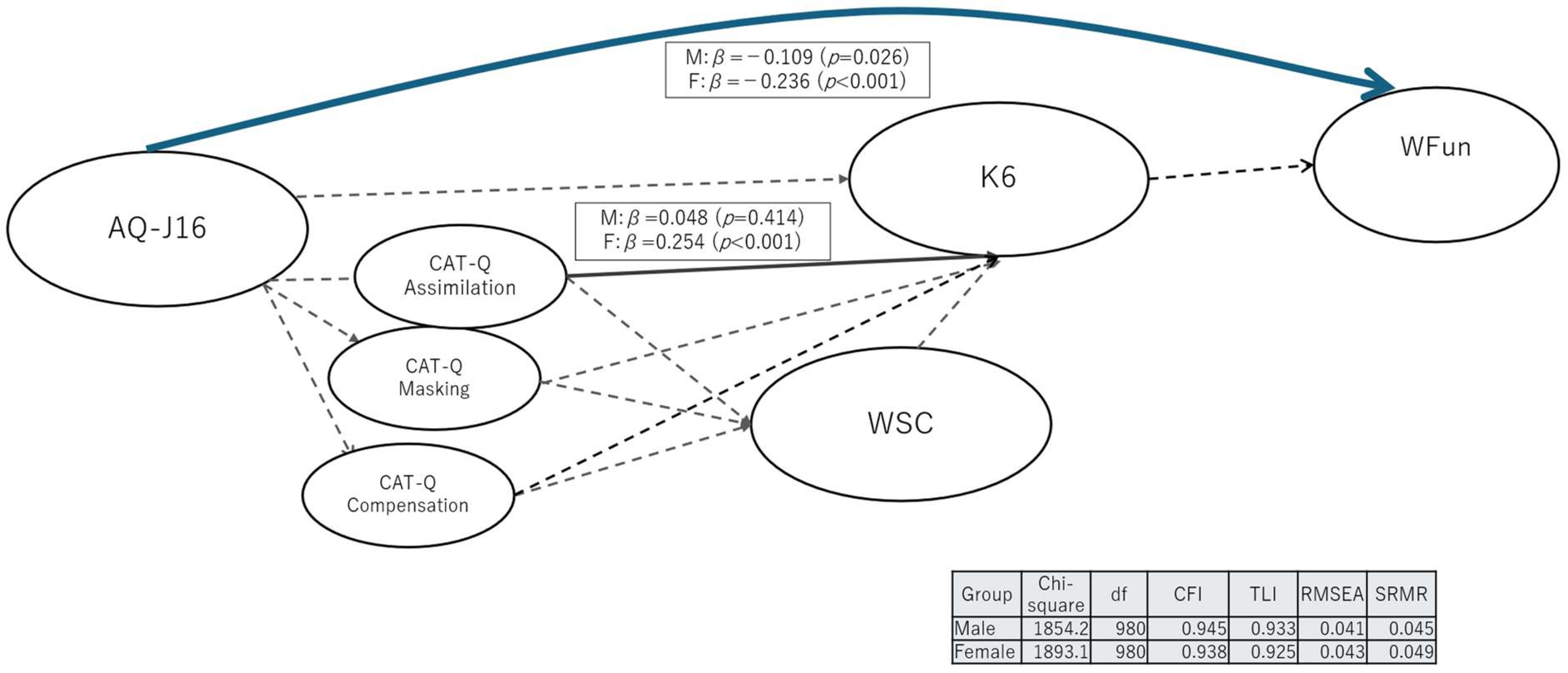
Multi-group SEM was performed to examine the structural relationships among ASD traits, camouflaging behaviors, WSC, mental health (K6), and presenteeism (WFun) by gender (Table 4). Figure 1 presents the results of the multi-group structural equation modeling, illustrating the overall model structure and highlighting the structural paths that showed significant gender differences. Model fit indices indicated good fit for both groups (men: CFI = 0.945, RMSEA = 0.041; women: CFI = 0.938, RMSEA = 0.043). Comparison of path coefficients revealed significant gender differences. The path from ASD traits to presenteeism (WFun) was stronger and significant in women (β = −0.236) compared to men (β = −0.109; p < 0.001). The path from Assimilation to psychological distress (K6) was significant only among women (β = 0.254), with evidence of a gender difference.

4. Discussion

4.1. Characteristics of the Sample

The participants in this study were primarily white-collar workers, and clear gender differences emerged in their socioeconomic backgrounds. Regarding educational attainment, a higher proportion of men held university (60.2%) or postgraduate degrees (13.0%), whereas women were more likely to have graduated from junior college (14.7%). This pattern may reflect the historical gender gap in educational opportunities in Japan [46]. Employment status and job position also showed marked gender differences: men were more likely to be permanent employees (90.8%) and to hold managerial roles (23.2%), while women were more likely to be employed on a non-regular basis such as contract or temporary staff (8.1% vs. 1.8% for men), and the majority were in non-supervisory positions (85.3% vs. 56.0% for men). These results point to persistent structural gender inequalities in Japanese workplaces, where women continue to face restricted opportunities for advancement [47,48].
These findings suggest that our sample reflects a segment of urban knowledge workers embedded in typical Japanese workplace structures that are shaped by gendered social hierarchies [49]. Importantly, these disparities provide essential context for interpreting the structural determinants of occupational stress, social camouflaging, and mental health examined in this study. Notably, while Table 1 highlighted substantial gender gaps in education and job position, there were few significant gender differences in the main outcomes of interest, namely, ASD traits, camouflaging behaviors, occupational stress, WSC, mental health, and presenteeism. However, when examining specific ASD trait domains, men scored significantly higher on Imagination, whereas women scored significantly higher on Attention Switching., indicating stronger autistic-like characteristics in these areas (i.e., greater difficulty with flexible thinking and adapting to change).
In contrast, women scored significantly higher on the camouflaging subscale Assimilation, which showed a significant association with mental health (K6) only in women. Assimilation, defined as efforts to alter one’s behavior or responses to blend into social environments, is strongly influenced by cultural and social contexts. The SEM findings suggest that, among camouflaging strategies, assimilation may represent a gender-specific risk factor for psychological burden in women. These tendencies may be related to workplace conditions and structural inequalities that place greater pressure on women to adapt to prevailing social expectations. This finding points to the psychological cost of excessive assimilation, or efforts to hide one’s autistic traits, particularly for women. Supporting environments that reduce the need for such adaptive pressure may help maintain both mental health and productivity.

4.2. Measurement Invariance as a Prerequisite for Gender Comparisons

In this study, we assessed measurement invariance by gender across all of the scales used in the survey. Results demonstrated configural and metric invariance for all measures, and scalar invariance was achieved for some. The findings indicate that the psychological constructs were interpreted consistently across gender groups, thereby supporting the statistical validity of the cross-gender comparisons. Ensuring measurement invariance has become essential for establishing the international validity of psychological instruments. For example, Swami et al. demonstrated scalar invariance of the Body Appreciation Scale-2 (BAS-2) across gender and age groups in a multinational sample from 65 countries [50]. Similarly, Ubels and Schlander reported invariance for the ICEpop Capability Measure for Adults (ICECAP-A) and Well-being and Recovery of Freedom Instrument (WeRFree) measures across gender, education, and age [51], while Hazzard and colleagues showed robust invariance of body image measures across gender, sexual orientation, race, and age [52]. The present results are consistent with the findings of these studies, reinforcing the premise that the scales functioned equivalently across gender and that subsequent multi-group SEM analyses were methodologically justified.

4.3. ASD Traits and Productivity: Implications of the Suppression Effect

A central aim of this study was to determine whether the structural relationships among ASD traits, camouflaging behaviors, mental health, and presenteeism differed by gender. Multi-group SEM revealed several gender-specific pathways. While an indirect path from ASD traits to presenteeism via psychological distress (K6) was observed, the direct path from ASD traits to presenteeism became negative once K6 was controlled for. This suppression effect was significant for both sexes but particularly pronounced among women. Suppression effects occur when controlling for a third variable reveals a hidden association [53]. The suppression pattern observed in this study should not be interpreted as evidence that autistic traits directly enhance productivity. Rather, this finding reflects a statistical relationship that becomes apparent only when psychological distress is controlled. The results suggest that strengths associated with autistic traits may be expressed in a context-dependent manner, influenced by workplace environment and psychological state, rather than indicating a direct or universal advantage. This interpretation is consistent with an individual-differences, person–task–environment fit perspective.
This question of a possible ‘autism advantage’ in the workplace was explored in a 2020 systematic review by Bury and colleagues, which concluded that, despite frequent anecdotal and experimental claims, there is insufficient ecological (workplace) evidence for a generalized autism advantage [54]. Instead, Bury et al. argue for an individual-differences approach in which putative strengths (e.g., attention to detail or sustained focus) translate into better performance only under favorable person–task–environment fit and adequate supports [54]. Consistent with this view, our suppression finding suggests a contingent advantage: when psychological distress is minimized, ASD-related characteristics may be harnessed to enhance productivity, but this is unlikely to be universal and depends on job demands, accommodations, and individual profiles. Complementing this perspective, qualitative scholarship has argued that Autistic characteristics such as hyperfocus/‘flow’, attention to detail, pattern recognition, direct communication, and deep topic knowledge, can constitute role-specific strengths, particularly in research settings, when workplaces are accessible and inclusive [55]. Framed within the social model of neurodiversity, their analysis underscores that any ‘advantage’ is context-dependent: it emerges under supportive conditions and can be undermined by masking demands or inaccessible practices; again, aligning with an individual-differences, person–task–environment fit view.
Grant and Kara further discuss how the concept of an ‘autistic advantage’ is shaped by gendered experiences, noting that diagnostic criteria historically biased toward male presentations have contributed to the late recognition of autistic women [55]. Their accounts, as two late-diagnosed female qualitative researchers, illustrate how traits often dismissed as quirks or undervalued as ‘soft skills’ such as empathy, loyalty, and meticulous attention to detail, can, under supportive conditions, constitute significant professional strengths. Importantly, they frame advantage as contingent not only on individual traits but also on the inclusivity of the workplace, reinforcing the need to consider gender when evaluating how autistic characteristics translate into productivity.
Assimilation-type camouflaging was significantly associated with psychological distress in women but not in men; however, the gender difference in this path remained at a trend level. This finding does not establish a female-specific effect but rather suggests a potentially gender-differentiated pattern that warrants further investigation.
It should be noted that men and women in this sample differed substantially in structural occupational characteristics, including education, employment type, and job position. Women were more likely to be employed in non-regular and non-supervisory roles, whereas men were more often in permanent and managerial positions. These structural differences may plausibly influence psychological distress and work functioning through differences in job control, job security, and interpersonal demands. Importantly, however, supplementary gender-stratified regression analyses adjusting for employment type and job position confirmed that assimilation remained significantly associated with psychological distress among women, whereas no significant association was observed among men (Supplementary Table S1). These findings indicate that the observed gender-specific association between assimilation and psychological distress cannot be explained solely by structural occupational factors.
In the current study, the stronger association observed among women does not necessarily imply that ASD traits are inherently more advantageous for women but may instead reflect the greater influence of societal expectations and gender norms on women’s workplace experiences. The findings of our study do, however, highlight the need for a dual approach to workplace support for employees with ASD traits, that is, (1) addressing potential difficulties while (2) also creating working environments that enable individuals with ASD to leverage their strengths. Such an approach requires shifting from a deficit-based to a strength-based perspective that values authenticity and psychological safety in diverse work settings. Such efforts may simultaneously enhance individual well-being and boost organizational productivity.

4.4. Limitations

This study has several limitations. First, it was based on secondary analysis of cross-sectional online survey data, which precludes causal inference. The sample was restricted to white-collar workers registered with a major Japanese marketing research company, limiting generalizability to other occupational groups or the broader working population. Second, ASD traits and camouflaging behaviors were assessed using self-report measures, raising the possibility of response bias. Future research should incorporate longitudinal and qualitative designs to capture subjective experiences of camouflaging and their long-term occupational impacts. Third, although the study was guided by the NIOSH job stress model, quantitative and qualitative workload could not be retained in the final SEM due to statistical and theoretical issues. Specifically, quantitative workload yielded a negative variance estimate (Heywood case), and including qualitative workload alone led to poor model fit. As a result, both workload variables were excluded, limiting the interpretability of stressor-related effects on camouflaging and mental health. Future studies should aim to develop more stable measurement models that incorporate stressors into comprehensive SEM frameworks. In addition, alternative causal structures (e.g., psychological distress acting as a confounder rather than a mediator, or the influence of unmeasured factors such as job fit or cognitive ability) cannot be ruled out based on the present cross-sectional design.

5. Conclusions

This study demonstrated gender differences in the structural relationships among ASD traits, social camouflaging, mental health, and presenteeism in Japanese white-collar workers without formal ASD diagnoses. ASD traits showed a positive indirect association with work functioning impairment through psychological distress, with this pathway being particularly pronounced among women. In contrast, the direct path from ASD traits to presenteeism was negative after controlling for distress, indicating a statistical suppression pattern. This finding is consistent with a context-dependent interpretation, whereby the functional expression of ASD-related characteristics may vary according to psychological state rather than reflecting a direct or universal advantage.
Men exhibited higher scores on Imagination, whereas women showed higher scores on Attention Switching and on Assimilation, a form of camouflaging characterized by efforts to fit into social expectations. Furthermore, assimilation was significantly associated with psychological distress in women but not in men, although the gender difference in this path remained at a trend level. These findings suggest a potentially gender-differentiated pattern in how camouflaging behaviors relate to mental health, warranting further investigation.
Taken together, the present results indicate that the impacts of ASD traits and social camouflaging on mental health and work functioning are not uniform across genders. While the findings point to the possible relevance of workplace environments that recognize individual differences in ASD-related characteristics, they should be interpreted cautiously given the cross-sectional design. Future longitudinal and interventional studies will be needed to clarify causal mechanisms and to determine how workplace supports might best be individualized to promote both well-being and sustainable work functioning among employees with diverse neurodevelopmental traits.

Supplementary Materials

The following supporting information can be downloaded at: https://www.mdpi.com/article/10.3390/psychiatryint7010038/s1, Table S1: Regression analyses testing whether the assimilation–distress association remains after adjusting for employment type (women and men separately), Table S2: Sensitivity analysis for work functioning impairment (WFun) with autism spectrum disorder (ASD) traits (AQ-J-16), psychological distress (K6), and structural covariates, stratified by gender; Table S3: Pearson correlations among study variables by gender.

Author Contributions

Conceptualization; T.O. and W.S. methodology T.O., T.S. and W.S.; formal analysis, T.O., W.S., T.S. and T.M.; investigation, W.S., T.O. and T.S.; resources, T.O. and T.M.; data curation, W.S. and T.O.; writing—original draft preparation, T.O., W.S. and T.M.; writing—review and editing T.O., A.M., K.N., Y.H., M.I. and T.M.; project administration, T.O. and T.S. All authors have read and agreed to the published version of the manuscript.

Funding

This research received no external funding.

Institutional Review Board Statement

The study was conducted in accordance with the Declaration of Helsinki and approved by the Ethical Review Committee of the Institute of Medicine, University of Tsukuba (Approval No. 2016, 1 August 2024).

Informed Consent Statement

Informed consent was obtained from all subjects involved in the study.

Data Availability Statement

The data presented in this study are available upon request from the corresponding author under certain conditions. However, please note that some measures cannot be made public due to contractual restrictions.

Acknowledgments

We would like to thank all the people who cooperated in the survey.

Conflicts of Interest

The authors declare no conflicts of interest.

Abbreviations

The following abbreviations are used in this manuscript:
AQAutism-Spectrum Quotient
AQ-J-16Autism-Spectrum Quotient, Japanese 16-item short form
ASDAutism Spectrum Disorder
BAS-2Body Appreciation Scale-2
BJSQBrief Job Stress Questionnaire
CAT-QCamouflaging Autistic Traits Questionnaire
CAT-Q-JCamouflaging Autistic Traits Questionnaire, Japanese version
CFAConfirmatory Factor Analysis
CFIComparative Fit Index
DSM-IVDiagnostic and Statistical Manual of Mental Disorders, Fourth Edition
DSM-5Diagnostic and Statistical Manual of Mental Disorders, Fifth Edition
ICECAP-AICEpop CAPability measure for Adults
K6Kessler Psychological Distress Scale (6-item)
MG-CFAMulti-Group Confirmatory Factor Analysis
NIOSHNational Institute for Occupational Safety and Health
RMSEARoot Mean Square Error of Approximation
SEMStructural Equation Modeling
SRMRStandardized Root Mean Square Residual
WeRFreeWell-being and Recovery of Freedom instrument
WFunWork Functioning Impairment Scale
WSCWorkplace Social Capital

References

  1. D’Cruz, A.M.; Ragozzino, M.E.; Mosconi, M.W.; Shrestha, S.; Cook, E.H.; Sweeney, J.A. Reduced behavioral flexibility in autism spectrum disorders. Neuropsychology 2013, 27, 152–160. [Google Scholar] [CrossRef] [PubMed]
  2. Sperry, L.A.; Mesibov, G.B. Perceptions of social challenges of adults with autism spectrum disorder. Autism 2005, 9, 362–376. [Google Scholar] [CrossRef] [PubMed]
  3. American Psychiatric Association; DSM-5 Task Force. Diagnostic and Statistical Manual of Mental Disorders: DSM-5, 5th ed.; American Psychiatric Publishing: Washington, DC, USA, 2013. [Google Scholar] [CrossRef]
  4. Maenner, M.J.; Warren, Z.; Williams, A.R.; Amoakohene, E.; Bakian, A.V.; Bilder, D.A.; Durkin, M.S.; Fitzgerald, R.T.; Furnier, S.M.; Hughes, M.M.; et al. Prevalence and characteristics of autism spectrum disorder among children aged 8 years—Autism and Developmental Disabilities Monitoring Network, 11 sites, United States, 2020. MMWR Surveill. Summ. 2023, 72, 1–14. [Google Scholar] [CrossRef] [PubMed]
  5. Baio, J.; Wiggins, L.; Christensen, D.L.; Maenner, M.J.; Daniels, J.; Warren, Z.; Kurzius-Spencer, M.; Zahorodny, W.; Robinson Rosenberg, C.; White, T.; et al. Prevalence of autism spectrum disorder among children aged 8 years—Autism and Developmental Disabilities Monitoring Network, 11 sites, United States, 2014. MMWR Surveill. Summ. 2018, 67, 1–23. [Google Scholar] [CrossRef]
  6. American Psychiatric Association. Diagnostic and Statistical Manual of Mental Disorders, 4th ed.; American Psychiatric Association: Washington, DC, USA, 2000. [Google Scholar]
  7. Rippon, G. Differently different? A commentary on the emerging social cognitive neuroscience of female autism. Biol. Sex Differ. 2024, 15, 49. [Google Scholar] [CrossRef]
  8. Shaw, K.A.; Williams, S.; Patrick, M.E.; Valencia-Prado, M.; Durkin, M.S.; Howerton, E.M.; Ladd-Acosta, C.M.; Pas, E.T.; Bakian, A.V.; Bartholomew, P.; et al. Prevalence and early identification of autism spectrum disorder among children aged 4 and 8 years—Autism and Developmental Disabilities Monitoring Network, 16 sites, United States, 2022. MMWR Surveill. Summ. 2025, 74, 1–22. [Google Scholar] [CrossRef]
  9. Zulauf Logoz, M. The revision and 5th edition of the Diagnostic and Statistical Manual of Mental Disorders (DSM-5): Consequences for the diagnostic work with children and adolescents. Prax. Kinderpsychol. Kinderpsychiatr. 2014, 63, 562–576. [Google Scholar] [CrossRef]
  10. Volkmar, F.R.; Reichow, B. Autism in DSM-5: Progress and challenges. Mol. Autism 2013, 4, 13. [Google Scholar] [CrossRef]
  11. Wiggins, L.D.; Rice, C.E.; Barger, B.; Soke, G.N.; Lee, L.C.; Moody, E.; Edmondson-Pretzel, R.; Levy, S.E. DSM-5 criteria for autism spectrum disorder maximizes diagnostic sensitivity and specificity in preschool children. Soc. Psychiatry Psychiatr. Epidemiol. 2019, 54, 693–701. [Google Scholar] [CrossRef]
  12. Lockwood Estrin, G.; Milner, V.; Spain, D.; Happé, F.; Colvert, E. Barriers to autism spectrum disorder diagnosis for young women and girls: A systematic review. Rev. J. Autism Dev. Disord. 2021, 8, 454–470. [Google Scholar] [CrossRef]
  13. Lai, M.-C.; Lombardo, M.V.; Auyeung, B.; Chakrabarti, B.; Baron-Cohen, S. Sex/Gender differences and autism: Setting the scene for future research. J. Am. Acad. Child Adolesc. Psychiatry 2015, 54, 11–24. [Google Scholar] [CrossRef]
  14. Harrop, C.; Jones, D.; Zheng, S.; Nowell, S.W.; Boyd, B.A.; Sasson, N. Sex differences in social attention in autism spectrum disorder. Autism Res. 2018, 11, 1264–1275. [Google Scholar] [CrossRef] [PubMed]
  15. Hull, L.; Mandy, W.; Lai, M.-C.; Baron-Cohen, S.; Allison, C.; Smith, P.; Petrides, K.V. Development and validation of the Camouflaging Autistic Traits Questionnaire (CAT-Q). J. Autism Dev. Disord. 2019, 49, 819–833. [Google Scholar] [CrossRef] [PubMed]
  16. Bargiela, S.; Steward, R.; Mandy, W. The experiences of late-diagnosed women with autism spectrum conditions: An investigation of the female autism phenotype. J. Autism Dev. Disord. 2016, 46, 3281–3294. [Google Scholar] [CrossRef] [PubMed]
  17. Hull, L.; Petrides, K.V.; Allison, C.; Smith, P.; Baron-Cohen, S.; Lai, M.-C.; Mandy, W. “Putting on my best normal”: Social camouflaging in adults with autism spectrum conditions. J. Autism Dev. Disord. 2017, 47, 2519–2534. [Google Scholar] [CrossRef]
  18. Lupindo, B.M.; Maw, A.; Shabalala, N. Late diagnosis of autism: Exploring experiences of males diagnosed with autism in adulthood. Curr. Psychol. 2022, 42, 24181–24197. [Google Scholar] [CrossRef]
  19. Gesi, C.; Migliarese, G.; Torriero, S.; Capellazzi, M.; Omboni, A.C.; Cerveri, G.; Mencacci, C. Gender differences in misdiagnosis and delayed diagnosis among adults with autism spectrum disorder with no language or intellectual disability. Brain Sci. 2021, 11, 912. [Google Scholar] [CrossRef]
  20. Cassidy, S.; Bradley, L.; Shaw, R.; Baron-Cohen, S. Risk markers for suicidality in autistic adults. Mol. Autism 2018, 9, 42. [Google Scholar] [CrossRef]
  21. Sato, W.; Omiya, T.; Kumada-Deguchi, N.; Sankai, T.; Mayers, T. Impact of autism spectrum disorder traits and social camouflaging on presenteeism among Japanese white-collar workers. Psychiatry Int. 2025, 6, 61. [Google Scholar] [CrossRef]
  22. Oshima, F.; Takahashi, T.; Tamura, M.; Guan, S.; Seto, M.; Hull, L.; Mandy, W.; Tsuchiya, K.; Shimizu, E. The association between social camouflage and mental health among autistic people in Japan and the UK: A cross-cultural study. Mol. Autism 2024, 15, 1. [Google Scholar] [CrossRef]
  23. Tamura, M.; Cage, E.; Perry, E.; Hongo, M.; Takahashi, T.; Seto, M.; Shimizu, E.; Oshima, F. Understanding camouflaging, stigma, and mental health for autistic people in Japan. Autism Adulthood 2025, 7, 52–65. [Google Scholar] [CrossRef] [PubMed]
  24. Evans, D.; Mason, C.; Chen, H.; Reeson, A. Accelerated demand for interpersonal skills in the Australian post-pandemic labour market. Nat. Hum. Behav. 2024, 8, 32–42. [Google Scholar] [CrossRef] [PubMed]
  25. Nordin, V.; Palmgren, M.; Lindbladh, A.; Bölte, S.; Jonsson, U. School absenteeism in autistic children and adolescents: A scoping review. Autism 2024, 28, 1622–1637. [Google Scholar] [CrossRef] [PubMed]
  26. Suzuki, T.; Wada, K.; Muzembo, B.A.; Ngatu, N.R.; Yoshii, S.; Ikeda, S. Autistic and attention deficit/hyperactivity disorder traits are associated with suboptimal performance among Japanese university students. JMA J. 2020, 3, 216–231. [Google Scholar] [CrossRef]
  27. Lai, M.-C.; Kassee, C.; Besney, R.; Bonato, S.; Hull, L.; Mandy, W.; Szatmari, P.; Ameis, S.H. Prevalence of co-occurring mental health diagnoses in the autism population: A systematic review and meta-analysis. Lancet Psychiatry 2019, 6, 819–829. [Google Scholar] [CrossRef]
  28. Hull, L.; Lai, M.-C.; Baron-Cohen, S.; Allison, C.; Smith, P.; Petrides, K.V.; Mandy, W. Gender differences in self-reported camouflaging in autistic and non-autistic adults. Autism 2020, 24, 352–363. [Google Scholar] [CrossRef]
  29. Corbett, B.A.; Schwartzman, J.M.; Libsack, E.J.; Muscatello, R.A.; Lerner, M.D.; Simmons, G.L.; White, S.W. Camouflaging in autism: Examining sex-based and compensatory models in social cognition and communication. Autism Res. 2021, 14, 127–142. [Google Scholar] [CrossRef]
  30. Cook, J.; Hull, L.; Crane, L.; Mandy, W. Camouflaging in autism: A systematic review. Clin. Psychol. Rev. 2021, 89, 102080. [Google Scholar] [CrossRef]
  31. Kurita, H.; Koyama, T.; Osada, H. Autism-Spectrum Quotient—Japanese version and its short forms for screening normally intelligent persons with pervasive developmental disorders. Psychiatry Clin. Neurosci. 2005, 59, 490–496. [Google Scholar] [CrossRef]
  32. Wakabayashi, A.; Tojo, Y.; Baron-Cohen, S.; Wheelwright, S. The Autism-Spectrum Quotient (AQ) Japanese version: Evidence from high-functioning clinical group and normal adults. Shinrigaku Kenkyu 2004, 75, 78–84. [Google Scholar] [CrossRef]
  33. Hongo, M.; Oshima, F.; Guan, S.; Takahashi, T.; Nitta, Y.; Seto, M.; Hull, L.; Mandy, W.; Ohtani, T.; Tamura, M.; et al. Reliability and validity of the Japanese version of the Camouflaging Autistic Traits Questionnaire. Autism Res. 2024, 17, 1205–1217. [Google Scholar] [CrossRef]
  34. Fujino, Y.; Uehara, M.; Izumi, H.; Nagata, T.; Muramatsu, K.; Kubo, T.; Oyama, I.; Matsuda, S. Development and validity of a work functioning impairment scale based on the Rasch model among Japanese workers. J. Occup. Health 2015, 57, 521–531. [Google Scholar] [CrossRef] [PubMed]
  35. Fujino, Y.; Kubo, T.; Uehara, M.; Koyama, I.; Izumi, H.; Nagata, T.; Matsuda, S. Development of the WFun Presenteeism Questionnaire in accordance with international standards for patient-reported outcome measures. Occup. Health J. 2017, 40, 55–60. [Google Scholar]
  36. Kessler, R.C.; Andrews, G.; Colpe, L.J.; Hiripi, E.; Mroczek, D.K.; Normand, S.-L.; Walters, E.E.; Zaslavsky, A.M. Short screening scales to monitor population prevalences and trends in non-specific psychological distress. Psychol. Med. 2002, 32, 959–976. [Google Scholar] [CrossRef] [PubMed]
  37. Furukawa, T.A.; Kawakami, N.; Saitoh, M.; Ono, Y.; Nakane, Y.; Nakamura, Y.; Tachimori, H.; Iwata, N.; Uda, H.; Nakane, H.; et al. The performance of the Japanese version of the K6 and K10 in the World Mental Health Survey Japan. Int. J. Methods Psychiatr. Res. 2008, 17, 152–158. [Google Scholar] [CrossRef]
  38. Inoue, A.; Kawakami, N.; Shimomitsu, T.; Tsutsumi, A.; Haratani, T.; Yoshikawa, T.; Shimazu, A.; Odagiri, Y. Development of a short questionnaire to measure an extended set of job demands, job resources, and positive health outcomes: The new Brief Job Stress Questionnaire. Ind. Health 2014, 52, 175–189. [Google Scholar] [CrossRef]
  39. Watanabe, K.; Imamura, K.; Eguchi, H.; Hidaka, Y.; Komase, Y.; Sakuraya, A.; Inoue, A.; Kobayashi, Y.; Sasaki, N.; Tsuno, K.; et al. Usage of the Brief Job Stress Questionnaire: A systematic review of a comprehensive job stress questionnaire in Japan from 2003 to 2021. Int. J. Environ. Res. Public Health 2023, 20, 1814. [Google Scholar] [CrossRef]
  40. Matsubara, T.; Inoue, S. Workplace social capital and health-related quality of life: A cross-sectional study among schoolteachers working at junior highs. Jpn. J. Public Health Nurs. 2019, 8, 52–61. [Google Scholar] [CrossRef]
  41. Kouvonen, A.; Kivimäki, M.; Vahtera, J.; Oksanen, T.; Elovainio, M.; Cox, T.; Virtanen, M.; Pentti, J.; Cox, S.J.; Wilkinson, R.G. Psychometric evaluation of a short measure of social capital at work. BMC Public Health 2006, 6, 251. [Google Scholar] [CrossRef]
  42. Hori, D.; Takao, S.; Kawachi, I.; Ohtaki, Y.; Andrea, C.S.; Takahashi, T.; Shiraki, N.; Ikeda, T.; Ikeda, Y.; Doki, S.; et al. Relationship between workplace social capital and suicidal ideation in the past year among employees in Japan: A cross-sectional study. BMC Public Health 2019, 19, 919. [Google Scholar] [CrossRef]
  43. National Institute for Occupational Safety and Health. Stress … at Work; U.S. Department of Health and Human Services, Centers for Disease Control and Prevention, National Institute for Occupational Safety and Health: Cincinnati, OH, USA, 1999. Available online: https://www.cdc.gov/niosh/docs/99-101/default.html (accessed on 2 October 2025).
  44. Byrne, B.M. Structural Equation Modeling with Mplus: Basic Concepts, Applications, and Programming; Routledge: New York, NY, USA, 2012. [Google Scholar]
  45. Kline, R.B. Principles and Practice of Structural Equation Modeling, 5th ed.; The Guilford Press: New York, NY, USA, 2023. [Google Scholar]
  46. Ministry of Education, Culture, Sports, Science and Technology—Japan (MEXT). Survey Results on Issues Surrounding Students with Developmental Disabilities in Universities. 2022. Available online: https://www.mext.go.jp/content/20221221-mxt_chousa01-000024177_001.pdf (accessed on 2 October 2025). (In Japanese)
  47. Gender Equality Bureau, Cabinet Office, Government of Japan. The White Paper on Gender Equality 2024 (Provisional Translation). 2024. Available online: https://www.gender.go.jp/about_danjo/whitepaper/r06/gaiyou/pdf/r06_gaiyou_en.pdf (accessed on 2 October 2025).
  48. Ministry of Health, Labour and Welfare, Japan. The Present Situation of Working Women in 2023 [Report]. 2023. Available online: https://www.mhlw.go.jp/bunya/koyoukintou/josei-jitsujo/dl/23.pdf (accessed on 2 October 2025).
  49. Ogasawara, Y. Office Ladies and Salaried Men: Power, Gender, and Work in Japanese Companies; University of California Press: Berkeley, CA, USA, 2023. [Google Scholar]
  50. Swami, V.; Tran, U.S.; Stieger, S.; Aavik, T.; Ranjbar, H.A.; Adebayo, S.O.; Afhami, R.; Ahmed, O.; Aime, A.; Akel, M.; et al. Body appreciation around the world: Measurement invariance of the Body Appreciation Scale-2 (BAS-2) across 65 nations, 40 languages, gender identities, and age. Body Image 2023, 46, 449–466. [Google Scholar] [CrossRef]
  51. Ubels, J.; Schlander, M. Measurement invariance and adapted preferences: Evidence for the ICECAP-A and WeRFree instruments. Health Qual. Life Outcomes 2023, 21, 121. [Google Scholar] [CrossRef]
  52. Hazzard, V.M.; Schaefer, L.M.; Thompson, J.K.; Murray, S.B.; Frederick, D.A. Measurement invariance of body image measures by age, gender, sexual orientation, race, weight status, and age: The U.S. Body Project I. Body Image 2022, 41, 97–108. [Google Scholar] [CrossRef]
  53. MacKinnon, D.P.; Krull, J.L.; Lockwood, C.M. Equivalence of the mediation, confounding and suppression effect. Prev. Sci. 2000, 1, 173–181. [Google Scholar] [CrossRef]
  54. Bury, S.M.; Hedley, D.; Uljarević, M.; Gal, E. The autism advantage at work: A critical and systematic review of current evidence. Res. Dev. Disabil. 2020, 105, 103750. [Google Scholar] [CrossRef]
  55. Grant, A.; Kara, H. Considering the autistic advantage in qualitative research: The strengths of autistic researchers. Contemp. Soc. Sci. 2021, 16, 589–603. [Google Scholar] [CrossRef]
Figure 1. Multi-group structural equation model illustrating the relationships among ASD traits, social camouflaging (assimilation, masking, and compensation), workplace social capital (WSC), psychological distress (K6), and work functioning impairment (WFun) by gender. Solid lines indicate paths with significant gender differences; dashed lines represent nonsignificant paths. Arrows indicate hypothesized directional paths in the structural equation model. Note. AQ-J-16: Higher scores indicate stronger ASD traits. CAT-Q = Social Camouflaging Questionnaire; Assimilation = adopting social behaviors (mimicry); Masking = concealing one’s traits; Compensation = covering difficulties through other means; K6 = psychological distress (higher scores = poorer mental health); WSC = Workplace Social Capital (higher scores = stronger WSC); WFun = Work Functioning Impairment (higher scores = lower productivity).
Psychiatryint 07 00038 g001
Table 1. Basic participants characteristics and comparisons by gender.
Total (N = 543)Male
(n = 284)
Female
(n = 259)
Comparison Between the Groups *
Variablesn% (SD)n% (SD)n% (SD)p
Age-Mean46.3(12.8)47.5(12.2)45(13.3)0.022
Marital Status
    Married21639.89633.812046.3<0.001
    Unmarried/Single28151.717762.310440.2
    Widowed/Divorced468.5113.93513.5
Highest Level of Education
    High School9617.74114.45521.2<0.001
    Vocational School6812.52910.23915.1
    Junior College448.162.13814.7
    University28853.017160.211745.2
    Graduate School458.33713.083.1
    Other20.400.020.8
Occupation
    Managerial8114.96322.2186.9<0.001
    Professional/Technical17031.310737.76324.3
    Clerical20237.25920.814355.2
    Sales346.3207.0145.4
    Other5610.33512.3218.1
Employment Type
    Full-time47286.925890.821482.60.001
    Part-time/Temporary/Dispatch264.851.8218.1
    Contract458.3217.4249.3
Job Position (Level)
    Staff38070.015956.022185.3<0.001
    Assistant Manager/Supervisor8515.75920.82610.0
    Manager/Department Head7814.46623.2124.6
* Pearson’s Chi-Square Test, Fisher’s Exact Test. Abbreviations: SD, standard deviation.
Table 2. Mean scores for each variable and group comparisons by gender.
VariablesScore RangeMale
(n = 284)
Female
(n = 259)
Two-Group Comparison by Gender: Test of Mean Differences (Two-Tailed p-Value *)
MeanSDMeanSD
AQ-J-16 Total Score0–166.632.826.392.840.323
    Communication0–72.591.502.451.470.272
    Imagination0–41.701.001.371.03<0.001
    Attention Switching0–31.410.981.591.050.045
    Social Skills0–20.930.600.980.620.367
CAT-Q-J Total Score25–17591.0116.7391.7515.210.589
    Compensation 8–5629.868.9529.217.800.369
    Masking8–5630.486.3130.866.000.470
    Assimilation8–5630.675.1431.675.770.032
K6 0–245.686.005.375.600.525
WFun0–7014.077.2013.606.890.437
WSC8–4021.977.0921.857.360.848
BJSQ
    Quantitative Job Demands3–127.802.307.682.390.553
    Qualitative Job Demands3–127.942.077.862.290.672
Note: * t-test. Abbreviations: SD, standard deviation; AQ-J-16, Autism-Spectrum Quotient, Japanese 16-item short form; CAT-Q-J, Japanese version of the Camouflaging Autistic Traits Questionnaire; WFun, Work Functioning Impairment Scale; K6, Kessler Psychological Distress Scale; WSC, Workplace Social Capital; BJSQ, Brief Job Stress Questionnaire.
Table 3. Gender-Based Measurement Invariance Results from Multi-Group CFA.
Scale/FactorModelCFIRMSEASRMRΔCFIInvariance Judgment
K6Configural0.9600.1540.028Acceptable
Metric0.9590.1370.041−0.001Metric invariance
Scalar0.9570.1270.044−0.002Scalar invariance supported
WFunConfigural0.9700.1100.025Good
Metric0.9690.1020.039−0.001Metric invariance
Scalar0.9660.0980.042−0.003Scalar invariance supported
WSC (3-factor)Configural0.9920.0590.017Excellent
Metric0.9920.0560.0230.000Metric invariance
Scalar0.9920.0530.0240.000Scalar invariance supported
CAT-Q CompensationConfigural0.9110.1140.054Acceptable
Metric0.9120.1060.059+0.001Metric invariance
Scalar0.9150.0980.059+0.003Scalar invariance supported
CAT-Q MaskingConfigural0.9030.1150.056Acceptable
Metric0.9030.1150.0570.000Metric invariance
Scalar0.9040.1130.057+0.001Scalar invariance supported
CAT-Q AssimilationConfigural0.7690.1390.084Poor absolute fit
Metric0.7460.1390.101−0.024Metric invariance not supported
Scalar (partial)0.7440.1340.102−0.002Partial scalar invariance only
AQ-J-16 total (4-factor tested)Configural0.6820.1240.120Poor
Metric0.6960.1170.132+0.014Metric approx. supported
Scalar (partial)0.6770.0880.123−0.019Partial scalar invariance only
AQ-J CommunicationConfigural0.6920.1300.107Poor
Metric0.6960.1170.059+0.004Metric invariance
Scalar (partial)0.7130.1530.107−0.002Partial scalar invariance
AQ-J ImaginationConfigural1.0000.0000.024Heywood risk
Metric1.0000.0000.0220.000Metric invariance
Scalar (partial)0.9080.0600.043Partial scalar invariance
AQ-J SwitchingConfigural1.0000.0000.000Good
Metric1.0000.0000.0100.000Metric invariance
Scalar (partial)0.9740.0510.063Partial scalar invariance
AQ-J Social Skillsn/an/an/an/aNot testable (two items only)
Note: Measurement invariance was evaluated based on changes in fit indices rather than absolute fit (ΔCFI < 0.01, ΔRMSEA < 0.015, ΔSRMR < 0.030). When full scalar invariance was not supported, partial invariance models were estimated by freeing minimal intercept constraints based on modification indices. For the AQ-J16 total score, the following item intercepts were freed: aqj_2, aqj_4, aqj_6, aqj_10, aqj_11, aqj_13, aqj_14, aqj_15, and aqj_16. The Social Skills subscale was not tested due to having only two indicators. MG-CFA results were used solely to justify cross-gender comparisons; subsequent SEM analyses used observed total and subscale scores rather than latent factors. Abbreviations: CFI, Comparative Fit Index; RMSEA, Root Mean Square Error of Approximation; AQ-J-16, Autism-Spectrum Quotient, Japanese 16-item short form; CAT-Q, Camouflaging Autistic Traits Questionnaire WFun, Work Functioning Impairment Scale; K6, Kessler Psychological Distress Scale; WSC, Workplace Social Capital.
Table 4. Standardized path coefficients by gender and significance of gender differences in the structural equation modeling.
PathMale
n = 284
Female
n = 259
p for
Gender
Difference
Std. Coef.Sig.Std. Coef.Sig.
ASD (AQ-J-16)
   ASD → Assimilation0.0790.1920.1010.0940.826
   ASD → Compensation0.0580.1210.0880.0170.227
   ASD → Masking0.0180.0020.0110.0080.917
   ASD → K60.2420.0000.2540.0000.440
   ASD → WFun−0.1090.026−0.2360.0000.010
Camouflaging (CAT-Q-J)
   Assimilation → K60.0480.4140.2540.0000.080
   Assimilation → WSC−0.1640.005−0.2640.0000.636
   Compensation → K60.0590.548−0.0520.6270.487
   Compensation → WSC0.1180.0470.2190.0000.120
   Masking → K6−0.0300.608−0.0060.9190.501
   Masking → WSC−0.0330.5800.0760.1960.172
K6 → WFun0.6840.0000.5850.0000.324
WSC → K6−0.3300.056−0.2350.1140.660
Abbreviations: ASD, autism spectrum disorder; AQ-J-16, Autism-Spectrum Quotient, Japanese 16-item short form; CAT-Q-J, Japanese version of the Camouflaging Autistic Traits Questionnaire; WFun, Work Functioning Impairment Scale; K6, Kessler Psychological Distress Scale; WSC, Workplace Social Capital.
Disclaimer/Publisher’s Note: The statements, opinions and data contained in all publications are solely those of the individual author(s) and contributor(s) and not of MDPI and/or the editor(s). MDPI and/or the editor(s) disclaim responsibility for any injury to people or property resulting from any ideas, methods, instructions or products referred to in the content.