Article

Abandoning Reportage and Proximity in Journalism: There Is No Time, No Money, and No People to Leave the Newsroom More Often

1
CECS—Centro de Estudos Comunicação e Sociedade, Universidade do Minho, 4710-057 Braga, Portugal
2
Escola Superior de Educação, CI&DEI, Instituto Politécnico de Viseu, 3504-510 Viseu, Portugal
*
Authors to whom correspondence should be addressed.
Journal. Media 2026, 7(2), 96; https://doi.org/10.3390/journalmedia7020096
Submission received: 11 March 2026 / Revised: 24 April 2026 / Accepted: 28 April 2026 / Published: 6 May 2026

Abstract

Starting from the idea of proximity as a fundamental news value—which may assume geographical, cultural, emotional, and thematic dimensions—this article discusses how this concept influences journalists’ production routines, focusing on the progressive abandonment of the journalistic genre of reportage. This quantitative study aims to understand how Portuguese journalists conceptualize proximity journalism and the role reportage plays as a journalistic practice that involves direct contact with the field. The study collected responses from 111 Portuguese journalists working in television, radio, print, and online media, across different media outlets, regardless of their hierarchical position or contractual status. The research shows that although proximity is considered transversal across all levels of journalism (local, regional, or national), current production routines primarily favor news production. This trend is driven by a strong dependence on the political and institutional agenda, neglecting reportage, which requires going into the field and establishing direct contact with local communities and, consequently, with alternative and non-official or non-institutional sources. Among the main reasons identified by journalists are a lack of time, a scarcity of human and financial resources, an overload of tasks in newsrooms, and poor editorial decisions by newsroom leadership. The study concludes that this dependence on fast production routines and institutional sources may compromise journalism’s ability to maintain close relationships with communities and to produce more in-depth, contextualized narratives, thereby gradually losing proximity to local communities and citizens.

1. Introduction

The definition of the concept of proximity in the Cambridge Dictionary leaves room for discussion about its relationship to the media and journalism. Proximity (noun)—the state or quality of being near or close in space, time, relation, or sequence. It refers to nearness or closeness to something or someone rather than distance (Cambridge University Press, 2026). Being near, according to the meaning of proximity, is being close in space, time, relation, or sequence. This means that not only can closeness in space explain the proximity between someone or something.
Ramos (2025) discusses how the concept of proximity is developed across several dimensions: geographical, cultural, emotional, and thematic. These dimensions influence the journalist’s perspective and the criteria they use in approaching events and telling stories.
In media studies, proximity is a component of the newsworthiness of events (Wolf, 2009), whether in local, regional, or national media outlets. In journalism, proximity is a news value, and despite its cultural significance, the geographic notion prevails. For some authors, however, proximity can be seen as relevance. Harcup and O’Neill (2017, p. 1482) define relevance as a news value and define relevance as “stories about groups or nations perceived to be influential with, or culturally or historically familiar to, the audience”.
By focusing on these different dimensions of proximity, journalists get to know their audience better, choose topics that originate in the local area, establish direct contact with the community, create narratives that reflect local identities, and can even involve citizens in the construction of the report, encouraging citizen participation in the media. Parameters that could enable community journalism to play a crucial role in a new business model for the local and regional media sector (characterized by a lack of human and financial resources): “the intrinsic relationship with the community” (Ramos, 2025, p. 197).
Local journalism is often associated with the notion of proximity. Being close to a community, to a specific region, makes proximity to his neighbors a mission for journalists, since they mainly report on issues and problems of those regions. In regional and local media, proximity is essentially geographical and implies sharing a thematic reference point, whatever form of presence allows participants to focus on a topic (Correia, 2023).
The regionalist character of the term “proximity journalism”, or its exclusive link to local and regional journalism, as defined by Camponez (2002), seems to drive away the idea of proximity to journalism itself. Regardless of geography, all journalism should be close to its audience, which means reporting the problems and issues that the audience faces.
The issue of proximity is far from being exclusive to the regional press. In fact, it is a cross-cutting issue in journalism, in the effort to communicate content considered relevant to its readers and, particularly, in the definition of business strategies aimed at achieving audience loyalty.
(Camponez, 2002, p. 113)
In the last decade of the last century, Franklin and Murphy (1991, cited by Ramos & Grupillo, 2021), pointed out that local news does not necessarily have to have a local origin, emphasizing that national or international news, as long as it has a local and regional approach, fits into this type of journalism that is closer or more intimate. Along the same lines, López García (2012) points out that proximity journalism and regional journalism are not the same thing and, although closely associated, they are not necessarily related, because proximity journalism involves not only physical proximity, but also cultural proximity.
Thus, proximity can occur when national media outlets report on an international event, such as the war in Ukraine, and even when local press report on the same war, as seen in Midões and Martins (2023). As the authors conclude “proximity cannot be considered only from a geographical perspective” (p. 174), since the distance between Portugal and Ukraine does not drive away the interest and affinity of the audience with this subject, especially considering the international and diplomatic relations between the countries, the strong presence of an immigrant Ukrainian community in Portugal, and even the imminence of a possible world war.
The different geometries of proximity imply, as Camponez (2002, p. 118) writes, “a sufficiently broad concept in which it is legitimate to include all media”. We therefore start from the idea that the audiences of the various media “are the result of close ties, whether geographical, psycho-affective, social, or temporal” (Camponez, 2002, p. 118). Therefore, the cultural implications of proximity are one of the arguments to support the erosion of local and regional boundaries in the concept of proximity.
Midões and Martins (2023) state that “all journalism should be close” (p. 403) and substantiate this statement with the need for journalism to be close to its sources, the issues it reports on, or its community, regardless of geographical reference. Going back to the Cambridge Dictionary definition, all journalism should develop a relationship of nearness with its audience, whether the closeness lies in space, relation, time, or sequence. Jerónimo (2015) also considers that journalists in the national media practice proximity journalism “when the references are Portugal and the Portuguese” (p. 11).
The aim of this article is to further develop the idea of proximity as a cornerstone of journalism. National, regional, or local. As Karlsson and Rowe (2019) explain, two places far away from each other create a “friction of distance”, since it will consume resources to make any movement in space. This is the case of national media, whose idea of proximity remains limited to geographical proximity, thereby excluding local media outlets.
Journalism cannot maintain proximity to its audience when journalists sit inside the newsroom. The street is where journalists belong. Neveu (2014) argues very clearly that journalism loses quality when it abandons the field, replacing physical presence with desk work, telephone calls, and screens. For Neveu, journalism—especially reporting and proximity journalism—is based on what he calls “legwork,” that is, going to places, observing directly, talking to ordinary people, experiencing social contexts “from within”.
How to portray characters whom one never met directly? How to describe spaces and actions only viewed on the blurred images of a computer or summarized in a dispatch?
(Neveu, 2014, p. 539)
In his view, the street is the space where journalism gains depth, legitimacy, and narrative, as opposed to “sedentary” journalism, mediated by press releases and institutional sources.
This research explores how Portuguese journalists perceive proximity in journalism and seeks to understand their organizational options regarding “street journalism”, particularly reportage as an instrument of closeness to the audience. We used an online questionnaire and gathered responses from 111 journalists across several media outlets (press, online, radio, and television), a random sample regardless of their hierarchical position or contractual relationship with the media organization.

2. Reportage, a Genre of Proximity

Reportage can be characterized as a journalistic genre that offers depth, context, and narrative richness (Gomes, 2013). It is a genre with a preponderance of facts, but with multiple perspectives and openness to interpretation. It does not limit itself to stating what happened: it explains, contextualizes, deepens, and gives meaning to events, bringing the reader closer to the reality experienced (Cavazzino, 2021).
Despite its recognized journalistic value, studies show that this genre has a relatively small presence in overall news coverage. Gomes’ (2013) study concerning the space that daily Portuguese newspapers allocate to reportage concludes that this reduced presence may result in a loss of analytical depth and weakening of journalism’s capacity for social scrutiny and watchdog functions. Midões et al. (2025), in an analysis of media coverage of the major fires in Portugal in 2017, found that there was a clear predominance of the news format over reporting, with no visits to the field by journalists and a distant approach, without description of the event by the journalist and direct contact with the community.
It is reporting that involves going to the field and listening directly to the source of information, giving priority to the stories of local communities, and, consequently, giving them a voice through the media. There was little room for reporting, which, together with the strong preference for official sources, broke the dynamic that is supposed to exist between a local or regional newspaper and communities, strengthening and promoting democracy, allowing populations and entities to speak openly about the positive and negative aspects they encountered throughout the process of preventing and fighting forest fires.
Proximity in journalism is anchored with reportage, since the aim is to be closer to the audience, its problems, difficulties, and stories. Reportage is a means towards that end, and it requires “legwork”, here comprehended as “one of the bases of journalistic practice to meet and question actors and authorities, to gain a practical knowledge of the places and atmospheres” (Neveu, 2014, p. 538). As Neveu (2014) argues, contemporary journalism is undergoing a process of rationalization that prioritizes speed, simplification, and the immediate usefulness of news, “but traditional “legwork” remains one of the bases of journalistic practice to meet and question actors and authorities, to gain a practical knowledge of the places and atmospheres” (p. 539).
As Lai Men (2021) writes in the Reportage Manual of REC, reportages are “stories involving people that we can only tell by being on the ground” (p. 233), and, in the same work, Francisco Sena Santos complements that to develop the observation, the knowledge about the subject with the “utmost precision, you need to breathe in the air of the place, absorb what comes from the senses, listen face to face to people’s voices. You need to be there, paying close attention to everything (2021, p. 247). However, this important point of view, Lai Man reminds us that “it has never been as difficult as it is now to go to the end of the street, let alone to the end of the world. Pennies are counted, increasingly confined to desk journalism and screens” (2021, p. 233). Kassel et al. (2026) state that today’s media environment—shaped by the 24 h news cycle, reduced workforces, and multimedia demands—leaves little room for genuine closeness to stories, sources, or audiences, reducing proximity to little more than a measure of immediate newsworthiness.

3. Materials and Methods

This study favored a quantitative methodology to obtain responses from a significant number of journalists. Although the sample of 111 participants is not representative, comprising 2.2% of the population of journalists with professional licenses in Portugal (n = 4972), with an estimated margin of error of around 9% for a confidence level of 95%, the sample is adequate for exploratory purposes.
In this study, an online questionnaire survey was conducted, to which 111 Portuguese journalists (53.2% male and 45.9% female) from the press, television, radio, online, and other media. The survey was available between 19 October and 30 November.
About half of the respondents (44.4%) work in national media outlets, and the other half (37.1%) in regional and local media outlets. About 19% work for international or specialized media.
The press is the main sector of activity, followed by online/digital, radio, and television. 57.6% of the inquiries have more than 20 years of journalism experience, and 66.1% work as journalists. We should notice that 28.5% have editorial responsibilities, such as editors, managing editors, or executive editors.
The majority (61.2%) of journalists have a bachelor’s degree, and 22.5% have a master’s degree. The field of study of most respondents (76.6%) is communication sciences.
The vast majority (70.3% works in the newsroom, and 23.4% say they work from home.
68.5% of the journalists who responded have a permanent contract, but there is a significant presence of precarious forms of work, namely term contracts or freelance contributors (12%). 51.4% of the respondents work for all media desks and produce mainly news (66.4%).
This article presents findings on journalists’ questioning of proximity journalism and the practice of reporting. However, these results constitute only part of a more extensive questionnaire, which also included questions concerning their perspectives on the impact of artificial intelligence on journalism and on different media newsrooms, the difficulties encountered in gathering information, and the sources most frequently used in their production routines.

4. Results

4.1. News vs. Reportage

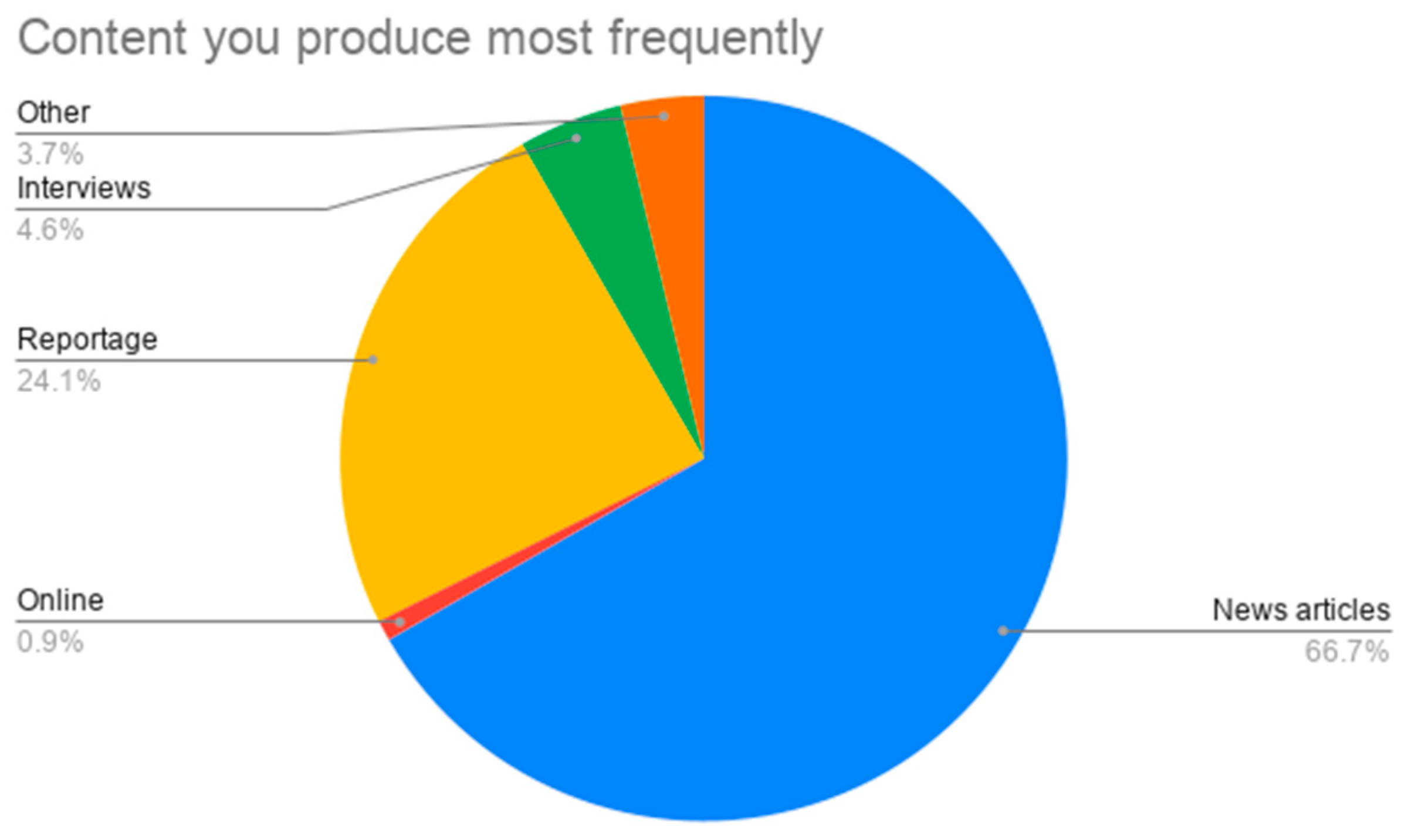
Analyzing the survey results, our first conclusion is the strong dominance of the journalistic genre, the news article (Figure 1). More than 60% of Portuguese journalists say their daily routine is dominated by news production, while only 24.1% by reporting on the scene of events. These answers should be read with the understanding that most journalists claim to be completely autonomous in presenting proposals or work ideas (n = 64), in selecting information (n = 65), in choosing their sources (n = 74), in choosing the news stories’ angles (n = 58), and in producing the news (n = 67).
Figure 1. Content Portuguese journalists produce most frequently.
Journalmedia 07 00096 g001
Considering the responses from Portuguese journalists working in national media outlets, the numbers are slightly different: 56.3% mainly produce news stories, and 31.3% focus more on reportage. The greatest discrepancy occurs when we isolate data from regional and local journalists. Almost 80% devote themselves primarily to writing news stories, and the reportage genre accounts for only 18.4% of responses.

4.2. Agenda Dependency and Sources of Information

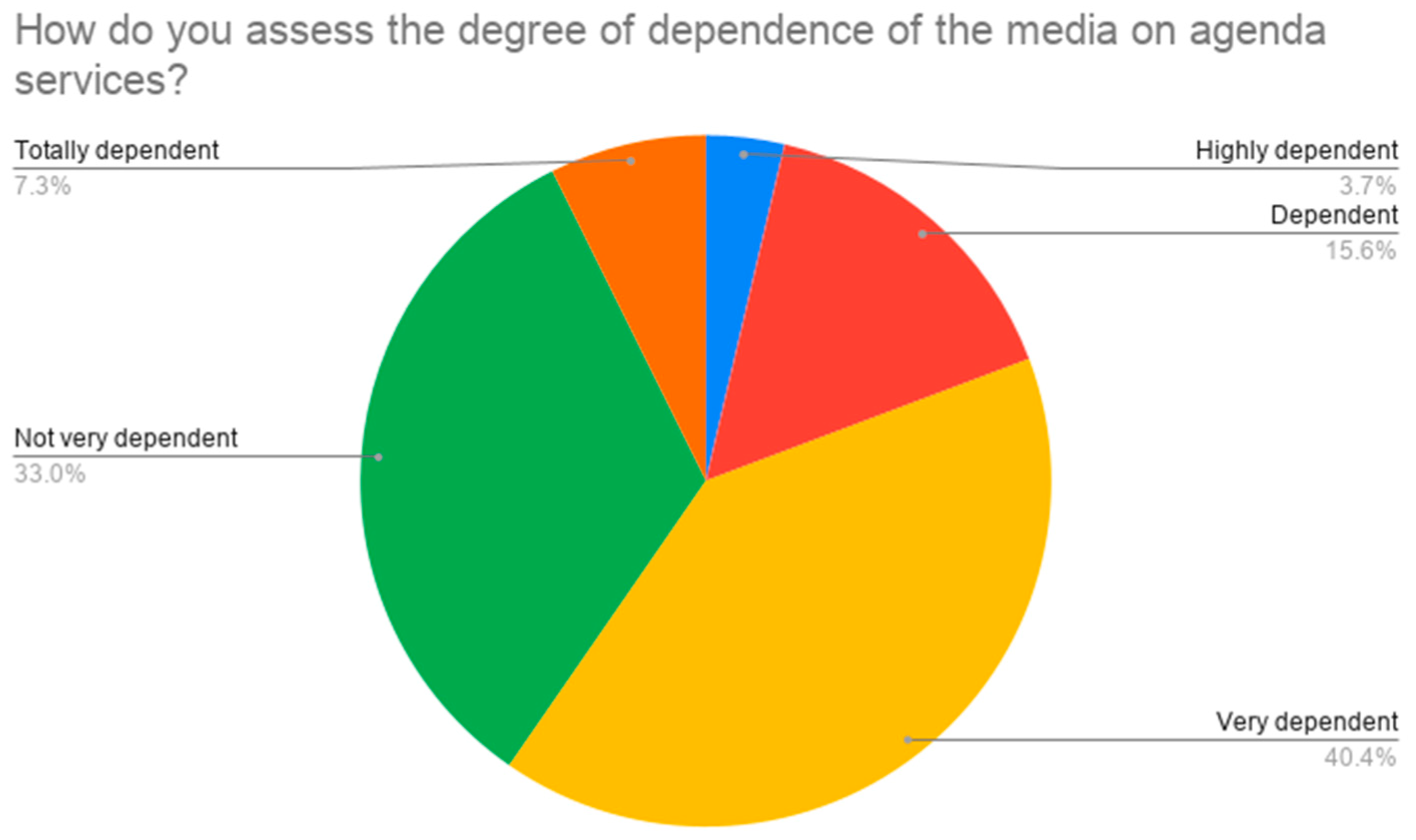
The news agenda, as an important editorial tool, also defines the news day. More than 50% of the journalists claim that the media they work in is very, highly, or totally dependent on the agenda (Figure 2). If we read these numbers through a geographical lens, the responses show that the agenda is more prevalent among local and regional media journalists: 42.1% consider their media to be highly or totally dependent on the agenda.
Figure 2. Degree of media dependence on agenda services.
Journalmedia 07 00096 g002
Simultaneously, if we consider only the 73 journalists who say they mainly produce news, 72.6% indicate a high dependence on the agenda. It is also relevant to consider the degree of autonomy journalists have in the various tasks they perform. As for presenting proposals and work ideas, information, angles, and source selection, completion, and realization of the articles, more than 80% of the journalists claim to be totally or very autonomous.
When asked whether agenda-driven journalism (influenced by political, economic, etc., agendas) undermines proximity journalism and, consequently, the diversity of news content covered, half the respondents either partially or fully agree, but a significant percentage (38.2%) are neutral.
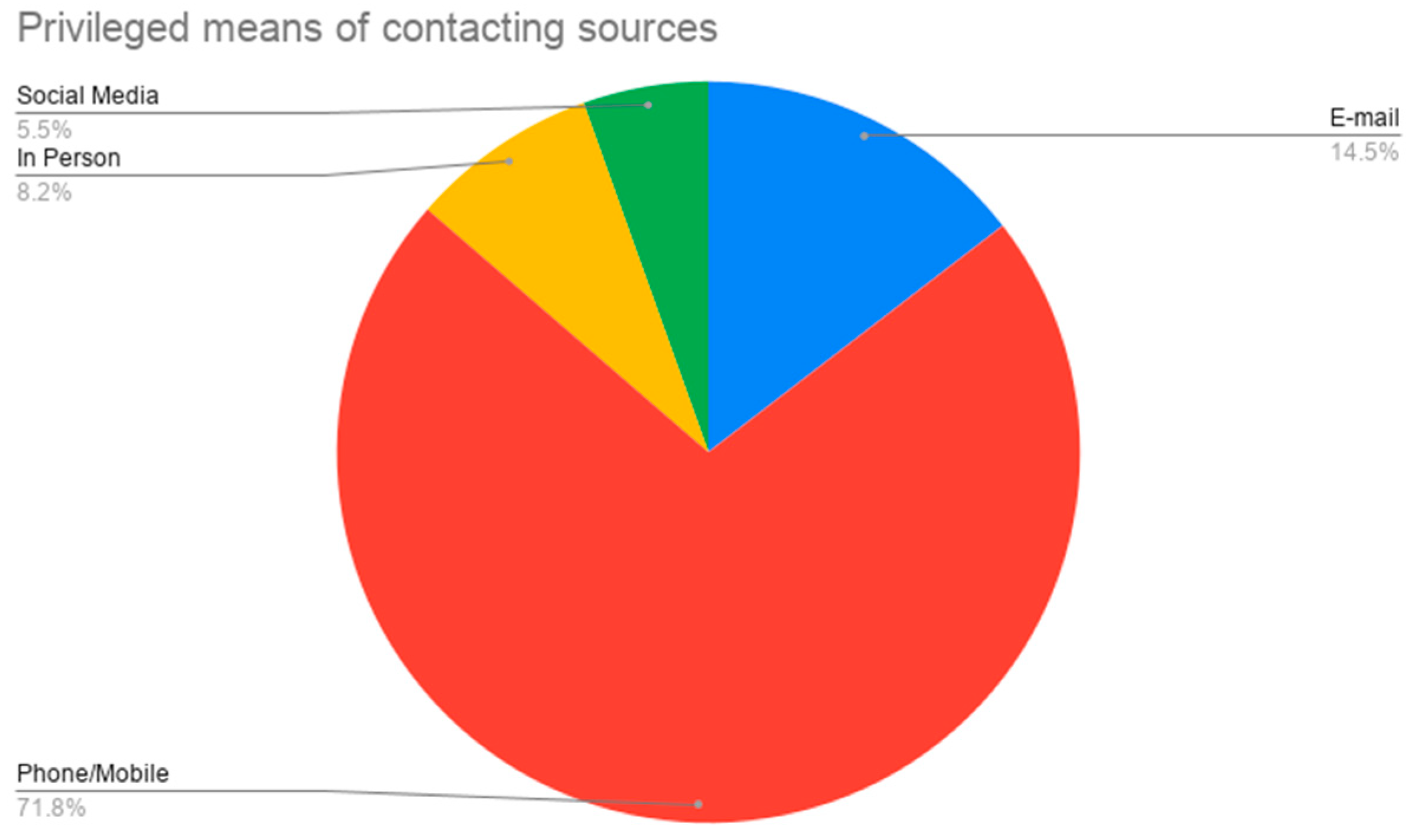
Another important factor that suggests stress in desk journalism is that 72.1% of journalists mainly use their phones to contact news sources, while only 8.1% do so face-to-face. The number of face-to-face interactions is 12.8% amongst regional and local journalists and 4.2% for national media outlet journalists (Figure 3).
Figure 3. Means of contacting sources mainly used by journalists.
Journalmedia 07 00096 g003
As for the main challenges in gathering information, we should not consider agenda dependency at this point. Time and lack of human resources are the most significant, as identified by 70.3% and 54.1%, respectively.

4.3. Practice and Importance of Proximity Journalism

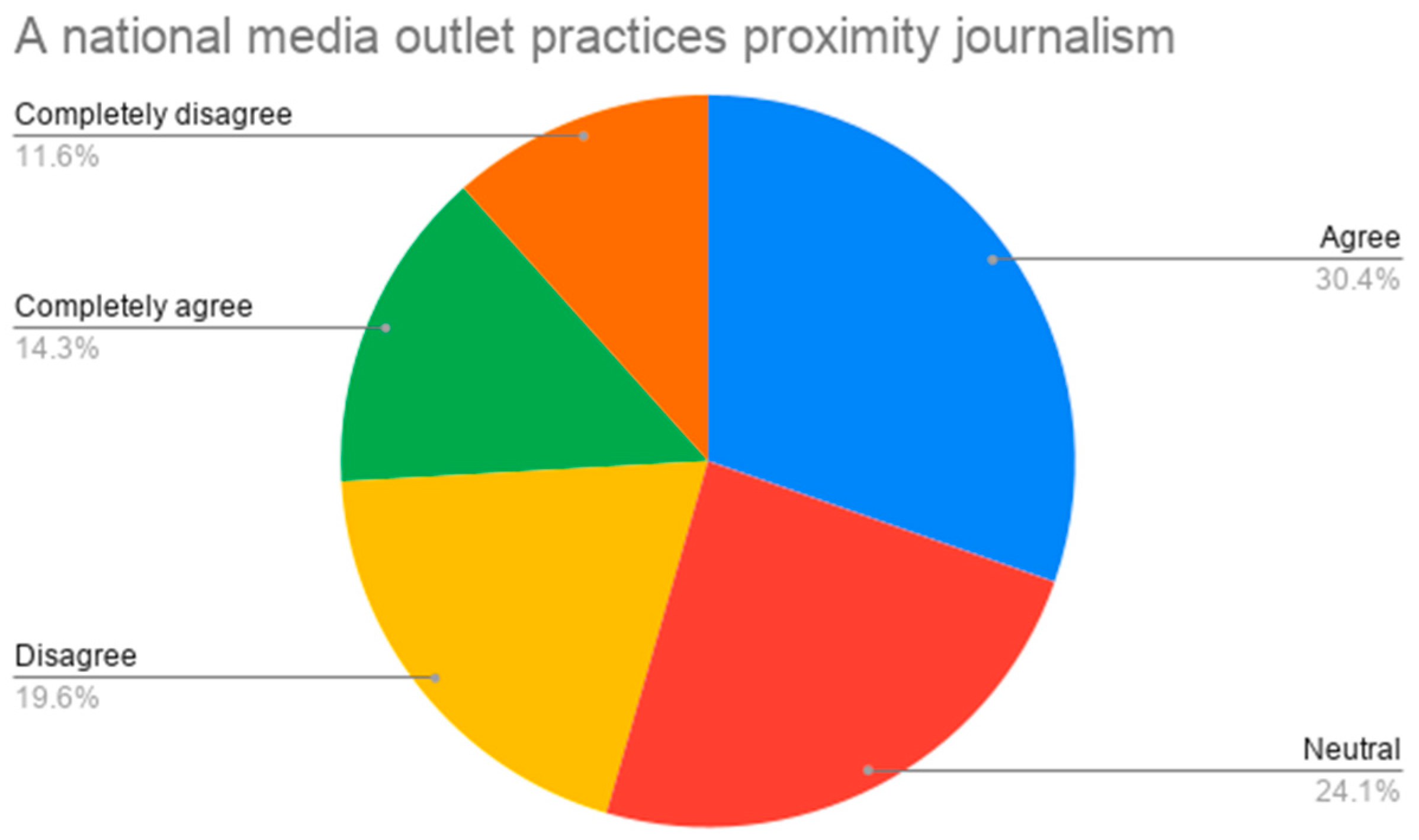
Considering that proximity is not a specific characteristic of local journalism, we asked Portuguese journalists to take a position on the statement “A national media outlet practices proximity journalism” (Figure 4). Less than half (42.3%) agree or strongly agree with this statement, and the rest, except for those who are neutral (23.4%), disagree (24.3%) or strongly disagree (9.9%). Therefore, 34% of our survey participants disagree with the statement.
Figure 4. Journalists’ level of agreement with the sentence “A national media outlet practices proximity journalism.”.
Journalmedia 07 00096 g004
Reflecting geographical differences, we should note that 58.4% of journalists at national media outlets agree or strongly agree with the idea of practicing proximity journalism. On the other hand, 71.4% of regional and local journalists disagree or strongly disagree with this idea. This significant discordance may be seen as a sign of a devaluation of the idea of proximity to national journalism. These local and regional journalists who disagree may see their media outlets as proximity gatekeepers.
Portuguese journalists were also asked to rate the importance of proximity journalism in journalism overall, and 73.6% rated it very important. In this case, there are no significant differences between national and local journalists.
As for its characteristics, most responses focus on the “journalism close to civil society” (75.7%), “journalism committed with community and neighborhood” (62.2%), “journalism doable in any media outlet, regardless of whether it is local or national” (59.5%), and “typical of local and regional media” (53.2%). In an open question about what one considers as proximity journalism, many responses focus on the geographical, neighborhood, and community aspects of proximity, as seen in the examples above:
“Someone who follows the problems of a local or regional community, who fights for the region, who does cause-based journalism for the benefit of the community”.
“Journalism that informs people about what is happening in the community. Even if it is a smaller event, that is going to happen because national media outlets do not do that. Reporting on the best and worst of the region. Alerting people to something as simple as road closures”.
“Journalism that is close to the people, giving a voice above all to those who live outside the major centers. It represents the connection of a community through information, in a territory that is common to all, serving their interests and needs”.
“It is a form of journalism that brings readers closer to the local community, reaching places where broader journalism does not, giving a voice to people or entities that feel more isolated and distant, not only physically. Proximity journalism includes the details. I often use examples of a house. National journalism may portray a house that is about to collapse, but proximity journalism can tell the story of those at risk, investigate the causes, etc. Basically, it goes inside the house”.
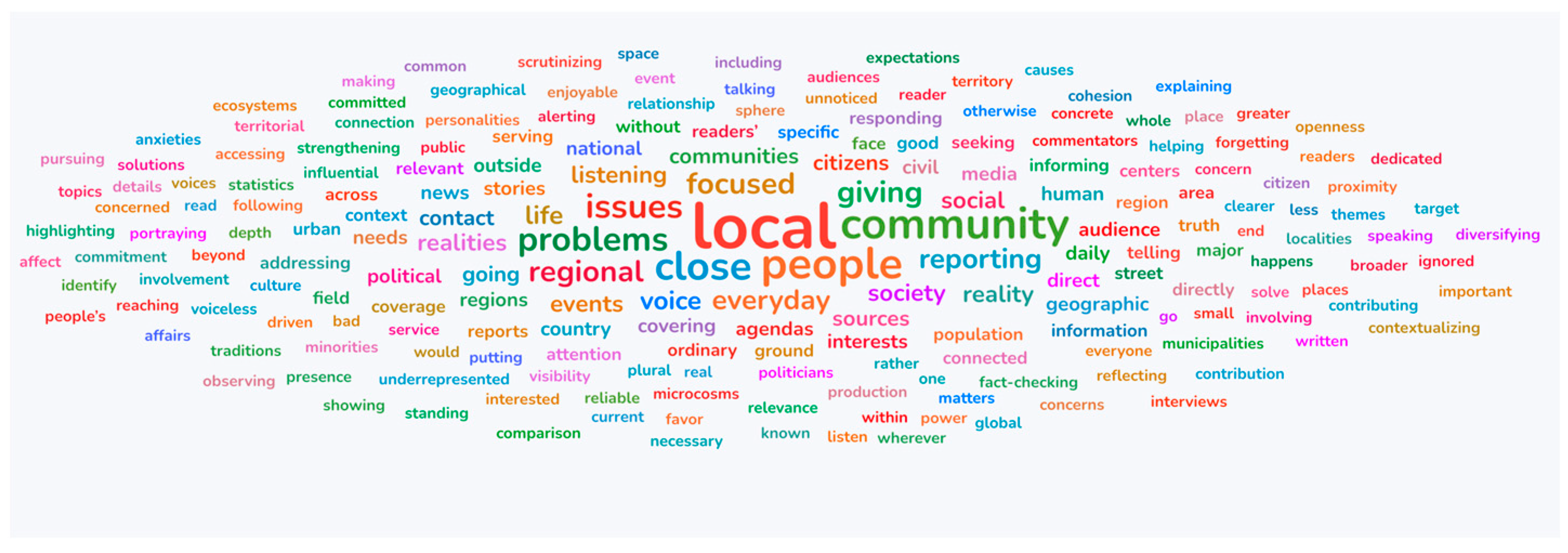
Disregarding the use of the word “journalism” in these open answers, we find that the words “local”, “community”, “people”, and “close” are the most used by the respondents (Figure 5).
Figure 5. Word cloud with answers to the definition of proximity journalism.
Journalmedia 07 00096 g005

4.4. Importance and Practice of Journalistic Reportage

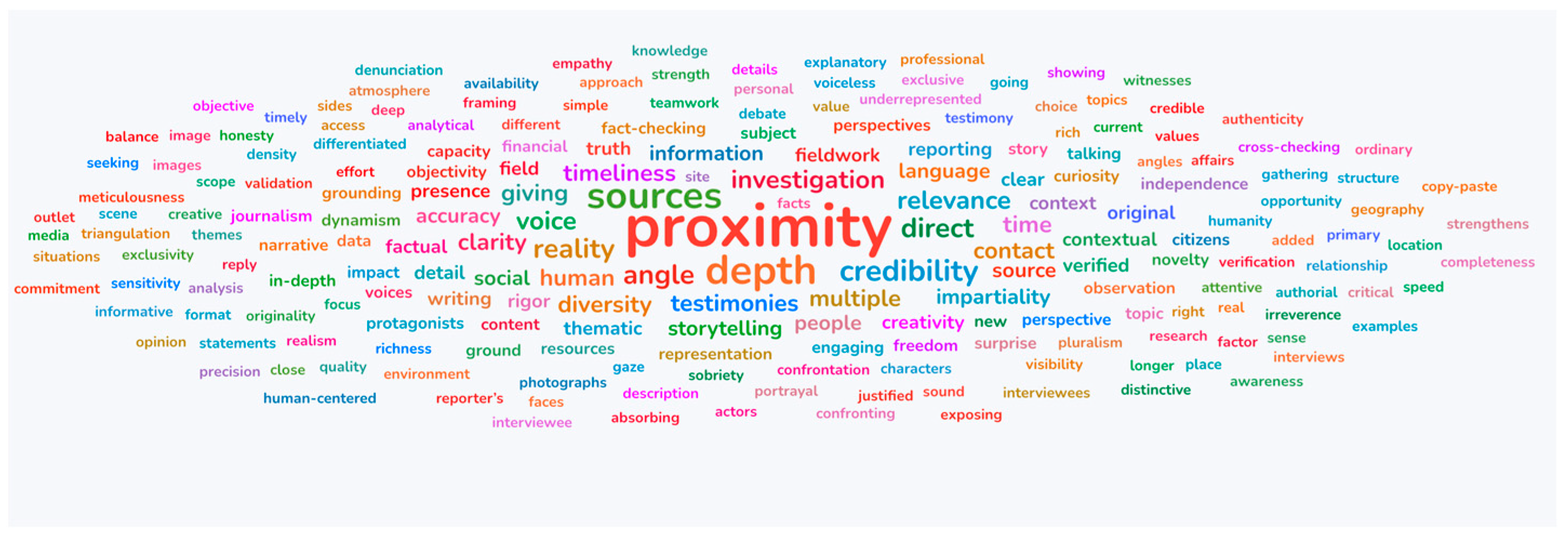
Reviewing the responses regarding the importance of journalistic reportage, 98.1% of journalists find it important (17.1%) or very important (81.1%) to journalism itself. Respondents define reportage primarily in terms of proximity to the population. Consider that it allows in-depth approaches to events, lends greater credibility to the information conveyed, and provides more context. The words of proximity, depth, sources, and credibility are amongst the most used to describe this genre (Figure 6).
Figure 6. Word cloud with answers to the definition of journalistic reportage.
Journalmedia 07 00096 g006
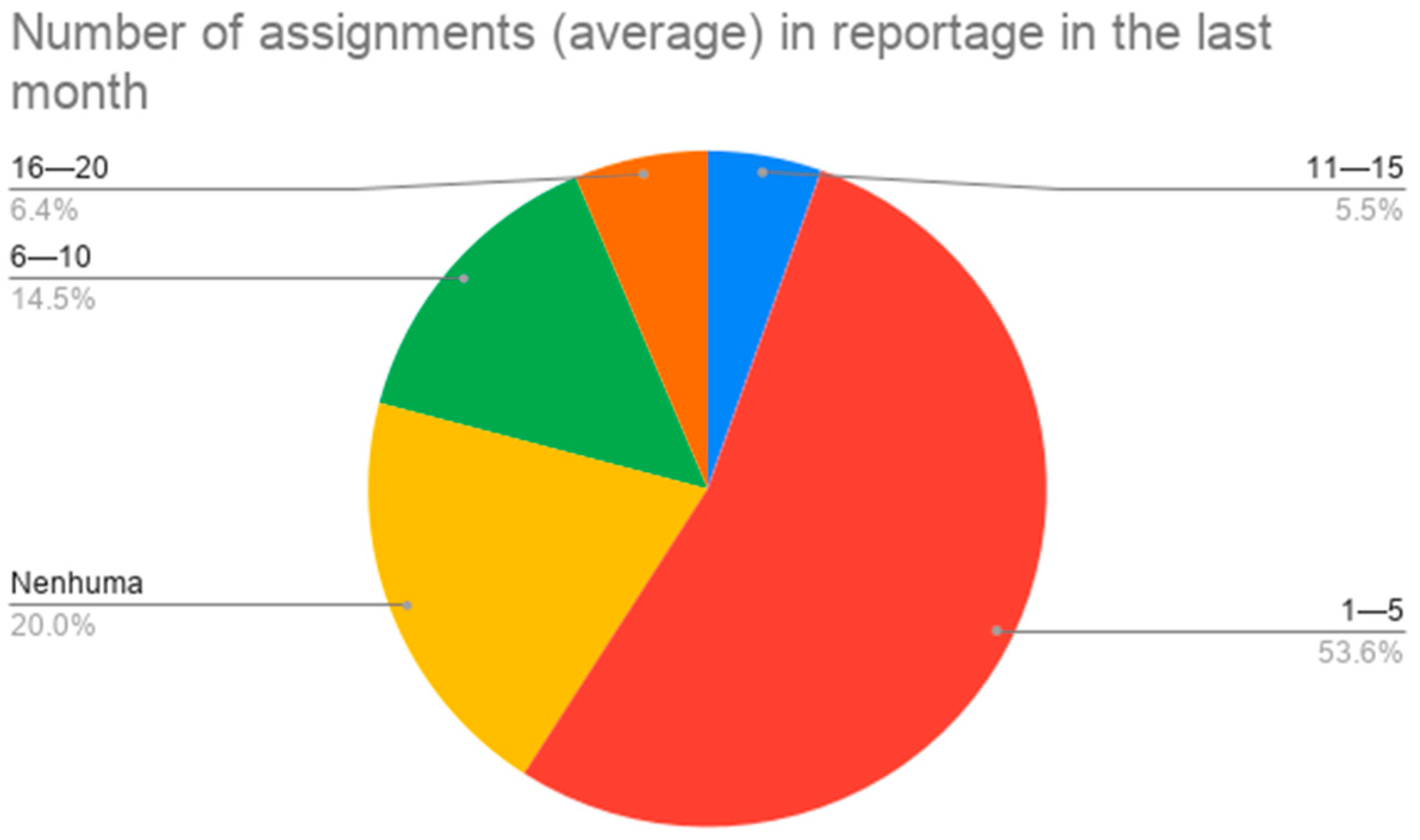
Most of the respondents (53.6%) had, on average, 1 to 5 assignments in reportage the month before, but it is significant that almost 20% did not leave the newsroom even once to do this kind of work (Figure 7). The reasons these 20% give for not leaving the newsroom are mostly related to the exercise of other functions or hierarchical positions within the media, but there are also responses indicating a lack of time and human resources.
Figure 7. Number of assignments (average) in reportage in the last month.
Journalmedia 07 00096 g007
We can conclude that the importance that Portuguese journalists attribute to reporting contrasts with the number of monthly assignments for this type of work.
Reading these numbers through a geographical lens shows that only 37.5% of journalists at national media outlets leave the newsroom for reportage between 1 and 5 times, and 22.9% never do this type of work. Almost 70% of regional and local journalists left for 1 to 5 reportages, the month before, and only 12.8% never left.
Portuguese journalists who took this survey claim that the main factors preventing them from leaving the newsroom more often are a lack of human resources, mentioned by 21.3% of respondents. Time is another factor that seems to affect keeping journalists in the newsroom, since many claim to have too many tasks and not enough time to leave for journalistic reporting. As one of the journalists states: “Lack of time to combine all the tasks performed by a journalist in a newsroom where he works alone”. Since some of the inquiries have editorial responsibilities that keep them in the newsroom, this is the third reason cited for the lack of street work, and financial resources are the fourth most-mentioned reason.
Interestingly, when the question centers on obstacles to proximity journalism, and we ask what prevents media outlets from doing more of it, the answers are very similar. Money and people are the most mentioned, since 32.2% refer to the financial difficulties and 31.5% blame it on the lack of human resources in the newsroom: “Once again, the lack of human resources and poor coordination management, or even the tendency to want to follow current events without worrying about bringing them closer to the reality surrounding the respective media outlet”. Time is also mentioned, but only by 7.7% of the respondents.

5. Discussion

Proximity is regarded by Wolf (2009) as an essential news value, “both as geographical neighborhood and as cultural affinity” (p. 182), and Portuguese journalists consider proximity journalism very important, thereby confirming its symbolic value within journalistic production routines. However, this study also shows that daily production is marked by a clear preference for news reporting, revealing a gap between what journalists believe in and deending at a theoretical level and what they practice in their daily professional activity.
This study also reveals an association between proximity and concepts such as “local” and “community”, reinforcing the centrality of the community dimension of proximity journalism in its relationship with audiences, as observed by Ramos (2025).
Although Midões and Martins (2024) argue that all journalism should be close to civil society, rejecting the dependence of the concept of proximity on local and regional journalism—or at least its exclusive association with these—this study shows that journalists tend to associate proximity more strongly with local and regional media, especially journalists who work in these types of media. Nevertheless, within the profession, there is a significant number of journalists who also consider proximity to be a practice that should apply to any media outlet, regardless of its scope (local, regional, national, or international).
This study also empirically confirms the notion of Friction of Distance put forward by Karlsson and Rowe (2019), who argue that proximity requires physical displacement and, consequently, the mobilization of resources. This understanding is reaffirmed by the finding that lack of time, human resources, and financial resources are identified by journalists as the main obstacles preventing them from leaving the newsroom.
These constraints on proximity contribute to an increasingly “seated” and sedentary form of journalism (Neveu, 2014), which moves away from reportage as a recurrent practice. Choosing this more in-depth journalistic genre implies physical presence, sensory observation, direct contact with sources, and a greater investment of time (Cavazzino, 2021; Lai Men, 2021; Sena Santos, 2021). The group of more than one hundred journalists analyzed in this study illustrates this reality, as at least twenty admit not having carried out any reportage in the previous month, with the majority stating that they frequently work from the newsroom. It can therefore be observed that journalism is becoming increasingly seated, agenda-driven, and dependent on institutional sources.
Our findings also reinforce the idea of a “passive journalist” (O’Neill & O’Connor, 2008, p. 490), giving local people less voice. The authors conclude that “unless the local press improves standards of journalism, the health of local papers will continue to decline” (p. 498). Camponez (2002) also states that proximity in journalism can be a strategy to win back segments of the public that are more alienated from the mass media. Nevertheless, Portuguese journalists seem distant from the idea of street journalism.
By limiting fieldwork and privileging news reporting over reportage, journalists weaken their relationship with the community (Midões et al., 2025). Thus, even though they demonstrate appreciation for reportage and attribute importance to it—particularly due to its proximity, depth, and credibility—this valuation contrasts with actual professional practice.
The routinization of journalistic work cannot be disregarded in this analysis, especially since the results show that organizational factors directly impact the lower number of journalists’ outings. Studies by authors such as Tuchman (1983) and Schudson (2003), in the field of Organizational Theory, show the weight of routines in the construction of news and their importance in ensuring the flow of news. As Tuchman points out, “news is located, gathered, and disseminated by professionals working in organizations. Thus, it is inevitably a product of newsworkers drawing upon institutional processes and conforming to institutional practices” (Tuchman, 1983, p. 16). Ultimately, it is a question of the dichotomy between constraints and autonomy, between routine production and creativity (McQuail, 2003).
The results of our research point to one consequence of this standardization of procedures: reduced proximity between journalists and their readers. These data can, in fact, be cross-referenced with studies of information sources that show the importance of official and institutional sources.
This study shows that journalists in Portuguese media outlets do not seem to leave the newsroom as often as they think they should. This is not new information, but it seems to be clearer each day. As Neveu (2014, p. 536) states, “the downsizing of newsrooms has produced a more “seated” journalism, using more computer terminals and phone contacts than investigating and ferreting out with old style “legwork”. We are talking about mediation within the mediator itself or, as O’Neill and O’Connor (2008) state: “journalists are becoming more passive, often merely passing information to the public that they have been given” (p. 490).

6. Conclusions

This study demonstrates that proximity should be understood as a component of transversal to all journalism, regardless of whether its genesis is local, regional, national, or international. When proximity is considered a highly significant newsworthiness criterion—and bearing in mind that such proximity is not merely spatial or geographical, but also cultural or imaginary—it reinforces the notion that it should be inherent to journalism, as practiced by any media organization.
This research further shows that the productive routines of Portuguese journalists are characterized by autonomy in presenting story ideas, selecting information, choosing sources, and defining the angle of approach. The news format strongly determines how information is presented to the public, particularly in local and regional media. In other words, it is precisely within media outlets that proximity would supposedly be greater than in reporting, and direct contact with information sources is less frequent.
Another conclusion of this study is the strong dependence on agenda-driven news, a dependence that is, once again, more pronounced in local and regional media. The study thus raises the possibility that such reliance may undermine proximity to journalism. According to Portuguese journalists, this dependence is justified by a lack of time and insufficient human resources to meet the demands of journalistic production routines.
Portuguese journalists define proximity journalism as journalism that is close to communities, grounded in neighborhood dynamics, attentive to local issues, and oriented towards causes and people. It is described as a more detailed form of journalism that gives a voice to communities. In this respect, the study reveals that Portuguese journalists regard proximity journalism as a transversal practice across all media organizations, regardless of their origin. However, a degree of protectionism becomes evident among journalists working in local and regional media regarding this concept and practice. The vast majority disagree that Portuguese national media engage in proximity journalism, instead assuming responsibility for it themselves and positioning themselves as its guardians.
These journalists also consider reporting to be an important or very important journalistic genre and view it as the embodiment of proximity journalism, as it entails deeper knowledge, greater contextualization, and enhanced credibility.
This characterization and the importance attributed to reporting contrast with its actual practice, which is considerably limited. To justify the decline in reporting, journalists once again point to a lack of time and human resources, but also to the functions they perform within newsrooms, which occupy most of their working time, as well as the managerial positions they hold. Some journalists further argue that poor editorial decisions hinder the completion of more reporting assignments. Financial constraints are likewise identified as a determining factor in the decline in the practice of proximity journalism.
In sum, journalists acknowledge the importance of proximity journalism as a link between journalism and the public, and they recognize reporting as a highly significant genre that ensures direct engagement with communities and gives citizens an active voice. Nevertheless, they practice it sparingly—far less than the importance they attribute to it would suggest. Why? A lack of time, a shortage of staff, insufficient financial resources, and a lack of editorial commitment to the practice of proximity journalism, whether at the national or local level.


Author Contributions

Conceptualization, M.M. and J.M.; methodology, M.M. and J.M.; validation, M.M. and J.M.; formal analysis, M.M. and J.M.; investigation, M.M. and J.M.; resources, M.M. and J.M.; data curation, M.M. and J.M.; writing—original draft preparation, M.M. and J.M.; writing—review and editing, M.M. and J.M.; visualization, M.M. and J.M.; supervision, M.M. and J.M. All authors have read and agreed to the published version of the manuscript.

Funding

This research received no external funding.

Institutional Review Board Statement

Not applicable.

Informed Consent Statement

Informed consent was obtained from all subjects involved in the study.

Data Availability Statement

Data available in the following link: https://docs.google.com/spreadsheets/d/1oKIibnS_-ZIgmF-FaZ7ny-lOQ-ZFFto-OGTOj6jl4TA/edit?usp=sharing (accessed on 27 April 2026).

Acknowledgments

No GenAI has been used for purposes such as generating text, data, or graphics, or for study design, data collection, analysis, or interpretation of data.

Conflicts of Interest

The authors declare no conflicts of interest.

References

  1. Cambridge University Press. (2026). Proximity. Cambridge Dictionary. Available online: https://dictionary.cambridge.org/dictionary/english/proximity (accessed on 18 March 2026).
  2. Camponez, C. (2002). Jornalismo de proximidade: Rituais de comunicação na imprensa regional. Minerva Coimbra. [Google Scholar]
  3. Cavazzino, V. (2021). El reportaje narrativo como género periodístico en España entre la literatura y el periodismo. Comunicación y Sociedad, 18, e7751. [Google Scholar] [CrossRef] [Scilit]
  4. Correia, J. C. (2023). As duas proximidades: Algumas notas sobre os riscos dos media em contextos comunitários. In P. V. Melo, & P. Jerónimo (Eds.), Comunicação comunitária e jornalismo de proximidade (pp. 33–55). LabCom. [Google Scholar] [CrossRef]
  5. Gomes, R. M. (2013). Que lugar é dado à reportagem como género jornalístico? Avaliação dos casos do Correio da Manhã, Diário de Notícias e Público. Media & Jornalismo, 11(22), 131–161. [Google Scholar]
  6. Harcup, T., & O’Neill, D. (2017). What is news? News values revisited (again). Journalism Studies, 18(12), 1470–1488. [Google Scholar] [CrossRef] [Scilit]
  7. Jerónimo, P. (2015). Ciberjornalismo de proximidade. Redações, jornalistas e notícias online. Labcom. [Google Scholar]
  8. Karlsson, M., & Hellekant Rowe, E. (2019). Local journalism when the journalists leave town: Probing the news gap that hyperlocal media are supposed to fill. Nordicom Review, 40, 15–29. [Google Scholar] [CrossRef] [Scilit]
  9. Kassel, N., Backhaus, B., & Ubayasiri, K. (2026). Proximity as practice: Fostering accountability to community in journalism practice-research. Journal of Media Ethics, 41(2), 98–112. [Google Scholar] [CrossRef] [Scilit]
  10. Lai Men, C. (2021). Gente com cócegas. In P. Coelho, A. I. Reis, & L. Bonixe (Eds.), Manual de reportagem do REC (pp. 231–234). LabCom. [Google Scholar]
  11. López García, X. (2012). Realidades e desafios do ciberjornalismo de proximidade. In P. Jerónimo (Ed.), Media e jornalismo de proximidade na era digital (pp. 119–136). LabCom. [Google Scholar]
  12. McQuail, D. (2003). Teoria da comunicação de massas (2nd ed.). Fundação Calouste Gulbenkian. [Google Scholar]
  13. Midões, M., & Martins, J. (2023). Local journalism: How the war in Ukraine imposed itself on the production routine of the local press. Journalism and Media, 4(1), 162–176. [Google Scholar] [CrossRef] [Scilit]
  14. Midões, M., & Martins, J. (2024). Jornalismo de proximidade: O filão de ligação com os cidadãos, abandonado pelo Estado, privados e profissionais dos media. In J. Lourenço (Ed.), Jornalismo de especialidade (pp. 403–420). Livros Horizonte. [Google Scholar]
  15. Midões, M., Reis, A. I., Pereira, F., & Guerra, R. (2025). Jornalismo de proximidade: A cobertura noticiosa do Jornal do Centro aos incêndios de outubro de 2017 na região de Viseu (Portugal). Ámbitos. Revista Internacional de Comunicación, 67, 222–242. [Google Scholar] [CrossRef] [Scilit]
  16. Neveu, E. (2014). Revisiting narrative journalism as one of the futures of journalism. Journalism Studies, 15(5), 533–542. [Google Scholar] [CrossRef] [Scilit]
  17. O’Neill, D., & O’Connor, C. (2008). The passive journalist: How sources dominate local news. Journalism Practice, 2(3), 487–500. [Google Scholar] [CrossRef] [Scilit]
  18. Ramos, G. (2025). Jornalismo de proximidade em rede. LabCom. [Google Scholar]
  19. Ramos, G., & Grupillo, A. (2021). Local journalism in new platforms. In P. Jerónimo, & J. C. Correia (Eds.), O pulsar da proximidade nos media e no jornalismo. LabCom. [Google Scholar]
  20. Schudson, M. (2003). The sociology of news. Norton. [Google Scholar]
  21. Sena Santos, F. (2021). O pivô também como repórter. In P. Coelho, A. I. Reis, & L. Bonixe (Eds.), Manual de reportagem do REC (pp. 243–248). LabCom. [Google Scholar]
  22. Tuchman, G. (1983). La producción de la noticia: Estudio sobre la construcción de la realidad. Gustavo Gili. [Google Scholar]
  23. Wolf, M. (2009). Teorias da comunicação. Editorial Presença. [Google Scholar]
Disclaimer/Publisher’s Note: The statements, opinions and data contained in all publications are solely those of the individual author(s) and contributor(s) and not of MDPI and/or the editor(s). MDPI and/or the editor(s) disclaim responsibility for any injury to people or property resulting from any ideas, methods, instructions or products referred to in the content.