Article

Strategic Control over Participatory Promise: Campaign Websites as Media Infrastructures in Portugal’s 2026 Presidential Election


by
António Cardoso
1,2,*,
Jorge Figueiredo
3,4,
Isabel Oliveira
3,4,
Amândio Silva
5 and
Manuel Sousa Pereira
6
1
Faculty of Humanities and Social Sciences, Fernando Pessoa University, 4249-004 Porto, Portugal
2
LABCOM—Laboratório de Comunicação, University of Beira Interior, 6201-001 Covilhã, Portugal
3
Faculty of Economics and Business Sciences, Lusíada University of Porto, 4100-348 Porto, Portugal
4
COMEGI—Centro de Investigação em Organizações, Mercados e Gestão Industrial, Lusíada University, 4100-348 Porto, Portugal
5
Atlântico Business School, 4405-604 Vila Nova de Gaia, Portugal
6
Instituto Politécnico de Viana do Castelo, 4930-678 Valença, Portugal
*
Author to whom correspondence should be addressed.
Journal. Media 2026, 7(2), 80; https://doi.org/10.3390/journalmedia7020080
Submission received: 13 February 2026 / Revised: 30 March 2026 / Accepted: 4 April 2026 / Published: 14 April 2026

Abstract

Digital media have reshaped electoral communication, yet official campaign websites, owned and strategically controlled media spaces, remain underexamined within hybrid media systems. This study investigates how these websites function in Portugal’s 2026 presidential election, focusing on the tension between participatory affordances and strategic control. A qualitative-dominant comparative content analysis of all eleven candidate websites is conducted using an integrated multi-model framework combining interactivity, web campaigning, functional analysis, digital sophistication, and political framing. The findings reveal a stratified digital landscape in which most websites operate as unidirectional communication hubs prioritizing narrative coherence and mobilization over deliberative interaction. Rather than functioning as democratic equalizers, campaign websites reproduce and amplify pre-existing strategic and organizational asymmetries. A key contribution of the study is the identification of a systematic association between the strength of campaign framing and the level of digital infrastructural investment. The study contributes by conceptualizing campaign websites as central media infrastructures and by reframing digital campaigning as a strategy-driven, rather than technology-driven, process.

1. Introduction

Digital media have fundamentally reshaped the organization, communication, and symbolic landscape of contemporary electoral campaigns. While scholarly and public attention often focuses on the dynamic, interactive realms of social media platforms, official campaign websites remain a comparatively underexamined yet critical component of the digital campaign ecosystem. As owned, controlled, and institutionalized communication spaces, these websites function not merely as informational repositories, but as strategic hubs for narrative production, leadership branding, and message coordination within hybrid media environments (Foot & Schneider, 2006; Gibson & Ward, 2009).
In presidential elections, where personalization, symbolic authority, and direct voter appeal are paramount, this controlled digital space assumes heightened significance. Unlike social media, subject to platform algorithms and unstructured public interaction, campaign websites offer candidates a rare venue for unfiltered strategic presentation. They thus constitute a privileged analytical site for examining how political actors define problems, articulate values, and construct leadership personas within highly mediatized electoral contexts (Gibson & Ward, 2000; Kaid & Postelnicu, 2005). The design and content of these websites reveal the core strategic choices of a campaign, making them a key battleground where a central tension in digital democracy is played out: the clash between the participatory affordances of digital tools and the strategic imperative for message control inherent to competitive politics (Stromer-Galley, 2014).
Extant research consistently demonstrates that political actors, despite adopting digital tools, systematically avoid open, reciprocal online interaction to minimize risk and maintain narrative discipline (Stromer-Galley, 2000, 2014). Campaign websites often prioritize symbolic persuasion, controlled information transmission, and brand stability over deliberative engagement (Foot & Schneider, 2006; Lilleker & Jackson, 2011). However, most studies employ single analytical lenses, focusing either on technical features, interactivity, or content, which limits a holistic understanding of websites as multidimensional strategic objects that simultaneously operate as infrastructures, interfaces, and political texts.
This gap is particularly pronounced in the Portuguese context. Research on digital political communication in Portugal has predominantly examined social media use, media coverage, and party-centered campaigning. Consequently, presidential campaign websites have remained underexplored since the foundational, pioneering analysis of the 2006 presidential election digital ecosystem (A. Cardoso, 2006; A. Cardoso & Gouveia, 2006). Given the profound evolution of digital technologies and the consolidation of hybrid media systems (Chadwick, 2017) over the past two decades, this lacuna represents a significant empirical and theoretical gap. The present study, therefore, offers a crucial update and extension of this baseline research, enabling a longitudinal assessment of how digital professionalism, strategic communication logics, and the management of interactivity have evolved within Portuguese presidential politics.
Addressing this gap, the present study asks: How do official campaign websites function as strategic communication tools within the hybrid media system of a presidential election, and to what extent do they resolve the tension between participatory potential and strategic control? To answer this, we analyze the official campaign websites of all eleven candidates in the first round of the 2026 Portuguese presidential election. We argue that no single theoretical perspective is sufficient to capture the multifaceted nature of these digital artefacts. Therefore, this study proposes and applies an integrated multi-model analytical framework, combining theories of online interactivity and avoidance (Stromer-Galley, 2000, 2014), web campaigning as strategic infrastructure (Foot & Schneider, 2006), feature-based functional analysis (Gibson & Ward, 2000, 2009), digital sophistication (Lilleker & Jackson, 2011), and political framing (Entman, 1993). This framework allows us to dissect campaign websites simultaneously as technical systems, communication channels, and political texts. Although these models were originally developed in earlier digital eras, they remain appropriate because they capture enduring strategic logics, narrative control, functional architecture, and relational management that transcend specific technological configurations.
Through this integrated analysis, the article makes three key contributions. First, it provides a comprehensive, empirical mapping of digital campaigning in a significant but understudied presidential election, offering novel data from Portugal’s competitive 2026 contest. Second, it demonstrates the analytical value of a deliberately multi-model framework for deconstructing complex digital campaign objects, moving beyond descriptive feature counts or isolated content analysis. Third, it advances theoretical debates by empirically linking micro-level website design and interaction choices to the macro-level coherence of campaign narratives and strategic positioning, showing that digital sophistication is less an indicator of democratic innovation than an outcome of pre-existing political strategy and narrative clarity.
More fundamentally, this study shifts the analytical focus from technology-driven explanations of digital campaigning to a strategy-driven perspective, demonstrating that technological sophistication follows political narrative clarity rather than preceding it.
The paper is structured as follows. First, we develop our integrated theoretical framework, synthesizing key models from digital campaigning and political communication research. Second, we detail our qualitative-dominant comparative methodology and the operationalization of our multi-model approach. Third, we present our findings, organized to reflect the layered analysis of functionality, interactivity, sophistication, and framing. Fourth, we discuss the implications of these results, arguing that campaign websites serve primarily as instruments of strategic narrative control within a political marketing paradigm, thereby amplifying rather than mitigating pre-existing campaign inequalities. We conclude by reflecting on the broader implications for understanding digital politics as a domain of managed communication.

2. Theoretical Framework: An Integrated Model for Analyzing Campaign Websites

2.1. Digital Political Communication and the Hybrid Media System

Early research highlighted the internet’s democratic potential for participation and deliberation. However, subsequent scholarship shows that political uses of digital technologies are shaped more by strategic, organizational, and institutional logics than by technological affordances (Papacharissi, 2015). Campaigns operate within hybrid media systems (Chadwick, 2017), where older and newer media logics interact, shaping communication styles and professional practices (Kreiss, 2016). In this environment, communication strategies are orchestrated across a multi-platform ecosystem, with official campaign websites functioning as controlled hubs, while social media platforms prioritize visibility and engagement dynamics (Daniel & Obholzer, 2026). Network media logics further privilege speed, symbolism, and emotional resonance over deliberative exchange (Klinger & Svensson, 2015). This reflects the increasing integration of multiple communication channels within broader campaign strategies, consistent with research highlighting the growing importance of new media in shaping complex and hybrid campaigning models (Lilleker et al., 2015).
Within this context, campaign websites occupy a distinctive position: as campaign-controlled, owned media spaces, they provide a stable anchor for narrative coordination and strategic messaging, counterbalancing the volatility of social platforms.
Comparative research confirms that digital media tend to reinforce existing patterns of political competition and organizational capacity rather than radically transforming participation (Vaccari, 2013; Vaccari & Valeriani, 2021), a finding that aligns with more recent accounts of hybrid and professionalized campaigning.
In the Portuguese context, digital political marketing has grown in importance but continues to coexist with traditional media and on-the-ground campaigning (Lemos & Alturas, 2017). Electoral communication remains strongly embedded within a hybrid media system in which digital tools complement rather than replace established campaign practices (Santana-Pereira et al., 2023).
Social media platforms, particularly Facebook, have become central channels for political communication, enabling parties and candidates to disseminate messages, mobilize supporters, and increase visibility during electoral campaigns (Pereira, 2018; Bacaksizlar Turbic & Rosa, 2023; Loureiro & Ribeiro, 2017; Baptista & Gradim, 2020; Guedes et al., 2025). At the same time, campaign strategies increasingly emphasize leader-centered branding, with personalization and “human branding” playing a key role in shaping perceptions of authenticity and competence among voters (Da Silva e Silva & Leandro, 2025).
Recent studies also point to the growing presence of negative campaigning, populist communication (Domínguez-García et al., 2025), and disinformation dynamics in Portuguese digital environments. Challenger actors and ideologically extreme parties, particularly on the radical right, tend to adopt more aggressive and emotionally charged communication strategies, often achieving higher levels of engagement (Machado & Fenoll, 2025; Prior, 2024; Domínguez-García et al., 2025; Baptista & Gradim, 2020; Guedes et al., 2025). However, despite the increasing relevance of digital platforms, traditional media and offline campaigning continue to play a central role, reinforcing the hybrid nature of electoral communication in Portugal.
Overall, digital political marketing in Portugal can be characterized as integrated but not dominant, operating within a broader media ecosystem in which online communication interacts with, rather than supplants, legacy media and face-to-face campaign practices.

2.2. Campaign Websites as Strategic Infrastructures: Functions and Organization

Understanding the strategic role of campaign websites requires analytical models that move beyond surface content to examine their functional architecture. Gibson and Ward’s (2000, 2009) feature-based analysis offers a systematic methodology for comparing campaign websites through observable functional categories, such as information provision, participation mechanisms, resource generation, and navigability. The model’s continued applicability is evidenced by recent scholarship that employs functional analysis to assess contemporary campaign websites (Dubois & Dommett, 2025). This approach enables cross-case comparison and provides insight into the functional density and professionalization of campaign websites.
Complementing this perspective, Foot and Schneider’s (2006) concept of web campaigning conceptualizes websites as strategic infrastructures embedded within broader campaign networks. Rather than static repositories, websites are understood as organizational hubs that centralize content, coordinate campaign activities, and link supporters, media, and offline mobilization.
These approaches foreground the website as a purposive campaign tool whose design reflects strategic priorities. Early empirical analyses of political websites in Southern European contexts similarly highlighted the predominance of informational and presentational functions, alongside the strategic use of websites as controlled communication spaces rather than participatory arenas (A. Cardoso & Gouveia, 2006; A. Cardoso, 2008). More recent scholarship on Portuguese digital political communication has examined social media strategies and platformization, as well as comparative patterns in Southern Europe (G. Cardoso & Lapa, 2017). However, systematic analysis of presidential campaign websites has remained scarce, reinforcing the need for the present study. Although these studies are now two decades old, they provide the sole baseline for understanding the evolution of digital campaigning in the Portuguese presidential context.
Recent research further conceptualizes official campaign websites as central nodes within hybrid media systems, coordinating multiple communication channels, including television, social media, email, and grassroots campaigning, into a unified strategic architecture (Vaccari, 2013; Vaccari & Valeriani, 2021; Seizov & Müller, 2016). In this context, campaign websites perform three interrelated functions. First, they operate as brand and message hubs, where visual and textual elements construct coherent candidate identities and issue frames. Second, they function as data and targeting infrastructure, serving as key entry points for voter data collection (e.g., sign-ups, donations) that feed into broader microtargeting strategies. Third, they act as organizational command centers, transforming supporters into distributed campaign networks through tools for volunteering, event coordination, and content dissemination (Vaccari, 2013; Chester & Montgomery, 2017; Dommett & Temple, 2018).
Compared to social media platforms, campaign websites offer fewer external constraints and enable higher levels of message control, while social media environments are more oriented toward visibility, personalization, and algorithmically driven engagement (Stier et al., 2018).

2.3. The Relational Dimension: Interactivity, Avoidance, and Sophistication

A central concern in digital campaigning research is how online tools mediate relationships between political actors and citizens. Stromer-Galley’s (2000, 2014) theory of the strategic avoidance of interactivity provides a critical lens for analyzing these relationships. Contrary to participatory expectations, campaigns often limit online interaction to symbolic or tightly controlled forms to minimize reputational risk and maintain message discipline.
This strategic logic has persisted despite advances in digital technology, underscoring the primacy of political calculation over communicative openness. To capture variation in how campaigns operationalize this controlled relationship, the present study also draws on Lilleker and Jackson’s (2011) model of digital sophistication. Although the Lilleker and Jackson (2011) model was originally developed in the context of early Web 2.0 campaigning, its core analytical distinction, between basic presence, informational, mobilizational, and interactive strategies, has proven resilient across subsequent technological shifts (Koc-Michalska & Lilleker, 2017). The model focuses on communicative orientation rather than specific technical affordances, making it suitable for cross-temporal comparison. Its continued application in recent scholarship (e.g., Dommet et al., 2021) further supports its validity for analyzing contemporary campaign websites. This model conceptualizes digital campaigning as a progressive continuum, ranging from basic online presence to informational, mobilizational, and interactive campaigning. Importantly, higher levels of digital sophistication do not necessarily imply greater democratic engagement, but rather more professional and integrated use of digital tools to disseminate information, mobilize supporters, and manage campaign–citizen interactions.
Recent reviews of political micro-targeting and content personalization suggest that, despite growing technological capacity, personalized campaigning remains uneven and largely subordinated to organizational control, regulatory constraints, and risk-management considerations rather than enabling open-ended interaction (Decker, 2025).
A central tension in digital campaigning concerns the balance between participatory affordances and strategic control. Research consistently identifies a pattern of “controlled interactivity,” whereby campaign websites and associated digital tools offer opportunities for participation, such as sharing content, volunteering, or donating, while tightly structuring user roles and limiting deliberative or agenda-setting capacities (Koc-Michalska & Lilleker, 2017; Penney, 2017). In this sense, supporters are positioned less as co-creators of political discourse and more as amplifiers of campaign messaging, functioning as “citizen marketers” within a controlled communicative environment (Dommett & Temple, 2018).
While digital tools enable hybrid organizing models that expand participation, they simultaneously reinforce centralized strategic control through data infrastructures and platform design (Vaccari, 2013; Vaccari & Valeriani, 2021). More open and less regulated forms of participation tend to emerge in peripheral or unofficial campaign spaces, where creative engagement is higher but also entails greater reputational risk (Penney, 2017; Graham & Hogan, 2018).

2.4. The Discursive Dimension: Framing and Visual Political Communication

Beyond infrastructure and interaction, campaign websites are sites of symbolic meaning-making. Framing theory (Entman, 1993) provides a foundational framework for analyzing how political communication selects and emphasizes certain aspects of reality to define problems, attribute responsibility, evaluate moral stakes, and propose solutions. In campaign websites, frames are articulated through programmatic texts, slogans, issue hierarchies, and leadership narratives. These discursive constructions are reinforced through visual political communication.
Research on political imagery demonstrates that visual elements, such as photographs, color schemes, layout, and design, play a central role in shaping perceptions of leadership, credibility, and emotional appeal (Kaid & Postelnicu, 2005; Schill, 2012). Contemporary research continues to emphasize the centrality of visual rhetoric in digital political communication (Parry, 2022). In digital environments, visual rhetoric functions as an integral component of framing (Kreiss, 2018), contributing to the construction of coherent political identities and affective alignment in the absence of direct interaction.
Recent scholarship suggests that emerging forms of AI-mediated communication in electoral campaigns may further extend these logics of managed interaction, enabling large-scale responsiveness while preserving high levels of strategic control over message, tone, and engagement boundaries (Foos, 2024). Forward-looking analyses posit that advances in generative AI could enable new forms of large-scale, AI-mediated political persuasion that maintain strategic control over engagement dynamics (Olejnik, 2026).

2.5. The Strategic Logic: Political Marketing and Digital Campaigning

The strategic choices observed in website design, interactivity, and discourse are best interpreted through the lens of political marketing. Contemporary political marketing scholarship conceptualizes campaigns as processes of value creation, positioning, and relationship management rather than mere persuasion techniques (Lees-Marshment, 2019, 2020; Newman, 1999; Baines & Harris, 2011). This perspective highlights branding, segmentation, and strategic coherence, while recognizing the normative tensions between market-oriented communication and democratic ideals (Scammell, 2014; Savigny, 2008; Baines & Harris, 2011). The field has also attended to the internal organizational consequences of market-oriented strategies, including shifts in party democracy and stakeholder engagement (Henneberg, 2006; Hughes & Dann, 2009; Lilleker, 2005).
Political branding research further highlights the symbolic and performative dimensions of campaign communication, in which leaders are constructed as coherent political products through narrative consistency and visual identity (O’Shaughnessy, 2016, 2021; Needham & Smith, 2015). Within hybrid media systems, campaigns increasingly rely on owned platforms, such as websites, to maintain brand coherence and narrative authority amid fragmented media environments (Lilleker & Vedel, 2013, 2020; Vaccari, 2013).
Early empirical research on Portuguese digital campaigning, including the analysis of presidential campaign websites in 2006 (A. Cardoso & Gouveia, 2006), already identified a predominance of informational and presentational functions. The intensification of digital media has not fundamentally altered this logic, but rather professionalized and consolidated it within a political marketing paradigm. This interpretation is reinforced by recent systematic literature reviews on human branding in political marketing, which emphasize the role of digital platforms in stabilizing leadership identity, authenticity cues, and symbolic coherence, rather than fostering reciprocal or deliberative interaction (Reis Soares et al., 2025).

2.6. Synthesizing an Integrated Multi-Model Framework

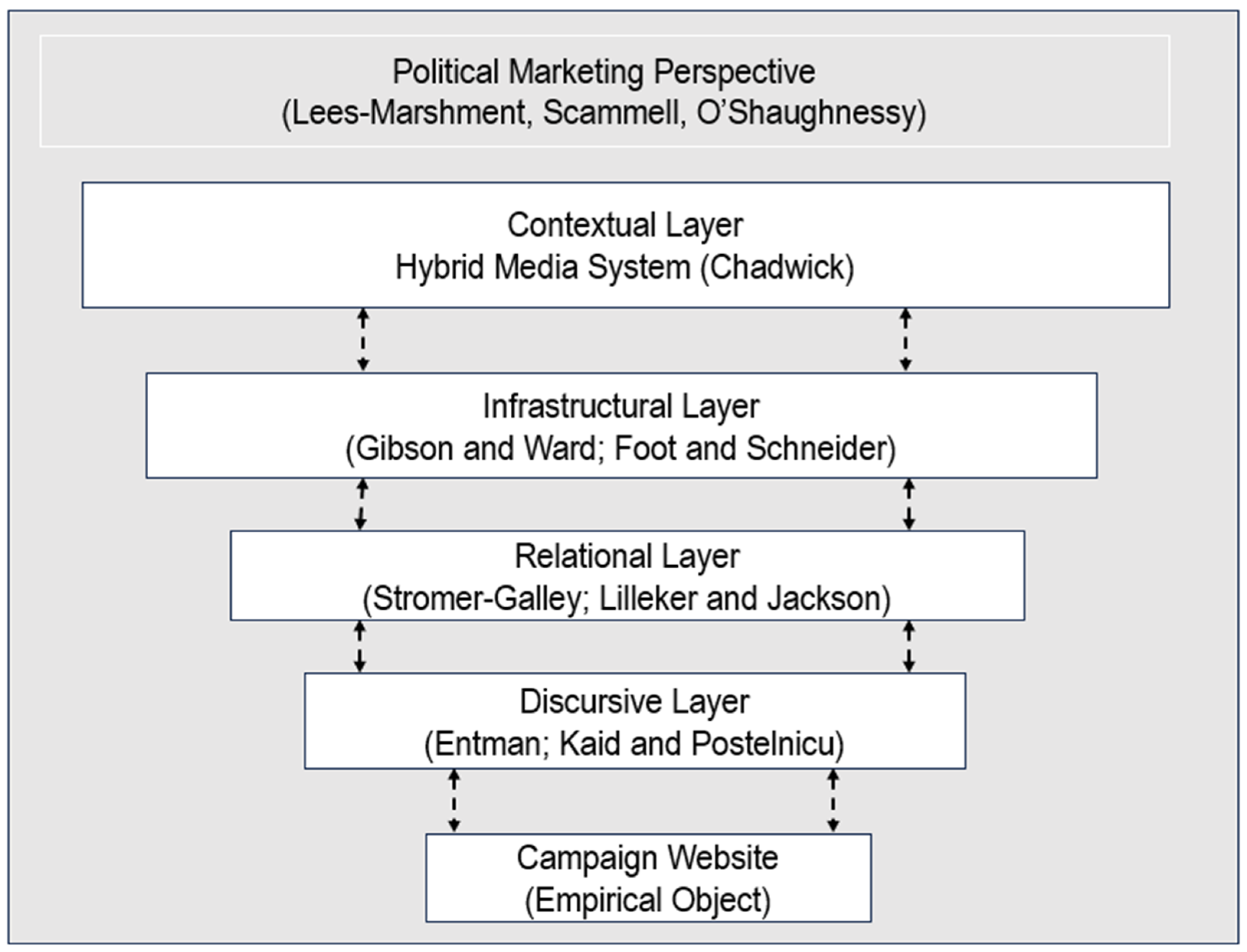
The reviewed theoretical approaches capture specific dimensions of campaign websites, yet none alone is sufficient to explain their strategic complexity in contemporary electoral competition. This study, therefore, integrates these perspectives into a coherent multi-model analytical framework, conceptualizing the campaign website as the central empirical object examined through multiple, interrelated analytical layers (see Figure 1).
At the broadest level, campaign websites are situated within the hybrid media system (Chadwick, 2017), which defines the structural environment. Within this context, websites function as owned, campaign-controlled media assets that provide stability and narrative coordination. At the infrastructural level, the framework combines feature-based website analysis (Gibson & Ward, 2000, 2009) with the concept of web campaigning as strategic infrastructure (Foot & Schneider, 2006), capturing functional architecture and organizational logic. The relational level addresses how campaigns manage their interface with citizens, drawing on the theory of the strategic avoidance of interactivity (Stromer-Galley, 2000, 2014) and the concept of digital sophistication (Lilleker & Jackson, 2011). The discursive level focuses on the construction of political meaning through framing (Entman, 1993) and visual political communication (Kaid & Postelnicu, 2005).
Enveloping and informing all analytical layers is an overarching political marketing logic (Lees-Marshment, 2019; Scammell, 2014; O’Shaughnessy, 2016). This perspective provides the interpretive lens through which infrastructural design, relational management, and discursive framing are understood as strategic choices oriented toward brand coherence, voter positioning, and risk management. Rather than applying the constituent models in parallel, the integrated framework emphasizes their interaction, allowing the analysis to link micro-level website features and engagement strategies to macro-level campaign narratives and political positioning.

3. Methodology

3.1. Research Design and Theoretical Operationalization

Building on the integrated multi-model framework developed in Section 2, this study adopts a qualitative-dominant comparative content analysis design. The research strategy is explicitly theory-driven, translating each of the constituent analytical models into observable indicators aligned with the framework’s contextual, infrastructural, relational, and discursive layers. These operationalizations are summarized in Table 1.
At the contextual level, the hybrid media system (Chadwick, 2017) provides the interpretive backdrop for understanding campaign websites as owned and controlled media assets embedded within broader communicative ecologies. This layer informs the analysis of how campaign websites are positioned in relation to social media platforms and legacy media, functioning as stable anchors for strategic narrative coordination.
At the infrastructural level, campaign websites are analyzed using feature-based content analysis following Gibson and Ward (2000, 2009). Websites are coded across predefined functional categories using dichotomous indicators (presence/absence), allowing systematic comparison of functional capacity and professionalization. This approach is complemented by Foot and Schneider’s (2006) conception of web campaigning as strategic infrastructure, which frames campaign websites as organizational hubs designed to centralize content, coordinate campaign activity, and integrate online and offline mobilization.
The relational level operationalizes two complementary perspectives. First, patterns of engagement are examined through the lens of the strategic avoidance of interactivity (Stromer-Galley, 2000, 2014), distinguishing symbolic and instrumental forms of interaction from more substantive dialogical engagement. Second, variation in the professionalization of campaign–citizen relationships is captured through the digital sophistication model (Lilleker & Jackson, 2011), which conceptualizes online campaigning as a continuum ranging from basic presence to informational, mobilizational, and interactive strategies.
At the discursive level, political meaning-making is analyzed using framing theory (Entman, 1993), operationalized by identifying dominant problem definitions, causal attributions, moral evaluations, and proposed solutions in key textual elements of the websites. This analysis is complemented by the study of visual political communication (Kaid & Postelnicu, 2005), focusing on imagery, layout, color schemes, and symbolic cues used to construct leadership narratives and emotional appeal.
Finally, findings from all analytical layers are synthesized through the overarching lens of political marketing theory (Lees-Marshment, 2019, 2020, 2023; Scammell, 2014; O’Shaughnessy, 2016, 2021), which provides the interpretive logic linking infrastructural design, relational management, and discursive framing to strategic positioning, brand coherence, and risk management.
Importantly, the present study is explicitly situated within the tradition of empirical research on Portuguese digital campaigning. Early analyses of presidential campaign websites in Portugal highlighted the predominance of informational and presentational functions, as well as the strategic use of websites as controlled communication spaces rather than participatory arenas (A. Cardoso, 2006; A. Cardoso & Gouveia, 2006). By applying an integrated multi-model framework to the 2026 presidential election, this study updates and extends this line of research, enabling a longitudinal comparison of how digital professionalism, interactivity management, and strategic communication logics have evolved within the Portuguese context.

3.2. Case Selection, Data Collection, and Analytical Procedure

The study analyses the official campaign websites of the eleven candidates formally admitted to the first round of the 2026 Portuguese presidential election. This constitutes the full population of candidates, enabling a comprehensive comparative analysis without sampling bias. Data collection took place during the peak campaign period (1–18 January 2026), ensuring the capture of websites in their final, operational state. All publicly accessible content was systematically captured and archived.
The analytical procedure followed a structured, theory-driven process, as summarized in Table 1.
(i)
Infrastructural Layer Analysis (Gibson & Ward; Foot & Schneider): Website features were coded dichotomously (presence/absence) across eight categories: information provision, resource generation, links, participation, online campaigning, multimedia, accessibility, and navigability. Category scores were aggregated to produce a total functional score. The structure and content organization were simultaneously analyzed to assess the website’s role as a strategic campaign hub.
(ii)
Relational Layer Analysis (Stromer-Galley; Lilleker & Jackson): Interactivity was assessed by identifying mechanisms enabling reciprocal communication. Features limited to one-way contact were classified as symbolic interactivity. Websites were then classified by their predominant communicative orientation (informational, mobilizational, or interactive) based on the combination and intensity of features present, according to Lilleker and Jackson’s (2011) levels of digital sophistication.
(iii)
Discursive Layer Analysis (Entman; Kaid & Postelnicu): Framing analysis identified dominant frames and narrative structures in key texts (e.g., homepage statements, programme sections). Visual analysis examined imagery, color schemes, layout, and symbolic cues used to construct leadership images and emotional appeal.
(iv)
Integrative Interpretation (Political Marketing): Findings from all stages were synthesized to interpret how websites function as branding and positioning platforms within a competitive electoral market, informed by political marketing theory.

3.3. Reliability and Validity

To enhance reliability and internal validity, the study employed a consensus-based validation procedure consistent with established practices in qualitative content analysis (Krippendorff, 2018). A second researcher, trained in the coding framework, independently analyzed a strategically selected subset of three campaign websites representing high, medium, and low levels of digital sophistication.
Coding results and interpretive assessments were compared across the infrastructural, relational, and discursive layers. Discrepancies were discussed and resolved through iterative refinement of coding criteria until agreement was reached on all contested items. This process ensured consistent application of the integrated multi-model framework across the entire dataset.
While the study does not rely on large-scale intercoder reliability coefficients, the use of consensus coding follows recognized methodological standards. Where categorical agreement was assessed during the validation phase, interpretive consistency was evaluated in line with established thresholds discussed by Landis and Koch (1977), strengthening confidence in the robustness and transparency of the coding decisions.

4. Results

This section presents the findings from the analysis of the eleven official campaign websites, structured according to the integrated analytical framework developed in Section 2. We begin by examining the infrastructural foundation of the websites, proceed to analyze the relational dynamics of interactivity and sophistication, then decode their discursive and symbolic construction, and finally synthesize these layers to reveal coherent strategic clusters that characterized the digital landscape of the 2026 presidential election.

4.1. The Infrastructural Layer: Functional Capacity and Strategic Design

Applying Gibson and Ward’s (2000, 2009) feature-based analysis complemented by Foot and Schneider’s (2006) perspective on web campaigning, this section maps the functional and strategic landscape of the campaign websites. The analysis reveals marked disparities in professionalization and strategic intent, confirming the role of websites as central campaign hubs, albeit with varying degrees of functional density and strategic orchestration.

4.1.1. Functional Density and Feature-Based Analysis

The feature-based content analysis based on Gibson and Ward’s (2000, 2009) methodology reveals marked differences in the functional density and professionalization of campaign websites. However, it also highlights a clear functional hierarchy across campaigns (Table 2).
The feature-based analysis indicates that information provision is the strongest functional dimension across campaign websites, with a mean score of 8.3 out of 16, reflecting a generalized emphasis on candidate profiles, policy positions, and campaign narratives. The highest scores in this dimension correspond to candidates with the most sophisticated overall digital infrastructures.
Navigability also records relatively high scores across the sample (mean = 3.2 out of 5), suggesting that most campaigns prioritize structural clarity and ease of access. Candidates such as Henrique Gouveia e Melo and Catarina Martins achieve the maximum score in this dimension (5), indicating professionally designed and intuitively organized websites.
By contrast, participation and resource generation remain systematically underdeveloped. Participation features yield a mean score of only 1.8 out of 4, while resource generation records a mean of 1.6 out of 4. Even among the highest-scoring campaigns, participatory affordances are limited. Henrique Gouveia e Melo and André Ventura reach a score of 3 in participation, but none of the analyzed websites approach the upper bound of this dimension. This pattern underscores the marginal role assigned to citizen engagement within official campaign websites. In terms of overall functional capacity, total scores range from 41 (Henrique Gouveia e Melo) to 12 (Manuel João Vieira), with a sample mean of 24.5. Higher-scoring websites combine richer informational content with stronger campaign-related features and multimedia resources. For example, André Ventura (37) and Catarina Martins (36) display relatively high levels of functional density, while João Cotrim de Figueiredo (32) occupies an intermediate position.
Importantly, higher functional scores do not correspond to greater participatory openness. Campaigns with more developed websites exhibit increased professionalization, content diversity, and presentational coherence rather than enhanced interaction. This confirms that digital sophistication, as measured through feature accumulation, is primarily oriented toward strategic presentation, narrative coherence, and message control, rather than toward expanding dialogical or participatory communication.

4.1.2. Websites as Strategic Infrastructures: Applying the Foot & Schneider Model

To understand how these functional capacities are orchestrated for strategic goals, we apply the web campaigning model of Foot and Schneider (2006). They propose that campaign websites should be analyzed according to the strategic functions they perform within the campaign’s relational network. Adapting this framework, we evaluate the intensity with which each website performed five primary strategic functions: Informing (providing information), Involving (mobilizing supporters), Connecting (linking to networks), Engaging (in electoral competition), and Electing (facilitating voting) (Table 3).
The analysis reveals five distinct strategic archetypes, moving beyond a simple ranking of website quality.
  • The Comprehensive Campaign Hub (Henrique Gouveia e Melo): This website was designed as the operational center of a national campaign, achieving high levels across all five functions.
  • The Containment and Mobilization Campaign (André Ventura): This website stood out for its high score in Engaging, reflecting a confrontational campaign style, combined with strong mobilization capacity.
  • The Information and Community Platform (Catarina Martins): This site excelled in Informing through dense programmatic content and in Connecting to social movements.
  • The Institutional Support Network (Luís Marques Mendes): This case presented a distinctive profile characterized by a high score in Connecting, driven by displaying an extensive honorary committee.
  • Static Personal Showcases (Pinto, Correia, Pestana) and Satirical Performance (Vieira): These websites performed all strategic functions at low or negligible levels.
The combined application of Gibson and Ward’s and Foot and Schneider’s models provide a complete picture of the websites’ infrastructural layer. The functional density analysis shows what tools are available, while the strategic functions analysis reveals how those tools are orchestrated for specific campaign goals. This confirms that campaign websites are, above all, strategically designed infrastructures (Foot & Schneider, 2006). Their design prioritizes information control and mobilization logics.
The infrastructural analysis confirms that campaign websites serve as selectively deployed strategic assets, whose design and coordination reflect underlying political ambitions and organizational capacities. This reinforces the interpretation of websites as controlled environments for campaign management and narrative coordination, rather than as open-ended platforms for democratic engagement.

4.2. The Discursive Layer: Framing and Visual Rhetoric

Beyond their functional architecture and relational setup, campaign websites are curated texts that construct political reality. This layer examines the production of meaning through textual framing (Entman, 1993) and visual symbolism (Kaid & Postelnicu, 2005). A key finding emerges: the strength and clarity of a campaign’s political narrative appear intrinsically linked to its level of investment in the infrastructural and relational layers.

4.2.1. Dominant Political Frames

Framing analysis reveals how each candidate defined the political situation, assigned responsibility, and proposed solutions, structuring political reality for the voter.
The framing analysis demonstrates how campaign websites are used not only for candidate promotion but also to structure voters’ perceptions of political reality (Table 4). The most emotionally charged and mobilizing frames are based on moral binary conflict (Ventura, Martins, Filipe). In contrast, several candidates adopt frames designed to transcend conflict (Gouveia e Melo, Seguro, Cotrim de Figueiredo). A clear correspondence emerges between dominant frames and levels of digital sophistication: candidates employing strong, mobilizing frames (Ventura, Martins, Gouveia e Melo) also operated the most advanced websites (Levels 3–4).

4.2.2. Visual Strategy and Symbolic Appeal

Visual rhetoric operated in concert with textual frames to reinforce leadership narratives and emotional appeal, functioning as a key persuasive mechanism in the absence of interactive engagement. Distinct visual styles were identified, ranging from institutional and formal aesthetics to emotional, personalized, or disruptive designs. These styles are generally coherent with the dominant discursive frames, indicating strategic alignment between visual and textual communication. Visual rhetoric thus operates as a key persuasive mechanism, often compensating for the absence of dialogical engagement by fostering affective identification.

4.2.3. Framing, Digital Investment, and Strategic Coherence

A central finding of the discursive analysis is the systematic correspondence between framing strength and digital investment. Campaigns that articulate strong, coherent, and mobilizing frames operate the most sophisticated websites, characterized by higher functional density and more advanced relational strategies (as shown in Section 4.1 and Section 4.2). Conversely, campaigns with weakly articulated or vague frames tend to maintain minimalist digital presences.
This relationship suggests that digital infrastructure does not compensate for discursive weakness; rather, it amplifies pre-existing narrative clarity and strategic coherence. Strong frames provide the rationale for investing in complex digital architectures capable of disseminating narratives efficiently and converting symbolic support into mobilization. In the absence of such frames, extensive digital investment appears strategically unnecessary.
The discursive layer therefore acts as a strategic driver of digital campaigning. Framing decisions shape not only what campaigns communicate, but also how extensively they invest in digital tools and how they manage interaction with citizens. This finding reinforces the interpretation of campaign websites as integrated strategic instruments in which discourse, infrastructure, and relational design are mutually reinforcing.

4.3. The Relational Layer: Managed Interactivity and Levels of Sophistication

This section analyses how campaigns managed the interface with citizens, combining Stromer-Galley’s (2014) interactivity avoidance thesis with Lilleker and Jackson’s (2011) model of digital sophistication. The findings demonstrate that higher functional capacity (Section 4.1) does not translate into more democratic openness but into more professionalized management of predominantly unidirectional communication.

4.3.1. Strategic Avoidance of Conversational Interactivity

Consistent with Stromer-Galley’s (2000) thesis, the analysis reveals a dominant pattern of controlled, top-down communication across the campaign websites. Communication is overwhelmingly unidirectional, with no evidence of substantive, public, or dialogical interaction between candidates and citizens (Table 5).
Although most websites provide contact forms, email addresses, newsletter subscriptions, or links to social media platforms, these elements correspond to what Stromer-Galley (2000) defines as symbolic interactivity. Such features create the appearance of openness while avoiding reciprocal, unpredictable, or public communication. No discussion forums, comment sections, public Q&A spaces, or deliberative tools were identified across the majority of campaign websites.
The analysis confirms Stromer-Galley’s central thesis, while revealing important contextual nuances specific to the Portuguese presidential elections of 2026. For the majority of candidates (7 out of 11), Stromer-Galley’s prediction clearly holds. Campaign websites operate as basic or enhanced transmission channels. Henrique Gouveia e Melo represents a notable exception, approximating a “participatory with control” model, yet this interaction takes place within a proprietary, highly structured platform. André Ventura and Catarina Martins exemplify a mobilizational interactivity model, where interaction is transactional and instrumental. The website of Manuel João Vieira constitutes a meta-critique of online campaigning itself.
The findings confirm Stromer-Galley’s (2014) central claim that political actors systematically avoid conversational interactivity in official campaign spaces. At the same time, they refine this argument by demonstrating that avoidance is graduated rather than uniform. Campaigns choose among different modes of controlled engagement—transmission, mobilization, or managed participation—based on strategic ambition, organizational capacity, and tolerance for communicative risk. Campaign websites thus function as interfaces of selective openness, designed to maximize strategic efficiency while minimizing uncertainty.

4.3.2. Levels of Digital Sophistication

The strategic management of the citizen interface is further clarified by assessing the level of digital sophistication (Lilleker & Jackson, 2011). This model reveals not just the presence of features, but their integration into a coherent communicative strategy.
Only one candidate (Henrique Gouveia e Melo) reached Level 4, due to the presence of structured forums and community deliberation tools. Two candidates (André Ventura and Catarina Martins) operated at Level 3, with strong mobilizational features but no public dialogical spaces. Four candidates (Cotrim de Figueiredo, Marques Mendes, Seguro, Filipe) were classified at Level 2, using websites primarily as informational platforms. The remaining candidates exhibited only basic online presences (Level 1), with minimal or static content (Table 6).
This classification reveals a clear hierarchy of digital maturity, in which each level presupposes and incorporates the previous one (Table 5). At the top of the ladder (Level 4), only Henrique Gouveia e Melo reaches the Interactive threshold. The digital elite (Level 3) is composed of André Ventura and Catarina Martins, whose websites function as highly effective mobilization engines. The traditional majority (Level 2) includes Cotrim de Figueiredo, Marques Mendes, Seguro, and Filipe. Their campaigns used the web primarily as a sophisticated broadcasting channel. The static base (Level 1) comprises Pinto, Correia, and Pestana. For these candidates, having a website appears to be a procedural formality rather than a strategic choice.
The results presented in Table 5 demonstrate that digital sophistication reflects strategic capacity rather than participatory ambition. Campaigns advance from basic presence to mobilization, but rarely cross the threshold into genuine dialogical engagement. When read alongside the findings on interactivity management, the digital sophistication analysis confirms that relational design is strategically calibrated to balance efficiency, control, and symbolic responsiveness within a political marketing logic.

4.4. Synthesis: Three Strategic Clusters in Portuguese Digital Campaigning

Before integrating the layers into a holistic interpretation, Table 7 summarizes the core findings from each analytical model, providing a clear diagnosis of the digital campaign strategies observed.
These models function as complementary analytical lenses, offering a comprehensive diagnosis. The central transversal insight from this diagnosis is the absence of dissociation between narrative strength (framing) and platform sophistication. On the contrary, the analysis reveals a structural correlation: powerful narratives justify and demand robust digital infrastructures, which in turn are designed to amplify those narratives. This dynamic creates either a virtuous or a vicious cycle of digital campaigning.
Integrating the findings from all analytical layers through the overarching lens of political marketing allows us to move beyond isolated observations. The convergence of infrastructural capacity, relational management, and discursive strategy reveals not a linear ranking, but three distinct strategic archetypes or clusters that define the digital campaign landscape of the 2026 Portuguese presidential election. These clusters demonstrate how digital tools are differentially harnessed according to the core political logic and resources of each candidacy (Table 8).
Cluster 1: Integrated Digital Campaigns comprise the candidates that fully integrated their web presence into their core campaign strategy. Their websites were multifunctional hubs with high technical professionalism, used for efficient one-to-many dissemination and asymmetrical mobilization. This cluster exemplifies a market-oriented political marketing approach.
Cluster 2: Digital Transmission Campaigns. Candidates in this cluster adopted a more traditional, supplemental view of digital media. Their websites functioned primarily as digital brochures or catalogues. The digital investment here aligns with a product-oriented political marketing logic, serving to inform and legitimize rather than to actively engage or mobilize.
Cluster 3: Symbolic Digital Presences. For this cluster, an official website appeared to be a procedural formality or an artistic gesture rather than a strategic tool. These candidates did not leverage the web for persuasive campaigning and fall outside a conventional political marketing framework.
This integrated analysis demonstrates that the digital space does not function as an inherent democratic equalizer in electoral campaigning. On the contrary, it tends to amplify pre-existing differences in resources, strategic clarity, and professionalization. Ultimately, digital maturity reflects, with striking fidelity, the maturity, ambition, and coherence of each candidate’s overall political strategy. The campaign website emerges as a central instrument for strategic narrative control and political marketing, where control, brand coherence, and symbolic persuasion are systematically prioritized over participatory openness.

5. Discussion

This study examined how official campaign websites functioned as strategic communication and political marketing tools in the first round of the 2026 Portuguese presidential elections. By integrating models of interactivity (Stromer-Galley), strategic infrastructure (Foot & Schneider), functional analysis (Gibson & Ward), digital sophistication (Lilleker & Jackson), and political framing (Entman), the findings offer a comprehensive interpretation of contemporary digital campaigning. The discussion situates these results within broader theoretical debates on digital democracy, hybrid media systems, and political marketing, elucidating their implications.

5.1. Reaffirming Strategic Control: The Persistence of Avoided Interactivity

The most consistent finding across all campaigns was the systematic avoidance of substantive, public interactivity, strongly corroborating Stromer-Galley’s (2014) thesis. Even the most sophisticated websites (Cluster 1) favored controlled, asymmetrical engagement, either through managed deliberation within proprietary platforms (Gouveia e Melo) or through transactional mobilization (Ventura, Martins). This pattern transcends the Portuguese context, reflecting a core strategic calculus in high-stakes electoral politics where message discipline and risk mitigation are paramount (Lilleker & Vedel, 2020).
This finding extends Stromer-Galley’s work by showing that avoidance is not monolithic but strategically differentiated. Campaigns make a conscious choice between models of controlled dialogue, asymmetrical mobilization, or simple transmission. This choice is not technologically determined but is a function of campaign resources, ideological base, and leadership style, interpreted through a political marketing lens that views uncontrolled interaction as a reputational liability rather than a democratic asset (Lees-Marshment, 2019).
Rather than interpreting the limited interactivity observed as a technological shortcoming, the results highlight the primacy of political, organizational, and strategic logics in shaping digital campaigning practices. This pattern of prioritizing control over conversation is not unique to Portugal. Similar findings have been observed in other Southern European contexts with institutionalized party systems, such as Italy (A. Cardoso, 2008), suggesting a broader strategic adaptation to digital media within certain political cultures.
The predominance of centralized, unidirectional communication observed across the 2026 Portuguese presidential campaign websites, while potentially disappointing from a deliberative democratic perspective, is theoretically expected within a political marketing framework. Several interconnected logics explain this pattern. First, political campaigns operate under conditions of uncertainty and reputational vulnerability, where open interactivity introduces unpredictable communicative risks that may disrupt message discipline (Lilleker & Jackson, 2011; Stromer-Galley, 2014). Second, the political marketing paradigm conceptualizes voters as segmented publics to be persuaded and mobilized, rather than deliberative actors requiring open dialogue (Lees-Marshment, 2019; Newman, 1999; Scammell, 2014). Third, institutional constraints and limited campaign resources favor investments in features with measurable returns, such as mobilization and recruitment, over deliberative engagement. Finally, within hybrid media systems, websites function as stable, controlled anchors where narratives can be curated and disseminated without algorithmic interference (Chadwick, 2017; Foot & Schneider, 2006). In this context, the observed communication patterns reflect a rational adaptation of digital tools to the strategic imperatives of electoral competition.
These findings reinforce the interpretation of campaign websites as strategically controlled hubs within hybrid media systems. While they expand opportunities for low-threshold participation and data-driven mobilization, they largely resolve the tension between participation and control in favor of centralized and carefully managed communication. More autonomous and less predictable forms of engagement tend to be displaced to peripheral digital spaces surrounding the official campaign infrastructure.

5.2. Websites as Strategic Hubs in a Hybrid Media Environment

The analysis supports Foot and Schneider’s (2006) conceptualization of websites as centralized strategic infrastructures within a hybrid media system (Chadwick, 2017). In an environment characterized by fragmented audiences and algorithmic unpredictability on social platforms, the campaign website serves as a stable, owned media anchor. It provides a coherent narrative hub from which content is disseminated and cross-platform consistency is managed.
The functional profiles identified, from Comprehensive Hubs to Static Showcases, illustrate how differentially campaigns leverage this anchoring potential. However, the prevalent use as a unidirectional hub reinforces Chadwick’s observation that older logics of broadcast and control are often reproduced within new digital architectures, rather than displaced by them. The findings align with the normalization perspective advanced by Margolis and Resnick (2000), and subsequently confirmed in more recent work (Kreiss, 2016), where campaign websites emerge as selectively designed communication spaces that reproduce existing hierarchies of control, resources, and strategic capacity.

5.3. How Political Narrative Drives Digital Investment Within Hybrid Media Systems

A pivotal contribution of this study lies in identifying a consistent and systematic association between the strength of a campaign’s discursive framing and the level of digital investment in its official website. Campaigns articulating clear, mobilizing frames (e.g., conflict-based or unity-oriented narratives) tended to develop functionally dense and strategically integrated digital infrastructures, whereas campaigns presenting vague or weakly articulated narratives maintained minimalist online presences.
Rather than suggesting direct causality, these findings indicate that digital infrastructures are strategically aligned with narrative clarity. In this sense, digital investment appears conditional upon the political actor’s capacity to articulate a coherent and mobilizing interpretive frame. Within the hybrid media system, campaign websites function as amplification infrastructures: they stabilize, coordinate, and disseminate political narratives across platforms. A powerful narrative thus provides the strategic rationale for investing in digital architecture, while the digital infrastructure itself enhances narrative visibility, coherence, and cross-media circulation. This dynamic generates a reinforcing cycle that may amplify pre-existing differences in strategic capacity.
This interpretation refines the normalization thesis (Lilleker & Vedel, 2013). While prior research has argued that digital tools tend to reproduce existing hierarchies, the present findings suggest a more conditional process: digital adoption and sophistication are not uniformly “normalized,” but are selectively intensified where strategic clarity and narrative mobilization are strongest. In this regard, technological uptake appears embedded within broader political communication logics rather than driven by technological affordance alone.
When contrasted with the pioneering analysis of the 2006 presidential race (A. Cardoso, 2006), the results point to a substantial increase in technical sophistication and professionalization. Yet, the underlying strategic logic remains remarkably stable. Campaign websites continue to operate primarily as controlled media spaces designed to centralize narrative authority. This continuity indicates the consolidation of a digital political marketing paradigm within the Portuguese media system, supporting Entman’s (1993) argument that framing structures not only interpretive meaning but also strategic action.
The finding that narrative clarity systematically precedes and conditions digital investment represents a central contribution of the study, reframing technological sophistication as a consequence of political strategy rather than an independent driver of democratic innovation.

5.4. The Overarching Logic: A Political Marketing Interpretation

The integrated framework reveals that the operational logics of infrastructure, interactivity, and discourse are ultimately orchestrated by an overarching political marketing logic (Lees-Marshment, 2023; Scammell, 2014). The websites of Cluster 1 function as quintessential digital brand platforms, where every feature, visual cue, and textual frame is aligned to position the candidate, differentiate them from competitors, and manage the relationship with voters in a market-oriented manner (O’Shaughnessy, 2021). This reflects a broader logic identified in political marketing scholarship, where campaigns increasingly adopt stakeholder engagement strategies that prioritize controlled communication and measurable outcomes over open deliberation (Hughes & Dann, 2009; Savigny, 2008). The avoidance of open interactivity, the prioritization of information and mobilization functions, and the use of cohesive visual rhetoric all serve the marketing objectives of brand coherence, voter targeting, and perceived leadership, while also reinforcing organizational control (Lilleker, 2005; Henneberg, 2006). This interpretation is reinforced by recent systematic literature reviews on human branding in political marketing, which emphasize the role of digital platforms in stabilizing leadership identity, authenticity cues, and symbolic coherence, rather than fostering reciprocal or deliberative interaction (Reis Soares et al., 2025).
This study thus positions the campaign website not merely as a communication channel, but as the digital embodiment of a political marketing strategy, where technological affordances are subordinate to electoral goals. From a political marketing perspective (Lees-Marshment, 2019, 2023), campaign websites operate as digital brand infrastructures designed to stabilize political identity and manage engagement.

5.5. Implications for Digital Democracy: Between Promise and Practice

The findings engage directly with normative debates about the internet’s impact on democracy. The observed dominance of controlled, unidirectional communication supports a more pessimistic or realist perspective (Hindman, 2008; Margolis & Resnick, 2000). The participatory promise of digital media remains largely unfulfilled at the core of official campaign architectures, subordinated to the logics of elite competition and strategic persuasion.
However, this does not necessarily imply democratic degradation. Instead, it reframes the website’s role: it is a tool for strategic narrative construction and voter engagement within representative democracy, not a direct conduit for deliberative participation. The democratic quality of elections may thus depend less on the interactivity of campaign tools and more on the clarity, accessibility, and diversity of the narratives they present—a dimension where our analysis shows significant inequality. In this sense, inequality in digital sophistication translates into inequality in narrative visibility and strategic amplification, raising critical questions about fairness and pluralism in mediated electoral competition.
From a normative standpoint, these findings resonate with critical perspectives on digital democracy. As Papacharissi (2015) cautions, the availability of interactive affordances does not guarantee deliberative outcomes. Instead, participation is frequently instrumentalized, aligning with Scammell’s (2014) observation that market-oriented political communication prioritizes strategic effectiveness over democratic openness.
In summary, this analysis of the 2026 Portuguese presidential web campaigns reveals a landscape where digital tools are wielded with strategic intent, not democratic idealism. The integrated multi-model framework has proven effective in unpacking this complexity, showing how infrastructural choices, relational management, and discursive construction are interconnected and driven by a market-oriented political logic. The study confirms that in highly institutionalized electoral settings, the campaign website remains a bastion of strategic control, narrative centralization, and brand management. Its evolution will be a key site for observing how the enduring imperatives of political competition adapt to the next wave of digital innovation.
From a journalism and media perspective, campaign websites also function as primary source infrastructures for news production. By centralizing press materials, framing issue hierarchies, and stabilizing candidate narratives, these platforms indirectly shape media agendas and interpretive repertoires available to journalists. Even in the absence of direct interactivity, websites contribute to the mediated construction of political reality by structuring the informational environment within which journalistic actors operate. Their strategic design, therefore, influences not only voter communication but also the broader ecology of electoral coverage.

6. Conclusions

This study set out to investigate how official campaign websites function as strategic communication tools within the hybrid media environment of a presidential election, specifically examining the tension between their participatory potential and the campaigns’ imperative for control. Through an integrated multi-model analysis of the eleven candidate websites in the 2026 Portuguese presidential election, the research provides a comprehensive mapping of digital campaigning in an understudied context and yields theoretical insights with broader applicability.
The findings are consistent with the view that campaign websites operate primarily as centrally controlled, unidirectional communication hubs. Despite varying levels of digital sophistication, from basic online brochures to sophisticated mobilization platforms, a consistent logic of strategic avoidance of substantive interactivity (Stromer-Galley, 2014) prevails. This avoidance is not a failure to understand digital tools, but a rational strategic choice within a political marketing paradigm that prioritizes brand consistency, message discipline, and risk management over deliberative engagement (Lees-Marshment, 2019; Lilleker & Vedel, 2020).
The study’s primary theoretical contribution lies in empirically demonstrating the primacy of political logic over technological affordance. The strong correlation observed between the clarity and strength of a campaign’s political narrative (framing) and its level of investment in digital infrastructure challenges technologically deterministic views. It supports and extends the normalization thesis (Lilleker & Vedel, 2013) by showing that digital tools are absorbed into, and amplify, pre-existing campaign strategies and inequalities, rather than transforming them. In particular, the study demonstrates that narrative clarity functions as a key driver of digital investment, meaning that technological sophistication follows political strategy rather than preceding or substituting for it. The identified strategic clusters, Integrated Digital Campaigns, Digital Transmission Campaigns, and Symbolic Digital Presences, are not merely technical categories but reflect fundamental differences in political ambition, resource allocation, and strategic coherence.
Methodologically, the article demonstrates the significant analytical value of a deliberately integrated, multi-model framework. By combining theories focused on infrastructure (Gibson & Ward; Foot & Schneider), interaction (Stromer-Galley; Lilleker & Jackson), and discourse (Entman; Kaid & Postelnicu), we moved beyond feature counting or single-lens analyses. This approach captured the campaign website as a multifaceted strategic object, enabling a holistic interpretation of how functional design, relational management, and symbolic construction coalesce into a coherent political offering.
For the Portuguese context, this research fills a significant gap, providing one of the first comprehensive analyses of digital presidential campaigning. It reveals a landscape of stratified digital professionalism, where a small number of well-resourced, strategically coherent campaigns effectively harness the web for narrative dominance and mobilization, while a larger number use it minimally or symbolically. This pattern underscores that the digital divide in politics is not merely about access, but about the strategic capacity to integrate digital tools into a compelling political project.
This study has several limitations that open avenues for future research. First, its cross-sectional design captures campaign websites at a single moment in time, limiting insight into temporal dynamics and strategic adaptation over the course of the campaign. Future longitudinal research could examine such variations across electoral cycles. Second, the analytical focus on official campaign websites, while theoretically justified as campaign-controlled and owned media spaces, does not account for interactions occurring on social media platforms, which constitute the primary arenas for networked, interactive, and algorithmically mediated political communication. Future research should therefore integrate websites and social media environments in comparative or relational designs. Third, strategic intent is inferred from observed design and content; interviews with campaign professionals could provide deeper insight into internal decision-making processes, resource allocation rationales, and the strategic calculations underpinning observed patterns. Fourth, while the consensus-based validation procedure enhances reliability, the qualitative-dominant approach prioritizes interpretive depth over generalizable metrics; future studies may complement these findings with quantitative approaches. Finally, the findings are situated within the specific institutional and cultural context of Portuguese presidential elections; comparative research across political systems would illuminate how contextual factors condition the strategic use of campaign websites.
Future research should adopt longitudinal and comparative approaches to examine the stability of the identified archetypes across electoral cycles and political systems, and integrate voter perspectives to assess how different configurations of website and social media strategies shape political efficacy, trust, and vote choice. Finally, the growing incorporation of data analytics and AI-driven personalization into campaign communication represents a critical frontier for examining how strategic control and targeted engagement may further transform digital campaigning. Recent scholarship on AI-mediated communication suggests this could deepen, rather than resolve, the tension between control and participation (Foos, 2024; Olejnik, 2026).
In sum, the 2026 Portuguese presidential election illustrates that the campaign website remains a cornerstone of digital strategy, not as a site of democratic conversation, but as a controlled stage for strategic narrative performance. Digital maturity in campaigning appears closely aligned with broader strategic coherence and political capacity. As such, understanding the evolving architecture of these digital platforms is essential for understanding how political power is narrated, branded, and contested in the contemporary public sphere.
In this sense, the study reorients the debate on digital political communication by showing that technological sophistication is not an independent driver of campaign effectiveness, but a consequence of underlying strategic and narrative coherence.

Author Contributions

Conceptualization, A.C. and J.F.; methodology, A.C.; validation, A.S., M.S.P. and I.O.; formal analysis, A.C. and M.S.P.; investigation, A.C., M.S.P. and A.S.; data curation, A.C. and J.F.; writing—original draft preparation, A.C. and M.S.P. writing—review and editing, A.C. and J.F.; visualization, A.S. and I.O.; supervision, A.C.; project administration, A.C. All authors have read and agreed to the published version of the manuscript.

Funding

This research received no external funding.

Institutional Review Board Statement

Not applicable.

Informed Consent Statement

Not applicable.

Data Availability Statement

The data supporting the findings of this study consist of archived versions of publicly accessible campaign websites collected during the official campaign period of the 2026 Portuguese presidential election. These materials are available from the corresponding author upon reasonable request.

Acknowledgments

During the preparation of this manuscript, the authors used Elicit (v2.0) to assist with literature exploration and reference organization, and Grammarly (8.935.0) for language editing and proofreading. All conceptualization, analysis, and interpretation were conducted by the authors, who take full responsibility for the content of this publication.

Conflicts of Interest

The authors declare no conflicts of interest.

Appendix A

Feature-Based Coding Scheme for Campaign Websites

This appendix details the coding criteria used to operationalize the feature-based website analysis proposed by Gibson and Ward (2000, 2009). All items were coded dichotomously (0 = absent; 1 = present). Category scores represent the sum of observed features within each dimension.
A1. Information Provision (0–16)
The following elements were coded as present or absent:
-
Candidate biography
-
Political trajectory or curriculum vitae
-
Policy positions or manifesto
-
Issue-specific policy sections
-
Campaign objectives or priorities
-
Press releases or official statements
-
Campaign news updates
-
Speeches or transcripts
-
Downloadable documents (e.g., programme PDF)
-
FAQ or explanatory sections
-
Timeline of campaign activities
-
Position on national political issues
-
Position on international issues
-
Endorsements or support statements
-
Media appearances or coverage
-
Historical background or political values
A2. Resource Generation (0–4)
-
Online donation facilities
-
Membership or supporter registration
-
Volunteer recruitment forms
-
Merchandise or campaign material sales
A3. Links (0–5)
-
Links to social media platforms
-
Links to party or affiliated organizations
-
Links to allied movements or causes
-
External informational links
-
Cross-linking within the campaign digital ecosystem
A4. Participation (0–4)
-
Online petitions or pledge forms
-
Interactive surveys or polls
-
Event registration with feedback capacity
-
Mechanisms for user-generated content submission
A5. Online Campaigning (0–5)
-
Campaign slogans or calls to action
-
Mobilization messages (e.g., vote, attend events)
-
Event calendars
-
Campaign countdowns or reminders
-
Explicit vote-seeking messages
A6. Multimedia (0–6)
-
Photographs of the candidate
-
Campaign videos
-
Embedded speeches or interviews
-
Audio materials or podcasts
-
Infographics or visual explainers
-
Interactive or animated content
A7. Accessibility (0–5)
-
Mobile-responsive design
-
Text readability features
-
Alternative text for images
-
Multilingual options
-
Compliance with basic accessibility standards
A8. Navigability (0–5)
-
Clear menu structure
-
Internal search function
-
Logical content hierarchy
-
Navigation aids (e.g., breadcrumbs)
-
Consistent layout across pages

Appendix B

Interactivity Assessment Criteria (Stromer-Galley, 2000, 2014)

This appendix specifies the criteria used to assess online interactivity following Stromer-Galley’s distinction between symbolic and substantive interactivity.
B1. Symbolic Interactivity
-
Features suggesting openness without enabling public, reciprocal communication:
-
Contact forms or email addresses
-
Newsletter subscriptions
-
Social media links without on-site interaction
-
Controlled feedback mechanisms
B2. Substantive Interactivity
Features enabling reciprocal, unpredictable, and public communication:
-
Public comment sections
-
Discussion forums
-
Live Q&A sessions
-
Open debate platforms
Based on these criteria, websites were classified as predominantly employing a Basic Transmission, Enhanced Transmission, Asymmetrical Mobilization, or Participatory with Control strategy, as detailed in Section 4.2.1.

Appendix C

Digital Sophistication Classification (Lilleker & Jackson, 2011)

This appendix outlines the criteria used to classify campaign websites according to the digital sophistication model proposed by Lilleker and Jackson (2011).
Level 1: Basic Presence
-
Static website with minimal information.
-
Often a single page or a few pages.
-
Contains basic biography and contact information.
-
No dynamic content, campaign-specific features, or regular updates.
-
Absence of multimedia beyond basic photographs.
Level 2: Informational Website
-
Structured presentation of biography, detailed programme, and campaign agenda.
-
Clear navigation and organization of content.
-
May include downloadable documents (PDFs), a news/updates section, and photo galleries.
-
Lacks features for mobilization (donations, volunteer sign-ups) or substantive interactivity.
-
Primary function is to inform and present the candidate.
Level 3: Mobilizational Website
-
Contains all features of Level 2.
-
Strong emphasis on calls to action: volunteer recruitment, online donations, event sign-ups.
-
Integration of social media for sharing and amplification.
-
May include tools for supporters to download and share campaign materials (e.g., posters, social media graphics).
-
Focused on converting visitor support into concrete campaign resources and actions.
-
Interactivity remains largely unidirectional and transactional.
Level 4: Interactive Website
-
Contains all features of Level 3.
-
Incorporates tools for two-way communication and public dialogue.
-
Features may include: public discussion forums, comment sections, live chat or Q&A functionalities, platforms for user-generated content or policy ideas.
-
Aims to foster a sense of community and deliberative engagement among supporters.
Note: In our analysis, Level 4 was assigned only if interactive features were structured and promoted, not merely tokenistic.
Websites were classified according to the dominant communicative orientation observed, as detailed in Section 4.2.2.

Appendix D

Framing and Visual Communication Analysis Criteria

This appendix summarizes the criteria used to analyze the discursive and symbolic elements of campaign websites.
D1. Framing Analysis (based on Entman, 1993)
Analysis focused on identifying the following elements in key textual content (homepage, “About”, “Programme”, key policy pages):
-
Problem Definition: How is the central problem, crisis, or situation defined? What is made salient?
-
Causal Attribution: Who or what is diagnosed as responsible for the problem?
-
Moral Evaluation: How are the identified problems or actors judged (e.g., unjust, dangerous, corrupt, virtuous)?
-
Proposed Solution/Remedy: What treatment is recommended? What specific actions, values, or leadership qualities are promoted as the solution?
A dominant frame was identified for each candidate based on the consistency of these elements across their website’s core texts.
D2. Visual Political Communication Analysis (based on Kaid & Postelnicu, 2005; Schill, 2012)
Visual analysis examined the following elements:
-
Candidate Imagery: Predominant types of photographs (official portrait, casual, with crowds, in action). Setting, clothing, and facial expression were noted to infer qualities (authority, empathy, dynamism).
-
Color Scheme: Dominant colors and their symbolic association (e.g., party colors, national colors, colors evoking stability/change/trust).
-
Layout and Design Aesthetics: Overall impression (clean/professional, chaotic/energetic, minimalist, saturated). Use of visual hierarchy to guide attention.
-
Use of Symbols: Inclusion of national flags, party logos, historical references, or other iconic imagery.
-
Emotional Appeal: The overall emotional tone conveyed by the visual composition (hopeful, urgent, angry, serene, trustworthy).
The visual strategy was interpreted in relation to the dominant textual frame to assess coherence in the candidate’s overall symbolic communication.

Appendix E

Table A1. Candidate Profiles and Official Websites for the 2026 Portuguese Presidential Election.
NameAge (2026)Profession/OccupationPolitical SupportOfficial Website
Henrique Gouveia e Melo66Retired AdmiralIndependenthttps://gouveiamelopresidente.pt/ (accessed on 3 April 2026)
André Ventura43Lawyer and Party LeaderChegahttps://ventura26.pt/ (accessed on 3 April 2026)
Catarina Martins52MEP, Former Bloco de Esquerda LeaderBloco de Esquerdahttps://catarina2026.pt/ (accessed on 3 April 2026)
João Cotrim de Figueiredo62MEP, ManagerIniciativa Liberalhttps://cotrim2026.pt/ (accessed on 3 April 2026)
Luís Marques Mendes69Lawyer, Political CommentatorPSD/CDS-PPhttps://luismarquesmendes.pt/ (accessed on 3 April 2026)
António José Seguro64Former PS Secretary-General, ProfessorPartido Socialistahttps://seguropresidente.pt/ (accessed on 3 April 2026)
Jorge Pinto41Deputy and AcademicLivrehttps://vieira2026.com/ (accessed on 3 April 2026)
António Filipe61University ProfessorPCP/PEVhttps://antoniofilipe2026.pt (accessed on 3 April 2026)
André Pestana52Teacher and UnionistIndependenthttps://andrepestana.pt/ (accessed on 3 April 2026)
Humberto Correia66Painter and AuthorIndependenthttps://humbertocorreiapr.pt/ (accessed on 3 April 2026)
Manuel João Vieira63Visual Artist and MusicianIndependenthttps://jorgepinto2026.pt (accessed on 3 April 2026)
MEP—Member of the European Parliament.

References

  1. Bacaksizlar Turbic, N. G., & Rosa, J. M. (2023). Political presence on Facebook during and beyond election campaigns: The portuguese case. Observatorio (OBS*), 17(2), 29–51. [Google Scholar] [CrossRef] [Scilit]
  2. Baines, P. R., & Harris, P. (2011). Political marketing. In L. L. Kaid (Ed.), The Sage handbook of political advertising (pp. 95–112). Sage. [Google Scholar]
  3. Baptista, J., & Gradim, A. (2020). Online disinformation on Facebook: The spread of fake news during the Portuguese 2019 election. Journal of Contemporary European Studies, 30, 297–312. [Google Scholar] [CrossRef] [Scilit]
  4. Cardoso, A. (2006). A comunicação política digital na corrida às eleições presidenciais 2006: Internet, blogues e multimédia móvel [Digital political communication in the 2006 presidential election race: Internet, blogs, and mobile multimedia]. In P. Cardoso, & A. Cairrão (Eds.), Comunicação política (pp. 87–115). Edições Universidade Fernando Pessoa. [Google Scholar]
  5. Cardoso, A. (2008). Political communication on the Internet—Website analysis of the political parties in Italy. Observatorio (OBS) Journal*, 2(4), 180–204. Available online: http://obs.obercom.pt/index.php/obs/index (accessed on 10 January 2026).
  6. Cardoso, A., & Gouveia, V. (2006, October 27–28). Comunicação política na internet: Análise dos web sites dos candidatos às eleições presidenciais 2006 em Portugal [Conference presentation]. XIII Jornadas Internacionales de Jóvenes Investigadores en Comunicación “Nuevos Retos de la Comunicación: Economía, Empresa y Sociedad”, Universidad San Jorge, Zaragoza, Spain. [Google Scholar]
  7. Cardoso, G., & Lapa, T. (2017). Digital campaigning in Southern Europe: A comparative analysis of Portugal, Spain, and Italy. In M. Barisione, & A. Michailidou (Eds.), Social media and European politics: Rethinking power and legitimacy in the digital era. Springer. [Google Scholar]
  8. Chadwick, A. (2017). The hybrid media system: Politics and power (2nd ed.). Oxford University Press. [Google Scholar]
  9. Chester, J., & Montgomery, K. (2017). The role of digital marketing in political campaigns. Internet Policy Review, 6(4), 1–20. [Google Scholar] [CrossRef] [Scilit]
  10. Daniel, W. T., & Obholzer, L. (2026). Social media campaigning across multiple platforms: Evidence from the 2024 European elections. West European Politics, 49(1), 293–319. [Google Scholar] [CrossRef] [Scilit]
  11. Da Silva e Silva, I., & Leandro, A. (2025). The power of personal branding in political marketing. Revista Latina de Comunicación Social, (84), 1–17. [Google Scholar] [CrossRef] [Scilit]
  12. Decker, H. (2025). The role of content personalisation in political social media campaigning: A review of political microtargeting. Z Politikwiss 35, 83–98. [Google Scholar] [CrossRef] [Scilit]
  13. Domínguez-García, R., Baptista, J., Pérez-Curiel, C., & Fonseca, D. (2025). From emotion to virality: The use of social media in the populism of Chega and VOX. Social Sciences, 14(5), 255. [Google Scholar] [CrossRef] [Scilit]
  14. Dommett, K., & Temple, L. (2018). Digital campaigning: The rise of Facebook and satellite campaigns. Parliamentary Affairs, 71, 189–202. [Google Scholar] [CrossRef] [Scilit]
  15. Dommett, K., Temple, L., & Seyd, P. (2021). Dynamics of intra-party organisation in the digital age: A grassroots analysis of digital adoption. Parliamentary Affairs, 74(2), 378–397. [Google Scholar] [CrossRef] [Scilit]
  16. Dubois, E., & Dommett, K. (2025). Reconceptualising political influencers: An alternative means of definition and analysis. New Media & Society, 14614448251395272. [Google Scholar] [CrossRef] [Scilit]
  17. Entman, R. M. (1993). Framing: Toward clarification of a fractured paradigm. Journal of Communication, 43(4), 51–58. [Google Scholar] [CrossRef] [Scilit]
  18. Foos, F. (2024). The use of AI by election campaigns. LSE Public Policy Review, 3(3), 8. [Google Scholar] [CrossRef] [Scilit]
  19. Foot, K. A., & Schneider, S. M. (2006). Web campaigning. MIT Press. [Google Scholar]
  20. Gibson, R. K., & Ward, S. J. (2000). A proposed methodology for studying the function and effectiveness of party and candidate web sites. Social Science Computer Review, 18(3), 301–319. [Google Scholar] [CrossRef] [Scilit]
  21. Gibson, R. K., & Ward, S. J. (2009). Parties in the digital age: A review article. Representation, 45(1), 87–100. [Google Scholar] [CrossRef] [Scilit]
  22. Graham, S., & Hogan, J. (2018). An examination of Seán Gallagher’s presidential campaign in a hybridized media environment. Irish Communication Review, 14, 3. [Google Scholar] [CrossRef]
  23. Guedes, I., Vigo, B., Santos, M., Moreira, S., Cardoso, C., & Castro, J. (2025). Disinformation dynamics and regulation in Portugal: Insights from a qualitative study. European Journal on Criminal Policy and Research, 31, 529–557. [Google Scholar] [CrossRef] [Scilit]
  24. Henneberg, S. C. (2006). Leading or following? A theoretical analysis of political marketing postures. Journal of Political Marketing, 5(3), 29–46. [Google Scholar] [CrossRef] [Scilit]
  25. Hindman, M. (2008). The myth of digital democracy. Princeton University Press. [Google Scholar]
  26. Hughes, A., & Dann, S. (2009). Political marketing and stakeholder engagement. Marketing Theory, 9(2), 243–256. [Google Scholar] [CrossRef] [Scilit]
  27. Kaid, L. L., & Postelnicu, M. (2005). Political advertising and candidate images in 2004: Comparing the Internet to television. In L. L. Kaid (Ed.), Handbook of political advertising (pp. 155–175). Lawrence Erlbaum Associates. [Google Scholar]
  28. Klinger, U., & Svensson, J. (2015). The emergence of network media logic in political communication: A theoretical approach. New Media & Society, 17(8), 1241–1257. [Google Scholar] [CrossRef] [Scilit]
  29. Koc-Michalska, K., & Lilleker, D. (2017). Digital politics: Mobilization, engagement, and participation. Political Communication, 34, 1–5. [Google Scholar] [CrossRef] [Scilit]
  30. Kreiss, D. (2016). Prototype politics: Technology-intensive campaigning and the data of democracy. Oxford University Press. [Google Scholar]
  31. Kreiss, D. (2018). The media are about identity, not information. In P. J. Boczkowski, & Z. Papacharissi (Eds.), Trump and the media (pp. 93–101). MIT Press. [Google Scholar] [CrossRef] [Scilit]
  32. Krippendorff, K. (2018). Content analysis: An introduction to its methodology (4th ed.). Sage. [Google Scholar] [CrossRef] [Scilit]
  33. Landis, J. R., & Koch, G. G. (1977). The measurement of observer agreement for categorical data. Biometrics, 33(1), 159–174. [Google Scholar] [CrossRef] [Scilit] [PubMed]
  34. Lees-Marshment, J. (2019). Political marketing: Principles and applications (3rd ed.). Routledge. [Google Scholar]
  35. Lees-Marshment, J. (2020). The ministry of public opinion: Understanding and managing public opinion as a strategic political resource. In Routledge handbook of political marketing (pp. 45–58). Routledge. [Google Scholar]
  36. Lees-Marshment, J. (2023). The ministry of public opinion: Understanding and managing public opinion as a strategic political resource. Routledge. [Google Scholar]
  37. Lemos, M., & Alturas, B. (2017). The Internet and the online social networks on the 2016’s Portuguese presidential elections. In 2017 12th Iberian Conference on Information Systems and Technologies (CISTI) (pp. 1–6). IEEE. [Google Scholar] [CrossRef] [Scilit]
  38. Lilleker, D. G. (2005). The impact of political marketing on internal party democracy. Parliamentary Affairs, 58(3), 570–584. [Google Scholar] [CrossRef] [Scilit]
  39. Lilleker, D. G., & Jackson, N. A. (2011). Political campaigning, elections and the Internet: Comparing the US, UK, France and Germany. Routledge. [Google Scholar]
  40. Lilleker, D. G., Tenscher, J., & Štětka, V. (2015). Towards hypermedia campaigning? Perceptions of new media’s importance for campaigning by party strategists in comparative perspective. Information, Communication & Society, 18(7), 747–765. [Google Scholar] [CrossRef] [Scilit]
  41. Lilleker, D. G., & Vedel, T. (2013). The internet in campaigns and elections. In W. H. Dutton (Ed.), The Oxford handbook of internet studies (pp. 401–420). Oxford University Press. [Google Scholar]
  42. Lilleker, D. G., & Vedel, T. (2020). The French digital landscape: The 2017 online presidential election campaign. In Routledge handbook of political marketing (pp. 345–360). Routledge. [Google Scholar]
  43. Loureiro, M., & Ribeiro, J. (2017). Digital democracy and political participation through Facebook: Portuguese legislative elections in 2015. Estudos em Comunicação, 24, 229–243. [Google Scholar] [CrossRef] [Scilit]
  44. Machado, S., & Fenoll, V. (2025). It glitters, but is it gold? Negative campaigning on social media in Portugal. Communication and the Public, 20570473251323766. [Google Scholar] [CrossRef] [Scilit]
  45. Margolis, M., & Resnick, D. (2000). Politics as usual: The cyberspace “revolution”. Sage. [Google Scholar]
  46. Needham, C., & Smith, G. (2015). Introduction: Political branding. Journal of Political Marketing, 14(1–2), 1–6. [Google Scholar] [CrossRef] [Scilit]
  47. Newman, B. I. (1999). The mass marketing of politics: Democracy in an age of manufactured images. Sage. [Google Scholar]
  48. Olejnik, L. (2026). Weaponising AI: Political persuasion at an industrial scale. King’s College London. Available online: https://www.kcl.ac.uk/weaponising-ai (accessed on 3 February 2026).
  49. O’Shaughnessy, N. J. (2016). Selling the president: The rise of political marketing in the United States. Palgrave Macmillan. [Google Scholar]
  50. O’Shaughnessy, N. J. (2021). Marketing the revolution: The new political marketing. Palgrave Macmillan. [Google Scholar]
  51. Papacharissi, Z. (2015). Affective publics: Sentiment, technology, and politics. Oxford University Press. [Google Scholar]
  52. Parry, K. (2022). The politics of visual communication. In H. Tumber, & S. Waisbord (Eds.), The Routledge companion to media disinformation and populism (pp. 298–308). Routledge. [Google Scholar]
  53. Penney, J. (2017). Social media and citizen participation in “official” and “unofficial” electoral promotion: A structural analysis of the 2016 Bernie sanders digital campaign. Journal of Communication, 67, 402–423. [Google Scholar] [CrossRef] [Scilit]
  54. Pereira, M. (2018). Online politicians: Portuguese digital political communication strategies in a governmental and electoral context. Sphera Publica, 2(18), 21–42. Available online: https://sphera.ucam.edu/index.php/sphera-01/article/view/350 (accessed on 15 January 2026).
  55. Prior, H. (2024). Social media and the rise of radical right populism in Portugal: The communicative strategies of André Ventura on X in the 2022 elections. Humanities and Social Sciences Communications, 11, 1–10. [Google Scholar] [CrossRef] [Scilit]
  56. Reis Soares, V., Rodriguez y Rodriguez, M. V., de Sousa Montalvão, S., Martins Rodrigues, M. C., & da Silva Oliveira, A. B. (2025). Human branding in political marketing: A systematic literature review and agenda for future research. Journal of Political Marketing, 1–27. [Google Scholar] [CrossRef] [Scilit]
  57. Santana-Pereira, J., Ferrinho Lopes, H., & Nina, S. R. (2023). Sailing uncharted waters with old boats? COVID-19 and the digitalization and professionalization of presidential campaigns in Portugal. Social Sciences, 12(1), 45. [Google Scholar] [CrossRef] [Scilit]
  58. Savigny, H. (2008). The problem of political marketing. Continuum. [Google Scholar]
  59. Scammell, M. (2014). Consumer democracy: The marketing of politics. Cambridge University Press. [Google Scholar]
  60. Schill, D. (2012). The Visual Image and the Political Image: A Review of Visual Communication Research in the Field of Political Communication. Review of Communication, 12(2), 118–142. [Google Scholar] [CrossRef] [Scilit]
  61. Seizov, O., & Müller, M. (2016). Multimodal campaign strategies in the US presidential election 2012: A content analysis of the campaign websites of Barack Obama and mitt Romney. In C. Bieber, & K. Kamps (Eds.), Die US-präsidentschaftswahl 2012. Springer VS. [Google Scholar] [CrossRef] [Scilit]
  62. Stier, S., Bleier, A., Lietz, H., & Strohmaier, M. (2018). Election campaigning on social media: Politicians, audiences, and the mediation of political communication on Facebook and Twitter. Political Communication, 35, 50–74. [Google Scholar] [CrossRef] [Scilit]
  63. Stromer-Galley, J. (2014). Presidential campaigning in the internet age. Oxford University Press. [Google Scholar]
  64. Stromer-Galley, J. (2020). On-line interaction and why candidates avoid it. Journal of Communication, 50(4), 111–132. [Google Scholar] [CrossRef]
  65. Vaccari, C. (2013). Digital politics in Western democracies: A comparative study. Johns Hopkins University Press. [Google Scholar]
  66. Vaccari, C., & Valeriani, A. (2021). Outside the bubble: Social media and political participation in Western democracies. Oxford University Press. [Google Scholar]
Figure 1. The integrated multi-model analytical framework for campaign websites. Source: Authors’ own elaboration.
Journalmedia 07 00080 g001
Table 1. Operationalization of the integrated multi-model framework.
Analytical LayerTheoretical ConstructsPrimary OperationalizationOutput/Metric
ContextualHybrid Media System (Chadwick)Analysis of cross-platform integration and media logicDescriptive contextualization
InfrastructuralFeature-Based Analysis (Gibson & Ward); Strategic Infrastructure (Foot & Schneider)Dichotomous coding of 50+ features across 8 categoriesFunctional score (0–50+);
structural profile
RelationalStrategic Interactivity Avoidance (Stromer-Galley); Digital Sophistication (Lilleker & Jackson)1. Classification of interactivity type
2. Assessment of sophistication level
1. Symbolic/Substantive rating
2. Level (1–4) classification
DiscursiveFraming (Entman); Visual Rhetoric (Kaid & Postelnicu)1. Textual framing analysis
2. Visual content analysis
1. Identified dominant frames
2. Description of visual strategy
Overarching LogicPolitical Marketing (Lees-Marshment; O’Shaughnessy; Scammell)Interpretive synthesis of all layer outputsIntegrated strategic profile
Source: Authors’ own elaboration.
Table 2. Feature-Based Scoring of Campaign Websites (Gibson & Ward, 2000, 2009).
CandidateInformation (0–16)Resources CandidateInformation (0–16)
Henrique Gouveia e Melo13443444541
André Ventura11343543437
Catarina Martins12243334536
João Cotrim de Figueiredo11332333432
Luís Marques Mendes9142223427
António José Seguro8322213324
Jorge Pinto6121222319
António Filipe7121122218
André Pestana5011112213
Humberto Correia5011112213
Manuel João Vieira4011112212
Mean8.31.62.51.82.22.12.73.224.5
Note. Scores are based on a feature-based content analysis using dichotomous coding (presence/absence). The total score represents the aggregate functional capacity of each campaign website. Columns 4–8 correspond to the remaining Gibson & Ward categories: Links (0–5), Participation (0–4), Online Campaigning (0–5), Multimedia (0–6), Accessibility (0–5). Source: Authors’ own elaboration.
Table 3. Strategic functions of campaign websites (Foot & Schneider, 2006).
CandidateInformingInvolvingConnectingEngagingElectingPredominant Functional Profile
Henrique Gouveia e MeloHighHighHighMediumHighComprehensive Campaign Hub
André VenturaHighHighHighHighMediumContainment and Mobilization Campaign
Catarina MartinsHighMediumHighLowLowInformation and Community Platform
João Cotrim de FigueiredoHighMediumMediumMediumLowModerate Information and Engagement
Luís Marques MendesMediumLowHighLowLowInstitutional Support Network
António José SeguroMediumMediumLowLowLowBasic Transactional Presence
Jorge PintoLowLowLowLowLowStatic Personal Showcase
António FilipeMediumLowLowLowLowDoctrinal Repository
Humberto CorreiaLowLowLowLowLowStatic Personal Showcase
André PestanaLowLowLowLowLowStatic Personal Showcase
Manuel João VieiraLow Low Low Low Low Satirical Performance
Note: Manuel João Vieira’s website does not perform conventional campaign functions. Its low scores reflect the absence of serious campaign infrastructure and instead indicate a deliberate use of satire as political critique. Source: Authors’ own elaboration.
Table 4. Framing analysis of presidential campaign websites (Entman, 1993).
CandidateDominant FrameProblem DefinitionCausal AttributionMoral EvaluationProposed Solution
André Ventura“Portugal Betrayed vs. Honest People”Country in freefall, lost direction. Crisis in Health, corruption, and housing.Corrupt political class, “webs of partisan interests”. PS and the system protect themselves.Shame, betrayal. Politicians without honor vs. dignified people.A “strong” president to “shake the system”. Restore national pride, put “the Portuguese first, always!”
Catarina Martins“Democracy in Danger vs. Solidarity Force”Democratic degradation, advance of “the voice of barbarism”, and inequalities.Far-right forces in the center of power. Shadow powers.Danger, urgency. Attack on constitutional values and solidarity.“Care for Democracy”. Popularize politics, center on the people. President as constitutional guardian and mobiliser.
Henrique Gouveia e Melo“Partisan Division vs. National Unity”Country divided and blocked by partisan fights (“pink, orange, blue”).Party system that places its own interests above the country.Divisiveness is harmful. “We are not Portuguese of one colour, we are just Portuguese.”An “independent” and unifying president. Serious and technical leadership to serve as “boss of all”.
António Filipe“Fascist Threat vs. April’s Values”The right and “fascist extreme-right” control sovereign organs.Economic power and capitalism, which feed the far-right.Historical regression. Betrayal of the April Revolution’s values.President as a trench of April. Denounce the system, convergence of democrats.
João Cotrim de Figueiredo“Stagnation vs. Liberal Modernity”Country stuck in the past, without ambition, with inefficient public services.Lack of economic freedom, a heavy state, resistance to change.Lack of dynamism and competitiveness.A president to “imagine Portugal seriously”, modern and dynamic. Promote freedom and innovation.
Luís Marques Mendes“Lack of Credible Leadership vs. Experience”(Implicit) Need for a serious presidential figure with stature.(Not explicit, but implied: current political class)(Implicit: value of competence and experience)President with a statesman profile, institutional knowledge, and a qualified support network.
António José Seguro“Fear vs. Hope”Country dominated by fear, complex paralyzing problems.(Generic, not personalized) Difficult situation.Need for optimism and ambition.President to “defeat fear and raise hope”, uniting the Portuguese in a positive vision.
Humberto Correia“Social Challenges vs. Sustainable Future”Concrete problems: inaccessible housing, youth emigration.(Not explicitly attributed)(Neutral/Technical) Focus on practical problems.Specific political solutions (housing, youth employment). President as a manager of solutions.
Jorge Pinto“Lack of Hope vs. Collective Ambition”(Vague) Need for a candidacy that “does not give up”.(Not attributed)Lack of collective ambition.President as a symbol of “hope” and “daring”. (Not concrete)
André PestanaUndefined Frame(Almost absent) Generic list of ideas (hope, opportunities).(Not applicable)(Not applicable)(Not specified)
Manuel João Vieira“Absurdity of Politics vs. Liberating Satire”Political “serious” language itself is the problem (it is absurd, hypocritical).Political and social conventions.Humor as deconstruction. Satire is truer.President as artistic performance to expose absurdity. “I only quit if I am elected.”
Source: Authors’ own elaboration.
Table 5. Interactivity strategies in campaign websites (based on Stromer-Galley, 2000, 2014).
CandidateInteraction Strategy ClassificationIllustrative Feature
Henrique Gouveia e MeloParticipatory with ControlStructured discussion forums and volunteer event creation tools
André VenturaAsymmetrical MobilizationDonation platform, supporter gallery, and shareable campaign materials
Catarina MartinsInformational–InteractiveVolunteer and contact forms; social media integration for debate
João Cotrim de FigueiredoInformational–InteractiveContact and volunteer forms; comments on news items
Luís Marques MendesEnhanced TransmissionGeneric contact form; links to social media
António José SeguroEnhanced TransmissionBasic contact form
Jorge PintoBasic TransmissionEmail contact only
António FilipeBasic TransmissionMinimal contact form
Humberto CorreiaBasic TransmissionMinimal contact
André PestanaBasic TransmissionMinimal contact
Manuel João VieiraSatirical Performance/TransmissionSatirical use of contact forms and content; no substantive interactivity
Note: The classification follows Stromer-Galley’s (2000, 2014) distinction between symbolic and substantive interactivity. No campaign offered open, public, or deliberative dialogue. Detailed coding criteria are provided in Appendix B. Source: Authors’ own elaboration.
Table 6. Classification by the four progressive levels of Lilleker and Jackson (2011).
CandidateLevel 1
Basic Presence
Level 2
Informational
Level 3
Mobilizational
Level 4
Interactive
Assigned Level
Henrique Gouveia e Melo Level 4 (Interactive)
André Ventura Level 3 (Mobilizational)
Catarina Martins Level 3 (Mobilizational)
João Cotrim de Figueiredo ✓ Limited Level 2–3 (Transitional)
Luís Marques Mendes Level 2 (Informational)
António José Seguro ✓ Limited Level 2 (Informational)
Jorge Pinto Level 1 (Basic Presence)
António Filipe Level 2 (Informational)
Humberto Correia Level 1 (Basic Presence)
André Pestana Level 1 (Basic Presence)
Manuel João Vieira✓ Atypical Outside the Scale
Source: Authors’ own elaboration.
Table 7. Summary of analytical findings per theoretical model.
Model (Focus)Central QuestionWhat It RevealsKey Campaign-Level Conclusion
Gibson and Ward (2000)
(Technical Functions)
“What does the website do?”Quality of implementation across eight standard website functions (information, resources, participation, etc.).A clear technical and resource gap between campaigns. The majority (7 out of 11) underperformed in key functions (Resources, Participation), reflecting limited digital investment.
Foot and Schneider (2006)
(Strategic Infrastructure)
“How is the website orchestrated?”Strategic functions performed (Informing, Involving, Connecting, Engaging, Electing).Websites serve as “hubs” with distinct strategic profiles (e.g., Comprehensive Hub, Mobilization Engine), but rarely as deliberative spaces.
Stromer-Galley (2000, 2014)
(Interactivity)
“How does the website engage?”Reluctance versus openness to dialogue.Strategic avoidance of open dialogue dominates. Most campaigns prefer controlled transmission. Only Gouveia e Melo attempted structured bidirectional interaction; Ventura and Martins focused on asymmetrical mobilization.
Lilleker and Jackson (2011)
(Digital Sophistication)
“What is the level of digital maturity?”Evolution of online presence across four progressive levels.A clear hierarchy of strategic maturity. Campaigns operated at three speeds: Basic Presence (L1), Informational (L2), and Mobilizational (L3). Only one campaign reached the Interactive level (L4).
Entman (1993) & Kaid and Postelnicu (2005)
(Framing and Visual Rhetoric)
“What does the website say, and how?”Construction and structuring of political reality through text and image.The strongest frames (moral conflict and unification) were associated with the most sophisticated websites. Content and form mutually reinforce each other.
Source: Authors’ own elaboration.
Table 8. Strategic clusters: an integrated view of web campaigning in the 2026 presidential election.
Strategic ClusterCandidatesInfrastructural Profile (Section 4.1)Relational Profile (Section 4.2)Discursive Profile (Section 4.3)Overarching Political Marketing Logic
1. Integrated Digital CampaignsHenrique Gouveia e Melo
André Ventura
Catarina Martins
High functional density (Scores 36–41). Professional design, rich multimedia.High sophistication (Lvl 3–4). Managed interaction (participatory/mobilizational). Strategic avoidance of open dialogue.Strong, clear, mobilizing frames (moral conflict or national unity). Coherent visual rhetoric.Digital as a core strategic asset for branding, voter mobilization, and narrative dominance. Market-oriented, professionalized.
2. Digital Transmission CampaignsJoão Cotrim de Figueiredo
Luís Marques Mendes
António José Seguro
António Filipe
Medium-low functional density (Scores 18–32). Focus on core information.Medium sophistication (Lvl 2). Symbolic interactivity only (contact forms). Informational focus.Moderate, technical, or doctrinal frames. Less mobilizing, more explanatory or ideological.Digital as a supplementary channel for broadcasting messages, demonstrating legitimacy, and servicing supporters.
3. Symbolic Digital PresencesJorge Pint o
Humberto Correia
André Pestana
Manuel João Vieira
Low/atypical functional density (Scores 12–19). Minimalist or satirical structure.Low sophistication (Lvl 1) or performative/satirical. No substantive interactivity.Vague, undefined, or satirical frames. Lacks clear political proposition.Digital as a formal compliance or artistic statement, not a strategic campaign tool.
Note: Manuel João Vieira constitutes a singular meta-critical case, operating as an artistic critique of the very phenomenon under analysis. Source: Authors’ own elaboration.
Disclaimer/Publisher’s Note: The statements, opinions and data contained in all publications are solely those of the individual author(s) and contributor(s) and not of MDPI and/or the editor(s). MDPI and/or the editor(s) disclaim responsibility for any injury to people or property resulting from any ideas, methods, instructions or products referred to in the content.