
Front-Page Environmental News Coverage and Implications for the Public Sphere: A Study Against the Backdrop of India’s G20 Presidency


Abstract
1. Introduction
1.1. Review of Literature
1.1.1. Environmental Reporting in Indian Newspapers
1.1.2. The Newspaper Front Page
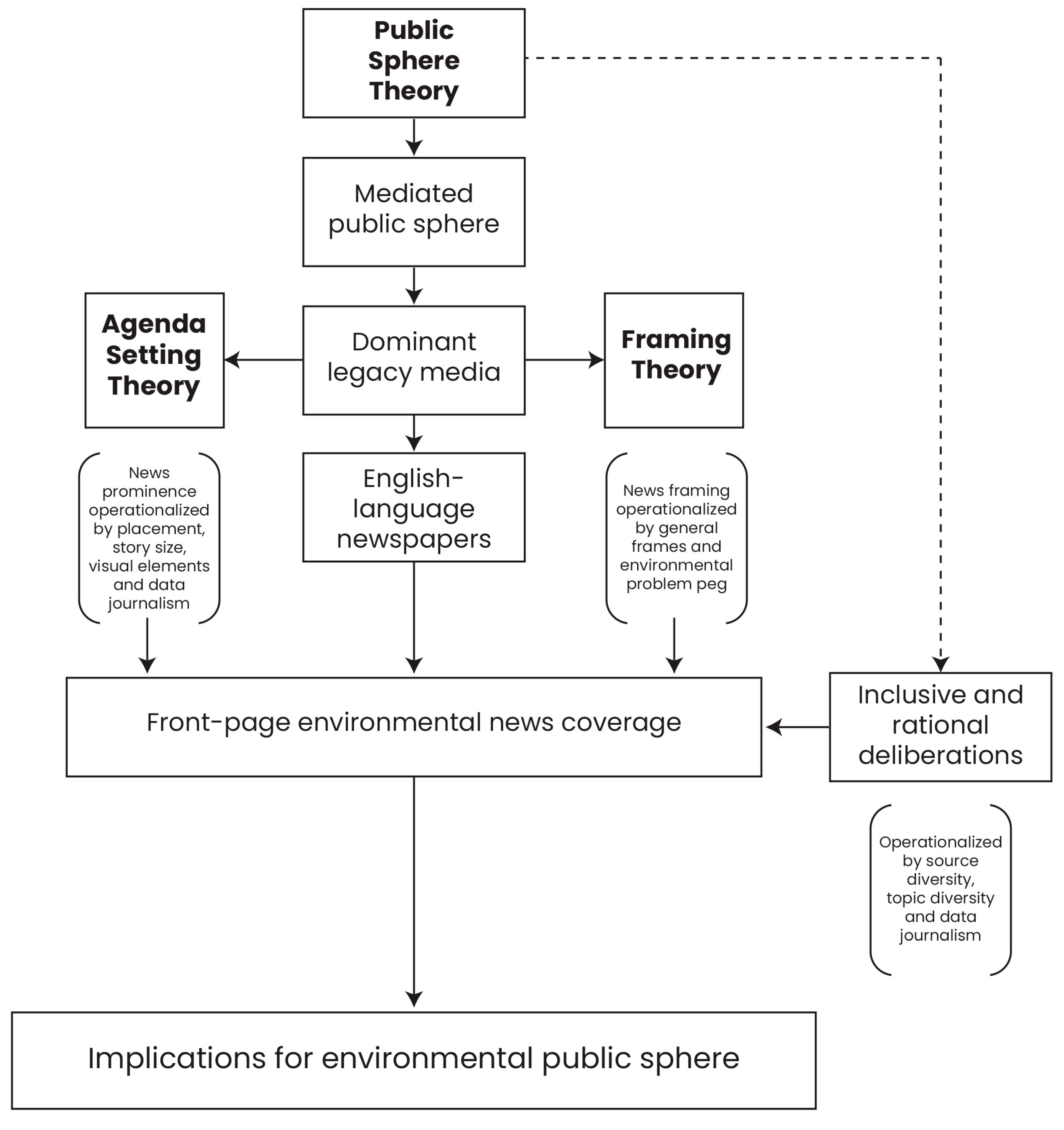
1.2. Theoretical Framework
1.2.1. Public Sphere and English-Language Newspapers in India
1.2.2. Agenda Setting, News Framing and the Environmental Public Sphere
2. Materials and Methods
2.1. Sampling
2.2. Unit of Analysis
2.3. Measuring Story Prominence
2.4. Measuring Inclusive and Rational Deliberations
2.5. Framing Parameters
3. Results
3.1. Story Prominence
3.2. Inclusive and Rational Deliberations
3.2.1. Topic Diversity
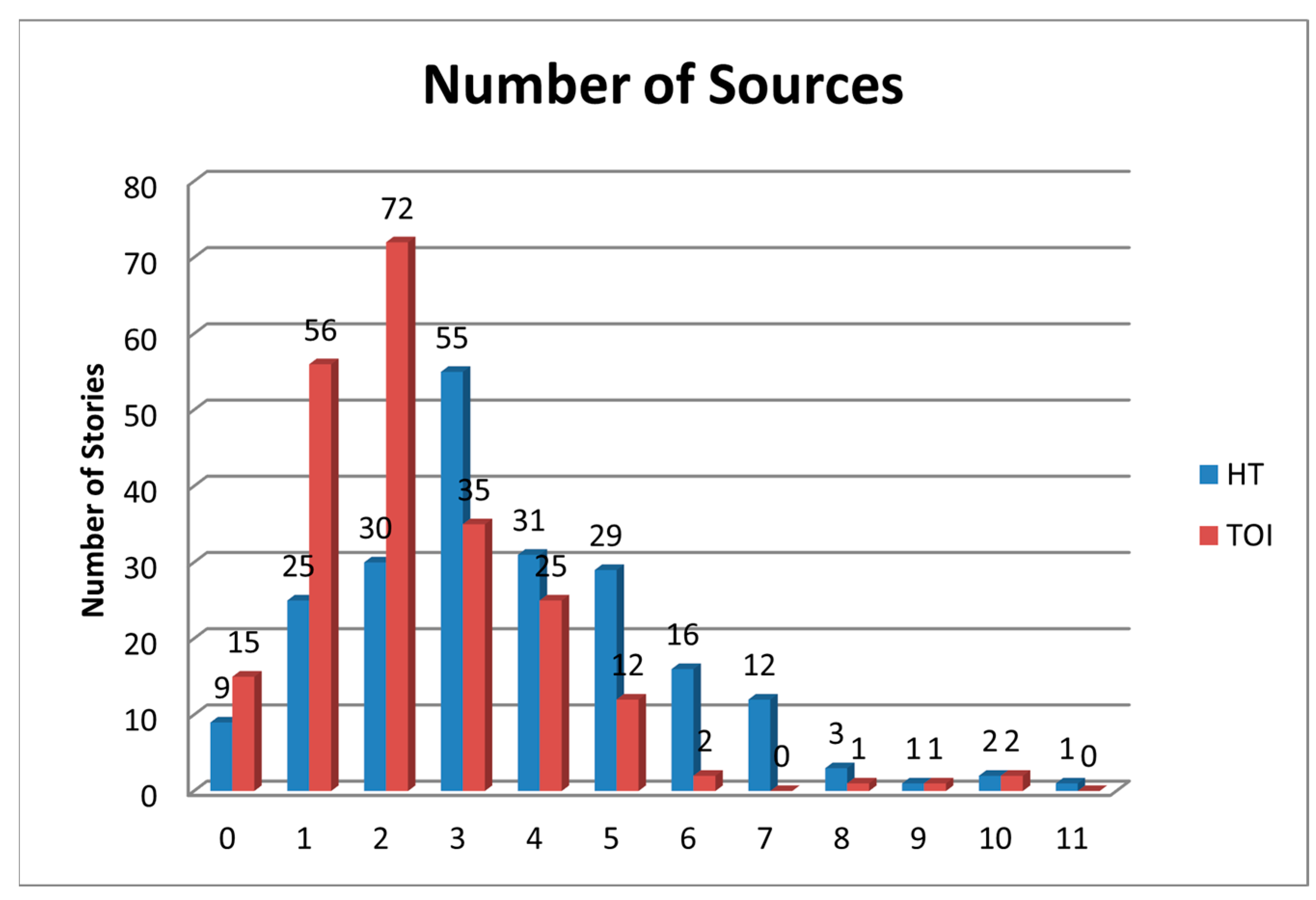
3.2.2. Source Diversity
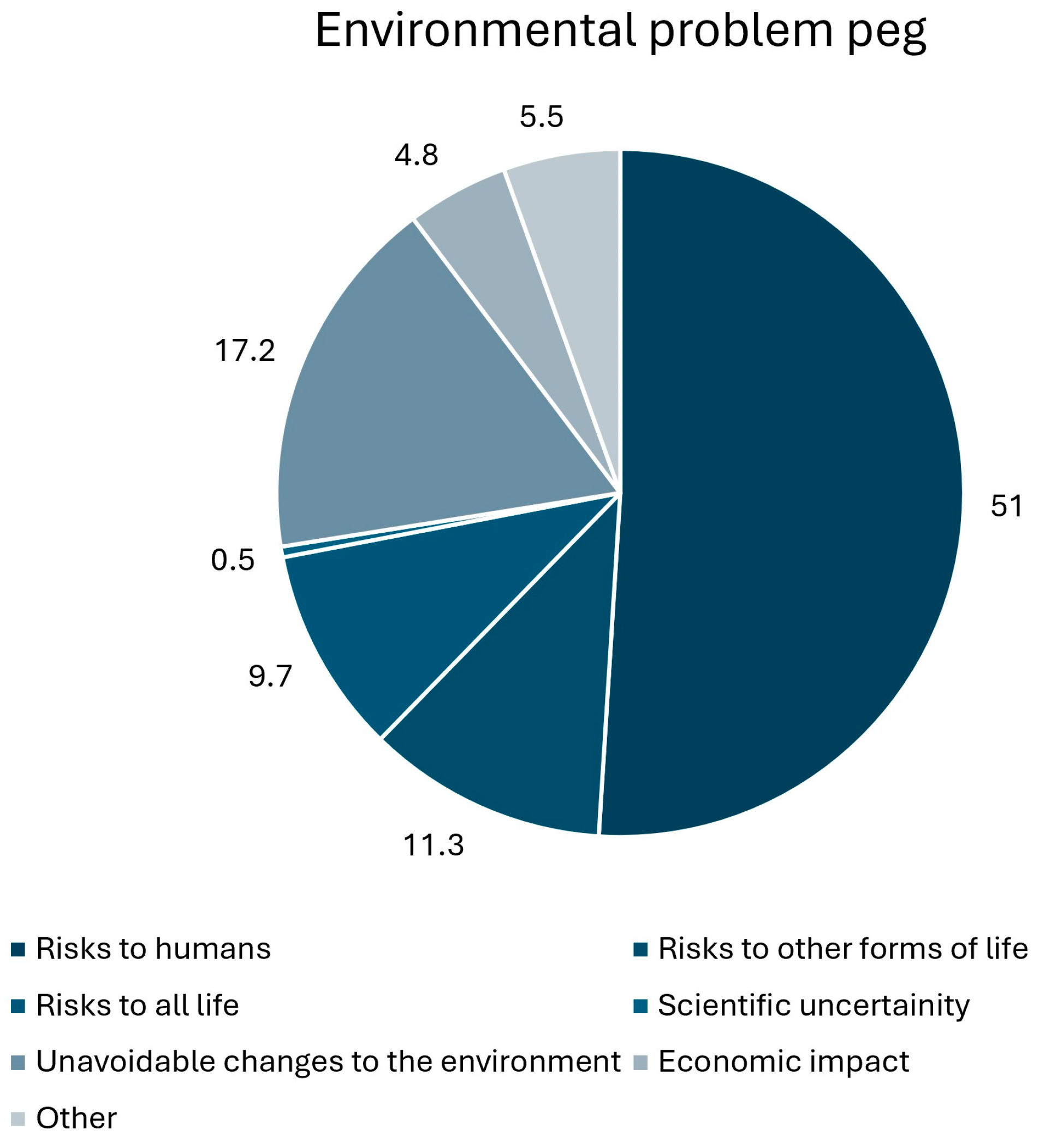
3.3. Frame Analysis
3.4. Statistical Analysis
4. Discussion
4.1. Focus on Extreme and Unusual Weather Patterns
4.2. Shortcomings in Inclusive and Rational Deliberations
4.3. Problem-Centric, Adversarial, and Anthropocentric Framing
5. Conclusions
Supplementary Materials
Funding
Institutional Review Board Statement
Informed Consent Statement
Data Availability Statement
Conflicts of Interest
References
- Abalo, E., & Olausson, U. (2023). An environmental problem in the making: How media logic molds scientific uncertainty in the production of news about artificial turf in Sweden. Journal of Science Communication, 22(1), A01. [Google Scholar] [CrossRef]
- Aram, A. (2012). Why do media academics keep off environmental reporting? Asia Pacific Media Educator, 22(2), 243–252. [Google Scholar] [CrossRef]
- Baah-Acheamfour, K., & Lamptey-George, J. (2025). What makes the headlines: A five-year analysis of the front page of the Ghanaian Times. Journal of Arts, Humanities and Social Science, 2(2), 159–167. [Google Scholar] [CrossRef]
- Banerjee, S., & Kumar, A. (2026). To print or not to print: Indian English newspapers and the ensnaring economic quandary. Journal of Media Business Studies, 1–26. [Google Scholar] [CrossRef]
- Banerjee, S., & Shukla, A. K. (2023). How the English language newspapers in India weathered a pandemic. The Round Table, 112(4), 376–385. [Google Scholar] [CrossRef]
- Baviskar, A. (2011). Cows, cars and cycle-rickshaws: Bourgeois environmentalism and the battle for Delhi’s streets. In A. Baviskar, & R. Ray (Eds.), Elite and everyman: The cultural politics of the Indian middle classes (pp. 391–418). Routledge. [Google Scholar]
- Begum, A. M., & Mobin, M. A. (2025). A machine learning approach to carbon emissions prediction of the top eleven emitters by 2030 and their prospects for meeting Paris agreement targets. Scientific Reports, 15(1), 19469. [Google Scholar] [CrossRef] [PubMed]
- Belair-Gagnon, V., Mishra, S., & Agur, C. (2013). Reconstructing the Indian public sphere: Newswork and social media in the Delhi gang rape case. Journalism, 15(8), 1059–1075. [Google Scholar] [CrossRef]
- Berelson, B. (1952). Content analysis in communication research. Free Press. [Google Scholar]
- Biswas, A. (2024). Most of the circulation figures of print newspapers in India illustrate the strong hold of Indian languages. International Journal for Research in Applied Science and Engineering Technology, 12(1), 101–104. [Google Scholar] [CrossRef]
- Boora, S., & Karakunnel, M. T. (2023). Media framing of Indian green fiscal policy: A survey of environmental policies across online news portals. Environment and Ecology Research, 11(5), 712–726. [Google Scholar] [CrossRef]
- Bora, A., & Kumar, A. (2025). India’s green dilemma: Balancing economic growth, environmental crisis and political will. SSRN Electronic Journal. [Google Scholar] [CrossRef]
- Boukes, M., Jones, N. P., & Vliegenthart, R. (2020). Newsworthiness and story prominence: How the presence of news factors relates to upfront position and length of news stories. Journalism, 23(1), 98–116. [Google Scholar] [CrossRef]
- Bowd, K. (2017). Keeping it local: News themes on regional newspaper front pages. Australian Journalism Review, 39(1), 63–76. [Google Scholar]
- Boykoff, M. T. (2009). We speak for the trees: Media reporting on the environment. Annual Review of Environment and Resources, 34(1), 431–457. [Google Scholar] [CrossRef]
- Boykoff, M. T., & Rajan, S. R. (2007). Signals and noise. EMBO Reports, 8(3), 207–211. [Google Scholar] [CrossRef] [PubMed]
- Carter, M. J. (2013). The hermeneutics of frames and framing: An examination of the media’s construction of reality. Sage Open, 3(2), 1–12. [Google Scholar] [CrossRef]
- Catalan-Matamoros, D., & Elías, C. (2020). Vaccine hesitancy in the age of coronavirus and fake news: Analysis of journalistic sources in the Spanish quality press. International Journal of Environmental Research and Public Health, 17(21), 8136. [Google Scholar] [CrossRef] [PubMed]
- Cielemęcka, O., & Daigle, C. (2019). Posthuman sustainability: An ethos for our anthropocentric future. Theory Culture & Society, 36(7–8), 67–87. [Google Scholar] [CrossRef]
- Coche, R., & Bell, T. R. (2023). Front-page prominence and newspaper ownership: Examining US women’s national team coverage after 2015 and 2019 World Cup victories. Journalism, 25(3), 710–728. [Google Scholar] [CrossRef]
- Costanza-Chock, S., & Rey-Mazón, P. (2016). PageOneX: New approaches to newspaper front page analysis. International Journal of Communication, 10, 2318–2345. [Google Scholar] [CrossRef] [PubMed]
- Cox, R., & Pezzullo, P. C. (2015). Environmental communication and the public sphere (4th ed.). Sage Publications. [Google Scholar]
- Cristancho, C., & Wouters, R. (2021). Protesters at the news gates: An experimental study of journalists’ news judgment of protest events. Communications, 47(2), 262–285. [Google Scholar] [CrossRef]
- Cullinan, K. (2024, March 20). Eighty three of 100 most polluted cities are in India, but lack of monitoring influences global ranking. Health Policy Watch. Available online: https://healthpolicy-watch.news/eighty-three-of-100-most-polluted-cities-are-in-india-but-lack-of-monitoring-influences-global-ranking/ (accessed on 8 November 2024).
- Deb, K., Kohli, P. C., & Thacker, D. P. (2023, February 27). Unpacking India’s green growth budget. Center on Global Energy Policy at Columbia University. Available online: https://www.energypolicy.columbia.edu/unpacking-indias-green-growth-budget/ (accessed on 8 November 2024).
- Dixit, P., Kodali, R., Pandey, P., Sharma, D., & Sinhal, A. (2025). Green coverage: How Indian print media is shaping the sustainability narrative on climate. International Journal of Environmental Sciences, 11, 1842–1849. [Google Scholar] [CrossRef]
- Djerf-Pierre, M. (2012). The crowding-out effect. Journalism Studies, 13(4), 499–516. [Google Scholar] [CrossRef]
- Dobson, A., MacGregor, S., Torgerson, D., & Saward, M. (2009). Trajectories of green political theory. Contemporary Political Theory, 8(3), 317–350. [Google Scholar] [CrossRef]
- Dwivedy, A. K., Kara, P., Sriranjan, P., Nayak, B., & Jena, B. K. (2023). Climate communication and Indian media: Challenges and responses. Issues in Social Science, 11(1), 17. [Google Scholar] [CrossRef]
- Entman, R. M. (1993). Framing: Toward clarification of a fractured paradigm. Journal of Communication, 43(4), 51–58. [Google Scholar] [CrossRef]
- Express News Service. (2025, September 12). 2.77% jump in newspaper circulation for Jan-June period this year: ABC. The Indian Express. Available online: https://indianexpress.com/article/india/2-77-jump-in-newspaper-circulation-for-jan-june-period-this-year-abc-10244858/ (accessed on 18 November 2025).
- Fischer, R., & Jarren, O. (2024). The platformization of the public sphere and its challenge to democracy. Philosophy & Social Criticism, 50(1), 200–215. [Google Scholar]
- Follmann, A. (2016). The role of environmental activists in governing riverscapes: The case of the Yamuna in Delhi, India. South Asia Multidisciplinary Academic Journal, 14. [Google Scholar] [CrossRef]
- Gamson, W. A., & Modigliani, A. (1987). The changing culture of affirmative action. In R. G. Braungart, & M. M. Braungart (Eds.), Research in political sociology (Vol. 3, pp. 137–177). JAI Press. [Google Scholar]
- Garman, A. (2019). The public sphere and journalism. In Oxford research encyclopedia of communication. Oxford University Press. [Google Scholar]
- Gibson, T. A., Craig, R. T., Harper, A. C., & Alpert, J. M. (2015). Covering global warming in dubious times: Environmental reporters in the new media ecosystem. Journalism, 17(4), 417–434. [Google Scholar] [CrossRef]
- Gupta, A., Awasthy, D., & Mehta, P. K. (2025). The impact of international environmental agreements on national policy. International Journal of Environmental Sciences, 11(8s), 122–130. [Google Scholar] [CrossRef]
- Habermas, J. (1989). The structural transformation of the public sphere. Polity Press. [Google Scholar]
- Hansen, A. (2011). Communication, media and environment: Towards reconnecting research on the production, content and social implications of environmental communication. International Communication Gazette, 73(1–2), 7–25. [Google Scholar] [CrossRef]
- Hansen, A. (2019). Environment, media and communication (2nd ed.). Routledge. [Google Scholar]
- Higgins, M. (2006). Substantiating a political public sphere in the Scottish press: A comparative analysis. Journalism, 7(1), 25–44. [Google Scholar] [CrossRef]
- Igini, M. (2024, February 19). 5 biggest environmental issues in India. Earth.org. Available online: https://earth.org/environmental-issues-in-india/ (accessed on 29 July 2025).
- Karlberg, M. (1997). News and conflicts: How adversarial news frames limit public understanding of environmental issues. Alternatives Journal, 23(1), 22–28. [Google Scholar]
- Kashyap, G., Bhaskaran, H., & Mishra, H. (2020). “We need to find a revenue model”: Data journalists’ perceptions on the challenges of practicing data journalism in India. Observatorio (OBS*), 14(2), 1–18. [Google Scholar] [CrossRef]
- Keller, T. R., Hase, V., Thaker, J., Mahl, D., & Schäfer, M. S. (2020). News media coverage of climate change in India 1997–2016: Using automated content analysis to assess themes and topics. Environmental Communication, 14(2), 219–235. [Google Scholar] [CrossRef]
- Kiflu, G. K., Ali, A. C., & Nigussie, H. (2022). Media and public sphere in Ethiopia: Mediated deliberations in public and commercial television programs. Journalism, 24(5), 1109–1129. [Google Scholar] [CrossRef]
- Kim, J., Zhang, Y., & Borah, P. (2024). Second-level agenda-setting effects of news media and public policy on social media discourse across platforms: Immigration during the COVID-19 pandemic in the U.S. Information, Communication & Society, 28(11), 1923–1944. [Google Scholar] [CrossRef]
- Kopnina, H., Washington, H., Taylor, B., & Piccolo, J. J. (2018). Anthropocentrism: More than just a misunderstood problem. Journal of Agricultural and Environmental Ethics, 31(1), 109–127. [Google Scholar] [CrossRef]
- Kozina, S., Kowalski, M., Vlastelica, M., Mastelić, T., & Borovac, J. A. (2019). Traumatic memory of one’s son gone missing in war: Content analysis using Krippendorff’s Alpha. Sage Open, 9(1), 1–9. [Google Scholar] [CrossRef]
- Kumar, M., & Nargunde, S. (2026). Framing analysis of climate change communication on digital media portals—Down to earth and Carboncopy. International Journal for Multidisciplinary Research, 8, 1–11. [Google Scholar] [CrossRef]
- Le, E. (2012). Gateways to the news: Headlines on Le Monde’s home page and front page. Discourse, Context & Media, 1(1), 32–44. [Google Scholar] [CrossRef]
- Marzi, G., Balzano, M., & Marchiori, D. (2024). K-alpha calculator–Krippendorff’s alpha calculator: A user-friendly tool for computing Krippendorff’s alpha inter-rater reliability coefficient. MethodsX, 12, 102545. [Google Scholar] [CrossRef] [PubMed]
- McCombs, M. E., Barrios, M. M., & Garcés, M. (2023). Rethinking environmental news coverage through agenda-setting and the normative function of attributes. Comunicación y Sociedad, 20, e8574. [Google Scholar] [CrossRef]
- McCombs, M. E., & Shaw, D. L. (1972). The agenda-setting function of mass media. Public Opinion Quarterly, 36(1), 176–187. [Google Scholar] [CrossRef]
- Mishra, M. (2020). Environmental journalism in India: Past, present, and future. In D. B. Sachsman, & J. M. Valenti (Eds.), Routledge handbook of environmental journalism (pp. 291–305). Routledge. [Google Scholar]
- Mittal, R. (2012). Climate change coverage in Indian print media: A discourse analysis. The International Journal of Climate Change Impacts and Responses, 3(2), 219–232. [Google Scholar] [CrossRef]
- Mohanty, A., & Wadhawan, S. (2021). Mapping India’s climate vulnerability: A district-level assessment. Council on Energy, Environment and Water. Available online: https://www.ceew.in/publications/mapping-climate-change-vulnerability-index-of-india-a-district-level-assessment (accessed on 29 July 2025).
- Moon, R., Boukouvidis, T., & Ramirez, F. (2024). Assessing physical and digital news spaces: Placemaking in global south journalism. Journalism Practice, 20(1), 165–187. [Google Scholar] [CrossRef]
- MyGov. (2023). G20 archive. Available online: https://static.mygov.in/archive/g20/index.html (accessed on 17 July 2025).
- Nicoletta, G. C., & Yüksek, D. (2023). Strategies and tactics to communicate nature: Beyond anthropocentrism in Swedish media. Journal of Communication Inquiry, 47(4), 434–456. [Google Scholar] [CrossRef]
- Nimmo, D., & Combs, J. E. (1983). Mediated political realities. Longman. [Google Scholar]
- Nirmala, T., & Aram, I. A. (2018). Environmental images in Indian newspapers. Asia Pacific Media Educator, 28(1), 38–54. [Google Scholar] [CrossRef]
- Painter, J., & Ashe, T. (2012). Cross-national comparison of the presence of climate scepticism in the print media in six countries, 2007–10. Environmental Research Letters, 7(4), 044005. [Google Scholar] [CrossRef]
- Patel, K., Adhikary, R., Patel, Z. B., Batra, N., & Guttikunda, S. (2022). Samachar: Print news media on air pollution in India. In ACM SIGCAS/SIGCHI conference on computing and sustainable societies (COMPASS): June 29–July 1 (pp. 1–13). Association for Computing Machinery. [Google Scholar] [CrossRef]
- Poornananda, D. S. (2022). Environmental journalism: Reporting on environmental concerns and climate change in India. Sage Publishing India. [Google Scholar]
- Prajjwal, P., & Kumar, A. (2025). Rethinking ecology: Gandhi, duties, and the limits of rights-based ethics. Intersections: A Journal of Literary and Cultural Studies, 5(11), 159–171. [Google Scholar] [CrossRef] [PubMed]
- Prasad, R. (2019). Digital disruption? Journalism startups in India. Journalism, 22(8), 2122–2138. [Google Scholar] [CrossRef]
- Press Information Bureau. (2022, December 10). G-20 and India’s Presidency. Ministry of Information and Broadcasting, Government of India. Available online: https://www.pib.gov.in/PressReleasePage.aspx?PRID=1882356 (accessed on 16 May 2026).
- Qusien, R., & Robbins, D. (2024). Science journalism in Pakistan: The challenges faced by environmental reporters. Journalism Studies, 25(5), 459–479. [Google Scholar]
- Rajagopal, A. (2004). Politics after television: Hindu nationalism and the reshaping of the public in India. Cambridge University Press. [Google Scholar]
- Rao, U. (2010). News as culture: Journalistic practices and the remaking of Indian leadership traditions (Vol. 3). Berghahn Books. [Google Scholar]
- Ravikumar, M., Downey, J., Bhargav, N., Deb, D., Dasgupta, R. K., & Pavarala, V. (2024). Media and citizenship in India: Heteronomy and autonomy in the Indian journalistic field. Journalism Studies, 25(15), 1813–1833. [Google Scholar] [CrossRef]
- Romeu, H. C. (2025). Framing in climate change communication and its influence on ideological divides. Glocality, 8(1), 1–24. [Google Scholar] [CrossRef]
- Sabareesh, P. A., & Sony, R. A. L. (2022). Ecocentric approach of science from the perspective of Mahatma Gandhi and Rabindranath Tagore: Exploring sustainability and ethics amidst British colonialism. Journal of Scientific Temper, 10(1&2), 121–131. [Google Scholar] [CrossRef]
- Saleem, M., & Khattak, N. R. (2025). Anthropocentric and ecocentric perspectives in environmental news: A corpus-assisted ecolinguistic study. Journal of Corpus Linguistics, 8(1), 36–45. [Google Scholar]
- Schulz, W. F. (1982). News structure and people’s awareness of political events. Gazette, 30(3), 139–153. [Google Scholar] [CrossRef]
- Serafis, D., & Tseronis, A. (2023). The front page as a canvas for multimodal argumentation: Brexit in the Greek press. Frontiers in Communication, 8, 1230632. [Google Scholar] [CrossRef]
- Shastri, S. C. (2013). Environmental ethics anthropocentric to eco-centric approach: A paradigm shift. Journal of the Indian Law Institute, 55(4), 522–530. [Google Scholar]
- Shoemaker, P. J., & Reese, S. D. (1996). Mediating the message: Theories of influences on mass media content. Allyn & Bacon. [Google Scholar]
- Simon, A., & Xenos, M. (2000). Media framing and effective public deliberation. Political Communication, 17(4), 363–376. [Google Scholar] [CrossRef]
- Ståhlberg, P. (2013). Writing society through media: Ethnography of a Hindi daily. Orient Blackswan. [Google Scholar]
- The Hindu Bureau. (2023, February 1). Budget 2023|What are the Centre’s initiatives for ‘Green Growth’ and energy transition? The Hindu. Available online: https://www.thehindu.com/news/national/budget-2023-energy-transition-carbon-reduction-policies/article66457760.ece (accessed on 17 July 2025).
- Thirumalaiah, N., & Aram, A. (2017). Framing of environment in English and Tamil newspapers in India. Journal of Media and Communication Studies, 9(1), 1–9. [Google Scholar] [CrossRef]
- Thirumalaiah, N., & Aram, A. I. (2020). Climate change and sustainability issues in Indian newspapers. In Handbook of research on recent developments in internet activism and political participation (pp. 189–206). IGI Global. [Google Scholar] [CrossRef]
- Tiseo, I. (2024). Carbon dioxide (CO2) emissions from fossil fuel and industrial purposes in India from 1970 to 2023. Statista. Available online: https://www.statista.com/statistics/486019/co2-emissions-india-fossil-fuel-and-industrial-purposes/ (accessed on 10 April 2026).
- Tong, J. (2014). Environmental risks in newspaper coverage: A framing analysis of investigative reports on environmental problems in 10 Chinese newspapers. Environmental Communication, 8(3), 345–367. [Google Scholar] [CrossRef]
- Tong, J., & Zuo, L. (2019). The inapplicability of objectivity: Understanding the work of data journalism. Journalism Practice, 15(2), 153–169. [Google Scholar] [CrossRef]
- Udupa, S. (2015). News, publics and politics in globalising India: Media, publics, politics. Cambridge University Press. [Google Scholar]
- Umamaheswaran, S., Dar, V., & Thaker, J. (2022). The evolution of climate change reporting in business media: Longitudinal analysis of a business newspaper. Sustainability, 14(22), 15214. [Google Scholar] [CrossRef]
- Vilanilam, J. V. (1993). Science communication and development. Sage Publications. [Google Scholar]
- Wheatley, D. (2020). A typology of news sourcing: Routine and non-routine channels of production. Journalism Practice, 14(3), 277–298. [Google Scholar] [CrossRef]



| Environmental News Category | Description |
|---|---|
| Animal Welfare | Protection of pets, domestic, stray and captive animals, birds, livestock, fisheries, and marine resources |
| Alternative Sources of Energy | Non-fossil fuel energy sources including solar, biomass, wind, and nuclear energy |
| Biodiversity | Importance of biodiversity; current status of biodiversity |
| Environment & Agriculture | GMO, environmental degradation due to farming and livestock industry, and organic food production |
| Environment & Culture | Impact of environmental problems on cultural heritage |
| Environment & Energy Conservation | Issues and developments related to conservation of environment and energy sources |
| Environmental Policies and Legislation | Environmental law, diplomacy, policy, debates |
| Forest Conservation | Afforestation, forest legislation, importance of forests, forest fires |
| Green Products and Practices | Related to environment-friendly products and practices such as green architecture |
| Natural Disasters | Large-scale extreme events resulting from natural or environmental phenomena |
| Natural Resources | Related to use and misuse of natural resources other than water |
| Pollution, Deforestation and Other Environmental Degradation | Includes air/water quality, noise pollution, desertification, deforestation, acid rain and acidification, degradation of ecologically sensitive area |
| Sustainable Development | Issues and developments related to sustainable development |
| Tourism and Environment | Environmental impact of tourism, ecotourism |
| Waste Management | Solid waste management, landfills, sewage systems |
| Water Conservation and Water Resources Management | Management and conservation of water as a natural resource |
| Weather Events | Extreme/severe/freakish weather, changes in weather patterns, global warming, greenhouse effect and discussions around climate change |
| Weather Updates | General weather reporting and forecasts |
| Wildlife and Ornithology | Related to threats, concerns and efforts to protect wildlife |
| Workplace Environment | Including work hazards and safety, pollution and toxic substances in the workplace (not general accidents) |
| Other | All other environmental topics that cannot be classified in any of the above |
| General Frames | |
| Ailing Planet (Karlberg, 1997) | Stories highlighting environmental problems such as environmental degradation, threats, and crises, as well as consequences of such problems. e.g., Weather trends show Capital no longer gets benign fog as polluted smog rules winter skies (HT, 4 January 2023) |
| Source of Conflict | Stories where the central issue is about the environment or environmental actors/developments becoming a source of conflict. e.g., Water crisis in city, Bharadwaj blames illegal Yamuna sand mining in Haryana (TOI, 8 March 2023) |
| Crisis Management | Stories that focus on efforts to resolve an environment-related problem after an environmental crisis has struck. e.g., Resettlement hangs fire in Joshimath as report awaited (HT, 4 April 2023) |
| Reason to Hope | Stories that report environmental developments that are likely to have positive repercussions in the future. e.g., How India’s coastal forests could become a goldmine (TOI, 21 April 2023) |
| Source of Pride | Stories related to the achievement of environmental and sustainable development goals. e.g., Skill devpt in green mode: Ministry HQ designed around 3 thriving trees (TOI, 27 May 2023) |
| Weather Info | Neutral stories that provide information on the weather. e.g., Light rainfall predicted today after wet Sunday (HT, 30 January 2023) |
| Other | Stories that cannot be included in any of the above frames. e.g., Tiger Anthem launched by TOI gets 100m views (TOI, 9 June 2023) |
| Environmental Problem Peg | |
| Environment-related risks to humans | Stories focusing on losses, damage and difficulties to humans or human life due to an environmental issue. e.g., 26 families evacuated in ‘sinking’ Joshimath (TOI, 5 January 2023) |
| Environment-related risks to other forms of life | Stories focusing on losses and threats to nonhuman entities. e.g., Proposed changes to wildlife law could make species-saving research tougher, say experts (HT, 17 June 2023) |
| Environment-related risks to all life forms | A combination of the above two. e.g., Be careful about green nod to projects in ecologically fragile regions: House panel (TOI, 17 March 2023) |
| Unavoidable changes to environment | Stories that frame environmental development to be beyond human control or intervention. e.g., Summer-like temperatures in spring set off alarm bells (HT, 18 February 2023) |
| Scientific uncertainty | Stories that focus on lack of consensus in the scientific community regarding an environmental issue. e.g., Uncertainty over monsoon as US agency forecasts an early El Nino (TOI, 14 April 2023) |
| Economic impact | Stories focusing on the economic aspect of environmental developments. e.g., Centre forms panel to save wheat from heat (HT, 22 February 2023) |
| Other | Stories that do not fall in any of the above. e.g., Big buzz over aurora-like sighting in Ladakh skies (TOI, 7 May 2023) |
| Rank | News Categories | HT Count | TOI Count | Total | % |
|---|---|---|---|---|---|
| 1 | Weather Events | 69 | 45 | 114 | 26.2069 |
| 2 | Pollution, Deforestation and Other Environmental Degradation | 28 | 51 | 79 | 18.16092 |
| 3 | Weather Update | 41 | 28 | 69 | 15.86207 |
| 4 | Natural Disaster | 18 | 25 | 43 | 9.885057 |
| 5 | Wildlife and Ornithology | 16 | 16 | 32 | 7.356322 |
| 6 | Other | 10 | 11 | 21 | 4.827586 |
| 7 | Environment and Energy Conservation | 3 | 14 | 17 | 3.908046 |
| 8 | Water Conservation and Water Resources Management | 2 | 6 | 8 | 1.83908 |
| 9 | Environmental Policies and Legislation | 6 | 1 | 7 | 1.609195 |
| 10 | Alternative Sources of Energy | 2 | 4 | 6 | 1.37931 |
| 11 | Green Products and Practices | 1 | 5 | 6 | 1.37931 |
| 12 | Sustainable Development | 5 | 1 | 6 | 1.37931 |
| 13 | Waste Management | 2 | 4 | 6 | 1.37931 |
| 14 | Workplace Environment | 1 | 4 | 5 | 1.149425 |
| 15 | Animal Welfare | 3 | 1 | 4 | 0.91954 |
| 16 | Forest Conservation | 2 | 2 | 4 | 0.91954 |
| 17 | Environment and Agriculture | 2 | 0 | 2 | 0.45977 |
| 18 | Environment and Culture | 0 | 2 | 2 | 0.45977 |
| 19 | Natural Resources | 1 | 1 | 2 | 0.45977 |
| 20 | Biodiversity | 1 | 0 | 1 | 0.229885 |
| 21 | Tourism and Environment | 1 | 0 | 1 | 0.229885 |
| TOTAL | 214 | 221 | 435 | 100 |
| Source Type | HT | HT% | TOI | TOI% | TOTAL | % |
|---|---|---|---|---|---|---|
| Government source (government officials/documents/other government source) | 466 | 60.99476 | 290 | 56.42023 | 756 | 59.20125 |
| Scientist/expert | 135 | 17.67016 | 71 | 13.81323 | 206 | 16.13156 |
| Community member (members of the public/residents/affected individuals) | 81 | 10.60209 | 78 | 15.1751 | 159 | 12.45106 |
| Activist | 22 | 2.879581 | 17 | 3.307393 | 39 | 3.054033 |
| Foreign government source | 17 | 2.225131 | 15 | 2.918288 | 32 | 2.505873 |
| UN source | 10 | 1.308901 | 10 | 1.945525 | 20 | 1.566171 |
| Judiciary | 5 | 0.65445 | 11 | 2.140078 | 16 | 1.252937 |
| Other | 6 | 0.78534 | 8 | 1.55642 | 14 | 1.096319 |
| Foreign organization | 10 | 1.308901 | 3 | 0.583658 | 13 | 1.018011 |
| Private organization | 1 | 0.13089 | 7 | 1.361868 | 8 | 0.626468 |
| Politician | 5 | 0.65445 | 3 | 0.583658 | 8 | 0.626468 |
| News agency | 5 | 0.65445 | 1 | 0.194553 | 6 | 0.469851 |
| TOTAL | 764 | 100 | 514 | 100 | 1277 | 100 |
| Variables | HT | TOI | Combined | |||||||
|---|---|---|---|---|---|---|---|---|---|---|
| χ2 Value | df | p-Value | χ2 Value | Df | p-Value | χ2 Value | df | p-Value | ||
| Content analysis categories | Visual Elements | 24.728 | 5 | 0.001 * | 6.616 | 5 | 0.251 | 22.194 | 5 | 0.001 * |
| Data Journalism | 64.84 | 5 | 0.001 * | 48.926 | 5 | 0.001 * | 118.663 | 5 | 0.001 * | |
| Number of sources | 72.468 | 55 | 0.057 | 71.02 | 45 | 0.008 * | 89.618 | 55 | 0.002 * | |
| Placement of Story | 33.832 | 15 | 0.004 * | 36.815 | 10 | 0.001 * | 58.391 | 15 | 0.001 * | |
| Routine Sources | 60.85 | 15 | 0.001 * | 34.09 | 15 | 0.003 * | 73.062 | 15 | 0.001 * | |
| Story Size | 67.103 | 45 | 0.017 * | 75.896 | 50 | 0.010 * | 82.637 | 50 | 0.003 * | |
| Framing categories | General Frames | 310.310 | 30 | 0.001 * | 265.551 | 30 | 0.001 * | 554.854 | 30 | 0.001 * |
| Environmental Problem Peg | 224.351 | 25 | 0.001 * | 251.288 | 30 | 0.001 * | 449.211 | 30 | 0.001 * | |
Disclaimer/Publisher’s Note: The statements, opinions and data contained in all publications are solely those of the individual author(s) and contributor(s) and not of MDPI and/or the editor(s). MDPI and/or the editor(s) disclaim responsibility for any injury to people or property resulting from any ideas, methods, instructions or products referred to in the content. |
© 2026 by the author. Licensee MDPI, Basel, Switzerland. This article is an open access article distributed under the terms and conditions of the Creative Commons Attribution (CC BY) license.
Share and Cite
Unnithan, S. Front-Page Environmental News Coverage and Implications for the Public Sphere: A Study Against the Backdrop of India’s G20 Presidency. Journal. Media 2026, 7, 128. https://doi.org/10.3390/journalmedia7020128
Unnithan S. Front-Page Environmental News Coverage and Implications for the Public Sphere: A Study Against the Backdrop of India’s G20 Presidency. Journalism and Media. 2026; 7(2):128. https://doi.org/10.3390/journalmedia7020128
Chicago/Turabian StyleUnnithan, Sangeetha. 2026. "Front-Page Environmental News Coverage and Implications for the Public Sphere: A Study Against the Backdrop of India’s G20 Presidency" Journalism and Media 7, no. 2: 128. https://doi.org/10.3390/journalmedia7020128
APA StyleUnnithan, S. (2026). Front-Page Environmental News Coverage and Implications for the Public Sphere: A Study Against the Backdrop of India’s G20 Presidency. Journalism and Media, 7(2), 128. https://doi.org/10.3390/journalmedia7020128