

High-Visibility Protest Engagement on Twitter: How Content, Form, and Event Context Interact in Thai Digital Activism


Abstract
1. Introduction
- RQ1: How does event context influence the visibility of high-engagement protest tweets in Thailand?
- RQ2: To what extent do content themes, media formats, and posting time influence retweet visibility, and are these effects dependent on specific protest events?
2. Literature Review
2.1. Platform Visibility, Algorithmic Amplification, and the Politics of Selection
2.2. Affective Publics, Emotional Amplification, and Networked Mobilization
2.3. Event-Contingent Connective Action: Salience, Repression, and Media Witnessing
2.4. Integrating the Three Pillars: Conceptual Framework for the Present Study
3. Methods
3.1. Research Design
3.2. Data Collection and Tweet Selection
3.2.1. Data Collection Procedure
3.2.2. Event Window and Contextual Anchoring
3.2.3. High-Engagement Sampling
3.2.4. Event Context Annotation
3.2.5. Interpreting Retweets as Visibility
3.2.6. Reproducibility
3.3. Thematic Analysis and Coding Procedure
3.4. Variable Construction
3.4.1. Log-Transformed Retweets (LogRetweet)
3.4.2. Content Theme
3.4.3. Media Presence
3.4.4. Time of Tweet (ToT)
3.4.5. Event
3.5. Statistical Analysis
3.6. Ethical Considerations
4. Findings
4.1. Overview of the Statistical Analysis
4.2. Interaction Effects
4.3. Event-Contingent Theme Effects
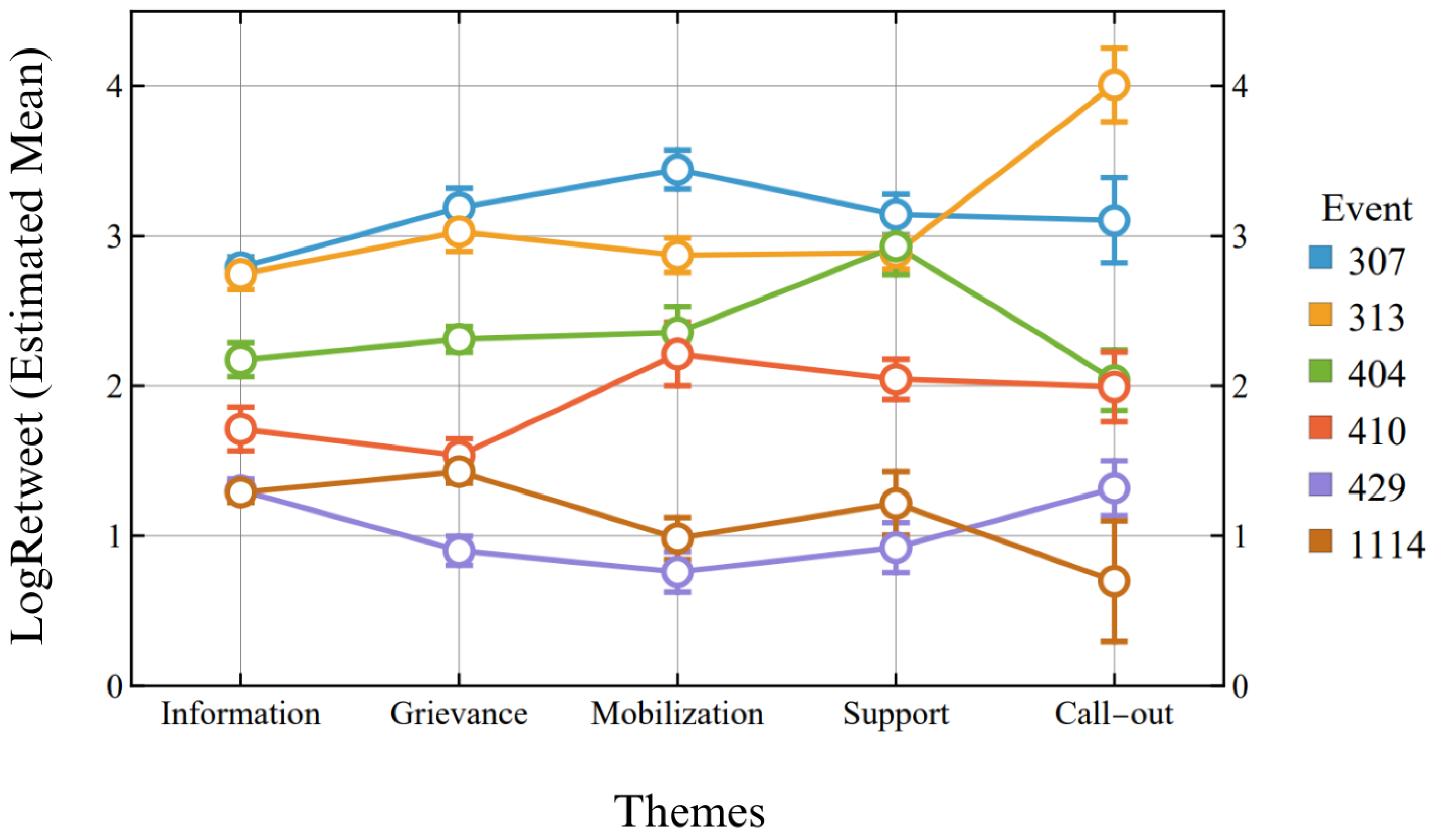
- Within the Information theme, its mean retweet count was significantly lower than that of 9 other events, and higher than that of 4 events.
- Within the Grievance theme, it was significantly lower than that of 4 events, and higher than that of 9 events.
- Within the Mobilization theme, it was lower than that of 9 events, and higher than that of 3 events.
- Within the Support theme, it was lower than that of 12 events, and higher than that of 4 events.
- Within the Call-out theme, it was lower than that of 2 events, and higher than that of 2 events.
4.4. Event-Contingent Media Effects
5. Discussion
5.1. Event Context and Event-Centered Visibility
5.2. Event-Contingent Connective Action
5.3. Context-Sensitive Affective Publics
5.4. Visual Media, Algorithmic Amplification, and Negotiated Visibility
5.5. High-Visibility Discourse and Analytical Scope
5.6. Implications for the Study of Digital Protest
5.7. Contextualizing Western Theoretical Frameworks
6. Conclusions
Author Contributions
Funding
Institutional Review Board Statement
Informed Consent Statement
Data Availability Statement
Acknowledgments
Conflicts of Interest
References
- Altman, D. G. (1991). Practical statistics for medical research. Chapman & Hall. [Google Scholar]
- Association of Internet Researchers. (2020). Internet research: Ethical guidelines 3.0. Available online: https://aoir.org/reports/ethics3.pdf (accessed on 15 October 2025).
- Bakshy, E., Hofman, J. M., Mason, W. A., & Watts, D. J. (2011). Everyone’s an influencer: Quantifying influence on Twitter. In Proceedings of the fourth ACM international conference on web search and data mining (pp. 65–74). Association for Computing Machinery. [Google Scholar] [CrossRef] [Scilit]
- Bennett, W. L., & Segerberg, A. (2012). The logic of connective action: Digital media and the personalization of contentious politics. Information, Communication & Society, 15(5), 739–768. [Google Scholar] [CrossRef] [Scilit]
- Boyd, D. (2010). Social network sites as networked publics: Affordances, dynamics, and implications. In Z. Papacharissi (Ed.), A networked self: Identity, community, and culture on social network sites (pp. 39–58). Routledge. [Google Scholar]
- Brady, W. J., Wills, J. A., Jost, J. T., Tucker, J. A., & Van Bavel, J. J. (2017). Emotion shapes the diffusion of moralized content in social networks. Proceedings of the National Academy of Sciences of the United States of America, 114(28), 7313–7318. [Google Scholar] [CrossRef] [Scilit] [PubMed]
- Braun, V., & Clarke, V. (2006). Using thematic analysis in psychology. Qualitative Research in Psychology, 3(2), 77–101. [Google Scholar] [CrossRef] [Scilit]
- Bruns, A., & Hanusch, F. (2017). Conflict imagery in a connective environment: Audiovisual content on Twitter following the 2015/2016 terror attacks in Paris and Brussels. Media, Culture & Society, 39(8), 1122–1141. [Google Scholar] [CrossRef] [Scilit]
- Bucher, T. (2018). If… then: Algorithmic power and politics. Oxford University Press. [Google Scholar]
- Charoenthansakul, T., & Natee, W. (2023). Twitter and the protest movement in Thailand: A thematic analysis of highly retweeted tweets during the pro-democracy protests. First Monday, 28(6). [Google Scholar] [CrossRef] [Scilit]
- Gillespie, T. (2014). The relevance of algorithms. In T. Gillespie, P. J. Boczkowski, & K. A. Foot (Eds.), Media technologies: Essays on communication, materiality, and society (pp. 167–194). MIT Press. [Google Scholar]
- Hermida, A., Lewis, S. C., & Zamith, R. (2014). Sourcing the Arab spring: A case study of Andy Carvin’s sources on Twitter during the Tunisian and Egyptian revolutions. Journal of Computer-Mediated Communication, 19(3), 479–499. [Google Scholar] [CrossRef] [Scilit]
- Highfield, T. (2016). Social media and everyday politics. Polity Press. [Google Scholar]
- Howard, P. N., & Hussain, M. M. (2013). Democracy’s fourth wave? Digital media and the Arab Spring. Oxford University Press. [Google Scholar]
- Huszár, F., Ktena, S. I., O’Brien, C., Belli, L., Schlaikjer, A., & Hardt, M. (2022). Algorithmic amplification of politics on Twitter. Proceedings of the National Academy of Sciences, 119(1), e2025334119. [Google Scholar] [CrossRef] [Scilit] [PubMed]
- Keppel, G., & Wickens, T. D. (2004). Design and analysis: A researcher’s handbook (4th ed.). Pearson Prentice Hall. [Google Scholar]
- King, G., Pan, J., & Roberts, M. E. (2013). How censorship in China allows government criticism but silences collective expression. American Political Science Review, 107(2), 326–343. [Google Scholar] [CrossRef] [Scilit]
- Kongkirati, P., & Kanchoochat, V. (2018). The Prayuth regime: Embedded military and hierarchical capitalism in Thailand. TRaNS: Trans-Regional and-National Studies of Southeast Asia, 6(2), 279–305. [Google Scholar] [CrossRef] [Scilit]
- Landis, J. R., & Koch, G. G. (1977). The measurement of observer agreement for categorical data. Biometrics, 33(1), 159–174. [Google Scholar] [CrossRef] [Scilit] [PubMed]
- Lindekilde, L. (2014). Discourse and frame analysis in-depth. In D. Della Porta (Ed.), Methodological practices in social movement research (pp. 195–227). Oxford University Press. [Google Scholar]
- Lotan, G., Graeff, E., Ananny, M., Gaffney, D., Pearce, I., & Boyd, D. (2011). The revolutions were tweeted: Information flows during the 2011 Tunisian and Egyptian revolutions. International Journal of Communication, 5, 1375–1405. [Google Scholar]
- McAdam, D., & Snow, D. A. (Eds.). (2010). Readings on social movements: Origins, dynamics, and outcomes (2nd ed.). Oxford University Press. [Google Scholar]
- Milli, S., Carroll, M., Pandey, S., Wang, Y., & Dragan, A. (2023). Twitter’s algorithm: Amplifying anger, animosity, and affective polarization. arXiv. [Google Scholar] [CrossRef] [Scilit]
- Papacharissi, Z. (2015). Affective publics: Sentiment, technology, and politics. Oxford University Press. [Google Scholar]
- Phatthiyaphaibun, W., Phatthiyaphaibun, T., & Sornlertlamvanich, V. (2021). Evaluating Thai sentiment analysis tools in political contexts. In Proceedings of the 35th Pacific Asia conference on language, information and computation (pp. 112–121). Association for Computational Lingustics. [Google Scholar]
- Phoborisut, P. (2021). Reimagining dissent in Thailand’s 2020 uprising. SAIS Review of International Affairs, 40(2), 43–55. [Google Scholar] [CrossRef] [Scilit]
- Sewell, W. H., Jr. (1996). Historical events as transformations of structures: Inventing revolution at the Bastille. Theory and Society, 25(6), 841–881. [Google Scholar] [CrossRef] [Scilit]
- Sinpeng, A. (2021). Hashtag activism: Social media and the #FreeYouth protests in Thailand. Critical Asian Studies, 53(2), 192–205. [Google Scholar] [CrossRef] [Scilit]
- Sombatpoonsiri, J. (2021). The dark side of civil society? How Thailand’s civic networks foster autocracy. Melbourne Asia Review, (6). [Google Scholar] [CrossRef] [Scilit]
- Sombatpoonsiri, J. (2023). “A lot of people still love and worship the monarchy”: How polarizing frames trigger countermobilization in Thailand. Journal of Peace Research, 60(6), 1048–1063. [Google Scholar] [CrossRef] [Scilit]
- Stieglitz, S., & Dang-Xuan, L. (2013). Emotions and information diffusion in social media: Sentiment of microblogs and sharing behavior. Journal of Management Information Systems, 29(4), 217–248. [Google Scholar] [CrossRef] [Scilit]
- Tufekci, Z. (2017). Twitter and tear gas: The power and fragility of networked protest. Yale University Press. [Google Scholar]
- Tufekci, Z., & Wilson, C. (2012). Social media and the decision to participate in political protest: Observations from Tahrir Square. Journal of Communication, 62(2), 363–379. [Google Scholar] [CrossRef] [Scilit]


| Theme | Sub-Theme |
|---|---|
| Theme 1: Information Dissemination | Protest situations |
| Police action | |
| General movement information | |
| Theme 2: Grievance Expression | Mainstream media |
| Police officers | |
| Government and the Prime Minister | |
| Monarchy | |
| Political opponents | |
| Theme 3: Mobilization | Support for gatherings |
| Information forwarding | |
| Boycott of goods/influencers | |
| Support for goods/influencers | |
| Theme 4: Moral Support | Care for protestors |
| Admiration for protestors and supporters | |
| General protest support | |
| Theme 5: Call-outs for Action | Release of detained individuals |
| Calling out influencers for political expression | |
| Tactical reviews of protest strategies |
| Source | SS | df | MS | F | p | η2p |
|---|---|---|---|---|---|---|
| Theme | 1.35 | 4 | 0.34 | 2.08 | 0.08 | 0.006 |
| Event | 620.81 | 20 | 31.04 | 191.8 | <0.001 * | 0.72 |
| ToT | 0.85 | 3 | 0.28 | 1.76 | 0.15 | 0.004 |
| Media | 1.2 | 1 | 1.2 | 7.41 | 0.010 * | 0.005 |
| Theme × Event | 20.52 | 75 | 0.27 | 1.69 | <0.001 * | 0.078 |
| Theme × ToT | 1.97 | 12 | 0.16 | 1.01 | 0.43 | 0.008 |
| Theme × Media | 0.46 | 4 | 0.11 | 0.7 | 0.59 | 0.002 |
| Event × ToT | 7.22 | 56 | 0.13 | 0.8 | 0.86 | 0.03 |
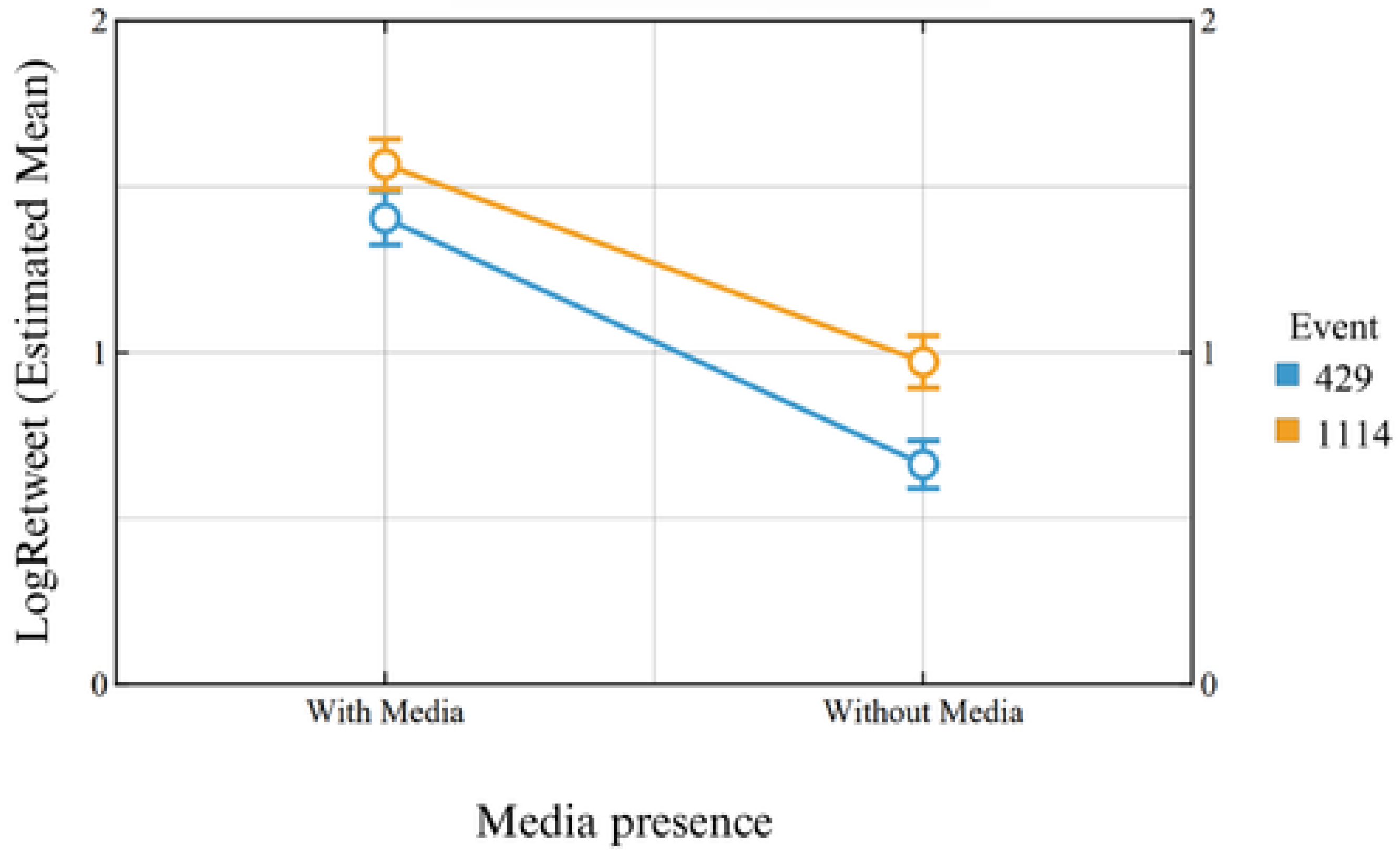
| Event × Media | 6.97 | 20 | 0.35 | 2.15 | 0.002 * | 0.028 |
| ToT × Media | 0.18 | 3 | 0.06 | 0.36 | 0.78 | 0.001 |
| Theme × Event × ToT | 19.73 | 107 | 0.18 | 1.14 | 0.16 | 0.076 |
| Theme × Event × Media | 8.86 | 51 | 0.17 | 1.07 | 0.34 | 0.035 |
| Theme × ToT × Media | 1.72 | 9 | 0.19 | 1.18 | 0.3 | 0.007 |
| Event × ToT × Media | 5.86 | 33 | 0.18 | 1.1 | 0.32 | 0.024 |
| Theme × Event × ToT × Media | 4.13 | 20 | 0.21 | 1.28 | 0.19 | 0.017 |
| Error | 241.3 | 1491 | 0.16 |
| Event | Sum of Squares | df | Mean Square | F | p |
|---|---|---|---|---|---|
| 307 | 3.82 | 4 | 0.95 | 5.89 | <0.001 |
| 313 | 3.78 | 4 | 0.95 | 5.85 | <0.001 |
| 404 | 2.28 | 4 | 0.57 | 3.52 | 0.007 |
| 410 | 2.21 | 4 | 0.55 | 3.41 | 0.009 |
| 429 | 3.23 | 4 | 0.81 | 4.99 | 0.001 |
| 1114 | 1.68 | 4 | 0.42 | 2.60 | 0.035 |
| Event | Comparison Pairs | Mean Difference | p |
|---|---|---|---|
| 307 (Mob 7 March 2021) | Information < Mobilization | −0.651 | <0.001 |
| 313 (Mob 13 March 2021) | Information < Call-out | −1.263 | <0.001 |
| Grievance < Call-out | −0.978 | 0.007 | |
| Mobilization < Call-out | −1.135 | 0.001 | |
| Support < Call-out | −1.118 | 0.001 | |
| 404 (Mob 4 April 2021) | Information < Support | −0.758 | 0.008 |
| Grievance < Support | −0.621 | 0.033 | |
| Support > Call-out | 0.893 | 0.015 | |
| 410 (Mob 10 April 2021) | Information < Mobilization | −0.499 | 0.042 |
| Grievance < Support | −0.508 | 0.042 | |
| 429 (Mob 29 April 2021) | Information > Grievance | 0.402 | 0.014 |
| Information > Mobilization | 0.543 | 0.007 | |
| Grievance < Call-out | −0.417 | 0.042 | |
| 1114 (Mob 14 November 2021) | Information > Mobilization | 0.307 | 0.043 |
| Grievance > Mobilization | 0.446 | 0.016 |
| Theme | Sum of Squares | df | Mean Square | F | p |
|---|---|---|---|---|---|
| Information | 421.82 | 20 | 21.09 | 130.32 | <0.001 |
| Grievance | 506.99 | 20 | 25.35 | 156.64 | <0.001 |
| Mobilization | 232.71 | 20 | 11.64 | 71.90 | <0.001 |
| Support | 139.15 | 20 | 6.96 | 42.99 | <0.001 |
| Call-out | 65.64 | 15 | 4.38 | 27.04 | <0.001 |
| Event | Sum of Squares | df | Mean Square | F | p |
|---|---|---|---|---|---|
| 429 (29 April 2021) | 7.54 | 1 | 7.54 | 46.59 | <0.001 |
| 1114 (14 November 2021) | 4.79 | 1 | 4.79 | 29.57 | <0.001 |
| Event | Comparison Pairs | Mean Difference | p |
|---|---|---|---|
| 429 (29 April 2021) | without media < with media | −0.742 | <0.001 |
| 1114 (14 November 2021) | without media < with media | −0.595 | <0.001 |
| Media | Sum of Squares | df | Mean Square | F | p |
|---|---|---|---|---|---|
| without media | 557 | 20 | 27.85 | 172.09 | <0.001 |
| with media | 614.4 | 20 | 30.72 | 189.82 | <0.001 |
Disclaimer/Publisher’s Note: The statements, opinions and data contained in all publications are solely those of the individual author(s) and contributor(s) and not of MDPI and/or the editor(s). MDPI and/or the editor(s) disclaim responsibility for any injury to people or property resulting from any ideas, methods, instructions or products referred to in the content. |
© 2026 by the authors. Licensee MDPI, Basel, Switzerland. This article is an open access article distributed under the terms and conditions of the Creative Commons Attribution (CC BY) license.
Share and Cite
Natee, W.; Chaisriya, K.; Charoenthansakul, T.; Gilbert, L. High-Visibility Protest Engagement on Twitter: How Content, Form, and Event Context Interact in Thai Digital Activism. Journal. Media 2026, 7, 65. https://doi.org/10.3390/journalmedia7010065
Natee W, Chaisriya K, Charoenthansakul T, Gilbert L. High-Visibility Protest Engagement on Twitter: How Content, Form, and Event Context Interact in Thai Digital Activism. Journalism and Media. 2026; 7(1):65. https://doi.org/10.3390/journalmedia7010065
Chicago/Turabian StyleNatee, Wannarat, Kannattha Chaisriya, Tanaporn Charoenthansakul, and Lester Gilbert. 2026. "High-Visibility Protest Engagement on Twitter: How Content, Form, and Event Context Interact in Thai Digital Activism" Journalism and Media 7, no. 1: 65. https://doi.org/10.3390/journalmedia7010065
APA StyleNatee, W., Chaisriya, K., Charoenthansakul, T., & Gilbert, L. (2026). High-Visibility Protest Engagement on Twitter: How Content, Form, and Event Context Interact in Thai Digital Activism. Journalism and Media, 7(1), 65. https://doi.org/10.3390/journalmedia7010065