
Article

Local Voices, Global Circulation: Women’s Agency, Sorority and Glocalisation in K-Pop Demon Hunters

by
Dácil Roca Vera
Studies in Information and Communication Sciences, Universitat Oberta de Catalunya (UOC), 08018 Barcelona, Spain
Journal. Media 2025, 6(4), 203; https://doi.org/10.3390/journalmedia6040203
Submission received: 23 October 2025 / Revised: 19 November 2025 / Accepted: 27 November 2025 / Published: 30 November 2025
(This article belongs to the Special Issue Global Media, Local Voices: The Dynamics of Diversity)

Abstract

This article examines how K-Pop Demon Hunters (2025) portrays women’s agency and sorority while curating Korean cultural specificity within the context of global streaming. Adopting a Gender Media Studies approach, the study conducts a scene-indexed close reading of nine key sequences, applying a coding scheme (co-presence, agency, solidarity, body framing, choreography–camera, colour) and a cultural-codes matrix that classifies elements as retained, hybridised, or globalised. Findings show a consistent pattern: when two or more women protagonists appear together, agency and sorority co-occur; this is visible in the narrative arcs and through full-body staging, ensemble composition, and a persistent we/together rhetoric. Korean local specificity is divided by purpose: English-led song hooks extend transnational reach; retained social anchors (space, ritual, foodways, and folklore) preserve locality; and hybridised cues (stylised folklore; idol/traditional blends) manage cultural density without erasure. Authorship and industry context align with this encoding, combining a women centred creative core and Korean cast with on-screen emphasis on women’s friendship, repair, and shared agency. Two tensions remain: traditional attire in spectacle numbers, and the narrow body diversity in the idol-slim body ideal, inviting comparative and interpretative scrutiny. Overall, the case demonstrates how an animated musical can emphasise women’s empowerment and cultural specificity without reducing either to mere marketing tools.

1. Introduction

This article takes as its case K-Pop Demon Hunters (2025, dir. Maggie Kang & Chris Appelhans). This widely circulated animated K-pop feature centres a racialised Korean women’s band and their friendship. In a field where women, especially non-white women, have been historically under-represented (Smith et al., 2019; Lauzen, 2025), the film foregrounds women’s agency and sorority (De Lauretis, 1987; Tronto, 2013) through specifically Korean cultural codes while travelling on global streaming services.
Animation targets children, youths, and adults, serving as a powerful and transcultural audiovisual language that spans various platforms and markets (Wells, 1998; Buchan, 2013). It significantly influences children’s social development and gender perceptions (Martínez León, 2020), especially within streaming platforms where children are particularly engaged (Ofcom, 2025). Conceptually, the analysis brings together women’s agency and glocalisation (Robertson, 1995), asking how gendered traits are represented and how cultural specificity is retained, softened, or translated in circulation (Appendix A).
The study proceeds on two analytical planes. First, it tracks agency and sorority at the level of arcs, blocking, and scene construction: who decides, who repairs, when shared action and care take the frame, and how bodies are composed. Second, it examines specifically Korean cultural elements (language, food, myth/folklore, social ritual, setting, idol/K-pop performance grammar, and aesthetics/beauty) to determine what is retained, what is hybridised, and what is globalised.
The contribution analyses, from the intersection of Gender Media Studies and transnational animation, an underexplored area: scene-indexed work that brings together gender and the re-articulation of cultural codes for global circulation in an animated context. The objective is to develop a concise, scene-indexed account of how women’s agency and sorority are made legible while specifying, with textual evidence, which Korean cultural elements are retained, hybridised, or globalised for an animated production that moves across markets.
Research question: How does K-Pop Demon Hunters make women’s agency and sorority legible, and how does it retain, hybridise, or globalise Korean cultural codes as it circulates on global streaming services?
For that purpose, the study combines a scene-indexed close reading with descriptive industrial paratexts and culturally specific codes to assess transnational legibility, gendered traits, and ethics of care. The case is relevant to Gender Media Studies and media industry debates because it links questions of representation to the conditions under which local cultural specificity travels in contemporary platform circulation.
The upcoming section describes the theoretical framework, then presents methods and results, divided into three thematic areas: first, how shared on-screen actions reveal women’s agency and sorority; second, how Korean cultural codes are preserved, hybridised, or globalised; and third, how song and language choices serve as tools for transnational understanding and gendered storytelling.

2. Theoretical Framework

The analysis examines K-Pop Demon Hunters through gender media studies, focusing on two interconnected perspectives: gendered agency and sorority, as well as the handling of Korean cultural codes within contemporary circulation. In feminist media scholarship, representation operates as a technology that organises looking relations and produces gendered meaning at the level of staging, framing, and emphasis (De Lauretis, 1987; Mulvey, 1975; Banet-Weiser, 2018). Within this register, women’s agency is understood not as mere protagonism or physical action but as ownership of decision and capacity in-relation, legible in an animated musical, for example, in how initiative is distributed across characters and gendered relations, in the wording and force of song lyrics, and in how bodies are framed on screen.
Sorority is read as practices of care and repair that sustain shared action rather than isolated heroism (Tronto, 2013), examined here through dialogue, touch and proxemics, on-screen composition between characters, and arc shifts in relation to others. In this sense, sorority is used to name practices of care and repair that sustain shared agency over time, rather than as a loose synonym for “friendship”. From the 1970s onwards, feminist movements re-appropriated the language of sisterhood and sorority to describe political bonds between women in the face of shared structural subordination, with Morgan’s Sisterhood is Powerful (Morgan, 1970) emblematic of this shift towards solidarity and collective struggle. The article adopts that re-politicised sense while remaining attentive to contemporary Korean feminist debates, in which protests such as Escape the Corset and the #MeToo movement in South Korea have articulated sorority and sisterhood as forms of collective refusal and self-protection in the face of entrenched misogyny and intense anti-feminist backlash (Yun, 2022; J. Lee & Jeong, 2021).
The study does not claim that K-Pop Demon Hunters directly represents these movements; rather, sorority functions as a transnational, context-sensitive analytic for reading how ensemble co-ordination, care/repair and mutual support are valued on screen in a post #MeToo, platform era Korean context marked by both expanded feminist visibility and virulent backlash. Throughout the analysis, moments in which these practices coincide with the protagonists’ shared on-screen presence are described as instances of “gendered alignment”, visual and narrative configurations where women characters are co-present and oriented towards a common task, so that agency and sorority are organised relationally through united effort rather than through isolated heroism.
To account for the cultural dimension, the framework draws on glocalisation and cultural proximity. Because the ensemble is non-white and Korean, the analysis also attends to ethnoracial specificity and the racialised politics of visibility in animation, asking when difference is made legible, softened, or neutralised in order to travel. Glocalisation highlights the coexistence of homogenising and heterogenising forces in global circulation, where the “local” is not eliminated but redefined (Robertson, 1995). Building on work that reads Seoul as a “pop city” whose urban spaces are actively branded and sold through K-pop and television drama (Y. Oh, 2018) and on analyses of K-pop tourism that conceptualise the city as a site of fan pilgrimage (Y. Oh, 2023), the article treats spatial choices in the film as part of a broader project of place-selling within the Korean Wave. Cultural proximity enhances understanding when texts use recognisable codes that lessen interpretive difficulty across regions (Berg, 2017). When read alongside Iwabuchi’s discussion of cultural “odour” and studies on K-pop idols and the growth of the Korean music industry (Iwabuchi, 2002; H. J. Lee & Jin, 2019), this view clarifies where locality is preserved, softened, or de-odourised for easier comprehension. Because the work circulates via streaming, references to platform circulation are used descriptively to situate these dynamics within current industrial logics (Srnicek, 2016; Nieborg & Poell, 2018). In dialogue with Hallyu-focused accounts of the platformization of K-pop fandom that foreground fans’ “in-between” position as both co-creators and users (James, 2025), the analysis treats language and soundtrack design as one way in which the film negotiates recommendation-driven visibility without fully dissolving local cultural specificity.
Because songs structure meaning and reach, language design is treated as a pragmatic mechanism of transnational legibility: English-forward hooks and KR/EN code-switching can scaffold accessibility while maintaining cultural anchoring, and are thus pertinent to how language participates in the retention/translation/globalisation of codes (Jin, 2016; Lie, 2015). Other Korean cultural elements considered (idol-style performance ethos, myth/folklore cues, ritual, aesthetics/beauty, food/objects, industry metaphors, and landscape/space) are read for how the text mediates specificity for broad audiences. Following work on animation’s formal affordances, the study also treats animation as a set of staging resources (framing, movement, and colour) that render agency, other gendered dynamics, and cultural traits aesthetically legible, rather than as the primary theoretical object (Wells, 1998; Buchan, 2013). Regarding K-pop staging, choreography is engineered for camera legibility (formations, synchrony, and beat-driven cutting) which the analysis captures under CHOREO_CAMERA (C. Oh, 2023).
The approach is situated within scholarship on Korean screen cultures and women’s media. Studies of women’s engagement with Korean television emphasise daily negotiations of identity and aspiration, highlighting forms of agency that develop in domestic and dialogic scenes as well as in spectacle (Y. Kim, 2005). To contextualise this case, the analysis is framed within Korean-Wave scholarship that considers transnational mobility as a dynamic interaction of identity, market, and genre, clarifying why specific codes are packaged or softened in global circulation (Y. Kim, 2013). Analyses of recent K-dramas identify feminist motifs that rework gender imaginaries within mainstream formats, offering a comparative horizon for readings of sorority and care (Boman, 2022). Film-historical accounts of Hallyu cinema map how authorship, genre, and industry negotiate global markets, a reminder that animated musicals also participate in broader stylistic and political economies (K. H. Kim, 2011).
Finally, the industry context of animation underscores the stakes of a racialised, women-centred case. Historical audits document hyper-masculinised pipelines and persistent under-representation of women behind the scenes and on screen (Smith et al., 2019; Lauzen, 2025). This backdrop matters both for gender and for race/ethnicity: interview-based audits report barriers such as gendered stereotypes, limited mentorship networks, and exclusionary workplace cultures (Smith et al., 2019), while scholarship on racialisation in animation shows how labour and voice-casting practices can reproduce inequities in what differences become audible or visible (M. Kim & Brunn-Bevel, 2023; Warner, 2017). Read together, these strands justify a focus on where women’s agency and sorority are staged and how Korean cultural codes are retained, hybridised, or globalised across pivotal scenes in an animated text designed for international audiences.

3. Methodology

This study conducts a scene-centred close reading of K-Pop Demon Hunters to examine two axes: women’s agency and sorority, and the treatment of specifically Korean cultural elements. Evidence is strictly textual, time-coded, and organised through a lean coding scheme (Table 1), a canonical roster of focal scenes (Table 2), and a consolidated credit table (Appendix B) documenting authorship, nationalities, and publicly self-described gender and race/ethnicity.
Corpus/sample. The corpus is the global streaming release of the film. Nine focal sequences were selected for (a) narrative centrality, (b) musical salience, and (c) situational diversity (spectacle; domestic/repair; rupture/decision; antagonist set-pieces; climax/epilogue). Scenes are time-coded (h:mm:ss) in Supplementary File S1 (Coding Workbook); the roster appears in Table 2.
Analytic focus. Axis 1 tracks women’s agency and sorority at the level of arcs, blocking, and scene construction-who decides, who repairs, when shared action and care take the frame, and how bodies are composed. Axis 2 examines Korean cultural elements to determine what is retained, hybridised, or globalised in the scenes: language, food, myth/folklore, social ritual, setting, idol/K-pop performance grammar (C. Oh, 2023), and aesthetics/beauty. The analysis is attentive to intersectional dynamics, noting where gendered representations intersect with ethnoracial specificity in on-screen action and coding.
Coding scheme. Variables capture recurrent, visible cues at the scenes (not single shots): SHOT, TRIO_ONSCREEN_(0–3), BODY_FRAMING (1/0), AGENCY (0–2), SORORITY (0–2), CHOREO_CAMERA (1/0), COLOUR_SHIFT (1/0), CULTURE_TAGS (G-codes), plus Key song and a Memo field. Table 1 provides definitions. For cross-metric comparability in figures, TRIO (0–3), AGENCY (0–2), and SORORITY (0–2) are linearly rescaled to a 0–10 axis (TRIO × 3.33; AGENCY × 5; SORORITY × 5). The workbook in Supplementary File S1 preserves both the original intensity codes and the binary thresholds used for interpretation (TRIO ≥ 2; AGENCY ≥ 1; SORORITY ≥ 1).
Operational definitions.
Agency = decision ownership and/or strategic competence legible via blocking/continuity.
Sorority = care/repair and alignment that sustains collective action (dialogic or kinetic).
Gendered alignment = co-presence and shared agency of women protagonists (TRIO ≥ 2; AGENCY ≥ 1; SORORITY ≥ 1).
Body framing = full-body competence (non-fragmenting) vs. fragmenting display.
Choreo–camera = edits/moves that exalt synchrony.
Colour shift = salient palette/light transition linked to empowerment/jeopardy beats.
Cultural codes matrix. Korean cultural elements are classified per scene as Retained/Hybridised/Globalised, avoiding a loss/purity binary and specifying what travels, what softens, and what reconfigures. Each entry records a brief rationale and the scenes where it appears (auto-linked from scene tags). The matrix stored in S1::Globalized_Codes lists each Code_ID (Gx) with Category/Description, Status (Retained/Hybridised/Globalised), and the Scenes where it appears.
Songs & language. Each focal scene is linked to its officially credited track. Memos register KR/EN hook design (≤10-word lyric excerpts, fair use, with track reference) and motivate the “language” entry in the cultural-codes matrix. For quantitative shares, lyrics were coded at word level: Hangul-only tokens count as Korean; bracketed romanisations [ … ] are excluded; non-lexical vocables (e.g., oh/ah/na) are logged but excluded from denominators; section repetitions are weighted as they occur in the released mix. Sources are official lyric videos/track guides; where third-party transcripts were consulted, they were cross-checked against official video materials. Translations are used only to identify hooks and avoid interpretive overreach. A duration-based robustness check is run when time-coded sources are available (reported in S1).
Credit table. Appendix B consolidates names, roles, nationalities, and publicly self-described gender and race/ethnicity for core creative personnel, principal English-language voice cast, and lead singers. Data derived from official credits and reputable biographies; where unavailable, entries are marked “not declared”. The aim is analytic: in a historically hyper-masculinised and narrowly racialised domain, documenting who makes/voices/sings enables Discussion to compare off-screen composition with on-screen gender and cultural coding (including voicing contrasts between Huntrix and the Saja Boys).
Paratexts (descriptive). No audience meanings are inferred from paratexts; they contextualise circulation only. Industrial paratexts (programme pages, trade coverage, chart listings, and regional Top-10 trackers) are consulted descriptively to situate reach and circulation (Appendix A-Reach & Circulation) and do not enter the analytic model nor support causal claims.
Reliability and audit trail. Coding was conducted by a single researcher with a documented audit trail (versioned workbook tabs, dated memos, decision logs). Category decisions and thresholding are recorded transparently. A spot-check protocol (20% of scenes; target agreement ≥ 0.80 on AGENCY/SORORITY thresholds) is specified in the audit trail for independent verification if required by peer review.
Ethics & reflexivity. The researcher acknowledges their positionality within gender media scholarship and approached coding with an explicit reflexive stance (ongoing memoing; peer debrief on category decisions). Evidence is limited to what is visible/audible on screen and to credited materials. Ambiguities are flagged in memos. Quotations from lyrics are minimal and attributed to the official tracks.
Limits and reproducibility. The design is single-case and strictly textual. Public indicators of reach are cited as context (Appendix A) and do not determine interpretation. All time-codes, variable definitions, and scene tags are archived in Supplementary File S1 (Coding Workbook); anonymised extracts and figures are provided as Supplementary Material to facilitate verification and reuse.

4. Results

Results are presented thematically and follow the scene labels in Table 2. First, women’s agency and sorority are traced across pivotal scenes using scene-level tags (see Table 1 for code definitions). Second, specifically Korean cultural codes are read as retained, hybridised, or globalised. A short subsection closes on songs and language design. Lyric evidence is quoted minimally (≤10 words) from official lyric videos and guides.
Characters and groups. The protagonists are the three-member K-pop women’s band Huntrix, Rumi, Mira, and Zoey, whose friendship anchors the plot and the gender analysis. We refer to their on-screen co-presence with the variable TRIO_ONSCREEN (S1/Table 1). The principal on-screen foils are the Saja Boys, an idol demon boy band led by Jinu; the overarching antagonist is Gwi-Ma, the demon ruler who is the threat and tests the trio’s collective decision-making.

4.1. Women’s Agency and Sorority

As Figure 1 shows, agency is consistently staged as care-aware action whenever two or more protagonists share the frame. In the opening performance (S1), ensemble choreography and full-body framing present distributed leadership rather than a star system; the hook centres we-centric competence from the outset (S1; TRIO = 3; AGENCY = 2; SORORITY = 1). The new epic single/first crisis (S2, Golden) extends this pattern in a performance register: confidence (“we’re going up…”) coexists with vigilance around Rumi’s voice, keeping emphasis on collective problem-solving over solo heroics (S2; 3; 2; 1).
After the first rupture, the reunion re-grounds agency in everyday repair (S3; 3; 2; 2). Care is operationalised through joint diagnosis and task distribution; over food and during a shared medical visit, the trio names the problem and allocates next steps. This is also where the film begins to translate shame into repair: Rumi’s body becomes a site of anxiety that is managed with, rather than for, her by the group, marking sorority as an enabling condition of decision-making.
Two intimate passages clarify how care functions within agency. In the bedroom confrontation & care scene, Mira’s attentive challenge models sorority as active concern; the plot advances through repair, not spectacle (S5; 2; 1; 2). Mid-film crisis & repair (S6, Free) balances Rumi–Jinu exchanges with team alignment: mutual understanding grows, but it does not displace the friendship arc and agency remains ensemble-oriented (S6; 1; 1; 0).
Antagonist counterpoints. In S4 (Soda Pop) and S7 (Your Idol), the Saja Boys take the frame with their K-pop numbers. In S4, the protagonist trio are together within the crowd, briefly repositioned as fans rather than the main performers. This shift crystallises a humorous play with the fangirl stereotype, adding dimensionality to the female protagonists as they oscillate between playful “silly” friends and the more stoic, competent heroism emphasised elsewhere. In coding terms, these two sequences are centred on the Saja Boys’ performances and are therefore registered as instances where trio co-presence, agency and sorority are not the dominant thematic focus (S4, S7; 0; 0; 0). The protagonists’ shared agency is not removed from the story here, but it briefly moves away from the centre so that the plot can introduce the antagonists, raise the stakes, and allow the trio to recalibrate their attachments and responses to idol masculinity. The climactic battle & acceptance restores explicit shared action (S8; 3; 2; 1), marked by a palette turn from darkness red (demons) to light gold-violet (Huntrix). The community reprise/epilogue extends that alignment into collective ritual (S9; 3; 1; 2), where the long-running bath-house thread resolves: earlier refusals rooted in tattoo-related shame give way to shared enjoyment of the body in public space; the ethics of care becomes embodied acceptance, closing the shame→repair→community arc.
Gendered staging of bodies and looks. Throughout, the Huntrix share a normative idol body template but are framed as full-body competence, minimising sexualised fragmentation; this supports readings of capability and agency rather than objectification. By contrast, the Saja Boys exhibit greater bodily variation while still largely conforming to an androgynous, slim idol aesthetic, with one hyper-muscular outlier. This asymmetry suggests a broader tolerance for diversity in masculine bodies than in feminine ones. Their numbers also mobilise a more overtly sexualised, often comic, register of the male idols portrayal without displacing the film’s primary focus on the trio’s perspective and action. Wardrobe and hair distinguish functional differences among group members, reflecting K-pop band logics and reinforcing the distribution of initiative observed in S1–S3 and S8. Crowds and secondary figures exhibit greater body diversity, yet the main characters remain within a limited idol-slim template. This pattern is culturally legible in the South Korean context, where adolescent body-image distortion and appearance-based discrimination are well documented; it underscores a tension between formal progress, women’s shared agency, and persistent lookism and stereotyping (Hyun et al., 2014; H. Lee et al., 2017). This is a tension that is taken up in more detail in the Discussion below.
Summary indicator. Across all focal scenes with TRIO ≥ 2 (n = 6: S1, S2, S3, S5, S8, S9), AGENCY and SORORITY co-occur (6/6) under the binary thresholds specified in Methods. Intensity stratifies by setting: performance passages (S1, S2, S8) skew agency-very present/sorority-present, whereas domestic/community passages (S3, S5, S9) skew sorority-very present/agency-present, with S6 as a negotiation pivot.

4.2. Korean Cultural Codes

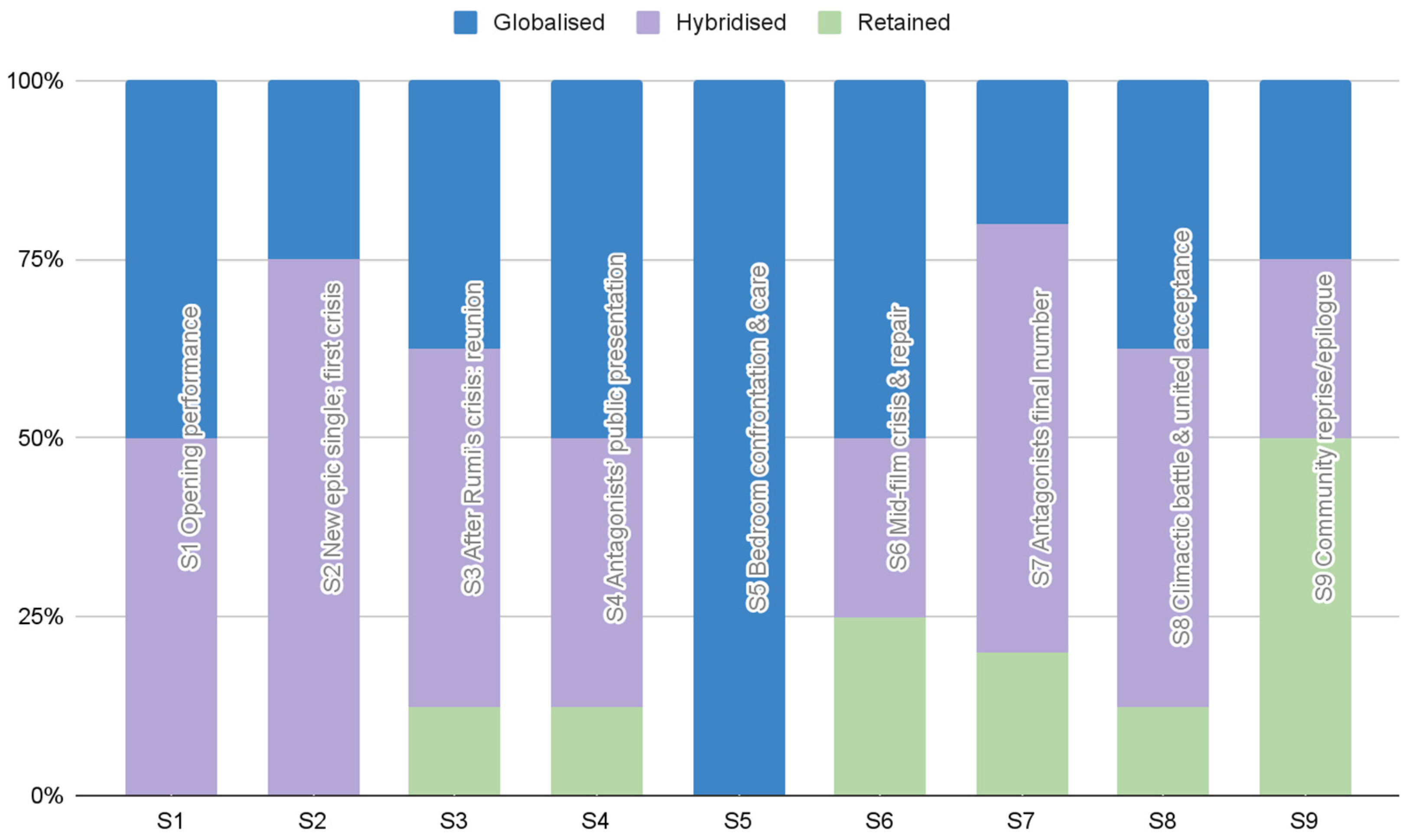
As shown in Figure 2 the paper classify cultural elements per scene as Retained (largely intact), Hybridised (translated/softened), or Globalised (widely intelligible trope), specifying what travels, what softens, and what remains.
Globalised. Elements designed for instant recognition sustain the trio’s “we” and make co-ordinated action easy to parse. Member-colour aesthetics quickly establish identity during performance segments, aiding the distributed initiative among the trio (S1, S2, S8; G3). English-oriented hooks ensure recognition and singability while preserving women-centred staging (S1, S2, S4, S5, S7, S8; G4); their use of ‘we/together’ aligns with the caring, mode of action discussed in Section 4.1. In S1, fandom-legibility, through crowd choreography and mass framing, provides a broad framework for understanding co-presence and collective responses around the trio. A broadly idol teamwork ethos often reads as global or hybrid and privileges co-ordination over solo display (S1, S3, S5, S8; G11). Full-body framing and ensemble composition function as globally legible pop staging grammars for capability and shared address, minimising sexualised fragmentation and making women’s co-action and repair easy to parse (see Section 4.1).
Hybridised. The Huntrix’s K-pop performance syntax is streamlined for a family audience: precise geometries, cuts riding the beat, and toned-down sensual moves, so that the trio’s co-ordination remains primary (S1, S2, S8; G1). This economy of movement and editing is consistent with K-pop’s choreography-for-camera conventions that privilege formation legibility and synchrony (C. Oh, 2023). The Saja Boys concentrate hybridity at the level of look and posture: idol staging and an adoration/power lyric stance (“I’m your idol”) coexist with body variation, including one hyper-muscular outlier that departs from slim idol templates; in both early and climactic numbers, hanbok/gat appear inside idol grammar as aesthetic citation, heightening threat legibility that the trio must meet together (S4, S7; G5/G10 with G3/G4). Myth/folklore cues are likewise stylised for access; visible but with reduced explanatory load (S7; G5). In S3, Rumi’s workaholism translates a work ethos recognisable within platform culture (G16), which the plot re-situates through shared care (joint diagnosis and task distribution). In S6, magpie and tiger companions to Jinu, culturally recognisable markers, are folded into a youth-adventure aesthetic, operating as hybrid daydream elements that keep focus on the trio’s alliance rather than folkloric literalism (S6; G5/G10). A parodic K-drama slow motion beat in the Rumi and Jinu meet-cute (outside the focal set) works as a meta generic wink, softening cultural load while keeping origin legible and signalling romance as a secondary line that does not eclipse sorority. Body diversity among crowds/extras aligns with contemporary global animation norms, softening a single local body template while keeping the setting legible; the Huntrix adopt an idol body template translated for a family audience (distinct hair/outfits/weapons rather than sexualised emphasis), which supports care-led co-ordination on screen. The Saja Boys’ mix of largely androgynous idol beauty with a hyper-muscular outlier hybridises local idol aesthetics with global “power” readability, heightening the perceived threat the trio must address together.
Retained. Space and community ground care. Seoul is recognisable with the Namsan Tower as skyline, placing the trio’s co-presence within a civic frame (various; G9). Crowds and secondary characters are consistently Asian, anchoring localisation and everyday settings such as restaurants, streets and the jjimjilbang carry the weight of ordinary Korean social life. These spatial choices resonate with contemporary place-selling strategies in Korean screen cultures, where pop-cultural texts brand Seoul as a K-pop media city and destination for fan tourism (Y. Oh, 2018, 2023). Foodways and ordinary spaces (Korean restaurant, home) provide retained social texture that underwrites everyday co-ordination (S3; G8/G9). The labour–rest tension persists as a domestic/dialogic theme (work drive versus care) rather than being discarded (S2, S6; G6). Naming grounds folklore as content: Jeoseung Saja/Dokkaebi and Gwi-ma (귀마) are explicitly mentioned (S4, S6–S8; G12), maintaining a local ethical focus on threat. The jjimjilbang is lexically hybridised (“bath house/sauna”) before being fully shown in S9, where it becomes the site where body shame turns into shared acceptance, closing the care arc traced in Section 4.1 (S2–S3 referenced; S9 shown; G18).
How codes map onto gendered legibility. In performance scenes, globalised devices (member colours; EN hooks) sustain the trio’s co-ordination and the “we” rhetoric; hybridised antagonist staging amplifies a readable threat that the trio must answer together. In domestic/community passages, retained anchors (space, food, ritual, named folklore) provide cultural footing for repair, translating sorority from dialogue and touch into collective practice.

4.3. Songs and Language (KR/EN) as Legibility Design

Across the six focal tracks, songs are EN-led (Table 3). Small KR pockets appear mainly in the Saja Boys’ numbers; elsewhere, they are sporadic. In the cultural-codes matrix, this maps to Globalised (G4) for hook language in all key numbers, aligning with Section 4.2. The English hooks match the cross-market recommendation patterns in streaming, where clear, quick cues improve discovery across different regions (Lesota et al., 2022). They also align with recent findings on code-switching and English-led choruses in globally successful K-pop (Sankaran, 2025). They also function as staging devices for co-ordinated dance action, anchoring recognition and singability while keeping women-centred blocking in frame. Huntrix repeatedly deploy a plural, affirmative lexicon (we, together, voices, born to be, how it’s done) alongside a semantics of repair/care (shine, heal, broken → beauty, together we’re glowing). The line “Huntrix don’t quit… how it’s done” links competence with the we-voice, expressing relational agency and sorority as a form of action; similar to Section 4.1 where TRIO ≥ 2 links AGENCY and SORORITY. By contrast, the Saja Boys’ cues (Soda Pop, Your Idol) are male-voiced and posture power/adoration/possession (e.g., “I’m your idol-say my name”) with metaphors of domination/submission (“down on your knees”, “set your world on fire”) and seduction as control. The effect is a pole of attraction → threat that narratively justifies the protagonists’ co-action, without recentring the plot around the male line (see Appendix B). In the duet “Free” (Rumi–Jinu), although the chorus codes EN-only, the content reorients romance toward mutual care and shame confrontation (“we can’t fix it if we never face it”) and, on screen (S6), re-aligns Rumi with the trio’s grammar of action.
Division of labour. Hook language sits in the Globalised layer (G4). By contrast, Retained anchors (space/ritual/foodways) carry local specificity in domestic/community passages (Section 4.2), while Hybridised resources (e.g., the Saja Boys’ idol/traditional-attire blend; stylised folklore) heighten a readable threat that the trio must meet together. The system effectively divides labour; language for reach, social texture for locality, which maps onto documented recommender effects in global music platforms (Lesota et al., 2022). The same split that underpins Figure 1 (agency peaking in performance; sorority peaking in everyday spaces).
The songs are decisively EN-forward, with hooks in the Globalised layer; qualitatively, those hooks carry a we/together rhetoric that scaffolds on-screen co-ordination without shifting focus from the women. Huntrix lyrics repeatedly encode relational agency and care (plural address; repair/shine/heal semantics), while the Saja Boys voice a counter-pole of power/adoration/possession that reads as legible threat rather than narrative centre. The duet “Free” operates as a liminal case: EN-only by count but oriented to mutual care and shame confrontation, re-aligning Rumi with the trio’s grammar of action. Taken with Section 4.1 and Section 4.2, language and staging divide labour: hooks for transnational reach, retained social codes (space/ritual/foodways) for local specificity, a pairing that explains how the film travels while keeping women’s shared agency and sorority aesthetically legible.

5. Discussion

Read through a Gender Media Studies lens, the film shifts the question from “are women visible?” to “how is agency organised on screen?”. Across the focal set, women’s agency is encoded as co-ordination and care/repair rather than slogans or isolated heroics: whenever two or more protagonists share the frame, agency and sorority co-occur (Figure 1; S1, S2, S3, S5, S8, S9). Full-body competence framings and ensemble composition stabilise decision, ownership, and distributed initiative, aligning with representation as a technology of organisation and counter-poising fragmenting optics in the classical sense. Intimate passages (e.g., S5) move the plot through repair rather than spectacle, making care the engine that enables action and organises the protagonists’ agency. In an animated musical, these patterns are reinforced by the medium’s affordances: the cohesion of the trio’s character designs, shifts in a restricted colour palette that cue different emotions and relationships, full-body framing, stylised character animation, and a carefully controlled editing pace. Together, these choices make the trio’s relational bonds and co-ordination legible at a glance, turning collective choreography, as well as quieter, intimate sisterhood moments, into a primary vehicle for the articulation of agency and sorority rather than a purely decorative feature.
This emphasis on shared agency and care also resonates with recent Korean feminist debates, in which questions of women’s solidarity, everyday organising and resistance to sexism have become highly visible and contested in the wake of digital activism, Escape the Corset protests and #MeToo in South Korea. Rather than mapping specific movements onto the film, the analysis treats sorority as a way of reading how ensemble co-ordination and emotional labour are valued on screen in a post #MeToo, platform era Korean context marked by both expanded feminist visibility and virulent backlash against it.
Songs and language sit alongside this formal substrate as a design for reach. Quantitatively, the soundtrack is decisively English-forward (Table 3), which places hooks in the Globalised layer of the cultural-codes matrix. Those English hooks carry a persistent we/together rhetoric that scaffolds on-screen co-ordination without displacing the women from the centre of the frame. Read against current practices in K-pop lyric design, the division of labour becomes clear in this case: language and instantly readable pop grammars travel; social texture anchors locality.
Placing authorship and industry context here clarifies why that division of labour looks the way it does from a gender point of view. Appendix B documents women across direction–writing–production, a Korean–Canadian woman director, and an Asian/Korean ensemble in key voice and singing roles (with few exceptions), aligning the behind-the-scenes composition with the on-screen focus on racialised, ethnically Korean protagonists. While the study does not assert a direct cause-and-effect link between identity and text, the alignment is significant: a women-focused creative core and an ensemble of mainly Asian/Korean voice-singers are featured alongside a film that consistently highlights themes of women’s friendship, healing, and collaborative effort. Statements from the film’s creator, a Korean-born and Toronto-raised filmmaker, underscore a diasporic authorship perspective. This approach positions the film as a conscious effort to honour Korean culture through animation, with folklore elements like Jeoseung saja and dokkaebi stylised for dramatic effect rather than ethnographic accuracy (Kirichanskaya, 2025). Creators’ interviews also frame animation as the medium that makes this ensemble legible on its own terms, while Arden Cho and May Hong explicitly connect their performances to diaspora identity and healing, resonating with the results on ensemble agency and care (Entertainment Weekly, 2025).
At scene level, the retained-hybridised-globalised triad specifies what travels, what softens, and what remains. Member colours, EN-led hooks, and fandom crowd framing provide low-friction legibility in performance passages (Globalised). Hybridised elements manage cultural density: performance syntax is streamlined for family viewing, folklore is stylised, and the Saja Boys’ staging blends idol posture with traditional attire (hanbok/gat) as aesthetic citation rather than ethnographic display. Retained anchors, such as named folklore (jeoseung saja/dokkaebi), foodways and ordinary spaces, a recognisable Seoul skyline, hold a specifically Korean social texture in domestic and community scenes (Section 4.2; Figure 2). In doing so, the film participates in a media-tourism grammar that links K-pop texts to the promotion of Seoul as both narrative setting and aspirational destination for international fans (Y. Oh, 2018, 2023). The “bath house” (jjimjilbang in Korea) arc makes the point narratively as well as culturally: lexically hybridised as “bath house”, the practice and place itself is retained and, in S9, becomes the site where body shame turns to shared acceptance, closing a care logic seeded across S2–S3.
Lyrically and vocally, the film stages a gendered opposition that supports ensemble action. Huntrix choruses repeatedly deploy a plural, affirmative lexicon (“we”, “together”, “voices”, “born to be”, “how it’s done”) and a semantics of repair/care (shine, heal, together we’re glowing). By contrast, the Saja Boys’ numbers posture power/adoration/possession and flirt with domination metaphors (“I’m your idol”; “down on your knees”; “set your world on fire”), producing an attraction-to-threat pole that narratively justifies the protagonists’ co-action rather than re-centring the plot around the male line. The duet Free presents a unique case in the movie; its content retools romance toward mutual care and shame confrontation (“we can’t fix it if we never face it”) and, on screen (S6), re-aligns Rumi with the trio’s grammar of action, unblocking repair without shifting the locus of competence from friendship to the couple.
A further layer sits in vocal performance and casting. Appendix B documents that both speaking and singing roles are largely performed by Korean and Korean diaspora actors, which matters in terms of how race, ethnicity and gender are voiced. The trio’s leads, voiced by Korean American performers, are mixed to the foreground with clear and bright pop vocals (accompanied by some rapping): their delivery emphasises confidence, optimism and decision-making rather than breathiness or sexualisation, aligning their voices with competence and communal care rather than with desirability. By contrast, the Saja Boys are mixed and arranged to sound like an idealised K-pop boy group: tightly stacked harmonies, soft consonants, and affect-saturated lines construct a polished, slightly excessive idol masculinity that leans into seduction. Paying attention to this sonic layer reinforces that agency and desire are organised not only visually, through blocking and framing, but also vocally, through who gets to sound central, assured, seductive or threatening.
Two tensions temper the findings. First, while antagonists’ attire and staging are consistent as aesthetic citation, the balance between citation and tokenism remains open to interpretation, especially in spectacle set-pieces (S4, S7). Second, the film’s commitment to relational agency and sorority coexists with narrowly defined female body aesthetics aligned with K-pop idol-slim norms. Crowds and secondary characters are more body-diverse, yet the protagonists retain a constrained corporeal template that participates in what has been described as “lookism” in South Korean popular culture (Hyun et al., 2014; H. Lee et al., 2017). This bodily normativity complicates the film’s otherwise progressive investment in women’s shared agency and care. On the one hand, care-led, collective action is afforded narrative and musical centrality; on the other, the coordinates of who can credibly embody that agency remain tightly bounded. In this sense, sorority and care risk being framed as compensatory rewards within a representational field that cannot fully escape disciplinary beauty standards, rather than as vectors through which more diverse bodies might claim space on screen.
Finally, the balance between global legibility and local anchoring should be read within platform logics. Relative to recent K-pop patterns, the soundtrack is even more English-weighted, a design coherent with transnational chart logics and discovery dynamics (Sankaran, 2025). In Netflix’s interface, these calibrations are further mediated by algorithmic paratexts such as thumbnails, autoplay trailers and the “Skip Intro” function, which repeatedly foreground the most spectacular, song-driven shots of the trio. While this study does not analyse these operations empirically here, they form part of the platform ecology that co-produces the film’s gendered address by pre-selecting which configurations of the protagonists are most likely to be seen, replayed and shared. EN-led hooks operate as practical tools for recognition and singability, as reflected in Appendix A, which documents the case’s broad circulation. Under platform era conditions, the text re-weights signs-language globalises; social texture is retained; heritage is stylised, while keeping women’s shared agency and sorority aesthetically legible. In this sense, the case resonates with James’s (2025) account of how K-pop texts navigate platformization by aligning with recommendation logics without fully surrendering local cues. As such, it offers a scene-indexed template for how women-centred animated features can travel without dissolving into generic global style, and it points to comparative work across other K-pop/animation titles and live-action counterparts to test whether this division of labour holds beyond this case.

6. Conclusions

This study shows that the animated film K-Pop Demon Hunters renders women’s agency and sorority legible as co-ordinated, care-led ensemble action whenever two or more protagonists share the frame, made visible through full-body staging, ensemble composition and a persistent we/together rhetoric. Korean specificity is curated via a consistent division of labour: globalised, EN-led hooks provide transnational reach; retained social anchors (space, ritual, foodways, named folklore) sustain locality; and hybridised cues (stylised folklore; idol/traditional blends) manage cultural density without erasure.
Authorship and industry context are consonant rather than causal: a women-centred creative core and an Asian/Korean voice–singing ensemble sit alongside a text that privileges women’s friendship, repair and shared initiative; creator and cast interviews frame the film as a diaspora-aware celebration of Korean culture, supporting hybridity as design choice rather than dilution.
Two tensions remain: potential tokenism in spectacle uses of traditional attire and an idol-slim body template for all main characters mark the boundaries of what the film is willing to risk, signalling limits in its feminist and glocal ambitions, even as they leave intact the core findings on ensemble agency and sorority. Substantively, the case indicates that cultural specificity need not flatten: language can carry reach while social texture carries locality. Nevertheless, the marked anglicisation of songs in a putatively K-pop text and the lexical substitution of terms such as jjimjilbang with “bath house” point to platform-era market pressures to code for English-led legibility, potentially curbing the diffusion of local terminology and cultural knowledge. Taken together, the case shows how an animated musical can sustain women’s empowerment and cultural specificity without reducing either to a mere marketing package.
Limits: This is a single-case, strictly textual study; viewing/streaming indicators are used descriptively.
Implications & next steps: Future work should (i) test the ensemble-agency cue across other animated features and girl-group media; (ii) link production pipelines to textual form in analyses of purplewashing/tokenism; and (iii) pursue reception studies with young girls and diaspora audiences.

Supplementary Materials

The following supporting information can be downloaded at: https://www.mdpi.com/article/10.3390/journalmedia6040203/s1, Supplementary File S1-Coding Workbook (xlsx): scene-indexed codes (S1–S9), cultural-codes matrix (Retained/Hybridised/Globalised), and figure-ready aggregates.

Funding

This research received no external funding.

Institutional Review Board Statement

Not applicable.

Informed Consent Statement

Not applicable.

Data Availability Statement

All materials required to replicate this study are provided as Supplementary Files and will be archived in an open repository upon acceptance. Specifically: Supplementary File S1 (Coding Workbook, .xlsx) contains the scene-indexed coding (S1–S9), the cultural-codes matrix (Retained/Hybridised/Globalised), and figure-ready aggregates; Appendix A (Reach & Circulation, .csv/.pdf) logs public indicators and sources; and Appendix B (Credits Table, .csv) consolidates creative roles and voice/singing credits.

Conflicts of Interest

The authors declare no conflicts of interest.

Abbreviations

The following abbreviations are used in this manuscript:
Gender Media StudiesGMS
Research QuestionRQ
English/Korean (language codes in lyric analysis)EN/KR
Retained/Hybridised/Globalised (cultural-codes matrix)R/H/G
Focal scenes (scene labels)S1–S9
TRIO_ONSCREEN (co-presence of the three protagonists)TRIO
Decision ownership/strategic competence (scene code)AGENCY
Care/repair and collective alignment (scene code)SORORITY
Full-body competence vs. fragmenting display (scene code)BODY_FRAMING
Choreography–camera reinforcement (scene code)CHOREO_CAMERA
Palette/light transition tied to narrative beats (scene code)COLOUR_SHIFT

Appendix A. Reach & Circulation

Evidence log of the film’s public circulation and music performance. Each row records: Metric/Claim, Date (ISO), Region/Scope, Source/Publisher, and Link (with access date noted). Items include Netflix programme/press materials, trade coverage of “most-watched”/Top-10 persistence, theatrical sing-along re-release notes, Billboard album/single chart positions, regional Top-10 trackers, and official lyric-video view counts. Indicators are used descriptively to characterise circulation and packaging and do not support reception or causal claims.
Table A1. Evidence log of the film’s public circulation and music performance.
LinkSource (Publisher)Region/ScopeDate (ISO)Metric/Claim#
(https://www.netflix.com/title/81498621 (accessed on 26 November 2025))NetflixGlobal18 October 2025Netflix title page (official programme page, synopsis, cast)R1
(https://people.com/kpop-demon-hunters-most-watched-movie-ever-netflix-11798152 (accessed on 26 November 2025))Reporting creators; notes Netflix’s peak popularityUS17 October 2025“Most-watched on Netflix” framing in major entertainment press (context article)R2
(https://www.netflix.com/tudum/articles/kpop-demon-hunters-halloween-sing-along (accessed on 26 November 2025))Netflix TudumGlobal (event)15 October 2025Halloween Sing-Along theatrical re-release announcement (official)R3
(https://elpais.com/cultura/2025-10-17/las-guerreras-k-pop-la-pelicula-animada-mas-vista-de-la-historia-de-netflix-vuelve-a-los-cines-en-version-sing-along.html (accessed on 26 November 2025))El País (Cultura)Spain17 October 2025Spain press: theatrical Sing-Along limited run; cites “most watched in Netflix history” + soundtrack tractionR4
(https://as.com/meristation/cine/las-guerreras-k-pop-llegan-a-la-gran-pantalla-podras-cantas-con-huntrx-en-cines-por-tiempo-limitado-f202510-n/ (accessed on 26 November 2025))MeriStation/ASSpain17 October 2025Spain games/entertainment press: return to cinemas; dethroned Red Notice; Oscar push; $18M US sing-along weekendR5
(https://www.animationmagazine.net/2025/10/watch-kpop-demon-hunters-creator-maggie-kang-talks-sequels-spin-offs-more/ (accessed on 26 November 2025))Animation Magazine (UTA talk)US/Global14 October 2025Trade interview: UTA/Animation Magazine video-“Netflix’s biggest animated feature,” phenomenon framingR6
(https://ew.com/kpop-demon-hunters-creators-shut-down-live-action-movie-adaptation-11829534 (accessed on 26 November 2025))Entertainment WeeklyUS17 October 2025EW interview with voice cast on the film’s “enormous success” (reception framing)R7
(https://www.billboard.com/music/chart-beat/kpop-demon-hunters-soundtrack-number-one-billboard-200-1236066167/ (accessed on 26 November 2025))BillboardUS14 September 2025Billboard 200: Soundtrack No. 1 (Chart Beat report)R8
(https://www.billboard.com/music/chart-beat/kpop-demon-hunters-returns-number-one-billboard-200-chart-1236082238/ (accessed on 26 November 2025))BillboardUS5 October 2025Billboard 200: Soundtrack returns to No. 1 (follow-up report)R9
(https://www.billboard.com/music/chart-beat/kpop-demon-hunters-returns-number-one-billboard-200-chart-1236082238/ (accessed on 26 November 2025))BillboardUS22 September 2025Hot 100: “Golden” No. 1 for 6 weeks (list/article)R10
(https://www.billboard.com/lists/huntr-x-golden-number-one-hot-100-eighth-week/ (accessed on 26 November 2025))BillboardUS6 October 2025Hot 100: “Golden” No. 1 for 8 weeks (update)R11
(https://flixpatrol.com/title/kpop-demon-hunters-sing-along/top10/ (accessed on 26 November 2025))FlixPatrol (3rd-party analytics; descriptive)Multi-country18 October 2025Regional Top-10 tracking (longevity across markets; complementary indicator)R12
(https://www.kedglobal.com/k-pop/newsView/ked202511050003 (accessed on 26 November 2025))Korea Economic Daily Global (KED Global)Korea/US16 October 2025Soundtrack multi-track Hot 100 presence (all 8 tracks charting; persistence)R13
(https://www.animationmagazine.net/2025/06/the-directors-of-kpop-demon-hunters-take-us-backstage-of-their-netflix-sony-showstopper/ (accessed on 26 November 2025))Animation MagazineUS/Global13 June 2025Background feature (pre-release/launch month) with directors on concept and women-led focus (contextual)R14

Appendix B. Core Credits, EN Voices, and Key Songs

Consolidated table of principal makers and performers: direction–writing–production, key animation/music leads, English-language voice cast, and lead singers for marquee tracks. Columns: Name; Role; Entity/Association (e.g., Huntrix, Saja Boys, antagonist); Nationality/Citizenship (self-described); Ethnicity (self-described); Gender (self-described); Key Song(s) (where applicable); Notes; Source (official credits or reputable biographies). Entries follow self-identification where available; otherwise marked “not declared.” The table facilitates analytic alignment between off-screen composition and on-screen gender/cultural coding.
Table A2. Consolidated table of principal makers and performers: direction–writing–production, key animation/music leads, English-language voice cast, and lead singers for marquee tracks.
GenderNationalityNameWork/Character/SongRole/FunctionCategory
WomanKorean-CanadianMaggie KangFilmDirector; story; co-screenwriterAuthorship/Prod.
ManAmericanChris AppelhansFilmDirector; co-screenwriterAuthorship/Prod.
WomanAmericanHannah McMechanFilmCo-screenwriterAuthorship/Prod.
WomanMexican-AmericanDanya JimenezFilmCo-screenwriterAuthorship/Prod.
WomanAmericanMichelle L. M. WongFilmProducer (Sony Pictures Animation)Authorship/Prod.
-USA/GlobalSony Pictures Animation/NetflixFilmStudio/DistributorAuthorship/Prod.
WomanKorean-AmericanArden ChoRumiSpeaking voiceEN Voice Cast
WomanKorean-AmericanMay HongMiraSpeaking voiceEN Voice Cast
WomanKorean-AmericanJi-young YooZoeySpeaking voiceEN Voice Cast
ManKorean-Canadian/South Korean–basedAhn Hyo-seopJinuSpeaking voiceEN Voice Cast
ManSouth KoreanLee Byung-hunGwi-maSpeaking voiceEN Voice Cast
WomanKorean-AmericanYunjin KimCelineSpeaking voiceEN Voice Cast
ManKorean-AmericanDaniel Dae Kim-Speaking voice (supporting)EN Voice Cast
ManKorean-AmericanKen Jeong-Speaking voice (supporting)EN Voice Cast
ManKorean-AmericanJoel Kim Booster-Speaking voice (supporting)EN Voice Cast
WomanAmericanLiza Koshy-Speaking voice (supporting)EN Voice Cast
WomanKorean-AmericanEJAE“How It’s Done”Opening setSongs (lead vocals)
WomanKorean-AmericanAudrey Nuna“How It’s Done”Opening setSongs (lead vocals)
WomanKorean-AmericanREI AMI“How It’s Done”Opening setSongs (lead vocals)
WomanKorean-AmericanEJAE“Golden”Narrative singleSongs (lead vocals)
WomanKorean-AmericanAudrey Nuna“Golden”Narrative singleSongs (lead vocals)
WomanKorean-AmericanREI AMI“Golden”Narrative singleSongs (lead vocals)
WomanKorean-AmericanEJAE“Free”Duet/mid-filmSongs (lead vocals)
ManKorean-AmericanAndrew Choi“Free”Duet/mid-filmSongs (lead vocals)
ManKorean-AmericanAndrew Choi“Soda Pop”Antagonist numberSongs (lead vocals)
ManSouth KoreanNeckwav“Soda Pop”Antagonist numberSongs (lead vocals)
ManKorean-AmericanDanny Chung“Soda Pop”Antagonist numberSongs (lead vocals)
ManKorean-AmericanKevin Woo“Soda Pop”Antagonist numberSongs (lead vocals)
ManSouth KoreansamUIL Lee“Soda Pop”Antagonist numberSongs (lead vocals)
ManKorean-AmericanAndrew Choi“Your Idol”Antagonist revealSongs (lead vocals)
ManSouth KoreanNeckwav“Your Idol”Antagonist revealSongs (lead vocals)
ManKorean-AmericanDanny Chung“Your Idol”Antagonist revealSongs (lead vocals)
ManKorean-AmericanKevin Woo“Your Idol”Antagonist revealSongs (lead vocals)
ManSouth KoreansamUIL Lee“Your Idol”Antagonist revealSongs (lead vocals)
WomanKorean-AmericanEJAE“What It Sounds Like”FinaleSongs (lead vocals)
WomanKorean-AmericanAudrey Nuna“What It Sounds Like”FinaleSongs (lead vocals)
WomanKorean-AmericanREI AMI“What It Sounds Like”FinaleSongs (lead vocals)
WomanKorean-AmericanEJAE“Takedown”End credits (version)Songs (lead vocals)
WomanKorean-AmericanAudrey Nuna“Takedown”End credits (version)Songs (lead vocals)
WomanKorean-AmericanREI AMI“Takedown”End credits (version)Songs (lead vocals)
WomanSouth KoreanJeongyeon (TWICE)“Takedown”End credits (TWICE ver.)Songs (lead vocals)
WomanSouth KoreanJihyo (TWICE)“Takedown”End credits (TWICE ver.)Songs (lead vocals)
WomanSouth KoreanChaeyoung (TWICE)“Takedown”End credits (TWICE ver.)Songs (lead vocals)

References

  1. Banet-Weiser, S. (2018). Empowered: Popular feminism and popular misogyny. Duke University Press. Available online: https://www.dukeupress.edu/empowered (accessed on 10 July 2024).
  2. Berg, M. (2017). The importance of cultural proximity in the success of Turkish dramas in Qatar. International Journal of Communication, 11, 3415–3430. Available online: https://ijoc.org/index.php/ijoc/article/view/6712 (accessed on 24 July 2025).
  3. Boman, B. (2022). Feminist themes in Hallyu 4.0 South Korean TV dramas as a reflection of a changing sociocultural landscape. Asian Journal of Women’s Studies, 28(4), 419–437. [Google Scholar] [CrossRef]
  4. Buchan, S. (Ed.). (2013). Pervasive animation. Routledge. [Google Scholar] [CrossRef]
  5. De Lauretis, T. (1987). Technologies of gender: Essays on theory, film, and fiction. Indiana University Press. Available online: https://iupress.org/9780253204417/technologies-of-gender/ (accessed on 1 January 2023).
  6. Entertainment Weekly. (2025, October 17). Arden Cho and May Hong on the healing impact of “K-Pop Demon Hunters” and their unexpected character connections. Entertainment Weekly. Available online: https://ew.com/kpop-demon-hunters-arden-cho-may-hong-healing-impact-character-connections-11831130 (accessed on 22 October 2025).
  7. Hyun, M.-Y., Jung, Y.-E., Kim, M.-D., Kwak, Y.-S., Hong, S.-C., Bahk, W.-M., Yoon, B.-H., & Kim, B.-S. (2014). Factors associated with body image distortion in Korean adolescents. Neuropsychiatric Disease and Treatment, 10, 797–802. [Google Scholar] [CrossRef] [PubMed]
  8. Iwabuchi, K. (2002). Recentering globalization: Popular culture and Japanese transnationalism. Duke University Press. [Google Scholar]
  9. James, S. (2025). Affective Participation from the in-between: The Platformization of K-Pop fandom. Social Media + Society, 11, 20563051251351390. [Google Scholar] [CrossRef]
  10. Jin, D. Y. (2016). New Korean wave: Transnational cultural power in the age of social media. University of Illinois Press. [Google Scholar] [CrossRef]
  11. Kim, K. H. (2011). Virtual hallyu? Korean cinema of the global era. Duke University Press. [Google Scholar] [CrossRef]
  12. Kim, M., & Brunn-Bevel, R. J. (2023). No face, no race? Racial politics of voice actor casting in popular animated films. Sociological Forum, 38(4), 1111–1135. [Google Scholar] [CrossRef]
  13. Kim, Y. (2005). Women, television and everyday life in Korea: Journeys of hope. Routledge. [Google Scholar]
  14. Kim, Y. (Ed.). (2013). The Korean wave: Korean media go global. Routledge. [Google Scholar] [CrossRef]
  15. Kirichanskaya, M. (2025, July 16). Interview with Maggie Kang, creator of “K-Pop Demon Hunters”. GeeksOUT. Available online: https://www.geeksout.org/2025/07/16/interview-with-maggie-kang-creator-of-kpop-demon-hunters/ (accessed on 10 September 2025).
  16. Lauzen, M. M. (2025). The celluloid ceiling: Employment of behind-the-scenes women on top-grossing U.S. films in 2024. Center for the Study of Women in Television & Film, SDSU. Available online: https://womenintvfilm.sdsu.edu/wp-content/uploads/2025/01/2024-Celluloid-Ceiling-Report.pdf (accessed on 22 September 2025).
  17. Lee, H., Son, I., Yoon, J., & Kim, S.-S. (2017). Lookism hurts: Appearance discrimination and self-rated health in South Korea. International Journal for Equity in Health, 16, 204. [Google Scholar] [CrossRef] [PubMed]
  18. Lee, H. J., & Jin, D. Y. (2019). K-pop idols: Popular culture and the emergence of the Korean music industry. Lexington Books. [Google Scholar] [CrossRef]
  19. Lee, J., & Jeong, E. (2021). The 4B movement: Envisioning a feminist future with/in a non-reproductive future in Korea. Journal of Gender Studies, 30(5), 633–644. [Google Scholar] [CrossRef]
  20. Lesota, O., Parada-Cabaleiro, E., Brandl, S., Lex, E., Rekabsaz, N., & Schedl, M. (2022). Traces of globalization in online music consumption patterns: Domestic vs. foreign listening and recommender effects. In Proceedings of ISMIR 2022. Available online: https://archives.ismir.net/ismir2022/paper/000034.pdf (accessed on 10 September 2025).
  21. Lie, J. (2015). K-pop: Popular music, cultural amnesia, and economic innovation in South Korea. University of California Press. Available online: https://www.ucpress.edu/book/9780520283121/k-pop (accessed on 11 September 2025).
  22. Martínez León, P. (2020). La construcción de identidades de género en la ficción audiovisual y sus implicaciones educativas. Área Abierta, 20(3), 317–333. [Google Scholar] [CrossRef]
  23. Morgan, R. (1970). Sisterhood is powerful: An anthology of writings from the women’s liberation movement. Vintage Books. [Google Scholar]
  24. Mulvey, L. (1975). Visual pleasure and narrative cinema. Screen, 16(3), 6–18. [Google Scholar] [CrossRef]
  25. Nieborg, D. B., & Poell, T. (2018). The platformization of cultural production: Theorizing the contingent cultural commodity. New Media & Society, 20(11), 4275–4292. [Google Scholar] [CrossRef]
  26. Ofcom. (2025). Children and parents: Media use and attitudes report 2025. Ofcom. [Google Scholar]
  27. Oh, C. (2023). K-pop dance music video choreography. In S.-Y. Kim (Ed.), The Cambridge companion to K-Pop (pp. 97–115). Cambridge University Press. [Google Scholar] [CrossRef]
  28. Oh, Y. (2018). Pop city: Korean popular culture and the selling of place. Cornell University Press. [Google Scholar]
  29. Oh, Y. (2023). Following in the footsteps of BTS: The global rise of K-pop tourism. In S.-Y. Kim (Ed.), The Cambridge companion to K-Pop (pp. 265–280). Cambridge University Press. [Google Scholar]
  30. Robertson, R. (1995). Glocalization: Time–space and homogeneity–heterogeneity. In M. Featherstone, S. Lash, & R. Robertson (Eds.), Global modernities (pp. 25–44). SAGE. [Google Scholar] [CrossRef]
  31. Sankaran, A. N. (2025). Studying code switching in K-pop hits on Billboard charts (preprint). arXiv, arXiv:2509.23197. [Google Scholar]
  32. Smith, S. L., Choueiti, M., Pieper, K., & Clark, H. (2019). Increasing inclusion in animation: Investigating opportunities, challenges, and the classroom-to-the-C-suite pipeline. USC Annenberg Inclusion Initiative & Women in Animation. Available online: https://assets.uscannenberg.org/docs/aii-inclusion-animation-201906.pdf (accessed on 20 January 2023).
  33. Srnicek, N. (2016). Platform capitalism. Polity. [Google Scholar]
  34. Tronto, J. C. (2013). Caring democracy: Markets, equality, and justice. New York University Press. [Google Scholar]
  35. Warner, K. J. (2017). In the Time of Plastic Representation. Film Quarterly, 71(2), 32–37. [Google Scholar] [CrossRef]
  36. Wells, P. (1998). Understanding animation. Routledge. [Google Scholar]
  37. Yun, J.-Y. (2022). Escaping the corset: Rage as a force of resistance and creation in the Korean feminist movement. Hypatia, 37(2), 257–275. [Google Scholar] [CrossRef]
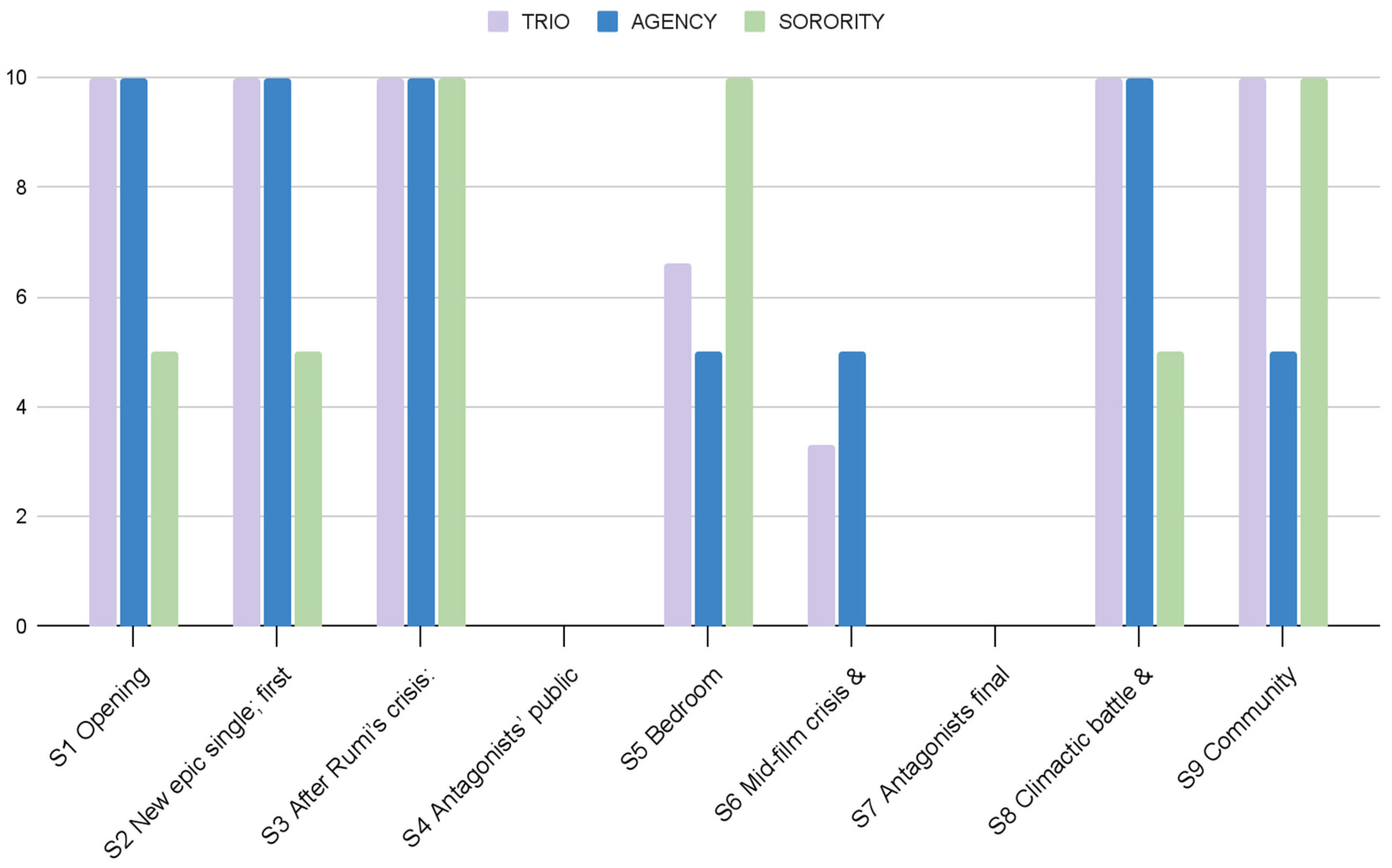
Figure 1. Normalised comparison of TRIO, AGENCY, and SORORITY across scenes (S1–S9). All measures are re-scaled to a common 0–10 axis (TRIO: 0–3 → 0–10; AGENCY/SORORITY: 0–2 → 0–10). The shared scale enables direct comparison between co-presence (TRIO) and the intensity of agency and sorority. Under binary thresholds (TRIO ≥ 2; AGENCY ≥ 1; SORORITY ≥ 1), AGENCY and SORORITY co-occur in all scenes where two or more protagonists share the frame (6/6). Source: Scene_Coding, Supplementary File S1 (Coding Workbook); values for the figure are derivable from S1 (see Methods).
Journalmedia 06 00203 g001
Figure 2. Distribution of Korean cultural codes by scene (retained/hybridised/globalised). Stacked bars show per-scene counts derived from the Globalized_Codes matrix after incorporating retained items for foodways (S3), folklore naming (S4, S6–S8), and ritual (S9). Traditional attire within idol staging is treated as hybridised. Source: Globalized_Codes, Supplementary File S1 (Coding Workbook); counts are reproducible from S1 (see Methods).
Journalmedia 06 00203 g002
Table 1. Coding scheme.
CapturesValuesCode
Dominant shot scale of the scene.WS/MS/CU/MIXSHOT
Number of protagonists sharing the frame for most of the scene (0 = none; 1 = one; 2 = two; 3 = three).0–3TRIO_ONSCREEN_(0–3)
1 = full-body competence (no sexualised fragmentation); 0 = otherwise.1/0BODY_FRAMING
Decision ownership/strategic competence visible (0 = absent; 1 = present/punctual; 2 = sustained/central).0–2AGENCY_(0–2)
Care/repair and collective alignment (0 = absent; 1 = present/punctual; 2 = sustained/central).0–2SORORITY_(0–2)
1 = edits/moves that exalt synchrony; 0 = weak/absent.1/0CHOREO_CAMERA
1 = marked palette/light transition tied to empowerment/jeopardy beats; 0 = none.1/0COLOUR_SHIFT
Korean cultural codes active in the scene (links to matrix in S1::Globalized_Codes).Gx listCULTURE_TAGS (G-codes)
Officially credited track associated with the scene.track ID/titleKey song
Table 2. Focal scenes.
Key SongLabel (Short)Scene
How It’s DoneOpening performanceS1
GoldenNew epic single; first crisisS2
-After Rumi’s crisis: reunionS3
Soda PopAntagonists’ public presentationS4
-Bedroom confrontation & careS5
FreeMid-film crisis & repairS6
Your IdolAntagonists final numberS7
What It Sounds LikeClimactic battle & acceptanceS8
-Community reprise/epilogueS9
Table 3. English and Korean word shares in key soundtrack songs.
KR
Share %
EN
Share %
Non-
Lex
KR
Words
EN
Words
Hook ≤ 10 wSong
010030404“We could be free”Free (duet)
1.998.12518906“We’re going up… together we’re glowing”Golden
3.996.11020493“Huntrix don’t quit… how it’s done”How It’s Done
7.592.55250614“You’re my soda pop”Soda Pop
0100160495“This is what it sounds like”What It Sounds Like
2.197.957271286“I’m your idol”Your Idol
Source: official lyric videos/track guides. Table 3 reports word-based shares, where Hangul is absent on source pages (romanisation only), KR can be under-estimated. S1 logs line-level evidence and hook quotes (≤10 words) for replication.
Disclaimer/Publisher’s Note: The statements, opinions and data contained in all publications are solely those of the individual author(s) and contributor(s) and not of MDPI and/or the editor(s). MDPI and/or the editor(s) disclaim responsibility for any injury to people or property resulting from any ideas, methods, instructions or products referred to in the content.