
Article

From Headlines to Thumbnails: Comparative Analysis of Web Publications in Bulgarian Digital Media and YouTube


by
Plamen Hristov Milev
* and
Yavor Nikolov Tabov
Department of Information Technologies and Communications, University of National and World Economy, 1700 Sofia, Bulgaria
*
Author to whom correspondence should be addressed.
Journal. Media 2025, 6(4), 202; https://doi.org/10.3390/journalmedia6040202

Submission received: 19 August 2025 / Revised: 19 November 2025 / Accepted: 25 November 2025 / Published: 28 November 2025

Abstract

The objective of this study is to determine if the thematic priorities of news organizations are consistent or platform-specific by investigating the cross-platform strategies of three leading Bulgarian news agencies. Methodologically, the study combines a quantitative TF-IDF text analysis of 315,103 headlines from their websites and 6961 titles from their official YouTube channels with a qualitative analysis of YouTube thumbnails to assess their strategic visual contribution. The findings reveal a significant strategic divergence: YouTube channels are primarily dedicated to high-impact domestic political news centered on key public figures, while their official websites feature a much broader thematic scope, covering international conflicts or extensive cultural events. The thumbnail analysis further shows they function as a critical visual layer, adding emotional context and explicit cues that are not present in text headlines. This research concludes that news agencies do not simply mirror content but strategically adapt it to leverage the unique characteristics and audience expectations of each platform, employing distinct models for their YouTube and web presences.

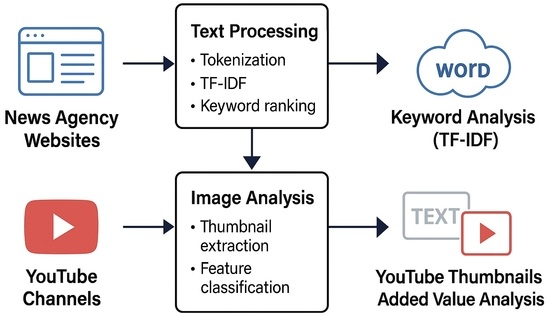
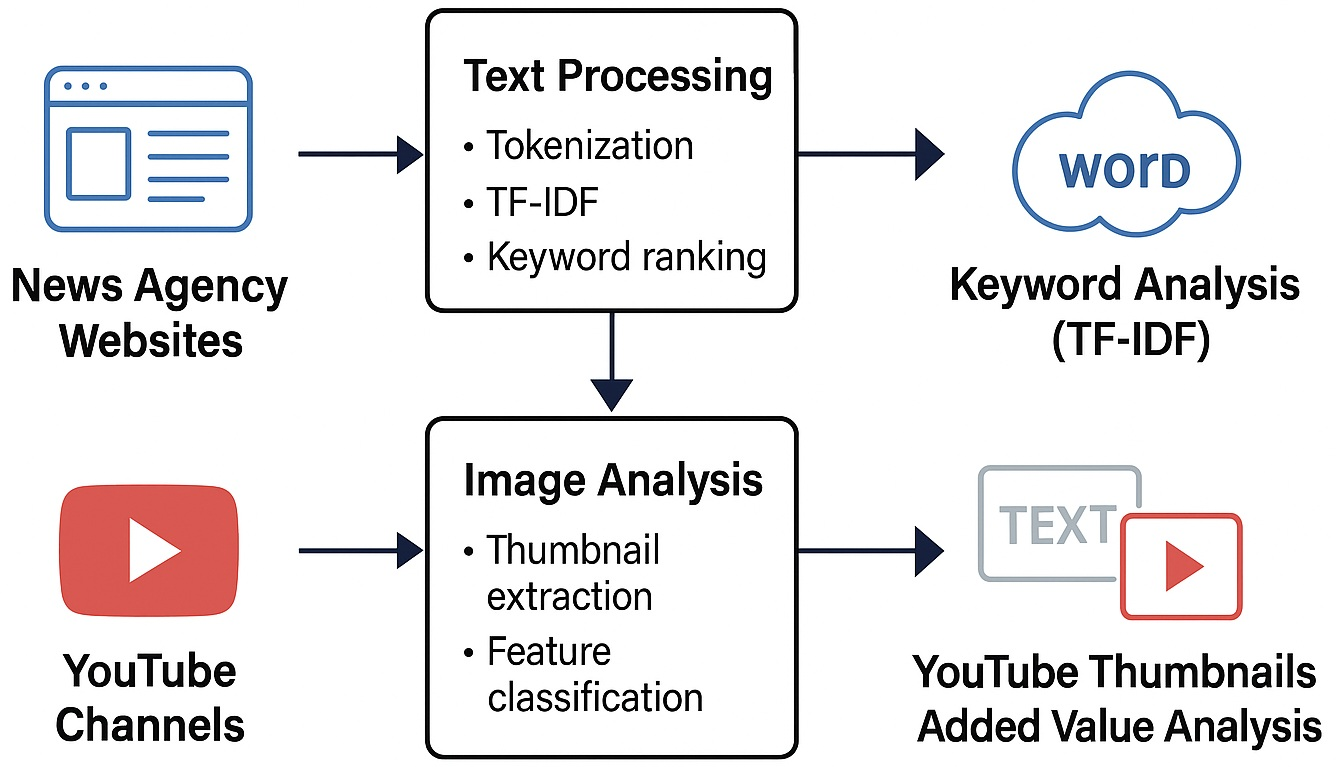
Graphical Abstract

1. Introduction

In the contemporary digital media landscape, audiences increasingly rely on visual cues to navigate vast amounts of information (Li et al., 2023). Headlines, traditionally the primary method of attracting reader attention, now compete directly with visual elements like thumbnails—small, representative images accompanying digital content. This shift is especially pronounced on platforms such as YouTube, where thumbnails significantly influence user engagement and content discoverability (Ahmed et al., 2023; Eizmendi-Iraola et al., 2025; Naing et al., 2024; Park & Shin, 2022). Meanwhile, traditional web-based digital media outlets continue to prioritize textual headlines, although recent studies indicate a clear divergence between publishing volumes and actual consumption patterns (Avraam et al., 2022). To analyze these digital environments, recent studies have demonstrated the potential of web scraping techniques for collecting and analyzing large-scale data from media and other fields (Rodríguez-Almonacid et al., 2023; Santos & Acosta, 2023). Research in the domain of digital education and communication highlights the importance of platforms like YouTube, where visual cues are critical in shaping user engagement patterns (Li et al., 2023; Naganawa & Hirata, 2025b). Moreover, the role of recommender systems on platforms such as YouTube has been analyzed in depth, indicating how algorithmic suggestions contribute to shaping content consumption trends (McGarry, 2023). These developments underline the growing convergence between technological innovations and digital media strategies, a transition impacting various fields and requiring new analytical frameworks to be fully understood (Kirilov, 2021; Panagiotidis & Veglis, 2020). In addition, studies on social media engagement and content dissemination stress the significance of integrating visual components to optimize user attention and interactions (Bhagat et al., 2021; Silvallana et al., 2025). The relevance of platforms like YouTube in public opinion formation and information dissemination has been further documented through analyses of comment sections and engagement metrics (Osman et al., 2025). In this context, the evolving role of visual content not only reflects changing audience behaviors but also prompts media practitioners to adapt their content strategies accordingly (Luţan & Bădică, 2022; Musleh et al., 2023).
The proliferation of digital platforms has compelled news organizations to move beyond a single-channel distribution model. Platforms like YouTube have become significant news sources, operating in parallel with traditional news websites. This multi-platform environment raises critical questions about editorial strategy, situated at the intersection of two key theoretical concepts. The first is platformization, which suggests that media content is increasingly shaped by the specific technical affordances, algorithmic curation, and audience expectations of the platforms it is published on. The second is framing theory, which explains how media organizations select, emphasize, and present information to promote a particular interpretation. In this context, they may “frame” the same news story differently to maximize engagement on different platforms. This study addresses the strategic adaptation of news content within this theoretical context. We are guided by the following research questions:
  • Do Bulgarian news agencies maintain a consistent thematic focus across their primary websites and official YouTube channels, or do their priorities diverge?
  • What are the specific thematic differences in content strategy between text-based headlines (websites) and video-based titles (YouTube)?
  • How do news agencies strategically use visual elements (thumbnails) on YouTube to complement, or alter, the messaging of their textual titles?
To investigate these questions, this paper conducts a comparative case study of three prominent Bulgarian news agencies with distinct profiles: Bulgarian News Agency (BTA)—the national news agency, BGNES Agency (a private agency), and Blitz News (a popular tabloid-style agency). The study analyzes a comprehensive corpus of all headlines from their websites and all video titles from their YouTube channels published over a one-year period.
We hypothesize that agencies do not simply replicate content but strategically differentiate it. Specifically, we expect that agencies use YouTube for more personality-driven and high-impact domestic news, while leveraging their websites for a broader, more comprehensive coverage of topics including international affairs and cultural events.
The primary contributions of this study include providing empirical insights into evolving media presentation practices and establishing a scalable, mixed-method framework for analyzing cross-platform visual and textual strategies. Our findings contribute to a deeper understanding of the intersection between global platform dynamics and local media ecosystems.

2. Materials and Methods

This study employs a mixed-method approach, combining quantitative text analysis with qualitative visual analysis.
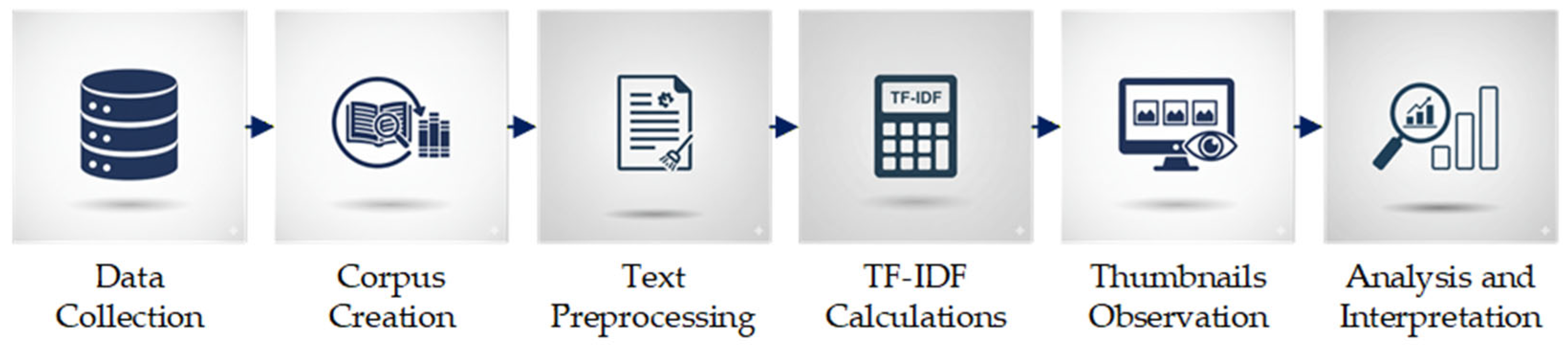
Figure 1 illustrates the schematic of the data analysis pipeline.
The research process began with data collection via web scraping to systematically gather headlines from official websites and YouTube channels of the agencies. Following this, a quantitative text analysis using the TF-IDF algorithm was applied to identify and rank the most significant keywords, thereby revealing the thematic priorities on each platform. This quantitative stage was complemented by a qualitative assessment of YouTube thumbnails to analyze their strategic function as a layer of visual communication. This integrated methodology ensures a robust, data-driven comparison of the editorial and visual strategies the agencies deploy across different digital platforms. The specific procedures undertaken at each stage of this workflow are detailed in the following subsections.

2.1. Web Scraping

To ensure the consistency and validity of the analysis, we applied a selection criterion focused on informational agencies that actively operate across both digital ecosystems—web and YouTube. Specifically, we included only those agencies that maintain regularly updated websites with textual news content and operate official YouTube channels with frequent video publications. YouTube was selected as the primary video-sharing platform for this study due to its dominant position in the global and Bulgarian digital media landscape, offering unparalleled reach and a significant presence of professional news organizations. Its standardized metadata structure and publicly accessible APIs facilitate consistent data collection and analysis. In Bulgaria, major information agencies maintain active YouTube channels, ensuring the availability of audiovisual content linked to their editorial policies.
After a preliminary review of the Bulgarian media landscape, three informational agencies met the requirements: Bulgarian News Agency, BGNES Agency and Blitz News. These agencies were chosen because they enable a direct comparison between web publications (headlines, article structure, textual features) and YouTube content (titles, thumbnails, visual and auditory cues) under a unified editorial and organizational framework. They represent distinct types of media ownership and editorial orientation:
  • Bulgarian News Agency: As the publicly funded, national news agency of Bulgaria, BTA has a long-standing history and a mandate for comprehensive, factual coverage of politics, economy, culture, and international affairs. It operates as a formal, journalistic source. The official BTA website delivers up-to-date news from Bulgaria and around the world, focusing on socially significant events, economics, politics, and culture (Bulgarian News Agency, 2025b). The official BTA YouTube channel features video reports, press conferences, and interviews, often complementing the website’s content with multimedia formats (Bulgarian News Agency, 2025a).
  • BGNES Agency: One of the largest private, commercially funded news agencies in the country, BGNES Agency offers timely reports and analysis. It is known for its aggressive, high-volume “media flow” style, focusing heavily on domestic and global developments. The BGNES website offers national and international news, analyses, and reports, with an emphasis on balanced coverage of current events (BGNES Agency, 2025b). The official BGNES YouTube channel includes video interviews, reports, and press events, synchronized with the publications on the website (BGNES Agency, 2025a).
  • Blitz News: A prominent private, commercially funded agency, Blitz is known for its high-traffic, sensationalist, tabloid-style reporting. Its content is often visually intense and designed to maximize clicks (clickbait). The Blitz website publishes high-frequency news covering a wide range of topics—from politics and economics to lifestyle and sports (Blitz News, 2025b). The Blitz YouTube channel presents video materials, news bulletins, and reports that visually enrich and complement the articles published on the website (Blitz News, 2025a).
Table 1 presents the profile of news agencies selected for research.
All data used in this study were collected from publicly accessible sources and processed exclusively for academic, non-commercial research purposes. The analysis includes only metadata such as headlines, titles, thumbnails (descriptive analysis only), and basic publication metrics (e.g., publication date), without reproducing full textual content or audiovisual material. In accordance with copyright laws and fair use principles applicable to scholarly research, the study does not make use of protected media content. Article headlines and video titles were used solely for analytical purposes. This approach ensures compliance with intellectual property rights while enabling comparative analysis of cross-platform communication strategies. Initially, the data was collected through systematic web scraping methods to collect relevant data (Sarker et al., 2022; Skoulikaris & Krestenitis, 2020). The dataset comprises content published over a one-year period from July 2024 to June 2025. The data collection focused primarily on capturing textual headlines, associated thumbnails and publication dates. Similar methodological approaches for data extraction from online sources have been described in previous studies focused on digital education platforms and open-source data collection (Hayes et al., 2018; Tsiourlini et al., 2024). In the case of YouTube, data was obtained firstly through web scraping for identifying the video publications and subsequently using YouTube Data API. The use of API-based data extraction and web scraping methods has been extensively discussed in the context of collecting user-generated content for media analysis and sentiment studies (Giannakoulopoulos et al., 2025; Lu, 2023). Ethical considerations regarding data collection and analysis were strictly observed, ensuring compliance with the terms of service of the respective platforms, and no personally identifiable information was collected or processed. Similar adherence to ethical standards in digital data research has been highlighted in recent publications on media and sentiment analysis (MacLean & Cavallucci, 2024; Polpanich et al., 2022). Additional research has demonstrated the applicability of web scraping techniques in the field of applied sciences, particularly for the extraction and preprocessing of large-scale datasets (Tanasescu et al., 2022). Such approaches have been effectively used to support decision-making processes through systematic data collection and analysis in related studies (Louro et al., 2024). Furthermore, the potential of automated methods for extracting structured data from online environments is well established in the recent literature on applied systems innovation (Hassanien, 2019). The data for this study were collected through web scraping between 1 July 2024 and 30 June 2025. A custom-built data-gathering application, developed in the Java programming language, was engineered for this task. The application was designed to systematically send HTTP requests to the URLs of the selected news websites and YouTube channels. Upon receiving the server response, the application parsed the raw HTML content to locate and extract the required data points, specifically the headlines and video titles. To ensure ethical scraping practices and avoid server overload, a rate limit was implemented by introducing a deliberate delay between consecutive requests. This process yielded a final corpus of 315,103 website headlines and 6961 YouTube video titles. The extracted raw data were then cleaned and structured into CSV files, creating the two distinct corpora for analysis (websites and YouTube). Each corpus represents the complete collection of all text documents (in our case, all post titles) that will be analyzed. It is important to note for transparency that no Artificial Intelligence (AI) tools were used during any phase of the data collection process. The data gathering was performed by a custom application.

2.2. Quantitative Analysis

To prepare the data for analysis, each title in the corpus went through several processing steps. All letters were converted to lowercase to ensure that words such as “Government” and “government” were treated as the same term. Each title was divided (tokenized) into individual words called “tokens”. All punctuation marks and numbers were removed, as they did not carry any semantic value for the purposes of this analysis. A filter was applied to remove common words in the Bulgarian language that do not carry any specific meaning. This allows the analysis to focus on the words that actually define the topic of the text.
The core of the analysis is the calculation of the Term Frequency-Inverse Document Frequency (TF-IDF) value for each token in each document. The concept of TF-IDF is fundamental in the field of Information Retrieval and Natural Language Processing (NLP). Conceptually, it assigns a high weight to terms that are frequent in a specific document but rare across all other documents, making them effective identifiers of a document’s main topic. The TF-IDF value is the product of two metrics: Term Frequency (TF), which measures how often a word appears in a document, and Inverse Document Frequency (IDF), which measures the word’s importance across the entire corpus. The specific formulas used for these calculations are detailed in Appendix A.
To ensure computational accuracy, the authors’ initial TF-IDF calculations were subsequently verified for correctness using a large language model (Google’s Gemini).

2.3. Qualitative Analysis

For the YouTube dataset, a supplementary analysis was conducted on the video thumbnails associated with top-ranking headlines to assess their strategic role in adding context and emotional value.
To complement the quantitative data, we conducted a qualitative content analysis of the YouTube thumbnails associated with the top-ranking TF-IDF keywords. This step was crucial for understanding the visual and affective strategies that text-only analysis cannot capture. The approach was a qualitative content analysis focused on visual rhetoric. We employed a purposive sampling strategy. Instead of analyzing all 6961 thumbnails, we focused on the thumbnails corresponding to videos whose titles contained the top-ranking keywords identified in the TF-IDF results. This allowed for a direct comparison between the most prominent textual themes and their visual representation. The analysis was guided by a predefined coding framework, focusing on:
  • Emotional valence (presence of strong emotions on faces: anger, surprise).
  • Text overlays (use of provocative quotes, all-caps, bold colors).
  • Iconography (use of symbols, flags, party logos).
  • Branding (agency logos, consistent color schemes).
To ensure reliability, the analysis was conducted independently by the two authors of the research. The coding results were compared, and any discrepancies were resolved through discussion to reach a consensus, ensuring the validity of the presented strategic interpretations.

3. Results

The findings of our research are organized into two main parts. First, the results of the quantitative keyword analysis, derived from the TF-IDF algorithm, detail the thematic priorities on each platform. Second, a qualitative analysis of the added value of YouTube thumbnails examines their strategic role in visual communication.
Table 2 presents the total number of publications for each of the media platforms analyzed within the period from July 2024 to June 2025.
A striking observation is the massive output of the Bulgarian News Agency, which published 206,950 articles during the specified period. This volume is substantially higher than that of the private agencies, being nearly ten times greater than the BGNES Agency output and more than double that of Blitz News. This aligns with BTA’s mandate as a national news agency, which is tasked with providing comprehensive, non-selective coverage of a wide range of events. In contrast, Blitz and BGNES, while still prolific, demonstrate a more editorially focused output, which is characteristic of private media organizations that prioritize specific topics.
Table 3 presents the total number of videos for each of the analyzed YouTube channels within the period from July 2024 to June 2025.
The data illustrate a different strategic landscape that emerges. While BTA maintains its position as the most active content creator with 5285 videos, there is a notable reversal in the ranking of the two private agencies. Blitz News, despite publishing four times as many web articles as BGNES Agency, produced significantly fewer videos (581 compared to 1095 by BGNES). This disparity suggests that the BGNES Agency has a more developed or prioritized video production strategy for its YouTube channel relative to its overall content output. Conversely, the content strategy of Blitz News appears to be heavily concentrated on its text-based website, with video playing a less central role. These figures indicate that the agencies’ resource allocation and strategic priorities differ significantly between their web and video platforms.

3.1. Keyword Analysis (TF-IDF)

The TF-IDF analysis yielded distinct keyword hierarchies for each platform. The scores represent the mean TF-IDF value for each term, indicating its overall importance within the respective corpus.
Table 4 presents the top 15 ranked words in publication titles of the agencies’ websites, during the analyzed period (July 2024–June 2025), sorted by their score in descending order.
The results clearly show that there is a very strong presence of the international topic, specifically the war in Ukraine (“Ukraine”, “war”, “Russia”, “Putin”). Domestic politics remains important but shares the leading place.
Table 5 presents the top 10 ranked words in publication titles of the Bulgarian News Agency on their website, during the analyzed period (July 2024–June 2025), sorted by their score in descending order.
BTA emphasizes cultural events (“theater”, “exhibition”, “concert”), regional news (“Varna”, “Plovdiv”) and official EU topics (“European”). This corresponds to its function as a national agency with broad coverage.
Table 6 presents the top 10 ranked words in publication titles of the BGNES Agency on their website, during the analyzed period (July 2024–June 2025), sorted by their score in descending order.
BGNES Agency focuses almost entirely on domestic politics and economics (“Borisov”, “price”, “gas”, “Radev”, “government”).
Table 7 presents the top 10 ranked words in publication titles of Blitz News on their website, during the analyzed period (July 2024–June 2025), sorted by their score in descending order.
Blitz News focuses on the war in Ukraine, using strong and emotional words (“shock,” “tragedy”). Domestic politics are secondary.
Table 8 presents the top 15 ranked words in video titles of the agencies’ YouTube channels, during the analyzed period (July 2024–June 2025), sorted by their score in descending order.
The results clearly show that the political situation in the country is a dominant topic. The names of key political figures (Borisov, Petkov, Radev, Vassilev), parties (GERB) and processes (government, elections, mandate) occupy the top spots.
Table 9 presents the top 10 ranked words in video titles of the Bulgarian News Agency on their YouTube channel, during the analyzed period (July 2024–June 2025), sorted by their score in descending order.
BTA focuses on the institutional and formal aspects of politics. Words like “government,” “draft cabinet,” “vote,” “mandate,” and “ministers” indicate a focus on the processes of state governance, rather than on individuals. This is expected by a national news agency. The difference between BTA compared to the publications on their website is substantial. Their YouTube channel is strictly focused on official political processes (the word “government” has a very high rating). Their website, on the other hand, has a much broader coverage and serves as a national information source on culture, regions and official European topics. Political news is only part of the general flow.
Table 10 presents the top 10 ranked words in video titles of the BGNES Agency on their YouTube channel, during the analyzed period (July 2024–June 2025), sorted by their score in descending order.
BGNES Agency occupies an intermediate position. It covers both political figures (“Borisov”, “Vassilev”) and processes (“elections”, “government”). Specific economic and regional topics such as “the eurozone”, “finance” and “Greece” also appear, which indicates a broader reporting scope. BGNES Agency is consistent in its content. In both channels (website and YouTube), the focus is on domestic politics and economic topics. The keywords are almost identical, with the website showing a slightly stronger emphasis on specific economic issues such as “price” and “gas”, while on YouTube, broader topics such as “eurozone” and international relations (“Greece”).
Table 11 presents the top 10 ranked words in video titles of Blitz News on their YouTube channel, during the analyzed period (July 2024–June 2025), sorted by their score in descending order.
Blitz News has a strong focus on political figures and confrontations (“Borisov”, “Petkov”, “Radev”, “Kostadinov”). The presence of sports topics (“CSKA”) is also notable, which distinguishes it from the other two agencies. The language is more direct and personalized. In comparison to their website publications, Blitz’s focus is changing dramatically. YouTube is dominated by domestic political figures and conflicts, as well as sports. However, on their site, they focus primarily on the war in Ukraine, using highly emotional language. Domestic politics remains but is given a lower priority.
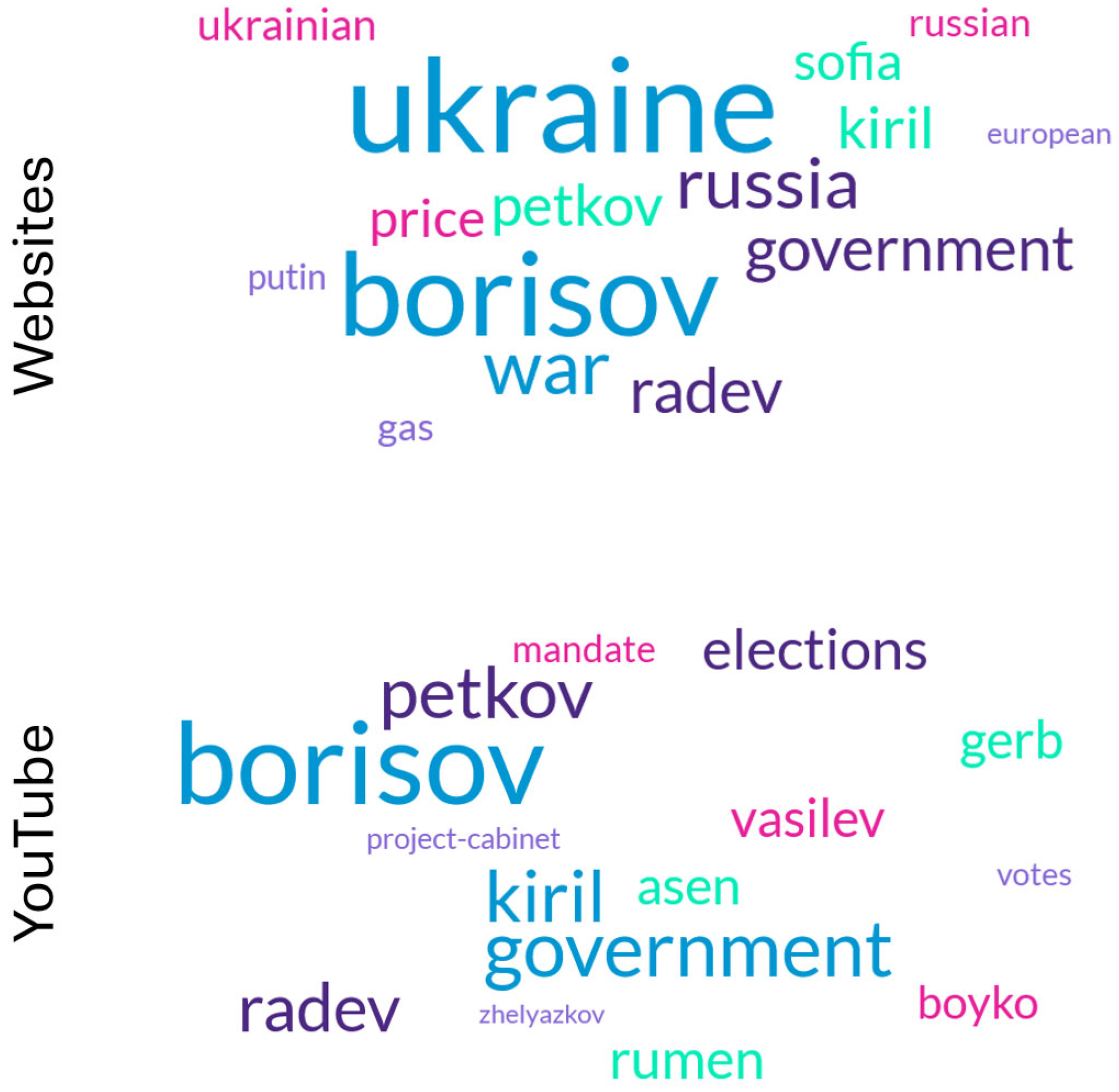
To provide a clear, high-level comparative synthesis of the two platforms, Figure 2 visualizes the top 15 aggregated keywords from all websites and all YouTube channels as weighted word clouds. The size of each word is proportional to its mean TF-IDF score.
The visualization makes the thematic divergence immediately apparent. The “Websites” corpus (top) is dominated by keywords related to the international conflict in Ukraine, alongside domestic politics. In stark contrast, the “YouTube” corpus (bottom) is almost exclusively focused on high-impact domestic politics and key political figures, with international topics being notably absent. This visual evidence strongly supports the finding of a platform-specific, rather than monolithic, content strategy.

3.2. YouTube Thumbnails Added Value Analysis

The main goal of any thumbnail is to increase the CTR (Click-Through Rate) by getting the user to click on the video. Unlike a standard title, a photo achieves this through emotional impact. Website titles inform, while thumbnails evoke emotion. Most successful thumbnails show the faces of the key figures in the news (in our case, Borisov, Petkov, Radev, etc.). The human brain is designed to respond to faces and emotions. Photos are often selected to show strong emotion—anger, concern, surprise, triumph. The title “Borisov with a comment on the government” is neutral. But a thumbnail with Borisov’s angry face instantly creates a sense of conflict and drama, which provokes curiosity. A photo can convey a significant amount of information in a second. The thumbnail hints at a story. A photo of a burning building or a line of people instantly communicates the topic, even before the user has read the title. This makes the news easier to “digest”. A short, bold text in capital letters is often placed above the photo. This text does not repeat the title but complements it with its most provocative part—often a quote or question. By consistently using logos, color schemes and fonts on thumbnails, media builds its visual identity. Users begin to recognize the style of a given media just by the photo, which builds loyalty and faster orientation in the YouTube feed. While websites rely on search engine optimization (SEO) and factual content, YouTube channels struggle for attention in a highly competitive visual environment. Thumbnails are their most powerful tool in this competition.
Table 12 outlines the observed visual strategies employed by each news agency on their YouTube channels, linking them to their dominant content themes and the resulting strategic value. The analysis is based on the correlation between the top-ranking keywords (from the TF-IDF results) and the associated thumbnails.
The analysis of the headline–thumbnail relationship on the data obtained confirms and concretizes our initial expectations. BTA uses thumbnails to show the scale and officiality of events, emphasizing institutional symbols. BGNES Agency uses thumbnails to connect individuals to specific topics and to visualize complex concepts, often through collages. Blitz News uses thumbnails to dramatize and emotionally amplify the news, focusing on faces and conflicts.

4. Discussion

The findings clearly indicate that the news agencies employ distinct, platform-specific content strategies rather than a monolithic “one-size-fits-all” approach. The thematic divergence between websites and YouTube is not random but rather a rational adaptation to the perceived audiences and technical logics of each platform. This can be best understood through the theoretical lenses of platformization and framing. The agencies’ websites largely fulfill a traditional informational mandate, using a broad “frame” to cover international conflicts or cultural events. In contrast, on YouTube, all agencies converge on a narrow, high-impact agenda centered on domestic political figures. This shift is a clear example of platformization, where editorial strategy is shaped by the platform’s logic. YouTube’s algorithm rewards high-engagement content (high CTR and watch time), and personality-driven conflicts are “framed” visually and textually to maximize this engagement.
BGNES Agency remains the most thematically consistent agency across both platforms. Its website maintains a strong focus on domestic politics and economics, with keywords like “price” and “gas” ranking highly, demonstrating a sustained specialization. Blitz News heavily prioritizes the conflict in Ukraine, using high-emotion keywords like “war,” “shock,” and “tragedy,” aligning with its tabloid style.
On YouTube, all three agencies converge on a narrow set of topics centered on domestic political figures and processes. This highlights an adaptive strategy aimed at aligning with the expectations of audiovisual audiences (Tsiourlini et al., 2024). The high ranking of names like “Borisov,” “Petkov,” and “Radev” suggests a personality-driven news agenda. BTA, as the national agency, focuses on the formal, institutional aspects of politics, with keywords like “government,” “project-cabinet,” and “votes” scoring highest. BGNES Agency balances its coverage between key political figures (“Borisov”) and overarching political events (“elections”), while also touching on foreign policy (“Greece”) and economic matters (“eurozone”). Blitz News adopts a confrontational angle, focusing on political clashes but also carving out a unique niche with sports content (“CSKA”), likely to attract a specific demographic.
The headline data only tells part of the story. Although textual headlines maintain their importance, integrating compelling visual elements offers a clear advantage in capturing user attention and driving interactions (Jung et al., 2021; Liu, 2025). The thumbnails associated with YouTube videos represent a critical layer of strategic communication, particularly within video-sharing platforms where visual immediacy strongly influences user behavior (Chang, 2022; Mabrouk et al., 2021). This shift towards video-centric engagement mirrors broader trends in digital advertising, where video content is seen as a breakthrough in the new media landscape (Garganas, 2024).
Based on a qualitative assessment of the thumbnails linked to the top-ranking keywords in our dataset, we observe several specifics. For videos on governmental procedures, BTA favors thumbnails depicting institutional symbols, such as the parliament hall or official podiums. This reinforces its brand of formal, objective reporting. For complex topics, the BGNES Agency often uses collage-style thumbnails that juxtapose a key political figure with a visual symbol of the topic (e.g., the EU flag for a story on the Eurozone). This serves to visualize abstract concepts and make them more accessible. For videos about political conflicts, Blitz News consistently uses thumbnails with close-up images of politicians’ faces displaying strong emotions (e.g., anger, frustration), often overlaid with provocative text. This transforms a news report into a personal drama. This visual layer is a key differentiator, designed to maximize emotional engagement and CTR in a competitive visual environment—a function that text-based website headlines do not perform.
These findings align with prior studies highlighting the impact of content and metadata, including thumbnails, on platform visibility and algorithmic promotion strategies (Naganawa & Hirata, 2025a). In practical terms, the study highlights the need for digital content creators to prioritize visual strategies, especially when operating within platforms characterized by high visual competition. This observation is consistent with insights from environmental monitoring and urban studies that stress the role of visual representation in information dissemination (Arreeras et al., 2024; Sergiacomi et al., 2022). Future research may expand upon these findings by exploring additional platforms, varying content genres, and broader geographical contexts to further illuminate the evolving role of visual content in digital communication (Polpanich et al., 2022; Santos Duarte et al., 2025). Moreover, the integration of artificial intelligence in journalism, as a growing field of study, suggests that future analyses could also examine how automated systems might influence these cross-platform strategies (Ioscote et al., 2024). The integration of spatial data and geoinformation systems with online media content analysis opens new avenues for future interdisciplinary research, as highlighted in recent studies (Pérez & Aybar, 2024).
Beyond its academic contribution, this study offers practical insights for media practitioners, communication specialists, and digital strategists. Understanding that audiences on different platforms respond to distinct types of content allows for more effective resource allocation and tailored communication strategies. The findings demonstrate that a “one-size-fits-all” approach to digital news distribution is suboptimal, and agencies can optimize engagement by developing platform-specific editorial and visual guidelines, as evidenced by the clear strategic differentiation between institutional focus and sensationalist approach.
We must acknowledge several limitations. First, our analysis is focused on metadata (headlines and thumbnails) and does not analyze the full textual content of articles or the audiovisual content of the videos, which would offer deeper insights. Second, the one-year data collection period provides a robust snapshot but cannot capture longer-term evolutionary trends in media strategy. Third, while our qualitative thumbnail analysis identifies strategic patterns, it is a supplementary assessment rather than a full-scale semiotic or multimodal analysis. Finally, this study is a case study of three agencies within the specific Bulgarian media ecosystem, and the findings may not be generalizable to all media systems without further research.

5. Conclusions

This study provides quantitative evidence that Bulgarian news agencies do not pursue a monolithic content strategy but rather adapt their editorial focus to the platform. YouTube is leveraged as a high-impact channel for personality-driven domestic political news, optimized for engagement through emotionally charged visual thumbnails. In contrast, the official websites fulfill a broader informational mandate, covering a wider range of topics including international affairs, economics, and culture, depending on the agency’s specific profile.
We found that private media emerges as the most thematically consistent content provider, while public media shows the greatest strategic divergence, clearly separating its formal political reporting on YouTube from its comprehensive cultural and regional coverage on its website. Sensationalist media pivots its primary focus from domestic politics on YouTube to the international conflict in Ukraine on its website, maintaining its sensationalist tone across both. These findings underscore the growing sophistication of news distribution strategies in the digital age.
The primary contribution of this work is a scalable, mixed-method framework (combining TF-IDF and qualitative visual analysis) for empirically comparing cross-platform media strategies. Our findings offer a clear model for understanding how global platform logics interact with local media ecosystems. The Bulgarian case study serves as a valuable example for how media systems in other non-Anglophone or “smaller” markets adapt their framing strategies to thrive in a platformized environment.
Future research should expand on this analysis in several key directions. First, integrating user engagement metrics (likes, comments, shares) would quantitatively measure audience reception to these differing strategies. Second, a longitudinal study could track the evolution of these platform-specific strategies over time, especially around major political or social events. Finally, applying this comparative framework to other geographic contexts or media types would further illuminate the universal and particular aspects of digital news dissemination.

Author Contributions

Conceptualization, P.H.M.; methodology, P.H.M. and Y.N.T.; software P.H.M. and Y.N.T.; validation, P.H.M. and Y.N.T.; formal analysis, P.H.M. and Y.N.T.; investigation, P.H.M. and Y.N.T.; resources, P.H.M. and Y.N.T.; data curation, P.H.M. and Y.N.T.; writing—original draft preparation, P.H.M. and Y.N.T.; writing—review and editing, P.H.M.; visualization, P.H.M. and Y.N.T.; supervision, P.H.M.; project administration, P.H.M.; funding acquisition, P.H.M. All authors have read and agreed to the published version of the manuscript.

Funding

This work was financially supported by the UNWE Research Programme (Research Grant No. 22/2024/A).

Institutional Review Board Statement

Not applicable.

Informed Consent Statement

Not applicable.

Data Availability Statement

The datasets analyzed during this study are available upon reasonable request from the corresponding author due to privacy and third-party data restrictions.

Conflicts of Interest

The authors declare no conflicts of interest. The funders had no role in the design of the study; in the collection, analyses, or interpretation of data; in the writing of the manuscript; or in the decision to publish the results.

Abbreviations

The following abbreviations are used in this manuscript:
AIArtificial Intelligence
BTABulgarian News (Telegraph) Agency
CTRClick-Through Rate
IDFInverse Document Frequency
NLPNatural language processing
SEOSearch Engine Optimization
TFTerm Frequency
TF-IDFTerm Frequency-Inverse Document Frequency

Appendix A. TF-IDF Calculations

The definition of the concept of Inverse Document Frequency argues that the specificity of a term (and therefore its weight) is inversely proportional to the frequency with which it occurs in the documents of a given collection (Sparck Jones, 1972). This concept has a direct relationship to the Vector Space Model, in which documents are represented as vectors in a multidimensional space. TF-IDF is the most used method for calculating the weights of the components of these vectors (Salton et al., 1975). TF-IDF and its variations have significant applications in search engines and information systems (Manning et al., 2008). The value of TF-IDF is the product of two metrics: Term Frequency (TF) and Inverse Document Frequency (IDF). Term Frequency measures how often a given word appears in a particular document (title). It is normalized by dividing the number of occurrences by the total number of words in the document, so as not to favor longer documents:
TF (t, d) = Number of times term t appears in document d/Total number of terms in document d
Inverse Document Frequency measures the importance of a word in the entire corpus. It gives higher weight to words that occur in few documents and lower weight to those that occur frequently throughout. It is calculated as the logarithm of the ratio between the total number of documents in the corpus and the number of documents containing the term:
IDF (t, D) = log (Total number of documents in corpus D/(1 + Number of documents containing term t))
Adding “+1” to the denominator is a standard “smoothing” practice that prevents division by zero. Conceptually, it ensures that any new terms encountered during analysis are assigned a high, finite IDF score, correctly reflecting their informational novelty and specificity. The final value of TF-IDF for each word in each document is obtained by multiplying its TF and IDF values:
TF-IDF (t, d, D) = TF (t, d) × IDF (t, D)
After the TF-IDF matrix (containing the values for each word in each document) was calculated, we proceeded to aggregate the results. To identify the top keywords for each agency and platform, the mean TF-IDF score for each term was calculated across all relevant documents. Terms with the highest average scores were ranked as the most significant.

References

  1. Ahmed, E., Xue, L., Sankalp, A., Kong, H., Matos, A., Silenzio, V., & Singh, V. K. (2023). Predicting loneliness through digital footprints on Google and YouTube. Electronics, 12(23), 4821. [Google Scholar] [CrossRef]
  2. Arreeras, S., Phonsitthangkun, S., Arreeras, T., & Arimura, M. (2024). Spatial analysis on the service coverage of emergency facilities for fire disaster risk in an urban area using a web scraping method: A case study of Chiang Rai City, Thailand. Urban Science, 8(3), 140. [Google Scholar] [CrossRef]
  3. Avraam, E., Veglis, A., & Dimoulas, C. (2022). Comparison of publishing and consumption patterns in Greek media websites. Journalism and Media, 3(1), 134–143. [Google Scholar] [CrossRef]
  4. BGNES Agency. (2025a). Home. YouTube. Available online: https://www.youtube.com/@BGNESAgency (accessed on 1 July 2025).
  5. BGNES Agency. (2025b). News. Available online: https://bgnes.bg/ (accessed on 1 July 2025).
  6. Bhagat, K. K., Mishra, S., Dixit, A., & Chang, C.-Y. (2021). Public opinions about online learning during COVID-19: A sentiment analysis approach. Sustainability, 13(6), 3346. [Google Scholar] [CrossRef]
  7. Blitz News. (2025a). Home. YouTube. Available online: https://www.youtube.com/@BlitzBGNews (accessed on 1 July 2025).
  8. Blitz News. (2025b). News. Available online: https://blitz.bg/ (accessed on 1 July 2025).
  9. Bulgarian News Agency. (2025a). Home. Available online: https://www.youtube.com/@BulgarianNewsAgency (accessed on 1 July 2025).
  10. Bulgarian News Agency. (2025b). News. Available online: https://bta.bg/ (accessed on 1 July 2025).
  11. Chang, C.-W. (2022). Developing a multicriteria decision-making model based on a three-layer virtual internet of things algorithm model to rank players’ value. Mathematics, 10(14), 2369. [Google Scholar] [CrossRef]
  12. Eizmendi-Iraola, M., Peña-Fernández, S., & Morales-i-Gras, J. (2025). The gender gap in science communication on TikTok and YouTube: How platform dynamics shape the visibility of female science communicators. Journalism and Media, 6(3), 108. [Google Scholar] [CrossRef]
  13. Garganas, O. (2024). Digital video advertising: Breakthrough or extension of TV advertising in the new digital media landscape? Journalism and Media, 5(2), 749–765. [Google Scholar] [CrossRef]
  14. Giannakoulopoulos, A., Pergantis, M., Lamprogeorgos, A., & Lampoura, S. (2025). A data-driven approach to estimating the impact of audiovisual art events through web presence. Information, 16(2), 88. [Google Scholar] [CrossRef]
  15. Hassanien, H. E.-D. (2019). Web scraping scientific repositories for augmented relevant literature search using CRISP-DM. Applied System Innovation, 2(4), 37. [Google Scholar] [CrossRef]
  16. Hayes, D. R., Cappa, F., & Cardon, J. (2018). A framework for more effective dark web marketplace investigations. Information, 9(8), 186. [Google Scholar] [CrossRef]
  17. Ioscote, F., Gonçalves, A., & Quadros, C. (2024). Artificial intelligence in journalism: A ten-year retrospective of scientific articles (2014–2023). Journalism and Media, 5(3), 873–891. [Google Scholar] [CrossRef]
  18. Jung, W.-C., Kim, J., & Park, N. (2021). Web-browsing application using web scraping technology in Korean network separation application. Symmetry, 13(8), 1550. [Google Scholar] [CrossRef]
  19. Kirilov, R. (2021). Approaches for building information systems for monitoring the realization of students. Economic Alternatives, 3, 469–481. [Google Scholar] [CrossRef]
  20. Li, B., Kou, X., & Bonk, C. J. (2023). Embracing the disrupted language teaching and learning field: Analyzing YouTube content creation related to ChatGPT. Languages, 8(3), 197. [Google Scholar] [CrossRef]
  21. Liu, T.-M. (2025). Using snake roadkill patterns to indicate effects of climate change on snakes in Taiwan. Sustainability, 17(4), 1580. [Google Scholar] [CrossRef]
  22. Louro, J., Fidalgo, F., & Oliveira, Â. (2024). Recognition of food ingredients—Dataset analysis. Applied Sciences, 14(13), 5448. [Google Scholar] [CrossRef]
  23. Lu, J. C.-C. (2023). Creating effective educational videos on YouTube in higher education. Engineering Proceedings, 38(1), 32. [Google Scholar] [CrossRef]
  24. Luţan, E.-R., & Bădică, C. (2022). Emotion-based literature book classification using online reviews. Electronics, 11(20), 3412. [Google Scholar] [CrossRef]
  25. Mabrouk, A., Redondo, R. P. D., & Kayed, M. (2021). SEOpinion: Summarization and exploration of opinion from E-commerce websites. Sensors, 21(2), 636. [Google Scholar] [CrossRef]
  26. MacLean, C., & Cavallucci, D. (2024). Assessing fine-tuned NER models with limited data in French: Automating detection of new technologies, technological domains, and startup names in renewable energy. Machine Learning and Knowledge Extraction, 6(3), 1953–1968. [Google Scholar] [CrossRef]
  27. Manning, C. D., Raghavan, P., & Schütze, H. (2008). Introduction to information retrieval. Cambridge University Press. [Google Scholar]
  28. McGarry, K. (2023). Analyzing social media data using sentiment mining and bigram analysis for the recommendation of YouTube videos. Information, 14(7), 408. [Google Scholar] [CrossRef]
  29. Musleh, D. A., Alkhwaja, I., Alkhwaja, A., Alghamdi, M., Abahussain, H., Alfawaz, F., Min-Allah, N., & Abdulqader, M. M. (2023). Arabic sentiment analysis of YouTube comments: NLP-based machine learning approaches for content evaluation. Big Data and Cognitive Computing, 7(3), 127. [Google Scholar] [CrossRef]
  30. Naganawa, H., & Hirata, E. (2025a). Enhancing policy generation with GraphRAG and YouTube data: A logistics case study. Electronics, 14(7), 1241. [Google Scholar] [CrossRef]
  31. Naganawa, H., & Hirata, E. (2025b). Social media and logistics: Uncovering challenges and solutions through YouTube data. Logistics, 9(2), 56. [Google Scholar] [CrossRef]
  32. Naing, I., Aung, S. T., Wai, K. H., & Funabiki, N. (2024). A reference paper collection system using web scraping. Electronics, 13(14), 2700. [Google Scholar] [CrossRef]
  33. Osman, N. S., Kim, J.-H., Park, J.-H., & Park, H.-W. (2025). Identifying the impacts of social movement mobilization on YouTube: Social network analysis. Information, 16(1), 55. [Google Scholar] [CrossRef]
  34. Panagiotidis, K., & Veglis, A. (2020). Transitions in journalism—Toward a semantic-oriented technological framework. Journalism and Media, 1(1), 1–17. [Google Scholar] [CrossRef]
  35. Park, Y., & Shin, Y. (2022). Novel scratch programming blocks for web scraping. Electronics, 11(16), 2584. [Google Scholar] [CrossRef]
  36. Pérez, V., & Aybar, C. (2024). Challenges in geocoding: An analysis of R packages and web scraping approaches. ISPRS International Journal of Geo-Information, 13(6), 170. [Google Scholar] [CrossRef]
  37. Polpanich, O.-U., Bhatpuria, D., Santos Santos, T. F., & Krittasudthacheewa, C. (2022). Leveraging multi-source data and digital technology to support the monitoring of localized water changes in the Mekong Region. Sustainability, 14(3), 1739. [Google Scholar] [CrossRef]
  38. Rodríguez-Almonacid, D. V., Ramírez-Gil, J. G., Higuera, O. L., Hernández, F., & Díaz-Almanza, E. (2023). A comprehensive step-by-step guide to using data science tools in the gestion of epidemiological and climatological data in rice production systems. Agronomy, 13(11), 2844. [Google Scholar] [CrossRef]
  39. Salton, G., Wong, A., & Yang, C. S. (1975). A vector space model for automatic indexing. Communications of the ACM, 18(11), 613–620. [Google Scholar] [CrossRef]
  40. Santos, F., & Acosta, N. (2023). An approach based on web scraping and denoising encoders to curate food security datasets. Agriculture, 13(5), 1015. [Google Scholar] [CrossRef]
  41. Santos Duarte, A. L., Souza, E. R. d., Silva, M. P. d. O., Monte, M. B. d. S., Correia, N. O. d. A., de Carvalho, V. D. H., & Taques, F. H. (2025). Data protection in Brazil: Applying text mining in court documents. Engineering Proceedings, 87(1), 57. [Google Scholar] [CrossRef]
  42. Sarker, K. U., Saqib, M., Hasan, R., Mahmood, S., Hussain, S., Abbas, A., & Deraman, A. (2022). A ranking learning model by K-means clustering technique for web scraped movie data. Computers, 11(11), 158. [Google Scholar] [CrossRef]
  43. Sergiacomi, C., Vuletić, D., Paletto, A., Barbierato, E., & Fagarazzi, C. (2022). Exploring national park visitors’ judgements from social media: The case study of Plitvice Lakes National Park. Forests, 13(5), 717. [Google Scholar] [CrossRef]
  44. Silvallana, D. F., Elias, C., & Catalan-Matamoros, D. (2025). Exploring vaccine hesitancy in the Philippines: A content analysis of comments on national TV channel YouTube videos. International Journal of Environmental Research and Public Health, 22(6), 819. [Google Scholar] [CrossRef]
  45. Skoulikaris, C., & Krestenitis, Y. (2020). Cloud data scraping for the assessment of outflows from dammed rivers in the EU. A case study in South Eastern Europe. Sustainability, 12(19), 7926. [Google Scholar] [CrossRef]
  46. Sparck Jones, K. (1972). A statistical interpretation of term specificity and its application in retrieval. Journal of Documentation, 28(1), 11–21. [Google Scholar] [CrossRef]
  47. Tanasescu, L. G., Vines, A., Bologa, A. R., & Vaida, C. A. (2022). Big data ETL process and its impact on text mining analysis for employees’ reviews. Applied Sciences, 12(15), 7509. [Google Scholar] [CrossRef]
  48. Tsiourlini, M., Tzafilkou, K., Karapiperis, D., & Tjortjis, C. (2024). Text analytics on YouTube comments for food products. Information, 15(10), 599. [Google Scholar] [CrossRef]
Figure 1. Data Processing and Analysis Workflow.
Journalmedia 06 00202 g001
Figure 2. Word Cloud Comparison of Top 15 Aggregated Keywords: Websites vs. YouTube.
Journalmedia 06 00202 g002
Table 1. Characteristics of Selected Media Sources.
MediaTypeStyle/Tone
Bulgarian News AgencyPublicFormal, factual, journalistic
BGNES AgencyPrivateAggressive, commercial, media flow
Blitz NewsPrivateSensational, clickbait, visually intense
Table 2. Total Number of Publications by Agency (July 2024–June 2025).
Digital MediaWebsitePublications
Bulgarian News Agencyhttps://bta.bg (accessed on 1 July 2025)206,950
BGNES Agencyhttps://bgnes.bg (accessed on 1 July 2025)21,492
Blitz Newshttps://blitz.bg (accessed on 1 July 2025)86,661
Table 3. Total Number of Videos by Agency (July 2024–June 2025).
ChannelHomepageVideos
Bulgarian News Agencyhttps://www.youtube.com/@BulgarianNewsAgency (accessed on 1 July 2025)5285
BGNES Agencyhttps://www.youtube.com/@BGNESAgency
(accessed on 1 July 2025)
1095
Blitz Newshttps://www.youtube.com/@BlitzBGNews
(accessed on 1 July 2025)
581
Table 4. Top 15 Keywords in Titles of Agencies’ Websites (July 2024–June 2025).
KeywordMean TF-IDF Score
ukrayna (Ukraine)0.038
borisov (former Prime Minister (PM) of Bulgaria)0.035
voynata (the war)0.026
rusiya (Russia)0.025
radev (President of Bulgaria)0.023
pravitelstvo (government)0.023
kiril (Kiril Petkov, former PM of Bulgaria)0.022
petkov (former PM of Bulgaria)0.022
sofia (Sofia)0.021
tsena (price)0.021
ukrainski (Ukrainian)0.019
ruski (Russian)0.018
gaz (gas)0.018
putin (President of Russia)0.017
evropeyskiya (the European)0.016
Table 5. Top 10 Keywords in Titles of Bulgarian News Agency (July 2024–June 2025).
KeywordMean TF-IDF Score
teatur (theater)0.045
izlozhba (exhibition)0.044
kontsert (concert)0.038
varna (coastal city in Bulgaria)0.031
evropeyskiya (the European)0.028
bulgaria (Bulgaria)0.027
obshtina (municipality)0.027
mezhdunarodniya (the international)0.026
festival (fest)0.025
plovdiv (second largest city in Bulgaria)0.024
Table 6. Top 10 Keywords in Titles of BGNES Agency (July 2024–June 2025).
KeywordMean TF-IDF Score
borisov (former PM of Bulgaria)0.052
tsena (price)0.046
gaz (gas)0.042
radev (President of Bulgaria)0.040
pravitelstvo (government)0.039
kiril (Kiril Petkov, former PM of Bulgaria)0.038
petkov (former PM of Bulgaria)0.038
gerb (political party)0.035
asen (Asen Vasilev, former Minister of Finance of Bulgaria)0.034
vasilev (former Minister of Finance of Bulgaria)0.034
Table 7. Top 10 Keywords in Titles of Blitz News (July 2024–June 2025).
KeywordMean TF-IDF Score
ukrayna (Ukraine)0.051
voynata (the war)0.043
rusiya (Russia)0.039
borisov (former PM of Bulgaria)0.038
putin (President of Russia)0.032
shok (schock)0.028
tragediya (tragedy)0.027
kiev (Kiev)0.027
ruskata (the Russian)0.025
petkov (former PM of Bulgaria)0.024
Table 8. Top 15 Keywords in Titles of Agencies’ YouTube Channels (July 2024–June 2025).
KeywordMean TF-IDF Score
borisov (former PM of Bulgaria)0.053
pravitelstvo (government)0.040
kiril (Kiril Petkov, former PM of Bulgaria)0.038
petkov (former PM of Bulgaria)0.038
radev (President of Bulgaria)0.036
izbori (elections)0.033
rumen (Rumen Radev, President of Bulgaria)0.032
gerb (political party)0.031
asen (Asen Vasilev, former Minister of Finance of Bulgaria)0.031
vasilev (former Minister of Finance of Bulgaria)0.031
boyko (Boyko Borisov, former PM of Bulgaria)0.029
mandata (the mandate)0.026
glasuva (votes)0.024
proektokabineta (the project-cabinet)0.023
zhelyazkov (PM of Bulgaria)0.022
Table 9. Top 10 Keywords in Titles of Bulgarian News Agency on YouTube (July 2024–June 2025).
KeywordMean TF-IDF Score
pravitelstvo (government)0.095
proektokabineta (the project-cabinet)0.063
glasuva (votes)0.063
bulgaria (Bulgaria)0.056
zhelyazkov (PM of Bulgaria)0.053
radev (President of Bulgaria)0.052
mandata (the mandate)0.049
rumen (Rumen Radev, President of Bulgaria)0.046
pravitelstvoto (the government)0.044
ministri (ministers)0.040
Table 10. Top 10 Keywords in Titles of BGNES Agency on YouTube (July 2024–June 2025).
KeywordMean TF-IDF Score
borisov (former PM of Bulgaria)0.075
izbori (elections)0.066
gurtsiya (Greece)0.056
pravitelstvo (government)0.055
gerb (political party)0.048
boyko (Boyko Borisov, former PM of Bulgaria)0.046
asen (Asen Vasilev, former Minister of Finance of Bulgaria)0.045
vasilev (former Minister of Finance of Bulgaria)0.045
evrozonata (the eurozone)0.042
finansi (finances)0.042
Table 11. Top 10 Keywords in Titles of Blitz News on YouTube (July 2024–June 2025).
KeywordMean TF-IDF Score
borisov (former PM of Bulgaria)0.076
petkov (former PM of Bulgaria)0.054
kiril (Kiril Petkov, former PM of Bulgaria)0.054
cska (football club)0.052
radev (President of Bulgaria)0.045
asen (Asen Vasilev, former Minister of Finance of Bulgaria)0.042
vasilev (former Minister of Finance of Bulgaria)0.042
rumen (Rumen Radev, President of Bulgaria)0.038
boyko (Boyko Borisov, former PM of Bulgaria)0.037
kostadinov (Bulgarian politician)0.033
Table 12. Strategic Analysis of YouTube Thumbnail Value by News Agency.
ChannelDominant Keyword ThemesObserved Thumbnail StrategyAdded Value
Bulgarian News AgencyInstitutional Processes, Formal PoliticsFormal, objective imagery depicting institutional symbols.
Clean, professional aesthetic with minimal text overlays.
Schematic: [wide shot of parliament hall + Agency logo]
Reinforces brand authority and objectivity.
Provides context of scale and officiality.
Appeals to audience seeking formal information.
BGNES AgencyDomestic and Economic Policy, International RelationsConceptual, collage-style images juxtaposing a key person with a visual symbol of the topic.
Schematic: [Politician’s photo + Euro symbol overlay]
Visualizes complex or abstract topics.
Makes content more accessible.
Directly links figures to specific issues.
Blitz NewsPolitical Confrontation, Sports FiguresEmotional, close-up shots of key figures displaying strong emotions.
Frequent use of large, provocative text overlays.
Schematic: [Close-up of politician’s angry face + Red border + “SCANDAL!” in yellow text]
Dramatizes news into personal conflicts.
Maximizes emotional engagement.
Creates strong CTR appeal.
Disclaimer/Publisher’s Note: The statements, opinions and data contained in all publications are solely those of the individual author(s) and contributor(s) and not of MDPI and/or the editor(s). MDPI and/or the editor(s) disclaim responsibility for any injury to people or property resulting from any ideas, methods, instructions or products referred to in the content.