Article

Rain Erosivity Factor (R) and Topographic Factor (LS) of the Universal Soil Loss Equation (USLE) in a Semi-Desert Area


by
Lorena Ceballos-Pérez
1,*,
Juvenal Villanueva-Maldonado
1,
Erick Dante Mattos-Villarroel
2,
Víktor Iván Rodríguez-Abdalá
1,
Remberto Sandoval-Aréchiga
1 and
Carlos Francisco Bautista-Capetillo
2
1
Ingeniería para la Innovación Tecnológica, Unidad Académica de Ingeniería Eléctrica, Universidad Autónoma de Zacatecas, Zacatecas C.P. 98160, Mexico
2
Ciencias de la Ingeniería, Universidad Autónoma de Zacatecas, Campus UAZ Siglo XXI, Carretera Zacatecas-Guadalajara Km. 6, Ejido La Escondida C.P. 98160, Mexico
*
Author to whom correspondence should be addressed.
Earth 2026, 7(4), 105; https://doi.org/10.3390/earth7040105 (registering DOI)
Submission received: 8 May 2026 / Revised: 19 June 2026 / Accepted: 20 June 2026 / Published: 25 June 2026
(This article belongs to the Topic Water Management in the Age of Climate Change)

Abstract

Water erosion is a critical degradation process that reduces fertility and agricultural sustainability, especially in semi-arid regions. The Universal Soil Loss Equation (USLE) allows for the quantification of this phenomenon using factors such as rainfall erosivity (R) and topography (length-slope, LS). In this study, both factors were estimated and analyzed in the Cañitas sub-basin, located in the semi-desert area of the state of Zacatecas, Mexico, characterized by irregular precipitation and limited data availability. The objective of this study is to estimate and analyze the R factor and LS factor to evaluate their influence on soil water erosion processes. Records from five meteorological stations (1986–2022) were used, along with the Modified Fournier Index (MFI) and Geographic Information Systems (GIS) tools, generating spatial maps of rainfall erosivity and topography. An average R factor of 81.69 MJ∙mm/ha∙h∙year was estimated, consistent with the values obtained using the MFI. The LS factor shows that the northwestern area of the study zone has the most extensive and steepest slopes (up to 20). This study analyzes the R and LS factors to identify areas vulnerable to water erosion and to understand the influence of climate and topography in a semi-arid region, which can serve as a reference for planning conservation actions and managing watersheds in semi-arid areas with high climatic variability.

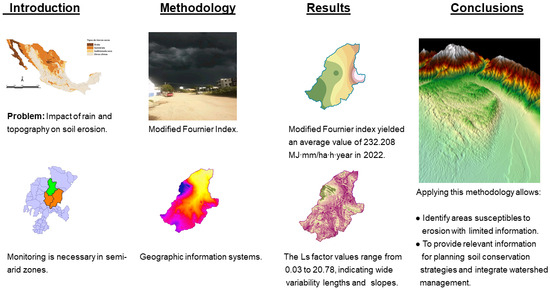
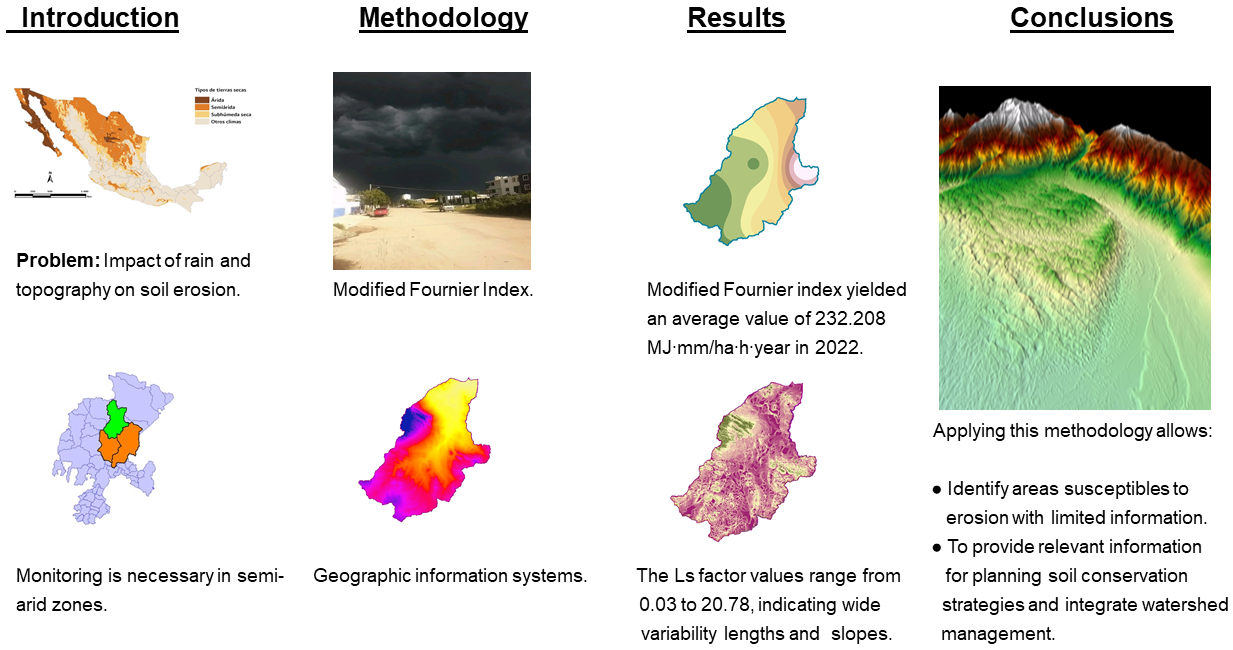
Graphical Abstract

1. Introduction

One of the main environmental problems globally is soil erosion [1], due to its economic and social impact [2]. Loss of biodiversity, soil degradation, nutrient loss, and water and soil pollution are negative impacts of erosion. In 2018, the International Resolution on Soil and Water Conservation established that in different types of land cover and uses, “the global average soil erosion is estimated to be between 12 and 15 t/ha/year” ([3], meaning that, globally, the Earth’s land surface loses between 0.90 and 0.95 mm of soil annually, assuming a soil density of 1.4–1.5 g   c m 3 .
Its economic, social, and ecological impacts, which affect fertility, biodiversity, and water quality, have made soil erosion one of the main environmental problems. Precipitation, topography, and land use are fundamental factors in water erosion, which also exhibits high spatial and temporal variability. In this context, the integration of models such as USLE/RUSLE with geospatial tools has allowed for progress in identifying critical areas; however, limitations persist in the detailed representation of these factors, especially in semi-arid regions with limited data. In particular, understanding the spatial distribution of the R factor and the heterogeneity of the LS factor remains a significant challenge for accurately interpreting erosional processes under conditions of climatic variability. The R and LS factors represent two of the main mechanisms controlling the water erosion of soil: the capacity of rainfall to detach particles and the influence of topography on their transport [4].
In 2015, a 20 m Digital Elevation Model (DEM) [5] and the Desmet and Govers model were used [6] in southern Italy, with the authors finding that for slopes greater than 15–20%, erosion can be up to 10 times higher than for slopes gentler than 15%, with the topographical factor being the main geomorphological control [5]. Using the RUSLE method and GIS, in 2015, LS was identified as one of the fundamental factors in the erosion process [6]. In 2016, using high-precision precipitation data, the R factor was analyzed in Europe using the RUSLE method, revealing high variability and elevated values associated with extreme events in the Mediterranean region [7]. In 2016, using the GAM statistical model and the RUSLE method, it was found that erosivity is concentrated in autumn and winter, with a clear relationship between the distribution of rainfall and the spatial distribution of the erosivity factor [8]. In Rwanda in 2016, the USLE method, GIS, and remote sensing were used to determine that water erosion is very severe in Rwanda, and is concentrated in agricultural areas with steep slopes [9]. In the Koga Basin in 2016, using RUSLE, GIS, and remote sensing, severe erosion was found to be related to topography, rainfall, and intensive land use for agriculture [10]. In 2017, a collaborative study was conducted on a global R factor using high-density climate databases, concluding that rainfall erosivity is highly variable in space and time, concentrating in the tropics and in specific seasons [11]. In 2017, erosion risk was assessed by integrating RUSLE and GIS, concluding that it is a powerful tool for diagnosing erosion and prioritizing areas for ecological restoration [12].
In 2021 erosivity and its trend were monitored in Juliaca, calculating R using the USLE and the Mann–Kendall method. It was concluded that rainfall erosivity in Juliaca is high and variable, directly linked to annual precipitation, with no clear trend during the evaluated period, but with a potentially significant impact on soil erosion [13]. In 2022, USLE and GIS methods were used to estimate soil loss in the Estibaná River sub-basin, comparing different types of vegetation cover and their effects, as well as agricultural management practices. It was concluded that erosion in the Estibaná River sub-basin is a serious problem caused mainly by intense rainfall and rugged topography [14]. In Argentina in 2022, a study was conducted using the USLE, demonstrating the spatial and temporal interactions between different factors (precipitation, slope, soil, crops, and management) [15]. In Cuba, local precipitation data (20 years) were used, and edaphic and topographic factors were estimated using the RUSLE method. Indices such as rainfall erosivity were validated, and the Modified Fournier Index was used to estimate erosion risk in the Los Palacios River sub-basin. This reflected the spatial and temporal interactions between natural factors (rainfall, slope, soil) and anthropogenic factors (crops, management), where rainfall exhibits very high erosive aggressiveness [16].
In 2023, a watershed in northwestern Morocco was analyzed using GIS, DEM, and RUSLE, identifying risk areas and highlighting the LS and R factor importance of the RUSLE as the most relevant factors in the spatial variability of erosion [17]. In China, in 2024 the improved USLE methodology was applied with global climatic, soil, topographic, and satellite data from 1992 to 2015, analyzing temporal trends and regional variations. The authors also validated the results by comparing them with previous global studies, concluding that global potential water erosion is highly sensitive to precipitation and changes in land cover [18]. A 2025 study demonstrates a robust application of the USLE integrated with GIS to assess soil loss and its economic impact in an agricultural watershed, highlighting the effectiveness of conservation practices. Critical areas associated with slope and position in the landscape are identified [19].
This research aims to determine and evaluate the rainfall erosivity factor (R) using the Modified Fournier Index (MFI) and the LS factor through a 20 m DEM. ArcGIS 10.8 software was used, utilizing available data from five meteorological stations of Comisión Nacional del Agua (CONAGUA) spanning 37 years, from 1986 to 2022. The study area is located in the Cañitas sub-basin within the Fresnillo–Yesca basin in the semi-arid region of the state of Zacatecas, Mexico.
This study provides new evidence on the spatial distribution of rainfall erosivity and the topographic influence on soil erosion in a semi-arid watershed in northern Zacatecas State, Mexico. It demonstrates the applicability of the Modified Fournier Index combined with GIS techniques in data-scarce environments.
This research expands knowledge about the dynamics of water erosion in semi-arid regions of northern Mexico by spatially characterizing the R and LS factors. Furthermore, it provides evidence on the usefulness of the Modified Fournier Index for estimating rainfall erosivity in basins with limited meteorological data.
Selected studies conducted between 2015 and 2025 are presented [Table 1] ([7,8,9,10,11,12,13,14,15,18,20,21,22,23,24,25,26]).

2. Materials and Methods

2.1. Study Area

The study area is located in the Cañitas sub-basin, situated between −102°4′49.888564″ longitude and 23°27′47.102213″ latitude, within the Fresnillo–Yesca Basin in the State of Zacatecas, Mexico. This region is located in a semi-desert zone, characterized by high-intensity rainfall over short periods, high hydroclimatic variability, and erosivity associated with high-intensity rainfall events [22].
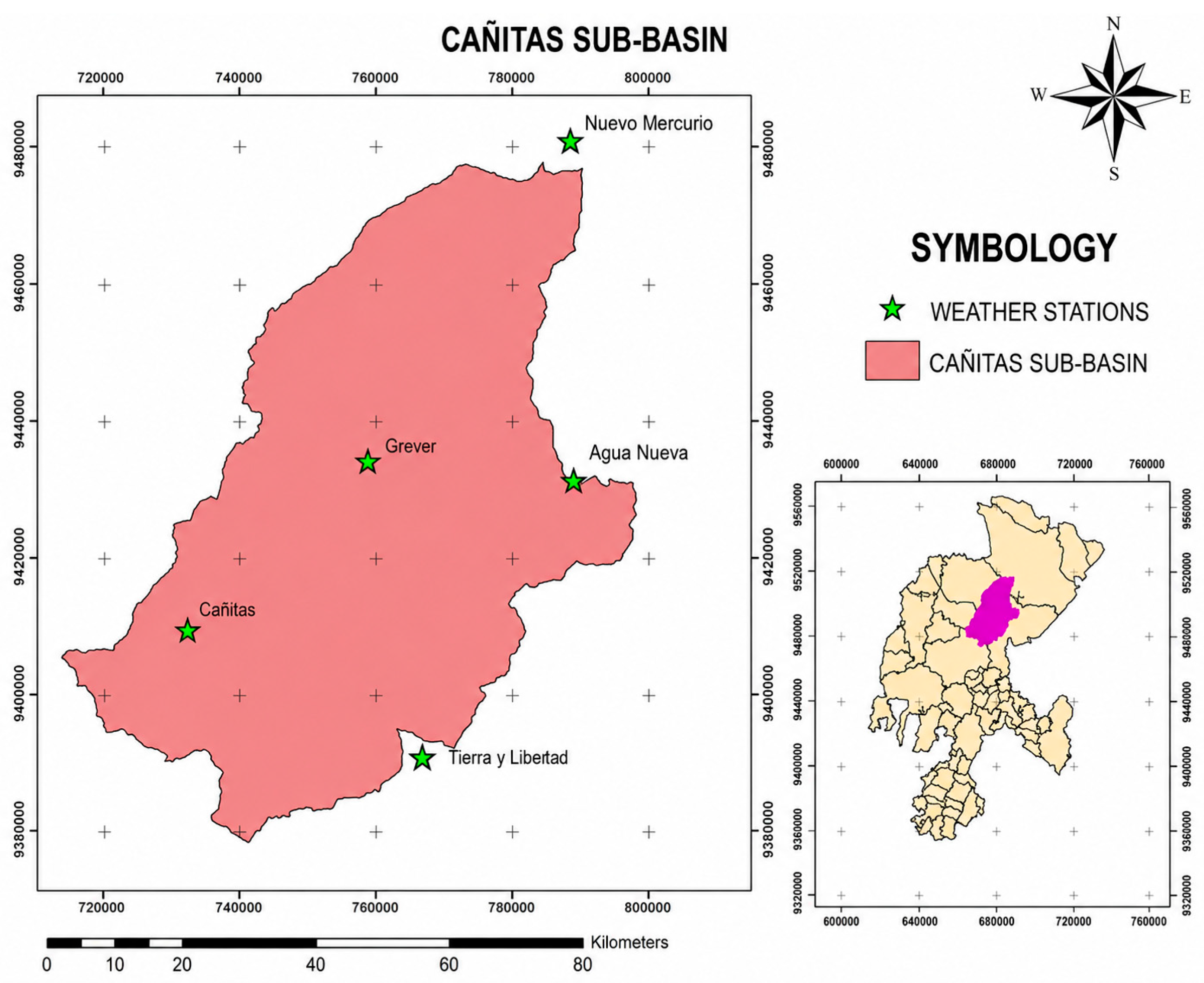
The Cañitas sub-basin demonstrates the predominant influence of the R and LS factors on the dynamics of water erosion, as also seen in several international studies; however, it is distinguished by its semi-arid condition, limited data availability, and high climatic variability, which modifies the erosion generation mechanisms. In Cañitas it is associated with intense but sporadic rainfall events. Furthermore, the use of different techniques to validate the R factor represents a significant contribution compared to previous studies. The Cañitas sub-basin (Figure 1) has an area of 4949 km2 and a perimeter of 428.12 km (SIATL, the water flow simulator for watersheds was developed by the Instituto Nacional de Estadística y Geografía (INEGI, 2010). Within the sub-basin, different land uses are observed, associated with soil degradation processes. The Cañitas sub-basin contributes to surface runoff and the recharge of local aquifers, which is fundamental to the sustainable management of water resources in the northern part of the state of Zacatecas [27]. Analyzing the R (rainfall erosivity) and LS (topography) factors in the Cañitas sub-basin is fundamental to understanding the mechanisms that control water erosion in this environment, characterized by high climatic variability and rainfall concentrated between June and September. This favors short-duration, high-kinetic-energy erosion events. The R factor quantifies the energy and intensity of precipitation, while the LS factor shows the influence of topography on the erosion process. Evaluating both factors allows us to identify the spatial distribution of erosion risk and distinguish areas where climatic or topographic effects predominate. Furthermore, this approach helps reduce uncertainty in erosion estimation using the USLE (Universal Soil Loss Equation), particularly in contexts with limited information, thus strengthening the analysis of the erosion process at a local scale.
The climatic, edaphic, and topographic characteristics of the Cañitas sub-basin, represented by the presence of Leptosols, Calcisols, Phaeozems, and Regosols, and the information derived from the 20 m Digital Elevation Model (DEM) make it an area of interest for evaluating water erosion and the potential effects of climate change on soil loss in semi-arid environments [28].
Table 2 shows the general characteristics of the five meteorological stations analyzed during the period 1986–2022. It is worth noting that some stations have a longer operating time and greater availability of records.
GIS tools based on the Modified Fournier Index (MFI) were applied, enabling a spatial assessment of rainfall erosivity and topography in the study area.

2.2. Universal Soil Loss Equation (USLE)

The Universal Soil Loss Equation (USLE) is a mathematical model that calculates water erosion of soil [30] based on factors given by Equation (1) [31].
A = R · K · L · S · C · P
where A is the annual average soil erosion M g / ( h a · y e a r ) ,  R is rainfall erosivity (MJ∙mm/ha∙h∙year), K is soil erodibility ( M g · h ) / M J · m m ,  L is slope length (dimensionless), S is slope grade (dimensionless), C is crop and crop management (dimensionless), and P is soil management practices (dimensionless) [32].

2.3. Modified Fournier Index (MFI)

The R factor, called rainfall erosivity or soil erosivity, is a function of the kinetic energy and intensity of precipitation. The calculation is based on the climatic aggressiveness index or FI (Equation (2)), which is calculated using data from weather stations. The formula for the FI is obtained from Equation (2) [33].
Fournier, in 1960, calculated the precipitation coefficient to estimate erosivity [31]. Lombardi Neto and Moldenhauer (1992) established an empirical equation between precipitation and erosivity using the Fournier Index (FI). This allows erosivity to be calculated [34].
F I = p m a x 2 P
where FI is the Fournier Index, p m a x is the average precipitation of the rainiest month (mm), and P is the average annual precipitation (mm).
The MFI (Equation (3)) is obtained from the ratio of the sum of the squares of the monthly precipitation for a year to the total average annual precipitation [35].
Although the FI is widely used due to its ease of calculation, it does not have much popularity among soil scientists, since it only considers the month with the highest precipitation, while the MFI considers all months and is based on the fact that surface erosion is not only caused by the month with the highest precipitation, but also by months with lower precipitation [20].
M F I = i = 1 12 p i 2 P t
where MFI is the Modified Fournier Index, p i is the mean monthly precipitation (mm), and P t is the mean annual precipitation (mm).

2.4. Erosivity Factor (R)

The use of the Modified Fournier Index (MFI) for estimating the rainfall erosivity factor R has been widely supported in the scientific literature, particularly in regions where high-resolution pluviographic records are unavailable. In this context, several studies have demonstrated a strong relationship between the MFI and the R factor. For example, in 2016, it was reported that the Modified Fournier Index shows a high degree of fit with the R factor [34], supporting its use as a surrogate indicator of rainfall erosivity. Subsequently, in 2018, a correlation between the R factor and the MFI was used to recalibrate and improve the representation of erosivity in erosion models [35]. Furthermore, in 2015, the erosivity factor was estimated using Equation (4), developed with data from a Mediterranean region characterized by irregular rainfall and high-intensity rain events [36]. Although Mediterranean climatic conditions differ from those present in semi-arid environments, both contexts share precipitation patterns capable of generating high erosivity, which has favored the use of this type of empirical relationship in water erosion studies carried out in regions with limited availability of rainfall intensity data.
R = 1.05 · M F I .
For the spatial estimation of the rainfall erosivity factor, ArcGIS software was used, a geospatial platform widely used in hydrological and environmental studies for the processing, analysis, and interpolation of climatic variables [37]. The calculation of the R factor was based on precipitation records from five meteorological stations located within and in the immediate vicinity of the Cañitas sub-basin, whose distribution allowed for the representation of the spatial variability of precipitation in the study area.
Because the erosivity estimate was based on information from only five meteorological stations heterogeneously distributed within and around the Cañitas sub-basin, the Inverse Distance Weighting (IDW) method was deemed appropriate. This method assumes that the similarity between observations decreases with distance, thus assigning greater weight to stations closer to the estimation point. This approach is particularly suitable for climatic variables such as precipitation and rainfall erosivity, whose spatial variability is often strongly influenced by geographic proximity. Furthermore, comparison with the Kriging method showed very similar spatial patterns, indicating that the spatial structure of the data was consistently represented. In this context, the use of IDW allowed for a robust spatial representation of erosivity with a limited number of stations and without requiring the explicit modeling of the spatial autocorrelation structure necessary in more complex geostatistical methods.
The Modified Fournier Index (MFI) was calculated annually for each station during the study period, allowing for the incorporation of the temporal variability of precipitation. From these values, the R factor was estimated for each year and station, and subsequently, the average erosivity values were determined. This procedure made it possible to characterize both the temporal variability of rainfall erosivity and its spatial distribution within the Cañitas sub-basin, providing a solid basis for the identification of areas with greater erosive potential.

2.5. Topographic Factor LS

The precipitation and topographic surfaces were generated using the Inverse Distance Weighting (IDW) interpolation method in ArcGIS, using a cell size of 100 m × 100 m.
Slope length (L) and slope (S) are two fundamental elements in the USLE for calculating the LS factor in watershed studies, which includes the influence of topography on soil loss [38].
Foster (1977) proposed Equations (5)–(7) for L factor estimation.
L = λ 22.13 m
with
m = F 1 + F
and
F = s i n β / 0.086 3 ( s i n β ) 1.8 + 0.56
where L is the slope length (m), λ is the surface flow area (m2), F is the slope factor that defines m, m is the exponent influenced by the slope length and angle, and β is the slope angle.
In 2015, Panagos and Meusburger expanded on the approach developed by Desmet and Govers (1996), incorporating GIS techniques to propose Equation (8) [8].
L i , j = A ( i , j ) + D 2 ( m + 1 ) A ( i , j ) ( m + 1 ) x m D ( m + 2 ) ( 22.13 ) m ,
where β is the slope, A is the flow accumulation, D is the grid cell size (m), and x is the shape coefficient (x = 1).
According to Renard et al. (1997), soil loss increases with slope length, hence the importance of the L factor [39].
The formula for obtaining the slope is derived from Equations (9) and (10) based on McCool et al. (1987) [39].
t a n β ( i , j ) < 0.09 S ( i , j ) = 10.8 s i n β ( i , j ) + 0.03 ,
t a n β ( i , j ) 0.09   S ( i , j ) = 16.8 s i n β ( i , j ) 0.5 .

3. Results and Discussion

3.1. R Factor

The R-factor was calculated based on data from weather stations over the period 1986–2022 (National Meteorological Service), the last year with published data; however, significant changes have been recorded in recent years.
Table 3 shows the R factor for the five stations analyzed during the period 1986–2022.
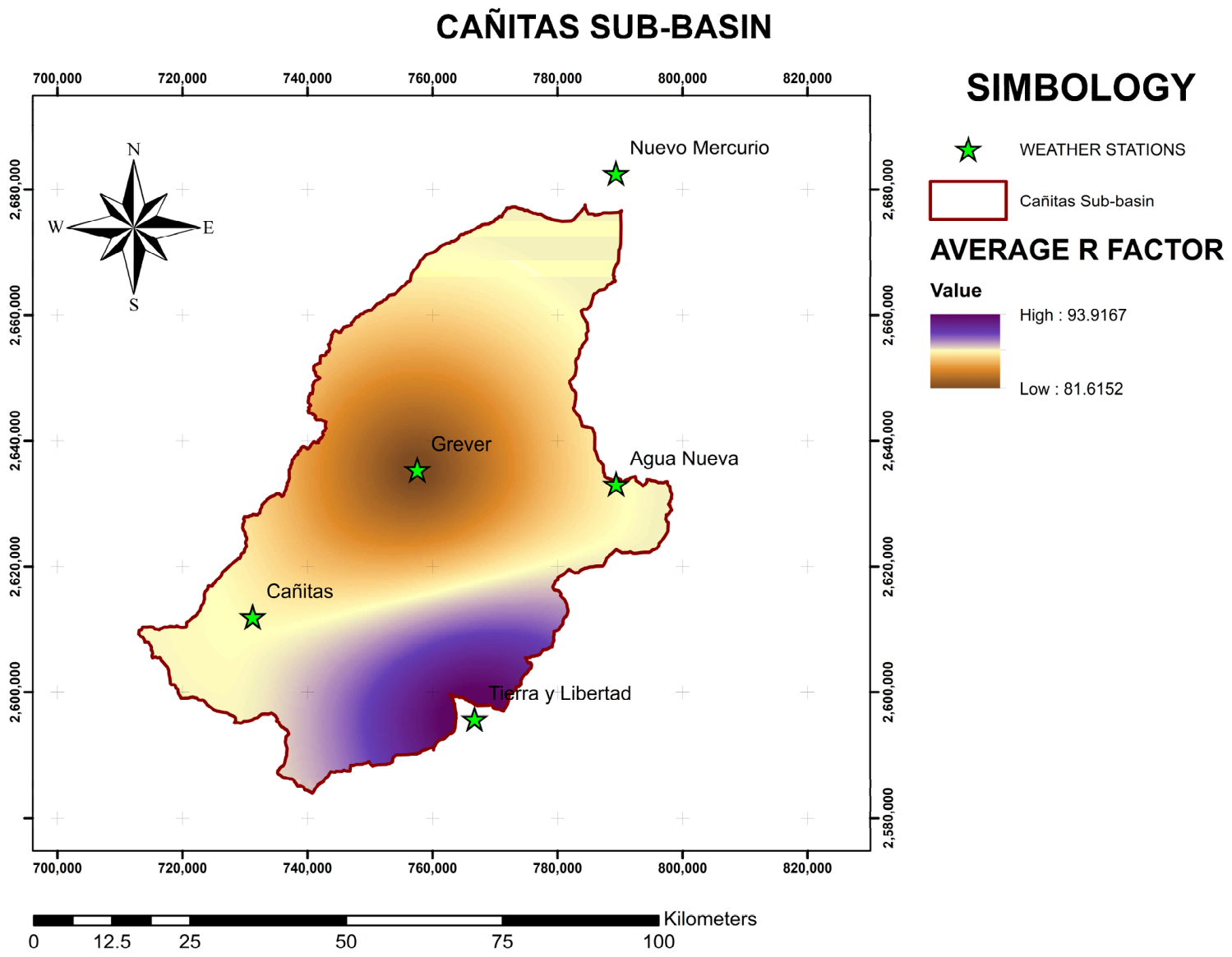
Figure 2 shows the average R factor results for the five weather stations analyzed over the period 1986–2022.
Figure 2 shows that the area most influenced by the average R factor is the southeast during the period 1986–2022.
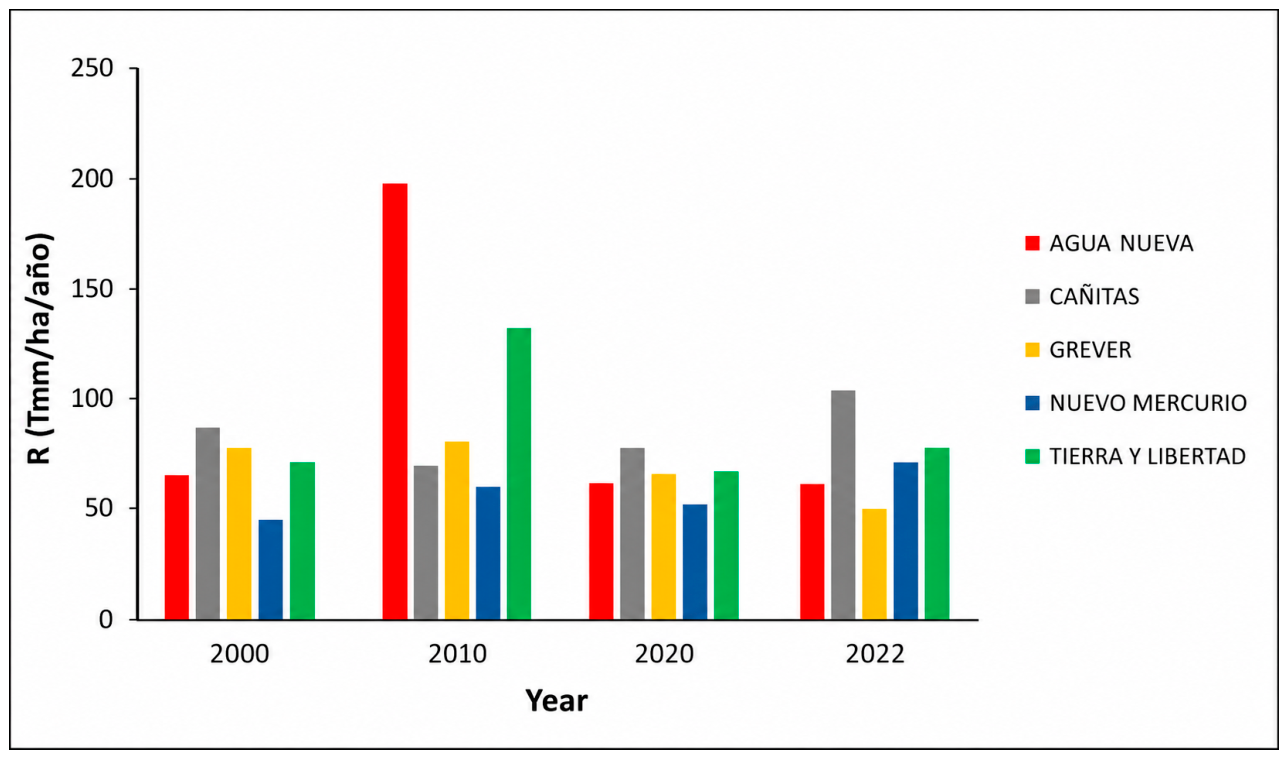
Figure 3 shows the average results of the R factor at the five meteorological stations analyzed in 2000, 2010, 2020 and 2022, showing significant changes in precipitation.
The year 2022 was selected because it corresponds to the most recent period with complete and validated meteorological data for the five stations analyzed. Its selection allows for the characterization of current rainfall erosivity conditions and the evaluation of recent erosion factors in the Cañitas sub-basin, providing an updated basis for soil management and conservation.
Figure 3 shows that the stations exhibiting the highest R factor in 2020 and 2022 are located in the southwest of the sub-basin (Cañitas) and in the southeast (Tierra y Libertad). In 2010, the highest factor was found in the west (Agua Nueva) and in the southeast (Tierra y Libertad). In 2000, the highest R factor was found in the southwest (Cañitas) and in the center of the sub-basin (Grever).
The results indicate that the highest R-value recorded in 2000 was 85 MJ∙mm/ha∙h∙year; in 2010 it was 197 MJ∙mm/ha∙h∙year, while in 2020 it was 73 MJ∙mm/ha∙h∙year and in 2022 it was 103 MJ∙mm/ha∙h∙year. The Cañitas station (southwest of the sub-basin) had the highest R factor in 2000, 2020, and 2022. In 2010, the highest R factor was recorded at the Agua Nueva station (east of the sub-basin). This area shows increased susceptibility to water erosion due to several intense rainfall events, which increase runoff and the erosive power of surface flow. The spatial distribution of this maximum value suggests the influence of intense, short-duration storms during the analyzed period, a typical behavior in semi-desert regions where storms occur in localized areas and with high kinetic energy (Figure 3).
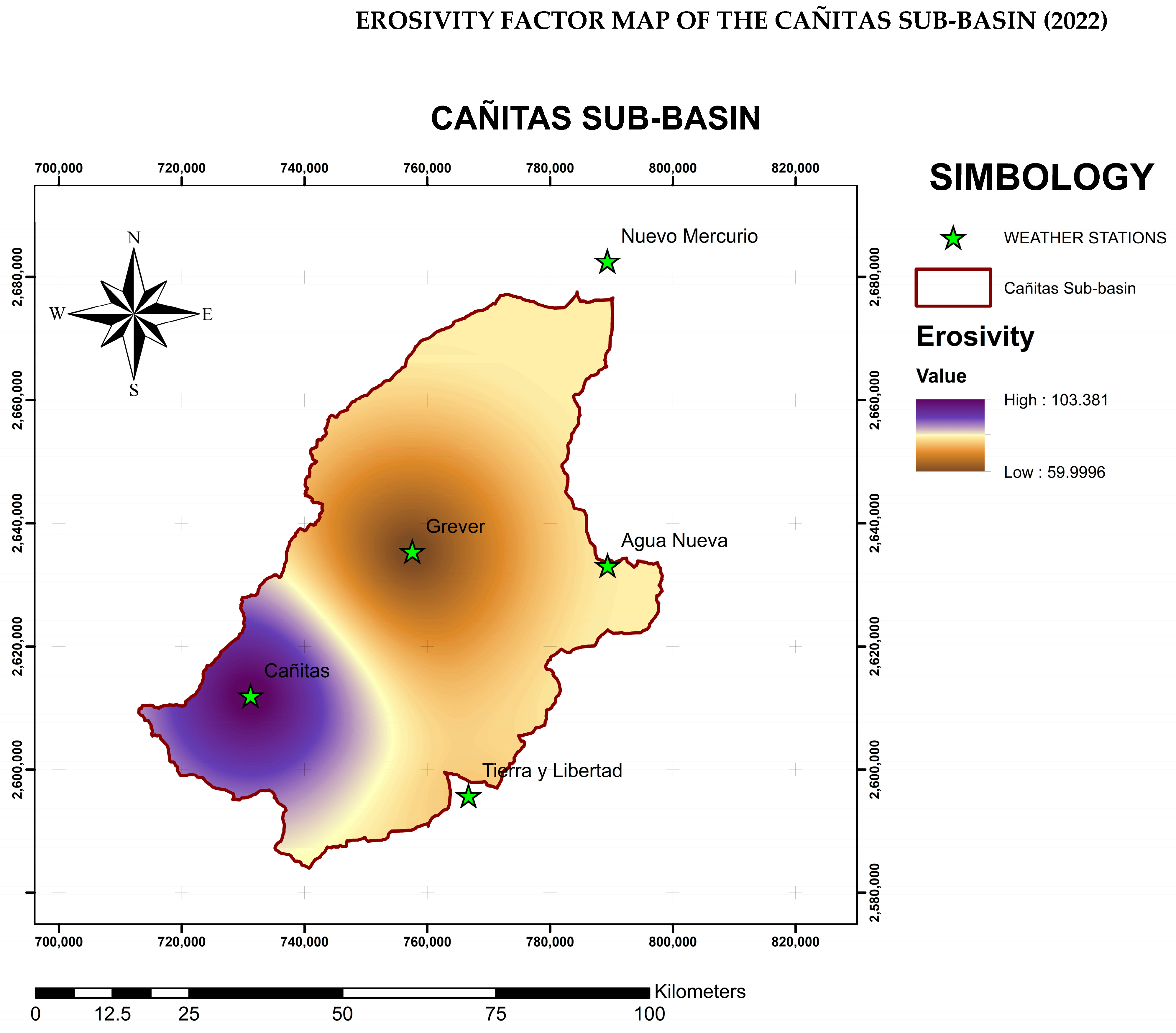
The highest erosivity index in 2022 in the Cañitas sub-basin was obtained in the southwest (Figure 4).
The western part of the study area has the highest erosivity values, while the southern part has the lowest. Similarly, low erosivity values predominate in the central and eastern parts of the sub-basin, while average values are recorded in the north and center.
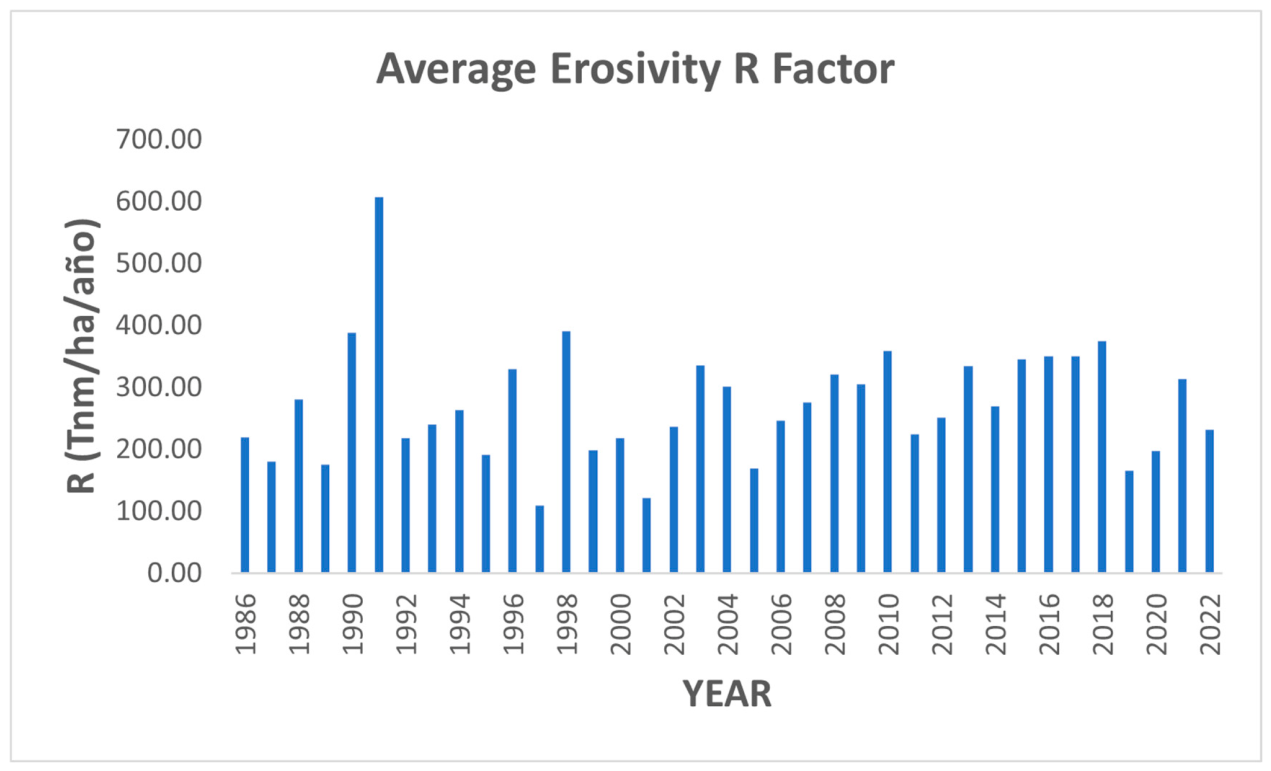
During the period 1986–2022, the rainfall erosivity values ranged from 68 MJ∙mm/ha∙h∙year in 1986 to 72 MJ∙mm/ha∙h∙year in 2022. This allows us to evaluate the temporal evolution of rainfall erosivity in the Cañitas sub-basin, using the first and last years of the analyzed series as a reference. This approach facilitates the identification of long-term changes associated with climate variability and the potential effect of climate change on precipitation and, therefore, on the risk of water erosion. The difference between the two years (4 MJ∙mm/ha∙h∙year) is relatively insignificant; however, some years show more marked variations, such as 1991, when erosivity reached considerably higher values than the historical average for the period studied (Figure 5).
Table 4 shows the classification of the R factor according to its values [40].
In 1990 and 2010, the eastern part of the sub-basin had an R index of 387.81 and 358.31 MJ∙mm/ha∙h∙year, respectively. In 2018, the southern part had an R index of 374.29 MJ∙mm/ha∙h∙year; in all these cases, the index was classified as moderate. However, in 1991 the index had a value of 607.91 MJ∙mm/ha∙h∙year, which is classified as high.

3.2. LS Factor

High values for the LS factor indicate a combination of slope length and gradient that increases the erosive potential of surface runoff. However, the LS value does not allow for the identification of the relative contribution of each component separately.
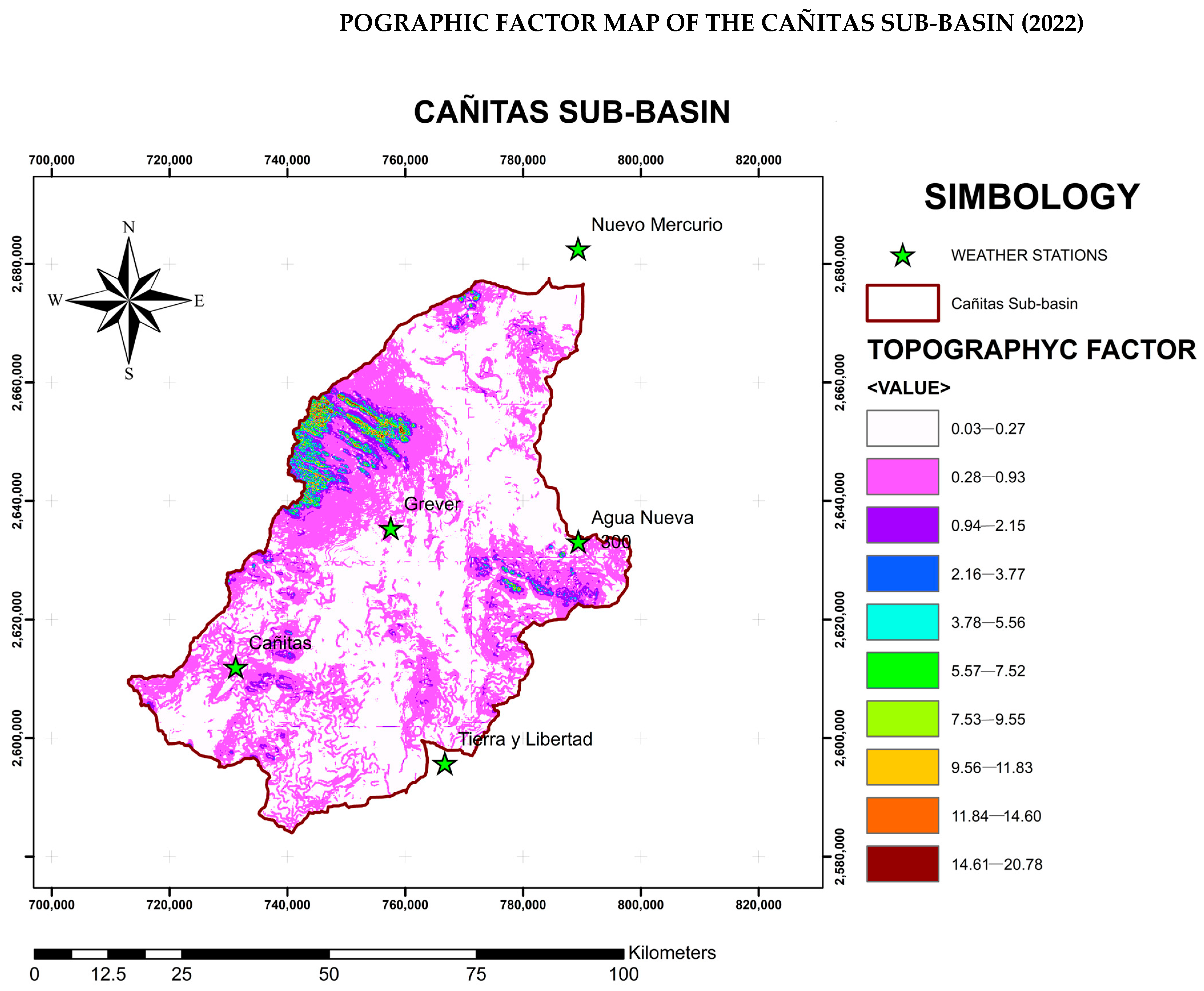
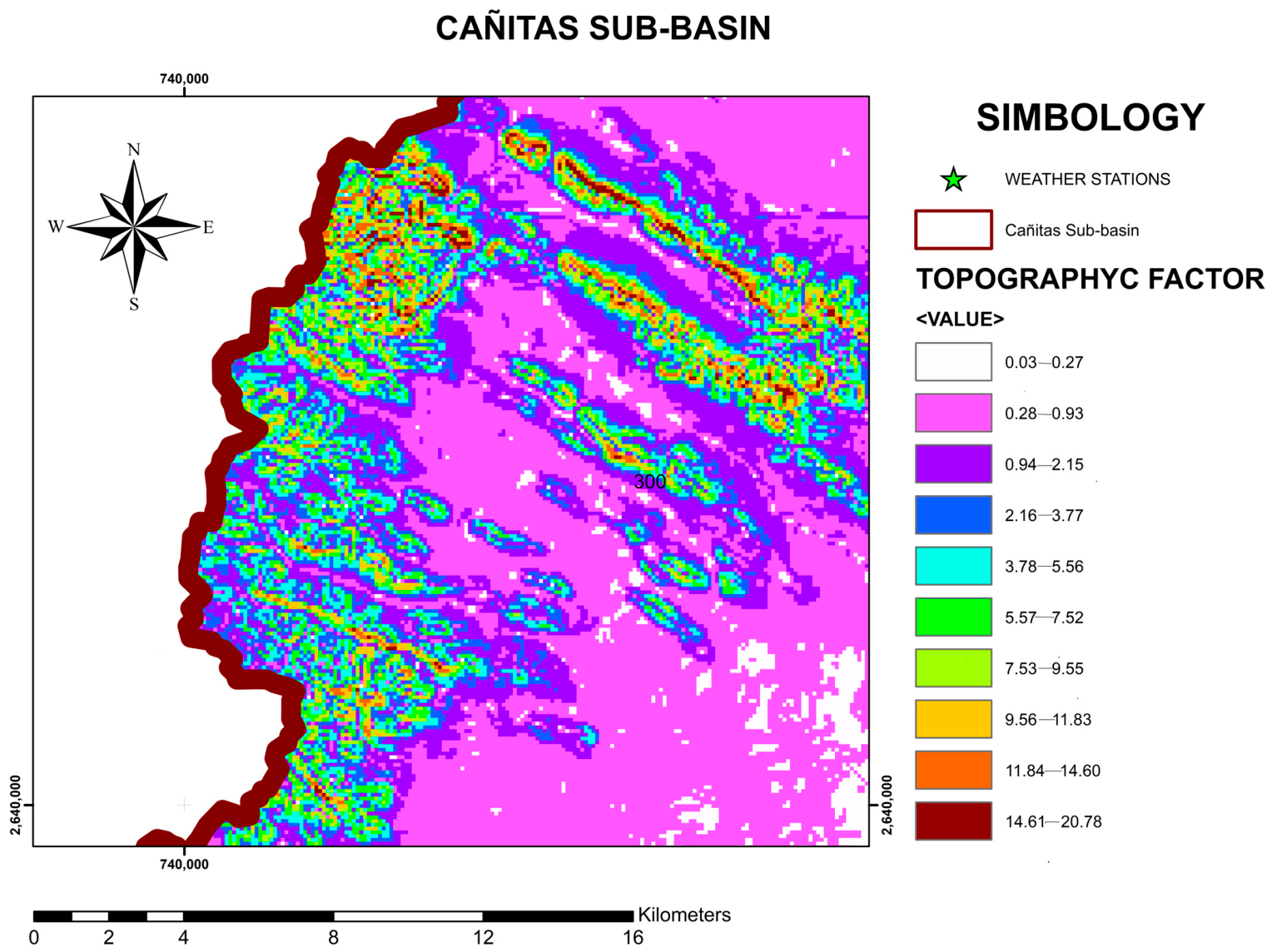
Figure 6 and Figure 7 show significant spatial differences in the influence of topography within the Cañitas sub-basin. The LS values range from 0.03 to 20.78. This indicates a wide topographic variability derived from length and slope, demonstrating the significant influence of topography on erosion.
The northwest zone is characterized primarily by steep slopes and long hillsides, where surface runoff acquires greater energy and transport capacity, creating critical areas with erosion potential, especially during heavy rainfall. The eastern part of the sub-basin exhibits a low-to-moderate topographic intensity factor (0.94–3.77). Conversely, most of the sub-basin presents very low LS values (≤1), corresponding to gentle terrain with short slopes and relatively flat areas.
Table 5 shows the classification of the LS factor values [40].
The results show that erosion depends on the interaction of the R and LS factors. This analysis provides valuable information for the delimitation of priority conservation areas, decision-making, and the calibration of erosion models at a regional scale.

4. Discussion

The R factor depends on the energy and intensity of rainfall; therefore, a reduction in annual accumulations or in the frequency of erosive events tends to be reflected in lower erosivity values. In Zacatecas, some studies have reported evidence of a reduction in annual precipitation and changes in climatic extremes, which coincides with the behavior observed in the Cañitas sub-basin. In 2014, annual precipitation trends were analyzed in Zacatecas [41].
From a climate change perspective, this decrease in the R factor should not necessarily be interpreted as a reduction in erosion risk. In semi-arid regions, climate change can reduce average precipitation but increase temporal irregularity, the duration of droughts, and the occurrence of concentrated, intense rainfall events. Therefore, although the annual average of R tends to decrease, isolated extreme events can still generate significant erosion, indicating that erosion may be dominated by intense episodes rather than by total annual precipitation.
On the other hand, the spatial heterogeneity of the LS factor is due to geomorphological causes such as slope length and gradient; therefore, its values increase in areas where the topography favors greater concentration and velocity of surface runoff. In the Cañitas sub-basin, the higher values located toward the northwest are explained by steeper slopes and longer gradients. Conversely, the central, eastern, and southern areas show low LS values due to gentler topography and gradients, and a lower capacity for runoff concentration.
Compared to the studies in Table 1, the Cañitas sub-basin provides an intermediate approach between global or continental studies and local analyses of soil loss. For example, in 2016, researchers worked with high-resolution pluviographic data in Greece, which allows for greater accuracy in R values, but limits its replicability in data-scarce regions. In contrast, the Cañitas sub-basin study validates the use of the Modified Fournier Index under semi-arid conditions with limited information.
Table 1 shows that several studies focus on national, continental, or global scales, while the present study works at the sub-basin scale, allowing for greater spatial detail. Furthermore, it uses an extensive series, from 1986 to 2022, and integrates R and LS analysis. Although the R factor calculation was not performed using high-resolution rainfall data, the use of monthly and annual precipitation records over a 37-year period provided a sufficiently long timescale to assess the variability and evolution of rainfall erosivity. The use of the Modified Fournier Index (MFI) allowed for leveraging this available climate information and obtaining consistent estimates of the R factor in a region where rainfall intensity data are limited.
The study of the Cañitas sub-basin stands out for combining temporal analysis of the R factor, spatial evaluation of the LS factor, and methodological validation in a semi-arid region. While comparative studies confirm the importance of slope, vegetation cover, and data resolution in erosion estimation, this study provides local evidence of how climatic variability and geomorphology control erosion risk differently: the differentiation of critical zones within the Cañitas sub-basin is due to the predominant influence of different erosion factors. The southwest sector showed the highest values of the R factor, indicating greater rainfall erosivity associated with more intense precipitation and, consequently, a greater capacity of rain to generate soil particulate detachment and transport. In contrast, the northwest sector registered the highest values for the LS factor, reflecting more favorable topographic conditions for the concentration of surface runoff. Although the LS factor incorporates the effects of slope length and slope, its high values demonstrate greater susceptibility of the terrain to erosive processes. Therefore, while in the southwest the erosive potential is mainly controlled by rainfall energy, in the northwest it is primarily determined by the topographic characteristics of the terrain.

5. Conclusions

Analysis of the rainfall erosivity factor (R) revealed marked spatial and temporal variability among the meteorological stations in the Cañitas sub-basin. The highest values were recorded in specific years associated with high-intensity rainfall events, while most records corresponded to moderate erosivity levels. The observed heterogeneity confirms that rainfall erosivity is not uniformly distributed within the sub-basin and that its behavior is strongly influenced by precipitation variability.
On the other hand, the LS factor results show marked spatial heterogeneity within the sub-basin. The northwest region has the most extensive slopes and the steepest gradients (LS up to 20.78), where surface runoff generates greater energy and transport capacity, creating critical areas of erosive potential. Conversely, most of the sub-basin area has low values (LS ≤ 1), associated with gentle relief and small slopes, where the topography has a minimal impact on erosion.
The analysis of the R and LS factors shows that the R factor in the southwest area indicates a greater tendency toward erosion, while the LS factor indicates a higher probability of erosion by transport in the northwest area due to the local topography. This identifies two critical areas susceptible to erosion from different causes. This provides empirical validation of the MFI as an alternative method for estimating rainfall erosivity in semi-arid environments with limited pluviographic data, strengthening the regional calibration of the USLE/RUSLE model. This contribution assesses the influence of rainfall on water erosion processes. The LS factor shows marked spatial heterogeneity within the sub-basin, associated with the influence of topography on water erosion.
The results suggest that the identified critical areas are more susceptible to water erosion due to a combination of climatic and topographic conditions that favor surface runoff.
Estimating the R factor allowed for the identification of the spatial and temporal distribution of rainfall erosivity in the Cañitas sub-basin, providing key information on areas where precipitation exerts the greatest pressure on erosive processes. These findings support the planning of soil conservation strategies and integrated watershed management in the semi-arid regions of northern Mexico and constitute a technical basis for formulating land-use and management recommendations aimed at reducing soil degradation.

Author Contributions

Conceptualization, L.C.-P.; E.D.M.-V. and J.V.-M.; methodology, L.C.-P. and E.D.M.-V.; software, L.C.-P. and E.D.M.-V.; validation, J.V.-M., R.S.-A., V.I.R.-A. and C.F.B.-C.; formal analysis, E.D.M.-V. and J.V.-M.; investigation, L.C.-P. and E.D.M.-V.; data curation, L.C.-P. and E.D.M.-V.; writing—original draft preparation, L.C.-P.; writing—review and editing, L.C.-P.; E.D.M.-V.; J.V.-M.; R.S.-A. and V.I.R.-A.; visualization, R.S.-A.; V.I.R.-A. and C.F.B.-C.; supervision, E.D.M.-V., J.V.-M., R.S.-A. and V.I.R.-A. All authors have read and agreed to the published version of the manuscript.

Funding

This research received no external funding.

Data Availability Statement

The original contributions presented in this study are included in the article. Further inquiries can be directed to the corresponding author.

Acknowledgments

The authors gratefully acknowledge the National Council for Humanities, Sciences and Technologies (CONAHCYT) of Mexico, for the scholarship awarded to Master of Mathematics Lorena Ceballos Pérez to pursue doctoral studies and conduct this research.

Conflicts of Interest

The authors declare no conflicts of interest.

Abbreviations

The following abbreviations are used in this manuscript:
RRainfall erosivity factor
GISGeographic Information System
MFIModified Fournier Index
LSTopographic Factor
USLEUniversal Soil Loss Equation
t/ha/yearTons of soil per hectare
FAOFood and Agriculture Organization of the United Nations
DEMDigital Elevation Model
RUSLERevised Universal Soil Loss Equation
GAMGeneralized Additive Model
MCDAMultiple Criteria Decision Analysis
RmRainfall magnitude
SWATSoil and Water Assessment Tool
CCrop and crop management
ArcGISSoftware as a geospatial platform
LSlope length
SSlope grade
SIATLEnvironmental and Territorial Information System (Sistema de Información Ambiental y Territorial)
E I 30 Maximum intensity in 30 min
R c Precipitation coefficient
FIFournier Index
IDWInverse Distance Weighting
MJ∙mm/ha∙h∙yearMegajoules per millimeter per hectare per hour per year

References

  1. Inoue, N.; Hamanaka, A.; Shimada, H.; Sasaoka, T.; Matsui, K. Fundamental Study on Assessment of Soil Erosion by the USLE Method at Rehabilitation Area in Indonesian Coal Mine. Earth Sci. Res. 2015, 4, 61–67. [Google Scholar] [CrossRef]
  2. Phinzi, K.; Ngetar, N.S. The assessment of water-borne erosion at catchment level using GIS-based RUSLE and remote sensing: A review. Int. Soil Water Conserv. Res. 2019, 7, 27–46. [Google Scholar] [CrossRef]
  3. Food and Agriculture Organization of the United Nations. 2018. Available online: https://www.fao.org/faostat/en/#home (accessed on 10 January 2026).
  4. Swarnkar, S.; Malini, A.; Tripathi, S.; Sinha, R. Assessment of uncertainties in soil erosion and sediment yield estimates at ungauged basins: An application to the Garra River basin, India. Hydrol. Earth Syst. Sci. 2018, 22, 2471–2485. [Google Scholar] [CrossRef]
  5. Aiello, A.; Adamo, M.; Canora, F. Remote sensing and GIS to assess soil erosion with RUSLE3D and USPED at the watershed scale in southern Italy. Catena 2015, 131, 174–185. [Google Scholar] [CrossRef]
  6. Tahiri, M.; Tabyaoui, H.; Tahiri, A.; El Hadi, H.; El Hammichi, F.; Achab, M. Modelling Soil erosion and sedimentation in the Oued Haricha sub-basin (Tahaddart watershed, Western Rif, Morocco): Risk assessment. J. Geosci. Environ. Prot. 2015, 4, 107–119. [Google Scholar]
  7. Desmet, P.J.; Govers, G. A GIS procedure for automatically calculating the USLE LS factor on topographically complex landscape units. J. Soil Water Conserv. 1996, 51, 427–433. [Google Scholar] [CrossRef]
  8. Panagos, P.; Ballabio, C.; Borrelli, P.; Meusburger, K. Spatio-temporal analysis of pluvial erosivity and erisivity density in Greece. Catena 2016, 137, 161–172. [Google Scholar] [CrossRef]
  9. Karamage, F.; Zhang, C.; Ndayisaba, F.; Shao, H.; Kayiranga, A.; Fang, X.; Tian, G. Extent of cropland and related soil erosion risk in Rwanda. Sustainability 2016, 8, 609. [Google Scholar] [CrossRef]
  10. Gelagay, H.S.; Minale, A.S. Estimation of soil loss using GIS and remote sensing techniques: A case study of the Koga River Basin, northwestern Ethiopia. Int. Res. Soil Water Conserv. 2016, 4, 126–136. [Google Scholar] [CrossRef]
  11. Panagos, P.; Borrelli, P.; Meusburger, K.; Yu, B.; Klik, A.; Lim, K.J.; Yang, J.E.; Ni, J.; Miao, C.; Chattopadhyay, N.; et al. Global rainfall erosivity assessment based on high-temporal resolution rainfall records. Sci. Rep. 2017, 7, 4175. [Google Scholar] [CrossRef] [PubMed]
  12. Benchettouh, A.; Kouri, L.; Jebari, S. Spatial estimation of soil erosion risk using RUSLE/GIS techniques and practices conservation suggested for reducing soil erosion in Wadi Mina watershed (northwest, Algeria). Arab. J. Geosci. 2017, 10, 79. [Google Scholar] [CrossRef]
  13. Navarro, W.M.; Puma, L.M.; Ttito, Y.N.; Valeriano, Y.M.M.; Cañapataña, M.G.Q. Estimación del factor de erosividad de las precipitaciones pluviales en la localidad Juliaca-Perú. Ñawparisun-Rev. Investig. Científica Ing. 2021, 3. [Google Scholar]
  14. Castro-Villarreal, J.A.; Cabrera-Rodríguez, J.A.; Villarreal-Núñez, J.E. Pérdida de suelo evaluada por el método USLE en la subcuenca del río Estibaná, Panama. Acta Agronómica 2022, 71, 369–376. [Google Scholar]
  15. Ares, M.G.; Entraigas, I. Effects of spatial and temporal heterogeneity on soil loss in an agricultural watershed. Ecosistemas 2022, 31, 2298. Available online: https://www.revistaecosistemas.net/index.php/ecosistemas/article/view/2298 (accessed on 10 January 2026). [CrossRef]
  16. Ricardo-Calzadilla, M.P.; Gómez-Arias, A.; Cutie-Cansino, V. Erosividad de las lluvias en Finca Tierra Brava de la subcuenca (S1) Río Los Palacios. Ing. Agrícola 2022, 12, e02. [Google Scholar]
  17. Bouayad, F.E.; El Idrysy, M.; Ouallali, A.; El Amrani, M.; Courba, S.; Hahou, Y.; Benhachmi, M.K.; Spalevic, V.; Kebede, F.; Briak, H. Assessing soil erosion dynamics in the RMEL watershed, northern Morocco by using the RUSLE model, GIS, and remote sensing integration. Agric. For. 2023, 69, 173–194. [Google Scholar] [CrossRef]
  18. Li, J.; Xiong, M.; Sun, R.; Chen, L. Temporal variability of global potential water erosion based on an improved USLE model. Int. Res. Soil Water Conserv. 2024, 12, 1–12. [Google Scholar] [CrossRef]
  19. Gvozdenovich, J.J.; Saluzzio, M.F.; Crettaz, M.E.; Folmer, M.A.; Gregorutti, V.C.; Dorelo, M.P.B.; Gaitan, J.J. Environmental and economic impact of soil and water conservation through the systematization of the La Ensenada Stream basin. Sci. Teach. Technol. Suppl. 2025, 15. Available online: https://pcient.uner.edu.ar/index.php/Scdyt/article/view/2203 (accessed on 10 January 2026).
  20. Calero Mosquera, D.; Martínez López, C.; Menjívar Flores, J.C. Evaluación de modelos para estimar la erosividad de la lluvia en el Valle del Cauca, Colombia. Acta Agronómica 2021, 70, 198–210. [Google Scholar] [CrossRef]
  21. Aguirre-Salado, C.A.; Miranda-Aragón, L.; Pompa-García, M.; Reyes-Hernández, H.; Soubervielle-Montalvo, C.; Flores-Cano, J.A.; Méndez-Cortés, H. Improving identification of areas for ecological restoration for conservation by integrating USLE and MCDA in a GIS-environment: A pilot study in a priority region Northern Mexico. ISPRS Int. J. Geo-Inf. 2017, 6, 262. [Google Scholar] [CrossRef]
  22. Gaubi, I.; Chaabani, A.; Ben Mammou, A.; Hamza, M.H. GIS-based prediction of soil erosion using the Revised Universal Soil Loss Equation (RUSLE) (Lebna River Basin, Cape Bon, Tunisia). Nat. Hazards 2017, 86, 219–239. [Google Scholar]
  23. Yue, T.; Xie, Y.; Yin, S.; Yu, B.; Miao, C.; Wang, W. Effect of time resolution of rainfall measurements on the erosivity factor in the USLE in China. Int. Soil Water Conserv. Res. 2020, 8, 373–382. [Google Scholar] [CrossRef]
  24. Fiener, P.; Dostál, T.; Krása, J.; Schmaltz, E.; Strauss, P.; Wilken, F. Operational USLE-based modelling of soil erosion in Czech Republic, Austria, and Bavaria—Differences in model adaptation, parametrization, and data availability. Appl. Sci. 2020, 10, 3647. [Google Scholar] [CrossRef]
  25. Marcillo, J.L.M.; Triana, L.V. Riesgo de erosión del suelo en el cantón Mocache aplicando análisis multicriterio y sistemas de información geográfica. Rev. Geográfica De Chile Terra Aust. 2024, 60, 86–101. [Google Scholar]
  26. Santos, A.D.S.; Silva Júnior, J.F.D.; Santos, L.D.S.; Alencar Sobrinho, R.J.; Amorim, E.C.; Fernandes, G.S.T.; Silva, E.F.d.; Silva, T.G.F.d.; de Lima, J.L.M.P.; Jardim, A.M.D.R.F. Identification of Priority Areas for the Control of Soil Erosion and the Influence of Terrain Factors Using RUSLE and GIS in the Caeté River Basin, Brazilian Amazon. Earth 2025, 6, 35. [Google Scholar] [CrossRef]
  27. Lozano-Rivas, W.A. Clima, Hidrología Meteorología: Para Ciencias Ambientales e Ingeniería; Universidad Piloto de Colombia: Bogotá, Colombia, 2018. [Google Scholar]
  28. Gallegos-Cedillo, J.; Arteaga-Ramírez, R.; Vázquez-Peña, M.A.; Juárez-Méndez, J. Estimación de datos diarios faltantes en registros de precipitación y temperatura máxima y mínima en San Luis Potosí. Ing. Agrícola Y Biosist. 2015, 8, 3–16. [Google Scholar]
  29. Panagos, P.; Ballabio, C.; Borrelli, P.; Meusburger, K.; Klik, A.; Rousseva, S.; Tadić, M.P.; Michaelides, S.; Hrabalíková, M.; Olsen, P.; et al. Rainfall erosivity in Europe. Sci. Total Environ. 2015, 511, 801–814. [Google Scholar] [CrossRef] [PubMed]
  30. Loaiza, S.; Silva, M.A.D. Evaluación del Potencial de Mitigación de las Estrategias de Adaptación Implementadas en los Territories Sostenibles Adaptados al Clima (TeSAC). 2018. Available online: https://hdl.handle.net/10568/93413 (accessed on 10 January 2026).
  31. Valdivia-Martínez, O.; Peña-Uribe, G.D.J.; Rufino-Rodríguez, F.; Torres-González, J.A.; Meraz-Jiménez, A.D.J.; López-Santos, A. Ajuste de la Ecuación Universal de Pérdida de Suelo en parcelas de escurrimiento ubicadas en una región del centro de México. Terra Latinoam. 2022, 40, e990. [Google Scholar] [CrossRef]
  32. Wischmeier, W.H.; Smith, D.D. Predicting Losses from Rainfall Erosion: A Guide for Conservation Planning (No. 537); Department of Agriculture, Science and Educational Administration: Washington, DC, USA, 1978.
  33. Behrends Kraemer, F.; Chagas, C.I.; Ibañez, L.; Carfagno, P.; Vangeli, S. Análisis de la erosividad de las lluvias para el partido de San Pedro (Bs. As.). Cienc. Del Suelo 2018, 36, 124–137. [Google Scholar]
  34. Crettaz, E.; Gvozdenovich, J.; Saluzzio, M. Calculo del Factor R de la Usle a Traves del Indice Modificado de Fournier; INTA Paraná: Paraná, Argentina, 2016; Available online: https://www.researchgate.net/profile/Jj-Gvozdenovich/publication/321058206_CALCULO_DEL_FACTOR_R_DE_LA_USLE_A_TRAVES_DEL_INDICE_MODIFICADO_DE_FOURNIER/links/5a0b06720f7e9b0cc025169f/CALCULO-DEL-FACTOR-R-DE-LA-USLE-A-TRAVES-DEL-INDICE-MODIFICADO-DE-FOURNIER.pdf (accessed on 8 April 2025).
  35. Benavidez, R.; Jackson, B.; Maxwell, D.; Norton, K. A revision of the Universal Soil Loss Equation (Revised) ((R)USLE): With a view to increasing its global applicability and improving soil loss estimates. Hydrol. Earth Syst. Sci. 2018, 22, 6059–6086. [Google Scholar] [CrossRef]
  36. Hernando, D.; Romana, M.G. Estimación del factor de erosividad de la lluvia a partir de datos de precipitación mensuales en la Comunidad de Madrid (España). J. Hydrol. Hydromech. 2015, 63, 55–62. [Google Scholar]
  37. Ghosh, A.; Rakshit, S.; Tikle, S.; Das, S.; Chatterjee, U.; Pande, C.B.; Alataway, A.; Al-Othman, A.A.; Dewidar, A.Z.; Mattar, M.A. Integration of GIS and remote sensing with RUSLE model for estimation of soil erosion. Land 2022, 12, 116. [Google Scholar] [CrossRef]
  38. Anampa, M.H.A.; Soldevilla, M.Y.E.; Araujo, V.G.S. Estimation of the topographic factor LS (RUSLE) using geographic information systems: The Ichu sub-basin case, Huancavelica, Peru. Polo Del Conoc. Rev. Científica-Prof. 2021, 6, 66–81. Available online: https://dialnet.unirioja.es/servlet/articulo?codigo=8094627 (accessed on 6 June 2025).
  39. Michalopoulou, M.; Depountis, N.; Nikolakopoulos, K.; Boumpoulis, V. The significance of digital elevation models in the calculation of the LS factor and soil erosion. Land 2022, 11, 1592. [Google Scholar] [CrossRef]
  40. Rengifo-Rengifo, I.Y.; Muñoz-Gómez, F.A.; Toro-Trochez, O.A. USLE model for estimating water erosion in seven municipalities of the Colombian Andean region. Biotechnol. Agric. Agro-Ind. Sect. 2022, 20, 29–44. [Google Scholar] [CrossRef]
  41. Campos-Aranda, D.F. Búsqueda de tendencias en la precipitación anual del Estado de Zacatecas, México; en 30 registros con más de 50 años. Ing. Investig. Y Tecnol. 2014, 16, 355–368. [Google Scholar]
Figure 1. Location of the Cañitas sub-basin and the five meteorological stations analyzed.
Earth 07 00105 g001
Figure 2. Average R factor (1986–2022).
Earth 07 00105 g002
Figure 3. Average of the R factor where significant changes in precipitation are shown.
Earth 07 00105 g003
Figure 4. Erosivity factor map of the Cañitas sub-basin (2022) showing the southwestern zone with the highest erosivity index.
Earth 07 00105 g004
Figure 5. Average R factor for the period 1986–2022, where the variability in precipitation can be observed.
Earth 07 00105 g005
Figure 6. The LS factor shows the northwest part with a topography with extensive lengths and steeper slopes.
Earth 07 00105 g006
Figure 7. Close-up to the northwest zone of the LS factor with extensive lengths and steeper slopes.
Earth 07 00105 g007
Table 1. Some of the studies carried out in the period 2015–2025.
ReferenceCountry/
Region
MethodologyMain
Focus
Main FindingsLimitations
[7]MoroccoRUSLE + GISSpatial analysis.LS as a fundamental factor.Without temporal analysis of R factor.
[8]GreeceRUSLE + DEM high resolution + GAMSpatiotemporal erosivity (R factor).High spatial and temporal variability.Dependence on high-resolution pluviographic data. Approach with Mediterranean dictions.
[9]RwandaRUSLE+GISErosion assessment.High erosion in sloping agricultural areas.Tropical context.
[10]EthiopiaRUSLE + DEM (30 m)Critical erosion zones.Identification of vulnerable areas.Without methodological validation.
[11]GlobalRUSLE + climatological dataGlobal R factor.High spatial and temporal variability.Global scale without local detail.
[12]AlgeriaRUSLE + GISRisk of erosion.A useful tool for planning.Without validation of the R factor or long time series.
[13]PerúUSLE + Mann–KendallR FactorHigh erosivity and decreasing erosivity trendShort series (2013–2017); LS not calculated
[20]ColombiaEmpirical models of RErosivity assessmentSignificant differences between methodsData dependency; does not include LS.
[21]MexicoRUSLE + SWAT + HITAgricultural basins.Integration of hydrological models.Not validated in semi-arid zones.
[22]TunisiaRUSLER and LS factors.Interaction between factors in the Mediterranean Basin.Without methodological comparison.
[23]ChinaRainfall Temporal Resolution Analysis + USLE (R factor)R factor accuracy.Erosivity decreases when using low-temporal-resolution data; errors increase > 15 min.Dependence on high-resolution data; methodological approach.
[24]Europe (Czech Republic, Germany, Austria)USLE/RUSLE comparative + SIGComparison of model implementations.Differences of up to 75% in erosion estimates depending on implementation. Even greater variability at the plot scale.Lack of standardization between countries.
[14]PanamaUSLE + plots + GISSoil useInfluence of soil cover and management.No methodological validation of the R factor.
[15]ArgentinaUSLE (monthly scale)Spatiotemporal analysis.Interaction of natural and anthropogenic factors.Monthly scale.
[25]EcuadorMCDA + GISRisk zoning.Identification of critical areas by slope and cover.Subjectivity in weightings; no physical model or validation.
[18]ChinaUSLE + DEM + GISGlobal trends.High sensitivity to climate and land use.Global scale.
[26]BrazilRUSLE + GIS + MLRIdentification of priority areas and geomorphometric control.Predominantly low risk, with localized critical areas. Topographic factors explain much of the variability. Identification of key geomorphological variables (curvature, humidity index, etc.).The model partially explains the variability. Dependence on spatial data. Tropical regional focus.
Table 2. General characteristics of climatological stations (National Meteorological Service).
Weather StationNameBasinMunicipalityLatitudeLongitudeAEYears of Service
32001Agua NuevaFresnillo–YescaVilla de Cos, Zac.23°46′58″−102°09′37″19321964–2022
32005Cañitas de Felipe PescadorFresnillo–YescaCañitas de Felipe Pescador23°36′08″−102°44′02″20461941–2022
32040Nuevo MercurioCamacho–GruñidoraMazapil, Zac.24°13′38″−102°09′09″17061969–2022
32076Col. Grever La ColoradaFresnillo–YescaVilla de Cos, Zac.23°48′34″−102°28′19″19501971–2023
32142Tierra y LibertadFresnillo–YescaVilla de Cos, Zac.23°27′00″−102°23′32″20301982–2023
The analysis was performed on precipitation data from the five meteorological stations (the remaining stations within the sub-basin either ceased operations several years prior or lacked sufficient data for analysis and were therefore excluded) provided by the Comisión Nacional del Agua (CONAGUA) for the period 1986–2022. This period was chosen to provide more comprehensive information. The U.S. National Weather Service method was used to fill in missing data [29].
Table 3. R factor for the period 1986–2022.
YearAgua NuevaCañitasGreverNuevo MercurioTierra y Libertad
198654.2571.1482.4259.1775.22
19879.6454.3568.1226.4082.36
198884.56106.47113.0768.2758.91
198953.5852.9742.0584.1845.09
1990269.3788.9970.9468.9080.34
1991132.23149.41291.40156.91160.18
199273.1061.1566.0148.1292.83
199382.1873.1293.7342.5981.33
199474.4655.0967.3874.81134.43
199571.6173.6072.0046.5036.81
199645.90216.7578.8553.77101.70
199733.3729.6027.2339.2148.97
199895.00136.12131.3891.86134.41
199952.4659.3358.6673.3068.60
200065.0085.3276.2544.0070.83
200132.1846.9535.5132.6950.06
200273.8771.4058.7470.1593.95
2003113.3184.4058.66132.03121.63
200483.3391.3958.6681.47146.50
200534.5880.9149.9736.3566.31
200666.2165.5488.8557.64102.73
200778.8386.8358.6648.36149.30
200854.25123.01132.3757.30121.59
200963.4272.15138.65100.8291.28
2010197.8470.3179.0959.94132.59
201167.0160.9948.7185.3288.06
201257.7979.2285.61100.5466.00
201397.68122.6283.2664.45140.78
201488.6078.7583.2484.6380.34
2015102.22125.5891.1687.67117.41
201696.22123.6286.99132.9691.24
201793.74123.36121.4283.62109.12
201873.27114.4281.12116.67178.85
201960.1844.0237.1347.2073.84
202058.0273.7761.3750.7766.07
2021113.8582.0592.3372.83118.69
202259.99103.3948.7971.8076.95
Table 4. Classification of R factor values.
R FactorR Factor Classification
0–50Light
50–500Moderate
500–1000High
>1000Very high
Table 5. Classification of LS factor.
ClassLS Factor ClassificationValue
1<1.5Very low
21.6–3Low
33–5Moderate
45.1–7High
5>7Very high
Disclaimer/Publisher’s Note: The statements, opinions and data contained in all publications are solely those of the individual author(s) and contributor(s) and not of MDPI and/or the editor(s). MDPI and/or the editor(s) disclaim responsibility for any injury to people or property resulting from any ideas, methods, instructions or products referred to in the content.