Review

A Review of Process-Based Landform Evolution Models for Evaluating the Erosional Stability of Constructed Post-Mining Landscapes


by
Indishe P. Senanayake
1,*,
Gregory R. Hancock
1 and
Thomas J. Coulthard
2
1
School of Engineering, The University of Newcastle, Newcastle, NSW 2308, Australia
2
Department of Natural Sciences, Manchester Metropolitan University, Manchester M15 6BX, UK
*
Author to whom correspondence should be addressed.
Earth 2026, 7(1), 19; https://doi.org/10.3390/earth7010019
Submission received: 4 December 2025 / Revised: 22 January 2026 / Accepted: 31 January 2026 / Published: 4 February 2026

Abstract

Understanding landform evolution is essential for assessing how terrain responds to geomorphic drivers such as weathering, fluvial erosion, hillslope processes, and tectonic uplift. This is particularly important in applications such as constructed post-mining landform rehabilitation, where predicting long-term erosional stability is vital for sustainable closure planning. In addition to long-term average erosion rates, the spatial patterns of gullies, rills, and channels are critical for assessing landform stability. This review examines Digital Elevation Model (DEM)—driven, process-based Landform Evolution Models (LEMs), with a primary focus on SIBERIA, CAESAR-Lisflood, and SSSPAM, which are widely used to evaluate the erosional behaviour of constructed post-mining landforms, each with distinct characteristics. These models are systematically compared in terms of input requirements, process representations, parameterisation, and predictive capabilities. Recent advances in high-spatial resolution DEMs (e.g., LiDAR, SRTM), along with digital soil and rainfall databases and satellite-derived vegetation indices, have improved the parameterisation of erosion, hydrological, and sediment-transport processes of the LEMs. A brief comparative case study is presented to demonstrate how these LEMs simulate 1000-year erosional behaviour along a linear hillslope. This review synthesises the current capabilities and limitations of DEM-driven LEMs, providing guidance for researchers, land managers, and practitioners in selecting appropriate models to support sustainable post-mining landform management, as well as outlining potential future advancements.

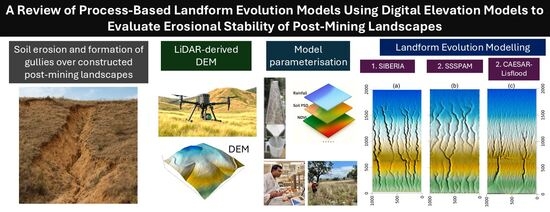
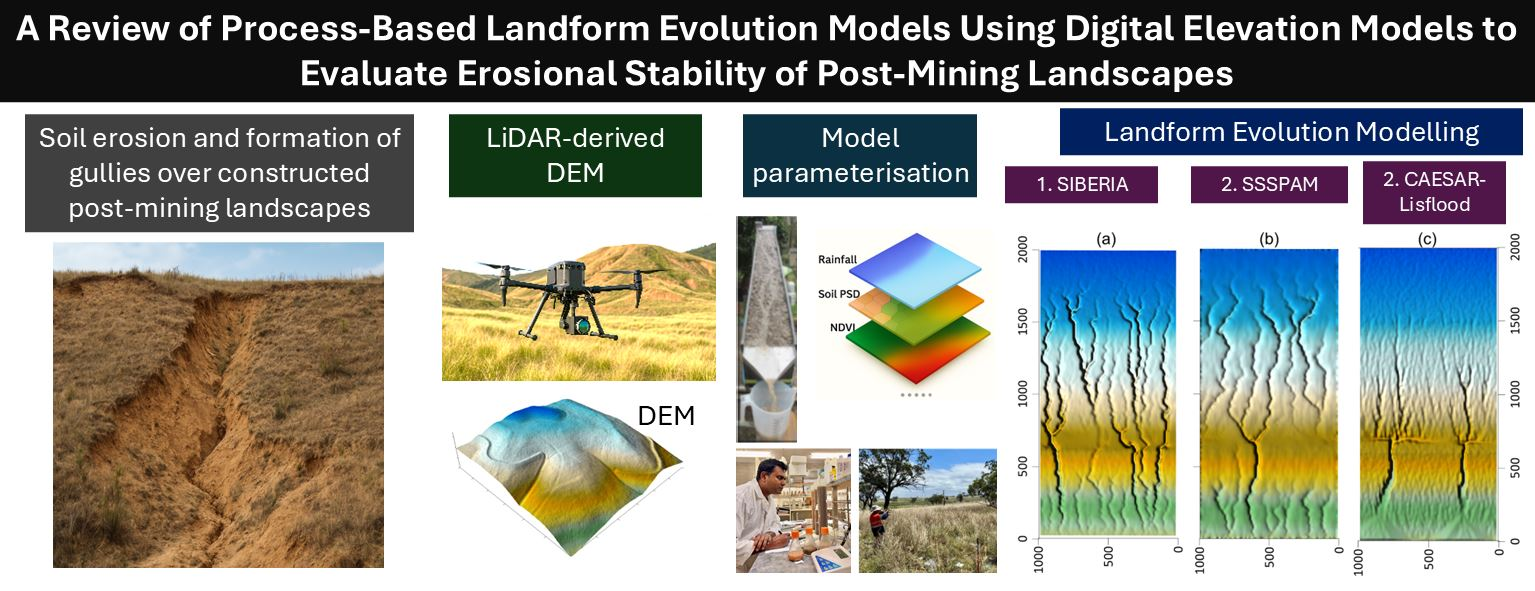
Graphical Abstract

1. Introduction

Landform evolution refers to the long-term processes that shape and transform the Earth’s surface through forces such as weathering, erosion, and tectonic activity [1]. Understanding how landscapes change over time is important for identifying the drivers of those changes and quantifying their influences to manage both natural and engineered landscapes more effectively. This knowledge is especially important when predicting the future evolution of landscapes over decadal to millennial timescales, including those modified for applications such as constructed post-mining landscape rehabilitation and nuclear waste containment [2,3,4,5].
A key requirement for studying landform evolution is the accurate measurement and quantification of erosion and deposition processes. These processes can be examined across a range of spatial scales, from global and continental levels to national, catchment, and hillslope scales. Erosion rates can be assessed using a range of field-based methods, including erosion pins and stakes, sediment traps, environmental tracers such as 137Cs, catchment plots, soil profile monitoring, repeated topographic surveys, hydrological measurements such as runoff sampling, turbidity sensors, and sediment load samplers, as well as Digital Elevation Models (DEMs) derived from remote sensing and photogrammetry [1,6,7,8,9,10,11].
Early conceptual work on erosion estimation, including foundational experiments such as those by Zingg in 1940 [12], paved the way for the development of the first generation of soil erosion models. These first generation soil erosion models and their derivatives include the Universal Soil Loss Equation (USLE) [13,14], the Modified Universal Soil Loss Equation (MUSLE) [15,16], the Soil Loss Estimation Model for Southern Africa (SLEMSA) [17], the Areal Nonpoint Source Watershed Environment Response Simulation (ANSWERS) [18], the Chemicals, Runoff, and Erosion from Agricultural Management Systems model (CREAMS) [19], the Water Erosion Prediction Project (WEPP) [20], and the Revised Universal Soil Loss Equation (RUSLE) [21]. These models were widely used to estimate soil erosion rates for agricultural and land management applications [22,23,24,25,26]. While these soil erosion models have been widely applied for soil conservation planning and erosion estimation [27,28,29,30,31,32,33,34,35,36], they come with significant limitations. Most are designed to estimate erosion only, without explicitly accounting for deposition processes. They have been empirically fitted to field data, allowing them to satisfactorily predict soil loss over relatively short periods, typically a few years, and at paddock or field scales. However, they generally assume a static topography and do not simulate the feedbacks between dynamically modifying landforms and surface processes. As a result, long-term interactions between changes in terrain and erosion are not captured.
To overcome these limitations, a new generation of landform evolution models (LEMs) has emerged in recent decades, driven primarily by digital elevation data, computational power, and process-based understanding of geomorphic systems [1,37,38]. Note that the term LEM is often used interchangeably to refer to both landform and landscape evolution modelling. However, landforms represent only one component of a landscape, which also includes soils, vegetation, and soil flora and fauna [1]. These models explicitly simulate the coupled processes of erosion, deposition, and hydrology over time, allowing the landscape to evolve in response to these dynamics. By incorporating high-resolution DEMs as inputs, they can capture complex topographic feedbacks and provide spatially distributed predictions of landform change. Unlike empirical models, DEM-based LEMs are designed to operate over extended timescales, ranging from decades to millennial timescales, making them particularly suitable for applications such as post-mining landform design, natural catchment evolution, and assessing the long-term stability of engineered man-made landforms. They offer a more realistic and flexible framework for exploring how landscapes respond to climate, vegetation, soil properties, and human interventions, with the capability to dynamically evolve the terrain at each timestep.
In the mining industry, understanding both erosional and depositional processes on the hillslopes of constructed post-mining landforms is essential for assessing their long-term geomorphic stability. In countries like Australia, once valuable minerals are extracted, the remaining overburden material and waste rock are stockpiled on the surface in designated waste dumps [39,40]. The blasting and handling processes break the rock into fragments, increasing its bulk volume compared to its in situ state [41]. These stockpiles are then capped with topsoil and revegetated using native pasture and plants, with the aim of integrating the rehabilitated landform into the surrounding natural landscape. However, due to the physical and chemical properties of the waste rock and the length and shape of the constructed hillslopes, these landforms can be highly susceptible to surface erosion. In particular, rill and gully formation may expose the underlying mine waste, increasing the risk of serious environmental and ecological impacts. These include acid mine drainage from reactive waste rock exposed to runoff, sedimentation of streambeds, degradation of downstream aquatic habitats, and contamination of agricultural lands [42]. Therefore, achieving long-term erosional stability, relative to the surrounding natural terrain, is a major concern during both the design and operational stages of these engineered landforms [40,43]. Furthermore, it is necessary to calculate the average erosion rates and gully patterns of the surrounding natural catchments, as they serve as a reference for plausible erosion rates and gully densities in the area when integrating the constructed post-mining landforms into the surrounding landscape [44,45]. Traditional erosion models are generally limited to estimating average erosion rates and are unable to capture the spatially distributed, long-term morphological evolution of these landforms. In contrast, LEMs have emerged as a robust and feasible approach for simulating the coupled processes of erosion and deposition over extended timescales, providing valuable insights into the long-term performance and sustainability of constructed post-mining landscapes [1,40,46]. In addition to overall erosion rates, the spatial distribution and occurrence of gullies, rills, and other concentrated erosion features are critical for assessing the stability and sustainability of post-mining landforms. These patterns are often the primary drivers of localised failure and cannot typically be resolved using traditional soil erosion models, highlighting the advantage of LEMs in mining rehabilitation applications.
Numerous LEMs have been developed to simulate terrain evolution under various environmental and land use scenarios such as SIBERIA [47,48,49], GOLEM [50] CHILD (Channel-Hillslope Integrated Landscape Development) [51,52], CAESAR-Lisflood [53,54], LAPSUS (Land Use Change Impact Analysis and Soil Erosion Modelling) [55,56,57], WATEM LT/WATERM LTT (water and tillage erosion model long term) [58,59,60,61], Landlab [62], SSSPAM (State Space Soil Production and Assessment Model) [63], CHONK [64] and eSCAPE [65], each with their own strengths, computational frameworks, process representations, and applications tailored to different spatial and temporal scales. A comparison of basic characteristics of some of the widely used LEMs is provided in Table 1. The characteristics listed in Table 1 are provided as contextual remarks rather than explicit advantages or disadvantages, as many features reflect design choices tailored to specific modelling objectives. What may appear as a limitation in one application can be advantageous in another, depending on the spatial and temporal scales of interest.
Recent advancements in remote sensing and spatial data analysis have greatly enhanced LEM performance by providing high-resolution DEMs, from global SRTM to submeter LiDAR-derived datasets [73,74,75], and detailed soil maps with physicochemical information from initiatives like GlobalSoilMap [76,77,78,79]. Additionally, multispectral vegetation data from platforms such as MODIS, Landsat, and Sentinel-2 offer valuable insights at various spatial and temporal scales [44,80,81,82]. Coupled with powerful computing resources and sophisticated software, these technologies enable more accurate and complex landscape evolution modelling through improved parameterisation of models and input datasets.
The objective of this paper is to provide a review of LEMs widely used in constructed post-mining landform rehabilitation by evaluating erosional behaviour. This review focusses on their model inputs, process representations, strengths, and limitations. Additionally, a brief case study is presented to demonstrate the outputs of three selected models, SIBERIA, SSSPAM and CAESAR-Lisflood. This approach highlights the practical significance of understanding model capabilities and limitations, guiding researchers and practitioners in selecting appropriate tools for landscape evolution studies and improving future model development.

2. Soil Erosion Models and LEM—Modelling Frameworks

Soil erosion models can be primarily categorised based on their underlying modelling mechanisms. These include empirical models, which rely on observed data and statistical relationships (e.g., USLE, RUSLE, MUSLE), and process-based models, which simulate the actual physical processes driving erosion and deposition (e.g., runoff, sediment transport, and slope instability) [1]. Additionally, there are cellular automata and rule-based models [83,84,85], which apply simple rules to grid cells to simulate landscape changes over time, and hybrid models that combine elements of multiple approaches. The choice of framework depends on the study objectives, spatial and temporal scale, data availability, and the level of process representation required.
Originally, USLE and RUSLE were designed for field- or hillslope-scale applications, producing erosion estimates averaged over entire slopes based on mean conditions. USLE [13,32] is regarded as one of the most influential advancements in soil and water conservation during the 20th century. In contrast to these soil erosion models, LEMs such as SIBERIA operate at finer resolutions, performing calculations on a pixel-by-pixel basis using physics-based (and process-based) equations that dynamically evolve the landscape over time. Despite their empirical nature, RUSLE and similar models still offer useful relative estimates of erosion risk, particularly for comparative studies, agricultural planning, and land management. However, USLE, RUSLE, and MUSLE estimate average soil loss or sediment yield but do not account for sediment deposition or channel erosion such as gullies and streambanks. As a result, they predict potential erosion rather than actual sediment delivery, limiting their use in studies requiring detailed sediment transport and landscape evolution. More process and physics-based models are needed for these purposes. Variants of these erosion models such as USLE-M [86], SOILOSS [87], EPIC (Erosion-Productivity Impact Calculator) [88,89], and APEX (Agricultural Policy/Environmental eXtender) [90] have been developed for various specific applications. A detailed review of these models is provided in Kinnell [91]. However, the main focus of this paper is to review process-based LEMs that utilise DEMs as the primary dataset for the rehabilitation of constructed post-mining landforms.

2.1. Process-Based LEMs

These simulate landform change by explicitly modelling processes like runoff, detachment, sediment transport, and deposition. Unlike empirical models, they are based on physical laws and conservation equations, allowing for more realistic and spatially distributed predictions of erosion and landform evolution over time. Three process-based LEMs and their modelling frameworks are described in Section 3.

Process-Based LEMs to Assess Erosional Stability of the Post-Mining Landforms

Process-based LEMs play an important role in post-mining landform rehabilitation and the design of low-level radioactive waste repositories, by providing a means to assess potential erosion rates under different scenarios through adjustments to model parameterisation [2,3,4,92,93]. For example, LEMs enable the evaluation of erosion with and without vegetation cover, which is important as vegetation can be affected by fire or drought events. Additionally, LEMs can be used to test the erosional behaviour of landforms during climatic extremes, such as major storm events. During the design stage, this information is valuable for modifying landform designs to minimise erosion, particularly gully and rill formation, and for informing post-mining landform maintenance planning and budgeting.
This necessitates the assessment of long-term erosion and landform evolution, including the development of gullies and rills, in comparison with natural catchments [5,94,95]. Similar concerns arise in the design of low-level radioactive waste repositories, where ensuring long-term stability is critical. A viable approach for such assessments is the use of process-based LEMs like SIBERIA, which can simulate erosion, deposition, and landscape evolution over extended timescales. These models provide valuable insights into how landforms change under different environmental conditions, making them essential tools in the planning and evaluation of both mine waste and nuclear waste containment systems.

3. Modelling Framework of Widely Used Process-Based LEMs in Mining Industry

This section provides a brief overview of three widely used process-based Landform Evolution Models (LEMs) in the mining industry for post-mining landform rehabilitation: SIBERIA, SSSPAM, and CAESAR-Lisflood. These three models were selected due to their extensive use in post-mining landform rehabilitation and their distinct capabilities. SSSPAM is commonly applied to estimate long-term erosion at annual time steps, while CAESAR-Lisflood can simulate erosion at event scales, such as during storm events. SSSPAM is also a recently developed model that incorporates soil-armouring effects and soil weathering functions. Together, these models offer a strong basis for understanding model formulation, parameterisation, and operational workflows.

3.1. SIBERIA

One of the earliest and most widely used process and physics-based models is SIBERIA, which was specifically developed to simulate long-term hillslope evolution and assess landform stability under varying environmental conditions. SIBERIA is widely used in post-mining landform rehabilitation. SIBERIA’s modelling framework is based on the sediment transport equation:
q s = q s f + q s d
where q s (m3/s/m width) denotes the total sediment transport capacity per unit width; q s f represents the fluvial sediment transport component, and q s d denotes the diffusive (creep) transport component—both expressed in m3/s/m width. The fluvial transport component, q s f , is derived from the Einstein-Brown equation, which models surface incision as:
q s f = β 1 q m 1 S n 1
where q (in m3/s/m) denotes the discharge per unit width, S (m/m) represents the local slope in the steepest downslope direction, and β 1 , m 1 , and n 1 are calibration parameters.
The diffusive transport component is expressed as:
q s d = S D
where D is the diffusivity (m3/s/m), and S is the slope. The diffusive term accounts for the smoothing of the land surface through processes such as soil creep and rainsplash. Instead of explicitly simulating runoff ( Q , m3/s) at individual points, SIBERIA employs a subgrid parameterisation. This approach, based on empirical observations and theoretical analysis, links discharge to the contributing area ( A ) using:
Q = β 3 A m 3
where β 3 is the runoff rate constant, and m 3 is the area exponent, both of which require calibration specific to each site.
SIBERIA is primarily designed for modelling long-term erosion and deposition rather than individual storm events. Since its initial development, the model has been improved to incorporate spatially variable erosion parameters, off-site runoff, external flows, tectonic uplift, and multiple soil layers with distinct characteristics. Additionally, it simulates sediment transport by particle size and models surface coarsening through depth-dependent armouring. The use of simplified hydrological formulations combined with time-invariant parameters and annual time steps may limit the model’s ability to capture short-term hydrological variability and extreme events, potentially affecting predictions of incision depth.
Using SIBERIA can be challenging for new users, not only due to the experience and expertise required for site-specific parameterisation, but also because of the model’s outdated command-line interface and workflow. SIBERIA operates through a Fortran-based command prompt interface and requires input files in specific formats. For example, the DEM must be converted to an rst2 file, which includes a header with parameters followed by the outlet coordinates and an 8-column data structure, where column 4 contains elevation values. This must be accompanied by a .bnd file, which defines the boundary of the area of interest and the outlet locations. Currently, these input files have to be prepared separately, and data visualisation is handled through external modules, such as the EAMS Viewer.
Therefore, a more user-friendly version of SIBERIA, with a graphical user interface (GUI) and integrated modules for input preparation, model execution, data visualisation, and primary analysis, would be highly beneficial, particularly for industrial users.

3.2. SSSPAM

SSSPAM [63,69] integrates a soilscape evolution model with a landscape evolution model, developed based on both detachment-limited and transport-limited erosion concepts. The model incorporates a diffusive component to account for the combined effects of rainsplash, soil creep, and gully wall failure. Using a state-space matrix approach, SSSPAM streamlines the complex equations governing physical processes, enabling the integration of pedogenesis with landscape evolution.
SSSPAM employs a multi-layered structure to simulate key processes including surface diffusion, fluvial erosion, deposition, sediment armouring, and soil weathering [70]. It models the particle size distribution of soil materials at each grid cell throughout the soil profile, which determines the sediment grading of overland flow. Sediment eroded from upstream influences the material composition of downstream cells along flow paths. Net erosion or deposition at each cell is calculated as the difference between the incoming sediment load and the local transport capacity [45,63].
The soil profile at each grid cell evolves through interactions between surface water flow and soil layers. Depending on the carrying capacity at a location, water either removes or deposits sediments, effectively connecting different parts of the landform through sediment transport. The model divides the soil profile into multiple surface and subsurface layers, capturing textural changes due to weathering. Erosion and deposition occur primarily in the uppermost layer, with changes balanced by material exchange with the layers beneath. This vertical redistribution continues down to the bedrock, gradually altering the composition of each layer. As material moves through the profile, the overall soil grading changes. Erosion lowers the surface, while deposition raises it, with all layer depths defined relative to the evolving surface. After updating the mass distribution, SSSPAM updates the DEM, and recalculates water flow paths accordingly. This cycle is repeated over a specified number of iterations to simulate long-term landform and soilscape development. SSSPAM’s soil-layer tracking allows erosion penetration depth to be assessed relative to material boundaries, which is important for evaluating landform stability.
Here, potential fluvial erosion is calculated as,
E f = K e q α 1 S α 2 T
where e represents the erodibility factor, q is the discharge per unit width (m3s−1m−1), and S is the slope, α 1 and α 2 are exponents regulating the erosion process, and T (s) is the time step used. K is a parameter which determines the maximum volume of erosion that could potentially occur based on the surface soil grading and the threshold entrainment diameter (TED). TED defines the maximum diameter of the particles that can be entrain by surface flow and is estimated using the Shield’s shear stress criteria. TED is defined as,
T E D = C t h n q 0.6 S 0.7
where C t h is a calibrated parameter, and n is the Manning’s friction factor. Particles in the surface grading smaller than the TED are susceptible to erosion, while those larger than the TED remain on the surface, contributing to armouring.
SSSPAM employs a slope-dependent diffusion model, similar to that used in SIBERIA, to compute diffusive erosion ( E d ). It also incorporates a threshold slope ( S t h ), which represents the maximum gradient a landform can sustain without structural failure, determined by the soil’s physical properties.
The weathering module in SSSPAM comprises two primary components, i.e., (i) the geometry of weathered fragments, which determines the resulting particle size distribution, and (ii) the layer-specific weathering rate, which governs the rate at which parent material degrades into finer particles. Although depth-dependent variation in weathering rates is common, it is not a fixed rule. For instance, when a spherical parent particle of diameter d decomposes into one fragment of diameter d 1 (constituting a mass fraction α ) and ( n 1 ) fragments of diameter d 2 , the particle sizes can be mathematically described as;
d 1 = α 1 / 3 d
d 2 = 1 α n 1 1 / 3 d
To represent the variation in weathering rates with depth, SSSPAM incorporates a range of depth-dependent functions, such as exponential decay, humped exponential decay, static and dynamic reversed exponential forms, a modified dynamic reversed exponential, and surface-limited weathering. These functions offer flexibility to simulate different patterns of soil formation and profile evolution according to specific soil characteristics.

3.3. CAESAR-Lisflood

CAESAR-Lisflood [54] is a coupled hydrodynamic-landscape evolution that simulates erosion, deposition, and sediment transport in river catchments over various time scales. By integrating the CAESAR model with the Lisflood-FP flow model, it captures fluvial processes more dynamically, including storm-driven erosion events, something LEMs like SIBERIA do not.
A regularly spaced DEM is the primary input for CAESAR-Lisflood. It can run in either catchment mode, using rainfall time series as input, or reach mode, where water and sediment are introduced at specific points [96,97]. Water flow is simulated across the DEM using a quasi-2D hydraulic approach based on the Lisflood-FP model. The resulting flow velocities drive sediment transport, which is modelled using various equations capable of handling nine sediment size classes, covering both suspended and bedload transport.
An active layer framework tracks vertical variations in sediment composition over time, as detailed by Van De Wiel et al. [98]. The model also includes slope failure processes, allowing for the simulation of lateral sediment inputs from collapsing banks. Erosion and deposition processes modify the elevation of grid cells, thereby capturing the morphological evolution of the landscape.
CAESAR-Lisflood employs a simplified approach to open channel flow modelling by reducing some components such as full inertial dynamics. While this results in less complexity compared to more detailed two-dimensional flow models, it significantly enhances computational efficiency. This allows for the use of finer resolution grid cells or the simulation of larger spatial extents. One of the key advantages of CAESAR-Lisflood is its ability to simulate the full sequence of hydrological events, including both high-flow and low-flow periods, without selectively modelling only specific events, which is often necessary in other methods. A detailed description of CAESAR-Lisflood is provided in Coulthard et al. [54].

4. LEM Parametrisation

These LEMs often require site-specific parameterisation for soil, vegetation, topographic, hydrologic and meteorological characteristics. The accuracy of the model outputs is dependent on parameterisation [99].
While generic parameters can provide an initial indication of landscape behaviour, reliable prediction of erosion patterns and landform stability requires calibration using site-specific data. The choice between generic and locally derived parameters depends on data availability, project stage, and the required level of accuracy.

4.1. Preliminary Assessment Using Generic Parameters

Erosion models can be run using general or non-site-specific parameters to provide a first-pass assessment of landscape performance. This approach is useful during the early design phase, helping identify areas potentially prone to erosion. However, the predictive accuracy is limited, and outputs should be interpreted only as indicative.
Empirical models such as RUSLE and WEPP include generic parameter sets derived mainly from agricultural field data in the United States. Their use outside similar environments requires caution. For example, the RUSLE soil erodibility (K) factor was developed for sandy and loamy soils and needs recalibration for high-clay or ferrosol soils [100,101]. Similarly, WEPP simulations must be adjusted using local runoff and sediment data for reliable performance [102].
For SIBERIA, pre-defined parameter sets are available through the EAMS software suite and can be used where material and climatic conditions are broadly comparable to the site. Likewise, CAESAR-Lisflood can use particle size, and roughness coefficients from nearby catchments. A key additional data source for CAESAR-Lisflood is rainfall data to drive the hydrology and hydraulics. In the absence of detailed field data, regional databases such as the National Soil Erosion Survey [103] or national soil datasets [104] can provide baseline values.
Nevertheless, results from generic inputs should be treated as approximate and primarily used to identify data gaps and guide subsequent site-specific calibration.

4.2. Site-Specific Parameterisation for Reliable Prediction

For accurate and defensible erosion prediction, parameters must reflect local soil, hydrology, and climatic conditions [1,97]. These characteristics strongly influence erosion rates, runoff generation, and landform evolution. Therefore, parameterisation should evolve iteratively from generic assumptions to site-calibrated values as more data become available.
The most robust approach involves long-term field monitoring of rainfall, runoff, and sediment yield from representative plots or catchments [105,106,107]. These observations capture the transition from bare to vegetated surfaces and the resulting decline in erosion rates as armouring and vegetation establish. For example, post-mining surfaces at the Ranger Mine reached near-steady erosion rates after approximately 3–4 years [106,108].
Alternatively, topographic surveys using LiDAR or digital photogrammetry can quantify erosion and deposition by differencing DEMs collected before and after major rainfall events [92,109]. Although these methods capture spatial patterns effectively, their accuracy depends on survey resolution and timing, and interpretation requires technical expertise.
Faster but smaller-scale parameter determination can be achieved through flume and rainfall simulation experiments. These laboratory or field tests allow controlled assessment of erosion under different slopes and rainfall intensities, generating reliable data within weeks [69,110]. Vegetation effects can also be tested by running simulations with bare and planted surfaces. While these experiments provide valuable short-term insights, they should complement rather than replace long-term field monitoring, as they do not capture temporal processes such as weathering or surface stabilisation.

5. Case Study—With SIBERIA, CAESAR-Lisflood and SSSPAM

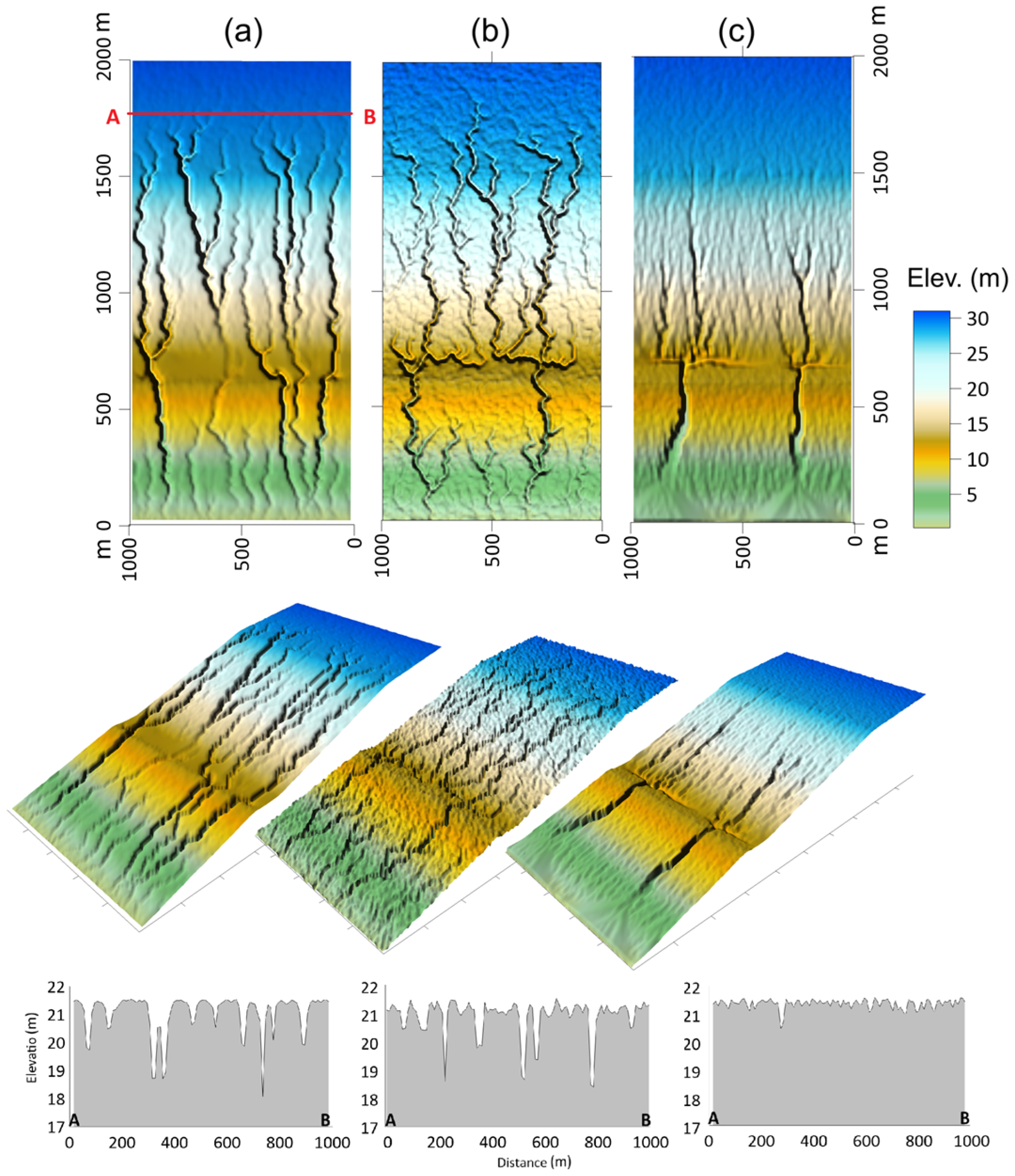
A brief case study was conducted to demonstrate and compare the SIBERIA, SSSPAM and CAESAR-Lisflood LEMs. A synthetically generated DEM, representing a post-mining landform, was used for this purpose. This DEM consists of 100 rows and 200 columns, with a grid cell size of 10 m. A random roughness was applied to simulate a natural, erodible surface. The elevation values range from 0 m at the base of the slope to 30 m at the top. The topographic roughness index (TRI) of the surface is 0.16 m. TRI, which quantifies the surface irregularity of the terrain, was calculated by averaging the absolute elevation differences between each grid cell and its eight immediate neighbours within a 3 × 3 window. This provides a simple yet effective measure of local elevation variability, higher TRI values indicate a rougher, more uneven terrain, while lower values suggest smoother surfaces. The hillslope includes three distinct slope sections, as illustrated in Figure 1. All three models used the same initial DEM, ensuring identical terrain, while model-specific parameterisations were applied to reflect site conditions according to each model’s formulation.

5.1. Model Setup

SIBERIA and SSSPAM LEM simulations were performed for 1000 years using this DEM for a landform covered with grass at annual time steps. Parameters from a post-mining landform in the Northern Territory of Australia are used for the parameterisation of the LEMs. The key parameters used in this comparison for SIBERIA β = 27,743, m 1 = 2.52, and n 1 = 0.69 [106]. SSSPAM simulations were performed with α 1 = 2.0412, α 2 = 0.69, and e = 10.8934/y (modified from Welivitiya et al. [111]). CAESAR-Lisflood simulations were performed for 1000 years, to test the erosion values. Grain-size distributions and other model parameters were defined according to the catchment characteristics. Fluvial erosion and deposition were simulated using the sediment transport formulation of Einstein [112], which governs sediment flux as a function of shear stress and bedload transport dynamics. Parameters used for CAESAR-Lisflood simulations are given in Table 2. A historic pluviographic rainfall record (1972–2007) from the Jabiru Bureau of Meteorology raingauge (#014198, www.bom.gov.au), the weather station closest to Ranger Mine, was used for CAESAR-Lisflood simulations, with the record repeated to cover the entire simulation period. Erodibility and vegetation parameters in all three models were adjusted to represent comparable vegetation conditions.

5.2. Erosion Rate Calculation

The final erosion rates were calculated by determining the average elevation difference between pre- and post-simulation DEMs per year, based on the simulation duration. Erosion rates were first computed in m3/ha/yr and then converted to t/ha/yr using a soil bulk density of 1.2 g/cm3. This method provides a consistent and practical approach for estimating site-scale erosion rates and facilitates comparison with industry benchmarks and regulatory reporting requirements.

5.3. Case Study- Results

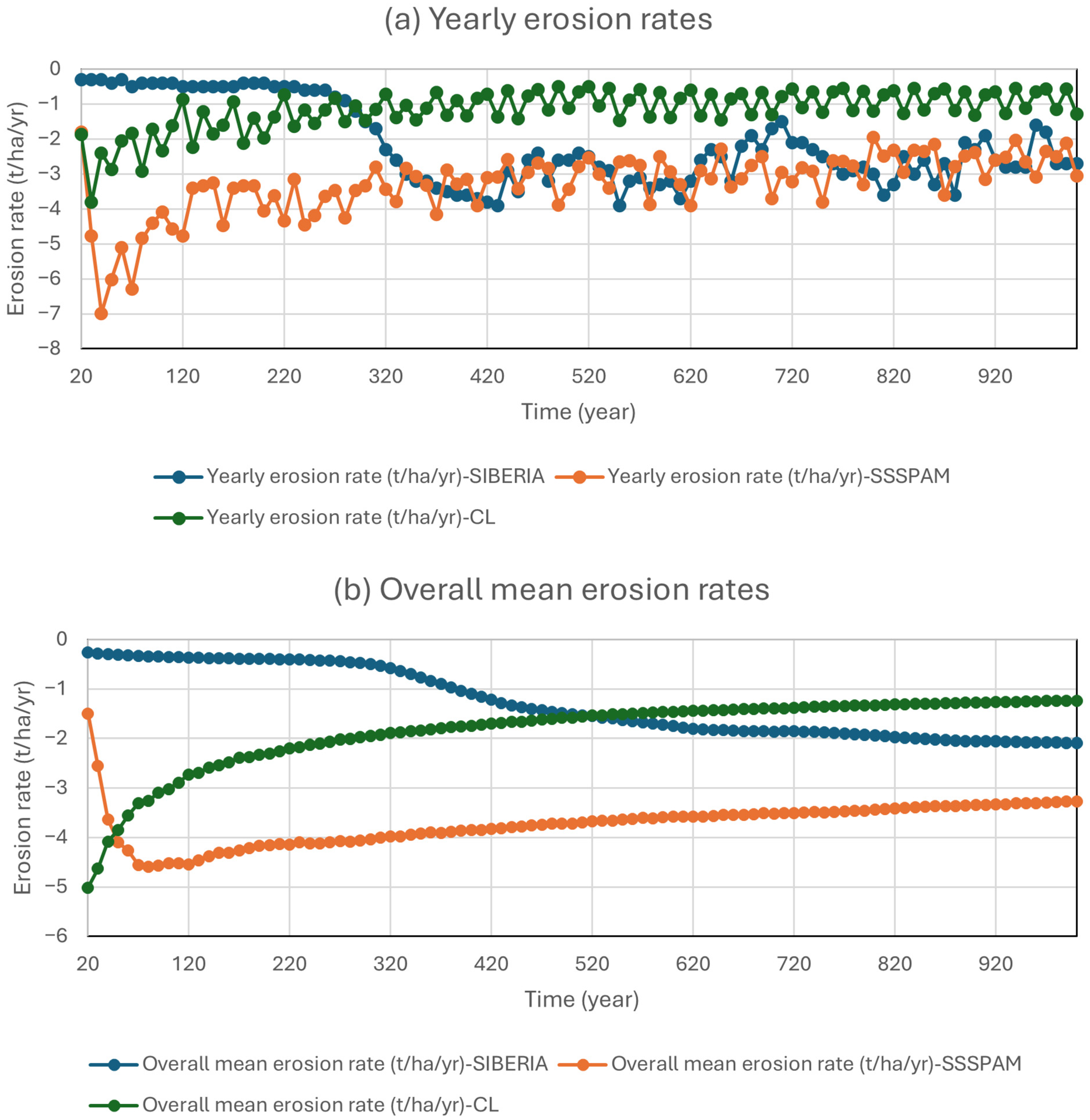
The results showed comparable average erosion rates of 2.52 t/ha/yr, 2.90 t/ha/y and 1.26 t/ha/yr for SIBERIA, SSSPAM, and CAESAR-Lisflood, respectively, after 1000 years of simulation. The topography after 1000 years of simulation for the three LEMs are shown in Figure 2. The model results demonstrate similar patterns and orientations of gully formation, although the gullies do not form in exactly the same locations. CAESAR-Lisflood produces lower gully density. CAESAR-Lisflood and SSSPAM both capture the behaviour around the existing contour bank located approximately 700 m upslope from the bottom of the figures, showing water ponding at the bank before flowing downslope, which leads to sedimentation followed by erosion. This topographic step acts as a branching point for the next row of upslope-directed gullies in the model outputs. CAESAR-Lisflood also produced sediment fans at the bottom of the hillslope. The cross-sections in Figure 2 show that the gullies produced by SIBERIA and SSSPAM have similar patterns and depths, although they are not in exactly the same locations. In contrast, CAESAR-Lisflood results show shallower gullies, with more sheet wash than rilling and gullying.
Figure 3a presents the erosion rates calculated at yearly time steps and displayed at 10-year intervals. Figure 3b shows the overall mean erosion rates, computed at each 10-year interval relative to the initial (t = 0) DEM. All LEMs exhibit fluctuations in yearly erosion rates, generally remaining within a defined range. SIBERIA shows relatively low erosion rates until approximately year 220, followed by an increase up to year ~420, after which it exhibits fluctuating behaviour similar to the other two models, but in a more irregular manner. This pattern is likely due to gully formation and its impact on erosion, as the DEM is dynamically modified. When erosion rates are plotted at finer time scales (e.g., daily), larger fluctuations can be expected in CAESAR-Lisflood, which captures individual events, whereas SIBERIA and SSSPAM are expected to show more consistent patterns at shorter time scales due to their annual time-step simulations. The low early-stage erosion rates predicted by SSSPAM are often a result of the model’s soil-armouring component, which helps prevent over-prediction of erosion at early stages.
An advantage of using LEMs is that the evolution of the landscape can be observed over time at user-defined time steps. This allows both the location and type of erosion processes to be visually identified. The simulations were conducted to illustrate the model setup and outputs; a detailed analysis of the results was not undertaken, as it falls outside the scope of this review paper.

6. Discussion

6.1. Choosing a Model

LEMs are valuable tools for assessing the erosional stability of post-mining landforms, both at the design stage, i.e., before the landform physically exists, and during the operational stage, to investigate why certain erosion patterns are occurring. These models enable us to simulate different scenarios, helping to design landforms that are erosionally stable and aligned with long-term sustainability goals. LEMs can model potential gully and rill formation and estimate average erosion rates over a range of timescales, from single events to millennia. However, there is no universal LEM; each model must be tailored to the specific characteristics of the study area. LEMs cannot capture all the complex processes and influences of potential drivers on hillslope erosion. They often simplify these processes and focus on the dominant ones required for modelling [113]. For example, LEMs such as SIBERIA and SSSPAM do not explicitly model erosion driven by wind [114], gelifluction [115], solifluction [116], or frost [117]. SSSPAM simulates the effects of surface armouring and soil weathering on erosion [69,70,111], processes that are not emphasised in some other models, whereas SIBERIA is primarily based on fluvial and diffusive erosion [118]. Therefore, applying a LEM in an area where driving forces not included in the model dominate erosion may not produce plausible results.
The choice of model depends heavily on the purpose of prediction. For example, simpler models like RUSLE or WEPP are well suited for estimating erosion on existing or proposed hillslopes, especially when only basic data is available. In contrast, for evaluating entire post-mining landforms, particularly those with encapsulated buried materials that must remain stable indefinitely, or landforms with complex features like contour drains, more advanced, DEM-driven, process-based LEMs such as SIBERIA, SSSPAM, or CAESAR-Lisflood are more appropriate. Setting up LEMs involves a series of deliberate and well-documented choices, particularly for multi-process models. Temme et al. [113] demonstrate approaches for making these decisions, often through comparison of alternative model configurations. Collectively, such tests support the development and evaluation of multi-process LEMs across different settings and help assess model sensitivity to simplifications. Ideally, LEM frameworks should facilitate these choices by being modular, accommodating non-spurious sinks, and allowing variable spatial and temporal resolutions across processes. The necessity of these features, however, depends on the modeller’s objectives. Even with such frameworks, key challenges remain, including equifinality in calibration and validation constraints related to force budgets and mass or volume balances.
While long-term average erosion rates are useful for comparing models, they do not fully capture landscape stability. LEMs provide additional insights by resolving the spatial distribution of erosion, including persistent gullies, rills, incision depth, and channel connectivity. As such, landscapes with similar average erosion rates can exhibit very different patterns of instability. This distinction highlights the value of LEMs over traditional soil erosion models, especially in applications such as post-mining rehabilitation, where understanding the spatial concentration of erosion is critical for management and restoration planning.
Each model offers distinct advantages: SIBERIA is well suited for long-term predictions over decades or millennia, but not for short-term, event-based erosion analysis. For simulating the impact of individual storm events and capturing dynamic hydrological processes, CAESAR-Lisflood is a more suitable choice. However, running CAESAR-Lisflood simulations over long time periods is time-consuming and computationally costly. Models that integrate geomorphic or soilscape evolution processes are particularly useful when long-term soil development or subsurface interactions are critical. Further, model selection should consider not only the prediction goal but also the availability of input data and the complexity of model parameterisation.
While this review aims to provide guidance for selecting appropriate LEMs, model selection does not follow a single, universal pathway. Instead, it is a multi-criteria decision informed by study objectives, spatial and temporal scale, dominant geomorphic processes, data availability, and practical requirements such as regulatory compliance or closure planning. Table 3 summarises these key considerations and provides a pragmatic roadmap for selecting DEM-based landscape evolution models, offering guidance rather than a prescriptive decision tree and recognising that expert judgement and iterative testing are often required.

6.2. Input Data Quality

Since DEMs are the primary input for process-based models, their quality, particularly grid resolution, is critical for reliable results. Coarse-resolution DEMs often fail to capture key erosional features which are smaller than the grid resolution. With the advancements of remote sensing technologies, many mine sites now routinely collect high-resolution terrain data using LiDAR and Terrestrial Laser Scanning (TLS), producing sub-metre DEMs compared to traditional 30 m SRTM data. These systems generate large datasets with varying accuracy. Welivitiya and Hancock [119] showed that to reliably represent features like gullies or contour drains, the DEM grid spacing should be no greater than one-third the width of the feature. They also found that typical coordinate errors do not significantly impact the accurate representation of such features. Schoorl et al. [55] examined how DEM resolution influences landscape process modelling using LAPSUS model. Their experiments demonstrated that erosion and deposition results are highly sensitive to DEM grid size, with coarser resolutions generally producing higher erosion estimates. This effect arises from both artificial mathematical exaggeration of slopes and reduced representation of sediment redeposition. The study highlighted that DEM resolution and flow routing algorithms interact strongly, making spatial resolution a key source of uncertainty in landscape evolution and process-based erosion modelling. Skinner and Coulthard [120] evaluated the sensitivity of the CAESAR-Lisflood landscape evolution model to DEM grid cell size using a global sensitivity analysis. Their results showed that discharge, sediment yield, and overall geomorphic trends remained relatively consistent across a range of grid sizes until the resolution became too coarse, which led to a loss of fine-scale channel detail and produced fewer but more extreme erosion and deposition events. DEM resolution emerged as one of the most influential parameters affecting model behaviour, comparable to key hydrological and sediment transport parameters. The study highlighted that although coarser grids improve computational efficiency, they can alter internal process dynamics, underscoring the importance of selecting an appropriate resolution to balance accuracy and efficiency in landform evolution modelling. Similarly, Hancock and Evans [121] investigated two small catchments in north Australia using the SIBERIA model to examine how DEM resolution affects the prediction of channel head locations, the area slope relationship, and cumulative area distribution. Their study revealed that coarser resolutions reduce the ability to accurately capture hillslope-channel transitions, primarily due to smoothing and simplification of topography. Finlayson and Montgomery [122] also demonstrated that decreasing DEM resolution from 30 m to coarser scales, such as 90 m and 900 m, substantially reduces mean slope values, reflecting the smoothing of topographic features and the lowering of gradients. Pelletier [123] also explained that conventional flow-routing methods are sensitive to DEM grid resolution, which can affect LEM predictions.
Hancock [124] investigated how different DEM gridding/interpolation methods (e.g., kriging vs. Delaunay triangulation) influence catchment geomorphology and soil-erosion predictions using the SIBERIA landscape evolution model over a 50,000-year timescale. The study found that, despite initial geomorphic and hydrologic differences between the interpolation methods, after long simulation periods the catchment-scale outputs (such as net erosion and drainage network patterns) converged and showed little difference between the methods. The key implication is that for long-term landscape evolution modelling, the choice of gridding method may be of secondary importance relative to other factors, provided the DEM resolution and topographic representation are adequate. However, the findings also underline that subtle differences in the initial surface representation can be masked only over very long timescales and may still influence shorter-term or finer-scale process results.
For parameterisation, vegetation data can be derived from both satellite indices and field-based observations. Modern satellites such as Sentinel-2 provide vegetation indices (e.g., NDVI, EVI) at a spatial resolution of 10 m and a high temporal frequency, making them suitable for assessing seasonal and spatial variations in vegetation cover over post-mining landforms. LiDAR surveys, while primarily used for terrain mapping, can also capture vegetation structure when combined with multispectral data or RGB composites. Some LiDAR systems even support NDVI computation by integrating near-infrared (NIR) returns. These high-resolution datasets are valuable for calibrating vegetation parameters such as ground cover fraction, canopy height, and roughness coefficients in erosion models.
Some mine sites maintain long-term rainfall records, which are valuable for LEM simulations, especially for event-based erosion modelling. When on-site data are unavailable, rainfall from nearby stations can be used, though spatial variability may reduce accuracy. In such cases, interpolation methods or gridded/modelled rainfall products (e.g., ERA5, TRMM, GPM) offer useful alternatives. While these may require calibration, they often provide sufficiently reliable estimates for model parameterisation and scenario testing.

6.3. Evaluating LEM Performance with Cross Comparison and Field Methods

Several studies have compared different LEMs as well as LEM outputs against field-based erosion measurements [45,113,125]. Welivitiya and Hancock [45] used the SSSPAM and CAESAR-Lisflood LEMs to simulate the evolution of a natural catchment with over 20 years of monitored soil erosion data. Both models produced erosion rates consistent with field measurements and reproduced similar catchment-scale geomorphic patterns. Comparisons of simulated and observed rock content along two field transects showed good agreement, demonstrating SSSPAM’s capability to predict catchment-scale erosion and surface soil distribution. Temme et al. [125] compared the performance of the WATEM LT, WATEM LTT, and LAPSUS models in simulating landscape evolution over two small catchments in Belgium. The model outputs were evaluated against discretised observations of transect profiles. For the catchment-scale analysis, simulated results were compared with point-based paleo-altitude observations averaged over different landscape element classes. All three models produced satisfactory results for the transect simulations. However, at the catchment scale, the transport-limited model WATEM LTT was unable to realistically reproduce long-term landscape evolution, whereas the detachment-limited models, WATEM LT and LAPSUS, produced results more consistent with the transect-based observations.
In a study conducted by Hancock et al. [126], field measurements from rehabilitated mine plots showed an initial high sediment pulse during the first three years, which then declined to levels similar to the surrounding undisturbed landscape by year six. Calibrated SIBERIA simulations matched these observations, indicating that bare waste rock parameters are suitable for short-term predictions while vegetated parameters are more accurate for longer-term sediment output, with model reliability influenced by surface structure, topography, and initial DEM. More work is needed to test existing models across a greater range of climates, landscapes and materials.

6.4. Factors Affecting Erosion Rates

Many studies have demonstrated that vegetation cover is a key factor in minimising erosion and gully formation in constructed post-mining landforms [44,127]. In general, actual erosion rates are expected to fall between the outputs obtained under two extreme vegetation scenarios: full vegetation cover and no vegetation cover, with a bias reflecting the actual vegetation dynamics in the study area. Presenting results for these two bounding scenarios therefore provides a useful measure of uncertainty.
To quantify the erosion reduction provided by both bare soil and vegetation, extensive research has been conducted using field plots. This has generated a comprehensive database of erosion reduction scaling factors that can be applied in models such as USLE, RUSLE and their derivatives [14,128]. However, most of this research, and the resulting erosion reduction scaling factors, such as the RUSLE Cover or C-factor [129,130,131], has focused on agricultural soils. Far less work has been conducted on newly formed soils, such as those found on post-mining landscapes [1,128,132,133].
Erosion rates are strongly influenced by the reconstructed slope profile [134]. Concave slopes, which resemble natural terrain, channel water to the slope toe and generally experience less erosion than uniform slopes of the same average gradient. Convex slopes, in contrast, exhibit an exponentially increasing erosion rate with increasing slope length. On uniform slopes, erosion rates tend to increase proportionally with slope length, whereas on concave slopes, erosion peaks at intermediate lengths, around 50 m, before decreasing on longer slopes [135]. Martín-Moreno et al. [136] found that a thick, non-compacted topsoil on linear slopes produced less sediment than carbonate colluvium or topsoil on concave slopes, and that vegetation establishment depended on topography, with more uniform cover on linear slopes and limited colonisation on steep concave slopes, indicating that both topography and soil cover strongly influence mine reclamation success. Young and Mutchler [137] demonstrated that for slopes with the same average steepness, concave slopes reduce total sediment loss compared to uniform or convex slopes. Laboratory experiments by Rieke-Zapp and Nearing [138] demonstrated that slope shape affects rill formation, sediment yield, and runoff, with uniform, nose-shaped, and convex-linear slopes producing more sediment than concave-linear and head-shaped slopes. Similarly, field experiments by Sensoy and Kara [139] found that uniform slopes generate the most runoff and erosion, while concave slopes produce the least, although spatial variability remains on concave and convex slopes. Hancock et al. [140] used the area–slope relationship from pre-mining topography at two Western Australian sites to construct concave hillslope profiles and compare them with linear slopes using the SIBERIA model. Their results showed that concave slopes can reduce sediment loss by up to five times compared to linear slopes.
Lal [134] (after Haan et al. [141]) described the relationship between erosion loss and slope steepness over a wide range of slope angles up to the angle of repose. Different materials, stress histories, and climatic conditions produce a family of curves. For slopes up to about 8° (15 percent), erosion is transport-limited, with abundant erodible material and loss controlled by the carrying capacity of runoff, making erosion approximately proportional to slope steepness. On steeper slopes, erosion is detachment-limited, controlled by the runoff’s ability to detach particles, so erosion is less sensitive to slope angle. Supporting evidence from the Chamber of Mines South Africa [142] indicates that erosion from mine spoil peaks at slopes of 25° to 35° (47 to 70 percent) and is relatively low on slopes flatter than 20° or steeper than 40°. This relationship is particularly relevant for the steep slopes of final spoil or waste rock [135].
While LEMs offer valuable insights into long-term erosion trends and landform development, they are simplifications of complex natural processes and cannot capture all dynamics in full detail. Importantly, different LEMs use varying algorithms, assumptions, and parameterisation methods, which influence model behaviour. As a result, two models applied to the same landform may not produce identical erosion rates or gully locations. Nonetheless, the predicted average erosion rates from most LEMs generally fall within acceptable ranges and are often consistent with field data. Discrepancies in spatial predictions, such as the precise location of gullies, are influenced by factors like how each model simulates surface flow, flow direction, and sediment transport processes.
The parameterisation of LEMs often requires modification through trial and error to match field conditions, which in turn requires expertise in both the models and the natural processes of the actual environment.

6.5. Future Work

Some landform evolution models are still running on their initial setup and have interfaces that are not very user-friendly. For example, using SIBERIA can be challenging for new users, not only due to the experience and expertise required for site-specific parameterisation, but also because of the model’s structure. SIBERIA operates through an old Fortran-based command prompt interface and requires input files in specific formats. For example, the DEM must be converted to an .rst2 file, which includes a header with parameters followed by the outlet coordinates and an 8-column data structure, where column 4 contains elevation values. This must also be accompanied by a .bnd file, which defines the boundary of the area of interest and the outlet locations. Additionally, input files must be prepared separately, and data visualisation is handled through external modules, such as the EAMS Viewer. Therefore, a more user-friendly version of such old-school LEMs, with a graphical user interface (GUI) and integrated modules for input preparation, model execution, data visualisation, and primary analysis, would be highly beneficial, particularly for industrial applications.
Uncertainty assessment of LEM outputs remains a significant challenge. A commonly used approach is to examine year-to-year variability in predicted erosion rates and summarise this using statistical measures such as the standard deviation. Another approach involves running multiple simulations in which different levels of surface roughness are added to the initial DEM, allowing assessment of how erosion predictions vary with changes in microtopography. A further method is to conduct ensembles of simulations in which parameter values are systematically or randomly varied within defined ranges (e.g., using minimum, maximum, and standard deviation values). While the latter two methods provide insight into the overall uncertainty in average erosion rates, they do not yield meaningful pixel-wise uncertainty maps of the evolved landform. This is because varying parameters or surface roughness alters the spatial positioning of rills and gullies, meaning that differences at the pixel scale reflect pattern shifts rather than true uncertainty. Consequently, pixel-level comparisons can be misleading. Further research into robust and defensible methods for quantifying model uncertainty would be highly valuable. Examining the effect of grid sensitivity on the results of LEMs such as SSSPAM would also provide useful information on the uncertainties.
An additional source of uncertainty arises from the internal architecture of constructed landforms. Most standard LEMs are designed to simulate natural geomorphic processes (e.g., hillslope diffusion, fluvial erosion, and sediment transport) and do not explicitly represent engineered features unless they are encoded in the topography or boundary conditions. In contrast, post-mining landforms often contain complex internal structures, including layered materials, compacted zones, and engineered barriers, which can strongly influence erosion pathways, penetration depth, and failure mechanisms but are often poorly constrained or simplified in model inputs. Although some models allow partial representation through multilayer soil schemes (e.g., Ref. [143]), explicit parameterisation of internal landform architecture remains limited. Future work should therefore focus on better representing material layering and compaction to reduce uncertainty in erosion and stability predictions.
Many LEMs developed decades ago are limited in the maximum data size they can handle and often cannot process large DEMs. With the increasing availability of high-resolution, sub-metre LiDAR-derived DEMs, updating these models to run on high-performance computing platforms while efficiently handling larger datasets is essential for more accurate and detailed predictions. Integrating soil chemistry changes, such as carbon dynamics, with particle size distributions could further improve applications for post-mining landscapes, agriculture, and contaminated lands. Additionally, advancements in artificial intelligence and machine learning offer opportunities to accelerate parameterisation and model runs, enabling rapid, data-driven assessments of erosion rates.

7. Conclusions

This review synthesises the current state of DEM-based LEMs in evaluating the long-term erosional stability of post-mining landscapes. These models effectively simulate both erosion and deposition over extended timescales, offering dynamic visualisations of terrain evolution, including rill and gully formation, key indicators of landform degradation and stability. No single LEM is universally applicable; model selection must consider the intended application, simulation duration, temporal resolution, process representation, and computational constraints. Uncertainties remain a critical challenge, stemming not only from model structure and process inclusion but also from site-specific parameterisation. Key drivers such as vegetation cover, topography, meteorological conditions, and soil properties significantly influence erosion dynamics, with vegetation consistently identified as a dominant control in post-mining environments. Recent advances in remote sensing, particularly LiDAR-derived high-resolution DEMs, along with satellite-based vegetation indices, gridded rainfall datasets, and digital soil maps, have enhanced model fidelity. Highly detailed DEMs can often capture smaller gullies and erosion processes, whereas soil information, long-term vegetation, and rainfall datasets support improved parameterisation, calibration, and validation, especially for long-term simulations. Comparative simulations underscore model variability. The 1000-year synthetic hillslope simulations using SIBERIA and SSSPAM produced similar erosion rates and gully patterns, though spatial discrepancies in gully density and location were observed. CEASER-Lisflood simulations over 100 years yielded slightly higher average annual erosion rates, yet remained within plausible ranges. Comparative simulations underscore model variability and highlight that DEM-based LEMs are most powerful for scenario comparison and erosion risk screening, rather than for precise spatial prediction of individual rill or gully locations. Future research should focus on refining parameterisation techniques, advancing uncertainty quantification, enhancing user-friendly model reconstruction, and integrating AI-driven tools for rapid erosion assessment. These developments are essential for delivering robust, scalable, and site-adaptable erosion predictions to support sustainable post-mining landform design and management.

Author Contributions

Conceptualization, I.P.S., G.R.H. and T.J.C.; methodology, I.P.S., G.R.H. and T.J.C.; software, I.P.S., G.R.H. and T.J.C.; validation, I.P.S., G.R.H. and T.J.C.; formal analysis, I.P.S., G.R.H. and T.J.C.; investigation, I.P.S., G.R.H. and T.J.C.; resources, G.R.H. and T.J.C.; data curation, I.P.S. and G.R.H.; writing—original draft preparation, I.P.S.; writing—review and editing, I.P.S., G.R.H. and T.J.C.; visualisation, I.P.S., G.R.H. and T.J.C.; supervision, G.R.H. and T.J.C.; project administration, G.R.H.; funding acquisition, G.R.H. All authors have read and agreed to the published version of the manuscript.

Funding

This work was funded by the mining industry through Australian Coal Association Research Program (ACARP) Projects C34025: New Landscape Evolution Model for Assessing Rehabilitation and C27042: Adaption of design tools to better design rehabilitation and capping over highly mobile mine waste and Australian Research Council Discovery Grant DP110101216.

Data Availability Statement

The data presented in this study are available on request from the corresponding author.

Acknowledgments

The authors acknowledge the late Garry Willgoose (deceased 2021), developer of the SIBERIA model, whose pioneering ideas and lifelong contributions laid the foundation for improved geomorphic outcomes in post-mining landscapes. We also acknowledge Dimuth Welivitiya for the development of the SSSPAM model and his significant contributions to advancing landform evolution modelling. We extend our gratitude to ACARP for their decades of support for LEM research, and to the many mining industry personnel who have provided data, field access, and ongoing collaboration over the years.

Conflicts of Interest

The authors declare no conflicts of interest.

References

  1. Willgoose, G. Principles of Soilscape and Landscape Evolution; Cambridge University Press: Cambridge, UK, 2018. [Google Scholar]
  2. Atchley, A.L.; Birdsell, K.H.; Crowell, K.; Middleton, R.S.; Stauffer, P.H. Simulating 10,000 years of erosion to assess nuclear waste repository performance. Geosciences 2019, 9, 120. [Google Scholar] [CrossRef]
  3. Hancock, G.R.; Willgoose, G.R. Predicting gully erosion using landform evolution models: Insights from mining landforms. Earth Surf. Process. Landf. 2021, 46, 3271–3290. [Google Scholar] [CrossRef]
  4. Willgoose, G.; Riley, S. The long-term stability of engineered landforms of the Ranger Uranium Mine, Northern Territory, Australia: Application of a catchment evolution model. Earth Surf. Process. Landf. J. Br. Geomorphol. Group 1998, 23, 237–259. [Google Scholar] [CrossRef]
  5. Lacy, H. Mine landforms in Western Australia from dump to landform design: Review, reflect and a future direction. In Proceedings of the Mine Closure 2019: Proceedings of the 13th International Conference on Mine Closure, Perth, Australia, 3–5 September 2019; pp. 371–384. [Google Scholar]
  6. Wang, J.; Yang, J.; Li, Z.; Ke, L.; Li, Q.; Fan, J.; Wang, X. Research on Soil Erosion Based on Remote Sensing Technology: A Review. Agriculture 2024, 15, 18. [Google Scholar] [CrossRef]
  7. Boardman, J.; Evans, R. The measurement, estimation and monitoring of soil erosion by runoff at the field scale: Challenges and possibilities with particular reference to Britain. Prog. Phys. Geogr. Earth Environ. 2020, 44, 31–49. [Google Scholar] [CrossRef]
  8. Wang, L.; Qi, Y.; Xie, W.; Yang, R.; Wang, X.; Zhou, S.; Dong, Y.; Lian, X. Estimating Gully Erosion Induced by Heavy Rainfall Events Using Stereoscopic Imagery and UAV LiDAR. Remote Sens. 2025, 17, 3363. [Google Scholar] [CrossRef]
  9. Hancock, G.; Lowry, J. Hillslope erosion measurement—A simple approach to a complex process. Hydrol. Process. 2015, 29, 4809–4816. [Google Scholar] [CrossRef]
  10. Boix-Fayos, C.; Martínez-Mena, M.; Arnau-Rosalén, E.; Calvo-Cases, A.; Castillo, V.; Albaladejo, J. Measuring soil erosion by field plots: Understanding the sources of variation. Earth Sci. Rev. 2006, 78, 267–285. [Google Scholar] [CrossRef]
  11. Loughran, R.J. The measurement of soil erosion. Prog. Phys. Geogr. 1989, 13, 216–233. [Google Scholar] [CrossRef]
  12. Zingg, A.W. Degree and length of land slope as it affects soil loss in run-off. Agric. Eng. 1940, 21, 59–64. [Google Scholar]
  13. Wischmeier, W.H.; Smith, D.D. Predicting Rainfall-Erosion Losses from Cropland East of the Rocky Mountains: Guide for Selection of Practices for Soil and Water Conservation; Agricultural Research Service, US Department of Agriculture: Washington, DC, USA, 1965.
  14. Wischmeier, W.H.; Smith, D.D. Predicting Rainfall Erosion Losses: A Guide to Conservation Planning; Department of Agriculture, Science and Education Administration: Washington, DC, USA, 1978.
  15. Williams, J.R. Sediment-yield prediction with universal equation using runoff energy factor. In Proceedings of the Present and Prospective Technology for Predicting Sediment Yield and Sources: Proceedings of the Sediment-Yield Workshop, USDA Sedimentation Laboratory, Oxford, Miss; Agricultural Research Service, US Department of Agriculture: Washington, DC, USA, 1975; p. 244. [Google Scholar]
  16. Williams, J.; Berndt, H. Sediment yield prediction based on watershed hydrology. Trans. ASAE 1977, 20, 1100–1104. [Google Scholar] [CrossRef]
  17. Elwell, H. Modelling soil losses in Southern Africa. J. Agric. Eng. Res. 1978, 23, 117–127. [Google Scholar] [CrossRef]
  18. Beasley, D.; Huggins, L.; Monke, E.J. Answers: A model for watershed planning. Trans. ASAE 1980, 23, 938–0944. [Google Scholar] [CrossRef]
  19. Knisel, W.G. Creams: A Field Scale Model for Chemicals, Runoff, and Erosion from Agricultural Management Systems; Department of Agriculture, Science and Education Administration: Washington, DC, USA, 1980.
  20. Flanagan, D.; Nearing, M. USDA-Water Erosion Prediction Project: Hillslope profile and watershed model documentation. NSERL Rep. 1995, 10, 1196–47097. [Google Scholar]
  21. Renard, K.G. Predicting Soil Erosion by Water: A Guide to Conservation Planning with the Revised Universal Soil Loss Equation (RUSLE); US Department of Agriculture, Agricultural Research Service: Washington, DC, USA, 1997.
  22. Mohammed, S. Modeling current and future run-off and soil erosion dynamics in Eastern Mediterranean ecosystems using the WEPP model. Energy Nexus 2025, 17, 100375. [Google Scholar] [CrossRef]
  23. Kinnell, P. A comparison of the abilities of the USLE-M, RUSLE2 and WEPP to model event erosion from bare fallow areas. Sci. Total Environ. 2017, 596, 32–42. [Google Scholar] [CrossRef]
  24. Yosef, B.A.; Gomi, T.; Ohira, M. Soil erosion modeling in forested watersheds: A comprehensive review. J. Sediment. Environ. 2025, 10, 1101–1116. [Google Scholar] [CrossRef]
  25. Biddoccu, M.; Guzmán, G.; Capello, G.; Thielke, T.; Strauss, P.; Winter, S.; Zaller, J.; Nicolai, A.; Cluzeau, D.; Popescu, D. Evaluation of soil erosion risk and identification of soil cover and management factor (C) for RUSLE in European vineyards with different soil management. Int. Soil Water Conserv. Res. 1920, 8, 337–353. [Google Scholar] [CrossRef]
  26. Laflen, J.M.; Flanagan, D.C.; Ascough, J.C.; Weltz, M.A.; Stone, J.J. The WEPP model and its applicability for predicting erosion on rangelands. Var. Rangel. Water Eros. Process. 1994, 38, 11–22. [Google Scholar]
  27. Sadeghi, S.; Gholami, L.; Khaledi Darvishan, A.; Saeidi, P. A review of the application of the MUSLE model worldwide. Hydrol. Sci. J. 2014, 59, 365–375. [Google Scholar] [CrossRef]
  28. Djoukbala, O.; Hasbaia, M.; Benselama, O.; Mazour, M. Comparison of the erosion prediction models from USLE, MUSLE and RUSLE in a Mediterranean watershed, case of Wadi Gazouana (NW of Algeria). Model. Earth Syst. Environ. 2019, 5, 725–743. [Google Scholar] [CrossRef]
  29. Arekhi, S.; Shabani, A.; Rostamizad, G. Application of the modified universal soil loss equation (MUSLE) in prediction of sediment yield (Case study: Kengir Watershed, Iran). Arab. J. Geosci. 2012, 5, 1259–1267. [Google Scholar] [CrossRef]
  30. Kumar, M.; Sahu, A.P.; Sahoo, N.; Dash, S.S.; Raul, S.K.; Panigrahi, B. Global-scale application of the RUSLE model: A comprehensive review. Hydrol. Sci. J. 2022, 67, 806–830. [Google Scholar] [CrossRef]
  31. Renard, K.G.; Foster, G.; Yoder, D.; McCool, D. RUSLE revisited: Status, questions, answers, and the future. J. Soil Water Conserv. 1994, 49, 213–220. [Google Scholar] [CrossRef]
  32. Alewell, C.; Borrelli, P.; Meusburger, K.; Panagos, P. Using the USLE: Chances, challenges and limitations of soil erosion modelling. Int. Soil Water Conserv. Res. 2019, 7, 203–225. [Google Scholar] [CrossRef]
  33. Benavidez, R.; Jackson, B.; Maxwell, D.; Norton, K. A review of the (Revised) Universal Soil Loss Equation ((R) USLE): With a view to increasing its global applicability and improving soil loss estimates. Hydrol. Earth Syst. Sci. 2018, 22, 6059–6086. [Google Scholar] [CrossRef]
  34. Laflen, J.; Elliot, W.; Simanton, J.; Holzhey, C.; Kohl, K. WEPP: Soil erodibility experiments for rangeland and cropland soils. J. Soil Water Conserv. 1991, 46, 39–44. [Google Scholar] [CrossRef]
  35. Elliot, W.J. Wepp Internet Interfaces for Forest Erosion Prediction. JAWRA J. Am. Water Resour. Assoc. 2004, 40, 299–309. [Google Scholar] [CrossRef]
  36. Smith, H. Application of empirical soil loss models in southern Africa: A review. S. Afr. J. Plant Soil 1999, 16, 158–163. [Google Scholar] [CrossRef]
  37. Epple, L.; Kaiser, A.; Schindewolf, M.; Bienert, A.; Lenz, J.; Eltner, A. A review on the possibilities and challenges of today’s soil and soil surface assessment techniques in the context of process-based soil erosion models. Remote Sens. 2022, 14, 2468. [Google Scholar] [CrossRef]
  38. Nearing, M.; Lane, L.; Lopes, V.L. Modeling soil erosion. In Soil Erosion Research Methods; Routledge: London, UK, 2017; pp. 127–158. [Google Scholar]
  39. Lowry, J.; Narayan, M.; Hancock, G.; Evans, K. Understanding post-mining landforms: Utilising pre-mine geomorphology to improve rehabilitation outcomes. Geomorphology 2019, 328, 93–107. [Google Scholar] [CrossRef]
  40. Hancock, G.; Nicolson, L.; Purtill, J.; Dunlop, J. Applying Erosion and Landscape Evolution Models to Assess Post-Mining Landform Stability: Technical Paper; Brisbane, Office of the Queensland Mine Rehabilitation Commissioner, Queensland Government: Brisbane, Australia, 2025.
  41. Gowan, M.; Lee, M.; Williams, D. Co-disposal techniques that may mitigate risks associated with storage and management of potentially acid generating wastes. In Proceedings of the Mine Waste 2010: Proceedings of the First International Seminar on the Reduction of Risk in the Management of Tailings and Mine Waste, Perth, Australia, 29 September–1 October 2010; pp. 389–404. [Google Scholar]
  42. Satapathy, S.; Mishra, M.; Das, M.R. Literature Review on Waste Generation from Mines. In Sustainable Waste Management Practices for the Mining Sector Through Recycling of Mining Waste; Springer: Berlin/Heidelberg, Germany, 2024; pp. 7–14. [Google Scholar]
  43. Howard, E.; Loch, R.; Vacher, C. Evolution of landform design concepts. Min. Technol. 2011, 120, 112–117. [Google Scholar] [CrossRef]
  44. Senanayake, I.P.; Hancock, G.R. Soil erosion under changing climatic conditions: Insights from catchment-scale landform evolution modelling in the Hunter Region of NSW, Australia. In Proceedings of the 2025 IEEE International Geoscience and Remote Sensing Symposium (IGARSS 2025), Brisbane, Australia, 3–8 August 2025. [Google Scholar]
  45. Welivitiya, W.D.P.; Hancock, G.R. Hillslope and catchment scale landform evolution–Predicting catchment form and surface properties. Environ. Model. Softw. 2023, 166, 105725. [Google Scholar] [CrossRef]
  46. Hancock, G.; Duque, J.M.; Welivitiya, W.D.P. A new way to geoengineer landscapes using computer-based landform evolution models. Earth Surf. Process. Landf. 2025, 50, e70161. [Google Scholar] [CrossRef]
  47. Willgoose, G.; Bras, R.L.; Rodriguez-Iturbe, I. A coupled channel network growth and hillslope evolution model: 1. Theory. Water Resour. Res. 1991, 27, 1671–1684. [Google Scholar] [CrossRef]
  48. Willgoose, G.; Bras, R.L.; Rodriguez-Iturbe, I. A coupled channel network growth and hillslope evolution model: 2. Nondimensionalization and applications. Water Resour. Res. 1991, 27, 1685–1696. [Google Scholar] [CrossRef]
  49. Willgoose, G.; Bras, R.L.; Rodriguez-Iturbe, I. A physical explanation of an observed link area-slope relationship. Water Resour. Res. 1991, 27, 1697–1702. [Google Scholar] [CrossRef]
  50. Tucker, G.E.; Slingerland, R.L. Erosional dynamics, flexural isostasy, and long-lived escarpments: A numerical modeling study. J. Geophys. Res. Solid Earth 1994, 99, 12229–12243. [Google Scholar] [CrossRef]
  51. Tucker, G.E.; Bras, R.L. A stochastic approach to modeling the role of rainfall variability in drainage basin evolution. Water Resour. Res. 2000, 36, 1953–1964. [Google Scholar] [CrossRef]
  52. Tucker, G.E.; Lancaster, S.T.; Gasparini, N.M.; Bras, R.L.; Rybarczyk, S.M. An object-oriented framework for distributed hydrologic and geomorphic modeling using triangulated irregular networks. Comput. Geosci. 2001, 27, 959–973. [Google Scholar] [CrossRef]
  53. Coulthard, T.; Kirkby, M.; Macklin, M. Modelling geomorphic response to environmental change in an upland catchment. Hydrol. Process. 2000, 14, 2031–2045. [Google Scholar] [CrossRef]
  54. Coulthard, T.J.; Neal, J.C.; Bates, P.D.; Ramirez, J.; de Almeida, G.A.; Hancock, G.R. Integrating the LISFLOOD-FP 2D hydrodynamic model with the CAESAR model: Implications for modelling landscape evolution. Earth Surf. Process. Landf. 2013, 38, 1897–1906. [Google Scholar] [CrossRef]
  55. Schoorl, J.; Sonneveld, M.; Veldkamp, A. Three-dimensional landscape process modelling: The effect of DEM resolution. In Earth Surface Processes and Landforms: The Journal of the British Geomorphological Research Group; Wiley: Hoboken, NJ, USA, 2000; Volume 25, pp. 1025–1034. [Google Scholar]
  56. Temme, A.J.; Schoorl, J.; Veldkamp, A. Algorithm for dealing with depressions in dynamic landscape evolution models. Comput. Geosci. 2006, 32, 452–461. [Google Scholar] [CrossRef]
  57. Sonneveld, M.; Temme, A.; Schoorl, J.; Claessens, L.; Viveen, W.; Baartman, J.; Lesschen, J.; van Gorp, W. Landscape-Soilscape Evolution Modelling: LAPSUS. In Proceedings of the 19th World Congress of Soil Science; Soil Solutions for a Changing World, Brisbane, Australia, 1–6 August 2010; pp. 12–15. [Google Scholar]
  58. Van Oost, K.; Govers, G.; Desmet, P. Evaluating the effects of changes in landscape structure on soil erosion by water and tillage. Landsc. Ecol. 2000, 15, 577–589. [Google Scholar] [CrossRef]
  59. Van Rompaey, A.J.; Verstraeten, G.; Van Oost, K.; Govers, G.; Poesen, J. Modelling mean annual sediment yield using a distributed approach. Earth Surf. Process. Landf. 2001, 26, 1221–1236. [Google Scholar] [CrossRef]
  60. Verstraeten, G.; Van Oost, K.; Van Rompaey, A.; Poesen, J.; Govers, G. Evaluating an integrated approach to catchment management to reduce soil loss and sediment pollution through modelling. Soil Use Manag. 2002, 18, 386–394. [Google Scholar] [CrossRef]
  61. Peeters, I.; Rommens, T.; Verstraeten, G.; Govers, G.; Van Rompaey, A.; Poesen, J.; Van Oost, K. Reconstructing ancient topography through erosion modelling. Geomorphology 2006, 78, 250–264. [Google Scholar] [CrossRef]
  62. Hobley, D.E.; Adams, J.M.; Nudurupati, S.S.; Hutton, E.W.; Gasparini, N.M.; Istanbulluoglu, E.; Tucker, G.E. Creative computing with Landlab: An open-source toolkit for building, coupling, and exploring two-dimensional numerical models of Earth-surface dynamics. Earth Surf. Dyn. 2017, 5, 21–46. [Google Scholar] [CrossRef]
  63. Welivitiya, W.; Willgoose, G.R.; Hancock, G.R. A coupled soilscape–landform evolution model: Model formulation and initial results. Earth Surf. Dyn. 2019, 7, 591–607. [Google Scholar] [CrossRef]
  64. Gailleton, B.; Malatesta, L.C.; Cordonnier, G.; Braun, J. CHONK 1.0: Landscape evolution framework: Cellular automata meets graph theory. Geosci. Model Dev. 2024, 17, 71–90. [Google Scholar] [CrossRef]
  65. Salles, T. eSCAPE: Regional to global scale landscape evolution Model v2. 0. Geosci. Model Dev. 2019, 12, 4165–4184. [Google Scholar] [CrossRef]
  66. Tucker, G.; Lancaster, S.; Gasparini, N.; Bras, R. The channel-hillslope integrated landscape development model (CHILD). In Landscape Erosion and Evolution Modeling; Springer Nature: Berlin/Heidelberg, Germany, 2001; pp. 349–388. [Google Scholar]
  67. Tucker, G.E.; Bras, R.L. Hillslope processes, drainage density, and landscape morphology. Water Resour. Res. 1998, 34, 2751–2764. [Google Scholar] [CrossRef]
  68. Skinner, C.J.; Coulthard, T.J.; Schwanghart, W.; Van De Wiel, M.J.; Hancock, G. Global sensitivity analysis of parameter uncertainty in landscape evolution models. Geosci. Model Dev. 2018, 11, 4873–4888. [Google Scholar] [CrossRef]
  69. Welivitiya, W.D.P.; Hancock, G.R. Calibration and validation of the SSSPAM coupled soilscape–landform evolution model for simulating short-term gully development on a post-mining landform. Earth Surf. Process. Landf. 2022, 47, 2779–2795. [Google Scholar] [CrossRef]
  70. Welivitiya, W.; Willgoose, G.; Hancock, G.; Senanayake, I. Modelling hillslope soil profiles using a coupled pedogenesis and landform evolution model. Soil Adv. 2025, 4, 100074. [Google Scholar] [CrossRef]
  71. Braun, J.; Sambridge, M. Modelling landscape evolution on geological time scales: A new method based on irregular spatial discretization. Basin Res. 1997, 9, 27–52. [Google Scholar] [CrossRef]
  72. Coulthard, T.J. Landscape evolution models: A software review. Hydrol. Process. 2001, 15, 165–173. [Google Scholar] [CrossRef]
  73. Kariminejad, N.; Jafari, M.; Domazetović, F.; Quesada-Román, A. An Overview of the Importance of DEM Resolution in Soil Erosion Assessment. Pap. Appl. Geogr. 2024, 10, 207–216. [Google Scholar] [CrossRef]
  74. Hancock, G.R. The use of digital elevation models in the identification and characterization of catchments over different grid scales. Hydrol. Process. Int. J. 2005, 19, 1727–1749. [Google Scholar] [CrossRef]
  75. Reddy, G.O. Remote sensing and GIS for geomorphological mapping. In Geospatial Technologies in Land Resources Mapping, Monitoring and Management; Springer Nature: Berlin/Heidelberg, Germany, 2018; pp. 223–252. [Google Scholar]
  76. Arrouays, D.; McKenzie, N.; Hempel, J.; de Forges, A.R.; McBratney, A.B. GlobalSoilMap: Basis of the Global Spatial Soil Information System; CRC Press: Boca Raton, FL, USA, 2014. [Google Scholar]
  77. Arrouays, D.; Grundy, M.G.; Hartemink, A.E.; Hempel, J.W.; Heuvelink, G.B.; Hong, S.Y.; Lagacherie, P.; Lelyk, G.; McBratney, A.B.; McKenzie, N.J. GlobalSoilMap: Toward a fine-resolution global grid of soil properties. Adv. Agron. 2014, 125, 93–134. [Google Scholar]
  78. Grundy, M.; Rossel, R.V.; Searle, R.; Wilson, P.; Chen, C.; Gregory, L. Soil and landscape grid of Australia. Soil Res. 2015, 53, 835–844. [Google Scholar] [CrossRef]
  79. Richer-de-Forges, A.C.; Chen, Q.; Baghdadi, N.; Chen, S.; Gomez, C.; Jacquemoud, S.; Martelet, G.; Mulder, V.L.; Urbina-Salazar, D.; Vaudour, E. Remote sensing data for digital soil mapping in French research—A review. Remote Sens. 2023, 15, 3070. [Google Scholar] [CrossRef]
  80. Bannari, A.; Morin, D.; Bonn, F.; Huete, A. A review of vegetation indices. Remote Sens. Rev. 1995, 13, 95–120. [Google Scholar] [CrossRef]
  81. Xue, J.; Su, B. Significant remote sensing vegetation indices: A review of developments and applications. J. Sens. 2017, 2017, 1353691. [Google Scholar] [CrossRef]
  82. Zhou, P.; Luukkanen, O.; Tokola, T.; Nieminen, J. Effect of vegetation cover on soil erosion in a mountainous watershed. Catena 2008, 75, 319–325. [Google Scholar] [CrossRef]
  83. Hartwig, M.E.; Alves, J.P.I. Gully evolution and numerical simulation using the SIMWE model in Brazil. Catena 2025, 254, 108991. [Google Scholar] [CrossRef]
  84. Favis-Mortlock, D.T.; Boardman, J.; Parsons, A.J.; Lascelles, B. Emergence and erosion: A model for rill initiation and development. Hydrol. Process. 2000, 14, 2173–2205. [Google Scholar] [CrossRef]
  85. Shen, H.; Lynch, B.; Poulsen, C.J.; Yanites, B.J. A modeling framework (WRF-Landlab) for simulating orogen-scale climate-erosion coupling. Comput. Geosci. 2021, 146, 104625. [Google Scholar] [CrossRef]
  86. Kinnell, P.; Risse, L. USLE-M: Empirical modeling rainfall erosion through runoff and sediment concentration. Soil Sci. Soc. Am. J. 1998, 62, 1667–1672. [Google Scholar] [CrossRef]
  87. Rosewell, C. Soiloss: A Program to Assist in the Selection of Management Practices to Reduce Erosion; Soil Conservation Service of NSW: Sydney, NSW, Australia, 1993.
  88. Williams, J.R.; Jones, C.A.; Dyke, P.T. A modeling approach to determining the relationship between erosion and soil productivity. Trans. ASAE 1984, 27, 129–0144. [Google Scholar] [CrossRef]
  89. Williams, J.; Jones, C.; Dyke, P. The EPIC model and its application. In Proceedings of the International Symposium on Minimum Data Sets for Agrotechnology Transfer, Patancheru, India, 21–26 March 1983; pp. 111–121. [Google Scholar]
  90. Williams, J.; Izaurralde, R.; Steglich, E. Agricultural policy/environmental extender model. Theor. Doc. Version 2008, 604, 2008–2017. [Google Scholar]
  91. Kinnell, P. Event soil loss, runoff and the Universal Soil Loss Equation family of models: A review. J. Hydrol. 2010, 385, 384–397. [Google Scholar] [CrossRef]
  92. Hancock, G.; Lowry, J.; Moliere, D.; Evans, K. An evaluation of an enhanced soil erosion and landscape evolution model: A case study assessment of the former Nabarlek uranium mine, Northern Territory, Australia. In Earth Surface Processes and Landforms: The Journal of the British Geomorphological Research Group; Wiley: Hoboken, NJ, USA, 2008; Volume 33, pp. 2045–2063. [Google Scholar]
  93. Evans, K.; Saynor, M.; Willgoose, G.; Riley, S. Post-mining landform evolution modelling: 1. Derivation of sediment transport model and rainfall–runoff model parameters. In Earth Surface Processes and Landforms: The Journal of the British Geomorphological Research Group; Wiley: Hoboken, NJ, USA, 2000; Volume 25, pp. 743–763. [Google Scholar]
  94. Howard, E.; Loch, R. Acceptable erosion rates for mine waste landform rehabilitation modelling in the Pilbara, Western Australia. In Proceedings of the Mine Closure 2019: Proceedings of the 13th International Conference on Mine Closure, Perth, Australia, 3–5 September 2019; pp. 1545–1560. [Google Scholar]
  95. Jasper, D.; Braimbridge, M.; Lacy, H.; Russell, M. Integrating waste characterisation into landform design for low-risk and low-cost mine closure. In Proceedings of the First International Seminar on Mine Closure, Perth, Australia, 13–15 September 2006. [Google Scholar]
  96. Bates, P.D.; Horritt, M.S.; Fewtrell, T.J. A simple inertial formulation of the shallow water equations for efficient two-dimensional flood inundation modelling. J. Hydrol. 2010, 387, 33–45. [Google Scholar] [CrossRef]
  97. Coulthard, T.J.; Skinner, C.J. The sensitivity of landscape evolution models to spatial and temporal rainfall resolution. Earth Surf. Dyn. 2016, 4, 757–771. [Google Scholar] [CrossRef]
  98. Van De Wiel, M.J.; Coulthard, T.J.; Macklin, M.G.; Lewin, J. Embedding reach-scale fluvial dynamics within the CAESAR cellular automaton landscape evolution model. Geomorphology 2007, 90, 283–301. [Google Scholar] [CrossRef]
  99. Batista, P.V.; Davies, J.; Silva, M.L.; Quinton, J.N. On the evaluation of soil erosion models: Are we doing enough? Earth Sci. Rev. 2019, 197, 102898. [Google Scholar] [CrossRef]
  100. Loch, R.; Slater, B.; Devoil, C. Soil erodibility (Km) values for some Australian soils. Soil Res. 1998, 36, 1045–1056. [Google Scholar] [CrossRef]
  101. Yang, X.; Gray, J.; Chapman, G.; Zhu, Q.; Tulau, M.; McInnes-Clarke, S. Digital mapping of soil erodibility for water erosion in New South Wales, Australia. Soil Res. 2017, 56, 158–170. [Google Scholar] [CrossRef]
  102. Yu, B.; Ciesiolka, C.; Rose, C.; Coughlan, K. A validation test of WEPP to predict runoff and soil loss from a pineapple farm on a sandy soil in subtropical Queensland, Australia. Soil Res. 2000, 38, 537–554. [Google Scholar] [CrossRef]
  103. Elliott, G. A National Reconnaissance Survey of Soil Erosion: Queensland; University of Newcastle: Newcastle, UK, 1996. [Google Scholar]
  104. Viscarra Rossel, R.; Teng, H.; Zhou, S.; Behrens, T.; Chappell, A.; Bui, E. Maps of Australian Soil Loss by Water Erosion Derived Using the RUSLE. v1; Data Collection. 2016. Available online: https://data.csiro.au/collection/csiro:19354 (accessed on 30 January 2026).
  105. Hancock, G.; Evans, K.; Willgoose, G.; Moliere, D.; Saynor, M.; Loch, R. Medium-term erosion simulation of an abandoned mine site using the SIBERIA landscape evolution model. Soil Res. 2000, 38, 249–264. [Google Scholar] [CrossRef]
  106. Hancock, G.; Lowry, J.; Saynor, M. Surface armour and erosion–impacts on long-term landscape evolution. Land Degrad. Dev. 2017, 28, 2121–2136. [Google Scholar] [CrossRef]
  107. Moliere, D.; Evans, K.; Willgoose, G. Temporal trends in erosion and hydrology for a post-mining landform at Ranger Mine. Australian Government: Canberra, Australia, 2002; pp. 31–36. [Google Scholar]
  108. Hancock, G.; Verdon-Kidd, D.; Lowry, J. Sediment output from a post-mining catchment–Centennial impacts using stochastically generated rainfall. J. Hydrol. 2017, 544, 180–194. [Google Scholar] [CrossRef]
  109. Hancock, G.R.; Duque, J.M.; Willgoose, G.R. Geomorphic design and modelling at catchment scale for best mine rehabilitation–The Drayton mine example (New South Wales, Australia). Environ. Model. Softw. 2019, 114, 140–151. [Google Scholar] [CrossRef]
  110. Hancock, G.; Gibson, A.; Wells, T. Hillslope erosion in a grassland environment: Calibration and evaluation of the SIBERIA landscape evolution model. Earth Surf. Process. Landf. 2021, 46, 728–743. [Google Scholar] [CrossRef]
  111. Welivitiya, W.D.P.; Willgoose, G.R.; Hancock, G.R. Evaluating a new landform evolution model: A case study using a proposed mine rehabilitation landform. Earth Surf. Process. Landf. 2021, 46, 2298–2314. [Google Scholar] [CrossRef]
  112. Einstein, H.A. The Bed-Load Function for Sediment Transportation in Open Channel Flows; US Government Printing Office: Washington, DC, USA, 1950; Volume 1026.
  113. Temme, A.; Claessens, L.; Veldkamp, A.; Schoorl, J. Evaluating choices in multi-process landscape evolution models. Geomorphology 2011, 125, 271–281. [Google Scholar] [CrossRef]
  114. Okin, G.; Gillette, D.; Herrick, J. Multi-scale controls on and consequences of aeolian processes in landscape change in arid and semi-arid environments. J. Arid. Environ. 2006, 65, 253–275. [Google Scholar] [CrossRef]
  115. Harris, C.; Davies, M.C.; Rea, B.R. Gelifluction: Viscous flow or plastic creep? In Earth Surface Processes and Landforms: The Journal of the British Geomorphological Research Group; Wiley: Hoboken, NJ, USA, 2003; Volume 28, pp. 1289–1301. [Google Scholar]
  116. Matsuoka, N.; Ikeda, A.; Date, T. Morphometric analysis of solifluction lobes and rock glaciers in the Swiss Alps. Permafr. Periglac. Process. 2005, 16, 99–113. [Google Scholar] [CrossRef]
  117. Williams, R.; Robinson, D. Experimental frost weathering of sandstone by various combinations of salts. In Earth Surface Processes and Landforms: The Journal of the British Geomorphological Research Group; Wiley: Hoboken, NJ, USA, 2001; Volume 26, pp. 811–818. [Google Scholar]
  118. Willgoose, G.R. User Manual for SIBERIA; Version 8.33; NRC: Scone, NSW, Australia, 2012.
  119. Welivitiya, W.D.P.; Hancock, G. What is the optimal digital elevation model grid size to best capture hillslope gullies and contour drains? Environ. Model. Softw. 2025, 188, 106404. [Google Scholar] [CrossRef]
  120. Skinner, C.J.; Coulthard, T.J. Testing the sensitivity of the CAESAR-Lisflood landscape evolution model to grid cell size. Earth Surf. Dyn. 2023, 11, 695–711. [Google Scholar] [CrossRef]
  121. Hancock, G.; Evans, K. Channel head location and characteristics using digital elevation models. In Earth Surface Processes and Landforms: The Journal of the British Geomorphological Research Group; Wiley: Hoboken, NJ, USA, 2006; Volume 31, pp. 809–824. [Google Scholar]
  122. Finlayson, D.P.; Montgomery, D.R. Modeling large-scale fluvial erosion in geographic information systems. Geomorphology 2003, 53, 147–164. [Google Scholar] [CrossRef]
  123. Pelletier, J.D. Minimizing the grid-resolution dependence of flow-routing algorithms for geomorphic applications. Geomorphology 2010, 122, 91–98. [Google Scholar] [CrossRef]
  124. Hancock, G. The impact of different gridding methods on catchment geomorphology and soil erosion over long timescales using a landscape evolution model. Earth Surf. Process. Landf. 2006, 31, 1035–1050. [Google Scholar] [CrossRef]
  125. Temme, A.; Peeters, I.; Buis, E.; Veldkamp, A.; Govers, G. Comparing landscape evolution models with quantitative field data at the millennial time scale in the Belgian loess belt. Earth Surf. Process. Landf. 2011, 36, 1300–1312. [Google Scholar] [CrossRef]
  126. Hancock, G.; Lowry, J.; Saynor, M. Early landscape evolution—A field and modelling assessment for a post-mining landform. Catena 2016, 147, 699–708. [Google Scholar] [CrossRef]
  127. Hancock, G. Quantifying the Role of Vegetation in Reducing Erosion on Post-Mining Landforms: An Experimental Approach. Land Degrad. Dev. 2025, 36, 5542–5556. [Google Scholar] [CrossRef]
  128. Singh, P.D.; Klamerus-Iwan, A.; Hawryło, P.; Sierka, E.; Pietrzykowski, M. Possibility of spatial estimation of soil erosion using Revised Universal Soil Loss Equation model and generalized additive model in post-hard coal mining spoil heap. Land Degrad. Dev. 2024, 35, 923–935. [Google Scholar] [CrossRef]
  129. Macedo, P.M.S.; Oliveira, P.T.S.; Antunes, M.A.H.; Durigon, V.L.; Fidalgo, E.C.C.; de Carvalho, D.F. New approach for obtaining the C-factor of RUSLE considering the seasonal effect of rainfalls on vegetation cover. Int. Soil Water Conserv. Res. 2021, 9, 207–216. [Google Scholar] [CrossRef]
  130. Lin, D.; Gao, Y.; Wu, Y.; Shi, P.; Yang, H.; Wang, J.A. A conversion method to determine the regional vegetation cover factor from standard plots based on large sample theory and TM images: A case study in the eastern farming-pasture ecotone of Northern China. Remote Sens. 2017, 9, 1035. [Google Scholar] [CrossRef]
  131. Alexandridis, T.K.; Sotiropoulou, A.M.; Bilas, G.; Karapetsas, N.; Silleos, N.G. The effects of seasonality in estimating the C-factor of soil erosion studies. Land Degrad. Dev. 2015, 26, 596–603. [Google Scholar] [CrossRef]
  132. Emmerton, B.; Burgess, J.; Esterle, J.; Erskine, P.; Baumgartl, T. The application of natural landform analogy and geology-based spoil classification to improve surface stability of elevated spoil landforms in the B owen B asin, A ustralia—A review. Land Degrad. Dev. 2018, 29, 1489–1508. [Google Scholar] [CrossRef]
  133. Karpilo, R., Jr.; Toy, T. RUSLE C-factors for slope protection applications. Proc. Am. Soc. Min. Reclam. 2004, 995, 1076–1093. [Google Scholar] [CrossRef]
  134. Lal, R. Soil Erosion in the Tropics: Principles and Management; McGraw Hill: New York, NY, USA, 1990. [Google Scholar]
  135. Williams, D.J. Prediction of erosion from steep mine waste slopes. Environ. Manag. Health 2001, 12, 35–50. [Google Scholar] [CrossRef]
  136. Martín-Moreno, C.; Martin Duque, J.F.; Nicolau Ibarra, J.M.; Hernando Rodriguez, N.; Sanz Santos, M.A.; Sanchez Castillo, L. Effects of topography and surface soil cover on erosion for mining reclamation: The experimental spoil heap at El Machorro Mine (Central Spain). Land Degrad. Dev. 2016, 27, 145–159. [Google Scholar] [CrossRef]
  137. Young, R.A.; Mutchler, C.K. Soil movement on irregular slopes. Water Resour. Res. 1969, 5, 1084–1089. [Google Scholar] [CrossRef]
  138. Rieke-Zapp, D.; Nearing, M. Slope shape effects on erosion: A laboratory study. Soil Sci. Soc. Am. J. 2005, 69, 1463–1471. [Google Scholar] [CrossRef]
  139. Sensoy, H.; Kara, Ö. Slope shape effect on runoff and soil erosion under natural rainfall conditions. Ifor. Biogeosci. For. 2014, 7, 110. [Google Scholar] [CrossRef]
  140. Hancock, G.; Loch, R.; Willgoose, G. The design of post-mining landscapes using geomorphic principles. In Earth Surface Processes and Landforms: The Journal of the British Geomorphological Research Group; Wiley: Hoboken, NJ, USA, 2003; Volume 28, pp. 1097–1110. [Google Scholar]
  141. Haan, C.T.; Johnson, H.P.; Brakensiek, D.L. Hydrologic Modeling of Small Watersheds; American Society of Agricultural Engineers: Joseph, MI, USA, 1982. [Google Scholar]
  142. Chamber of Mines South Africa. Guidelines for Environmental Protection—The Design, Operation and Closure of Metalliferous, Diamond and Coal Residue Deposits; Chamber of Mines South Africa: Johannesburg, South Africa, 1995; Volume 1. [Google Scholar]
  143. Kurfeß, D.; Heidbach, O. CASQUS: A new simulation tool for coupled 3D finite element modeling of tectonic and surface processes based on ABAQUS™ and CASCADE. Comput. Geosci. 2009, 35, 1959–1967. [Google Scholar] [CrossRef]
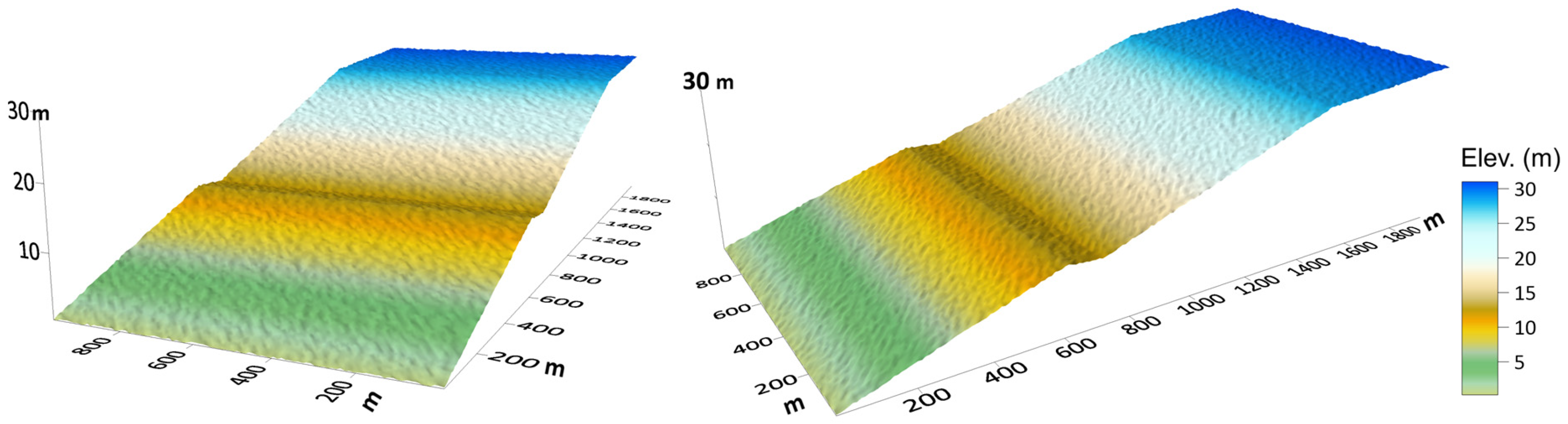
Figure 1. The synthetic DEM of the hillslope with three distinct slope sections (grid size = 10 m, TRI = 0.16 m).
Earth 07 00019 g001
Figure 2. Topography of the hillslope after 1000 years of simulation using (a) SIBERIA, (b) SSSPAM, and (c) CAESAR-Lisflood LEMs. The bottom row shows the cross-section along A–B, as marked in (a), for the outputs of the three models.
Earth 07 00019 g002
Figure 3. (a) Yearly and (b) overall mean erosion rates calculated by the SIBERIA, SSSPAM, and CAESAR-Lisflood (CL) LEMs over 1000-year simulations. Data are plotted at 10-year intervals, and the first 10-year rates are excluded to account for the initial model settlement period.
Earth 07 00019 g003
Table 1. Comparison of basic characteristics of some of the widely used LEMs.
ModelReferencesTime StepProcesses SimulatedSpatial/Temporal ScaleRemarks
SIBERIA[47,48,49]AnnualFluvial erosion, hillslope diffusion, depositionCatchment scale/1000–100,000 yDeterministic, steady-state; widely used in post-mining applications; computationally efficient; well suited for long-term landscape evolution modelling; not designed for short time steps (e.g., individual storm-event simulations)
GOLEM[50]Decades to centuriesSoil creep, landsliding, detachment-limited erosionLandscape scale/Mid- to long-termProcess-based model linking climate, tectonics, and surface processes; combines two modelling approaches: hillslope–valley scale and large-scale fluvial-focused evolution; explicitly models fluvial processes; hillslope processes simplified at larger scales; applicable from small catchments to mountain-range or regional scales
CHILD[52,66]Flexible (days–centuries)Uplift, fluvial incision, weathering, hillslope transportHillslope to basin/1000+ yStochastic rainfall variability [67]; includes meandering and floodplain deposition; detachment- and transport-limited fluvial erosion with single- or dual-size sediment; tracks subsurface stratigraphy and deposit ages; variable triangulated discretisation with adaptive remeshing; handles infiltration-, storage-, and saturation-excess runoff linking topography and hydrology
CAESAR-Lisflood[53,54,68]variable (sub second to hours)Hydrology, 2D hydrodynamics, sediment transport, floodplain processesRiver basins/Event to millennial scaleCouples hydrodynamics and sediment transport; simulates channel incision, deposition, and lateral erosion; operates at fine temporal resolution (event to annual scale); handles complex catchment-scale topography; can model flood events and variable flow regimes; computationally intensive for long-term or large-scale simulations
LAPSUS[55,56]AnnualSoil redistribution, tillage erosion, shallow landslidesPlot to catchment/Decades–centuriesDesigned for land use and conservation scenario modelling. Models simulate erosion and sedimentation processes driven by surface water redistribution, tillage movement, landslides, soil creep, solifluction, as well as biological activity and frost-induced weathering.
Landlab[62]Fully flexibleModular: erosion, uplift, hydrology, weatheringFlexible/AnyOpen-source, modular Earth-surface dynamics toolkit; flexible gridding (regular and irregular) and process components; supports coupling of diverse processes (e.g., hydrology, erosion, run-off); facilitates rapid model prototyping and reproducible research; not a single fixed LEM but a framework requiring user assembly of components.
SSSPAM[63,69,70]Annual to millennialSoil production, bioturbation, chemical weatheringHillslope/Centuries–millenniaCoupled soilscape–landform evolution modelling; simulates fluvial erosion, armouring, physical weathering and sediment deposition; tracks soil profile and particle size grading through depth; uses state-space matrix approach for efficient mechanistic simulation; modular framework for integrating pedogenesis and landscape processes.
eSCAPE[65]Event to annualErosion, overland flow, sediment yieldCatchment/Event to millennial scalePython-based, open-source landscape evolution model; simulates landscape and sediment dynamics from source to sink at regional to global scales; uses stream power and creep laws with implicit, matrix-based algorithms; handles multiple flow directions on large unstructured grids; designed for geological-time and large-scale problems, not detailed channel hydraulics.
WATEM LT/WATEM LTT[58,59,60]AnnualSoil erosion, sediment depositionCatchment to regional scale/1000–100,000 yearsDeveloped based on WaTEM/SEDEM for longer timescales; widely used in soil erosion studies [61]. WaTEM LT is a detachment-limited model, whereas WaTEM LTT is a transport-limited model; relatively simple structure with reduced input requirements; limited representation of detailed channel hydraulics and floodplain processes.
CASCADE[71]Long time steps (100 + years)Fluvial erosion, transport and deposition, hillslope (diffusion) processes, flexural isostasy, orographic precipitationCatchment to orogenic scale, geologic time scalesUses an adaptive triangulated irregular network (TIN) based on Delaunay triangulation, allowing variable spatial resolution and dynamic node addition. Water routing is computed using the CASCADE bucket-passing algorithm. Designed for large-scale, long-term landscape evolution (∼km spacing, million-year timescales) integrating diffusive hillslope and simple fluvial processes [71,72].
Table 2. Parameters used for CAESAR-Lisflood simulations (after Lowry et al. [39]).
ParameterValues
Grainsizes (m) and proportions: corresponding to above sizes0.000063 (9%), 0.000125 (4%), 0.00025 (5%), 0.0005 (6%), 0.001 (7%),
0.002 (8%), 0.004 (8%), 0.016 (23%), 0.064 (30%)
Sediment transport lawEinstein
Maximum erode limit (m)0.005
Active layer thickness (m)0.02
Lateral erosion rate0.000002
Lateral edge smoothing passes30
m-value0.01
Soil creep/diffusion value0.0015
Slope failure threshold45°
Input/output difference (m3 s−1)2.5
Evaporation rate (m/d)0.005
Courant number0.3
Mannings n0.04
Table 3. Key considerations for selecting an appropriate DEM-based Landscape Evolution Model (LEM) for post-mining landform assessment.
ConsiderationRemarks/Implications for Model Selection
Application/RequirementCompliance and closure planning often require long-term stability assessment and comparison against reference landscapes; design and operational stages may prioritise scenario testing and sensitivity analysis.
Tim stepEvent-based models are suited to storm-scale processes but can be computationally expensive for long-term simulations; annual or time-averaged models are more practical for centennial–millennial assessments.
Simulation time spanModels designed for short-term events may be impractical for simulations spanning 103–105 years; long-term LEMs prioritise process generalisation and computational efficiency.
Dominant processesSelection should consider whether site behaviour is controlled by fluvial erosion, hillslope diffusion, inter-rill and rill erosion, gully and tunnel erosion, sediment transport and deposition, surface armouring, soil and regolith evolution, multi-layer soil characteristics, vegetation dynamics, soil weathering, and hydrodynamic flow representations.
Spatial representationHighly heterogeneous landscapes benefit from models allowing spatially and temporally variable parameterisation (e.g., soils, vegetation, rainfall).
Input data requirementsModel complexity should align with data availability, including DEM resolution and format, rainfall records (pluviographic vs. averaged), soil properties, and vegetation data.
Object typeHillslope dumps and small landforms may be adequately represented with simpler models, whereas catchment-scale dumps with channel networks require more process-rich representations.
Man-made structuresMost LEMs do not explicitly represent engineered structures; their influence is commonly incorporated through modified topography or boundary conditions.
Ease of use and flexibilityUser-friendly models facilitate iterative testing, sensitivity analysis, and application across design, operational, and closure stages.
Output requirementsChoice depends on whether numerical metrics (e.g., erosion rates), spatial patterns (rill/gully distribution), or visual DEM evolution outputs are required.
Disclaimer/Publisher’s Note: The statements, opinions and data contained in all publications are solely those of the individual author(s) and contributor(s) and not of MDPI and/or the editor(s). MDPI and/or the editor(s) disclaim responsibility for any injury to people or property resulting from any ideas, methods, instructions or products referred to in the content.