Next Article in Journal
Spatial and Temporal Changes in Suspended Sediment Load and Their Contributing Factors in the Upper Reaches of the Yangtze River
Previous Article in Journal
Assessment of Stone Wall Soil Conservation Techniques for Mitigating Rainfall-Induced Erosion in Sloping Areas of an Arid Region
 
 
Due to scheduled maintenance work on our servers, there may be short service disruptions on this website between 11:00 and 12:00 CEST on March 28th.
Article

Assessing Earthquake-Induced Sediment Accumulation and Its Influence on Flooding in the Kota Belud Catchment of Malaysia Using a Combined D-InSAR and DEM-Based Analysis


by
Navakanesh M. Batmanathan
1,
Joy Jacqueline Pereira
1,*,
Afroz Ahmad Shah
2,
Lim Choun Sian
1 and
Nurfashareena Muhamad
1
1
Southeast Asia Disaster Prevention Research Initiative, Universiti Kebangsaan Malaysia, Bangi 43600, Malaysia
2
Faculty of Science, Universiti Brunei Darussalam, Gadong BE1410, Brunei
*
Author to whom correspondence should be addressed.
Earth 2025, 6(4), 151; https://doi.org/10.3390/earth6040151
Submission received: 27 September 2025 / Revised: 19 November 2025 / Accepted: 29 November 2025 / Published: 30 November 2025

Abstract

A combined Differential InSAR (D-InSAR) and Digital Elevation Model (DEM)-based analysis revealed that earthquake-triggered landslides significantly altered river morphology and intensified flooding in the Kota Belud catchment, Sabah, Malaysia. This 1386 km2 catchment, home to about 120,000 people, has experienced a marked rise in flood events following the 4 June 2015 and 8 March 2018 earthquakes. Multi-temporal Sentinel-1 Synthetic Aperture Radar (SAR) data and a 30 m Shuttle Radar Topography Mission (SRTM) DEM, complemented by river network information from HydroBASINS, were integrated to map sediment redistribution and model flood extent. Upstream zones exhibited extensive coseismic landslides and pronounced geomorphic disruption. Interferometric analysis showed that coherence was well preserved over stable terrain but rapidly degraded in vegetated and steep areas. Sediment aggradation, interpreted qualitatively from patterns of coherence loss and increased backscatter intensity, highlights slope failure initiation zones and depositional build-up along channels. Conversely, downstream, similar sedimentary adjustments were detected immediately upstream of areas with repeated flood incidents. Between 2015 and 2018, flood occurrences increased over fivefold, and after 2018, they increased by more than thirteenfold relative to pre-2015 conditions. DEM-based inundation simulations demonstrated that channel shallowing substantially reduced conveyance capacity and expanded flood extent. Collectively, these results confirm that earthquake-induced landslides have contributed to reshaping the geomorphology and amplified flooding in the area.

1. Introduction

Earthquake-triggered cascading hazards occur when seismic shaking initiates landslides that remobilize vast quantities of sediment [1,2,3]. Beyond the immediate ground shaking, these geomorphic disturbances can drastically alter river systems, disrupt sediment transport, and modify flood dynamics for years or even decades [4,5,6,7,8]. Globally, earthquake-induced landslides have been recognized as dominant agents of postseismic landscape evolution in tectonically active regions such as Nepal, Taiwan, Japan, and China [9,10,11,12,13,14,15,16,17]. For example, the 2008 Wenchuan earthquake in China generated over 60,000 landslides that produced tens of millions of cubic meters of sediment, triggering long-term channel aggradation and repeated downstream flooding [18,19]. Comparable cascading effects were also observed after the 2015 Gorkha earthquake in Nepal and the 2016 Kaikōura earthquake in New Zealand, where excess sediment delivery amplified fluvial hazards and infrastructure vulnerability [20,21]. These examples highlight how coseismic sediment pulses can extend the hydrological and societal impacts of earthquakes far beyond the initial event.
In tropical Southeast Asia, studies on earthquake-induced sediment redistribution and flood hazards are relatively limited [22,23,24]. The region’s steep terrain, high rainfall, and rapid vegetation regrowth obscure geomorphic change detection and hinder traditional field-based monitoring. These challenges are more pronounced in areas where active tectonics intersect with monsoonal hydrology. Earthquakes trigger extensive landsliding in mountainous interior regions, introducing large sediment volumes into small, inhabited catchments [25,26,27]. However, the quantitative relationships between these sediment inputs and downstream flood behavior remain poorly understood, partly due to limited ground data and the logistical constraints of post-earthquake fieldwork [28,29].
Traditional geomorphic surveys and sediment sampling provide valuable local insights but are restricted in spatial and temporal scope. Meanwhile, remote sensing technologies, though increasingly employed, often address either surface deformation or land-cover change separately, rather than examining their integrated hydrological consequences [30,31,32,33,34]. This methodological gap limits understanding of how coseismic sediment redistribution contributes to evolving flood hazards in tropical mountain environments. Furthermore, a comprehensive understanding of slope stability requires linking surface geomorphic responses to the physical and mechanical properties of subsurface materials. The petrophysical behavior of geological formation such as rock strength, porosity, and wave propagation can be evaluated through subsurface geophysical approaches, including advanced numerical modelling of wave propagation in complex media [35]. Integrating such analyses provides a more complete basis for assessing the susceptibility of slopes and catchments to cascading failures. At the same time, these localized natural hazards occur within the broader context of anthropogenic environmental change, where human activities particularly those contributing to greenhouse gas emissions and global climate variability intensify hydrological extremes and compound flood risks [36]. This combined natural–human perspective underscores the need for multi-scale frameworks that incorporate both Earth-system processes and human-induced pressures.
Recent advances in radar-based Earth observation, particularly Interferometric Synthetic Aperture Radar (InSAR) offer a powerful means to overcome these challenges [37]. InSAR coherence and backscatter are directly sensitive to surface roughness, dielectric properties, and phase stability, making them effective indicators of geomorphic and sedimentary change [38,39]. Loss of coherence between radar acquisitions reflects surface decorrelation caused by slope instability, mass movement, or sediment reworking, while increased backscatter indicates enhanced surface roughness and compaction due to debris accumulation or riverbed aggradation. Unlike optical sensors, radar observations penetrate cloud cover and are unaffected by illumination, allowing continuous monitoring of postseismic landscapes in humid, topographically complex settings such as Sabah [40,41]. Together, these signal characteristics provide a physically grounded basis for detecting and quantifying coseismic sediment redistribution.
To address the regional data gap and capitalize on these capabilities, this study applies a combined Differential Interferometric Synthetic Aperture Radar (D-InSAR) and Digital Elevation Model (DEM)-based analysis to quantify sediment accumulation and assess its impact on flood extent in the Kota Belud catchment of Sabah, Malaysia. Dual Sentinel-1 SAR data and 30 m SRTM DEMs were integrated with river network information from HydroBASINS to map coseismic landslide debris, model inundation patterns, and validate observed geomorphic changes using ancillary datasets. Sediment redistribution is linked to downstream flood dynamics to enhance understanding of hydro-geomorphic coupling between seismic and fluvial processes, offering critical insights for disaster risk reduction, river management, and post-earthquake recovery planning in tropical catchments.

2. Materials and Methods

2.1. Study Area

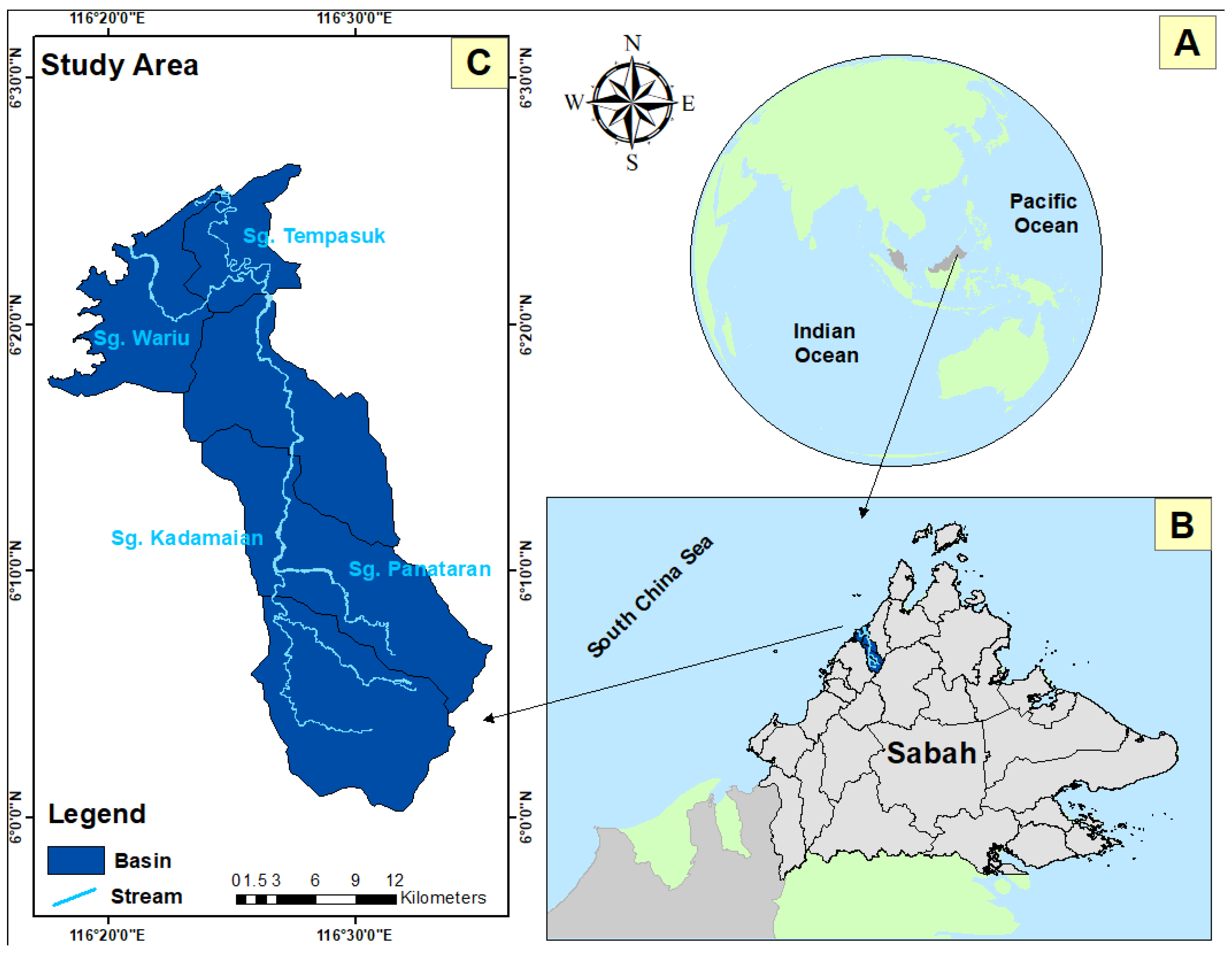
The study was conducted in the Kota Belud catchment, situated on the west coast of Sabah, Malaysia, encompassing an area of approximately 1386 km2. The district is drained by several major rivers, including the Kadamaian, Panataran, Wariu, and Tempasuk rivers, which flow into the South China Sea (Figure 1). The region is characterized by a tropical climate, with an annual average rainfall of 2547.2 mm and daytime temperatures ranging from 32.2 °C to 44.3 °C. On 4 June 2015, the Mw 6.0 Ranau earthquake triggered extensive landslides in the area, resulting in significant alterations to the river systems and a marked increase in floods, particularly within the Kadamaian and Wariu rivers [42]. The seismic event led to the deposition of substantial amounts of sediment, which reduced the capacity of river channels and formed new river bars in low-lying areas [43,44]. Analysis of remote sensing data from Landsat 8 and Sentinel-2, covering the years 2014 to 2020, revealed considerable land cover changes, including a 56.97 ha increase in river bar areas in the Kadamaian River. The catchment, which is home to approximately 120,000 residents, has seen a rise in flood events, even under lower rainfall intensities, due to the altered river morphology and sedimentation resulting from the earthquake [45]. Additionally, local farmers, particularly those in flood-prone areas, have reported significant crop losses, indicating the region’s vulnerability to flooding [46]. On 8 March 2018, the Mw 5.2 earthquake occurred, but no major coseismic landslides were reported during this earthquake. Although less destructive than the 2015 event, the quake triggered localized rockfalls and minor rolling of boulders along Mount Kinabalu trails.

2.2. Data Sources

This study utilized a combination of remote sensing data, topographic information, and historical flood records to investigate the impact of the June 2015 and March 2018 earthquakes on flood hazards in the Kota Belud catchment. Multi-temporal Synthetic Aperture Radar (SAR) images from Sentinel-1, operated by the European Space Agency (ESA), were employed to analyze surface deformation and sediment movement. Sentinel-1 imagery was acquired in the Interferometric Wide (IW) swath mode, which provides 250 km coverage with a spatial resolution of approximately 10 m, optimized for interferometric applications such as deformation and coherence analysis. The IW mode was selected because it offers the best trade-off between spatial resolution and temporal revisit frequency required for D-InSAR processing, whereas the Extra Wide (EW) mode, though offering larger coverage, provides lower spatial resolution (~40 m) more suited to marine and coastal monitoring. The VV/VH dual-polarization configuration was chosen as it is standard for Sentinel-1 IW acquisitions over land and provides enhanced sensitivity to surface roughness and moisture variations, improving coherence-based identification of landslides and sediment deposition. In contrast, HH polarization is available primarily for specific C-band missions (e.g., Radarsat-2) and was not part of the Sentinel-1 IW acquisition plan for Borneo during the study period. These images, acquired from the ESA Copernicus Open Access Hub, had a 12-day revisit cycle, ensuring regular data availability for temporal analysis. River network data from the HydroBASINS database provided detailed hydrological and river catchment information [47]. Additionally, a 30 m resolution Digital Elevation Model (DEM) from the Shuttle Radar Topography Mission (SRTM) was used for terrain correction, allowing for an accurate representation of the study area’s topography for flood modeling. To validate the findings, historical flood event records were collected from the Malaysian Department of Irrigation and Drainage (DID), offering insights into past flood events and flood depths, for assessing the correlation between sedimentation and flood susceptibility.

2.3. SAR Pre-Processing and InSAR Analysis

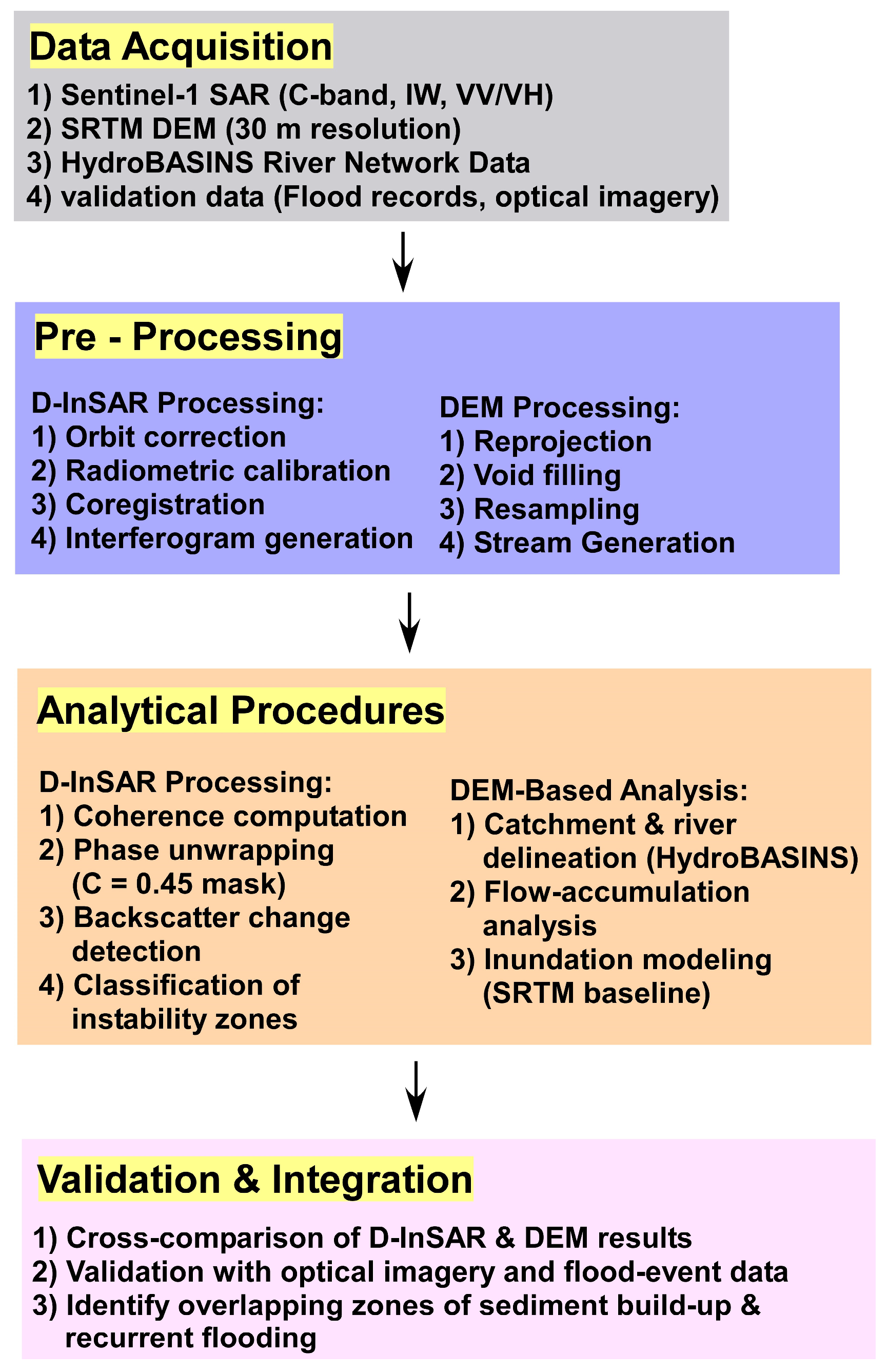
SAR data were processed using the Sentinel Application Platform (SNAP) software (version 9.0.0) (Table 1). The pre-processing steps began with the application of precise orbit files to correct satellite positional errors, ensuring data accuracy for subsequent analysis. Thermal noise, which can degrade the quality of SAR data, was removed to enhance the clarity and reliability of the results. Image pairs were co-registered to ensure precise interferometric alignment, a crucial step for detecting surface displacement resulting from landslides and sediment accumulation [48,49]. Radiometric and geometric terrain correction was applied to the Sentinel-1 SAR imagery using the SRTM DEM to mitigate topographic distortions (e.g., foreshortening and layover) and to ensure accurate geolocation of backscatter and coherence data [50,51,52]. Finally, interferometric coherence maps were generated to identify areas of surface change, particularly those caused by earthquake-induced landslides and sediment deposition.
Interferograms were multilooked (4 × 1) and Goldstein-filtered prior to coherence and phase analyses. To ensure phase reliability, we masked pixels with coherence C < 0.35 and attempted phase unwrapping only where C ≥ 0.45 and phase gradients were moderate. Unwrapping employed a minimum-cost-flow solver with conservative residue thresholds; solutions spanning low-coherence gaps were rejected. Given C-band’s wavelength (λ ≈ 5.6 cm; 2π ≙ ~2.8 cm LOS), we interpret unwrapped LOS displacements only in small, stable patches and do not use phase to infer meter-scale vertical change [53,54].

2.4. DEM-Based Analysis

The Kota Belud catchment was extracted by selecting the HydroBASINS polygon corresponding to the Kadamaian, Panataran, Wariu and Tempasuk river systems. The selected units were merged and clipped to generate the catchment polygon for subsequent spatial analysis. Prior to analysis, the DEM images were preprocessed, projected to Timbalai 1948 and sink filling was applied to remove spurious depression. The resulting hill shade raster image provided a three-dimensional view of the study area, which enables clear surface morphology of various features, such as ridge breaks and valleys. The subsequent step involves the generation of flow direction and flow accumulation grids to verify the delineated stream network and watershed boundaries obtained from HydroBASINS. Thresholds were applied to define the stream patterns.

2.5. Sediment Accumulation Mapping

Differential InSAR (D-InSAR) techniques were applied to derive deformation maps capturing ground displacement associated with landslide activity and sediment redistribution (Figure 2). Additional backscatter intensity analysis was used to detect surface roughness changes indicative of sediment deposition in river channels [55,56]. Landslide-affected areas were delineated using a semi-automated thresholding method, followed by manual refinement to reduce false positives in densely vegetated terrain [57]. To delineate zones of significant surface change, coherence values ≤ 0.35 were classified as low, representing potential landslide initiation or reworked areas, while coherence ≥ 0.70 indicated stable terrain. Intermediate coherence values (0.35–0.70) marked partially disturbed regions. In parallel, increases in radar backscatters exceeding +1.5 dB were interpreted as indicative of surface roughening or sediment accumulation. These thresholds were derived from the statistical distribution of coherence and backscatter values across stable reference areas and validated using optical imagery and ancillary datasets.

2.6. Flood Scenario Modelling

Flood inundation scenarios were modeled using Global Mapper software 25.0 64-bit to evaluate the potential impact of sediment accumulation on flood propagation. Two flood depth scenarios, 0.5 m and 1.0 m, were selected based on historical flood events and typical flood levels observed during the monsoon season, representing moderate to severe flooding conditions [58,59]. The 30 m Digital Elevation Model (DEM) served as the base terrain model for flood inundation mapping, with water level increments corresponding to the chosen flood depths applied to the DEM to simulate potential flood zones under various conditions. The flood extent maps generated from the simulation identified areas that are susceptible to flooding in different scenarios, indicating how sediment-induced changes to river morphology affect the spatial distribution of floodwater. The analysis of these flood maps provided a deeper understanding of how sediment accumulation from the earthquake altered the flow dynamics of the rivers, exacerbating susceptibility to floods. The findings provide insights for assessing future flood hazards in the catchment and formulating appropriate flood mitigation strategies.

2.7. Validation

The loss of spatial coherence and increase in backscatter values are validated against published secondary sources and Sentinel-2 derived imageries to highlight the actual ground changes associated with both earthquakes in selected areas within the Kota Belud catchment. The reported flood incidences were acquired from published secondary sources and DID Malaysia to delineate the changes in flood incidences prior to and after earthquake events.
The rainfall variability and its relationship with flood frequency was evaluated using rainfall data that were obtained from the ERA5—Land Monthly Aggregated (ECMWF Climate Reanalysis) dataset using Google Earth Engine (GEE) catalog. This dataset provides spatially coherent and continuous rainfall estimates at (~9 km) resolution. The ERA5 has been reported to be reliable for small basins (<460 km2) where the dataset generally reproduces seasonal rainfall patterns. However, it would require recalibration for larger basins as the rainfall tends to be underestimated [60]. Thus, the findings from this dataset are used judiciously in the present work, where the river basin is relatively larger (1386 km2). Furthermore, the dataset is not the official meteorological observation of the country, limiting its use for nation-wide application in flood-analysis.
Data from SRTM was compared to the official topographic map issued by [61]. A total of 10 trigonometric control points located in the Kota Belud area, which represent established benchmarks via geodetic surveying, were used in the analysis [61]. Both datasets were aligned to a common coordinate system, and elevation differences were calculated as SRTM minus topographic height. Basic statistical measures were used to characterize the vertical bias and variability, and the point differences were shown (Table S1). This error information identifies areas where SRTM-derived sediment and flood analyses may be affected by higher uncertainty.

3. Results

3.1. Spatial Coherence Detection

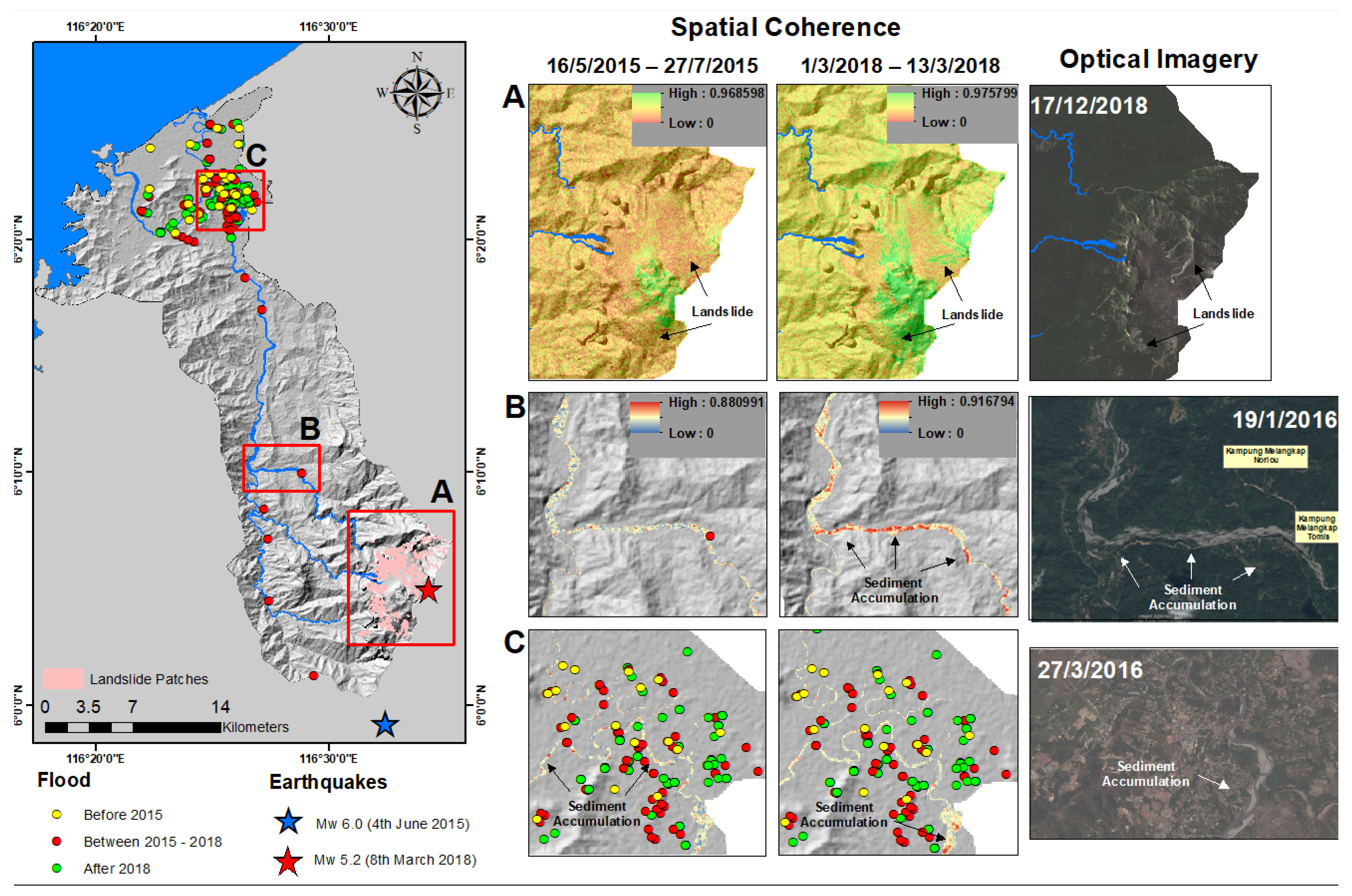
The Dual-Pair SAR analysis revealed significant sediment accumulation in areas affected by coseismic landslides following the 4 June 2015 and 8 March 2018 earthquakes (Figure 3). Coherence change detection between pre- and post-event interferograms indicated widespread surface disturbances along steep slopes, with abrupt loss of coherence corresponding to landslide initiation zones. In contrast, the downslope regions exhibited localized increases in backscatter and partial recovery of coherence, consistent with mass deposition.
The sediment accumulation was not limited to the coseismic moment but continued during the immediate postseismic phase. The catchments exhibited persistent surface change within weeks after the mainshock, suggesting progressive mass wasting and remobilization of slope materials triggered by aftershocks and rainfall. Phase unwrapping yielded localized, centimeter-scale LOS displacements only within high-coherence patches; in vegetated or steep slopes, decorrelation precluded reliable unwrapping. We therefore interpret aggradation qualitatively from coherence loss at initiation zones and backscatter increases in depositional reaches, rather than as phase-derived thickness. These findings align with optical observations reported in comparable seismically active terrains by past studies, reinforcing the reliability of the InSAR-derived results.
A key downstream impact of this upstream aggradation was increased flood incidence between 2015 and 2018. InSAR-derived channel profiles and coherence maps indicated that extensive sediment deposition led to the shallowing of river reaches upstream during the 4 June 2015 earthquake, especially along the Panataran river. This reduction in channel capacity acted as a hydraulic bottleneck, amplifying flow resistance and enhancing overbank flooding during subsequent high-discharge events. Downstream floodplain areas, which previously showed stable hydrological regimes, experienced anomalous inundation extents in the months following the earthquake, demonstrating the indirect hazard link between sediment accumulation and flood risk. In addition, the 2018 earthquake likely contributed to the remobilization of loose sediments and colluvium deposited by the 2015 failures, posing continued challenges for river stability and increasing the risk of downstream flooding during subsequent rainfall events.

3.2. Flood Extent Downstream

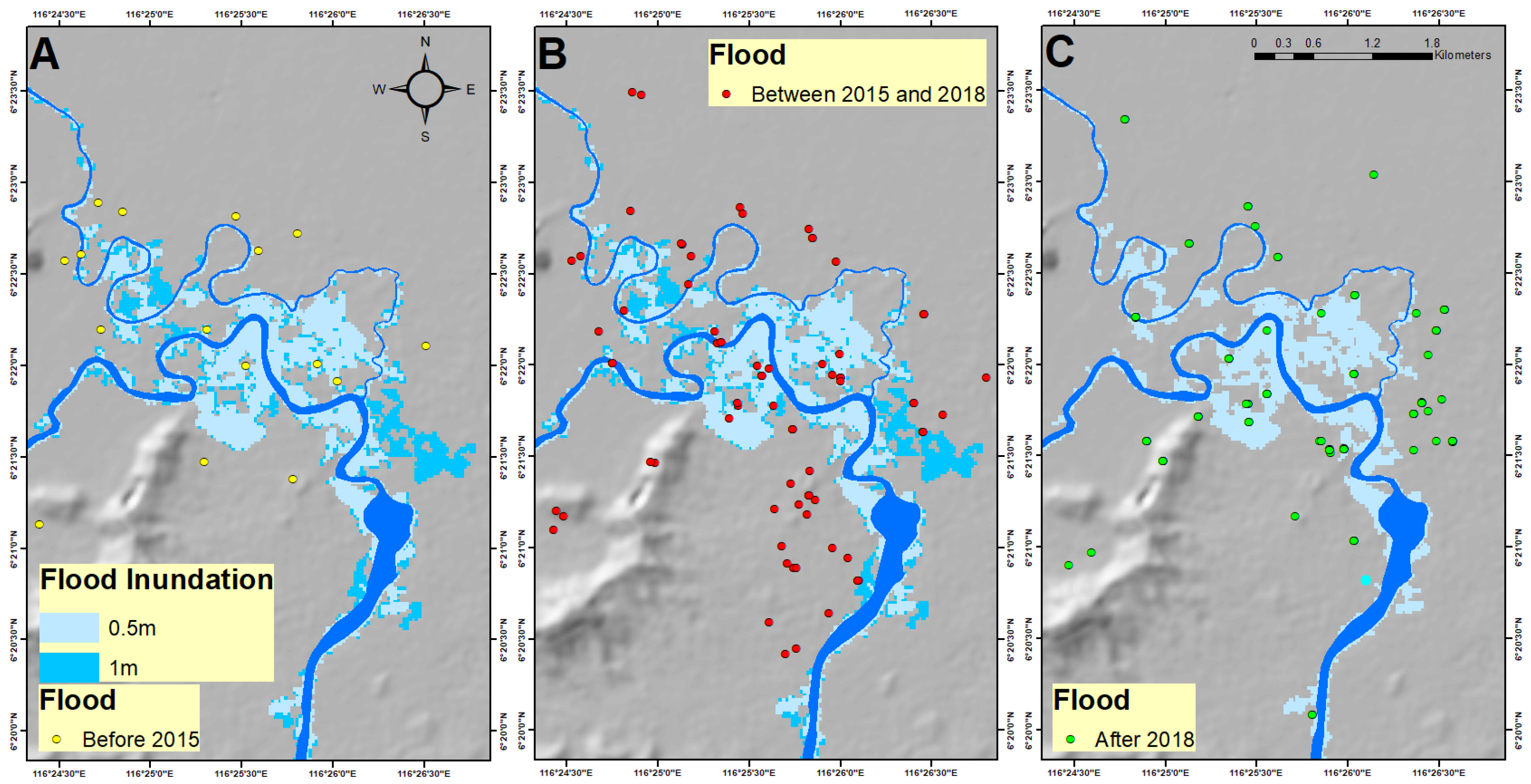
The analysis of flood incidences along the Wariu river demonstrates a clear increase in flood frequency following the 4 June 2015 and 8 March 2018 earthquakes. Prior to the former event, floods in the catchment area were occurring mainly during high-intensity rainfall (>60 mm/h) associated with northeast monsoon. In the period before 2015, a total of 25 flood events were documented from secondary sources. However, it rose sharply to 131 events between 2015 and 2018, which represents more than fivefold increase compared to the pre-earthquake baseline (Table 2). The trend continued after the 2018 earthquake, with 324 flood events recorded by DID Malaysia, indicating an increase of more than thirteen-fold relative to pre-2015 conditions.
The results show noticeable interannual variability with markedly higher rainfall totals after 2020 (exceeding 3000 mm), which likely contributed to the increased number of floods during those years. Nevertheless, there are several years with comparative moderate rainfalls such 2015 and 2016 associated with elevated flood occurrences. While this calls for judicious use of the data from ERA5, high rainfall contribution to floods events cannot be dismissed. The findings indicate that both seismic impacts and rainfall variability have influenced the observed escalation in flood frequency. Earthquake induced sediment accumulation and channel aggradation have played a contributing role in enhancing flood susceptibility.
Flood depth analysis further highlights the intensification of flood hazards after the earthquakes (Figure 4). Before 2015, only 2 events exceeded 0.5 m in depth and 3 events exceeded 1.0 m. Between 2015 and 2018, the number of events exceeding 0.5 m rose to 25, while 12 events exceeded 1.0 m. After 2018, flood severity increased further, with 64 events exceeding 0.5 m and 14 events exceeding 1.0 m. These data indicate that not only did the overall frequency of floods rise sharply after the earthquakes, but the proportion of moderate–severe floods also increased.

3.3. Vertical Error Assessment

The comparison between the SRTM elevation data and the topographic map data revealed varying levels of error across the dataset (Table S1). The mean elevation error was found to be 3.49 m, with a standard deviation of 5.24 m, indicating some variability in the accuracy of the data. The minimum error was 0.39 m, while the maximum error reached 17.75 m. The larger discrepancy occurred in hilly areas, suggesting that elevation differences in steep or mountainous terrains may lead to higher errors, particularly where the resolution of the SRTM data (30 m) may not capture fine-grained topographic features. The error-difference information indicates areas where SRTM-derived analyses such as sediment accumulation and flood susceptibility should be interpreted with caution.

4. Discussion

4.1. Earthquake Impact on Land Use Change

The findings of this study resonate strongly with previous research that examined the land use impacts of the 2015 Ranau Earthquake and subsequent seismic events in Sabah. Ref. [62] emphasized the vulnerability of built infrastructure to seismic risks. The increased frequency of flooding along the Wariu river in this study demonstrates how seismic activity has heightened pressures on settlements and agricultural land, underscoring the importance of integrating both seismic and flood resilience into urban and rural planning. The substantial rise in flood incidences illustrates how earthquake-induced geomorphic changes continue to amplify disaster risks for human-made structures long after the initial seismic shock.
In agreement with the observations of [63], the results reveal that the earthquakes triggered widespread slope failures and sediment deposition, which altered river morphology through aggradation, bar formation, and braiding. These geomorphic adjustments significantly reduced channel capacity, leading to more frequent and extensive overbank flooding. Such outcomes align with [64], who reported that the cascading effects of sediment deposition and altered river channels intensified flood hazards in previously stable areas. Evidence from the Wariu river supports this conclusion by showing that even moderate rainfall events could now result in flooding, a clear indication of the altered sediment–flood relationship.
The findings also highlight the compounding influence of human activity, echoing [65], who noted that deforestation and agricultural expansion have further transformed riparian landscapes. In the case of the Wariu river, earthquake-driven geomorphic instability has been exacerbated by land use pressures, accelerating vegetation loss and increasing vulnerability to repeated flooding. The interplay between natural seismic disturbances and human modifications therefore emerges as a critical factor shaping the long-term dynamics of land use and hazard exposure in Kota Belud.
Taken together, these findings affirm that the impacts of the 2015 and 2018 earthquakes extend beyond immediate structural damage to produce lasting environmental and socio-economic consequences. By situating the results within the context of existing literature [66,67,68], this study emphasizes the importance of addressing cascading hazards and cumulative impacts in both disaster risk reduction strategies and land use planning for seismically active regions such as Sabah.

4.2. Implications for Future Flood Risk Management

The findings underscore the need for an integrated approach to flood risk management in Kota Belud. The combination of earthquake-induced landslides and increasing sedimentation necessitates a comprehensive strategy that considers both seismic and hydrological risks. For future flood risk assessments, the region needs to integrate long-term landslide monitoring and sediment transport models to improve flood prediction accuracy [69,70].
Further research is required to refine these models and include real-time data from InSAR, hydrological monitoring, and geological studies to better understand the feedback loops between sediment accumulation and flooding. As Kota Belud continues to face the dual threats of tectonic activity and climate change, an adaptive approach to land use planning, infrastructure development, and disaster management will be crucial to mitigate future flood risks and safeguard the region’s communities [71,72].
The error-difference information derived from the comparison of elevation from SRTM and topographic data highlights substantial spatial variability in the accuracy of the DEM across the Kota Belud area. High-error zones (up to 17.75 m) are predominantly located in hilly regions with steep slopes and complex terrain, while lowland floodplains show smaller discrepancies (generally between 0.39 and 5 m). This finding aligns with previous studies that have demonstrated improved SRTM performance over flatter, minimally vegetated surfaces, while highlighting the limitations of the SRTM data in more rugged and forested areas [73,74]. These patterns suggest that SRTM-related uncertainties may contribute to both over- and under-representation of topographic features in upland regions. This could affect the accuracy of analyses such as sediment deposition and flood modelling, particularly in areas with higher elevation variability. Although the overall spatial trends in these processes remain consistent, interpretations in high-error zones should be made cautiously, as the elevation uncertainty in these regions may influence the reliability of the results.

4.3. Limitations

The 30 m resolution Shuttle Radar Topography Mission (SRTM) DEM used in this study is known to have vertical uncertainties of approximately 5–10 m in steep and vegetated terrain [75]. It introduces temporal uncertainty, as pre-2015 geomorphic changes may have altered channel morphology. The DEM was therefore used as a baseline elevation surface for hydrological modeling rather than as a precise pre-event reference for geomorphic differencing. As a result, the flood extent simulations presented here should be interpreted as relative indicators of flood susceptibility rather than precise inundation boundaries. The DEM provides a consistent topographic framework suitable for analyzing general spatial patterns of channel shallowing and flood expansion but is limited for high-resolution flood-depth estimation.
Although more recent DEMs such as ALOS World 3D and Copernicus GLO-30 were evaluated, both contained local vertical artifacts and voids over the steep terrain of the study area, which reduced their suitability for radar terrain correction and flood modeling. While this may affect flood depth and extent estimates, its relative consistency across the study area allows for reliable assessment of spatial flood patterns and channel conveyance changes. The flood simulations presented here therefore emphasize relative inundation trends rather than absolute depth accuracy. Future work incorporating higher-resolution LiDAR or UAV-derived DEMs could further refine these results, particularly in areas with high relief and dense canopy cover.
While the temporal correspondence between sediment accumulation and increased flood frequency strongly suggests a causal relationship, this study does not explicitly quantify the spatial overlap between deposition zones and inundation areas. Future work incorporating high-resolution spatial correlation and hydrodynamic modeling would help to confirm the extent to which channel aggradation directly governs flood propagation dynamics. Also, the long 72-day temporal baseline of the 2015 Sentinel-1 pair likely introduced temporal decorrelation in vegetated areas, potentially reducing phase reliability. While the available interferogram captures relative coherence loss along unvegetated slopes consistent with mapped landslides, these observations should be interpreted cautiously as semi-qualitative indicators of surface disturbance rather than precise coseismic displacements.
The interpretation of D-InSAR coherence and backscatter in this study is subject to several inherent limitations. First, the tropical vegetation cover in the study area likely contributed to temporal decorrelation, particularly in regions with NDVI ≥ 0.2, where radar signal coherence deteriorates rapidly. Second, only one preseismic Sentinel-1 acquisition was available for the 2015 event, which limits the ability to establish stable reference points and to fully separate coseismic motion from atmospheric or orbital noise. Third, the spatial resolution of the Sentinel-1 IW mode (~10 m) approaches the average river width (approximately 25–40 m in main channels and <15 m in tributaries), which may result in mixed-pixel effects caused by marginal vegetation and water-surface scattering. These factors may have locally reduced the precision of sediment mapping and coherence-based interpretations but do not alter the overall pattern of geomorphic disturbance and sediment redistribution observed across the catchment.
The observed rise in flood frequency after the 2015 and 2018 earthquakes is interpreted primarily from empirical observations and secondary reports. Due to limited availability of continuous rainfall and discharge data, the relationship between flood occurrence and sediment-induced channel modification could not be statistically verified. Consequently, the flood frequency analysis should be regarded as qualitative evidence of increased hydrological response linked to sediment aggradation, rather than a quantified rainfall–flood correlation. Future studies integrating rainfall intensity records, discharge measurements, and hydrodynamic modeling would allow more rigorous testing of this inferred causal relationship.
The flood extent simulations presented here were based on static topographic interpolation using the 30 m SRTM DEM. While this approach provides an effective first-order representation of potential inundation zones, it does not incorporate hydraulic processes such as backwater flow, recirculation, or transient wave propagation [76,77]. Consequently, the results should be interpreted as indicative of relative flood susceptibility rather than as outputs of fully dynamic hydraulic modeling. The integration of one- or two-dimensional hydrodynamic models, such as HEC-RAS or LISFLOOD-FP, in future work would enable more realistic simulations of flow behavior and sediment–water interactions, particularly in confluence zones where hydraulic complexity is high.

5. Conclusions

The combined application of D-InSAR and DEM-based modelling of the 4 June 2015 and 8 March 2018 earthquakes in the Wariu catchment revealed that coseismic landslides supplied substantial amounts of debris into the river system, leading to progressive shallowing and aggradation along the upstream and midstream reaches. Loss of coherence in the interferometric data pinpointed the initiation zones of landslides in the upper catchment, while enhanced backscatter responses in the midstream highlighted zones of sediment accumulation and channel adjustment. These geomorphic changes propagated downstream, where inundation modelling using the 30 m SRTM DEM confirmed reduced channel conveyance and higher susceptibility to flooding in downstream areas.
Flood records substantiate these observations, showing that flood incidences increased dramatically after the earthquakes, with higher rainfall levels in some periods. Prior to 2015, only 24 events were recorded, whereas 132 events were documented between 2015 and 2018, and 324 events occurred after 2018. Depth-specific analysis further demonstrated that both the frequency and severity of floods escalated, with events exceeding 0.5 m and 1.0 m flood depths becoming increasingly common. This trend underscores how earthquake-induced sediment pulses fundamentally altered river hydraulics, lowering the threshold for overbank flows and intensifying flood hazards for downstream communities.
The findings highlight the strong interconnection between seismic activity, hillslope processes, and fluvial dynamics in mountainous tropical catchments. Unlike short-lived hydrological disturbances, the legacy of earthquake-induced landslides persists for years, continuing to influence flood risk long after the seismic events themselves. This research therefore emphasizes the need to incorporate sediment management strategies, river corridor monitoring, and postseismic hazard assessments into disaster risk reduction frameworks. Early warning systems should also account for the lower levels of flood thresholds, particularly during the initial monsoon seasons following major earthquakes when sediment supply and channel instability remain high.
Evidence along the Wariu river confirms that earthquake-triggered landslides not only contributed to reshape catchment morphology but also amplified flood frequency and severity, with direct implications for community safety, infrastructure resilience, and long-term watershed management. Future research should explore finer-resolution DEMs, multi-temporal InSAR time series, and sediment budget analyses to quantify recovery trajectories and to inform mitigation planning in seismically active small catchments in the tropics.

Supplementary Materials

The following supporting information can be downloaded at: https://www.mdpi.com/article/10.3390/earth6040151/s1, Table S1: Elevation differences between SRTM and topographic map at 10 points in the Kota Belud Area [Department of Survey and Mapping Malaysia, 1986] [61].

Author Contributions

Conceptualization, J.J.P. and N.M.; methodology, N.M.B., J.J.P. and A.A.S.; software, N.M.; validation, N.M.B. and J.J.P.; formal analysis, N.M.B. and A.A.S.; investigation, N.M.B. and L.C.S.; resources, J.J.P. and N.M.; data curation, L.C.S.; writing—original draft preparation, N.M.B. and A.A.S.; writing—review and editing, J.J.P., N.M.B., L.C.S. and N.M.; supervision, J.J.P., N.M. and A.A.S.; project administration, J.J.P. and N.M.; funding acquisition, J.J.P. and N.M. All authors have read and agreed to the published version of the manuscript.

Funding

This work was conducted with the aid of a grant from the International Development Research Centre (IDRC), Ottawa, Canada [Grant No: 109162-001], and Universiti Kebangsaan Malaysia [Project Code: XX-2019-011].

Data Availability Statement

InSAR data are available via Alaska Satellite Facility (ASF) website (https://search.asf.alaska.edu/), accessed on 3 August 2025). The 30 m resolution Digital Elevation Model (DEM) can be downloaded from https://dwtkns.com/srtm30m/, accessed on 3 August 2025. Landsat data are freely available via https://earthexplorer.usgs.gov/, accessed on 3 August 2025. The datasets from this study are available upon request.

Acknowledgments

The authors would like to thank the Drainage and Irrigation Department of Malaysia (DID) for providing the flood incidences data. Additionally, we acknowledge the support from SEADPRI-UKM for providing data and express our gratitude to the interns and colleagues who assisted with data collection and analysis.

Conflicts of Interest

The authors declare no conflicts of interest.

References

  1. Ma, C.; Wei, Z.; Qian, L.; Li, T.; Li, C.; Xi, X.; Deng, Y.; Geng, S. Study of the Characteristics of a Co-Seismic Displacement Field Based on High-Resolution Stereo Imagery: A Case Study of the 2024 MS7.1 Wushi Earthquake, Xinjiang. Remote Sens. 2025, 17, 2625. [Google Scholar] [CrossRef]
  2. Vidal-Páez, P.; Clavero, J.; Ramírez, V.; Fernández-Sarría, A.; Meseguer-Ruiz, O.; Aguilera, M.; Pérez-Martínez, W.; González Bonilla, M.J.; Cuerda, J.M.; Casal, N.; et al. Remote Monitoring of Ground Deformation in an Active Landslide Area, Upper Mapocho River Basin, Central Chile, Using DInSAR Technique with PAZ and Sentinel-1 Imagery. Remote Sens. 2025, 17, 2921. [Google Scholar] [CrossRef]
  3. Zhao, D.; Qu, C.; Bürgmann, R.; Gong, W.; Shan, X.; Qiao, X.; Zhao, L.; Chen, H.; Liu, L. Large-Scale Crustal Deformation, Slip-Rate Variation, and Strain Distribution along the Kunlun Fault (Tibet) from Sentinel-1 InSAR Observations (2015–2020). J. Geophys. Res. Solid Earth 2022, 127, e2021JB022892. [Google Scholar] [CrossRef]
  4. Stoffel, M.; Huggel, C. Effects of Climate Change on Mass Movements in Mountain Environments. Prog. Phys. Geogr. 2012, 36, 421–439. [Google Scholar] [CrossRef]
  5. Strozzi, T.; Klimeš, J.; Frey, H.; Caduff, R.; Huggel, C.; Wegmüller, U.; Cochachin, A. Satellite SAR Interferometry for the Improved Assessment of the State of Activity of Landslides: A Case Study from the Cordilleras of Peru. Remote Sens. Environ. 2018, 217, 111–125. [Google Scholar] [CrossRef]
  6. Serey, A.; Piñero-Feliciangeli, L.; Sepúlveda, S.A.; Poblete, F.; Petley, D.N.; Murphy, W. Landslides Induced by the 2010 Chile Megathrust Earthquake: A Comprehensive Inventory and Correlations with Geological and Seismic Factors. Landslides 2019, 16, 1153–1165. [Google Scholar] [CrossRef]
  7. Wood, J.L.; Harrison, S.; Reinhardt, L.; Taylor, F.E. Landslide Databases for Climate Change Detection and Attribution. Geomorphology 2020, 355, 107061. [Google Scholar] [CrossRef]
  8. Tomás, R.; Díaz, E.; Szeibert, W.T.; Liu, X.; Lopez-Sanchez, J.M.; Zhao, C. Geomorphological Characterization, Remote Sensing Monitoring, and Modeling of a Slow-Moving Landslide in Alcoy (Southern Spain). Landslides 2023, 20, 1293–1301. [Google Scholar] [CrossRef]
  9. Shao, X.; Xu, C. Earthquake-Induced Landslides Susceptibility Assessment: A Review of the State-of-the-Art. Nat. Hazards Res. 2022, 2, 172–182. [Google Scholar] [CrossRef]
  10. Zhao, B.; Su, L.; Xu, Q.; Li, W.; Xu, C.; Wang, Y. A Review of Recent Earthquake-Induced Landslides on the Tibetan Plateau. Earth-Sci. Rev. 2023, 244, 104534. [Google Scholar] [CrossRef]
  11. Huang, Y.; Xu, C.; He, X.; Cheng, J.; Huang, Y.; Wu, L.; Xu, X. Distribution Characteristics and Cumulative Effects of Landslides Triggered by Multiple Moderate-Magnitude Earthquakes: A Case Study of the Comprehensive Seismic Impact Area in Yibin, Sichuan, China. Landslides 2024, 21, 2927–2943. [Google Scholar] [CrossRef]
  12. Keefer, D.K. The Importance of Earthquake-Induced Landslides to Long-Term Slope Erosion and Slope-Failure Hazards in Seismically Active Regions. Geomorphology 1994, 10, 265–284. [Google Scholar] [CrossRef]
  13. Korup, O. Geomorphic implications of fault zone weakening: Slope instability along the Alpine Fault, South Westland to Fiordland. N. Z. J. Geol. Geophys. 2004, 47, 257–267. [Google Scholar] [CrossRef]
  14. Dadson, S.J.; Hovius, N.; Chen, H.; Dade, W.B.; Lin, J.C.; Hsu, M.L.; Lin, C.W.; Horng, M.J.; Chen, T.C.; Milliman, J.; et al. Earthquake-Triggered Increase in Sediment Delivery from an Active Mountain Belt. Geology 2004, 32, 733–736. [Google Scholar] [CrossRef]
  15. Hovius, N.; Stark, C.P.; Allen, P.A. Sediment Flux from a Mountain Belt Derived by Landslide Mapping. Geology 1997, 25, 231–234. [Google Scholar] [CrossRef]
  16. Hovius, N.; Meunier, P.; Lin, C.W.; Chen, H.; Chen, Y.G.; Dadson, S.; Horng, M.J.; Lines, M. Prolonged Seismically Induced Erosion and the Mass Balance of a Large Earthquake. Earth Planet Sci. Lett. 2011, 304, 347–356. [Google Scholar] [CrossRef]
  17. Kargel, J.S.; Leonard, G.J.; Shugar, D.H.; Haritashya, U.K.; Bevington, A.; Fielding, E.J.; Fujita, K.; Geertsema, M.; Miles, E.; Steiner, J.; et al. Geomorphic and Geologic Controls of Geohazards Induced by Nepal’s 2015 Gorkha Earthquake. Science 2016, 351, aac8353. [Google Scholar] [CrossRef]
  18. Dai, F.C.; Xu, C.; Yao, X.; Xu, L.; Tu, X.B.; Gong, Q.M. Spatial Distribution of Landslides Triggered by the 2008 Wenchuan Earthquake, China. J. Asian Earth Sci. 2011, 40, 883–895. [Google Scholar] [CrossRef]
  19. Fan, X.; Scaringi, G.; Xu, Q.; Dong, X.; Zhu, X.; Dai, L.; Pei, X.; Dai, K. Coseismic Landslides Triggered by the 2008 Wenchuan Earthquake: Distribution, Characteristics, and Mechanisms. Landslides 2018, 15, 1357–1372. [Google Scholar]
  20. Massey, C.I.; Townsend, D.B.; Rathje, E.M.; Allstadt, K.E.; Lukovic, B.; Jibson, R.W.; Bradley, B.A.; Wartman, J.; McColl, S.; Petley, D.N.; et al. Landslides Triggered by the 14 November 2016 Mw 7.8 Kaikōura Earthquake, New Zealand. Bull. Seismol. Soc. Am. 2018, 108, 1630–1648. [Google Scholar] [CrossRef]
  21. Li, G.; West, A.J.; Densmore, A.L.; Jin, Z.; Parker, R.N.; Hilton, R.G. Earthquakes drive focused denudation along a tectonically active mountain front. Earth Planet Sci. Lett. 2017, 472, 253–265. [Google Scholar] [CrossRef]
  22. Lin, G.-W. Variations of Fluvial Sediment Transport after Large Earthquakes: Field Study in Taiwan Catchments. Water 2018, 10, 1836. [Google Scholar] [CrossRef]
  23. Graf, E.L.S.; Sinclair, H.D.; Attal, M.; Gailleton, B.; Adhikari, B.R.; Baral, B.R. Geomorphological and Hydrological Controls on Sediment Export in Earthquake-Affected Catchments in the Nepal Himalaya. Earth Surf. Dynam. 2024, 12, 135–161. [Google Scholar] [CrossRef]
  24. Browning, T.N.; Sawyer, D.E. Vulnerability to Watershed Erosion and Coastal Deposition in the Tropics. Sci. Rep. 2021, 11, 885. [Google Scholar] [CrossRef]
  25. Wang, Y.; Wei, S.; Wang, X.; Lindsey, E.O.; Tongkul, F.; Tapponnier, P.; Bradley, K.; Chan, C.-H.; Hill, E.M.; Sieh, K. The 2015 Mw 6.0 Mt. Kinabalu Earthquake: An Infrequent Fault Rupture within the Crocker Fault System of East Malaysia. Geosci. Lett. 2017, 4, 6. [Google Scholar] [CrossRef]
  26. Mathew, M.J.; Menier, D.; Siddiqui, N.; Kumar, S.G.; Authemayou, C. Active Tectonic Deformation along Rejuvenated Faults in Tropical Borneo: Inferences Obtained from Tectono-Geomorphic Evaluation. Geomorphology 2016, 267, 1–15. [Google Scholar] [CrossRef]
  27. Tongkul, F. Active Tectonics in Sabah—Seismicity and Active Faults. Bull. Geol. Soc. Malays. 2017, 64, 27–36. [Google Scholar] [CrossRef]
  28. Roslee, R.; Krishnan, R.B. Landslide Susceptibility Assessment in Sabah, Malaysia: A Bivariate Frequency Ratio Approach. Sci. Eng. Health Stud. 2023, 17, 23020004. [Google Scholar] [CrossRef]
  29. Golutin, B.; Tongkul, F.; Abd Rahim, I. Intraplate Crustal Deformation in Sabah: Preliminary Results of Global Positioning System/Global Navigation Satellite System Measurements in the Ranau Area. Bull. Geol. Soc. Malays. 2022, 74, 111–122. [Google Scholar] [CrossRef]
  30. Blaschke, T. Object Based Image Analysis for Remote Sensing. ISPRS J. Photogramm. Remote Sens. 2010, 65, 2–16. [Google Scholar] [CrossRef]
  31. Yu, W.; Zhou, W.; Qian, Y.; Yan, J. A New Approach for Land Cover Classification and Change Analysis: Integrating Backdating and an Object-Based Method. Remote Sens. Environ. 2016, 177, 37–47. [Google Scholar] [CrossRef]
  32. Zhou, W.; Troy, A.; Grove, M. Object-Based Land Cover Classification and Change Analysis in the Baltimore Metropolitan Area Using Multitemporal High-Resolution Remote Sensing Data. Sensors 2008, 8, 1613–1636. [Google Scholar] [CrossRef]
  33. Li, M.; Ma, L.; Blaschke, T.; Cheng, L.; Tiede, D. A Systematic Comparison of Different Object-Based Classification Techniques Using High Spatial Resolution Imagery in Agricultural Environments. Int. J. Appl. Earth Obs. Geoinf. 2016, 49, 87–98. [Google Scholar] [CrossRef]
  34. Phua, M.H.; Tsuyuki, S. Assessing Impact of Multiple Fires on a Tropical Peat Swamp Forest Using High- and Very-High-Resolution Satellite Images. Fire 2021, 4, 89. [Google Scholar] [CrossRef]
  35. Zhan, W.; Zhuang, M.; Liu, Q.Q.; Shi, L.; Sun, Y.; Liu, Q.H. Frequency domain spectral element method for modelling poroelastic waves in 3-D anisotropic, heterogeneous and attenuative porous media. Geophys. J. Int. 2021, 227, 1339–1353. [Google Scholar] [CrossRef]
  36. Li, R.; Kockelman, K.M.; Lee, J. Reducing Greenhouse Gas Emissions from Long-Distance Travel Business: How Far Can We Go? Transp. Res. Rec. J. Transp. Res. Board 2021, 2676, 472–486. [Google Scholar] [CrossRef]
  37. ESA. Sentinel Application Platform (SNAP), v9.0; European Space Agency: Paris, France, 2019.
  38. Crosetto, M.; Monserrat, O.; Cuevas-González, M.; Devanthéry, N.; Crippa, B. Persistent Scatterer Interferometry: A Review. ISPRS J. Photogramm. Remote Sens. 2016, 115, 78–89. [Google Scholar] [CrossRef]
  39. Zhou, Y.; Zhang, L.; Wang, H.; Yang, M.; Zhao, C. Advances in InSAR Techniques for Landslide Monitoring and Assessment. Remote Sens. 2022, 14, 567. [Google Scholar]
  40. Ferretti, A.; Prati, C.; Rocca, F. Permanent Scatterers in SAR Interferometry. IEEE Trans. Geosci. Remote Sens. 2001, 39, 8–20. [Google Scholar] [CrossRef]
  41. Hooper, A.; Bekaert, D.; Spaans, K.; Arıkan, M. Recent Advances in SAR Interferometry Time Series Analysis for Measuring Crustal Deformation. Tectonophysics 2012, 514–517, 1–13. [Google Scholar] [CrossRef]
  42. Tongkul, F. The 2015 Ranau Earthquake: Cause and Impact. Sabah Soc. J. 2016, 32, 16. [Google Scholar]
  43. Rosli, M.I.; Mohd Kamal, N.A.; Razak, K.A. Assessing Earthquake-Induced Debris Flow Risk in the First UNESCO World Heritage in Malaysia. Remote Sens. Appl. Soc. Environ. 2021, 23, 100550. [Google Scholar] [CrossRef]
  44. Yusoff, H.H.M.; Razak, K.A.; Yuen, F.; Harun, A.; Talib, J.; Mohamad, Z.; Ramli, Z.; Razab, R.A. Mapping of Post-Event Earthquake-Induced Landslides in Sg. Mesilou Using LiDAR. IOP Conf. Ser. Earth Environ. Sci. 2016, 37, 012068. [Google Scholar] [CrossRef]
  45. Roslee, R.; Sharir, K. Integration of GIS-Based RUSLE Model for Land Planning and Environmental Management in Ranau Area, Sabah, Malaysia. ASM Sci. J. 2019, 12, 60–69. [Google Scholar]
  46. Sharir, K.; Lai, G.T.; Simon, N.; Ern, L.K.; Madran, E.; Roslee, R. Debris Flow Susceptibility Analysis Using a Bivariate Statistical Analysis in the Panataran River, Kg Melangkap, Sabah, Malaysia. IOP Conf. Ser. Earth Environ. Sci. 2022, 1103, 012038. [Google Scholar] [CrossRef]
  47. Lehner, B.; Grill, G. Global River Hydrography and Network Routing: Baseline Data and New Approaches to Study the World’s Large River Systems. Hydrol. Process. 2013, 27, 2171–2186. [Google Scholar] [CrossRef]
  48. Chen, Q.; Fu, B.; Shi, P.; Li, Z. Surface Deformation Associated with the 22 August 1902 Mw 7.7 Atushi Earthquake in the Southwestern Tian Shan, Revealed from Multiple Remote Sensing Data. Remote Sens. 2022, 14, 1663. [Google Scholar] [CrossRef]
  49. Yang, F.; An, Y.; Ren, C.; Xu, J.; Li, J.; Li, D.; Peng, Z. Monitoring and analysis of surface deformation in alpine valley areas based on multi-dimensional InSAR technology. Sci. Rep. 2023, 13, 12896. [Google Scholar] [CrossRef]
  50. Raja Shekar, P.; Mathew, A. Morphometric analysis of watersheds: A comprehensive review of data sources, quality, and geospatial techniques. Watershed Ecol. Environ. 2024, 6, 13–25. [Google Scholar] [CrossRef]
  51. Syzdykbayev, M.; Karimi, B.; Karimi, H.A. A Method for Extracting Some Key Terrain Features from Shaded Relief of Digital Terrain Models. Remote Sens. 2020, 12, 2809. [Google Scholar] [CrossRef]
  52. Gautam, P.; Kubota, T.; Aditian, A. Evaluating underlying causative factors for earthquake-induced landslides and landslide susceptibility mapping in Upper Indrawati Watershed, Nepal. Geoenviron. Disasters 2021, 8, 30. [Google Scholar] [CrossRef]
  53. Goorabi, A. Detection of landslide induced by large earthquake using InSAR coherence techniques—Northwest Zagros, Iran. Egypt. J. Remote Sens. Space Sci. 2020, 23, 195–205. [Google Scholar] [CrossRef]
  54. Fielding, E.J.; Jung, J. Damage Proxy Mapping with SAR interferometric coherence change. Procedia Comput. Sci. 2024, 239, 2322–2328. [Google Scholar] [CrossRef]
  55. Huang, J.; Sinclair, H.D. Sediment aggradation rates for Himalayan Rivers revealed through SAR remote sensing. EGUsphere 2024. [Google Scholar] [CrossRef]
  56. Lin, S.-Y.; Chang, S.-T.; Lee, C.-F. InSAR-based investigation on spatiotemporal characteristics of river sediment behavior. J. Hydrol. 2023, 617, 129076. [Google Scholar] [CrossRef]
  57. Yan, L.; Xiong, Q.; Li, D.; Cheon, E.; She, X.; Yang, S. InSAR-Driven Dynamic Landslide Hazard Mapping in Highly Vegetated Area. Remote Sens. 2024, 16, 3229. [Google Scholar] [CrossRef]
  58. Belay, H.; Melesse, A.M.; Tegegne, G.; Kassaye, S.M. Flood Inundation Mapping Using the Google Earth Engine and HEC-RAS Under Land Use/Land Cover and Climate Changes in the Gumara Watershed, Upper Blue Nile Basin, Ethiopia. Remote Sens. 2025, 17, 1283. [Google Scholar] [CrossRef]
  59. Teng, J.; Jakeman, A.J.; Vaze, J.; Croke, B.F.W.; Dutta, D.; Kim, S. Flood inundation modelling: A review of methods, recent advances and uncertainty analysis. Environ. Model. Softw. 2017, 90, 201–216. [Google Scholar] [CrossRef]
  60. Alexopoulos, M.J.; Müller-Thomy, H.; Nistahl, P.; Šraj, M.; Bezak, N. Validation of Precipitation Reanalysis Products for Rainfall–Runoff Modelling in Slovenia. Hydrol. Earth Syst. Sci. 2023, 27, 2559–2578. [Google Scholar] [CrossRef]
  61. Department of Survey and Mapping Malaysia. Department of Survey and Mapping Malaysia; JUPEM: Kuala Lumpur, Malaysia, 1986.
  62. Hassan, N.I.H.; Herayani, N.S.H. Enhancing Readiness for Seismic Resilience in Kota Belud, Sabah through a Comprehensive Vulnerability Assessment. Trans. Sci. Technol. 2023, 10, 218–226. [Google Scholar]
  63. Chai, L.T.; Nainar, A.; Roslee, R.; Wong, W.V.C.; Phua, M.-H. Assessment of Immediate and Five-Year Earthquake Impacts on River Systems in Sabah, Malaysia Using Multi-Temporal Satellite Imageries. Geoenviron. Disasters 2024, 11, 16. [Google Scholar] [CrossRef]
  64. Sharir, K.; Roslee, R. Reviewing the Impact of Earthquakes on Flood Occurrence: Insights from Kota Belud, Sabah, Malaysia. Nat. Environ. Pollut. Technol. 2025, 24, 331–337. [Google Scholar] [CrossRef]
  65. Kamlun, U.K.; Miuse, C.F.; Puma, D.D.; Mahali, M.; Wong, W.; Phua, M.-H. Mapping Pre- and Post-Earthquake Land Cover Change in Melangkap, Kota Belud Sabah Using Multi-Temporal Satellite Landsat 8/OLI and Sentinel-2 Imagery. IOP Conf. Ser. Earth Environ. Sci. 2022, 1053, 012024. [Google Scholar] [CrossRef]
  66. Shah, A.A.; Zhafri, M.N.; Delson, J.; Batmanathan, N. Major Strike-Slip Faults Identified Using Satellite Data in Central Borneo, SE Asia. Geosciences 2018, 8, 156. [Google Scholar] [CrossRef]
  67. Batmanathan, N.; Shah, A.A.; Prasanna, M.V. Earthquake Education Through the Use of Documentary Movies. Front. Earth Sci. 2019, 7, 42. [Google Scholar] [CrossRef]
  68. Batmanathan, N.M.; Shah, A.A. Is the active deformation in NW Borneo tectonically-driven or gravity-induced? In Proceedings of the 5th International Young Earth Scientists (YES) Congress “Rocking Earth’s Future”, Berlin, Germany, 25–30 September 2019; Rose, T., de Gelder, G., Fernández-Blanco, D., Sieber, M., Eds.; Copernicus: Göttingen, Germany, 2021. [Google Scholar] [CrossRef]
  69. Sajid, T.; Maimoon, S.K.; Waseem, M.; Ahmed, S.; Khan, M.A.; Tränckner, J.; Pasha, G.A.; Hamidifar, H.; Skoulikaris, C. Integrated Risk Assessment of Floods and Landslides in Kohistan, Pakistan. Sustainability 2025, 17, 3331. [Google Scholar] [CrossRef]
  70. Nguyen, H.D.; Nguyen, Q.-H.; Dang, D.K.; Van, C.P.; Truong, Q.H.; Pham, S.D.; Bui, Q.-T.; Petrisor, A.-I. A novel flood risk management approach based on future climate and land use change scenarios. Sci. Total Environ. 2024, 921, 171204. [Google Scholar] [CrossRef]
  71. Delalay, M.; Ziegler, A.D.; Shrestha, M.S.; Gopal, V. Methodology for future flood assessment in terms of economic damage: Development and application for a case study in Nepal. J. Flood Risk Manag. 2020, 13, e12623. [Google Scholar] [CrossRef]
  72. Khodaei, H.; Nasiri Saleh, F.; Nobakht Dalir, A.; Zarei, E. Future flood susceptibility mapping under climate and land use change. Sci. Rep. 2025, 15, 97008. [Google Scholar] [CrossRef]
  73. Sharma, A.; Bagri, D.S. Comparison and validation of elevation data at selected ground control points and terrain derivatives derived from different digital elevation models. Remote Sens. Earth Syst. Sci. 2023, 6, 38–59. [Google Scholar] [CrossRef]
  74. Al Ashiry, A.; Elkhalil, O. Vertical accuracy assessment for the free digital elevation models SRTM and ASTER in various sloping areas. J. Eng. Sci. 2024, 52, 250–268. [Google Scholar] [CrossRef]
  75. Farr, T.G.; Rosen, P.A.; Caro, E.; Crippen, R.; Duren, R.; Hensley, S.; Kobrick, M.; Paller, M.; Rodriguez, E.; Roth, L.; et al. The Shuttle Radar Topography Mission. Rev. Geophys. 2007, 45, RG2004. [Google Scholar] [CrossRef]
  76. Miskin, T.J.; Rosas, L.R.; Hales, R.C.; Nelson, E.J.; Follum, M.L.; Gutenson, J.L.; Williams, G.P.; Jones, N.L. Impact of Elevation and Hydrography Data on Modeled Flood Map Accuracy Using ARC and Curve2Flood. Hydrology 2025, 12, 202. [Google Scholar] [CrossRef]
  77. Yan, K.; Di Baldassarre, G.; Solomatine, D.P. Exploring the Potential of SRTM Topographic Data for Flood Inundation Modelling under Uncertainty. J. Hydroinform. 2013, 15, 849–861. [Google Scholar] [CrossRef]
Figure 1. Location of the study area. (A) Global map showing the position of Borneo within Southeast Asia. (B) Regional map of Sabah highlighting the Kota Belud District (C) Detailed map of the Panataran, Kadamaian, Wariu, and Tempasuk rivers draining into the South China Sea. The coordinate grid is applied only to frame (C) to preserve clarity in the larger-scale reference maps.
Earth 06 00151 g001
Figure 2. Workflow of main data processing and analysis.
Earth 06 00151 g002
Figure 3. The spatial coherence and Sentinel-2 derived optical imagery were emphasized on three zones; landslide initiation (A), midstream (B) and downstream (C) along the Kota Belud catchment.
Earth 06 00151 g003
Figure 4. Reported flood incidents before the 2015 earthquake (A), between 2015 and 2018 (B) and after 2018 (C) overlain on 0.5 m and 1 m inundation.
Earth 06 00151 g004
Table 1. Sentinel-1 C-band collection image details.
DatePathFrameFlight DirectionAbsolute OrbitNotesEvent
16 May 2015105570Descending5952PreseismicMw 6.0
27 July 20157002Coseismic
1 March 201810557220,827PreseismicMw 5.2
13 March 201821,002Coseismic
Table 2. Flood events and total rainfall for the same period in the Kota Belud catchment, Sabah prior to 4 June 2015, and between 2015 and 2022.
YearNumber of Flood EventsTotal Rainfall (mm)
2015 (prior to 4 June 2015)252626.2
2015462299.1
2016122259.1
2017423250.0
2018 (after 8 March 2018)312295.8
2019532230.2
20201223044.7
20211193473.8
2022303565.8
Disclaimer/Publisher’s Note: The statements, opinions and data contained in all publications are solely those of the individual author(s) and contributor(s) and not of MDPI and/or the editor(s). MDPI and/or the editor(s) disclaim responsibility for any injury to people or property resulting from any ideas, methods, instructions or products referred to in the content.