


Abstract
This study investigated the geohydraulic properties of the Chaouia coastal aquifer in western Morocco through two-dimensional Electrical Resistivity Tomography (ERT). Five resistivity profiles were carried out and inverted to define subsurface lithology and estimate hydraulic conductivity (K), effective porosity (Φeff), and transmissivity (T) using the empirical relationships.The obtained results showed that K ranged from 1.2 m/day to more than 217.4 m/day, Φeff varied between 20.3% and 47.8%, and T varied between 0.4 and 159.3 m2/day. These findings highlight considerable lithological variability, with low to intermediate values in Plio-Quaternary deposits and higher values in fractured Cretaceous marly limestones. Comparison with available pumping test data and numerical modeling validated the consistency of the ERT-derived estimates with independent hydrogeological evidence. The present study demonstrates that, in areas where pumping tests are limited or impractical, ERT provides an effective, non-invasive, and cost-efficient tool for aquifer characterization. These findings offer valuable insights for groundwater assessment and support the development of sustainable management strategies to mitigate overexploitation and seawater intrusion in vulnerable coastal aquifers and propose sustainable strategies for conserving these water resources.
1. Introduction
Groundwater constitutes a vital resource that supports agriculture, industry, and domestic water supply. In coastal areas, however, its exploitation represents a significant challenge, particularly given the rising population pressures and increasing demand for freshwater. Although coastal areas account for only about 5% of the Earth’s surface, they host between 50% and 70% of the global population [1,2].
In hydrogeology, the hydrodynamic properties of porous media, namely hydraulic conductivity (K), transmissivity (T), and effective porosity (Φeff), are a major focus [3,4]. They play a crucial role in modeling groundwater flow, predicting contaminant transport, and optimizing water resource management. Traditionally, these parameters are determined through pumping tests. While effective, such tests are invasive, costly, and provide data limited to the immediate vicinity of the pumping well [5,6]. Their restricted spatial scope makes it difficult to capture the heterogeneity of the subsurface formations [7,8]. Consequently, geophysical methods have gained prominence as non-invasive alternatives for indirectly inferring aquifer properties over broader areas. Among these methods, Electrical Resistivity Tomography (ERT) has proven particularly valuable. ERT maps the subsurface distribution of electrical resistivity, which depends mainly on water content, pore fluid conductivity, material porosity, and the electrical properties of geological formations [9,10]. Owing to the strong resistivity contrast between freshwater and saline water, geophysical methods based on electrical resistivity measurements are particularly well-suited for investigating salinity problems in coastal aquifers [11]. ERT is non-destructive, cost-effective, and enables rapid acquisition of data with high spatial and temporal resolution [12]. Two-dimensional (2D) electrical imaging methods provide subsurface models in which resistivity varies both vertically and laterally along a profile. Several studies have used this approach to evaluate the geohydraulic parameters in diverse aquifer settings [5,13,14].
Indirect estimation of geohydraulic parameters through resistivity methods is well established. For example, Asfahani [5] applied the Vertical Electrical Sounding (VES) technique to determine hydraulic conductivity and transmissivity in the semi-arid Khansar valley, Syria. George et al. [13] combined core samples and pumping test data to estimate the porosity and hydraulic parameters, including transverse resistance, hydraulic conductivity, and transmissivity. Seguin and Wuilleumier [15] extended these approaches by linking gas injection-withdrawal experiments to transmissivity and storage coefficient in a sub-molasse sand aquifer. Other researchers have investigated aquifer properties from tidal wave propagation [16,17]. Likewise, Fadili et al. [14] converted VES data into ERT-like profiles to estimate the geohydraulic parameters of a coastal aquifer affected by seawater intrusion.
Over the past decades, empirical relationships between geoelectrical and hydraulic properties have shown promising potential as alternatives to traditional pumping tests, particularly in situations where logistical or financial constraints limit their application [14,18]. Many studies have confirmed that the hydraulic behavior of aquifers is closely linked to their electrical response, which is primarily influenced by porosity, saturation level, and lithology [6,14,18,19,20]. Numerous models have been proposed to quantitatively link resistivity with hydraulic conductivity, effective porosity, and formation factor [21,22,23]. These approaches have been successfully implemented in both porous and fractured aquifer systems [5,14,19,20].
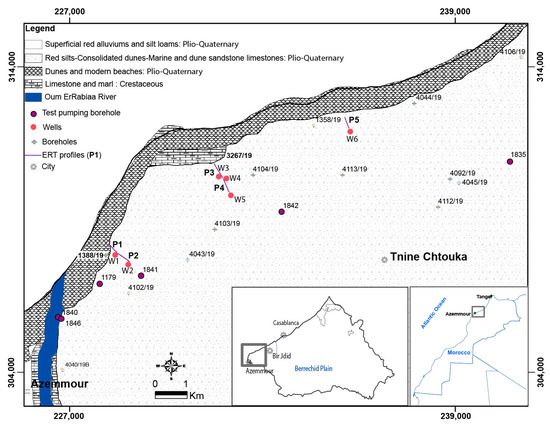
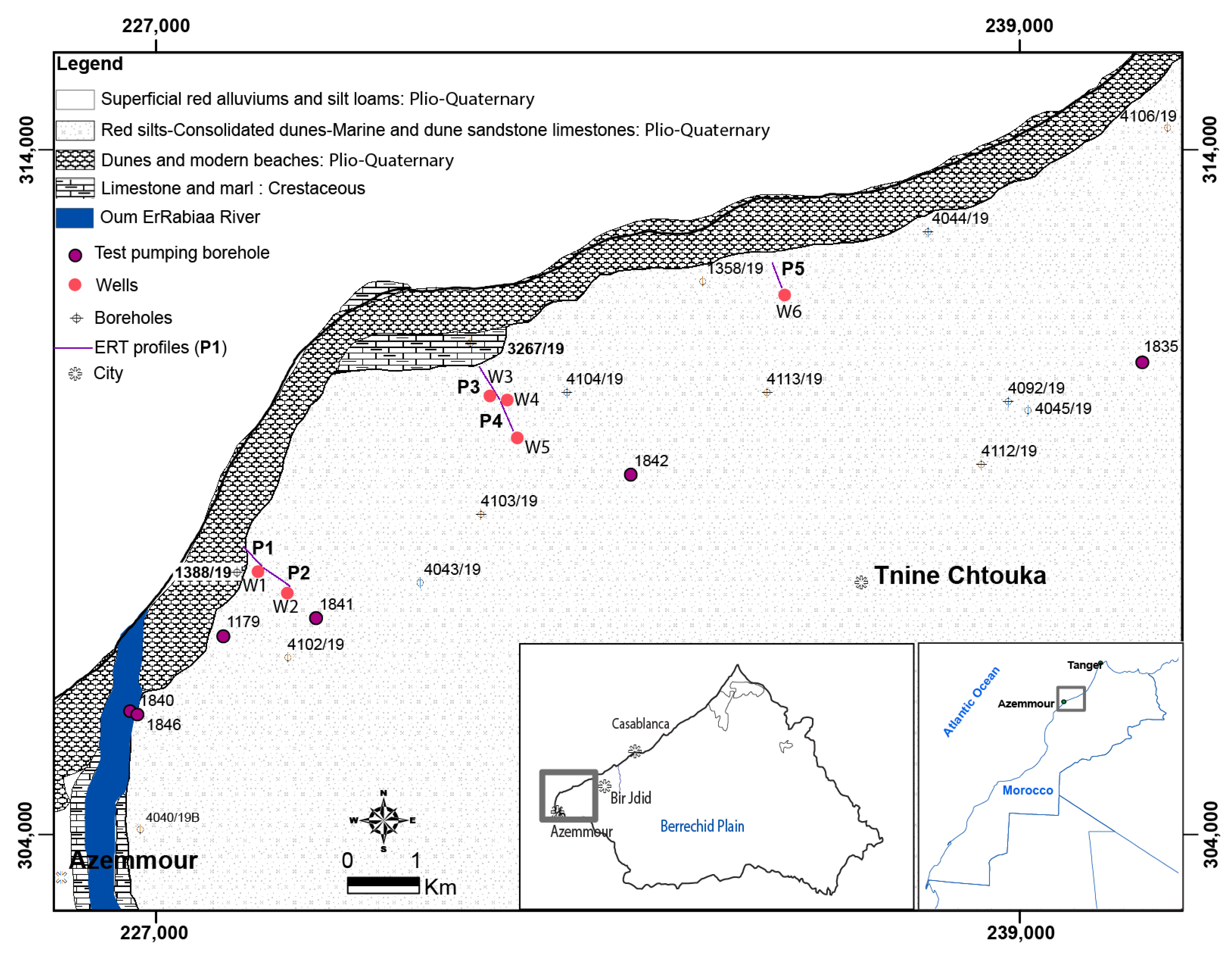
The Chaouia coastal region of western Morocco is an important agricultural zone, particularly renowned for its market gardening activities, and relies almost entirely on groundwater for irrigation and supply (Figure 1). The aquifer system comprises three hydraulically connected geological formations: a Paleozoic substratum of weathered schists and sandstones at the base, overlain by Cretaceous limestones, and capped by Plio-Quaternary deposits. The Plio-Quaternary calcareous and sandstone formations are highly permeable [24,25,26].
Figure 1.
Geographic location and geological map of the Chaouia coastal region.
In recent years, the overexploitation of groundwater has increased, especially in arid and semi-arid areas. This issue is particularly critical in Morocco, where coastal aquifer such as the coastal Chaouia aquifer are experiencing serious declines in groundwater levels and increasing vulnerability to seawater intrusion because of agricultural intensification and prolonged dry periods. This situation has disrupted the natural equilibrium between freshwater and seawater, leading to seawater intrusion into the aquifer [2,16,24,25]. This regional context underscores the urgent need for improved methods to evaluate aquifer properties and to support effective groundwater management strategies of coastal aquifers. Consequently, understanding the geohydraulic characteristics of this system is therefore crucial for addressing degradation and implementing sustainable groundwater management strategies. To date, only one study has evaluated the aquifer’s geohydraulic properties using pumping tests, focusing on hydraulic conductivity, transmissivity, and storage coefficient [26].
Given the scarcity of studies on the hydrodynamic characteristics of the Chaouia aquifer and the limited availability of pumping test data, a comprehensive assessment of groundwater behavior across its geological formations is essential. To address this gap, the present study applies two-dimensional ERT to estimate key geohydraulic parameters. This approach enables the investigation of large areas and provides rapid, spatially resolved insights into subsurface properties both laterally and vertically. To our knowledge, this is the first application of ERT to estimate geohydraulic parameters in the Chaouia coastal aquifer. Beyond its regional relevance, the proposed methodology is adaptable and can be adapted to other coastal regions worldwide that share similar hydrogeological settings. The outcomes of this study are expected to support the sustainable management of groundwater resources in Chaouia by providing essential data for protecting both the quantity and quality of this vulnerable aquifer system.
2. Materials and Methods
2.1. Study Area Setting
The Chaouia coastal region represents a significant hydrogeological unit within Morocco’s coastal Meseta. It is geographically bounded by the Oum Er-Rbiaa River to the southwest, the Atlantic Ocean to the northwest, Casablanca to the northeast, and the Berrechid Plain to the southeast (Figure 1). Groundwater from a shallow, unconfined aquifer is the primary water source in the region and is heavily exploited for both agricultural irrigation and domestic use.
Geologically, the area is underlain by a Paleozoic-Cretaceous basement, overlain by Plio-Quaternary deposits [26,27]. In the southwestern sector, particularly between Azemmour and Tnine Chtouka, Plio-Quaternary sediments rest directly on Cenomanian limestones of Cretaceous age (Figure 1).
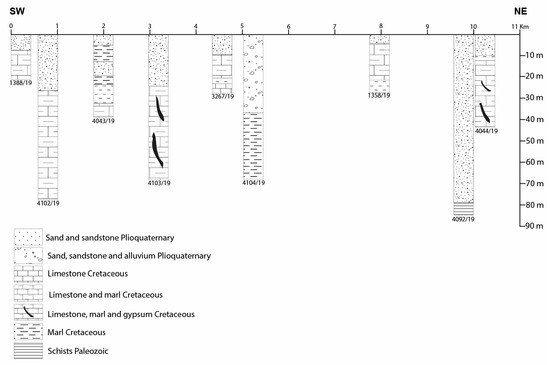
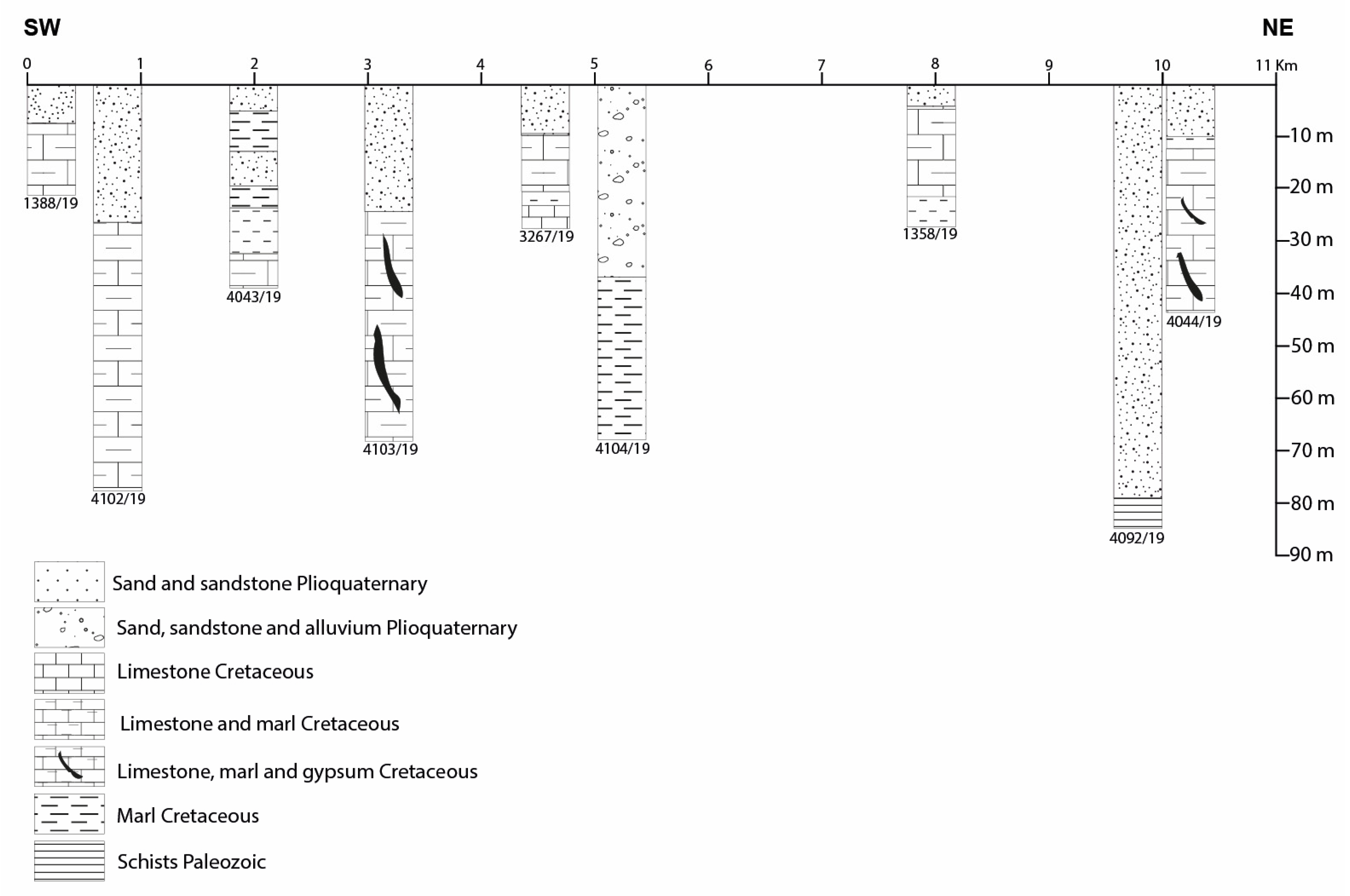
From a hydrogeological perspective, the Chaouia coastal aquifer is unconfined and exhibits significant spatial variability. In the northeastern part, it is primarily developed within Plio-Quaternary sandstone-limestone formations and weathered Paleozoic schists. Although the Plio-Quaternary aquifer is relatively thin (10–15 m) and fractured, these fractures enhance the recharge of the underlying schists [24,25,26]. The weathered upper portion of the schists, reaching up to 30 m in thickness [26], can also facilitate groundwater flow depending on its degree of alteration. Moving toward the southwest, particularly between Azemmour and Tnine-Chtouka, the aquifer is predominantly developed within Cretaceous limestone formations (Figure 2). Where marl predominates, this unit behaves as an aquitard; however, limestone-rich facies enable groundwater flow.
Figure 2.
Lithological borehole data of coastal Chaouia illustrating the main Cretaceous aquifer characterized by alternating limestone, marl, and gypsum formations.
These distinct geological units are laterally interconnected, enabling hydraulic continuity across the region. Groundwater generally flows southeast to northwest, roughly perpendicular to the Atlantic coastline [24,25]. A natural drainage axis near Tnine Chtouka effectively divides the system into two main regimes: one circulating through the Cretaceous limestone in the western zone and another through Plio-Quaternary deposits in the eastern part. The hydraulic gradient also varies across the region, being more pronounced in the northeast (approximately 1.6‰) and significantly lower in the southwest (around 0.3‰). This variability reflects spatial differences in both aquifer permeability and groundwater extraction intensity [24].
2.2. Geoelectrical Data
In this study, five 2D ERT profiles (labeled P1 to P5) were acquired to investigate the hydraulic characteristics of the Chaouia coastal aquifer (Figure 1). Data collection was carried out using the Syscal Junior system (IRIS Instruments, Orléans, France, https://www.iris-instruments.com/ (accessed on 22 November 2025)) with a roll-along technique, in which the trailing electrode cable is successively repositioned to the front and reconnected to the initial section, thereby extending the survey line [28]. Each profile comprised 72 electrodes with a uniform spacing of 5 m. The Wenner-Schlumberger array configuration was selected due to its effective depth penetration, low sensitivity to ambient noise, and ability to produce high-resolution images of horizontal stratifications beneath conductive surface layers [29,30]. Profile lengths varied between 355 and 535 m, corresponding to a maximum investigation depth of approximately 67 m (Table 1). The resistivity data were processed using Res2Dinv (version 4.10.20) [30,31], with inversion carried out through the robust L1-norm approach [31].
Table 1.
Characteristics of geoelectric profiles used in this study.
The quality of the measured data depends primarily on the instrument output current, which is influenced by factors such as the maximum driving voltage, ground resistivity, electrode spacing, and electrode contact resistance. To ensure reliable current injection and potential difference measurements, electrode resistances were systematically checked. Saltwater was added around the electrodes to reduce resistance and improve ground contact, resulting in consistently low contact resistances (10 kΩ). In this case, the ground resistivity represents the most decisive factor influencing the measurements and their interpretation.
As recommended for ERT surveys, apparent resistivity measurements for each quadripole were repeated and averaged (stacking) to improve the signal-to-noise ratio. Between 3 and 6 stacks were applied in this study. Repeated and reciprocal measurements allowed the selection of high-quality data, while measurements with standard or reciprocal errors exceeding 5% were discarded. This editing process was completed prior to inversion. Overall, the acquired ERT profiles exhibited consistently good data quality.
The ERT profiles analyzed in this work had previously been subjected to detailed uncertainty analysis [32]. This evaluation confirmed the reliability of the inverted resistivity models and allowed the identification of the most robust sections, ensuring that the geohydraulic parameters derived here are based on well-constrained datasets.
The inversion procedure utilized the standard Gauss-Newton optimization algorithm, with a convergence criterion of 0.005 [33,34]. During each iteration, the Jacobian matrix was recalculated to improve accuracy. Forward modeling was performed on a mesh grid with four nodes per electrode unit, used to compute apparent resistivity values [34]. Minimum damping factors of 0.1 and 0.015 were applied and programmed to increase exponentially with depth by a factor of 1.1, thereby compensating for the reduced resolution of resistivity data at greater depths. Depending of ERT profiles, the number of iterations ranged between 4 and 7 and the RMS error ranged from 2.7% to 12% (Table 1). The only exception was profile 4, for which the inversion converged after four iterations; although the RMS error remained around 12%, which can be attributed to localized subsurface heterogeneity rather than poor data quality.
2.3. Estimation of Geohydraulic Parameters
The electrical resistivity distribution within an aquifer is mainly governed by the porosity of the geological medium and the electrical conductivity (EC) of the saturated groundwater [35,36]. Consequently, ERT has become a widely applied technique in hydrogeological investigations to infer subsurface characteristics correlated with resistivity variations [37]. In this research, interpretation of resistivity models was supported by lithological data from boreholes located near the survey lines (Figure 2). To further enhance the reliability of hydraulic parameter estimation, Archie’s law [38] was applied, integrating porosity and groundwater EC data. As proposed by Archie [38], the resistivity of a saturated aquifer can be expressed as (Equation (1)):
where ρt is the total fluid saturated rock resistivity (Ohm·m), ρw is the resistivity of pore water (Ohm·m) measured directly from boreholes, and Φ represents the porosity of the rock. The constants a and m are empirical coefficients known as the tortuosity factor and the cementation exponent, respectively, which depend on lithology. S indicates the degree of water saturation, and n corresponds to the saturation exponent.
ρt = a ρw Φ−m S−n
Hydraulic conductivity (K) is a fundamental hydrogeological parameter describing a porous medium’s ability to transmit water. According to Darcy’s law, it is defined as the volume of water (in m3) flowing through a cross-sectional area of 1 m2 under a unit hydraulic gradient per unit time [39]. Its value depends on both the intrinsic characteristics of the porous medium and the physical properties of the fluid, such as viscosity and density [40,41]. Accurate determination of K is crucial for groundwater modeling, aquifer assessment, and sustainable water resource management. Additionally, it serves as a key indicator of well performance [14]. Building on this, Heigold et al. [22] proposed an empirical formula linking K to electrical resistivity, which is expressed in Equation (2):
where K is the hydraulic conductivity (m/day) and Rw is the aquifer resistivity (Ohm·m) obtained from ERT inversion. This relationship has been widely applied in both porous and fractured aquifers across diverse settings [42,43]. Given the similar hydrogeological characteristics of the Chaouia coastal aquifer, this equation was utilized here to estimate hydraulic conductivity.
Another key parameter considered in this study is the effective porosity (Φeff), which depends on factors such as grain size distribution and the spatial configuration of pore spaces. Marotz [21] introduced an empirical relationship, expressed in Equation (3), to estimate effective porosity:
where Φeff is the effective porosity of the aquifer (%) and K is the hydraulic conductivity (m/day).
Transmissivity (T) (m2/day) represents the aquifer’s capacity to transmit groundwater in the horizontal direction. According to [44], it is calculated by multiplying K by the thickness of the aquifer (h), as expressed in Equation (4):
The thickness (m) is determined by interpreting the inverted resistivity data, which corresponds to specific depth intervals within the subsurface [14]. The maximum thickness of the main aquifer in the study area corresponds to the investigation depth, which is 67 m. Therefore, the estimated parameters reflecting this 67 m investigation depth effectively correspond to the principal aquifer of the study area.
Accordingly, the proposed approach for estimating the geohydraulic parameters of each geological formation involved four key steps:
- Calculation of hydraulic conductivity (K) using the empirical formula of Heigold et al. [22].
- Estimation of effective porosity (Φeff) using the logarithmic model of Marotz [21].
- Determination of aquifer thickness (h) from depth analysis of inverted resistivity sections.
- Computation of transmissivity (T) by combining K and h to assess aquifer productivity.
To demonstrate the applicability of the empirical relationships proposed by Heigold et al. (1979) [22] and Marotz (1968) [21], in the geological context of coastal Chaouia, this method was validated against a similar local lithological and aquifer conditions [14,20].
The results were thoroughly cross-validated with independent datasets of data, including pumping test results, numerical modeling, and borehole lithological logs. In addition, a detailed uncertainty analysis of the resistivity inversion results [32] was conducted to ensure reliability. The results of this uncertainty analysis indicate that the resistivity values obtained, as well as the inversion method applied, are highly reliable for investigating areas affected by seawater intrusion. This confirms that the selected inversion approach provides stable and consistent results, making it particularly suitable for characterizing subsurface conditions in coastal environments, where salinity variations significantly influence geophysical responses. Therefore, the obtained resistivity can be used with to estimate the geohydraulic parameters within the study area. The derived resistivity values can be confidently used to estimate the geohydraulic parameters within the study area. Moreover, following the recommendations of [32], only the most robust and well-constrained sections were retained for geohydraulic parameter estimation.
3. Results and Discussion
3.1. ERT Modeling
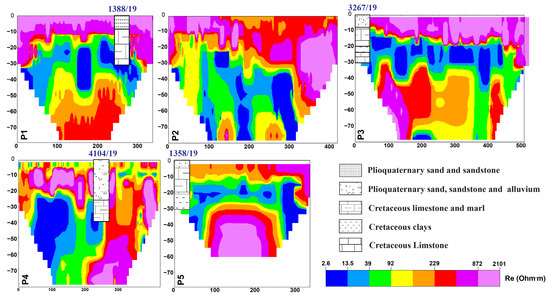
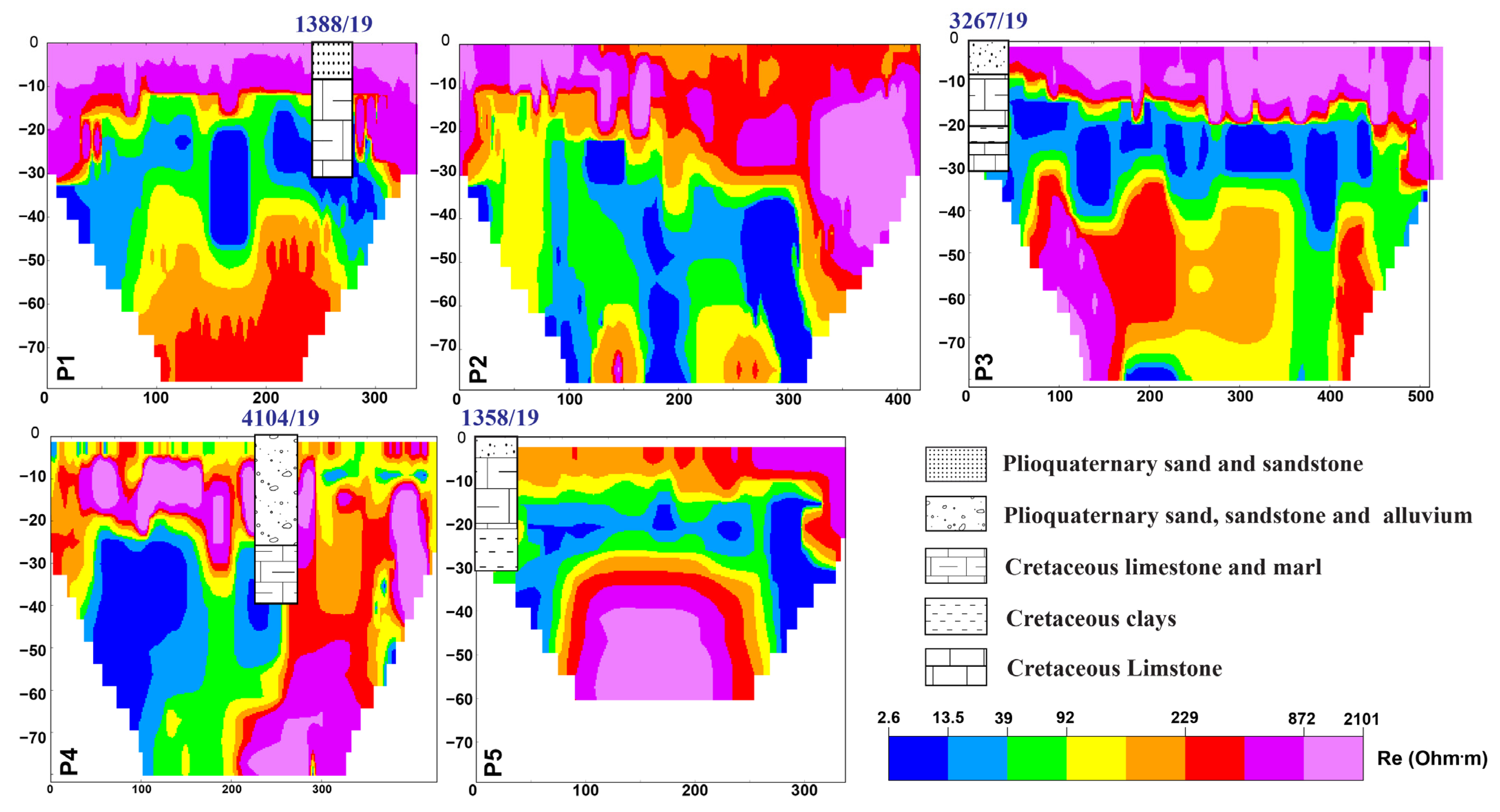
The inversion results yielded resistivity values ranging from 2.7 and more than 872 Ohm·m (Figure 3). The root mean square (RMS) error of the inversion varied between 2.7% and 12%, indicating a satisfactory level of accuracy and reliability (Table 1). To validate these results, the inverted resistivity models were compared with lithological data from nearby boreholes (Figure 2) and with electrical conductivity measurements obtained from wells located next to the tomography profiles (Table 2).
Figure 3.
2D lateral and vertical distribution of inverted resistivity (Ohm·m) along the coastal Chaouia.
Table 2.
Groundwater quality data collected in the study area.
The resistivity distribution revealed three main geoelectrical layers, which closely correspond to the known geological formations of the region. Moreover, these findings are consistent with previous ERT investigations conducted in the Chaouia coastal area [24,32].
The obtained results revealed three distinct resistivity zones: (1) a resistive surface layer, with values between 374 and more than 872 Ohm·m; (2) a conductive intermediate layer, occurring at depths of 10–30 m, with low resistivity values (2.7–8.7 Ohm·m); and (3) a deeper resistive layer, below 30 m, with resistivity values between 107.3 and 374 Ohm·m. Notably, an exceptionally resistive anomaly (more than 872 Ohm·m) was detected in Profile P5 at depths shallower than 30 m. This feature is likely associated with gypsiferous limestone, previously identified in borehole 4044/19 (Figure 2). Calibration with borehole data (Figure 2) indicates that the upper resistive layer corresponds to unsaturated Plio-Quaternary sandstones and sands. The deeper resistive zone is linked to the Cenomanian aquifer, which is saturated with fresh to brackish groundwater. In contrast, the conductive layer is linked to Cretaceous marls and limestones saturated with saline water. Geological correlations from boreholes confirm that the surface resistive layer represents Plio-Quaternary deposits (consolidated sands, sandstones, and alluvium), while the conductive layer corresponds to the Cretaceous calcareous-marly formations.
Complementary hydrochemical and geophysical analyses by Najib et al. [24] identified a conductive zone with resistivity values below 36 Ohm·m across all profiles. This zone was attributed to the Cretaceous aquifer, which is affected by brackish water and seawater intrusion. Using Archie’s Law (Equation (1)), the same authors obtained values total fluid saturated rock resistivity values ranging between 4.3 and 74.4 Ohm·m, confirming the presence of saline to brackish water. In contrast, higher resistivity values (100–700 Ohm·m) were observed both near the surface (0–10 m depth) and again at depths greater than 40 m. The shallow high-resistivity layer is associated with Plio-Quaternary deposits, while the deeper resistive zone corresponds to Cretaceous formations.
3.2. Geohydraulic Parameters Estimation
The inverted resistivity models provide critical information on the depth and thickness of subsurface geological formations, including the aquifers in the study area. These data are fundamental for deriving geohydraulic parameters through geoelectrical analysis. Based on the validated resistivity sections, the hydraulic parameters K, Φeff, and T were estimated for each identified geological unit using Equations (2), (3), and (4), respectively. As outlined by [14], the approach assumes a multilayer model consisting of n distinct layers, each characterized by a specific thickness (h1, h2, ..., hₙ) and corresponding true resistivity values (ρ1, ρ2, ..., ρₙ). The reliability of the derived parameters was assessed by comparing them with pumping test data reported in previous studies from the region [26,45,46]. Moreover, since one major limitation of this empirical method is its sensitivity to clay content, its application in the Chaouia context, where clay occurrence is limited, ensures a more reliable parameter estimate.
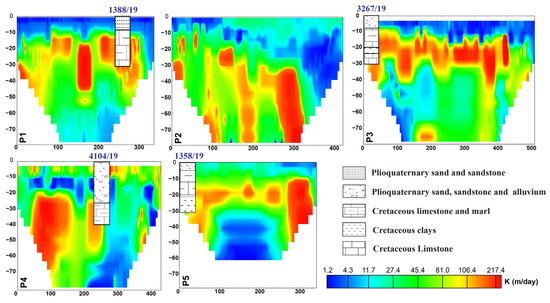
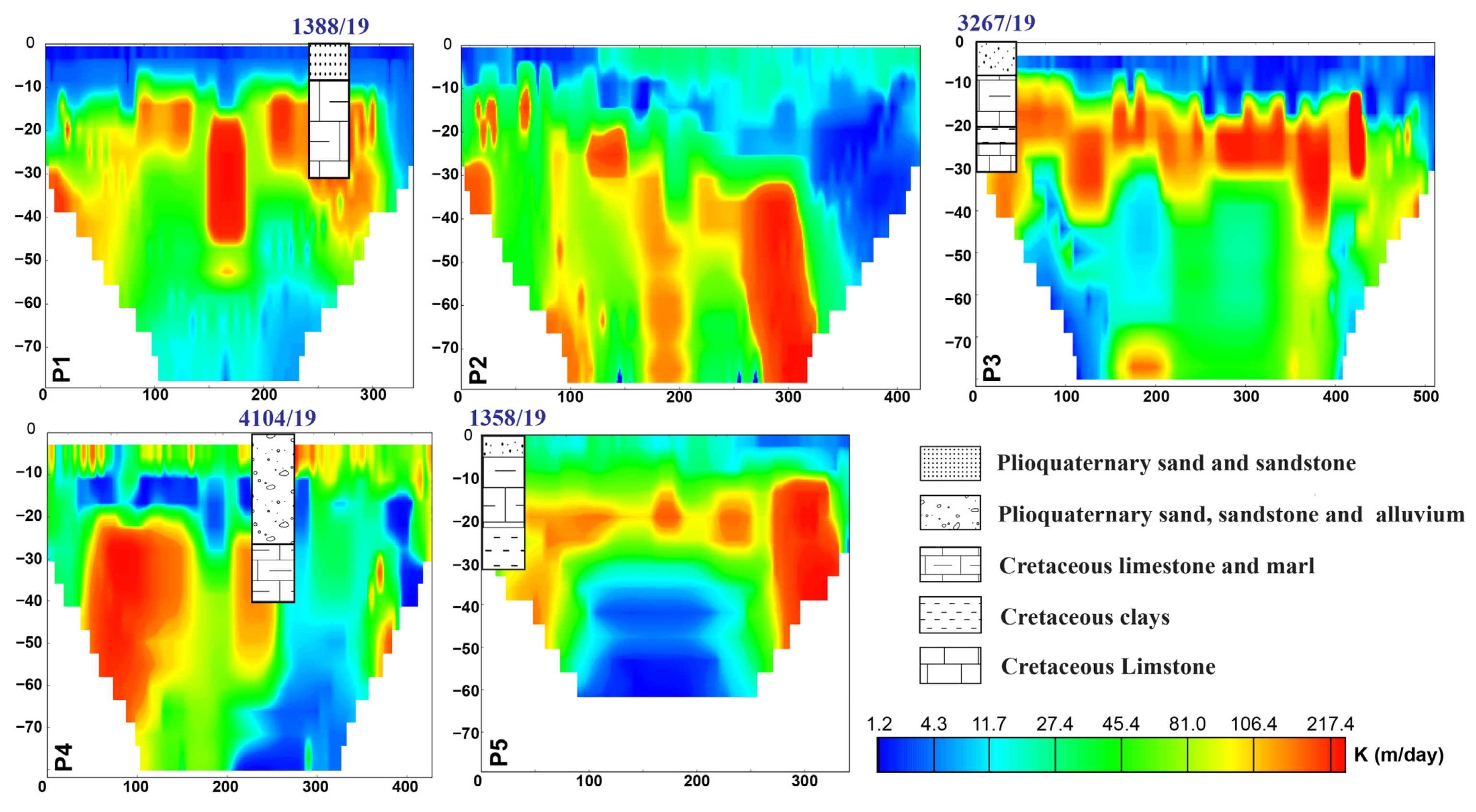
As shown in Figure 4, the estimated K values across the study area span from 1.2 to >217.4 m/day, reflecting significant lithological variability dominated by gravel, sand, and silt [39]. Near-surface profiles (P1, P2, P3, and P5) show lower K values (1.2–11.7 m/day), characteristic of Plio-Quaternary consolidated sands, sandstones, and alluvial deposits, where water saturation is relatively low. In contrast, profile P4 exhibits much higher K values (106.4 -> 217.4 m/day), which likely result from greater lithological heterogeneity and increased subsurface connectivity in that area.
Figure 4.
2D lateral and vertical distribution of hydraulic conductivity section (m/day) illustrating the spatial variability of aquifer permeability across the study area.
The Cretaceous marly limestone aquifer generally displays elevated K values (45.4 -> 217.4 m/day), confirming its role as the region’s primary groundwater reservoir. In the southeastern portion of Profile P4, however, moderate K values (11.7–81.0 m/day) were observed, likely reflecting fracture-related variability. Such variations can be explained by differences in fracture density, orientation, and connectivity within the rock matrix [47]. Exceptionally high K values (>217.4 m/day) observed in the coastal zone may be linked to seawater intrusion, which increases formation conductivity. These findings indicate that elevated hydraulic conductivity in the coastal zone may facilitate saline water encroachment inland, contributing to progressive salinization of the aquifer system [14,24].
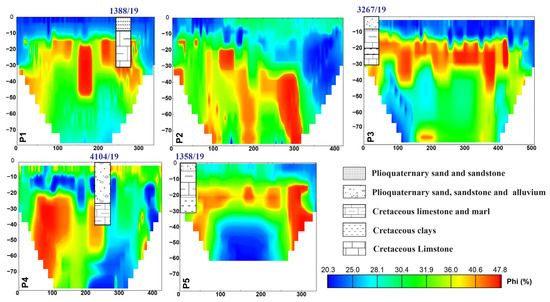
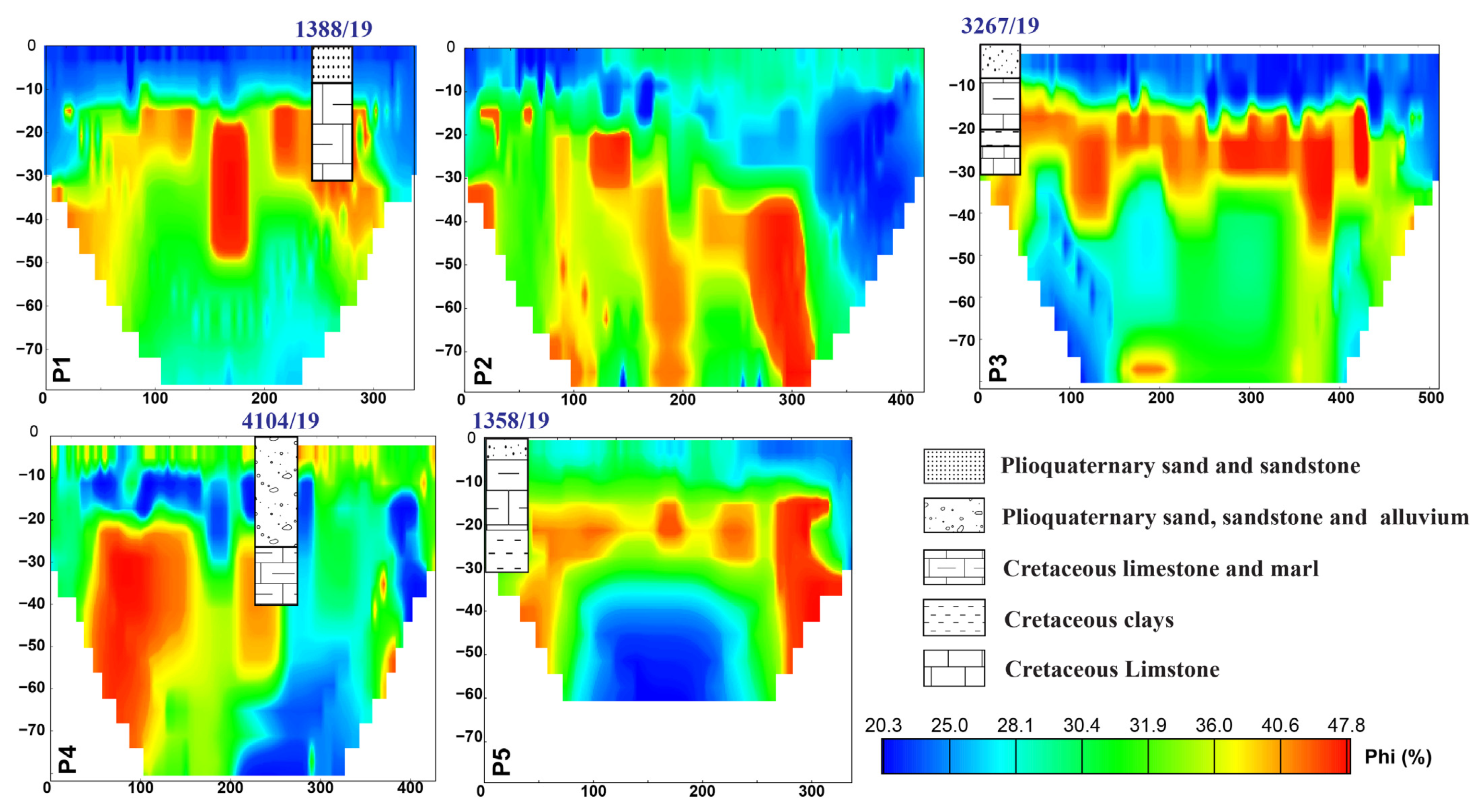
Effective porosity (Φeff) values, estimated from K values (Figure 5), range between 20.3% and 47.8%. These results are consistent with the sandy, gravelly, and alluvial lithologies in the region. Generally, Φeff decreases with increasing grain size, as coarser materials tend to have lower pore space [48]. As a result, higher porosities are typically associated with fine sands, while lower values indicate coarser sandy formations [14,19,49]. In the Plio-Quaternary formations, Φeff values fall between 20.3% and 30.4% across all profiles (P1–P5). Localized increases up to 36.0% in Profile 4 likely correspond to the presence of more consolidated materials such as sand, gravel, and marl [50,51].
Figure 5.
2D lateral and vertical distribution of effective porosity section (%), illustrating the spatial variability of aquifer porosity across the study area.
In contrast, the Cretaceous marly limestone aquifer exhibits notably higher Φeff values (31.9 -> 47.8%), confirming its strong storage potential. These elevated values are primarily attributed to the presence of fractures within the limestone, which enhance pore connectivity. In the southeastern part of Profile P4, intermediate Φeff values (25.0–36.0%) were recorded, reflecting the influence of gypsiferous limestone layers and moderate hydraulic conductivity. Near-surface zones, however, show reduced porosity due to unsaturated conditions that limit pore connectivity and increase resistivity.
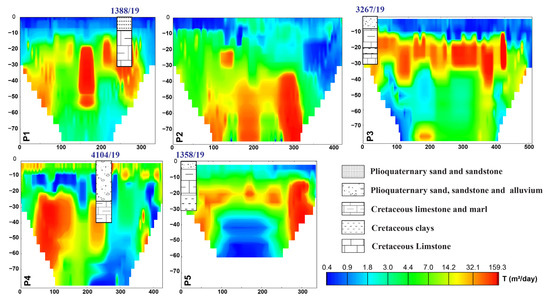
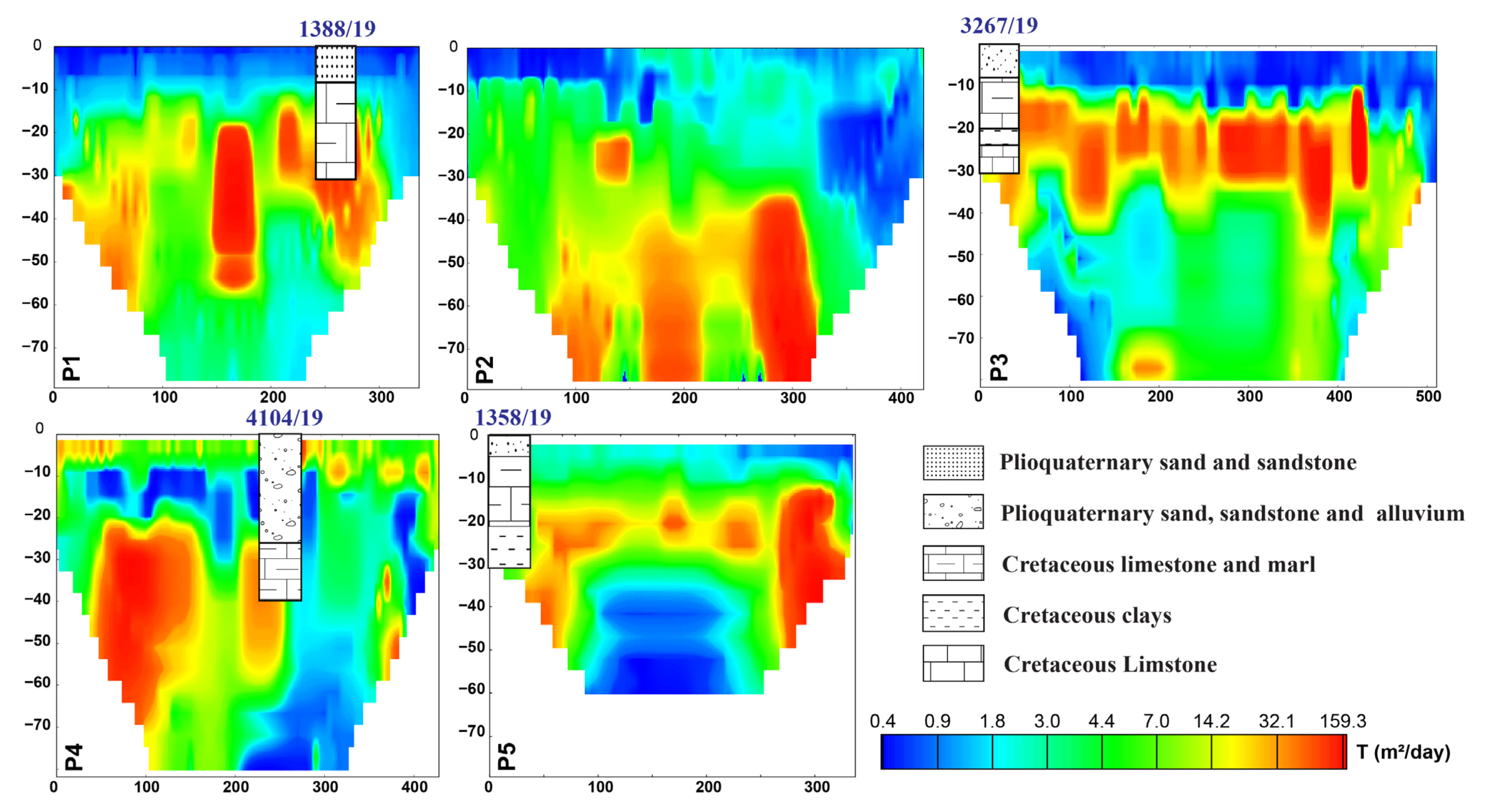
The literature consistently reports a direct relationship between K and T, with higher K typically corresponding to greater T [14]. However, this correlation may be influenced by lithological variability, hydraulic gradient, grain size distribution, pore connectivity, and cementation degree [14,52,53,54,55]. In the Chaouia aquifer, T values range from 0.4 to 159.3 m2/day (Figure 6). These variations primarily reflect differences in lithology and aquifer thickness. The Plio-Quaternary formations exhibit generally low T (0.4–14.2 m2/day), though localized zones, particularly along the coastal portion of Profile P4, reach up to 31.1 m2/day. In contrast, the Cretaceous aquifer displays significantly higher T values (14.2–159.3 m2/day), especially in the southwestern part of the study region, highlighting substantial groundwater potential. However, deeper Cretaceous layers present lower T values (1.8 and 7.0 m2/day), reflecting reduced permeability.
Figure 6.
2D lateral and vertical distribution of transmissivity section (m2/day), illustrating the spatial variability of aquifer transmissivity across the study area.
According to the groundwater potential classification proposed by Krásný [56] (as cited in [14]), T values of 100–1000, 10–100, and 1–10 m2/day correspond to high, intermediate, and low aquifer potential, respectively. Based on this classification, the aquifers in the study area predominantly exhibit intermediate to high groundwater potential. This suggests that, with proper management, they can sustain regional water supply development. However, the coastal zones with the highest T values (14.2–159.3 m2/day) may be particularly vulnerable to seawater intrusion due to their increased hydraulic connectivity.
Bentayeb [26] reported K values in the Chaouia coastal aquifer ranging from 0.5 to 380.2 m/day, with an average around 62.2 m/day. In the western part, near the Oum Er-Rbia estuary, K values vary between 25.9 and 345.6 m/day, averaging 17.3 m/day, while in the northeastern zone they can reach up to 604.8 m/day [26]. The highest K values (>34.6 m/day) are generally associated with Plio-Quaternary sandstone-limestone formations. Similarly, Moustadraf et al. [57] derived K values from numerical modeling ranging between 1.21 and 86.4 m/day in the southwestern sector, with lower values, approximately 0.86 m/day, were observed in the eastern region. Overall, the K values reported by [26,57], spanning from 0.5 to 604.8 m/day, are broadly consistent with the range obtained in the present study (1.2–217.4 m/day).
Transmissivity (T) values derived from pumping test interpretations also exhibit considerable variability, reflecting the heterogeneous nature of the aquifer system. Reported values range from 1.7 to 1296 m2/day, with an average of approximately 267 m2/day [26,58]. The highest T values are observed in the northeastern vicinity of Bir Jdid and near Azemmour. These ranges correspond well with the results of the present study, which show T values between 0.4 and 159.3 m2/day. Notably, the lower transmissivity values (0.4 to 14.2 m2/day) correspond mainly to Plio-Quaternary sands, sandstones, and alluvial deposits. In contrast, the Cretaceous marly limestone formation displays higher transmissivity values between 14.2 and over 159.3 m2/day, underscoring its significant groundwater potential, especially in the southwestern sector of the region.
Effective porosity (Φeff) values reported in earlier studies were primarily obtained from wells located along the coastal fringe, where they reflect the storage characteristics of the Plio-Quaternary sandstone-limestone formations [46]. By comparison, the present study yields somewhat higher estimates, generally ranging between 20.3% and 30.4% for the Plio-Quaternary deposits (sand, sandstone, and limestone). These values exceed those obtained from pumping tests, which ranged between 2% and 12% [45,46,58]. This difference could be due to several factors, including variations in measurement scale, heterogeneity within the formations, recharge fluctuations, or changes in hydraulic properties caused by compaction or cementation in the shallow Plio-Quaternary layers. As highlighted by [14], the observed range of Φeff is consistent with the presence of formations with heterogeneous grain sizes. Moreover, the results confirm the inverse relationship between geohydraulic parameters and the electrical resistivity, as well as the positive correlation between Φeff and K, both of which are consistent with previous findings [14,20,59,60]. This pattern can be attributed to the fact that increased resistivity within the aquifer typically corresponds to lower K and T values.
The dynamics of coastal aquifers are strongly influenced by tidal fluctuations [16], and the Chaouia aquifer is no exception [61,62]. These tidal effects significantly disrupt the hydrodynamic regime, which complicates the interpretation of pumping tests and often leads to uncertainty, especially in areas subject to marine intrusion. To overcome these challenges, this study applies 2D ERT data to estimate geohydraulic parameters. The inverted resistivity models clearly reveal the spatial heterogeneity of the subsurface (Figure 3), while the consistently low RMS errors across all models (Table 1) demonstrate the reliability and effectiveness of the method. Hydraulic conductivity (K) was subsequently calculated using the empirical formula of Heigold et al. [22] (Equation (2)), which is well suited to the hydrogeological characteristics of the study area. The results reflect lithological variability (Table 3): lower K values correspond to the Plio-Quaternary consolidated sands, sandstones, and alluvial deposits, while higher K values are associated with the Cretaceous marly limestone aquifer, often saturated with brackish to saline water. The estimated K and T values show good agreement with both pumping test data and numerical modeling outcomes from previous studies conducted in the Chaouia coastal region.
Table 3.
Summary of hydrostratigraphic units in the Chaouia coastal aquifer.
Overall, the differences observed between geohydraulic parameters estimated from ERT data and those derived from experimental pumping tests can largely be explained by the inherent heterogeneity of the geological formations and the presence of clay-rich layers within the aquifer system. In addition, the spatial scale of ERT imaging is much broader than that of localized pumping tests, which naturally leads to greater variability in resistivity measurements compared to hydraulic test results. Lithological variability, such as alternating sandy and clayey strata, affects both the electrical resistivity measurements and hydraulic behavior, often leading to discrepancies between geophysical estimates and direct hydrological observations (Table 3).
Despite these differences, ERT remains a highly valuable exploratory tool for assessing the spatial distribution of geohydraulic properties in large and complex regions. It enables the identification of zones with contrasting hydraulic characteristics, thereby guiding the strategic placement of pumping tests and focusing detailed investigations in areas with the greatest groundwater potential. This integrated approach not only enhances the efficiency of hydrogeological studies but also significantly reduces the costs and time associated with extensive pumping campaigns. By integrating ERT-derived estimates with selective experimental validation, aquifer characterization can be optimized while minimizing both economic and logistical burdens.
Globally, one of the main limitations of this study lies in the validation of the results, which was based on bibliographic pumping-test data reported in previous studies conducted in the region. The ranges of parameters derived from the ERT data were compared with the ranges of values obtained from these published pumping tests in order to assess their consistency. However, this comparison also represents a potential source of error or uncertainty, due to the differences between the two approaches. In addition, other sources of uncertainty can be summarized as follows:
- The inherent limitations of ERT, including limited vertical resolution, the influence of lateral heterogeneity, and uncertainties associated with the inversion process.
- Uncertainties related to pumping tests and the spatial variability of hydraulic properties at the field scale.
- Possible discrepancies between estimates and measurements, although the ranges derived from ERT remain broadly consistent with those from pumping tests despite differences in scale and methodology.
Therefore, future work focusing on the assessment and quantification of uncertainties in this estimation approach, as well as a comparison with recent or site-specific pumping tests, would be necessary to enhance the reliability of the adopted methodology.
4. Conclusions
This study focused on the direct estimation of key geohydraulic parameters, namely hydraulic conductivity (K), transmissivity (T), and effective porosity (Φeff), for the Chaouia coastal aquifer using ERT data. Resistivity measurements were interpreted through the empirical models proposed by Marotz [21] and Heigold et al. [22]. The resulting estimates showed that K ranged from 1.2 to >217.4 m/day, Φeff from 20.3% to 47.8%, and T from 0.4 to 159.3 m2/day. These values highlight the lithological variability of the region, which is predominated by sands, sandstones, and marly limestone formations. Additionally, the analysis revealed an inverse correlation between electrical resistivity and geohydraulic parameters, consistent with previous studies [14]. This relationship is primarily attributed to lower water saturation, finer grain sizes, and reduced pore connectivity, which collectively decrease conductivity and transmissivity. The findings underscore the complex and heterogeneous nature of the subsurface geology in the study area.
Comparisons with earlier works confirm the reliability of the ERT-based approach. Pumping tests and numerical modeling in the Chaouia aquifer reported K values between 0.5 and 604.8 m/day, while the ERT estimates ranged from 1.2 to 217.4 m/day. Similarly, T values obtained from pumping test data varied between 1.7 and 1296 m2/day, compared with 0.4 to 159.3 m2/day obtained here. Regarding Φeff, previous studies reported values between 2% and 12% for the Plio-Quaternary formations along the coastal zone, while this study yielded significantly higher values (20.3–47.8%), reflecting the influence of grain size heterogeneity and lithological variability.
Although certain limitations, such as reliance on geophysical data, the absence of recent pumping tests, and the use of a single estimation equation, this study makes a significant contribution to the understanding of the geohydraulic characteristics of the Chaouia coastal aquifer. Overall, the proposed approach offers a valuable alternative for estimating geohydraulic parameters in regions where pumping tests are unavailable, impractical, or costly. Due to data limitations and the scope of the current work, a full quantitative uncertainty analysis, including confidence intervals, was not implemented. Therefore, future research will be dedicated to addressing this aspect, as well as testing the applicability and robustness of the proposed method in different aquifer systems. Additional research avenues include the integration of parameters modeling with recent pumping tests and applying time-lapse ERT to monitor variations in groundwater parameters. These perspectives aim to strengthen the reliability of the approach and to support improved groundwater resource assessment, planning, and sustainable management.
Author Contributions
S.N.: Conceptualization, formal analysis, Methodology, Validation, Writing—original draft. A.F.: Conceptualization, formal analysis, Methodology, Validation, Writing—original draft. O.B.: Conceptualization, formal analysis, Methodology, Validation. K.M.: Resources, Supervision. M.B.: Investigation. A.M.: Supervision, Writing, review, editing. B.Z.: Resources, Supervision. S.I.: Formal analysis, Writing—review & editing, Funding acquisition. All authors have read and agreed to the published version of the manuscript.
Funding
This research received no external funding.
Data Availability Statement
The data supporting the findings of this study are available upon reasonable request from the corresponding author.
Conflicts of Interest
The authors state that they have no known financial or personal conflicts of interest that could have influenced the work presented in this paper.
References
- Benoit, J.; Hardaway, C.S.; Hernandez, D.; Holman, R.; Koch, E.; McLellan, N.; Peterson, S.; Reed, D.; Suman, D. Mitigating Shore Erosion Along Sheltered Coasts; The National Academies Press: Washington, DC, USA, 2007; Available online: https://nap.nationalacademies.org/catalog/11764/mitigating-shore-erosion-along-sheltered-coasts (accessed on 1 July 2025).
- Steyl, G.; Dennis, I. Review of coastal-area aquifers in Africa. Hydrogeol. J. 2010, 18, 217–225. [Google Scholar] [CrossRef] [Scilit]
- Cao, L.; Lv, M.; Li, C.; Sun, Q.; Wu, M.; Xu, C.; Dou, J. Effects of Crosslinking Agents and Reservoir Conditions on the Propagation of Fractures in Coal Reservoirs During Hydraulic Fracturing. Reserv. Sci. 2025, 1, 36–51. [Google Scholar] [CrossRef] [Scilit]
- Li, M.; Liu, J.; Xia, Y. Risk Prediction of Gas Hydrate Formation in the Wellbore and Subsea Gathering System of Deep-Water Turbidite Reservoirs: Case Analysis from the South China Sea. Reserv. Sci. 2025, 1, 52–72. [Google Scholar] [CrossRef] [Scilit]
- Asfahani, J. Hydraulic parameters estimation by using an approach based on vertical electrical soundings (VES) in the semi-arid Khanasser valley region, Syria. J. Afr. Earth Sci. 2016, 117, 196–206. [Google Scholar] [CrossRef] [Scilit]
- Perdomo, S.; Kurse, E.E.; Ainchil, J.E. Estimation of hydraulic parameters using resistivity tomography (ERT) and empirical laws in a semi-confined aquifer. Near Surf. Geophys. 2018, 1, 627–641. [Google Scholar] [CrossRef] [Scilit]
- McCarthy, J.M.; Yeh, W.W.-G. Optimal pumping test desiggn for parameter estimation and prediction ingroundwater hydrology. Water Resour. Res. 1990, 49, 4491–4507. [Google Scholar] [CrossRef] [Scilit]
- De Marsily, G. Quantitative Hydrogeology: Groundwater Hydrology for Engineers; Academic Press: New York, NY, USA, 1986; 440p, ISBN 0-12-208915-4. [Google Scholar]
- Binley, A.; Slater, L.D.; Fukes, M.; Cassiani, G. Relationship between spectral induced polarization and hydraulic properties of saturated and unsaturated sandstone. Water Resour. Res. 2005, 41, W12417. [Google Scholar] [CrossRef] [Scilit]
- Singha, K.; Gorelick, S.M. Saline tracer visualized with three-dimensional electrical resistivity tomography: Field-scale spatial moment analysis. Water Resour. Res. 2005, 41, W05023. [Google Scholar] [CrossRef] [Scilit]
- Comte, J.C. Apport de la Tomographie Électrique a la Modélisation des Écoulements Densitaires dans les Aquifères Côtiers: Application a Trois Contextes Climatiques Contrastes (Canada, Nouvelle-Caledonie, Sénégal). Ph.D. Thesis, Univ. D’Avignon et des pays de Vaucluse, Avignon, France, 2008. [Google Scholar]
- Lekmine, G. Quantification des Paramètres de Transport des Solutés en Milieux Poreaux par Tomographie de Résistivité Électrique: Développements Méthodologiques et Expérimentaux. Ph.D. Thesis, Univ. Paris Sud, Orsay, France, 2011. 160p. [Google Scholar]
- George, N.J.; Atat, J.G.; Umoren, E.B.; Etebong, I. Geophysical exploration to estimate the surface conductivity of residual argillaceous bands in the groundwater repositories of coastal sediments of EOLGA, Nigeria. NRIAG J. Astron. Geophys. 2017, 6, 174–183. [Google Scholar] [CrossRef] [Scilit]
- Fadili, A.; Najib, S.; Boualla, O.; Makan, A.; Mehdi, K.; Kharis, A. Estimation of geohydraulic parameters in coastal aquifers based on VES transformed to ERT profiles. Environ. Earth Sci. 2023, 82, 404. [Google Scholar] [CrossRef] [Scilit]
- Seguin, J.J.; Wuilleumier, A. Projet GAIA-Année 3-Exploitation des Cycles D’injections et de Soutirages de Gaz Aux Sites de Lussagnet et Izaute Pour Déterminer les Paramètres Hydrodynamiques de L’aquifère des Sables Infra-Molassiques. Rapport D’étape. BRGM/RP-67369-France. 2018. Available online: https://infoterre.brgm.fr/rapports/RP-67369-FR.pdf (accessed on 30 September 2025).
- Fadili, A.; Malaurent, P.; Najib, S.; Mehdi, K.; Riss, J.; Makan, A. Groundwater hydrodynamics and salinity response to oceanic tide in coastal aquifers: Case study of Sahel Doukkala, Morocco. Hydrogeol. J. 2018, 26, 2459–2473. [Google Scholar] [CrossRef] [Scilit]
- Zhang, M.; Hao, Y.; Zhao, Z.; Wang, T.; Yang, L. Estimation of coastal aquifer properties: A review of the tidal method based on theoretical solutions. Wiley Interdiscip. Rev. Water 2021, 8, e1498. [Google Scholar] [CrossRef] [Scilit]
- Abdulrazzaq, Z.T.; Al-Ansari, N.; Aziz, N.A.; Agbasi, O.E.; Etuk, S.E. Estimation of main aquifer parameters using geoelectric measurements to select the suitable wells locations in Bahr Al-Najaf depression, Iraq. Groundw. Sustain. Dev. 2020, 11, 100437. [Google Scholar] [CrossRef] [Scilit]
- Akhter, G.; Ge, Y.; Hasan, M.; Shang, Y. Estimation of hydrogeological parameters by using pumping, laboratory data, surface resistivity and Thiessen technique in Lowaer Bari Doab (Indus Basin), Pakistan. Appl. Sci. 2022, 12, 3055. [Google Scholar] [CrossRef] [Scilit]
- De Almeida, A.; Maciel, D.F.; Sousa, K.F.; Nascimento, C.T.C.; Koide, S. Vertical electrical sounding (VES) for estimation of hydraulic parameters in the porous aquifer. Water 2021, 13, 170. [Google Scholar] [CrossRef] [Scilit]
- Marotz, G. Techische grundlageneiner wasserspeicherung imm naturlichen untergrund habilitationsschrift. Univ. Stuttg. 1968, 2, 393–399. [Google Scholar]
- Heigold, P.C.; Gilkeson, R.H.; Cartwright, K.; Reed, P.C. Aquifer transmissivity from surfacial electrical methods. Groundwater 1979, 17, 338–345. [Google Scholar] [CrossRef] [Scilit]
- Salem, H.S. Modelling of lithology and hydraulic conductivity of shallow sediments from resistivity measurements using Schlumberger vertical electric soundings. Energy Sources 2001, 23, 599–618. [Google Scholar] [CrossRef]
- Najib, S.; Fadili, A.; Mehdi, K.; Riss, J.; Makan, A. Contribution of hydrochemical and geoelectrical approaches to investigate salization process and seawater intrusion in the coastal aquifers of Chaouia, Morocco. J. Contam. Hydrol. 2017, 198, 24–36. [Google Scholar] [CrossRef] [Scilit]
- Najib, S.; Fadili, A.; Mehdi, K.; Riss, J.; Makan, A.; Guessir, H. Salinization process and coastal groundwater quality in Chaouia, Morocco. J. Afr. Earth Sci. 2016, 115, 17–31. [Google Scholar] [CrossRef] [Scilit]
- Bentayeb, A. Hydrogeological Study of the Chaouia Coast and Steady State Modeling Attempt, Morocco. Ph.D. Thesis, University of Montpellier, Montpellier, France, 1972. Volume 151, p. 1972. [Google Scholar]
- Lecointre, G.; Gigout, M. Carte géologique provisoire de la région de Casablanca au 1/200 000 et notice explicative. Notes M. Serv. géol. Maroc 1950, 72, 42. [Google Scholar]
- Dahlin, T. 2D resistivity surveying for environmental and engineering applications. First Break 1996, 14, 275–284. [Google Scholar] [CrossRef] [Scilit]
- Loke, M.H.; Wilkinson, P.B.; Chambers, J.E. Fast computation of optimized electrode arrays for 2D resistivity surveys. J. Comput. Geosci. 2010, 36, 1414–1426. [Google Scholar] [CrossRef] [Scilit]
- Kazakis, N.; Vargemezis, G.; Voudouris, K.S. Estimation of hydraulic parameters in a complex porous aquifer system using geoelectrical methods. Sci. Total Environ. 2016, 550, 742–750. [Google Scholar] [CrossRef] [Scilit]
- Loke, M.H.; Barker, R.D. Rapid least-squares inversion of apparent resistivity pseudosections by a quasi-Newton method1. Geophys. Prospect. 1996, 44, 131–152. [Google Scholar] [CrossRef] [Scilit]
- Zeynolabedin, A.; Ghiassi, R.; Norooz, R.; Najib, S.; Fadili, A. Evaluation of geoelectrical models efficiency for coastal seawater intrusion by applying uncertainty analysis. J. Hydrol. 2021, 603, 127086. [Google Scholar] [CrossRef] [Scilit]
- Loke, M.H.; Dahlin, T. A comparison of the Gauss-Newton and quasi-Newton methods in resistivity imaging inversion. J. Appl. Geophys. 2002, 49, 149–162. [Google Scholar] [CrossRef] [Scilit]
- Fadili, A.; Najib, S.; Mehdi, K.; Riss, J.; Malaurent, P.; Makan, A. Geoelectrical and hydrochemical study for the assessment of seawater intrusion evolution in coastal aquifers of Oualidia, Morocco. J. Appl. Geophys. 2017, 146, 178–187. [Google Scholar] [CrossRef] [Scilit]
- Niwas, S.; Celik, M. Equation estimation of porosity and hydraulic conductivity of Ruhrtal aquifer in Germany using near surface geophysics. J. Appl. Geophys. 2012, 84, 77–85. [Google Scholar] [CrossRef] [Scilit]
- Fadili, A.; Mehdi, K.; Riss, J.; Najib, S.; Makan, A.; Boutayeb, K. Evaluation of groundwater mineralization processes and seawater extension in the coastal aquifer of Oualidia, Morocco: Hydrochemical and geophysical approach. Arab. J. Geosci. 2015, 8, 8567–8582. [Google Scholar] [CrossRef] [Scilit]
- Guérin, R. Borehole and surface-based hydrogeophysics. Hydrogeol. J. 2005, 13, 251–254. [Google Scholar] [CrossRef] [Scilit]
- Archie, G.E. The electrical resistivity log as an aid in determining some reservoir characteristics. Trans. Am. Inst. Min. Eng. 1942, 146, 54–62. [Google Scholar] [CrossRef] [Scilit]
- Castany, G. Principes et Méthodes de L’hydrogéologie; Ed Dunod: Paris, France, 1982; 236p, ISBN 9782040112219/2040112219. [Google Scholar]
- Bear, J. Dynamics of Fluids in Porous Media; Environmental Science Series; Americain Elsevier Pub. Co.: New York, NY, USA, 1972; ISBN 13:978-0-486-65675-5. [Google Scholar]
- Domenico, P.A.; Schwartz, F.W. Physical and Chemical Hydrogeology; Wiley: New York, NY, USA, 1990. [Google Scholar]
- Ezema, O.K.; Ibuot, J.C.; Obiora, D.N. Geophysical investigation of aquifer repositories in Ibagwa Aka, Enugu State, Nigeria, using electrical resistivity method. Groundw. Sustain. Dev. 2020, 11, 100458. [Google Scholar] [CrossRef] [Scilit]
- Urom, O.O.; Opara, A.I.; Usen, O.S.; Akiang, F.B.; Isreal, H.O.; Ibezim, J.O.; Akakuru, O.C. Electro-geohydraulic estimation of shallow aquifers of Owerri and environs, Southeastern Nigeria using multiple empirical resistivity equations. Int. J. Energy Water Resour. 2021, 6, 15–36. [Google Scholar] [CrossRef] [Scilit]
- Niwas, S.; Singhal, D.C. Estimation of aquifer transmissivity from Dar-Zarrouk parameters in porous media. J. Hydrol. 1981, 50, 393–399. [Google Scholar] [CrossRef] [Scilit]
- Younsi, A. Méthodologie de Mise en Évidence des Mécanismes de Salure des Eaux Souterraines Côtières en Zone Semi-Aride Irriguée (Chaouia Côtière, Maroc). Ph.D. Thesis, Univ. Chouaib Doukkali, El Jadida, Morocco, 2001. 190p. [Google Scholar]
- Moustadraf, J. Modélisation Numérique d’un Système Aquifère Côtier: Étude de L’impact de la Séchresse et de L’intrusion Marine (la Chaouia Côtière, Maroc). Ph.D. Thesis, Univ. de Poitiers, Poitiers, France, 2006. 212p. [Google Scholar]
- Oularé, S.; Kouamé, A.; Saley, M.B.; Ake, G.E.; Kouassi, M.A.; Adon, G.C.; Kouamé, F.K.; Therrien, R. Estimation de la conductivité hydraulique des zones discrètes de réseaux de fractures à partir des charges hydrauliques: Application au bassin versant du N’zo (ouest de la Côte d’Ivoire). Rev. Sci. L’eau 2016, 29, 279–301. [Google Scholar] [CrossRef] [Scilit]
- Fetter, C.W. Applied Hydrogeology, 4th ed.; Prentice-Hall; Pearson Education Limited: Upper Saddle River, NJ, USA, 2001; p. 605. ISBN 0-13-088239-9. [Google Scholar]
- Chretien, J.; Pedro, G.; Meunier, D. Granulométrie, porosité et spectre poral de sols développés sur formations détritiques Cas des terrasses alluviales de la Saône. Cah.-ORSTOM. Pédologie 1987, 23, 43–54. [Google Scholar]
- Oguama, B.E.; Jbuot, J.C.; Obiora, D.N. Geohydraulic study of aquifer characteristics in prts of Enugu North Local Government Area of Enugu State using electrical resistivity soundings. Appl. Water Sci. 2020, 10, 120. [Google Scholar] [CrossRef] [Scilit]
- Roscoe, M.C. Handbook of Ground Water Development; John Wiley and Sons: New York, NY, USA, 1990; ISBN 10:0471856118/13: 9780471856115. [Google Scholar]
- Salem, H.S. Determination of fuid transmissivity and electric transverse resistance for shallow aquifers and deep reservoirs from surface and well-log electric measurements. Hydrol. Earth Syst. Sci. 1999, 3, 421–427. [Google Scholar] [CrossRef] [Scilit]
- George, N.J.; Emah, J.B.; Ekong, U.N. Geohydrodynamic properties of hydrogeological units in parts of Niger Delta, Southern Nigeria. J. Afr. Earth Sci. 2015, 105, 55–63. [Google Scholar] [CrossRef] [Scilit]
- Barlow, P.M.; Reichard, E.G. Saltwater intrusion in coastal regions of North America. Hydrogeol. J. 2010, 18, 247–260. [Google Scholar] [CrossRef] [Scilit]
- Ebong, E.D.; Akpan, A.E.; Onwuegbuche, A.A. Estimation of geohydraulic parameters from fractured shales and sandstone aquifers of Abi (Nigeria) using electrical resistivity and hydrogeologic measurements. J. Afr. Earth Sci. 2014, 96, 99–109. [Google Scholar] [CrossRef] [Scilit]
- Krásný, J. Classifcation of transmissivity magnitude and variation. Groundwater 1993, 31, 230–236. [Google Scholar] [CrossRef] [Scilit]
- Moustadraf, J.; Razack, M.; Sinan, M. Evaluation of the impacts of climate changes on the coastal Chaouia aquifer, Morocco, using numerical modeling. Hydrogeol. J. 2008, 16, 1411–1426. [Google Scholar] [CrossRef] [Scilit]
- DRPE. Etude Hydrogéologique de la Nappe de la Chaouia Côtière; Maroc Rapport Scientifique: Rabat, Morocco, 1996; p. 7. [Google Scholar]
- Oli, I.C.; Opara, A.I.; Okeke, O.C.; Akaolisa, O.Z.; Akakuru, O.C.; Osi-Okeke, I.; Udeh, H.M. Evaluation of aquifer hydraulic conductivity and transmissivity of Ezza/Ikwo area, Southeastern Nigeria, using pumping test and surficial resistivity techniques. Environ. Monit. Assess. 2022, 194, 719. [Google Scholar] [CrossRef] [Scilit] [PubMed]
- Ammar, A.I.; Kamal, K.A. Effect of structure and lithological heterogeneity on the correlation coefficient between the electric–hydraulic parameters of the aquifer, Eastern Desert, Egypt. Appl. Water Sci. 2019, 9, 83. [Google Scholar] [CrossRef] [Scilit]
- Najib, S. Etude de L’évolution de la Salinization de L’aquifère de la Chaouia Côtière (Azemmour-Bir Jdid) Maroc: Climatologie, Hydrogéologie et Tomographie Électrique. Ph.D. Thesis, Univ. Chouaib Doukkali, El Jadida, Morocco, 2014. 287p. [Google Scholar]
- Fakir, Y.; Zerouali, A.; Aboufirassi, M. Exploitation et salinité des aquifères de la Chaouia Côtière, littoral atlantique, Maroc (Potential exploitation and salinity of aquifers, Chaouia coast, Atlantic shoreline, Morocco). J. Afr. Earth Sci. 2002, 32, 791801. [Google Scholar] [CrossRef] [Scilit]

Disclaimer/Publisher’s Note: The statements, opinions and data contained in all publications are solely those of the individual author(s) and contributor(s) and not of MDPI and/or the editor(s). MDPI and/or the editor(s) disclaim responsibility for any injury to people or property resulting from any ideas, methods, instructions or products referred to in the content. |
© 2025 by the authors. Licensee MDPI, Basel, Switzerland. This article is an open access article distributed under the terms and conditions of the Creative Commons Attribution (CC BY) license (https://creativecommons.org/licenses/by/4.0/).