1. Introduction
The main factors that make agriculture vulnerable are climate change and extreme weather events that pose significant challenges to agricultural production by increasing yield variability, disrupting water and nutrient availability, and elevating crop protection risks. Climate change leads to unpredictable weather, like changes in rainfall patterns, which can harm crops and cause more frequent and severe climate-related stresses, such as droughts or floods. Changes in temperature and weather can lead to increases in pests and diseases that harm plants. The level of yield variation in the main crops has a considerable effect on the vulnerability of agriculture.
Markov chain models have been extensively applied in climatic and environmental research due to their robust capacity to predict sequential events based on recent observations. Numerous studies have demonstrated their utility in forecasting weather patterns, including rainfall and drought risk, as well as land use and land cover (LULC) dynamics across diverse geographic regions. For example, research by Kulinich et al. [
1] highlighted the objectivity and effectiveness of Markov chain methodologies for optimizing climate model ensemble means, while Azizah et al. [
2] successfully applied these models to long-term rainfall prediction. Advances in model complexity, such as the incorporation of nonhomogeneous transition probabilities [
3] and chain-dependent stochastic components [
4], have enhanced forecasting skill and the characterization of precipitation events. Application of Cellular Automata (CA) Markov models to land use modeling [
5,
6] underlines the versatility of these stochastic methods in environmental management, enabling the simulation of future landscape changes under varying socio-economic and climatic drivers. Moreover, case studies addressing drought assessment through multi-state Markov chains (e.g., [
7]) and precipitation sequence generation tailored to climate regimes (e.g., [
8]) illustrate the practical relevance of these approaches in agriculture and policy-making. These findings underscore the adaptability and comprehensive applicability of Markov chain models in climate science, agricultural economics, and natural resource management, providing valuable tools for addressing challenges posed by climate variability and change [
9,
10].
First, Matis et al. [
11] proposed a methodology for forecasting crop yields using Markov chain theory to provide forecast distributions of crop yield for various crop and soil moisture condition classes at selected times before harvest. Stokes [
12] also proposed a Markov chain model to describe the weekly dynamic behavior of reported crop conditions to manage crop yield and price risks. Al-Ani and Alhiyali [
13] used Markov chains to forecast the productivity of wheat for a given region, recommending the use of Markov chains for forecasting due to their less stringent assumptions. Huang et al. [
14] used a combination of Markov Chain Monte Carlo (MCMC) and four-dimensional variational data assimilation (4DVAR) techniques to forecast winter wheat yield at a large regional scale.
Crop yield prediction faces challenges due to complex crop–environment interactions, traditionally addressed using process-based or machine learning models, each with their own strengths and limitations [
15]. Crop conditions modeled as a Markov chain can link intraseasonal data to final yields [
12]. However, the literature lacks studies on using Markov chains to predict crop failure or yield fluctuation probabilities. Our study uniquely applies discrete-time Markov chains to predict probabilities of maize yield variability. Our objectives were (1) to test the applicability of the discrete-time Markov chain method in predicting the probability of maize yield variability; (2) to compute the transition probability matrices, as well as the long-term probability of the maize yield being higher and lower than average by at least ±15% and over ±30%, based on two datasets selected by time period; and (3) to demonstrate the difference in the probability of yield variability, in the light of increasing amplitudes in weather extremes resulting from climate change. We also explore how climate change and increasing weather extremes affect these yield variability probabilities.
2. Materials and Methods
2.1. Data Description and Processing
Maize yields in Hungary in the time period of 1921–2023 were considered. The development of the socialistic, large-scale industrial technology involving intensive fertilization began in the 1960s and resulted in an exponential increase in yields. For the period between 1960 and 1980, however, the increasing trend does not allow for a correct estimation of yield losses. Based on the discrete-time Markov chain (DTMC) method’s applicability test results, we analyzed two periods: 1921–1960 and 1980–2023. Since we lost the data for the first five years for both periods due to the five-year moving average, we were able to examine the yield loss starting from 1926 and 1985. The number of years included in the analysis was thus 35 and 39 years, respectively [
16]. Within the investigated periods, the distribution of the forthcoming maize yield was assumed to depend only on the current yield and not on the previous ones. The Olympic average was determined for 5-year periods calculated after excluding the highest and lowest number within the set prior to ascertaining the average. The yield of a given year was divided by the moving average and expressed in percentage. Generated data formed the database for the calculations.
2.2. Markov Chain Model Setup
An analysis of three states (average, high, failure) was carried out using the DTMC method. The applicability of the method was proven for the two periods 1921–1960 and 1980–2023, fulfilling the condition of discrete time. The Markov memoryless property (Equation (1)) was verified using the
verifyMarkovProperty() function of the R {markovchain} package [
17]:
where
P is the transition probability,
t is the time point, and
j and
i indicate the states, i.e., average, high, and failure.
The function compares conditional probabilities for different lengths of past states. The null hypothesis is that the time series has the Markov (first-order) property, i.e., the process can be modeled as a Markov chain with “good approximation”. The test uses the χ2-test to examine deviations. If the p-value > 0.05, there is no evidence that the series does not have the Markov property (thus, the model is acceptable).
2.3. Testing Model Assumptions
The stationarity condition was examined with the
assessStationarity() function of the R package 4.5.1 {markovchain} (Equation (2)). The function simulates the chain over multiple steps and monitors whether the frequency distribution of the states converges to a stationary distribution. However, the current version of markovchain warns that this function is not yet accurate. A Markov chain is stationary if there exists a distribution according to Equation (2):
That is, if the initial distribution is π, it remains the same after each subsequent step.
2.4. Parameter Estimation and Simulation
Instead of the built-in R function, we wrote an R program that determines the stationary state step by step, from the first time point to the last. Furthermore, using the empirical transition matrix, we performed a simulation with 500 steps using the function rmarkovchain(n = 500, object = tmp_chain, t0 = “average”). The simulation was started from all three initial states, and we observed whether they converged to the same final state. When they did, the chain was considered ergodic. For a Markov chain to be ergodic means that, in the long run, the chain “forgets its initial state” and always converges to the same stationary distribution. After verifying the applicability conditions, we estimated the transition probability matrices. The stationary state probabilities and their confidence intervals were also provided.
The transition matrix is expressed as
P =
pij, where each element of position (
i,
j) represents transition probability
pij. The occurrence of maize yields being lower or higher was studied, first when they differed by at least 15% than the previous five-year moving average, and second when they differed by over 30%. Hereafter, we use “high” and “failure” to refer to a five-year moving average yield that is higher or lower, respectively, than the previous five-year moving average. The 3-dimensional discrete Markov chain was defined by the states of the five-year moving average yield (1), yield failure (2), and being higher than the five-year moving average yield (3). Transition matrix P is shown in Equation (3).
The 95% confidence intervals of the transition probabilities from the long-sequence data were estimated with the maximum likelihood estimator (MLE) method. Steady-state distribution was computed to calculate the long-time behavior of the Markov chains.
3. Results
3.1. DTMC Applicability
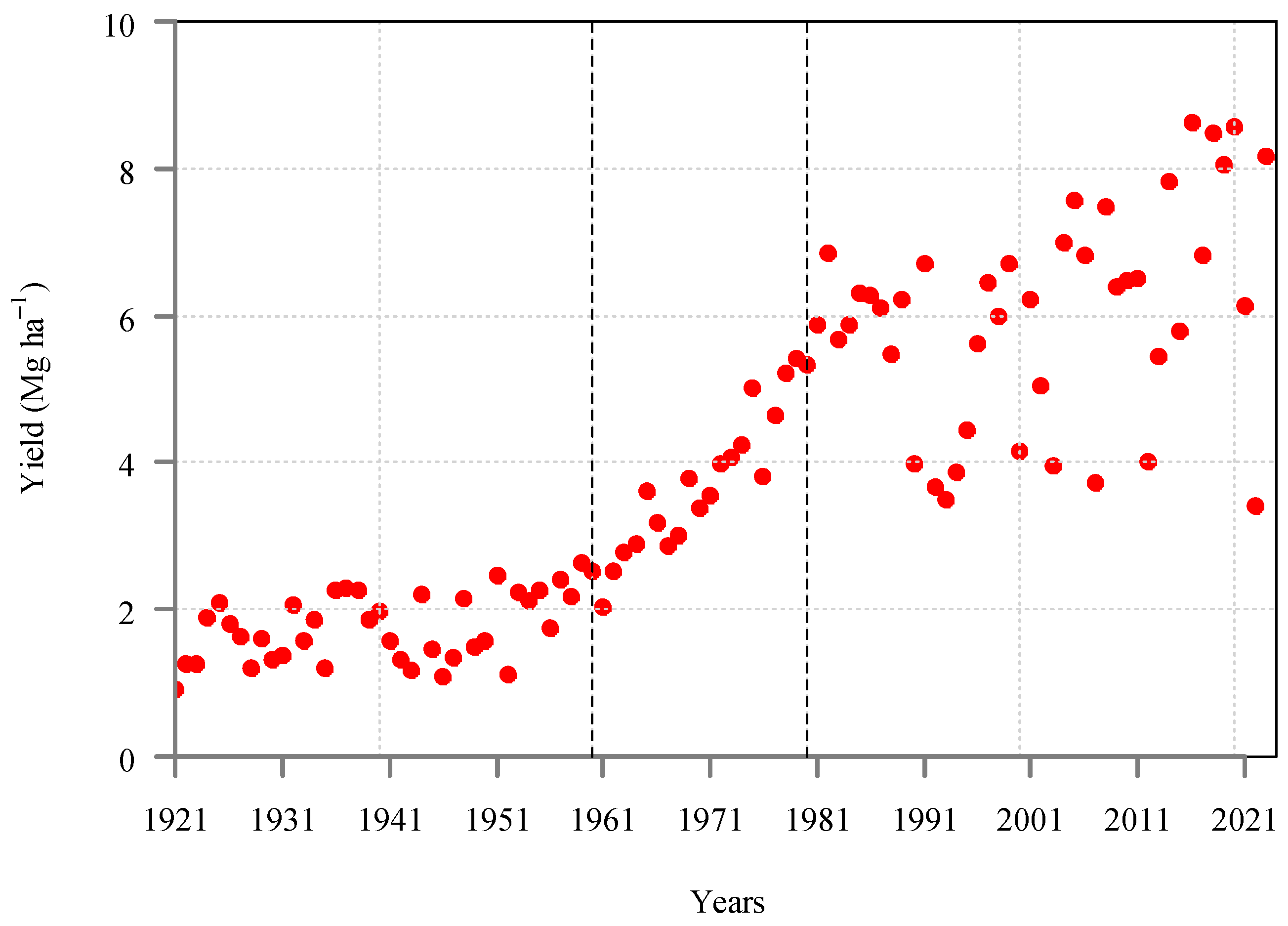
In the period of 1921–1960, the average maize yield in Hungary was 1.8 t ha−1 with a relatively low variability, while in the period of 1980–2023, it was 6 t ha−1. Variation increased by time, showing high heteroscedasticity, visually represented by a distinctive fan.
The development of socialistic, large-scale industrial technology involving intensive fertilization began in the 1960s. Between 1961 and 1979, maize yield gradually increased by year as a result of intensive technological development; hence, data were extracted [
16] (
Figure 1).
The reliability model assumes that the time series exhibits stationary Markov properties. Sufficiently big datasets assure an acceptable level of uncertainty in the estimation. For the period of 1961–1979, the time series did not exhibit stationary Markov properties; hence, they were not involved in the modeling. The test results for the Markov properties of the probability of maize yield failure and high yield by at least 15% and over 30% in the periods of 1925–1960 and 1985–2023 prove that the process is memoryless; the
p-values exceed the 0.05 threshold for rejecting the null hypothesis in the case of each yield data sequence (
Table 1).
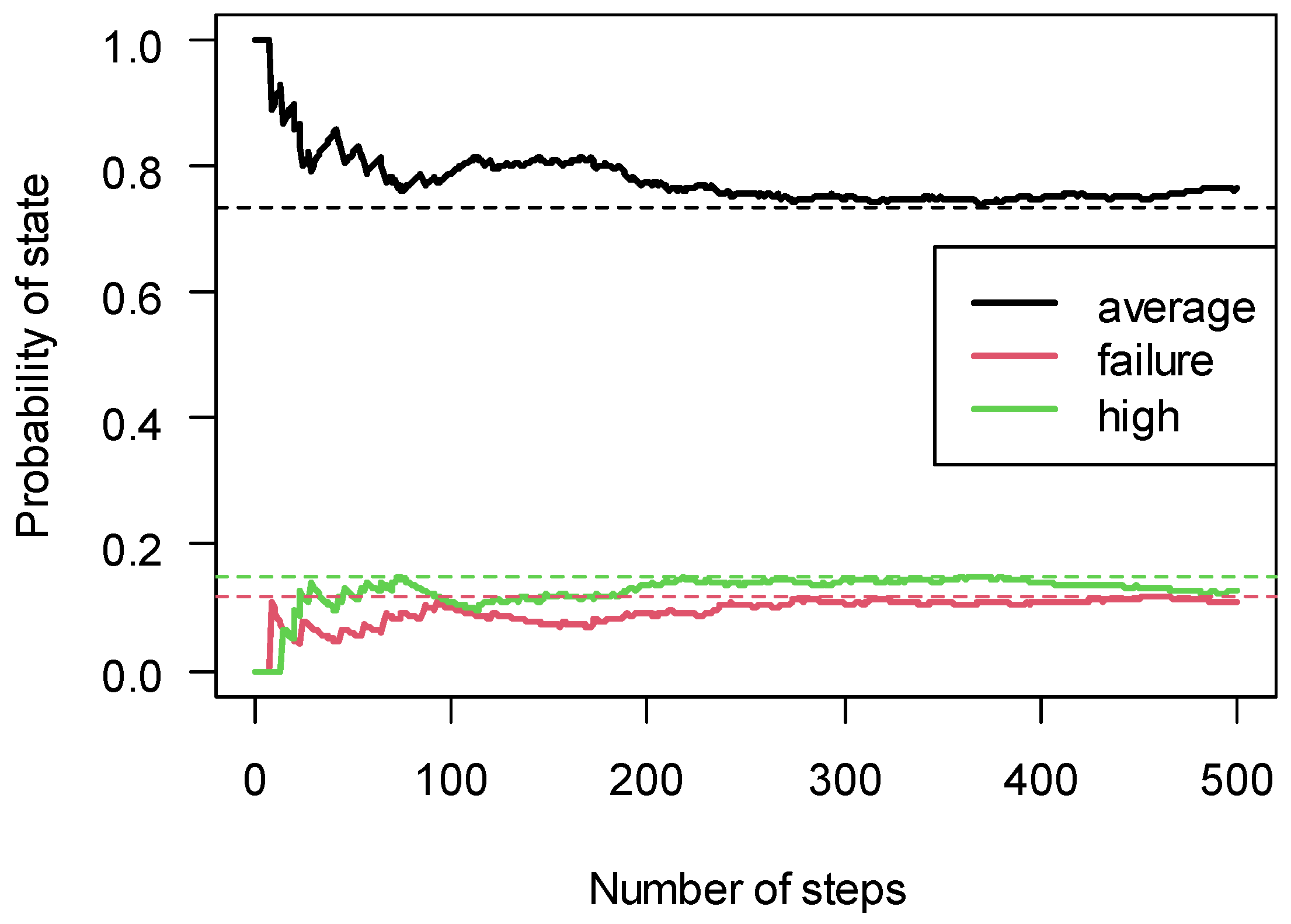
All three initial states were observed to converge to the same final state. Hence, the chain was considered ergodic. For a Markov chain to be ergodic means that, in the long run, the chain “forgets its initial state” and always converges to the same stationary distribution. All 12 simulations showed similar behavior; an example is shown in
Figure 2.
3.2. Probability of Maize Yield Failure and High Yield in Hungary in the 1925–1960 Period
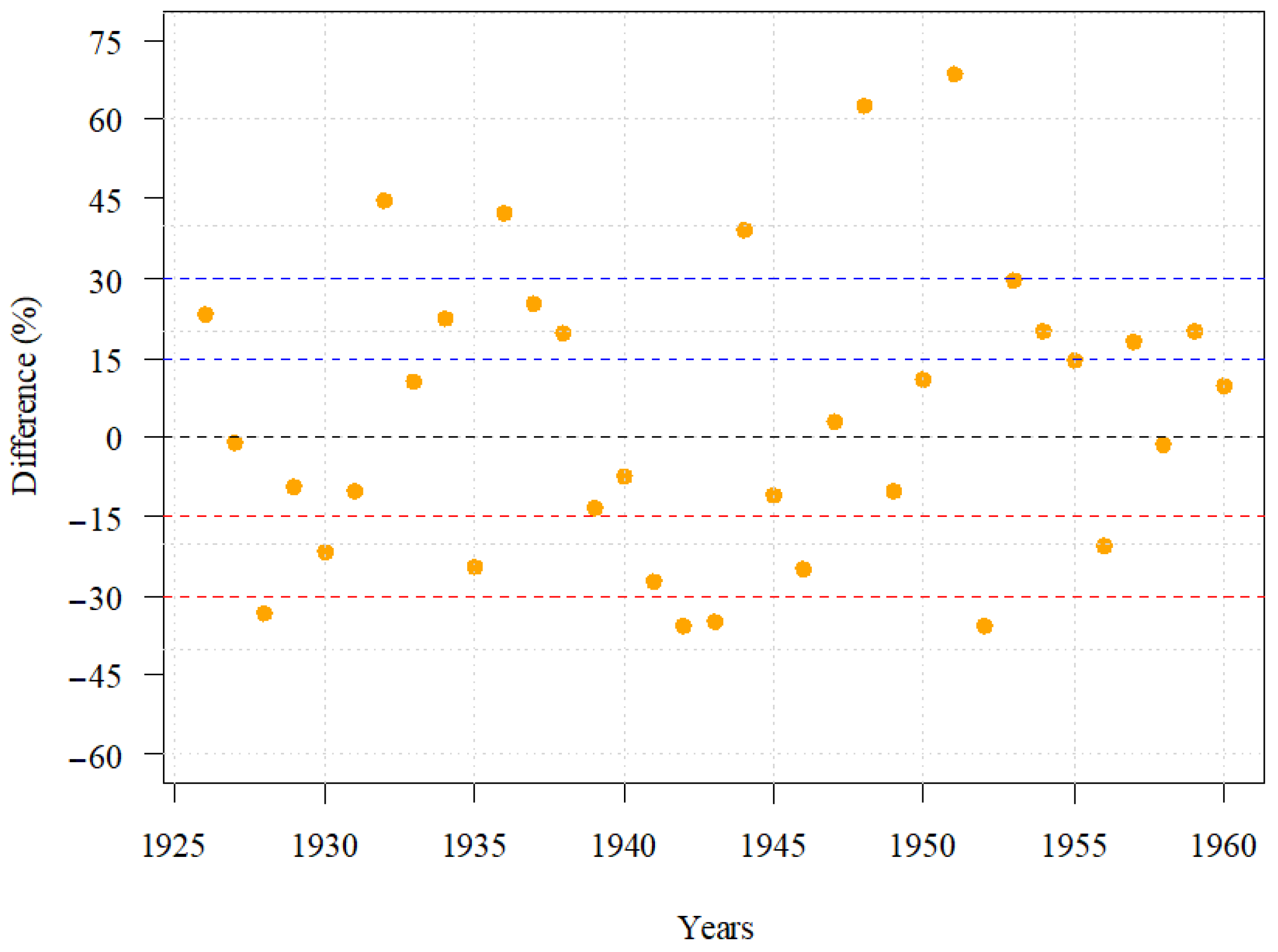
Maize yield varied between 0.92 and 2.62 t ha
−1 in the period of 1925–1960 in Hungary. Maize yield fluctuation does not seem to show any trends. Differences from the previous five-year moving average by being higher or lower by at least 15% were found to be 22 times more likely, while it was only 9 times more likely for being over ±30% (
Figure 3).
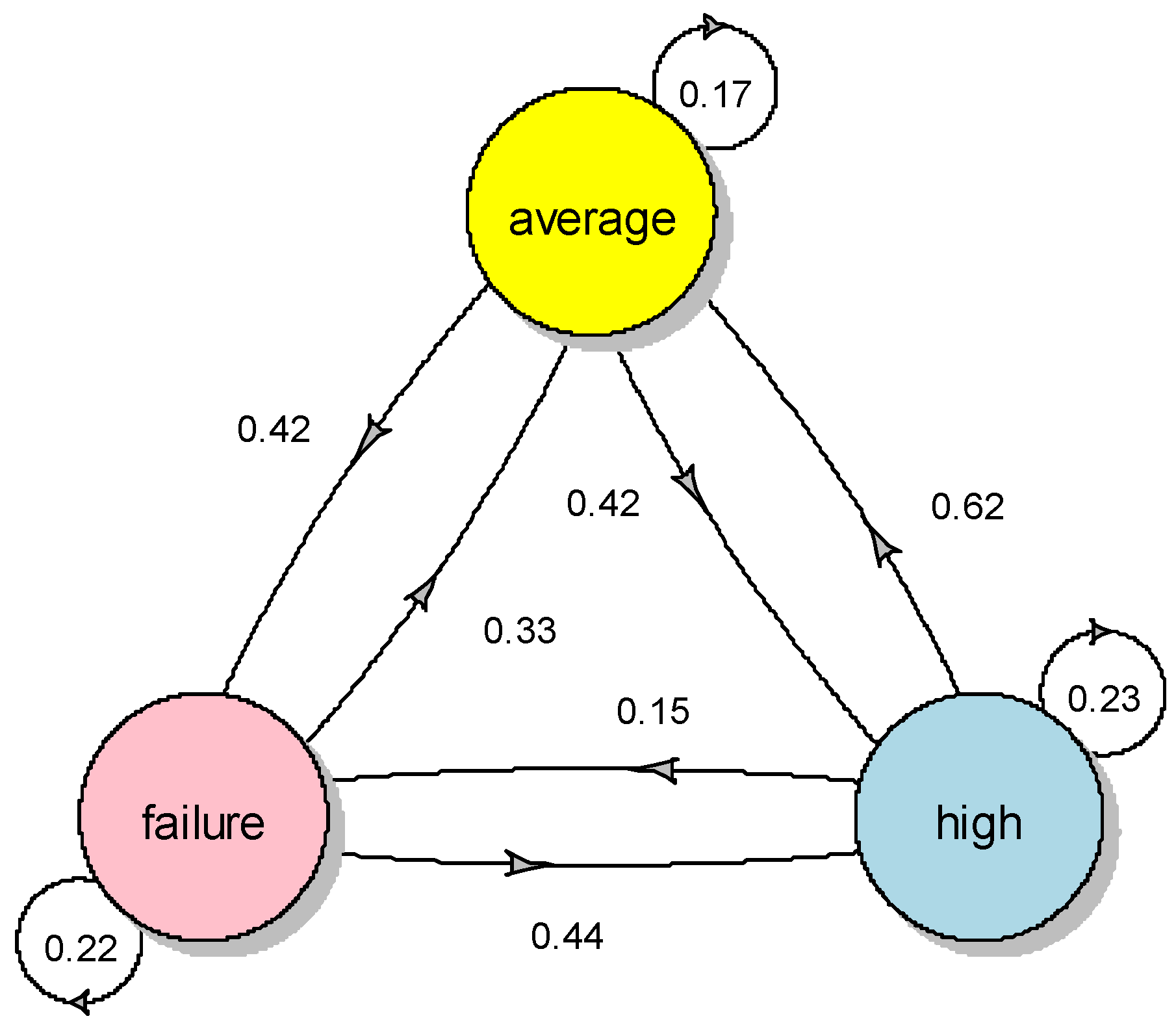
Transition matrix results characterizing the fluctuation of maize yield by at least ±15% between 1925 and 1960 are visualized in
Figure 4. There are three states, each represented by a vertex of the triangle, where arrows show the transition from one to another. There are nine possible transitions, e.g., the average yield can be followed by high yield or failure, or it can remain near the average in the following year. The probability of transitioning is indicated numerically. The sum of the probabilities given in the figure may differ from 1.00 due to rounding in the figure.
Within the period of 1925–1960, the probability that a year with average yield was followed by another year differing by less than ±15% was 17%, but it increased to 42–42% for having either at least 15% higher yield or yield failure in the following year. When the yield was higher than average by at least 15%, the probability of having a similarly high yield was found to be 23%, while it was 62% to have an average yield next year and 15% to have yield failure by at least 15%. A year with yield failure was found to be followed by another poor year with a probability of 22%, while it was 33% and 44% to have an average or high yield the next year, respectively.
Table 2 summarizes the 95% confidence intervals of the transition probabilities in the case of at least ±15% maize yield fluctuation compared to the previous five-year moving average within the period of 1925–1960.
The true probability within the 95% confidence interval can be expected to fall within the range of the lower and upper endpoints. The range is strongly dependent on the sample size and variation. Within the assessed period, the very rare states’ confidence intervals are the highest. In considering the steady-state distribution that represents the long-time behavior, in the case of the yield statistical pattern found in the 1925–1960 period, the probability of having average maize yield, yield failure, and high yield would be 37%, 27%, and 36%, respectively.
Transition matrix results characterizing the maize yield fluctuation by over ±30% between 1925 and 1960 are shown in
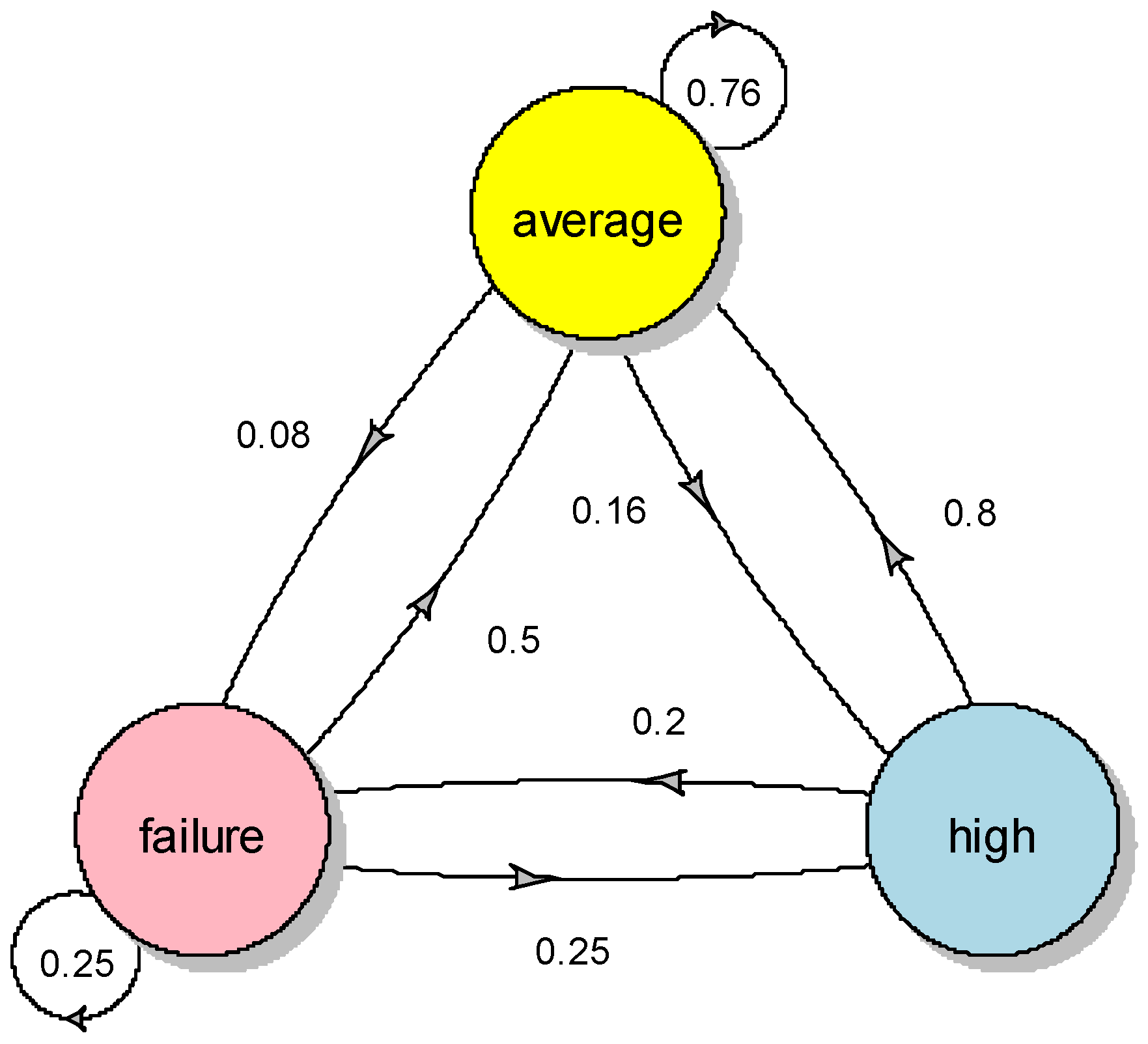
Figure 5. The probability of such an extreme difference for the yield of a year compared to the following year was found to be 76%. Crop yield failure could be expected with 8% probability, and exceptional yield with 16% probability. After a crop yield failure, a year with an average yield can be expected with 50% probability. Failure would occur again with 25% probability, and a high yield with 25% probability. After a high-yield year, an average yield was found to occur with 80% probability and crop failure with 20% probability. During this period, a high yield never occurred after a high yield.
Table 3 summarizes the 95% confidence intervals of the transition probabilities in the case of at least ±30% maize yield fluctuation compared to the previous five-year moving average within the 1925–1960 period. Similarly to the case of ±15% maize yield fluctuation, the very rare states’ confidence intervals are the highest in this period.
In considering the long-time behavior, with the statistics of the 1925–1960 data, the probability of average maize yield, yield failure, and high yield would be 73.5%, 11.8%, and 14.7%, respectively.
3.3. Probability of Maize Yield Failure and High Yield in Hungary in the 1985–2023 Period
Maize yield varied between 3.40 and 8.60 t ha
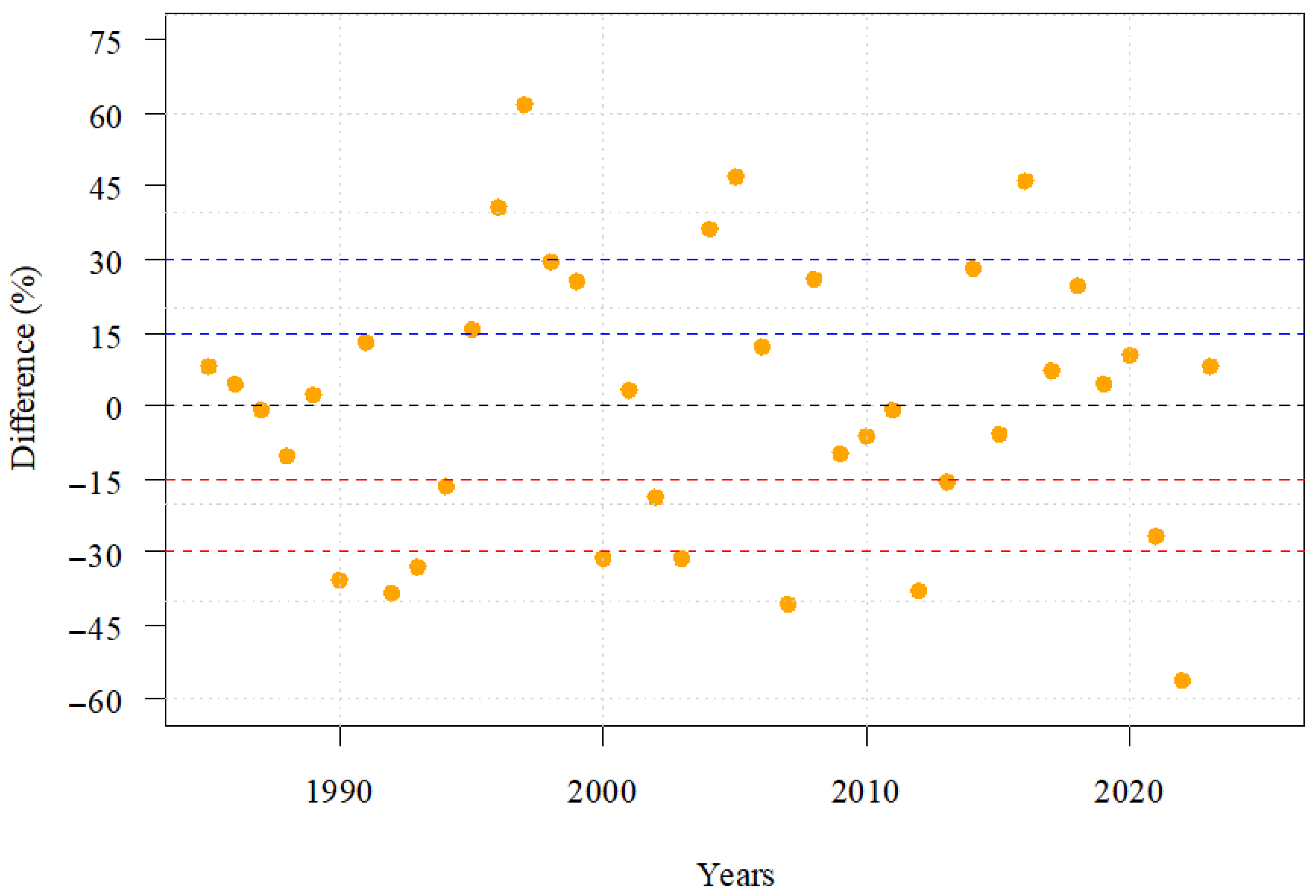
−1 in the period of 1985–2023 in Hungary. Maize yield fluctuation does not seem to show any trends. Differences from the previous five-year moving average by being higher or lower by at least 15% were found to be 23 times more likely, while it was 13 times more likely for being over ±30% (
Figure 6).
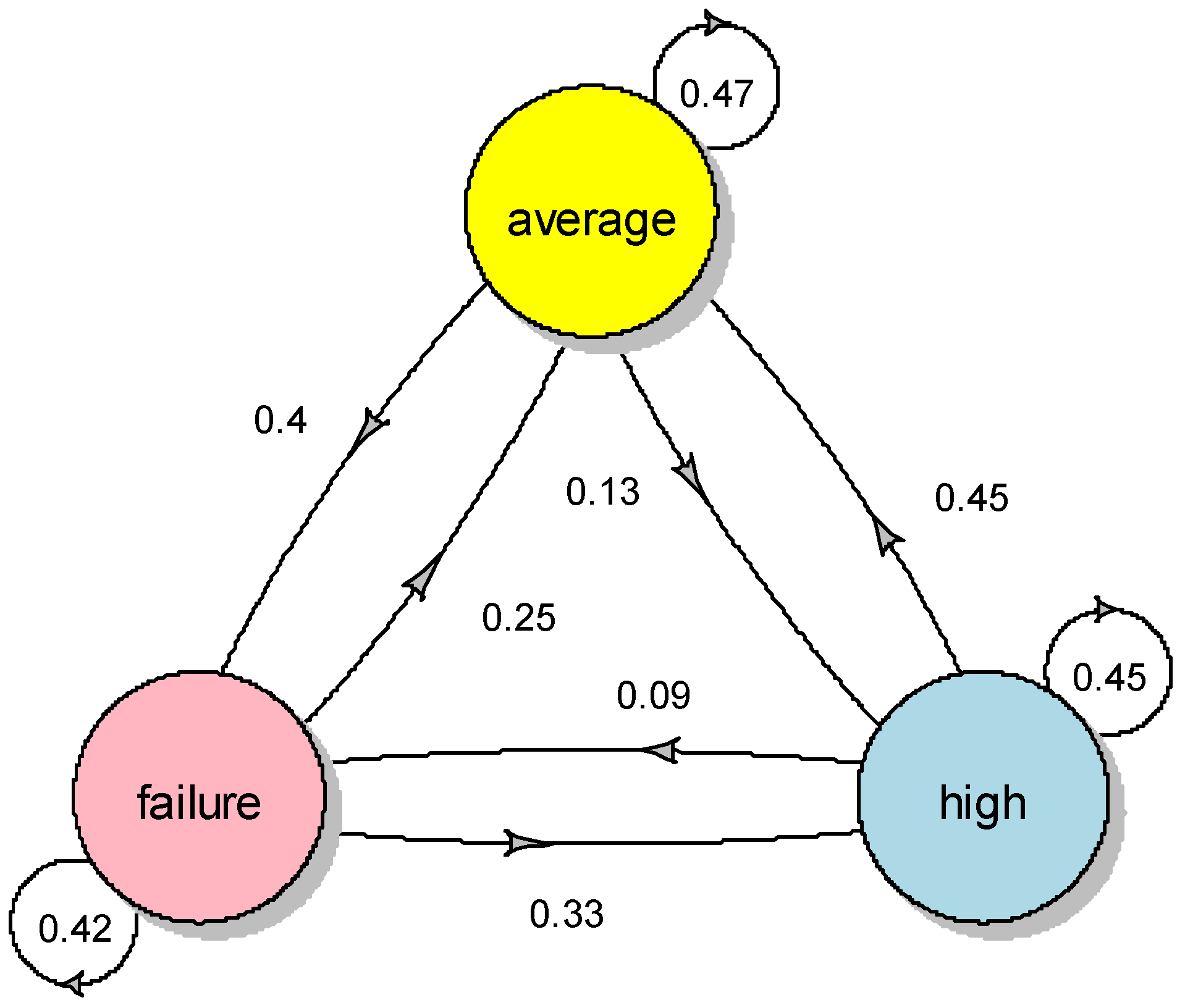
Figure 7 represents the transition matrix results for the yield fluctuation by at least ±15% between 1985 and 2023. After an average harvest, there was a 47% probability of an average harvest again. We could expect a high harvest with 13% probability and 40% probability of crop failure. Years with high harvests were found to repeat with 45% probability, i.e., the phenomenon repeats itself. With 45% probability, an average harvest follows, and with only a 9% probability of crop failure. A year with a low harvest was calculated to repeat with 42% probability, which is quite a high value. Then, with 25% and 33% probability, an average and high harvest would be expected, respectively.
Table 4 summarizes the 95% confidence intervals of the transition probabilities in the case of at least ±15% maize yield fluctuation compared to the previous five-year moving average within the 1985–2023 period. Similarly to the 1925–1960 period, the very rare states’ confidence intervals are the highest.
Based on the long-term steady state, the probability of average harvest, high harvest, and crop failure would be 39.5%, 29%, and 31.5%, respectively.
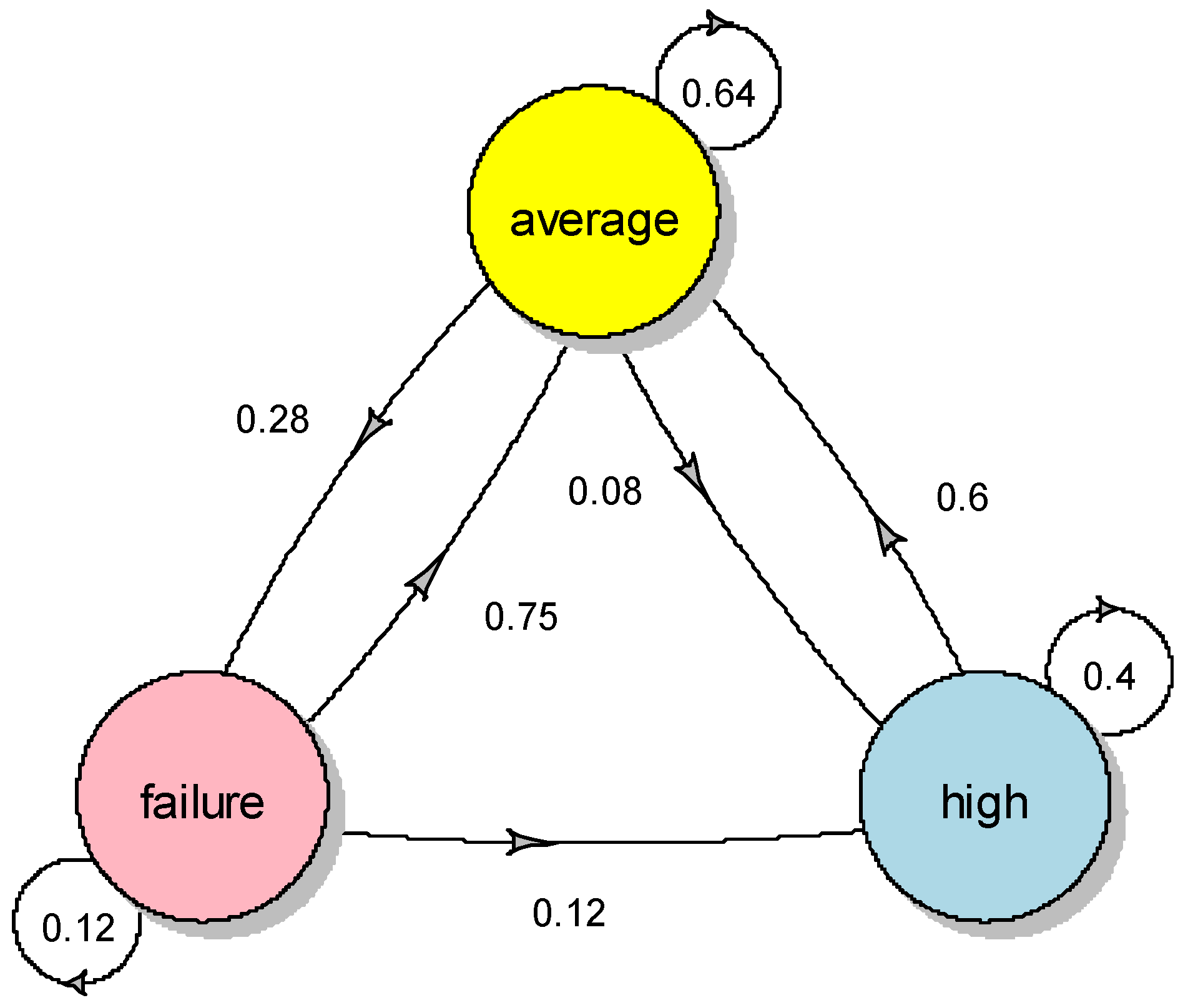
Figure 8 presents the transitions matrix results for yield fluctuation by over ±30% between 1985 and 2023. After an average harvest, there was a 64% probability of an average harvest again. We could expect crop failure with 28% probability, and high harvest with only 8% probability. The probability of a high-harvest year recurring was 40%. An average harvest could be expected with 60% probability. The probability of crop failure after a high-harvest year was zero. This did not occur in the period under review. After crop failure, a 12% probability of another crop failure was calculated. We could expect a high harvest with 12% probability and a year with an average harvest with 70% probability.
Table 5 summarizes the 95% confidence intervals of the transition probabilities in the case of over 30% maize yield fluctuation compared to the previous five-year moving average within the 1985–2023 period. Similarly to the 1925–1960 period, the very rare states’ confidence intervals are the highest.
Based on the steady state, the probability of average harvest, crop failure, and high harvest would be 66%, 21%, and 13%, respectively.
4. Discussion
The effects of weather extremes on crop failure are significant. The probability of variation in crop yield tends to increase. Today, yields under optimal conditions are close to the genetic potential compared to the earlier performance. Thus, any adverse effect results in higher loss; high yield assumes intensive utilization of resources with increased sensitivity for any shortage. Furthermore, when drought and heat stress occur together, they can lead to a higher probability of crop damage compared to when these stressors occur individually (e.g., [
19]). Studies suggest that current maize models may not adequately capture the impact of climate extremes, specifically heat and drought, on maize photosynthesis and yield (e.g., [
20]). According to Shi and Tao [
21], in the African continent, for each 1 °C increase in mean temperature, yield losses were over 10% in eight countries and between 5 and 10% in ten countries. A 10% decrease in average precipitation led to more than a 5% decrease in yields in 20 countries. A decrease of 0.5 in the standardized precipitation evapotranspiration index (SPEI) resulted in over 30% losses of maize yields in 32 countries. Obour et al. [
22] studied the primary causes of maize production failure with the conclusion that factors such as poor soil quality, inadequate farm inputs, and under-resourced mechanization had a lesser impact on maize production failure than drought conditions unfavorable for maize growth. Regarding Hungary, annual precipitation has not changed within the last 100 years; however, since 2000, it has shown increasing variation in distribution over the years, with shortage typically in the vegetation period. Annual average temperature, however, has increased in the last 25 years, resulting in an increase in potential evapotranspiration [
23]. Heat stress has occurred after 2000 too. It must be noted that without taking technological development into consideration, prediction models may overestimate the adverse effect of climate change on crop production [
24]. Srivastava et al. [
25] established that yield fluctuations are reflected through the variability in simulated maize yields when using different sets of climate data for regional simulations. They found that there was less variability in the simulated yield when using a consistent dataset from the same source. In contrast, when using a combined dataset from different sources, the variability was higher, indicating that the choice of climate data source can introduce significant uncertainties into crop simulation results.
In our study, based on the maximum likelihood estimation, in the 1925–1960 period, the probability of occurrence of average maize yield or higher by at least 15% was found to be the highest for the investigated region, Hungary, while that of failure by at least 15% was found to be 27%. Interestingly, when considering at least a 15% difference from the previous five-year moving average, the probability of failure was calculated to be higher, while that of the high yield was lower for the 1985–2023 period (
Table 6).
In conclusion, with the consideration of maize yield variation by at least ±15%, the three states occurred with similar probabilities in the past four decades. Thus, we found 15% as a threshold to be improper for the analysis of the phenomenon and inadequate for making probability estimations for the near future.
When we define maize yield variation as high in the case of the threshold ±30%, the probability of average-harvest years increases (
Table 7). Any state returns to the average with high probability, which represents regression and suggests normal distribution. This assures the crowd consistency and stability; hence the property of concern remains characteristic in the long term.
In comparing the probability of yield failure calculated for the 1925–1960 period with that of the 1985–2023 period, long-term tendency shows duplication; specifically, the frequency of maize yield failure increased from 11.8% to 21%. At the same time, the probability of average yield and high yield moderately decreased. Yield variation is dominant in the negative range.
Technological development aims to increase crop performance under optimal conditions; however, higher genetic potential occurs in conjunction with higher sensitivity to environmental extremes. For example, without properly adjusting irrigation to the actual water demand of crops, as well as promoting land drainage, both water shortage and excess are by far the most determinative weather factors for farmers in the investigated region [
26]. In Hungary, crops with high genetic potential are produced, and nutrition and crop protection are of a high standard. The size of the irrigated area, however, will be expanded to 20% of arable land by 2030.
Process-based models that incorporate mechanistic understanding of physiological, meteorological, and edaphic factors affecting yield, remain essential for mechanistic yield forecasting incorporating weather extremes. Our methodology offers a complementary probabilistic perspective focusing on yield fluctuation dynamics over time as a stochastic process. Discrete Markov chain approach circumvents some assumptions and data requirements, offering an alternative that specifically targets yield variability transitions as a stochastic time series problem. Similar Markovian methodologies have been applied effectively in crop condition forecasting and drought risk assessment [
7,
12], supporting the broader value of Markov models for agricultural risk characterization.
5. Conclusions
Towards our goals, we established the following: (1) The probability of maize yield variability for the examined periods can be modeled using the Markov chain method. This was proven by performing Chi-square tests in series. As the degree of yield fluctuation increases, the probability of average-yield years increases. (2) In the 1925–1960 period, considering both degrees of yield fluctuation, average and high yields occurred with the highest probability; the fluctuation of 30% gave the clearest results. This changed in the 1985–2023 period, as the probability of crop failure increased and the probability of average and high yields decreased. (3) Technological development has advanced in recent decades, but the adverse effects of climate change have increased the probability of crop failure. Currently, we cannot mitigate the adverse effects of weather using existing technologies. If climate change continues, according to the trend of recent decades, we will be forced to change current practices in order to reduce the frequency of crop failure. The study results regarding the 30% fluctuation can inform ministries and specialists in their work and provide an opportunity to mitigate the adverse effects of extreme crop failure.
The Markov chain method has been mostly applied for weather data analyses in relation to agriculture and climate change. The adaptability of such robust models with relatively low data input needs to be tested, as overparametrized chaotic models show a fan effect. Inputting more parameters in the model does not necessarily yield more reliable results.
This study demonstrates the applicability of the discrete-time Markov chain method for assessing inter-annual crop yield stability and risk under observed historical variability, as well. The approach is not a deterministic, process-based forecast of crop yield. It assumes a first-order, time-homogeneous Markov process based on regional historical yield data, not considering meteorological drivers (e.g., drought, heat stress), soil parameters, or agronomic adaptations (e.g., management practices, irrigation, cultivar choice). Despite these simplifications, the method provides an informative probabilistic risk profile of yield variability across years.





 ,
,