
Exploring Socioeconomic Implications of Time-of-Use Electricity Pricing on Residential and Electric Mobility Sectors in Developing Countries


Abstract
1. Introduction
2. The Jordanian Power System
2.1. Current and Future Projections of the Electricity Sector in Jordan
2.2. Load Curve and Renewable Matching
2.3. Electric Vehicle Development in Jordan
2.4. Development of Electricity Tariff in Jordan
3. Methodology
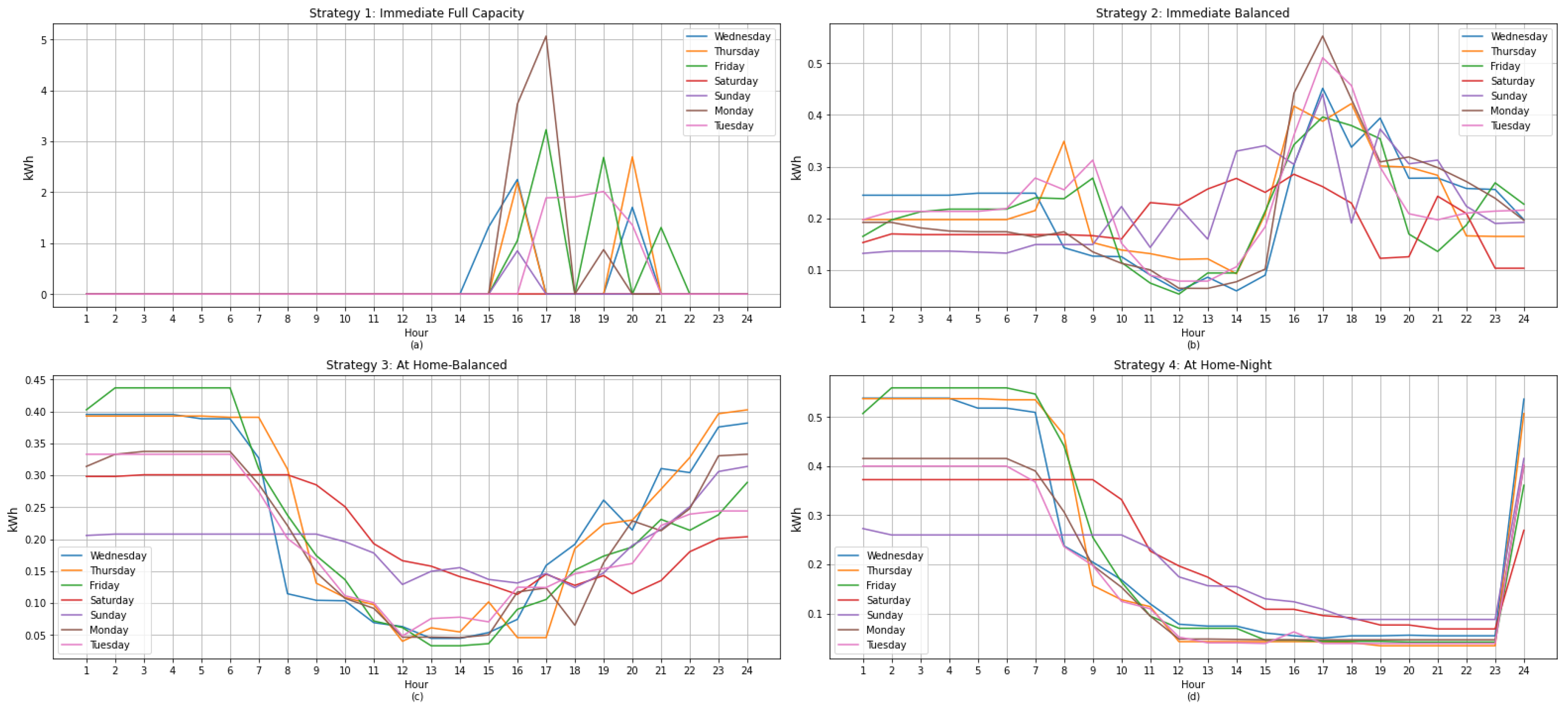
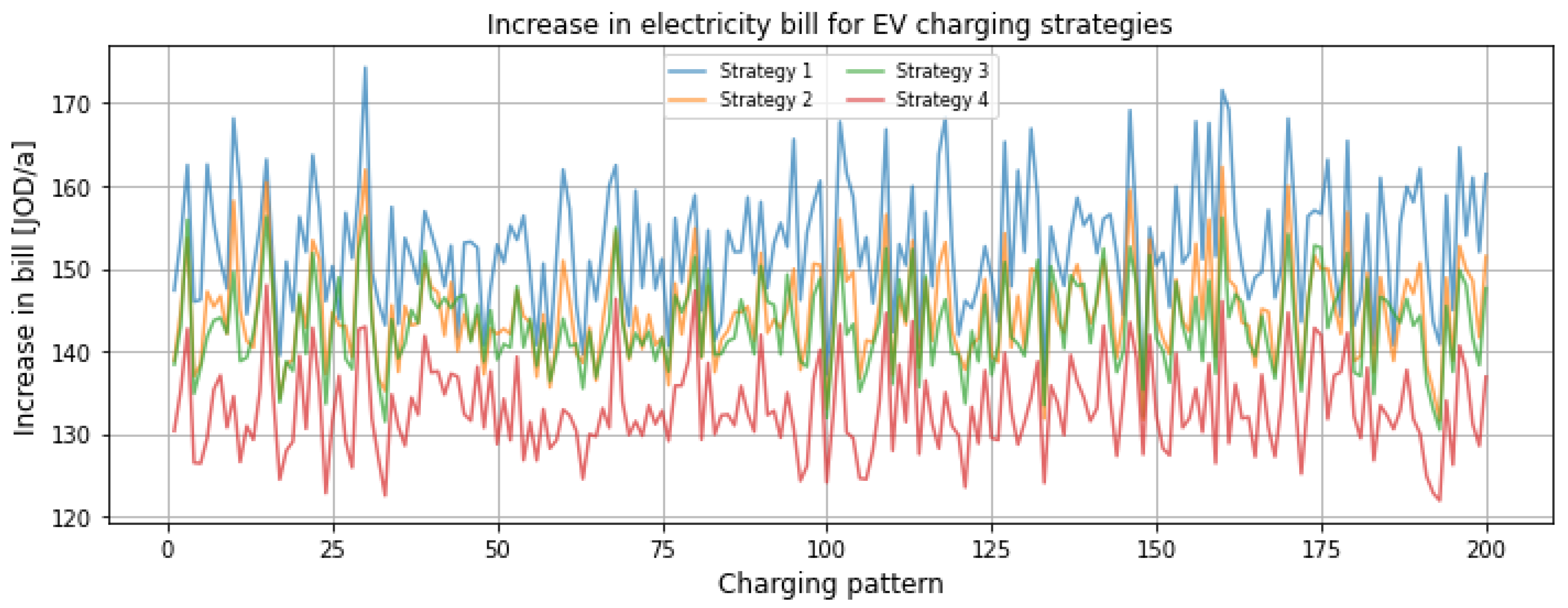
- Immediate—Full Capacity: EVs charge at the maximum available power rating as soon as they are plugged in. Charging continues until the battery is full or the next trip begins. This strategy prioritizes user convenience but results in the highest contribution to peak demand, as no attempt is made to smooth charging.
- Immediate—Balanced: EVs also begin charging immediately upon connection, but at a constant, reduced power rate. Charging is scheduled such that the battery reaches full capacity just before the next trip, approximating a smoother load profile while still maintaining user convenience.
- At Home—Balanced: Charging is limited to a balanced power rate over the whole day, reflecting user preferences or economic incentives for home-based charging.
- At Home—Night: A variant of the At Home—Balanced strategy, but charging is restricted to the off-peak window between 23:00 and 08:00. This simulates potential tariff incentives for off-peak charging and represents the most grid-friendly behavior.
4. Results and Discussion
4.1. Impact of ToU on Residential Sector
4.2. Impact of ToU on Transport Sector
5. Conclusions and Policy Implications
Author Contributions
Funding
Institutional Review Board Statement
Informed Consent Statement
Data Availability Statement
Acknowledgments
Conflicts of Interest
Abbreviations
| ToU | Time-of-Use |
| VRE | Variable Renewable Energy |
| DSM | Demand-Side Management |
| RES | Renewable Energy Sources |
| PPA | Power Purchase Agreement |
| PV | Photovoltaic |
| EV | Electric Vehicle |
| IEA | International Energy Agency |
| EEI | Edison Electric Institute |
| NEPCO | National Electric Power Company (Jordan’s national grid operator) |
| EMRC | Energy and Minerals Regulatory Commission |
| GDP | Gross Domestic Product |
| JOD | Jordanian Dinar |
| kWh | Kilowatt-hour |
| MW | Megawatt |
| TWh | Terawatt-hour |
| GWh | Gigawatt-hour |
| Wh | Watt-hour |
| km | Kilometer |
| Emobpy | Electric Mobility Python (open-source EV profile generation tool) |
Appendix A


References
- Söder, L.; Lund, P.D.; Koduvere, H.; Bolkesjø, T.F.; Rossebø, H.G.; Rosenlund-Soysal, E.; Skytte, K.; Katz, J.; Blumberga, D. A review of demand side flexibility potential in Northern Europe. Renew. Sustain. Energy Rev. 2018, 91, 654–664. [Google Scholar] [CrossRef] [Scilit]
- Lund, P.D.; Lindgren, J.; Mikkola, J.; Salpakari, J. Review of energy system flexibility measures to enable high levels of variable renewable electricity. Renew. Sustain. Energy Rev. 2015, 45, 785–807. [Google Scholar] [CrossRef] [Scilit]
- IEA. Status of Power System Transformation 2018: Advanced Power Plant Flexibility; IEA: Paris, France, 2018. [Google Scholar]
- Gonzalez-Salazar, M.A.; Kirsten, T.; Prchlik, L. Review of the operational flexibility and emissions of gas- and coal-fired power plants in a future with growing renewables. Renew. Sustain. Energy Rev. 2018, 81, 1497–1513. [Google Scholar] [CrossRef] [Scilit]
- IEA. Energy Transitions Require Innovation in Power System Planning; International Energy Agency: Paris, France, 2022. [Google Scholar]
- Gunkel, P.A.; Bergaentzlé, C.; Jensen, I.G.; Scheller, F. From passive to active: Flexibility from electric vehicles in the context of transmission system development. Appl. Energy 2020, 277, 115526. [Google Scholar] [CrossRef] [Scilit]
- Kiviluoma, J.; Helistö, N.; Putkonen, N.; Smith, C.; Koivisto, M.; Korpås, M.; Flynn, D.; Söder, L.; Taibi, E.; Guminski, A. Flexibility From the Electrification of Energy: How Heating, Transport, and Industries Can Support a 100% Sustainable Energy System. IEEE Power Energy Mag. 2022, 20, 55–65. [Google Scholar] [CrossRef] [Scilit]
- Abuzayed, A.; Liebensteiner, M.; Hartmann, N. Flexibility matters: Impact assessment of small and medium enterprises flexibility on the German energy transition. Energy Convers. Manag. X 2025, 25, 100880. [Google Scholar] [CrossRef] [Scilit]
- Torriti, J.; Yunusov, T. It’s only a matter of time: Flexibility, activities and time of use tariffs in the United Kingdom. Energy Res. Soc. Sci. 2020, 69, 101697. [Google Scholar] [CrossRef] [Scilit]
- Venizelou, V.; Philippou, N.; Hadjipanayi, M.; Makrides, G.; Efthymiou, V.; Georghiou, G.E. Development of a novel time-of-use tariff algorithm for residential prosumer price-based demand side management. Energy 2018, 142, 633–646. [Google Scholar] [CrossRef] [Scilit]
- Barjaková, M.; Belton, C.A.; Purcell, K.; Lunn, P.D. Effective communication of time–of–use electricity tariffs: Plain and simple. Util. Policy 2024, 90, 101798. [Google Scholar] [CrossRef] [Scilit]
- Stute, J.; Kühnbach, M. Dynamic pricing and the flexible consumer—Investigating grid and financial implications: A case study for Germany. Energy Strategy Rev. 2023, 45, 100987. [Google Scholar] [CrossRef] [Scilit]
- Aguilar-Dominguez, D.; Dunbar, A.; Brown, S. The electricity demand of an EV providing power via vehicle-to-home and its potential impact on the grid with different electricity price tariffs. Energy Rep. 2020, 6, 132–141. [Google Scholar] [CrossRef] [Scilit]
- Faruqui, A.; Sergici, S. Household response to dynamic pricing of electricity: A survey of 15 experiments. J. Regul. Econ. 2010, 38, 193–225. [Google Scholar] [CrossRef] [Scilit]
- Ali, M.; Jokisalo, J.; Siren, K.; Lehtonen, M. Combining the Demand Response of direct electric space heating and partial thermal storage using LP optimization. Electr. Power Syst. Res. 2014, 106, 160–167. [Google Scholar] [CrossRef] [Scilit]
- Faruqui, A.; Sergici, S.; Warner, C. Arcturus 2.0: A meta-analysis of time-varying rates for electricity. Electr. J. 2017, 30, 64–72. [Google Scholar] [CrossRef] [Scilit]
- Zaki, D.A.; Hamdy, M. A Review of Electricity Tariffs and Enabling Solutions for Optimal Energy Management. Energies 2022, 15, 8527. [Google Scholar] [CrossRef] [Scilit]
- Faruqui, A.; Palmer, J. The Discovery of Price Responsiveness—A Survey of Experiments Involving Dynamic Pricing of Electricity. In SSRN Working Paper Series; SSRN: Rochester, NY, USA, 2012. [Google Scholar]
- Rubanda, M.E.; Senyonga, L.; Ngomo, M.; Adaramola, M.S. Energy market integration: Harmonizing tariff recourse policies in East Africa. Util. Policy 2023, 84, 101653. [Google Scholar] [CrossRef] [Scilit]
- Mburamatare, D.; Gboney, W.K.; Hakizimana, J.D.D. Electricity Tariff Design “Theoretical Concepts Vs Practices”: Review of Tariff Design Approaches in East Africa—Case Studies of Rwanda, Kenya, Uganda and Tanzania. Int. J. Energy Econ. Policy 2022, 12, 260–273. [Google Scholar] [CrossRef] [Scilit]
- Sulaima, M.F.; Dahlan, N.Y.; Yasin, Z.M.; Rosli, M.M.; Omar, Z.; Hassan, M.Y. A review of electricity pricing in peninsular Malaysia: Empirical investigation about the appropriateness of Enhanced Time of Use (ETOU) electricity tariff. Renew. Sustain. Energy Rev. 2019, 110, 348–367. [Google Scholar] [CrossRef] [Scilit]
- Rahman, A.; Aziz, T.; Al-Masood, N.; Deeba, S.R. A time of use tariff scheme for demand side management of residential energy consumers in Bangladesh. Energy Rep. 2021, 7, 3189–3198. [Google Scholar] [CrossRef] [Scilit]
- Garcia, D.L.; Gallego, J.D.B.; Quintero, C.S.X. Proposing Dynamic Pricing as an Alternative to Improve Technical and Economic Conditions in Rural Electrification: A Case Study from Colombia. Sustainability 2023, 15, 7985. [Google Scholar] [CrossRef] [Scilit]
- Valencia, J.; Dyner, I.; Mesa, F.; Aristizábal, A.J. Evaluating demand response through the time of use model in off-grid regions. Renew. Sustain. Energy Transit. 2025, 7, 100115. [Google Scholar] [CrossRef] [Scilit]
- Setiawan, E.A.; Prakoso, A.; Maulia, V. Dynamic pricing scheme for the Java-Bali system residential load. Int. J. Technol. 2019, 10, 1194–1201. [Google Scholar] [CrossRef] [Scilit]
- Gamil, M.; Senjyu, T.; Takahashi, H.; Hemeida, A.; Krishna, N.; Lotfy, M.E. Optimal multi-objective sizing of a residential microgrid in Egypt with different ToU demand response percentages. Sustain. Cities Soc. 2021, 75, 103293. [Google Scholar] [CrossRef] [Scilit]
- Shaikh, S.K.; Dharme, A.A. Time of Use pricing—India, a case study. In Proceedings of the 2009 International Conference on Power Systems, Kharagpur, India, 27–29 December 2009; IEEE: New York, NY, USA, 2009. [Google Scholar]
- Leon, R.; Carvajal, G.; Guerro-Vallejos, E.; Ramirez, G. Techno-economic evaluation of a vehicle to home and time of use tariff scheme to promote the adoption of electric vehicles in Chile. Sustain. Energy Technol. Assess. 2023, 60, 103565. [Google Scholar] [CrossRef] [Scilit]
- Birk, J.; Vining, W.; Lave, M.; Haines, T.; Neuman, C.; Bennett, J.; Scoffield, D.R. Impact of Electric Vehicle customer response to Time-of-Use rates on distribution power grids. Energy Rep. 2022, 8, 8225–8235. [Google Scholar] [CrossRef] [Scilit]
- Sasidharan, A.; Tyagi, B.; Das, S. Evaluating Time of Use rates for Electric Vehicle Charging for Distribution Companies in India. In Proceedings of the 2019 IEEE Transportation Electrification Conference (ITEC-India), Bengaluru, India, 17–19 December 2019; IEEE: New York, NY, USA, 2019. [Google Scholar]
- Gaete-Morales, A.; Kramer, H.; Schill, W.-P.; Zerrahn, A. An open tool for creating battery-electric vehicle time series from empirical data, emobpy. Sci. Data 2021, 8, 152. [Google Scholar] [CrossRef] [Scilit]
- Fell, M.J.; Shipworth, D.; Huebner, G.M.; Elwell, C.A. Public acceptability of domestic demand-side response in Great Britain: The role of automation and direct load control. Energy Res. Soc. Sci. 2015, 9, 72–84. [Google Scholar] [CrossRef] [Scilit]
- Nicolson, M.; Huebner, G.; Shipworth, D. Are consumers willing to switch to smart time of use electricity tariffs? The importance of loss-aversion and electric vehicle ownership. Energy Res. Soc. Sci. 2017, 23, 82–96. [Google Scholar] [CrossRef] [Scilit]
- Zarnikau, J.; Zhu, S.; Russel, R.; Holloway, M.; Dittmer, M. How Will Tomorrow’s Residential Energy Consumers Respond to Price Signals? Insights from a Texas Pricing Experiment. Electr. J. 2015, 28, 57–71. [Google Scholar] [CrossRef] [Scilit]
- Khan, T.A.; Abdullah-Al-Nahid, S.; Tasnim, S.; Taseen, M.A.; Jamal, T.; Aziz, T. Empowering E-mobility: Day-ahead dynamic time of use tariff for electric vehicle charging. Energy Rep. 2024, 12, 3218–3242. [Google Scholar] [CrossRef] [Scilit]
- Hildermeier, J.; Burger, J.; Jahn, A.; Rosenow, J. A Review of Tariffs and Services for Smart Charging of Electric Vehicles in Europe. Energies 2023, 16, 88. [Google Scholar] [CrossRef] [Scilit]
- Hong, J.; She, Y.; Wang, S.; Dora, M. Impact of psychological factors on energy-saving behavior: Moderating role of government subsidy policy. J. Clean. Prod. 2019, 232, 154–162. [Google Scholar] [CrossRef] [Scilit]
- White, L.V.; Sintov, N.D. Health and financial impacts of demand-side response measures differ across sociodemographic groups. Nat. Energy 2020, 5, 50–60. [Google Scholar] [CrossRef] [Scilit]
- Borenstein, S. The economics of fixed cost recovery by utilities. Electr. J. 2016, 29, 5–12. [Google Scholar] [CrossRef] [Scilit]
- Nicolson, M.L.; Fell, M.J.; Huebner, G.M. Consumer demand for time of use electricity tariffs: A systematized review of the empirical evidence. Renew. Sustain. Energy Rev. 2018, 97, 276–289. [Google Scholar] [CrossRef] [Scilit]
- Fell, M.J.; Nicolshon, M.; Huebner, G.M.; Shipworth, D. Is It Time? Consumers and Time of Use Tariffs; Smart Energy GB: London, UK, 2015. [Google Scholar]
- Spence, A.; Demski, C.; Butler, C.; Parkhill, K.; Pidgeon, N. Public perceptions of demand-side management and a smarter energy future. Nat. Clim. Change 2015, 5, 550–554. [Google Scholar] [CrossRef] [Scilit]
- NEPCO. NEPCO Annual Report. National Electric Power Company (NEPCO). 2023. Available online: https://www.nepco.com.jo/AnnualReports.aspx (accessed on 30 November 2024).
- Aljarrah, R.; Afaneh, T.; Ghazal, M. Analyzing the Pattern of the Jordanian Electricity Peak Load Amid Renewable Energy Transition Considering the GDP and Population Growth. In Proceedings of the 14th International Renewable Energy Congress (IREC), Sousse, Tunisia, 16–18 December 2023; IEEE: New York, NY, USA, 2023. [Google Scholar]
- Almuhtady, A.; Alshawawra, A.; Alfaouri, M.; Al-Kouz, W.; Al-Hinti, I. Investigation of the trends of electricity demands in Jordan and its susceptibility to the ambient air temperature towards sustainable electricity generation. Energy Sustain. Soc. 2019, 9, 39. [Google Scholar] [CrossRef] [Scilit]
- Trading Economics. Jordan GDP Annual Growth Rate. Trading Economics. 2024. Available online: https://tradingeconomics.com/jordan/gdp-growth-annual (accessed on 4 December 2024).
- Abu-Rumman, G.; Khdair, A.I.; Khdair, S.I. Current status and future investment potential in renewable energy in Jordan: An overview. Heliyon 2020, 6, e03346. [Google Scholar] [CrossRef] [Scilit]
- MEMR. Summary of Jordan Energy Strategy 2020–2030; Jordan Ministry of Energy and Mineral Resources (MEMR): Amman, Jordan, 2020. Available online: https://www.memr.gov.jo/EBV4.0/Root_Storage/EN/EB_Info_Page/Summery_of_the_Comprehensive_Strategy_of_the_Energy_Sector_2020_2030.pdf (accessed on 4 December 2024).
- The Jordan Times. Jordan Aims for 50% Electricity from Renewables by 2030—EMRC Chairman; The Jordan Times: Amman, Jordan, 2024; Available online: https://jordantimes.com/news/local/jordan-aims-50-electricity-renewables-2030-%E2%80%94-emrc-chairman (accessed on 4 December 2024).
- IEA. Global EV Outlook 2024 Moving Towards Increased Affordability; IEA: Paris, France, 2024. [Google Scholar]
- World Economic Forum. Electric Vehicles Are Key to the Energy Transition—But the Switch Must Be Sustainable. Here’s Why. World Economic Forum. 2024. Available online: https://www.weforum.org/stories/2024/04/electric-vehicle-evs-energy-transition-demand/ (accessed on 15 December 2024).
- Satterfield, C.; Schefter, K.; Maiorana, J. Electric Vehicle Sales and the Charging Infrastructure Required Through 2035; Edison Electric Institute: Washington, DC, USA, 2024. [Google Scholar]
- MEMR. Jordan’s Energy Balance for 2023; MEMR: Amman, Jordan, 2023. Available online: https://www.memr.gov.jo/ebv4.0/root_storage/en/eb_list_page/energy_balance_2023.pdf (accessed on 15 December 2024).
- JSF. Transportation & Logistics Sector: Jordan’s Economic Vision Roadmap; Jordan Strategy Forum: Amman, Jordan, 2022; Available online: https://jsf.org/uploads/2022/12/transportation-logistics.pdf (accessed on 15 December 2024).
- JSF. Electric Vehicles in Jordan…Where Is the Direction? Jordan Strategy Forum: Amman, Jordan, 2024; Available online: https://jsf.org/uploads/Electric%20Vehicles%20in%20Jordan%E2%80%A6Where%20is%20the%20Direction.pdf (accessed on 30 December 2024).
- The Jordan Times. One in Six Own a Vehicle in Jordan—Report; The Jordan Times: Amman, Jordan, 2021; Available online: https://jordantimes.com/news/local/one-six-own-vehicle-jordan-%E2%80%94%C2%A0report (accessed on 20 December 2024).
- Schuetze, B.; Hussein, H. The geopolitical economy of an undermined energy transition: The case of Jordan. Energy Policy 2023, 180, 113655. [Google Scholar] [CrossRef] [Scilit]
- Bouri, A. Oil volatility shocks and the stock markets of oil-importing MENA economies: A tale from the financial crisis. Energy Econ. 2015, 51, 590–598. [Google Scholar] [CrossRef] [Scilit]
- World Bank Group. Conflict in Middle East Could Bring ‘Dual Shock’ to Global Commodity Markets; World Bank Group: Washington, DC, USA, 2023. [Google Scholar]
- The Jordan Times. Cabinet Exempts Charging Devices of Electric Cars from Customs Duties, Sales Tax; The Jordan Times: Amman, Jordan, 2015; Available online: https://jordantimes.com/news/local/cabinet-exempts-charging-devices-electric-cars-customs-duties-sales-tax (accessed on 20 December 2024).
- The Jordan Times. Cabinet Exempts Electric Cars from Registration Fees; The Jordan Times: Amman, Jordan, 2015; Available online: https://jordantimes.com/news/local/cabinet-exempts-electric-cars-registration-fees (accessed on 10 December 2024).
- Faqir, S. Kingdom Emerges as Regional Leader in Electric Vehicle Adoption, Infrastructure Growth; The Jordan Times: Amman, Jordan, 2024. [Google Scholar]
- Shalalfeh, L.; Alshalalfeh, A.; Alkaradsheh, K.; Alhamarneh, M.; Bashaireh, A. Electric vehicles in Jordan: Challenges and limitations. Sustainability 2021, 13, 3199. [Google Scholar] [CrossRef] [Scilit]
- Bloomberg, A. Electric Cars Pass Adoption Tipping Point in 31 Countries; Bloomberg: New York, NY, USA, 2024. [Google Scholar]
- Amrani, M.A.; Haddad, Y.; Obeidat, F.; Habush, A.M.; Zakarneh, M.K.; Ali, M.A. Driving Forward: A Decade of Electric Vehicles Progress and Challenges in Jordan. Jordan J. Mech. Ind. Eng. 2024, 18, 545–557. [Google Scholar] [CrossRef] [Scilit]
- Rahahleh, H.; Hani, M. Tackling Jordan’s Chronic Electricity Deficit: New Tariff Sparks Debate; Arab Center for Research and Policy Studies: Doha, Qatar, 2024. [Google Scholar]
- The World Bank. Hashemite Kingdom of Jordan Options for Immediate Fiscal Adjustment and Longer Term Consolidation; The World Bank: Washington, DC, USA, 2012. [Google Scholar]
- Albatayneh, A.; Juaidi, A.; Abdallah, R.; Peña-Fernández, A.; Manzano-Agugliaro, F. Effect of the subsidised electrical energy tariff on the residential energy consumption in Jordan. Energy Rep. 2022, 8, 893–903. [Google Scholar] [CrossRef] [Scilit]
- EMRC. Jordan Electricity Tariff 2022; Energy and Minerals Regulatory Commission: Amman, Jordan, 2022; pp. 20–36. Available online: https://www.nepco.com.jo/assets/doc/tariff.pdf (accessed on 20 December 2024).
- The Jordan Times. Incentive Electricity Tariffs During Off-Peak Times for Vital Productive Sectors; The Jordan Times: Amman, Jordan, 2025; Available online: https://jordantimes.com/news/business/incentive-electricity-tariffs-during-peak-times-vital-productive-sectors (accessed on 23 January 2025).
- The Jordan Times. Time-Based Electricity Tariff to Go Into Effect Monday—EMRC; The Jordan Times: Amman, Jordan, 2024; Available online: https://jordantimes.com/news/local/time-based-electricity-tariff-go-effect-monday%E2%80%94-emrc (accessed on 30 December 2024).
- MEMR. MEMR and EMRC Grant an Incentivizing Off-Peak Electricity Tariff to Several Vital Productive Sectors; MEMR: Amman, Jordan, 2025. Available online: https://www.memr.gov.jo/En/NewsDetails/MEMR_and_EMRC_Grant_an_Incentivizing_OffPeak_Electricity_Tariff_to_Several_Vital_Productive_Sectors (accessed on 30 January 2025).
- Zawaydeh, S. Jordan’s Solar Surge: Policy Shifts and Tech Innovations Fuel Distributed PV Growth; EcoMENA: Amman, Jordan, 2025; Available online: https://www.ecomena.org/jordans-solar-surge-policy-shifts-and-tech-innovations-fuel-distributed-pv-growth/ (accessed on 22 May 2025).
- Momani, M.A.; Alhmoud, L. Daily load curve prediction for Jordan based on statistical techniques. Open Eng. 2023, 13, 20220560. [Google Scholar] [CrossRef] [Scilit]
- JICA. Project for the Study on the Electricity Sector Master Plan in the Hashemite Kingdom of Jordan; Japan International Cooperation Agency: Tokyo, Japan, 2017; Available online: https://openjicareport.jica.go.jp/pdf/12283693_01.pdf (accessed on 30 December 2024).
- Momani, M.A.; Alhmoud, L. Statistical Modeling of the Determinants Driving the Electricity Demand in Jordan. IEEE Open Access J. Power Energy 2023, 10, 294–303. [Google Scholar] [CrossRef] [Scilit]
- Shaqour, A.; Farzaneh, H.; Almogdady, H. Day-Ahead Residential Electricity Demand Response Model Based on Deep Neural Networks for Peak Demand Reduction in the Jordanian Power Sector. Appl. Sci. 2021, 11, 6626. [Google Scholar] [CrossRef] [Scilit]
- Castillo, V.Z.; de Boer, H.-S.; Muñoz, R.M.; Gernaat, D.; Benders, R.; van Vuuren, D. Future global electricity demand load curves. Energy 2022, 258, 124741. [Google Scholar] [CrossRef] [Scilit]
- Toktarova, A.; Gruber, L.; Hlusiak, M.; Bogdanov, D.; Breyer, C. Long term load projection in high resolution for all countries globally. Int. J. Electr. Power Energy Syst. 2019, 111, 160–181. [Google Scholar] [CrossRef] [Scilit]
- Poblete-Cazenave, M.; Pachauri, S. A model of energy poverty and access: Estimating household electricity demand and appliance ownership. Energy Econ. 2021, 98, 105266. [Google Scholar] [CrossRef] [Scilit]
- Boßmann, T.; Staffel, I. The shape of future electricity demand: Exploring load curves in 2050s Germany and Britain. Energy 2015, 90, 1317–1333. [Google Scholar] [CrossRef] [Scilit]
- MEMR. Annual Report; Jordanian Ministry of Energy and Mineral Resources: Amman, Jordan, 2020. Available online: https://www.memr.gov.jo/En/List/Annual_Reports (accessed on 30 December 2024).
- Alrwashdeh, S.S. Energy sources assessment in Jordan. Results Eng. 2022, 13, 100329. [Google Scholar] [CrossRef] [Scilit]
- Saadeh, M.S.; Dalala, Z.; Saadeh, O.; Niet, T. A baseline long term technoeconomic electricity supply model for highly regulated fuel importing countries prone to shortages: Case of Jordan. Energy 2023, 281, 128237. [Google Scholar] [CrossRef] [Scilit]
- The Jordan Times. Over 29,000 Electricity Theft Cases Detected in 2024—EMRC; The Jordan Times: Amman, Jordan, 2025; Available online: https://jordantimes.com/news/local/over-29000-electricity-theft-cases-detected-in-2024-emrc (accessed on 4 April 2026).
- Al-Bajjali, S.K.; Shamayleh, A.Y. Estimating the determinants of electricity consumption in Jordan. Energy 2018, 147, 1311–1320. [Google Scholar] [CrossRef] [Scilit]
- Etxandi-Santolaya, M.; Casals, L.C.; Corchero, C. Estimation of electric vehicle battery capacity requirements based on synthetic cycles. Transp. Res. Part D Transp. Environ. 2023, 114, 103545. [Google Scholar] [CrossRef] [Scilit]
- Abdul-Manan, F.N.; Zavaleta, V.G.; Agarwal, A.K.; Kalghatgi, G.; Amer, A.A. Electrifying passenger road transport in India requires near-term electricity grid decarbonisation. Nat. Commun. 2022, 13, 2095. [Google Scholar] [CrossRef] [Scilit] [PubMed]
- Janpoom, K.; Suttakul, P.; Achariyaviriya, W.; Fongsamootr, T.; Katongtung, T.; Tippayawong, N. Investigating the influential factors in real-world energy consumption of battery electric vehicles. Energy Rep. 2023, 9, 316–320. [Google Scholar] [CrossRef] [Scilit]





| Ref. | Region | Sector | Main Finding |
|---|---|---|---|
| [14] | North America & France | Residential | ToU can reduce peak demand by 3–6%. |
| [12] | Germany | Household | Energy bills reduced by 11.7–16.4% based on household consumption flexibility. |
| [15] | Nordic Market | General | ToU tariffs resulted in a 5% reduction in energy costs. |
| [13] | UK | Household | Electricity bills could be reduced by up to 85%. |
| [16] | Global (Meta-analysis) | Residential | Confirmed that higher peak-to-off-peak price ratios lead to reduced peak consumption. |
| [18] | Global (Survey) | Residential | Highlighted the importance of enabling technologies to encourage demand–response behavior. |
| [11] | Ireland | Residential | Tabular visualization of ToU tariffs improved consumer comprehension and decision quality compared with clock-based displays. |
| [19] | East African Community | Residential | Consumers with greater load-shifting flexibility derive more benefits from ToU tariffs. |
| [17] | Egypt | Power Market | Recommended tariff design improvements to address challenges in the electricity market. |
| [20] | East Africa (RW, KE, UG, TZ) | Power Pricing | Emphasized importance of dynamic systems for sustainable power pricing. |
| [21] | Malaysia | Residential | Slow adoption due to consumer misunderstanding and readiness regarding load management. |
| [22] | Bangladesh | Residential | Low-income groups are financially affected by ToU, though bill increases are minimal. |
| [23] | Colombia (Isolated Areas) | Rural Energy | Proposed ToU to flatten the demand curve and enhance system stability. |
| [24] | Colombia (Off-grid) | Residential | Effective price signals encourage changes in consumption patterns with significant benefits. |
| [25] | Java-Bali (Indonesia) | Residential | Introducing ToU in the residential sector can reduce utility expenditures. |
| [26] | Egypt | Residential Microgrid | Investigated the impact of ToU on microgrid sizing. |
| [27] | India | Power Sector | Proposed revenue-neutral ToU pricing based on the actual cost of served/unserved energy. |
| [28] | Chile | EVs/Residential | Found huge economic incentives for EV owners using EV-to-home off-peak operation. |
| [31] | Germany | EVs/Residential | Large-scale uncoordinated EV charging can significantly increase peak demand, creating challenges for grid flexibility. |
| [32] | Great Britain | EVs/Residential | Flexible EV charging can significantly reduce peak demand and grid congestion. |
| [33] | Great Britain | EVs/Residential | EV owners were more willing to adopt ToU tariffs than other consumer groups. |
| [34] | Texas, USA | EVs/Residential | Effective ToU tariffs for EVs can lead to a 50% reduction in peak demand. |
| [35] | Global | EVs | EV owners can save more than 32% on charging bills with proper planning under ToU. |
| [36] | Europe | EVs | Smart charging tariffs help integrate EVs into the grid while maximizing social benefits. |
| Sector | Peak (17:00–23:00) | Partial Peak (14:00–17:00, 23:00–05:00) | Off-Peak (05:00–14:00) |
|---|---|---|---|
| Extractive Industry | 0.226 | 0.216 | 0.206 |
| Large Industry | 0.130 | 0.120 | 0.110 |
| Medium Industry | 0.79 | 0.69 | 0.59 |
| Telecommunications Sector | 0.152 | 0.142 | 0.132 |
| Household customers (including EV charging) | 0.160 | 0.118 | 0.108 |
| Public Charging Stations | 0.133 | 0.113 | 0.103 |
| Optional Water Pumping | 0.106 | 0.96 | 0.86 |
| Total Electricity Consumption [TWh] | Peak Demand [MW] | |
|---|---|---|
| 2019 | 19.0 | 3380 |
| 2020 | 19.8 | 3712 |
| 2021 | 20.4 | 3823 |
| 2022 | 21.6 | 4077 |
| 2023 | 22.4 | 4284 |
Disclaimer/Publisher’s Note: The statements, opinions and data contained in all publications are solely those of the individual author(s) and contributor(s) and not of MDPI and/or the editor(s). MDPI and/or the editor(s) disclaim responsibility for any injury to people or property resulting from any ideas, methods, instructions or products referred to in the content. |
© 2026 by the authors. Licensee MDPI, Basel, Switzerland. This article is an open access article distributed under the terms and conditions of the Creative Commons Attribution (CC BY) license.
Share and Cite
Abuzayed, A.; Aljarrah, R. Exploring Socioeconomic Implications of Time-of-Use Electricity Pricing on Residential and Electric Mobility Sectors in Developing Countries. Electricity 2026, 7, 53. https://doi.org/10.3390/electricity7020053
Abuzayed A, Aljarrah R. Exploring Socioeconomic Implications of Time-of-Use Electricity Pricing on Residential and Electric Mobility Sectors in Developing Countries. Electricity. 2026; 7(2):53. https://doi.org/10.3390/electricity7020053
Chicago/Turabian StyleAbuzayed, Anas, and Rafat Aljarrah. 2026. "Exploring Socioeconomic Implications of Time-of-Use Electricity Pricing on Residential and Electric Mobility Sectors in Developing Countries" Electricity 7, no. 2: 53. https://doi.org/10.3390/electricity7020053
APA StyleAbuzayed, A., & Aljarrah, R. (2026). Exploring Socioeconomic Implications of Time-of-Use Electricity Pricing on Residential and Electric Mobility Sectors in Developing Countries. Electricity, 7(2), 53. https://doi.org/10.3390/electricity7020053