
Article

Plug-and-Play Planning and Operation of N Grid-Connected Microgrids Under Uncertainty: A Data-Driven Optimization Framework Using Open French Load Profiles

by
Stefanos Keskinis
* and
Costas Elmasides
*
Department of Environmental Engineering, Democritus University of Thrace, 67132 Xanthi, Greece
*
Authors to whom correspondence should be addressed.
Electricity 2026, 7(2), 41; https://doi.org/10.3390/electricity7020041
Submission received: 18 March 2026 / Revised: 13 April 2026 / Accepted: 1 May 2026 / Published: 5 May 2026

Abstract

This paper presents a unified, data-driven optimization framework for the planning and operation of an arbitrary number N of grid-connected microgrids connected to a distribution feeder. Each microgrid is represented as a controllable energy entity comprising local loads, battery energy storage systems (BESS) modeled through their State of Energy (SOE), and optional local generation. The microgrids are embedded explicitly in a radial distribution network subject to hosting-capacity and ramp-rate constraints at the point of common coupling (PCC). Unlike many existing studies that rely on synthetic or stylized demand profiles, this work employs real, open-access hourly load data from the Electricity Load Measurements and Analysis (ELMAS) dataset (France) to construct heterogeneous residential, commercial, and industrial microgrid instances. A plug-and-play integration rule is formulated at the planning level: the connection of an additional microgrid is admissible if and only if the enlarged optimization problem remains feasible and all reliability, network, and safety-oriented constraints are satisfied. The deterministic formulation is extended to handle uncertainty via scenario-based stochastic modeling of load variability. A comprehensive case study based on real French load profiles illustrates how feeder hosting capacity can be quantified in terms of the maximum number of microgrids that can be safely integrated. The results demonstrate that coordinated planning significantly improves PCC behavior, reduces operational stress, and provides a clear quantitative criterion for plug-and-play microgrid integration in distribution networks.

1. Introduction

The rapid proliferation of distributed energy resources (DERs) is reshaping the architecture and operation of modern distribution systems. Microgrids have emerged as one of the most important paradigms within this transition because they integrate local generation, storage, and controllable demand into coordinated energy entities capable of improving reliability, flexibility, and operational autonomy [1]. Lasseter formalized the microgrid concept as a controllable cluster of loads and distributed generators able to operate both in grid-connected and islanded modes, thereby laying the foundation for modern decentralized distribution systems [2]. Guerrero et al. further advanced the field by establishing hierarchical control principles for AC and DC microgrids and by clarifying the role of layered control architectures in ensuring stable and flexible microgrid operation [3]. Olivares et al. then provided a comprehensive overview of trends in microgrid control, highlighting the growing importance of coordinated optimization, communication, and supervisory energy management in increasingly complex microgrid environments [4]. Piagi and Lasseter additionally emphasized the importance of autonomous control in enabling practical microgrid deployment under changing operating conditions [5].
In parallel with the control-oriented evolution of microgrids, a substantial research stream has focused on optimal energy management and planning. Logenthiran et al. proposed a multi-agent scheduling framework for integrated microgrids, showing that coordinated decision making can improve system-wide resource allocation [6]. Parisio et al. developed a model predictive control approach for microgrid operation optimization and demonstrated that receding-horizon decision making is highly effective in managing distributed resources under operational constraints [7]. Zhang et al. addressed robust energy management under high renewable penetration and showed that uncertainty-aware formulations are essential when intermittency significantly affects operational feasibility [8]. Adefarati and Bansal examined the reliability, economic, and environmental performance of microgrids with renewable energy sources and highlighted the need to jointly evaluate multiple criteria during planning and operation [9]. Battula et al. reviewed energy management system approaches for microgrids and confirmed that optimization-based frameworks dominate recent research because of their ability to explicitly handle constraints and trade-offs [10]. Battula et al. reviewed energy management system approaches for microgrids and confirmed that optimization-based frameworks dominate recent research because of their ability to explicitly handle constraints and trade-offs [10]. Recent review studies further consolidate this perspective by systematically analyzing optimization strategies for energy management in microgrids, highlighting the increasing role of advanced optimization techniques in complex distributed energy systems [11]. Zahraoui et al. likewise showed that energy management is central to the practical operation of microgrids, especially when storage and renewable generation are strongly coupled [12]. Zia et al. provided a comprehensive critical review of microgrid energy management systems, highlighting the wide range of optimization, heuristic, and intelligent control approaches proposed for coordinating renewable generation, storage systems, and flexible demand in modern microgrids [13]. Recent techno-economic studies have also investigated hybrid PV–battery microgrids with backup generation for industrial loads, demonstrating the importance of coordinated dispatch strategies such as load-following and cycle-charging control policies in realistic operating environments [14].
Additional studies have investigated the optimal management and sizing of distributed energy resources and demand response in microgrid and energy hub environments, highlighting the importance of integrated optimization frameworks for DER coordination [15,16,17].
Recent studies further confirm the relevance of optimization and coordinated operation at the distribution level. Liang et al. proposed a dynamic collaborative optimization strategy for multiple area clusters in distribution networks considering topology changes, thereby underscoring the value of coordinated feeder-level decision making in data-driven distribution system operation [18]. Jansen et al. examined renewable energy penetration in low-voltage networks and demonstrated that expert-knowledge-supported planning remains important when evaluating how much distributed generation can be safely accommodated [19]. Al-Tameemi et al. studied optimal coordinated control of a DC microgrid using a hybrid Particle Swarm Optimization–Grey Wolf Optimizer (PSO–GWO) framework, showing that coordinated microgrid control remains an active research topic even within narrower network architectures [20]. Daccò et al. investigated decentralized voltage regulation through optimal reactive power flow in distribution networks with dispersed generation, reinforcing the importance of network-aware coordination in active distribution systems [21].
More recent contributions have further examined coordination challenges in active distribution networks, including congestion management at the TSO–DSO interface and plug-and-play coordination strategies for distributed energy resources. These studies emphasize the need for scalable, optimization-based frameworks capable of ensuring reliable and flexible system operation under high DER penetration [22,23].
Additional studies have investigated the optimal management and sizing of distributed energy resources and demand response in microgrid and energy hub environments, highlighting the importance of integrated optimization frameworks for DER coordination [24,25,26].
Fatima et al. reviewed PV hosting capacity in distribution networks and showed that hosting capacity analysis has become a central issue in the operation and expansion of DER-rich grids [27]. Rossi et al. addressed smart-grid optimization and control using reinforcement learning tools for operational planning, illustrating the increasing role of advanced decision methods in active distribution systems [28]. Kaushik et al. reviewed power-system flexibility under high renewable penetration and stressed the importance of flexibility-oriented metrics and control structures in modern grid operation [29]. Altamimi et al. proposed a multi-agent reinforcement learning optimization framework for on-grid charging systems with renewable energy and storage, again highlighting the value of coordinated decision-making in complex distributed environments [30].
Although the microgrid and active distribution system literature is broad, one major weakness in many studies is the limited use of real demand measurements. Bellinguer et al. introduced the ELMAS dataset as a one-year open-access collection of hourly electricity load profiles from hundreds of French industrial and tertiary sectors, providing a valuable basis for realistic demand-driven studies [31]. Chicco showed that clustering methods for electrical load pattern grouping reveal important temporal structure in measured data and are therefore highly relevant when representative load typologies are needed [32]. Haben et al. demonstrated that smart-meter-based clustering can uncover significant heterogeneity in consumer demand behavior that cannot be adequately represented through oversimplified synthetic profiles [33].
At the same time, the notion of plug-and-play microgrids has attracted strong interest in the control community. Dörfler et al. proposed a plug-and-play control and optimization framework for microgrids, showing that modular interconnection can be supported without sacrificing stability if proper local conditions are satisfied [34]. Simpson-Porco et al. further strengthened this direction by developing quadratic droop control methods for voltage stabilization in microgrids, thereby contributing to the formal control-theoretic foundations of modular microgrid interconnection [35]. Distributed optimal power management systems with plug-and-play capabilities have also been proposed for modular coordination of microgrid resources [36]. However, these studies mainly address converter-level or control-level aspects. They do not directly answer the planning-level question of whether a new microgrid can be admitted into a distribution feeder while respecting feeder-level operational constraints.
In parallel, recent studies have also investigated advanced modeling and control aspects of microgrids under realistic operating conditions, including secondary control stability, robustness under electrical partitions, and resilience to cyber-physical disturbances. These works highlight the importance of robust and scalable formulations when extending microgrid concepts from control-level design to system-level planning and integration [37,38,39].
This gap becomes even more important when viewed through the lens of hosting capacity. Ismael et al. reviewed the state of the art of hosting capacity in modern power systems with distributed generation and showed that network admissibility is usually expressed in terms of the maximum DER capacity that can be integrated without violating technical limits [40]. Qamar et al. expanded this discussion by reviewing definitions, performance indices, and determination methodologies for hosting capacity in distribution grids and concluded that methodological diversity remains high, especially when uncertainty and flexibility are considered [41]. Zain ul Abideen et al. reviewed a wide range of analytical tools and computational methods for hosting capacity estimation in distribution networks, highlighting the diversity of techniques developed to evaluate DER integration limits [42]. In parallel, several studies have addressed the optimal placement, sizing, and operation of distributed generation and battery energy storage systems in AC distribution networks using advanced optimization techniques, further highlighting the complexity of planning under network constraints [43,44,45]. Umoh et al. examined methodological approaches for assessing the hosting capacity of low-voltage distribution networks considering both photovoltaic generation and electric vehicle integration, emphasizing the growing complexity of modern distribution systems [46]. Ochoa et al. demonstrated that the capacity of distribution networks to host variable distributed generation depends strongly on the operational management philosophy adopted by the network [47]. Püvi and Lehtonen further investigated the optimal structural configuration of distribution networks with respect to solar hosting capacity, demonstrating how network topology and infrastructure design can significantly influence the allowable penetration of photovoltaic generation [48]. Al-Saadi et al. extended hosting capacity analysis into a probabilistic framework for active distribution networks, thereby emphasizing the importance of uncertainty-aware admissibility assessment [49]. Zheng et al. proposed a robust hosting capacity assessment method for distribution networks with high photovoltaic penetration, demonstrating the importance of advanced analytical techniques in evaluating network integration limits under complex operating conditions [50]. Mahairi et al. proposed a holistic framework for real-world hosting-capacity management in low-voltage distribution networks, indicating that practical implementation requires multi-constraint assessment beyond simple static rules [51]. De Oliveira et al. further showed that hosting-capacity-based planning can support distribution-system decisions in high-PV contexts, especially when network limitations are explicitly embedded in the planning process [52]. Recent studies have also explored hosting-capacity enhancement and assessment in microgrid environments. Ryu et al. developed an MPC-based energy management strategy to improve PV and EV hosting capacity in stand-alone microgrids [53]. Arif et al. proposed a techno-economic framework for increasing solar PV hosting capacity in remote industrial microgrids [54]. Dynamic hosting-capacity assessment approaches have also been investigated for microgrid environments [55]. More recently, Karmaker et al. reviewed the challenges and applications of hosting-capacity analysis in DER-rich power systems [56].
A second important gap concerns the representation of microgrids as active and coordinated units rather than passive injections. Silva et al. discussed the challenges of estimating the impact of distributed energy resource flexibility on TSO/DSO boundary operating points, thereby showing that feeder-level interfaces are heavily influenced by coordinated flexibility [57]. Turitsyn et al. examined reactive power control options for distributed photovoltaic generators and demonstrated that active control can significantly reshape network behavior compared with passive integration assumptions [58]. Huang et al. studied coordinated control in building clusters with storage, electric vehicles, and energy sharing, providing evidence that clustered energy systems benefit greatly from coordination among distributed units [59]. Mengelkamp et al. explored the design of microgrid energy markets and highlighted the growing importance of structured interaction among multiple distributed energy participants [60].
The integration of distributed energy resources can also affect protection and operational characteristics of distribution feeders. Recent studies have shown that even small-scale DER units may significantly influence fault currents and protection coordination in distribution networks, highlighting the need for careful feeder-level planning when integrating large numbers of distributed energy resources [61].
Another key dimension is uncertainty. Conejo et al. proposed real-time demand response models that explicitly capture responsive load behavior within optimization [62]. Birge and Louveaux established the core principles of stochastic programming for decision making under uncertainty [63]. Ben-Tal et al. developed robust optimization as a tractable framework for decisions that must remain feasible under uncertain inputs [64]. Shapiro et al. provided a rigorous treatment of stochastic programming modeling and theory that remains foundational for energy applications [65]. Morales et al. showed how uncertainty enters power-system and electricity-market problems and why scenario-based approaches are often needed in operational studies [66]. These works collectively support the need to move beyond deterministic planning assumptions when microgrid admission depends on time-varying real demand.
Reliability-oriented formulations are equally important in microgrid planning. Billinton and Allan provided a foundational treatment of reliability evaluation in power systems and formalized the role of adequacy and probabilistic assessment in system planning [67]. Billinton and Li extended this line through Monte Carlo-based reliability assessment methods for electric power systems [68]. Chowdhury and Rahman reviewed economic dispatch developments and clarified how cost-oriented optimization must be reconciled with operational feasibility [69]. Kou et al. specifically addressed stochastic energy scheduling in microgrids under supply and demand uncertainties, thereby directly linking uncertainty-aware optimization to microgrid operation [70]. Bertsimas and Sim established the price-of-robustness concept, which is highly relevant when admissibility decisions must remain feasible under bounded uncertainty [71]. Rockafellar and Uryasev introduced Conditional Value-at-Risk as a general loss metric that has strongly influenced risk-aware optimization [72]. Hong et al. reviewed probabilistic energy forecasting and highlighted the growing need to explicitly account for demand uncertainty in energy-system decisions [73]. Hyndman and Fan showed the value of density forecasting for long-term peak electricity demand [74]. Weron provided a broad statistical perspective on modeling and forecasting electricity loads and prices [75].
Finally, feeder-level admissibility and coordinated microgrid integration must remain grounded in sound power-system modeling. Milano presented a systematic framework for power-system modeling and scripting that is particularly useful for analytical implementation of network-constrained studies [76]. Kundur provided the classical foundations of power-system stability and control, which continue to inform the interpretation of operational stress and system-level admissibility [77].
Motivated by these gaps, this paper proposes a data-driven, optimization-based framework for the planning and operation of an arbitrary number N of grid-connected microgrids embedded in a radial distribution feeder. The framework uses real hourly demand measurements from the ELMAS dataset and formulates plug-and-play admissibility as a planning-level feasibility problem under microgrid-level energy-balance constraints, battery state-of-energy constraints, and feeder-level point-of-common-coupling limits. In contrast to conventional hosting-capacity studies that express admissibility mainly in terms of installed DER capacity [47,48,49,50,51,52], the present work expresses hosting capacity directly in terms of the maximum admissible number of microgrids. This formulation is more appropriate for modern heterogeneous microgrids because it internalizes local flexibility, storage behavior, and coordinated feeder interaction. The resulting framework provides a practical and scalable tool for distribution system operators to evaluate microgrid integration scenarios. By expressing feeder hosting capacity in terms of the maximum admissible number of coordinated microgrids rather than installed generation capacity, the proposed methodology bridges the gap between microgrid planning research and distribution-level operational decision making.

Main Contributions

The main contributions of this paper are as follows:
  • Development of a planning-level, optimization-based framework for the coordinated design and operation of an arbitrary number N of grid-connected microgrids embedded in a radial distribution feeder.
  • Exclusive use of real, open-access hourly electricity demand data from the ELMAS dataset (France) to construct heterogeneous residential, commercial, and industrial microgrid instances, avoiding reliance on synthetic or stylized load profiles.
  • Formulation of a quantitative plug-and-play admission rule at the planning stage, whereby the connection of an additional microgrid is admissible if and only if the enlarged optimization problem remains feasible under all network and reliability constraints.
  • Integration of reliability constraints and safety-oriented operational stress indicators, derived from battery SOE trajectories and PCC behavior, to enable consistent comparison across planning scenarios.
  • Extension of the deterministic planning model to a scenario-based stochastic framework that assesses the robustness of admissibility decisions under realistic load uncertainty derived from measured data.

2. System Description and Mathematical Framework

2.1. Network and Microgrid Representation

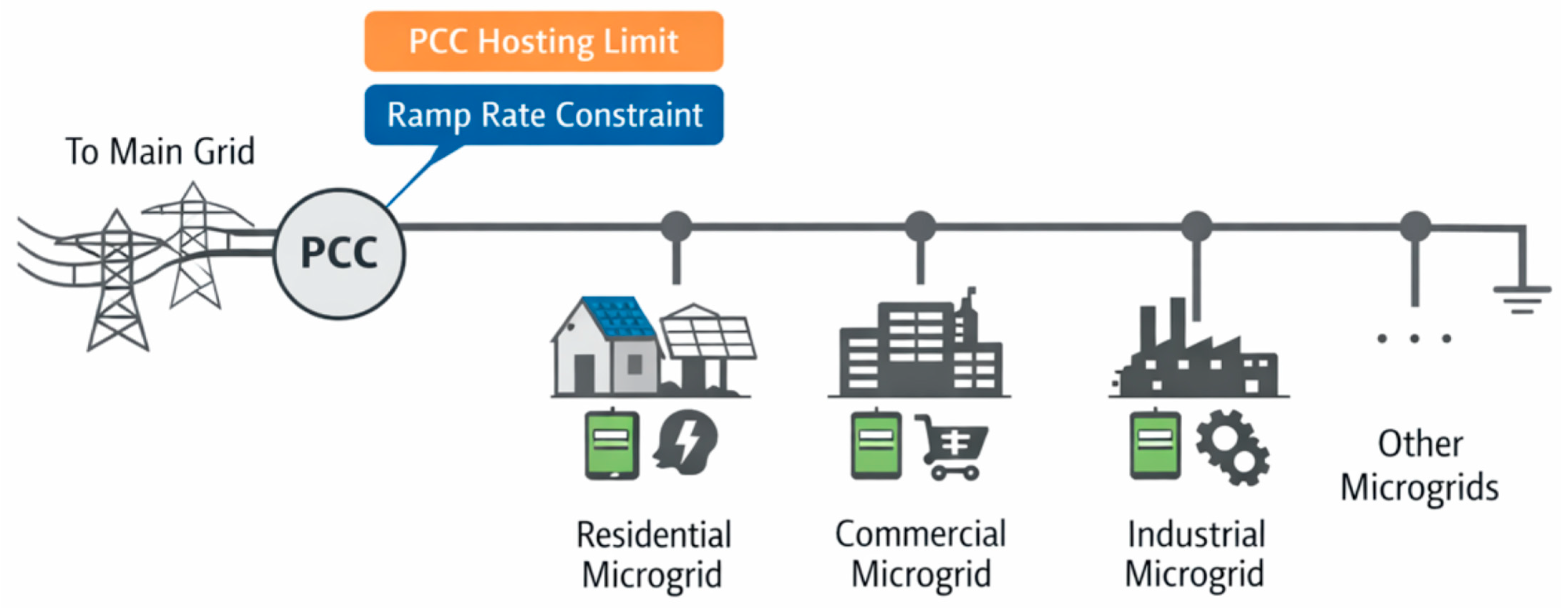
We consider a radial medium-voltage distribution feeder connected to the upstream grid through a point of common coupling (PCC), as it is shown in Figure 1. The feeder hosts a set of microgrids indexed by j = 1, …, N.
Each microgrid represents a controllable energy entity connected at a specific bus and characterized by
  • A local AC load profile;
  • A battery energy storage system (BESS);
  • Optional local generation and grid exchange capability.
Time is discretized into hourly intervals t = 1, …, T, with T = 8760.
Each microgrid is modeled at the planning level as an aggregated energy entity, without resolving internal low-voltage network details.

2.2. Load Data and Microgrid Typology

The load profiles used in this study are taken from the ELMAS dataset, an open-access collection of hourly electricity consumption data for French consumers. The dataset provides clustered load profiles derived from real measurements.
Three representative clusters are selected:
  • Type R (Residential/light tertiary);
  • Type C (Commercial);
  • Type I (Industrial).
Each microgrid is assigned to one of these types. The category “Other Microgrids” shown in Figure 1 does not represent a distinct microgrid type. Instead, it denotes additional microgrids of the same predefined types (R, C, or I), which are included to scale the system size. These microgrids are modeled identically to the primary clusters and are constructed by replicating and scaling the corresponding ELMAS-based load profiles. Therefore, no additional modeling assumptions are introduced for this category. Increasing the number of microgrids N corresponds to aggregating additional real cluster-based load profiles, scaled within realistic bounds to reflect diversity among consumers. This approach allows the construction of arbitrarily large microgrid clusters using only real measured data, without relying on synthetic demand generation. All replicated profiles remain directly traceable to real measurements contained in the ELMAS dataset [31].
Temporal correlations and variability patterns inherent in the original measurements are preserved during this aggregation process.
In addition to the load data, the PV generation profiles used in this study are constructed to be consistent with the temporal resolution of the ELMAS dataset (hourly). Specifically, normalized PV production profiles are adopted to represent typical daily and seasonal solar generation patterns and are scaled appropriately to reflect microgrid-level installations. Although the load data are derived from real measurements (ELMAS dataset [31]), the PV profiles are introduced as representative generation patterns to enable the analysis of renewable-dominated microgrid operation. This approach ensures consistency between load and generation time series while preserving realistic variability for planning-level assessment.
Although the present study is based on the ELMAS dataset, the proposed framework is not restricted to a specific data source. The methodology is fully data-driven and can be applied to load profiles from different regions or datasets without modification.
It should be noted that the numerical results, including the estimated hosting capacity, depend on the statistical characteristics of the underlying demand data, such as peak coincidence and temporal variability. Therefore, while the methodological framework is general, the quantitative outcomes may vary across different geographical or consumption contexts.

2.3. Battery Energy Storage and (SOE Dynamics and Limits)

Each microgrid j is equipped with a BESS of nominal energy capacity E j nom (kWh). The SOE is normalized as:
SOE j t = E j t E j nom , 0 SOE j t 1
The SOE evolves according to the discrete-time energy balance:
E j t + 1 = E j t + η ch P ch , j t Δ t 1 η dis P dis , j t Δ t
where P ch , j t 0 and P dis , j t 0 denote charging and discharging power, η ch , η dis ( 0 , 1 are efficiencies, and Δ t = 1 h.
Operational limits are enforced as:
SOE min SOE j t SOE max ,   j , t
where SOE min ,   SOE max represent technical bounds. In addition, a tighter healthy operating window SOE h , min ,   SOE h , max can be introduced to quantify operational stress and avoid sustained operation near extreme limits.

2.4. Power Balance and PCC Constraints

At each time step, the microgrid-level power balance is written as:
P grid , j t + P dis , j t P ch , j t + P gen , j t + P pv , j t = P load , j t P shed , j t
where P grid , j t denotes the power exchanged between microgrid j and the feeder (positive for import), P pv , j t and P gen , j t denote optional local PV and dispatchable generation, and P shed , j t 0 is load shedding (unserved load) used to define reliability metrics (Section 2.5). In the present case study, only PV generation and BESS are considered. Dispatchable generation is not included in the numerical analysis, as the focus is placed on evaluating the impact of storage coordination and feeder-level constraints under renewable-dominated operating conditions. However, the proposed framework remains fully general and can incorporate dispatchable generation without modification. In the present paper, feeder impacts are represented at the PCC through aggregate constraints rather than detailed branch-flow equations.
The aggregate PCC exchange is:
P PCC t = j = 1 N P grid , j t
The PCC hosting-capacity constraint is imposed as:
P PCC t P PCC max ,   t
and the ramp-rate constraint is:
P PCC t P PCC t 1 Δ P PCC max ,   t 2
These two constraints act as planning-level proxies for feeder/PCC interface capability, limiting both peak exchange and rapid variations that may stress distribution-level operation.
In the present framework, distribution network operational limits are represented at the feeder interface through PCC power-capacity and ramp-rate constraints. This planning-level abstraction serves as a proxy for feeder thermal limits and operational flexibility, enabling scalable multi-microgrid hosting-capacity assessment without requiring a detailed branch-flow or voltage-constrained network model.
It should be noted that the present formulation adopts a planning-level abstraction of the distribution network, where feeder constraints are represented through PCC power-capacity and ramp-rate limits. While this approach enables scalability and tractability for large multi-microgrid systems, it does not explicitly capture voltage profiles, branch power flows, or transformer loading constraints.
Therefore, the proposed framework is primarily intended for early-stage planning and comparative analysis. The incorporation of detailed power-flow models and voltage security constraints constitutes a natural extension of this work when applying the methodology to specific distribution networks.

2.5. Reliability Metric and Safety-Oriented Stress Proxies

Reliability is assessed using the Loss of Power Supply Probability (LPSP), defined as the ratio of total unserved energy to total demand energy:
LPSP = t = 1 T j = 1 N P shed , j t Δ t t = 1 T j = 1 N P load , j t Δ t  
A reliability requirement can be enforced by:
LPSP LPSP max  
In addition to LPSP, safety-oriented stress proxies are introduced to support planning comparisons. Typical examples include: (i) time spent near SOE extremes, (ii) excessive charge/discharge utilization, and (iii) proximity to PCC limits. For instance, a normalized PCC stress proxy can be defined as:
J PCC = 1 T t = 1 T P PCC t P PCC max  
and an SOE stress proxy may capture deviation from the healthy window (exact form can be selected depending on the optimization objective). These proxies are not proposed as standardized metrics, but as optimization-compatible indicators derived from physical operating limits.

2.6. Planning Optimization Problem (Independent vs. Coordinated)

Two planning paradigms are considered in order to evaluate the impact of feeder-level coordination on the admissibility of multiple grid-connected microgrids.
In the independent planning approach, each microgrid is designed and operated locally without explicitly considering the aggregated impact of other microgrids on the distribution feeder. Each microgrid optimizes its operation subject only to local energy balance and storage constraints. Consequently, the aggregate behavior at the point of common coupling (PCC) emerges from the coincident operation of multiple independently planned microgrids.
In contrast, the coordinated planning approach considers all microgrids connected to the feeder simultaneously within a single feeder-level optimization problem. In this formulation, the power exchange at the PCC and the ramp-rate limits are explicitly embedded as system-level constraints. The optimization redistributes operational flexibility across the set of microgrids, particularly through the coordinated use of battery energy storage systems, in order to avoid excessive stress at the feeder interface.
Let j = 1 ,     , N denote the index of the microgrid and t = 1 ,     , T the time index. The main decision variables include the grid exchange power P g r i d , j t , the battery charging and discharging powers P c h , j t and P d i s , j t , the battery state of energy E j t , and the potential load shedding P s h e d , j t . When renewable generation or local backup generators are explicitly modeled, the variables P p v , j t and P g e n , j t may also be included.
The coordinated planning problem is formulated as a feasibility-oriented optimization problem that minimizes the total amount of unserved demand while satisfying both microgrid-level and feeder-level operational constraints. The objective function is defined as:
min t = 1 T P s h e d t o t t  
where
P s h e d t o t t = j = 1 N P s h e d , j t  
represents the total load shedding across all microgrids at time t . This formulation ensures that the optimization seeks feasible operational trajectories while avoiding unserved demand whenever possible.
In this formulation, load shedding is directly minimized through the objective function and therefore acts as an implicit penalty term. No explicit economic cost (e.g., value of lost load) is assigned, as the focus of the present study is on feasibility and reliability assessment rather than economic optimization.
The optimization problem is subject to the constraints described in Section 2.3, Section 2.4 and Section 2.5, including the microgrid energy balance equations, the battery State-of-Energy dynamics and limits, the charging and discharging power limits, and the non-negativity of load shedding.
At the feeder level, the total power exchanged at the PCC is defined as:
P P C C t = j = 1 N P g r i d , j t  
and is constrained by the maximum allowable feeder capacity:
P P C C t P P C C m a x  
To avoid rapid variations in feeder power, an additional ramp-rate constraint is imposed:
P P C C t P P C C t 1 Δ P P C C m a x  
For compactness, let x denote the vector collecting all decision variables of the coordinated multi-microgrid problem. The feasible set Ω is defined as the set of all decision vectors satisfying the microgrid-level operational constraints as well as the feeder-level PCC and ramp-rate constraints. The coordinated planning problem can therefore be written in compact form as:
min x Ω t = 1 T P s h e d t o t t  
Within this framework, the plug-and-play admission rule can be interpreted as a feasibility test. For a given feeder and PCC limit, the connection of an additional microgrid is considered admissible if and only if the enlarged optimization problem remains feasible while satisfying all feeder-level and microgrid-level constraints.

Formal Planning-Level Plug-and-Play Admissibility Criterion

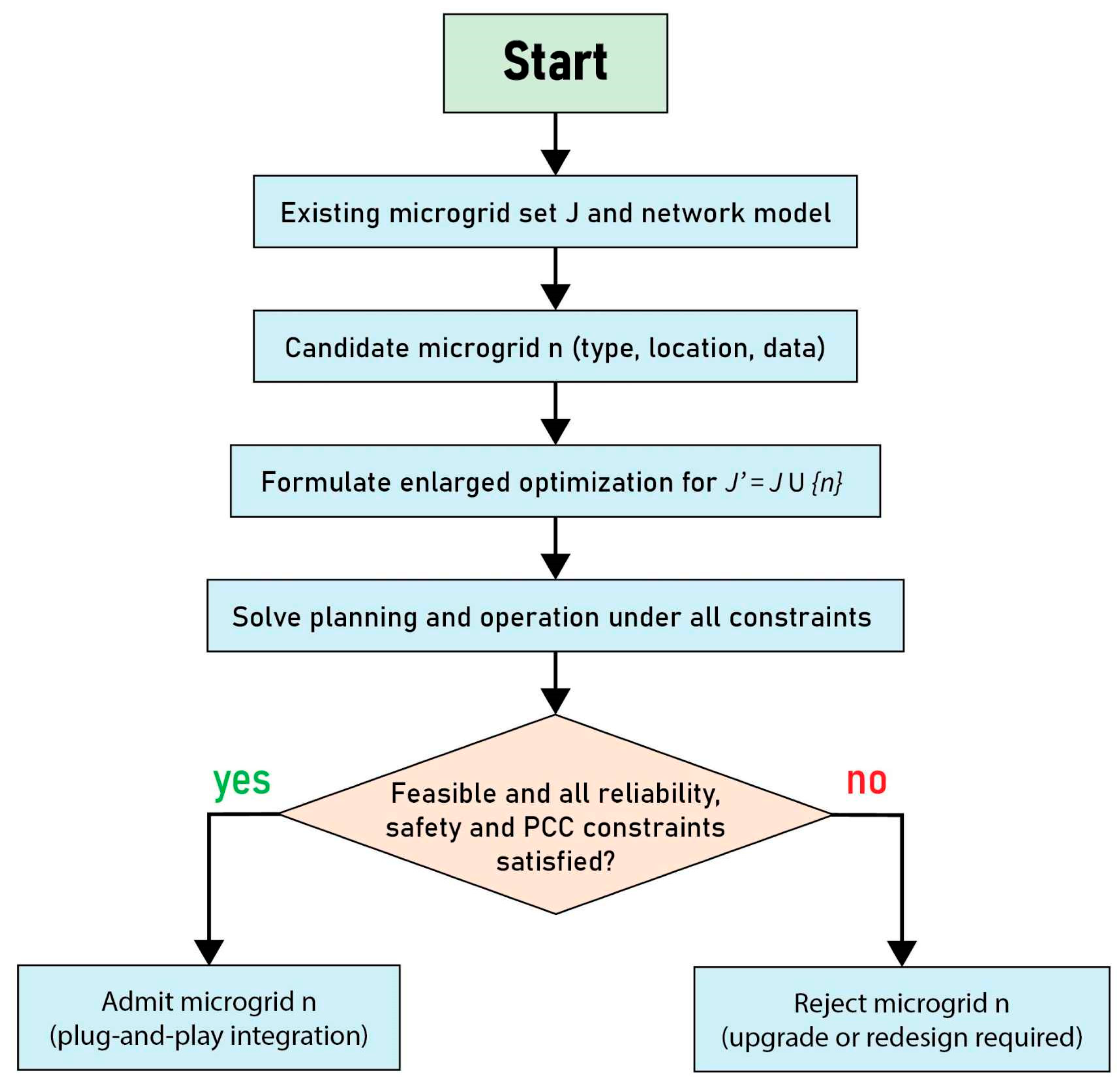
Let J denote the set of microgrids already connected to the distribution feeder and let n denote a candidate microgrid requesting connection. Let P J represent the coordinated planning optimization problem defined in Section 2.1, Section 2.2, Section 2.3, Section 2.4, Section 2.5 and Section 2.6 for the set J .
The candidate microgrid n is said to be plug-and-play admissible at the planning level if and only if the enlarged optimization problem:
P J with J = J n
admits at least one feasible solution satisfying all imposed constraints, including:
(i)
Microgrid-level power balance constraints;
(ii)
PCC hosting-capacity and ramp-rate constraints;
(iii)
SOE operational limits and any safety-oriented stress bounds (if enforced);
(iv)
The prescribed reliability constraint expressed through LPSP.
If P J is infeasible, the connection of microgrid n is rejected at the planning stage, and network reinforcement or redesign of existing microgrids is required prior to admission.
This definition translates the plug-and-play concept into a binary, optimization-based admission test that is independent of connection order and directly applicable to distribution-level planning studies.
For clarity and reproducibility, the main numerical parameters and planning constraints adopted in the case study are summarized in Table 1, and the flowchart diagram is presented in Figure 2.
All numerical parameters were selected within ranges commonly reported in the microgrid planning and hosting-capacity literature, ensuring that the results reflect realistic distribution-level operating conditions rather than optimistic assumptions and are shown in Table 1.
For practical implementation, the plug-and-play admission rule is summarized in Algorithm 1.
Algorithm 1. Planning-level plug-and-play admission test

  Initialize set J
  Define candidate microgrid n
  Set J’ = J ∪ {n}
  Formulate problem P(J’)
  Solve optimization
   If feasible:
  admit n
   Else:
  reject n or reenforce the feeder
 

3. Uncertainty Modeling

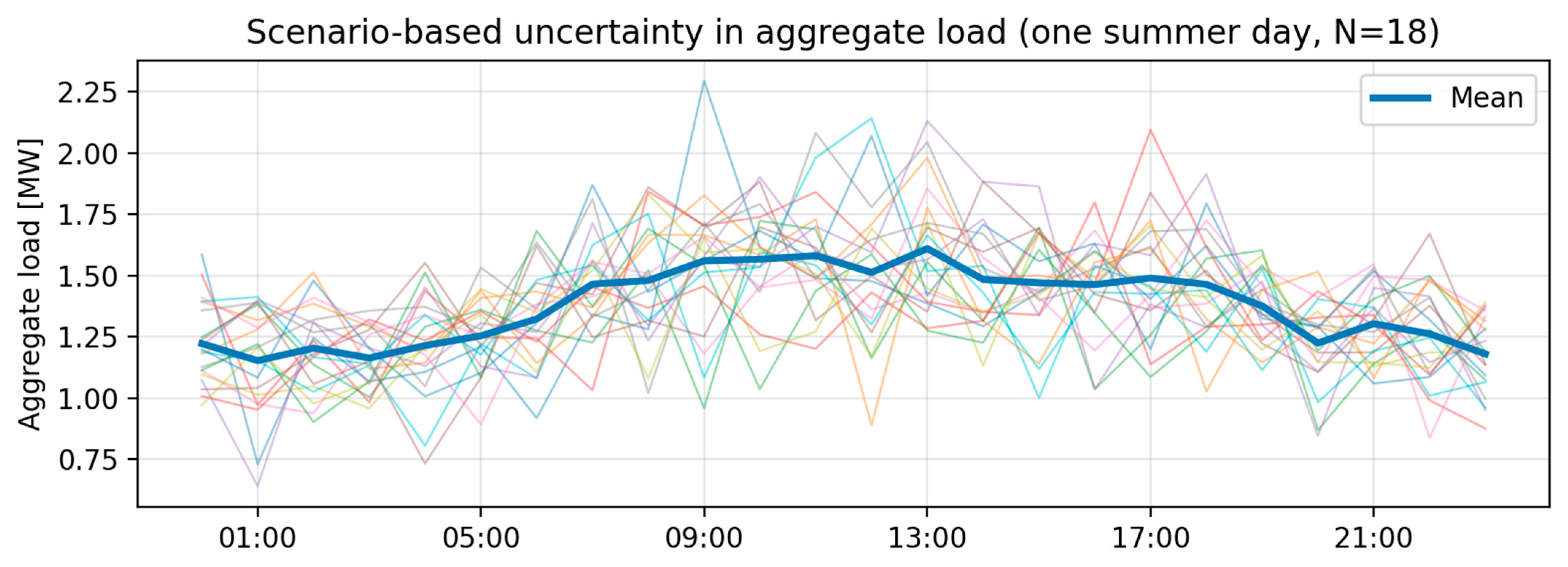
Load uncertainty is modelled using a scenario-based stochastic framework built upon the real ELMAS demand profiles (Figure 3). A finite set of scenarios is generated by applying bounded stochastic perturbations to the measured load time series, while preserving the main daily and weekly temporal patterns observed in the original measurements. Specifically, for each time step t , the load in scenario s is defined as:
P load , j , s t = P load , j ELMAS t 1 + ϵ s t
where ϵ s t is a zero-mean bounded random variable satisfying ϵ s t ϵ ¯ . In this study, ϵ ¯ = 15 % is adopted, in line with typical short-term load forecast errors reported in the literature. The perturbation process is applied consistently over time within each scenario in order to avoid unrealistic hour-to-hour fluctuations.
The selected ±15% uncertainty bound was chosen as a representative level of variability for aggregated distribution-level demand. In practice, load uncertainty depends on temporal resolution, forecasting horizon, and aggregation level. While aggregation smooths individual fluctuations, significant variability remains due to behavioral and temporal patterns. Therefore, a ±15% bound provides a balanced representation of uncertainty without overestimating extreme fluctuations.
Furthermore, the number of scenarios (S = 20) was selected as a trade-off between capturing variability and maintaining computational tractability. Scenario-based stochastic programming typically involves a compromise between model accuracy and solution time, particularly in large-scale multi-microgrid problems.
These assumptions are consistent with probabilistic load forecasting and uncertainty-aware energy system studies [78,79]. In addition, recent works on energy management under uncertainty in hybrid microgrids further highlight the importance of data-driven decision-making frameworks that explicitly account for variability in demand and renewable generation [80].
Investment decisions (PV, BESS and generator sizing) are treated as here-and-now variables and are therefore scenario-independent, while operational variables (dispatch, SOE evolution and grid exchanges) adapt to each scenario. This structure enables robust planning decisions that remain feasible across a representative range of demand realizations derived from real measurements. The purpose of this uncertainty model is to assess the robustness of planning decisions and admissibility conditions, rather than to develop or benchmark probabilistic load forecasting models.

4. Results: Hosting Capacity and Plug-and-Play Admissibility

This section presents the numerical results obtained using real hourly load profiles from the ELMAS dataset. The focus is on quantifying the impact of increasing the number of connected microgrids on PCC behavior and on identifying a practical hosting-capacity limit in terms of the maximum admissible number of microgrids.

4.1. Impact of Increasing N on PCC Loading

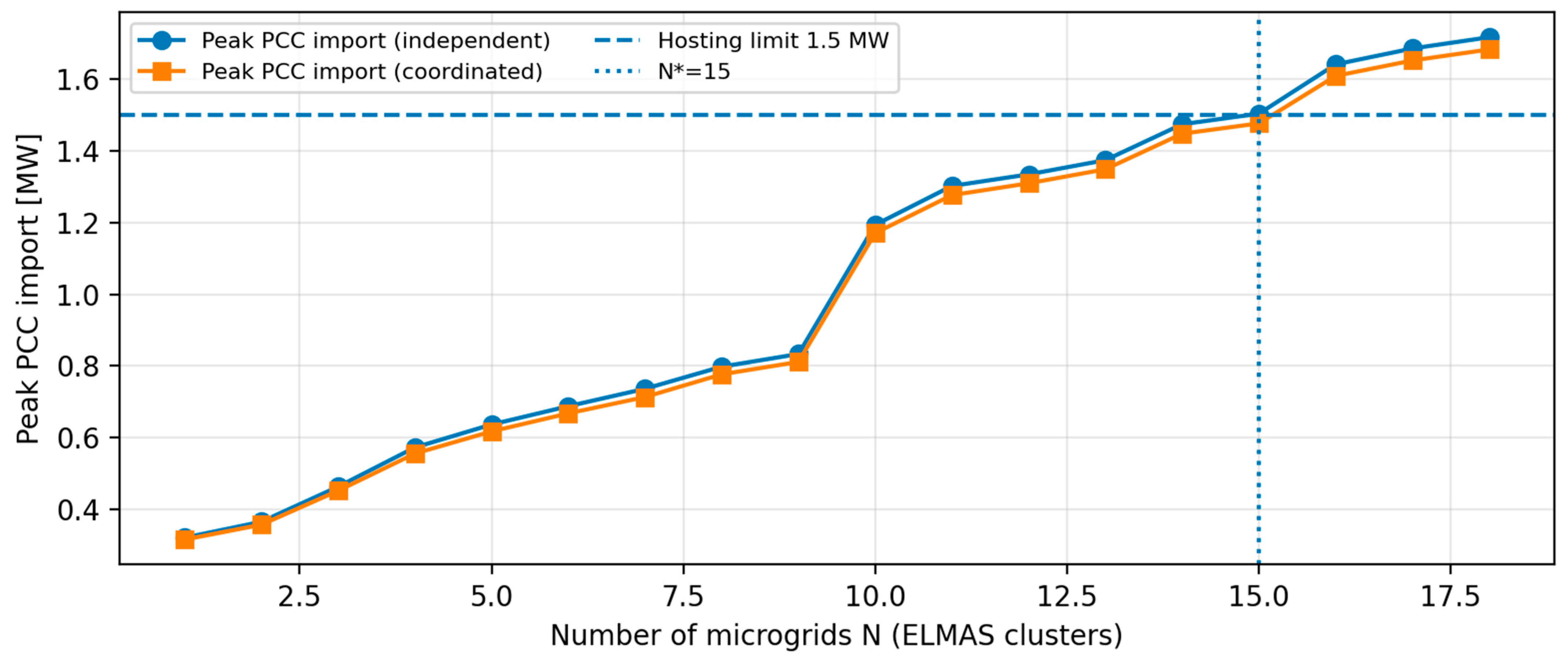
Figure 4 illustrates the evolution of the peak power imported at the point of common coupling (PCC) as a function of the number of connected microgrids N, using real ELMAS load clusters. Results are shown for two planning strategies: independent planning, where each microgrid is designed without considering system-level interactions, and coordinated planning, where all microgrids are planned jointly under PCC constraints.
Under independent planning, the peak PCC import increases almost linearly with N, reflecting the aggregation of coincident demand peaks across microgrids. As N grows, simultaneous high-load periods lead to pronounced stress at the PCC, and the hosting-capacity limit of 1.5 MW is exceeded for relatively small values of N.
In contrast, coordinated planning significantly moderates the growth of peak PCC import. By internalizing the PCC constraint at the planning stage, optimization redistributes flexibility across microgrids and avoids excessive coincidence of peak demand. As a result, the peak PCC import remains below the hosting-capacity limit for a larger range of N.
The vertical marker in Figure 4 indicates the maximum admissible number of microgrids N * under coordinated planning. Beyond this point, no feasible solution satisfying the PCC constraint can be found, even with coordinated planning. This value of N * therefore represents the effective hosting capacity of the feeder expressed in terms of microgrid count, rather than installed capacity alone.
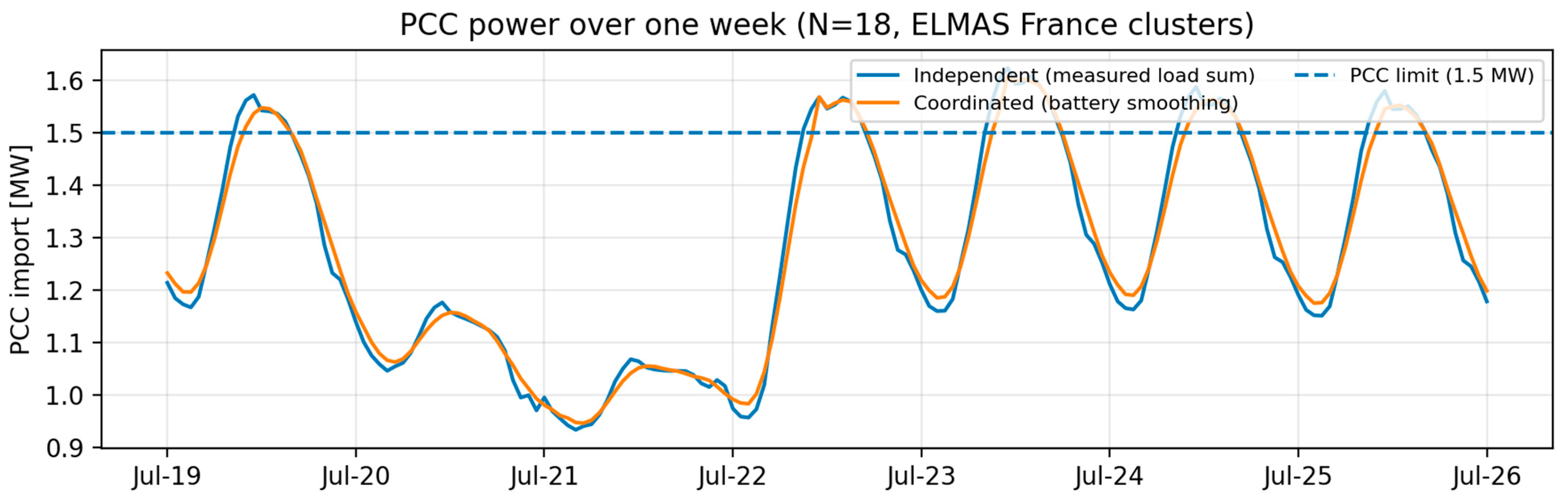
To complement the aggregated hosting-capacity analysis, Figure 5 illustrates the time evolution of the net PCC power over one representative summer week for a high-penetration case (N = 18), using real hourly load profiles from the ELMAS dataset.
In addition to limiting the peak PCC import, coordinated planning also reduces rapid variations of PCC power, ensuring compliance with the imposed ramp-rate constraint.
Table 2 provides a quantitative comparison between independent and coordinated planning strategies, showing that coordinated optimization increases the admissible number of microgrids while simultaneously reducing PCC loading, ramp-rate violations, and battery operational stress.

4.2. Interpretation in Terms of Plug-and-Play Admissibility

From a planning perspective, the plug-and-play admissibility test reduces to a feasibility check of the enlarged optimization problem after the addition of a candidate microgrid.
The results in Figure 4 provide direct quantitative support for the proposed plug-and-play admission rule. For a given feeder and PCC limit, a candidate microgrid can be admitted if and only if the enlarged optimization problem remains feasible and the resulting PCC loading does not exceed the hosting-capacity constraint.
For N < N * , coordinated planning yields feasible solutions that respect the PCC limit, indicating that additional microgrids can be safely integrated without network reinforcement. For N > N * , the PCC constraint becomes binding and no feasible solution exists, implying that further microgrid connections would require feeder upgrades, PCC reinforcement, or redesign of existing microgrids.
Importantly, these conclusions are drawn using exclusively real measured load profiles from the ELMAS dataset. The identified hosting-capacity limit therefore reflects realistic demand variability and peak coincidence, rather than artefacts of synthetic or stylized load generation.
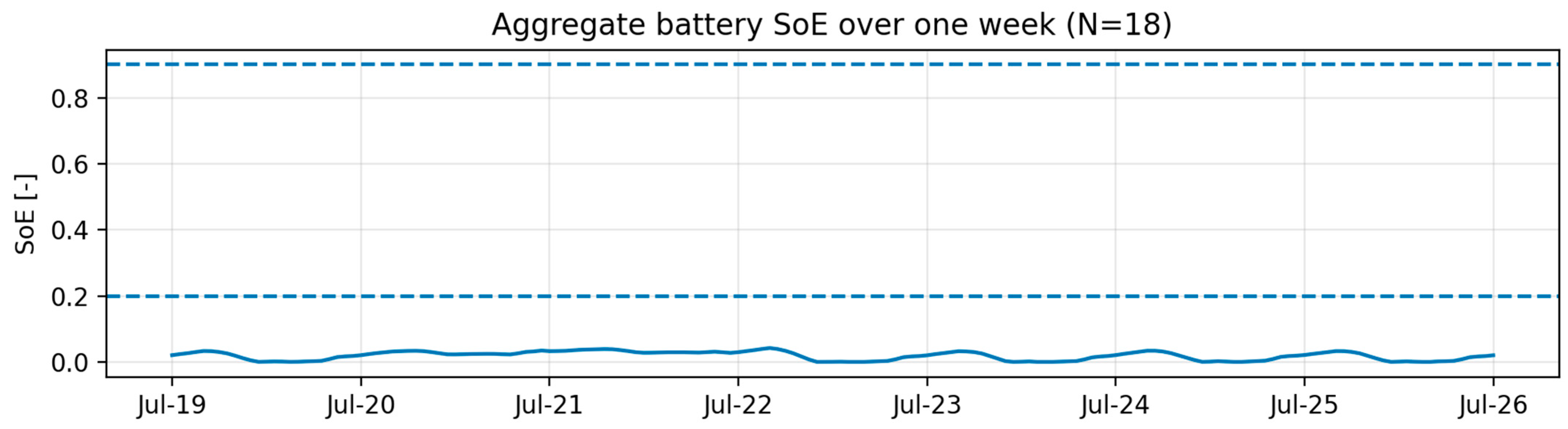
Figure 6 reports the aggregate battery State of Energy (SoE) trajectory over the same representative week for the coordinated planning case. The plotted quantity represents the normalized aggregate SoE variation across all microgrids, rather than the absolute SoE of individual batteries.
The results indicate that the smoothing of PCC power shown in Figure 5 is achieved without pushing storage systems towards their operational limits. The aggregate SoE remains well within the predefined safe operating window, confirming that coordinated planning mitigates network stress without inducing excessive battery depletion or overcharging.

4.3. Implications for Distribution-Level Planning

Expressing hosting capacity in terms of the admissible number of microgrids provides a planning-oriented metric that is directly actionable for distribution system operators. Rather than relying solely on aggregate installed capacity limits, the proposed framework allows DSOs to assess whether a specific new microgrid can be connected, given the existing set of connected microgrids and their realistic load characteristics.
The results demonstrate that coordinated planning substantially increases the number of microgrids that can be safely hosted on a feeder, while independent planning leads to premature saturation of the PCC. This highlights the importance of system-level optimization when moving from isolated microgrid design to large-scale multi-microgrid deployment.
Similar operational philosophies have been explored in studies focusing on zero feed-in photovoltaic systems, where grid injection is explicitly limited in order to comply with distribution network constraints. Such approaches further highlight the importance of coordinated control and planning when integrating distributed generation under feeder-level limitations [81,82].

4.4. Sensitivity Analysis of the Plug-and-Play Hosting Capacity

To assess the robustness and practical relevance of the proposed plug-and-play admission rule, a sensitivity analysis is conducted with respect to key network-level constraints imposed at the point of common coupling. In particular, the impact of the PCC hosting-capacity limit P PCC max and the ramp-rate limit Δ P PCC max on the maximum admissible number of microgrids N * is investigated.
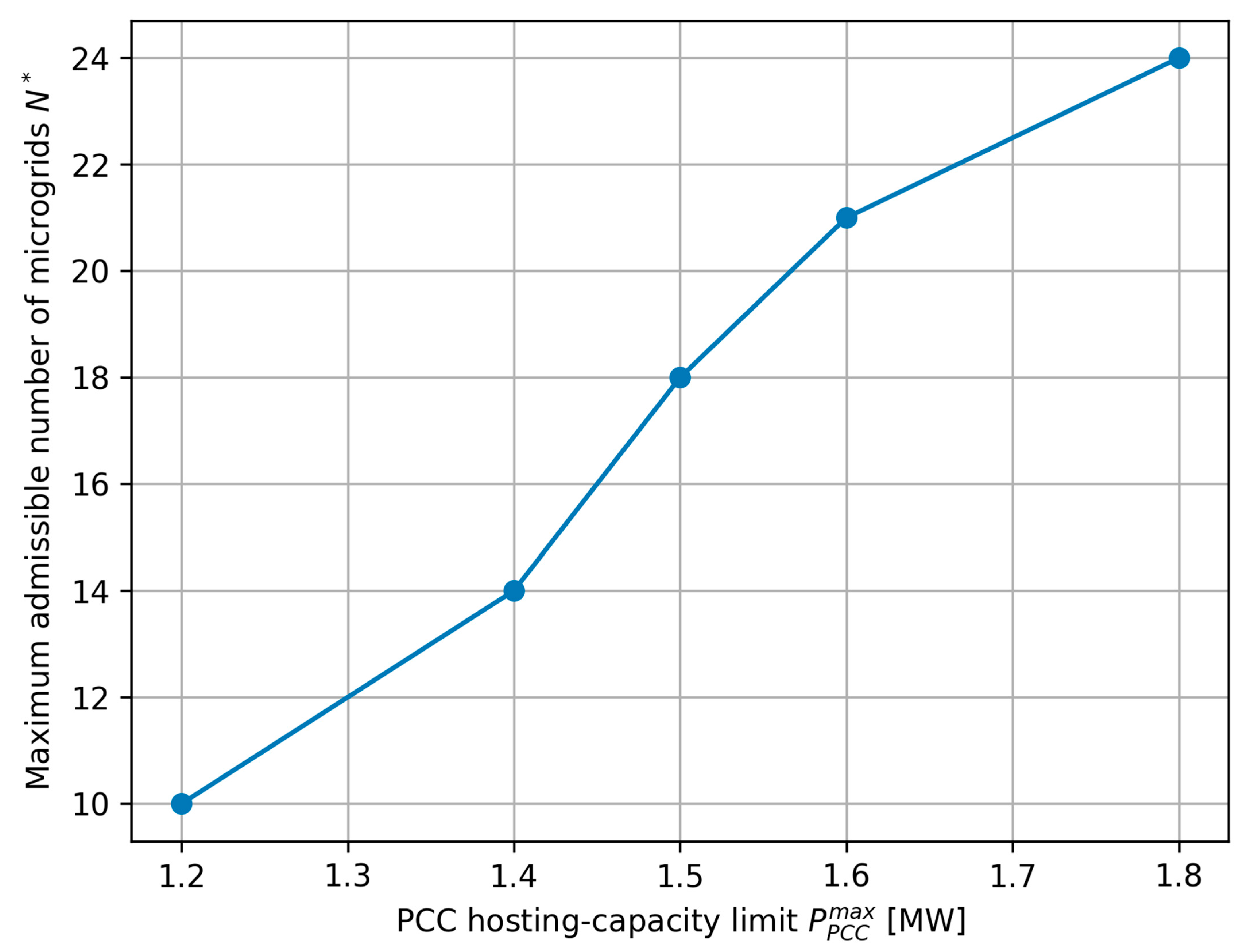
Figure 7 illustrates the variation of N * as a function of the PCC hosting-capacity limit, considering values of P PCC max ranging from 1.2 MW to 1.8 MW. As expected, increasing the allowable PCC capacity directly increases the number of admissible microgrids. However, the relationship is nonlinear: beyond a certain point, additional capacity yields diminishing returns due to the binding nature of other constraints, such as aggregate SOE limits and ramp-rate restrictions.
A similar trend is observed when relaxing the PCC ramp-rate constraint. Tighter ramp-rate limits significantly reduce N * , even when the hosting-capacity limit is sufficiently large. This highlights the importance of dynamic stress considerations at the feeder interface, which are often overlooked in static hosting-capacity assessments.
These results demonstrate that the proposed framework does not merely provide a single hosting-capacity value but rather enables what-if analysis for distribution system operators. By adjusting a small number of physically interpretable parameters, DSOs can directly quantify how network reinforcements or operational policy changes translate into increased plug-and-play admissibility of microgrids.
Figure 7 illustrates the sensitivity of the effective hosting capacity to the PCC hosting-capacity limit. As expected, increasing P P C C m a x allows a larger number of microgrids to be safely integrated. However, the relationship is clearly non-linear, reflecting the combined effects of load coincidence, temporal variability and storage flexibility. This result highlights that feeder reinforcement does not translate linearly into additional admissible microgrids, reinforcing the need for optimization-based planning rather than static capacity rules.
While the present study adopts a fixed uncertainty bound (±15%) and a limited number of scenarios (S = 20) for tractability, a detailed sensitivity analysis with respect to the uncertainty amplitude and scenario number would provide further insight into the robustness of the results.
In addition, alternative uncertainty modeling approaches, such as robust optimization frameworks, could be explored in future work to compare solution conservativeness and computational performance. The present scenario-based approach was selected due to its transparency, interpretability, and suitability for planning-level feasibility analysis.

4.5. Comparison with a Conventional Hosting-Capacity Criterion

In order to highlight the practical value of the proposed framework, a comparison is performed with a conventional hosting-capacity assessment approach commonly used in distribution planning studies, as it is shown in Table 3. In traditional methods, the admissibility of additional distributed resources is typically evaluated using static feeder limits, such as maximum allowable power at the point of common coupling (PCC). In such approaches, a new microgrid can be connected as long as the aggregate power exchange at the PCC does not exceed a predefined capacity threshold.
In contrast, the framework proposed in this paper evaluates microgrid admissibility using a coordinated optimization-based feasibility test. Instead of relying solely on static PCC capacity limits, the proposed method simultaneously accounts for multiple operational constraints, including PCC hosting-capacity limits, ramp-rate restrictions, battery state-of-energy dynamics, and reliability requirements expressed through the LPSP indicator. As a result, the admission decision is based on the overall feasibility of the enlarged multi-microgrid system rather than on a single static limit.
Table 3 summarizes the key differences between the conventional hosting-capacity criterion and the proposed optimization-based plug-and-play admission framework.

5. Discussion

The proposed framework provides a planning-level interpretation of the plug-and-play concept for grid-connected microgrids, shifting the focus from converter-level control stability to system-wide feasibility under network, reliability and safety constraints. By explicitly embedding multiple microgrids in a distribution feeder model and enforcing hosting-capacity and ramp-rate limits at the PCC, the framework enables a direct assessment of how many microgrids can be safely accommodated without violating operational limits.
A key aspect of this work is the exclusive use of real, open-access load data from the ELMAS dataset. Unlike studies based on synthetic or stylized demand profiles, the results reported here reflect realistic temporal correlations, variability patterns and peak-demand characteristics observed in practice. Therefore, the identified hosting-capacity limits and admissibility conditions are directly interpretable by distribution system operators and are less sensitive to modelling artefacts. It should be noted that the PV generation profiles are based on representative normalized patterns rather than site-specific measurements, which is consistent with the planning-level scope of the present study.
The results highlight the importance of coordinated planning. When microgrids are treated as independent entities, simultaneous demand or export patterns can lead to excessive stress at the PCC and reduced operational margins. In contrast, coordinated planning internalizes network constraints and redistributes flexibility across the feeder, resulting in smoother PCC behavior and reduced stress on storage systems. This effect becomes increasingly pronounced as the number of connected microgrids grows.
From an economic perspective, the improved coordination of microgrids and storage operation can also translate into enhanced system-wide benefits. By smoothing power exchanges at the PCC and reducing peak demand and ramping requirements, coordinated strategies can lower operational costs, defer network reinforcements, and increase the overall value of distributed flexibility. This observation is consistent with recent studies that analyze the economic potential of energy storage in distribution systems, showing that properly managed storage resources can significantly contribute to social welfare maximization under uncertainty and risk considerations [83].
Uncertainty modelling further reinforces these conclusions. By accounting for realistic load variability derived from measured data, the stochastic formulation identifies designs that remain feasible across a range of operating conditions. Rather than aiming at probabilistic forecasting accuracy, the uncertainty model serves to test the robustness of the plug-and-play admission rule and to avoid designs that are only feasible under nominal conditions.
Finally, the proposed framework establishes a clear separation between planning-level feasibility and operational decision-making. Future work may investigate how predictive operational strategies can be integrated within the feasibility boundaries defined at the planning stage, without compromising network, reliability, and safety constraints.
An important contribution of the present work is the translation of the plug-and-play microgrid concept from the control and converter level into a planning-level decision framework applicable to distribution networks. By expressing hosting capacity in terms of the maximum admissible number of coordinated microgrids rather than installed generation capacity alone, the proposed approach provides a practical and system-oriented metric that is directly interpretable for distribution system operators. This perspective shifts the focus of hosting-capacity assessment from static feeder limits toward coordinated multi-microgrid feasibility, enabling more realistic planning decisions in distribution systems with high penetration of distributed energy resources and battery storage.

6. Conclusions

This paper has presented a data-driven, optimization-based framework for the planning and operation of an arbitrary number of grid-connected microgrids embedded in a distribution feeder. By combining real measured load data, explicit network constraints and reliability- and safety-oriented indicators, the proposed approach translates the concept of plug-and-play microgrids into a clear and quantitative planning-level admission rule.
The use of open-access ELMAS load data enables scalability to large multi-microgrid clusters without resorting to synthetic demand generation, ensuring that the reported trends reflect realistic consumption behavior. The results demonstrate that coordinated planning significantly improves PCC behavior, reduces operational stress on storage systems and provides a transparent criterion for determining the effective hosting capacity of a feeder in terms of the maximum admissible number of microgrids.
The extension to scenario-based uncertainty modelling demonstrates that the proposed plug-and-play admission rule remains valid under realistic load variability and is not limited to nominal operating conditions. By explicitly accounting for demand uncertainty derived from real measurements, the framework avoids designs that are only feasible under idealized assumptions and ensures robustness across a representative range of operating scenarios.
From a practical perspective, the proposed framework provides a directly applicable decision-support tool for distribution system operators. By expressing hosting capacity in terms of the maximum admissible number of microgrids, rather than installed generation capacity, the approach enables intuitive and operationally meaningful planning decisions.
In addition, the use of explicit PCC constraints and storage-aware coordination allows operators to evaluate the impact of network limitations, operational policies, and flexibility resources without requiring detailed network models. This makes the framework particularly suitable for early-stage planning, rapid scenario assessment, and comparative evaluation of microgrid integration strategies under realistic conditions.
Future work will focus on the application of the proposed approach to real distribution feeders with detailed network models, as well as on the integration of additional resilience and cyber-security considerations.

Author Contributions

Conceptualization, S.K.; methodology, S.K.; formal analysis, S.K.; investigation, S.K.; data curation, S.K.; writing—original draft preparation, S.K.; writing—review and editing, S.K. Supervision, C.E. All authors have read and agreed to the published version of the manuscript.

Funding

This research received no external funding.

Institutional Review Board Statement

Not applicable.

Informed Consent Statement

Not applicable.

Data Availability Statement

The electricity demand data used in this study are derived from the publicly available ELMAS dataset, which provides hourly electricity consumption profiles for French industrial and tertiary sectors. Representative demand categories used in this work were constructed from clustered ELMAS profiles.

Conflicts of Interest

The authors declare no conflicts of interest.

Nomenclature

jindex of microgrids, j = 1, … ,N
ttime index, t = 1, …, T
sscenario index in the stochastic formulation
Ntotal number of microgrids
Ttotal number of time steps
Δttime-step duration
E j t stored energy of microgrid j at time t
E j nom nominal BESS energy capacity of microgrid j
SO E j t stored energy of microgrid j at time t
P ch , j t charging power of the BESS in microgrid j
P dis , j t discharging power of the BESS in microgrid j
P grid , j t power exchanged between microgrid j and the feeder
P pv , j t photovoltaic power in microgrid j
P gen , j t dispatchable generation power in microgrid j
P load , j t load demand of microgrid j
P shed , j t shed load in microgrid j
P PCC t aggregate power exchange at the PCC
P P C C max PCC hosting-capacity limit
Δ P P C C max PCC ramp-rate limit
η c h ,   η dis charging and discharging efficiency coefficients
ϵ s t load perturbation in scenario s at time t
ϵ ¯ uncertainty bound
J PCC normalized PCC stress proxy
Ωfeasible set of the coordinated optimization problem
J set of already connected microgrids
P J planning optimization problem for set J

Abbreviations

The following abbreviations are used in this manuscript:
BESSBattery Energy Storage Systems
SOEState of Energy
PCCPoint of Common Coupling
ELMASElectricity Load Measurements and Analysis
DERDistributed Energy Resource
PSOParticle Swarm Optimization
GWOGrey Wolf Optimizer
MPCModel Predictive Control
DSODistribution System Operator
TSOTransmission System Operator
LPSPLoss of Power Supply Probability

References

  1. Hatziargyriou, N. Microgrids. IEEE Power Energy Mag. 2008, 6, 26–29. [Google Scholar] [CrossRef] [Scilit]
  2. Lasseter, R.H. MicroGrids. In Proceedings of the IEEE Power Engineering Society Winter Meeting; IEEE: New York, NY, USA, 2002; Volume 1, pp. 305–308. [Google Scholar]
  3. Guerrero, J.M.; Vasquez, J.C.; Matas, J.; de Vicuña, L.G.; Castilla, M. Hierarchical Control of Droop-Controlled AC and DC Microgrids—A General Approach toward Standardization. IEEE Trans. Ind. Electron. 2011, 58, 158–172. [Google Scholar] [CrossRef] [Scilit]
  4. Olivares, D.E.; Mehrizi-Sani, A.; Etemadi, A.H.; Cañizares, C.A.; Iravani, R.; Kazerani, M.; Hajimiragha, A.H.; Gomis-Bellmunt, O.; Saeedifard, M.; Palma-Behnke, R.; et al. Trends in microgrid control. IEEE Trans. Smart Grid 2014, 5, 1905–1919. [Google Scholar] [CrossRef] [Scilit]
  5. Piagi, P.; Lasseter, R.H. Autonomous control of microgrids. In Proceedings of the IEEE Power Engineering Society General Meeting, Montreal, QC, Canada, 18–22 June 2006. [Google Scholar] [CrossRef] [Scilit]
  6. Logenthiran, T.; Srinivasan, D.; Khambadkone, A.M. Multi-agent system for energy resource scheduling of integrated microgrids in a distributed system. Electr. Power Syst. Res. 2011, 81, 138–148. [Google Scholar] [CrossRef] [Scilit]
  7. Parisio, A.; Rikos, E.; Glielmo, L. A Model Predictive Control Approach to Microgrid Operation Optimization. IEEE Trans. Control Syst. Technol. 2014, 22, 1813–1827. [Google Scholar] [CrossRef] [Scilit]
  8. Zhang, Y.; Gatsis, N.; Giannakis, G.B. Robust energy management for microgrids with high-penetration renewables. IEEE Trans. Sustain. Energy 2013, 4, 944–953. [Google Scholar] [CrossRef] [Scilit]
  9. Adefarati, T.; Bansal, R.C. Reliability, economic and environmental analysis of a microgrid system in the presence of renewable energy resources. Appl. Energy 2019, 236, 1089–1114. [Google Scholar] [CrossRef] [Scilit]
  10. Battula, A.R.; Vuddanti, S.; Salkuti, S.R. Review of Energy Management System Approaches in Microgrids. Energies 2021, 14, 5459. [Google Scholar] [CrossRef] [Scilit]
  11. Esparza, A.; Blondin, M.; Trovão, J.P.F. A Review of Optimization Strategies for Energy Management in Microgrids. Energies 2025, 18, 3245. [Google Scholar] [CrossRef] [Scilit]
  12. Zahraoui, Y.; Alhamrouni, I.; Mekhilef, S.; Basir Khan, M.R.; Seyedmahmoudian, M.; Stojcevski, A.; Horan, B. Energy Management System in Microgrids: A Comprehensive Review. Sustainability 2021, 13, 10492. [Google Scholar] [CrossRef] [Scilit]
  13. Zia, M.F.; Elbouchikhi, E.; Benbouzid, M. Microgrids energy management systems: A critical review on methods, solutions and prospects. Appl. Energy 2018, 222, 1033–1055. [Google Scholar] [CrossRef] [Scilit]
  14. Keskinis, S.; Elmasides, C.; Kosmadakis, I.E.; Raptis, I.; Tsikalakis, A. Techno-Economic Photovoltaic-Battery Energy Storage System Microgrids with Diesel Backup Generator: A Case Study in Industrial Loads in Germany Comparing Load-Following and Cycle-Charging Control. Energies 2025, 18, 6463. [Google Scholar] [CrossRef] [Scilit]
  15. Mroczek, B.; Pijarski, P. DSO Strategies Proposal for the LV Grid of the Future. Energies 2021, 14, 6327. [Google Scholar] [CrossRef] [Scilit]
  16. Pijarski, P.; Kacejko, P. Elimination of Line Overloads in a Power System Saturated with Renewable Energy Sources. Energies 2023, 16, 3751. [Google Scholar] [CrossRef] [Scilit]
  17. Pijarski, P.; Kacejko, P.; Wancerz, M. Voltage Control in MV Network with Distributed Generation—Possibilities of Real Quality Enhancement. Energies 2022, 15, 2081. [Google Scholar] [CrossRef] [Scilit]
  18. Liang, W.; Ma, X.; Yi, S.; Zhang, Y.; Dou, X. Dynamic collaborative optimization strategy for multiple area clusters in distribution networks considering topology change. Electricity 2025, 6, 10. [Google Scholar] [CrossRef] [Scilit]
  19. Jansen, L.A.; Botha, M.G.; van Schoor, G.; Uren, K.R. Increasing renewable energy penetration on low-voltage networks: An expert knowledge approach. Electricity 2024, 5, 804–825. [Google Scholar] [CrossRef] [Scilit]
  20. Al-Tameemi, Z.H.A.; Lie, T.T.; Foo, G.; Blaabjerg, F. Optimal coordinated control of DC microgrid based on hybrid PSO–GWO algorithm. Electricity 2022, 3, 346–364. [Google Scholar] [CrossRef] [Scilit]
  21. Daccò, E.; Falabretti, D.; Ilea, V.; Merlo, M.; Nebuloni, R.; Spiller, M. Decentralised Voltage Regulation through Optimal Reactive Power Flow in Distribution Networks with Dispersed Generation. Electricity 2024, 5, 134–153. [Google Scholar] [CrossRef] [Scilit]
  22. Bouhouras, A.S.; Kelepouris, N.S.; Koltsaklis, N.; Oureilidis, K.; Christoforidis, G.C. Congestion Management in Coupled TSO and DSO Networks. Electr. Power Syst. Res. 2024, 229, 110145. [Google Scholar] [CrossRef] [Scilit]
  23. Kouveliotis-Lysikatos, I.; Koukoula, D.I.; Dimeas, A.L.; Hatziargyriou, N.D. Plug-and-Play Algorithms for the Efficient Coordination of Active Distribution Grids. Proc. IEEE 2022, 110, 1927–1939. [Google Scholar] [CrossRef] [Scilit]
  24. Roldán-Blay, C.; Escrivá-Escrivá, G.; Roldán-Porta, C.; Álvarez-Bel, C. An Optimisation Algorithm for Distributed Energy Resources Management in Micro-Scale Energy Hubs. Energy 2017, 132, 126–135. [Google Scholar] [CrossRef] [Scilit]
  25. Roldán-Blay, C.; Escrivá-Escrivá, G.; Roldán-Porta, C. Improving the Benefits of Demand Response Participation in Facilities with Distributed Energy Resources. Energy 2019, 169, 710–718. [Google Scholar] [CrossRef] [Scilit]
  26. Roldán-Blay, C.; Escrivá-Escrivá, G.; Roldán-Porta, C.; Dasí-Crespo, D. Optimal Sizing and Design of Renewable Power Plants in Rural Microgrids Using Multi-Objective Particle Swarm Optimization and Branch and Bound Methods. Energy 2023, 284, 129318. [Google Scholar] [CrossRef] [Scilit]
  27. Fatima, S.; Püvi, V.; Lehtonen, M. Review on the PV Hosting Capacity in Distribution Networks. Energies 2020, 13, 4756. [Google Scholar] [CrossRef] [Scilit]
  28. Rossi, F.; Storti Gajani, G.; Grillo, S.; Gruosso, G. Future Smart Grids Control and Optimization: A Reinforcement Learning Tool for Optimal Operation Planning. Energies 2025, 18, 2513. [Google Scholar] [CrossRef] [Scilit]
  29. Kaushik, E.; Prakash, V.; Mahela, O.P.; Khan, B.; El-Shahat, A.; Abdelaziz, A.Y. Comprehensive Overview of Power System Flexibility during the Scenario of High Penetration of Renewable Energy in Utility Grid. Energies 2022, 15, 516. [Google Scholar] [CrossRef] [Scilit]
  30. Altamimi, A.; Ali, M.B.; Kazmi, S.A.A.; Khan, Z.A. Multi-Agent Reinforcement Learning Optimization Framework for On-Grid Electric Vehicle Charging from Base Transceiver Stations Using Renewable Energy and Storage Systems. Energies 2024, 17, 3592. [Google Scholar] [CrossRef] [Scilit]
  31. Bellinguer, K.; Girard, R.; Bocquet, A.; Chevalier, A. ELMAS: A one-year dataset of hourly electrical load profiles from 424 French industrial and tertiary sectors. Sci. Data 2023, 10, 686. [Google Scholar] [CrossRef] [Scilit]
  32. Chicco, G. Overview and performance assessment of clustering methods for electrical load pattern grouping. Energy 2012, 42, 68–80. [Google Scholar] [CrossRef] [Scilit]
  33. Haben, S.; Singleton, C.; Grindrod, P. Analysis and clustering of residential customers energy behavioral demand using smart meter data. IEEE Trans. Smart Grid 2015, 7, 136–144. [Google Scholar] [CrossRef] [Scilit]
  34. Dörfler, F.; Simpson-Porco, J.W.; Bullo, F. Plug-and-play control and optimization in microgrids. In Proceedings of the IEEE Conference on Decision and Control; IEEE: Los Angeles, CA, USA, 2014. [Google Scholar]
  35. Simpson-Porco, J.W.; Dörfler, F.; Bullo, F. Voltage stabilization in microgrids via quadratic droop control. IEEE Trans. Autom. Control 2017, 62, 1239–1253. [Google Scholar] [CrossRef] [Scilit]
  36. Hosseinzadeh, M.; Schenato, L.; Garone, E. A Distributed Optimal Power Management System for Microgrids with Plug&Play Capabilities. Adv. Control Appl. 2021, 3, e65. [Google Scholar] [CrossRef] [Scilit]
  37. Pompodakis, E.E.; Tinajero, G.D.A.; Karapidakis, E.S. Modelling the steady-state of secondary control in islanded AC microgrids. Int. J. Electr. Power Energy Syst. 2023, 153, 109295. [Google Scholar] [CrossRef] [Scilit]
  38. Pompodakis, E.E.; Orfanoudakis, G.I.; Katsigiannis, Y.; Karapidakis, E.S. Robust secondary controller for islanded microgrids with unexpected electrical partitions under fault conditions. Energies 2024, 17, 3727. [Google Scholar] [CrossRef] [Scilit]
  39. Pompodakis, E.E.; Orfanoudakis, G.I.; Katsigiannis, G.; Tsikalakis, A.; Karapidakis, E. A Novel Power Flow Approach for Calculating the Steady-State of Secondary Control in Islanded Microgrids under Cyberattacks. Sustain. Energy Grids Netw. 2025, 42, 101646. [Google Scholar] [CrossRef] [Scilit]
  40. Ismael, S.M.; Abdel Aleem, S.H.E.; Abdelaziz, A.Y.; Zobaa, A.F. State-of-the-art of hosting capacity in modern power systems with distributed generation. Renew. Energy 2019, 130, 1002–1020. [Google Scholar] [CrossRef] [Scilit]
  41. Qamar, N.; Arshad, A.; Mahmoud, K.; Lehtonen, M. Hosting capacity in distribution grids: A review of definitions and methodologies. Energy Sci. Eng. 2023, 11, 1536–1559. [Google Scholar] [CrossRef] [Scilit]
  42. Zain ul Abideen, M.; Ellabban, O.; Al-Fagih, L. A Review of the Tools and Methods for Distribution Networks’ Hosting Capacity Calculation. Energies 2020, 13, 2758. [Google Scholar] [CrossRef] [Scilit]
  43. Montoya, O.D.; Molina-Cabrera, A.; Chamorro, H.R.; Alvarado-Barrios, L.; Rivas-Trujillo, E. A Hybrid Approach Based on SOCP and the Discrete Version of the SCA for Optimal Placement and Sizing DGs in AC Distribution Networks. Electronics 2021, 10, 26. [Google Scholar] [CrossRef] [Scilit]
  44. Montoya, O.D.; Gil-González, W.; Serra, F.M.; Hernández, J.C.; Molina-Cabrera, A. A Second-Order Cone Programming Reformulation of the Economic Dispatch Problem of BESS for Apparent Power Compensation in AC Distribution Networks. Electronics 2020, 9, 1677. [Google Scholar] [CrossRef] [Scilit]
  45. Keskinis, S.; Elmasides, C.; Kouveliotis-Lysikatos, I.; Marhavilas, P.K.; Hatziargyriou, N.D.; Stergiopoulos, F.; Pompodakis, E.; Fantidis, J.G.; Makrides, G.; Delianidis, N. Integrating Safety into Microgrid Sizing: A Systematic Review. Energies 2026, 19, 2098. [Google Scholar] [CrossRef] [Scilit]
  46. Umoh, V.; Davidson, I.; Adebiyi, A.; Ekpe, U. Methods and Tools for PV and EV Hosting Capacity Determination in Low Voltage Distribution Networks—A Review. Energies 2023, 16, 3609. [Google Scholar] [CrossRef] [Scilit]
  47. Ochoa, L.N.; Dent, C.; Harrison, G. Distribution network capacity assessment: Variable DG and active networks. IEEE Trans. Power Syst. 2010, 25, 87–95. [Google Scholar] [CrossRef] [Scilit]
  48. Püvi, V.; Lehtonen, M. Evaluating Distribution Network Optimal Structure with Respect to Solar Hosting Capacity. Electr. Power Syst. Res. 2023, 216, 109019. [Google Scholar] [CrossRef] [Scilit]
  49. Al-Saadi, H.A.; Zivanovic, R.; Al-Sarawi, S.F. Probabilistic hosting capacity for active distribution networks. IEEE Trans. Ind. Inform. 2017, 13, 2519–2532. [Google Scholar] [CrossRef] [Scilit]
  50. Zheng, Y.; Zhou, K.; Yang, Y.; Diao, H.; Hua, L.; Wang, R.; Liu, K.; Guo, Q. Robust Assessment Method for Hosting Capacity of Distribution Network in Mountainous Areas for Distributed Photovoltaics. Energies 2025, 18, 2394. [Google Scholar] [CrossRef] [Scilit]
  51. Mahairi, M.G.; Mohamed, B.; Domínguez, X.; Miranda, A.; Arboleya, P. Holistic framework for real-world management of hosting capacity in low-voltage distribution networks. Sustain. Energy Grids Netw. 2025, 44, 102026. [Google Scholar] [CrossRef] [Scilit]
  52. de Oliveira, T.T.; Bollen, M.H.J.; Etherden, N. A hosting capacity based approach toward distribution system planning for high PV penetration. Electr. Power Syst. Res. 2025, 238, 111138. [Google Scholar] [CrossRef] [Scilit]
  53. Ryu, K.-S.; Kim, D.-J.; Ko, H.; Boo, C.-J.; Kim, J.; Jin, Y.-G.; Kim, H.-C. MPC Based Energy Management System for Hosting Capacity of PVs and Customer Load with EV in Stand-Alone Microgrids. Energies 2021, 14, 4041. [Google Scholar] [CrossRef] [Scilit]
  54. Arif, S.; Rabbi, A.E.; Ahmed, S.U.; Hossain Lipu, M.S.; Jamal, T.; Aziz, T.; Sarker, M.R.; Riaz, A.; Alharbi, T.; Hussain, M.M. Enhancement of Solar PV Hosting Capacity in a Remote Industrial Microgrid: A Methodical Techno-Economic Approach. Sustainability 2022, 14, 8921. [Google Scholar] [CrossRef] [Scilit]
  55. Hosseini, Z.S.; Khodaei, A.; Paaso, E.A.; Hossan, M.S.; Lelic, D. Dynamic Solar Hosting Capacity Calculations in Microgrids. arXiv 2018, arXiv:1809.10133. [Google Scholar] [CrossRef] [Scilit]
  56. Karmaker, A.K.; Du, Y.; Yang, J.; Jacob, M. Challenges and Applications of Hosting Capacity Analysis in DER-Rich Power Systems. Appl. Energy 2026, 407, 127323. [Google Scholar] [CrossRef] [Scilit]
  57. Silva, J.; Sumaili, J.; Bessa, R.J.; Seca, L.; Matos, M.; Miranda, V. The Challenges of Estimating the Impact of Distributed Energy Resources Flexibility on the TSO/DSO Boundary Node Operating Points. Comput. Oper. Res. 2017, 96, 294–304. [Google Scholar] [CrossRef] [Scilit]
  58. Turitsyn, K.; Sulc, P.; Backhaus, S.; Chertkov, M. Options for control of reactive power by distributed photovoltaic generators. Proc. IEEE 2011, 99, 1063–1073. [Google Scholar] [CrossRef] [Scilit]
  59. Huang, P.; Lovati, M.; Zhang, X.; Bales, C. A coordinated control to improve performance for a building cluster with energy storage, electric vehicles, and energy sharing considered. Appl. Energy 2020, 268, 114983. [Google Scholar] [CrossRef] [Scilit]
  60. Mengelkamp, E.; Gärttner, J.; Rock, K.; Kessler, S.; Orsini, L.; Weinhardt, C. Designing microgrid energy markets: A case study: The Brooklyn Microgrid. Appl. Energy 2018, 210, 870–880. [Google Scholar] [CrossRef] [Scilit]
  61. Vargas, M.C.; Mendes, M.A.; Batista, O.E.; Yang, Y. Investigating Small-Scale DER Impact on Fault Currents and Overcurrent Protection Coordination in Distribution Feeders Under Brazilian Technical Standards. Electricity 2025, 6, 54. [Google Scholar] [CrossRef] [Scilit]
  62. Conejo, A.J.; Morales, J.M.; Baringo, L. Real-Time Demand Response Model. IEEE Trans. Smart Grid 2010, 1, 236–242. [Google Scholar] [CrossRef] [Scilit]
  63. Birge, J.R.; Louveaux, F. Introduction to Stochastic Programming; Springer: New York, NY, USA, 2011. [Google Scholar] [CrossRef] [Scilit]
  64. Ben-Tal, A.; El Ghaoui, L.; Nemirovski, A. Robustness Optimization; Princeton University Press: Princeton, NJ, USA, 2009. [Google Scholar]
  65. Shapiro, A.; Dentcheva, D.; Ruszczyński, A. Lectures on Stochastic Programming: Modeling and Theory; SIAM: Philadelphia, PA, USA, 2009. [Google Scholar] [CrossRef] [Scilit]
  66. Morales, J.M.; Conejo, A.J.; Madsen, H.; Pinson, P.; Zugno, M. Integrating Renewables in Electricity Markets: Operational Problems; Springer: New York, NY, USA, 2013. [Google Scholar]
  67. Billinton, R.; Allan, R.N. Reliability Evaluation of Power Systems, 2nd ed.; Plenum Press: New York, NY, USA, 1996. [Google Scholar]
  68. Billinton, R.; Li, W. Reliability Assessment of Electric Power Systems Using Monte Carlo Methods; Springer: Boston, MA, USA, 1994. [Google Scholar]
  69. Chowdhury, B.H.; Rahman, S. A review of recent advances in economic dispatch. IEEE Trans. Power Syst. 1990, 5, 1248–1259. [Google Scholar] [CrossRef] [Scilit]
  70. Kou, P.; Liang, D.; Gao, L. Stochastic energy scheduling in microgrids considering the uncertainties in both supply and demand. IEEE Syst. J. 2018, 12, 2589–2600. [Google Scholar] [CrossRef] [Scilit]
  71. Bertsimas, D.; Sim, M. The price of robustness. Oper. Res. 2004, 52, 35–53. [Google Scholar] [CrossRef] [Scilit]
  72. Rockafellar, R.; Uryasev, S. Conditional Value-at-Risk for General Loss Distributions. J. Bank. Financ. 2002, 26, 1443–1471. [Google Scholar] [CrossRef] [Scilit]
  73. Hong, T.; Pinson, P.; Fan, S.; Zareipour, H.; Troccoli, A.; Hyndman, R.J. Probabilistic energy forecasting: Global Energy Forecasting ComELMASpetition 2014 and beyond. Int. J. Forecast. 2016, 32, 896–913. [Google Scholar] [CrossRef] [Scilit]
  74. Hyndman, R.J.; Fan, S. Density Forecasting for Long-Term Peak Electricity Demand. IEEE Trans. Power Syst. 2010, 25, 1142–1153. [Google Scholar] [CrossRef] [Scilit]
  75. Weron, R. Modeling and Forecasting Electricity Loads and Prices: A Statistical Approach; Wiley: Chichester, UK, 2006. [Google Scholar]
  76. Milano, F. Power System Modelling and Scripting; Springer: Berlin/Heidelberg, Germany, 2010. [Google Scholar]
  77. Kundur, P. Power System Stability and Control; McGraw-Hill: New York, NY, USA, 1994. [Google Scholar]
  78. Gilbert, C.; Browell, J.; Stephen, B. Probabilistic Load Forecasting for the Low Voltage Network: Forecast Fusion and Daily Peaks. Sustain. Energy Grids Netw. 2023, 34, 100998. [Google Scholar] [CrossRef] [Scilit]
  79. Haben, S.; Arora, S.; Giasemidis, G.; Voss, M.; Greetham, D.V. Review of Low Voltage Load Forecasting: Methods, Applications, and Recommendations. Appl. Energy 2021, 304, 117798. [Google Scholar] [CrossRef] [Scilit]
  80. Moazzen, F.; Hossain, M.; Li, L.; Mohammadi-ivatloo, B. Energy Management under Uncertainty for Hybrid Microgrids: From Data to Decision-Making. IET Renew. Power Gener. 2025, 19, e70174. [Google Scholar] [CrossRef] [Scilit]
  81. Pelekas, N.; Keskinis, S.; Kosmadakis, I.E.; Elmasides, C. Optimizing Industrial Energy Saving with On-Site Photovoltaics: A Zero Feed-In Case Study in Greece. Solar 2026, 6, 12. [Google Scholar] [CrossRef] [Scilit]
  82. Madouros, P.; Katsigiannis, Y.; Pompodakis, E.; Karapidakis, E.; Stavrakakis, G. Study of a University Campus Smart Microgrid That Contains Photovoltaics and Battery Storage with Zero Feed-In Operation. Solar 2026, 6, 8. [Google Scholar] [CrossRef] [Scilit]
  83. Abdolahi, A.; Salehi, J.; Gazijahani, F.S.; Safari, A. Assessing the Potential of Merchant Energy Storage to Maximize Social Welfare of Renewable-Based Distribution Networks Considering Risk Analysis. Electr. Power Syst. Res. 2020, 188, 106522. [Google Scholar] [CrossRef] [Scilit]
Figure 1. Radial distribution feeder with multiple-connected microgrids.
Electricity 07 00041 g001
Figure 2. Planning-level plug-and-play admission rule.
Electricity 07 00041 g002
Figure 3. Scenario-based aggregate load for a representative summer day (N = 18), based on ELMAS data.
Electricity 07 00041 g003
Figure 4. Peak PCC import versus number of microgrids N under independent and coordinated planning (ELMAS data).
Electricity 07 00041 g004
Figure 5. PCC power over a representative week for N = 18 under independent and coordinated planning.
Electricity 07 00041 g005
Figure 6. Aggregate normalized SoE trajectory for N = 18 under coordinated planning.
Electricity 07 00041 g006
Figure 7. Maximum admissible number of microgrids N* as a function of PCC hosting-capacity limit.
Electricity 07 00041 g007
Table 1. Baseline case-study parameters and planning constraints.
ParameterValue
Time step and horizon Δ t = 1   h ;   T = 8760
PCC hosting-capacity limit P PCC max = 1.5   MW
PCC ramp-rate limit Δ P PCC max = 0.10   MW / h
Number of microgrids N 1 ,     , 18
Load dataELMAS hourly demand profiles (France), representative clusters R ,   C ,   I
Uncertainty bound ϵ ¯ = 15 %
Number of scenarios S = 20
Reliability constraint LPSP 0.03
SOE limits SOE min = 0.20 ,   SOE max = 0.90
Healthy SOE window[0.30, 0.80]
Table 2. Quantitative comparison of independent and coordinated planning.
MetricIndependent PlanningCoordinated PlanningImprovement
Maximum admissible microgrids N * 1215+25%
Peak PCC import (MW)1.721.48−14%
PCC ramp violations9 events1 event−89%
Average PCC loading (%)87%73%−16%
Aggregate battery SoE deviation0.320.21−34%
Table 3. Comparison between conventional hosting-capacity assessment and the proposed plug-and-play planning framework.
CriterionConventional Hosting-Capacity MethodProposed Framework
Hosting capacity metricInstalled capacity (MW)Maximum admissible number of microgrids N *
Decision basisStatic PCC capacity limitOptimization feasibility
Storage behaviorNoYes
Ramp-rate constraintsNoYes
Reliability constraintsNoYes
System coordinationNot consideredCoordinated planning across microgrids
Practical interpretationMaximum MW injectionMaximum number of admissible microgrids
Disclaimer/Publisher’s Note: The statements, opinions and data contained in all publications are solely those of the individual author(s) and contributor(s) and not of MDPI and/or the editor(s). MDPI and/or the editor(s) disclaim responsibility for any injury to people or property resulting from any ideas, methods, instructions or products referred to in the content.