


Abstract
The increasing penetration of low-inertia renewable energy sources and distributed generation has significantly reduced system inertia, making frequency stability a critical challenge in modern power systems. Traditional Under-Frequency Load Shedding (UFLS) schemes often fail to adapt to varying operating conditions and load behaviors, leading to either insufficient or excessive disconnections. This paper presents an optimization-based UFLS scheme that integrates dynamic simulations in DIgSILENT PowerFactory with Python programming through the Particle Swarm Optimization (PSO) algorithm. The proposed methodology optimizes key UFLS parameters—frequency thresholds, intentional delays, and load-shedding percentages—under different ZIP load model configurations (constant power, constant current, and constant impedance). Simulation results on the IEEE 39-bus test system demonstrate that the type of load model has a significant impact on frequency recovery performance and the total amount of load shed. The constant power model achieved system stability with the lowest load disconnection, whereas the constant impedance model required a greater amount of shedding to restore nominal frequency. The results validate the effectiveness of the proposed optimization tool and highlight the importance of considering load characteristics in UFLS design to enhance operational reliability and resilience in modern power systems.
1. Introduction
1.1. Background and Motivation
Electric power generation has historically been driven by rotating synchronous generators directly connected to power systems. These machines provide natural mechanical inertia to the system due to the kinetic energy stored in their rotating masses, which inherently contributes to frequency stability under disturbances. Transmission and distribution networks, in turn, have traditionally been designed to ensure a unidirectional power flow from centralized generation to demand, under relatively predictable operating schemes and with high levels of aggregated inertia. Nowadays, environmental concerns and the pursuit of sustainable development are driving the replacement of conventional power plants, relying on fossil fuels, with low-inertia renewable energy sources—particularly wind and solar power plants. This energy transition process has led to a structural transformation in the configuration and operation of modern power systems, characterized by increased generation decentralization and a growing penetration of distributed energy resources. This shift produces a profound change in the dynamics of traditional power systems. The impact arises mainly from the fact that most of these low-inertia renewable generators are interfaced through power electronics, which significantly influence frequency dynamics and the operational stability of the grid. Frequency dynamics are weaker in power systems with limited (low) synchronous generation, making frequency control and overall system operation more challenging [1].
Frequency dynamics are considerably weaker in power systems with limited synchronous generation, which makes primary frequency control and overall system operation more complex. The reduction in aggregated inertia decreases the time available for control and protection schemes to respond effectively, thereby increasing the risk of operational limit violations, cascading trips, and potential large-scale blackouts.
The reduction of system inertia, associated with the progressive decline of synchronous generators, therefore represents one of the main technical challenges in the transition toward power systems with high renewable penetration [2]. This phenomenon requires a reassessment of traditional frequency control schemes, including secondary and tertiary regulation, as well as Under-Frequency Load Shedding (UFLS) mechanisms, which were originally designed for high-inertia systems.
Wind generation depends on highly fluctuating wind patterns, whereas solar generation is conditioned by irradiance levels and diurnal cycles. This variability increases uncertainty in operational planning, complicates the accurate forecasting of available generation, and requires larger power reserves to maintain the instantaneous balance between generation and demand [3]. This phenomenon introduces operational and planning challenges, particularly in modern power systems with high penetration of these sources [4].
In modern power systems with high renewable penetration, these challenges translate into increased requirements for operational flexibility, the integration of energy storage systems, the implementation of advanced converter-based controls (such as synthetic inertia and grid-forming control), and the development of optimization methodologies aimed at preserving frequency stability under extreme scenarios. Consequently, a detailed analysis of frequency dynamics and the design of appropriate mitigation strategies have become fundamental elements for ensuring the reliability and resilience of future power systems.
1.1.1. Penetration of RES and DERs
Maintaining frequency stability is a major challenge in power systems, particularly under large power imbalances. The increasing penetration of low-inertia renewable energy sources (LIRES), such as wind and solar, exacerbates this issue due to their lack of inertia and limited contribution to primary frequency control. Moreover, distributed energy resources (DERs), while offering the benefits of decentralization, further increase operational complexity by reducing system inertia, leading to faster and more severe frequency drops that complicate the adequacy of operational schemes.
In critical system events, several mechanisms can support frequency stability, among them automatic under-frequency load shedding (UFLS). This scheme acts as a safeguard to protect the system from an imminent blackout caused by a sudden frequency collapse. However, conventional UFLS schemes face significant limitations, such as their lack of adaptability to specific operating conditions or actual disturbances in systems with high NCRES penetration. This can result in either unnecessary or insufficient disconnections, thereby jeopardizing system stability.
Recent advancements have introduced UFLS schemes based on the Frequency Stability Margin (FSM) [5], which integrate frequency measurements and their rate of change (ROCOF) to more accurately determine the available time before reaching the minimum stage-allowed frequency. These schemes enable the optimization of load shedding by minimizing the required amount of disconnection while improving system efficiency and robustness, particularly in networks with high penetration of NCRES and DERs.
The impact of NCRES and DERs on frequency stability highlights the need to implement adaptive strategies, such as FSM-based schemes, to ensure the reliable and sustainable operation of modern power systems [5].
LIRES are typically connected through grid-following inverters (GFL), which synchronize and control power without providing inertia or frequency droop support. As a result, GFL converters weaken the power grid and increase its vulnerability to significant frequency fluctuations.
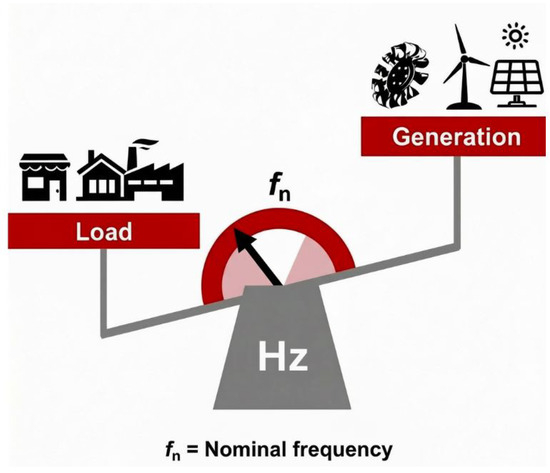
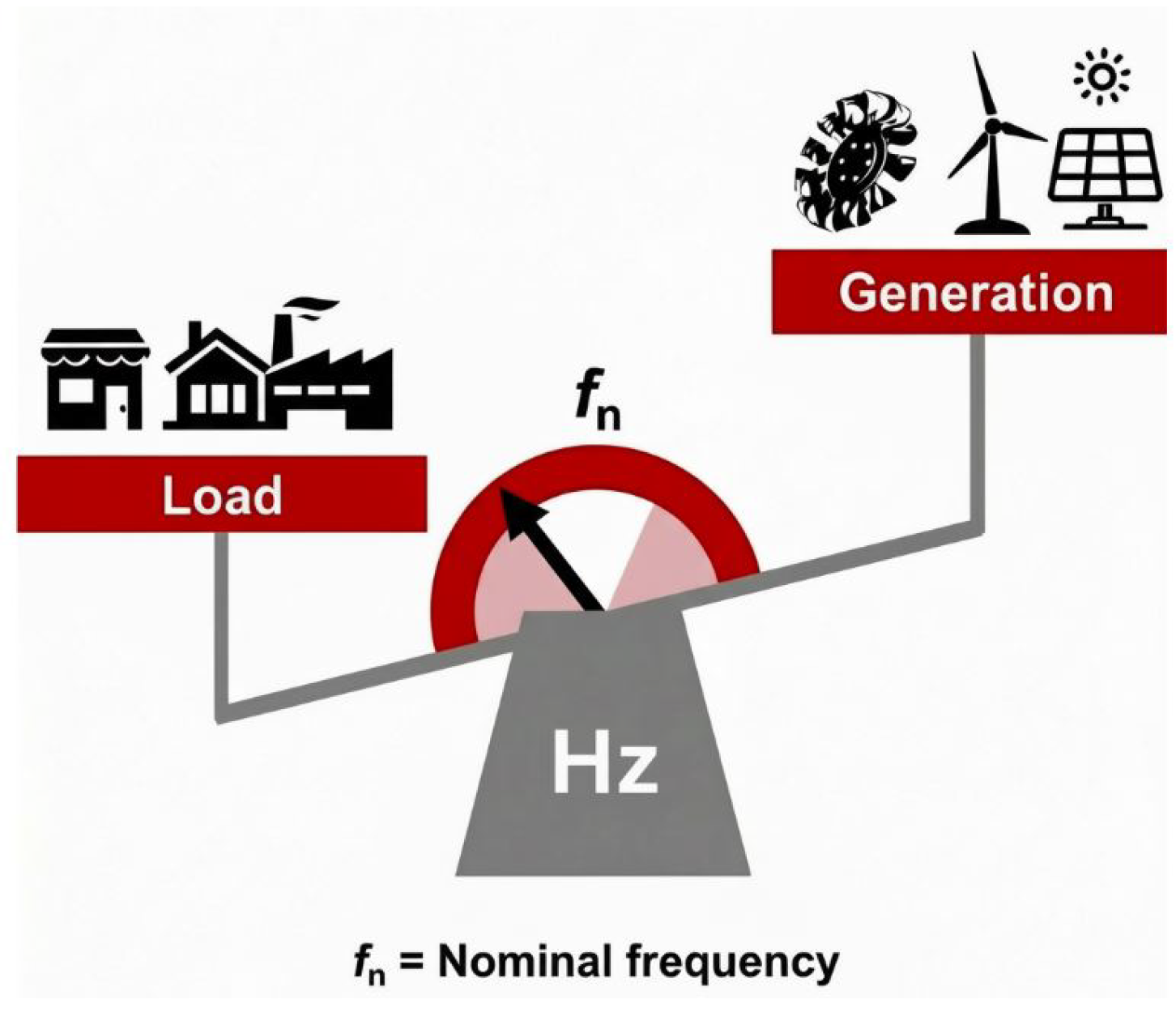
Figure 1 illustrates the required balance between demand and power generation to maintain the system frequency at 60 Hz. When demand exceeds generation, the frequency decreases; conversely, if generation exceeds demand, the frequency increases. This balance is essential for operating the system safely and preventing instabilities.
Figure 1.
Balance between generation and demand.
1.1.2. Impact of Different Load Types on Power System Dynamics
The impact of different load types on power systems can be analyzed through their dynamic behavior and how they influence system stability. Therefore, it is important to consider the various load types when designing automatic load shedding schemes.
In this context, loads are commonly classified into three main types: constant impedance (Z), constant current (I), and constant power (P). Each of these exerts distinct effects on power systems.
Constant impedance (Z) loads exhibit a behavior directly proportional to the system voltage; that is, as voltage decreases, current also decreases, which tends to stabilize the system during disturbances. However, constant impedance loads are less common today due to the proliferation of electronic devices that do not display linear behavior [6].
In constant current (I) loads, the current remains fixed regardless of voltage variations. This behavior can have adverse effects on network stability, since during voltage sags these loads significantly increase their apparent power consumption, thereby imposing a greater burden on the system [7].
Constant power loads pose a significant challenge to dynamic stability, particularly during disturbances. These loads attempt to maintain a constant consumption of active and reactive power, which can lead to instabilities if the voltage decreases. This type of behavior is typical in systems with power electronic converters or advanced controls, such as those found in industrial facilities and electric transportation systems [8].
In modern systems, constant power loads predominate, which may give rise to an unstable effect known as voltage collapse, where the system becomes unable to maintain the balance between generation and demand. The coexistence of these types of loads within a power system requires a careful approach in planning and operation to ensure dynamic stability [9].
1.1.3. Limitations of the Traditional Under-Frequency Load Shedding Scheme
Power systems constantly face power imbalances due to fluctuations between generation and demand. These imbalances can be exacerbated by unforeseen events, such as sudden increases in consumption or the unexpected disconnection of generation units. In extreme situations, it becomes necessary to resort to emergency measures, such as under-frequency load shedding (UFLS). The purpose of this mechanism is to stabilize frequency and restore the demand–generation balance through the controlled disconnection of a portion of the load, thereby improving frequency stability.
The classical UFLS scheme operates through under-frequency relays (UFRs), also known as ANSI 81U relays, which are automatically triggered when frequency falls below the threshold of the first predetermined stage. These devices perform staged disconnections by adjusting parameters such as the percentage of load to be shed, frequency thresholds, ROCOF thresholds (ANSI 81R relay), and intentional time delays. However, improper configuration of these parameters can lead to significant issues, including unnecessary or insufficient disconnections that compromise system stability. To overcome these limitations, methodologies based on advanced computational algorithms have been developed to optimize UFR settings, ensuring a more effective response while minimizing the impact on end users [10].
1.1.4. Operational Implications
The selection of loads to be disconnected is a fundamental criterion, as it enables the identification and prioritization of those that can be shed without affecting essential services. This process aims to minimize the impact on users while at the same time preserving the operational stability of power systems [11].
In this context, UFLS must be coordinated with these stages to avoid actions that contradict primary, secondary, and tertiary controls, thereby ensuring a coherent and effective response to frequency imbalances [12].
On the other hand, the maintenance and periodic testing of the equipment involved in the UFLS scheme are essential to ensure its proper operation during low-frequency events [13].
1.1.5. Regulatory Implications
Regulatory authorities must establish clear guidelines for the implementation and operation of UFLS, including design criteria and limit values to ensure proper performance [14]. Likewise, it is necessary to define the responsibilities of network operators and generation agents with respect to UFLS, ensuring a coordinated and effective response to low-frequency events [15]. In addition, communication and reporting protocols must be established to inform both authorities and the public about UFLS activations, thereby guaranteeing transparency and trust in the power system [16].
1.2. State of the Art
Under-Frequency Load Shedding (UFLS) is a fundamental strategy for maintaining stability in power systems during generation loss events or sudden increase of active power demand. The optimization of UFLS parameters has been widely studied to enhance its performance, with virtual inertia considered as a complementary tool in systems with high penetration of renewable energy. Genetic algorithms have proven effective in the optimal selection of relays, activation thresholds, and time delays, enabling more efficient mitigation of frequency drops and improved dynamic system response. These optimized strategies are key to the operation of modern power grids with increasing variability in generation and demand [17].
A successful case of UFLS optimization for maintaining frequency stability in power systems with high penetration of NCRES is the study titled “Optimal Load Shedding Allocation for Preserving Frequency Stability in a Large-Scale PV Integrated Grid” This work proposes a novel methodology based on the Particle Swarm Optimization (PSO) algorithm to determine optimal load shedding levels following critical contingencies, such as the unexpected disconnection of multiple generation units or the outage of a substation with high power transfers. Unlike conventional schemes that apply fixed disconnection levels, this methodology optimizes the amount of load to be shed by considering frequency response constraints, installed photovoltaic generation, and existing synchronous generators. The study was implemented on the IEEE 39-bus system and simulated through Python scripts using the DIgSILENT PowerFactory power system simulation tool. The methodology proved effective in containing frequency decline within established limits, while maintaining acceptable overshoot and settling frequency. Furthermore, it outperformed conventional approaches, demonstrating its viability for power grids with high NCRES penetration [18].
On the other hand, the article “Optimal Adaptive Under-Frequency Load Shedding Using Neuro-Evolution Algorithm” developed an adaptive scheme based on a neuro-evolution algorithm, which combines the learning capability of neural networks with the global optimization capabilities of evolutionary algorithms. The model takes as inputs the overload (L), which measures the excess demand relative to generation, the frequency (f), and the rate of change of frequency (RoCoF). The output is the optimal amount of load to be shed. The neural network, with a feed-forward architecture of three inputs, five hidden layers, and one output, was trained and optimized using an evolutionary algorithm. The scheme was tested on a standard 3-machine, 9-bus system, and its performance was compared with that of a conventional scheme under scenarios where demand exceeded generation by 20%, 35%, and 50%. The results showed that the adaptive method significantly reduced the amount of disconnected load while keeping frequency within the permissible range (49.8–50 Hz). For example, under a 20% overload, the conventional scheme disconnected 66 MW, whereas the adaptive scheme required only 27.06 MW. In the highest overload scenario (50%), the conventional scheme shed 132 MW, compared to 119.46 MW for the adaptive scheme, achieving precise and efficient disconnection. The adaptive scheme not only demonstrated greater efficiency by reducing unnecessary load shedding but also ensured system stability by restoring frequency to acceptable values. Unlike the conventional approach, which may result in out-of-range frequencies, the adaptive method proved to be more flexible and reliable in the face of power system dynamics [19].
A recent success case in the optimization of under-frequency load shedding (UFLS) schemes in systems with high renewable energy penetration is the study titled “Optimization Method of Under Frequency Load Shedding Schemes for Systems with High Permeability New Energy.” This work proposes an innovative approach that applies advanced optimization methods to improve the allocation of shed load during low-frequency events, specifically in networks with a high share of renewable generation. The methodology presented in the study combines frequency simulation models with optimization techniques to determine the most suitable load shedding levels under contingencies such as sudden generation loss. Unlike conventional schemes, which use predetermined load-shedding values, this approach accounts for the variability and fluctuations of renewable generation, dynamically adjusting the amount of load to be shed. The implementation of this model in a test system showed significant improvements in frequency stability, demonstrating its effectiveness for modern power grids with a high percentage of renewable generation [20].
The article titled “Application of Hybrid Meta-Heuristic Techniques for Optimal Load Shedding Planning and Operation in an Islanded Distribution Network Integrated with Distributed Generation” addresses the challenge of managing load shedding in islanded distribution networks with high penetration of distributed generation (DG), where disconnection from the main grid may lead to frequency and voltage instabilities. To solve this problem, the authors propose an optimal load shedding scheme based on a hybrid technique that combines the Firefly Algorithm (FA) and Particle Swarm Optimization (PSO), resulting in the FAPSO method. This approach is applied in two modes: planning, which maximizes the remaining load after shedding while considering voltage profiles, and operation, which corresponds to under-frequency load shedding (UFLS), identifying the optimal combination of loads to disconnect during operation. The FAPSO algorithm combines the advantages of FA (local search) and PSO (global search), achieving an optimal solution with fewer iterations. The hybrid nature of the algorithm suggests an effective solution for both planning and operating load shedding in islanded networks [21].
The article titled “Adaptive Non-Parametric Kernel Density Estimation for Under-Frequency Load Shedding with Electric Vehicles and Renewable Power Uncertainty” proposes a novel adaptive under-frequency load shedding (AUFLS) scheme for networks with high penetration of renewable energy and electric vehicles. It integrates three innovative techniques: adaptive kernel density estimation (AKDE) to predict wind variability, an intelligent queuing system that prioritizes electric vehicle discharging based on their state of charge, and reinforcement learning to adjust actions in real time. The results show that this approach reduces load shedding by 50% compared to traditional methods, while keeping frequency stable within ±0.5 Hz. The main innovation lies in the simultaneous integration of AKDE and reinforcement learning within the AUFLS framework, enabling effective management of both wind generation uncertainty and the dynamic behavior of electric vehicles. Simulations on the IEEE 39-bus system demonstrate its superiority over conventional load shedding schemes. This work stands out as the first to apply this combination of techniques to improve stability in networks with high renewable and electric vehicle penetration, offering a more efficient and adaptable solution than existing methods. Computational limitations are addressed through a hierarchical structure, while future research could incorporate multi-agent learning for even more effective coordination [22].
The article titled “Enhancing Power System Stability with Adaptive Under-Frequency Load Shedding Based on Synchrophasor Measurements and Empirical Mode Decomposition” proposes an adaptive under-frequency load shedding (AUFLS) scheme designed to improve power system stability under severe disturbances. Unlike conventional UFLS schemes based on fixed frequency thresholds, the proposed method employs synchrophasor measurements (PMUs) and the Empirical Mode Decomposition (EMD) technique to dynamically adapt the system response. The approach identifies the center of inertia (CoI) of the rate of change of frequency (RoCoF) and estimates the active power imbalance in the system. In addition, by applying EMD to the voltage angle at each bus, coherent groups of electrical buses are formed. A voltage stability index is then computed for these groups, which is used to precisely allocate the required load shedding, prioritizing those with higher vulnerability. The results, validated on the IEEE 39-bus test system, show that the proposed AUFLS scheme significantly improves frequency response with a lower amount of load shedding compared to traditional methods. The study concludes that the combined use of synchrophasors and EMD enables more accurate and efficient decision-making, representing a valuable contribution to the operation of modern power systems with high renewable generation penetration [23].
The article titled “A Hybrid Approach of Artificial Neural Network–Particle Swarm Optimization Algorithm for Optimal Load Shedding Strategy” proposes a hybrid scheme for optimal load shedding in power systems by combining artificial neural networks (ANN) with the particle swarm optimization (PSO) algorithm. The ANN is trained to determine the minimum amount of load to be shed and its distribution across the network, considering variables such as frequency and its rate of change, while PSO optimizes the neural network weights to improve training accuracy and speed. The model also accounts for the effects of primary and secondary controls of generating units as well as the electrical distance between loads and the failed generators. The strategy was validated on the IEEE 39-bus system, showing superior results compared to conventional methods such as GA-ANN (Genetic Algorithm–Artificial Neural Network), achieving a training accuracy of 97.4% and a testing accuracy of 100% with 120 input variables. It is concluded that the hybrid approach enables more efficient and precise load shedding, ensuring system stability with minimal interruption, and is presented as a promising tool for modern systems integrating low-inertia renewable energy sources [24].
The article titled “Optimal Frequency Regulation Support from PV Power Plants in a Renewable Incorporated Grid” presents an innovative approach to frequency stabilization in power grids with high photovoltaic (PV) penetration by optimizing the percentage of curtailment (operating reserve) in PV systems using the Particle Swarm Optimization (PSO) algorithm. The proposed method combines advanced control and optimization techniques to automatically determine the optimal level of active reserve (between 5.81% and 8.14% of the installed capacity) that PV systems should maintain available to respond to contingencies. Simulation results on the IEEE 39-bus test system, considering different PV penetration levels (30%, 40%, and 50%), demonstrate that this approach is capable of maintaining frequency stability (with nadir values above 49.05 Hz and ROCOF values below 0.12 Hz/s) even under the sudden loss of 9.5% of total generation, thereby avoiding the activation of traditional under-frequency load shedding (UFLS) schemes. Compared with conventional solutions such as synchronous condensers, the proposed method shows significant superiority both in technical efficiency and economic viability, reducing up to 50% of the energy not injected into the grid while ensuring an adequate response to disturbances. The main contribution of this work lies in the intelligent integration of optimization algorithms (PSO) with advanced PV system operation strategies (deloading mode), offering a scalable and adaptable solution for different renewable penetration scenarios. However, the authors acknowledge that future research should address factors such as the intrinsic variability of solar generation and conduct more detailed economic analyses to consolidate this proposal as a practical alternative for the secure operation of grids with high renewable participation [25].
The article titled “A Smart Load Management System Based on the Grasshopper Optimization Algorithm for Under-Frequency Load Shedding in Power Systems” proposes a smart load management system (SLMS) based on the Grasshopper Optimization Algorithm (GOA) to enhance power system response during low-frequency events. The approach combines dynamic power system modeling with a bio-inspired technique that determines, in real time, which loads should be disconnected to stabilize system frequency. The main innovation lies in the application of GOA to optimally calculate the amounts of load to be shed, taking into account both the severity of the event and the location of the frequency drop. Unlike traditional UFLS methods, which operate under fixed thresholds, the proposed method allows dynamic adaptation to changing conditions, minimizing the amount of load affected and improving overall stability. Simulation results on the IEEE 39-bus system show that the proposed system reduces recovery time and improves load shedding accuracy, avoiding both over-shedding and under-shedding. The algorithm outperforms other heuristic methods, such as PSO and GA, in terms of speed and efficiency. This work represents one of the first applications of GOA in a UFLS context and demonstrates its feasibility for strengthening the operational resilience of modern grids. Future research could incorporate coordinated responses among multiple intelligent agents or address uncertainties associated with renewable generation [26].
The article “Optimal Multi-Stage Design of Frequency Control and Load Shedding for Islanded Microgrid with Multiple Distributed Power Sources” presents a coordinated multi-stage method for optimal frequency control and intelligent load shedding in islanded microgrids with diverse distributed sources, including wind, solar, diesel, and batteries. The bio-inspired Artificial Hummingbird Optimization Algorithm is used to optimize the parameters of a PID controller in the load frequency control (LFC) loop, while fuzzy logic is implemented for under-frequency load shedding (UFLS), enabling a fast and efficient response to variations in load or generation. Simulation results show that the proposed strategy significantly reduces frequency fluctuations and minimizes the need for load shedding, thereby contributing to system stability and resilience. The main contribution lies in the integration of advanced optimization techniques and adaptive control to effectively manage the operation of microgrids with high renewable energy penetration [27].
The article “Optimal Operation of Under-Frequency Load Shedding Relays by Hybrid Optimization of Particle Swarm and Bacterial Foraging Algorithms” proposes a hybrid method that combines the Particle Swarm Optimization (PSO) algorithm and the Bacterial Foraging Algorithm (BFA) to optimize the operation of under-frequency load shedding (UFLS) relays. The main objective is to improve coordination and accuracy in load disconnection to stabilize system frequency during frequency drop events. The innovation lies in merging two bio-inspired techniques to leverage the advantages of both: PSO provides fast convergence, while BFA enhances solution space exploration to avoid local optima. This hybrid approach aims to determine the optimal thresholds and operating times of UFLS relays to minimize load interruption while maintaining system stability. Tests conducted on standard power systems demonstrate that the proposed technique significantly reduces response time and improves the effectiveness of load shedding compared with traditional methods and each algorithm applied separately. Furthermore, it achieves better adaptability under different fault scenarios and load variations [28].
1.3. Contributions and Paper Organization
The purpose of this research is to develop an optimization tool capable of finding the most suitable configuration for the parameters of the Under-Frequency Load Shedding (UFLS) scheme. The tool is implemented through an interface that combines dynamic simulations performed in DIgSILENT PowerFactory with Python programming, considering variations of the ZIP load model. This integration enables the automation and efficient evaluation of different UFLS configurations, adapting to the operating conditions of the electrical power system.
To achieve this objective, the study begins with a literature review of metaheuristic approaches that have been used for the parameterization and optimization of load-shedding schemes in power systems. The state-of-the-art review revealed that although several studies have parameterized the UFLS scheme using different metaheuristic tools and achieved satisfactory results, they did not consider the influence of the load model on the UFLS parameters. Therefore, this work addresses the optimization of the UFLS scheme using the Particle Swarm Optimization (PSO) algorithm while evaluating the algorithm’s performance under different types of loads represented by the ZIP model.
The remainder of this paper is organized as follows. Section 2 presents the proposed methodology, detailing the optimization framework based on the Particle Swarm Optimization (PSO) algorithm, the configuration of the Under-Frequency Load Shedding (UFLS) scheme, and the implementation of the ZIP load model within the DIgSILENT PowerFactory environment. Section 3 discusses the results obtained from the dynamic simulations performed under different load compositions—constant power, constant current, and constant impedance—and analyzes the corresponding impact on system frequency response. Finally, Section 4 summarizes the main conclusions, highlights the relevance of considering load sensitivity in UFLS design, and outlines potential directions for future research.
2. Methodology
As part of this research, the PSO algorithm implemented in the Pymoo library for Python 3.9—developed by the University of Michigan—was employed. This library has proven to be an effective and reliable tool for solving complex optimization problems. The literature review supports its frequent use in studies similar to the one addressed by the UFLS tool, which motivated its incorporation into the present work.
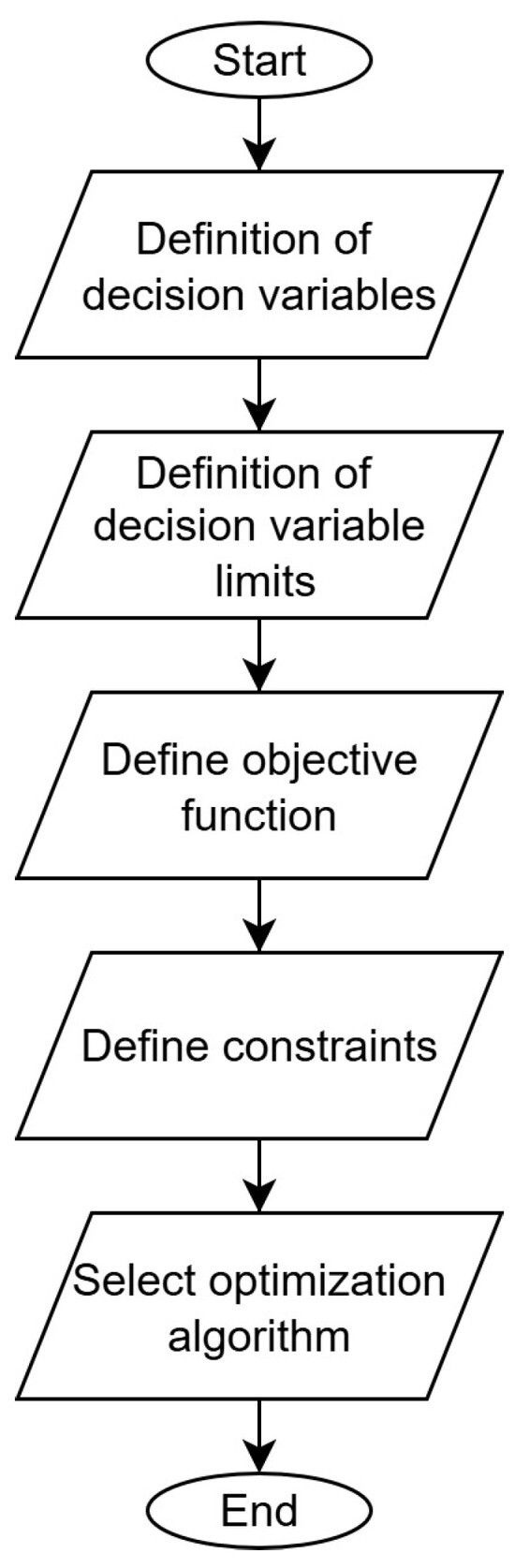
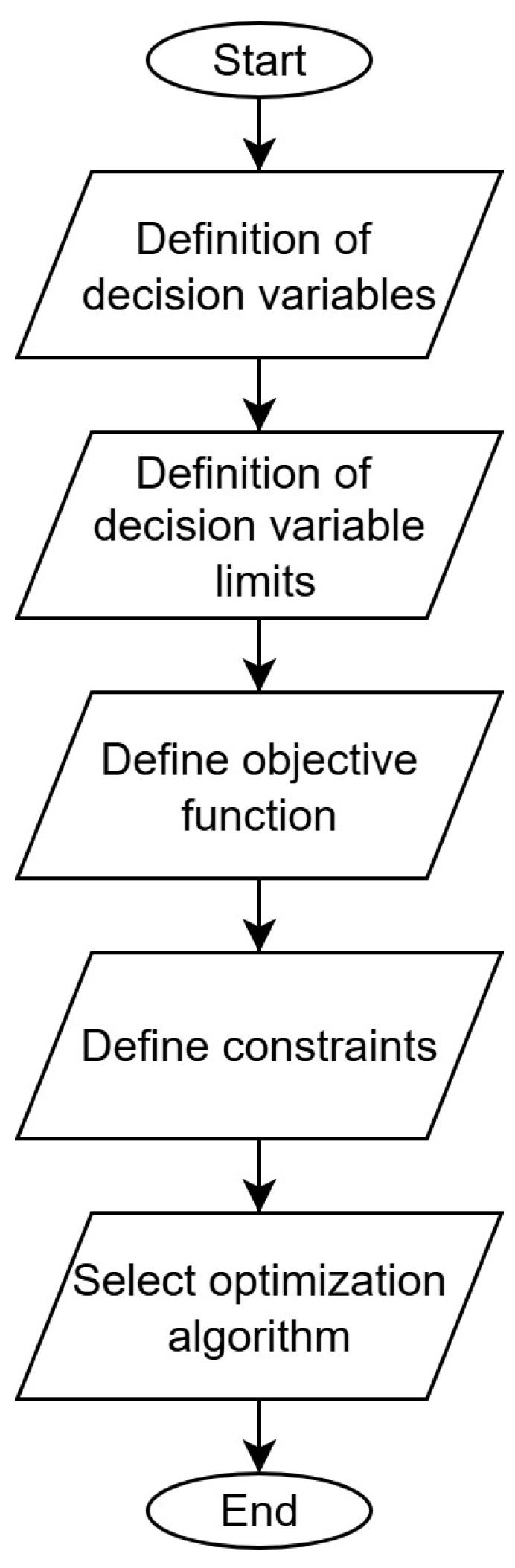
The main characteristics of the optimization problem are defined below. This involves specifying the lower and upper bounds of the control variables at each stage, the system constraints, and the objective function. Once these elements are established, the most suitable optimization algorithm must be selected to solve the problem. Figure 2 presents the methodology for the formulation of an optimized UFLS scheme.
Figure 2.
Methodology for the Formulation of an Optimization-Based UFLS.
2.1. Decision Variables
A decision variable in an optimization algorithm is an element that can be adjusted or controlled within the problem. It represents a decision to be made that will influence the outcome of the problem. The objective of the optimization algorithm is to determine the values of these decision variables that optimize a given objective function, subject to specific constraints. The optimal values of the decision variables provide the solution to the optimization problem.
The decision variables for our optimization problem are presented from Section 2.1.1, Section 2.1.2 and Section 2.1.3.
2.1.1. Frequency Thresholds
This variable is fundamental to the optimization algorithm, as it defines the activation frequency of the UFLS at each stage. Moreover, it corresponds to one of the six configurable parameters of the scheme, making it one of the main decision variables of the model.
where, denotes the frequency thresholds, represents the Stage 1 frequency threshold, and represents the Stage N frequency threshold.
2.1.2. Load Shedding Percentages
This variable is a key component of the optimization algorithm, as it determines the percentage of load to be disconnected in the National Interconnected System (SIN) at each stage of the scheme. Being one of the six configurable parameters of the UFLS, it is considered one of the main decision variables in the proposed model.
where is the percentage of load to be shed, is the percentage of load to be shed at Stage 1, and is the percentage of load to be shed at Stage N.
2.1.3. Intentional Delay Times
This variable is of great importance, as it acts as a secondary verification mechanism that determines whether the UFLS is activated or not, according to the time set for each stage. Furthermore, it is one of the six configurable parameters of the UFLS, and is therefore considered a key decision variable.
where is the intentional time delay, is the intentional time delay at Stage 1, and is the intentional time delay at Stage N.
2.1.4. Total Number of Stages
It indicates the number of stages in the UFLS configuration, defining only those necessary to ensure the safety and reliability of the National Interconnected System (SIN).
where is the number of stages (4), denotes Stage 1, and denotes Stage N.
2.2. Lower and Upper Bounds of the Decision Variables
In optimization algorithms, the bounds refer to the constraints imposed on the decision variables. These bounds define the range of possible values that the decision variables can take. They are essential to ensure that the solutions proposed by the algorithm are feasible and realistic within the context of the given problem. The bounds may be inherent to the problem itself—such as resource availability—or imposed to meet specific requirements or regulatory constraints.
Frequency Threshold Limits:
Load Shedding Percentage Limits:
Intentional Delay Time Limits:
Number of Stages Limits:
2.3. Objective Function
The objective function in metaheuristic optimization guides the search process toward optimal or near-optimal solutions. Unlike classical methods, metaheuristic algorithms can handle nonlinear, non-convex problems or those with multiple local optima. This makes the objective function particularly important in metaheuristic optimization, as it directly influences the exploration of the solution space in a more adaptive and flexible manner.
where:
- : Weights for the Prioritization of the Objective Function Components.
- : Operating Scenario.
- : Frequency Settling Time in the Scenario .
- : Load Shedding Percentage per Stage .
- : Total Load C in Megawatts.
- : Total Number of Operating Scenarios.
- : Steady-State Frequency in the Scenario .
In this study, frequency deviation is prioritized over the amount of load shedding, thereby ensuring system stability even if it requires adjusting or disconnecting part of the load. For the present case study, = 1 and = 900, since greater priority is assigned to minimizing frequency deviation.
2.4. Constraints
In the context of metaheuristic optimization, constraints are conditions that must be satisfied for a candidate solution to be considered valid. These constraints can take different forms—such as equality, inequality, or combinatorial constraints—depending on the specific problem being addressed. It is important to note that constraints can be incorporated into metaheuristic algorithms in various ways, either as part of the objective function (by penalizing invalid solutions) or as additional conditions applied during the generation and evaluation of solutions.
The constraints for our optimization problem are presented below:
Table 1 presents the assumed values for the variables used in the simulations.
Table 1.
Description of the Variables Used in the UFLS Simulation.
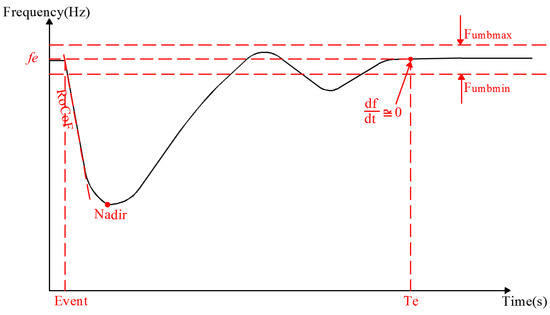
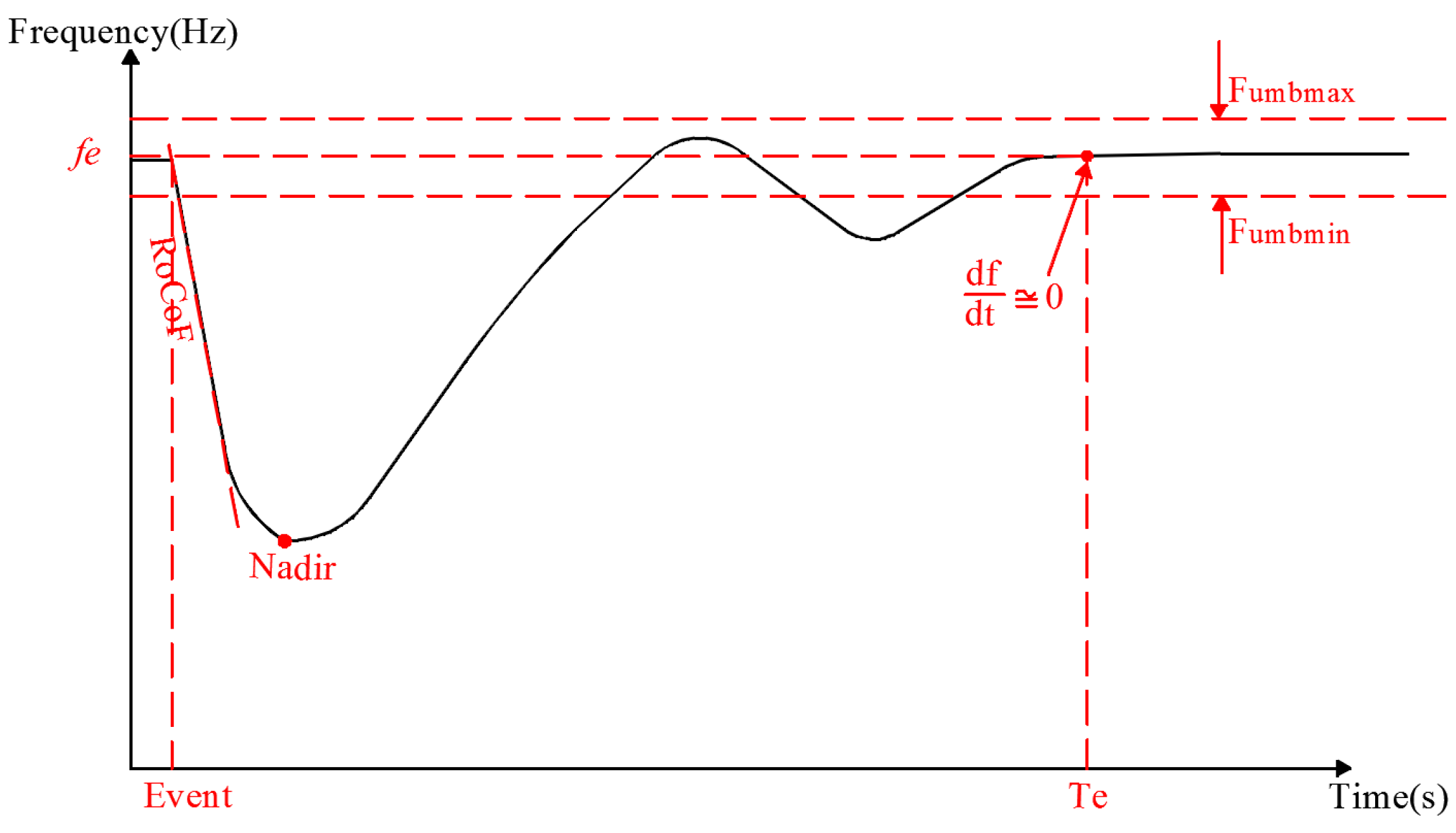
Figure 3 shows the frequency response following a generation event and includes a graphical representation of the associated event metrics, such as the ROCOF and the nadir.
Figure 3.
Frequency Response Following a Generation Event.
2.5. ZIP Load Model
In this study, a ZIP model is used to represent the behavior of the electrical load. This model establishes a polynomial relationship between voltage magnitude and power, integrating components of constant impedance (Z), constant current (I), and constant power (P). The dependence of the load on voltage is modeled through three polynomial terms:
where the coefficients and represent the proportional contribution of the constant power component to the active and reactive power demand, respectively; similarly, and indicate the degree of contribution of the constant current component, while and correspond to the share of the constant impedance component in each type of power [29].
The change in load type—whether constant power, constant current, or constant impedance—can be achieved by adjusting the exponential coefficients of the load model, as shown in Table 2.
Table 2.
Exponential Coefficient Values for Different Load Types.
2.6. Simulation Model
In this study, the IEEE 39-bus system—also known as the New England test system—is used. This system is widely employed in the technical literature due to its intermediate complexity and its ability to represent the dynamic behavior of a power system. The voltage levels within the system range from 345 kV to 16.5 kV, allowing the consideration of both transmission and generation interconnections.
Table 3 and Table 4 present a summary of the loads and generators in the IEEE 39-bus system. Additionally, Table 5 shows the polynomial coefficients used in Equations (19) and (20), which determine the type of load modeled.
Table 3.
Summary of Loads in the IEEE 39-Bus System.
Table 4.
Summary of Generators in the IEEE 39-Bus System.
Table 5.
Coefficients and Exponents for Different Load Types.
2.6.1. Buses Considered for Load Shedding
All load buses of the IEEE 39-bus system listed in Table 3 (19 load buses) were considered eligible for load shedding. The shedding percentages optimized by PSO are applied proportionally to the total system load at each stage, meaning that each stage disconnects the corresponding percentage of the aggregated load across the predefined load buses.
2.6.2. Load Selection and Shedding Order
The shedding sequence follows the stage activation defined by the optimized frequency thresholds. When a threshold is reached and the intentional delay condition is satisfied, the corresponding percentage of load is disconnected.
2.7. PSO Algorithm Methodology
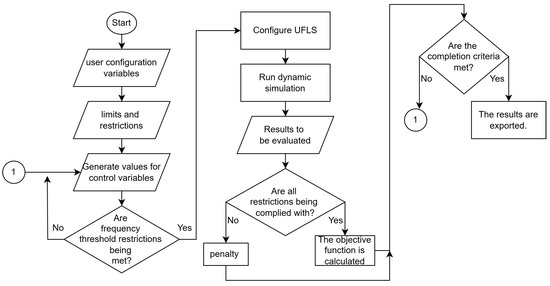
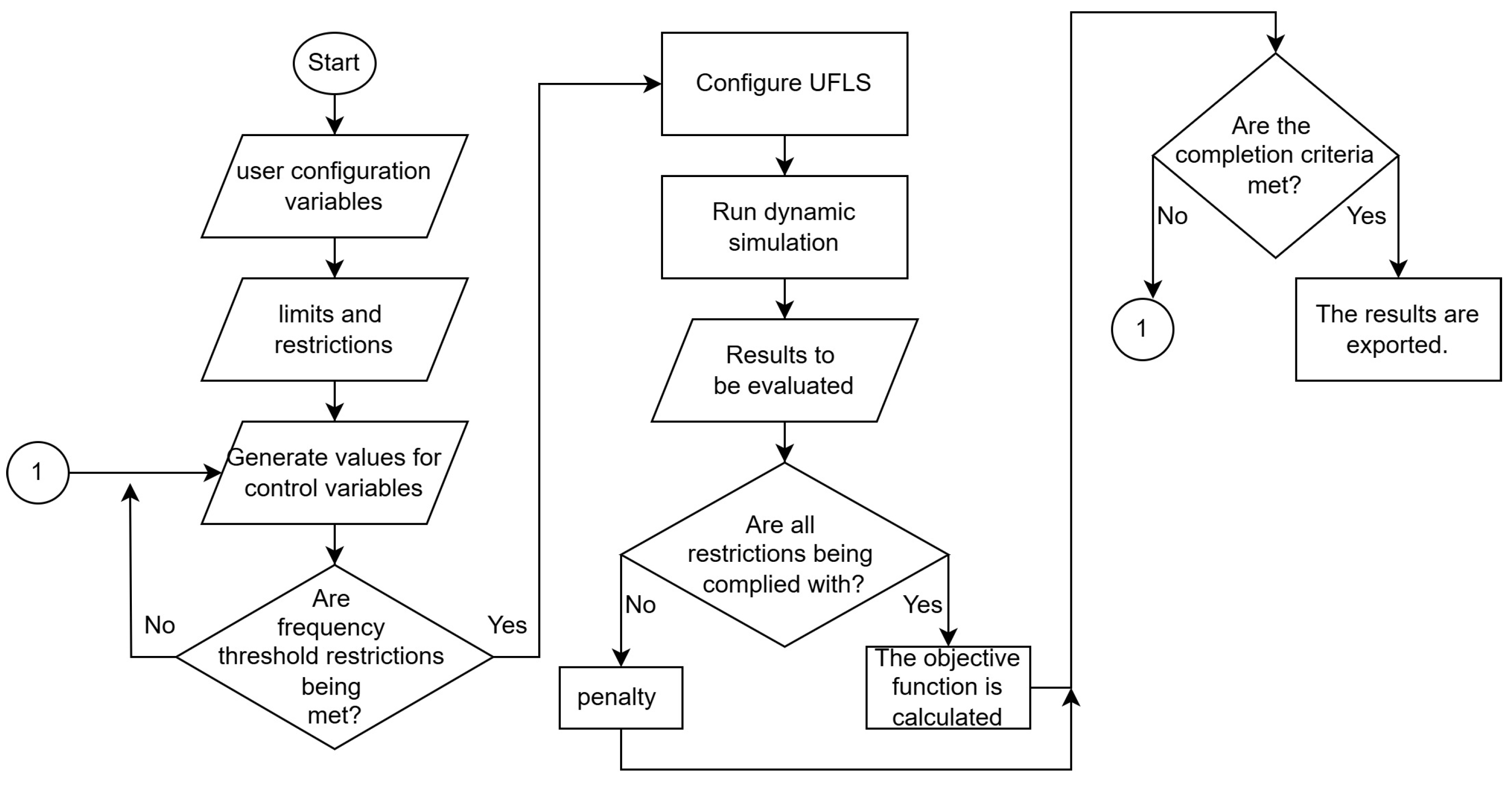
The PSO algorithm methodology, illustrated in Figure 4, is based on an iterative process that adjusts the UFLS control variables and evaluates their performance through dynamic simulations. The workflow begins with user configuration and the generation of initial variable values. Then, frequency constraint compliance is verified; if satisfied, the UFLS scheme is configured and the simulation is executed. The results are evaluated and penalized if the constraints are not met, or the fitness function is calculated if they are valid. Finally, a termination criterion is checked to determine whether to export the results or continue iterating.
Figure 4.
Flowchart of the Python-Based Optimization Tool.
3. Results
The following section presents the results obtained from applying the PSO algorithm to determine the optimal configuration of the Under-Frequency Load Shedding (UFLS) scheme. The analysis was conducted considering three types of load models: constant power (P), constant current (I), and constant impedance (Z). For each case, the frequency thresholds, intentional delays, and load-shedding percentages at each stage of the scheme were defined, aiming to achieve efficient frequency recovery with the minimum possible load shedding.
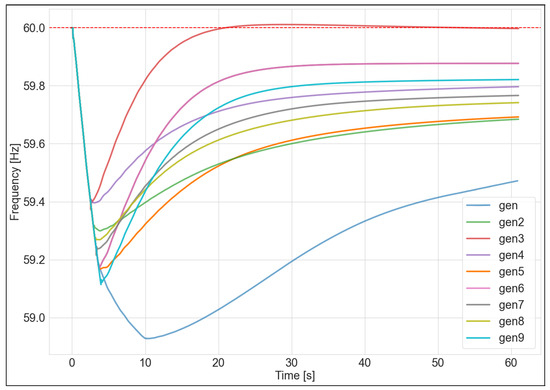
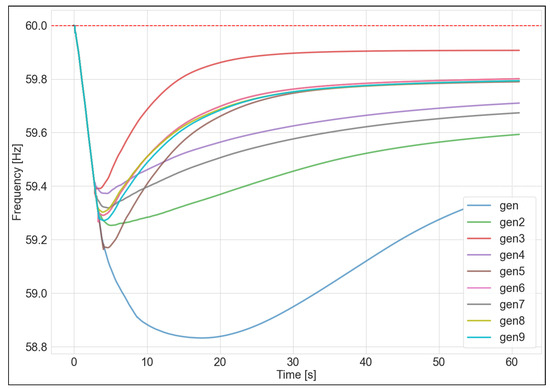
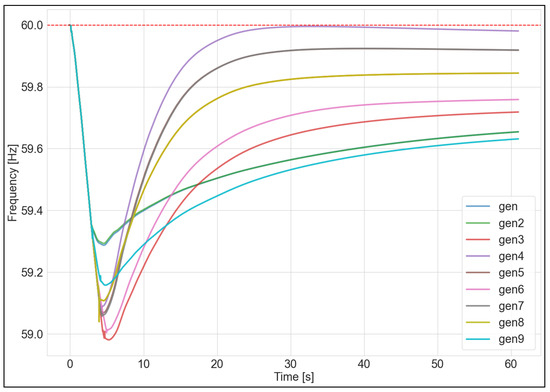
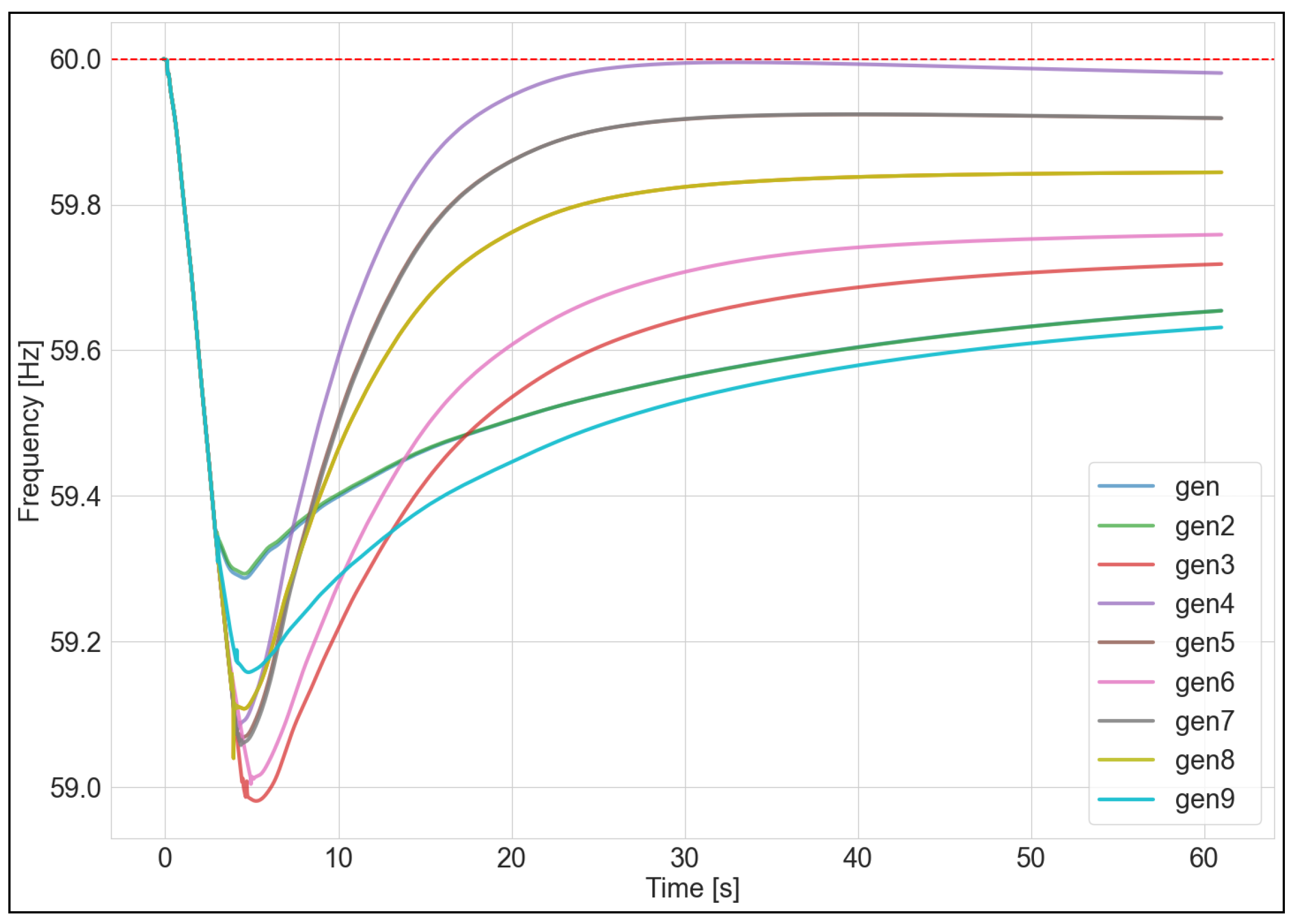
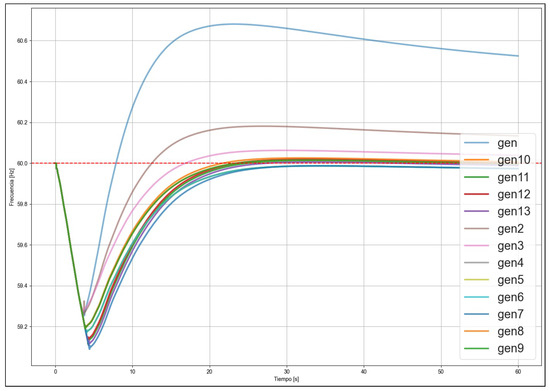
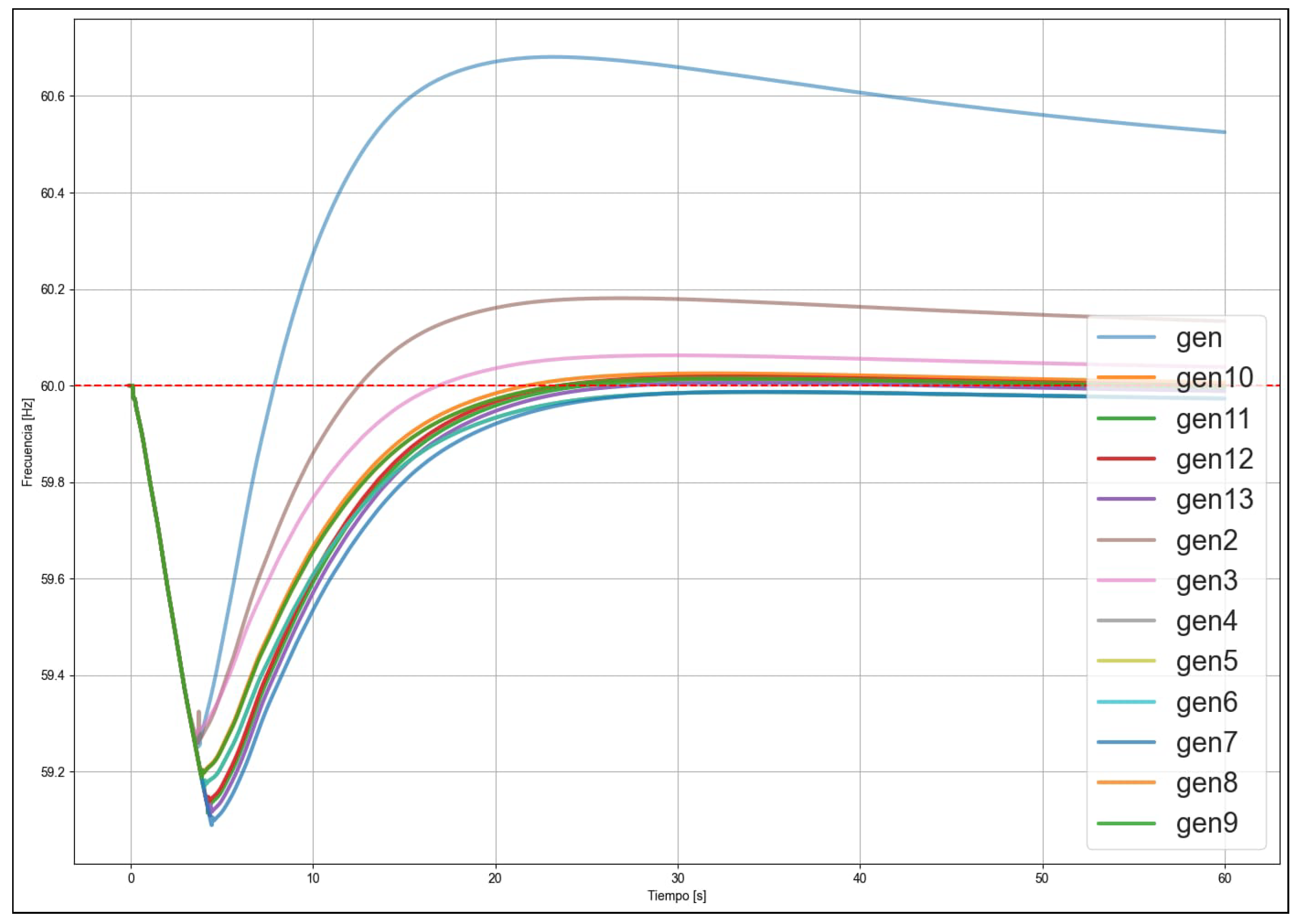
Figure 5, Figure 6, Figure 7 and Figure 8 present the simulations corresponding to each generation produced by the optimization algorithm. Here, Gen refers to the frequency response curve of the evaluated generation. It can be observed that the algorithm progressively improves in its search for an optimal configuration for the evaluated system. In this case, the analysis involves a single system (the IEEE 39-bus system) subjected to different types of loads: constant power, constant current, and constant impedance. Table 6 presents the optimal configuration of the UFLS scheme considering constant power (P) load.
Figure 5.
Optimal Configuration for the System with Constant Power Loads.
Figure 6.
Optimal Configuration for the System with Constant Current Loads.
Figure 7.
Optimal Configuration for the System with Constant Impedance Loads.
Figure 8.
Optimal Configuration for the System with Mixed Loads.
Table 6.
Optimal Configuration of the Under-Frequency Load Shedding Scheme with Constant Power (P) Load.
Results for the System with Constant Power Loads: In the case of the system with constant power loads, Generation 9 achieved the minimum value of the objective function, standing out as the most efficient configuration according to the optimization algorithm results. Table 7 presents the ROCOF, frequency nadir, and steady-state frequency obtained for Generation 9.
Table 7.
Optimal Generation: 9.
Results for the System with Constant Current Loads: In the case of the system with constant current loads, Generation 6 achieved the minimum value of the objective function, standing out as the most efficient configuration according to the optimization algorithm results.
Table 8 presents the optimal configuration obtained for the UFLS scheme under constant current load conditions, while Table 9 presents the ROCOF, frequency nadir, and steady-state frequency for this loading condition. Furthermore, Table 10 presents the optimal configuration of the UFLS scheme for constant impedance load, and Table 11 reports the ROCOF, frequency nadir, and steady-state frequency for this type of load. Finally, Table 12 presents the UFLS scheme for mixed load conditions, and Table 13 presents the ROCOF, frequency nadir, and steady-state frequency for this loading condition.
Table 8.
Optimal Configuration of the Under-Frequency Load Shedding Scheme with Constant Current (I) Load.
Table 9.
Optimal Generation: 6.
Table 10.
Optimal Configuration of the Under-Frequency Load Shedding Scheme with Constant Impedance (Z) Load.
Table 11.
Optimal Generation: 8.
Table 12.
Optimal Configuration of the Under-Frequency Load Shedding Scheme with Mixed Load.
Table 13.
Optimal Generation: 12.
Results for the System with Constant Impedance Loads: In the case of the system with constant impedance loads, Generation 8 achieved the minimum value of the objective function, standing out as the most efficient configuration according to the optimization algorithm results.
Results of the system with mixed ZIP loads: In the case of the system with mixed ZIP loads, Generation 12 achieved the minimum value of the objective function, standing out as the most efficient configuration according to the optimization algorithm results.
The results clearly demonstrate the significant impact that the modeled load type has on the effectiveness of the Under-Frequency Load Shedding (UFLS) scheme. The implementation of the optimization tool developed in Python using the Particle Swarm Optimization (PSO) algorithm allowed for precise tuning of UFLS parameters under different demand modeling scenarios, revealing substantial differences in the amount of load that must be disconnected to restore system frequency following a severe contingency.
In the case of the constant power model, system stability was achieved with the lowest amount of shed load, 1528.4 MW, since this type of load maintains a constant power consumption despite voltage drops, allowing for a more direct and controlled UFLS operation. The constant current model required an intermediate shedding of 1652.09 MW, reflecting a mixed behavior that partially responds to voltage reduction. In contrast, the constant impedance model—which decreases its consumption as voltage decreases—required the largest amount of shed load, 2218.26 MW, because its natural self-regulation was insufficient to counteract large-generation-loss events, forcing the UFLS to apply a more severe load shedding to restore frequency balance.
These results demonstrate that the choice of load model has a direct impact on the effectiveness of protection schemes. An inadequate representation can lead to inaccurate conclusions, affecting both the design of control mechanisms and the planning of system operation.
4. Conclusions
The implementation of the optimization tool using the Particle Swarm Optimization (PSO) algorithm in Python has proven to be effective in improving the UFLS configuration within the DIgSILENT PowerFactory software 2021. This has validated the high usefulness of metaheuristic techniques in the optimization of electric power systems, ensuring a more efficient response to frequency imbalances and enhancing power system stability in the face of the challenges posed by the energy transition.
In addition to the development of the UFLS optimization tool, an analysis was conducted to evaluate the performance of the scheme under different load models: constant power, constant current, and constant impedance. This analysis revealed that the performance of the UFLS and the amount of load that must be shed to stabilize the system frequency largely depend on the type of load modeled.
The results showed that the constant power model allowed the system to reach stability with the lowest level of load shedding. This is because this type of load does not change its consumption in response to variations in voltage or frequency, creating a more stable condition for the UFLS to act precisely without relying on self-regulation effects. In contrast, constant impedance loads—which do reduce their consumption when voltage drops—require greater load shedding to restore frequency, as this natural reduction is insufficient during severe generation loss events. Constant current loads, whose behavior lies between the two extremes, exhibited an intermediate level of load shedding requirement.
These results have important implications for both the design of load-shedding schemes and the modeling of power systems in dynamic studies. An unrealistic representation of loads can lead to inaccurate conclusions about the effectiveness of control actions during contingencies. In this regard, it is essential to incorporate mixed or representative load models that reflect the real behavior of consumers—especially in modern power systems where industrial, residential, and electronic loads coexist, each with different sensitivities to voltage variations.
Likewise, this analysis reinforces the need to adjust and validate the UFLS parameters based on the actual load profile of the system under study. This is particularly relevant in the context of interconnected systems, which are moving toward higher penetration of distributed energy resources and renewable generation. In scenarios characterized by high variability and uncertainty, having robust and well-calibrated load-shedding schemes will be essential to ensure operational stability and to mitigate the effects of critical events on system frequency.
Considering the load type in UFLS evaluation not only improves the accuracy of studies but also contributes to more informed and resilient planning of protection mechanisms in modern power systems.
The evaluation of the results obtained through dynamic simulations has demonstrated that the UFLS optimization tool is effective in minimizing the amount of load shed and maintaining system stability during generation events.
Author Contributions
Conceptualization, methodology, software, and writing (review and editing): J.D.B.-Q., A.F.Á.-C., S.B.-M. and S.D.S.-Z. All authors have read and agreed to the published version of the manuscript.
Funding
This work was funded by the Institución Universitaria Pascual Bravo, Research Project: Modelo eléctrico para el planeamiento de operación y expansión de la potencial microrred de la Institución Universitaria Pascual Bravo a partir de la medición localizada de las cargas y la generación distribuida existente, code PCT00085.
Institutional Review Board Statement
Not applicable.
Informed Consent Statement
Not applicable.
Data Availability Statement
The original contributions presented in this study are included in the article. Further inquiries can be directed to the corresponding author.
Conflicts of Interest
The authors declare no conflicts of interest.
Abbreviations
The following abbreviations are used in this manuscript:
| PSO | Particle Swarm Optimization |
| UFLS | Under-Frequency Load Shedding |
| DERs | Distributed energy resources |
| NCRES | Non-conventional renewable energy source |
| ROCOF | Rate of change of frequency |
| GFL | Grid-following inverters |
| UFRs | under-frequency relays |
| LIRESs | low-inertia renewable energy sources |
References
- Chekenbah, H.; Maataoui, Y.; Lasri, R. Grid Stability: High Penetration Levels of Renewable Energies; Springer International Publishing: Cham, Switzerland, 2022; pp. 579–587. [Google Scholar] [CrossRef] [Scilit]
- Fernández-Guillamón, A.; Gómez-Lázaro, E.; Muljadi, E.; Molina-García, Á. Power systems with high renewable energy sources: A review of inertia and frequency control strategies over time. Renew. Sustain. Energy Rev. 2019, 115, 109369. [Google Scholar] [CrossRef] [Scilit]
- Auer, S.; Kittel, T. Modeling the dynamics and control of power systems with high share of renewable energies. arXiv 2020, arXiv:2012.05164. [Google Scholar] [CrossRef] [Scilit]
- Gu, Y.; Green, T.C. Power System Stability With a High Penetration of Inverter-Based Resources. Proc. IEEE 2023, 111, 832–853. [Google Scholar] [CrossRef] [Scilit]
- Vadillo, M.; Sigrist, L.; Rudez, U. Design and comparison of UFLS schemes of isolated power systems based on frequency stability margin. In Proceedings of the 2023 IEEE Belgrade PowerTech, Belgrade, Serbia, 25–29 June 2023; pp. 1–6. [Google Scholar] [CrossRef] [Scilit]
- Machowski, J.; Bialek, J.; Bumby, J. Power System Dynamics: Stability and Control; John Wiley & Sons Ltd.: Oxford, UK, 2012. [Google Scholar]
- Kundur, P. Power System Stability and Control; The EPRI Power System Engineering Series; McGraw-Hill: Columbus, OH, USA, 1994. [Google Scholar]
- Andersson, G. Modelling and Analysis of Electric Power Systems; Lecture Notes; ETH Zurich: Zürich, Switzerland, 2008. [Google Scholar]
- Concordia, C.; Ihara, S. Load Representation in Power System Stability Studies. IEEE Power Eng. Rev. 1982, PER-2, 41–42. [Google Scholar] [CrossRef] [Scilit]
- Acosta, M.N.; Adiyabazar, C.; Gonzalez-Longatt, F.; Andrade, M.A.; Torres, J.R.; Vazquez, E.; Santos, J.M.R. Optimal Under-Frequency Load Shedding Setting at Altai-Uliastai Regional Power System, Mongolia. Energies 2020, 13, 5390. [Google Scholar] [CrossRef] [Scilit]
- Wang, C.; Chu, S.; Ying, Y.; Wang, A.; Chen, R.; Xu, H.; Zhu, B. Underfrequency Load Shedding Scheme for Islanded Microgrids Considering Objective and Subjective Weight of Loads. IEEE Trans. Smart Grid 2023, 14, 899–913. [Google Scholar] [CrossRef] [Scilit]
- Omar, Y.R.; Abidin, I.Z.; Yusof, S.; Hashim, H.; Rashid, H.A.A. Under frequency load shedding (UFLS): Principles and implementation. In Proceedings of the 2010 IEEE International Conference on Power and Energy, Kuala Lumpur, Malaysia, 29 November–1 December 2010; pp. 414–419. [Google Scholar] [CrossRef] [Scilit]
- Zheng, C.; Jones, K.W.; Dong, Y.; Gopalakrishnan, A.; Aquiles-Perez, S.G.; Culpepper, C.T. Optimizing underfrequency load shedding strategies in converter-dominated networks. In Proceedings of the 17th International Conference on Developments in Power System Protection (DPSP 2024), Manchester, UK, 4–7 March 2024; The Institution of Engineering and Technology: Stevenage, UK, 2024; Volume 2024, pp. 257–263. [Google Scholar] [CrossRef] [Scilit]
- Chen, R.; Xu, H.; Zhou, L.; Cai, J.; Xiong, C.; Zhou, Y.; Zhang, X.; Dong, Q.; Wang, C.; Yang, N. Underfrequency Load Shedding Strategy With an Adaptive Variation Capability for Multi-Microgrids. IEEE Access 2023, 11, 17294–17304. [Google Scholar] [CrossRef] [Scilit]
- Terzija, V. Adaptive underfrequency load shedding based on the magnitude of the disturbance estimation. IEEE Trans. Power Syst. 2006, 21, 1260–1266. [Google Scholar] [CrossRef] [Scilit]
- Petrichenko, R.; Chuvychin, V.; Sauhats, A.; Strelkovs, V. Development and integration of adaptive underfrequency load shedding into the smart grid. In Proceedings of the 2017 IEEE International Conference on Environment and Electrical Engineering and 2017 IEEE Industrial and Commercial Power Systems Europe (EEEIC/I&CPS Europe), Milan, Italy, 6–9 June 2017; pp. 1–6. [Google Scholar] [CrossRef] [Scilit]
- Bustamante-Mesa, S.; Gonzalez-Sanchez, J.W.; Saldarriaga-Zuluaga, S.D.; López-Lezama, J.M.; Muñoz-Galeano, N. Optimal Estimation of Under-Frequency Load Shedding Scheme Parameters by Considering Virtual Inertia Injection. Energies 2024, 17, 279. [Google Scholar] [CrossRef] [Scilit]
- Hossain, F.; Jawad, A.; Nahid-Al-Masood. Optimal Load Shedding Allocation for Preserving Frequency Stability in a Large-Scale PV Integrated Grid. In Proceedings of the 2023 International Conference for Advancement in Technology (ICONAT), Goa, India, 24–26 January 2023; pp. 1–6. [Google Scholar] [CrossRef] [Scilit]
- Saboune, S.; Ladjici, A.; Tiguercha, A. Optimal adaptive under frequency load shedding using Neuro-Evolution Algorithm. In Proceedings of the 2018 International Conference on Electrical Sciences and Technologies in Maghreb (CISTEM), Algiers, Algeria, 28–31 October 2018; pp. 1–4. [Google Scholar] [CrossRef] [Scilit]
- Zhang, X.; Ma, J.; Yao, S.; Chen, R. Optimization Method of Under Frequency Load Shedding Schemes for Systems with High Permeability New Energy. In Proceedings of the 2019 4th International Conference on Intelligent Green Building and Smart Grid (IGBSG), Yichang, China, 6–9 September 2019; pp. 577–580. [Google Scholar] [CrossRef] [Scilit]
- Jallad, J.; Mekhilef, S.; Mokhlis, H.; Laghari, J.; Badran, O. Application of Hybrid Meta-Heuristic Techniques for Optimal Load Shedding Planning and Operation in an Islanded Distribution Network Integrated with Distributed Generation. Energies 2018, 11, 1134. [Google Scholar] [CrossRef] [Scilit]
- Renhai, F.; Khan, W.; Tariq, A.; Abbas, M.; Yousaf, M.Z.; Aziz, A.; Bajaj, M.; Abdullah, M.; Tuka, M. Adaptive non-parametric kernel density estimation for under-frequency load shedding with electric vehicles and renewable power uncertainty. Sci. Rep. 2025, 15, 11499. [Google Scholar] [CrossRef] [Scilit] [PubMed]
- Muftić Dedović, M.; Avdaković, S.; Musić, M.; Kuzle, I. Enhancing power system stability with adaptive under frequency load shedding using synchrophasor measurements and empirical mode decomposition. Int. J. Electr. Power Energy Syst. 2024, 160, 110133. [Google Scholar] [CrossRef] [Scilit]
- Le, N.T.; Phung, T.T.; Quyen, A.H.; Phung Nguyen, B.L.; Nguyen, A.N. A hybrid approach of artificial neural network-particle swarm optimization algorithm for optimal load shedding strategy. Int. J. Electr. Comput. Eng. 2022, 12, 4253–4263. [Google Scholar] [CrossRef] [Scilit]
- Jawad, A.; Nahid-Al-Masood; Mahmud, I. Optimal Frequency Regulation Support from PV Power Plants in a Renewable Incorporated Grid. In Proceedings of the 2022 International Conference on Technology and Policy in Energy and Electric Power (ICT-PEP), Jakarta, Indonesia, 18–20 October 2022; pp. 255–260. [Google Scholar] [CrossRef] [Scilit]
- Talaat, M.; Hatata, A.; Alsayyari, A.S.; Alblawi, A. A smart load management system based on the grasshopper optimization algorithm using the under-frequency load shedding approach. Energy 2020, 190, 116423. [Google Scholar] [CrossRef] [Scilit]
- Kouba, N.; Brik, A.; Boudoucha, A. Optimal Multi-Stage Design of Frequency Control and Load Shedding for Islanded Microgrid with Multiple Distributed Power Sources. In Proceedings of the 2024 International Conference on Advances in Electrical and Communication Technologies (ICAECOT), Setif, Algeria, 1–3 October 2024; pp. 1–5. [Google Scholar] [CrossRef] [Scilit]
- Awad, H.; Hafez, A. Optimal operation of under-frequency load shedding relays by hybrid optimization of particle swarm and bacterial foraging algorithms. Alex. Eng. J. 2022, 61, 763–774. [Google Scholar] [CrossRef] [Scilit]
- DIgSILENT GmbH. DIgSILENT PowerFactory Technical Reference; Version 2024; DIgSILENT GmbH: Gomaringen, Germany, 2024. [Google Scholar]

Disclaimer/Publisher’s Note: The statements, opinions and data contained in all publications are solely those of the individual author(s) and contributor(s) and not of MDPI and/or the editor(s). MDPI and/or the editor(s) disclaim responsibility for any injury to people or property resulting from any ideas, methods, instructions or products referred to in the content. |
© 2026 by the authors. Licensee MDPI, Basel, Switzerland. This article is an open access article distributed under the terms and conditions of the Creative Commons Attribution (CC BY) license.