Review

Indoor Radon Exposure in Kindergartens and Schools in Serbia

by
Predrag Kuzmanović
Department of Forensic Engineering, Faculty of Forensic Sciences and Engineering, University of Criminal Investigation and Police Studies, Cara Dušana 196, Zemun, 11080 Belgrade, Serbia
Pollutants 2026, 6(3), 47; https://doi.org/10.3390/pollutants6030047
Submission received: 28 July 2026 / Revised: 27 August 2026 / Accepted: 31 August 2026 / Published: 3 September 2026
(This article belongs to the Section Air Pollution)

Abstract

This paper presents the first comprehensive review of radon concentration measurements conducted in educational institutions in the Republic of Serbia. The analysis includes data from the national radon survey conducted in 2019, long-term measurements performed within the national radioactivity monitoring program during the period 2011–2024, a local investigation carried out in the city of Šabac, and other available studies conducted throughout Serbia using different measurement methods (CR-39 detectors, activated charcoal canisters, and continuous radon monitors). During the 2011–2024 period, a total of 303 measurements were performed in kindergartens, primary schools, secondary schools, and universities across seven Serbian cities, while 4133 CR-39 detectors were collected during the 2019 national survey. The survey achieved high coverage of primary schools (87%) and kindergartens (76%), whereas the coverage of secondary schools was only 20%. Measured radon concentrations ranged from minimum values of 5–30 Bq/m3, with average concentrations between 60 and 150 Bq/m3 in most buildings, to a maximum of 2970 Bq/m3 recorded in a primary school. A significant proportion of the indoor radon concentration measurements exceeded the WHO reference level of 100 Bq/m3 (approximately 40%), while a smaller proportion also exceeded the threshold of 300 Bq/m3. The observed spatial variability could be associated with differences in geological conditions, building type, construction materials, and ventilation characteristics. On average, the estimated contribution of indoor radon exposure during occupancy of schools and kindergartens was below 1 mSv/y for children and educational staff. The critical analysis highlights insufficient coverage of certain regions and types of educational institutions, methodological differences among individual studies, and the need for a more rational approach to radon measurement and risk management. The findings indicate the need to move from fragmented and repeated measurements toward an integrated, risk-oriented national strategy based on mass screening, active public involvement, and targeted long-term measurements. Short-term measurements could be used for the initial screening of a large number of buildings, while buildings with elevated radon concentrations would be prioritized for confirmatory long-term measurements and mitigation measures, with the potential use of simple and IoT-based devices for large-scale data collection. Such an approach could provide a practical basis for the further development and implementation of the National Radon Action Plan in Serbia, with the aim of reducing individual and collective risks associated with radon exposure.

1. Introduction

Radon (222Rn) is a naturally occurring radioactive noble gas that is colorless, odorless, and tasteless, formed through the radioactive decay of radium (226Ra) within the natural uranium (238U) decay series. It is present in almost all types of soil and rocks and enters indoor environments primarily from the ground, while building materials and water may represent additional sources of its release. Due to its chemical inertness and relatively long half-life of 3.82 days, radon can migrate through soil pores and fractures in geological formations, eventually reaching the atmosphere and indoor environments. Although it is rapidly diluted in outdoor environments, radon can reach significantly elevated concentrations indoors, particularly in buildings with limited ventilation, increased airtightness, or those constructed on geological substrates rich in uranium and radium [1,2,3,4,5,6,7,8,9]. Therefore, radon is recognized as one of the most significant natural sources of exposure to ionizing radiation for the general population, with estimates indicating that it contributes approximately half of the total effective dose received by an average individual from natural sources of radiation [10,11].
The health significance of radon primarily arises from the inhalation of its short-lived decay products, such as polonium-218 (218Po), lead-214 (214Pb), bismuth-214 (214Bi), and polonium-214 (214Po), which attach to aerosol particles in the air and deposit in the respiratory tract [11,12,13,14]. The alpha particles emitted during their decay have high linear energy transfer, causing cellular DNA damage and increasing the likelihood of malignant transformation in lung tissue [15,16,17]. Numerous epidemiological studies have provided compelling evidence of a causal relationship between long-term radon exposure and an increased risk of lung cancer, even at low doses [15,17,18,19,20,21,22]. Based on the available scientific evidence, the International Agency for Research on Cancer (IARC) classified radon as a Group 1 carcinogen to humans [23], while the World Health Organization (WHO) recognizes it as the second leading cause of lung cancer after smoking and the leading cause of this disease among non-smokers [11].
Children have been shown to be more susceptible to radiation exposure than adults. The likelihood of radon exposure in children is approximately twice that in adults due to their higher respiratory rate. Consequently, considerable attention has been devoted to investigating radon concentrations in schools and kindergartens [22,24,25,26,27,28]. In recent decades, increasing attention has been paid to assessing radon exposure in these facilities, where people spend a significant proportion of their time throughout the year. Although the effective time spent in schools is shorter than in residential homes, the large number of occupants, prolonged exposure over several years, and potentially elevated radon concentrations in some buildings make educational institutions an important component of radiation protection and public health programs [4,24,28,29].
Indoor radon concentration depends on the complex interaction of numerous natural and anthropogenic factors. The most important source of radon is the soil beneath a building, with its entry influenced by the geological composition of the terrain, uranium and radium content in rocks, soil permeability, porosity, the presence of faults and cracks, and the pressure difference between the building interior and the outdoor environment. Additional factors include foundation type, the quality of waterproofing, the characteristics of building materials (type, porosity, and 226Ra content), heating systems, ventilation, building energy efficiency, climatic conditions, and seasonal variations. Current trends toward improving energy efficiency often result in increased building airtightness and reduced natural ventilation, which may lead to higher radon concentrations if appropriate technical measures for controlling indoor air quality are not implemented [5,12,30,31,32,33,34,35].
Awareness of the significance of radon has led to the development of international recommendations and regulatory frameworks aimed at identifying buildings with elevated radon concentrations and implementing remediation measures. The World Health Organization recommends a reference level of 100 Bq/m3 where this can be achieved, noting that it should not exceed 300 Bq/m3 [11]. In accordance with the International Basic Safety Standards [36] and European Directive 2013/59/Euratom [37], numerous countries have established national programs for managing radon risk, including systematic measurements in residential buildings, workplaces, and educational institutions, the development of radon maps, the definition of reference levels, and the implementation of national radon action plans.
The Republic of Serbia has a diverse geological structure, encompassing areas with varying natural potential for radon emanation. Over the past several decades, a substantial number of studies have been conducted to assess radon concentrations in residential buildings, public institutions, and workplaces, contributing to a better understanding of the spatial distribution of radon risk. Particular attention has been devoted to educational institutions (kindergartens and schools) through national and international projects, resulting in the collection of extensive data on radon concentrations in kindergartens and schools across different regions of Serbia [2,7,38,39,40,41,42,43,44,45,46,47].
Synthesizing the existing results represents an important step in assessing the extent of radon exposure among children and staff, identifying areas of increased risk, evaluating the effectiveness of previous monitoring programs, and defining priorities for future research and protective measures. A review of the available publications enables the comparison of measurement methodologies, assessment of temporal and spatial trends in radon concentrations, and an evaluation of the consistency of national results with international experience and regulatory requirements.
The aim of this first comprehensive review in Serbia is to systematically compile and critically analyse the available publications and research findings on radon concentrations in kindergartens and schools in the Republic of Serbia, while also presenting original results for the city of Šabac. The focus is on measurement methods, the spatial distribution of radon concentrations, the assessment of exposure among teachers and children, and the identification of factors contributing to variability and gaps in the existing literature. Particular attention is given to comparisons with international studies and recommendations, as well as to the implications for improving national radon monitoring and risk management in educational institutions, including possible directions for the future National Radon Action Plan in Serbia.

2. Methodology

The methodology of this narrative review is based on a systematic review of available national studies on indoor radon concentrations in kindergartens and schools in the Republic of Serbia. This includes the first national survey of radon in these institutions, conducted throughout Serbia in 2019, which covered 1252 schools and kindergartens with a total of 4133 measurement points, as well as an analysis of data obtained through the annual radioactivity monitoring program conducted between 2011 and 2024, comprising a total of 303 measurements, with some facilities monitored repeatedly over several years. In addition, the review includes the results of a study of radon concentrations in schools in the city of Šabac (western Serbia), covering 17 schools. Finally, other individual studies conducted in different parts of Serbia were also considered, encompassing more than 967 facilities in total. This structure enables a chronological overview of the development of radon research in educational institutions in Serbia, comparison of the results of different studies, and identification of existing research gaps through a critical review of the available evidence.
Statistical analysis was performed exclusively for the original radon measurement results obtained in Šabac and within the annual radon concentration monitoring program for the period 2011–2024, using basic descriptive statistical methods. For data obtained from previously published studies, including the national radon survey conducted in 2019, the statistical indicators reported and published by the original authors were used and interpreted.

2.1. Measurement of Indoor Radon Concentrations in Schools in Šabac (Western Serbia)

As part of the local study, radon concentrations were measured in 17 primary and secondary schools in Šabac using passive CR-39 detectors. The measurements were conducted from February to April, with approximately two months of the measurement period falling within the heating season. One detector was placed in each school, in a ground-floor room, primarily in rooms with limited natural ventilation and regular occupancy during school hours. The selection of buildings and rooms was determined by the available number of detectors, with an effort to select rooms that were representative for assessing the potential exposure of students and staff.
Given the duration of the measurements, the obtained values represent radon concentrations during the defined three-month measurement period and were not treated as annual average concentrations. No seasonal correction was applied. The results were used to assess the local spatial variability of radon concentrations across the educational institutions included in the study.
These measurements were conducted independently of the national radon monitoring program in schools across Serbia in 2019.

2.2. Monitoring of Indoor Radon in Kindergartens and Schools from 2011 to 2024 Within the Annual Radioactivity Monitoring Program in Serbia

Radioactivity monitoring in Serbia is conducted in accordance with the Regulation on the Systematic Environmental Radioactivity Monitoring [48] and the Regulation on Radioactivity Monitoring [49]. These regulations prescribe that indoor radon activity concentration may be determined using standardized methods, including nuclear track detection with alpha-track detectors, alpha spectrometry, and radon adsorption on activated charcoal. They also define the locations and frequency of indoor radon monitoring.
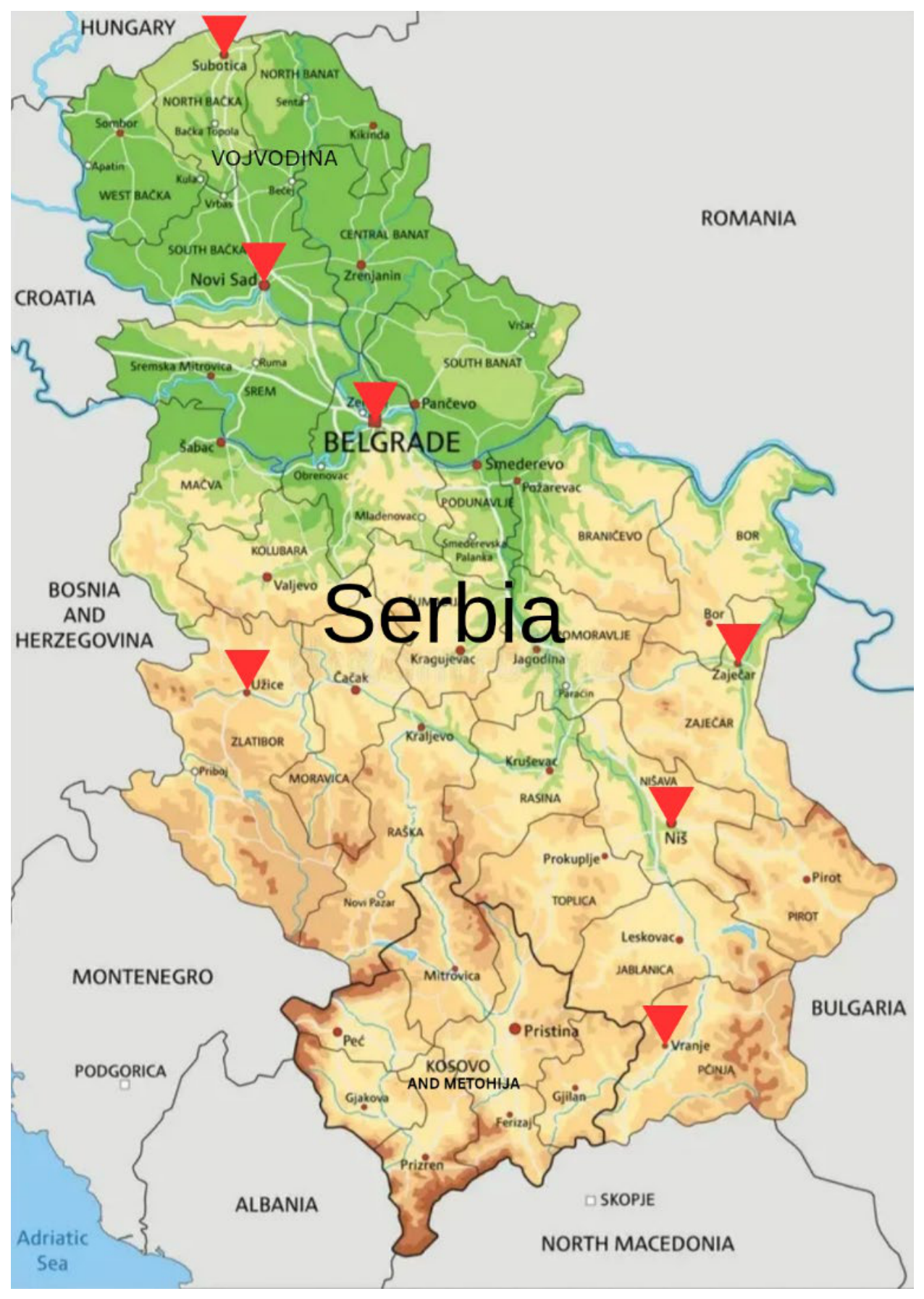
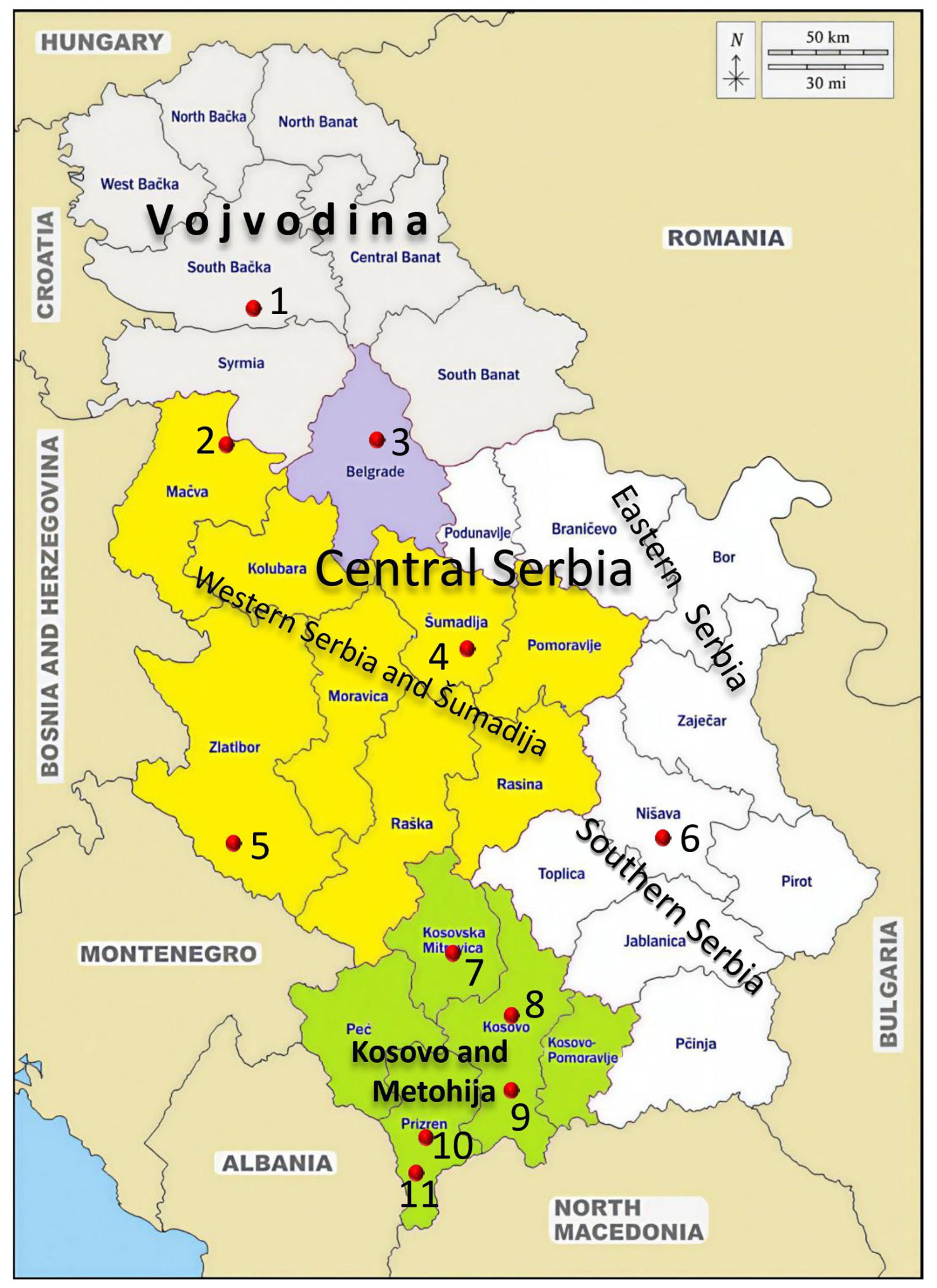
Measurements are performed annually in existing and newly constructed residential and public buildings, including dwellings, schools, and kindergartens, in Subotica, Novi Sad, Belgrade, Zaječar, Užice, Niš, and Vranje (Figure 1), with at least 50 buildings surveyed each year. The monitoring frequency is once per year. The regulations further specify that indoor radon measurements in Belgrade should be carried out annually in three kindergartens and three schools (the type of school is not specified), while in Subotica, Novi Sad, Niš, Užice, Zaječar, and Vranje, measurements are performed each year in two kindergartens and one school per city. Consequently, at least 24 educational buildings are included in the annual indoor radon monitoring program.
Data on long-term radon concentration monitoring were obtained from the national environmental ionizing radiation monitoring program, which is conducted annually. Within this program, a total of 303 measurements were performed in kindergartens, schools, and selected university faculties during the period from 2011 to 2024. Measurements in the analyzed facilities were conducted once a year using passive activated charcoal-based detectors. The distribution of the total number of measurements according to the type of educational institution is presented in Table 1 [50,51,52,53,54,55,56,57,58,59,60,61,62].

2.3. National Indoor Radon Monitoring in Educational Institutions in 2019

This review analyzes and synthesizes the results of the national radon measurement program conducted in schools and preschool institutions throughout the Republic of Serbia. The national measurements were carried out as part of activities aimed at assessing population exposure to natural sources of ionizing radiation and implementing the National Radon Action Plan. The analysis includes results from long-term radon concentration measurements collected in a large number of educational facilities across the Republic of Serbia, enabling an assessment of the spatial distribution of radon concentrations and the identification of areas with elevated radon potential.
As part of the national radon measurement program in educational institutions in the Republic of Serbia, conducted in cooperation with the International Atomic Energy Agency (IAEA), a total of 5000 passive detectors were deployed in schools and preschool institutions from March to June 2019, in cooperation with the Ministry of Education of the Republic of Serbia. Following the exposure period, 4133 detectors were collected, corresponding to a study completion rate of 83% (Table 2). This response rate enabled the collection of a representative dataset for assessing radon concentrations in educational institutions throughout the Republic of Serbia [46].
The coverage of the survey according to the type of institution is presented in Table 3. The survey included 980 of the 1127 primary schools (87%), 85 of the 416 secondary schools (20%), 124 of the 164 preschool institutions (76%), 28 of the 71 music and ballet schools (39%), and 35 of the 43 special schools (81%). The high coverage of primary schools, preschool institutions, and special schools contributes to the representativeness of the obtained data for these categories of educational institutions, whereas the coverage of secondary schools, as well as music and ballet schools, was considerably lower [46].
The number of CR-39 detectors deployed in schools depended on the number of students. According to the available data, three detectors were placed in schools with fewer than 500 students, four detectors in schools with 500 to 1000 students, and five detectors in schools with more than 1000 students. Three detectors were placed in each kindergarten. The collected detectors were analyzed in an accredited laboratory in Sweden. The institution responsible for the overall radon measurement procedure at the national level was the Directorate for Radiation and Nuclear Safety and Security of the Republic of Serbia. The project was supported by the IAEA through the national project SRB9006-“Upgrading National Capabilities and Infrastructure for a Systematic Approach to Control Public Exposure to Radon 2018–2019” [63].

2.4. Review and Selection of Additional Literature

The scientific literature search included articles published in international and domestic scientific journals, conference proceedings, and other available publications containing results of radon measurements in kindergartens and schools in the Republic of Serbia. Relevant publications were identified using electronic databases, including Web of Science, Scopus, Google Scholar, and other publicly available sources. Various combinations of keywords were used during the search, including indoor radon in schools, indoor radon in kindergartens, indoor radon in Serbia, indoor radon in schools in Serbia, indoor radon in kindergartens in Serbia, educational buildings, indoor radon exposure, radon measurements, and indoor radon in Kosovo, as well as searches for indoor radon in schools and kindergartens in different countries across the Balkan region and worldwide. Keywords in both Serbian and English were used. Studies published up to July 2026 were included.
Publications meeting the following criteria were included in the review: (i) the study was conducted in the Republic of Serbia; (ii) the study investigated preschool institutions, primary or secondary schools, and universities, as well as studies that, in addition to other types of buildings, included radon measurements in kindergartens and schools; (iii) the paper reported indoor radon concentration measurements accompanied by adequate statistical analysis, as well as studies providing adequately estimated annual effective doses due to radon inhalation, where such estimates were presented; and (iv) the measurement methodology and the main research results were clearly described. Publications exclusively concerning residential buildings, workplaces other than educational institutions, or studies without accessible measurement results were excluded from the analysis. Studies from neighboring countries and other countries worldwide that met the same criteria were also included to enable comparison of the results and identification of deviations.
From each publication and available national report, relevant data were extracted, including the study location, type of educational institution, number of investigated buildings and rooms, measurement method applied, measurement period, mean, median, minimum, and maximum radon concentrations, as well as the percentage of buildings in which the measured concentrations exceeded the reference level prescribed by the applicable regulations, in accordance with the methodology used in the respective study.
The collected data were analyzed using a descriptive comparative approach. The results of individual studies were compared with one another, as well as with the results of national measurements, to assess the spatial and temporal variability of radon concentrations in educational institutions in the Republic of Serbia. Particular attention was paid to the identification of areas with elevated radon concentrations, differences among various types of educational buildings, and the compliance of the obtained results with the national reference level for indoor radon concentration.
Given the heterogeneity of the analyzed studies in terms of measurement periods, the number of investigated buildings, and the methods applied, the results were interpreted through qualitative analysis and critical comparison of the available data, without conducting a formal meta-analysis, and the study was designed exclusively as a narrative review. This approach enabled a comprehensive overview of previous research, identification of existing knowledge gaps, and formulation of recommendations for future monitoring and research on radon concentrations in schools and preschool institutions in the Republic of Serbia.

3. Radon Measurement Methods in Kindergartens and Schools

Indoor radon concentration can be determined using passive and active measurement methods. The choice of method depends on the objective of the study, measurement duration, required accuracy, available financial resources, and the characteristics of the building in which the measurements are conducted. In studies of radon concentrations in schools and preschool institutions, long-term passive measurements using solid-state nuclear track detectors (SSNTDs) are most commonly applied, as they enable the determination of the annual average radon concentration at relatively low cost and allow for straightforward implementation across a large number of locations. In addition, some studies employ short-term methods based on radon adsorption onto activated charcoal, as well as various active electronic monitors that enable continuous monitoring of changes in radon concentration over time. The advantages, limitations, and critical considerations associated with these measurement methods are discussed in a previous critical review [1,12,64].
Previous studies conducted in kindergartens and schools in the Republic of Serbia have employed several different measurement techniques. The majority of studies have been based on passive CR-39 detectors, which were used in investigations conducted in southern Serbia [38,39,40,65,66], in the municipality of Sjenica [6], in the study conducted in the city of Šabac as part of the present research, and during the national radon measurement program in schools and preschool institutions in the Republic of Serbia in 2019 [46]. In addition to this method, some studies have employed activated charcoal canisters [43,67,68,69], discriminative radon/thoron UFO detectors [42,70], and various active radon monitors based on alpha-scintillation cells and continuous electronic measurements [7,27,35,44,45].
A similar methodological approach can be observed in most studies conducted in kindergartens and schools in other countries worldwide. The predominant measurement technique involves passive nuclear track detectors, particularly CR-39 detectors, which have been used in studies conducted in the Republic of Srpska [71,72], North Macedonia [8,73], Bosnia and Herzegovina [74], Montenegro [75], Bulgaria [29,76], Slovenia [13], Poland [77], Hungary [78], Albania [79,80], Romania [3], and Iraq [30]. Other types of passive detectors have been employed in some studies, such as LR-115 detectors in Croatia [81] and Greece [82], as well as various detection systems in Slovenia [83]. Active electronic monitors have been used considerably less frequently, mainly in studies focused on short-term or continuous measurements, such as the study conducted in Moldova using RTM-1642 (SARAD GmbH, Dresden, Germany) and RadonEye + 2 monitors (FTLab Co., Ltd., Ansan, Gyeonggi-do, South Korea) [28], the study in Portugal using the Radim 5B monitor [22], and the study conducted in Iraq using the Airthings Corentium Home device (Airthings ASA, Oslo, Norway) [84]. Overall, CR-39 detectors appear to represent an internationally accepted standard for long-term radon measurements in educational institutions, whereas active monitors are generally used as a complementary approach to passive methods or for detailed analysis of temporal variations in radon concentrations.
The IAEA recommends that the measurement period should not be shorter than two months, preferably during the heating season, in order to obtain a reliable estimate of the average radon concentration in a building, regardless of whether passive or active detectors are used [85].

3.1. Long-Term Measurements Using CR-39 Detectors

Etched track detectors (solid-state nuclear track detectors, SSNTDs) are the most widely used method for radon measurement, as they enable long-term measurements (ranging from two to twelve months), providing a more representative assessment of the average radon concentration due to its seasonal and daily variations [85].
Passive CR-39-type nuclear track detectors represent the most widely used method for long-term determination of indoor radon concentrations. Their widespread application is attributed to their ease of use, lack of need for an external power supply, high sensitivity, good long-term stability, and the possibility of simultaneously deploying a large number of detectors at different locations. Due to these characteristics, CR-39 detectors are a standard method in national radon monitoring programs in many European countries and are recommended for assessing the annual average radon concentration in buildings [1,6,9,12,13,46,75,76,77,78].
CR-39 is a polymer of allyl diglycol carbonate (ADC) that registers the passage of alpha particles generated by the decay of radon and its short-lived progeny. As an alpha particle passes through the detector material, it causes localized damage to its molecular structure, producing latent tracks that are not immediately visible after exposure. Subsequent chemical etching of the detector makes these tracks sufficiently pronounced for microscopic analysis, and their number is proportional to the total exposure of the detector to radon during the measurement period [86,87,88].
The design of the detector system may vary depending on the measurement purpose and manufacturer, with open (bare) and diffusion-type detectors being the most common configurations. In diffusion-type detectors, radon enters the chamber through a diffusion membrane or a small diffusion opening, while aerosols and short-lived radon progeny are retained by a filter or membrane, ensuring that the recorded tracks originate predominantly from alpha particles emitted during the decay of radon itself [89,90,91,92].
In the study conducted in primary and secondary schools in the city of Šabac, Radtrak2 CR-39 detectors manufactured by Radonova (Uppsala, Sweden) were used. The detectors were placed inside diffusion chambers with a defined geometry, ensuring standardized exposure conditions and minimizing the influence of radon progeny and local geometry. The detector chambers were mounted on the interior walls of classrooms at locations representative of occupied areas and were exposed for a period of three months. Following exposure, the CR-39 detectors were chemically etched, and the radon concentration was determined based on the density of recorded alpha-particle tracks using the appropriate calibration factor for the detector and diffusion-chamber configuration employed.
After the exposure period, the detectors were chemically etched in a 6 M sodium hydroxide solution at a temperature of 70 °C for four hours. This procedure made the latent alpha-particle tracks visible under a microscope. Track counting was performed by visual analysis, with each detector analyzed in ten randomly selected areas photographed at 100× magnification. The area of each analyzed region was 1.39 mm2, and the track density was determined as the number of registered tracks per unit area of the detector [86,88,93,94].
Radon concentration was determined based on the proportional relationship between the track formation rate and the mean radon concentration over the exposure period. For the detectors used, a calibration factor of 3.2 tracks cm−2 per (kBq m−3 h) was applied to convert the track density into the mean radon concentration in air [93]. Various sensitivity values (calibration factors) for CR-39 detectors have been reported in the literature, resulting from differences in detector characteristics, chemical etching conditions, calibration procedures, exposure system geometry, and track-reading methods [74,86,95,96,97,98].
The same methodology formed the basis of most long-term radon studies conducted in educational institutions in the Republic of Serbia. CR-39 detectors were used in systematic studies in southern Serbia during the period 2008–2010 [40,65], in the optimization of the national radon monitoring program [38], in the development of radon potential maps [39], in a study conducted in the municipality of Sjenica [6], and in the largest national radon measurement campaign in schools and preschool institutions in the Republic of Serbia, conducted in 2019 [46]. The widespread application of the same measurement technique enables comparison of the results of these studies with minimal influence from methodological differences. Further details on the methodology of radon measurements using CR-39 detectors can be found in previous studies [86,88,93,95,99,100,101,102].

3.2. Short-Term Measurements Using Activated Charcoal Canisters

In addition to long-term passive measurements, short-term radon measurements using activated charcoal canisters have also been widely applied in studies of radon concentrations in educational institutions for more than four decades. The method is based on the physical adsorption of radon from the air onto activated charcoal granules during a predefined exposure period, which, according to the recommendations of the U.S. Environmental Protection Agency (U.S. EPA), may range from 24 to 144 h, while in practice an exposure period of approximately 48 h is most commonly used [103]. Following the exposure period, the canister is hermetically sealed, and after radioactive equilibrium is established between radon and its short-lived decay progeny, the radon concentration is determined by gamma spectrometric measurement of the characteristic gamma lines of 214Pb (295 and 352 keV) and 214Bi (609 keV), using high-resolution germanium (HPGe) or NaI(Tl) detectors [43,68,69,104,105,106,107]. Efficiency calibration of these detection systems requires the use of EFFTRAN software and Monte Carlo simulations [108,109]. Prior to measurement, the activated charcoal is dried to constant mass to remove adsorbed moisture and residual radon, thereby ensuring the reproducibility of the results [103].
Radon concentration is calculated based on the recorded number of gamma-ray counts, exposure time, detection system efficiency, calibration factor, and correction for radioactive decay between the end of the exposure period and the beginning of the measurement [103,105]. Since the response of the canisters depends on the exposure duration and the amount of adsorbed moisture, each detector type is calibrated under controlled conditions with a known radon concentration, ensuring the accuracy, traceability, and comparability of measurement results [106,107]. A detailed description of the methodology for determining indoor radon concentration using activated charcoal canisters is provided in previous studies [12,104].
The main advantages of the activated charcoal method are its simple application, low cost, and the possibility of obtaining results rapidly, making it suitable for screening a large number of buildings, assessing the spatial distribution of radon concentrations, and identifying buildings where more detailed long-term measurements are required. An additional advantage is the possibility of performing the analysis in laboratories equipped with standard gamma spectrometry systems, without the need for chemical processing and microscopic analysis of nuclear track detectors [12,88,93].
However, due to the short exposure period, the obtained results represent instantaneous or short-term radon concentrations, which may differ substantially from the annual average due to daily and seasonal variations in meteorological conditions, atmospheric pressure, ventilation patterns, and building occupancy and use. Seasonal differences in radon concentration often exceed a factor of two between summer and winter, which is why short-term measurements are generally used as a screening method and are not recommended for assessing long-term population exposure or making decisions on building remediation unless they are supplemented with seasonal correction factors or subsequent long-term measurements [12,104,105].
In Serbia, the activated charcoal method was among the first methods applied in studies of radon concentrations in primary schools and preschool institutions in Novi Sad [67]. It was subsequently used in schools and kindergartens in the city of Belgrade [68,69], where, in addition to radon concentrations, annual effective doses for students and staff were also assessed, as well as in studies of educational institutions in the city of Niš [43]. The particular significance of this method lies in its continuous application within the Annual Environmental Radioactivity Monitoring Program of the Republic of Serbia, which has been implemented since 2011 [50,51,52,53,54,55,56,57,58,59,60,61,62]. Within this program, radon concentrations were determined in preschool institutions, primary and secondary schools, and universities in seven cities in Serbia (Subotica, Novi Sad, Belgrade, Zaječar, Užice, Niš, and Vranje; Figure 1). During the period 2011–2024, a total of 303 measurements were conducted in educational institutions, resulting in a unique time series of data that enables the assessment of spatial and temporal variability in radon concentrations and the identification of areas with elevated radon potential.
The International Atomic Energy Agency (IAEA) [85], the International Commission on Radiological Protection (ICRP) [110], and the World Health Organization (WHO) [11] recommend that decisions regarding the implementation of measures to reduce radon concentrations should be based primarily on the results of long-term measurements, while short-term measurements play an important role in the initial screening of buildings, planning national monitoring programs, and selecting locations where more detailed long-term investigations are required.

3.3. Other Methods for Measuring Indoor Radon Concentration

In addition to CR-39 detectors and activated charcoal canisters, other methods for determining radon concentration have also been employed in some studies conducted in Serbia and the surrounding region. Their application was determined by specific research objectives, the need for short-term or continuous measurements, and the availability of appropriate measurement equipment.
Studies conducted in Kragujevac employed discriminative UFO radon/thoron detectors based on Makrofol nuclear track detectors [42,70]. Unlike standard CR-39 detectors, these detectors enable the separate determination of radon (222Rn) and thoron (220Rn) concentrations, thereby reducing the potential for overestimation of radon concentration in environments where thoron may contribute significantly to the total alpha radiation. Although the contribution of thoron is relatively small in most school buildings, its separation represents an important advantage in buildings constructed with materials containing elevated thorium concentrations.
In several studies conducted in the area of Kosovo and Metohija, alpha-scintillation cells, i.e., Lucas cells, coupled with PRM-145 radon monitors (AMES d.o.o., Ljubljana, Slovenia) were used [7,27,35,45]. The operating principle of these devices is based on the detection of alpha particles emitted during the decay of radon and its progeny within a closed scintillation chamber coated with a ZnS(Ag) scintillator. The emitted light is detected by a photomultiplier tube, with the signal intensity being proportional to the radon concentration in the sampled air. Such systems enable rapid determination of radon concentration with high sensitivity and relatively short measurement times, making them suitable for field investigations and the identification of buildings with elevated radon concentrations.
In the study by Nafezi et al. [47], a combination of several methods was employed, including PRM-145 monitors, CRM-510 devices (femto-TECH, Inc., Carlisle, OH, USA) for continuous radon monitoring, and nuclear track detectors. This multi-method approach enabled cross-validation of the results and a more detailed analysis of temporal variations in radon concentration. Continuous monitors are particularly useful for studying daily fluctuations and the effects of ventilation, atmospheric pressure, and meteorological parameters on indoor radon concentrations, which cannot be adequately assessed using passive integration-type methods.
From a methodological perspective, different measurement techniques should not be regarded as competing but rather as complementary approaches to determining radon concentration. Long-term passive detectors provide the most representative assessment of the annual average radon concentration and form the basis of national monitoring programs, whereas active monitors enable detailed analysis of short-term variations in radon concentration and identification of factors influencing its spatial and temporal variability. Short-term measurements using activated charcoal occupy an intermediate position between these two groups of methods and represent an effective approach for screening a large number of buildings [12].
Due to these differences, direct comparison of results from different studies requires careful consideration of the measurement methodology applied, exposure duration, time of year when the measurements were conducted, and characteristics of the measurement systems used. Therefore, particular attention in this review is devoted to interpreting the results in the context of the measurement method applied, in order to ensure that comparisons of radon concentrations among individual studies are as objective and scientifically robust as possible.

4. Reference Values and Health Risk Assessment

4.1. Reference Values for Indoor Radon Concentrations

To protect the population from the adverse effects of long-term radon exposure, several international organizations have established reference levels for indoor radon concentrations. The World Health Organization (WHO) recommends a reference level of 100 Bq/m3, emphasizing that, if this level cannot be achieved for technical or economic reasons, the radon concentration should not exceed 300 Bq/m3 [11]. A similar approach has been adopted by the International Commission on Radiological Protection (ICRP), which recommends reference levels for residential and workplace environments in the range of 100–300 Bq/m3, depending on national circumstances and radon risk management programs, in accordance with the ALARA principle [110].
The obligation to establish national reference levels is also prescribed by Council Directive 2013/59/EURATOM [37], which stipulates that the reference level for the annual average radon concentration in residential and workplace environments should not exceed 300 Bq/m3. The Directive also requires Member States to develop national radon action plans, identify areas with elevated radon potential, and implement systematic monitoring in buildings with an increased risk of exposure, among which schools and preschool institutions have a particularly important role.
Unlike the recommendations of the World Health Organization, the ICRP, and Council Directive 2013/59/EURATOM [37], the current regulations of the Republic of Serbia still establish different intervention levels for new and existing buildings. According to national regulations, the intervention level for chronic radon exposure is 200 Bq/m3 for newly constructed buildings and 400 Bq/m3 for existing buildings, while a value of 1000 Bq/m3 is prescribed for workplaces [111]. This approach is based on earlier European recommendations. Serbia does not have a separate reference level, action level, or limit value specifically for kindergartens and schools; instead, the previously mentioned criteria based on the age of the building are applied. The value of 1000 Bq/m3 for workplaces is rarely applied in the context of schools and kindergartens; rather, the aforementioned stricter criteria are used. A large number of European countries likewise do not have specific radon action levels for schools and kindergartens [112].

4.2. Assessment of Annual Effective Dose Due to Indoor Radon Exposure

The measured indoor radon concentration obtained using any of the previously described methods represents a fundamental parameter for assessing population exposure to naturally occurring ionizing radiation. However, radon concentration alone does not allow for a direct assessment of health risk; therefore, measurement results are most commonly also expressed in terms of the annual effective dose resulting from the inhalation of radon and its short-lived decay products. Effective dose is a quantity that takes into account the biological effects of ionizing radiation on the human body and enables comparison of exposure among different population groups, buildings, and geographical areas, as well as assessment of compliance with the recommendations of international organizations in the field of radiation protection [10,110,113].
Most of the effective dose does not originate from radon itself, but from its short-lived decay products (218Po, 214Pb, 214Bi, and 214Po), which attach to aerosols in the air and, following inhalation, deposit in the respiratory system. The alpha particles emitted during their decay represent the dominant source of irradiation of the bronchial epithelium and the primary cause of the increased risk of lung cancer associated with long-term radon exposure. Therefore, effective dose assessment represents an important step in interpreting measurement results and evaluating radiological risk in schools and preschool institutions [113,114,115,116].
The annual effective dose due to radon exposure is most commonly calculated using the methodology recommended by the United Nations Scientific Committee on the Effects of Atomic Radiation (UNSCEAR), according to Equation (1) [10]:
D = C R n × F × T × D C F
where:
D—annual effective dose (mSv/y),
CRn—annual average indoor radon concentration (Bq/m3),
F—equilibrium factor between radon and its short-lived decay products,
T—annual occupancy time in the investigated building (h/y),
DCF—dose conversion coefficient from exposure to effective dose (nSv per Bq h/m3).
In most studies of radon concentrations in kindergartens and schools, an equilibrium factor of F = 0.4 is used [1,2,6,13,29,30,80,82], representing the average value for indoor environments recommended by UNSCEAR [10] and ICRP [110]. This factor describes the relationship between the concentration of gaseous radon and its short-lived decay products that actually contribute to irradiation of the respiratory system. Although the equilibrium factor may vary depending on ventilation, aerosol concentration, and microclimatic conditions within a building, a value of 0.4 has been adopted as an international standard and enables comparison of results from different studies [10,12,113].
Occupancy time (T) is determined according to the characteristics of the population under consideration and the purpose of the building. For children in kindergartens and students in schools, it is substantially shorter than for residential buildings, since educational facilities are occupied only during working days and for a limited number of hours per day. Consequently, the estimated effective doses in schools are generally lower than those that would result from the same radon concentration in residential buildings. Different assumptions regarding occupancy time are used in some studies; therefore, comparisons of effective doses between studies should be performed with careful consideration of the input parameters applied. For example, in the study by Papaefthymiou and Georgiou [82], an exposure time of 1050 h/y for students and 1225 h/y for teachers was used for dose assessment in Greece. The study by López-Pérez et al. [9], conducted in Tenerife, used an exposure time of 1620 h/y, while the study by Kaçeli et al. [80], conducted in Albania, used 2000 h/y. In Serbia, one of the earlier studies by Žunić et al. [65] used an exposure time of 925 h/y for students and 1380 h/y for teachers, with a methodology for dose assessment described in detail. For the assessment of the annual effective dose in the present study, an exposure time of 1380 h/y was used. A large number of studies conducted worldwide and in Serbia report measured indoor radon concentrations without also estimating annual effective doses. This, together with the use of different exposure times among studies, further limits the comparability of the results.
Particular attention has been drawn in recent years to the revision of dose conversion factors (DCFs). Older studies most commonly applied the UNSCEAR [10,117] methodology, based on a dose conversion coefficient of 9 nSv per (Bq h/m3). This dose conversion coefficient corresponds to an estimated annual effective dose of 10 mSv/y at an indoor radon concentration of 400 Bq/m3 [12], although it is often stated that this dose corresponds to an indoor radon concentration of 300 Bq/m3 [11], which introduces some inconsistencies in the literature. ICRP Publication 137 recommends a lower DCF value of 6.7 nSv per (Bq h/m3) [113], which further reduces the estimated dose by approximately 25%. The most recent UNSCEAR publication [10] continues to recommend a DCF value of 9 nSv per (Bq h/m3), which was also used in the present study. Other studies conducted in Serbia use the same value. Some authors use a lower DCF value in their dose assessments [28,80], which may also affect the comparability of the results.
According to the latest UNSCEAR report [10], of the total average annual effective dose of approximately 3 mSv/y from exposure to natural sources, radon and its decay products represent the largest single source of natural radiation exposure of the population. The average annual effective dose due to radon exposure is approximately 1.4 mSv/y, with a typical exposure range of 0.3–7.5 mSv/y, primarily resulting from time spent indoors.

5. Results and Discussion

5.1. Indoor Radon Concentrations in Primary and Secondary Schools in the City of Šabac

Radon concentrations measured in 17 primary and secondary schools in the city of Šabac ranged from 75 to 265 Bq/m3, with an arithmetic mean of 170 Bq/m3 and a geometric mean of 156 Bq/m3. The standard deviation was 65 Bq/m3, while the geometric standard deviation was 2, indicating pronounced variability in radon concentrations among the investigated buildings. The estimated annual effective dose ranged from 0.37 to 1.32 mSv/y, with a mean value of 0.85 mSv/y (Table 4).
The measurement results obtained in schools in the city of Šabac show that both the mean radon concentration (170 Bq/m3) and the maximum concentration (265 Bq/m3) were below the reference level of 300 Bq/m3 recommended by the WHO, ICRP, and Directive 2013/59/EURATOM, as well as below the applicable intervention level in Serbia for existing buildings (400 Bq/m3) [11,37,110,111]. This indicates that none of the investigated schools had concentrations requiring immediate remediation. The difference between the arithmetic mean (170 Bq/m3) and geometric mean (156 Bq/m3), together with a geometric standard deviation of 2, confirms the log-normal distribution of radon concentrations, which is characteristic of indoor measurements [10,11,65,67].
The mean radon concentration obtained in this study was slightly higher than the average values recorded within the national measurement program conducted in 2019 (132 Bq/m3 in primary schools and 115 Bq/m3 in secondary schools, Table 9). This difference may partly reflect local geological conditions, differences in building characteristics, and the fact that most of the measurement period covered the heating season, when indoor radon concentrations may be higher because of reduced ventilation [11,46]. The measured values are consistent with those reported for other regions and cities in Serbia (see Table 10). The values are also comparable with those reported for kindergartens and schools in other Balkan countries, including the Republic of Srpska [71,72], North Macedonia [8,73], Bulgaria [29], Slovenia [83], Croatia [81], and Romania [3] (see Table 11).
The estimated annual effective dose values are comparable with those reported for other regions of Serbia [2,45,68]. The estimated mean annual effective dose of 0.85 mSv/y is below the global average of 1.4 mSv/y and represents a relatively small contribution to the total natural radiation exposure of the population [10], but it confirms the importance of continuous radon monitoring in schools due to the long-term exposure of children and staff. Although the study included a limited number of buildings, the use of long-term CR-39 detectors over a three-month period provides a reliable assessment of radon concentrations and enables comparison with other national and international studies.

5.2. Annual Indoor Radon Monitoring in Serbia Using Activated Charcoal Canisters (2011–2024)

Indoor radon concentrations in kindergartens and schools measured within the framework of the Annual Environmental Radioactivity Monitoring Program in Serbia during the period 2011–2024 were determined using the activated charcoal adsorption method, according to the methodology described previously, with a total of 303 measurements (10 of which were conducted at universities). Measurements were carried out in buildings located in seven cities across Serbia: Belgrade, Subotica, Novi Sad, Niš, Užice, Zaječar, and Vranje (see Figure 1).
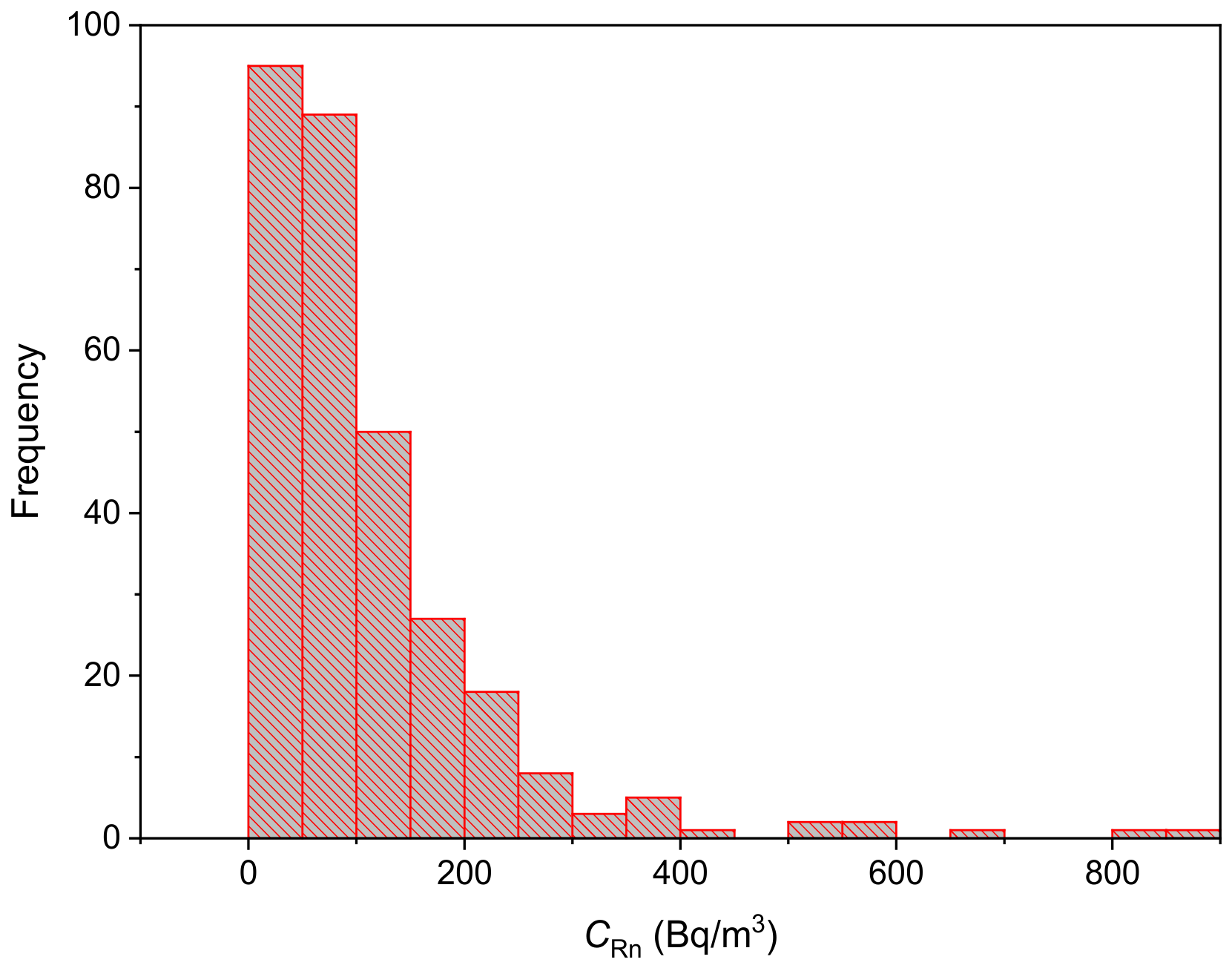
Table 5 presents the measured values and annual mean indoor radon concentrations in kindergartens and schools. No measurements were conducted in 2012. Table 6 presents the ranges of measured values and mean concentrations according to the cities in which the measurements were conducted, while the basic descriptive statistical parameters for all measurement results are presented in Table 7. The frequency distribution of all 303 measurement results is also presented in Figure 2.
The measured values for all analyzed kindergartens and schools across Serbia ranged from 5 to 873 Bq/m3. The mean indoor radon concentration was 112 Bq/m3, with a relatively high standard deviation of 116 Bq/m3, already indicating substantial variability in the dataset. The geometric mean was 76 Bq/m3, with a geometric standard deviation of 2. The median was 73 Bq/m3 (Table 7). The highest values were measured in a secondary school in Belgrade in 2018 (873 Bq/m3), in a primary school in Vranje in 2021 (800 Bq/m3), in a kindergarten in Zaječar in 2018, and at a university in Niš in 2019, where concentrations were around or above 600 Bq/m3 (Table 5 and Table 6, Figure 1). The maximum measured values in Belgrade and Vranje exceeded the Serbian intervention level for radon of 400 Bq/m3 by approximately a factor of two [111], and also exceeded the upper recommended WHO value of 300 Bq/m3 [11]. Elevated indoor radon concentrations were also measured in one building in Subotica, slightly exceeding the upper limit recommended by the WHO (see Table 5 and Table 6).
Compared with the reference levels for indoor radon concentration prescribed in Serbia [111], the measured radon concentrations were, in the vast majority of cases, below the intervention level of 400 Bq/m3 for chronic exposure of the general population. None of the measured values exceeded 1000 Bq/m3, which represents the intervention level for radon exposure in workplaces in the Republic of Serbia.
The measured indoor radon concentrations in kindergartens and schools are comparable with the results of previous studies conducted in Serbia [6,7,27,45,47,68,69], as presented in Table 10, as well as with results reported from neighboring countries, including Croatia [81], Slovenia [13], Bulgaria [29], Romania [3], North Macedonia [8,73], the Republic of Srpska [71], and Albania [79], as well as from Moldova [28] and Portugal [22] (see Table 11).
The analyzed dataset was dominated by measurements conducted in older buildings, with a smaller proportion of rooms located in newer buildings. Measurements were performed in various types of rooms, including children’s rooms, playrooms, sleeping rooms, teachers’ offices, dining rooms, medical rooms, and physical education rooms in kindergartens. In schools, the analyzed spaces included reception and security rooms, classrooms, libraries, teachers’ rooms, offices for various purposes, subject-specific classrooms, laboratories, basements, cellars, and auxiliary rooms.
Most of the analyzed rooms were located on the ground floor, in semi-basement or basement areas, or on the first and, in some cases, second floors. Some classrooms and other rooms regularly occupied by students and teachers were located in semi-basement or basement areas. In all cases, indoor radon concentrations measured on the first and second floors were below 90 Bq/m3. Consequently, the measured indoor radon concentrations on the first and second floors of schools and kindergartens did not exceed the WHO-recommended value of 100 Bq/m3 [11]. Elevated concentrations exceeding the reference levels were primarily measured in ground-floor and basement rooms.
Elevated radon concentrations in kindergartens and schools may result from several factors, including the use of building materials with increased 226Ra activity concentrations, insufficient ventilation, and the presence of cracks in floors or walls that facilitate radon entry from the soil. However, no data are available on the origin of the building materials used in these buildings or their 226Ra content. Previous studies conducted in Serbia have shown that commonly used building materials, such as bricks, concrete, and mortar, do not contain elevated 226Ra activity concentrations [33,118,119]. An exception is represented by certain ceramic tiles, for which 226Ra activity concentrations of up to 252 Bq/kg have been reported [120,121], and which are commonly used in kindergartens and schools. Although their association with elevated indoor radon concentrations has not been confirmed, such materials are unlikely to represent a dominant source of radon and may only contribute to the overall radon concentration within a building. On the other hand, the most recent review of soil radioactivity in Serbia [122] provides a comprehensive overview of the spatial distribution of naturally occurring radioactivity; however, due to the lack of appropriate spatially comparable datasets, it was not possible to establish a relationship between soil radioactivity and the measured indoor radon concentrations.
Descriptive statistics of indoor radon concentrations indicate a positively skewed distribution, with the geometric mean (76 Bq/m3) being lower than the arithmetic mean (112 Bq/m3). This relationship indicates that a small number of buildings with elevated radon concentrations substantially influence the arithmetic mean, as further confirmed by the high skewness (3.1) and kurtosis (12.9) coefficients (Table 7). This indicates that the majority of the investigated buildings had low to moderate radon concentrations, whereas only a small number of buildings exhibited substantially higher values, which is characteristic of the distribution of indoor radon concentrations.
Based on the frequency distribution presented in Figure 2, the radon concentrations show pronounced positive skewness, with the largest number of measurements falling within the lower concentration intervals and a gradual decrease in frequency toward higher values. The higher arithmetic mean compared with the geometric mean, positive skewness, and a geometric standard deviation greater than one indicate a positively skewed distribution of radon concentrations, which is consistent with the log-normal character of the data.
Additionally, to statistically test this assumption, the Shapiro–Wilk test was performed on the natural logarithm of the radon concentrations, ln(CRn). The obtained test statistic was W = 0.99776, while the p-value was p = 0.95745. Since p > 0.05, the null hypothesis of normality of ln(CRn) could not be rejected. Therefore, the results indicate that the logarithmically transformed radon concentrations do not deviate significantly from a normal distribution, providing additional support for the conclusion that the original CRn values are compatible with a log-normal distribution.
This finding is fully consistent with previous studies showing that indoor radon data are best described by a log-normal distribution, particularly when large geographical areas with heterogeneous geological and pedological characteristics are considered [10,11,79,123,124,125,126,127]. Similar findings have also been reported in other studies conducted in kindergartens and schools in Serbia [39,42,43,65,67].
Table 8 presents the number of measurements of indoor radon concentrations, determined using activated charcoal detectors and classified according to the reference levels recommended by the World Health Organization [11]. Of the 303 measurements, radon concentrations were ≤100 Bq/m3 in 185 measurements (61.1%), while concentrations exceeded this value in 118 measurements (38.9%). A total of 102 measurements (33.7%) had radon concentrations in the range of 100–300 Bq/m3, whereas concentrations above 300 Bq/m3 were measured in 16 measurements (5.3%).
When analyzed by city, the most favorable results were recorded in Novi Sad and Subotica, where 77.1% and 70.4% of the measurements, respectively, had radon concentrations ≤ 100 Bq/m3. No concentrations above 300 Bq/m3 were recorded in Novi Sad. In Belgrade, 65.9% of the measurements had concentrations below the recommended level, while 4.4% of the measurements had concentrations above 300 Bq/m3. Zaječar had the least favorable distribution of radon concentrations, with only 36.4% of measurements having concentrations ≤ 100 Bq/m3, while 63.6% exceeded this value, including 13.6% of measurements with concentrations above 300 Bq/m3. In Užice, Niš, and Vranje, the proportion of measurements with concentrations ≤ 100 Bq/m3 ranged from 57.6% to 62.5%, while the proportion of measurements with concentrations above 300 Bq/m3 remained relatively low (0–9.4%) (Table 8).
Overall, the majority of the analyzed buildings had radon concentrations below the WHO-recommended reference level [11]; however, nearly two-fifths of the buildings exceeded 100 Bq/m3. Particularly unfavorable results were observed in Zaječar, highlighting the need for continuous monitoring and the implementation of measures to reduce radon exposure.

Assessment of Annual Doses from Indoor Radon Exposure

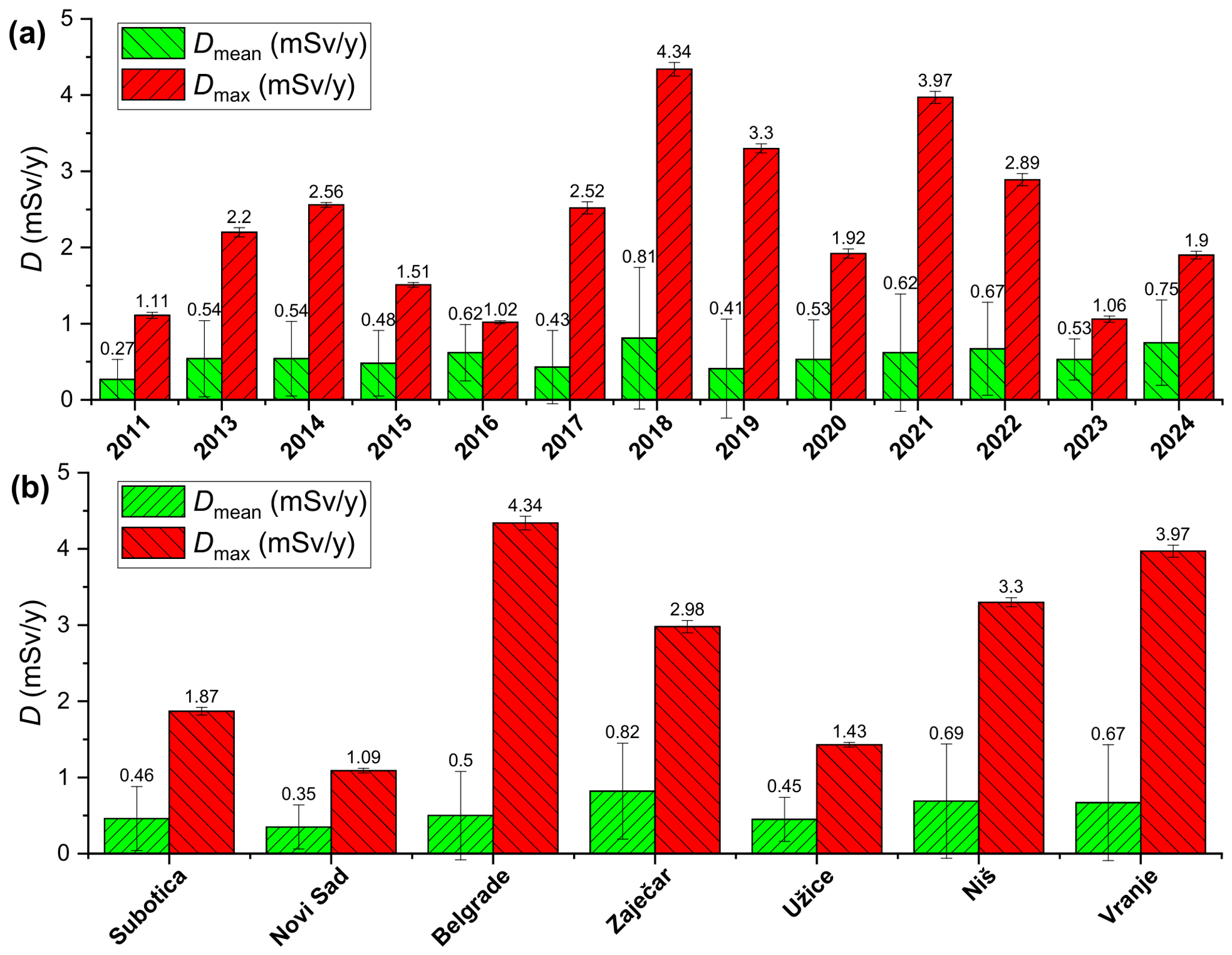
Based on the results of indoor radon concentration monitoring, the radiation risk was assessed by calculating the annual effective doses (D) using Equation (1). The maximum and mean annual effective dose values, categorized by measurement year and location, are presented in Figure 3. The descriptive statistics for the estimated annual effective doses corresponding to all measurements are provided in Table 7.
For the assessment of the annual effective dose, an exposure time of 1380 h was adopted in accordance with the guidelines described in the previous study by Žunić et al. [65]. The estimated annual effective doses for all measurements ranged from 0.02 to 4.34 mSv/y, with a mean value of 0.56 ± 0.58 mSv/y. The geometric mean was 0.38 mSv/y, while the median value was 0.36 mSv/y (Table 7). These values fall within the worldwide range (0.3–7.5 mSv/y) reported by UNSCEAR [10] for effective doses due to radon exposure, while the mean value is approximately 2.5 times lower than the global average annual effective dose from radon of 1.4 mSv/y. However, this comparison should be interpreted with caution, as occupancy times in schools and kindergartens are considerably shorter than those typically assumed for general indoor exposure. The estimated occupancy time in kindergartens and schools represents approximately 20% of the total time an individual spends indoors (7000 h). Therefore, the calculated values should be interpreted as the effective dose contribution from indoor radon exposure during occupancy of educational facilities, rather than as the total annual radiation exposure of an individual.
Figure 3a illustrates the temporal variation in the estimated mean (Dmean) and maximum (Dmax) annual effective doses due to indoor radon exposure during the period 2012–2024. The average annual effective doses ranged within a relatively narrow range, from 0.27 mSv/y (2011) to 0.81 mSv/y (2018), with values below 0.7 mSv/y in most years. In contrast, the maximum annual effective doses exhibited considerably greater variability, ranging from 1.02 mSv/y (2016) to 4.34 mSv/y (2018). Elevated maximum values were also recorded in 2019 (3.30 mSv/y) and 2021 (3.97 mSv/y), indicating the presence of individual buildings with higher indoor radon concentrations than those observed in the remaining analyzed buildings. Following the pronounced peak in 2018, a declining trend was observed, followed by another increase in 2021, while lower maximum values were recorded during the last two years of the monitoring period.
Figure 3b presents the spatial distribution of annual effective doses across the cities included in the monitoring program. The mean annual effective doses were relatively uniform, ranging from 0.35 mSv/y in Novi Sad to 0.82 mSv/y in Zaječar, with values below 1 mSv/y in all cities. In contrast, the maximum annual effective doses exhibited more pronounced spatial variability. The highest values were recorded in Belgrade (4.34 mSv/y) and Vranje (3.97 mSv/y), while in Niš and Zaječar they were approximately 3 mSv/y. The lowest maximum doses were determined in Novi Sad (approximately 1 mSv), while somewhat higher values were observed in the other cities (Figure 3). This spatial heterogeneity may reflect differences in local geological characteristics, building materials, and ventilation conditions that can affect indoor radon concentrations.
For comparison, the maximum annual effective dose remained below 10 mSv/y [11,110], which is sometimes used as a reference for contextual comparison in radon dose assessments and approximately corresponds, according to Equation (1), to an indoor radon concentration of 400 Bq/m3 [111]. This comparison should not be interpreted as demonstrating compliance with a limit for total individual radiation exposure, because the calculated values represent only the contribution from indoor radon exposure during occupancy of educational facilities. The pronounced differences between the mean and maximum annual effective doses indicate that some individual buildings may be associated with substantially higher exposure than the average, highlighting the need for targeted monitoring and the implementation of mitigation measures in buildings with elevated indoor radon concentrations.
The estimated annual effective doses obtained in this study are comparable with those reported in previous investigations conducted in different regions of Serbia [2,27,45,47,68]. They are also consistent with values reported for schools and a university in Albania [79,80], schools in Tenerife [9], schools in Bulgaria [29], and primary schools in Slovenia [13], while the estimated doses are higher than those reported for primary schools in Greece [82].

5.3. National Indoor Radon Monitoring Programme in Kindergartens and Schools, 2019

The national indoor radon survey conducted in educational institutions in 2019 represents the most comprehensive investigation of indoor radon in kindergartens and schools ever carried out in the Republic of Serbia. As part of a project supported by the International Atomic Energy Agency (IAEA), a total of 5000 CR-39 detectors were deployed in preschools and schools throughout Serbia. Of these, 4133 detectors were successfully retrieved and analyzed, corresponding to a response rate of 83%. Such a large number of analyzed detectors enabled a representative assessment of the spatial distribution of indoor radon concentrations in educational institutions at the national level [46,63].
The measured indoor radon concentrations are presented in Table 9. The highest radon concentrations were recorded in primary schools, where the maximum measured value reached 2970 Bq/m3, approximately 22.5 times higher than the arithmetic mean for this category of buildings (132 Bq/m3). In secondary schools, the maximum radon concentration was 870 Bq/m3, while the corresponding maximum values in kindergartens, special schools, and music and ballet schools were 843, 639, and 590 Bq/m3, respectively (Table 9) [46].
Table 9. Results of Indoor Radon Measurements in Schools and Kindergartens in Serbia (March–June 2019) within the National Indoor Radon Monitoring Programme in Educational Institutions [46].
Type of InstitutionNumber of Measuring PointsCRn (Bq/m3)
RangeMean Value
Kindergartens4250–843121
Primary schools30810–2970132
High schools2175–870115
Special schools1073–639131
Music and ballet schools8016–590112
The obtained results indicate that the arithmetic mean indoor radon concentrations do not differ substantially among the various types of educational institutions, as relatively similar values were observed for all categories. Therefore, the differences between these categories are small and are more likely to reflect variations in local geological conditions, building age, construction characteristics, and ventilation practices than the type of educational institution itself. A similar conclusion was reached by Bochicchio et al. [38], who demonstrated that the functional use of rooms within schools is not a significant factor influencing indoor radon levels. Instead, the most important determinants were geological conditions (differences between rural and urban areas), floor level, and building characteristics, whereas the functional purpose of individual rooms was not statistically associated with indoor radon concentration.
The maximum values exceeded the arithmetic means by several times, indicating pronounced spatial heterogeneity of the radon potential in Serbia. This distribution is a typical characteristic of indoor radon and results from the combined influence of geological substrate, soil permeability, the presence of geological faults, building foundation characteristics, the quality of waterproofing, and ventilation intensity [10,11,12,85]. As discussed previously, numerous studies have shown that indoor radon concentrations generally follow a log-normal distribution, in which a relatively small number of buildings with very high radon concentrations substantially increase the arithmetic mean, whereas the majority of buildings exhibit considerably lower concentrations, as can be inferred from the data presented in Table 9.
The results of the national survey also confirm the findings of previous regional studies conducted in southern Serbia, which demonstrated that buildings with elevated indoor radon concentrations are generally localized rather than uniformly distributed across the country (Table 9). Bochicchio et al. [38] reported that approximately 5% of primary schools in southern Serbia exceeded the reference level of 300 Bq/m3, with elevated concentrations being most frequently recorded in rural areas and in ground-floor rooms.
In general, the values presented in Table 9 are in good agreement with the radon monitoring data obtained during the 2011–2024 period (Table 5 and Table 6), with no substantial discrepancies in individual measurements except for several primary schools where considerably higher radon concentrations were recorded (Table 9). The mean values for all analyzed types of educational institutions are comparable with the overall mean value of 112 ± 116 Bq/m3 obtained for the seven surveyed cities in Serbia (Table 7). This suggests that indoor radon concentrations measured using activated charcoal canisters do not differ substantially, in most buildings, from those obtained in the national survey presented in Table 9.
However, the maximum and individual measured values in nearly all categories of educational institutions exceeded the recommended reference level of 300 Bq/m3 [11] as well as the Serbian action level of 400 Bq/m3 for existing buildings. Furthermore, a small proportion of primary schools exceeded the Serbian workplace action level of 1000 Bq/m3 [111]. At present, more comprehensive datasets and the results of individual measurements are not publicly available, preventing a reliable determination of the proportion of educational institutions exceeding the recommended reference or action levels for indoor radon.
The measured values are comparable with those reported for southern Serbia [38,39,40,65,66] and Kosovo and Metohija [44,47]. Compared with the values reported in the earlier nationwide study of Serbian schools [93], the concentrations obtained in the present study are considerably higher, although they remain within the reported ranges presented in Table 9. Furthermore, the measured values are comparable with those reported for Belgrade [68,69], Sjenica [6], Priština [27], Uroševac [45], and Šabac (Table 4 and Table 10).
In comparison with other countries, no major deviations were observed relative to neighboring countries (Table 11). The mean values were relatively uniform across all analyzed categories of educational institutions (Table 9) and were comparable with those reported in the Republic of Srpska [71], North Macedonia [73], certain regions of Bulgaria [29], Croatia [81], Albania [79], and Romania [3] (Table 11). However, the mean concentrations were considerably higher than those reported for Tuzla (Bosnia and Herzegovina) [74], Hungary [78], Patras, Greece [82], Durrës, Albania [80], and Iraq [30,84] (Table 11). These differences may reflect, among other factors, differences in geological conditions, building characteristics, ventilation practices, measurement periods, and methodological approaches; however, the present dataset does not allow the specific contribution of geological characteristics in Serbia to be quantified.
For buildings in which maximum indoor radon concentrations exceed the recommended action levels, it is particularly important to conduct additional measurements and implement appropriate remediation measures in order to reduce the long-term exposure of children and staff.

Assessment of Annual Doses from Indoor Radon Exposure

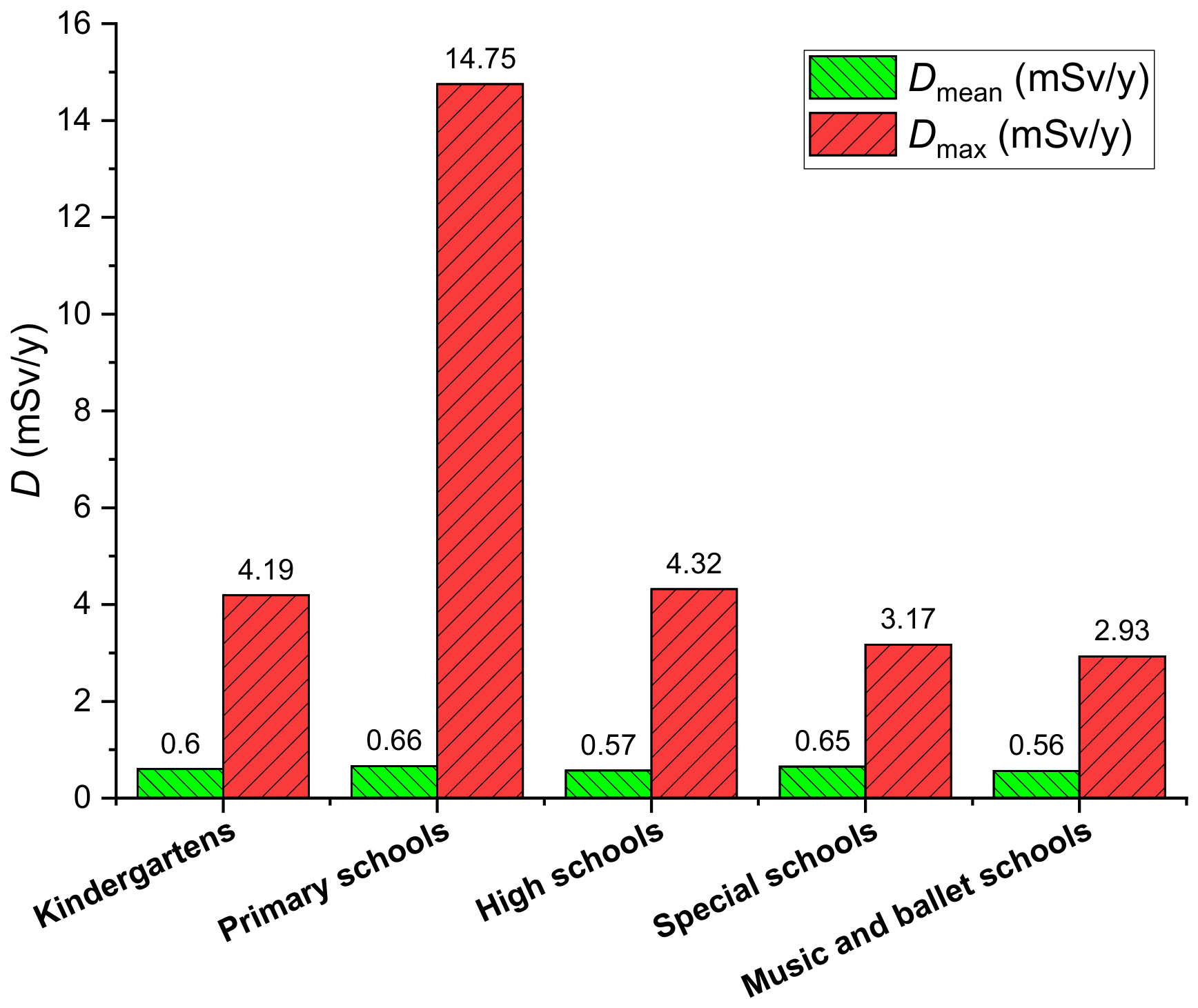
Based on the measured indoor radon concentrations, the annual effective doses were estimated. Figure 4 presents the estimated mean (Dmean) and maximum (Dmax) annual effective doses. The mean annual effective doses were relatively low and exhibited little variability among the different types of educational institutions, ranging from 0.56 mSv/y in music and ballet schools to 0.66 mSv/y in primary schools. The corresponding values for kindergartens, secondary schools, and special schools were 0.60, 0.57, and 0.65 mSv/y, respectively. This uniformity suggests that the estimated effective dose contribution from indoor radon exposure during occupancy was relatively similar among the analyzed categories of educational institutions.
In contrast to the mean values, the maximum annual effective doses exhibited considerably greater variability. The highest estimated annual effective dose was recorded in primary schools (14.75 mSv/y), whereas the maximum values for secondary schools, kindergartens, special schools, and music and ballet schools were 4.32, 4.19, 3.17, and 2.93 mSv/y, respectively (Figure 4). The pronounced difference between the mean and maximum annual effective doses, particularly in primary schools where the maximum value was more than twenty times higher than the mean, indicates the presence of a small number of buildings with substantially elevated indoor radon concentrations. This pattern is characteristic of indoor radon, whose concentrations generally follow a log-normal distribution, with the majority of buildings exhibiting low or moderate values, while a small number of buildings with very high concentrations have a strong influence on the maximum values.
The mean effective dose contributions estimated for occupancy of the educational facilities are broadly consistent with those obtained from the indoor radon monitoring program based on activated charcoal canisters conducted during the 2011–2024 period (Figure 3). All mean values were below the global average annual effective dose from radon reported for the general population [10]; however, these estimates represent only the effective dose contribution from indoor radon exposure during occupancy of the analyzed educational institution. The estimated annual effective doses are also similar to those reported for the city of Šabac (Table 4). Furthermore, all estimated dose values are comparable, without substantial deviations, to those reported in previous studies conducted in different regions of Serbia [2,27,45,47,68]. The estimated doses are also comparable with those reported for schools and a university in Albania [79,80], schools in Tenerife [9], schools in Bulgaria [29], and schools in Slovenia [13].

5.4. Other Studies of Indoor Radon in Serbian Kindergartens and Schools

The results of studies investigating indoor radon concentrations in kindergartens and schools in the Republic of Serbia, published in the available scientific literature, are summarized in Table 10, while the spatial distribution of the analyzed locations and broader regions is presented in Figure 5. The review includes studies conducted over different time periods, across various geographical regions, and using several measurement techniques, including passive CR-39 detectors, activated charcoal canisters, alpha scintillation cells, and other active radon monitors.
Table 10. Indoor radon concentrations (CRn) in primary schools, secondary schools, and kindergartens across Serbia, as reported in previous studies.
Region or CityNumber of DwellingsType of DetectorCRn (Bq/m3)References
Schools in Serbia a18CR-39 detector21–35
(29 ± 4)
[93]
Southern Serbia region b340CR-39 detector17–607
(119 ± 78)
[38,39,40,65,66]
Kosovo and Metohija c30RM-145; CRM-510; nuclear track detectors35–814
(185 ± 172)
[44]
Kosovo and Metohija d>200Alpha scintillation cells; AlphaGUARD PQ2000 PRO; CR-39 detector44–868[47]
Novi Sad city e50Charcoal canister method(47)[67]
Belgrade city f96Charcoal canister method8–894
(131)
[68]
Belgrade city g30Charcoal canister methodMax. 1910 in schools; Max. 970 in kindergartens[69]
Kragujevac city h42UFO detectors25–145
(60 ± 26)
[42]
Kragujevac city i14UFO detectors27–145
(73 ± 36)
[70]
Sjenica city j35CR-39 detector10–1130
(188 ± 213)
[6]
Niš city k30Charcoal canister method15–256
(60 ± 25)
[43]
Kosovska Mitrovica and Zvečan l2Charcoal canister method102–323
(205)
[41]
Priština city m/Radon Monitor PRM-145 (Alpha scintillation cells)13–577[27]
Priština city n31CR-39 detector24–360
(62 ± 28)
[2]
Uroševac city o11Radon Monitor PRM-145 (Alpha scintillation cells)21–725
(238 ± 229)
[45]
Prizren city p15Alpha scintillation cells12–492[7]
Dragaš city q6Radon Monitor PRM-145 (Alpha scintillation cells)20–236
(98 ± 49)
[35]
Šabac city r17CR-39 detector75–265
(170 ± 65)
This study
– range; (average) or (average ± standard deviation); a secondary schools; b primary schools in 13 municipalities in southern Serbia (Jablanica District, Pčinja District, and Zaječar District) (see Figure 5); c 30 primary and secondary schools (28 classrooms, 1 library, and 1 laboratory); d in dwellings, workplaces, and schools; e primary schools and kindergartens; f kindergartens, primary and secondary schools; 44 facilities in 2012 and 52 facilities in 2013; g 20 schools and 10 kindergartens annually (during the period 2016–2020, with 241 measurements conducted in schools and 107 measurements conducted in kindergartens); h 4 public kindergartens and 28 primary and secondary schools (November 2013–February 2014); i kindergartens (November 2013–February 2014); j schools and kindergartens; k kindergartens and primary schools; l 74 measurements in three phases at two kindergartens; m in all schools and kindergartens; n 31 underground workspaces, including those in schools, universities, hospitals, and other public buildings; o 11 elementary and high public schools; p 9 primary schools and 6 secondary schools; 30 rooms in primary schools and 19 rooms in secondary schools, May and December 2003; q 5 primary schools and 1 secondary school; 21 classrooms, March, May, August, and December 2003; r 17 primary and secondary schools.
One of the first investigations of indoor radon concentrations in secondary schools across Serbia was conducted by Banjanac et al. in 2004 using passive CR-39 solid-state nuclear track detectors. During a three-month exposure period in the spring of 2004, 30 detectors were deployed in school buildings located in different Serbian cities. The measured indoor radon concentrations ranged from 21 to 35 Bq/m3. All measured values were well below the intervention level of 200 Bq/m3 applicable at that time. The authors emphasized that the method was simple and suitable for large-scale application in schools but also pointed out the limitations of the study due to the small number of analyzed samples and the limited representativeness of the dataset, highlighting the need for systematic national indoor radon monitoring [93].
Systematic investigations of indoor radon concentrations in Serbian schools began in 2008 with a survey of primary schools in southern Serbia, aiming to assess the exposure of pupils and teaching staff and to identify areas with elevated radon potential. Between 2008 and 2010, a total of 340 schools were included, while the statistical analysis was based on 320 measurements performed in classrooms and teachers’ rooms. The mean indoor radon concentration was 121 Bq/m3 (SD = 78 Bq/m3), with values ranging from 30 to 607 Bq/m3, whereas the geometric mean was 102 Bq/m3 (GSD = 1.79). The results revealed pronounced spatial variability in indoor radon concentrations, primarily associated with the geological characteristics of the underlying terrain, with the highest values recorded in schools constructed on volcanic and granitoid rocks. The application of geostatistical methods enabled the development of spatial radon distribution maps and the identification of radon-prone areas [39,40].
A pilot study conducted in 334 primary schools across 13 municipalities in southern Serbia showed that indoor radon concentrations exceeded 300 Bq/m3 in approximately 5% of the schools, while the mean annual concentration was 119 Bq/m3. The pupil-weighted mean concentration was lower (73 Bq/m3), indicating that the actual exposure of pupils was lower than the average radon concentration measured in school premises [38]. A subsequent study involving 207 primary schools confirmed the log-normal distribution of indoor radon concentrations, with values ranging from 17 to 428 Bq/m3, a mean concentration of 118 ± 78 Bq/m3, and a geometric mean of 97 Bq/m3 [65]. These studies provided the foundation for the development of the national systematic indoor radon monitoring program in Serbian schools.
In a study conducted in 30 primary and secondary schools in Kosovo and Metohija, indoor radon concentrations were determined using PRM-145 monitors equipped with alpha scintillation cells, while CRM-510 continuous radon monitors and track-etch detectors were additionally employed at locations with elevated radon concentrations for continuous and long-term measurements, respectively. The measured indoor radon concentrations ranged from 35 to 814 Bq/m3, with an arithmetic mean, standard deviation, geometric mean, and geometric standard deviation of 184.6 Bq/m3, 171.8 Bq/m3, 145.8 Bq/m3, and 1.88, respectively. The estimated annual effective doses ranged from 0.28 to 6.47 mSv/y. The results showed that 80% of the investigated locations had indoor radon concentrations above 100 Bq/m3, approximately 27% exceeded 200 Bq/m3, and about 45% exceeded the national reference level. Based on these findings, the authors recommended long-term measurements and the implementation of radon mitigation measures in buildings with elevated indoor radon concentrations [47].
Indoor radon concentrations were also measured in residential buildings, workplaces, and schools across different areas of Kosovo and Metohija, with measurements performed during the winter, spring, and summer seasons using several different measurement techniques. The measured indoor radon concentrations reached a maximum value of 868 Bq/m3, corresponding to an annual effective dose of 15.46 mSv/y. In several buildings, the measured concentrations exceeded the reference levels of 200 Bq/m3 for new buildings and 400 Bq/m3 for existing buildings. Analysis of the results showed no influence of lignite-fired power plants or depleted uranium contamination on indoor radon concentrations. The obtained data contributed to the improvement of the national radon monitoring program and helped fill data gaps for the development of the European Radon Map [44].
One of the earliest studies investigating indoor radon concentrations in Serbian cities was conducted by Jevtić et al. [67] in 50 primary schools and kindergartens in Novi Sad during the winter season of 1999/2000 (Table 10). Approximately 15,000 pupils were included in the survey. Indoor radon concentrations were measured using the activated charcoal canister method, with the rooms kept closed throughout the 48 h sampling period. Radon concentration was determined by measuring the gamma activity of radon progeny. The results showed that indoor radon concentrations were below 100 Bq/m3 in 82% of the surveyed buildings, while 16% exhibited concentrations between 100 and 200 Bq/m3. Only one building had a concentration exceeding 200 Bq/m3, and none exceeded the then-proposed action level of 400 Bq/m3. The distribution of indoor radon concentrations was approximately log-normal, with an arithmetic mean of 47 Bq/m3 and a geometric mean of 25.5 Bq/m3 [67].
In a study conducted during 2012 and 2013 in schools and kindergartens in Belgrade, the mean indoor radon concentration was 131 Bq/m3, with measured values ranging from 8 to 894 Bq/m3. Approximately 80% of the surveyed buildings had indoor radon concentrations below 200 Bq/m3, 12% had concentrations between 200 and 400 Bq/m3, and 7% exceeded 400 Bq/m3 [111]. Based on the mean indoor radon concentration, the estimated annual effective dose due to radon exposure was 0.9 mSv/y (assuming an annual occupancy time of 2000 h), whereas the total annual effective dose was estimated at 2.1 mSv/y. The authors concluded that indoor radon concentrations in the majority of the investigated schools and kindergartens did not represent a significant health risk for children or staff, while emphasizing the need for continuous indoor radon monitoring [68].
Between 2016 and 2020, a systematic survey of indoor radon concentrations was carried out in the Belgrade area, covering 547 rooms, including 99 in residential buildings, 341 in schools, and 107 in preschool institutions. Indoor radon concentrations were measured using activated charcoal canisters. The mean indoor radon concentration was 105 Bq/m3, with 76.6% of the surveyed rooms exhibiting concentrations below 100 Bq/m3, whereas concentrations above 400 Bq/m3 were recorded in 4.94% of the rooms. The highest indoor radon concentrations were measured in residential buildings (3550 Bq/m3), schools (1910 Bq/m3), and preschool institutions (970 Bq/m3). Elevated indoor radon concentrations (>400 Bq/m3) were identified in eight of the fifteen surveyed municipalities of Belgrade, with the highest number of rooms exceeding the reference level found in schools and preschool institutions [69].
Stajić et al. and Milenković et al. conducted systematic investigations of indoor radon concentrations in 14 public kindergartens and 28 primary and secondary schools in Kragujevac during a three-month period (November 2013–February 2014), using passive discriminative UFO radon/thoron detectors calibrated with a RAD7 monitor. Indoor radon concentrations ranged from 27 to 145 Bq/m3 in kindergartens and from 25 to 86 Bq/m3 in schools, with an overall arithmetic mean of 59.6 ± 25.6 Bq/m3 for all surveyed buildings. In kindergartens, the arithmetic mean, geometric mean, median, and standard deviation were 73.3, 65.7, 72, and 35.6 Bq/m3, respectively. The results demonstrated a log-normal distribution of indoor radon concentrations, with no significant association with the construction period of the buildings. However, a weak negative correlation was observed between indoor radon concentration and the activity concentration of 226Ra in soil (ρ = −0.468). None of the measured values exceeded the reference level of 200 Bq/m3, and the authors concluded that indoor radon concentrations were relatively low and influenced not only by the radium content of the soil but also by soil characteristics, building materials, construction features, and ventilation conditions [42,70].
Indoor radon concentrations measured in 35 kindergartens and schools in the Sjenica area of western Serbia ranged from 10 to 1130 Bq/m3 (Table 10). In 14% of the investigated buildings, the indoor radon concentration exceeded the WHO reference level of 300 Bq/m3 [11], indicating that the municipality of Sjenica can be classified as a radon priority area. Each of the 35 measurement sites was georeferenced, and the corresponding lithostratigraphic units and geological periods were identified for every location. The data were analyzed using multiple linear regression (MLR), resulting in the development of two predictive models. The MLR model based on geological periods explained 17% of the variability in indoor radon concentration, whereas the more successful model based on lithostratigraphic units explained 52% of the total variability. The analysis demonstrated that lithostratigraphic units represent a significant predictor of indoor radon concentrations [6].
In a more recent study, Manić et al. [43] investigated indoor radon concentrations in kindergartens and schools in the city of Niš, southern Serbia. Measurements were performed using the activated charcoal method. The measured indoor radon concentrations ranged from 15 to 256 Bq/m3, with a mean value of 59.7 ± 25.3 Bq/m3. Statistical analysis showed that indoor radon concentrations followed a log-normal distribution, while no statistically significant correlation was found between indoor radon concentration and the activity concentration of 226Ra in soil [43], consistent with the findings reported for the Kragujevac area [70].
The most recent study by Gulan et al. [41], conducted in two kindergartens in Kosovska Mitrovica and Zvečan, included 74 short-term indoor radon measurements performed in 25 rooms using activated charcoal canisters. The study was carried out in a mining region with elevated radon potential, where the activity concentration of 226Ra in the soil surrounding the kindergartens was approximately 20 Bq/kg. Indoor radon concentrations ranged from 102 to 323 Bq/m3, with a mean value of 205 Bq/m3. More than 90% of the measurements exceeded the WHO reference level of 100 Bq/m3, while several rooms exhibited concentrations above 300 Bq/m3 [11]. The mean indoor radon concentrations were 194 Bq/m3 in Kosovska Mitrovica and 218 Bq/m3 in Zvečan. Statistically significantly higher concentrations were recorded on the ground floor than on the upper floors, whereas building age, room area, and flooring type had no significant influence on indoor radon concentrations. Lower concentrations were observed in regularly occupied rooms, most likely due to more frequent ventilation. The authors concluded that the geological characteristics of the area and mining activities are the primary causes of the elevated indoor radon concentrations and recommended long-term monitoring together with mitigation measures, including mechanical ventilation and floor sealing, to reduce radon exposure among children and staff [41].
Indoor radon concentrations were measured using a portable PRM-145 monitor in all schools and preschool institutions in Priština, as well as at selected locations in Kastriot near the thermal power plant, in order to assess the potential influence of its operation on indoor radon levels. In Priština, indoor radon concentrations ranged from 13 to 577 Bq/m3, whereas at the Kastriot locations they ranged from 104 to 218 Bq/m3. The estimated annual effective doses ranged from 0.1 to 5.2 mSv/y in Priština and from 0.9 to 2.0 mSv/y in Kastriot. In two schools, classrooms were identified in which the estimated annual effective dose exceeded the recommended values of the International Commission on Radiological Protection (ICRP) [27].
In a study conducted by Nafezi et al. [2], indoor radon concentrations were measured in 31 underground workplaces within public institutions in the Priština area (Kosovo and Metohija), including schools, universities, hospitals, and other public buildings. Measurements were performed using passive CR-39 solid-state nuclear track detectors installed in basement rooms at a height of 1–1.5 m above the floor, with an exposure period of approximately three months, including at least one month during the winter season. The measured indoor radon concentrations ranged from 24 to 360 Bq/m3, with only one measurement location exceeding the national reference level of 300 Bq/m3 [11]. After excluding this outlier, the arithmetic mean indoor radon concentration was 62 ± 28 Bq/m3, while the estimated mean annual effective dose for employees was 1.1 mSv/y. The authors concluded that indoor radon concentrations in the investigated underground workplaces were generally low, most likely due to effective building ventilation [2].
In Uroševac (Kosovo and Metohija), indoor radon concentrations were measured in 11 public primary and secondary schools using a portable PRM-145 radon monitor equipped with a ZnS(Ag) alpha scintillation cell. The measured indoor radon concentrations ranged from 20.84 to 725.44 Bq/m3, with arithmetic mean, geometric mean, and median values of 237.80, 141.56, and 119.89 Bq/m3, respectively, while the geometric standard deviation was 1.30. Two schools exhibited mean indoor radon concentrations exceeding the reference level of 200 Bq/m3, indicating the need for implementing radon mitigation measures in these buildings. The estimated annual effective doses for pupils ranged from 0.14 to 4.51 mSv/y, with values in two schools exceeding the level at which radon reduction measures are recommended [45].
Bahtijari et al. conducted short-term indoor radon measurements in 15 schools in Prizren (9 primary and 6 secondary schools) during May and December 2003 using alpha scintillation cells. A total of 49 rooms were included in the survey. Based on the individual values reported in the study, the mean indoor radon concentration was 91.6 ± 95.8 Bq/m3 in May (range: 11–485 Bq/m3) and 113 ± 105 Bq/m3 in December (range: 12–492 Bq/m3). Indoor radon concentrations exceeding 300 Bq/m3 were recorded in three rooms (6.1%) during May and in four rooms (8.2%) during December. The higher concentrations observed during the winter period were attributed to reduced room ventilation [7].
In the town of Dragaš, Kosovo and Metohija, indoor radon concentrations were measured in five primary schools and one secondary school, covering a total of 21 classrooms during four measurement campaigns (March, May, August, and December 2003), using 0.7 dm3 alpha scintillation cells with readings performed by a PRM-145 monitor. Based on a total of 84 individual measurements, indoor radon concentrations ranged from 20 to 236 Bq/m3. The arithmetic mean, standard deviation, geometric mean, and geometric standard deviation were 97.79 Bq/m3, 48.79 Bq/m3, 84.64 Bq/m3, and 1.78, respectively. Only one classroom exhibited an indoor radon concentration exceeding 200 Bq/m3. The results demonstrated pronounced seasonal variation, with the highest indoor radon concentrations recorded during the winter season (December) and the lowest during the summer (August). A significant influence of floor level was also observed, as radon concentrations in basement rooms were 3–5 times higher than those measured in classrooms located on the ground and first floors. The authors concluded that indoor radon levels in the investigated schools were generally low [35].

5.5. Comparison with Other Studies Worldwide

Table 11 provides an overview of representative studies on indoor radon concentrations in kindergartens and schools conducted in different countries worldwide. It summarizes the essential information on the study location, measurement technique, number of investigated buildings, and the range and mean indoor radon concentrations, where these data were available. This overview enables a comparison of the results obtained in Serbia with those reported in international studies and provides a broader perspective on Serbia’s position relative to other countries regarding indoor radon exposure in educational institutions.
Table 11. Reported indoor radon concentrations (CRn) in schools and kindergartens worldwide.
Country (City)Number of DwellingsType of DetectorCRn (Bq/m3)References
Republic of Srpska (Banja Luka) a25CR-39 detector36–549
(128 ± 111)
[71]
Republic of Srpska b50CR-39 detector90–4244
(341)
[72]
Bosnia and Herzegovina (Tuzla city) c14CR-39 detector7–143
(33 ± 7)
[74]
North Macedonia d76CR-39 detector22–990
(186 ± 178)
[73]
North Macedonia e29Nuclear track detectors10–508
(136 ± 115)
[8]
Montenegro f392CR-39 detector7–4000
(276)
[75]
Bulgaria g174CR-39 detector20–1117
(227 ± 181)
[76]
Bulgaria h55CR-39 detector20–544
(144 ± 83)
[29]
Slovenia i730Different detection systemsMax 5600
(133)
[83]
Slovenia j25CR-39 detector and RAD770–794[13]
Croatia k87LR-115 detector16–1288
(181 ± 169)
[81]
Poland l58CR-39 detector22–1034[77]
Hungary m88CR-39 detector16–160
(61 ± 29)
[78]
Canary Islands (Tenerife) n18CR-39 detector12–202
(78)
[9]
Greece (Patras) o53LR-115 detector10–89
(35 ± 17)
[82]
North Albania p30CR-39 detector31–633
(136 ± 113)
[79]
Albania (Durrës) q3CR-39 detector20–92
(45 ± 17)
[80]
Iraq (Waist) r40Airthings Corentium Home3–50
(18)
[84]
Iraq (Al-Najaf province) s100CR-39 detector7–45
(22 ± 8)
[30]
Moldovia t78SARAD RTM-1642, RadonEye + 217–1129[28]
Romania u109CR-39 detector23–1121
(143)
[3]
Finland v1809Radonpurkki, AlphaRadon, Radtrak2<20–4205
(86) kindergartens
(82) schools
[128]
Portugal w15Radim 5B0–888[22]
– range; (average) or (average ± standard deviation); a 25 primary schools in Banja Luka, Bosnia and Herzegovina; b 50 schools in 15 municipalities in the Republic of Srpska; c 14 primary schools; d including 31 primary schools and 5 kindergartens; e 58 rooms in 29 primary schools across four municipalities in eastern North Macedonia; f 345 primary schools and 47 secondary schools; g kindergartens in three Bulgarian cities during 2014; h 55 primary, secondary, and high schools in seven municipalities;. i 730 kindergartens in Slovenia; j 7 kindergartens and 18 elementary schools in Slovenia; k kindergartens; l kindergartens; m kindergartens; n 18 secondary schools; o 53 out of a total of 66 public primary schools in Patras during the period from December 1999 to May 2000; p a total of 37 classrooms in the regions of Durrës, Lezhë, Shkodër, and Kukës; q University of Durrës, 67 detectors in two campaigns (autumn–winter and spring–summer), three buildings at two campuses, and 53 rooms; r 40 school buildings in Wasit Province, April–August 2024; s 100 primary schools; t kindergartens, primary schools, grammar schools, and secondary schools, 23,954 measurements; u schools and kindergartens in five counties in Romania; v kindergartens, primary schools, and secondary schools; w nurseries, kindergartens, and primary schools, 47 classrooms, 3771 hourly readings.
The national radon survey conducted in Serbia in 2019 represents one of the most comprehensive investigations of indoor radon in educational institutions in Southeastern Europe. Within this program, a total of 4133 CR-39 detectors were collected from schools and preschool institutions throughout Serbia, providing a representative database for assessing the spatial distribution of indoor radon concentrations [46]. Combined with the results of the annual environmental radioactivity monitoring program conducted during the 2011–2024 period, as well as previous regional studies [6,38,39,40,42,43,65], Serbia now possesses one of the most comprehensive databases on indoor radon in educational institutions in the region.
Comparison of all measured values presented in this study with the results reported from other countries indicates that the mean indoor radon concentrations in Serbian schools fall within the range typically observed across European countries. Similar values have been reported in Slovenia [13], Croatia [81], North Macedonia [8,73], Bulgaria [29], and Romania [3]. The mean concentrations observed in Serbia are considerably higher than those reported for Greece [82], certain regions of Bosnia and Herzegovina [74], the Canary Islands [9], Albania [80], and Iraq [84], but lower than those reported for Montenegro [75] and some regions of Bulgaria [76] (Table 11). In all of these studies, the majority of educational buildings exhibited indoor radon concentrations below the national or internationally recommended reference levels, whereas a relatively small number of schools showed substantially elevated concentrations requiring additional measurements and, where appropriate, the implementation of radon mitigation measures. The same pattern was observed in Serbia, both within the framework of the 2019 national survey and during the long-term environmental radioactivity monitoring program.
Comparison with neighboring countries reveals a high degree of similarity in indoor radon concentrations. In North Macedonia, the geometric mean indoor radon concentration was 96 Bq/m3, while the arithmetic mean was 136 Bq/m3. Geological characteristics accounted for nearly 40% of the total variability in indoor radon concentrations, whereas building materials and the presence of basements were also identified as significant influencing factors [8]. In Romania, the mean indoor radon concentration was 143 Bq/m3, with 18% of schools exceeding the reference level of 300 Bq/m3, and the highest concentrations were recorded in basements and ground-floor rooms [3]. In Bulgaria, the mean indoor radon concentration was 144 Bq/m3, with as many as 30% of school buildings exceeding the reference level, while floor level and room type were identified as significant determinants of indoor radon concentrations [29]. In Slovenia, several schools and kindergartens exhibited elevated indoor radon concentrations of up to nearly 800 Bq/m3, further demonstrating that buildings with pronounced radon problems may exist even in countries with well-established radon monitoring systems [13].
In contrast, studies conducted in Greece, Iraq, and several university buildings in Albania reported substantially lower mean indoor radon concentrations, generally below 50 Bq/m3, with none of the measured values exceeding the reference level of 300 Bq/m3 [80,82,84]. On the other hand, investigations carried out in Portugal, Moldova, and Finland demonstrated that individual buildings may exhibit very high indoor radon concentrations, reaching several thousand Bq/m3 in extreme cases, thereby requiring immediate remediation and continuous monitoring [22,28,128]. Compared with these findings, the maximum indoor radon concentrations recorded in Serbia can be considered elevated but do not represent the extreme values observed in some of the radon-prone regions of Europe.
Particularly noteworthy is that the results of almost all studies, including those conducted in the Republic of Serbia, are consistent regarding the factors controlling indoor radon concentrations. The geological substrate and the radon potential of the underlying soil represent the dominant natural factors, whereas the most influential building-related factors include floor level, the presence of basements, building age and construction characteristics, building materials, and the intensity of natural or mechanical ventilation [3,8,22,28,29,82,84,128]. These findings are fully consistent with the results presented in the preceding sections of this study, which showed that the highest indoor radon concentrations in Serbia were generally recorded in ground-floor and basement rooms, as well as in buildings located in areas with elevated radon potential.
In addition, the experience of other countries demonstrates that continuous national radon monitoring programs represent the most effective approach for identifying buildings with elevated indoor radon concentrations and establishing priorities for the implementation of radon mitigation measures. Such an approach has been successfully implemented in Finland, where systematic measurements enabled the identification and remediation of buildings with elevated indoor radon concentrations [128], in Romania through the establishment of a standardized national protocol for long-term radon measurements [3], and in Bulgaria, where monitoring results were submitted to the competent authorities to support the planning of appropriate radiation protection measures [29]. A similar approach is currently being developed in the Republic of Serbia through the National Indoor Radon Monitoring Program and the annual environmental radioactivity monitoring program, thereby establishing a high-quality database for identifying radon-prone educational institutions and supporting the implementation of the National Radon Action Plan.

6. Critical Review of Previous Studies

Although previous studies of indoor radon concentrations in kindergartens and schools in the Republic of Serbia have provided a substantial body of data on the distribution of radon risk, the available literature reveals numerous methodological limitations and research gaps that hinder a comprehensive understanding of the spatial and temporal variability of indoor radon concentrations.
One of the major limitations is the pronounced methodological heterogeneity among the available studies. Although passive CR-39 detectors were used in a significant number of studies and are widely employed for long-term radon measurements (Table 11), some studies were based on short-term measurements using activated charcoal canisters or active radon monitors [7,27,41,43,44,45,67,68,69] (see Table 10). Differences in exposure periods, calibration procedures, and data processing methodologies substantially complicate direct comparison of the results and the integration of the available data into a unified national database without limitations. A particular concern is that short-term measurements may deviate from annual average concentrations due to pronounced diurnal and seasonal variations in radon concentration [11,85], which may limit their use for the direct assessment of long-term exposure, particularly when temporal variability and measurement uncertainty are not adequately accounted for [110].
Most studies conducted in Serbia have been limited to individual cities or a small number of schools and/or kindergartens, meaning that their findings are primarily of local significance and do not allow for a reliable assessment of national exposure levels [43,67,68,69]. Numerous studies included only a very limited number of facilities, such as those by Bahtijari et al. [7,35], Banjanac et al. [93], Milenković et al. [70], and Bekteshi et al. [45], while in some publications the total number of investigated educational institutions was not clearly specified [27]. Similarly, the study by Nafezi et al. [2] included only a small number of measurement sites distributed across different types of public buildings, thereby limiting conclusions specifically related to schools and kindergartens. Furthermore, Gulan et al. [41] restricted their investigation to only two kindergartens located in Kosovska Mitrovica and Zvečan (see Table 10). Consequently, a large number of cities throughout Serbia remain without systematic and comprehensive indoor radon surveys (see Figure 5).
To date, the results of indoor radon measurements conducted in schools and preschool institutions as part of the 2019 national monitoring program have not been published in the form of a peer-reviewed scientific paper or an official national report available to the public. The data presented in this review were obtained from the conference presentation Indoor Radon Measurements at Workplaces in the Republic of Serbia, delivered by Maja Eremić-Savković at the IAEA RER9153 Regional Workshop held in Debrecen, Hungary, in 2020, and should therefore be regarded as preliminary findings [46]. Additionally, Table 2 states that 4133 detectors were collected and analyzed, whereas the available data presented in Table 9 cover only 3910 measurement points. No explanation is provided for the remaining 223 detectors needed to account for the total number of collected detectors, which represents an additional limitation in the interpretation and traceability of the reported results. Consequently, it is currently not possible to assess the spatial distribution of indoor radon concentrations across Serbia or to determine the proportion of buildings exceeding the national reference levels of 200 Bq/ m3 for new buildings and 400 Bq/m3 for existing buildings [111], as well as the WHO reference level [11].
As part of the annual radioactivity monitoring program conducted between 2011 and 2024, a total of 303 indoor radon measurements were performed, corresponding to an average of approximately 24 measurements per year. In 2016, however, only three measurements were conducted, which is not consistent with the requirements of the national monitoring program [48]. Overall, the number of measurements performed in these types of facilities is insufficient to provide a representative assessment of indoor radon exposure, particularly considering that monitoring was limited to only seven cities (Figure 1), leaving the vast majority of Serbian cities and municipalities without any measurements. Buildings were selected on the basis of availability at the time of sampling rather than through a systematic or longitudinal sampling strategy, and the same facilities were not monitored continuously throughout the study period. This represents a significant methodological limitation, particularly in view of the well-documented daily and seasonal variability of indoor radon concentrations. Moreover, in some cases measurements were performed on the first floor, while a smaller proportion were carried out on the second floor. Because indoor radon concentrations generally decrease with increasing floor level, this sampling strategy may have underestimated the overall average concentration and produced values that are not fully representative. It also limits direct comparison with the 2019 national radon survey, in which measurements were systematically performed on the ground floor of buildings. Consequently, differences in both the measurement methodology and the sampling floor introduce additional uncertainty when comparing the two datasets, despite the similarity of the reported average concentrations. Furthermore, measurements using activated charcoal canisters were conducted at different times of the year without a systematic sampling design that adequately covered the heating season, when indoor radon concentrations are typically highest. This further reduces the representativeness and comparability of the reported results.
For small sample sizes, estimates of the GM and GSD should be interpreted with caution due to increased statistical uncertainty; however, their calculation cannot be considered meaningless solely on the basis of sample size (Table 5 and Table 6).
In addition, the estimated annual effective doses for exposure in schools do not account for additional radon exposure received by pupils and teachers in their homes, which may further increase their overall estimated exposure.
An additional limitation is the lack of quantitative analyses of the factors governing indoor radon concentrations. Most studies have focused exclusively on measuring indoor radon levels, while the influence of geological characteristics, soil permeability, tectonic structures, building materials, ventilation, and the energy efficiency of buildings has received limited attention. In particular, studies investigating the relationship between indoor radon concentrations and the 226Ra content of the underlying soil are lacking [122], despite the fact that 222Rn is the direct decay product of 226Ra. Existing local studies have not demonstrated a clear correlation between these two parameters, suggesting that the radium content of surface soils alone is not a sufficient indicator of radon potential without considering additional geological and building-related factors [43,70]. Accordingly, the spatial differences observed in the present review should be regarded as patterns that may be associated with these factors rather than as direct evidence of their individual effects.
Similarly, the contribution of building materials to indoor radon concentrations in Serbian educational institutions remains insufficiently understood. Although numerous studies have investigated the natural radioactivity of building materials [5,33,118,119,120,129,130], their findings have not yet been systematically integrated with indoor radon measurements.
Another important challenge in comparing results across national and international studies is the estimation of effective dose for students and staff. Existing assessments are based on different assumptions regarding occupancy time, equilibrium factor, and dose conversion coefficients, making direct comparisons between studies difficult. This issue has become even more pronounced following the publication of ICRP Publication 137, which introduced substantially lower dose conversion coefficients than those recommended in earlier guidance [10,113].
A large number of private kindergartens and schools in Serbia, which are not part of the public education system, were not included in the 2019 national radon survey. Consequently, a comprehensive assessment of radon exposure among children, pupils, and teaching staff across the entire country has not yet been achieved. Another important research gap is the almost complete absence of systematic investigations in higher education institutions. Serbia has more than 190 higher education institutions, each typically comprising multiple buildings with dozens of rooms located in basements, semi-basements, and ground floors. However, between 2011 and 2024, only about a dozen measurements conducted at such institutions were identified in this review. Existing surveys have therefore covered only a limited number of locations, despite the fact that students, academic staff, and researchers spend a substantial portion of the year in these facilities, particularly in basement laboratories where radon concentrations may be elevated. As a result, the assessment of long-term radon exposure in higher education institutions remains a significant gap that has not been adequately addressed by existing national monitoring programs. Future research should therefore prioritize long-term monitoring of the same educational institutions and investigate the effects of building energy retrofitting on indoor radon concentrations, an issue that has not yet been examined in Serbia.
Finally, Serbia still lacks an integrated system that would combine radon measurement results with geological, building-related, meteorological, and epidemiological data. The absence of a publicly accessible database, GIS models, and detailed radon potential maps further limits the possibility of a comprehensive assessment of the spatial distribution of radon and the identification of priority buildings. These methodological, spatial, and information-related limitations indicate that the existing database, although significant, is still insufficient for a fully integrated assessment and management of radon risk in educational institutions in the Republic of Serbia.

7. Radon Measurement and Risk Management

Given these limitations, the question is no longer simply how to continue radon measurements, but rather how to organize an effective national strategy for investigation and risk management. Tsapalov et al. [131] critically analyzed existing approaches to planning indoor radon surveys, highlighting issues related to measurement duration, temporal variability of radon concentration, measurement uncertainty, standardization of procedures, and sampling strategies. Based on this analysis, they proposed a rational approach in which the reliability of a decision depends not solely on the duration of an individual measurement, but also on the objective of the investigation, the measured concentration relative to the reference level, temporal and instrumental uncertainties, and the size and representativeness of the sample of buildings. Within such an approach, short-term measurements can play an important role in large-scale screening and the initial identification of potentially high-risk buildings, while long-term measurements can be applied selectively when a more detailed assessment is required. For decision-making, a reliability criterion of at least 95% has been proposed, together with the improvement of quality-control systems and the involvement of the population in large-scale measurements [131,132,133].
This concept was further developed in the study by Tsapalov and Kranrod [134], based on data from 26 countries, in which an algorithm was proposed for assessing the reliability of decisions as a function of measurement duration. The authors reported that short-term measurements lasting approximately 4–6 days can provide a high proportion of reliable decisions, whereas extending measurements to 2–3 months results, on average, in a relatively small increase in the number of definitive decisions, while incurring substantially higher costs. The rational criterion is based on the simultaneous consideration of the measured concentration, temporal variability, and instrumental uncertainty, with the aim of achieving at least 95% decision reliability. The authors also highlight the potential of IoT technologies, simple publicly accessible devices, and active public participation in large-scale data collection. Such a strategy implies a large-scale, standardized, and statistically based initial screening, followed by the targeted implementation of long-term measurements and remediation measures primarily in identified high-risk buildings [134].
Independent recent findings further support the need to reconsider the traditional approach to short-term measurements. Maringer and Blum [135] developed a procedure for estimating the annual mean radon concentration based on a three-week short-term measurement using active devices, while simultaneously taking into account seasonality, temperature differences, changes in atmospheric pressure, and other relevant parameters. The procedure was tested using 50 short-term and 24 long-term measurements conducted in 24 residential premises in Austria. A broader review by Tamborino et al. [136] further demonstrates that substantial heterogeneity still exists in the international literature regarding measurement duration, detector selection, sampling protocols, and criteria for result interpretation, limiting the comparability of studies and the effective management of radon risk.
All these findings and recommendations are particularly relevant to Serbia, where radon data have also been collected using different methodological approaches and within an inefficient traditional framework for radon risk management. A recent critical analysis of radon exposure in Serbia [12] highlights data heterogeneity, insufficient spatial coverage, and the need to standardize and expand the measurement network. Therefore, the main challenge is no longer simply to continue collecting individual measurements, but to establish an integrated national system in which a rational strategy would enable large-scale and cost-effective initial screening with active public participation, identification of buildings with elevated risk, targeted confirmatory/long-term measurements, the use of IoT technologies, and, most importantly, timely remediation. In this context, the lack of a fully functional National Radon Action Plan, including kindergartens, schools, and higher-education institutions, that would link measurement activities, a national database, identification of priority buildings, public information, and concrete measures to reduce exposure represents a significant gap between the existing scientific evidence base and practical risk management in Serbia. Serbia initiated work on a National Radon Action Plan as early as 2014, while subsequent documents envisaged its integration into the national strategic framework [123,137]. This demonstrates that the need for a systematic approach has been recognized, but that the key challenge remains its full and operational implementation.
It is important to emphasize that the ultimate goal of radon monitoring should be risk reduction rather than measurement alone, as is currently the case. Therefore, educational institutions in which radon concentrations exceed the relevant reference level should be prioritized for timely assessment and the implementation of appropriate remediation measures.

8. Conclusions

This review demonstrates that previous investigations of radon concentrations in educational institutions in Serbia have provided valuable information on the spatial distribution and range of radon concentrations. At the same time, the available data remain limited by methodological heterogeneity, uneven spatial coverage, and differences in measurement duration and methodology, which hinder their direct integration and comparison. The national survey conducted in 2019 provided the most extensive database for schools and preschool institutions; however, private educational institutions were not included, while the coverage of secondary schools was considerably lower than that of primary schools and preschool institutions. Measurements of indoor radon conducted as part of the annual radioactivity monitoring programme in Serbia between 2011 and 2024 further contributed to the continuity of monitoring and the expansion of the available database. However, the overall number of measurements remained relatively small and did not provide sufficient coverage of kindergartens and schools across the country. The available dataset also included only a limited number of measurements in higher-education institutions.
The results indicate pronounced spatial variability in indoor radon concentrations, which may partly reflect differences in geological conditions, building characteristics, and ventilation; however, the relative contribution of these factors has not been quantitatively established. In Šabac, all measured concentrations in the analyzed schools were below the relevant reference level, whereas higher concentrations were recorded in certain other areas of Serbia, including Kosovo and Metohija, Belgrade, and Sjenica. However, the relative contribution of individual factors, including building characteristics, ventilation, and energy-efficiency measures, has not yet been sufficiently clarified. Comparison with results from other European countries indicates that the overall level of radon concentrations in educational institutions in Serbia can be considered broadly comparable with the situation in Europe, although individual buildings with elevated concentrations require particular attention.
The maximum estimated annual effective doses exceeded 10 mSv/y, reflecting the very high indoor radon concentrations, which reached several thousand Bq/m3 in some educational institutions, whereas the typical average dose remained below 1 mSv/y. The estimated effective dose values should be interpreted as contributions from indoor radon exposure during occupancy of educational facilities and should not be considered estimates of total annual individual radiation exposure. Nevertheless, considering that children and teachers do not spend the entire year in these institutions, the relatively high doses estimated for some facilities warrant targeted investigation and, where appropriate, the implementation of remedial measures.
The key conclusion of this review is that the further development of the radon risk management system should not be based primarily on the continuous repetition of isolated measurements, but rather on their rational organization to support decision-making and risk reduction. In this context, the previously proposed Rational Method could potentially provide a suitable framework for large-scale and cost-effective initial testing of buildings, whereby short-term measurements could be used for initial screening and identification of potentially high-risk buildings, while long-term measurements would be applied selectively in buildings where a more reliable assessment is required. Such an approach would allow limited monitoring resources to be directed primarily toward buildings with a higher probability of elevated radon concentrations. At the same time, it would provide a practical framework for the further development and operational implementation of a comprehensive National Radon Action Plan for the Republic of Serbia, with particular emphasis on large-scale testing, identification of priority buildings, and effective remediation of buildings with elevated radon concentrations.

Funding

This research received no external funding.

Data Availability Statement

No new data were created or analyzed in this study. Data sharing is not applicable to this article.

Conflicts of Interest

The author declares no conflicts of interest.

References

  1. Yusuf, R.A.; Mbonane, T.P.; Rathebe, P.C. Indoor Radon Exposure Among Schoolchildren: A Systematic Review of Risk Factors. Int. J. Environ. Res. Public Health 2026, 23, 712. [Google Scholar] [CrossRef] [Scilit] [PubMed]
  2. Nafezi, G.; Xhixha, G.; Kuqali, M.; Qengaj, F.; Bahtijari, M.; Akkurt, İ. Radon activity concentrations in underground workplaces in Kosovo. Arab. J. Geosci. 2021, 14, 2417. [Google Scholar] [CrossRef] [Scilit]
  3. Bican-Brișan, N.; Dobrei, G.-C.; Burghele, B.-D.; Cucoș, A.-L. First Steps towards a National Approach for Radon Survey in Romani-an Schools. Atmosphere 2022, 13, 59. [Google Scholar] [CrossRef] [Scilit]
  4. Kouroukla, E.; Gooding, T.D. Distribution of radon in large workplaces: An analysis performed on radon levels measured in UK schools. J. Radiol. Prot. 2024, 44, 041501. [Google Scholar] [CrossRef] [Scilit] [PubMed]
  5. Kuzmanović, P.; Miljević, B.; Todorović, N.; Forkapić, S.; Čeliković, I.; Filipović Petrović, L.; Knežević Radić, J. The influence of building material structure on radon emanation. J. Radiol. Prot. 2022, 42, 041508. [Google Scholar] [CrossRef] [Scilit] [PubMed]
  6. Žunić, Z.S.; Stojanovska, Z.; Boev, B.; Šorša, A.; Čeliković, I.; Ćurguz, Z.; Ronnquist, T.; Janićijević, A.; Alavantić, D. Sjenica, a new-ly identified radon priority area in Serbia, and radon data correlated with geological parameters using the multiple linear regression model. Carpathian J. Earth Environ. Sci. 2019, 14, 235–244. [Google Scholar] [CrossRef] [Scilit]
  7. Bahtijari, M.; Stegnar, P.; Shemsidini, Z.; Kobal, I.; Vaupotič, J. Indoor air radon concentration in schools in Prizren, Kosovo. Radiat. Prot. Dosim. 2006, 121, 469–473. [Google Scholar] [CrossRef] [Scilit] [PubMed]
  8. Stojanovska, Z.; Boev, B.; Žunić, Z.S.; Ivanova, K.; Ajka, S.; Boev, I.; Ćurguz, Z.; Kolarž, P. Factors affecting indoor radon variations: A case study in schools of Eastern Macedonia. Rom. J. Phys. 2019, 64, 801. Available online: https://rjp.nipne.ro/2019_64_1-2/RomJPhys.64.801.pdf (accessed on 20 July 2026).
  9. López-Pérez, M.; Hernández, F.; Díaz, J.P.; Salazar-Carballo, P.A. Determination of the indoor radon concentration in schools of Tene-rife (Canary Islands): A comparative study. Air Qual. Atmos. Health 2022, 15, 825–835. [Google Scholar] [CrossRef] [Scilit] [PubMed]
  10. United Nations Scientific Committee on the Effects of Atomic Radiation (UNSCEAR). Sources, Effects and Risks of Ionizing Radiation (UNSCEAR) 2024 Report, Volume II; United Nations: New York, NY, USA, 2026; 270p, ISBN 9789211068740. Available online: https://www.unscear.org/unscear/uploads/documents/unscear-reports/UNSCEAR_2024_Report_Vol.II.pdf (accessed on 22 July 2026). [CrossRef] [Scilit]
  11. WHO. WHO Handbook on Indoor Radon: A Public Health Perspective; World Health Organization: Geneva, Switzerland, 2009; Available online: https://iris.who.int/server/api/core/bitstreams/47a93281-8a11-476f-aa7d-5488014ae433/content (accessed on 23 July 2026).
  12. Kuzmanović, P. Indoor radon exposure in Serbia–A critical review. J. Environ. Radioact. 2026, 298, 108097. [Google Scholar] [CrossRef] [Scilit] [PubMed]
  13. Vaupotič, J.; Bezek, M.; Kavasi, N.; Ishikawa, T.; Yonehara, H.; Tokonami, S. Radon and thoron doses in kindergartens and elementary schools. Radiat. Prot. Dosim. 2012, 152, 247–252. [Google Scholar] [CrossRef] [Scilit] [PubMed]
  14. Samet, Ј.М.; Richardson, D.B. Uranium mining and lung cancer: A legacy of the nuclear age. Carcinogenesis 2025, 46, bgaf057. [Google Scholar] [CrossRef] [Scilit] [PubMed]
  15. Dobrzyńska, M.M.; Gajowik, A.; Wieprzowski, K. Radon–occurrence and impact on health. Rocz. Państw. Zakładu Hig. 2023, 74, 5–14. [Google Scholar] [CrossRef] [Scilit] [PubMed]
  16. Enjo-Barreiro, J.R.; Ruano-Ravina, A.; Pérez-Ríos, M.; Kelsey, K.; Varela-Lema, L.; Torres-Durán, M.; Parente-Lamelas, I.; Provencio-Pulla, M.; Vidal-García, I.; Piñeiro-Lamas, M.; et al. Radon, tobacco exposure and non-small cell lung cancer risk related to BER and NER genetic polymorphisms. Arch. Bronconeumol. 2022, 58, 311–322. [Google Scholar] [CrossRef] [Scilit] [PubMed]
  17. Bersimbaev, R.; Pulliero, A.; Bulgakova, O.; Asia, K.; Aripova, A.; Izzotti, A. Radon biomonitoring and microRNA in lung cancer. Int. J. Mol. Sci. 2020, 21, 2154. [Google Scholar] [CrossRef] [Scilit] [PubMed]
  18. Darby, S.; Hill, D.; Auvinen, A.; Barros-Dios, J.M.; Baysson, H.; Bochicchio, F.; Deo, H.; Falk, R.; Forastiere, F.; Hakama, M.; et al. Radon in homes and risk of lung cancer: Col-laborative analysis of individual data from 13 European case-control studies. BMJ 2005, 330, 223. [Google Scholar] [CrossRef] [Scilit] [PubMed]
  19. Malinovsky, G.; Yarmoshenko, I.; Vasilyev, A. Meta-analysis of case-control studies on the relationship between lung cancer and indoor radon exposure. Radiat. Environ. Biophys. 2019, 58, 39–47. [Google Scholar] [CrossRef] [Scilit] [PubMed]
  20. Bobkier, R.; Kovler, K.; Tsapalov, A. Fusion of horizons: Part I. Historical context and early radon discoveries (until 1951). J. Environ. Radioact. 2025, 283, 107636. [Google Scholar] [CrossRef] [Scilit] [PubMed]
  21. Martín-Gisbert, L.; Ruano-Ravina, A.; Varela-Lema, L.; Penabad, M.; Giraldo-Osorio, A.; Candal-Pedreira, C.; Rey-Brandariz, J.; Mourino, N.; Pérez-Ríos, M. Lung cancer mortality attributable to residential radon: A systematic scoping review. J. Expo. Sci. Environ. Epidemiol. 2023, 33, 368–376. [Google Scholar] [CrossRef] [Scilit] [PubMed]
  22. Branco, P.T.B.S.; Nunes, R.A.O.; Alvim-Ferraz, M.C.M.; Martins, F.G.; Sousa, S.I.V. Children’s Exposure to Radon in Nursery and Primary Schools. Int. J. Environ. Res. Public Health 2016, 13, 386. [Google Scholar] [CrossRef] [Scilit] [PubMed]
  23. International Agency for Research on Cancer (IARC). Man-Made Mineral Fibres and Radon (IARC Monographs on the Evaluation of Carcinogenic Risks to Humans, Volume 43); WHO-IARC: Lyon, France, 1988; Available online: https://publications.iarc.who.int/61 (accessed on 18 July 2026).
  24. Yusuf, R.; Rathebe, P.C. Health Implications of Radon Exposure Among Children: A Systematic Review. Children 2026, 13, 208. [Google Scholar] [CrossRef] [Scilit] [PubMed]
  25. Ivanova, K.; Stojanovska, Z.; Djunakova, D.; Djounova, J. Analysis of the spatial distribution of the indoor radon concentration in school’s buildings in Plovdiv province, Bulgaria. Build. Environ. 2021, 204, 108122. [Google Scholar] [CrossRef] [Scilit]
  26. Su, Z.; Jia, X.H.; Fan, Y.G.; Zhao, F.H.; Zhou, Q.H.; Taylor, P.R.; Qiao, Y.L. Quantitative evaluation of radon, tobacco use and lung cancer association in an occupational cohort with 27 follow-up years. Ecotoxicol. Environ. Saf. 2022, 232, 113233. [Google Scholar] [CrossRef] [Scilit] [PubMed]
  27. Bekteshi, S.; Kabashi, S.; Ahmetaj, S.; Xhafa, B.; Kastrati, S.; Abdullahu, B. Radon concentration in schools and kindergartens in two cities of Kosovo: Prishtina and Kastriot. In Proceedings of the 2nd SEE SDEWES Conference, Piran, Slovenia, 15–18 June 2016. [Google Scholar]
  28. Coretchi, L.; Ene, A.; Virlan, S.; Gincu, M.; Ababii, A.; Capatina, A.; Overcenco, A.; Sargu, V. Children’s Exposure to Radon in Schools and Kindergartens in the Republic of Moldova. Atmosphere 2023, 14, 11. [Google Scholar] [CrossRef] [Scilit]
  29. Ivanova, K.; Chobanova, N.; Kunovska, B.; Djounova, J.; Stojanovska, Z. Exposure due to indoor radon in Bulgarian schools. Aerosol Air Qual. Res. 2022, 22, 220279. [Google Scholar] [CrossRef] [Scilit]
  30. Dosh, R.J.; Hasan, A.K.; Abojassim, A.A. Radon gas in the indoor air of primary schools of Al-Najaf City, Iraq. J. Turk. Chem. Soc. Sect. A Chem. 2023, 10, 1045–1054. [Google Scholar] [CrossRef] [Scilit]
  31. Rocchetti, I.; Portaro, M.; Tuccimei, P.; Galli, G.; Soligo, M.; Longoni, C.; Vasquez, D. Assessing the Effect of Insulation Materials Used for Energy Conservation in Buildings on Indoor Radon—The Scale Model Room Approach. Appl. Sci. 2025, 15, 12106. [Google Scholar] [CrossRef] [Scilit]
  32. Milner, J.; Chalabi, Z.; Davies, M.; Hutchinson, E.; Hsu, S.C.; Petrou, G.; Symonds, P.; Wilkinson, P. Using indoor radon data to infer the impact of home energy efficiency measures on the air exchange of dwellings. Indoor Air 2025, 35, 1294218. [Google Scholar] [CrossRef] [Scilit]
  33. Kuzmanović, P.; Todorović, N.; Filipović Petrović, L.; Mrđa, D.; Forkapić, S.; Nikolov, J.; Knežević, J. Radioactivity of building materials in Serbia and assessment of radiological hazard of gamma radiation and radon exhalation. J. Radioanal. Nucl. Chem. 2020, 324, 1077–1087. [Google Scholar] [CrossRef] [Scilit]
  34. Baltrocchi, A.P.D.; Maggi, L.; Dal Lago, B.; Torretta, V.; Szabó, M.; Nasirov, M.; Kabilov, E.; Rada, E.C. Mechanisms of Diffusion of Radon in Buildings and Mitigation Techniques. Sustainability 2024, 16, 324. [Google Scholar] [CrossRef] [Scilit]
  35. Bahtijari, M.; Stegnar, P.; Shemsidini, Z.; Ajazaj, H.; Halimi, Y.; Vaupotič, J.; Kobal, I. Seasonal variation of indoor air radon concentra-tion in schools in Kosovo. Radiat. Meas. 2007, 42, 286–289. [Google Scholar] [CrossRef] [Scilit]
  36. International Atomic Energy Agency. Radiation protection and safety of radiation sources: International basic safety standards. In General Safety Requirements (IAEA Safety Standards Series No. GSR Part 3); International Atomic Energy Agency: Vienna, Austria, 2014. [Google Scholar] [CrossRef] [Scilit]
  37. Euratom. Council Directive 2013/59/Euratom of 5 December 2013 on Basic Safety Standards for Protection Against the Dangers Arising from Exposure to Ionising Radiation, and Repealing Directives 89/618/Euratom, 90/641/Euratom, 96/29/Euratom, 97/43/Euratom, and 2003/122/Euratom; European Union: Brussels, Belgium, 2014; Available online: https://eur-lex.europa.eu/legal-content/EN/TXT/PDF/?uri=CELEX:32013L0059 (accessed on 12 July 2026).
  38. Bochicchio, F.; Žunić, Z.S.; Carpentieri, C.; Antignani, S.; Venoso, G.; Carelli, V.; Cordedda, C.; Veselinović, N.; Tollefsen, T.; Bossew, P. Radon in indoor air of primary schools: A systematic survey to evaluate factors affecting radon concentration levels and their variabil-ity. Indoor Air 2014, 24, 315–326. [Google Scholar] [CrossRef] [Scilit] [PubMed]
  39. Bossew, P.; Žunić, Z.S.; Stojanovska, Z.; Tollefsen, T.; Carpentieri, C.; Veselinović, N.; Komatina, S.; Vaupotič, J.; Simović, R.D.; Antignani, S.; et al. Geographical distribution of the annual mean radon concentrations in primary schools of Southern Serbia: Applica-tion of geostatistical methods. J. Environ. Radioact. 2014, 127, 141–148. [Google Scholar] [CrossRef] [Scilit] [PubMed]
  40. Žunić, Z.S.; Bossew, P.; Veselinović, N.; Bochicchio, F.; Carelli, V.; Vaupotič, J.; Čuknić, O.; Simović, R.; Vojinović, Z.; Kisić, D.; et al. The indoor radon survey in Serbian schools: Can it reflect also the general population exposure? Nukleonika 2010, 55, 419–427. Available online: http://www.nukleonika.pl/www/back/full/vol55_2010/v55n4p419f.pdf (accessed on 10 July 2026).
  41. Gulan, L.; Spasić, D.; Forkapić, S. Examination of factors influencing the radon levels in kindergartens in the mining area of Kosovska Mitrovica and Zvečan municipalities, North Kosovo region. J. Radioanal. Nucl. Chem. 2025, 334, 4009–4019. [Google Scholar] [CrossRef] [Scilit]
  42. Stajić, J.M.; Milenković, B.; Nikezić, D. Radon concentrations in schools and kindergartens in Kragujevac City, Central Serbia. Clean–Soil Air Water 2015, 43, 1361–1365. [Google Scholar] [CrossRef] [Scilit]
  43. Manić, V.; Manić, G.; Radojković, B.; Vučić, D.; Nikezić, D.; Krstić, D. Measurement of radon concentration in kindergartens and schools in Niš, Serbia. Facta Univ. Ser. Phys. Chem. Technol. 2019, 17, 191–197. [Google Scholar] [CrossRef] [Scilit]
  44. Nafezi, G.; Bahtijari, M. A comparative and systematic study of radon levels in Kosovo. J. Radiat. Res. Appl. Sci. 2024, 17, 100881. [Google Scholar] [CrossRef] [Scilit]
  45. Bekteshi, S.; Kabashi, S.; Xhafa, B.; Ymeri, A.; Kastrati, S.; Abdullahu, B. Indoor radon levels in schools of Ferizaj, Kosovo. Int. J. Biol.-Med. Sci. Technol. 2025, 1, 9–12. [Google Scholar] [CrossRef] [Scilit]
  46. Eremić-Savković, M. Indoor radon measurements at workplaces in the Republic of Serbia. In Proceedings of the RER9153-1904538 Regional Workshop on Establishment of Effective Regulatory Control for Exposure Due to Radon at Workplaces, Debrecen, Hungary, 14–17 January 2020; Available online: https://www.scribd.com/presentation/1066370467/Radon-in-school-and-workplaces-in-Serbia (accessed on 28 July 2026).
  47. Nafezi, G.; Bahtijari, M.; Xhafa, B.; Hodolli, G.; Kadiri, S.; Makolli, S.; Shala, B.; Mulaj, Z. Monitoring of indoor radon concentration in some elementary and secondary schools of Kosovo. J. Inst. Nat. Appl. Sci. 2014, 19, 43–47. Available online: https://dergipark.org.tr/en/download/article-file/204645 (accessed on 12 July 2026).
  48. Republic of Serbia. Official Gazette RS 100/10, Rulebook on Systematic Testing of Radioactivity in the Environment; Republic of Serbia: Belgrade, Serbia, 2010. Available online: https://www.srbatom.gov.rs/srbatomm/wp-content/uploads/2019/11/PRAVILNIK-O-UTVRDJIVANJU-PROGRAMA-SISTEMATSKOG-ISPITIVANJA-RADIOAKTIVNOSTI-U-ZIVOTNOJ-SREDINI-Sl.-glasnik-RS-br.-100-2010-LAT.pdf (accessed on 9 July 2026).
  49. Republic of Serbia. Official Gazette RS 97/11, Rulebook on Radioactivity Monitoring; Republic of Serbia: Belgrade, Serbia, 2011. Available online: https://www.srbatom.gov.rs/srbatomm/wp-content/uploads/2019/11/RULEBOOK-ON-RADIOACTIVITY-MONITORING.pdf (accessed on 9 July 2026).
  50. SRBATOM. Annual Report on Population Exposure to Ionizing Radiation in 2011; Agency for Ionizing Radiation Protection and Nuclear Safety of Serbia: Belgrade, Serbia, 2012. Available online: https://www.srbatom.gov.rs/srbatomm/wp-content/uploads/2019/10/monitoring-izvestaj-2011.pdf (accessed on 28 June 2026). (In Serbian)
  51. SRBATOM. Report on the Exposure of the Population to Ionizing Radiation in 2013 (September-December); Agency for Ionizing Radiation Protection and Nuclear Safety of Serbia: Belgrade, Serbia, 2014. Available online: https://www.srbatom.gov.rs/srbatomm/wp-content/uploads/2019/10/monitoring-izvestaj-2013-MES.pdf (accessed on 17 June 2026). (In Serbian)
  52. SRBATOM. Report on the Exposure of the Population to Ionizing Radiation in 2014; Agency for Ionizing Radiation Protection and Nuclear Safety of Serbia: Belgrade, Serbia, 2015. Available online: https://www.srbatom.gov.rs/srbatomm/wp-content/uploads/2019/10/Monitoring-izvestaj-2014.pdf (accessed on 19 June 2026). (In Serbian)
  53. SRBATOM. Report on the Exposure of the Population to Ionizing Radiation in 2015; Agency for Ionizing Radiation Protection and Nuclear Safety of Serbia: Belgrade, Serbia, 2016. Available online: https://www.srbatom.gov.rs/srbatomm/wp-content/uploads/2019/10/Izvestaj-Monitoring-2015.pdf (accessed on 19 June 2026). (In Serbian)
  54. SRBATOM. Report on the Exposure of the Population to Ionizing Radiation in 2016; Agency for Ionizing Radiation Protection and Nuclear Safety of Serbia: Belgrade, Serbia, 2017. Available online: https://www.srbatom.gov.rs/srbatomm/wp-content/uploads/2019/10/Monitoring-za-2016-godinu.pdf (accessed on 19 June 2026). (In Serbian)
  55. SRBATOM. Report on the Exposure of the Population to Ionizing Radiation in 2017; Agency for Ionizing Radiation Protection and Nuclear Safety of Serbia: Belgrade, Serbia, 2018. Available online: https://www.srbatom.gov.rs/srbatomm/wp-content/uploads/2019/10/Izvestaj-za-2017_-Monitoring_08072018.pdf (accessed on 19 June 2026). (In Serbian)
  56. SRBATOM. Report on the Exposure of the Population to Ionizing Radiation in 2018; Serbian Radiation and Nuclear Safety and Security Directorate: Belgrade, Serbia, 2019. Available online: https://www.srbatom.gov.rs/srbatomm/wp-content/uploads/2019/10/Izvestaj-Monitoring-2018.pdf (accessed on 19 June 2026). (In Serbian)
  57. SRBATOM. Report on the Exposure of the Population to Ionizing Radiation in 2019; Serbian Radiation and Nuclear Safety and Security Directorate: Belgrade, Serbia, 2020. Available online: https://www.srbatom.gov.rs/srbatomm/wp-content/uploads/2020/07/Izvestaj-Monitoring-2019-20200713.pdf (accessed on 19 June 2026). (In Serbian)
  58. SRBATOM. Report on the Exposure of the Population to Ionizing Radiation in 2020; Serbian Radiation and Nuclear Safety and Security Directorate: Belgrade, Serbia, 2021. Available online: https://www.srbatom.gov.rs/srbatomm/wp-content/uploads/2021/07/Izvestaj-Monitoring-2020_finalno.pdf (accessed on 19 June 2026). (In Serbian)
  59. SRBATOM. Report on the Exposure of the Population to Ionizing Radiation in 2021; Serbian Radiation and Nuclear Safety and Security Directorate: Belgrade, Serbia, 2022. Available online: https://www.srbatom.gov.rs/srbatomm/wp-content/uploads/2022/08/Izvestaj-Monitoring-2021.pdf (accessed on 19 June 2026). (In Serbian)
  60. SRBATOM. Report on the Exposure of the Population to Ionizing Radiation in 2022; Serbian Radiation and Nuclear Safety and Security Directorate: Belgrade, Serbia, 2023. Available online: https://www.srbatom.gov.rs/srbatomm/wp-content/uploads/2023/07/Izvestaj-Monitoring-2022.pdf (accessed on 19 June 2026). (In Serbian)
  61. SRBATOM. Report on the Exposure of the Population to Ionizing Radiation in 2023; Serbian Radiation and Nuclear Safety and Security Directorate: Belgrade, Serbia, 2024. Available online: https://www.srbatom.gov.rs/srbatomm/wp-content/uploads/2024/07/Izvestaj-Monitoring-2023-konacni.pdf (accessed on 19 June 2026). (In Serbian)
  62. SRBATOM. Report on the Exposure of the Population to Ionizing Radiation in 2024; Serbian Radiation and Nuclear Safety and Security Directorate: Belgrade, Serbia, 2025. Available online: https://www.srbatom.gov.rs/srbatomm/wp-content/uploads/2025/07/Izvestaj-Monitoring-2024-konacni.pdf (accessed on 19 June 2026). (In Serbian)
  63. Udovičić, V.; Babović, I. National Radon Action Plan in Serbia. In Proceedings of the Regional Workshop Sharing the Best Prac-tice in the Implementation of Radon Action Plan, RER/9/153 Enhancing the Regional Capacity to Control Long Term Risks to the Public due to Radon in Dwellings and Workplaces, Velingrad, Bulgaria, 9–11 April 2019; Available online: https://www.scribd.com/document/1067488140/National-Radon-Action-Plan-in-Serbia (accessed on 28 July 2026).
  64. ISO 11665-4:2021; Measurement of Radioactivity in the Environment—Air: Radon-222, Part 4: Integrated Measurement Method for Determining Average Activity Concentration Using Passive Sampling and Delayed Analysis. International Organization for Standardization: Geneva, Switzerland, 2021.
  65. Žunić, Z.S.; Carpentieri, C.; Stojanovska, Z.; Antignani, S.; Veselinović, N.; Tollefsen, T.; Carelli, V.; Cordedda, C.; Čuknić, O.; Filipović, J.; et al. Some results of a radon survey in 207 Serbian schools. Rom. J. Phys. 2013, 58, S320–S327. Available online: https://rjp.nipne.ro/2013_58_Suppl/RomJPhys.58.ps320.pdf (accessed on 12 July 2026).
  66. Carpentieri, C.; Zunic, Z.S.; Carelli, V.; Cordedda, C.; Ferrigno, G.; Veselinovic, N.; Bossew, P.; Tollefsen, T.; Cuknic, O.; Vojinovic, Z.; et al. Assessment of long-term radon concentration measurement precision in field conditions (Serbian Schools) for a sur-vey carried out by an international collaboration. Radiat. Prot. Dosim. 2011, 145, 305–311. [Google Scholar] [CrossRef] [Scilit] [PubMed]
  67. Jevtić, M.; Vesković, M.; Čonkić, L.; Bikit, I.; Krmar, M.; Slivka, J.; Žikić, N. Indoor radon survey in Novi Sad. Arch. Oncol. 2000, 8, 137–138. Available online: http://www.onk.ns.ac.rs/archive/Vol8/PDFVol8/V8n3p137.pdf (accessed on 30 June 2026).
  68. Arsić, V.; Ilić, J.; Bogojević, S.; Eremić-Savković, M.; Javorina, L. Assessment of the effective radon dose, measured in schools and kindergartens in Belgrade during 2012 and 2013. In Proceedings of the Second East European Radon Symposium (SEERAS 2014); Faculty of Electronic Engineering, University of Niš: Niš, Serbia, 2014; pp. 17–20. Available online: https://www.rad-conference.org/Proceedings-RAD_SEERAS_2014.pdf (accessed on 12 July 2026).
  69. Rajačić, M.; Todorović, D.; Krneta Nikolić, J.; Pantelić, G.; Vukanac, I.; Janković, M.; Sarap, N. Sistematsko ispitivanje koncentracije radona na teritoriji Beograda. In Proceedings of the XXXI Symposium of the Radiation Protection Society of Serbia and Monte-negro (Belgrade, 6–8 October 2021); Radiation Protection Society of Serbia and Montenegro: Belgrade, Serbia, 2021; pp. 128–133. Available online: https://dzz.org.rs/wp-content/uploads/2021%20posteri/Zbornik%20XXXI%20Simpozijum%20DZZ%20SCG%202021%20Beograd.pdf (accessed on 15 July 2026). (In Serbian)
  70. Milenković, B.; Stajić, J.; Nikezić, D. Radon, natural and artificial radionuclide concentrations in kindergartens in Kragujevac. In Proceedings of the 29th Symposium of the Radiation Protection Society of Serbia and Montenegro; Radiation Protection Society of Serbia and Montenegro: Belgrade, Serbia, 2017; Available online: https://vinar.vin.bg.ac.rs/bitstream/handle/123456789/8271/Milenkovic_173.pdf?sequence=1&isAllowed=y (accessed on 16 July 2026). (In Serbian)
  71. Ćurguz, Z.; Stojanovska, Z.; Žunić, Z.S.; Kolarž, P.; Ischikawa, T.; Omori, Y.; Mishra, R.; Sapra, B.K.; Vaupotič, J.; Ujić, P.; et al. Long-term measurements of radon, thoron and their airborne progeny in 25 schools in Republic of Srpska. J. Environ. Radioact. 2015, 148, 163–169. [Google Scholar] [CrossRef] [Scilit] [PubMed]
  72. Ćurguz, Z.; Venoso, G.; Zunic, Z.S.; Mirjanic, D.; Ampollini, M.; Carpentieri, C.; Di Carlo, C.; Caprio, M.; Alavantic, D.; Kolarz, P.; et al. Spatial variability of indoor radon concentration in schools: Im-plications on radon measurement protocols. Radiat. Prot. Dosim. 2020, 191, 133–137. [Google Scholar] [CrossRef] [Scilit] [PubMed]
  73. Stojanovska, Z.; Boev, B.; Zunic, Z.S.; Ivanova, K.; Ristova, M.; Tsenova, M.; Ajka, S.; Janevik, E.; Taleski, V.; Bossew, P. Variation of indoor radon concentration and ambient dose equivalent rate in different outdoor and indoor environments. Radiat. Environ. Biophys. 2016, 55, 171–183. [Google Scholar] [CrossRef] [Scilit] [PubMed]
  74. Kasić, A.; Kasumović, A.; Hodžić, M. Measurement of radon activity concentration in elementary schools in Tuzla, Bosnia and Herzegovina. Nucl. Technol. Radiat. Prot. 2024, 39, 243–249. [Google Scholar] [CrossRef] [Scilit]
  75. Vukotić, P.; Zekić, R.; Svrkota, N.; Anđelić, T.; Dlabac, A.; Mrdak, R.; Svrkota, R. Radon in schools of Montenegro. Radiat. Protec-Tion Dosim. 2025, 201, 211–222. [Google Scholar] [CrossRef] [Scilit] [PubMed]
  76. Ivanova, K.; Stojanovska, Z.; Tsenova, M.; Kunovska, B. Building-specific factors affecting indoor radon concentration variations in different regions in Bulgaria. Air Qual. Atmos. Health 2017, 10, 1151–1161. [Google Scholar] [CrossRef] [Scilit]
  77. Wołoszczuk, K.; Pawłowska, Z.; Tchorz-Trzeciakiewicz, D.E.; Cwik, K. Indoor radon measurements and dose assessment for workers in kindergartens in southern Poland. Build. Environ. 2025, 284, 113474. [Google Scholar] [CrossRef] [Scilit]
  78. Csordás, A.; Szabó, K.Z.; Sas, Z.; Kocsis, E.; Kovács, T. Indoor radon levels in Hungarian kindergartens. J. Radioanal. Nucl. Chem. 2021, 328, 1375–1382. [Google Scholar] [CrossRef] [Scilit]
  79. Dhoqina, P.; Tushe, K.; Xhixha, G.; Daci, B.; Bylyku, E. Measurements of indoor radon concentrations in schools in some cities of North Albania. AIP Conf. Proc. 2019, 2075, 170003. [Google Scholar] [CrossRef] [Scilit]
  80. Kaçeli, M.X.; Liti, A.; Sefa, S.; Xhixha, G.; Iannarone, A.; Ragazzini, G.; Valenti, A.; Taroni, M.; Tushe, K.; Priska, J.; et al. Radon levels in Aleksandër Moisiu University campus, Durrës (Albania). Eur. Phys. J. Plus 2026, 141, 245. [Google Scholar] [CrossRef] [Scilit]
  81. Radolić, V.; Miklavčić, I.; Poje Sovilj, M.; Stanić, D.; Petrinec, B.; Vuković, B. The natural radioactivity of Istria, Croatia. Radiat. Phys. Chem. 2019, 155, 332–340. [Google Scholar] [CrossRef] [Scilit]
  82. Papaefthymiou, H.; Georgiou, C.D. Indoor radon levels in primary schools of Patras, Greece. Radiat. Prot. Dosim. 2007, 124, 172–176. [Google Scholar] [CrossRef] [Scilit] [PubMed]
  83. Vaupotič, J. Indoor radon in Slovenia. Nucl. Technol. Radiat. Prot. 2003, 18, 36–43. [Google Scholar] [CrossRef] [Scilit]
  84. Ahmed, E.; Nemah, S.S.; Obayes, E.S.; Seood, G.H.; Jassim, A.S. Evaluation of radon gas air concentration in schools in Wasit, Iraq. E3S Web Conf. 2024, 592, 06001. [Google Scholar] [CrossRef] [Scilit]
  85. International Atomic Energy Agency. Protection of the Public Against Exposure Indoors Due to Radon and Other Natural Sources of Radiation (IAEA Safety Standards Series No. SSG-32); International Atomic Energy Agency: Vienna, Austria, 2015; Available online: https://www-pub.iaea.org/MTCD/Publications/PDF/Pub1651Web-62473672.pdf (accessed on 18 July 2026).
  86. Bing, S. CR-39 radon detector. Nucl. Tracks Radiat. Meas. 1993, 22, 451–454. [Google Scholar] [CrossRef] [Scilit]
  87. Lounis, Z.; Djeffal, S.; Morsli, K.; Allab, M. Track etch parameters in CR-39 detectors for proton and alpha particles of different ener-gies. Nucl. Instrum. Methods Phys. Res. Sect. B Beam Interact. Mater. At. 2001, 179, 543–550. [Google Scholar] [CrossRef] [Scilit]
  88. Oliveira, C.S.; Malheiros, B.; Pires, K.C.C.; Assunção, M.; Guedes, S.; Corrêa, J.N.; Paschuk, S.A. Low energy alpha particle tracks in CR-39 nuclear track detectors: Chemical etching studies. Nucl. Instrum. Methods Phys. Res. Sect. A Accel. Spectrometers Detect. Assoc. Equip. 2021, 995, 165130. [Google Scholar] [CrossRef] [Scilit]
  89. Khan, H.A.; Qureshi, I.E.; Tufail, M. Passive dosimetry of radon and its daughters using solid state nuclear track detectors (SSNTDs). Radiat. Prot. Dosim. 1993, 46, 149–170. [Google Scholar] [CrossRef] [Scilit]
  90. Nikezić, D.; Yu, K.N.; Stajić, J.M. Computer program for the sensitivity calculation of a CR-39 detector in a diffusion chamber for radon measurements. Rev. Sci. Instrum. 2014, 85, 022102. [Google Scholar] [CrossRef] [Scilit] [PubMed]
  91. Cimbaljević, Z.; Dragnić, R.; Radonjić, S.; Marković, V.M.; Stevanović, N.; Krstić, D.; Ruixue, H. Methodology of integrated meas-urements with radon diffusion chamber. Nucl. Instrum. Methods Phys. Res. Sect. A Accel. Spectrometers DE-Tectors Assoc. Equip. 2024, 1068, 169741. [Google Scholar] [CrossRef] [Scilit]
  92. Mansy, M.; Sharaf, M.A.; Eissa, H.M.; El-Kamees, S.U.; Abo-Elmagd, M. Theoretical calculation of SSNTD response for radon measurements and optimum diffusion chambers dimensions. Radiat. Meas. 2006, 41, 222–228. [Google Scholar] [CrossRef] [Scilit]
  93. Banjanac, R.; Dragić, A.; Grabež, B.; Joković, D.; Markushev, D.; Panić, B.; Udovičić, V.; Aničin, I. Indoor radon measurements by nuclear track detectors: Applications in secondary schools. Facta Univ. Ser. Phys. Chem. Technol. 2006, 4, 93–100. [Google Scholar] [CrossRef] [Scilit]
  94. Rehman, S.; Mati, N.; Ahmad, S. Some more new etchants for CR-39 detector. Radiat. Meas. 2005, 39, 551–555. [Google Scholar] [CrossRef] [Scilit] [PubMed]
  95. Nikolaev, V.A.; Ilić, R. Etched track radiometers in radon measurements: A review. Radiat. Meas. 1999, 30, 1–13. [Google Scholar] [CrossRef] [Scilit]
  96. Nikezić, D. Determination of detection efficiency for radon and radon daughters with CR-39 track detector: A Monte Carlo study. Nucl. Instrum. Methods Phys. Res. Sect. A Accel. Spectrometers Detect. Assoc. Equip. 1994, 344, 406–414. [Google Scholar] [CrossRef] [Scilit]
  97. Kropat, G.; Baechler, S.; Bailat, C.; Barazza, F.; Bochud, F.; Damet, J.; Meyer, N.; Palacios Gruson, M.; Butterweck, G. Calibration of the Politrack(R) system based on CR39 solid-state nuclear track detectors for passive indoor radon concentration measurements. Radiat. Prot. Dosim. 2015, 167, 302–305. [Google Scholar] [CrossRef] [Scilit] [PubMed]
  98. Takahashi, L.; Santos, T.; Correa, B.; Pinheiro, R.M.; Menezes, M.Â.; Rocha, Z. Calibration of solid state nuclear track detectors CR-39 for radon study in high concentration underground mines. Braz. J. Radiat. Sci. 2021, 9, 1533. [Google Scholar] [CrossRef] [Scilit]
  99. Nikezić, D.; Yu, K.N. Formation and growth of tracks in nuclear track materials. Mater. Sci. Eng. R Rep. 2004, 46, 51–123. [Google Scholar] [CrossRef] [Scilit]
  100. Durrani, S.A.; Ilic, R. (Eds.) Radon Measurements by Etched Track Detectors: Applications in Radiation Protection, Earth Sciences and the Environment; World Scientific: Singapore, 1997. [Google Scholar]
  101. Rezaie, M.R.; Sohrabi, M.; Negarestani, A. Studying the response of CR-39 to radon in non-polar liquids above water by Monte Carlo simulation and measurement. Radiat. Meas. 2013, 50, 103–108. [Google Scholar] [CrossRef] [Scilit]
  102. Leonardi, F.; Caresana, M.; D’Alessandro, M.; Mishra, R.; Tonnarini, S.; Trevisi, R.; Veschetti, M. An extended study of the etching characteristics of CR-39 detectors. Radiat. Meas. 2009, 44, 787–790. [Google Scholar] [CrossRef] [Scilit]
  103. Grey, D.J.; Windham, S.T. EERF Standard Operating Procedures for Radon-222 Measurement Using Charcoal Canisters (EPA Report No. 520/5-87-005); U.S. Environmental Protection Agency: Washington, DC, USA, 1987. [Google Scholar]
  104. Živanović, M.; Pantelić, G.; Čeliković, I.; Krneta Nikolić, J.; Vukanac, I.; Kržanović, N. Radon measurements using open-faced charcoal canisters: Measurement uncertainty and method optimization. Appl. Radiat. Isot. 2020, 165, 109335. [Google Scholar] [CrossRef] [Scilit] [PubMed]
  105. Forkapić, S.; Bikit, K.; Arsić, V.; Ilić, J.; Pantelić, G.; Živanović, M. Results of the 2015 national indoor radon intercomparison meas-urements in Serbia. Nukleonika 2016, 61, 321–325. [Google Scholar] [CrossRef] [Scilit]
  106. Pantelić, G.; Eremić-Savkovič, M.; Živanović, M.; Nikolić, J.; Rajačić, M.; Todorović, D. Uncertainty evaluation in radon concentration measurement using charcoal canister. Appl. Radiat. Isot. 2014, 87, 422–455. [Google Scholar] [CrossRef] [Scilit] [PubMed]
  107. Todorovic, N.; Bikit, I.; Veskovic, M.; Krmar, M.; Mrda, D.; Forkapic, S.; Hansman, J.; Nikolov, J.; Bikit, K. Radioactivity in the indoor building environment in Serbia. Radiat. Prot. Dosim. 2014, 158, 208–215. [Google Scholar] [CrossRef] [Scilit] [PubMed]
  108. Nikolić, J.; Pantelić, G.; Živanović, M.; Rajacić, M.; Todorović, D. Comparison of two methods for high purity germanium detector efficiency calibration for charcoal canister radon measurement. Radiat. Prot. Dosim. 2014, 162, 47–51. [Google Scholar] [CrossRef] [Scilit] [PubMed]
  109. Knežević, J.; Mrdja, D.; Hansman, J.; Bikit, K.; Forkapić, S.; Bikit, I.; Velimirović, D.; Kuzmanović, P. Corrections of HPGe detector efficiency curve due to true coincidence summing by program EFFTRAN and by Monte Carlo simulations. Appl. Radiat. Isot. 2022, 189, 110421. [Google Scholar] [CrossRef] [Scilit] [PubMed]
  110. ICRP. Radiological Protection Against Radon Exposure; ICRP Publication 126; Ann. ICRP 43; SAGE Publications: London, UK, 2014; Available online: https://journals.sagepub.com/doi/pdf/10.1177/ANIB_43_3 (accessed on 20 July 2026).
  111. Republic of Serbia. Official Gazette RS 86/11 and 50/18, Regulation on Exposure Limits to Ionizing Radiation and Measurements for the Assessment of Ionizing Radiation Exposure (“Official Gazette of the Republic of Serbia,” No. 86/2011 and 50/2018); Official Gazette of the Republic of Serbia: Belgrade, Serbia, 2018. Available online: https://www.srbatom.gov.rs/srbatomm/wp-content/uploads/2019/11/Pravilnik-o-granicama-izlaganja_50_2018.pdf (accessed on 14 July 2026). (In Serbian)
  112. International Atomic Energy Agency. Status of Radon Related Activities in Member States Participating in Technical Cooperation Projects in Europe (IAEA-TECDOC-1810); IAEA: Vienna, Austria, 2017; Available online: https://www-pub.iaea.org/MTCD/Publications/PDF/TE-1810_web.pdf (accessed on 20 July 2026).
  113. ICRP. Occupational Intakes of Radionuclides: Part 3; ICRP Publication 137; Ann. ICRP 46(3/4); SAGE Publications: London, UK, 2017; Available online: https://journals.sagepub.com/doi/pdf/10.1177/ANIB_46_3-4 (accessed on 20 July 2026).
  114. Brudecki, K.; Li, W.B.; Meisenberg, O.; Tschiersch, J.; Hoeschen, C.; Oeh, U. Age-dependent inhalation doses to members of the pub-lic from indoor short-lived radon progeny. Radiat. Environ. Biophys. 2014, 53, 535–549. [Google Scholar] [CrossRef] [Scilit] [PubMed]
  115. Kayouh, N.; Rabi, R.; Oufni, L. Quantifying lung dose from inhaled radon progeny using computational fluid dynamics. Eur. Phys. J. Plus 2026, 141, 178. [Google Scholar] [CrossRef] [Scilit]
  116. Farkas, A.; Balashazy, I. Development and application of a complex numerical model and software for the computation of dose conver-sion factors for radon progenies. Radiat. Prot. Dosim. 2014, 164, 278–290. [Google Scholar] [CrossRef] [Scilit] [PubMed]
  117. UNSCEAR. Sources and Effects of Ionizing Radiation; United Nations Scientific Committee on the Effects of Atomic Radiation: New York, NY, USA, 2000. [Google Scholar]
  118. Pantelić, G.K.; Todorović, D.J.; Nikolić, J.D.; Rajačić, M.M.; Janković, M.M.; Šarap, N.B. Measurement of radioactivity in building materials in Serbia. J. Radioanal. Nucl. Chem. 2015, 303, 2517–2522. [Google Scholar] [CrossRef] [Scilit]
  119. Kuzmanović, P.; Todorović, N.; Nikolov, J.; Knežević, J.; Miljević, B. Radiological, structural and chemical characterization of raw mate-rials and ceramic tiles in Serbia. J. Radioanal. Nucl. Chem. 2020, 323, 861–874. [Google Scholar] [CrossRef] [Scilit]
  120. Kuzmanović, P.; Todorović, N.; Miljević, B.; Nikolov, J.; Knežević, J.; Vraničar, A.; Hansman, J. Natural radioactivity in ceramic tiles used in Serbian buildings. Rom. J. Phys. 2020, 65, 805. Available online: https://rjp.nipne.ro/2020_65_1-2/RomJPhys.65.805.pdf (accessed on 5 July 2026).
  121. Janković, M.M.; Rajačić, M.M.; Rakić, T.M.; Todorović, D.J. Natural radioactivity in imported ceramic tiles used in Serbia. Pro-Cessing Appl. Ceram. 2013, 7, 123–127. Available online: https://vinar.vin.bg.ac.rs/bitstream/id/12306/2741.pdf (accessed on 25 July 2026). [CrossRef] [Scilit]
  122. Kuzmanović, P. Soil radioactivity in Serbia–A critical review. J. Environ. Radioact. 2026, 295, 107938. [Google Scholar] [CrossRef] [Scilit] [PubMed]
  123. Savković, M.E.; Udovičić, V.; Maletić, D.; Pantelić, G.; Ujić, P.; Čeliković, I.; Forkapić, S.; Marković, V.; Arsić, V.; Ilić, J. Results of the first national indoor radon survey performed in Serbia. J. Radiol. Prot. 2020, 40, N22. [Google Scholar] [CrossRef] [Scilit] [PubMed]
  124. Suman, G.; Reddy, K.V.K.; Reddy, M.S.; Reddy, C.G.; Yadagiri Reddy, P. Radon and thoron levels in the dwellings of Buddonithanda: A village in the environs of proposed uranium mining site, Nalgonda district, Telangana state, India. Sci. Rep. 2021, 11, 6199. [Google Scholar] [CrossRef] [Scilit] [PubMed]
  125. Kubiak, J.; Basińska, M. A novel method for analysing indoor radon concentration measurements. Build. Environ. 2025, 277, 112940. [Google Scholar] [CrossRef] [Scilit]
  126. Ivanova, K.; Stojanovska, Z.; Kunovska, B.; Chobanova, N.; Badulin, V.; Benderev, A. Analysis of the spatial variation of indoor radon concentrations (national survey in Bulgaria). Environ. Sci. Pollut. Res. 2019, 26, 6971–6979. [Google Scholar] [CrossRef] [Scilit] [PubMed]
  127. Daraktchieva, Z.; Miles, J.C.H.; McColl, N. Radon, the lognormal distribution and deviation from it. J. Radiol. Prot. 2014, 34, 183–197. [Google Scholar] [CrossRef] [Scilit] [PubMed]
  128. Kojo, K.; Kurttio, P. Indoor Radon Measurements in Finnish Daycare Centers and Schools—Enforcement of the Radiation Act. Int. J. Environ. Res. Public Health 2020, 17, 2877. [Google Scholar] [CrossRef] [Scilit] [PubMed]
  129. Radic, J.K.; Hansman, J.; Mrdja, D.; Demirhan, K.; Velimirovic, D.; Kuzmanovic, P.; Forkapic, S. Survey of radiological properties of some commonly used building materials: Cement, chamotte and refractory products. J. Radioanal. Nucl. Chem. 2025, 334, 1715–1727. [Google Scholar] [CrossRef] [Scilit]
  130. Kuzmanović, P.; Filipović Petrović, L.; Petrović, J.; Forkapić, S.; Hansman, J.; Velimirović, D.; Knežević Radić, J. Physico-Chemical, Technological and Radiological Characteristics of Kaolinized Granite from Northwestern Serbia. Radiat. Phys. Chem. 2024, 222, 111885. [Google Scholar] [CrossRef] [Scilit]
  131. Tsapalov, A.; Kovler, K.; Kiselev, S.; Yarmoshenko, I.; Bobkier, R.; Miklyaev, P. IAEA Safety Guides vs. Actual Challenges for Design and Conduct of Indoor Radon Surveys. Atmosphere 2025, 16, 253. [Google Scholar] [CrossRef] [Scilit]
  132. Tsapalov, A.; Kovler, K. Temporal uncertainty versus coefficient of variation for rational regulation of indoor radon. Indoor Air 2022, 32, e13098. [Google Scholar] [CrossRef] [Scilit] [PubMed]
  133. Mphaga, K.V.; Mbonane, T.P.; Utembe, W.; Rathebe, P.C. Short-Term vs. Long-Term: A Critical Review of Indoor Radon Measurement Techniques. Sensors 2024, 24, 4575. [Google Scholar] [CrossRef] [Scilit] [PubMed]
  134. Tsapalov, A.; Kranrod, C. Measurement duration for reliable indoor radon testing. Atmosphere 2026, 17, 706. [Google Scholar] [CrossRef] [Scilit]
  135. Maringer, F.J.; Blum, M. Application of short-term measurements to estimate the annual mean indoor air radon-222 activity concentration. Atmosphere 2025, 16, 215. [Google Scholar] [CrossRef] [Scilit]
  136. Tamborino, S.; Congedo, P.M.; Baglivo, C. Procedures for indoor radon measurement in recent years: A scoping review. Buildings 2025, 15, 3725. [Google Scholar] [CrossRef] [Scilit]
  137. Udovičić, V.; Maletić, D.; Eremić Savković, M.; Pantelić, G.; Ujić, P.; Čeliković, I.; Forkapić, S.; Nikezić, D.; Marković, V.M.; Arsić, V.; et al. First steps towards national radon action plan in Serbia. Nukleonika 2016, 61, 361–365. [Google Scholar] [CrossRef] [Scilit]
Figure 1. Locations where indoor radon concentration measurements were conducted during the 2011–2024 period as part of the annual radioactivity monitoring program in Serbia using activated charcoal canisters (cities, from north to south: Subotica, Novi Sad, Belgrade, Zaječar, Užice, Niš, and Vranje).
Pollutants 06 00047 g001
Figure 2. Frequency distribution of measured indoor radon concentrations in educational institutions in Serbia (kindergartens, primary schools, secondary schools, and faculties) obtained within the framework of the annual radioactivity monitoring programme using activated charcoal canisters during the period 2011–2024.
Pollutants 06 00047 g002
Figure 3. Estimated maximum and mean annual effective doses (D) due to radon inhalation, calculated based on the results of the National Radioactivity Monitoring Programme for the period 2011–2024, excluding 2012, when no measurements were conducted, presented by year (a) and city (b).
Pollutants 06 00047 g003
Figure 4. Estimated maximum and mean annual effective doses (D) due to radon inhalation, calculated based on the results of the National Indoor Radon Monitoring Programme in kindergartens and schools in 2019, according to Equation (1).
Pollutants 06 00047 g004
Figure 5. Indoor radon measurements in kindergartens and schools across Serbia, showing the investigated regions and cities and the corresponding literature sources. Across Serbia: Banjanac et al. [93]. Southern Serbia: Bochicchio et al. [38], Bossew et al. [39], and Žunić et al. [40,65]. Kosovo and Metohija: Nafezi and Bahtijari [44] and Nafezi et al. [47]. The numbered locations indicate: 1—Novi Sad city: Jevtić et al. [67]; 2—Šabac city: this study; 3—Belgrade city: Arsić et al. [68] and Rajčić et al. [69]; 4—Kragujevac city: Stajić et al. [42] and Milenković et al. [70]; 5—Sjenica city: Žunić et al. [6]; 6—Niš city: Manić et al. [43]; 7—Kosovska Mitrovica city and Zvečan: Gulan et al. [41]; 8—Priština city: Bekteshi et al. [27] and Nafezi et al. [2]; 9—Uroševac city: Bekteshi et al. [45]; 10—Prizren city: Bahtijari et al. [7]; 11—Dragaš city: Bahtijari et al. [35].
Pollutants 06 00047 g005
Table 1. Number of indoor radon concentration measurements by city (from north to south, see Figure 1) conducted during the period 2011–2024 within the framework of the annual National Radioactivity Monitoring Programme.
CityNumber of Measurements
KindergartensPrimary SchoolsSecondary SchoolsFaculties
Subotica16470
Novi Sad151091
Belgrade3036187
Zaječar221570
Užice191480
Niš161132
Vranje24900
Total142995210
303
Table 2. Basic Information on National Indoor Radon Measurements in Kindergartens and Schools in Serbia [46].

Received detectors5000
Exposure timeFrom March to June 2019
Collected detectors4133
The efficiency of the survey83%
Table 3. Coverage of the National Radon Measurement Program in Kindergartens and Schools in Serbia [46].
Kindergartens124/164 (76%)
Primary schools980/1127 (87%)
High schools85/416 (20%)
Music and ballet schools28/71 (39%)
Special schools35/43 (81%)
Table 4. Results of indoor radon concentration (CRn) measurements in 17 elementary and secondary schools in Šabac, western Serbia.
Statistical ParameterCRn (Bq/m3)D (mSv/y)
N17
Range75–2650.37–1.32
Arithmetic mean1700.85
Standard deviation650.33
Geometric mean1560.78
Geometric standard deviation *21.56
* GSD is dimensionless (unitless).
Table 5. Measured indoor radon concentrations in educational institutions in seven cities across Serbia during the period 2011–2024, determined using activated charcoal canisters within the National Radioactivity Monitoring Programme [50,51,52,53,54,55,56,57,58,59,60,61,62].
YearsNIndoor Radon Concentration (Bq/m3)GSD
RangeArithmetic Mean ± SDGeometric Mean
20111810–22454 ± 52392
20132322–442108 ± 100772
2014355–516108 ± 98753
2015248–30398 ± 87633
2016360–205125 ± 741112
2017278–50886 ± 96592
20182725–873164 ± 1871072
20192412–66483 ± 130542
20202415–386106 ± 104703
20212424–800126 ± 154892
20222417–581134 ± 122952
20232420–213107 ± 54932
20242617–382151 ± 1121122
SD = Standard deviation; GSD = Geometric standard deviation.
Table 6. Measured indoor radon concentrations in educational institutions in seven cities in Serbia (see Figure 1) using activated charcoal canisters within the annual National Radioactivity Monitoring Programme during the period 2011–2024 [50,51,52,53,54,55,56,57,58,59,60,61,62]. No national radioactivity monitoring was conducted in 2012; therefore, data for that year are not available.
CityNIndoor Radon Concentration (Bq/m3)GSD
RangeArithmetic Mean ± SDGeometric Mean
Subotica2710–37693 ± 84662
Novi Sad3510–22070 ± 57522
Belgrade915–873100 ± 117643
Zaječar4426–600165 ± 1261242
Užice418–28790 ± 59702
Niš3231–664140 ± 150972
Vranje3333–800135 ± 152952
SD = Standard deviation; GSD = Geometric standard deviation.
Table 7. Descriptive statistics of indoor radon concentrations (CRn) measured using activated charcoal canisters within the framework of the annual radioactivity monitoring programme during the period 2011–2024. Descriptive statistics of the corresponding annual effective dose (D) values are also presented.
NRangeMedianMeanStandard DeviationGeometric MeanGeometric SDSkewnessKurtosis
CRn (Bq/m3)3035–873731121167623.112.9
D (mSv/y)0.02–4.340.360.560.580.382.42
Table 8. Measured indoor radon concentrations determined using activated charcoal canisters by city, classified according to the World Health Organization reference level [11].
CityNWHO Reference Level
CRn ≤ 100 Bq/m3CRn > 100 Bq/m3100 < CRn < 300 Bq/m3CRn > 300 Bq/m3
Subotica2719 (70.4%)8 (29.6%)7 (25.9%)1 (3.7%)
Novi Sad3527 (77.1%)8 (22.9%)8 (22.9%)0 (0.0%)
Belgrade9160 (65.9%)31 (34.1%)27 (29.7%)4 (4.4%)
Zaječar4416 (36.4%)28 (63.6%)22 (50.0%)6 (13.6%)
Užice4124 (58.5%)17 (41.5%)17 (41.5%)0 (0.0%)
Niš3220 (62.5%)12 (37.5%)9 (28.1%)3 (9.4%)
Vranje3319 (57.6%)14 (42.4%)12 (36.4%)2 (6.1%)
Total303185 (61.1%)118 (38.9%)102 (33.7%)16 (5.3%)
Disclaimer/Publisher’s Note: The statements, opinions and data contained in all publications are solely those of the individual author(s) and contributor(s) and not of MDPI and/or the editor(s). MDPI and/or the editor(s) disclaim responsibility for any injury to people or property resulting from any ideas, methods, instructions or products referred to in the content.