Greenhouse Gas Emissions and Environmental Footprint Assessment of Sub-Saharan Africa’s Oil Energy Companies: Case of BOCOM Petroleum, Douala-Cameroon

Abstract
1. Introduction
2. Literature Review
2.1. Overview of GHG in Industrial Oil Sector
2.2. Pollution Levels and Carbon Footprint of Oil Companies Worldwide and in Sub-Saharan Africa
2.3. Empirical Studies on Emissions Reduction in African Industrial Firms
2.4. Corporate Strategies for GHG Emissions Reduction
2.5. Specific Challenges in Oil-Producing Sub-Saharan African Countries
3. Materials and Methods
3.1. Research Design and Conceptual Framework
3.2. Model Assumptions and Uncertainty Analysis
3.3. Data Collection
3.4. Analytical Framework
4. Results
4.1. Description of Emissions by Activity/Process
4.2. Breakdown of Emissions by Activity/Process
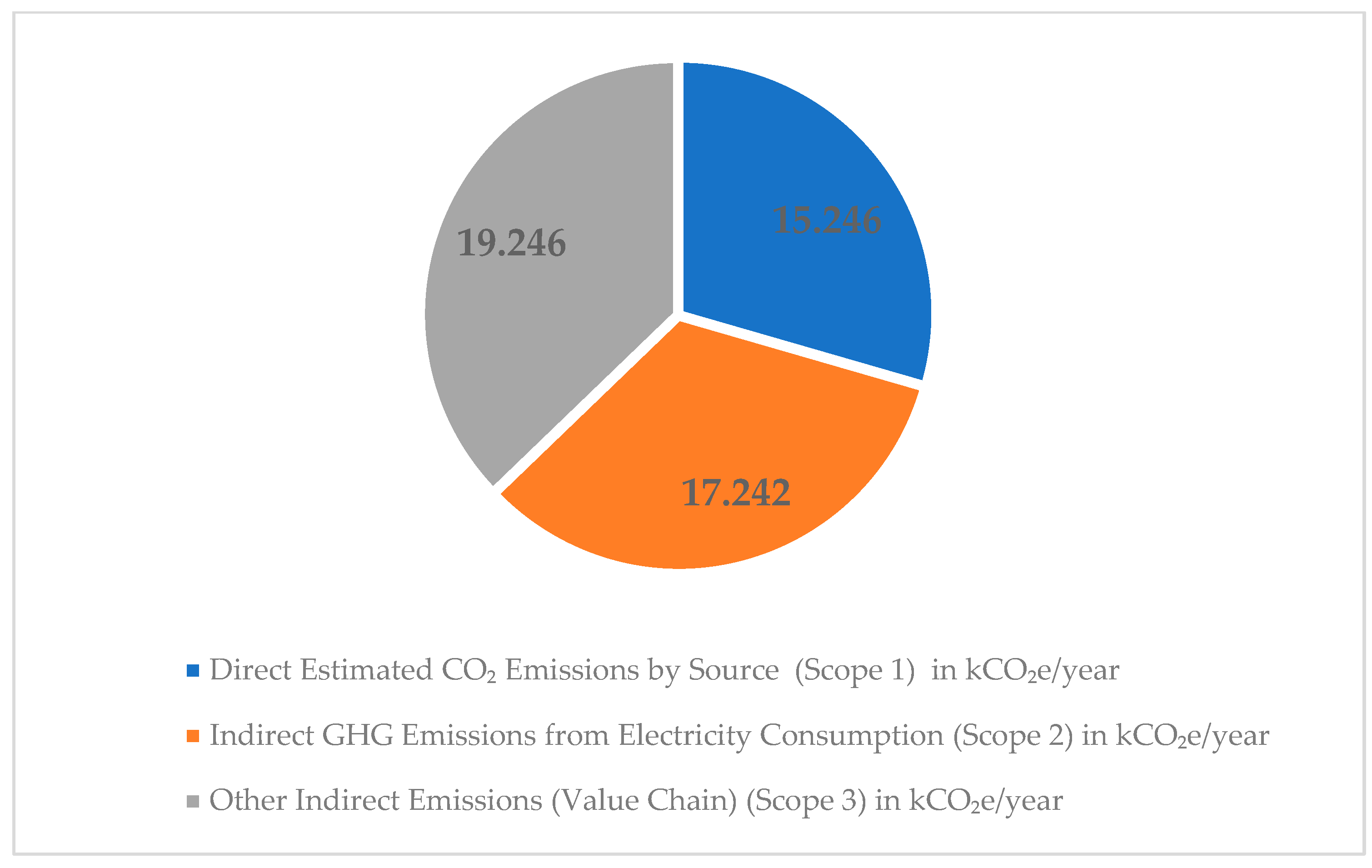
4.2.1. Scope 1
4.2.2. Scope 2
4.2.3. Scope 3
- Environmental Management Plan
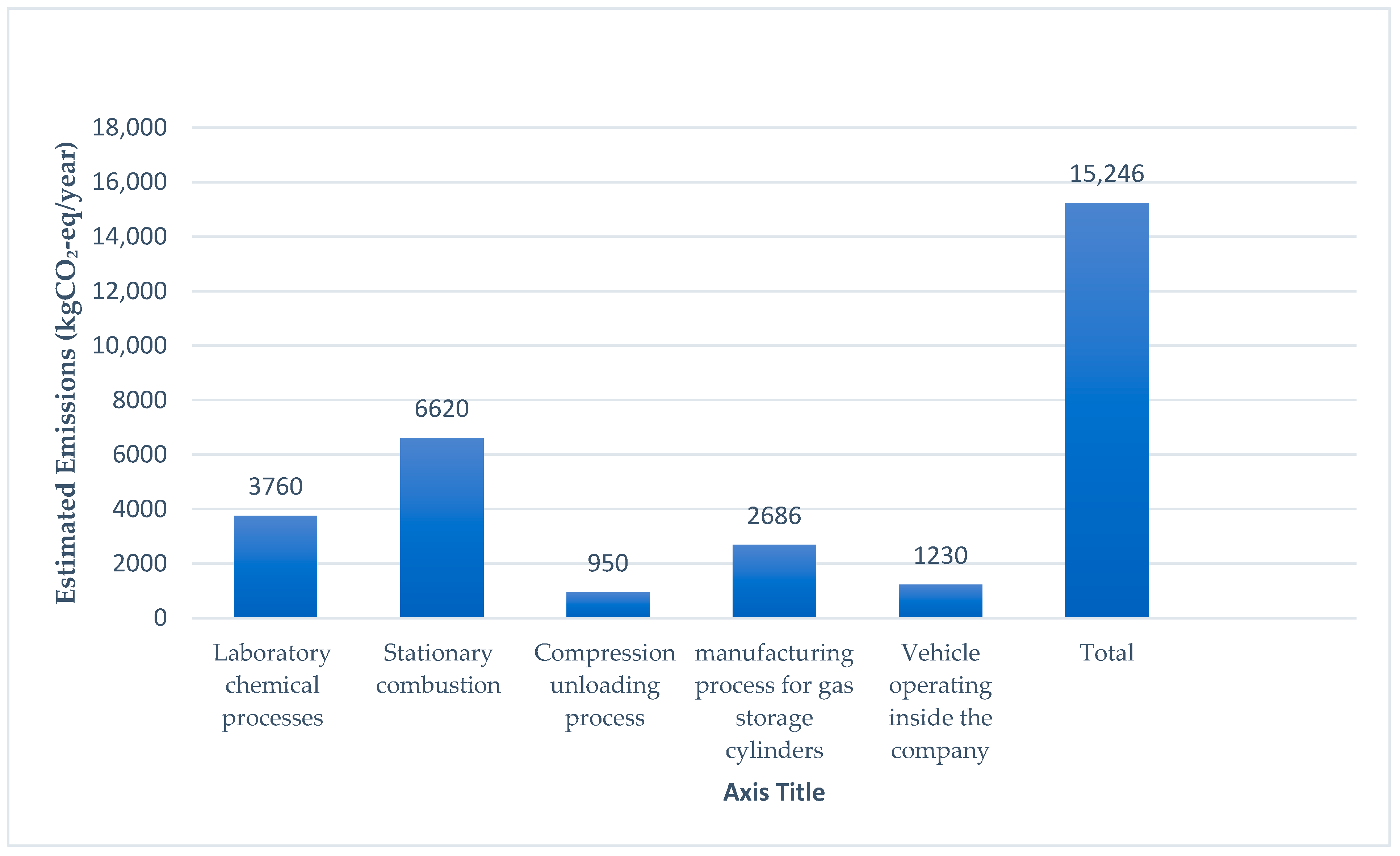
- Laboratory Chemical Processes
- Stationary Combustion
- Compression Unloading Process
- Manufacturing of Gas Cylinders
- Vehicle Operation Within the Company
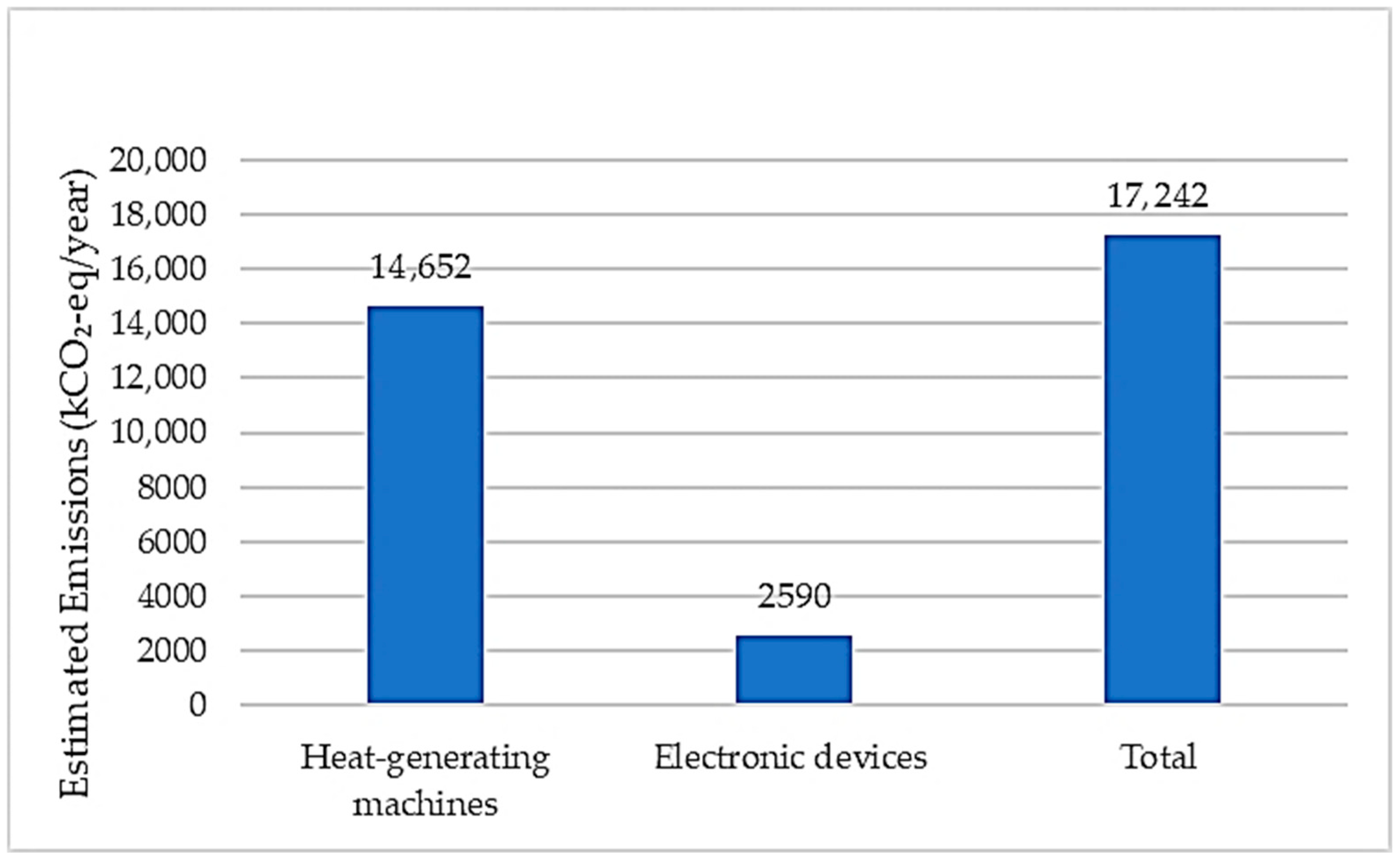
- Heat-Generating Machines
- Electronic Devices
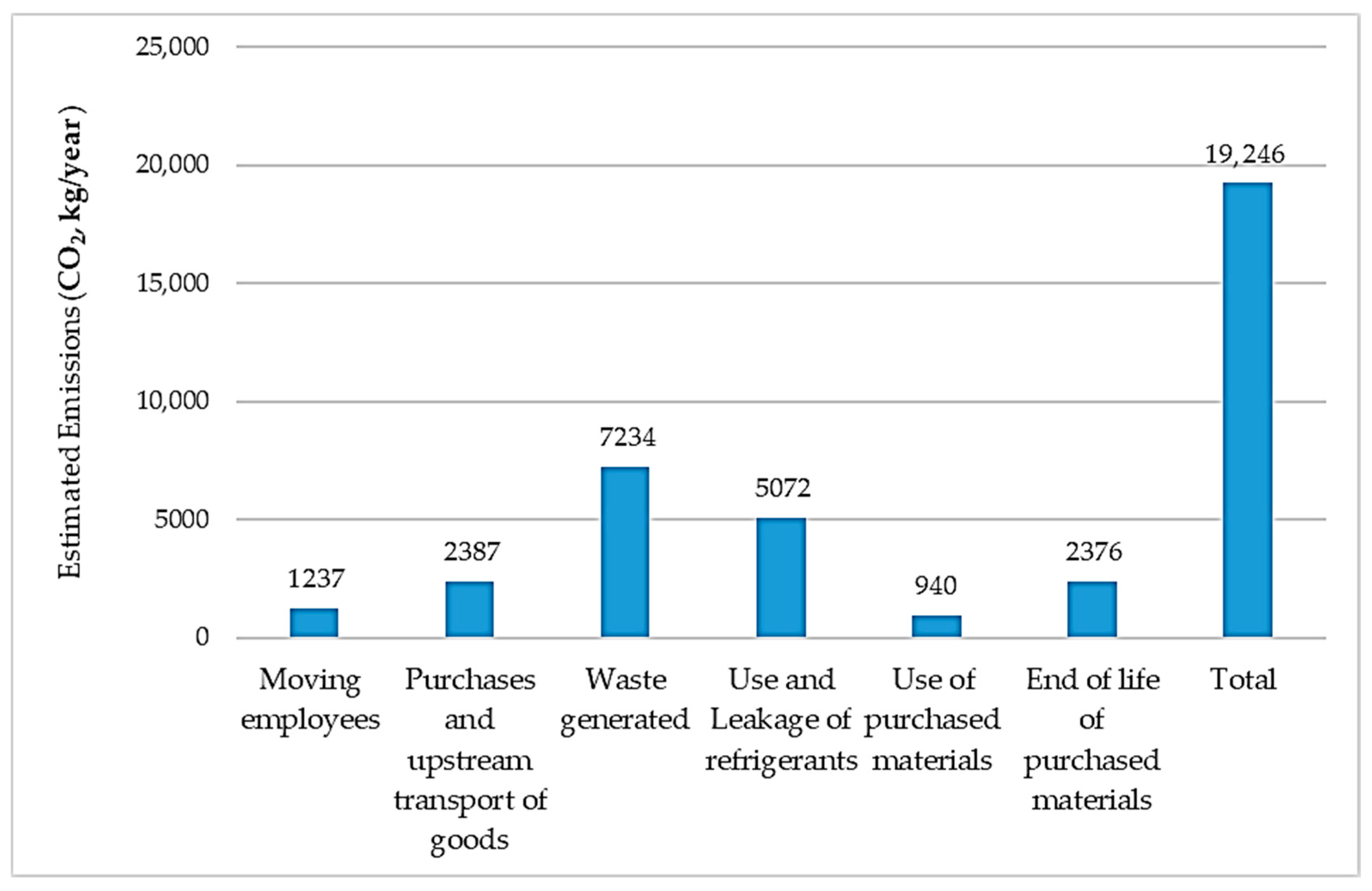
- Moving of People
- ○
- Purchases and Transportation of Goods (Upstream/Downstream)
- ○
- End-of-Life of Purchased Materials
- ○
- Waste Generated
- ○
- Use of Purchased Materials
- ○
- Leakage of Air Conditioning Refrigerants
5. Discussion
5.1. Critical Interpretation of Results and Their Local Significance
5.2. Regional and African Implications of BOCOM Petroleum’s Decarbonisation Strategy
5.3. Alignment with Cameroon’s Legal and Institutional Frameworks: Current Status and Long-Term Projections
5.4. Strategic and Environmental Advantages of Decarbonising Industrial Enterprises in Sub-Saharan Africa
5.5. International Comparison and Benchmarking
5.6. Limitation of Framework
6. Conclusions
Author Contributions
Funding
Data Availability Statement
Acknowledgments
Conflicts of Interest
References
- Bot, B.V.; Axaopoulos, P.J.; Sakellariou, E.I.; Sosso, O.T.; Tamba, J.G. Economic Viability Investigation of Mixed-Biomass Briquettes Made from Agricultural Residues for Household Cooking Use. Energies 2023, 16, 6469. [Google Scholar] [CrossRef]
- Sakellariou, E.I.; Axaopoulos, P.J.; Bot, B.V.; Kavadias, K.A. First Law Comparison of a Forced-Circulation Solar Water Heating System with an Identical Thermosyphon. Energies 2023, 16, 431. [Google Scholar] [CrossRef]
- Gopakumar, L.; Kholdorov, S.; Shamsiddinov, T. Greenhouse gases emissions: Problem, global reality, and future perspectives. In Agriculture Toward Net Zero Emissions; Elsevier: New York, NY, USA, 2025; pp. 11–26. [Google Scholar] [CrossRef]
- Lamb, W.F.; Wiedmann, T.; Pongratz, J.; Andrew, R.; Crippa, M.; Olivier, J.G.J.; Wiedenhofer, D.; Mattioli, G.; Al Khourdajie, A.; House, J.; et al. A review of trends and drivers of greenhouse gas emissions by sector from 1990 to 2018. Environ. Res. Lett. 2021, 16, 073005. [Google Scholar] [CrossRef]
- Allen, D.T. Emissions from oil and gas operations in the United States and their air quality implications. J. Air Waste Manag. Assoc. 2016, 66, 549–575. [Google Scholar] [CrossRef]
- Mudhee, K.H.; Hilal, M.M.; Alyami, M.; Rendal, E.; Algburi, S.; Sameen, A.Z.; Khurramov, A.; Abboud, N.G.; Barakat, M. Assessing climate strategies of major energy corporations and examining projections in relation to Paris Agreement objectives within the framework of sustainable energy. Unconv. Resour. 2025, 5, 100127. [Google Scholar] [CrossRef]
- Byaro, M. Impacts of climate change and non-renewable energy consumption on health in sub-Saharan Africa: Transmission channels and policy response. Next Res. 2025, 2, 100385. [Google Scholar] [CrossRef]
- Sørreime, H.B. The Current Role of Western Development Actors as Knowledge and Policy Providers: The Making of Good Governance of Natural Gas Resources in Tanzania. Forum Dev. Stud. 2024, 52, 81–106. [Google Scholar] [CrossRef]
- Assembleée Nationale, C. Loi N ° 96/12 Du 5 Aout 1996 Portant Loi-Cadre Relative a La Gestion De L’ Environnement; Éditions Premières lignes SARL: Dschang, Cameroun, 1996; p. 21. [Google Scholar]
- Ayuketah, Y.; Gyamfi, S.; Diawuo, F.A.; Dagoumas, A.S. A techno-economic and environmental assessment of a low-carbon power generation system in Cameroon. Energy Policy 2023, 179, 113644. [Google Scholar] [CrossRef]
- INVESTIR AU CAMEROUN, Le Marketeur Bocom Petroleum s.a. Investit Près d’un Demi-Milliard de FCFA dans sa 75è Station-Service au Cameroun. Available online: https://www.investiraucameroun.com/transport/2701-15880-le-marketeur-bocom-petroleum-s-a-investit-pres-d-un-demi-milliard-de-fcfa-dans-sa-75e-station-service-au-cameroun (accessed on 21 May 2025).
- El-Fadel, M.; Chedid, R.; Zeinati, M.; Hmaidan, W. Mitigating energy-related GHG emissions through renewable energy. Renew. Energy 2003, 28, 1257–1276. [Google Scholar] [CrossRef]
- Otene, I.J.J.; Murray, P.; Enongene, K.E. The potential reduction of carbon dioxide (CO2) emissions from gas flaring in Nigeria’s oil and gas industry through alternative productive use. Environments 2016, 3, 31. [Google Scholar] [CrossRef]
- Winkler, H. Taking Action on Climate Change: Long Term Mitigation Scenarios for South Africa; Juta And Company: Cape Town, South Africa, 2010. [Google Scholar]
- Owusu, V.; Lawer, E.T.; Adjei, M.; Ogbe, M. Impact of offshore petroleum extraction and “ocean grabbing” on small-scale fisheries and coastal livelihoods in Ghana. Marit. Stud. 2023, 22, 17. [Google Scholar] [CrossRef]
- Idemudia, U.; Tuokuu, F.X.D.; Essah, M. The extractive industry and human rights in Africa: Lessons from the past and future directions. Resour. Policy 2022, 78, 102838. [Google Scholar] [CrossRef]
- Olawuyi, D.S. Extractives Industry Law in Africa; Springer: Cham, Switzerland, 2018. [Google Scholar]
- Lee, H.E.; Jin, T.; Lee, Y.; Lee, S.H. Incorporating life cycle assessment into energy transition policy: Displacing coal with natural gas. J. Clean. Prod. 2026, 552, 147969. [Google Scholar] [CrossRef]
- Retegi, J.; Kamp, B.; Igartua, J.I. Industrial Value Chains and Greenhouse Gas Emissions: An EEIOT-Based Sustainability Analysis for Assessing Policy Options. Gases 2026, 6, 12. [Google Scholar] [CrossRef]
- Enking, J.; Cucurachi, S.; Meys, R.; Tukker, A. Industry-wide life cycle assessment for improved decision-making: A case study on carbon emissions of petrochemicals. Front. Environ. Sci. 2025, 13, 1646009. [Google Scholar] [CrossRef]
- Hetherington, A.C.; Borrion, A.L.; Griffiths, O.G.; McManus, M.C. Use of LCA as a development tool within early research: Challenges and issues across different sectors. Int. J. Life Cycle Assess. 2014, 19, 130–143. [Google Scholar] [CrossRef]
- Kayhan, D.Y. Future Directions in Oil and Gas–Renewables and Energy Transition. In Energy Transition in the Oil and Gas Industry; CRC Press: Boca Raton, FL, USA, 2024; pp. 682–715. [Google Scholar] [CrossRef]
- Chu, H.; Huang, Z.; Zhang, Z.; Yan, X.; Qiu, B.; Xu, N. Integration of carbon emission reduction policies and technologies: Research progress on carbon capture, utilization and storage technologies. Sep. Purif. Technol. 2024, 343, 127153. [Google Scholar] [CrossRef]
- Cheah, W.Y.; Ling, T.C.; Juan, J.C.; Lee, D.J.; Chang, J.S.; Show, P.L. Biorefineries of carbon dioxide: From carbon capture and storage (CCS) to bioenergies production. Bioresour. Technol. 2016, 215, 346–356. [Google Scholar] [CrossRef] [PubMed]
- Blondeel, M.; Bradshaw, M. International oil companies, decarbonisation and transition risks. In Handbook on Oil and International Relations; Edward Elgar Publishing: Cheltenham, UK, 2022. [Google Scholar]
- Sapnken, F.E.; Kibong, M.T.; Tamba, J.G. Analysis of household LPG demand elasticity in Cameroon and policy implications. Heliyon 2024, 9, e16471. [Google Scholar] [CrossRef]
- Lokossou, J. Oil and the Cameroonian Economy: A Story of Unfulfilled Potential1 Léonce Ndikumana2 Hans Tino Mpenya Ayamena3. 2025. Available online: https://peri.umass.edu/publication/oil-and-the-cameroonian-economy-a-story-of-unfulfilled-potential (accessed on 26 June 2025).
- Baiye, E. Petroleum Supply Chain in Cameroon: An Exploratory Study. Chem. Week 2015, 159, 23–29. [Google Scholar] [CrossRef]
- Adekoya, O.B.; Yaya, O.S.; Oliyide, J.A.; Posu, S.M. Growth and growth disparities in Africa: Are differences in renewable energy use, technological advancement, and institutional reforms responsible? Struct. Change Econ. Dyn. 2022, 61, 265–277. [Google Scholar] [CrossRef]
- Isbell, P. Atlantic Energy and the Changing Global Energy Flow Map. Atl. Future Sci. Pap. 2014, 17, 1–29. [Google Scholar]
- Hafner, M.; Raimondi, P.P. Energy and the Economy in Europe; Springer International Publishing: Cham, Switzerland, 2022. [Google Scholar]
- Paes, W. Oil Production and National Security in Sub-Saharan Africa. Oil Policy Gulf Guin. 2004, 87–100. Available online: https://www.semanticscholar.org/paper/Oil-Production-and-National-Security-in-Sub-Saharan-Paes/64f1b9f2f63676c3ee54ae959b78d995cdf29734 (accessed on 26 June 2025).
- Graham, E.; Ovadia, J.S. Oil exploration and production in Sub-Saharan Africa, 1990-present: Trends and developments. Extr. Ind. Soc. 2019, 6, 593–609. [Google Scholar] [CrossRef]
- Ouedraogo, N.S. Africa energy future: Alternative scenarios and their implications for sustainable development strategies. Energy Policy 2017, 106, 457–471. [Google Scholar] [CrossRef]
- Liew, W.T.; Adhitya, A.; Srinivasan, R. Sustainability trends in the process industries: A text mining-based analysis. Comput. Ind. 2014, 65, 393–400. [Google Scholar] [CrossRef]
- Otsubo, Y.; Chapman, A.J. Assessing Corporate Vendor Selection in the Oil and Gas Industry: A Review of Green Strategies and Carbon Reduction Options. Sustainability 2023, 15, 16249. [Google Scholar] [CrossRef]
- Schutzbach, M.; Miehe, R.; Sauer, A. Simplifying life cycle Assessment: Basic considerations for approximating product carbon footprints based on corporate carbon footprints. Ecol. Indic. 2025, 176, 113710. [Google Scholar] [CrossRef]
- Lee, C.H.; Ma, H.W. Improving the integrated hybrid LCA in the upstream scope 3 emissions inventory analysis. Int. J. Life Cycle Assess. 2013, 18, 17–23. [Google Scholar] [CrossRef]
- McGaughy, K.; Abraham, T.; Bergerson, J.A.; Masnadi, M.S. Canadian oil sands industry GHG emissions intensity and mitigation potential of some key emerging technologies towards fulfilling its 2050 net-zero commitment. Resour. Conserv. Recycl. 2025, 28, 108230. [Google Scholar] [CrossRef]
- IPCC. Refinement to the 2006 IPCC Guidelines for National Greenhouse Gas Inventories 2019. Available online: https://www.ipcc-nggip.iges.or.jp/public/2019rf/index.html (accessed on 1 July 2025).
- Gentilucci, G.; Accardo, A.; Spessa, E. Life cycle greenhouse gas emissions of diesel oil and zero-emission trucks: Systematic review of status and perspectives. Transp. Res. Interdiscip. Perspect. 2025, 32, 101563. [Google Scholar] [CrossRef]
- Chan, S.; Brandi, C.; Bauer, S. Aligning transnational climate action with international climate governance: The road from Paris. Rev. Eur. Comp. Int. Environ. Law 2016, 25, 238–247. [Google Scholar] [CrossRef]
- Acobta, A.N.B.; Ayompe, L.M.; Wandum, L.M.; Tambasi, E.E.; Muyuka, D.S.; Egoh, B.N. Greenhouse gas emissions along the value chain in palm oil producing systems: A case study of Cameroon. Clean. Circ. Bioecon. 2023, 6, 100057. [Google Scholar] [CrossRef]
- Yusuf, A.M.; Abubakar, A.B.; Mamman, S.O. Relationship between greenhouse gas emission, energy consumption, and economic growth: Evidence from some selected oil-producing African countries. Environ. Sci. Pollut. Res. 2020, 27, 15815–15823. [Google Scholar] [CrossRef] [PubMed]
- Boakye, B.; Ofori, C.G.; Yaotse, K. Examining Methane Management in the Climate Action Plans of Oil Producing African Nations; Africa Centre for Energy Policy: Accra, Ghana, 2023. [Google Scholar]
- IPCC Climate Change 2021. The Physical Science Basis. Intergovernmental Panel on Climate Change. Available online: https://www.ipcc.ch/report/ar6/wg1 (accessed on 25 June 2025).
- DEFRA. UK Government GHG Conversion Factors for Company Reporting; DEFRA: London, UK, 2023. [Google Scholar]
- IEA. Energy Efficiency, International Energy Agency. Available online: https://www.iea.org/reports/energy-efficiency-2022 (accessed on 17 June 2025).
- IEA. Cameroon: Energy Profile. International Energy Agency. Available online: https://www.iea.org/countries/cameroon (accessed on 24 June 2025).
- Sotos, M. GHG Protocol Scope 2 Guidance; World Resources Intstitute: Washington, DC, USA, 2022; p. 120. [Google Scholar]
- IRENA. Renewable Power Generation Costs in 2016, International Renewable Energy Agency; IRENA rapport; IRENA: Abu Dhabi, United Arab Emirates, 2016. [Google Scholar]
- Protocol, G. Corporate Value Chain (Scope 3) Accounting and Reporting Standard. World Resources Institute and World Business Council for Sustainable Development. 2011. Available online: https://ghgprotocol.org/standards/scope-3-standard (accessed on 19 May 2025).
- International Energy Agency. Africa Energy Outlook 2022; International Energy Agency: Paris, France, 2022. [Google Scholar]
- Amponsah, N.Y.; Troldborg, M.; Kington, B.; Aalders, I.; Hough, R.L. Greenhouse gas emissions from renewable energy sources: A review of lifecycle considerations. Renew. Sustain. Energy Rev. 2014, 39, 461–475. [Google Scholar] [CrossRef]
- Kuppusamy, S.; Magazine, M.J.; Rao, U. Electric vehicle adoption decisions in a fleet environment. Eur. J. Oper. Res. 2017, 262, 123–135. [Google Scholar] [CrossRef]
- Matthews, H.S.; Hendrickson, C.T.; Weber, C.L. The importance of carbon footprint estimation boundaries. Environ. Sci. Technol. 2008, 42, 5839–5842. [Google Scholar] [CrossRef]
- Ghisellini, P.; Cialani, C.; Ulgiati, S. A review on circular economy: The expected transition to a balanced interplay of environmental and economic systems. J. Clean. Prod. 2016, 114, 11–32. [Google Scholar] [CrossRef]
- Wilson, D.C.; Rodic-Wiersma, L.; Scheinberg, A.; Alabaster, G. Comparative analysis of solid waste management in cities around the world. In Proceedings of the Waste, Warwickshire, UK, 28–29 September 2010; pp. 1–30. Available online: https://edepot.wur.nl/169398 (accessed on 5 July 2025).
- United Nations Environment Programme (UNEP). Waste. 2022. Available online: https://www.unep.org/annualreport/2022 (accessed on 19 May 2025).
- IEA. Africa Energy Outlook 2019—Analysis—IEA. Available online: https://www.iea.org/reports/africa-energy-outlook-2019 (accessed on 3 July 2025).
- South African Government. Carbon Tax Act; South African Government: Cape Town, South African, 2019; Volume 647, pp. 1–65. [Google Scholar]
- African Union. Agenda2063 report of the commission on the African Union Agenda 2063 The Africa we want in 2063. 2015. Available online: https://au.int/en/agenda2063/overview (accessed on 2 July 2025).
- MINEPDED. Plan National d’Adaptation aux Changements Climatique du Cameroun; MINEPNDD: Yaoundé, Cameroun, 2015; pp. 1–154. [Google Scholar]
- African Development Bank Group. Green Investment Program for Africa. Available online: https://www.afdb.org/en/topics-and-sectors/initiatives-and-partnerships/green-investment-program-africa (accessed on 3 July 2025).
- UNFCCC. Private Sector Engagement in Climate Finance. Available online: https://unfccc.int/ (accessed on 3 July 2025).
- Emborg, M.; Gebara, C.H.; Olsen, S.I. Using process-based life cycle assessment to help companies identify emission reduction potentials in their value chain: A case study in the petroleum industry. Carbon Manag. 2025, 16, 2445242. [Google Scholar] [CrossRef]
- Geethani, M.; Kulatunga, A. Life Cycle Assessment of the Gasoline Supply Chain in Sri Lanka. Sustainability 2024, 16, 10933. [Google Scholar] [CrossRef]
- Suhartono; Prasetyo, B.D.; Azizah, I.N. Synthetic gas (syngas) production in downdraft corncob gasifier and its application as fuel using conventional domestic (LPG) stove. ARPN J. Eng. Appl. Sci. 2016, 11, 5238–5243. [Google Scholar]
- Al Zarkani, H.M.; Mezher, T.; El-Fadel, M. Life cycle assessment in the petroleum industry: A systematic framework towards improved environmental performance. J. Clean. Prod. 2023, 408, 137196. [Google Scholar] [CrossRef]


| Emissions Categories | Emissions Activities |
| Direct GHG emissions | Laboratory chemical processes (lubricant production) |
| Stationary combustion (use of diesel as a generator for the generator set) | |
| Compression unloading process (extraction of gas from tankers to the company’s tanks) | |
| Manufacturing process for gas storage cylinders | |
| Vehicle operating inside the company | |
| Indirect emissions associated with energy | Electrical Heat-generating machines |
| Electronic devices, air conditioning air-conditioning, filtering process | |
| Other indirect emissions | Moving employees |
| Purchases and upstream transport of goods | |
| Waste generated | |
| Use and Leakage of refrigerants | |
| Use of purchased materials (butane, gas cylinders, granules, seals, etc.) | |
| End of life of purchased materials |
| Company/Study | Scope 1 (%) | Scope 2 (%) | Scope 3 (%) | Region |
| BOCOM Petroleum (This study) | 29% | 33% | 38% | Cameroon |
| Industry Average [52] | 25% | 30% | 45% | Global |
| IEA Regional Average [53] | 28% | 30% | 42% | Sub-Saharan Africa |
| Information on Impacts and Proposed Measures | Information on the Implementation of Measures | Effectiveness Monitoring | ||||||
| Source Activities | Importance * | Proposed Measures | Objective of Measure | Activities Required | Implementation Period ** | Responsible for Implementation | Monitoring Indicators | Verification Methods |
| Laboratory chemical processes | +++ | Use clean technologies | Reduction in waste produced | Investing in clean and efficient technologies | +++ | General Manager/SafetyManager | Volume of chemical waste/frequency of disposal | Half-yearly environmental audit/safety data sheets |
| Stationary combustion | ++ | Conversion to natural gas/biogas boilers or replacement with heat pumps | Reduction in direct CO2; emissions (Scope 1) | Energy assessment, new boiler installation, maintenance | ++ | Maintenance Manager | Fossil fuel consumption (litres/year) | Invoice tracking + CO2; sensors |
| Compression unloading process | ++ | Modernisation of compressors to reduce leaks | Reducing energy losses and gas leaks | Equipment audit, upgrade | ++ | Production Manager/Safety Manager | Leak detected/specific energy consumption | Maintenance report/leak test |
| Manufacturing process for gas storage cylinders | +++ | Energy optimisation of machines, control of material losses | Emissions reduction/process decarbonisation | Workshop diagnostics, insulation, improvement of machine efficiency | +++ | Production Manager/Safety Manager | tCO2;/cylinder produced, kWh/unit | Quarterly energy balance |
| Vehicle operating inside the company | ++ | Switching to electric vehicles | Emissions reduction | Assessment of current fleet, purchase/maintenance of clean vehicles | +++ | Logistic Manager | CO2;/km travelled | Logbook, technical data sheets |
| Heat-generating machines | ++ | Installation of automatic control systems | Reduction in thermalenergy consumption | Adjustment of combustion systems, verification of insulation | ++ | Maintenance Manager | Thermal efficiency, kWh/product | Monthly energy monitoring |
| Electronic devices | +++ | Gradual transition to low-energy equipment (Energy Star label) | Reducing electricity demand | Replacement of old equipment, staff awareness training | + | Maintenance Manager/Certified Electrician | kWh/year per position or department | Consumption monitoring, bills, smart sensors |
| Information on Impacts and Proposed Measures | Information on the Implementation of Measures | Effectiveness Monitoring | ||||||
| Source Activities | Importance | Proposed Measures | Objective of Measure | Activities Required | Implementation Period | Responsible for Implementation | Monitoring Indicators | Verification Methods |
| Moving of people | + | Use of hybrid/electric vehicles, promotion of carpooling | Reduction in CO2; emissions from transport | Purchase/rental of low-carbon vehicles, eco-driving training | ++ | Logistics and Safety Manager | Fuel consumption per month, CO2;/km | GPS tracking, consumption records, |
| Purchases, upstream and downtream transport of goods | + | ++ | Logistics and Safety Manager | Monthly analysis of transport invoices | ||||
| End of life of purchased materials | + | Promoting recycling and reuse of waste | Reduction of final waste | Internal awareness-raising, contractual agreements with recycling organisations | + | Logistics and Safety Manager | Percentage of waste sorted and recycled | Waste weighing, service provider reporting |
| Waste generated | ++ | Promoting recycling and reuse of waste | Reduction in landfill waste volumes | Set up a recycling programme on site | ++ | Safety Manager | Volume rate of recycled waste | Measuring the amount of waste recycled |
| Use of purchased materials | Use of high energy efficiency equipment, | Reduction in electricity consumption | Energy audit, replacement of obsolete equipment | +++ | Maintenance and Safety Manager | Consumption kWh/machine | Eneo bill, IoT consumption sensors | |
| Leakage of air conditioning refrigerants | + | Switch to low GWP gases (e.g. R-32, R-290), preventive maintenance | Reducing the fluorine footprint | Annual inventory of equipment, tracking of refilled quantities | + | Maintenance Manager | Annual leakage rate, recharge quantity | Equipment maintenance log, annual GHG report |
Disclaimer/Publisher’s Note: The statements, opinions and data contained in all publications are solely those of the individual author(s) and contributor(s) and not of MDPI and/or the editor(s). MDPI and/or the editor(s) disclaim responsibility for any injury to people or property resulting from any ideas, methods, instructions or products referred to in the content. |
© 2026 by the authors. Licensee MDPI, Basel, Switzerland. This article is an open access article distributed under the terms and conditions of the Creative Commons Attribution (CC BY) license.
Share and Cite
Bôt, B.V.; Matanga, J.; Mbog, S.M.; Bitondo, D.; Axaopoulos, P.J. Greenhouse Gas Emissions and Environmental Footprint Assessment of Sub-Saharan Africa’s Oil Energy Companies: Case of BOCOM Petroleum, Douala-Cameroon. Pollutants 2026, 6, 27. https://doi.org/10.3390/pollutants6020027
Bôt BV, Matanga J, Mbog SM, Bitondo D, Axaopoulos PJ. Greenhouse Gas Emissions and Environmental Footprint Assessment of Sub-Saharan Africa’s Oil Energy Companies: Case of BOCOM Petroleum, Douala-Cameroon. Pollutants. 2026; 6(2):27. https://doi.org/10.3390/pollutants6020027
Chicago/Turabian StyleBôt, Bill Vaneck, Jacques Matanga, Severin Mbog Mbog, Dieudonné Bitondo, and Petros J. Axaopoulos. 2026. "Greenhouse Gas Emissions and Environmental Footprint Assessment of Sub-Saharan Africa’s Oil Energy Companies: Case of BOCOM Petroleum, Douala-Cameroon" Pollutants 6, no. 2: 27. https://doi.org/10.3390/pollutants6020027
APA StyleBôt, B. V., Matanga, J., Mbog, S. M., Bitondo, D., & Axaopoulos, P. J. (2026). Greenhouse Gas Emissions and Environmental Footprint Assessment of Sub-Saharan Africa’s Oil Energy Companies: Case of BOCOM Petroleum, Douala-Cameroon. Pollutants, 6(2), 27. https://doi.org/10.3390/pollutants6020027