

Nano- and Microplastics in Single-Use Plastic Water Bottles: A Review of Occurrence, Health Risks, and Regulatory Needs


Abstract
1. Introduction
2. Literature Search Methodology
3. Occurrence and Characteristics of NMPs in Bottled Water
3.1. Definitional Framework of Microplastics and Nanoplastics
3.2. Concentration Ranges and Variability
3.3. Physical and Chemical Characteristics
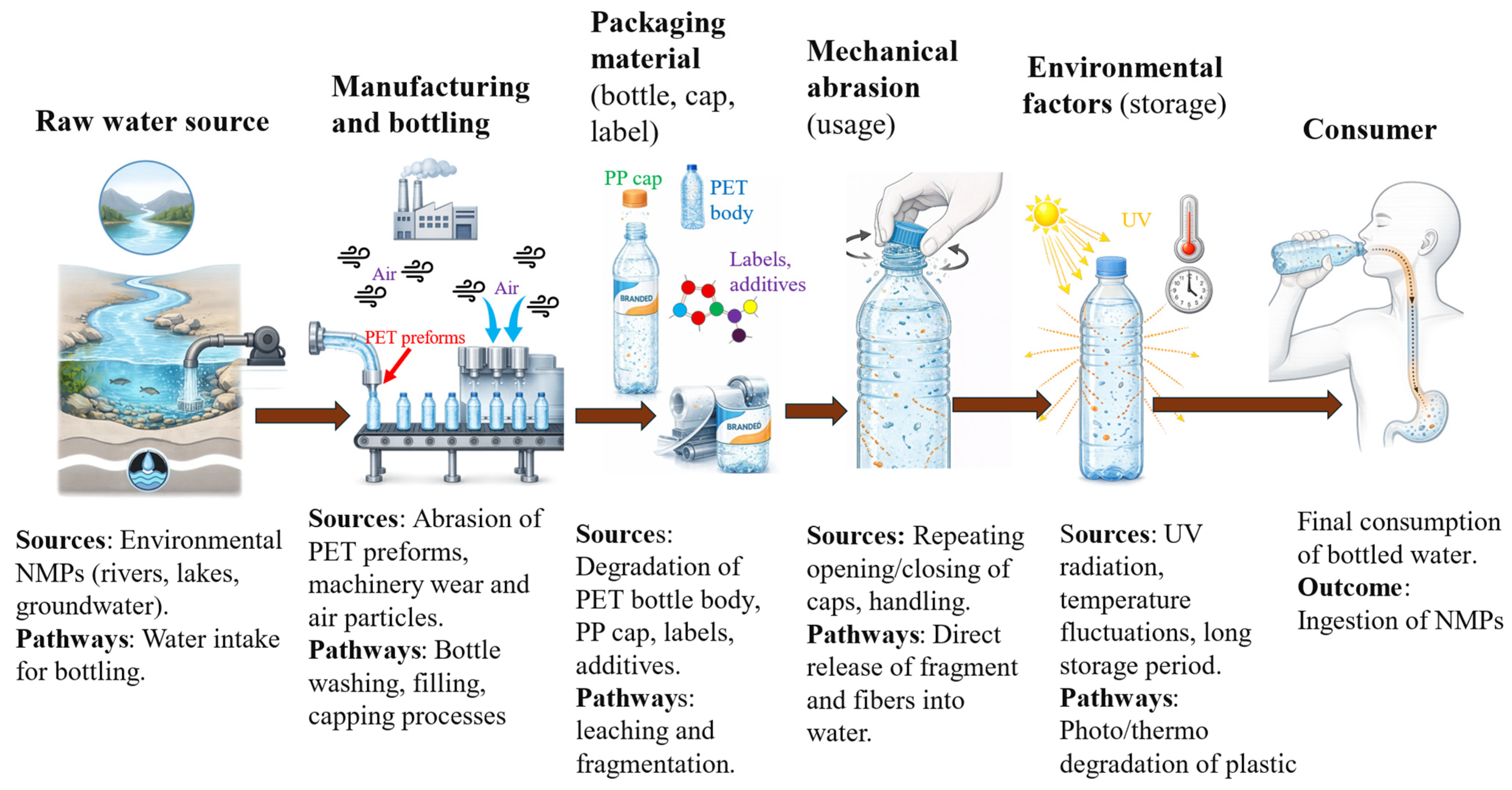
4. Sources and Pathways of Contamination
4.1. Raw Water Source
4.2. Production and Bottling Process
4.3. Packaging Material Degradation
4.4. Storage Conditions and Environmental Factors
4.5. Handling and Use Patterns
4.6. Global Bottled Water Consumption
5. Analytical Techniques for Detection and Quantification
5.1. Sample Preparation
5.2. Instrumentation and Detection Limits
5.2.1. Microscopy Techniques
5.2.2. Spectroscopic Methods
5.2.3. Thermal Analysis
5.2.4. Advanced and Integrated Approaches
5.3. Comparative Approaches to Analyzing NMPs in Bottled and Alternative Water Sources
6. Adverse Health Risks and Dose–Response Relationships
6.1. Observed Effects on Animal Studies
6.2. Limited Human Data and Accumulation
6.3. Human Exposure Levels
6.4. Cellular and Systemic Effects
6.5. Bioaccumulation and Translocation
6.6. Vector Effect of Contaminants
6.7. Absence of Established Safety Thresholds
6.8. Current Understanding of Microplastic Exposure Health Risks
6.9. Knowledge Gaps and Uncertainties in Health Assessment
7. Overview of Current Regulatory Environment and Necessary Actions
7.1. Current Regulatory Status
7.2. International and National Initiatives
7.3. Standardization Challenges and Policy Recommendations
7.4. Future Directions
7.5. Promotion of Sustainable Practices and Public Awareness
8. Challenges and Uncertainties in Quantifying the Human Health Risks of MNPs
8.1. Analytical and Methodological Challenges
8.2. Uncertainties in Health Impact and Risk Assessment
8.3. Complex Mechanisms of Toxicity
8.4. Inadequate Risk Assessment Models
9. Conclusions
Author Contributions
Funding
Data Availability Statement
Conflicts of Interest
Abbreviations
| AI | Artificial Intelligence |
| EDC | Endocrine-disrupting Chemicals |
| EU | European Union |
| FTIR | Fourier-Transform Infrared |
| GI | Gastrointestinal |
| IBWA | International Bottled Water Association |
| LIBS | Laser-Induced Breakdown Spectroscopy |
| MP | Microplastics |
| NMP | Nano- and Microplastics |
| NP | Nanoplastics |
| PC | Polycarbonate |
| PE | Polyethylene |
| PET | Polyethylene Terephthalate |
| PP | Polypropylene |
| PPSU | Polyphenylene Sulfone |
| PS | Polystyrene |
| PVS | Polyvinyl chloride |
| Pyrolysis GC-MS | Pyrolysis Gas Chromatography–Mass Spectrometry |
| QCM | Quartz Crystal Microbalance |
| SEM | Scanning Electron Microscopy |
| SERS | Surface-Enhanced Raman Spectroscopy |
| US EPA | United States Environmental Protection Agency |
| WHO | World Health Organization |
References
- Zhang, J.; Liu, Y.; Zhao, L.; Peng, C.; Wang, L. Microplastics and nanoplastics in drinking water and beverages: Occurrence and human exposure. J. Environ. Expo. Assess. 2024, 3, 24. [Google Scholar] [CrossRef]
- Hirt, N.; Body-Malapel, M. Immunotoxicity and intestinal effects of nano-and microplastics: A review of the literature. Part. Fibre Toxicol. 2020, 17, 57. [Google Scholar] [CrossRef]
- Gaur, P.; Raheja, Y.; Regar, R.K.; Singh, A.; Kumari, K.; Kumari, A.; Sharma, P.; Gaur, V.K.; Srivastava, J.K. Tiny Plastics, Massive Consequences: The Environmental and Health Crisis of Micro (Nano) Plastics. Water Air Soil Pollut. 2025, 236, 705. [Google Scholar] [CrossRef]
- Nguyen, B.; Claveau-Mallet, D.; Hernandez, L.M.; Xu, E.G.; Farner, J.M.; Tufenkji, N. Separation and analysis of microplastics and nanoplastics in complex environmental samples. Acc. Chem. Res. 2019, 52, 858–866. [Google Scholar] [CrossRef] [PubMed]
- Hidalgo-Ruz, V.; Gutow, L.; Thompson, R.C.; Thiel, M. Microplastics in the marine environment: A review of the methods used for identification and quantification. Environ. Sci. Technol. 2012, 46, 3060–3075. [Google Scholar] [CrossRef] [PubMed]
- Mejjad, N.; Laissaoui, A.; Ait Bouh, H.; El Aouidi, S.; Moumen, A.; Azidane, H.; El Bouhaddioui, M. Analytical review of microplastics occurrence in bottled water, tap water, and wastewater treatment plants. E3S Web Conf. 2024, 489, 06005. [Google Scholar] [CrossRef]
- Welle, F.; Franz, R. Microplastic in bottled natural mineral water–literature review and considerations on exposure and risk assessment. Food Addit. Contam. Part A 2018, 35, 2482–2492. [Google Scholar] [CrossRef]
- Mason, S.A.; Welch, V.G.; Neratko, J. Synthetic polymer contamination in bottled water. Front. Chem. 2018, 6, 389699. [Google Scholar] [CrossRef]
- Ivleva, N.P. Chemical analysis of microplastics and nanoplastics: Challenges, advanced methods, and perspectives. Chem. Rev. 2021, 121, 11886–11936. [Google Scholar] [CrossRef]
- Amobonye, A.; Bhagwat, P.; Raveendran, S.; Singh, S.; Pillai, S. Environmental impacts of microplastics and nanoplastics: A current overview. Front. Microbiol. 2021, 12, 768297. [Google Scholar] [CrossRef]
- Caputo, F.; Vogel, R.; Savage, J.; Vella, G.; Law, A.; Della Camera, G.; Hannon, G.; Peacock, B.; Mehn, D.; Ponti, J.; et al. Measuring particle size distribution and mass concentration of nanoplastics and microplastics: Addressing some analytical challenges in the sub-micron size range. J. Colloid Interface Sci. 2021, 588, 401–417. [Google Scholar] [CrossRef]
- Song, J.; Wang, C.; Li, G. Defining primary and secondary microplastics: A connotation analysis. ACS EST Water 2024, 4, 2330–2332. [Google Scholar] [CrossRef]
- EFSA Panel on Contaminants in the Food Chain (CONTAM). Presence of microplastics and nanoplastics in food, with particular focus on seafood. Efsa J. 2016, 14, e04501. [Google Scholar] [CrossRef]
- Pelegrini, K.; Pereira, T.C.; Maraschin, T.G.; Teodoro, L.D.; Basso, N.R.; De Galland, G.L.; Ligabue, R.A.; Bogo, M.R. Micro-and nanoplastic toxicity: A review on size, type, source, and test-organism implications. Sci. Total Environ. 2023, 878, 162954. [Google Scholar] [CrossRef]
- Ramsperger, A.F.; Bergamaschi, E.; Panizzolo, M.; Fenoglio, I.; Barbero, F.; Peters, R.; Undas, A.; Purker, S.; Giese, B.; Lalyer, C.R.; et al. Nano-and microplastics: A comprehensive review on their exposure routes, translocation, and fate in humans. NanoImpact 2023, 29, 100441. [Google Scholar] [CrossRef] [PubMed]
- Alqahtani, S.; Alqahtani, S.; Saquib, Q.; Mohiddin, F. Toxicological impact of microplastics and nanoplastics on humans: Understanding the mechanistic aspect of the interaction. Front. Toxicol. 2023, 5, 1193386. [Google Scholar] [CrossRef] [PubMed]
- Yee, M.S.; Hii, L.W.; Looi, C.K.; Lim, W.M.; Wong, S.F.; Kok, Y.Y.; Tan, B.K.; Wong, C.Y.; Leong, C.O. Impact of microplastics and nanoplastics on human health. Nanomaterials 2021, 11, 496. [Google Scholar] [CrossRef] [PubMed]
- Meyers, N.; Catarino, A.I.; Declercq, A.M.; Brenan, A.; Devriese, L.; Vandegehuchte, M.; De Witte, B.; Janssen, C.; Everaert, G. Microplastic detection and identification by Nile red staining: Towards a semi-automated, cost-and time-effective technique. Sci. Total Environ. 2022, 823, 153441. [Google Scholar] [CrossRef]
- Aliyu, A.O.; Okunola, O.J.; Awe, F.E.; Musa, A.A. Assessment of Microplastics Contamination in River Water, Bottled Water, Sachet Water and Branded Table Salt Samples in Kaduna Metropolis, Nigeria. J. Appl. Sci. Environ. Manag. 2023, 27, 1105. [Google Scholar] [CrossRef]
- Amir, R. Factors influencing microplastic contamination in bottled drinking water in Indonesia: A systematic. Ber. Kedokt. Masy. 2023, 39, e7980. [Google Scholar] [CrossRef]
- Singh, T. Generation of microplastics from the opening and closing of disposable plastic water bottles. J. Water Health 2021, 19, 488–498. [Google Scholar] [CrossRef]
- Moscoso, P.W.; Rivadeneira, X.J.; Gualoto, K.G.; Calle, J.E.; Lopez, P.G. Analysis of the presence of microplastics in different brands of bottled water in region 6-Ecuador. Rev. Colomb. Química 2024, 53, 45–49. [Google Scholar] [CrossRef]
- Zhang, J.; Peng, M.; Lian, E.; Xia, L.; Asimakopoulos, A.G.; Luo, S.; Wang, L. Identification of poly (ethylene terephthalate) nanoplastics in commercially bottled drinking water using surface-enhanced Raman spectroscopy. Environ. Sci. Technol. 2023, 57, 8365–8372. [Google Scholar] [CrossRef]
- Alva-Rojas, E.; Rivera-Ramírez, F.; Jiménez-Rosales, A.; Velázquez-Garduño, G. Identification of Microplastics in Bottled Water, a Potential Risk to Human Health. ECORFAN J. Repub. Parag. 2024, 10, e51018110. [Google Scholar] [CrossRef]
- Singh, S.; Naik, T.S.; Anil, A.G.; Dhiman, J.; Kumar, V.; Dhanjal, D.S.; Aguilar-Marcelino, L.; Singh, J.; Ramamurthy, P.C. Micro (nano) plastics in wastewater: A critical review on toxicity risk assessment, behaviour, environmental impact and challenges. Chemosphere 2022, 290, 133169. [Google Scholar] [CrossRef] [PubMed]
- Naz, S.; Chatha, A.M.; Khan, N.A.; Ullah, Q.; Zaman, F.; Qadeer, A.; Khan, I.M.; Danabas, D.; Kiran, A.; Skalickova, S.; et al. Unraveling the ecotoxicological effects of micro and nano-plastics on aquatic organisms and human health. Front. Environ. Sci. 2024, 12, 1390510. [Google Scholar] [CrossRef]
- Hossain, M.B.; Yu, J.; Banik, P.; Noman, M.A.; Nur, A.A.; Haque, M.R.; Rahman, M.M.; Albeshr, M.F.; Arai, T. First evidence of microplastics and their characterization in bottled drinking water from a developing country. Front. Environ. Sci. 2023, 11, 1232931. [Google Scholar] [CrossRef]
- Melikoglu, M. Microplastics and nanoplastics in food systems: Contamination, impacts, and mitigation strategies–A global review. Next Res. 2025, 2, 100998. [Google Scholar] [CrossRef]
- Osoro, B.O.; Ndegwa, R.; Ombati, W.N.; Gwaro, J.O. Identification of microplastics in plastic bottled drinking water using laser-induced breakdown spectroscopy (LIBS) and Raman spectroscopy. Asian J. Res. Rev. Phys. 2023, 7, 15–24. [Google Scholar] [CrossRef]
- Song, K.; Ding, R.; Sun, C.; Yao, L.; Zhang, W. Microparticles and microplastics released from daily use of plastic feeding and water bottles and plastic injectors: Potential risks to infants and children in China. Environ. Sci. Pollut. Res. 2021, 28, 59813–59820. [Google Scholar] [CrossRef]
- Wang, J.; Wang, L.; Gardner, D.J.; Shaler, S.M.; Cai, Z. Towards a cellulose-based society: Opportunities and challenges. Cellulose 2021, 28, 4511–4543. [Google Scholar] [CrossRef]
- Jiang, D.; Wang, Y.; Xu, H.; Guo, C.; Pan, Q.; Li, H.; Jiang, K. Separate determination of polystyrene nanoplastics and microplastics in water by membrane filtration and gel permeation chromatography-ultraviolet detection analysis. Talanta 2025, 296, 128468. [Google Scholar] [CrossRef]
- Visakh, P.M.; Darie-Nita, R.N. Polyvinylchloride (PVC)-based blends: State of art, new challenges and opportunities. In Polyvinylchloride-Based Blends; Springer: Cham, Switzerland, 2021; pp. 1–7. [Google Scholar] [CrossRef]
- Ugboka, U.G.; Ihedioha, J.N.; Ekere, N.R.; Okechukwu, F.O. Human health risk assessment of bisphenol A released from polycarbonate drinking water bottles and carbonated drinks exposed to sunlight in Nigeria. Int. J. Environ. Anal. Chem. 2022, 102, 2830–2840. [Google Scholar] [CrossRef]
- Mellace, A.; Hanson, J.E.; Griepenburg, J. Hyperbranched poly (phenylene sulfide) and poly (phenylene sulfone). Chem. Mater. 2005, 17, 1812–1817. [Google Scholar] [CrossRef]
- Samandra, S.; Mescall, O.J.; Plaisted, K.; Symons, B.; Xie, S.; Ellis, A.V.; Clarke, B.O. Assessing exposure of the Australian population to microplastics through bottled water consumption. Sci. Total Environ. 2022, 837, 155329. [Google Scholar] [CrossRef] [PubMed]
- World Health Organization. Guidelines on Recreational Water Quality; Volume 1: Coastal and fresh waters; World Health Organization: Geneva, Switzerland, 2021. [Google Scholar]
- Panno, S.V.; Kelly, W.R.; Scott, J.; Zheng, W.; McNeish, R.E.; Holm, N.; Hoellein, T.J.; Baranski, E.L. Microplastic contamination in karst groundwater systems. Groundwater 2019, 57, 189–196. [Google Scholar] [CrossRef]
- Biswal, B.K.; Balasubramanian, R. A review on fate and transport of biodegradable and non-biodegradable microplastics in aquatic environment. Curr. Opin. Environ. Sci. Health 2025, 47, 100660. [Google Scholar] [CrossRef]
- Shen, M.; Zeng, Z.; Wen, X.; Ren, X.; Zeng, G.; Zhang, Y.; Xiao, R. Presence of microplastics in drinking water from freshwater sources: The investigation in Changsha, China. Environ. Sci. Pollut. Res. 2021, 28, 42313–42324. [Google Scholar] [CrossRef] [PubMed]
- Zhao, W.; Wang, X.; Wang, D.; Tang, H.; Zhang, T.; Li, H. Quantification of PP, PE, and PET microplastics in Lake water by Raman spectroscopy combined with PLS regression. Spectrochim. Acta Part A Mol. Biomol. Spectrosc. 2025, 348, 127178. [Google Scholar] [CrossRef]
- Tang, K.H.; Li, R.; Li, Z.; Wang, D. Health risk of human exposure to microplastics: A review. Environ. Chem. Lett. 2024, 22, 1155–1183. [Google Scholar] [CrossRef]
- Weisser, J.; Beer, I.; Hufnagl, B.; Hofmann, T.; Lohninger, H.; Ivleva, N.P.; Glas, K. From the well to the bottle: Identifying sources of microplastics in mineral water. Water 2021, 13, 841. [Google Scholar] [CrossRef]
- Duda, A.; Petka, K. The presence of micro-and nanoplastics in food and the estimation of the amount consumed depending on dietary patterns. Molecules 2025, 30, 3666. [Google Scholar] [CrossRef]
- Oßmann, B.E.; Sarau, G.; Holtmannspötter, H.; Pischetsrieder, M.; Christiansen, S.H.; Dicke, W. Small-sized microplastics and pigmented particles in bottled mineral water. Water Res. 2018, 141, 307–316. [Google Scholar] [CrossRef]
- Schymanski, D.; Goldbeck, C.; Humpf, H.U.; Fürst, P. Analysis of microplastics in water by micro-Raman spectroscopy: Release of plastic particles from different packaging into mineral water. Water Res. 2018, 129, 154–162. [Google Scholar] [CrossRef]
- Geng, Z.; Zhou, L.; Fang, Z.; Wang, J.; Yuan, K.; Zhang, L.; Hu, J. Influence of the dissolved gas on the interfacial properties of decane surface nanodroplets. Langmuir 2022, 38, 2213–2219. [Google Scholar] [CrossRef] [PubMed]
- Al-Mansoori, M.; Harrad, S.; Abdallah, M.A. MPs in drinking water and beverages: Concentrations, characteristics and implications for human exposure. Emerg. Contam. 2025, 11, 100552. [Google Scholar] [CrossRef]
- Qian, N.; Gao, X.; Lang, X.; Deng, H.; Bratu, T.M.; Chen, Q.; Stapleton, P.; Yan, B.; Min, W. Rapid single-particle chemical imaging of nanoplastics by SRS microscopy. Proc. Natl. Acad. Sci. USA 2024, 121, e2300582121. [Google Scholar] [CrossRef]
- Rahman, S.; Saha, W.; Maysha, T.I.; Sarker, P.; Datta, T.R.; Rahman, S.; Chacrabati, R. Prevalence and Health Risks of Microplastics in Bottled Water and Beverages: A Food Safety Concern. J. Hazard. Mater. Plast. 2025, 2, 100024. [Google Scholar] [CrossRef]
- Wawer, J.; Panuszko, A.; Kozłowski, D.; Juniewicz, J.; Szymikowski, J.; Brodnicka, E. Sustainable Management of Microplastic Pollutions from PET Bottles: Overview and Mitigation Strategies. Appl. Sci. 2025, 15, 5322. [Google Scholar] [CrossRef]
- Dhaka, V.; Singh, S.; Anil, A.G.; Sunil Kumar Naik, T.S.; Garg, S.; Samuel, J.; Kumar, M.; Ramamurthy, P.C.; Singh, J. Occurrence, toxicity and remediation of polyethylene terephthalate plastics. A review. Environ. Chem. Lett. 2022, 20, 1777–1800. [Google Scholar] [CrossRef]
- Godwin, A.D. Plasticizers. In Applied Plastics Engineering Handbook; William Andrew Publishing: Norwich, NY, USA, 2024; pp. 595–618. [Google Scholar] [CrossRef]
- Lohmann, R. Microplastics are not important for the cycling and bioaccumulation of organic pollutants in the oceans—But should microplastics be considered POPs themselves? Integr. Environ. Assess. Manag. 2017, 13, 460–465. [Google Scholar] [CrossRef]
- O’Kelly, B.C.; Pantos, O.; Weaver, L.; Sarris, T.S.; Goli, V.S.; Mohammad, A.; Singh, P.; Singh, D.N. Fate and impact of nano/microplastic in the geoenvironment—Ecotoxicological perspective. Environ. Geotech. 2024, 11, 293–306. [Google Scholar] [CrossRef]
- Hong, J.; Ju, M.; Oh, M.Y.; Ha, K.; Hong, S. Tracing the journey of nano-and microplastics: From environmental prevalence to human intake. Mol. Cell. Toxicol. 2025, 21, 1039–1069. [Google Scholar] [CrossRef]
- Sadique, S.A.; Konarova, M.; Niu, X.; Szilagyi, I.; Nirmal, N.; Li, L. Impact of microplastics and nanoplastics on human Health: Emerging evidence and future directions. Emerg. Contam. 2025, 11, 100545. [Google Scholar] [CrossRef]
- Payán, L.; Poyatos, M.T.; Muñoz, L.; La Rubia, M.D.; Pacheco, R.; Ramos, N. Study of the influence of storage conditions on the quality and migration levels of antimony in polyethylene terephthalate-bottled water. Food Sci. Technol. Int. 2017, 23, 318–327. [Google Scholar] [CrossRef] [PubMed]
- Allafi, A.R. The effect of temperature and storage time on the migration of antimony from polyethylene terephthalate (PET) into commercial bottled water in Kuwait. Acta Bio Medica Atenei Parm. 2020, 91, e2020105. [Google Scholar] [CrossRef]
- Hadeed, M.D.; Al-Ahmady, K.K. The effect of different storage conditions for refilled plastic drink bottles on the concentration of microplastic release in water. J. Res. Appl. Sci. Biotechnol. 2022, 1, 71–77. [Google Scholar] [CrossRef]
- Oßmann, B.E. Microplastics in drinking water? Present state of knowledge and open questions. Curr. Opin. Food Sci. 2021, 41, 44–51. [Google Scholar] [CrossRef]
- Giese, A.; Kerpen, J.; Weber, F.; Prediger, J. A preliminary study of microplastic abrasion from the screw cap system of reusable plastic bottles by Raman microspectroscopy. ACS EST Water 2021, 1, 1363–1368. [Google Scholar] [CrossRef]
- Winkler, A.; Santo, N.; Ortenzi, M.A.; Bolzoni, E.; Bacchetta, R.; Tremolada, P. Does mechanical stress cause microplastic release from plastic water bottles? Water Res. 2019, 166, 115082. [Google Scholar] [CrossRef]
- Chaïb, I.; Doyen, P.; Merveillie, P.; Dehaut, A.; Duflos, G. Microplastic contaminations in a set of beverages sold in France. J. Food Compos. Anal. 2025, 144, 107719. [Google Scholar] [CrossRef]
- Eerkes-Medrano, D.; Leslie, H.A.; Quinn, B. Microplastics in drinking water: A review and assessment. Curr. Opin. Environ. Sci. Health 2019, 7, 69–75. [Google Scholar] [CrossRef]
- Theodoridou, G.; Avramidou, P.; Kassianidis, P.; Partalidou, M.; Lakioti, E.; Karayannis, V.; Samaras, P. Social Preferences, Awareness and Ecological Consciousness of Sustainable Drinking Water Options. Sustainability 2025, 17, 3597. [Google Scholar] [CrossRef]
- Hu, Z.; Morton, L.W.; Mahler, R.L. Bottled water: United States consumers and their perceptions of water quality. Int. J. Environ. Res. Public Health 2011, 8, 565–578. [Google Scholar] [CrossRef]
- Parag, Y.; Elimelech, E.; Opher, T. Bottled water: An evidence-based overview of economic viability, environmental impact, and social equity. Sustainability 2023, 15, 9760. [Google Scholar] [CrossRef]
- Cohen, A.; Ray, I. The global risks of increasing reliance on bottled water. Nat. Sustain. 2018, 1, 327–329. [Google Scholar] [CrossRef]
- Jebarajakirthy, C.; Das, M.; Maggioni, I.; Sands, S.; Dharmesti, M.; Ferraro, C. Understanding on-the-go consumption: A retail mix perspective. J. Retail. Consum. Serv. 2021, 58, 102327. [Google Scholar] [CrossRef]
- Ballantine, P.W.; Ozanne, L.K.; Bayfield, R. Why buy free? Exploring perceptions of bottled water consumption and its environmental consequences. Sustainability 2019, 11, 757. [Google Scholar] [CrossRef]
- Pacheco-Vega, R. (Re)theorizing the politics of bottled water: Water insecurity in the context of weak regulatory regimes. Water 2019, 11, 658. [Google Scholar] [CrossRef]
- Watson, M.; Nikić, J.; Pešić Bajić, J.; Vujić, M.; Apostolović, T.; Atanasijević, J.; Agbaba, J. Public Perception of Drinking Water Quality in an Arsenic-Affected Region: Implications for Sustainable Water Management. Water 2025, 17, 1613. [Google Scholar] [CrossRef]
- Howell, R.; Sinha, K.M.; Wagner, N.; Doorn, N.; van Beers, C. Consumption of bottled water at the bottom of the pyramid: Who purchases first? J. Macromark. 2020, 40, 31–50. [Google Scholar] [CrossRef]
- Hawkins, G. The impacts of bottled water: An analysis of bottled water markets and their interactions with tap water provision. Wiley Interdiscip. Rev. Water 2017, 4, e1203. [Google Scholar] [CrossRef]
- Aljaradin, M. Biodegradation of microplastics in drinking water, a review. SRMJ 2020, 5, 1–7. [Google Scholar] [CrossRef]
- Parveen, N.; Ranjan, V.P.; Chowdhury, S.; Goel, S. Occurrence and potential health risks due to trihalomethanes and microplastics in bottled water. Environ. Eng. Sci. 2022, 39, 523–534. [Google Scholar] [CrossRef]
- Hadeed, M.D.; Al-Ahmady, K.K. Investigate the presence of plastic particles in bottled and reused water bottles for several times and medical feeder bottles. J. Pharm. Negat. Results 2022, 13, 812–818. [Google Scholar] [CrossRef]
- Wątor, K.; Rusiniak, P.; Kmiecik, E.; Bugno, R.; Ristić Vakanjac, V. Assessing health risks in bottled water: Chemical compounds and their impact on human health. Environ. Geochem. Health 2024, 46, 178. [Google Scholar] [CrossRef]
- Kirstein, I.V.; Hensel, F.; Gomiero, A.; Iordachescu, L.; Vianello, A.; Wittgren, H.B.; Vollertsen, J. Drinking plastics?–Quantification and qualification of microplastics in drinking water distribution systems by µFTIR and Py-GCMS. Water Res. 2021, 188, 116519. [Google Scholar] [CrossRef]
- Enríquez-Hidalgo, A.M.; Lara-Borrero, J.; Torres, A. Identification of explanatory factors of the presence and quantification of endocrine disruptors in commercially available bottled waters. Water Environ. J. 2022, 36, 30–42. [Google Scholar] [CrossRef]
- Winkler, A.; Fumagalli, F.; Cella, C.; Gilliland, D.; Tremolada, P.; Valsesia, A. Detection and formation mechanisms of secondary nanoplastic released from drinking water bottles. Water Res. 2022, 222, 118848. [Google Scholar] [CrossRef]
- Zhang, Q.; Xu, E.G.; Li, J.; Chen, Q.; Ma, L.; Zeng, E.Y.; Shi, H. A review of microplastics in table salt, drinking water, and air: Direct human exposure. Environ. Sci. Technol. 2020, 54, 3740–3751. [Google Scholar] [CrossRef] [PubMed]
- Wang, Z.; Taylor, S.E.; Sharma, P.; Flury, M. Poor extraction efficiencies of polystyrene nano-and microplastics from biosolids and soil. PLoS ONE 2018, 13, e0208009. [Google Scholar] [CrossRef]
- Schymanski, D.; Oßmann, B.E.; Benismail, N.; Boukerma, K.; Dallmann, G.; Von der Esch, E.; Fischer, D.; Fischer, F.; Gilliland, D.; Glas, K.; et al. Analysis of microplastics in drinking water and other clean water samples with micro-Raman and micro-infrared spectroscopy: Minimum requirements and best practice guidelines. Anal. Bioanal. Chem. 2021, 413, 5969–5994. [Google Scholar] [CrossRef] [PubMed]
- De Frond, H.; Hampton, L.T.; Kotar, S.; Gesulga, K.; Matuch, C.; Lao, W.; Weisberg, S.B.; Wong, C.S.; Rochman, C.M. Monitoring microplastics in drinking water: An interlaboratory study to inform effective methods for quantifying and characterizing microplastics. Chemosphere 2022, 298, 134282. [Google Scholar] [CrossRef]
- Scircle, A.; Cizdziel, J.V. Detecting and quantifying microplastics in bottled water using fluorescence microscopy: A new experiment for instrumental analysis and environmental chemistry courses. J. Chem. Educ. 2019, 97, 234–238. [Google Scholar] [CrossRef]
- Dileepan, A.B.; Jeyaram, S.; Arumugam, N.; Almansour, A.I.; Santhamoorthy, M. Identification and occurrence of microplastics in drinking water bottles and milk packaging consumed by humans daily. Environ. Monit. Assess. 2025, 197, 261. [Google Scholar] [CrossRef]
- Xu, Y.; Aljuhani, W.; Zhang, Y.; Ye, Z.; Li, C.; Bell, S.E. A practical approach to quantitative analytical surface-enhanced Raman spectroscopy. Chem. Soc. Rev. 2025, 54, 62–84. [Google Scholar] [CrossRef]
- Sim, W.; Song, S.W.; Park, S.; Jang, J.I.; Kim, J.H.; Cho, Y.M.; Kim, H.M. Unveiling microplastics with hyperspectral Raman imaging: From macroscale observations to real-world applications. J. Hazard. Mater. 2024, 463, 132861. [Google Scholar] [CrossRef] [PubMed]
- Zajác, P.; Čapla, J.; Čurlej, J. Microplastic contamination of food. Scifood 2025, 19, 1–6. [Google Scholar] [CrossRef]
- Nene, A.; Sadeghzade, S.; Viaroli, S.; Yang, W.; Uchenna, U.P.; Kandwal, A.; Liu, X.; Somani, P.; Galluzzi, M. Recent advances and future technologies in nano-microplastics detection. Environ. Sci. Eur. 2025, 37, 7. [Google Scholar] [CrossRef]
- Wang, Z.; Pal, D.; Pilechi, A.; Ariya, P.A. Nanoplastics in water: Artificial intelligence-assisted 4D physicochemical characterization and rapid in situ detection. Environ. Sci. Technol. 2024, 58, 8919–8931. [Google Scholar] [CrossRef]
- Vitali, C.; Peters, R.J.; Janssen, H.G.; Undas, A.K.; Munniks, S.; Ruggeri, F.S.; Nielen, M.W. Quantitative image analysis of microplastics in bottled water using artificial intelligence. Talanta 2024, 266, 124965. [Google Scholar] [CrossRef]
- Lim, W.Y.; Lau, E.V.; Ramakrishnan, N. Electrophoresis and Quartz Crystal Microbalance Instrumentation to Sense Nanoplastics in Water. Anal. Chem. 2024, 96, 19213–19219. [Google Scholar] [CrossRef]
- Karki, A.; Thaiba, B.M.; Shishir Acharya, K.C.; Sedai, T.; Kandel, B.; Paudyal, H.; Sharma, K.R.; Giri, B.; Neupane, B.B. Smartphone microscopic method for imaging and quantification of microplastics in drinking water. Microsc. Res. Tech. 2024, 87, 2266–2274. [Google Scholar] [CrossRef]
- Parobková, V.; Holub, D.; Kizovský, M.; Kalčíková, G.; Rozman, U.; Urík, M.; Novotný, K.; Samek, O.; Zikmund, T.; Pořízka, P.; et al. Raman microspectroscopy and laser-induced breakdown spectroscopy for the analysis of polyethylene microplastics in human soft tissues. Heliyon 2024, 10, e37844. [Google Scholar] [CrossRef]
- Reichel, J.; Graßmann, J.; Letzel, T.; Drewes, J.E. Systematic development of a simultaneous determination of plastic particle identity and adsorbed organic compounds by thermodesorption–pyrolysis GC/MS (TD-Pyr-GC/MS). Molecules 2020, 25, 4985. [Google Scholar] [CrossRef]
- Mikac, L.; Rigó, I.; Himics, L.; Tolić, A.; Ivanda, M.; Veres, M. Surface-enhanced Raman spectroscopy for the detection of microplastics. Appl. Surf. Sci. 2023, 608, 155239. [Google Scholar] [CrossRef]
- Vélez-Escamilla, L.Y.; Contreras-Torres, F.F. Latest advances and developments to detection of micro--and nanoplastics using surface-enhanced Raman spectroscopy. Part. Part. Syst. Charact. 2022, 39, 2100217. [Google Scholar] [CrossRef]
- Danopoulos, E.; Twiddy, M.; Rotchell, J.M. Microplastic contamination of drinking water: A systematic review. PLoS ONE 2020, 15, e0236838. [Google Scholar] [CrossRef] [PubMed]
- Kukkola, A.; Schneidewind, U.; Haverson, L.; Kelleher, L.; Drummond, J.D.; Sambrook Smith, G.; Lynch, I.; Krause, S. Snapshot sampling may not be enough to obtain robust estimates for riverine microplastic loads. ACS Est. Water 2024, 4, 2309–2319. [Google Scholar] [CrossRef]
- Rani, M.; Ducoli, S.; Depero, L.E.; Prica, M.; Tubić, A.; Ademovic, Z.; Morrison, L.; Federici, S. A complete guide to extraction methods of microplastics from complex environmental matrices. Molecules 2023, 28, 5710. [Google Scholar] [CrossRef] [PubMed]
- Yu, Y.; Zhou, D.; Li, Z.; Zhu, C. Advancement and challenges of microplastic pollution in the aquatic environment: A review. Water Air Soil Pollut. 2018, 229, 140. [Google Scholar] [CrossRef]
- Duncan, T.V.; Khan, S.A.; Patri, A.K.; Wiggins, S. Regulatory science perspective on the analysis of microplastics and nanoplastics in human food. Anal. Chem. 2024, 96, 4343–4358. [Google Scholar] [CrossRef]
- Bhowmik, A.; Saha, G. Microplastics in Our Waters: Insights from a Configurative Systematic Review of Water Bodies and Drinking Water Sources. Microplastics 2025, 4, 24. [Google Scholar] [CrossRef]
- Wong, N.H.; Chai, C.S.; Bamgbade, J.A.; Ma, G.F.; Hii, G.W. Detection of microplastics in bottled water. Mater. Sci. Forum 2021, 1030, 169–176. [Google Scholar] [CrossRef]
- Irfan, H.; Irfan, H.; Khan, M.A.; Inanc, O.; Al Hasibuzzaman, M. Microplastics and nanoplastics: Emerging threats to cardiovascular health–a comprehensive review. Ann. Med. Surg. 2025, 87, 209–216. [Google Scholar] [CrossRef] [PubMed]
- Adamopoulos, I.; Valamontes, A.; Karantonis, J.T.; Syrou, N.; Mpourazanis, G.; Tsirkas, P.; Mpourazanis, P.; Ali, G.; Mijwil, M.; Tornjanski, V.; et al. The impact of microplastics on global public health, distribution, and contamination: A systematic review and meta-analysis. Toxicol. Environ. Health Sci. 2025, 57, 579–600. [Google Scholar] [CrossRef]
- Tang, K.H. Toxic Effects of Nanoplastics on Animals: Comparative Insights into Microplastic Toxicity. Environments 2025, 12, 429. [Google Scholar] [CrossRef]
- Fallah, S.; Yusefi-Tanha, E.; Peralta-Videa, J.R. Interaction of nanoparticles and reactive oxygen species and their impact on macromolecules and plant production. Plant Nano Biol. 2024, 10, 100105. [Google Scholar] [CrossRef]
- Zolotova, N.; Kosyreva, A.; Dzhalilova, D.; Fokichev, N.; Makarova, O. Harmful effects of the microplastic pollution on animal health: A literature review. PeerJ 2022, 10, e13503. [Google Scholar] [CrossRef]
- Ali, N.; Katsouli, J.; Auyang, E.; de la Serna, J.B. Microplastic and nanoplastic pollution and associated potential disease risks. Lancet Planet. Health 2025, 9, 101390. [Google Scholar] [CrossRef]
- Kwabena Danso, I.; Woo, J.H.; Hoon Baek, S.; Kim, K.; Lee, K. Pulmonary toxicity assessment of polypropylene, polystyrene, and polyethylene microplastic fragments in mice. Toxicol. Res. 2024, 40, 313–323. [Google Scholar] [CrossRef] [PubMed]
- Sivakumar, R.; Senghor Kadalangudi Aravaanan, A.; Vellore Mohanakrishnan, V.; Kumar, J. From Environment to Endothelium: The Role of Microplastics in Vascular Aging. Microplastics 2025, 4, 52. [Google Scholar] [CrossRef]
- Bastante-Rabadán, M.; Boltes, K. Mixtures of micro and nanoplastics and contaminants of emerging concern in environment: What we know about their toxicological effects. Toxics 2024, 12, 589. [Google Scholar] [CrossRef] [PubMed]
- Zhang, T.; Liao, Y.; Ling, J.; Zhang, J.; Zhang, D.; Yin, X.; Yu, P.; Liu, X. Tiny trouble: Microplastics, nanoplastics, and their heartfelt impact on cardiovascular health. Cardiovasc. Res. 2025, 121, cvaf068. [Google Scholar] [CrossRef]
- Ullah, S.; Ahmad, S.; Guo, X.; Ullah, S.; Ullah, S.; Nabi, G.; Wanghe, K. A review of the endocrine disrupting effects of micro and nano plastic and their associated chemicals in mammals. Front. Endocrinol. 2023, 13, 1084236. [Google Scholar] [CrossRef]
- Talaie, A.; Alaee, S.; Hosseini, E.; Rezania, S.; Tamadon, A. Toxicological Effects of Micro/Nano-plastics on Human Reproductive Health: A Review. Toxicol. Lett. 2025, 412, 1–20. [Google Scholar] [CrossRef]
- Kumari, S.; Begum, M.Y.; Chinglenthoiba, C.; Aran, K.R.; Panda, S.P.; Abomughaid, M.M.; Lakhanpal, S.; Avinash, D.; Jha, N.K.; Gupta, R. Deciphering the Neurotoxic Burden of Micro-and Nanoplastics: From Multi-model Experimental Evidence to Therapeutic Innovation. Mol. Neurobiol. 2025, 62, 15295–15317. [Google Scholar] [CrossRef]
- Urli, S.; Corte Pause, F.; Crociati, M.; Baufeld, A.; Monaci, M.; Stradaioli, G. Impact of microplastics and nanoplastics on livestock health: An emerging risk for reproductive efficiency. Animals 2023, 13, 1132. [Google Scholar] [CrossRef]
- Vanetti, C.; Broggiato, M.; Pezzana, S.; Clerici, M.; Fenizia, C. Effects of microplastics on the immune system: How much should we worry? Immunol. Lett. 2025, 272, 106976. [Google Scholar] [CrossRef]
- Huynh, K. Presence of microplastics in carotid plaques linked to cardiovascular events. Nat. Rev. Cardiol. 2024, 21, 279. [Google Scholar] [CrossRef]
- Sheraz, M.; Kim, J.; Kim, J. Nano/microplastics in indoor air: A critical review of synthesis routes for toxicity testing and preventative measure strategies. Process Saf. Environ. Prot. 2023, 180, 274–304. [Google Scholar] [CrossRef]
- Blackburn, K.; Green, D. The potential effects of microplastics on human health: What is known and what is unknown. Ambio 2022, 51, 518–530. [Google Scholar] [CrossRef] [PubMed]
- World Health Organization. Microplastics in Drinking-Water; Licence: CC BY-NC-SA 3.0 IGO; World Health Organization: Geneva, Switzerland, 2019; Available online: https://iris.who.int/server/api/core/bitstreams/a6365240-4b02-4620-9f51-d700eb4e00de/content (accessed on 10 January 2026).
- Zhang, X.; Yu, C.; Wang, P.; Yang, C. Microplastics and human health: Unraveling the toxicological pathways and implications for public health. Front. Public Health 2025, 13, 1567200. [Google Scholar] [CrossRef]
- Carlin, J.; Craig, C.; Little, S.; Donnelly, M.; Fox, D.; Zhai, L.; Walters, L. Microplastic accumulation in the gastrointestinal tracts in birds of prey in central Florida, USA. Environ. Pollut. 2020, 264, 114633. [Google Scholar] [CrossRef]
- Du, J.; Xu, S.; Zhou, Q.; Li, H.; Fu, L.; Tang, J.; Wang, Y.; Peng, X.; Xu, Y.; Du, X. A review of microplastics in the aquatic environmental: Distribution, transport, ecotoxicology, and toxicological mechanisms. Environ. Sci. Pollut. Res. 2020, 27, 11494–11505. [Google Scholar] [CrossRef]
- Rafa, N.; Ahmed, B.; Zohora, F.; Bakya, J.; Ahmed, S.; Ahmed, S.F.; Mofijur, M.; Chowdhury, A.A.; Almomani, F. Microplastics as carriers of toxic pollutants: Source, transport, and toxicological effects. Environ. Pollut. 2024, 343, 123190. [Google Scholar] [CrossRef]
- Lane, T.; Wardani, I.; Koelmans, A.A. Exposure scenarios for human health risk assessment of nano-and microplastic particles. Microplast. Nanoplast. 2025, 5, 28. [Google Scholar] [CrossRef]
- Mohamed Nor, N.H.; Kooi, M.; Diepens, N.J.; Koelmans, A.A. Lifetime accumulation of microplastic in children and adults. Environ. Sci. Technol. 2021, 55, 5084–5096. [Google Scholar] [CrossRef]
- Cox, K.D.; Covernton, G.A.; Davies, H.L.; Dower, J.F.; Juanes, F.; Dudas, S.E. Human consumption of microplastics. Environ. Sci. Technol. 2019, 53, 7068–7074. [Google Scholar] [CrossRef] [PubMed]
- Zhou, L.; Ran, L.; He, Y.; Huang, Y. Mechanisms of microplastics on gastrointestinal injury and liver metabolism disorder. Mol. Med. Rep. 2025, 31, 98. [Google Scholar] [CrossRef] [PubMed]
- Qiao, J.; Chen, R.; Wang, M.; Bai, R.; Cui, X.; Liu, Y.; Wu, C.; Chen, C. Perturbation of gut microbiota plays an important role in micro/nanoplastics-induced gut barrier dysfunction. Nanoscale 2021, 13, 8806–8816. [Google Scholar] [CrossRef]
- Afreen, V.; Hashmi, K.; Nasir, R.; Saleem, A.; Khan, M.I.; Akhtar, M.F. Adverse health effects and mechanisms of microplastics on female reproductive system: A descriptive review. Environ. Sci. Pollut. Res. 2023, 30, 76283–76296. [Google Scholar] [CrossRef]
- Pulvirenti, E.; Ferrante, M.; Barbera, N.; Favara, C.; Aquilia, E.; Palella, M.; Cristaldi, A.; Conti, G.O.; Fiore, M. Effects of nano and microplastics on the inflammatory process: In vitro and in vivo studies systematic review. Front. Biosci. Landmark 2022, 27, 287. [Google Scholar] [CrossRef] [PubMed]
- Ali, N.; Katsouli, J.; Marczylo, E.L.; Gant, T.W.; Wright, S.; De La Serna, J.B. The potential impacts of micro-and-nano plastics on various organ systems in humans. eBioMedicine 2024, 99, 104901. [Google Scholar] [CrossRef]
- Cole, M.; Lindeque, P.; Fileman, E.; Halsband, C.; Goodhead, R.; Moger, J.; Galloway, T.S. Microplastic ingestion by zooplankton. Environ. Sci. Technol. 2013, 47, 6646–6655. [Google Scholar] [CrossRef]
- Noventa, S.; Boyles, M.S.; Seifert, A.; Belluco, S.; Jiménez, A.S.; Johnston, H.J.; Tran, L.; Fernandes, T.F.; Mughini-Gras, L.; Orsini, M.; et al. Paradigms to assess the human health risks of nano-and microplastics. Microplast. Nanoplast. 2021, 1, 9. [Google Scholar] [CrossRef]
- Sun, W.; Yan, S.; Meng, Z.; Tian, S.; Jia, M.; Huang, S.; Wang, Y.; Zhou, Z.; Diao, J.; Zhu, W. Combined ingestion of polystyrene microplastics and epoxiconazole increases health risk to mice: Based on their synergistic bioaccumulation in vivo. Environ. Int. 2022, 166, 107391. [Google Scholar] [CrossRef] [PubMed]
- Li, J.; Li, J.; Zhai, L.; Lu, K. Co-exposure of polycarbonate microplastics aggravated the toxic effects of imidacloprid on the liver and gut microbiota in mice. Environ. Toxicol. Pharmacol. 2023, 101, 104194. [Google Scholar] [CrossRef]
- Zarus, G.M.; Muianga, C.; Hunter, C.M.; Pappas, R.S. A review of data for quantifying human exposures to micro and nanoplastics and potential health risks. Sci. Total Environ. 2021, 756, 144010. [Google Scholar] [CrossRef]
- Graham, U.M.; Pinto, J.M.; Weuve, J.; Dozier, A.K.; Rogers, R.; Nag, S.; Schneider, J.; Kaufman, J.D.; Bennett, D.A.; Oberdörster, G. Nose-to-brain translocation of inhaled ultrafine elongated particles: Facts and mysteries. Front. Toxicol. 2025, 7, 1655149. [Google Scholar] [CrossRef]
- Li, Y.; Tao, L.; Wang, Q.; Wang, F.; Li, G.; Song, M. Potential health impact of microplastics: A review of environmental distribution, human exposure, and toxic effects. Environ. Health 2023, 1, 249–257. [Google Scholar] [CrossRef] [PubMed]
- Huang, Y.; Wong, K.K.; Li, W.; Zhao, H.; Wang, T.; Stanescu, S.; Boult, S.; van Dongen, B.; Mativenga, P.; Li, L. Characteristics of nano-plastics in bottled drinking water. J. Hazard. Mater. 2022, 424, 127404. [Google Scholar] [CrossRef] [PubMed]
- Sajedi, S.; An, C.; Chen, Z. Unveiling the hidden chronic health risks of nano-and microplastics in single-use plastic water bottles: A review. J. Hazard. Mater. 2025, 495, 138948. [Google Scholar] [CrossRef]
- Prasetiawan, T.; Nastiti, A.; Muntalif, B.S. ‘Bad’ piped water and other perceptual drivers of bottled water consumption in Indonesia. Wiley Interdiscip. Rev. Water 2017, 4, e1219. [Google Scholar] [CrossRef]
- Jeon, S.; Lee, D.K.; Jeong, J.; Yang, S.I.; Kim, J.S.; Kim, J.; Cho, W.S. The reactive oxygen species as pathogenic factors of fragmented microplastics to macrophages. Environ. Pollut. 2021, 281, 117006. [Google Scholar] [CrossRef]
- Płuciennik, K.; Sicińska, P.; Misztal, W.; Bukowska, B. Important factors affecting induction of cell death, oxidative stress and DNA damage by nano-and microplastic particles in vitro. Cells 2024, 13, 768. [Google Scholar] [CrossRef]
- Bianchi, M.G.; Casati, L.; Sauro, G.; Taurino, G.; Griffini, E.; Milani, C.; Ventura, M.; Bussolati, O.; Chiu, M. Biological Effects of Micro-/Nano-Plastics in Macrophages. Nanomaterials 2025, 15, 394. [Google Scholar] [CrossRef] [PubMed]
- Hussain, Z.; Bhatti, S.A.; Muhammad, B.; Binshahid, A.; Leghari, A.; Khoso, A.; Memon, A.; Chandio, M.A.; Bin Shahid, A. Hazard Effects and Mechanisms of Action of Microplastics on Health. J. Biomed. Sci. Biotechnol. Res. 2024, 2, 1–6. [Google Scholar] [CrossRef]
- Cheng, Y.; Chen, J.; Fu, R.; Zhang, P.; Chen, H.; Cao, H.; Jiang, Z.; Hong, Y.; Li, Y.; He, C.; et al. Molecular mechanism differences between nanoplastics and microplastics in colon toxicity: Nanoplastics induce ferroptosis-mediated immunogenic cell death, while microplastics cause cell metabolic reprogramming. J. Nanobiotechnol. 2025, 23, 505. [Google Scholar] [CrossRef]
- He, T.; Qu, Y.; Yang, X.; Liu, L.; Xiong, F.; Wang, D.; Liu, M.; Sun, R. Research progress on the cellular toxicity caused by microplastics and nanoplastics. J. Appl. Toxicol. 2023, 43, 1576–1593. [Google Scholar] [CrossRef]
- Domenech, J.; Annangi, B.; Marcos, R.; Hernández, A.; Catalán, J. Insights into the potential carcinogenicity of micro-and nano-plastics. Mutat. Res.-Rev. Mutat. Res. 2023, 791, 108453. [Google Scholar] [CrossRef]
- Jiménez-Arroyo, C.; Tamargo, A.; Molinero, N.; Moreno-Arribas, M.V. The gut microbiota, a key to understanding the health implications of micro (nano) plastics and their biodegradation. Microb. Biotechnol. 2023, 16, 34–53. [Google Scholar] [CrossRef]
- Schwarzfischer, M.; Rogler, G. The intestinal barrier—Shielding the body from nano-and microparticles in our diet. Metabolites 2022, 12, 223. [Google Scholar] [CrossRef]
- Liang, B.; Zhong, Y.; Huang, Y.; Lin, X.; Liu, J.; Lin, L.; Hu, M.; Jiang, J.; Dai, M.; Wang, B.; et al. Underestimated health risks: Polystyrene micro-and nanoplastics jointly induce intestinal barrier dysfunction by ROS-mediated epithelial cell apoptosis. Part. Fibre Toxicol. 2021, 18, 20. [Google Scholar] [CrossRef]
- Haldar, S.; Yhome, N.; Muralidaran, Y.; Rajagopal, S.; Mishra, P. Nanoplastics toxicity specific to liver in inducing metabolic dysfunction—A comprehensive review. Genes 2023, 14, 590. [Google Scholar] [CrossRef] [PubMed]
- Jahedi, F.; Frad, N.J.; Khaksar, M.A.; Rashidi, P.; Safdari, F.; Mansouri, Z. Nano and microplastics: Unveiling their profound impact on endocrine health. Toxicol. Mech. Methods 2025, 35, 865–893. [Google Scholar] [CrossRef]
- Balali, H.; Morabbi, A.; Karimian, M. Concerning influences of micro/nano plastics on female reproductive health: Focusing on cellular and molecular pathways from animal models to human studies. Reprod. Biol. Endocrinol. 2024, 22, 141. [Google Scholar] [CrossRef]
- Yang, W.; Jannatun, N.; Zeng, Y.; Liu, T.; Zhang, G.; Chen, C.; Li, Y. Impacts of microplastics on immunity. Front. Toxicol. 2022, 4, 956885. [Google Scholar] [CrossRef] [PubMed]
- Baroni, A.; Moulton, C.; Cristina, M.; Sansone, L.; Belli, M.; Tasciotti, E. Nano-and Microplastics in the Brain: An Emerging Threat to Neural Health. Nanomaterials 2025, 15, 1361. [Google Scholar] [CrossRef] [PubMed]
- Prüst, M.; Meijer, J.; Westerink, R.H. The plastic brain: Neurotoxicity of micro-and nanoplastics. Part. Fibre Toxicol. 2020, 17, 24. [Google Scholar] [CrossRef]
- Guerrera, M.C.; Aragona, M.; Porcino, C.; Fazio, F.; Laurà, R.; Levanti, M.; Montalbano, G.; Germanà, G.; Abbate, F.; Germanà, A. Micro and nano plastics distribution in fish as model organisms: Histopathology, blood response and bioaccumulation in different organs. Appl. Sci. 2021, 11, 5768. [Google Scholar] [CrossRef]
- Zhang, Q.; He, Y.; Cheng, R.; Li, Q.; Qian, Z.; Lin, X. Recent advances in toxicological research and potential health impact of microplastics and nanoplastics in vivo. Environ. Sci. Pollut. Res. 2022, 29, 40415–40448. [Google Scholar] [CrossRef] [PubMed]
- Ciccarelli, D.; Samanipour, S.; Rapp-Wright, H.; Bieber, S.; Letzel, T.; O’Brien, J.W.; Marczylo, T.; Gant, T.W.; Vineis, P.; Barron, L.P. Bridging knowledge gaps in human chemical exposure via drinking water with non-target screening. Crit. Rev. Environ. Sci. Technol. 2025, 55, 190–214. [Google Scholar] [CrossRef]
- Masseroni, A.; Rizzi, C.; Urani, C.; Villa, S. Nanoplastics: Status and knowledge gaps in the finalization of environmental risk assessments. Toxics 2022, 10, 270. [Google Scholar] [CrossRef]
- Christopher, E.A.; Christopher-de Vries, Y.; Devadoss, A.; Mandemaker, L.D.; van Boxel, J.; Copsey, H.M.; Dusza, H.M.; Legler, J.; Meirer, F.; Muncke, J.; et al. Impacts of micro-and nanoplastics on early-life health: A roadmap towards risk assessment. Microplast. Nanoplast. 2024, 4, 13. [Google Scholar] [CrossRef]
- Khaki, Q.Z.; Kumar, P. Ecological Impacts of Microplastics and Their Additives: Exposure Risk/Toxicity Assessment and Fate/Transport of Persistent, Bio-Accumulative and Toxic Substances. In Microplastics in the Environment: Fate, Impacts, Removal, and Management; Wiley: Hoboken, NJ, USA, 2025; pp. 259–282. [Google Scholar] [CrossRef]
- Hoang, H.G.; Nguyen, N.S.; Zhang, T.; Tran, H.T.; Mukherjee, S.; Naidu, R. A review of microplastic pollution and human health risk assessment: Current knowledge and future outlook. Front. Environ. Sci. 2025, 13, 1606332. [Google Scholar] [CrossRef]
- O’Neill, S.M.; Lawler, J. Knowledge gaps on micro and nanoplastics and human health: A critical review. Case Stud. Chem. Environ. Eng. 2021, 3, 100091. [Google Scholar] [CrossRef]
- Krause, S.; Ouellet, V.; Allen, D.; Allen, S.; Moss, K.; Nel, H.A.; Manaseki-Holland, S.; Lynch, I. The potential of micro-and nanoplastics to exacerbate the health impacts and global burden of non-communicable diseases. Cell Rep. Med. 2024, 5, 101581. [Google Scholar] [CrossRef]
- Cunningham, B.E.; Sharpe, E.E.; Brander, S.M.; Landis, W.G.; Harper, S.L. Critical gaps in nanoplastics research and their connection to risk assessment. Front. Toxicol. 2023, 5, 1154538. [Google Scholar] [CrossRef]
- Vogel, A.; Tentschert, J.; Pieters, R.; Bennet, F.; Dirven, H.; van den Berg, A.; Lenssen, E.; Rietdijk, M.; Broßell, D.; Haase, A. Towards a risk assessment framework for micro-and nanoplastic particles for human health. Part. Fibre Toxicol. 2024, 21, 48. [Google Scholar] [CrossRef]
- Koelmans, A.A.; Redondo-Hasselerharm, P.E.; Nor, N.H.; de Ruijter, V.N.; Mintenig, S.M.; Kooi, M. Risk assessment of microplastic particles. Nat. Rev. Mater. 2022, 7, 138–152. [Google Scholar] [CrossRef]
- Wang, W.X. Marine micro (nano) plastics toxicology: Knowledge gaps and perspectives. J. Hazard. Mater. 2025, 492, 138086. [Google Scholar] [CrossRef] [PubMed]
- Kooi, M.; Koelmans, A.A. Simplifying microplastic via continuous probability distributions for size, shape, and density. Environ. Sci. Technol. Lett. 2019, 6, 551–557. [Google Scholar] [CrossRef]
- Pourfadakari, S.; Dobaradaran, S.; De-la-Torre, G.E.; Mohammadi, A.; Saeedi, R.; Spitz, J. Evaluation of occurrence of organic, inorganic, and microbial contaminants in bottled drinking water and comparison with international guidelines: A worldwide review. Environ. Sci. Pollut. Res. 2022, 29, 55400–55414. [Google Scholar] [CrossRef]
- Praveena, S.M.; Laohaprapanon, S. Quality assessment for methodological aspects of microplastics analysis in bottled water–a critical review. Food Control 2021, 130, 108285. [Google Scholar] [CrossRef]
- Mahajan, M.; Singh, A.K.; Singh, R.P.; Gupta, P.K.; Singh, S.; Pratap, M. Preventing Microplastic Pollution in Surface Waters: Legal Frameworks and Strategic Actions. Environ. Qual. Manag. 2025, 35, e70116. [Google Scholar] [CrossRef]
- Chang, Y.; Yang, J. Occurrence, Characteristics, and Risk Assessment of Microplastics in Tap Water and Bottled Water, China. Environ. Qual. Manag. 2025, 35, e70143. [Google Scholar] [CrossRef]
- Mahendran, R.; Ramaswamy, S.N. Nanoplastics as Trojan horses: Deciphering complex connections and environmental ramifications: A review. Chem. Afr. 2024, 7, 2265–2282. [Google Scholar] [CrossRef]
- Sunil, M.; Mithun, N.; Xavier, M.; Nayak, G.; Kalthur, G.; Chidangil, S.; Kumar, S.; Lukose, J. Exploring the detrimental effects of nanoplastics on ecosystems and human health. J. Hazard. Mater. Adv. 2025, 19, 100831. [Google Scholar] [CrossRef]
- Yang, Z.; Wang, M.; Feng, Z.; Wang, Z.; Lv, M.; Chang, J.; Chen, L.; Wang, C. Human microplastics exposure and potential health risks to target organs by different routes: A review. Curr. Pollut. Rep. 2023, 9, 468–485. [Google Scholar] [CrossRef]
- World Health Organization. Safer Water, Better Health. 2019. Available online: https://iris.who.int/server/api/core/bitstreams/ad854cdd-1836-48b2-88b4-3b5fb6baf244/content (accessed on 10 January 2026).
- Yang, L.; Kang, S.; Luo, X.; Wang, Z. Microplastics in drinking water: A review on methods, occurrence, sources, and potential risks assessment. Environ. Pollut. 2024, 348, 123857. [Google Scholar] [CrossRef]
- Choudhury, M.; Roy, P. Challenges with microplastic pollution in the regime of UN sustainable development goals. World Dev. Sustain. 2025, 6, 100216. [Google Scholar] [CrossRef]
- Carlo, L. European Parliament Seeks Clarity on Microplastics—Polimerica It. 2025. Available online: https://www.polimericanews.com/articolo.asp?id=594 (accessed on 10 January 2026).
- Sorensen, R.M.; Kanwar, R.S.; Jovanovi, B. Past, present, and possible future policies on plastic use in the United States, particularly microplastics and nanoplastics: A review. Integr. Environ. Assess. Manag. 2023, 19, 474–488. [Google Scholar] [CrossRef]
- Maurya, N.K.; Kumari, N.; Yadav, L.; Maurya, P.; Kumar, S. Micro-and Nanoplastics Impact on Food Safety and Security. In Micro-Nano Plastics Exposure, Environmental Degradation and Public Health Crisis: Perspectives and Concerns for Sustainable Development; Springer Nature: Singapore, 2025; pp. 319–330. [Google Scholar] [CrossRef]
- Matheka, V.K.; Manono, B.O.; Muriu Ng’ang’a, F. Resident Perceptions on the Health Risks Associated with Solid Waste Disposal at Kalundu Dumpsite, Kitui County–Kenya on the Surrounding Human Settlement. Asian J. Environ. Ecol. 2022, 19, 11–20. [Google Scholar] [CrossRef]
- Cowan, E.; Booth, A.M.; Misund, A.; Klun, K.; Rotter, A.; Tiller, R. Single-use plastic bans: Exploring stakeholder perspectives on best practices for reducing plastic pollution. Environments 2021, 8, 81. [Google Scholar] [CrossRef]
- Shekh, M.R.; Kumar, V. Impact of plastic pollution on ecosystems: A review of adverse effects and sustainable solutions. Environ. Monit. Assess. 2025, 197, 264. [Google Scholar] [CrossRef]
- Gouin, T.; Ellis-Hutchings, R.; Pemberton, M.; Wilhelmus, B. Addressing the relevance of polystyrene nano-and microplastic particles used to support exposure, toxicity and risk assessment: Implications and recommendations. Part. Fibre Toxicol. 2024, 21, 39. [Google Scholar] [CrossRef] [PubMed]
- Huber, M.J.; Ivleva, N.P.; Booth, A.M.; Beer, I.; Bianchi, I.; Drexel, R.; Geiss, O.; Mehn, D.; Meier, F.; Molska, A.; et al. Physicochemical characterization and quantification of nanoplastics: Applicability, limitations and complementarity of batch and fractionation methods. Anal. Bioanal. Chem. 2023, 415, 3007–3031. [Google Scholar] [CrossRef]
- Lambert, S.; Scherer, C.; Wagner, M. Ecotoxicity testing of microplastics: Considering the heterogeneity of physicochemical properties. Integr. Environ. Assess. Manag. 2017, 13, 470–475. [Google Scholar] [CrossRef] [PubMed]
- Zhu, M.; Nie, G.; Meng, H.; Xia, T.; Nel, A.; Zhao, Y. Physicochemical properties determine nanomaterial cellular uptake, transport, and fate. Acc. Chem. Res. 2013, 46, 622–631. [Google Scholar] [CrossRef]
- Zhao, J.; Lan, R.; Tan, H.; Wang, J.; Ma, Y.; Chen, Q.; Jiang, F.; Wang, Z.; Xing, B. Detection and characterization of microplastics and nanoplastics in biological samples. Nat. Rev. Bioeng. 2025, 3, 1019–1033. [Google Scholar] [CrossRef]
- Hale, R.C.; Seeley, M.E.; King, A.E.; Yu, L.H. Analytical chemistry of plastic debris: Sampling, methods, and instrumentation. In Microplastic in the Environment: Pattern and Process; Springer International Publishing: Cham, Switzerland, 2021; pp. 17–67. [Google Scholar] [CrossRef]
- Belontz, S.L.; Corcoran, P.L. Prioritizing suitable quality assurance and control standards to reduce laboratory airborne microfibre contamination in sediment samples. Environments 2021, 8, 89. [Google Scholar] [CrossRef]
- Delmaar, C.J.; Peijnenburg, W.J.; Oomen, A.G.; Chen, J.; de Jong, W.H.; Sips, A.J.; Wang, Z.; Park, M.V. A practical approach to determine dose metrics for nanomaterials. Environ. Toxicol. Chem. 2015, 34, 1015–1022. [Google Scholar] [CrossRef]
- Braakhuis, H.M.; Kloet, S.K.; Kezic, S.; Kuper, F.; Park, M.V.; Bellmann, S.; van der Zande, M.; Le Gac, S.; Krystek, P.; Peters, R.J.; et al. Progress and future of in vitro models to study translocation of nanoparticles. Arch. Toxicol. 2015, 89, 1469–1495. [Google Scholar] [CrossRef]
- Heinrich, P.; Hanslik, L.; Kämmer, N.; Braunbeck, T. The tox is in the detail: Technical fundamentals for designing, performing, and interpreting experiments on toxicity of microplastics and associated substances. Environ. Sci. Pollut. Res. 2020, 27, 22292–22318. [Google Scholar] [CrossRef]
- Sørensen, L.; Gerace, M.H.; Booth, A.M. Small micro-and nanoplastic test and reference materials for research: Current status and future needs. Camb. Prism. Plast. 2024, 2, e13. [Google Scholar] [CrossRef]
- Dzierżyński, E.; Gawlik, P.J.; Puźniak, D.; Flieger, W.; Jóźwik, K.; Teresiński, G.; Forma, A.; Wdowiak, P.; Baj, J.; Flieger, J. Microplastics in the human body: Exposure, detection, and risk of carcinogenesis: A state-of-the-art review. Cancers 2024, 16, 3703. [Google Scholar] [CrossRef] [PubMed]
- Zoccali, C.; Tripepi, G.; Stel, V.; Fu, E.L.; Mallamaci, F.; Dekker, F.; Jager, K.J. Biomarkers in clinical epidemiology studies. Clin. Kidney J. 2024, 17, sfae130. [Google Scholar] [CrossRef]
- Hahn, M.A.; Singh, A.K.; Sharma, P.; Brown, S.C.; Moudgil, B.M. Nanoparticles as contrast agents for in-vivo bioimaging: Current status and future perspectives. Anal. Bioanal. Chem. 2011, 399, 3–27. [Google Scholar] [CrossRef] [PubMed]
- Miller, M.F.; Goodson, W.H., III; Manjili, M.H.; Kleinstreuer, N.; Bisson, W.H.; Lowe, L. Low-dose mixture hypothesis of carcinogenesis workshop: Scientific underpinnings and research recommendations. Environ. Health Perspect. 2016, 125, 163. [Google Scholar] [CrossRef]
- Häffner, S.M.; Nyström, L.; Nordström, R.; Xu, Z.P.; Davoudi, M.; Schmidtchen, A.; Malmsten, M. Membrane interactions and antimicrobial effects of layered double hydroxide nanoparticles. Phys. Chem. Chem. Phys. 2017, 19, 23832–23842. [Google Scholar] [CrossRef] [PubMed]
- Ghayor, C.; Gjoksi, B.; Siegenthaler, B.; Weber, F.E. N-methyl pyrrolidone (NMP) inhibits lipopolysaccharide-induced inflammation by suppressing NF-κB signaling. Inflamm. Res. 2015, 64, 527–536. [Google Scholar] [CrossRef]
- Bianchi, A.; Casoli, G.; Vergara, T.; Cordone, V.; Placidi, M.; Tatone, C.; Di Emidio, G. P-266 Profiling redox effects induced by micro-nanoplastics in the female reproductive system: Insights from human granulosa cells. Hum. Reprod. 2024, 39, deae108.636. [Google Scholar] [CrossRef]
- Patrón-Romero, L.; Luque-Morales, P.A.; Loera-Castañeda, V.; Lares-Asseff, I.; Leal-Ávila, M.Á.; Alvelais-Palacios, J.A.; Plasencia-López, I.; Almanza-Reyes, H. Mitochondrial dysfunction induced by zinc oxide nanoparticles. Crystals 2022, 12, 1089. [Google Scholar] [CrossRef]
- Rashad, S.E.; Haggran, A.A.; Abdoon, A.S. Comprehensive assessment of gold nanorod-induced genotoxicity using multi-model biological systems. Sci. Rep. 2026, 16, 5429. [Google Scholar] [CrossRef]
- Tang, Y.; Mankaa, R.N.; Traverso, M. An effect factor approach for quantifying the impact of plastic additives on aquatic biota in life cycle assessment. Int. J. Life Cycle Assess. 2022, 27, 564–572. [Google Scholar] [CrossRef]
- Ong, H.T.; Samsudin, H.; Soto-Valdez, H. Migration of endocrine-disrupting chemicals into food from plastic packaging materials: An overview of chemical risk assessment, techniques to monitor migration, and international regulations. Crit. Rev. Food Sci. Nutr. 2022, 62, 957–979. [Google Scholar] [CrossRef]
- Teuten, E.L.; Rowland, S.J.; Galloway, T.S.; Thompson, R.C. Potential for plastics to transport hydrophobic contaminants. Environ. Sci. Technol. 2007, 41, 7759–7764. [Google Scholar] [CrossRef]
- Lee, Y.; Cho, J.; Sohn, J.; Kim, C. Health effects of microplastic exposures: Current issues and perspectives in South Korea. Yonsei Med. J. 2023, 64, 301. [Google Scholar] [CrossRef] [PubMed]
- Rede, D.; Delerue-Matos, C.; Fernandes, V.C. The microplastics iceberg: Filling gaps in our understanding. Polymers 2023, 15, 3356. [Google Scholar] [CrossRef]


| Polymer Type | Common Sources | Detection Frequency | Percentage | Notes | References |
|---|---|---|---|---|---|
| PET (Polyethylene Terephthalate) | Bottle bodies | Up to 42% of MPs; 28.57% in samples | Main material for single-use bottles | [8,20,29] | |
| PE (Polyethylene) | Bottle caps, packaging | 35.71% in samples | Includes low- and high-density polyethylene | [19,29] | |
| PP (Polypropylene) | Bottle caps, additives | 14.28% in samples | Used in caps and certain plastic components | [8,20,29] | |
| PS (Polystyrene) | Packaging, other contaminants | 14.28% in samples | Less common but detected | [29,32] | |
| PVC (Polyvinyl Chloride) | Contaminants | 7.14% in samples | Identified in some studies | [29,33] | |
| PC (Polycarbonate) | Some water bottles, feeding bottles | Detected in specific bottle types | Primarily in reusable or specialized bottles | [30,34] | |
| PPSU (Polyphenylene Sulfone) | Feeding bottles | Detected in specific bottle types | Used in infant feeding bottles | [30,35] |
| Analytical Technique | Sample Preparation | Instrumentation | Detection Limits/Size Range | Advantages | Limitations | References |
|---|---|---|---|---|---|---|
| Optical Microscopy (Digital/Fluorescence) | Filtration (0.45–1 µm); Nile Red staining | Optical/Fluorescence microscope | ~1 µm to 5 mm | Visual identification, counting, morphology | Limited resolution for NPs; potential misidentification | [5] |
| Scanning Electron Microscopy (SEM) | Filtration; drying; (optional) conductive coating | SEM | Nanometer scale (tens of nm) | High-resolution morphology, surface details | Time-consuming; complex preparation; low throughput | [24,84] |
| FTIR Spectroscopy (Micro-FTIR) | Filtration; organic matter digestion | FTIR spectrometer; micro-FTIR | Down to ~1 µm | Polymer identification | Lower spatial resolution than Raman for very small particles | [5,85] |
| Raman Spectroscopy (Micro-Raman) | Filtration; organic matter digestion | Raman microscope | Down to ~1 µm or smaller | Polymer identification; higher spatial resolution | Can be affected by fluorescence interference; cost; time-efficiency | [29,85] |
| LIBS (Laser-Induced Breakdown Spectroscopy) | Filtration | LIBS system (often with Raman) | Microplastic scale | Enhances polymer discrimination | Primarily elemental analysis, needs integration for organic polymers | [29,97] |
| Pyrolysis-GC-MS | Thermal degradation of isolated particles | Pyrolyzer coupled to GC-MS | Mass-based quantification of specific polymers | Accurate polymer-specific quantification | No information on particle size, shape, or number | [91,98] |
| SERS (Surface-Enhanced Raman Spectroscopy) | Specialized sample prep for SERS substrate | SERS-active substrate, Raman spectrometer | Down to 50 nm | High sensitivity for trace nanoplastics | Requires specialized substrates; still developing for complex samples | [23,99,100] |
| Aspect | Bottled Water Analysis | Other Water Source Analysis (Tap, Surface, Groundwater) | References |
|---|---|---|---|
| Sample Collection | To eliminate subsampling errors, entire bottle units are analyzed across multiple brands. Comprehensive studies involve collecting small-volume samples across a high number of bottles. | Requires large-volume sampling (grab/filter) for low-concentration or heterogeneous samples. Water is sampled across all supply points including treatment plants, distribution networks, and natural sources. | [101,107] |
| Matrix Complexity | The primary concern is contamination from the plastic packaging and bottling process itself, rather than environmental debris | More complex, natural matrices contain high levels of inorganic sediments, organic matter, and biological organisms. These interfering substances require specific removal steps. | [8,101] |
| Sample Preparation | Focus is on minimizing physical degradation and chemical alteration of microplastics. Filtration usually employs membranes with small pore sizes (e.g., 0.2–0.45 µm). Digestion of organic matter is less common but can involve mild treatments if necessary. Gentle drying (below 40 °C) is crucial to prevent plastic degradation. | Rigorous pretreatment is often necessary to remove complex matrices, using methods like wet peroxide oxidation or hydrochloric acid digestion to break down organic and inorganic components. High temperatures (>60 °C) are typically avoided to prevent MP damage. Filtration typically uses pore sizes appropriate for the target particle range, often 0.22–0.45 µm. | [101] |
| Contamination Control | Widespread microplastic contamination requires strict laboratory control measures. This includes using glass or metal equipment, filtering all reagents, working in laminar flow hoods, wearing cotton lab coats, and conducting numerous field and procedural blanks. | Stringent contamination control is essential, as the environmental sampling equipment and process can introduce additional pollutants. Field blanks are essential to account for airborne contamination during collection. | [101] |
| Analytical Techniques | Employs highly sensitive spectroscopic methods such as micro-Fourier Transform Infrared Spectroscopy (μ-FTIR) and micro-Raman Spectroscopy (μ-Raman) to identify polymer types and count particles down to 1 µm or smaller. Pyrolysis-Gas Chromatography–Mass Spectrometry (Py-GC/MS) is used for mass quantification of polymer types, often without providing particle size information. | Uses similar advanced spectroscopic and mass spectrometry techniques (μ-FTIR, μ-Raman, Py-GC/MS). However, the focus may be on a broader size range, and challenges arise from distinguishing microplastics from natural particles after digestion. Visual identification under a microscope is often a preliminary step, followed by chemical confirmation. | [85,101] |
| Detection Limits | Quantifying microplastics down to 1 µm or smaller requires sensitive detection, especially when assessing potential health impacts. | Detection limits vary based on instrument capabilities and matrix complexity, with some studies focusing on particles greater than 10 µm or even 50 µm. The presence of smaller particles is often noted to be significantly higher. | [101] |
| Reporting Standards | Comprehensive reporting includes bottle brand, packaging material, volume, production dates, and specific details on analytical methods and contamination controls. Results quantify findings as particle concentration (particles per liter) and specify the individual polymer types identified | Reporting includes sampling location, environmental conditions, raw water quality, water treatment efficiency, and detailed characterization of identified microplastics (size, shape, color, polymer type). The lack of standardized reporting contributes to difficulty in comparing studies. | [101] |
| Endpoint/Effect | Study Models | Key Findings | References |
|---|---|---|---|
| Oxidative Stress | Human-derived cells, Rodent models, In vivo animal studies | NMPs induce reactive oxygen species generation, leading to cellular damage | [42,137,149,150] |
| Inflammatory Responses | Human-derived cells, Rodent models, Systematic reviews | Increase in interleukins, TNF-α, chemokines, indicating immune activation. | [2,42,151] |
| Cytotoxicity | Human-derived cells, In vivo animal studies | Direct cell damage and death observed, especially with smaller particles | [152,153,154] |
| Genotoxicity | Lung epithelial cells (in vitro) | DNA damage detected, suggesting mutagenic potential | [155] |
| Gut Microbiota Dysbiosis | Rodent models, In vivo animal studies | Alterations in gut microbial composition and function, impacting gut health | [2,42,135,156] |
| Gastrointestinal Dysfunction | Rodent models | Interference with gut barrier function and overall GI health | [2,42,157,158] |
| Hepatotoxicity | Rodent models (liver) | Liver damage, dysfunction, and metabolic disorders | [42,134,141,159] |
| Reproductive Toxicity | Rodent models | Impaired reproductive health, potential endocrine disruption from leached additives | [42,160,161] |
| Immunotoxicity | Rodent models, In vivo animal studies | Disruption of immune system function | [42,137,162] |
| Neurotoxicity | Rodent models | Potential for behavioral changes and neurological impacts | [42,163,164] |
| Systemic Accumulation | In vivo animal studies | NMPs cross biological barriers and accumulate in various organs | [55,132,138,165] |
| Vector for Pollutants | In vivo animal studies | NMPs absorb and carry other toxic chemicals, amplifying combined effects | [42,55,141,166] |
| Knowledge Gap | Description | Impact on Risk Assessment | References |
|---|---|---|---|
| Standardized Analytical Methods | Lack of consistent, sensitive methods for detecting and characterizing diverse NMPs (especially nanoplastics) | Limits accurate exposure quantification and comparability across studies | [4,76,168,169] |
| Environmentally Realistic Toxicological Data | Most studies use high doses of pristine polystyrene, not reflecting complex environmental NMPs | Difficult to extrapolate findings to real-world human exposure levels and diverse NMP types | [7,170] |
| Bioaccumulation & Biodistribution Mechanisms | Incomplete understanding of how NMPs translocate across biological barriers (e.g., intestinal lining, placenta) and their fate in the body | Hinders understanding of internal exposure and long-term accumulation | [55,171,172] |
| Long-Term Effects of Chronic Exposure | Limited research on chronic low-dose ingestion of NMPs over a human lifespan | Unknown long-term health consequences, especially for chronic diseases | [173] |
| Vulnerable Populations | Insufficient focus on specific risks for infants, children, pregnant women, and individuals with pre-existing conditions | Health impacts on susceptible groups are poorly understood | [174] |
| Role as Contaminant Vectors | The full extent of NMPs acting as carriers for chemicals and microbes, and their combined toxic effects, is not fully elucidated | Underestimates potential composite health risks | [42,175,176] |
| Physicochemical Properties | Variability in particle size, shape, polymer type, surface charge, and aging state significantly influences toxicity, but these are not consistently studied | Makes it challenging to generalize toxicological findings | [76,177,178] |
Disclaimer/Publisher’s Note: The statements, opinions and data contained in all publications are solely those of the individual author(s) and contributor(s) and not of MDPI and/or the editor(s). MDPI and/or the editor(s) disclaim responsibility for any injury to people or property resulting from any ideas, methods, instructions or products referred to in the content. |
© 2026 by the authors. Licensee MDPI, Basel, Switzerland. This article is an open access article distributed under the terms and conditions of the Creative Commons Attribution (CC BY) license.
Share and Cite
Manono, B.O.; Gichana, Z.; Theuri, A.; Kithaka, K.M. Nano- and Microplastics in Single-Use Plastic Water Bottles: A Review of Occurrence, Health Risks, and Regulatory Needs. Pollutants 2026, 6, 15. https://doi.org/10.3390/pollutants6010015
Manono BO, Gichana Z, Theuri A, Kithaka KM. Nano- and Microplastics in Single-Use Plastic Water Bottles: A Review of Occurrence, Health Risks, and Regulatory Needs. Pollutants. 2026; 6(1):15. https://doi.org/10.3390/pollutants6010015
Chicago/Turabian StyleManono, Bonface O., Zipporah Gichana, Alice Theuri, and Kelvin Mutugi Kithaka. 2026. "Nano- and Microplastics in Single-Use Plastic Water Bottles: A Review of Occurrence, Health Risks, and Regulatory Needs" Pollutants 6, no. 1: 15. https://doi.org/10.3390/pollutants6010015
APA StyleManono, B. O., Gichana, Z., Theuri, A., & Kithaka, K. M. (2026). Nano- and Microplastics in Single-Use Plastic Water Bottles: A Review of Occurrence, Health Risks, and Regulatory Needs. Pollutants, 6(1), 15. https://doi.org/10.3390/pollutants6010015