1. Introduction
Mining activities form a branch of industry that is important for raw material supply, thus representing the first step in the processes needed for the development of modern society [
1]. In the continuous economic development, where demand for minerals and energy is expected to increase, mining remains the basis for industry, even though it has numerous environmental and social impacts [
2,
3]. The most important negative changes for the environment are deforestation, deposition of mining waste (mining dumps and tailing ponds), erosion, landslides, chemical pollution of environmental compounds (air, soil, water) and generation of acid mine drainage [
4,
5,
6]. Due to these environmental impacts, despite the local or national economic benefits, those who live nearby the mining area might be forced to migrate or be displaced [
7].
The chemical pollution of the environment due to the mining industry is considered a global concern, with some authors framing mining and ore processing as the main global polluters nowadays [
8]. The large amounts of mining waste that need deposition, along with the acid mine drainage, are responsible for heavy metal pollution [
9], especially when proper management is not considered. Heavy metal contamination is an important environmental problem that has been documented [
10,
11,
12]. The most important type of damage caused by metal contamination is represented by soil contamination, especially when soil becomes the source of contamination for other environmental components, thus causing water contamination, air pollution, uptake by plants, and accumulation into the food chain [
13,
14].
In Romania, mining activities represent one of the main sources for heavy metal contamination [
15,
16]. The main sources of pollution are the industrial waste dumps and the tailing ponds in which sterile material is deposited after exploitation. In the last few years, 1101 sterile dumps and 108 tailing ponds were generated by mining in Romania [
17]. From these sources, heavy metals can be released into the environment in various ways, mostly through direct contact with soil at the base of the waste dump or the tailing pond, through infiltration water due to precipitation, and through air transport due to the small sizes of sterile particles found in the waste dump or tailing pond.
Evaluation of polluted soils is an important step in the long process of remediation. To increase the rate of decontamination, it is important to gain knowledge on the pollution features in soil. Since heavy metals cannot be degraded, their presence into soil is unlikely to change without external intervention during long periods of time [
18]. In terms of toxicity, the metal forms that can be solubilized are the ones associated mostly with negative environmental impacts [
19]. Additionally, for the assessment of heavy metal contamination, it is important to understand the physical–chemical parameters that determine soil quality, such as pH, redox potential, electrical conductivity, total dissolved solids, etc. [
20,
21].
Soil quality is often affected by metal contamination, resulting in changes in the chemical composition of the soil as a consequence of mining waste dispersion from the ore processing activities [
22]. The negative effects lead to a decrease in organic matter, which furthermore leads to changes in soil structure and a decrease in water and nutrient (C and N) retention [
23]. Once the essential nutrients decrease, the soil ecosystem faces imbalances, and the life cycle of the plants is disturbed [
24]. The final consequence is soil degradation, a phenomenon often found in mining areas [
25].
Even though mining projects are highly mediatized in mass media and often face negative criticism from the public, as demonstrated by the Certej exploitation case, public information related to metal pollution levels is scarce. Furthermore, in 2017, based on new Romanian regulations for contaminated sites, it became mandatory to identify such areas and declare if soil contamination has been confirmed.
The present study focused on the chemical assessment of the Certej mining waste dump, located in Romania. Based on our knowledge, this is the first soil assessment in this Certej area. Several soil and sterile samples were collected from the mining area considered to pose a potential risk for the environment. The assessment was based on the determination of the total metal content for Cr, Cd, Cu, Mn, Pb, Ni, Zn and Fe, and their values were evaluated in association with the physical–chemical parameters and the Romanian environmental legislation. Considering that the investigated mining area was not subjected to environmental restoration even though the mining activities stopped approx. 20 years ago, the results of the chemical investigation provide important information for the local authorities to start decontamination projects. Also, the inhabitants living nearby should be informed about the risks associated with the cultivation of crops near the mining waste dump.
2. Materials and Methods
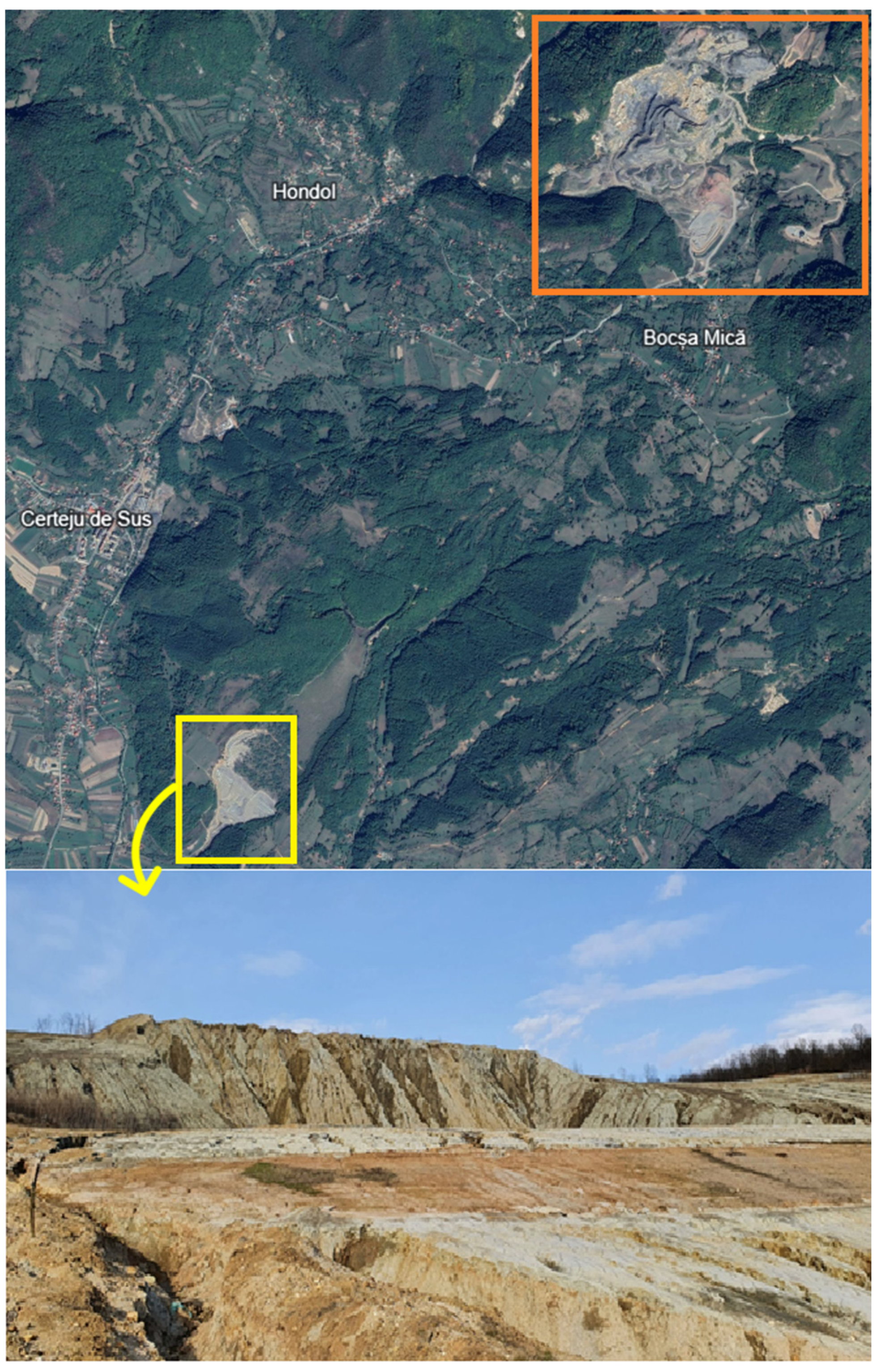
The study was conducted in Certeju de Sus, a former mining center in Hunedoara County, Romania. The exploitation perimeter belongs to the Săcărâmb-Brad-Roșia Montană-Baia de Arieș gold reservoir, at approx. 20 km from Deva city. The heavy metal assessment was conducted on the Certej mining waste dump (yellow frame in
Figure 1), which resulted from the exploitation of Coranda quarry (orange frame in
Figure 1), known for Au-Ag ore deposits [
26]. The exploitation started in 1982, and the mining activity stopped at the beginning of the 2000s. Since then, the industrial waste dump, located at approx. 5 km from quarry, has been subjected to weather conditions that generated morphological deformations (
Figure 1).
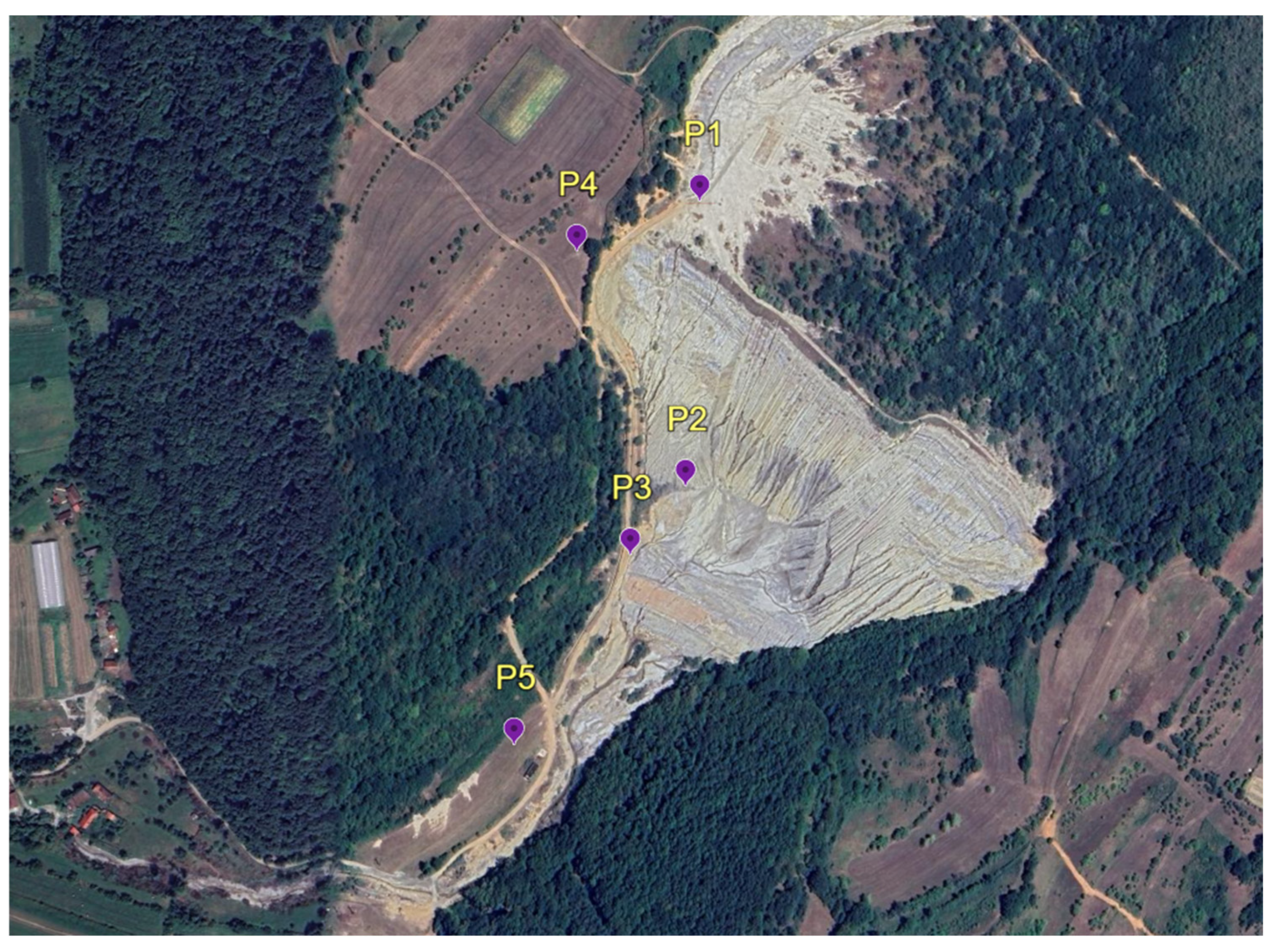
The Certej mining waste dump has a surface of approx. 30 ha, and is surrounded by forests, water courses and agricultural lands. Because no remediation and restoration programs were conducted in the area, it was considered important to perform a chemical assessment of the environmental quality. Therefore, 5 samples were collected from the Certej waste dump (P1, P2, P3,) and surroundings (P4, P5) (
Figure 2), as follows:
- -
P1 was taken from the top of the dump, a plane surface;
- -
P2 from the middle of the dump, where a muddy area had formed;
- -
P3 from the bottom of the dump;
- -
P4 from the orchard located at approx. 50 m west of the dump;
- -
P5 from an agricultural land found at approx. 180 m south of the bottom of the dump.
One soil sample was collected as reference (P6) from the garden of a villager, located at approx. 2 km north of the dump. Samples P4, P5 and P6 correspond to a type of soil named anthrosols [
27] and were placed in the sensitive soil use class because they represent areas where human activity takes place, while P1, P2 and P3 correspond to sterile soils and were associated with less sensitive uses due to their origin, i.e., different areas within the mining waste dump.
The samples were collected at a depth of 5 cm (no vegetation was present to be removed) by a stainless-steel hand auger and transferred to polyethylene bags, according to Ord. 184/1997 [
28]. Approx. 200 g of soil was collected from each sampling point, and all the samples were transported to the laboratory in cold (4 °C) and dark conditions.
The chemical assessment started with the determination of the physical–chemical parameters (pH, redox potential (Eh), electrical conductivity (EC), total dissolved solids (TDSs) and salinity). The samples were dried for 24 h at 105 °C, followed by the addition of aqueous extract of soil/water (1:5 ratio) according to the SR 7184-13/2001 protocol [
29]. In total, 50 g of soil was mixed in 200 mL ultrapure water (2 h), decanted (15 min), filtered through 8 μm qualitative paper filter and further determined using a portable multiparameter (WTW Multi 3320, Xylem Analytics Germany Sales GmbH & Co. KG, Weilheim, Germany).
To perform heavy metals analyses on soil, 3 g of previously dried sample was grounded and sieved through a 250 μm sieve. Then, the samples were mineralized in
aqua regia (21 mL of 12 mol·L
−1 of HCl and 7 mL of 15.8 mol·L
−1 HNO
3), according to the ISO 11466:1995 protocol [
30]. After mineralization at room temperature (overnight) and boiling in a sand bath (2 h), the extracts were filtered and diluted with HNO
3 (0.5 M) to a final volume of 100 mL. The resulting solutions were then analyzed using an atomic absorption spectrometer (AAS, Analytik Jena ZEEnit 700, Analytik Jena AG, Jena, Germany) equipped with an air-acetylene flame, a graphite furnace and hollow cathode lamps specific for each metal (Ni, Cd, Cr, Mn, Pb, Zn, Cu, Fe) [
31].
The analytical determinations were carried out using a previously validated method. The procedure was optimized in accordance with the instrument manufacturer’s specifications and quality assurance/quality control (QA/QC) requirements to ensure the reliability of the generated data. Instrumental linearity was assessed using five calibration standards, with concentrations ranging from 0.25 to 3.00 mg·L−1 for Cu, Fe, and Mn, and from 0.25 to 1.00 mg·L−1 for Cd, Cr, Ni, Pb, and Zn. All analyzed elements exhibited good linear responses, with coefficients of determination (R2) exceeding 0.999. Method precision was evaluated by calculating the relative standard deviation (RSD) from eight replicate analyses of spiked solutions, yielding RSD values below 15% for all metals. Limits of quantification (LOQs) were determined as ten times the standard deviation of eight replicate blank measurements, resulting in LOQ values between 0.23 mg·L−1 for Cd and 0.087 mg·L−1 for Pb. The performance of the aqua regia extraction procedure was verified through the analysis of a certified reference material (ERM-CC141 loam soil), with recoveries ranging from 71% to 115%, indicating satisfactory extraction efficiency.
3. Results
The chemical assessment revealed a highly acidic soil in the industrial waste dump, where sterile samples from top (P1), middle (P2) and bottom (P3) of the dump ranged between 2.9–3.1 (
Table 1). The decreased pH can be considered an indicator for the presence of heavy metals in the investigated area. The other two soil samples found in the proximity of the mining waste dump, the one from the orchard (P4) and the other from the agricultural field (P5), had a slightly acidic pH (5.3–5.8), more similar to the reference sample (P6) located in the garden of a villager, which had a pH of 6. The decreased pH in P4 and P5 can be attributed to soil contamination from the mining waste dump, either through wind dispersion of fine particles from the dump or through landslides or acid mine drainages.
The oxido-reducing potential (ORP) indicated a big difference between the samples from the mining waste dump and the surroundings (
Table 1). All the samples had oxidizing capacity, but P1, P2 and P3 can induce an oxidizing process 2 or 3 times stronger than the other samples. Compared to the reference sample (P6), P4, which is much closer to the mining waste dump than P5, had an oxidizing capacity (92 mV) almost double that of the reference (52 mV). These differences indicate that the soil quality near the Certej mining waste dump is quickly affected. Since pH and redox conditions are known as key variables for the main processes that can take place in heavy metal soils [
32], the results will be explored in more detail in the discussion related to metal concentrations.
Another significant difference was observed after the determination of the electrical conductivity (EC). The sterile samples from the industrial waste dump (P2 and P3) revealed a much higher capacity of EC (
Table 1), thus indicating a higher rate of ionization for the substances present in the deposited material. In line with the salinity results, where P2 and P3 showed 1‰ salt contents (
Table 1), the high EC in those samples confirms the presence of different forms of salts into the mining waste dump. It is also important to note the considerable differences between P1 (169 µS/cm) and the other samples from the dump, P2 (2020 µS/cm) and P3 (1959 µS/cm). Considering that P1 was found on a plane surface where no vegetation is growing, the results might indicate that no water retention takes place at the top of the mining dump, followed by possible infiltration processes and accumulation in the body of the dump, where transport is limited due to sterile compaction.
The TDS values (
Table 1) confirm the previous assumptions related to the ionized forms of the salts present in the mining waste dump. At the same time, due to the increased values of EC, TDS and salinity in the samples from the middle (P2) and bottom (P3) of the dump, it can be assumed that water infiltration from the top and draining take place, meaning the possible existing contaminants can be transported to the lower levels of the dump.
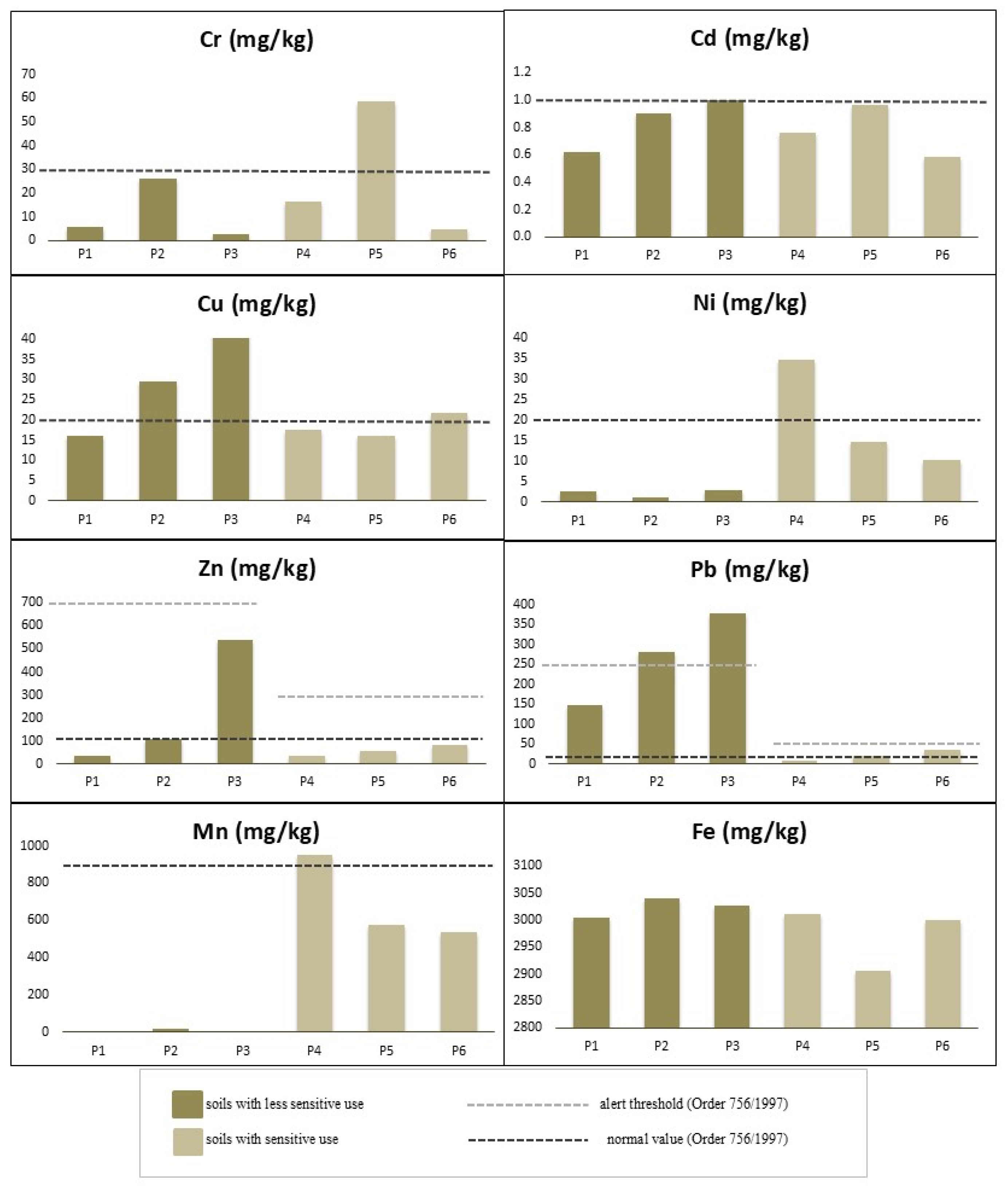
The metal concentrations were compared with the Romanian thresholds for trace elements in soil, according to Order 756/1997 [
33] (
Figure 3). It is important to mention that the samples from the mining waste dump (P1, P2, P3) were classified as soils with less sensitive use, while the ones from the proximity of the dump (P4, P5) and the reference sample (P6) were classified as soils with sensitive use. These classifications must be carried out according to the Romanian environmental regulations (Order 756/1997).
In the case of Cr, only the sample from the agricultural field (P5) overpassed the normal threshold (30 mg/kg) with a concentration of almost double (59 mg/kg), but still below the alert threshold (100 mg/kg) (
Figure 3). Since the sterile samples from the industrial waste dump had low concentrations of Cr, the mining dump cannot be assumed as a source of Cr contamination, even though P5 is located below the bottom of the Certej mining dump. However, it is important to determine the source of Cr contamination, especially because the result in the reference sample (5 mg/kg) indicated that the occurrence of Cr is not natural in the area. Also, the increased Cr concentration in P2 (26 mg/kg) is unexpected since the other samples from the mining dump had similar concentrations to the reference sample (6 mg/kg in P2, respectively, 3 mg/kg in P3). Supplementary investigation should be conducted to establish the source of Cr in P2, considering that this sample was collected from a muddy area created at the middle of the mining waste dump.
A similar situation was found in the case of Ni, where the sample from the orchard (P4) exceeded the normal threshold (20 mg/kg) by almost double (35 mg/kg) (
Figure 3). Therefore, the mining waste dump is unlikely to be the source of Ni contamination. Compared with P6 (10 mg/kg), the reference sample, Ni, revealed a decreased level in the mining waste dump (average 2.3 mg/kg), thus indicating a decreased quality of soil in the dump, and not necessarily a contamination problem as in the case of Cr, since Ni is an essential element for plant development, while Cr is not. This might also be the reason for the higher concentrations of Ni in P4 and P5, where different agricultural activities take place and supply of nutrients might occur, compared to P6. The same argument might be valid in the case of Mn, where again P4 slightly exceeded (948 mg/kg) the normal threshold (900 mg/kg), while the Mn concentrations were considerably low (
Figure 3).
No contamination was observed in the case of Cd, as the values did not exceed the normal threshold (1 mg/kg) (
Figure 3). A decreasing trend of Cd was observed from the top (P1) towards the base of the dump (P3), a fact that may indicate metal leakage due to water infiltration. The lack of vegetation from the mining waste dump may favor the infiltration process, but Cd at the present concentrations does not pose contamination threats.
Cu concentrations exceeded the normal threshold (20 mg/kg) in P2 (29 mg/kg), P3 (43 mg/kg) and slightly in P6 (22 mg/kg) (
Figure 3). As in the case of other analyzed metals, a decreasing trend was noticed from the top of the dump (P1) to the bottom of the dump (P3). For Cu, it is important to mention that the infiltration process generates important contamination concerns, since at the top of the dump (P1), the concentration was 16 mg/kg, then almost doubled at the middle (P2) at 29 mg/kg, and almost tripled at 43 mg/kg at the bottom of the mining dump (P3).
In the case of Zn, the same increasing concentration from the top to bottom of the mining waste dump was observed (
Figure 3), where the Zn content in P3 (538 mg/kg) was almost 5 times higher than P2 (109 mg/kg) and almost 15 times higher than P1 (36 mg/kg). At the same time, the Zn level at the bottom of the mining dump considerably exceeded the normal threshold (100 mg/kg), without overpassing the alert threshold for less sensitive use (700 mg/kg). Because P3 is classified as less sensitive soil, no measurements for decontamination should be taken for the moment, according to the environmental legislation Law 74/2019 [
34]. A slight increase above the Zn normal threshold was also registered in P2 (109 mg/kg). However, considering the proximity of the agricultural lands and the chances of landslides due to water infiltrations, technical solutions should be found to ensure the stability of the industrial waste dump. The lack of vegetation and the current undefined morphology of the dump (
Figure 1) strengthen the need for stability measurements.
The chemical assessment revealed considerable concentrations of Pb in the mining waste dump, with all the samples exceeding the normal threshold (20 mg/kg) (
Figure 3). The increasing trend for top-down metal accumulation demonstrated a Pb content that exceeded the alert threshold for less sensitive soils (250 mg/kg) in samples P2 (282 mg/kg) and P3 (378 mg/kg). Due to national environmental regulations, Law 74/2019, decontamination measurements should be evaluated in order limit spread of metals from the source of contamination. Compared with the sensitive soil use limits, Pb exceeded the normal threshold (20 mg/kg) only in the reference sample (36 mg/kg), without reaching the alert threshold for sensitive soil uses (50 mg/kg). The increased level of Pb in the reference sample might indicate either greater spread metal contamination than initially assumed, or Pb content in the bedrock. For both hypotheses, more detailed assessments should be performed.
The Fe assessment did not reveal any contamination in the studied area. Since all the samples revealed similar concentrations to the reference point, additional contamination with Fe is ignored in the discussion. Only P5 had a more decreased Fe content, but it can be assumed that the difference compared to P6 was caused by intensive land crops that take place in that area.
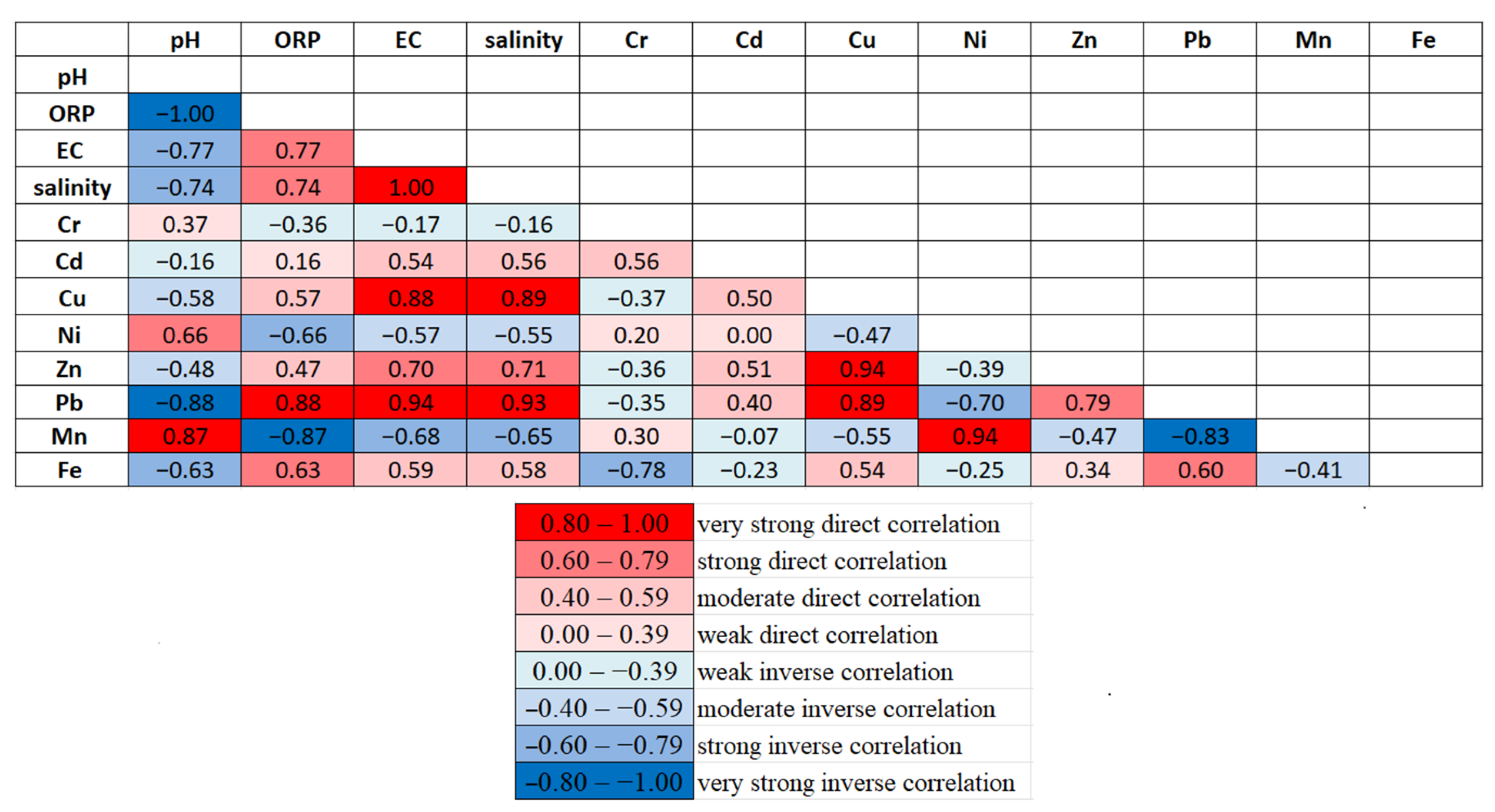
To examine the correlations between heavy metals and soil physicochemical properties, Pearson’s correlation analysis was performed (
Figure 4). Very strong negative correlations were observed between pH and oxidation–reduction potential (ORP), pH and Pb, ORP and Mn, and Pb and Mn. In contrast, very strong positive correlations were identified between pH and Mn, ORP and Pb, electrical conductivity (EC) and salinity, Cu and Pb, Cu and Zn, and Ni and Mn.
4. Discussion
The obtained results indicate that the industrial material stored in the mining dump contains acid compounds that negatively affect the development of spontaneous vegetation, as it can be seen in
Figure 1. It is known that the ideal pH for plant growth varies between 5.5–8.8 [
20,
35], so the environmental impact can be considered significant in the area, especially in relation to landscape and biodiversity, since the average pH in the Certej mining waste dump is 2.9. Due to the absence of plants, landslides can occur. This phenomenon is favored also by water runoff that seems to take place on the dump slopes, indicated by the generated ravines (
Figure 1).
Another problem generated by the very low pH found in the mining waste dump is related to the metal mobility. The bioavailable fraction represents the first mobile form of a metal and usually is associated with the metal content taken up by plants [
36]. Usually, the bioavailable fraction is considered to be water soluble and extracted with a slight acid (e.g., acetic acid) as a reagent with a pH higher than 5 [
37]. The 2.9 average pH from the mining dump creates an optimal environment for metal solubilization, especially for Pb, Cu and Zn which overpassed the normal thresholds. Metal solubilization is favored also by the lack of vegetation, because the organic matter in soil is expected to be extremely low, so no adsorption processes can take place to reduce the metal mobility [
38].
Pb, Zn and Cu are common contaminants found in soils nearby mining exploitations and are often described as primary pollutants [
39]. Topsoil found in the proximity of a Pb-Zn mining area from Slovenia revealed slightly higher Pb concentrations (mean level 410 mg/kg) and Zn content (mean level 400 mg/kg) [
8] compared to the levels from the current study (269 mg/kg for Pb and 228 mg/kg for Zn). Similar metal contamination was reported in another study [
40], where the metal content was evaluated across almost 20 years (1997 and 2015), and the results revealed that the contamination is present even after such a long period. The mining activity in the Certej area also stopped approx. 20 years ago, so it could be assumed that the soil contamination has been present for a very long time in this area and will remain due to the persistence of heavy metals.
The high concentrations of Pb along with the other trace elements found in the Certej mining waste dump are responsible for the negative environmental impacts, strengthening the argument that their trophic transfer to indigenous fauna should be considered. Metals are known for their bioaccumulation potential in primary producers, from where they can enter the food chain [
41]. First, the local wildlife can be affected by the toxicity of these heavy metals, especially if nearby water bodies are in contact with the contaminated soil. From here, metal uptake in aquatic organisms (including invertebrates and fish) can take place [
42]. Second, the potential human health risk should be discussed. Considering that crops are cultivated nearby, and fruits are grown in orchards, the investigated metals are also expected to enter the human food chain. Therefore, the local population may be exposed to metal toxicity via dietary exposure. Since Pb had the highest concentrations, it is important to mention that the World Health Organization (WHO) classified Pb as extremely toxic, with harmful effects on brain, kidneys, liver and reproductive system [
43].
Since Pb is known as a toxic substance, without any beneficial properties for plant growth even at low concentration [
44], it can be assumed that the high concentration might be one of the factors that led to the lack of vegetation. This assumption is based on the fact that plants can absorb only the soluble form of a metal [
45], which in lead’s case could be the ionic form of Pb
2+. Since the soil from the mining dump revealed an extremely acidic soil (
Table 1), the metal solubilization conditions are achieved, so lead could generate ecotoxicological effects.
The negative correlation between pH and Pb, and between ORP and Mn, suggest that acidic and oxidizing conditions may enhance the solubility and potential mobility of these elements. In contrast, the positive correlation between pH and Mn may reflect Mn immobilization through precipitation or adsorption under higher pH conditions. The strong association between ORP and Pb further underscores the importance of redox processes in regulating Pb behavior. Additionally, the significant correlations among Cu, Pb, and Zn point to either common contamination sources or similar geochemical controls, such as co-precipitation or adsorption onto mineral surfaces. The strong relationship between EC and salinity confirms the influence of dissolved ions on soil conductivity, while the positive correlation between Ni and Mn suggests coupled redox-driven cycling or shared lithogenic origins.
The investigation revealed an increased oxidizing potential of the material stored in the Certej mining waste dump. In terms of chemical speciation, another metal fraction that can become mobile is the oxidizable fraction. Usually, this fraction is extracted in oxidizing conditions achieved by the use of hydrogen peroxide (H
2O
2), followed by extraction in a highly acidic environment (approx. pH 2) [
46]. Considering the increased oxidizing conditions, along with the highly acidic environment from the mining waste dump, it could be expected that higher concentrations of metals become mobile, thus increasing the metal toxicity in the studied area. The oxidizable fraction is linked to the metal content bound to organic matter and sulfur, so the observed lack of vegetation strengthens the previous assumption.
Considering the important information that a speciation assessment could bring, further chemical analyses should be completed. In addition, since soil organic carbon proved to offer important direction for soil quality evaluation and metal mobility features, the determination of this parameter may be useful.
For a more comprehensive evaluation of metal contamination, further investigations should include additional chemical assessments. The current investigation was conducted on samples collected at a 5 cm depth, but due to assumptions of water infiltration (possibly landslides), samples should be collected at depths ranging from 30 cm to 60 cm or even deeper if possible. These depths are relevant for plant development and would allow us to anticipate if root growth would be possible in the presence of Pb, Cu and Zn. At the same time, additional chemical analyses to determine the bioavailability of the metals would provide important information related to the possible uptake of metals in the plant or food chain.
5. Conclusions
The current study revealed Pb, Cu and Zn contamination in the Certej mining waste dump. In particular, the presence of Pb above the warning threshold is an indicator of anthropogenic pollution, for which special measures should be taken in order to decrease the environmental impact. First, the metal solubilization should be limited by applying soil amendments that would increase the soil pH. Second, technical measurements to enhance the dump stability are required, together with an impermeable barrier to prevent water infiltration at the top of the mining waste dump. Third, ecological restoration carried out with the use of phytoremediation plant species would provide metal decontamination and natural stability, and would improve the landscape in the studied area.
Finally, this study addresses important considerations for ecological risks to the local fauna. The terrestrial and aquatic ecosystems from the Certej area are subjected to ecotoxicological effects due to the increased heavy metal concentrations (especially Pb), which can bioaccumulate across the trophic levels. Once the metals are uptaken into the food chain, acute or chronic toxicity effects can threaten the health of the local fauna population and inhabitants as well. These impacts should be evaluated in future studies focused on ecological risk assessment. The local authorities should be informed and future development strategies should consider mitigation and landscape improvement, along with measures to decrease the discussed risks.