
Proceeding Paper

Raman Imaging Study of Powder Metallurgy-Processed Ti–6Al–4V/ZrO2 Composite †

by
Lerato Semetse
1,*,
Moshawe Madito
2 and
Peter Olubambi
1
1
Centre for Nanoengineering and Advanced Materials (CeNAM), School of Mining, Metallurgy and Chemical Engineering, University of Johannesburg, Doornfontein 2094, South Africa
2
Institute for Nanotechnology and Water Sustainability (iNanoWS), College of Science, Engineering and Technology, University of South Africa, Johannesburg 1710, South Africa
*
Author to whom correspondence should be addressed.
Presented at the 4th International Conference on Applied Research and Engineering, Pretoria, South Africa, 21–23 November 2025.
Mater. Proc. 2026, 31(1), 34; https://doi.org/10.3390/materproc2026031034
Published: 22 May 2026
(This article belongs to the Proceedings of The 4th International Conference on Applied Research and Engineering)

Abstract

This study investigates the phase composition and vibrational characteristics of a powder metallurgy-processed Ti–6Al–4V alloy reinforced with ZrO2. Raman spectroscopy confirmed that the ZrO2 powder predominantly exhibits a monoclinic structure, while the Ti–6Al–4V alloy contains anatase and rutile TiO2, along with minor Ti3O5 phases. Optical microscopy revealed a well-defined grain structure on the Ti–6Al–4V/ZrO2 composite surface, which was subsequently examined in greater detail using Raman imaging combined with True Component analysis. The spatially resolved Raman maps demonstrated that the visually distinct light and dark grains possess a similar chemical composition, consisting mainly of ZrO2 and TiO2 phases. This represents the first application of Raman imaging to Ti–6Al–4V/ZrO2 composites, offering new insight into the relationship between microstructure and phase distribution in this material system.

1. Introduction

Titanium matrix composites (TMCs) are advanced engineered materials that merge the inherent strengths of titanium alloys with the added benefits of ceramic reinforcements [1]. By combining these components, TMCs achieve an exceptional balance of properties, such as high-temperature stability, strong resistance to corrosion and wear, and improved yield strength and elastic modulus. As a result, they often outperform conventional titanium alloys in demanding service environments [2,3,4].
Among titanium alloys, Ti–6Al–4V is the most widely used alpha-beta alloy. Composed of approximately 6 wt% aluminum, 4 wt% vanadium, and 90 wt% titanium, it offers an outstanding combination of high specific strength, corrosion resistance, and reliable fatigue performance. These characteristics make it highly suitable for aerospace structures, biomedical implants, automotive components, and chemical processing equipment [5,6,7].
Various ceramic materials are commonly incorporated into TMCs to enhance specific performance characteristics. These include nitrides such as TiN, carbides like TiC and SiC, and oxides including Al2O3 and ZrO2 [8,9]. Each reinforcement type is selected based on the property improvements required. In particular, zirconia (ZrO2) has gained considerable interest due to its excellent biocompatibility, high wear resistance, strong mechanical properties, and thermal and chemical stability. Additionally, ZrO2 exhibits stress-induced phase transformations that contribute to improved crack resistance and fracture toughness [9,10].
Several researchers have explored the powder processing of ZrO2–Ti–6Al–4V composites using different consolidation techniques. Their findings emphasise that sintering conditions and compaction parameters have a strong influence on microstructure development and phase formation. Careful control of these processing variables enables tailoring of the composite’s final properties. For instance, Madeira et al. (2017) investigated interfacial diffusion bonding in Ti–6Al–4V/ZrO2 bilayer composites fabricated under varying sintering pressures [11]. They observed diffusion of ZrO2 particles into the titanium matrix, leading to the formation of reaction products at the interface. Limited diffusion resulted in weak bonding and microstructural defects, which negatively affected mechanical performance. In contrast, higher sintering pressures promoted the development of a well-defined reaction zone between Ti–6Al–4V and ZrO2. X-ray diffraction analysis of samples sintered at 100 MPa identified tetragonal ZrO2 and hexagonal Ti phases in the reaction zone, with no detectable titanium oxide phases.
Other studies have focused on the influence of ZrO2 reinforcement on the microstructure and mechanical performance of Ti–6Al–4V. Murmu et al. (2021), for example, applied laser cladding to produce Ti–6Al–4V reinforced with nano-sized ZrO2 particles [12]. The resulting coatings exhibited a dendritic microstructure and significantly enhanced hardness and wear resistance, with microhardness values nearly four times greater than those of the base material. Similarly, Ogunmefun et al. (2024) incorporated ZrO2 and Si3N4 particles into Ti–6Al–4V using spark plasma sintering, reporting improved densification along with increased hardness and elastic modulus [13].
Powder metallurgy techniques, particularly spark plasma sintering, have also been used to fabricate Ti–6Al–4V/ZrO2 composites with markedly improved wear behavior and fretting corrosion resistance [3]. Studies on porous titanium-zirconia composites further demonstrate enhanced mechanical properties and biocompatibility, especially for implant-related applications [14,15]. Recent research consistently shows that ZrO2-reinforced titanium composites display superior fracture toughness, better wear resistance, and stronger high-temperature mechanical performance compared to unreinforced alloys. These advantages position them as promising materials for advanced aerospace and biomedical uses, where both durability and chemical compatibility are essential [9,10,14,15].
Overall, ZrO2-reinforced TMCs offer an attractive combination of lightweight performance and resilience under extreme conditions, making them suitable for high-performance engineering applications, including aerospace systems, biomedical implants, and advanced automotive components.
Although previous investigations have examined the individual vibrational characteristics of ZrO2 and Ti–6Al–4V, limited research addresses their combined phase composition and microstructural relationships when processed via powder metallurgy. Furthermore, spatially resolved Raman imaging studies of Ti–6Al–4V/ZrO2 composites remain largely unexplored. Gaining insight into the distribution and interaction of oxide phases within these materials is crucial for optimizing both structural integrity and functional performance. In this study, confocal Raman microscopy combined with True Component analysis is employed to systematically identify the chemical phases present on Ti–6Al–4V/ZrO2 surfaces and to map their spatial distribution.

2. Materials and Methods

Yttrium-stabilized zirconia (3Y-TZP) powder with an average particle size of 18.9 µm (supplied by Alfa Aesar, Ward Hill, Massachusetts, U.S) and Ti–6Al–4V powder with an average particle size of 65 µm (supplied by TLS-Tecknik, Bitterfeld-Wolfen, Germany) were used as the starting materials. To fabricate the composite, a powder blend consisting of 5 wt% ZrO2 and 95 wt% Ti–6Al–4V was prepared. This reinforcement level was selected based on previous studies indicating that low to moderate ZrO2 additions can enhance microstructure, hardness, and wear resistance without promoting particle agglomeration or reducing powder homogeneity [3]. The 5 wt% content provides an optimal balance between reinforcement effectiveness and processability, while also allowing sensitive detection of surface oxides and minor phases through Raman spectroscopy, which is particularly effective for probing phase chemistry at the micro- to nanoscale. Ti–6Al–4V served as the matrix phase [9]. The powders underwent mixing and milling procedures to ensure homogeneous distribution before consolidation.
The blended powders were consolidated using spark plasma sintering (SPS) (HHPD-25, manufactured by FCT Systeme GmbH, Frankenblick, Germany). Spark plasma sintering (SPS) is a rapid consolidation technique that employs uniaxial pressure and pulsed direct current to consolidate powders into solid compacts within minutes [9,16].
Sintering was carried out in a 40 mm diameter graphite die at 1150 °C under an applied pressure of 50 MPa for 10 min, with a heating rate of 100 °C/min. The process was conducted under vacuum with argon gas protection to minimize oxidation. These SPS parameters were chosen to promote full densification of the Ti–6Al–4V matrix while limiting grain growth and maintaining the structural integrity of the ZrO2 reinforcement. Under these conditions, the monoclinic ZrO2 phase remains thermodynamically stable, and the short dwell time combined with rapid heating minimizes diffusion-driven interfacial reactions with the Ti–6Al–4V matrix. This approach ensures strong interfacial bonding without significant chemical interaction, consistent with previous studies on Ti–6Al–4V/ceramic composites processed via SPS [3].
Following sintering, metallographic preparation was performed according to the Struers procedure for titanium-based materials to ensure reliable and reproducible microstructural characterization. The samples were sectioned using a silicon-carbide cut-off wheel and hot-mounted in MultiFast bakelite resin to facilitate handling during subsequent preparation steps.
Initial grinding was performed using a resin-bonded MD-Mezzo disk (220-grit). Fine grinding followed with an MD-Largo disk and a 9 μm diamond suspension to eliminate surface scratches. Final polishing involved chemical-mechanical polishing on an MD-Chem disk with an OP-S colloidal silica suspension (0.04 μm), producing a mirror-like, scratch-free surface suitable for microstructural analysis. After polishing, samples were thoroughly rinsed with distilled water and ethanol, then dried using compressed air prior to characterization.
Raman spectroscopy measurements were conducted using a WITec alpha300 RA confocal Raman microscope (WITec GmbH, Ulm, Germany) equipped with a 100×/0.9 NA objective and a 532 nm laser operating at 5 mW. Raman images were collected over a 50 µm2 area (200 × 200 pixels, totaling 40,000 spectra) with an integration time of 0.1 s per spectrum. Average spectra were obtained using a 30 s integration time with 10 accumulations. The diffraction-limited lateral resolution for the 100×/0.9 NA objective was ~361 nm, and the spectral resolution was ~1 cm−1. To analyze the hyperspectral data, True Component Analysis was employed for spectral demixing. Initially, more than 10 components were tested to account for all potential contributions from the sample phases. Components exhibiting highly overlapping spatial distributions were then consolidated, resulting in five chemically meaningful components. Overfitting was minimized by retaining only components that corresponded to distinct Raman signatures, verified against literature reference spectra and characteristic band positions. This approach ensures that the demixed components represent genuine chemical variation rather than noise or statistical artifacts.

3. Results and Discussion

The powder metallurgy-processed Ti–6Al–4V alloy, reinforced with ZrO2 powder, was analyzed to determine its phase composition and vibrational characteristics.

3.1. ZrO2 and (b) Ti–6Al–4V Alloy Powders

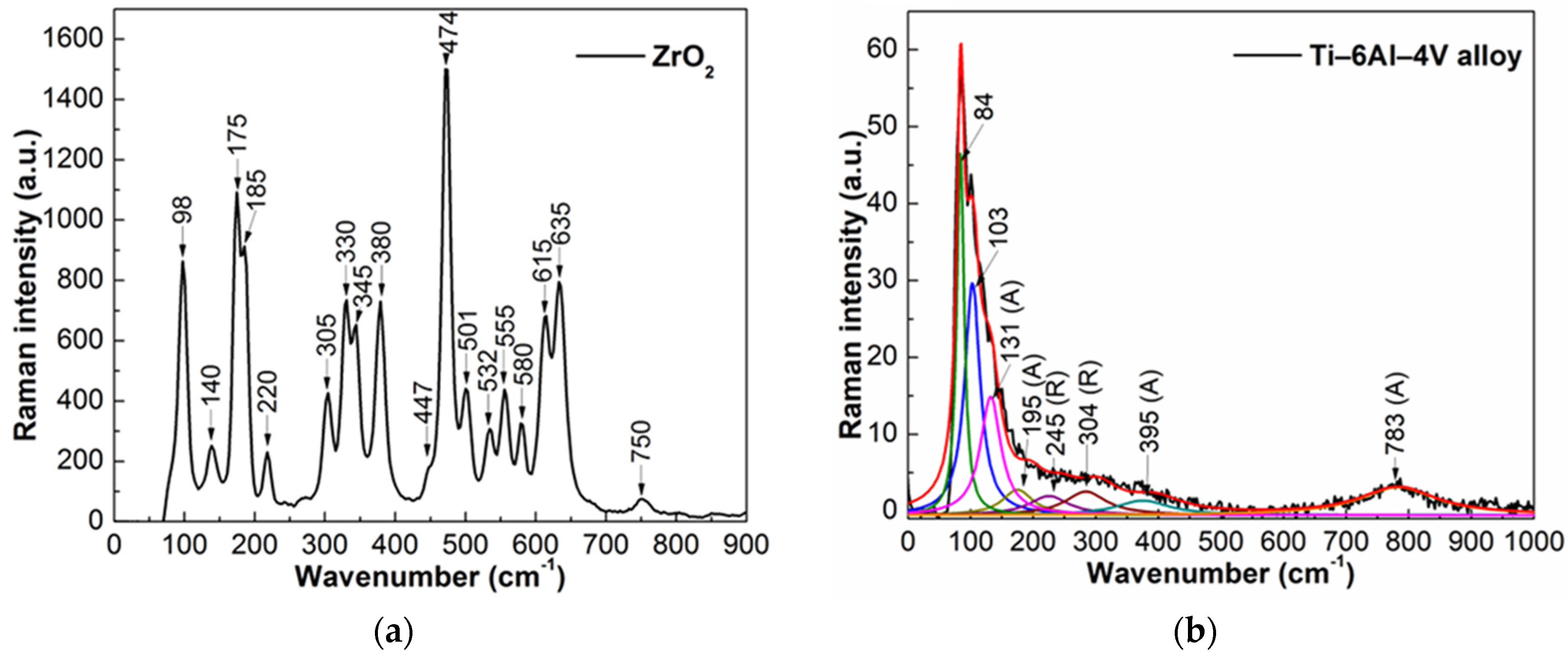
Figure 1a presents the Raman spectrum of the ZrO2 powder, displaying 18 vibrational bands (9Ag + 9Bg modes) characteristic of monoclinic ZrO2. Prominent peaks observed at 98, 175, 185, 330, 345, 380, 474, 615, and 635 cm−1 correspond well with reported values for the monoclinic zirconia structure [17,18,19]. These results confirm that the ZrO2 powder predominantly exhibits a monoclinic crystal structure.
Figure 1b shows the Raman spectrum of the Ti–6Al–4V alloy powder. Peak deconvolution was performed using a Lorentzian fitting function [20], yielding a correlation coefficient of R = 0.98. A strong feature near 100 cm−1 corresponds to the O–Ti–O vibrational mode. Peaks located at 131 and 195 cm−1 (Eg), 395 cm−1 (B1g), and 783 cm−1 (B1g) are associated with the tetragonal anatase phase [20,21], while peaks at 245 and 304 cm−1 are attributed to rutile TiO2 [18,22,23]. These findings indicate the presence of both anatase and rutile phases in the Ti–6Al–4V alloy powder. Additionally, weak features at 84 and 103 cm−1 may be linked to Ti2O5 polymorphs, potentially arising from interlayer interactions within Ti2O5 chains [24].
It should be emphasized that the anatase and rutile TiO2 phases detected in the Ti–6Al–4V powder were already present in the as-received material. Titanium alloys are highly reactive toward oxygen and readily develop a thin, stable oxide layer upon exposure to air during atomization, storage, and routine handling. No additional oxidation or thermal treatment was applied prior to Raman analysis. Accordingly, the identified TiO2 polymorphs are attributed to the naturally formed surface oxide layer of the powder rather than to any processing steps conducted in this study.
These Raman-active oxide phases are likely to exist at low concentrations, which accounts for their relatively weak spectral intensity. Their detection highlights the high sensitivity of Raman spectroscopy to surface-localized and minor phases, providing valuable insights into the surface chemistry of the alloy and the potential role of these oxides in interfacial interactions within the Ti–6Al–4V/ZrO2 composite.

3.2. Ti–6Al–4V Alloy

3.2.1. Optical Microscope Image

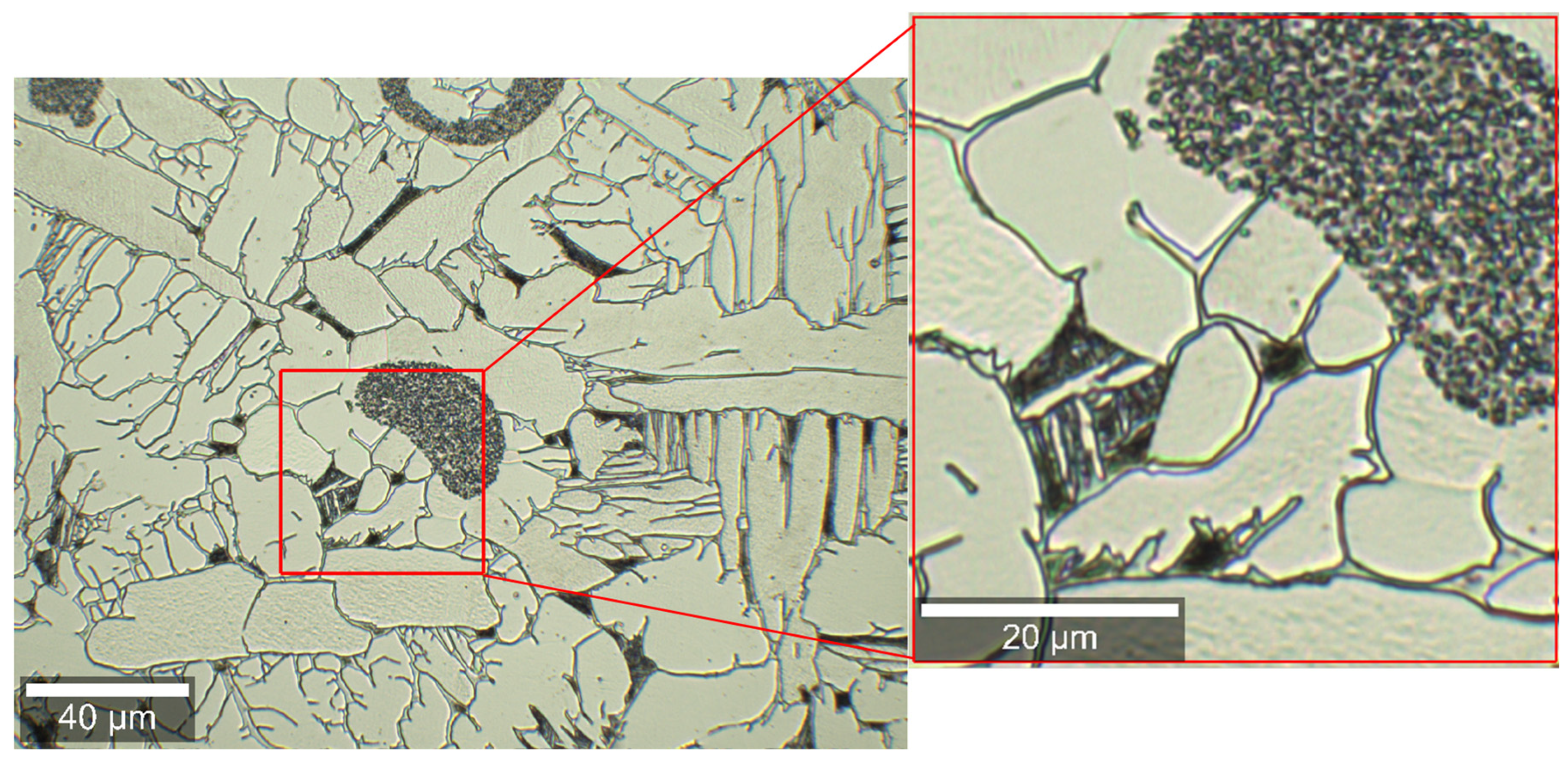
Figure 2 displays an optical micrograph of the Ti–6Al–4V/ZrO2 composite surface. The image reveals a grain-structured microstructure with randomly distributed darker regions. To determine the chemical nature of these features, Raman imaging was performed over a 50 μm2 area, indicated by the red box in Figure 2.

3.2.2. Raman Imaging and True Component Analysis

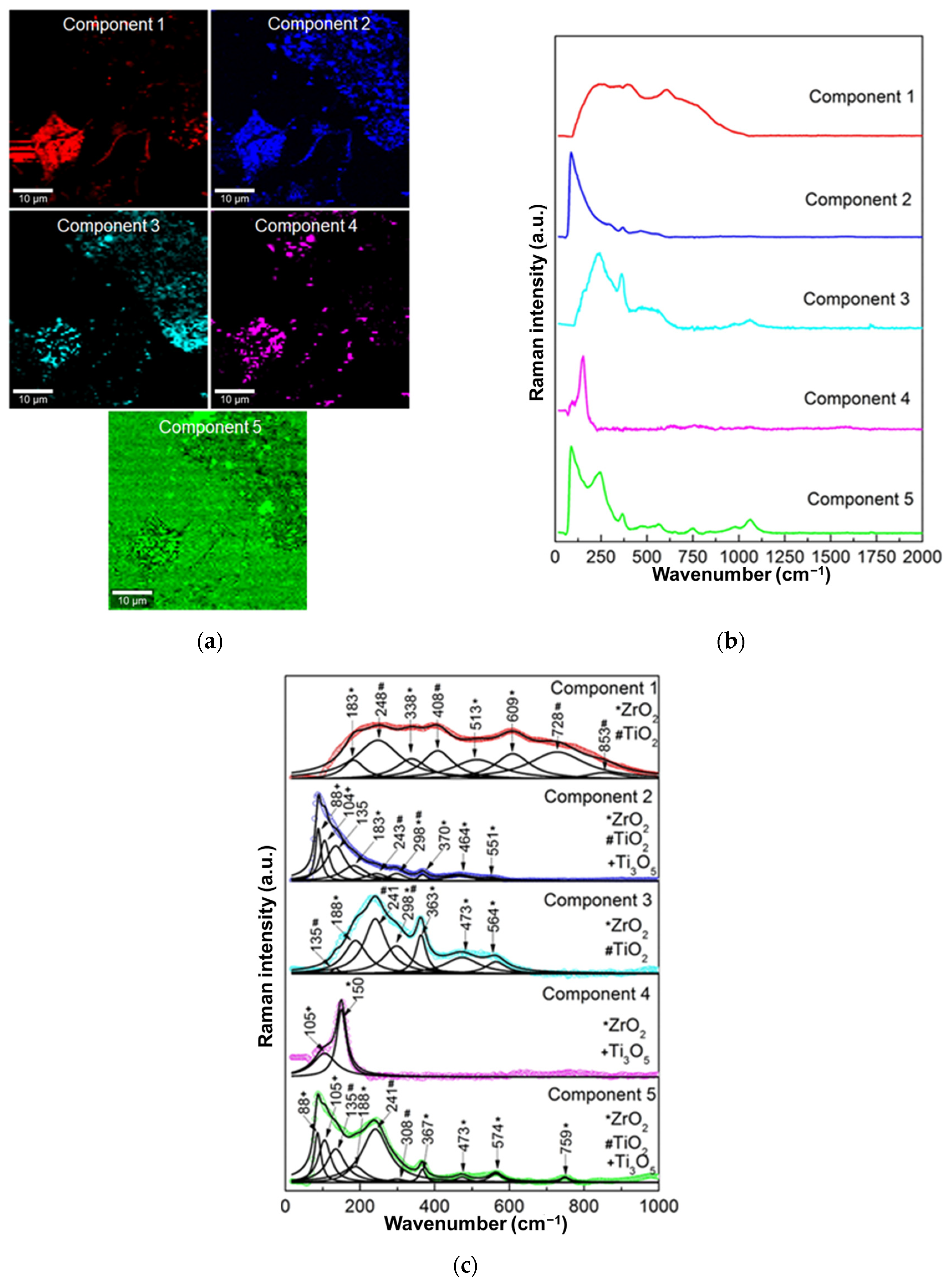
To further analyze the chemical composition of the surface grain structures, the Raman imaging dataset collected from the selected area was processed using the True Component analysis tool within WITec software project six version 6.1 and plus version. This approach enabled the generation of intensity distribution maps for five distinct components, along with their corresponding average Raman spectra (Figure 3a,b).
The Raman band assignments established for the ZrO2 and Ti–6Al–4V powders (Figure 1) were used to achieve an optimal Lorentzian fit of the composite average spectrum (Figure 3c), resulting in a correlation coefficient of R = 0.98. The analysis indicates that the composite primarily consists of ZrO2 and TiO2 phases.
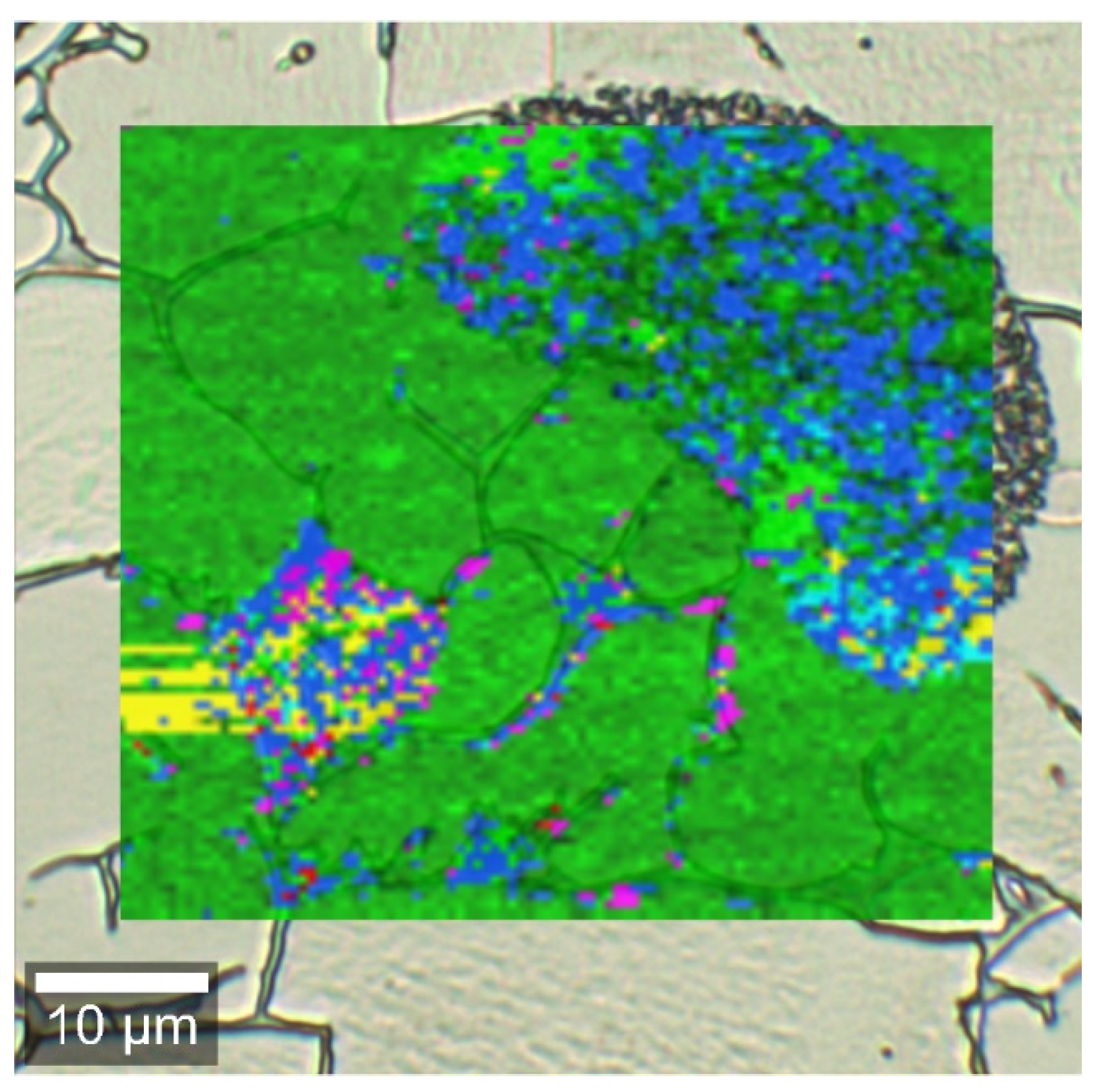
Finally, the combined True Component Raman intensity maps (Figure 3) were superimposed onto the optical micrograph (Figure 4) to correlate the observed grain structures with their spatially resolved chemical composition. This analysis reveals that the randomly distributed darker areas share similar chemical phases, comparable to the lighter grain structures. Although optical microscopy reveals contrast between light and dark grains, Raman imaging confirms chemical uniformity across these regions. The apparent visual differences are most likely due to variations in crystallographic orientation, residual stresses, or subtle surface topography, which can affect light reflection and scattering under the microscope rather than indicating differences in chemical composition. Raman peak assignments for the ZrO2 and Ti–6Al–4V powders are summarized in Table 1, while those for the Ti–6Al–4V/ZrO2 alloy are listed in Table 2.
The identified phase distribution and surface oxide chemistry have significant implications for the mechanical and functional performance of the Ti–6Al–4V/ZrO2 composite. The incorporation of ZrO2 particles into the Ti–6Al–4V matrix has been shown in previous studies to enhance hardness and wear resistance, primarily due to the presence of the hard ceramic reinforcement and improved load transfer across the matrix-particle interfaces [26,27,28]. These effects broaden the material’s suitability for applications subjected to severe wear conditions.
Furthermore, the minor surface oxides and sub-stoichiometric titanium oxides detected by Raman spectroscopy may play an important role in interfacial bonding and surface stability. Such oxide phases can influence friction behavior, oxidation resistance, and fatigue performance by modifying the chemical and mechanical characteristics of the interface. Overall, the combination of a tough metallic matrix with hard zirconia reinforcement contributes to improved tribological performance and surface durability, reinforcing the potential of these composites for structural and wear-resistant applications.

4. Conclusions

Raman spectroscopy, coupled with True Component analysis, verified that the spark plasma–sintered Ti–6Al–4V/ZrO2 composites consist predominantly of monoclinic ZrO2, along with anatase and rutile TiO2, and minor amounts of Ti3O5 phases. Optical microscopy revealed a heterogeneous grain morphology characterized by alternating darker and lighter regions. However, Raman imaging demonstrated that these visually distinct features share essentially the same phase composition. This consistency in chemical distribution, despite the apparent microstructural variation, suggests a homogeneous phase dispersion throughout the Ti–6Al–4V/ZrO2 composite.
Because spatially resolved Raman imaging of this material system has not previously been documented, the present results offer new insight into the correlation between microstructure and phase distribution in titanium-zirconia composites. Furthermore, these findings provide a basis for optimizing powder metallurgy processing conditions to tailor the structural and functional performance of such composites.

Author Contributions

Writing—original draft preparation, L.S.; methodology, formal analysis, M.M. and L.S.; investigation, software, writing—review and editing, M.M.; Conceptualization, resources, validation, visualization, supervision, project administration, funding acquisition, P.O. All authors have read and agreed to the published version of the manuscript.

Funding

This research received no external funding.

Institutional Review Board Statement

Not applicable.

Informed Consent Statement

Not applicable.

Data Availability Statement

The data presented in this study are available on request from the corresponding author due to ethical reasons.

Acknowledgments

The authors gratefully acknowledge the National Research Foundation (NRF) of South Africa for funding received for the acquisition of the WITec alpha300 Raman system used in this study. The authors further acknowledge Angstrom and WITec for technical training on the system.

Conflicts of Interest

The authors declare no conflicts of interest.

References

  1. Hayat, M.D.; Singh, H.; He, Z.; Cao, P. Titanium metal matrix composites: An overview. Compos. Part A Appl. Sci. Manuf. 2019, 121, 418–438. [Google Scholar] [CrossRef]
  2. Falodun, O.E.; Obadele, B.A.; Oke, S.R.; Okoro, A.M.; Olubambi, P.A. Titanium-based matrix composites reinforced with particulate, microstructure, and mechanical properties using spark plasma sintering technique: A review. Int. J. Adv. Manuf. Technol. 2019, 102, 1689–1701. [Google Scholar] [CrossRef]
  3. Semetse, L.; Obadele, B.A.; Raganya, L.; Geringer, J.; Olubambi, P.A. Fretting corrosion behaviour of Ti-6Al-4V reinforced with zirconia in foetal bovine serum. J. Mech. Behav. Biomed. Mater. 2019, 100, 103392. [Google Scholar] [CrossRef] [PubMed]
  4. Semetse, L.; Obadele, B.A.; Raganya, L.; Olubambi, P.A. Wear studies of spark plasma sintered ZrO2 reinforced Ti-6Al-4V alloy. Mater. Today Proc. 2020, 28, 468–474. [Google Scholar] [CrossRef]
  5. Li, Z.; Gou, J.; Gao, J.; Zhu, J.; Kou, W.; Wang, J. Microstructural evolution and corrosion resistance of additively manufactured Ti-6Al-4V alloy annular shaped components using multistage heat treatment. Mater. Chem. Phys. 2025, 346, 131414. [Google Scholar] [CrossRef]
  6. Jin, H.; Wei, K.X.; Li, J.M.; Zhou, J.Y.; Peng, W.J. Research development of titanium alloy in aerospace industry. Chin. J. Nonferr. Met. 2015, 25, 280–292. [Google Scholar]
  7. Du, S.; Song, Y.; He, Y.; Wei, C.; Chen, R.; Guo, S.; Liang, W.; Lei, S.; Liu, X. Evolution of Microstructure and Mechanical Properties of Ti-6Al-4V Alloy under Heat Treatment and Multi-Axial Forging. Materials 2024, 17, 1060. [Google Scholar] [CrossRef]
  8. Maja, M.E.; Falodun, O.E.; Obadele, B.A.; Oke, S.R.; Olubambi, P.A. Nanoindentation studies on TiN nanoceramic reinforced Ti–6Al–4V matrix composite. Ceram. Int. 2018, 44, 4419–4425. [Google Scholar] [CrossRef]
  9. Semetse, L. Bio-Tribocorrosion Behaviour of Spark Plasma Sintered Titanium Composites in Simulated Body Fluid. Master’s Thesis, University of Johannesburg, Johannesburg, South Africa, 2019. [Google Scholar]
  10. Shi, S.; Goto, T.; Cho, S.; Sekino, T. Development of Ti dispersed ZrO2 composites and their room-temperature crack-healing behaviors. J. Alloys Compd. 2021, 851, 156895. [Google Scholar] [CrossRef]
  11. Madeira, S.; Pinto, A.; Rodrigues, L.; Carvalho, O.; Miranda, G.; Reis, R.; Caramês, J.; Silva, F. Effect of sintering pressure on microstructure and mechanical properties of hot-pressed Ti6Al4V-ZrO2 materials. Mater. Des. 2017, 120, 394–403. [Google Scholar] [CrossRef]
  12. Murmu, A.M.; Parida, S.K.; Das, A.K. Synthesis and characterization of Ti6Al4V-Nano-ZrO2 composite cladding on Ti6Al4V substrate using fiber laser. J. Mater. Eng. Perform. 2021, 30, 1748–1758. [Google Scholar] [CrossRef]
  13. Ogunmefun, A.O.; Ayodele, O.; Bayode, L.; Anamu, U.; Olorundaisi, E.; Mkhatshwa, S.; Babalola, J.; Ngeleshi, M.; Odetola, P.; Olubambi, P.A. Influence of sintering temperature on Ti6Al4V-Si3N4-ZrO2 ternary composites prepared by spark plasma sintering. Manuf. Rev. 2024, 11, 5. [Google Scholar] [CrossRef]
  14. Shalnova, S.A.; Volosevich, D.V.; Sannikov, M.I.; Magidov, I.S.; Mikhaylovskiy, K.V.; Turichin, G.A.; Klimova-Korsmik, O.G. Direct energy deposition of SiC reinforced Ti–6Al–4V metal matrix composites: Structure and mechanical properties. Ceram. Int. 2022, 48, 35076–35084. [Google Scholar] [CrossRef]
  15. Jiang, Q.; Li, S.; Guo, S.; Fu, M.; Zhang, B. Comparative study on process-structure-property relationships of TiC/Ti6Al4V and Ti6Al4V by selective laser melting. Int. J. Mech. Sci. 2023, 241, 107963. [Google Scholar] [CrossRef]
  16. Moshokoa, N.; Mukhudwana, T.V.; Raganya, L.M.; I Lekgoathi, J.; A Obadele, B.; A Olubambi, P. Spark plasma sintered Ti6Al4V-ZrO2 bio-composites: Optimization of ball milling and turbula mixing of powders and their subsequent sintering parameters. In IOP Conference Series: Materials Science and Engineering; IOP Publishing: Philadelphia, PA, USA, 2018. [Google Scholar]
  17. Ciszak, C.; Mermoux, M.; Miro, S.; Gutierrez, G.; Lepretre, F.; Popa, I.; Hanifi, K.; Zacharie-Aubrun, I.; Fayette, L.; Chevalier, S. Micro-Raman analysis of the fuel-cladding interface in a high burnup PWR fuel rod. J. Nucl. Mater. 2017, 495, 392–404. [Google Scholar] [CrossRef]
  18. Miro, S.; Bordas, E.; Thomé, L.; Costantini, J.; Leprêtre, F.; Trocellier, P.; Serruys, Y.; Beck, L.; Gosset, D.; Verlet, R.; et al. Monitoring of the microstructure of ion-irradiated nuclear ceramics by in situ Raman spectroscopy. J. Raman Spectrosc. 2016, 47, 476–485. [Google Scholar] [CrossRef]
  19. Verlet, R.; Tupin, M.; Baldacchino, G.; Wolski, K.; Miro, S.; Gosset, D.; Colas, K.; Jublot, M.; Jomard, F. Influence of light ion irradiation of the oxide layer on the oxidation rate of Zircaloy-4. Corros. Sci. 2015, 98, 327–338. [Google Scholar] [CrossRef]
  20. Zhang, Y.; Li, J.; Che, S.; Yang, Z.; Tian, Y. Chemical leveling mechanism and oxide film properties of additively manufactured Ti–6Al–4V alloy. J. Mater. Sci. 2019, 54, 13753–13766. [Google Scholar] [CrossRef]
  21. Hardcastle, F. Raman spectroscopy of titania (TiO2) nanotubular water-splitting catalysts. J. Ark. Acad. Sci. 2011, 65, 43–48. [Google Scholar]
  22. Balachandran, U.; Eror, N. Raman spectra of titanium dioxide. J. Solid State Chem. 1982, 42, 276–282. [Google Scholar] [CrossRef]
  23. Georgescu, D.; Baia, L.; Ersen, O.; Baia, M.; Simon, S. Experimental assessment of the phonon confinement in TiO2 anatase nanocrystallites by Raman spectroscopy. J. Raman Spectrosc. 2012, 43, 876–883. [Google Scholar] [CrossRef]
  24. Smirnov, M.B.; Roginskii, E.M.; Smirnov, K.S.; Baddour-Hadjean, R.; Pereira-Ramos, J.-P. Unraveling the structure–Raman spectra relationships in V2O5 polymorphs via a comprehensive experimental and DFT study. Inorg. Chem. 2018, 57, 9190–9204. [Google Scholar] [CrossRef] [PubMed]
  25. Shi, L.; Tin, K.-C.; Wong, N.-B. Thermal stability of zirconia membranes. J. Mater. Sci. 1999, 34, 3367–3374. [Google Scholar] [CrossRef]
  26. Ganesamoorthy, R.; Suresh, G.; Padmavathi, K.R.; Rajaparthiban, J.; Vezhavendhan, R.; Bharathiraja, G. Experimental analysis and mechanical properties of fly-ash loaded E-glass fiber reinforced IPN composites. Fibers Polym. 2022, 23, 2916–2926. [Google Scholar] [CrossRef]
  27. Rajaparthiban, J.; Suresh, G.; Ganesamoorthy, R.; Padmavathi, K.R.; Abbas, S.H.M.; Meenakshi, C.M. Effect of polyurethane ratio on mechanical behavior of banana fiber/polyurethane–vinylester composites. Matéria 2022, 27, e13182. [Google Scholar] [CrossRef]
  28. Suresh, G.; Vivek, S.; Babu, L.G.; Bernard, S.S.; Akash, R.M.; Kanna, S.K.R.; Kumar, S.B.; Sethuramalingam, P. Mechanical behaviour of carbon fiber reinforced nanoclay-filled IPN matrix composites. Mater. Res. Express 2019, 6, 125311. [Google Scholar] [CrossRef]
Figure 1. Raman spectra (black lines) of (a) ZrO2 powder and (b) Ti–6Al–4V alloy powder; in (b), the solid-coloured lines represent the Lorentzian fits to the experimental spectrum.
Materproc 31 00034 g001
Figure 2. Optical microscope image of Ti–6Al–4V/ZrO2 surface.
Materproc 31 00034 g002
Figure 3. (a) Raman intensity distribution images for the five components. (b) Corresponding average Raman spectra. (c) Lorentzian fit (solid lines) of the average spectrum shown in (b).
Materproc 31 00034 g003
Figure 4. Optical microscope image overlaid with combined True Component Raman intensity distribution images from Figure 3.
Materproc 31 00034 g004
Table 1. Raman bands of ZrO2 powder (Figure 1a, intense bands) and Ti–6Al–4V alloy powder (Figure 1b, Lorentzian fit peaks), along with their corresponding assignments reported in previous studies.
SamplesBands (cm−1)PhasesLocal StructurePhonon ModesRef.
ZrO2 powder98ZrO2MonoclinicAg[3,4,5,25]
175ZrO2MonoclinicAg[3,4,5,12]
185ZrO2MonoclinicAg[3,4,5,12]
330ZrO2MonoclinicBg[3,4,5,12]
345ZrO2MonoclinicBg[3,4,5,12]
380ZrO2MonoclinicBg[3,4,5,12]
474ZrO2MonoclinicAg[3,4,5,12]
615ZrO2MonoclinicAg[3,4,5,12]
635ZrO2MonoclinicAg[3,4,5,12]
Ti–6Al–4V alloy powder84Ti3O5Ag[11]
103Ti3O5Ag[11]
131Anatase TiO2TetragonalEg[7,8]
195Anatase TiO2TetragonalEg[7,8]
245Rutile TiO2TetragonalA1g[9,10]
304Rutile TiO2TetragonalB1g[9,10]
395Anatase TiO2TetragonalB1g[7,8]
783Anatase TiO2TetragonalB1g[7,8]
Table 2. Raman bands of the Ti–6Al–4V/ZrO2 alloy (Figure 3, Lorentzian fit peaks of each average spectrum) and their corresponding assignments from previous studies.
SamplesBands (cm−1)PhasesLocal StructurePhonon ModesRef.
Ti–6Al–4V/ZrO2 alloy
Component 1
183ZrO2MonoclinicAg[3,4,5,12]
248Rutile TiO2MonoclinicAg[3,4,5,12]
338ZrO2MonoclinicBg[3,4,5,12]
408Anatase TiO2TetragonalB1g[7,8]
513ZrO2MonoclinicAg[3,4,5,12]
609ZrO2MonoclinicAg[3,4,5,12]
728Anatase TiO2TetragonalB1g[7,8]
853Anatase TiO2TetragonalB1g[7,8]
Ti–6Al–4V/ZrO2 alloy
Component 2
88Ti3O5Ag[11]
104Ti3O5Ag[11]
135Anatase TiO2TetragonalEg[7,8]
183ZrO2MonoclinicAg[3,4,5,12]
243Rutile TiO2TetragonalA1g[9,10]
298ZrO2/TiO2Bg[3,4,5,9,10]
370ZrO2MonoclinicBg[3,4,5,12]
464ZrO2MonoclinicAg[3,4,5,12]
551ZrO2MonoclinicAg[3,4,5,12]
Ti–6Al–4V/ZrO2 alloy
Component 3
135Anatase TiO2TetragonalEg[7,8]
188ZrO2MonoclinicAg[3,4,5]
241Rutile TiO2TetragonalA1g[9,10]
298ZrO2/TiO2Bg[5,9,10]
363ZrO2MonoclinicBg[3,4,5]
473ZrO2MonoclinicAg[3,4,5,12]
564ZrO2MonoclinicAg[3,4,5,12]
Ti–6Al–4V/ZrO2 alloy
Component 4
105Ti3O5Ag[11]
150ZrO2MonoclinicAg[3,4,5]
Ti–6Al–4V/ZrO2 alloy
Component 5
88Ti3O5Ag[11]
105Ti3O5Ag[11]
135Anatase TiO2TetragonalEg[7,8]
188ZrO2MonoclinicAg[3,4,5,12]
241Rutile TiO2TetragonalA1g[9,10]
308Rutile TiO2TetragonalB1g[9,10]
367ZrO2MonoclinicBg[3,4,5]
473ZrO2MonoclinicAg[3,4,5,12]
574ZrO2MonoclinicAg[3,4,5,12]
759Anatase TiO2TetragonalB1g[7,8]
Disclaimer/Publisher’s Note: The statements, opinions and data contained in all publications are solely those of the individual author(s) and contributor(s) and not of MDPI and/or the editor(s). MDPI and/or the editor(s) disclaim responsibility for any injury to people or property resulting from any ideas, methods, instructions or products referred to in the content.