1. Introduction
Energy demand has risen significantly in the world in recent years. Population growth, economic growth and fast technological advancements have been key drivers of this excessive energy demand [
1]. As developing nations industrialize, they need a considerable amount of energy to run their infrastructure, manufacturing, and transportation. Energy consumption in the residential, business, and transportation sectors rises as more people migrate into cities. Urbanization drives up energy demand and strains the energy infrastructure already in place, which frequently results in increased use of fossil fuels and adverse environmental effects. Conventional energy sources such as oil, coal, and natural gas are excellent economic drivers [
2] and primary contributors to the energy sector [
1], as many countries still rely on fossil fuels for energy generation. The world’s energy mix is dominated by fossil fuels, which provide around 75% of the global electricity consumption and raise CO
2 emissions [
3]. For example, South Africa’s energy mix has historically been dominated by coal, which still accounts for a significant portion of electricity generation [
4], as shown in
Table 1. Growth in energy demand, greenhouse gases emitted by fossil fuel sources, and the aging of current power generation plants have pushed the country to accelerate its move to alternative energy sources [
5]. The UN has set a global goal to achieve net zero emissions by 2050 and to reduce greenhouse gas emissions by 45% during the next ten years [
6]. The South African government is boosting renewable energy production through the Renewable Energy Independent Power Producer Procurement Program, aligning with global efforts to decarbonize human activity [
7]. Coal remains the dominant energy source in South Africa, though renewable energy is steadily gaining ground as investments in wind, solar, and hydro projects expand. Gas and diesel use are gradually declining due to improved stability and efficiency within Eskom’s coal fleet. Nuclear power continues to provide consistent output through the Koeberg station, while hydroelectric generation fluctuates seasonally based on water availability. Meanwhile, private sector participation is accelerating the renewable transition, driving diversification and sustainability across the national energy landscape.
Renewable energy is energy obtained from the continuous or repetitive currents of energy recurring in the natural environment. According to [
2], renewable energy sources are regenerated by nature, such as the sun, wind, biomass, and tidal, and have been integrated into energy systems to address global challenges [
8]. Biomass refers to organic material derived from plants and animals, a renewable energy source that can be utilized to generate heat, power, and biofuels. Biomass can come from various sources, including wood, agricultural crops, manure, food, yard waste, and forestry waste [
9], naturally produced by the breakdown of organic waste. When organic matter, such as food scraps and animal manure, breaks down in an anaerobic environment (without oxygen), it produces a blend of gases, mainly methane (CH
4) and carbon dioxide (CO
2) [
10]. Biogas can be harvested and used as a sustainable energy resource. Biogas generation involves wet and dry fermentation processes [
11].
Biogas systems can be utilized in various ways in the built environment. One of the common forms of application is heating. Biogas can be used in boilers or heating systems to provide warmth for residential or commercial buildings. These can be implemented in office environments. In many regions, biogas is used as a clean and efficient cooking fuel. Biogas stoves can replace traditional wood or charcoal stoves, reducing indoor air pollution and deforestation. Biogas can also be converted into electricity using a generator, and it can also provide backup power during outages. Some systems combine electricity generation and heat production from biogas in a single process. This is known as combined heat and power (CHP) and maximizes the energy efficiency of biogas utilization. Biogas systems also contribute to biofertilizer production. The digestate (residual material) from biogas production can be used as a nutrient-rich fertilizer for gardens and landscapes, promoting sustainable agricultural practices.
Urbanization contributes to over 70% of global greenhouse gas emissions, originating from various sources such as plant respiration, human activity, garbage decomposition, and fossil fuel combustion [
12,
13]. Buildings and landfills generate 1.6% of the world’s total carbon release, requiring fossil fuel energy for construction and maintenance. Unmanaged carbon emissions led to increased greenhouse gas concentrations, climate change, and increased severity of hurricanes, droughts, heat waves, and floods. While numerous studies have examined biogas technology and renewable energy systems in general, the majority of available assessments concentrate on rural applications, agricultural waste management, or national energy transitions. There is a paucity of research that particularly investigates the utilization of biogas in urban buildings and the interactions of these systems with urban infrastructure, municipal waste streams, and building-level energy requirements. This review presents a novel thematic approach that consolidates research regarding biogas efficiency, carbon-reduction potential, integration obstacles, and urban implementation strategies. This study addresses a significant gap in the literature by concentrating solely on the urban built environment and underscores the potential for integrating biogas systems into forthcoming low-carbon city policies.
Therefore, this thematic review aims to evaluate the adoption of biogas systems in urban buildings to reduce carbon footprints. It will evaluate modes of adoption of biogas from the literature in urban areas. It looks at the evidence from the literature that demonstrates the impact of the incorporation of biogas systems in the urban built environment.
This study explores the following research questions to identify gaps and trends:
How does the efficiency of biogas systems in urban buildings compare to other renewable energy sources in reducing carbon footprints?
How can biogas systems be effectively integrated with existing urban infrastructure to enhance energy efficiency and reduce carbon emissions?
How does the use of biogas systems influence urban waste management practices and the overall carbon footprint of cities?
What are some successful case studies of biogas systems in urban buildings, and what lessons can be learned from these examples?
2. Methodology
2.1. Literature Review Approach
This study employed a thematic literature review to investigate the role of biogas systems in reducing carbon footprints in urban buildings. The review aimed to identify existing knowledge, assess the effectiveness of biogas integration, and uncover gaps in current research.
2.2. Search Strategy and Data Sources
A comprehensive search was conducted across multiple academic databases, including Scopus, Web of Science, ScienceDirect, and Google Scholar. The search covered publications from 2004 to 2024 using combinations of keywords such as “biogas,” “urban buildings,” “carbon emissions,” “carbon footprint,” “anaerobic digestion,” and “renewable energy.” Boolean operators (AND, OR) were applied to refine the search results.
The review period of 2004–2024 was chosen to highlight advancements in biogas technology and urban energy systems that align with modern carbon-reduction strategies and sustainability policies. Research has shifted from rural anaerobic digestion studies to urban applications, focusing on building-level energy systems and GHG accounting in line with post-2006 IPCC guidelines. Earlier studies were excluded not for irrelevance but because they primarily dealt with biochemical processes or rural models, which do not fit the urban-centric theme of the review (source).
2.3. Inclusion and Exclusion Criteria
Studies were included in the review if they focused on biogas systems specifically in urban contexts, provided empirical data or case studies, discussed the impacts on carbon emissions, and were published as peer-reviewed journal articles, conference papers, or technical reports. Conversely, studies were excluded if they concentrated solely on rural applications, lacked relevance to energy or environmental impact, or were not available in English.
2.4. Screening and Selection Process
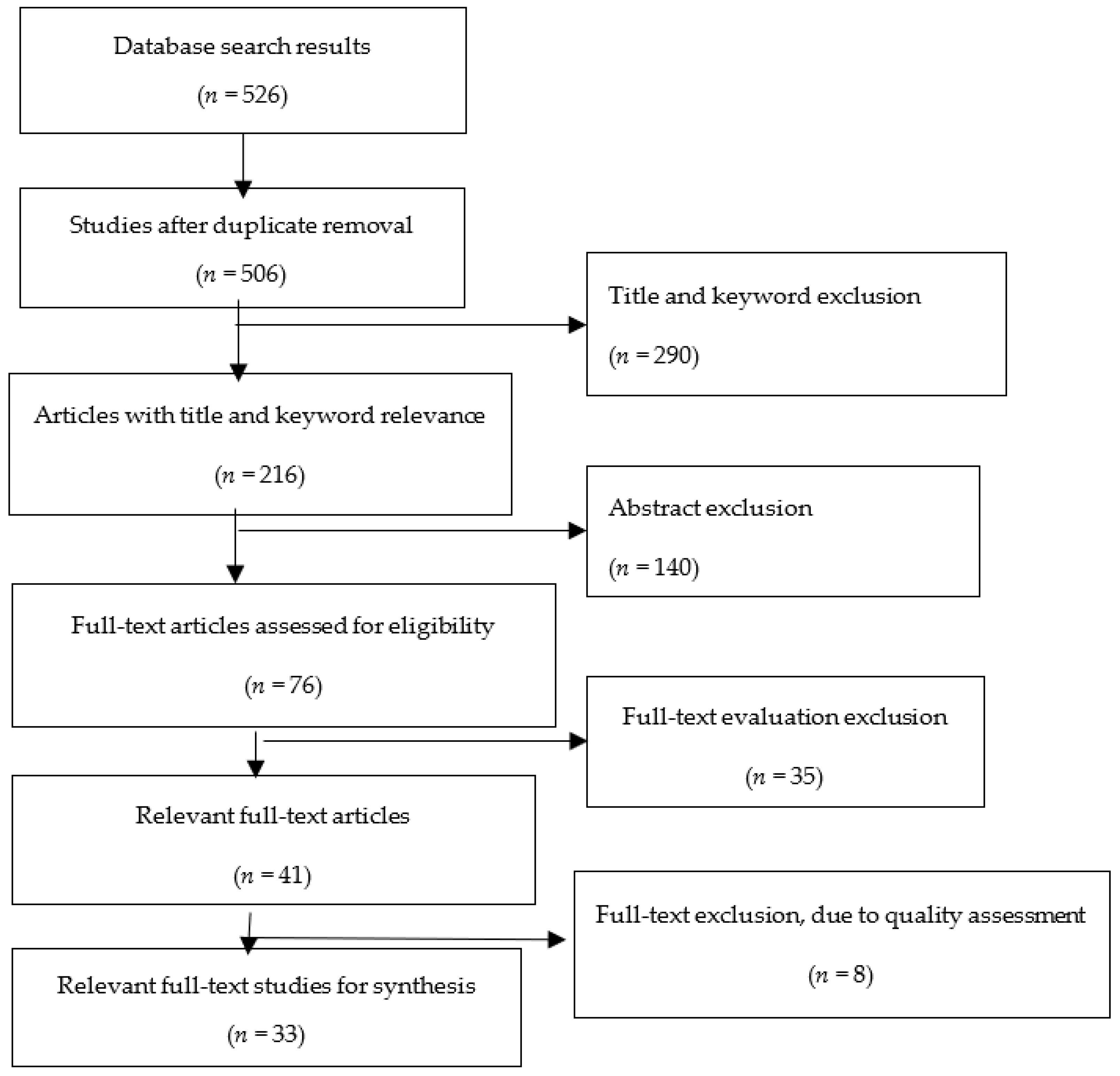
From an initial pool of 526 publications, titles and abstracts were screened for relevance. After applying the inclusion and exclusion criteria and removing duplicates, 33 studies were selected for full-text review. The selection process followed a modified PRISMA approach to ensure transparency and reproducibility (See
Figure 1).
2.5. Data Extraction and Analysis
Key data extracted from each study includes the type of biogas system, urban applications such as residential, commercial, or municipal uses, reported carbon-reduction metrics, integration with existing infrastructure, and the challenges and success factors encountered. Peer-reviewed publications with high-quality material were evaluated to verify that they contain trustworthy and useful information that is compatible with the research objectives. Wells et al. [
14] emphasize that faulty ‘raw content’ in systematic review findings cannot be trusted. The quality assessment in this research aims to determine the reliability of the source’s findings, using a checklist tailored to the research objectives [
15,
16,
17]. A final quality review was performed using adapted assessment criteria, focusing on research method clarity, evidence strength, relevance to biogas use in urban buildings, and reporting transparency. Articles lacking empirical support, methodological detail, or alignment with urban objectives were excluded. This review process resulted in the elimination of 8 articles. Ultimately, 33 high-quality studies were included for the final synthesis.
Though the study primarily employed a thematic literature review, it considered bibliometric techniques for potential future application. The focus was on qualitative synthesis in line with research questions, rather than quantitative literature mapping. Incorporating bibliometric tools like VOSviewer version 1.6.20 and CiteSpace version 7.0 Advanced could enhance methodological rigor by visualizing key themes and research evolution, representing a valuable opportunity for future research enhancements.
3. Results and Discussion
The literature discussed highlights the studies in a thematic layout and discussion below.
3.1. Renewable Energy Source
To provide better management solutions against global warming, the built environment industry, which is one of the major producers of greenhouse gas emissions, needs to optimize its carbon footprint decision-making processes [
18]. Biogas systems are an environmentally friendly alternative to fossil fuels, as they produce methane-rich biogas from organic waste that may be utilized for cooling, heating, and power generation. The use of biogas in place of fossil fuels like coal and natural gas allows buildings in cities to significantly reduce their carbon emissions. Biogas is regarded as a renewable energy source since it is a byproduct of a closed carbon cycle, meaning that the carbon dioxide (CO
2) released during combustion was previously absorbed by organic matter and plants. When comparing this to fossil fuels, the carbon footprint is either neutral or substantially decreased. Mata-Alvarez et al. [
19] state that an integrated plant utilizing anaerobic digestion and aerobic post-composting can reduce CO
2 emissions by 25–67% (depending on how the exhaust heat is used). Compared with grid-powered cooling configurations, offices supplied with on-site biogas-generated electricity exhibited substantially lower, and in some cases net negative, annual GHG emissions [
20].
Picardo et al. [
21] proposed a district heating model where an anaerobic digester is integrated into a water treatment, which supplies heat and domestic hot water to households. The findings for the examined area indicate a potential 1.8 Mt annual reduction in CO
2 emissions. In a case study conducted in Melbourne, Australia, Ref. [
7] found that the suburban home was able to cook for an average of 37.8 min a day for three months using biogas. This helps to reduce the usage of fossil fuel-generated electricity and ends up reducing greenhouse gas emissions. Szyba et al. [
22] suggest that a 1 MW biogas plant can generate 4.1 million m
3 of biogas, which can be used to heat 1.1 thousand homes and generate energy for 2.5 thousand homes. This will provide a clean energy source for these households. Cavana et al.’s [
23] case study findings demonstrate how integrating biogas into the gas grid might reduce reliance on fossil natural gas by as much as 4.7%.
Biogas is often seen as a carbon-neutral energy source; however, a lifecycle analysis reveals various emission-generating stages, particularly in urban settings, including embodied emissions from construction materials and operational emissions from energy use. Additionally, methane leakage and digestate handling can significantly contribute to the carbon footprint, especially in densely populated areas. Despite these challenges, lifecycle assessments generally show that biogas systems still achieve notable net emission reductions compared to fossil fuels, emphasizing the need for improved management practices to enhance sustainability.
3.2. Waste Reduction and Management
Urban regions generate substantial organic waste, which can be directed to biogas systems instead of landfills. Funk et al. [
24] assert that in 2010, the United States generated 250 million tons of municipal solid waste (MSW). According to [
25], food waste is escalating due to inadequate storage facilities and insufficient electricity for preservation. They illustrate the mean waste production across various regions. South Asia generates the least food waste at 164 kg per capita per year, while North Africa produces the most at 442 kg. Sub-Saharan Africa follows with 237 kg, East Asia and the Pacific with 347 kg, and Latin America with 407 kg. The OECD countries average 402 kg. These disparities in food waste are attributed to factors like storage infrastructure, electricity availability for food preservation, and regional food handling practices.
According to a 2011 report, on [
26] global food waste by the UN Food and Agriculture Organization, 1.3 billion tons, or about one-third, of all food produced annually for human use is wasted. Proper municipal solid waste management is a major challenge for many communities due to the high capacity, cost, and technology demands of solid waste management. There are numerous external factors that make this challenge more difficult. Economic growth, for example, results in waste production and more consumption. Untreated municipal solid waste (MSW) might result in uncontrolled methane emissions due to its biodegradable content. Rapid urbanization has led to a scarcity of landfill sites and severe regulations limiting the disposal of biodegradable garbage [
27].
According to a 2011 report [
26] on global food waste by the UN Food and Agriculture Organization, 1.3 billion tons, or about one-third, of all food produced annually for human use is wasted. Proper municipal solid waste management is a major challenge for many communities due to the high capacity, cost, and technology demands of solid waste management. There are numerous external factors that make this challenge more difficult. Economic growth, for example, results in waste production and more consumption. Untreated municipal solid waste (MSW) might result in uncontrolled methane emissions due to its biodegradable content. Rapid urbanization has led to a scarcity of landfill sites and severe regulations limiting the disposal of biodegradable garbage [
27]. Szyba et al. [
22] assert that the selective collection of biodegradable municipal waste facilitates biological processing in municipal facilities instead of being diverted to landfills. The high quantity of food waste can be treated with anaerobic digestion, which might produce 367 m
3 of biogas per dry tonne at roughly 65% methane and an energy content of 6.25 kWh/m
3 of biogas, yielding 894 TWh yearly [
26].
This would mean that biodegradable waste is channeled to energy production rather than being sent to landfills. Li et al. [
28] agree, stating that when urban structures are integrated with biogas plants, organic waste from the municipal solid waste (MSW) management system, including food and human waste, can be recycled and used as feedstock to produce biogas. This will significantly reduce the amount of organic waste sent to landfills.
Dzene et al. [
29] in
Table 2 compared the waste management strategies and concluded that the use of anaerobic digesters is often suggested as a waste management strategy in urban areas and has other benefits like high energy efficiency and reusable end-product (digestate).
3.3. Carbon Sequestration
Digestate, a byproduct of biogas generation, can be utilized to nourish urban agriculture or green spaces. When applied to soil, digestate can improve soil health and increase carbon absorption, hence offsetting further emissions [
30]. This decreases the need for synthetic fertilizers, which are carbon-intensive to make and apply, resulting in additional carbon savings. In a study published by Liu et al. [
20], the results revealed that biogas digestate application boosted rice growth, enhancing rice yield and economic returns.
Digestate, although advantageous for carbon sequestration and soil improvement, presents environmental and public health hazards in urban environments due to the likelihood of contamination from pathogens, heavy metals, and chemicals, especially when feedstock is inadequately processed. This issue corresponds with overarching difficulties in municipal solid waste management, wherein feedstock heterogeneity hampers biogas system operations [
22,
29]. Moreover, surplus nutrients in digestate may result in nutrient runoff, negatively impacting urban soil and water quality. Insufficient stabilization of digestate may lead to odor problems and attract bugs, rendering its application near residential areas troublesome. The need for skilled staff and efficient management protocols is underscored, highlighting that technical capability and operational supervision pose considerable hurdles for biogas systems in numerous urban settings across Africa [
31]. These aspects highlight the necessity for regulatory requirements and quality control to guarantee the safe incorporation of digestate into urban green spaces or landscaping applications.
3.4. Environmental Sustainability
Gebreegziabher et al. [
31] state that installations of biogas systems in the urban built environment can lower the amount of firewood used. One of the main causes of deforestation in developing nations is the use of firewood. Firewood consumption has been rising gradually, and unless sufficient alternative energy sources are created, it is predicted to keep rising as the population grows.
3.5. Benefits and Challenges of Biogas Systems
Biogas systems have the potential to drastically reduce urban buildings’ carbon footprints by generating renewable energy, lowering waste-related methane emissions, and reducing dependency on fossil fuels. Integrating biogas into urban energy and waste management systems can assist cities in meeting sustainability targets, improving air quality, and promoting a circular economy in which organic waste is efficiently turned into energy. As cities grow, implementing biogas systems can be a crucial step in managing urban carbon emissions and minimizing climate change impacts.
The literature synthesis shows a direct proportional relationship between the adoption of biogas systems and a reduction in carbon emissions. The literature also shows the challenges in the implementation of the biogas system, such as the startup cost, high energy efficiency [
22,
25], and environmental benefits [
27,
29].
Although biogas systems have a vast number of advantages, there are still challenges to their adoption. Rasimphi et al. [
32] tabulates these challenges in
Table 3. These include insufficient feedstock. Feedstock plays a critical role in energy yield. Narasinh et al. [
33] agree, stating that the co-digestion process involving two or more types of feedstocks was more effective than using a single type of feedstock. Biogas application is a well-researched topic [
19], but the literature mainly focuses on rural areas. This provides an opportunity for more research in areas like the economic benefits of adopting biogas in urban areas, the feasibility of implementing biogas in current urban built areas, and the implementation of biogas systems in urban planning.
Also, retrofitting biogas systems into urban buildings poses unique technical challenges compared to rural or greenfield installations. Barriers include limited space for essential components like digesters and storage tanks, as urban buildings are often not designed for anaerobic digestion [
31]. The variability of organic waste in dense urban areas complicates feedstock supply, necessitating careful sorting and preprocessing, with inconsistent feedstock potentially lowering gas yield [
22,
29]. Integrating biogas systems with existing building services may require expensive modifications to plumbing and electrical systems, and safety concerns such as gas handling and leak detection are heightened in multi-storey buildings. Furthermore, the operation of these systems demands skilled personnel for installation and maintenance, which is particularly challenging in many African contexts [
31]. These issues underscore the need for focused research on retrofit designs and technical models tailored for high-density urban environments.
Also, the successful large-scale adoption of biogas systems in urban areas is significantly influenced by the presence of supportive policy and regulatory frameworks. Challenges such as limited financial resources, inadequate technical support, and institutional barriers are often linked to weak or non-existent policy structures [
29,
31,
32]. For effective scaling of urban biogas systems, municipalities need clear regulations for organic waste separation, incentives for anaerobic digestion infrastructure, and integration of biogas into urban energy planning. Policies that enhance municipal solid waste management, like mandatory diversion of biodegradable waste from landfills, could improve the reliability of feedstock supply, which is a major challenge in densely populated cities [
27,
28]. Financial mechanisms such as subsidies, low-interest loans, or public–private partnerships can help mitigate high upfront costs and stimulate private-sector investment. Additionally, establishing technical standards and safety protocols for biogas installations is vital, especially in multi-storey urban settings.
To enhance public acceptance of urban biogas systems, it is crucial to address socio-economic barriers and misconceptions, as limited awareness and distrust due to malfunctioning digesters hinder adoption [
22,
29,
32]. Municipalities can implement targeted education campaigns and demonstration projects to showcase the benefits and reliability of biogas systems, while participatory planning can foster community ownership [
31]. Additionally, providing training and financial incentives can further encourage adoption, ultimately shift public perceptions and build long-term support for these technologies.
Overall, the absence of strong regulatory and policy support is a significant barrier to urban biogas expansion, particularly in African cities, and addressing these gaps is essential for enabling sustainable, large-scale implementation.
4. Recent Technological Advancements in Urban Biogas Systems
Recent advancements in biogas technology have increasingly aligned with the needs of densely populated urban areas over the past five years. Studies highlight significant improvements in anaerobic digestion efficiency, particularly in integrated systems that combine anaerobic digestion with aerobic post-processing, leading to enhanced methane recovery and CO
2 reduction in urban settings [
19]. The application of biogas-powered cooling and electrical systems in buildings has risen, supported by techno-economic assessments that show improved efficiency when biogas is used on-site in commercial and office spaces [
20].
District-scale biogas utilization has also progressed, with models demonstrating the effective integration of anaerobic digesters into municipal wastewater treatment systems to supply heating and hot water to urban homes [
21]. Feasibility studies suggest that modern facilities can generate sufficient biogas to meet the heating and energy needs of many urban residences, underscoring their importance in densely populated areas [
22]. Furthermore, research indicates the potential for injecting enhanced biogas into municipal gas grids, which could reduce reliance on fossil natural gas for urban heating [
23].
Additionally, advancements in managing urban organic waste streams have improved biogas systems’ ability to handle variable municipal solid waste (MSW). Restrictions on landfill disposal of biodegradable waste have accelerated the development of waste-to-energy systems, including better methods for converting food and human waste into biogas feedstock. Li et al. [
28] highlight urban models that integrate municipal waste streams into building-level or district-scale digesters, resulting in increased efficiency and reduced methane emissions from landfills through advanced collection and conversion technologies. Overall, these developments indicate a shift towards more compact, efficient, and integrated biogas systems designed to meet the spatial and infrastructural facilities. The literature on urban biogas systems is limited, primarily focusing on rural contexts and leaving significant research gaps in urban-specific areas. The main issues include the need for compact digester designs for dense buildings, understanding urban feedstock logistics, and addressing safety and regulatory compliance for multi-storey developments. Additionally, there is a lack of tailored techno-economic models and social research on community acceptance and concerns related to biogas installations in urban neighborhoods, indicating the necessity for a dedicated urban research agenda. A comparative evaluation of CO
2-reduction potential and cost–benefit performance of renewable energy options in urban buildings is summarized in
Table 4, highlighting the relative advantages of biogas systems over solar and wind alternatives.
5. Conclusions
Biogas systems in urban buildings offer numerous benefits, including fostering entrepreneurship, business innovation, and job creation. The private sector can renovate traditional buildings with biogas, turning them into greener options. Biofertilizers can be sold to farmers, creating business ventures. Universities in South Africa are offering courses on biogas system implementation, equipping people with the necessary skills for small-scale anaerobic digester implementation. The review highlights a notable gap in the literature regarding biogas applications in urban settings within South Africa and other African cities, as it did not find published case studies focusing on the integration of biogas systems in urban buildings. Most existing research in Africa centers on rural household digesters, agricultural waste processing, or community-scale initiatives (with little evidence on urban building-level or district-scale systems). This gap is particularly concerning given the rapid urbanization and reliance on fossil fuels in South African cities. Future research should focus on evaluating the feasibility, design models, and carbon-reduction potential of biogas systems in South Africa. Future research on urban biogas adoption should focus on four key areas: developing urban-specific technical design models for digesters that fit dense city infrastructures, conducting city-level case studies in African contexts to assess feasibility and socio-economic impacts, examining policy and regulatory frameworks to support biogas deployment, and evaluating social acceptance through community engagement and training programs. This roadmap serves as a guide for researchers, policymakers, and city planners to promote sustainable biogas solutions in urban environments.