
Proceeding Paper

An Investigation into the Electrochemical Test on Corrosion and Surface Characterisation of Alumina AI2O3 for Bio-Inspired 3D Dental Implants †

by
Winnie Mtetwa
1,*,
Emmanuel Munenge
1,
Lebogang Lebea
2,
Harry M. Ngwangwa
1 and
Thanyani Pandelani
1
1
Department of Mechanical, Bioresources and Biomedical Engineering, College of Science and Engineering Technology, University of South Africa, P.O. Box Private Bag X6, Johannesburg 1710, South Africa
2
Department of Mechanical and Mechatronic Engineering, Central University of Technology, P.O. Box Private Bag X20539, Bloemfontein 9300, South Africa
*
Author to whom correspondence should be addressed.
Presented at the 4th International Conference on Applied Research and Engineering, Pretoria, South Africa, 21–23 November 2025.
Mater. Proc. 2026, 31(1), 30; https://doi.org/10.3390/materproc2026031030
Published: 26 May 2026
(This article belongs to the Proceedings of The 4th International Conference on Applied Research and Engineering)

Abstract

Alumina is a long-used dental and medicinal biomaterial. It is considered one of the best jaw implant materials and has greater antibacterial resistance than titanium (Ti6Al-4V). 3D-printed alumina dental implants were tested in NaCl and Ringer’s solutions for electrochemical corrosion. In six studies, linear polarisation (LPR), electrochemical impedance spectroscopy (EIS), linear sweep voltammetry (LSV), and SEM were used to assess, compare, and elucidate corrosion mechanisms in 3.5% NaCl solution and Ringer’s solution at 25 °C, 45 °C, and 65 °C. At 25–65 °C, alumina in NaCl had corrosion rates of 0.000016–0.000013 mm/yr. Polarisation resistance was good even in a chloride-rich environment at high temperatures, showing effective corrosion protection. The EIS test indicated that the alumina film’s excellent dielectric and insulating capabilities prevented deterioration of the alumina substrate in a concentrated chloride solution. The SEM showed no deep pits.

1. Introduction

The use of bio-inspired design and additive manufacturing has made dental implants more like natural teeth and bone [1]. These designs seek to optimise stress distribution, boost osseointegration, and improve long-term performance [2]. Alumina (Al2O3) is advantageous for dental implants due to its hardness, wear resistance, corrosion stability, biocompatibility, and chemical inertness [2]. Biomedical-grade alumina typically has a Vickers hardness of 2200 HV, flexural strength of 500 MPa, compressive strength of 4100 MPa, fracture toughness of 4 MPa·m½, and Young’s modulus of 380 GPa [3]. Recent advances in lithography-based ceramic manufacturing (LCM) enable the fabrication of complex geometries, including threaded dental screws, using high-purity powders such as alumina (LithaLox 350) [4]. Long-term clinical success in the challenging oral environment requires strong, corrosion-resistant dental implants. Alumina (Al2O3) ceramics are ideal for implant applications due to their wear resistance, biocompatibility, and hardness [5,6]. Alumina is a long-used dental and medicinal biomaterial. It is considered one of the best jaw implant materials and has greater antibacterial resistance than titanium (Ti6Al-4V) [7]. Although titanium oxide has been reported to increase thermal stability and water adsorption resistance, it is of great importance to employ materials that are envirofriendly and safe [8,9]. Traditional fabrication processes cannot develop complex, bio-inspired designs that improve load distribution and osseointegration. The evolution of additive manufacturing toward function-driven fabrication, as discussed by Ganapathy [10], highlights the importance of tailoring internal architectures to achieve application-specific performance. Additive printing allows bio-inspired 3D objects with adjustable surface shape and porosity [6]. In the mouth, implants are constantly exposed to saliva, enzymes, pH changes, and heat [11]. Corrosion resistance is a crucial attribute, as deterioration can lead to mechanical failure and the release of harmful ions [12]. Electrochemical corrosion is the degradation of materials in an electrolyte due to microcells [12,13]. Electrochemical testing techniques, including linear polarisation resistance (LPR), potentiodynamic polarisation (PDP), electrochemical impedance spectroscopy (EIS), and linear sweep voltammetry (LSV) are frequently employed to assess corrosion behaviour under simulated physiological settings [14]. Current research is limited in understanding the corrosion resistance and electrochemical behaviour of porous 3D-printed alumina dental implants in physiological environments, particularly with implant-relevant solutions like Ringer’s and sodium chloride.
Most electrochemical research focuses on metals or composite materials; hence, there are few systematic studies on the electrochemical stability of pure and 3D-printed alumina under physiological conditions [15]. The long-term safety and dependability of alumina-based bio-inspired dental implants depend on this understanding. The 3D-printed dental implants use bio-inspired geometry, surface texture, chemistry, and material gradients to behave less like metal screws and more like natural teeth [16]. Porous alumina, such as Lithalox 350, satisfies the bio-inspired criterion of bone-mimicking porosity. The implant geometry is inspired by the hierarchical structure of natural tooth roots, which exhibit gradual transitions in alumina compared to diameter and curvature to optimise stress distribution within the surrounding jawbone [17]. A porous structure facilitates a bone implant interface that facilitates good osseointegration. The relevance of pore morphology and surface characteristics in porous alumina for biomedical use has been highlighted in recent studies [18], supporting further investigation into their influence on electrochemical behaviour. Advanced composite materials’ mechanical, tribological, and environmental durability has been extensively studied underlining the importance of microstructure, reinforcement, and environmental exposure in long-term performance [19,20]. These studies have improved our understanding of structural and polymer-based materials, but few have examined the electrochemical stability of dental ceramic biomaterials. Alumina Lithalox 350, utilised in biomedical implants due to its hardness and biocompatibility, must be electrochemically evaluated under simulated physiological circumstances to ensure corrosion resistance and clinical dependability. This work investigates alumina Lithalox 350 electrochemistry for dental implants to fill this gap. This study combines electrochemical testing with microstructural assessment to find performance correlations and help develop the future generation of dental implants. This study aims to fill the gap by examining the electrochemical stability and corrosion behaviours of bio-inspired alumina dental implants produced by sophisticated additive manufacturing techniques. The study aims to evaluate the corrosion resistance of bio-inspired 3D-printed alumina dental implant prototypes using LPR, LSV and EIS in simulated oral conditions.

2. Materials and Methods

Six samples of 3D-printed alumina (Lithalox 350) dental implants measuring 22 mm × 4 mm with 3 mm taper were used as working electrodes. The dental implants were printed by Lithoz in Vienna, Austria. A galvanostat/potentiostat Autolab (PGSTAT302N computer-controlled) with the NOVA software version 2.1.8 was used for carrying out electrochemical tests. The potentiostat was manufactured by Metrohm Autolab in the Netherlands. The electrolyte solutions were Ringer’s and NaCl solution. These electrolytes were selected because of the osmolarity and ionic content like that of the extracellular fluid, with Ringer’s solution being closer to the physiological extracellular fluid, which helps assess comparative material behaviour. These provide key electrolytes involved in cellular and tissue functions.
The heater plate, a JSM-6010PLUS/LA scanning electron microscope (SEM) manufactured by JEOL Ltd., Tokyo, Japan and a Philips XL30 FESEM EDS by Philips Electron Optics, Eindhoven, The Netherlands, were used for morphological analysis. The graphs were drawn using Origin (v.10.3) from OriginLab Corporation and Nova software (Metrohm). The fitting for the electrochemical impedance spectroscopy (EIS) was done using Nova software and Origin software to get the equivalent circuit. The following equations were used to calculate some of the parameters:
R p = Δ E Δ I
where Rp is in Ω·cm2 after normalisation to electrode area. The Stern Geary equation was utilised to calculate Icorr.
I c o r r = B R p
where B = β a β c 2.303 ( β a +   β C ) , where βa and βc are anodic and cathodic Tafel slopes (V/d) from the polarisation curves drawn from the linear sweep voltammetry test. Then, to calculate
Corrosion   rate ( CR )   ( mm/yr ) = K   Icorr = ( μ Acm 2 ) EW ƿ
where K = 0.00327; constant Icorr is in μA·cm−2, EW in g·equiv−1, ƿ in g·cm−3, and CR in mm·yr−1); EW is equivalent weight (g per equivalent); and ƿ is metal density (g·cm−3). Electrochemical behaviour was evaluated in Ringer’s solution and NaCl (3.5%) at 25, 45, and 65 °C using LPR, LSV and EIS. The 65 °C testing was not meant to replicate body temperature, but to accelerate and expose long-term electrochemical and ageing mechanisms relevant to decades of in vivo service.
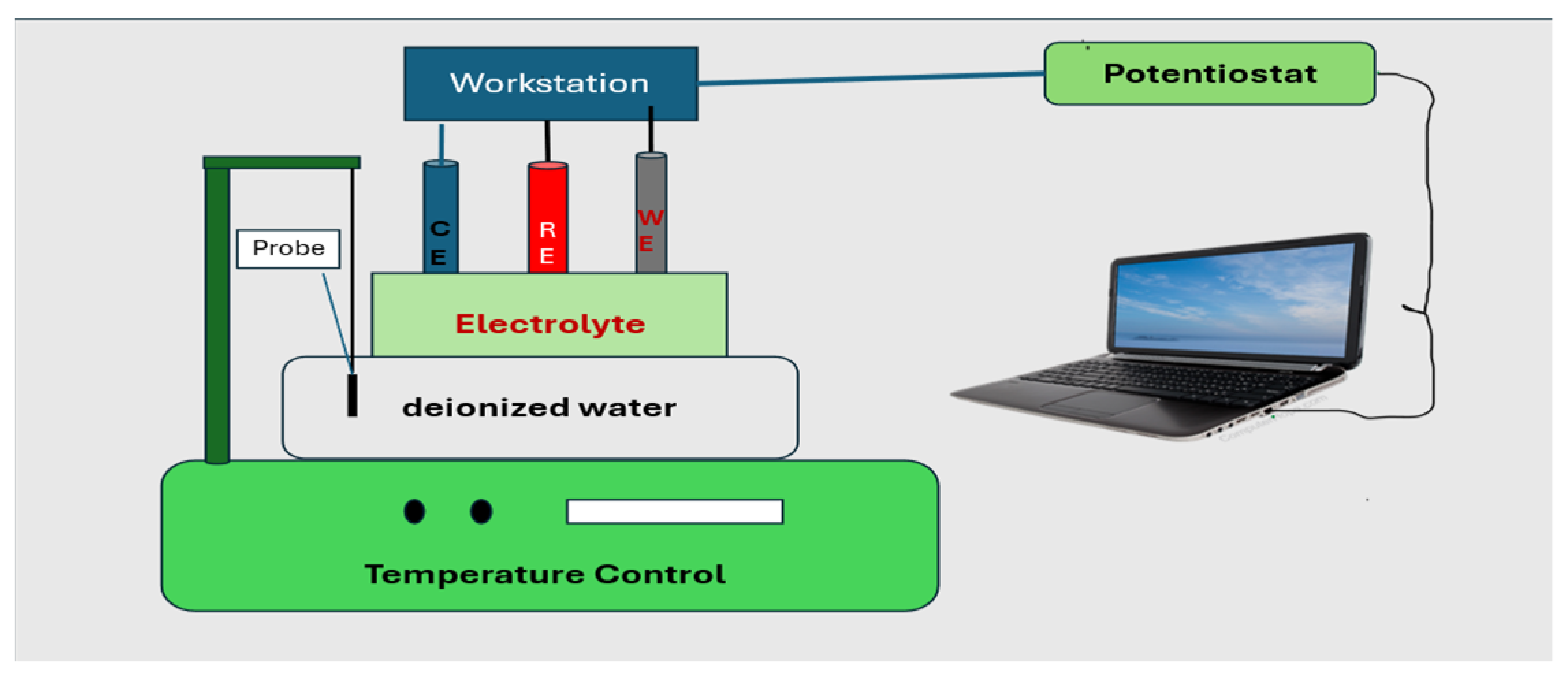
These tests were conducted on threaded dental screw prototypes fabricated via lithography-based ceramic manufacturing (LCM) using Lithalox 350 alumina and sintered to achieve porous microstructures. The samples were initially rinsed with distilled water, subsequently with acetone, and finally air-dried. A 3.5% NaCl solution was prepared for three distinct trials at temperatures of 25 °C, 45 °C, and 65 °C. An electrochemical cell comprising a working electrode (alumina samples), a graphite rod as the counter electrode, and silver chloride as the reference electrode. Ringer’s solution was utilised in another set of experiments at the same temperatures: 25 °C, 45 °C, and 65 °C. The electrodes were placed in a beaker containing an electrolyte, which was placed in another beaker filled with deionised water. The beaker with deionised water was placed on top of a hot plate with temperature control. The three electrodes were placed into the beaker with the electrolyte and connected to the potentiostat, which was linked to a computer with the Nova 2.8.1 software to analyse the tests, as shown in Figure 1.
At a stabilised OCP (>1 mV/min) and a stable electrode potential EIS, tests were conducted first to preserve the native surface using a small AC perturbation amplitude of 10 mV (rms) (AC) at frequencies ranging from 0.1 Hz to 100 kHz. Real and imaginary impedances, as well as magnitudes and phase data, were recorded. The LPR test was conducted second on a small DC perturbation (10 mV) with a small drift on OCP and scanning slowly until current and potential had a linear relationship. The change in potential over change in current (∆E/∆I) was measured to attain Rp, which was used to calculate Icorr. Lastly, after a stable OCP potential less than 1 mV/min according to ASTM G5 or G59, the LSV test was conducted at a sweep potential from the cathodic potential to the anodic potential at a scan rate of 1 mV/s, and the polarisation curves were drawn from the data, Ecorr and Icorr, and the corrosion rate was obtained. The Joel JSM-6010PLUS/LA SEM, manufactured by JOEL Limited in Tokyo, Japan, was used to analyse the etched specimens for microstructure, grains, flaws, and phases. For comparison, micrographs were obtained at 50×, 100×, 300×, 500×, and 1000× magnification for the bottom, middle, and top of the samples. An accelerating voltage of 20 kV was used to run the scanning electron microscope (SEM). The Link ISIS X-ray analysis system (Oxford Instruments) and Origin and Nova software were used to generate the curves and the graphs for the electrochemical tests.

3. Results and Discussion

3.1. Electrochemical Tests

3.1.1. Linear Polarisation Resistance (LPR) Tests

The regression results from the LPR analysis of alumina samples in Ringer’s at 25 °C showed a linear fit of current versus potential in the near corrosion region, giving a regression equation y = −0.015884 – 5.5823 × 10⁻⁶ x at an intercept of −0.015884 and the Slope (b = −5.5823 × 10⁻⁶ A V−1). The slope corresponded with the key quantity dI/dE for linear polarisation tests. The LPR tests yielded a polarisation resistance (Rp) of 1.8 × 10⁵ Ω. This showed a very small current response with a change in potential, strong passivation and extremely low corrosion rate, indicating the electrochemical inertness in the physiological solutions. The correlation of −0.99 showed excellent linearity in the −10 mv–20 mv window around Ecorr. The regression model is reliable, and no nonlinear faradaic process dominated the region, indicating no breakdown of alumina or pitting.

3.1.2. The Electrochemical Impedance Spectroscopy (EIS) Tests

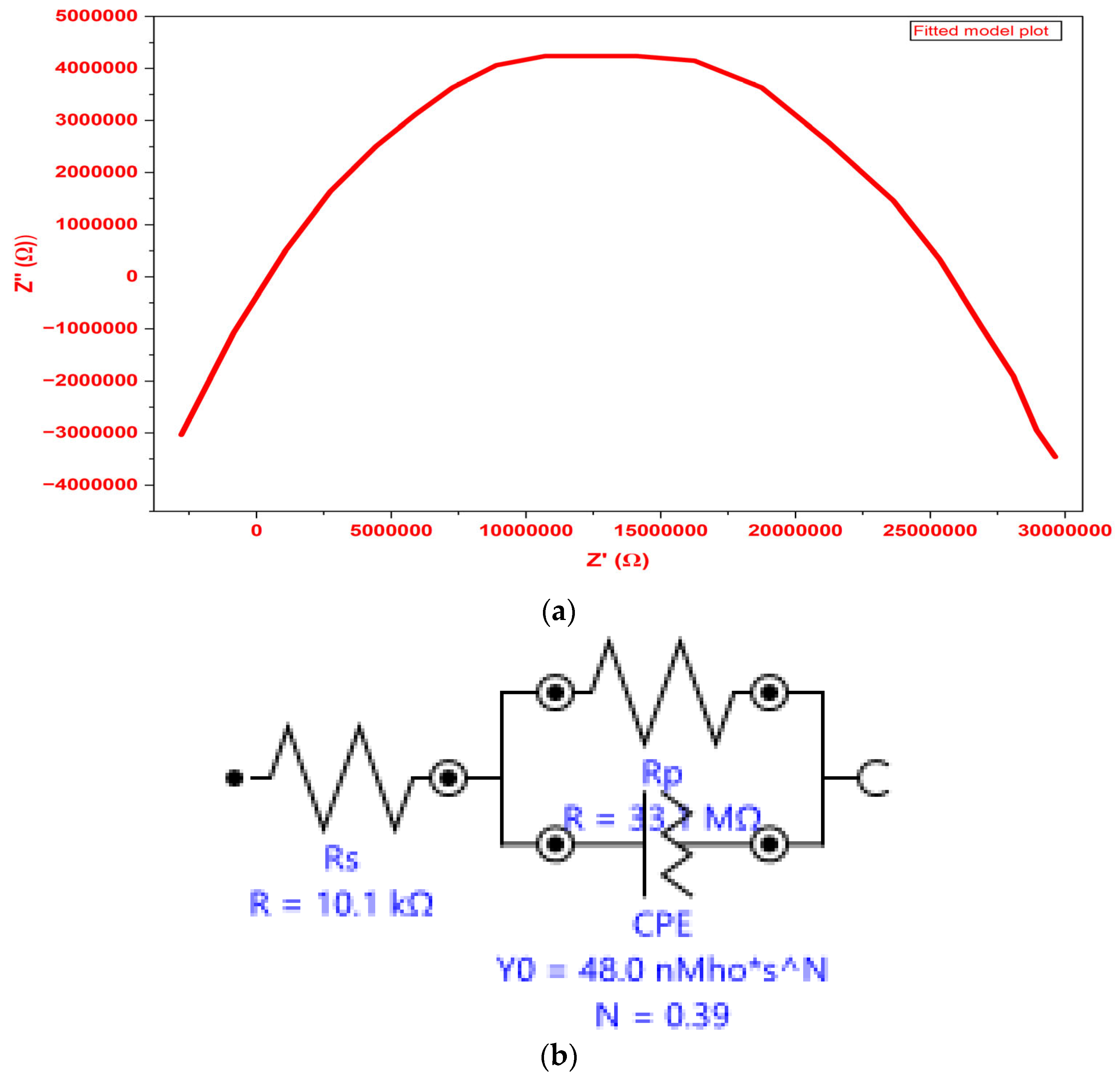
Figure 2a,b show the fitted Nyquist data plots for alumina at 25 °C NaCl in EIS tests. The fitting polarisation resistance (Rp) of 3.3 MΩ conforms to the literature on the protective alumina oxide layer and resistive insulating oxide properties [16]. The CPE (N < 0.5) indicates significant variability, with a rough/porous surface that matches Lithalox 350, a 3D-printed alumina part with microstructure, porosity, and grain boundary networks.
N denotes the dielectric relaxation distribution mechanism throughout the oxide sheet. Figure 2a,b show the impedance spectra for Nyquist plots obtained by fitting the experimental data to the equivalent circuit model using Nova software version 2.8.1 and Origin. The comparable circuit comprises the solution resistance (Rs), charge transfer resistance (Rct), and time constant phase element (Q). The solution resistance (Rs) arises from the cumulative resistance present. The impedance spectra recorded in NaCl and Ringer’s solutions display unique low-frequency characteristics. Conversely, the harmonics in both NaCl and Ringer’s solution exhibited a closed, depressed semicircle devoid of a diffusion tail and were effectively characterised using a more straightforward Rs–(RpCPE) model. The employment of various equivalent circuits thus indicates the distinct predominant electrochemical processes in the two electrolytes. Figure 2a,b show the fitted Nyquist model plot at 25 °C NaCl and the equivalent circuit model.
From Figure 2b, the circuit equation for the EIS test follows [RsRpCPE] for NaCl solution and Rs = 10.1 kΩ, indicating the electrolyte had higher resistance and low ion conductivity, Rp = 33 MΩ, showing that the material was protected, hence the low corrosion rate. The derived CPE exponent (N = 0.39) signifies a pronounced divergence from ideal capacitive behaviour, highlighting considerable interfacial heterogeneity and dispersion phenomena at the alumina/electrolyte interface. Notwithstanding this suboptimal behaviour, the exceedingly low χ2 values affirm that the chosen comparable circuit precisely replicates the experimental EIS data. This indicates that the fitting quality is excellent and that the non-ideal dielectric response is an inherent property of the system, not a consequence of inadequate fitting [21]. Residual porosity in lithography-based ceramic alumina causes geometric and electrochemical variability at the ceramic–electrolyte interface. Electrolyte penetration into the pore network causes a distributed capacitive response defined by a constant phase element with decreasing exponent n as porosity and connectedness increase. Increased effective interfacial area and shorter ionic route length lower polarisation resistance. Due to alumina’s bioinert and electrically insulating properties, microstructural shape drives monotonic trends in n and polarisation resistance [22].
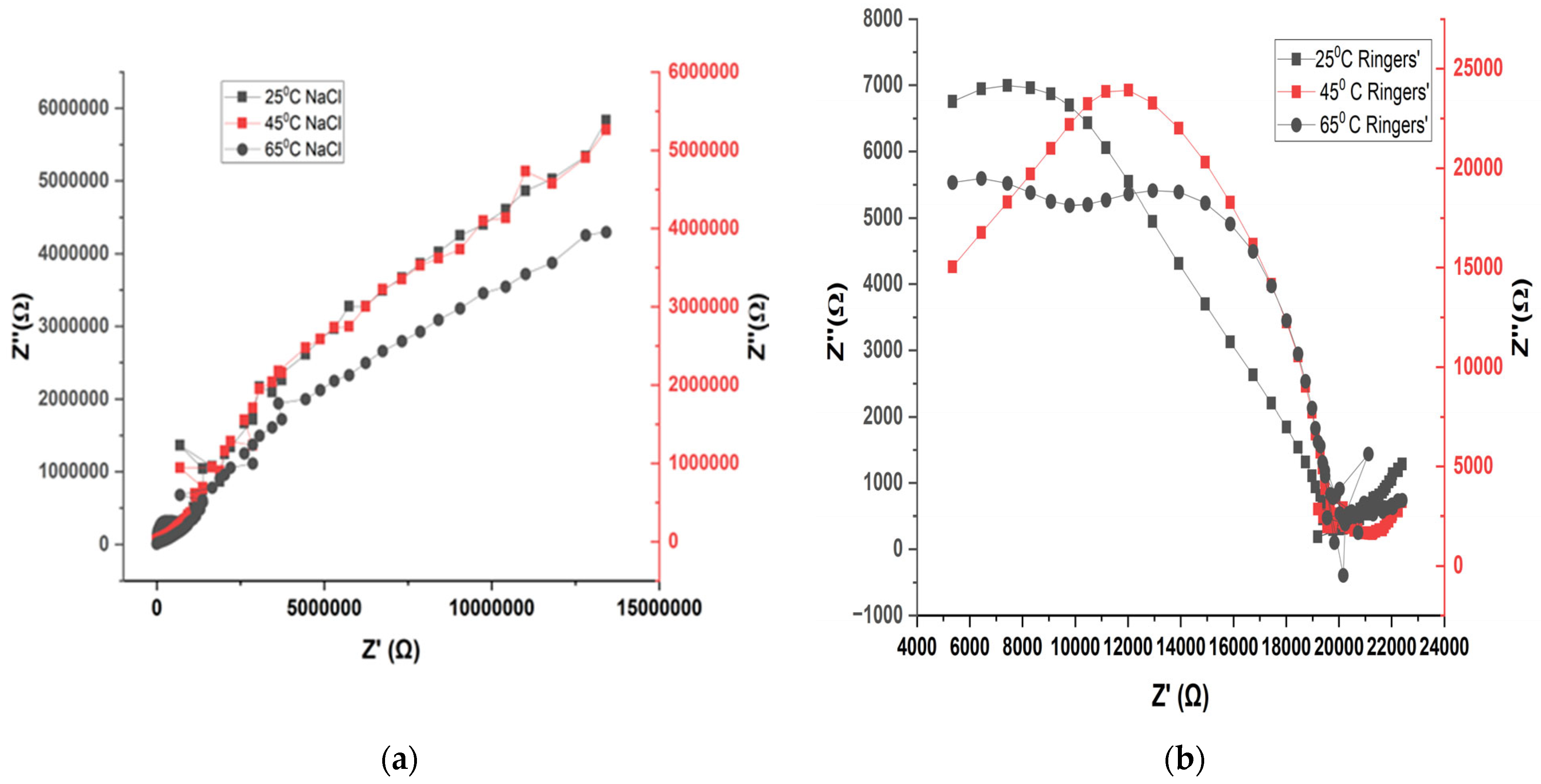
The goodness of fit of the electrochemical impedance spectroscopy (EIS) data for alumina immersed in NaCl solution at different temperatures was evaluated using the chi-square (χ2) parameter. The obtained χ2 values were 6.91 × 10⁻²⁰ at 25 °C, 6.29 × 10⁻²⁰ at 45 °C, and 4.27 × 10⁻²¹ at 65 °C. This trend suggests improved model conformity at elevated temperatures, which may be attributed to enhanced electrolyte conductivity, increased ionic mobility, and reduced dispersion effects at the alumina/electrolyte interface [23]. In Ringer’s solution, alumina had low chi values 4.62 × 10⁻¹⁷ at 25 °C, 8.72 × 10⁻¹⁹ at 45 °C, and 5.10 × 10⁻¹⁶ at 65 °C. The consistently low χ2 values indicate that the dominant electrochemical mechanisms governing alumina behaviour remain unchanged between 25 °C and 65 °C. Polarisation resistance (Rp) is a crucial electrochemical measure used to determine corrosion resistance and interfacial stability in electrolytic settings. Higher Rp values often indicate stronger charge-transfer resistance, leading to improved corrosion resistance [24]. At ambient temperature, alumina had an Rp value of 31,110 Ω, suggesting high resistance to electrochemical processes in Ringer’s solution. A stable and protective alumina passive layer inhibits ionic transport across the interface. At 45 °C, Rp reaches 87,385 Ω, the highest resistance among the tested temperatures. This large rise shows that the alumina surface is better passivated at moderate temperatures. Surface rearrangement, densification, or defect repair in the passive film may limit charge transfer and increase electrochemical stability at high temperatures. At 65 °C, the Rp value drops to 26,692 Ω, suggesting a decrease in polarisation resistance. Thermal ionic transport activation, enhanced electrolyte conductivity, or partial destabilisation may cause this drop. Overall, alumina demonstrates excellent electrochemical stability in Ringer’s solution under the tested conditions, with optimal corrosion resistance observed at 45 °C and stable passive behaviour even at elevated temperatures. The results of the tests are displayed in Figure 3a,b, showing the Nyquist plots of alumina in both NaCl and Ringer’s solutions.
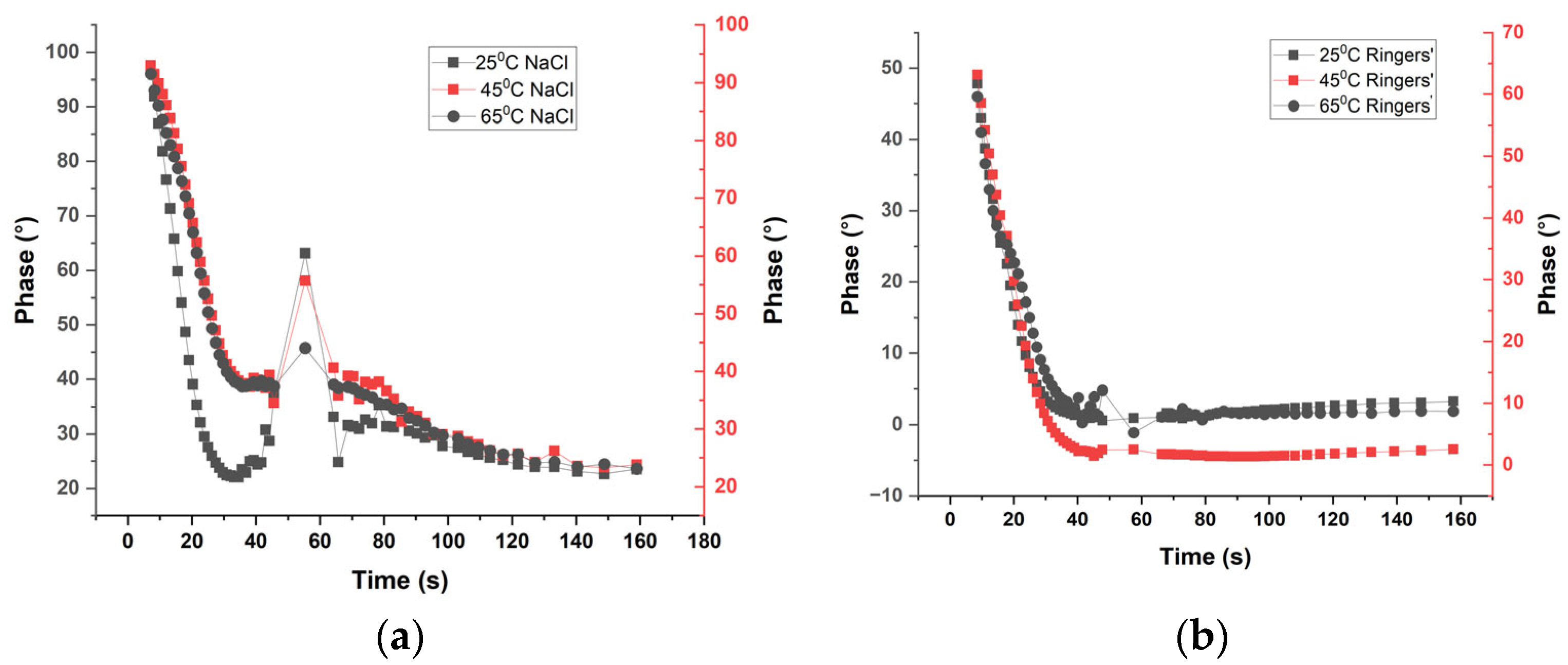
There was a high overall impedance in all three curves, as shown in Figure 3a,b, with impedance values in the range of millions of Ohms (MΩ), indicating excellent corrosion resistance or barrier properties. Alumina ceramic acts as a very effective insulator, severely hindering the flow of electrical ions. The highest impedance was recorded at 25 °C, followed by 45 °C, which had a significantly lower impedance, and 65 °C, which showed the lowest impedance. This indicates that the conduction of ions (Na+ and Cl) through or along the surface of the alumina becomes easier at higher temperatures, resulting from increased ionic mobility [25]. The thermally activated charge transport process followed an Arrhenius-type behaviour, with conductivity increasing exponentially with temperature. Figure 4a and Figure 4b show the Bode plots of alumina in NaCl and Ringer’s solution, respectively.
The Bode plots showed a decrease in breakdown or pitting potential in the NaCl experiment as temperature increased, as shown in Figure 4a. The potential at which the current sharply increased was lower at 65 °C than at 45 °C, and lower than at 25 °C. This could indicate initial pitting and passive alumina breakdown. Higher temperatures initiate protective passive film instability [26], indicating acceleration of the kinetics of aggressive chloride ion (Cl) adsorption and penetration into the film. Furthermore, the solubility of the oxide film and the driving force for pit nucleation increase with temperature increase. This makes it easier for chlorides to break down the film and initiate localised corrosion at a less noble electrical potential difference (E) [26]. In Figure 4, there is a time-dependent interfacial stabilisation in Ringer’s solution, where temperatures of 25 °C and 65 °C and a non-monotonic trend at 45 °C.

3.1.3. Linear Sweep Voltammetry (LSV) Tests

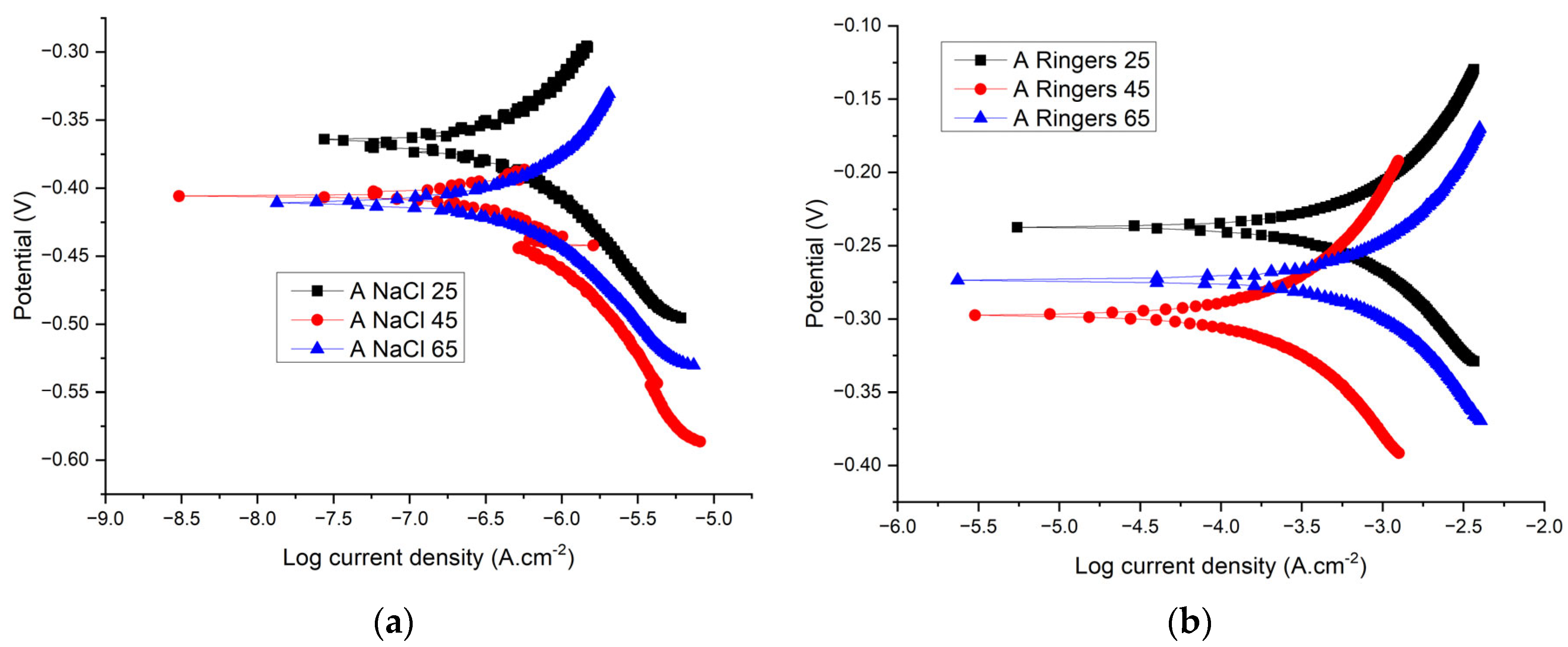
The polarisation curves for 3.5% NaCl and Ringer’s solution at temperatures between 25 °C and 65 °C are shown in Figure 5a,b. From these graphs, Icorr and Ecorr were determined. Figure 5a shows that Lithalox 350 alumina possesses excellent corrosion resistance in NaCl environments. However, this resistance is temperature-dependent. Elevated temperatures (45 °C, 65 °C) increase the corrosion rate and reduce resistance to localised corrosion, such as pitting. Ringer’s solution is a complex physiological saline containing ions like Na+, K+, Ca2+, and Cl, making it a highly relevant environment for simulating biomedical or biological applications. From the Tafel curves at 25 °C, 45 °C, and 65 °C, the stability of the alumina under these conditions (NaCl) and Ringer’s solution is revealed.
Lithalox 350 forms a highly stable, protective passive layer that blocks charge transfer and electrochemical reactions, thus reducing corrosion rate. Extremely low current densities indicated high corrosion resistance (passivity) across a wide potential range of all temperatures. Results in Figure 5b indicated strong temperature dependence from 25 to 65 °C. The entire current density curve rose. Implantable devices and biological settings require this property. Higher temperatures increase ionic mobility, allowing destructive ions such as Cl to migrate through tiny defects in the alumina surface [27]. Ringer’s solution had the lowest current densities and corrosion rate at 25 °C. The cathodic branch was very active between 45 and 65 °C, and Ringer’s Tafel curves showed higher current densities at comparable potentials and increased corrosion rates at 45 °C. Therefore, corrosion was most active at 45 °C, while 65 °C altered surface film equilibrium.
Bio-inert and corrosion-resistant Lithalox 350 (alumina) performed well in Ringer’s solution. Despite being thermally sensitive, Lithalox 350 alumina implants may withstand repeated hot beverage exposure (≈65 °C) without significant corrosion or structural damage [25]. Alumina (Lithalox 350) had negligible electrochemical activity under these study conditions. The corrosion currents (Icorr ≈ 1.08–1.88 × 10⁻⁹ A·cm−2) and corrosion rates (on the order of 10−5 mm·yr−1) were low, confirming the chemical inertness of high-purity alumina. The measured low currents correspond to considerable polarisation resistances (Rp = 3.3–4.4 × 10⁷ Ω·cm2), indicating a highly resistant surface [28]. A small cathodic shift in corrosion potential with temperature (Ecorr from −0.1538 at 25 °C to −0.1977 V at 65 °C) was observed. The small value (<50 mV) suggests alterations in electrolyte kinetics, leading to enhanced conductivity and O2 reduction. It also suggests small surface adsorbate changes rather than loss of protection. The absence of a monotonic increase in Icorr with temperature (45 °C has slightly higher Icorr than 65 °C) suggests that the observed scatter is within experimental error at low current levels and may be affected by surface microstructure or measurement noise. Measured currents at approximately 10−9 A/cm−2 approach typical instrument noise floors due to the electrical insulating nature of Al2O3. Consequently, a portion of the absolute values may be attributed to detection limits or small conductive pathways (e.g., microcracks, open porosity, or electrode contact effects) rather than bulk dissolution. Lithalox 350 alumina was electrochemically characterised in Ringer’s solution at 25 °C, 45 °C, and 65 °C, and the results showed a non-monotonic variation in polarisation resistance with temperature. The competition between thermally enhanced ionic transport and temperature-induced restructuring of the alumina–electrolyte interface, including surface hydroxyl chemistry, ion adsorption equilibria, and pore electrolyte dynamics, causes alumina’s electrochemical parameters to be non-monotonic instead of a straightforward Arrhenius trend. Apparent corrosion parameters may peak or dip as temperature rises due to a distinct interfacial mechanism [8,29].
The open-circuit corrosion potential (Ecorr) exhibited a mild temperature dependence, changing from −0.024 V at 25 °C to −0.085 V at 45 °C and −0.060 V at 65 °C. These values, which are close to zero volts, reflect alumina’s great chemical inertness and the absence of major anodic dissolution processes that are characteristic of metallic systems. The greater negative potential at 45 °C may imply enhanced interaction with chloride ions with surface defect sites or grain boundaries, while the shift back toward −0.060 V at 65 °C implies partial stability of the alumina/electrolyte interface, potentially driven by decreasing dissolved oxygen concentration at elevated temperatures [29]. The corrosion current density (Icorr) was consistent across temperatures, with values of ~1.2 × 10⁻⁶ A/cm2, indicating exceptionally low corrosion rates of 0.013–0.015 mm/year. The superior electrochemical stability of alumina ceramics in physiologically simulated settings is consistent with studies that show alumina has little homogeneous corrosion but may be susceptible to defect-mediated degradation or localised leaks after prolonged immersion. Alumina corrosion in Ringer’s solution is affected by oxygen solubility and reduction kinetics, chloride adsorption at grain boundaries and defect sites, and surface hydroxylated alumina film stability, as Icorr has a weak temperature dependence. Oxide biomaterials in Ringer’s and simulated biological fluids behave non-monotonically with temperature due to small film solubility and surface charge changes. Ceramics have minimal solubility in physiological fluids and retain oxide coatings at 80 °C, according to recent investigations [24].

3.2. Surface Morphology

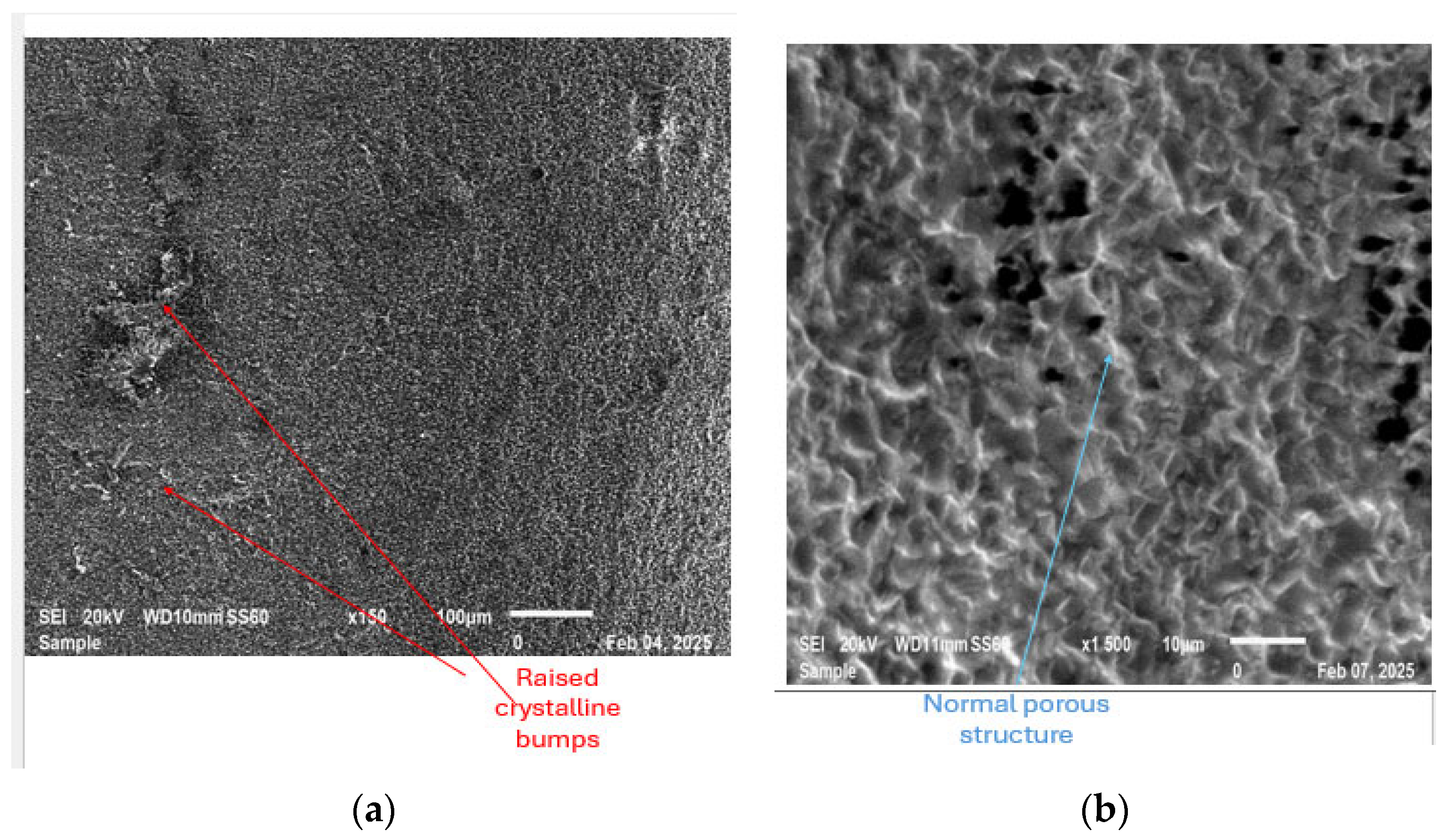
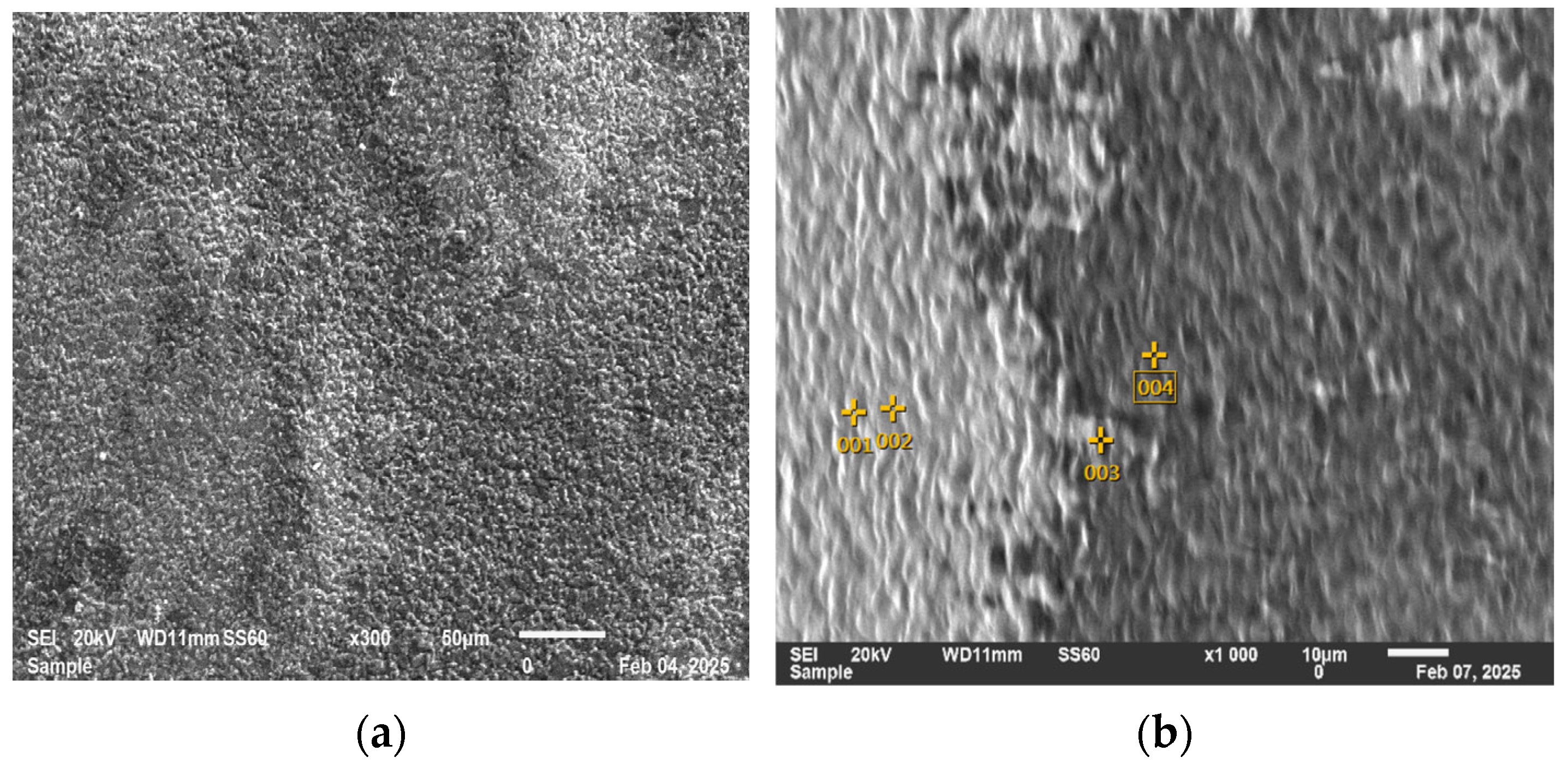
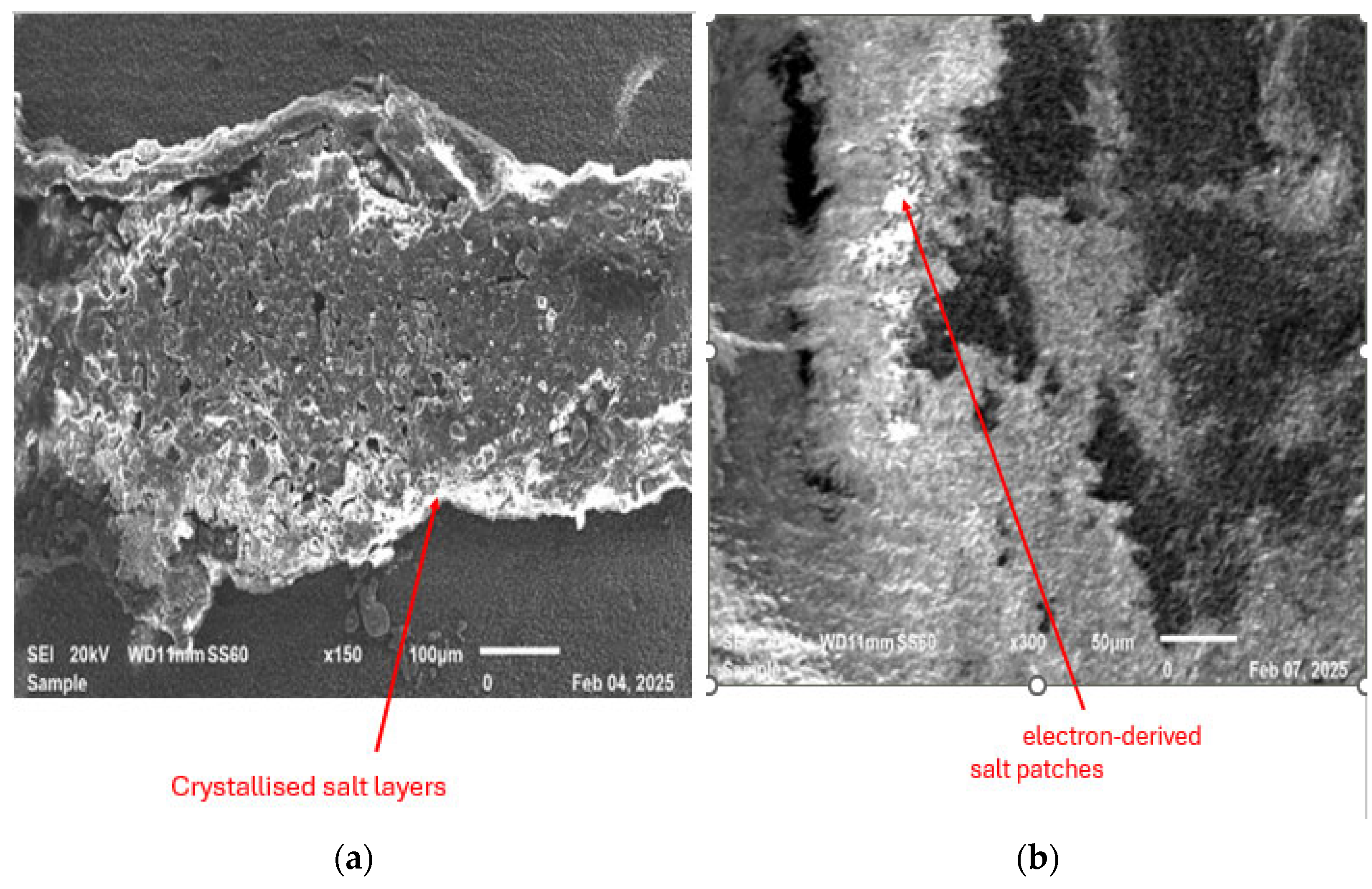
Alumina surface morphology after the tests were examined using the SEM at varying magnifications and positions, as shown in Figure 6a,b, Figure 7a,b and Figure 8a,b.
The SEM image in Figure 6a shows rough surfaces depicting corrosion activity due to the aggressive chloride attack, which can attack weak points or microdefects within the oxide layer [30]. The synthesis of sodium chloride with surface hydroxyl groups on alumina may potentially cause hydrated aluminium oxide or hydroxide layers and enhanced roughness [30]. Bright patches may indicate salt recrystallisation or Al-hydroxide/oxide corrosion products altering the alumina surface [31], or electrochemical oxidation or anodic oxide morphology [28]. After exposure to Ringer’s solution at 25 °C, LithaLox 350 alumina (Figure 6b) had a thick, homogeneous microstructure with low surface relief and no corrosive degradation. At low magnification (×150), the surface showed a continuous texture without cracks, pits, or delamination, indicating no chemical corrosion or film formation. High-magnification SEM imaging (×1500) confirmed a thick, fine-grained surface without open or connected porosity. Alumina retained chemical and structural stability during electrochemical and immersion testing without etch traces, grain-boundary dissolution, or particle corrosion products. This level of morphological integration implies that the ceramic surface had little interaction with Ringer’s electrolyte. Ringer’s solution’s near-neutral chloride medium causes localised corrosion in metallic systems. Instead of dissolution, totally dense alumina undergoes surface adsorption and little hydroxylation. The elevated polarisation resistance (Rp) and capacitive impedance response commonly exhibited by insulating ceramics are thus associated with the uniform, featureless surface morphology. Previous electrochemical impedance spectroscopy (EIS) studies on dense Al2O3 coatings and ceramics in physiological electrolytes showed impedance magnitudes of 106–108 Ω·cm2 and nearly ideal phase angles (−80° to −90°), indicating dielectric behaviour and minimal charge transfer [32,33]. The stability of Al–O bonds and lack of electrical conductivity in α-Al2O3 may have led to high Rp. Thermally induced hydration of alumina into boehmite or gibbsite phases occurs at temperatures above 60 °C, not 45 °C [34].
SEM’s lack of chloride-rich deposits or surface roughening supports surface reactions limited to weak ionic species physisorption. Micrometre-scale topographical changes are likely caused by sintering textures, not corrosion. Lithalox 350 is a highly pure (≥99.8%) alumina with low impurities, reducing Rp-lowering galvanic coupling. Similar thick alumina systems in neutral fluids have a single-time-constant response due to microstructural homogeneity [35]. Figure 6b shows that LithaLox 350 is chemically stable in Ringer’s solution at 45 °C, according to SEM. The lack of morphological degradation suggests that dielectric capacitance, not active charge transfer, governs electrochemical activity. This makes the material electrochemically inert due to its compact microstructure and intrinsic alumina passivity. The electrochemical stability of porous alumina dental implants depends on pore size and distribution, which governs electrolyte penetration, ionic transport, and local surface polarisation. Macropores allow consistent electrolyte access and more stable interfacial behaviour, while micropores may increase ion buildup and electrochemical heterogeneity. Uniformly distributed, interconnected microporosity enhances the effective surface area and reduces localised electrochemical activity, thereby improving long-term electrochemical stability under oral simulation [36]. Furthermore, electrochemical stability guarantees chemical safety, but mechanical reliability in alumina implants is governed by fatigue and gradual crack propagation under cyclic oral loading.
The SEM image in Figure 7a shows bright rims/particles that often indicate either retained, higher-Z deposits (e.g., chloride salts, corrosion products like Al (OH)3, or adsorbed impurities) or charging contrast [36]. This could also have been a result of increased temperature, which accelerates the corrosion rate [37]. Electrochemical degradation occurs because of induced surface roughening and hydroxide formation [38]. Figure 8a,b show the SEM image of alumina after exposure to NaCl and Ringer’s solutions at 65 °C. The alumina surface had changed due to the precipitation of insoluble salts. Ringer’s solution contains Ca2+ and Mg2+ ions. Leading to a localised micro-environment at the alumina–solution interface, which can become alkaline due to cathodic reactions (e.g., O2 + 2H2O + 4e → 4OH), promoting the precipitation of these ions as insoluble hydroxides or carbonates (from dissolved CO2) [37]. A 2022 study by Shahzad et al. on the scaling of implants in simulated body fluids highlighted that temperature is the primary driver for the nucleation density and growth rate of CaCO3 scales, and at 65 °C, the authors observed a rapid formation of discrete crystalline patches [38].

4. Conclusions

Lithalox 350 showed negligible corrosion rates over the temperature range, confirming its biocompatibility and long-term stability in physiological fluids. These findings confirm that alumina maintains electrochemical passivity under conditions relevant to biomedical applications; however, further investigation of localised grain boundary erosion at physiological temperatures may be necessary. In NaCl and Ringer’s solutions at 25–65 °C, Lithalox 350 showed virtually no corrosion. Oxygen solubility, film stability, and experimental fitting biases may explain the non-monotonic Ecorr/Icorr response. The SEM scans indicated no deep pits in both solutions, rather crystallised salts, and there was no morphological degradation on AM alumina, but surface porosity may hide subsurface degradation. Higher-resolution and depth-sensitive methods, including AFM, cross-sectional FIB-SEM, and micro-CT, are indicated for localised corrosion evaluation. These approaches can identify incipient pits, subsurface cracks, and pore connections that traditional SEM cannot, improving long-term material stability assessments.

5. Recommendations/Future Work

The recommendations are as follows:
  • Advanced characterisation, AFM, FIB cross-sectioning with both EDS and TEM to show amorphous versus crystalline layers.
  • Investigate surface chemistry with XPS and ToF SIMS Mapping.

Author Contributions

Conceptualisation, W.M.; methodology, W.M., Experiments, W.M., E.M., L.L. and H.M.N.; validation, L.L., T.P. and E.M.; formal analysis, W.M.; investigation, W.M.; resources, H.M.N. and T.P.; writing—original draft preparation, W.M.; writing—review and editing, L.L., H.M.N. and T.P. All authors have read and agreed to the published version of the manuscript.

Funding

This research was funded by the Directorate of Innovation, Technology Transfer, and Commercialisation under the Technology Innovation Agency grant at the University of South Africa. Funder number DITTC/TIA.

Institutional Review Board Statement

The study was conducted in accordance with the Declaration of Helsinki and approved by the Institutional Review Board (or Ethics Committee) of UNISA on 15-10-2024 and Ethical clearance ref number 4011, College of Science, Engineering, Technology, School of Engineering.

Informed Consent Statement

Not applicable.

Data Availability Statement

Data is available upon request.

Acknowledgments

The authors would like to thank the University of South Africa’s Directorate of Innovation and Technology Transfer and Commercialisation for financial support from the Technology Innovation Agency.

Conflicts of Interest

The authors declare no conflicts of interest.

References

  1. Zhou, L.; Miller, J.; Vezza, J.; Mayster, M.; Raffay, M.; Justice, Q.; Al Tamimi, Z.; Hansotte, G.; Sunkara, L.D.; Bernat, J. Additive Manufacturing: A Comprehensive Review. Sensors 2024, 24, 2668. [Google Scholar] [CrossRef] [Scilit]
  2. Nicholson, J.W. Titanium Alloys for Dental Implants: A Review. Prosthesis 2020, 2, 100–116. [Google Scholar] [CrossRef] [Scilit]
  3. Al-Sanabani, F.A.; Madfa, A.A.; Al-Qudaimi, N.H. Alumina ceramic for dental applications: A review article. Am. J. Mater. Res. 2014, 1, 26–34. [Google Scholar]
  4. Lithoz GmbH. LithaLox 350—Alumina Slurry for Industrial & Medical Ceramics. 2025. Available online: https://www.lithoz.com/en/materials/lithalox-350/ (accessed on 1 June 2025).
  5. Eliaz, N. Corrosion of Metallic Biomaterials: A Review. Materials 2019, 12, 407. [Google Scholar] [CrossRef] [Scilit]
  6. Silva, R.N.A.; Neto, R.; Vieira, A.; Leite, P.; Radi, P.; Da Silveira, C.H.; Santos, M.D.; Viana, F.; Vieira, L. Wear rate, tribo-corrosion, and plastic deformation of ceramics in Ringer’s solution. Tribol. Int. Mater. 2024, 17, 2327. [Google Scholar] [CrossRef] [Scilit]
  7. Panda, S.; Tumedei, M.; Panda, S.; Goker, F.; Depalma, C.M.; Pande, T.; Del Fabbro, M. The Biological Impact of Residual Aluminum Particles on Sand-Blasted Dental Implant Surfaces. Appl. Sci. 2024, 14, 7745. [Google Scholar] [CrossRef] [Scilit]
  8. Gopal, K.V.; Kumar, K.R.V.; Suresh, G.; Rajasekharan, V.; Nagarajan, P.K.; Meenakshi, C.M. Investigation of TiO2 nano filler in mechanical and thermal behaviour of sisal/jute fibre reinforced IPN composites. Mater. Res. 2022, 25, e20220406. [Google Scholar] [CrossRef] [Scilit]
  9. Krishnan, G.S.; Jayakumari, L.S.; Babu, L.G.; Suresh, G. Investigation on the physical, mechanical and tribological properties of areca sheath fibers for brake pad applications. Mater. Res. Express 2019, 6, 085109. [Google Scholar] [CrossRef] [Scilit]
  10. Ganapathy, K. Evolution of 5D printing and its vast applications: A review. In Recent Advances in Materials and Modern Manufacturing; Springer Nature: Singapore, 2022. [Google Scholar]
  11. Nagay, B.E.; Cordeiro, J.M.; Barao, V.A.R. Insight into Corrosion of Dental Implants: From Biochemical Mechanisms to Designing Corrosion-Resistant Materials. Curr. Oral Health Rep. 2022, 9, 7–21. [Google Scholar] [CrossRef] [Scilit] [PubMed]
  12. Jain, S.; Soni, S.; Lodhi, S.; Khan, R.; Jain, A.; Khare, B.; Thakur, B.S.; Jain, P.K. Contemporary Trends in Dental Implants. Asian J. Dent. Health Sci. 2022, 2, 48–54. [Google Scholar] [CrossRef] [Scilit]
  13. Zhang, X.G. Galvanic Corrosion. In Uhlig’s Corrosion Handbook, 3rd ed.; Wiley: Hoboken, NJ, USA, 2011; pp. 123–143. [Google Scholar]
  14. Martinez-Gonzalez, J.J.; Tello-Salgado, I.; Larios-Galvez, A.K.; Lopez-Sesenes, R.; Zarhri, Z.; Ramirez-Arteaga, A.M.; Gonzalez-Rodriguez, J.G. Electrochemical, thermodynamic and DFT studies of Fomitopsis pinicola as green corrosion inhibitor for carbon steel in sulfuric acid. J. Mol. Struct. 2025, 1321, 140014. [Google Scholar] [CrossRef] [Scilit]
  15. Gulati, K.; Chopra, D.; Kocak-Oztug, N.A.; Verron, E. Fit and forget: The future of dental implant therapy via nanotechnology. Adv. Drug Deliv. Rev. 2023, 199, 114900. [Google Scholar] [CrossRef] [Scilit]
  16. Yu, Y.M.; Lu, Y.P.; Zhang, T.; Zheng, Y.F.; Liu, Y.S.; Xia, D.D. Biomaterials science and surface engineering strategies for dental peri-implantitis management. Mil. Med. Res. 2024, 11, 29. [Google Scholar] [CrossRef] [Scilit]
  17. Okazaki, Y. Characterisation of Oxide Film of Implantable Metals by Electrochemical Impedence Spectroscopy. Materials 2019, 12, 3466. [Google Scholar] [CrossRef] [Scilit]
  18. Kizar, S.S.; Sabree, I.K. Enhancing porous alumina ceramics for bioapplications through targeted surface modification techniques. Adv. Ceram. Sci. Mater. 2024, 48, 259–267. [Google Scholar] [CrossRef] [Scilit]
  19. Suresh, G.; Jayakumari, L.S. Evaluating the mechanical properties of E-glass/carbon fiber reinforced IPNs. Polímeros 2015, 25, 49–57. [Google Scholar] [CrossRef] [Scilit]
  20. Naveen Kumar, M.; Vijaya Kumar, K.R.; Suresh, G.; Chinnathambi Muthukaruppan, M.; Vezhavendhan, R.; Chandramohan, P.; Rathinasabapathi, G. An inclusive study on hygrothermal aging effects on tribological and physical properties of E-glass fiber reinforced interpenetrating polymer networks (IPNs) composites. Polym. Compos. 2025, 46, S226–S244. [Google Scholar] [CrossRef] [Scilit]
  21. Lazanas, A.C.; Prodromidis, M.I. Electrochemical Impedance Spectroscopy: A Tutorial. ACS Meas. Sci. Au 2023, 3, 162–193. [Google Scholar] [CrossRef] [Scilit] [PubMed]
  22. Nohut, S.; Geier, S.; Kraleva, I.; Schwentenwein, M.; Bermejo, R. Lithography-Based Additive Manufacturing of Porosity Graded Alumina. Addit. Manuf. Lett. 2022, 3, 100060. [Google Scholar] [CrossRef] [Scilit]
  23. Zhang, R.; Sur, D.; Li, K.; Witt, J.; Black, R.; Whittingham, A.; Scully, J.R.; Hattrick-Simpers, J. Bayesian assessment of commonly used equivalent circuit models for corrosion analysis in electrochemical impedance spectroscopy. npj Mater. Degrad. 2024, 8, 120. [Google Scholar] [CrossRef] [Scilit]
  24. Cupertino-Malheiros, L.; Duportal, M.; Hageman, T.; Zafra, A.; Martínez-Pañeda, E. Hydrogen uptake kinetics of cathodic polarized metals in aqueous electrolytes. Corros. Sci. 2024, 231, 111959. [Google Scholar] [CrossRef] [Scilit]
  25. Pujar, P.; Gupta, B.; Sengupta, P.; Gupta, D.; Mandal, S. Sodium ion incorporated alumina—A versatile anisotropic ceramic. J. Eur. Ceram. Soc. 2019, 39, 4473–4486. [Google Scholar] [CrossRef] [Scilit]
  26. Vorobjova, A.; Tishkevich, D.; Shimanovich, D.; Zdorovets, M.; Kozlovskiy, A.; Zubar, T.; Vinnik, D.; Dong, M.; Trukhanov, S.; Trukhanov, A.; et al. Electrochemical Behaviour of Ti/Al2O3/Ni Nanocomposite Material in Artificial Physiological Solution: Prospects for Biomedical Application. Nanomaterials 2020, 10, 173. [Google Scholar] [CrossRef] [Scilit] [PubMed]
  27. Amaya-Vazquez, M.R.; Sanchez-Amaya, J.M.; Boukha, Z.; Botana, F.J. Microstructure, microhardness and corrosion resistance of remelted TiG2 and Ti6Al4V by a high power diode laser. Corros. Sci. 2012, 56, 36–48. [Google Scholar] [CrossRef] [Scilit]
  28. Benea, L.; Simionescu–Bogatu, N.; Chiriac, R. Electrochemically obtained Al2O3 nanoporous layers with increased anticorrosive properties of aluminium alloy. J. Mater. Res. Technol. 2022, 17, 2636–2647. [Google Scholar] [CrossRef] [Scilit]
  29. Pang, H.; Zhou, Y.; Li, H.; Zhang, Y.; Zhao, Y.; He, Y.; Li, Z. Investigation of the adsorption behavior of Cl and O2 on Al (111) surface based on density functional theory. Mater. Commun. 2025, 42, 111229. [Google Scholar] [CrossRef] [Scilit]
  30. Souza, J.C.; Barbosa, S.L.; Ariza, E.A.; Henriques, M.; Teughels, W.; Ponthiaux, P.; Celis, J.-P.; Rocha, L.A. How do titanium and Ti6Al4V corrode in fluoridated medium as found in the oral cavity? An in vitro study. Mater. Sci. Eng. C Mater. Biol. Appl. 2015, 47, 384–393. [Google Scholar] [CrossRef] [Scilit]
  31. Anita, N.; Joany, R.; Dorothy, R.; Aslam, J.; Rajendran, S.; Subramania, A.; Singh, G.; Verma, C. Linear polarisation resistance (LPR) technique for corrosion measurements. In Electrochemical and Analytical Techniques for Sustainable Corrosion Monitoring; Elsevier: Amsterdam, The Netherlands, 2023; pp. 59–80. [Google Scholar]
  32. Asperti, D.; Cabrini, M.; Lorenzi, S.; Rosace, G.; Omrani, A.; Pastore, T. Electrochemical Impedance Spectroscopy Analysis of Organic Epoxy Coatings Reinforced with Nano Clay. Materials 2024, 17, 3028. [Google Scholar] [CrossRef] [Scilit]
  33. Cimpoeșu, R.; Luțcanu, M.; Cazac, A.M.; Adomniței, I.; Bejinariu, C.; Andrușcă, L.; Prelipceanu, M.; Cioca, L.-I.; Chicet, D.L.; Radu, A.M.; et al. Electrochemical Corrosion Resistance of Al2O3–YSZ Coatings on Steel Substrates. Appl. Sci. 2024, 14, 10877. [Google Scholar] [CrossRef] [Scilit]
  34. Zhang, C.H.; Liu, M.; Jin, Y.; Sun, D.B. The corrosive influence of chloride ions’ preference adsorption on the α-Al2O3 (0001) surface. Appl. Surf. Sci. 2015, 347, 386–391. [Google Scholar] [CrossRef] [Scilit]
  35. Bobzin, K.; Wietheger, W.; Burbaum, E.; Hosenfeldt, T.; Bagcivan, N.; Ote, M.; Muller, B.; Kunde, C.; Lena-Elsna, A. Comparison of Ceramic Insulation Coatings via Impedance Spectroscopy. J. Therm. Spray. Tech 2022, 31, 1556–1567. [Google Scholar] [CrossRef] [Scilit]
  36. Makena, I.M.; Shongwe, M.B.; Motsi, G.T. Effect of porosity and pore size on the corrosion and compression behavior of biomedical porous titanium fabricated via space holder technique with spark plasma sintering. J. Bio-Tribo-Corros. 2025, 11, 70. [Google Scholar] [CrossRef] [Scilit]
  37. Lakhloufi, S.; Labjar, N.; Labjar, H.; Dahrouch, A.; El Hajjaji, S. Electrochemical responses and surface degradation analyses of alumina and feldspar dental materials in acidic environments: A comprehensive in vitro study. Open Ceram. 2024, 19, 100643. [Google Scholar] [CrossRef] [Scilit]
  38. Shahzad, K.; Sliem, M.H.; Shakoor, R.A.; Radwan, A.B.; Kahraman, R.; Umer, M.A.; Manzoor, U.; Abdullah, A.M. Electrochemical and thermodynamic study on the corrosion performance of API X120 steel in 3.5% NaCl solution. Sci. Rep. 2020, 10, 4314. [Google Scholar] [CrossRef] [Scilit] [PubMed]
Figure 1. Experimental set-up for the electrochemical test with a heating stage use in all the electrochemical tests.
Materproc 31 00030 g001
Figure 2. (a). Fitted Nyquist plot at 25 °C NaCl for EIS tests. (b). The equivalent circuit model was generated after the fitted EIS data for 25 °C NaCl tests.
Materproc 31 00030 g002
Figure 3. (a). NaCl Nyquist plots at 25 °C, 45 °C, and 65 °C from the EIS tests. (b). Ringer’s Nyquist plots at temperatures of 25 °C, 45 °C, and 65 °C from the EIS test.
Materproc 31 00030 g003
Figure 4. (a) Bode plots alumina in 3.5% NaCl and Ringer’s solutions at 25 °C, 45 °C and 65 °C drawn from the EIS data. (b) Bode plots for alumina at 25, 45 and 65 °C in Ringer’s solution drawn from the EIS data set.
Materproc 31 00030 g004
Figure 5. (a) Tafel polarisation curves for alumina in NaCl drawn from LSV test data. (b) Tafel polarisation curves for Ringer’s solutions derived from the LSV electrochemical test.
Materproc 31 00030 g005
Figure 6. (a) Surface morphology of alumina after exposure to 25 °C NaCl in electrochemical tests, indicating raised crystalline bumps. (b) SEM image for alumina after exposure to 25 °C Ringer’s solution.
Materproc 31 00030 g006
Figure 7. (a) Surface characterisation of alumina after exposure to a 45 °C NaCl. (b). SEM image of alumina surface after electrochemical tests in a 45 °C Ringer’s solution.
Materproc 31 00030 g007
Figure 8. (a) Surface characterisation of alumina after exposure to electrochemical tests at 65 °C, 3.5% NaCl. (b) SEM image after exposure to Ringer’s solutions in electrochemical tests at 65 °C.
Materproc 31 00030 g008
Disclaimer/Publisher’s Note: The statements, opinions and data contained in all publications are solely those of the individual author(s) and contributor(s) and not of MDPI and/or the editor(s). MDPI and/or the editor(s) disclaim responsibility for any injury to people or property resulting from any ideas, methods, instructions or products referred to in the content.