
Proceeding Paper

Dual-Energy CBCT Detector Configuration: High-Z Materials for Improving Microcalcification Detection and Characterization in Breast Imaging †

by
Evangelia Karali
*,
Christos Michail
,
George Fountos
,
Nektarios Kalyvas
and
Ioannis Valais
Radiation Physics, Materials Technology and Biomedical Imaging Laboratory, Department of Biomedical Engineering, University of West Attica, Ag. Spyridonos, 12210 Athens, Greece
*
Author to whom correspondence should be addressed.
Presented at the 4th International Online Conference on Materials, 3–6 November 2025; Available online: https://sciforum.net/event/IOCM2025.
Mater. Proc. 2025, 26(1), 12; https://doi.org/10.3390/materproc2025026012
Published: 27 February 2026
(This article belongs to the Proceedings of The 4th International Online Conference on Materials)

Abstract

This study investigates whether detector materials with an effective atomic number (Zeff), density, and light output higher than cesium iodide (CsI) could provide images of better quality in dual-energy cone beam computed tomography (CBCT) breast examinations. Seven different detector material configurations were applied in a simulated micro-CBCT system using GATE v.9.2.1 (GEANT4 application for tomographic emission). Four breast phantoms, containing microcalcifications of Type I and Type II, were imaged. Planar images and tomographic data were analyzed. Microcalcification CNRs (contrast-to-noise ratios) were calculated for each configuration. CZT (cadmium zinc telluride) and GAGG (gadolinium aluminum gallium garnet) materials show a 3–17% increase in relative HAp (hydroxyapatite)-CNR values towards CsI.

1. Introduction

Breast microcalcifications are categorized as Type I (calcium carbonate CaCO3 and calcium oxalate CaC2O4) and Type II (hydroxyapatite, HAp). Type II indicates breast malignancy. The early diagnosis of Type II microcalcifications accompanied by advancements in breast tumor therapy and excellent organized prolepsis programs worldwide could further increase patients’ recovery rates [1].
Imaging techniques for breast screening are based on simple mammographic systems, magnetic resonance tomographs, 3D tomosynthesis and more recently on cone beam computed tomography (CBCT) detectors [2,3].
CBCT arises as an excellent alternative to standard mammography and 3D tomosynthesis, since the breast is not compressed during the examination, resulting in a painless examination. Furthermore, according to recent research, it can be applied at the same or lower dose levels in comparison to mammography and 3D tomosynthesis. At the same time, it presents images with better specificity and spatial resolution, especially in the case of dense breasts, as far as classical breast imaging techniques are concerned [3].
The dual-energy technique relies on different tissue absorption properties when irradiated at X-rays of different energy spectra. When using two energy spectra, two different images of the same object can be acquired. By a proper subtraction of these two images, structures like microcalcifications that are not visually distinguished can be enhanced at acceptable levels and be diagnosed [4].
The adoption of photon-counting detectors has enabled low-dose dual-energy applications for patients. The cesium iodide (CsI) crystal is the standard detector material in CBCT. Materials with a higher effective atomic number (Zeff), density, and scintillation efficiency than CsI crystals could be beneficiary in imaging dense breast tissue [5].
This study examines the extent to which the properties of detector materials can improve image quality in dual-energy breast imaging with CBCT. Final image quality for every detector configuration will be evaluated to determine the optimal CBCT detector material. The scintillators that were examined are bismuth germanate (BGO), lutetium oxyorthosilicate (LSO:Ce), lutetium–yttrium oxyorthosilicate (LYSO:Ce) (both doped with Ce), CsI:Tl (doped with Tl), gadolinium aluminum gallium garnet (GAGG:Ce), and lanthanum bromide (LaBr3:Ce). Additionally, the cadmium zinc telluride (CZT) semiconductor will be assessed. These are materials with a density of about 7 g/cm3 and high light efficiency. GAGG attracts extra scientific interest because of its good light output and fast X-ray response (50–60 ns). CZT is being explored for CT systems due to almost negligible noise (in the range of nA) and satisfactory signal-to-noise ratio (SNR) [6,7]. These are detector materials that present a very good X-ray stopping power and a good energy conversion efficiency that improves quantum efficiency while at the same time their imaging performance results in high CNR values versus CsI:Tl, at the same dose as CsI:Tl material [6]. LSO, LYSO and LaBr3 are also favorable for their fast temporal response, very good noise manipulation and less afterglow in relation to CsI:Tl, which make them capable of high acquisition rates with reduced blur and very good energy separation [8,9]. The last is essential for adequate material discrimination and increased image quality. Because of the above reasons the selected materials are strong candidates to replace CsI:Tl material in dual-energy breast CBCT applications [9].

2. Materials and Methods

2.1. System Simulation

A small CBCT system was simulated in GATE [10], which is built of a micro-focus X-ray source with 6.8° aperture. Source energy spectrum ranged from 10 to 40 keV. Furthermore, 0.35 MBq was used as the X-ray source activity. For medical system simulations, GATE v9.2.1 requires the source radioactivity to be determined no matter whether it is an X-ray or γ-ray system. The CBCT system had a rotating table 15 cm away from the source. The table rotated at a speed of 1°/s from 0° to 360°. The detector was discretized into 100 × 100 pixels. The detector was 50 × 50 × 1 mm3 in dimension. Thus, each detector pixel resulted in 0.5 × 0.5 × 1 mm3.
Seven different detector materials (as mentioned in Section 1) were used to simulate seven different micro-CBCT detector systems. Each detector was mounted to the same front-end electronics. A simple pulse analysis scenario was assumed, accompanied by a 10 keV energy cutoff threshold. The data were extracted in txt format. In each script detected data for one rotation angle were included. Image size (planar and tomographic) was 128 × 128 pixels.

2.2. Phantoms

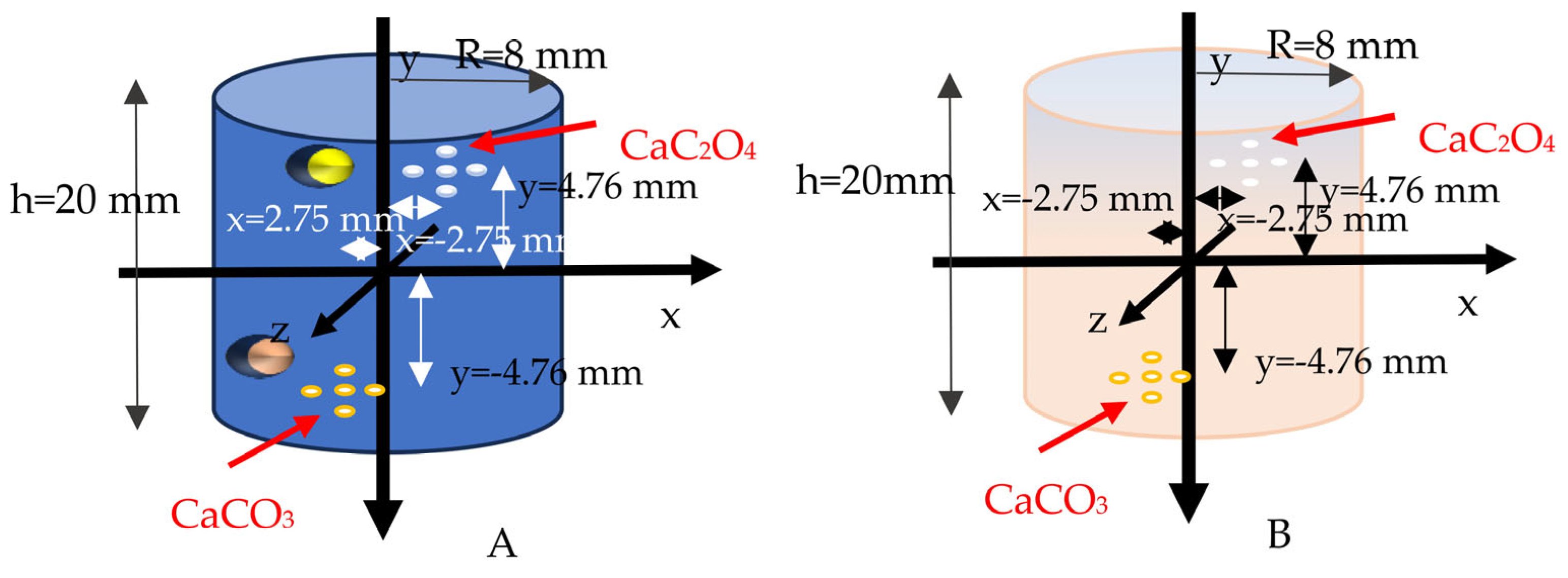
In order to evaluate the seven different detection schemes, four phantoms of different geometry, containing microcalcifications, were simulated. Phantom I and II were simulated containing microcalcifications of Type I. Phantom I consisted of water, one sphere of bone, one sphere of PVC, a cluster of CaCO3 and a cluster of CaC2O4, simulating the case of dense breast tissue (Figure 1A). Phantom II consists of normal breast tissue (Figure 1B).
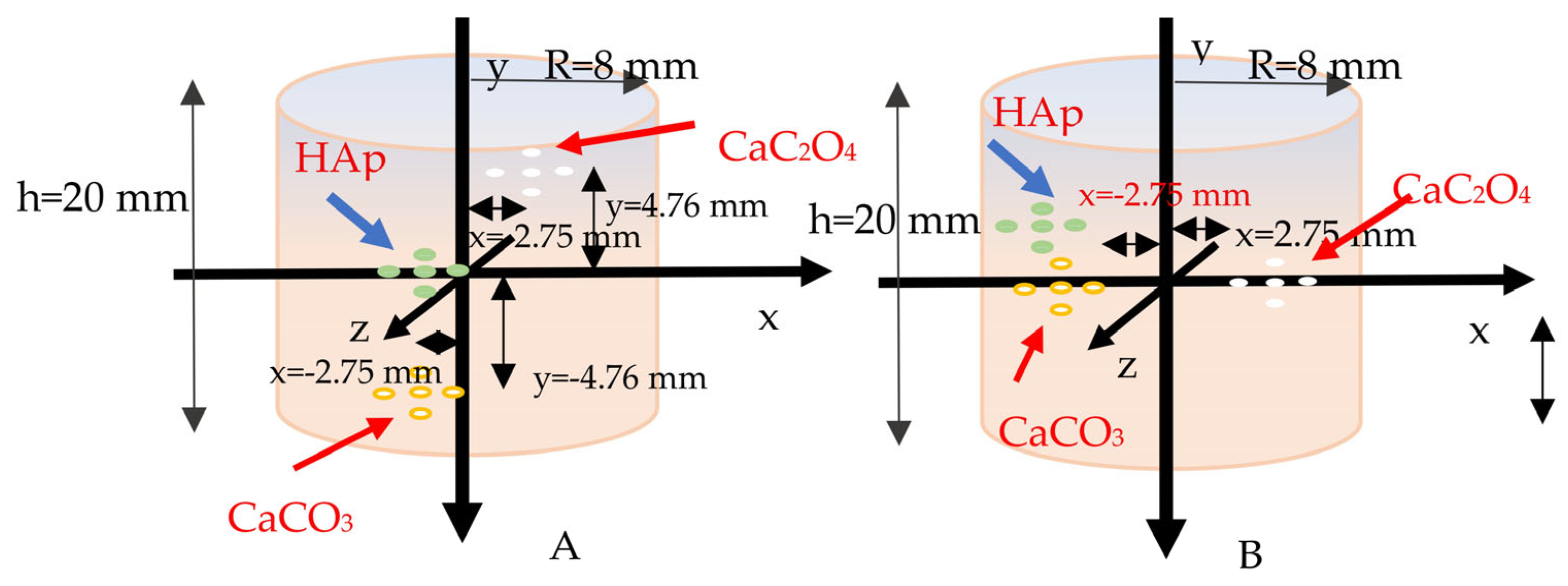
Two additional phantoms (phantom III and IV) were also simulated consisting of normal breast tissue and both types of microcalcifications. These phantoms also contained HAp that belongs to type II microcalcifications. It is a dense material that also contains phosphorus and absorbs high photon energies between 25 and 40 keV [11]. The phantoms are presented in Figure 2.

2.3. Dual-Energy Methodology

Dual energy was applied by acquiring two data sets at a low (25 keV) and a high (40 keV) energy spectrum. A 0.05 mm-thick rhodium (Rh) filter was used for the low energy window of 25 keV, whereas a 1 mm-thick aluminum (Al) filter was used for data acquisition at 40 keV. These filters reshape the X-ray energy spectrum by hardening the X-ray beam and stabilizing the spectra around 25 and 40 keV. At the same time they provide good energy separation which leads to very good material decomposition. Dual energy was applied according to [12].

2.4. Data Processing

Data were presented for planar and tomographic images. Tomographic images were reconstructed with a filtered back-projection (FBP) algorithm [13], requiring short reconstruction times and providing a straightforward analytical reconstruction solution. FBP was applied using a Hamming window for filtering sinogram data before back-projecting them to the image space and bilinear interpolation. Data were also reconstructed with an ordered subset expectation maximization algorithm (OSEM) [14] using 24 subsets and 1 iteration. A system matrix was implemented as presented in [15]. OSEM is the most popular iterative image reconstruction solution. It is based on a maximum likelihood maximization approach by assuming that the collected data follow Poisson’s statistics. In the case of FBP, dual energy was assessed on image levels while for OSEM the dual-energy technique was addressed on the sinogram domain.

2.5. Image Quality Metrics

The CNR metric was chosen to assess image quality. Local CNRs around the microcalcification area were calculated according to [15].

2.6. Sensitivity Analysis

In order to validate result robustness against simulation uncertainties, a sensitivity analysis was performed. Data in the sinogram domain was injected by Poisson’s counting noise (quantum noise) and additive Gaussian noise (similar to electronic and readout noise). Four different Poisson’s noise levels were used; namely the Poisson scaling factor values were 0.25, 0.5, 1 and 2. Gaussian fraction-level values in relation to mean blank sinograms were 0.0005, 0.001, 0.0015, and 0.002. For each scenario, 30 Monte Carlo realizations were used.

3. Results

3.1. Planar Images

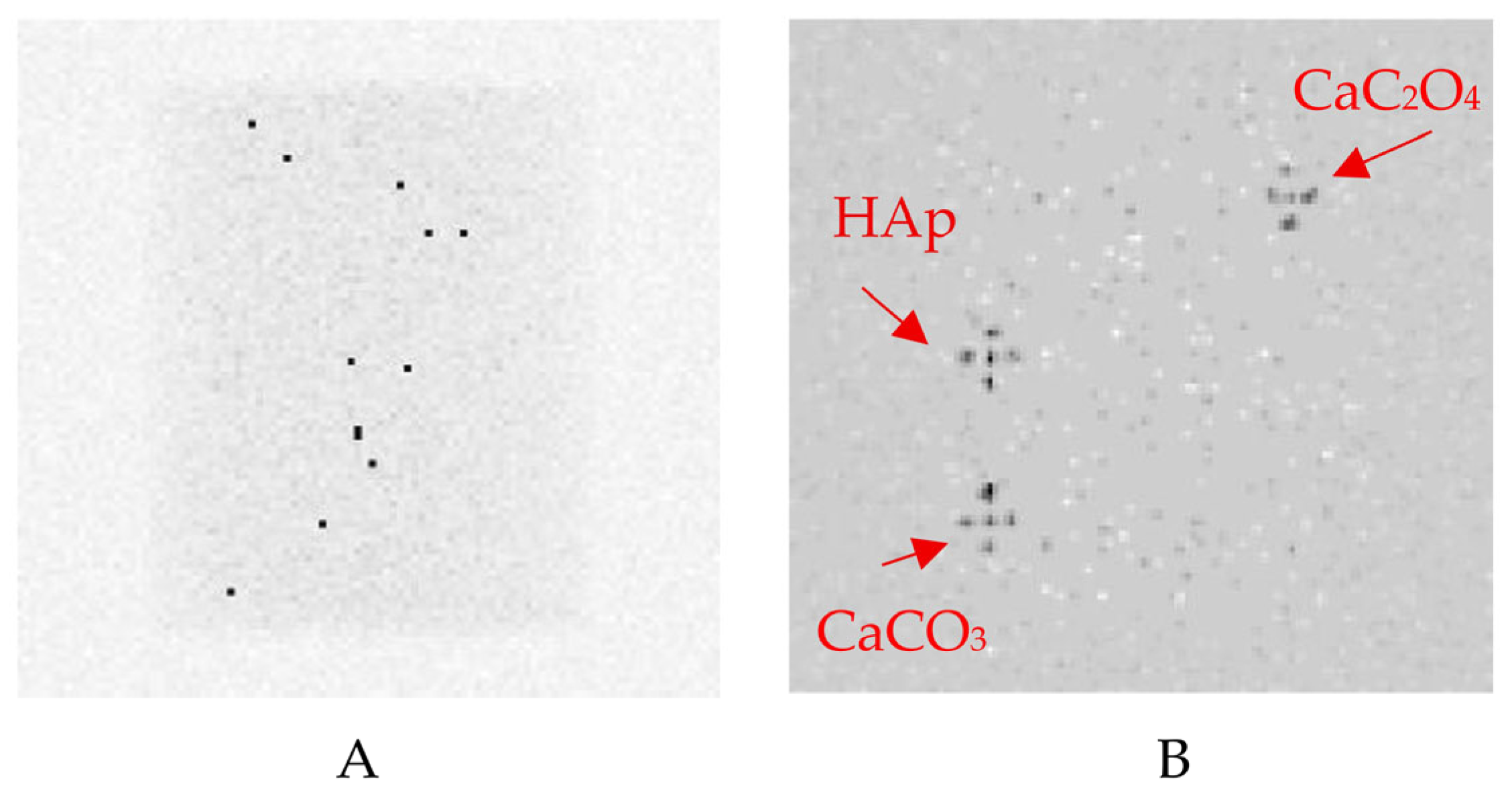
Figure 3 shows the application of the dual-energy methodology on phantom III. On the left, a planar phantom image is presented, acquired at 40 keV without the application of the dual-energy technique. Microcalcifications cannot be visible nor distinguished and no reliable CNRs can be extracted. On the right of Figure 3, the phantom III planar image is shown after the application of the dual-energy technique. Microcalcifications are enhanced and are clearly visible. Figure 3 is an example of data acquisition using the GAGG scintillator.
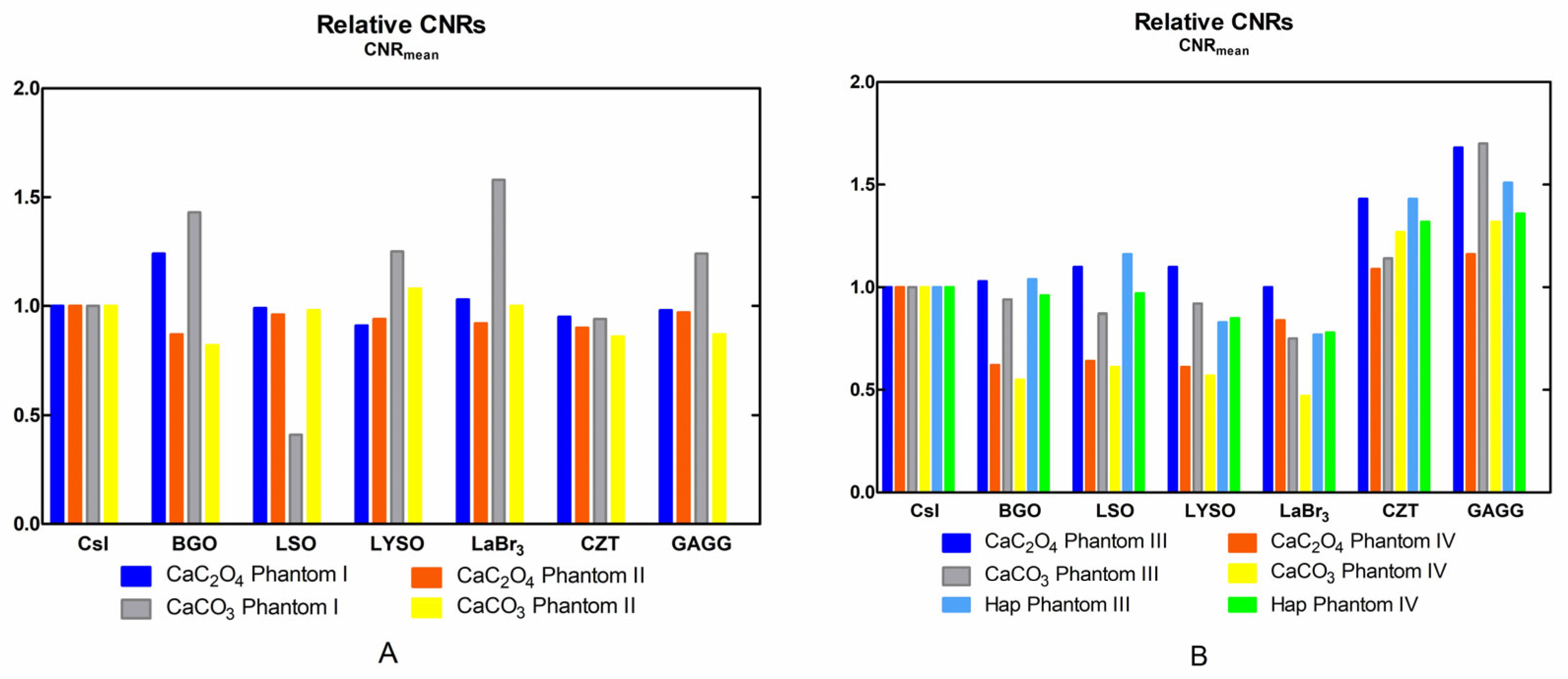
The relative microcalcification CNRs in the planar views accompanied by the dual-energy methodology are presented in Figure 4A for both phantom I and phantom II. The relative CNRs of the microcalcifications in the planar images using the dual-energy methodology are presented in Figure 4B for both phantom III and phantom IV.
As can be seen from Figure 4A GAGG presents the most consistent relative CNR values for both CaC2O4 and CaCO3 microcalcifications in comparison to CsI and shows an improvement between 1.02 and 1.3. LaBr3 shows also increased relative CNR values. From Figure 4B it is obvious that GAGG and CZT show the largest relative CNR values in relation to CsI detector material. The differences are on the order of 1.4–1.7.

3.2. Tomographic Data

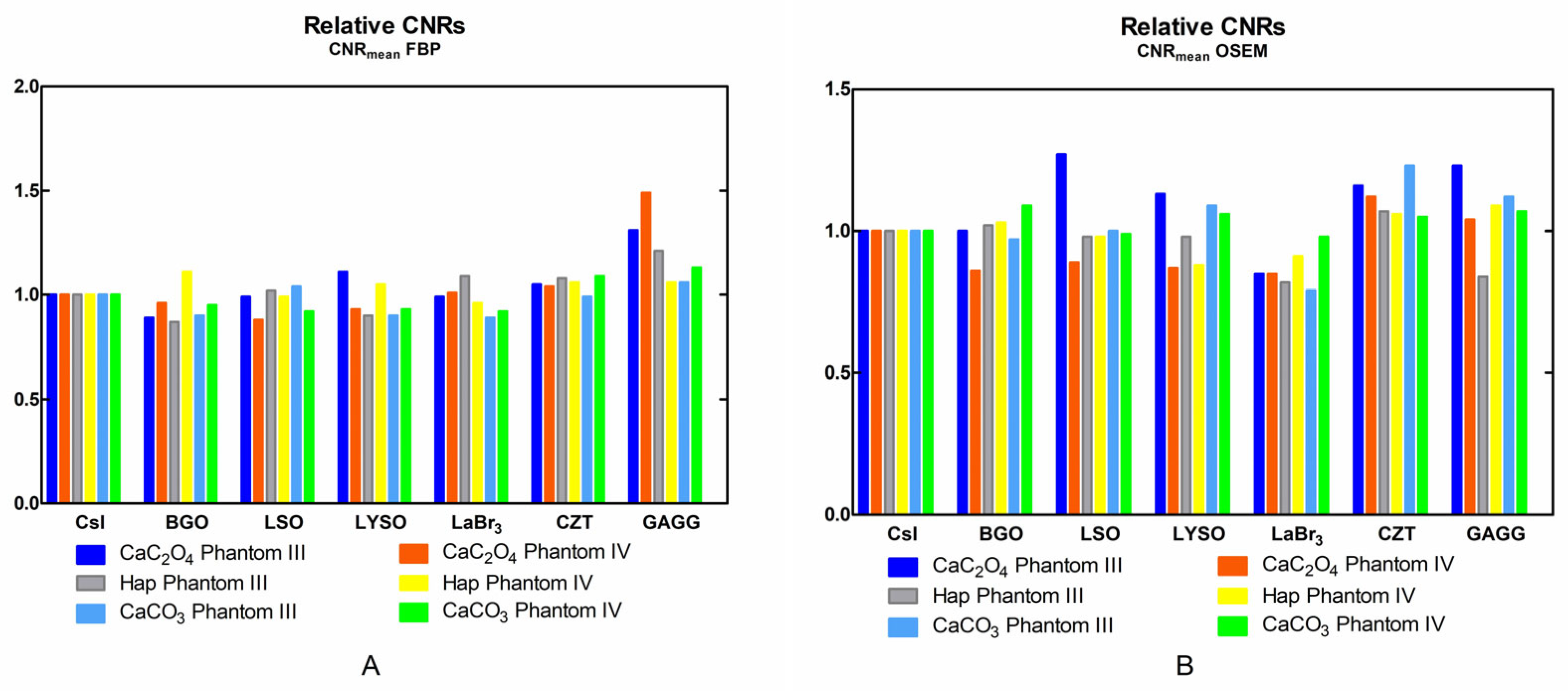
The relative CNRs for the microcalcifications in the FBP tomographic images using the dual-energy methodology are presented in Figure 5A for both phantom III and phantom IV. The relative CNRs of microcalcifications in tomographic mode after applying the dual-energy technique and OSEM reconstruction for the same phantoms are shown in Figure 5B. Again, GAGG’s and CZT’s outperformance is obvious in both Figure 5A,B.

3.3. Polyenergetic Model

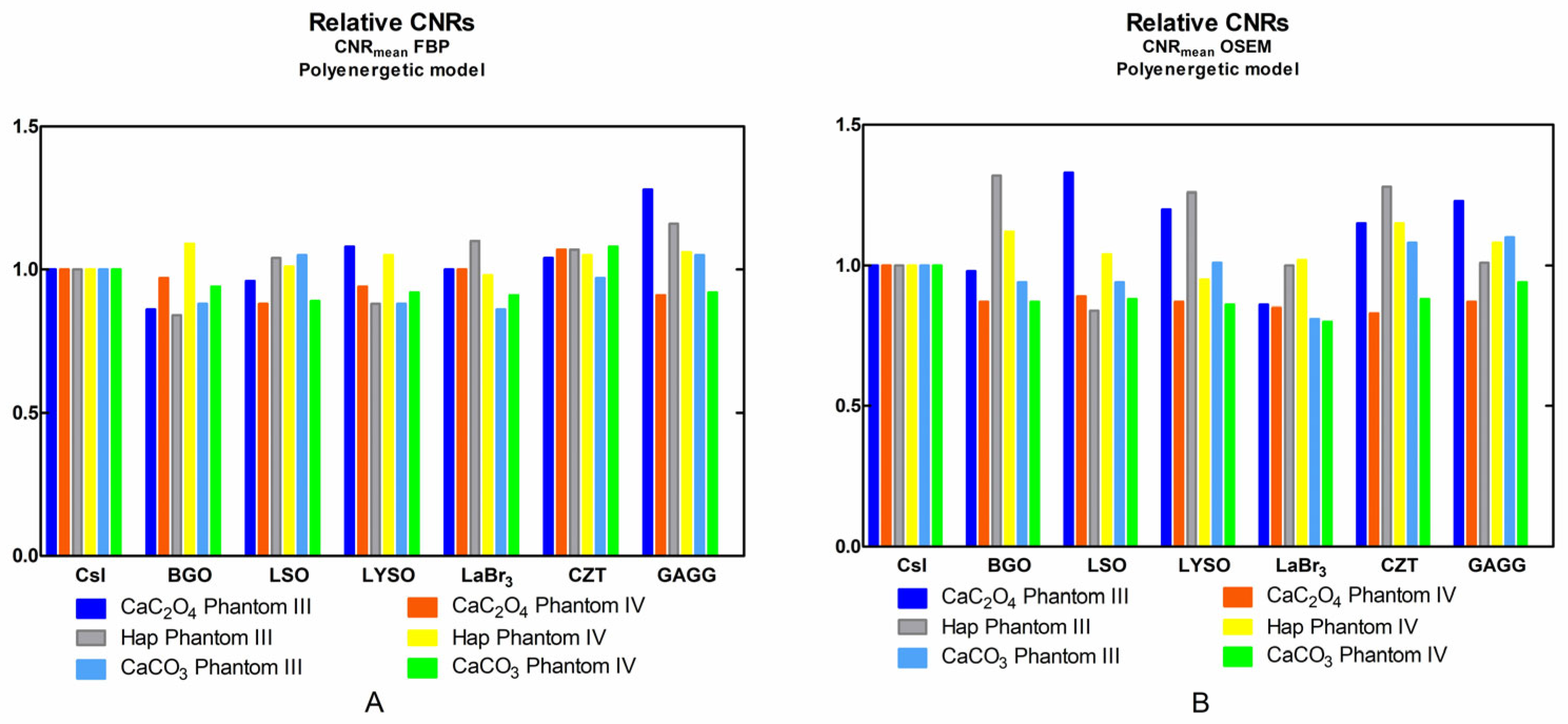
The relative CNRs for the microcalcifications in the tomographic images accompanied by the dual-energy methodology following the polyenergetic model for FBP are presented in Figure 6A for both phantom III and phantom IV. The results of OSEM reconstruction for the same phantoms for the polyenergetic case are shown in Figure 6B. No differences are observed as far as GAGG’s and CZT’s relative CNR values are concerned, which are still the largest for all types of microcalcifications.

3.4. Sensitivity Analysis

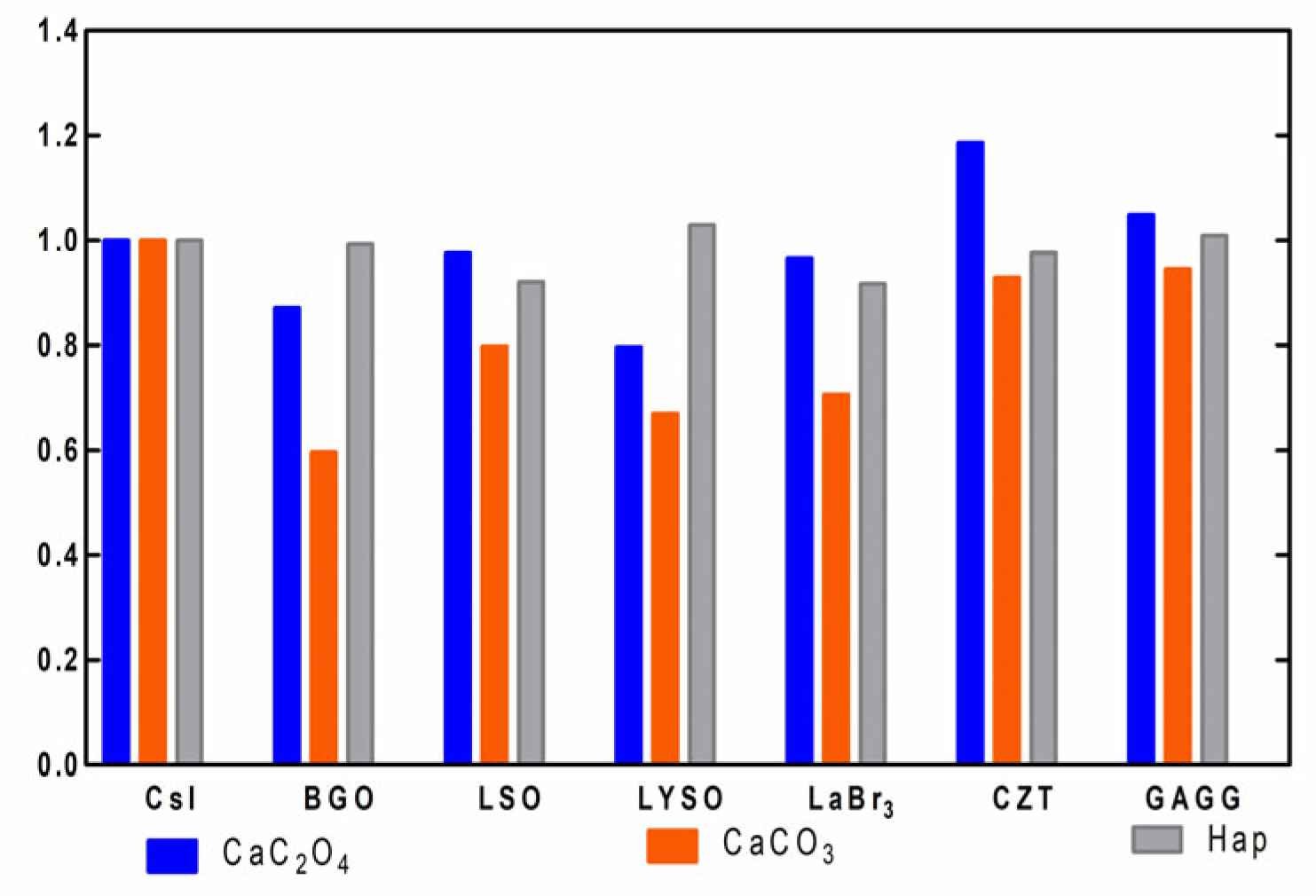
In Figure 7, the mean relative CNR values for the 16 injected noise scenarios are presented for phantom IV. As is depicted, the GAGG and CZT detector materials maintain a consistently high mean relative CNR in relation to the CsI crystal. The rest of the results show a similar behavior.

4. Discussion

The GAGG scintillator presents high relative CNR values, higher than those of the CsI scintillator (Figure 4, Figure 5 and Figure 6). GAGG is advantageous when it is coupled to SiPMs. The CZT semiconductor also provides satisfactory CNRs. CZT and GAGG present on average relative CNR values between 1.17 and 1.15 for the monoenergetic application and 1.13 and 1.08 for the polyenergetic model, respectively, as far as HAp detection is concerned. Both CZT and GAGG materials present an 8–17% increase in HAp-CNR values in comparison to CsI. These materials present a superior stopping power, energy resolution and light yield, and are an excellent alternative to the CsI scintillator [6,7]. These properties not only improve image quality but also enable potential radiation dose reduction (17–24%), since an equivalent diagnostic performance can be achieved with lower exposure levels.
The water phantom exhibits a higher mean density than the breast tissue phantom due to the inclusion of plastic and bone-equivalent spheres. Consequently, microcalcifications are located near structures of similar density, as occurs in dense breasts.
Nevertheless, the application of the dual-energy technique results in images in which the microcalcifications are clearly visible and distinguishable.
Between CaC2O4, CaCO3 and HAp, discrimination could be achieved by classifying structures according to their contrast-to-noise ratios when dual energy is applied. HAp exhibits a higher X-ray attenuation coefficient, thus absorbing a greater proportion of X-ray photons, which provides satisfactory spatial discrimination and higher contrast-to-noise ratios in imaging. Furthermore, HAp has a higher density (3.18 g/cm3 and a molecular weight of 1004.6 g/mol) [11].
The study of the polyenergetic model led to similar conclusions (Figure 6), as far as the materials under investigation were concerned. CZT and GAGG crystals presented the highest relative microcalcification CNRs.
At the same time, photon-counting detector technology can be used, requiring only a single data acquisition, without any additional radiation dose to the examined area, since it allows the use of two or more energy discriminators [16].
GATE is a Monte Carlo platform based on the GEANT 4 physics engine. It is suitable for medical imaging system simulation (PET (Positron Emission Tomography), SPECT (Single Photon Emission Tomography) and CT). It has been widely validated as far as photon transport and detector response is concerned, with real clinical and experimental systems [17,18,19]. In this study the micro CBCT system simulation is supported by Poisson’s counting statistics modeling, detector energy blurring and a threshold of 10keV at the discriminator. The sensitivity analysis followed in order to demonstrate the stability of the results and verified that GAGG and CZT detector materials tend to present high mean relative CNR values in comparison to CsI. Although synthetic noise perturbation is applied, this simulation assesses a realistic scenario.

5. Conclusions

In conclusion, denser materials of a higher atomic number than CsI can improve imaging performance in CBCT imaging systems. GAGG and CZT stand as excellent alternatives. They both present increased CNR values compared to CsI which indicates that a detector technology based on these materials could also lead to patient dose decrease, while preserving the imaging performance at similar levels to that of CsI.

Author Contributions

Conceptualization, E.K. and C.M.; data curation, E.K., C.M., N.K., G.F. and I.V.; formal analysis, E.K., C.M., N.K., G.F. and I.V.; investigation, E.K., C.M., N.K., G.F. and I.V.; methodology, E.K., C.M., N.K., G.F. and I.V.; project administration, C.M. and I.V.; resources, C.M., G.F. and I.V.; software, E.K.; validation, C.M., N.K., G.F. and I.V.; visualization, E.K., C.M. and I.V.; writing—original draft, E.K., C.M., N.K., G.F. and I.V.; writing—review and editing, E.K., C.M., N.K., G.F. and I.V. All authors have read and agreed to the published version of the manuscript.

Funding

This research received no external funding.

Institutional Review Board Statement

Not applicable.

Informed Consent Statement

Not applicable.

Data Availability Statement

The data are contained within this article.

Conflicts of Interest

The authors declare no conflicts of interest.

Abbreviations

The following abbreviations were used in this manuscript:
CBCTCone beam computed tomography
CNRContrast-to-noise ratio
FBPFiltered back-projection algorithm
OSEMOrdered subsets expectation maximization algorithm
GATEGEANT4 application for tomographic emission

References

  1. Logullo, A.F.; Prigenzi, K.C.; Nimir, C.C.; Franco, A.F.; Campos, M.S. Breast microcalcifications: Past, present and future (Review). Mol. Clin. Oncol. 2022, 16, 1–8. [Google Scholar] [CrossRef] [PubMed]
  2. Beremauro, S.; Girio-Fragkoulakis, C. Imaging techniques in breast cancer. Surgery 2024, 42, 875–883. [Google Scholar] [CrossRef]
  3. O’Connell, A.M.; Marini, T.J.; Kawakyu-O’Connor, D.T. Cone-Beam Breast Computed Tomography: Time for a New Paradigm in Breast Imaging. J. Clin. Med. 2021, 10, 5135. [Google Scholar] [CrossRef] [PubMed]
  4. Sajja, S.; Lee, Y.; Eriksson, M.; Nordström, H.; Sahgal, A.; Hashemi, M.; Mainprize, J.G.; Ruschin, M. Technical Principles of Dual-Energy Cone Beam Computed Tomography and Clinical Applications for Radiation Therapy. Adv. Radiat. Oncol. 2020, 5, 1–16. [Google Scholar] [CrossRef] [PubMed]
  5. Greffier, J.; Viry, A.; Robert, A.; Khorsi, M.; Si-Mohamed, S. Photon-counting CT systems: A technical review of current clinical possibilities. Diagn. Interv. Imaging 2024, 106, 53–59. [Google Scholar] [CrossRef]
  6. Michail, C.; Liaparinos, P.; Kalyvas, N.; Kandarakis, I.; Fountos, G.; Valais, I. Phosphors and Scintillators in Biomedical Imaging. Crystals 2024, 14, 169. [Google Scholar] [CrossRef]
  7. Berg, E.; Cherry, S.R. Innovations in Instrumentation for Positron Emission Tomography. Semin. Nucl. Med. 2018, 48, 311–331. [Google Scholar] [CrossRef]
  8. Dujardin, C.; Auffray, E.; Bourret-Courchesne, E.; Dorenbos, P.; Lecoq, P.; Nikl, M.; Vasil’EV, A.N.; Yoshikawa, A.; Zhu, R.-Y. Needs, Trends, and Advances in Inorganic Scintillators. IEEE Trans. Nucl. Sci. 2018, 65, 1977–1997. [Google Scholar] [CrossRef]
  9. Taguchi, K.; Iwanczyk, J.S. Vision 20/20: Single photon counting X-ray detectors in medical imaging. Med. Phys. 2013, 40, 100901. [Google Scholar] [CrossRef] [PubMed]
  10. OpenGATE Collaboration. GATE Documentation—GAM Documentation. Available online: https://opengate.readthedocs.io/_/downloads/en/v9.0/pdf/ (accessed on 7 June 2025).
  11. Martini, N.; Koukou, V.; Michail, C.; Fountos, G. Dual Energy X-ray Methods for the Characterization, Quantification and Imaging of Calcification Minerals and Masses in Breast. Crystals 2020, 10, 198. [Google Scholar] [CrossRef]
  12. Karali, E.; Michail, C.; Fountos, G.; Kalyvas, N.; Valais, I. Characterization of Breast Microcalcifications Using Dual-Energy CBCT: Impact of Detector Configuration on Imaging Performance—A Simulation Study. Sensors 2025, 25, 6853. [Google Scholar] [CrossRef] [PubMed]
  13. Herman, G.T. Image Reconstruction from Projections: The Fundamentals of Computed Tomography; Academic Press: New York, NY, USA, 1980. [Google Scholar]
  14. Hudson, H.M.; Larkin, R.S. Accelerated image reconstruction using ordered subsets of projection data. IEEE Trans. Med. Imaging 1994, 13, 601–609. [Google Scholar] [CrossRef] [PubMed]
  15. Karali, E.; Michail, C.; Fountos, G.; Kalyvas, N.; Valais, I. Novel Detector Configurations in Cone-Beam CT Systems: A Simulation Study. Crystals 2024, 14, 416. [Google Scholar] [CrossRef]
  16. Nakamura, Y.; Higaki, T.; Kondo, S.; Kawashita, I.; Takahashi, I.; Awai, K. An introduction to photon-counting detector CT (PCD CT) for radiologists. Jpn. J. Radiol. 2022, 41, 266–282. [Google Scholar] [CrossRef] [PubMed]
  17. Aldahouk, A.W.; Sezdi, M.; Demir, M. Validation of GATE-based Monte Carlo simulation for clinical CT imaging using the Catphan CTP404 phantom. Radiat. Phys. Chem. 2025, 239. [Google Scholar] [CrossRef]
  18. Bretin, F.; Bahri, M.A.; Luxen, A.; Phillips, C.; Plenevaux, A.; Seret, A. Monte Carlo simulations of the dose from imaging with GE eXplore 120 micro-CT using gate. Med. Phys. 2015, 42, 5711–5719. [Google Scholar] [CrossRef] [PubMed]
  19. Chen, Y.; Liu, B.; O’COnnor, J.M.; Didier, C.S.; Glick, S.J. Characterization of scatter in cone-beam CT breast imaging: Comparison of experimental measurements and Monte Carlo simulation. Med. Phys. 2009, 36, 857–869. [Google Scholar] [CrossRef] [PubMed]
Figure 1. (A) Phantom I. (B) Phantom II.
Materproc 26 00012 g001
Figure 2. (A) Phantom III. (B) Breast phantom IV.
Materproc 26 00012 g002
Figure 3. Acquired images with GAGG: planar mode acquisition (A) without dual-energy application; (B) using the “dual-energy” technique for phantom III.
Materproc 26 00012 g003
Figure 4. Relative CNRs of each detector configuration against the CNR values calculated for the dual-energy image extracted from the CsI detection scheme, (A) for phantom I and II; (B) for phantom III and IV.
Materproc 26 00012 g004
Figure 5. Relative CNRs of each detector configuration against the CNRs values calculated for the dual-energy image extracted from the CsI detection scheme. The figure shows results for phantoms III and IV for (A) FBP reconstruction and (B) OSEM reconstruction.
Materproc 26 00012 g005
Figure 6. Relative CNRs of each detector configuration against the CNR values calculated for the dual-energy image extracted from the CsI detection scheme. The figure shows phantoms III and IV and the case of the polyenergetic model (A) for FBP reconstruction and (B) for OSEM reconstruction.
Materproc 26 00012 g006
Figure 7. Mean relative CNRs for each detector material for 16 different noise level scenarios and for phantom IV in planar mode.
Materproc 26 00012 g007
Disclaimer/Publisher’s Note: The statements, opinions and data contained in all publications are solely those of the individual author(s) and contributor(s) and not of MDPI and/or the editor(s). MDPI and/or the editor(s) disclaim responsibility for any injury to people or property resulting from any ideas, methods, instructions or products referred to in the content.