1. Introduction
Iron oxide nanoparticles, particularly hematite (α-Fe
2O
3) and magnetite (Fe
3O
4), are widely utilized due to their chemical stability, optical properties, magnetic behavior, and non-toxicity. Among these, hematite plays a crucial role as an inorganic pigment in paints, coatings, and construction materials, where color stability, corrosion resistance, and environmental safety are essential requirements. Conventional synthesis routes for iron oxide nanoparticles, including chemical precipitation, hydrothermal methods, and thermal decomposition, often involve elevated temperatures, hazardous reducing agents, or complex processing steps, which raise environmental, health, and economic concerns [
1,
2,
3].
Green synthesis strategies based on renewable biological resources have emerged as promising alternatives that align with the principles of sustainable chemistry [
4,
5,
6]. Plant extracts, in particular, offer practical advantages due to their availability, phytochemical diversity, and ability to act simultaneously as reducing and stabilizing agents [
4,
7,
8]. Biomolecules present in plant matrices can facilitate metal ion reduction while providing surface passivation to control particle growth [
9,
10].
Spinacia oleracea (spinach) is a nutrient-rich edible plant containing significant amounts of biomolecules, all of which exhibit strong reducing and antioxidant properties [
9]. Previous studies have reported the synthesis of iron oxide nanoparticles using plant extracts and other eco-friendly routes, primarily exploring antimicrobial or physicochemical behavior [
11,
12,
13,
14]. However, many reported routes involve additional processing steps or focus on functional testing rather than application-driven material suitability.
In the present work, a simplified plant-mediated synthesis of hematite nanoparticles using Spinacia oleracea extract is revisited, with a specific focus on pigment-relevant characteristics. The study emphasizes ambient-condition processing, phase purity without post-synthesis calcination, and particle dimensions suitable for dispersion in paint and coating formulations. By framing the synthesis from an application-oriented perspective, this work contributes to the development of sustainable and environmentally compatible routes for iron oxide pigment production.
2. Materials and Methods
2.1. Materials
Fresh spinach (Spinacia oleracea) leaves were procured from a local market. Ferric chloride hexahydrate (FeCl3·6H2O, analytical grade) was obtained from Sigma-Aldrich (Merck KGaA, Darmstadt, Germany) and used without further purification. Deionized water was used throughout the experiments.
2.2. Preparation of Spinach Extract
Fresh spinach leaves were thoroughly washed with deionized water to remove surface contaminants and subsequently chopped into small pieces. The leaves were oven-dried at 70 °C for 8 h to eliminate residual moisture and then ground into a fine powder using a laboratory ball mill (MM 500 Control, Retsch GmbH, Haan, Germany) with stainless-steel balls (5 mm diameter).
For extract preparation, 10 g of spinach powder was mixed with 100 mL of deionized water and heated at 80 °C for 30 min under continuous stirring. The mixture was cooled to room temperature and filtered through Whatman No. 1 filter paper Sigma-Aldrich (Merck KGaA, Darmstadt, Germany) to remove insoluble residues. The resulting aqueous extract was stored at 4 °C and used within 24 h to preserve phytochemical activity.
2.3. Green Synthesis of Iron Oxide Nanoparticles
An aqueous 0.1 M FeCl3 solution was mixed with the spinach extract in a 1:1 volume ratio under constant stirring at room temperature. The reaction mixture exhibited a gradual color change from yellowish-brown to reddish-brown, indicating the reduction of ferric ions and the formation of iron oxide nanoparticles. Stirring was continued for 3 h to ensure reaction completion. The product was separated by centrifugation at 8000 rpm for 10 min, washed repeatedly with deionized water and ethanol (Sigma-Aldrich Merck KGaA, Darmstadt, Germany), and dried at 80 °C overnight to obtain a fine iron oxide nanoparticle powder.
2.4. Characterization
X-ray diffraction (XRD) analysis was performed using Cu Kα radiation (λ = 1.5406 Å) to determine the crystalline phase and average crystallite size. Transmission electron microscopy (TEM) (JEM-2200FS, JEOL Ltd., Tokyo, Japan) was employed to evaluate particle morphology, size distribution, and dispersion. All measurements were carried out at the CSIR–National Metallurgical Laboratory (NML), Jamshedpur.
3. Results and Characterization
3.1. Visual Observation of Nanoparticle Formation
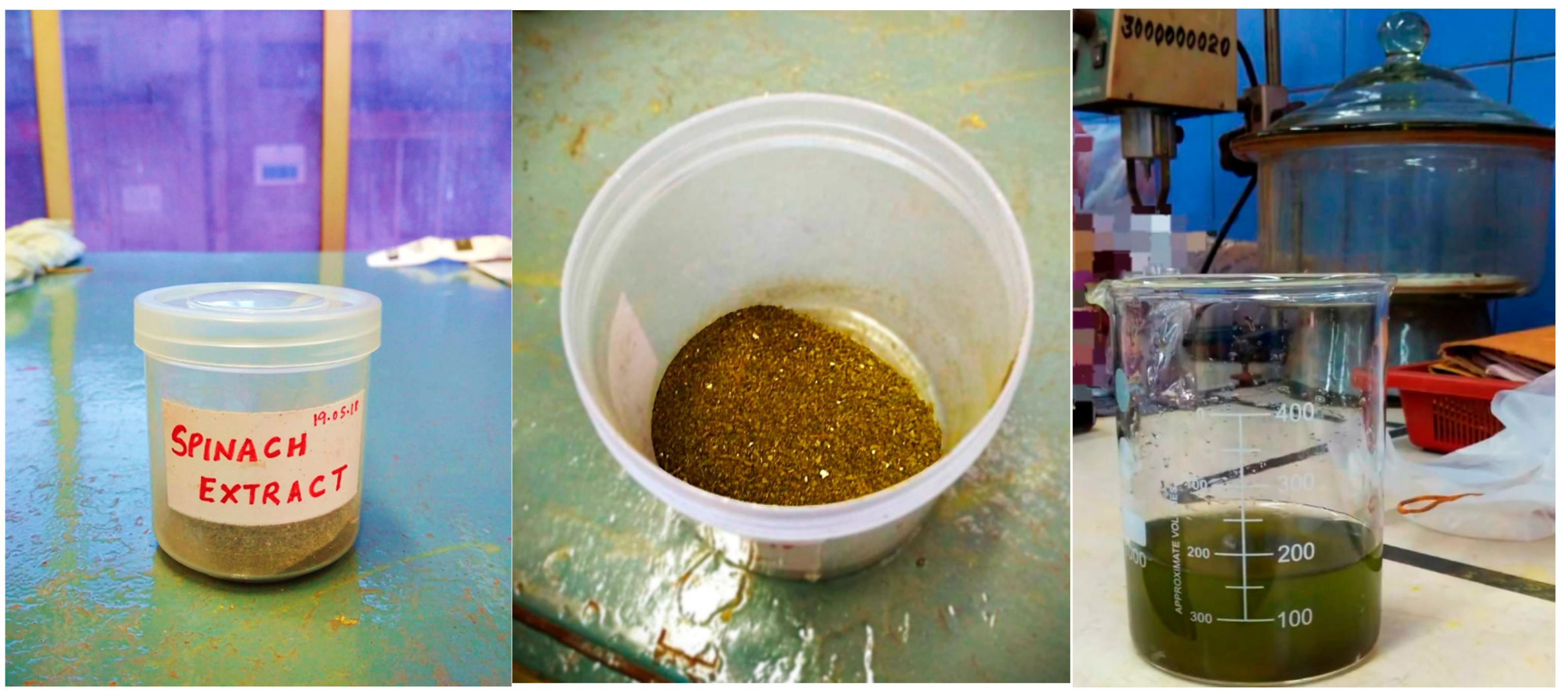
The progression of nanoparticle synthesis was initially assessed through visual observation. Upon mixing the ferric chloride solution with the spinach extract, the reaction mixture gradually changed from light green to reddish-brown (
Figure 1). This color evolution is characteristic of hematite formation and is commonly attributed to surface plasmon-related absorption and nanoparticle nucleation mediated by plant-derived reducing agents. Similar observations have been reported in other plant-assisted iron oxide synthesis studies, supporting the effectiveness of phytochemicals in initiating nanoparticle formation.
3.2. X-Ray Diffraction (XRD)
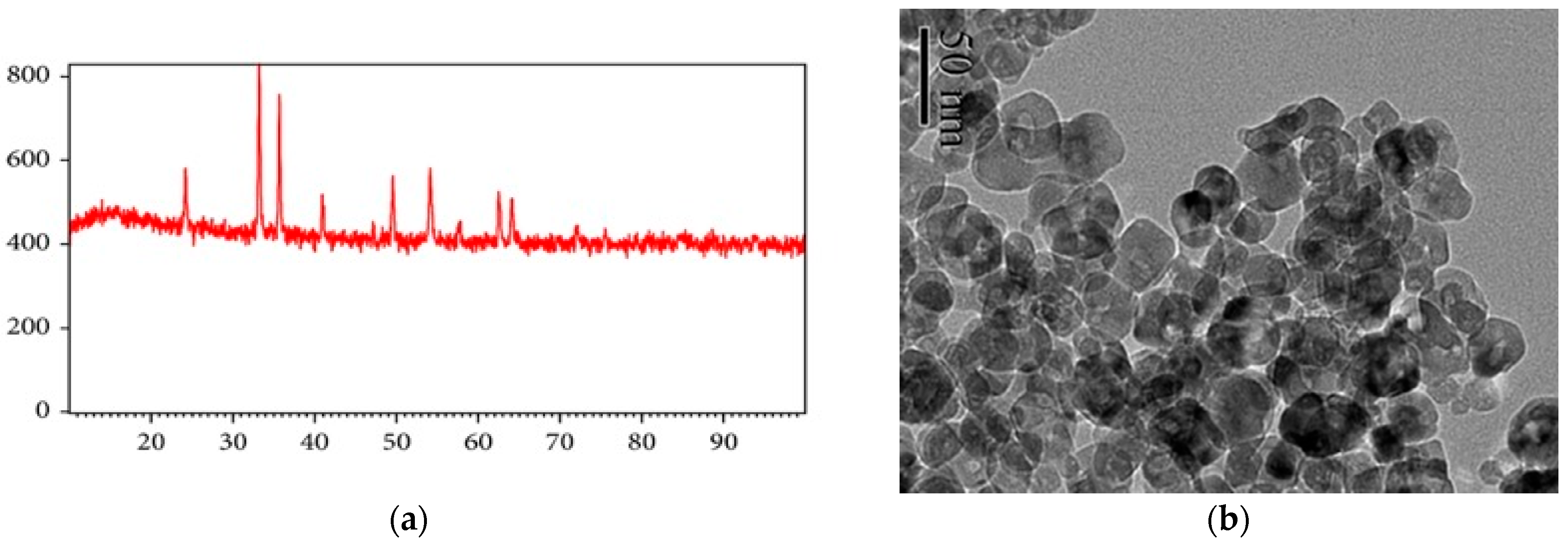
The XRD pattern exhibited distinct peaks corresponding to the crystalline planes of hematite-phase Fe
2O
3. The average crystallite size, calculated using the Debye–Scherrer equation, was found to be approximately 28 nm. The sharp peaks confirmed the high crystallinity of the synthesized nanoparticles (
Figure 2a). The XRD measurements were conducted using a D8 Discover (Bruker AXS GmbH, Karlsruhe, Germany) diffractometer at the CSIR–National Metallurgical Laboratory (NML), Jamshedpur, and the results were generated using their analytical facility.
3.3. Transmission Electron Microscopy (TEM)
TEM images revealed that the particles were predominantly quasi-spherical with a narrow size distribution. The average particle size was estimated to be 20–50 nm, consistent with the XRD results (
Figure 2b). A thin organic coating observed around some particles suggested surface capping by phytochemicals from the spinach extract. The TEM analysis was performed using a JEOL JEM-2200FS transmission electron microscope at the CSIR–National Metallurgical Laboratory (NML), Jamshedpur, and the results were generated utilizing their advanced characterization facility.
4. Discussion
The results confirm that spinach extract acts as both a reducing and stabilizing agent in the synthesis of iron-oxide nanoparticles. The presence of phenolic and ascorbic compounds in the extract facilitates the reduction of Fe3+ ions, while the organic constituents cap the nanoparticles, preventing aggregation.
In comparison with conventional pigment synthesis routes employed in the paint industry, the plant-mediated approach demonstrated here operates under substantially milder conditions and avoids thermal processing. At the same time, it is acknowledged that the reaction time and production efficiency are not comparable to established industrial methods, which are optimized for high throughput. The present work should therefore be regarded as an exploratory study highlighting an alternative synthesis direction rather than an optimized production process.
The results demonstrate that
Spinacia oleracea extract functions effectively as both a reducing and stabilizing agent in the synthesis of hematite nanoparticles. The formation of iron oxide nanoparticles in the present system is likely associated with the collective reducing action of antioxidant biomolecules present in the spinach extract. While specific compounds were not identified experimentally, adsorption of organic species on the particle surface, as observed in TEM images (
Figure 2b), suggests a stabilizing role during nanoparticle growth. Similar behavior has been widely reported in plant-mediated iron oxide synthesis systems.
The present study did not include quantitative yield analysis or systematic control experiments, as the primary objective was to demonstrate the feasibility of iron oxide nanoparticle formation using a plant-based reducing system under mild conditions. While conventional pigment synthesis routes are optimized for yield and process control, plant-mediated approaches remain at an early exploratory stage. Future work will therefore focus on reaction efficiency, control experiments, and scalability to better assess their relevance for pigment applications.
4.1. Suitability for Pigment and Paint Applications
Hematite is widely used as an inorganic pigment due to its color stability, chemical inertness, corrosion resistance, and non-toxicity. For pigment and coating applications, phase purity, particle size, and dispersion behavior are critical parameters influencing color strength and coating performance. The nanoparticles synthesized in this study exhibit high crystallinity and particle dimensions well suited to uniform dispersion in paint matrices.
The use of an edible plant extract and aqueous processing enhances the environmental and occupational safety of the synthesis route, aligning with sustainability goals in the pigment and coating industries. Furthermore, the low-temperature, solution-based nature of the process supports its adaptability to scalable and decentralized manufacturing settings.
4.2. Limitations and Outlook
A limitation of the present approach is the relatively low nanoparticle yield per batch, primarily due to the dilute nature of the plant extract and the mild reaction conditions employed. While this may restrict immediate large-scale production, it does not undermine the relevance of the method for specialty pigment applications, laboratory-scale synthesis, or eco-sensitive formulations. Future optimization strategies, such as extract concentration tuning, should be addressed in subsequent studies.
5. Conclusions
This study demonstrates a sustainable, plant-mediated route for the synthesis of hematite nanoparticles using Spinacia oleracea leaf extract. The method produces phase-pure, quasi-spherical nanoparticles with sizes in the range of 20–50 nm under ambient conditions, without the use of toxic chemicals or high-energy inputs. Although the yield per batch is modest, the simplicity, environmental compatibility, and pigment-relevant properties of the synthesized nanoparticles make this approach promising for sustainable pigment and coating applications. With further process optimization, this method could contribute meaningfully to eco-friendly iron oxide pigment production.
Author Contributions
Conceptualization, A.S. and V.K.M.; methodology, A.S. and V.K.M.; validation, A.S. and V.K.M.; formal analysis, A.S. and V.K.M.; investigation, A.S. and V.K.M.; data curation, A.S. and V.K.M.; writing—original draft preparation, A.S. and V.K.M.; writing—review and editing, A.S. and V.K.M.; visualization, A.S. and V.K.M. All authors have read and agreed to the published version of the manuscript.
Funding
This research received no external funding.
Institutional Review Board Statement
Not applicable.
Informed Consent Statement
Not applicable.
Data Availability Statement
All data generated or analyzed during this study are included in this published article.
Acknowledgments
The authors acknowledge CSIR NML, Jamshedpur, Tata Pigments Pvt. Ltd., and the Department of Nanotechnology, Central University of Jharkhand, for providing laboratory support and instrumentation facilities.
Conflicts of Interest
The authors declare no conflicts of interest.
References
- Kim, S.; Jeong, J.; Lee, S.; Sung, J.; Song, K.S.; Cho, W.-S. Inhalation toxicity, pulmonary clearance, and biotransformation of ferric oxide nanoparticles in rats. Part. Fibre Toxicol. 2026, 23, 3. [Google Scholar] [CrossRef] [PubMed]
- Ali, A.; Zafar, H.; Zia, M.; ul Haq, I.; Phull, A.R.; Ali, J.S.; Hussain, A. Synthesis, characterization, applications, and challenges of iron oxide nanoparticles. Nanotechnol. Sci. Appl. 2016, 9, 49–67. [Google Scholar] [CrossRef] [PubMed]
- Huber, D.L. Synthesis, Properties, and Applications of Iron Nanoparticles. Small 2005, 1, 482–501. [Google Scholar] [CrossRef] [PubMed]
- Priya; Naveen; Kaur, K.; Sidhu, A.K. Green Synthesis: An Eco-friendly Route for the Synthesis of Iron Oxide Nanoparticles. Front. Nanotechnol. 2021, 3, 655062. [Google Scholar] [CrossRef]
- Iqbal, F.; Naveed, M.; Aziz, T.; ur Rehman, S.; Makhdoom, S.I.; Waseem, M.; Alwutayd, K.M.; Shami, A.; Al-Asmari, F.; Alsulami, S.O.; et al. Molecular characterization and green synthesis of iron oxide nanoparticles from Bacillus amyloliquefaciens for efficient degradation of textile dyes. AATCC J. Res. 2026, 13, 24723444251396587. [Google Scholar] [CrossRef]
- El Ouardy, K.; Akhrouf, A.; Faik, A.; Mir, Y. Green synthesis of metal and metal oxide nanoparticles: A pathway to sustainable energy and sensing applications. Nanotechnol. Rev. 2026, 15, 20250207. [Google Scholar] [CrossRef]
- Buarki, F.; AbuHassan, H.; Al Hannan, F.; Henari, F.Z. Green Synthesis of Iron Oxide Nanoparticles Using Hibiscus rosa sinensis Flowers and Their Antibacterial Activity. J. Nanotechnol. 2022, 2022, 5474645. [Google Scholar] [CrossRef]
- Rajpurohit, R.; Kumar, N.; Chandramore, K.; Kumar, P.; Reddy, K.S. Ecofriendly synthesis of iron nanoparticles and their role in mitigation of multiple abiotic stresses in fish. Sci. Rep. 2026, 16, 3027. [Google Scholar] [CrossRef] [PubMed]
- Fayyaz, B.; Zahra, M.B.; Aftab, Z.-E.-H.; Haider, M.S. Screening of Phenolic Compounds from Spinach (Spinacia oleracea), Green Synthesis of Iron-Nanoparticles and Determination of its Anti-Microbial Effect on Escherichia coli. Res. Sq. 2022. in review. [Google Scholar] [CrossRef]
- Kanagasubbulakshmi, S.; Kadirvelu, K. Green synthesis of Iron oxide nanoparticles using Lagenaria siceraria and evaluation of its Antimicrobial activity. Def. Life Sci. J. 2017, 2, 422–427. [Google Scholar] [CrossRef]
- Macera, L.; Taglieri, G.; Daniele, V.; Passacantando, M.; D’Orazio, F. Nano-Sized Fe(III) Oxide Particles Starting from an Innovative and Eco-Friendly Synthesis Method. Nanomaterials 2020, 10, 323. [Google Scholar] [CrossRef] [PubMed]
- Zúñiga-Miranda, J.; Guerra, J.; Mueller, A.; Mayorga-Ramos, A.; Carrera-Pacheco, S.E.; Barba-Ostria, C.; Heredia-Moya, J.; Guamán, L.P. Iron Oxide Nanoparticles: Green Synthesis and Their Antimicrobial Activity. Nanomaterials 2023, 13, 2919. [Google Scholar] [CrossRef] [PubMed]
- Liu, G.; Gao, J.; Ai, H.; Chen, X. Applications and Potential Toxicity of Magnetic Iron Oxide Nanoparticles. Small 2013, 9, 1533–1545. [Google Scholar] [CrossRef] [PubMed]
- Valdiglesias, V.; Fernández-Bertólez, N.; Kiliç, G.; Costa, C.; Costa, S.; Fraga, S.; Bessa, M.J.; Pásaro, E.; Teixeira, J.P.; Laffon, B. Are iron oxide nanoparticles safe? Current knowledge and future perspectives. J. Trace Elem. Med. Biol. 2016, 38, 53–63. [Google Scholar] [CrossRef] [PubMed]
| Disclaimer/Publisher’s Note: The statements, opinions and data contained in all publications are solely those of the individual author(s) and contributor(s) and not of MDPI and/or the editor(s). MDPI and/or the editor(s) disclaim responsibility for any injury to people or property resulting from any ideas, methods, instructions or products referred to in the content. |
© 2026 by the authors. Licensee MDPI, Basel, Switzerland. This article is an open access article distributed under the terms and conditions of the Creative Commons Attribution (CC BY) license (https://creativecommons.org/licenses/by/4.0/).