
Solubility-Driven Prediction of Electrospun Nanofibers’ Diameters via Generalized Linear Models †
Abstract
1. Introduction
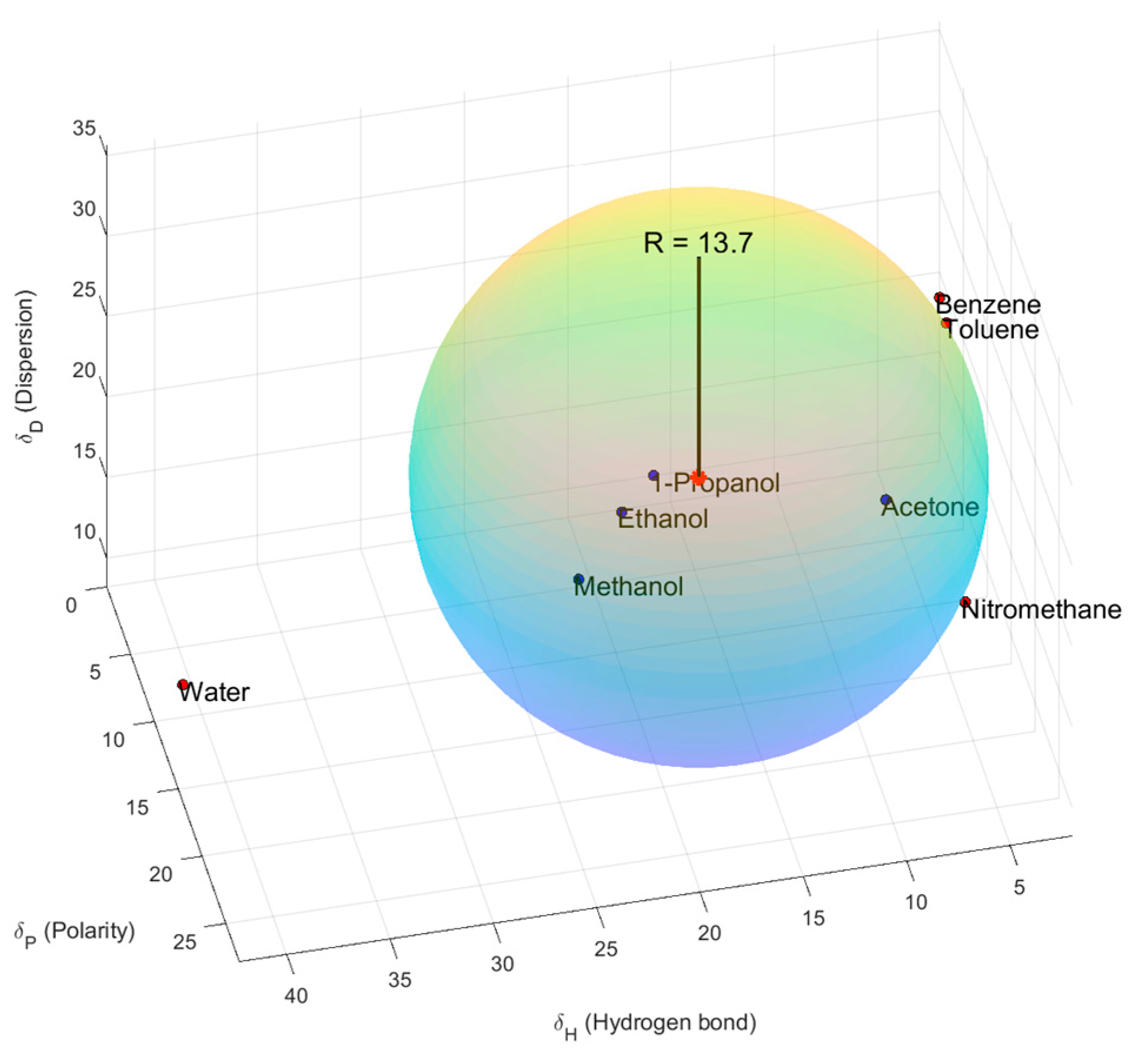
- Ra = three-dimensional distance between solvent–polymer coordinates (MPa1/2).
- = Hansen solubility parameters of the polymer (MPa1/2).
- = Hansen solubility parameters of the solvent (MPa1/2).
- R0 = radius of interaction of the polymer (MPa1/2).
- RED = Relative Energy Difference between the species. Systems with RED ≤ 1 are considered miscible, while RED > 1 are not.
- E[Y] = expected value of Y;
- g() = link function;
- = X = linear predictor.
2. Materials and Methodology
2.1. Data Collection
- = Flory–Huggins parameter;
- = molar volume (cm3/mol);
- Ra = three-dimensional distance between solvent–polymer coordinates (MPa1/2);
- = 1.987 cal/mol K;
- T = temperature (K).
2.2. Materials, Resources, and Process
2.3. Inference Modeling
2.4. Prediction Modeling
2.5. Experimental Testing
3. Results and Discussion
3.1. Inference Modeling
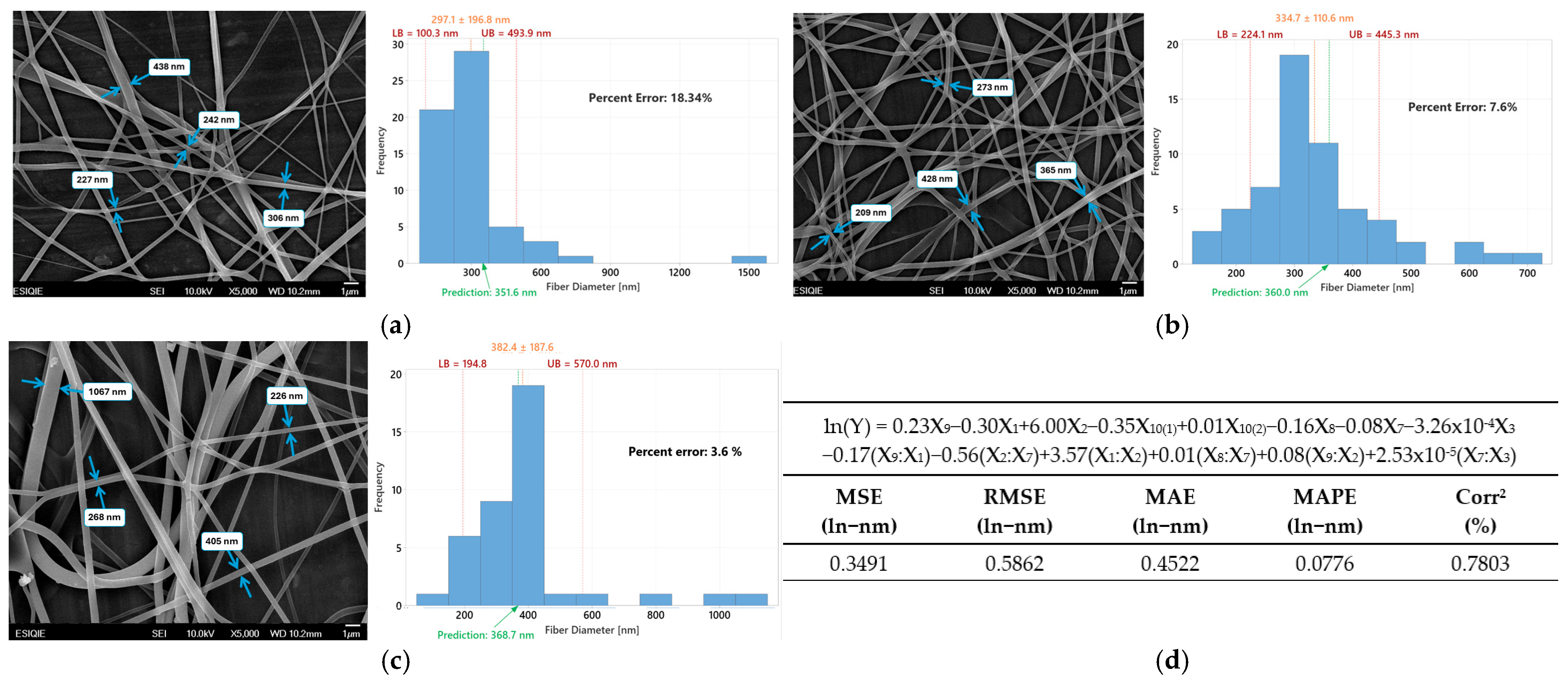
3.2. Prediction Modeling and Experimental Verification
4. Conclusions
Author Contributions
Funding
Institutional Review Board Statement
Informed Consent Statement
Data Availability Statement
Acknowledgments
Conflicts of Interest
Abbreviations
| GLM | Generalized Linear Models |
| AIC | Akaike Information Criteria |
| BIC | Bayesian Information Criteria |
| MSE | Mean Squared Error |
| RMSE | Root Mean Squared Error |
| MAE | Mean Absolute Error |
| MAPE | Mean Absolute Percentage Error |
| RED | Relative Energy Difference |
| PVDF | Polyvinylidene Fluoride |
| GBR | Gradient Boosting Regressor |
| SHAP | SHapley Additive exPlanation |
| ANN | Artificial Neural Network |
| PVA | Polyvinyl alcohol |
| PCL | Polycaprolactone |
| MLE | Maximum Likelihood Estimation |
| OLS | Ordinary Least Squares |
References
- Bhardwaj, N.; Kundu, S.C. Electrospinning: A fascinating fiber fabrication technique. Biotechnol. Adv. 2010, 28, 325–347. [Google Scholar] [CrossRef] [PubMed]
- Francis, L.F. Materials Processing: A Unified Approach to Processing of Metals, Ceramics and Polymers, 1st ed.; Elsevier: Amsterdam, The Netherlands, 2016; Volume 6. [Google Scholar]
- Hansen, C.M. Hansen Solubility Parameters: A User’s Handbook, 1st ed.; CRC Press LLC: New York, NY, USA, 2000. [Google Scholar]
- Hildebrand, J.H.; Scott, R.L. The Solubility of Nonelectrolytes, 3rd ed.; Science: New York, NY, USA, 1950; p. 488. [Google Scholar]
- Loyola-González, O. Black-box vs. white-box: Understanding their advantages and weaknesses from a practical point of view. IEEE Access 2019, 7, 154096–154113. [Google Scholar] [CrossRef]
- Starbuck, C. Linear Regression. In The Fundamentals of People Analytics; Springer: Berlin/Heidelberg, Germany, 2023; pp. 181–206. [Google Scholar]
- Sarma, S.; Verma, A.K.; Phadkule, S.S.; Saharia, M. Towards an interpretable machine learning model for electrospun polyvinylidene fluoride (PVDF) fiber properties. Comput. Mater. Sci. 2022, 213, 111661. [Google Scholar] [CrossRef]
- Golbabaei, M.H.; Varnoosfaderani, M.S.; Hemmati, F.; Barati, M.R.; Pishbin, F.; Ebrahimi, S.A.S. Machine learning-guided morphological property prediction of 2D electrospun scaffolds: The effect of polymer chemical composition and processing parameters. RSC Adv. 2024, 14, 15178–15199. [Google Scholar] [CrossRef] [PubMed]
- Socuéllamos, J.M. Modelos Lineales Generalizados, 1st ed.; Universidad Miguel Hernández: Elche, Spain, 2001; p. 247. [Google Scholar]
- Nelder, J.; Wedderburn, W. Generalized Linear Models. J. R. Stat. Soc. 1972, 135, 370–384. [Google Scholar] [CrossRef]
- Allaire, J.J. R: A Language and Environment for Statistical Computing; R Foundation for Statistical Computing: Vienna, Austria, 2025. [Google Scholar]
- Sakia, R. The Box-Cox Transformation Technique: A Review. J. R. Stat. Soc. 1992, 41, 169–178. [Google Scholar] [CrossRef]



| Link Function | Response Variable Y | Commonly Used Distributions | ||
|---|---|---|---|---|
| Identity | Continuous | Gaussian 1, Poisson, Gamma, Inverse Gaussian | ||
| Log | Continuous | Gaussian, Poisson 2, Gamma, Inverse Gaussian | ||
| Inverse | Continuous | Gaussian, Poisson, Gamma 3, Inverse Gaussian | ||
| Inverse squared | Continuous | Inverse Gaussian 4 | ||
| Square root | Discrete | Poisson | ||
| Logit | Discrete | Bernoulli 5, Binomial 6 | ||
| Probit | Discrete | Bernoulli, Binomial | ||
| Log-Log | Discrete | Bernoulli, Binomial | ||
| C-Log-Log | Discrete | Bernoulli, Binomial |
| Variable | Parameter | Values Range |
|---|---|---|
| Response variable (Y) | Fiber Diameter (nm) | 45.0000–7670.0000 |
| X1 | RED | 0.2416–1.2962 |
| X2 | Flory–Huggins Interaction Parameter (F_H) | 0.0074–0.7752 |
| X3 | Jet speed-Velocity (cm/h) | 6.0172–9417.4520 1 |
| X4 | Temperature (K) | 293.1000–393.1000 |
| X5 | Syringe diameter (cm) | 0.0260–0.4600 |
| X6 | Feed Rate (cm3/h) | 0.1000–12.000 |
| X7 | Distance (cm) | 6.0000–20.0000 |
| X8 | Voltage (kV) | 5.5000–45.0000 |
| X9 | Polymer Concentration (wt%) | 0.1000–22.0000 |
| X10 | Type of electrospinning | 0, 1, 2 2 |
| Library | Function/Syntaxis | Usage |
|---|---|---|
| stats | glm(formula, data, family(“link function”)) 1 | Model training |
| car | residualPlots(model) | Check linearity across X’s |
| glmtoolbox | BoxTidwell(model, transf~variable) | Fix linearity across X’s 2 |
| DHARMa 3 | plot(simulateResiduals(model, seed)) | Check normality of GLM |
| MASS | stepAIC(model, direction = c(“both”), k) 4 | AIC/BIC variable reduction 5 |
| Sample 1 | PVA Concentration (wt%) | HAc 2 Concentration (wt%) | Feed Rate (mL/h) | Voltage (kV) | Distance (cm) |
|---|---|---|---|---|---|
| A | 10.00 | 5.00 | 2.00 | 30.00 | 18.00 |
| B | 10.00 | 5.00 | 2.00 | 25.00 | 18.00 |
| C | 10.00 | 5.00 | 2.00 | 20.00 | 18.00 |
| Material | Description | Chemical Formula |
|---|---|---|
| Deionized water | Barnstead MicroPure ST Thermo Scientific-processed (Waltham, Massachusetts, USA) |  |
| Acetic Acid (HAc) | Reagent Grade (R.G.), Merck (Darmstadt, Germany) |  |
| Polyvinyl Alcohol | R.G., Merck (Darmstadt, Germany) Molecular Weight (M.W.) 89,000–98,000 99+% hydrolyzed |  |
Disclaimer/Publisher’s Note: The statements, opinions and data contained in all publications are solely those of the individual author(s) and contributor(s) and not of MDPI and/or the editor(s). MDPI and/or the editor(s) disclaim responsibility for any injury to people or property resulting from any ideas, methods, instructions or products referred to in the content. |
© 2025 by the authors. Licensee MDPI, Basel, Switzerland. This article is an open access article distributed under the terms and conditions of the Creative Commons Attribution (CC BY) license (https://creativecommons.org/licenses/by/4.0/).
Share and Cite
Pérez-Castillo, M.A.; Caro-Briones, R.; López-González, M.; Martínez-Mejía, G.; Corea, M.; Ruiz-Virgen, L. Solubility-Driven Prediction of Electrospun Nanofibers’ Diameters via Generalized Linear Models. Mater. Proc. 2025, 25, 8. https://doi.org/10.3390/materproc2025025008
Pérez-Castillo MA, Caro-Briones R, López-González M, Martínez-Mejía G, Corea M, Ruiz-Virgen L. Solubility-Driven Prediction of Electrospun Nanofibers’ Diameters via Generalized Linear Models. Materials Proceedings. 2025; 25(1):8. https://doi.org/10.3390/materproc2025025008
Chicago/Turabian StylePérez-Castillo, Marco Antonio, Rubén Caro-Briones, Mariangely López-González, Gabriela Martínez-Mejía, Mónica Corea, and Lazaro Ruiz-Virgen. 2025. "Solubility-Driven Prediction of Electrospun Nanofibers’ Diameters via Generalized Linear Models" Materials Proceedings 25, no. 1: 8. https://doi.org/10.3390/materproc2025025008
APA StylePérez-Castillo, M. A., Caro-Briones, R., López-González, M., Martínez-Mejía, G., Corea, M., & Ruiz-Virgen, L. (2025). Solubility-Driven Prediction of Electrospun Nanofibers’ Diameters via Generalized Linear Models. Materials Proceedings, 25(1), 8. https://doi.org/10.3390/materproc2025025008