Proceeding Paper

ZnO Functional Nanomaterial in Green Microalgae Growth Advancement †

by
Praskoviya Boltovets
1,*,
Sergii Kravchenko
1 and
Viktoriya Petlovana
2
1
Institute of Semiconductor Physics, NASU, 03028 Kyiv, Ukraine
2
Department of Plant Biology, Taras Shevchenko National University of Kyiv, 01033 Kyiv, Ukraine
*
Author to whom correspondence should be addressed.
Presented at the 4th International Electronic Conference on Biosensors, 20–22 May 2024; Available online: https://sciforum.net/event/IECB2024.
Eng. Proc. 2024, 73(1), 3; https://doi.org/10.3390/engproc2024073003

Published: 8 October 2024
(This article belongs to the Proceedings of The 4th International Electronic Conference on Biosensors)

Abstract

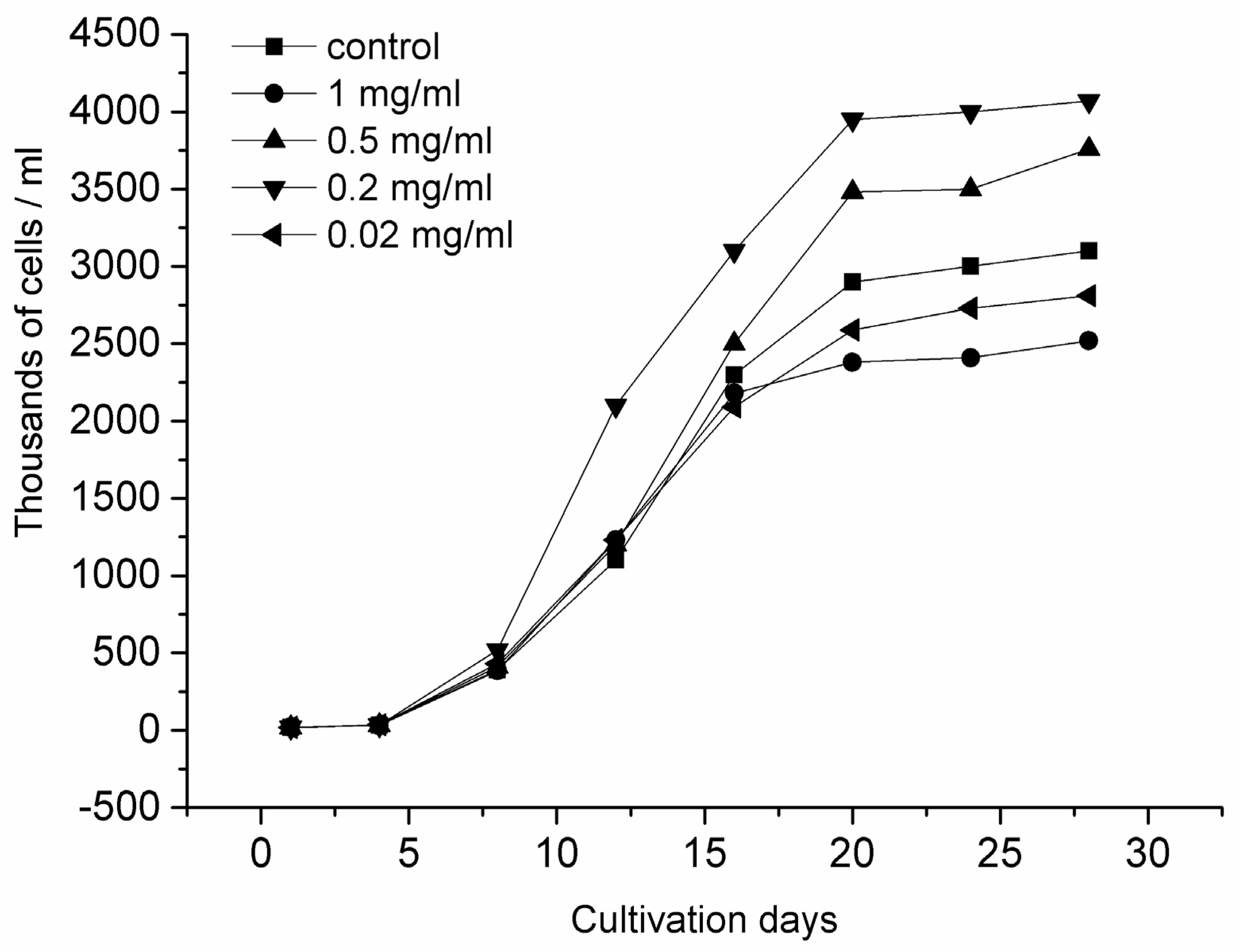
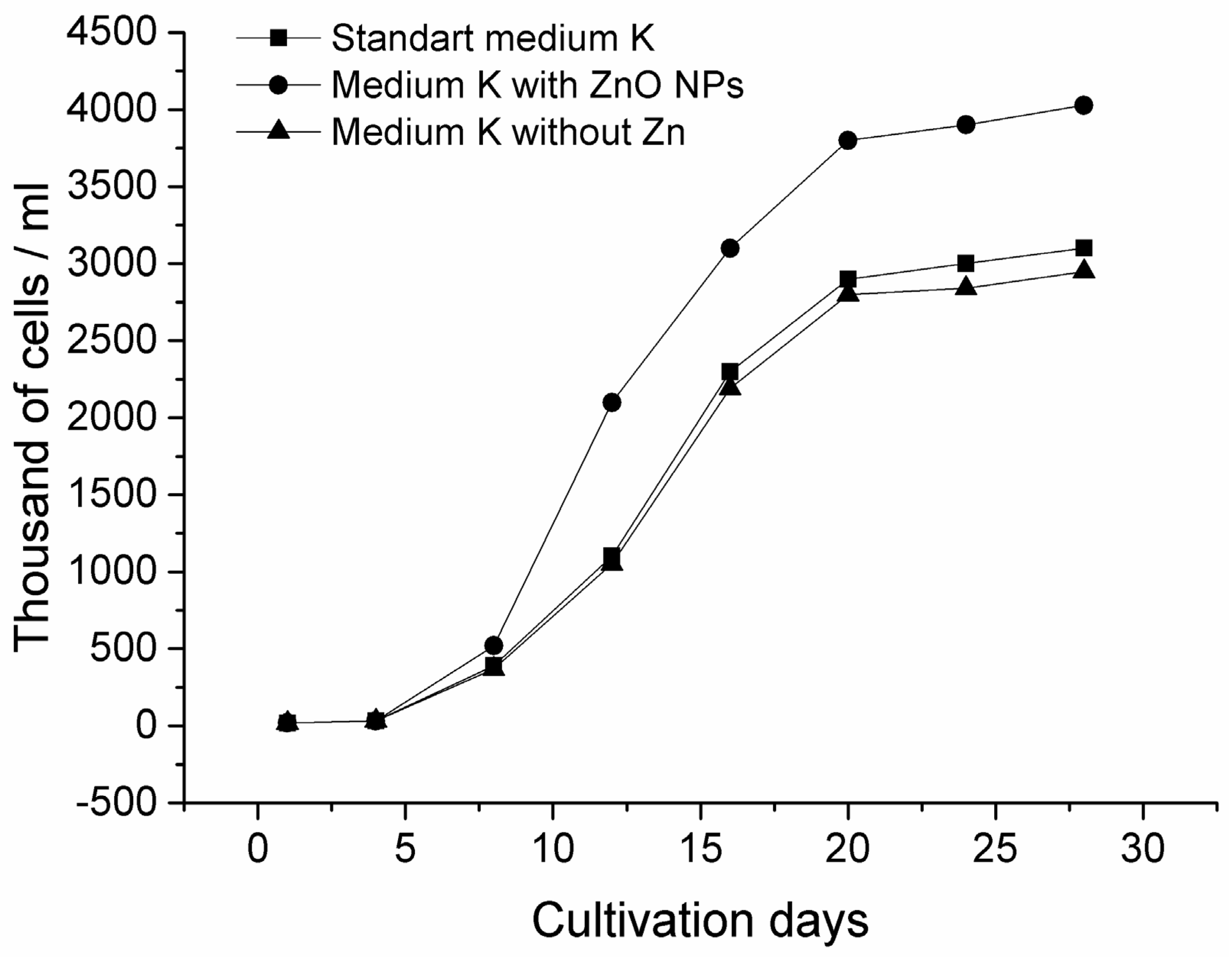
Nanomaterials are substances with unique properties due to the irintrinsic confinement effect and high surface area that have allowed their use in biology and medicine for sensor application. The key feature of nanomaterials in such applications is their ability to providesensitivity enhancement for sensors. On the other hand, nanomaterials possess the ability to change the biological function in cells or tissues; therefore, it is from this point of view that nanomaterials can be considered as functional. As far as biosensor application is concerned, it is important to optimize the determination of target molecules in spatial and temporal modes. The purpose of the presented work was to study the effect of functional nanomaterials on the growth (the temporal component) and morphology (the spatial component) of cell culture. The aim was to provide a culture condition where an increase in both the spatial and temporal components of configuration could be achieved in order to optimize sensor needs. Since microalgae have a wide range of possibilities for practical use in medicine, pharmacology and various industries, the study of the effect of nanomaterials on their growth and development is very important. It was found that ZnO nanomaterial, which was obtained by volumetric electrospark dispersion, revealed the concentration-dependent effect on both the grown rate and the color intensity interior of Chlamydomonas monadina microalgae culture. Therefore, ZnO functional nanomaterial achieved the optimization of target molecule formation for biosensor application.
Keywords: ZnO nanoparticles; electric spark dispersion; microalgae; cell growth ZnO nanoparticles; electric spark dispersion; microalgae; cell growth