Modeling Temperature Fluctuations during Intermittent Water Usage within Water Systems: Water Quality Impact †
Abstract
1. Introduction
2. Materials and Methods
2.1. Water Shower System Configuration and Experimental Setup
2.2. Hydraulic and Water Quality Modeling
3. Results and Discussion
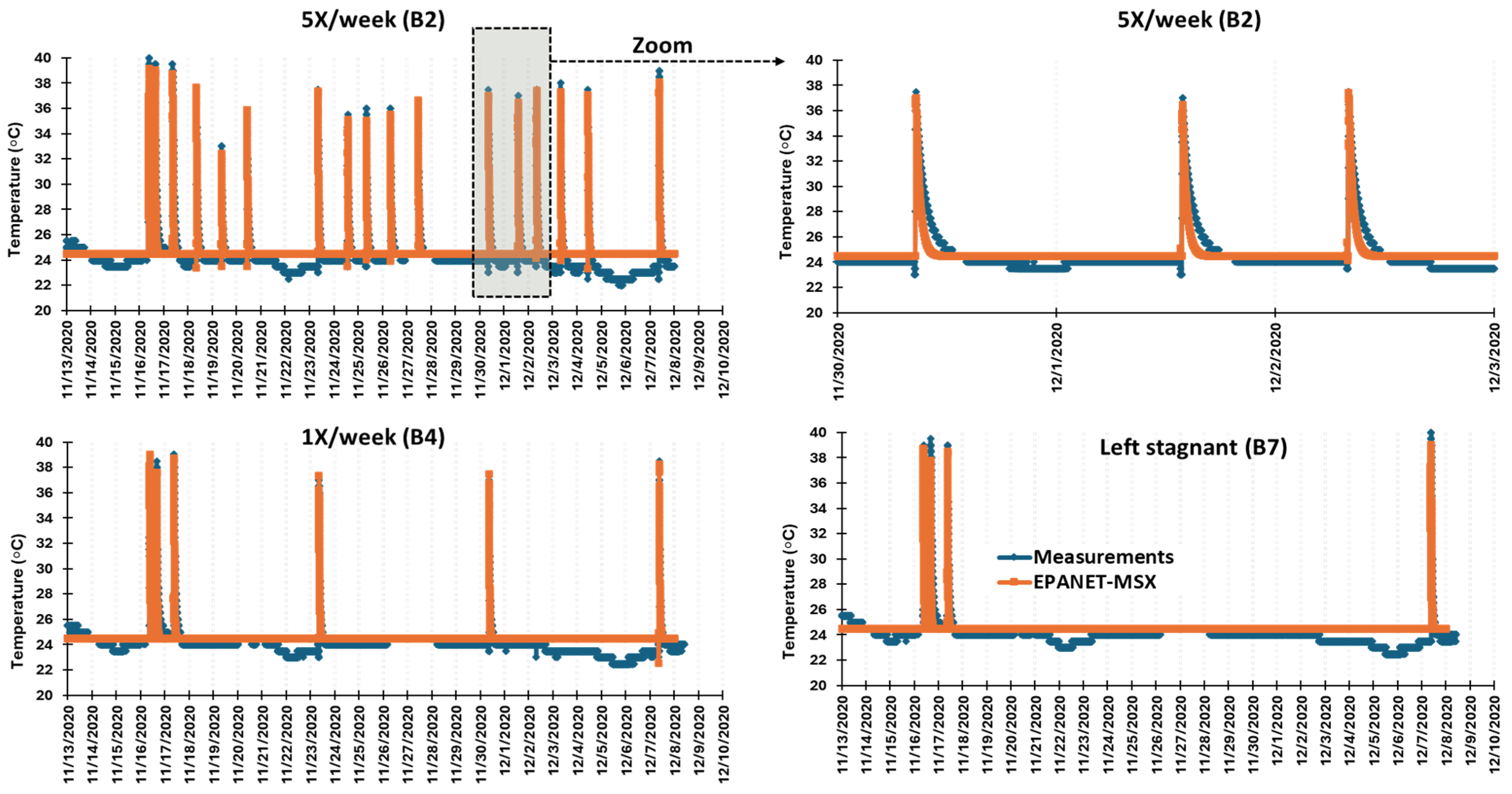
3.1. Spatial and Temporal Variation in Temperature
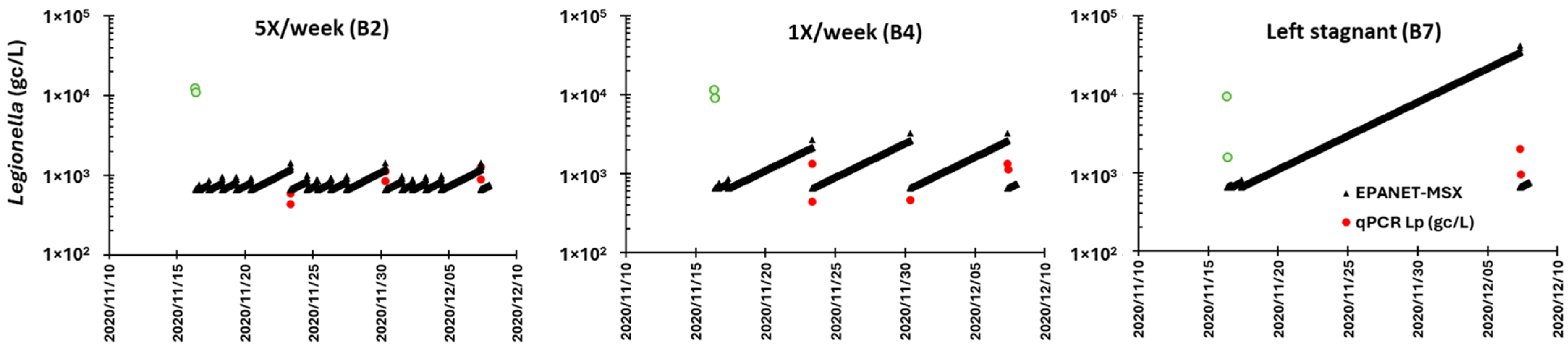
3.2. Spatial and Temporal Variation in Microorganisms
4. Conclusions
Author Contributions
Funding
Institutional Review Board Statement
Informed Consent Statement
Data Availability Statement
Acknowledgments
Conflicts of Interest
References
- Bédard, E.; Fey, S.; Charron, D.; Lalancette, C.; Cantin, P.; Dolcé, P.; Laferrière, C.; Déziel, E.; Prévost, M. Temperature diagnostic to identify high risk areas and optimize Legionella pneumophila surveillance in hot water distribution systems. Water Res. 2015, 71, 244–256. [Google Scholar] [CrossRef] [Scilit] [PubMed]
- National Academies of Sciences, Engineering, and Medicine (NASEM). Management of Legionella in Water Systems; The National Academies Press: Washington, DC, USA, 2019; p. 304. [Google Scholar]
- Grimard-Conea, M.; Deshommes, E.; Doré, E.; Prévost, M. Impact of recommissioning flushing on Legionella pneumophila in a large building during the COVID-19 pandemic. Front. Water 2022, 4. [Google Scholar] [CrossRef] [Scilit]
- Grimard-Conea, M.; Prévost, M. Controlling Legionella pneumophila in Showerheads: Combination of Remedial Intervention and Preventative Flushing. Microorganisms 2023, 11, 1361. [Google Scholar] [CrossRef] [Scilit] [PubMed]
- Moerman, A. Drinking Water Temperature Modeling in Domestic Systems, in Civil Engineering; Delft University of Technology (TU Delft): Delft, The Netherlands, 2013; p. 84. [Google Scholar]
- Rhoads, W.J.; Ji, P.; Pruden, A.; Edwards, M.A. Water heater temperature set point and water use patterns influence Legionella pneumophila and associated microorganisms at the tap. Microbiome 2015, 3, 67. [Google Scholar] [CrossRef] [Scilit]

Disclaimer/Publisher’s Note: The statements, opinions and data contained in all publications are solely those of the individual author(s) and contributor(s) and not of MDPI and/or the editor(s). MDPI and/or the editor(s) disclaim responsibility for any injury to people or property resulting from any ideas, methods, instructions or products referred to in the content. |
© 2024 by the authors. Licensee MDPI, Basel, Switzerland. This article is an open access article distributed under the terms and conditions of the Creative Commons Attribution (CC BY) license (https://creativecommons.org/licenses/by/4.0/).
Share and Cite
Hatam, F.; Ortiz, C.; Grimard-Conea, M.; Prévost, M. Modeling Temperature Fluctuations during Intermittent Water Usage within Water Systems: Water Quality Impact. Eng. Proc. 2024, 69, 86. https://doi.org/10.3390/engproc2024069086
Hatam F, Ortiz C, Grimard-Conea M, Prévost M. Modeling Temperature Fluctuations during Intermittent Water Usage within Water Systems: Water Quality Impact. Engineering Proceedings. 2024; 69(1):86. https://doi.org/10.3390/engproc2024069086
Chicago/Turabian StyleHatam, Fatemeh, Catalina Ortiz, Marianne Grimard-Conea, and Michèle Prévost. 2024. "Modeling Temperature Fluctuations during Intermittent Water Usage within Water Systems: Water Quality Impact" Engineering Proceedings 69, no. 1: 86. https://doi.org/10.3390/engproc2024069086
APA StyleHatam, F., Ortiz, C., Grimard-Conea, M., & Prévost, M. (2024). Modeling Temperature Fluctuations during Intermittent Water Usage within Water Systems: Water Quality Impact. Engineering Proceedings, 69(1), 86. https://doi.org/10.3390/engproc2024069086