


Forecasting Methods for Road Accidents in the Case of Bucharest City †
 , , , ,
Abstract
1. Introduction
- Each year, road traffic accidents result in the deaths of approximately 1.19 million people;
- For individuals aged 5–29 years, road traffic injuries are the primary cause of death;
- Although low- and middle-income countries account for about 60% of the world’s vehicles, they experience 92% of the global road fatalities;
- Vulnerable road users, such as pedestrians, cyclists and motorcyclists, represent more than half of all road traffic deaths;
- The economic impact of road traffic crashes amounts to 3% of the gross domestic product in most countries;
- The United Nations General Assembly aims to reduce the global number of deaths and injuries from road traffic accidents by 50% by 2030 (A/RES/74/299).
2. Literature Background
- A country-level analysis indicated that the model could be effectively applied to most countries;
- Road safety is increasingly becoming a priority, occupying a prominent position on the agenda of both developed and developing nations.
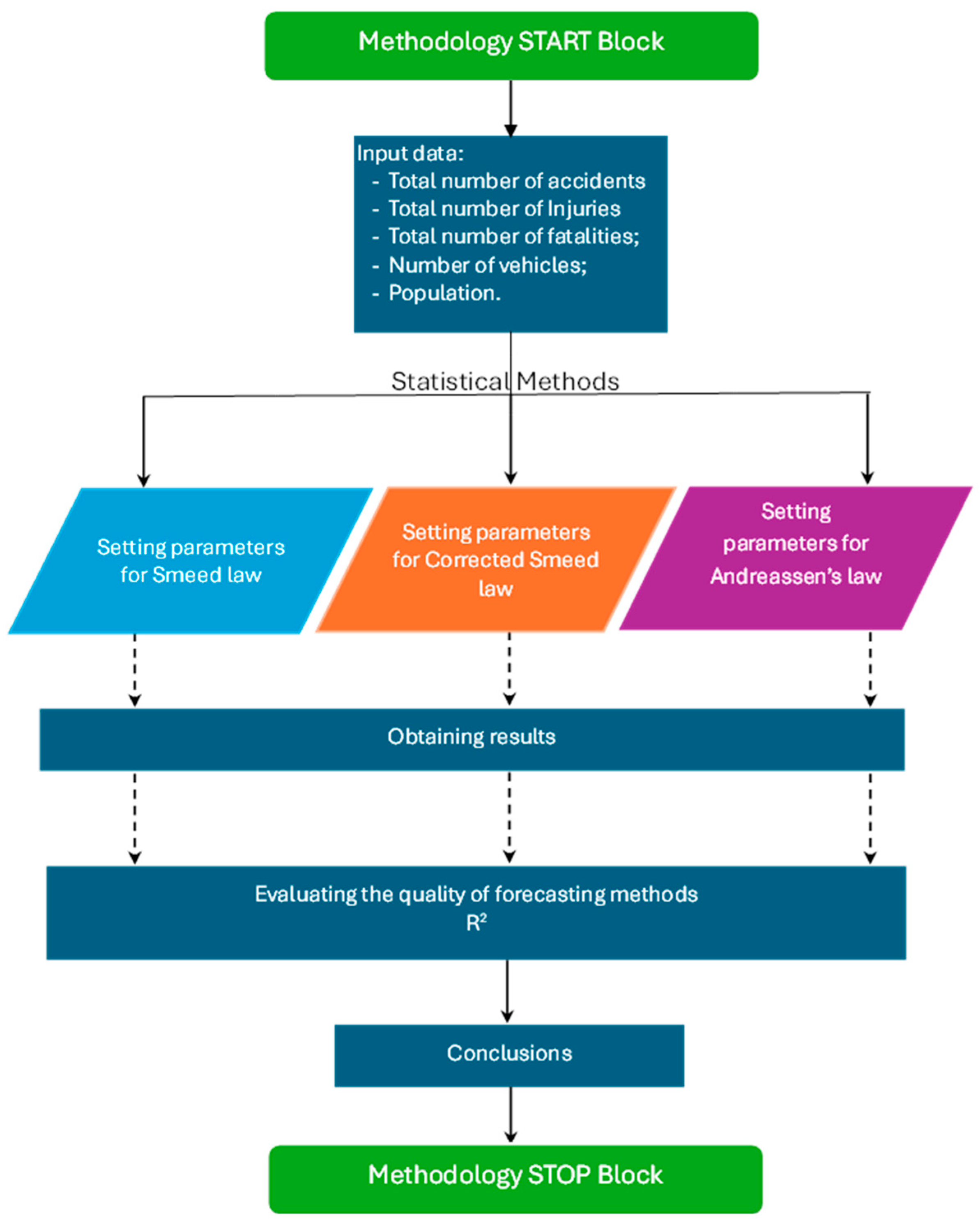
3. Methodology
3.1. The Smeed Law
3.2. The Corrected Smeed Law
3.3. The Andreassen Law
4. Case Study: Bucharest City
5. Conclusions
- Romania has not made significant progress in utilizing technology in the field of road traffic or in modernizing the road infrastructure. This could contribute to maintaining an old vehicle fleet and poor traffic management in cities, including Bucharest.
- The vehicle fleet is old. Older vehicles may be less fuel-efficient and emit more pollutants, and the safety technologies may be less advanced. Additionally, these vehicles may require more maintenance and repairs, leading to a higher frequency of road incidents.
- The levels of road education among the population and adherence to traffic rules in Romania are not at the levels of other European countries. Poor road education can contribute to unsafe behaviors on roads and a higher frequency of road accidents.
Author Contributions
Funding
Data Availability Statement
Conflicts of Interest
References
- Road Traffic Injuries. Available online: https://www.who.int/news-room/fact-sheets/detail/road-traffic-injuries (accessed on 28 January 2024).
- George, M. Development of a Forecasting Model of Indian Road Traffic Scenario to Predict Road User Share, Injuries and Fatalities. Master’s Thesis, Linköping University, Linköping, Switzerland, 2020. Available online: https://liu.diva-portal.org/smash/get/diva2:1437174/FULLTEXT01.pdf (accessed on 28 January 2024).
- Road Safety Statistics. 2022. Available online: https://transport.ec.europa.eu/background/road-safety-statistics-2022-more-detail_en (accessed on 28 January 2024).
- Smeed, R.J. Some Statistical Aspects of Road Safety Research. J. R. Stat. Soc. Ser. A 1949, 112, 1–34. [Google Scholar] [CrossRef]
- Adams, J.G.U. Smeed’s Law: Some Further Thoughts. 1987. Available online: http://john-adams.co.uk/wp-content/uploads/2006/smeed%27s%20law.pdf (accessed on 28 January 2024).
- Koren, C.; Borsos, A. Is Smeed’s law still valid? A world-wide analysis of the trends in fatality rates. J. Soc. Transp. Traffic Stud. 2010, 1, 64–76. [Google Scholar]
- Persia, L.; Gigli, R.; Usami, D.S. Smeed’s law and expected road fatality reduction: An assessment of the Italian case. J. Saf. Res. 2015, 55, 121–133. [Google Scholar] [CrossRef]
- Elvik, R. The non-linearity of risk and the promotion of environmentally sustainable transport. Accid. Anal. Prev. 2009, 41, 849–855. [Google Scholar] [CrossRef]
- Al-Reesi, H.; Ganguly, S.S.; Al-Adawi, S.; Laflamme, L.; Hasselberg, M.; Al-Maniri, A. Economic Growth, Motorization, and Road Traffic Injuries in the Sultanate of Oman, 1985–2009. Traffic Inj. Prev. 2013, 14, 322–328. [Google Scholar] [CrossRef] [PubMed]
- Huang, H.; Yin, Q.; Schwebel, D.C.; Li, L.; Hu, G. Examining Road Traffic Mortality Status in China: A Simulation Study. PLoS ONE 2016, 11, e0153251. [Google Scholar] [CrossRef] [PubMed]
- Kakizawa, Y. A dynamic model for Smeed’s equation. J. Transp. Econ. Policy 2002, 36, 265–284. [Google Scholar]
- Hakamies-Blomqvist, L.; Wiklund, M.; Henriksson, P. Predicting older drivers’ involvement—Smeed’s law revisited. Accid. Anal. Prev. 2005, 37, 675–680. [Google Scholar] [CrossRef]
- David, C.A. Linking deaths with vehicles and population. Traffic Eng. Control 1985, 26, 547–549. [Google Scholar]
- Gorzelanczyk, P.; Tylicki, H. Methodology for Optimizing Factors, Affecting Road Accidents in Poland. Forecasting 2023, 5, 336–350. [Google Scholar] [CrossRef]
- Hossain, S.; Faruque, O. Road Traffic Accident Scenario, Pattern and Forecasting in Bangladesh. J. Data Anal. Inf. Process. 2019, 7, 29–45. [Google Scholar] [CrossRef]
- Imran, M.; Nasir, J.A. Road traffic accidents; prediction in Pakistan. Prof. Med. J. 2015, 22, 705–709. [Google Scholar]
- Borsos, A. Long-Term Safety Trends Related to Vehicle Ownership in 26 Countries, Fulbright Grant 2010–2011. Available online: https://www.fulbright.hu/book6/borsosattila.pdf (accessed on 28 January 2024).
- Cabrera-Arnau, C.; Prieto Curiel, R.; Bishop, S.R. Uncovering the behaviour of road accidents in urban areas. R. Soc. Open Sci. 2020, 7, 191739. [Google Scholar] [CrossRef] [PubMed]
- Andreassen, D. Population and registered vehicles data vs. Road deaths. Accid. Anal. Prev. 1991, 23, 342–351. [Google Scholar] [CrossRef] [PubMed]
- Preda, I. (Romanian Police Institution, Bucharest, Romania); Accidents’ statistics for period 2011–2024. (Unpublished work).
- INSSE, Tempo-Online. Available online: http://statistici.insse.ro/shop/?page=catD&lang=ro&category_id=30 (accessed on 28 January 2024).
- Available online: https://dgpci.mai.gov.ro/news-and-media/statistica (accessed on 28 January 2024).
- Available online: https://data.gov.ro/dataset/parc-auto-romania (accessed on 28 January 2024).
- Costescu, D.; Roşca, M.; Burciu, S.; Ruscă, F. On accident prediction functions for urban road intersections. UPB Sci. Bull. Ser. D Mech. Eng. 2016, 78, 55–64. [Google Scholar]

| Year | Population 2 | Accidents 1 (Total) | Fatalities 1 | Seriously Injured 1 | Easily Injured 1 | Registered Vehicles 3 |
|---|---|---|---|---|---|---|
| 2011 | 1,883,425 | 920 | 86 | 899 | 149 | 1131807 |
| 2012 | 1,886,866 | 960 | 79 | 946 | 248 | 1118125 |
| 2013 | 1,875,389 | 783 | 62 | 762 | 102 | 1131694 |
| 2014 | 1,865,563 | 614 | 61 | 583 | 91 | 1152796 |
| 2015 | 1,853,638 | 670 | 68 | 628 | 110 | 1193775 |
| 2016 | 1,843,962 | 480 | 66 | 441 | 87 | 1253692 |
| 2017 | 1,826,579 | 471 | 74 | 408 | 73 | 1320230 |
| 2018 | 1,828,869 | 569 | 58 | 521 | 109 | 1381620 |
| 2019 | 1,832,802 | 690 | 58 | 657 | 123 | 1457889 |
| 2020 | 1,841,052 | 535 | 52 | 498 | 58 | 1502169 |
| 2021 | 1,828,781 | 378 | 63 | 323 | 66 | 1535310 |
| 2022 | 1,722,865 | 441 | 47 | 415 | 69 | 1570965 |
| 2023 | 1,725,271 | 400 | 45 | 361 | 45 | 1598284 |
| (a) Model Fit Measures | |||||||
| Model | R | R2 | |||||
| 1 | 0.623 | 0.388 | |||||
| (b) Model Coefficients—ln(D) | |||||||
| 95% Confidence Interval | |||||||
| Predictor | Estimate | SE | t | p | Stand. Estimate | Lower | Upper |
| Intercept | 56.84 | 19.960 | 2.85 | 0.016 | |||
| ln(NP2) | −1.23 | 0.465 | −2.64 | 0.023 | −0.623 | −1.14 | −0.104 |
| (a) Model Fit Measures | |||||||
| Model | R | R2 | |||||
| 1 | 0.763 | 0.583 | |||||
| (b) Model Coefficients—ln(D/P) | |||||||
| 95% Confidence Interval | |||||||
| Predictor | Estimate | SE | t | p | Stand. Estimate | Lower | Upper |
| Intercept | −9.51 | 0.202 | −47.01 | <0.001 | |||
| N/P | −1.07 | 0.273 | −3.92 | 0.002 | −0.763 | −1.19 | −0.335 |
| (a) Model Fit Measures | |||||||||||||||
| Model | R | R2 | F | df1 | df2 | p | |||||||||
| 1 | 0.825 | 0.681 | 10.7 | 2 | 10 | 0.003 | |||||||||
| (b) Model Coefficients—ln(D) | |||||||||||||||
| 95% Confidence Interval | 95% Confidence Interval | ||||||||||||||
| Predictor | Estimate | SE | Lower | Upper | t | p | Stand. Estimate | Lower | Upper | ||||||
| Intercept | −34.066 | 33.604 | −108.94 | 40.808 | −1.01 | 0.335 | |||||||||
| ln(N) | −0.527 | 0.421 | −1.47 | 0.411 | −1.25 | 0.239 | −0.381 | −1.060 | 0.297 | ||||||
| ln(P) | 3.164 | 1.984 | −1.26 | 7.585 | 1.59 | 0.142 | 0.485 | −0.193 | 1.164 | ||||||
Disclaimer/Publisher’s Note: The statements, opinions and data contained in all publications are solely those of the individual author(s) and contributor(s) and not of MDPI and/or the editor(s). MDPI and/or the editor(s) disclaim responsibility for any injury to people or property resulting from any ideas, methods, instructions or products referred to in the content. |
© 2024 by the authors. Licensee MDPI, Basel, Switzerland. This article is an open access article distributed under the terms and conditions of the Creative Commons Attribution (CC BY) license (https://creativecommons.org/licenses/by/4.0/).
Share and Cite
Oprea, C.; Rosca, E.; Preda, I.; Ilie, A.; Rosca, M.; Rusca, F. Forecasting Methods for Road Accidents in the Case of Bucharest City. Eng. Proc. 2024, 68, 3. https://doi.org/10.3390/engproc2024068003
Oprea C, Rosca E, Preda I, Ilie A, Rosca M, Rusca F. Forecasting Methods for Road Accidents in the Case of Bucharest City. Engineering Proceedings. 2024; 68(1):3. https://doi.org/10.3390/engproc2024068003
Chicago/Turabian StyleOprea, Cristina, Eugen Rosca, Ionuț Preda, Anamaria Ilie, Mircea Rosca, and Florin Rusca. 2024. "Forecasting Methods for Road Accidents in the Case of Bucharest City" Engineering Proceedings 68, no. 1: 3. https://doi.org/10.3390/engproc2024068003
APA StyleOprea, C., Rosca, E., Preda, I., Ilie, A., Rosca, M., & Rusca, F. (2024). Forecasting Methods for Road Accidents in the Case of Bucharest City. Engineering Proceedings, 68(1), 3. https://doi.org/10.3390/engproc2024068003

