


Pulp and Paper Mill Sludge Utilization by Biological Methods †
Abstract
:1. Introduction
- Residues (including coarse, heavy, and fine residues): These are generated during the use of recycled fiber pulp (RCF) and may contain fibrous pieces, plastics, metals, sand, and glass, respectively;
- Deinking sludge: Produced during the removal of printing ink from RCF, typically comprising short fibers/fine particles, inorganic fillers, and ink particles;
- Primary sludge: Generated in the mechanical water cleaning process, primarily consisting of short fibers/fine particles and fillers;
- Secondary sludge: Formed during the treatment of process water using biological methods;
- Process water (often referred to as wastewater): It is a significant component of paper production and is generally treated on-site to remove impurities [5].
2. Material and Methods
2.1. Preparation of the Leachate
2.2. Biodegradability Tests (Anaerobic and Aerobic Biodegradability of Organic Substances in Paper Mill Sludge)
2.3. Phytotoxicity Test with Lepidium sativum L.
2.4. Phytotoxicity Test on Leaf Lettuce (Lactuca sativa L.)
2.5. Calculation of Biodegradation
- BOD is the biochemical oxygen demand of the test substance (mg/L),
- BOD blank is the biochemical oxygen demand of the biotic control (mg/L),
- ThOD is the theoretical oxygen demand required when the target compound is completely oxidized (mg/L) [20].
3. Results and Discussion
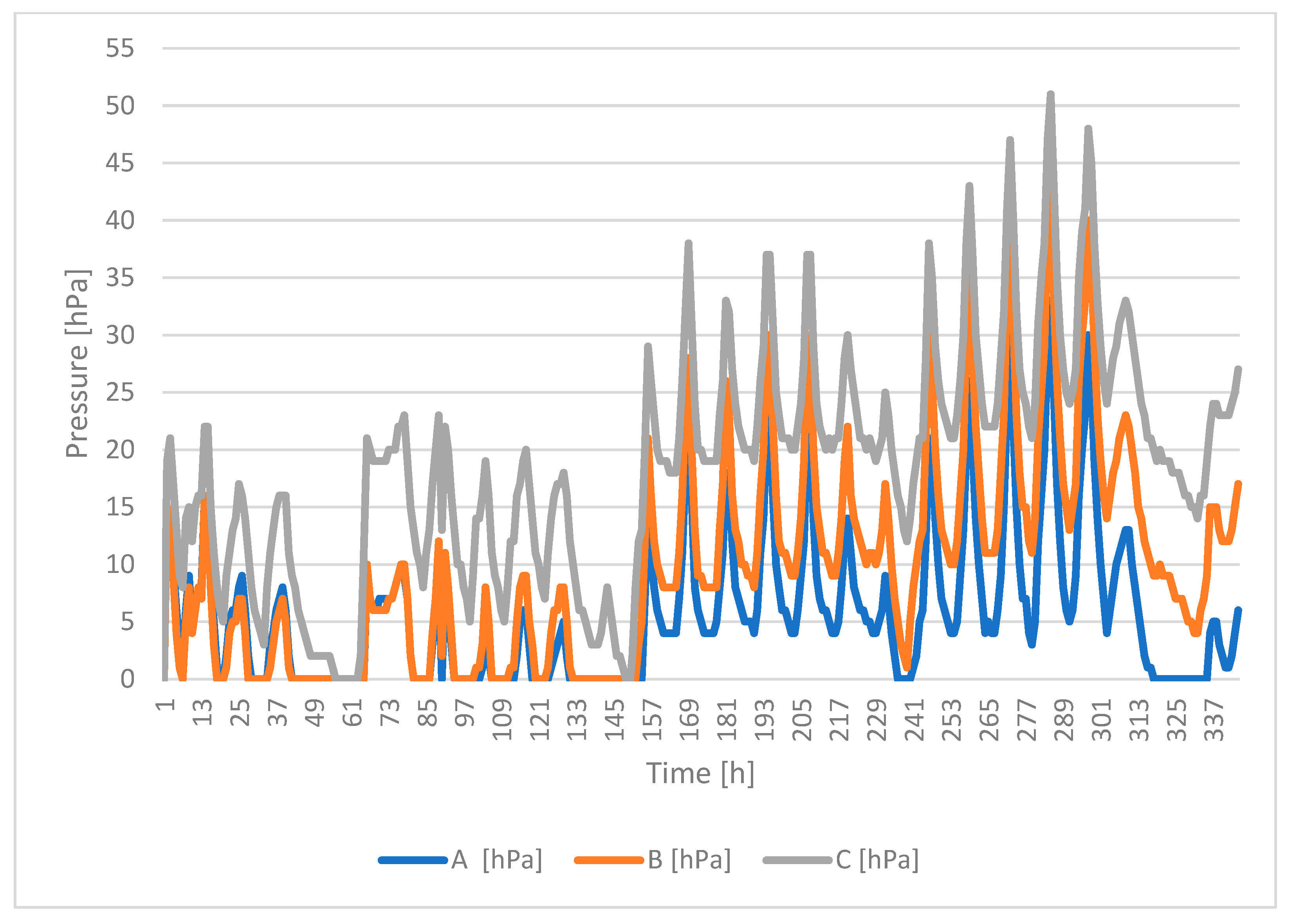
3.1. Anaerobic Biodegradability of Organic Substances in Paper Sludge
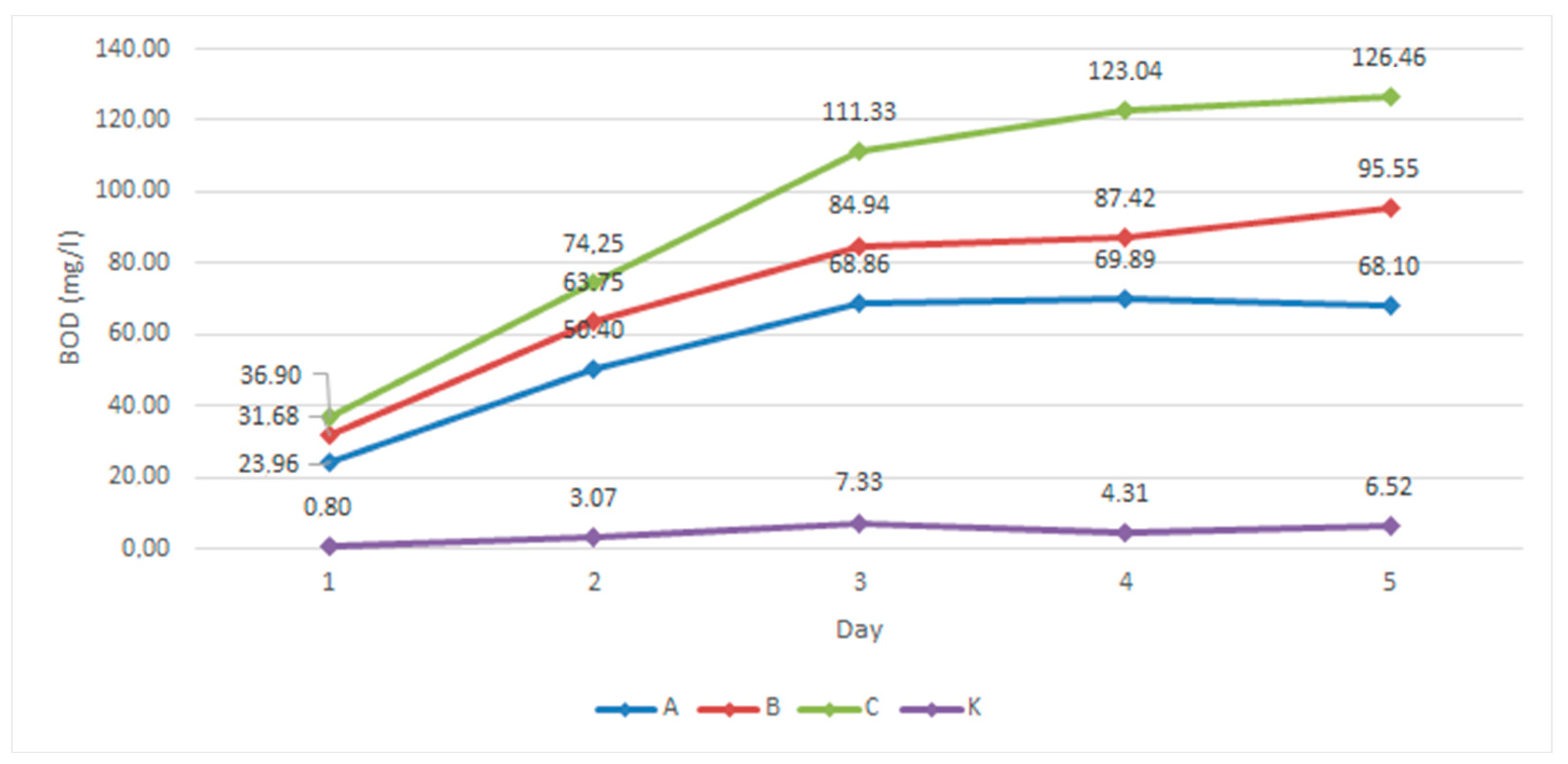
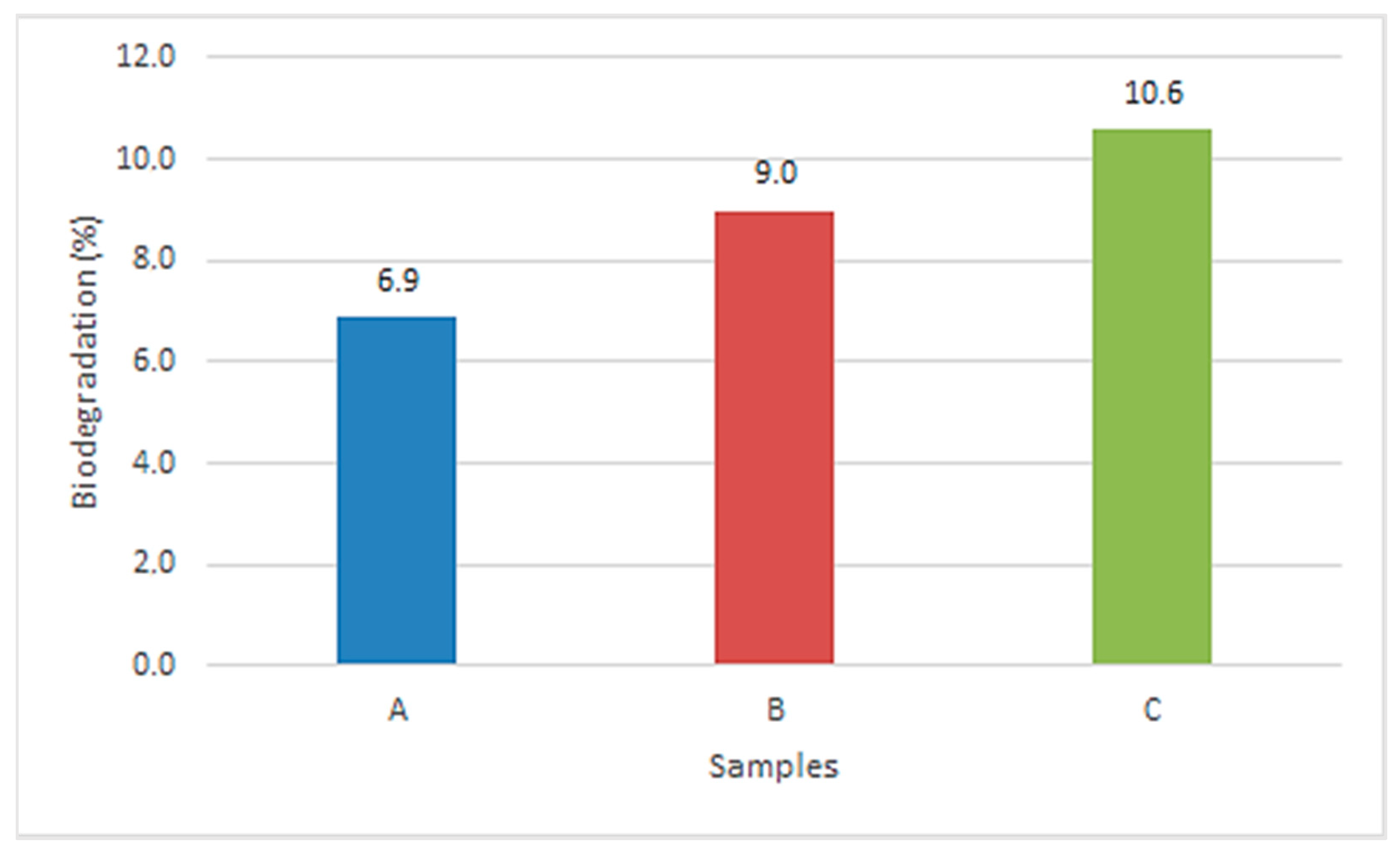
3.2. Aerobic Biodegradability of Organic Substances in Paper Sludge
3.3. Phytotoxicity Test with Lepidium sativum L.
3.4. Leaf Lettuce (Lactuca sativa L.) Growth Inhibition Test
4. Conclusions
Author Contributions
Funding
Institutional Review Board Statement
Informed Consent Statement
Data Availability Statement
Conflicts of Interest
References
- Statista Research Department: Global Production of Paper and Paperboard 1961–2021, 29 August 2023, Available: Global Paper and Paperboard Production 2021 | Statista. Available online: https://www.statista.com/statistics/240598/production-of-paper-and-cardboard-in-selected-countries (accessed on 21 September 2023).
- Mandeep; Kumar Gupta, G.; Shukla, P. Insights into the Resources Generation from Pulp and Paper Industry Wastes: Challenges, Perspectives and Innovations. Bioresour. Technol. 2020, 297, 122496. [Google Scholar] [CrossRef]
- European Commission. New Market Niches for the Pulp and Paper Industry Waste Based on Circular Economy Approaches; European Commission: Brussels, Belgium, 2021. [Google Scholar] [CrossRef]
- Gopal, P.M.; Sivaram, N.M.; Barik, D. Paper Industry Wastes and Energy Generation from Wastes. In Energy from Toxic Organic Waste for Heat and Power Generation; Woodhead Publishing: Cambridge, UK, 2019; pp. 83–97. [Google Scholar] [CrossRef]
- Casco, M.E.; Moreno, V.; Duarte, M.; Sapag, K.; Cuña, A. Valorization of Primary Sludge and Biosludge from the Pulp Mill Industry in Uruguay through Hydrothermal Carbonization. Waste Biomass Valorization 2023, 14, 3893–3907. [Google Scholar] [CrossRef]
- Institute for Prospective Technological Studies (Joint Research Centre); Roudier, S.; Kourti, I.; Sancho, D.; Gonzalo, M.; Suhr, M.; Santonja, G.; Klein, G. Best Available Techniques (BAT) Reference Document for the Production of Pulp, Paper and Board. Available online: https://op.europa.eu/en/publication-detail/-/publication/fcaab1a5-d287-40af-b21c-115e529685fc/language-en (accessed on 21 September 2023).
- Kumar, A.; Singh, A.K.; Bilal, M.; Prasad, S.; Rameshwari, K.R.T.; Chandra, R. Paper and Pulp Mill Wastewater: Characterization, Microbial-Mediated Degradation, and Challenges. In Nanotechnology in Paper and Wood Engineering; Elsevier: Amsterdam, The Netherlands, 2022; pp. 371–387. [Google Scholar] [CrossRef]
- Lindholm-Lehto, P.C.; Knuutinen, J.S.; Ahkola, H.S.; Herve, S.H. Refractory Organic Pollutants and Toxicity in Pulp and Paper Mill Wastewaters. Environ. Sci. Pollut. Res. 2015, 22, 6473–6499. [Google Scholar] [CrossRef] [PubMed]
- Show, K.-Y.; Guo, X. Industrial Waste; InTech: London, UK, 2012; ISBN 9535102532. [Google Scholar]
- De Azevedo, A.R.G.; Alexandre, J.; Pessanha, L.S.; Manhães, R.d.; de Brito, J.; Marvila, M.T. Characterizing the Paper Industry Sludge for Environmentally-Safe Disposal. Waste Manag. 2019, 95, 43–52. [Google Scholar] [CrossRef]
- Xu, J.; Liao, Y.; Yu, Z.; Cai, Z.; Ma, X.; Dai, M.; Fang, S. Co-Combustion of Paper Sludge in a 750 t/D Waste Incinerator and Effect of Sludge Moisture Content: A Simulation Study. Fuel 2018, 217, 617–625. [Google Scholar] [CrossRef]
- Priadi, C.; Wulandari, D.; Rahmatika, I.; Moersidik, S.S. Biogas Production in the Anaerobic Digestion of Paper Sludge. APCBEE Procedia 2014, 9, 65–69. [Google Scholar] [CrossRef]
- Hagelqvist, A.; Granström, K. Co-Digestion of Manure with Grass Silage and Pulp and Paper Mill Sludge Using Nutrient Additions. Environ. Technol. 2016, 37, 2113–2123. [Google Scholar] [CrossRef]
- STN EN 12457-4, 2006 Waste Characterization. Extraction. Verification Test for Leaching Granular Waste Materials and Sludge. Available online: https://eshop.normservis.sk/norma/stnen-12457-4-1.4.2006.html (accessed on 21 September 2023).
- OECD. Test No. 311: Anaerobic Biodegradability of Organic Compounds in Digested Sludge: By Measurement of Gas Production. Available online: https://www.oecd-ilibrary.org/environment/test-no-311-anaerobic-biodegradability-of-organic-compounds-in-digested-sludge-by-measurement-of-gas-production_9789264016842-en (accessed on 21 September 2023).
- OECD. Test No. 301: Ready Biodegradability. Available online: https://www.oecd-ilibrary.org/environment/test-no-301-ready-biodegradability_9789264070349-en (accessed on 21 September 2023).
- ISO-18763-2016. Available online: https://cdn.standards.iteh.ai/samples/63317/309b04cbc836409292017175f5039b36/ISO-18763-2016.pdf (accessed on 21 September 2023).
- OECD. Test No. 302B: Inherent Biodegradability: Zahn-Wellens/EVPA Test. Available online: https://www.oecd-ilibrary.org/environment/test-no-302b-inherent-biodegradability-zahn-wellens-evpa-test_9789264070387-en (accessed on 21 September 2023).
- Plíva, P.; Banout, J.; Harant, J.; Jelínek, A.; Kollárová, M.; Roy, A.; Tomanova, D. Zakládání, Průběh a Řízení Kompostovacího Procesu; Výzkumný ústav zemědělské techniky: Praha, Czech Republic, 2006; ISBN 80-86884-11-2. [Google Scholar]
- Rossetti, I.; Conte, F.; Ramis, G. Kinetic Modelling of Biodegradability Data of Commercial Polymers Obtained under Aerobic Composting Conditions. Eng—Adv. Eng. 2021, 2, 54–68. [Google Scholar] [CrossRef]
- Chynoweth, D.P.; Turick, C.E.; Owens, J.M.; Jerger, D.E.; Peck, M.W. Biochemical Methane Potential of Biomass and Waste Feedstocks. Biomass Bioenergy 1993, 5, 95–111. [Google Scholar] [CrossRef]
- Zhu, A.; Qin, Y.; Wu, J.; Ye, M.; Li, Y.-Y. Characterization of Biogas Production and Microbial Community in Thermophilic Anaerobic Co-Digestion of Sewage Sludge and Paper Waste. Bioresour. Technol. 2021, 337, 125371. [Google Scholar] [CrossRef]

| Ratio of Ingredients in Mixtures | A | B | C |
|---|---|---|---|
| Sludge (mL) * | 1.0 | 1.2 | 1.6 |
| Leachate (mL) | 50 | 60 | 70 |
| Biomedium (mL) ** | 125 | 125 | 125 |
| Ratio of Ingredients in Mixtures | A | B | C |
|---|---|---|---|
| Leachate (mL) | 50 | 60 | 70 |
| Inoculum (mL) * | 5 | 5 | 5 |
| Biomedium (mL) ** | 125 | 125 | 125 |
| Sample | CODCr Day 1 | CODCr Day 5 |
|---|---|---|
| A | 847.80 | 561.90 |
| B | 960.84 | 481.11 |
| C | 1073.88 | 581.97 |
| Blank | 489.84 | 501.70 |
| Sample | Germination (%) | Germination (%) | Average Root Length (mm) | (GI) (%) |
|---|---|---|---|---|
| Blind experiment | 100 | 100 | 6.74 | 100 |
| Water from sludge dewatering | 92.50 | 92.50 | 4.09 | 56.12 |
| Sludge leachate | 88.89 | 88.89 | 4.81 | 63.40 |
| Sample | Germination (%) | Wet Weight (g) | Dry Weight (g) | Dry Matter (%) |
|---|---|---|---|---|
| Blank | 100 | 0.29 | 0.27 | 4.88 |
| A | 83.3 | 0.26 | 0.25 | 5.30 |
| B | 86.6 | 0.26 | 0.25 | 4.82 |
| C | 100 | 0.33 | 0.31 | 5.03 |
| Water from sludge dewatering | 90 | 0.25 | 0.23 | 6.72 |
Disclaimer/Publisher’s Note: The statements, opinions and data contained in all publications are solely those of the individual author(s) and contributor(s) and not of MDPI and/or the editor(s). MDPI and/or the editor(s) disclaim responsibility for any injury to people or property resulting from any ideas, methods, instructions or products referred to in the content. |
© 2023 by the authors. Licensee MDPI, Basel, Switzerland. This article is an open access article distributed under the terms and conditions of the Creative Commons Attribution (CC BY) license (https://creativecommons.org/licenses/by/4.0/).
Share and Cite
Pochyba, A.; Samešová, D.; Poništ, J.; Salva, J. Pulp and Paper Mill Sludge Utilization by Biological Methods. Eng. Proc. 2023, 57, 12. https://doi.org/10.3390/engproc2023057012
Pochyba A, Samešová D, Poništ J, Salva J. Pulp and Paper Mill Sludge Utilization by Biological Methods. Engineering Proceedings. 2023; 57(1):12. https://doi.org/10.3390/engproc2023057012
Chicago/Turabian StylePochyba, Adam, Dagmar Samešová, Juraj Poništ, and Jozef Salva. 2023. "Pulp and Paper Mill Sludge Utilization by Biological Methods" Engineering Proceedings 57, no. 1: 12. https://doi.org/10.3390/engproc2023057012
APA StylePochyba, A., Samešová, D., Poništ, J., & Salva, J. (2023). Pulp and Paper Mill Sludge Utilization by Biological Methods. Engineering Proceedings, 57(1), 12. https://doi.org/10.3390/engproc2023057012

