Proceeding Paper

Development of Non-Stationary Rainfall Intensity–Duration–Frequency Curves for Calabar City, Nigeria †
by
Inyeneobong Cletus Odiong
1,* and
Jonah C. Agunwamba
2
1
Department of Civil Engineering, Akwa Ibom State University, P.M.B. 1167, Uyo N-532111, Nigeria
2
Department of Civil Engineering, University of Nigeria, Nsukka N-410001, Nigeria
*
Author to whom correspondence should be addressed.
Presented at the 4th International Electronic Conference on Applied Sciences, 27 October–10 November 2023; Available online: https://asec2023.sciforum.net/.
Eng. Proc. 2023, 56(1), 89; https://doi.org/10.3390/ASEC2023-15393

Published: 27 October 2023
(This article belongs to the Proceedings of The 4th International Electronic Conference on Applied Sciences)

Abstract

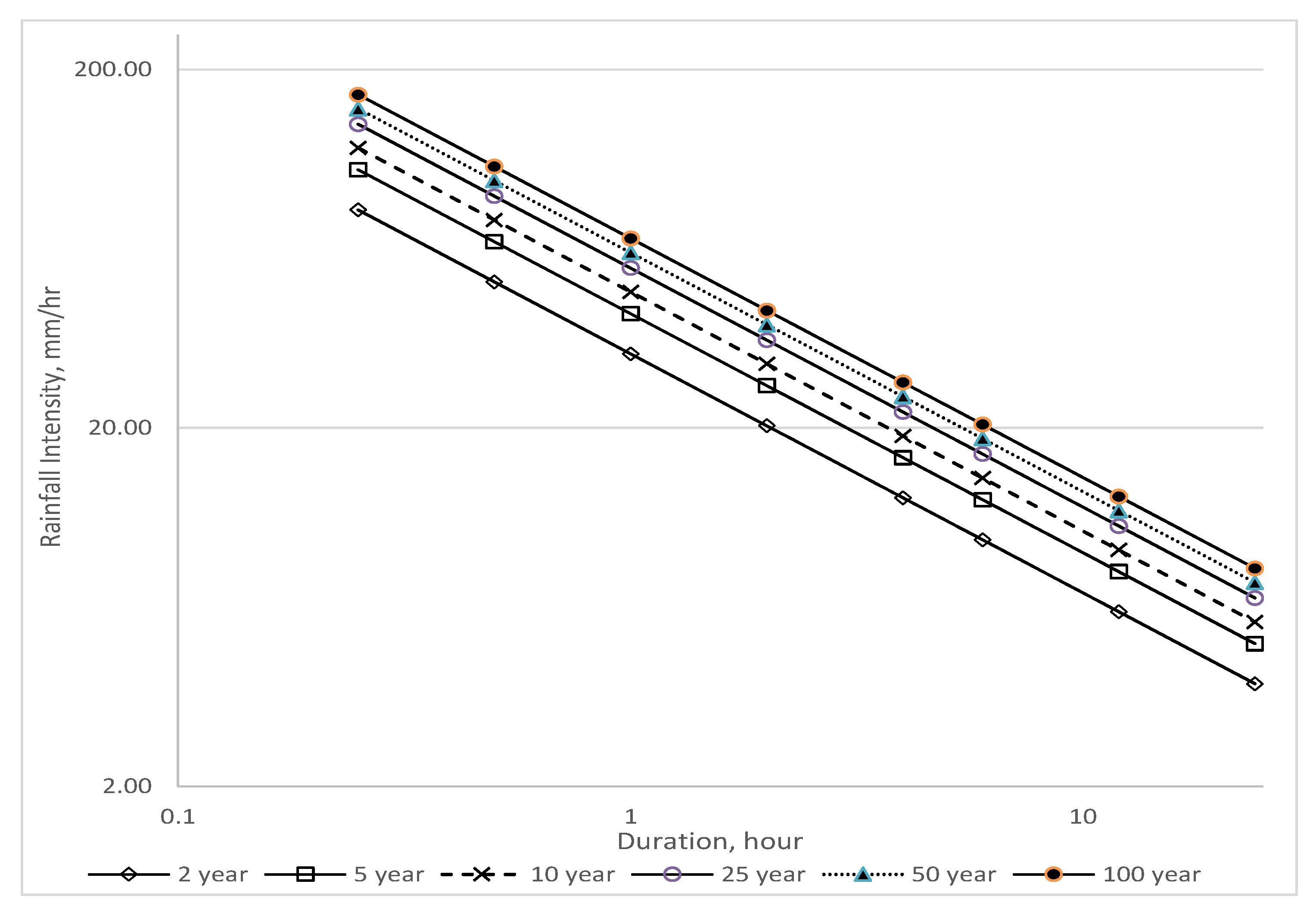
Rainfall intensity–duration–frequency (IDF) relationships are crucial in the design and management of hydraulic structures. At the core of the assumption for IDF development is that the statistics of past rainfall events will represent future rainfall events. It has been proven that climate change is a major trigger for non-stationarity; therefore, the assumption is untenable. This work is aimed at considering the impact of climate change in the development of IDF curves for a city. To account for this non-stationarity, an RCM was combined with measured data through a climate factor (CF) to develop a rainfall IDF for the coastal city of Calabar. The baseline and future climatic periods of the RCM were 1971–2010 and 2021–2060, respectively. The annual maxima series (AMS) were disaggregated and fitted to the Gumbel distribution. Results revealed that the magnitude of trend for the measured AMS and measured annual rainfall are −0.351 and +3.628, respectively. A CF value of 0.86 was obtained, and a generalized non-stationary rainfall IDF model was derived. When compared to models from similar studies, this model has conserved values with r2 = 1 and an error margin of ±6% for all return periods. This will introduce economy in the design of hydraulic structures. Excess runoffs in Calabar were, therefore, related to frequent short-duration rainfall with low intensities.
Keywords: rainfall intensity–duration–frequency; non-stationarity; regional circulation model; bias correction in climate data; trend analysis; Gumbel distribution rainfall intensity–duration–frequency; non-stationarity; regional circulation model; bias correction in climate data; trend analysis; Gumbel distribution