Proceeding Paper

Enhancing Flood Resilience: Streamflow Forecasting and Inundation Modeling in Pakistan †
1
AI Research Group, Faculty of Computer Science and Engineering, Ghulam Ishaq Khan Institute of Engineering Sciences and Technology, Topi 23460, Khyber Pakhtunkhwa, Pakistan
2
Department of Technology and Software Engineering, University of Europe for Applied Sciences, 14469 Berlin, Germany
3
BCMaterials Basque Center for Materials, Applications & Nanostructure, Buil. Martina Casiano, Pl. 3 Parque Científico UPV/EHU Barrio Sarriena, 48940 Leioa, Spain
*
Authors to whom correspondence should be addressed.
Presented at the 4th International Electronic Conference on Applied Sciences, 27 October–10 November 2023; Available online: https://asec2023.sciforum.net/.
These authors contributed equally to this work.
Eng. Proc. 2023, 56(1), 315; https://doi.org/10.3390/ASEC2023-16612

Published: 7 December 2023
(This article belongs to the Proceedings of The 4th International Electronic Conference on Applied Sciences)

Abstract

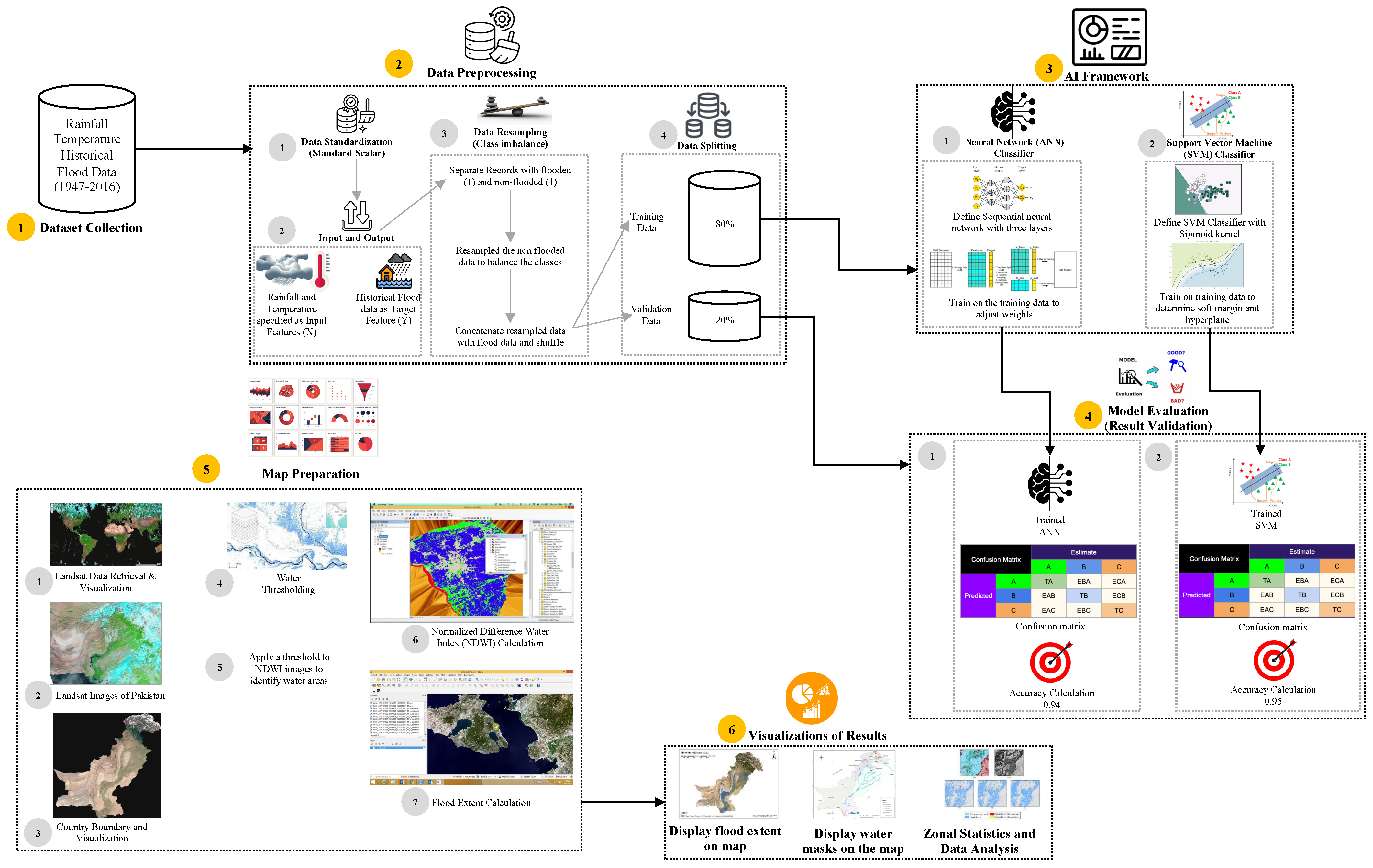
Climatic changes have increased the frequency of natural disasters, and Pakistan, as a developing nation, is facing severe challenges in coping with floods, which have devastatingly impacted people’s livelihoods. In 2022, floods affected over 33 million people, resulting in more than 1730 deaths, according to the World Bank. Flood prediction is a critical research area which can aid in saving critical lives, crops, livestock, and money. This study employs machine learning techniques to provide accurate and reliable flood forecasts for Pakistan. Specifically, Support Vector Machine (SVM) and Artificial neural network (ANN) are utilized in this research for flood prediction. Historical data encompassing floods, rainfall, temperature, water level, topographic information, and land cover of Pakistan is collected and split into 75% for model training and 25% for testing. Additionally, topographic data and land cover information are employed to create inundation maps. The findings highlight three topographic factors that play a pivotal role in predicting flood-sensitive areas: slope, distance to the river, and river. The combined Support Vector Machine (SVM) and Artificial neural network (ANN) exhibited areas under the curve values of 0.94 and 0.95 for the training and testing phases, respectively. These results demonstrate the efficacy of the SVM and ANN integration for precise flood forecasting in Pakistan, contributing to enhancing flood resilience in the region.
Keywords: Support Vector Machine (SVM); artificial neural network (ANN); machine learning; flood; mapping; meteorology; topography Support Vector Machine (SVM); artificial neural network (ANN); machine learning; flood; mapping; meteorology; topography