1. Introduction
Aluminium possesses attractive properties such as low density, high corrosion resistance, and excellent strength-to-weight ratio, making it a suitable material for large-scale structural applications, including bridges, renewable energy systems, and offshore infrastructure. In addition, its excellent recyclability makes aluminium a material of growing importance for sustainable development. However, the use of aluminium in large structures is not without challenges, particularly with respect to fatigue performance. Welding of aluminium, especially in thick sections, presents further difficulties. These challenges are not limited to weldability itself, since many aluminium alloys exhibit good weldability but also involve the microstructural and mechanical consequences of welding, such as softening in the heat-affected zone (HAZ). This softening is particularly pronounced in heat-treatable alloys, such as the 6xxx series, while it is generally less significant in 5xxx alloys. To ensure structural safety, designers often adopt highly conservative design approaches, which substantially restrict the full potential of aluminium in large structural applications. Under current design codes, strength reductions of up to 50% may be assumed [
1]. To address this limitation, advanced welding technologies are required, among which high-energy-density laser-based processes, including autogenous laser beam welding (LBW) and hybrid laser-arc welding (HLAW), have emerged as promising alternatives for thick-section aluminium welding [
2]. However, several challenges still limit the wider industrial adoption of laser-based welding for the fabrication of large aluminium structures, including the relatively high capital cost of laser systems, the need for stringent safety and production-line protection measures, and the limited tolerance to joint gap and fit-up variations. Moreover, aluminium remains intrinsically difficult to laser weld because of its high reflectivity, high thermal conductivity, and susceptibility to defects such as porosity. This paper aims to address the industrial and practical challenges associated with laser-based welding of aluminium and to examine potential solutions related to materials, welding processes, production set-up, structural design, and product performance.
2. Key Industrial Challenges
The industrial application of laser-based welding for aluminium structures is constrained by a combination of material-related, process-related, and production-related challenges. From a materials perspective, aluminium is difficult to weld by laser because its high reflectivity and thermal conductivity reduce energy absorption and increase the sensitivity of the process window. This may in turn promote defects such as porosity due to keyhole instabilities or incomplete fusion if the welding conditions are not sufficiently controlled [
3]. Surface condition is also important, since the oxide layer (melting point ~2050 °C) on aluminium can adversely affect weld quality and therefore requires careful cleaning and preparation [
4]. From a production perspective, implementation of laser-based welding requires substantial investment in equipment, automation, and safety measures [
2,
3].
In addition, conventional laser beam welding is generally sensitive to joint gap and fit-up variations, placing strict requirements on part preparation, fixturing, and dimensional accuracy in large-scale structural fabrication. For this reason, industrial deployment depends not only on weld quality itself, but also on process robustness, manufacturability, and the ability to meet structural performance requirements under realistic production conditions.
Standard LBW has limited gap-bridging capability and therefore requires tight joint fit-up and accurate edge preparation; in some applications, joint gaps must be controlled to below about 0.4 mm to ensure seam integrity [
5]. By combining the deep penetration of the laser with the filler and arc support from arc welding, HLAW can improve gap-bridging capability and reduce the strict fit-up requirements associated with conventional laser beam welding. Liao et al. [
6] demonstrated that good weld quality could be achieved in 5 mm thick aluminium even at gap tolerances as large as 2.49 mm.
For large aluminium structures, material thickness is an important factor influencing both structural requirements and welding feasibility. Recent developments in laser-based welding have significantly expanded the weldable thickness range of aluminium alloys, although these values should be understood as demonstrated research capabilities under specific conditions rather than general industrial limits. For 5xxx alloys, single-pass welding of 35 mm thick 5A06 has been achieved under sub-atmospheric pressure [
7]. Wang et al. [
8] reported double-sided, two-pass laser welding of 130 mm thick 5A06 aluminium alloy under sub-atmospheric pressure using a 30 kW-level laser. For 6xxx alloys, HLAW has been demonstrated on 10 mm thick 6082 in a single pass [
9]. In general, however, the achievable weldable thickness in laser-based welding depends strongly on alloy type, joint configuration, laser power, and process conditions [
2].
In practice, these material-, process-, and production-related constraints must be considered together. Successful industrial application depends not only on achieving sound welds, but also on ensuring adequate process robustness, manufacturability, and structural performance under realistic production conditions.
Another important industrial challenge lies in design practice. Despite the availability of design standards, aluminium structures are still less familiar to many practicing engineers than steel structures. This is particularly true for large, welded structures, where fatigue, weld quality, and HAZ softening must be accounted for. Consequently, conservative design assumptions are often adopted, which can limit structural efficiency and slow down industrial uptake.
3. Key Material and Process Challenges
Laser-based welding of aluminium involves several coupled metallurgical and process-related challenges that strongly affect weld quality. A major concern is porosity, which may arise from both hydrogen entrapment during solidification and unstable keyhole behaviour during welding [
10]. In addition, the evaporation of volatile alloying elements, particularly Mg and Zn, can alter weld composition and reduce process stability [
11]. Certain aluminium alloys, including some 6xxx alloys, are also susceptible to solidification cracking under unfavourable solidification and cooling conditions [
12]. Process-related defects such as underfill, humping, and root sagging may further occur when weld pool flow becomes unstable [
2]. Reliable laser welding of aluminium therefore requires simultaneous control of alloy chemistry, keyhole stability, and melt-pool behaviour.
In 6xxx aluminium alloys, welding often leads to significant local softening because these alloys obtain their strength from precipitation hardening. During the welding thermal cycle, the strengthening precipitates may dissolve, grow, or transform into less effective forms, which reduces the strength of the material in the HAZ. For this reason, the HAZ commonly becomes the weakest region of the welded joint. This behaviour is also reflected in Eurocode 9, where welded EN AW-6082-T6 is assigned a HAZ proof-strength reduction factor of 0.48, corresponding to a reduction of roughly 50% compared with the base material [
1]. The situation is different for 5xxx alloys, which are non-heat treatable. Their strength is primarily derived from solid-solution strengthening and, in many tempers, from work hardening rather than from strengthening precipitates. As a result, they are generally less affected by welding than 6xxx alloys. Nevertheless, some loss of strength may still occur, especially in strain-hardened conditions because the heat input from welding can locally remove part of the work-hardening effect through annealing in the HAZ.
Fatigue is a further critical issue in welded aluminium structures. In addition to weld-induced stress concentrations and geometric imperfections, local softening may influence fatigue behaviour by changing the stress–strain response in the vicinity of the weld. Fatigue design is further complicated by the fact that aluminium alloys are generally considered not to exhibit a true fatigue limit, so fatigue failure may still occur at relatively low stress ranges if the number of cycles is sufficiently high. Consequently, welded aluminium structures are commonly assessed on a finite-life basis, and fatigue verification is closely linked to design approaches such as those adopted in Eurocode 9 [
1,
13].
4. Approaches to Improve Weld Quality and Joint Performance
Several approaches have been proposed to mitigate the metallurgical and process-related challenges in laser-based welding of aluminium. One effective route is beam oscillation, in which the laser follows certain scanning paths to modify keyhole dynamics and melt-pool flow. Song et al. [
14] investigated pure laser, O-shaped, and infinity-shaped scanning paths for 2 mm thick AA2060 aluminium–lithium (Al-Li) alloy plates, and demonstrated that laser beam oscillation welding is more effective than pure laser beam welding in terms of reduced spattering and improved process stability. Tang et al. [
4] developed a novel W-shaped oscillating laser beam welding technique for Al-Mg aluminium alloys and achieved low porosity and high tensile properties (85.8% of base material’s tensile strength).
Another promising development is power modulation, particularly full-domain power modulation (FDPM) combined with galvanometer scanning. In this approach, laser power varies continuously during the oscillation cycle to tailor local heat input. Studies on aluminium alloys show that FDPM can make the heat distribution more favourable, reduce porosity, and improve weld morphology compared with conventional constant-power oscillating welding [
15].
It has been shown that advanced beam profiles, such as adjustable ring-mode can dramatically reduce porosity in laser welding of medium-thick aluminium alloys when compounding a ring laser beam over the Gaussian beam [
16]. More recently, dynamic beam shaping has emerged as a promising approach in laser welding, whereby the spatial energy distribution of the beam is actively modified during processing. This concept has been demonstrated for Al6061 using a 14 kW fibre laser with Optical Phase Array (OPA)-based beam control, where the welded joint reached about 79% of the base-material strength without the use of filler wire [
17]. These results highlight the capability of dynamic beam shaping to enhance the mechanical performance of autogenous laser welds in aluminium alloys.
The addition of Zr and Sc is a promising approach for improving the performance of laser-welded aluminium joints. When introduced through filler materials or alloying additions, these elements can promote the formation of stable particles that assist nucleation during solidification, leading to a finer weld microstructure. In particular, Al
3(Li, Sc, Zr) type phases and related dispersoids have been reported to promote heterogeneous nucleation and significant grain refinement in laser-processed aluminium alloys [
18]. This refinement can reduce the tendency for coarse columnar grain growth and instead promote a more uniform and equiaxed structure. Such microstructural changes are beneficial for weld integrity and can contribute to improved mechanical performance. Deng et al. [
19] has demonstrated the effectiveness of Sc/Zr microalloying in improving aluminium weld performance by welding 5052 aluminium with Sc-5183 wire. The results showed a 35% reduction in HAZ width and 11% increase in yield strength. Xie et al. [
20] investigated Zr micro-alloying under circular beam oscillation in laser-arc hybrid welding of 15-mm thick 6082-T6 aluminium alloy. Their results showed that the combination of Zr micro-alloying and circular beam oscillation fundamentally altered solidification, virtually eliminating porosity and refining grains across the fusion zone. Accordingly, the ultimate tensile strength and elongation of the joint increased by 30.9% and 170%, respectively, and fracture was consistently shifted to the heat-affected zone [
20]. There is also possibility to add Zr and Sc into base metal to facilitate benefits for HAZ not only in fusion zone.
Local post-weld strengthening offers a potential route to address the softened zones that commonly develop in welded aluminium joints. By selectively targeting the weld and nearby heat-affected regions, it may be possible to restore local hardness and strength, reduce property mismatch, and improve joint performance [
3,
21,
22].
5. A Case Study
In this paper, we have performed a case study to show the potential effect of laser beam oscillation on pore and cracking suppression using HLAW of 6082 aluminium based on bead-on-plate (BOP).
A continuous wave Yb: fibre laser (IPG Photonics YLS-16000-S2) has been used with installed D50 wobble head as focusing optics. The base metal was 6082-T6 aluminium alloy extruded plate. BOP methodology has been used to optimise process parameters in an efficient manner. Here, two different oscillation patterns, circular and infinity-shaped (meaning 8-wobbling along the welding direction), have been compared, wobbling amplitudes (1.0 mm against 2.0 mm), laser angle (10 and 20 degrees), and focal plane position (0 mm at the top surface and −8.0 mm down to the plate). Moreover, the experimental runs were done with a laser power ramp-up technique, where laser power has a gradual linear increase from low to high value, from 10 kW to 14 kW in this case. Such methodology with multiple variables and the laser power ramp-up technique allows fast and efficient screening of the process parameters for optimisation to achieve minimum to zero porosity and cracking in welds.
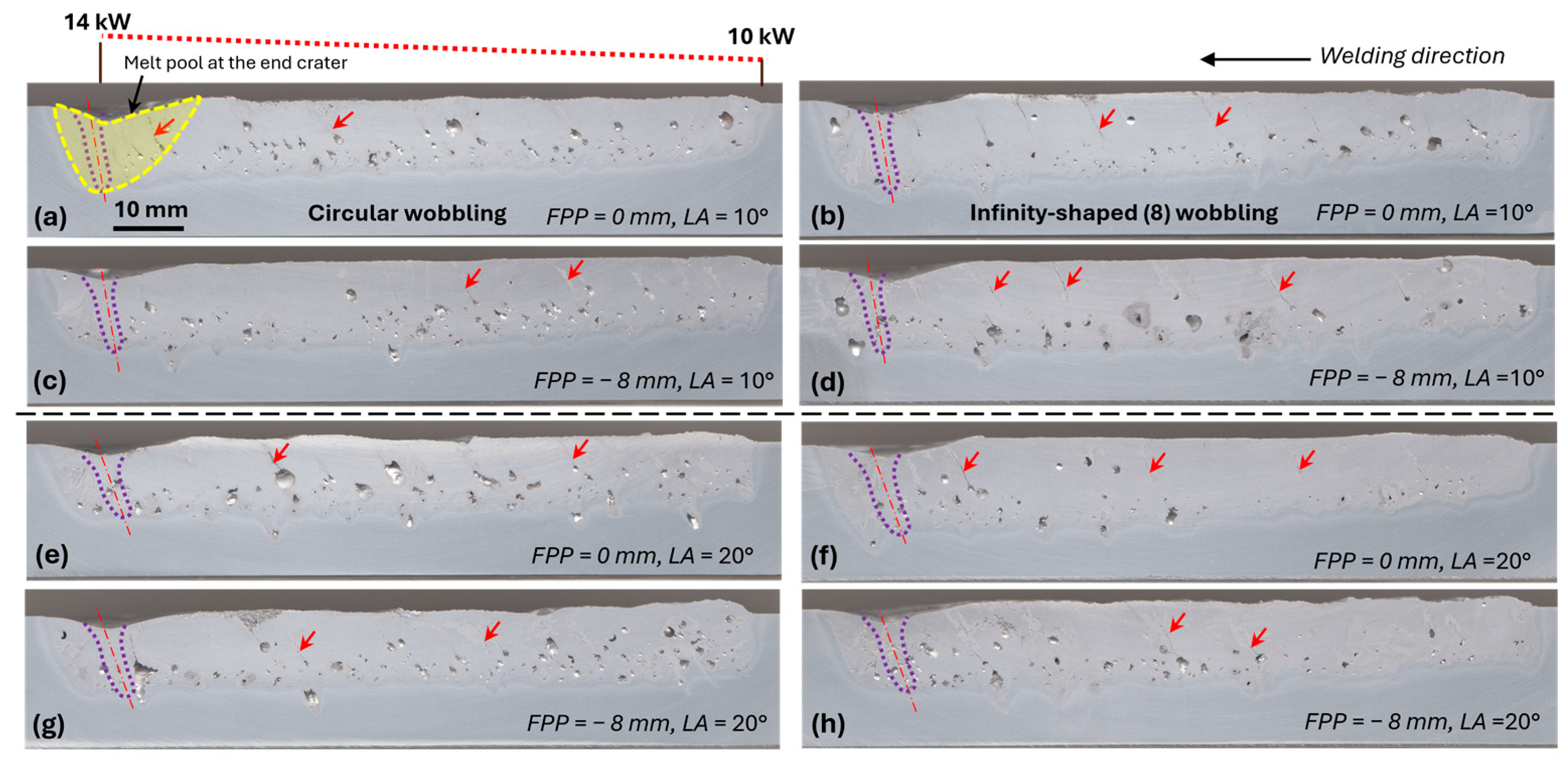
To reveal porosity, a longitudinal cut near the centerline of the weld (0.5–1.0 mm) with precise machining to hit the exact centerline. Afterwards, the samples were polished and etched to reveal the fusion zone area. The results with 1.0 mm wobbling amplitude are shown in
Figure 1, illustrating a large amount of porosity formation in most of parameters and their ranges. No significant differences were observed between parameters. Infinity-shaped (8) wobbling showed slightly better results with a higher penetration depth. No effect on laser beam angle was identified. In most cases, hot cracking also commonly appeared in most of welds, indicated by a red arrow in the figures.
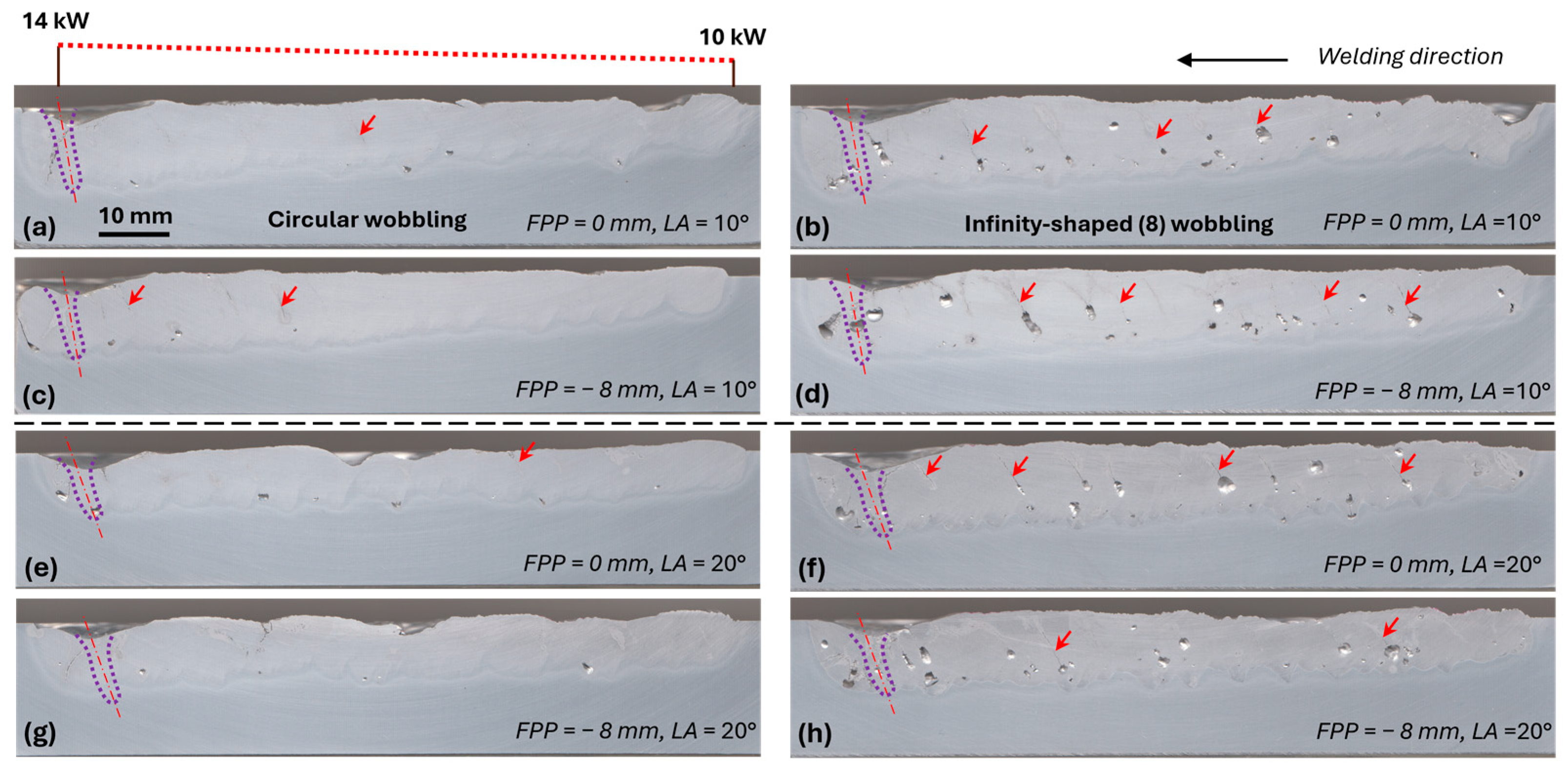
Porosity was significantly reduced by using 2.0 mm wobbling amplitude, see
Figure 2. In this case, circular wobbling showed significantly better results than infinity-shaped (8) wobbling. Near porosity-free and crack-free welds were achieved using circular wobbling at any tested process parameters range. No correlation of depth, induced higher laser beam power, and porosity was found. It is generally accepted that deeper keyholes are more prone to collapses. However, stability appears to be maintained at greater depths as the wobbling amplitude increases. As expected, penetration depth was reduced with increase in wobbling amplitude making welds wider. This increases melt pool size in favour of de-gassing mechanism.
The mechanism of porosity suppression in circular wobbling is studied in our previous research [
23] in detail. It was indicated that circular keyhole behaviour induced vigorous melt pool stirring which effectively re-navigates the keyhole-induced pore back to keyhole where it is eliminated through evaporation. During large pore formation, reciprocating keyhole motion can intersect and fragment large pores into smaller ones, thereby partially mitigating the pore defect.
Based on the provided results, circular wobbling is a more viable wobbling pattern with higher wobbling amplitude. Higher wobbling amplitude is more effective due to improved melt stirring mechanism, and infinity-shaped (8) wobbling has been demonstrated to also be effective for porosity suppression and particularly good for solidification mode, providing more equiaxed grains within welds, which are effective in hot cracking reduction. However, with a high laser power case, the effectiveness of this approach is reduced. This may be related to more complex keyhole behaviour associated with its depth or high depth-to-width ratio. This effect is related to rapid collapse of the keyhole bottom due to surface tension overcoming vapour pressure, or Plateau–Rayleigh instability.
Notably, at stop position, there is increased porosity and cracking (denoted in
Figure 1 as the yellow area), associated with end crater cracking and rapid solid metal shrinkage upon solidification. Therefore, it is important to continue to supply shielding gas to the welding area upon cooling for a few seconds. Moreover, when the laser beam is stopped, it is advisable to ramp down laser power since it may leave a deeper cavity or even a small hole due to the drilled keyhole. The results also indicate that the laser tilt angle (10° versus 20°) also influences the formation of porosity and hot cracking. A smaller laser tilt angle appears to be more effective in suppressing both pore formation and hot cracking.
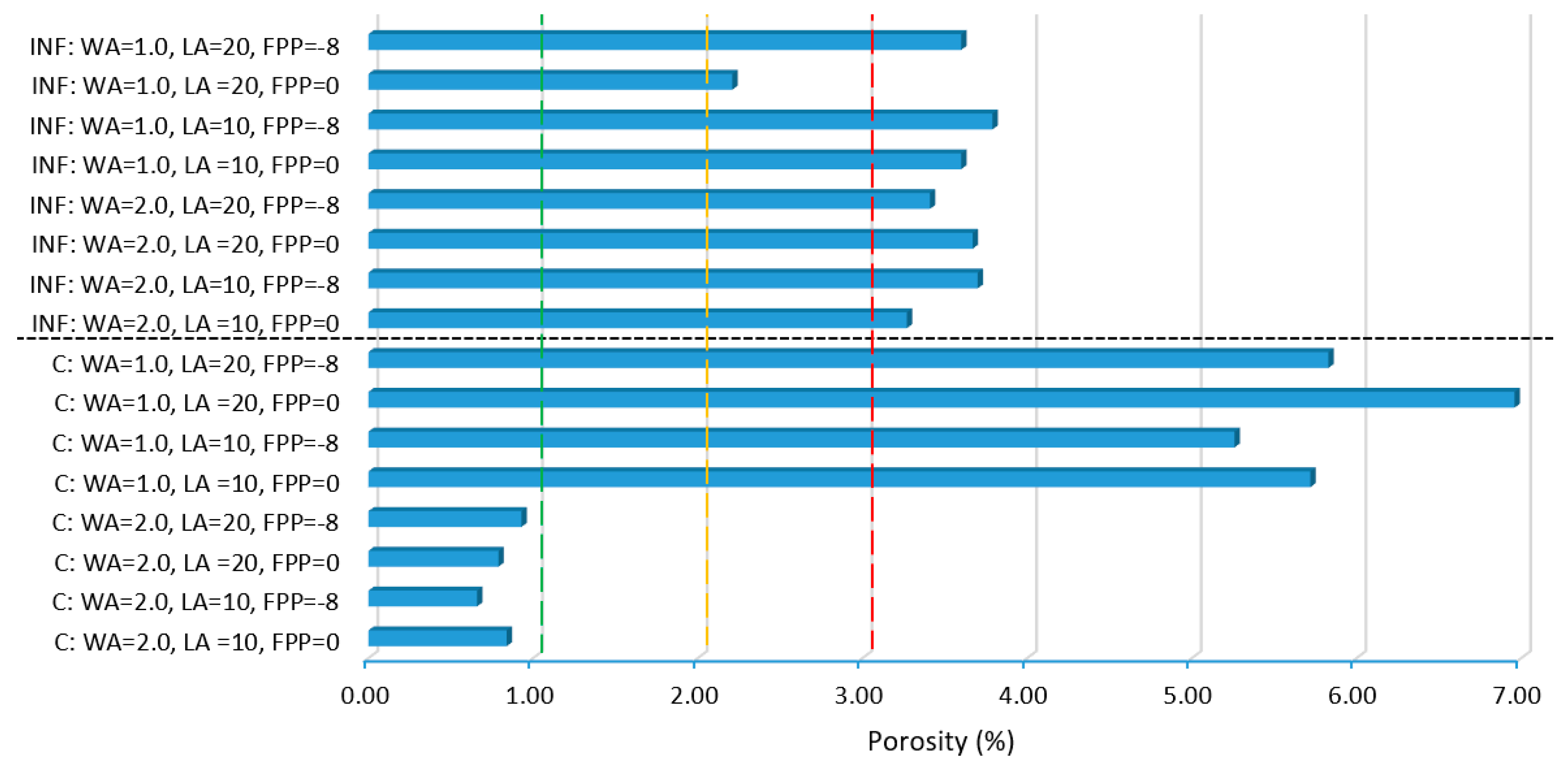
Porosity level was estimated based on the longitudinal cuts (as presented in
Figure 1 and
Figure 2). Processing was performed with ImageJ software (version 1.54p). The results are shown in
Figure 3. It shows an acceptable level of porosity for circular wobbling with a wobbling amplitude of 2.0 regardless laser angle and FPP. In contrast, at a wobbling amplitude of 1.0 mm, circular wobbling produced the highest porosity level. Most infinity-shaped (8) welds showed high and consistent porosity levels of slightly more than 3%. Surprisingly, a wobbling amplitude of 1.0 did not improve porosity condition, unlike circular wobbling most likely related to unfavourable melt pool stirring. According to the ISO 13919:2-2021 standard [
24], the maximum acceptable porosity to reach level B is 3%. Therefore, only welds made with larger wobbling amplitudes under circular wobbling can be qualified.
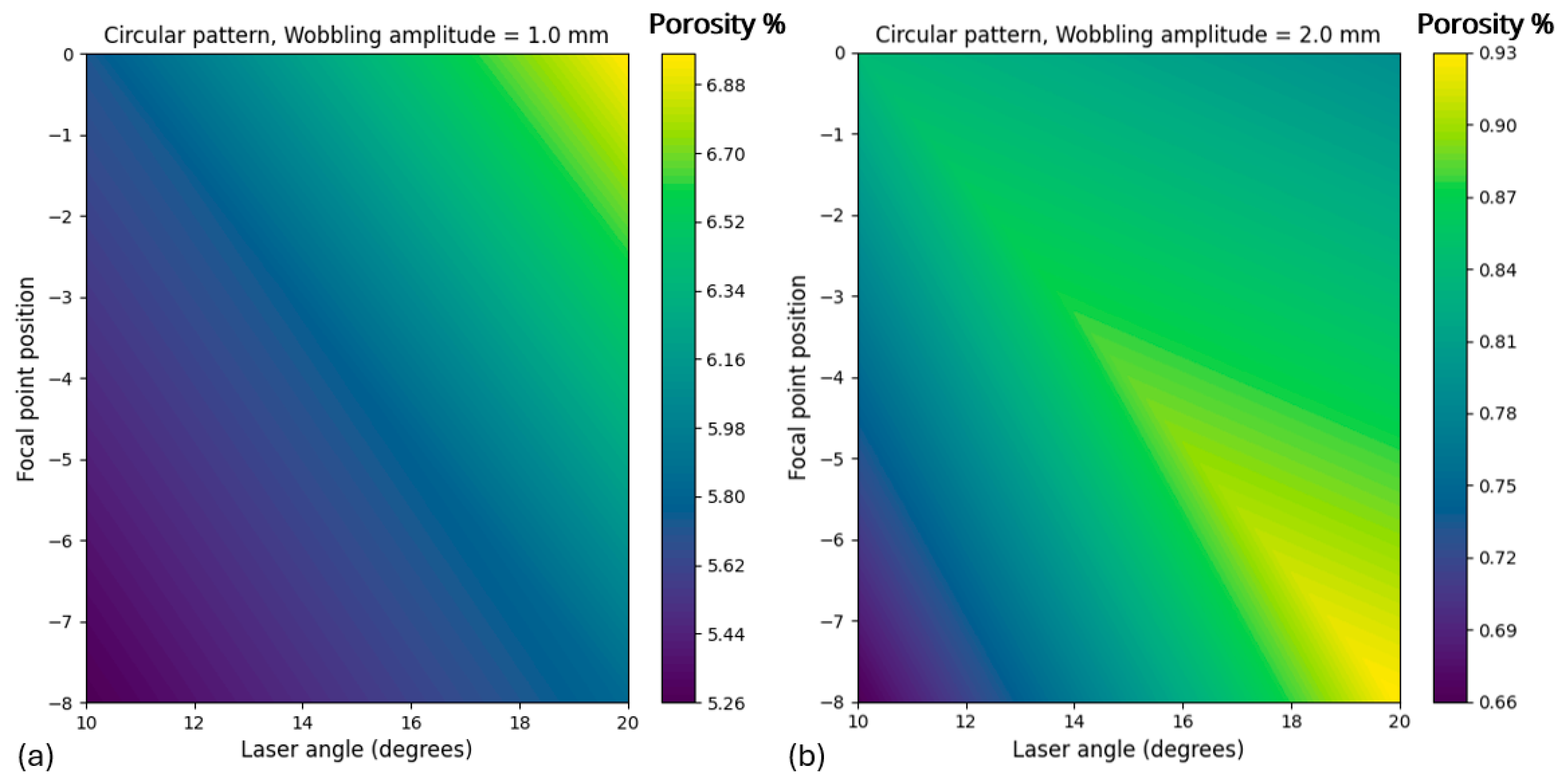
For a clearer representation of the porosity data, processing maps were developed and are shown in
Figure 4. Here, only the circular wobbling pattern (C) is shown. Processing maps clearly indicate that regardless of wobbling amplitude, porosity is reduced with negative laser focusing position (−8.0 mm) and smaller laser angle. At higher beam angle, the keyhole is assumed to be less stable and more prone to collapses.