Proceeding Paper

Analysis of Natural Frequencies of a MacPherson Suspension Using Different Bushings’ Elastic Characteristics †
by
Stiliyana Taneva
1,2,
Krasimir Ambarev
1,2,* and
Valyo Nikolov
1,2
1
Department of Transport and Aircraft Equipment and Technologies, Faculty of Mechanical Engineering, Technical University of Sofia, Plovdiv Branch, 4000 Plovdiv, Bulgaria
2
Center of Competence “Smart Mechatronics, Eco- and Energy Saving Systems and Technologies, 4000 Plovdiv, Bulgaria
*
Author to whom correspondence should be addressed.
Presented at the 15th International Scientific Conference TechSys 2026—Engineering, Technologies and Systems, Plovdiv, Bulgaria, 14–16 May 2026.
Eng. Proc. 2026, 150(1), 87; https://doi.org/10.3390/engproc2026150087
Published: 30 July 2026

Abstract

The first natural frequency is the most important vibration parameter during the design of suspensions. It has a major impact on vehicle ride comfort and handling. This paper presents the results of the effects of different bushings’ elastic characteristics of the natural frequencies of a front-independent quarter MacPherson suspension system. The natural frequencies and mode shapes were obtained using Finite Element Analysis (FEA). A simulation study was conducted, taking into account the elastic characteristics of bushings and an analysis with two rubber bushings within the mounting of the arm (Case I), and a rubber bushing and a polyurethane bushing (Case II). The natural frequencies were also determined by Frequency Response Function (FRF) analysis. FRF analysis was performed using experimentally obtained acceleration and time data of the body. The experiment was conducted using a suspension tester and a measuring system. FEA was performed using SolidWorks 2023. The results were compared and analyzed.

1. Introduction

The problems related to free and forced vibrations of cars and their individual elements are classic and are of interest to many researchers [1,2,3,4,5,6,7,8,9,10]. The parameters of the free vibrations are the natural frequencies and mode shapes.
The optimal suspension system design is difficult for designers and most important to determine the natural frequencies and the frequencies of disturbances to avoid their coincidence during its movement under different conditions. The natural frequencies should not be close or coincide with each other, or if they do, the resistance coefficients should increase. The natural frequencies of vertical vibrations in passenger cars are from 1 to 1.5 Hz [4].
Determining and analyzing the natural frequencies of the vehicle suspension system is one of the essential and current tasks in its design and operation. Different vibration bushings can be used in the suspension of cars, depending on the material from which they are made. In recent years, polyurethane bushings have been increasingly used instead of traditional rubber ones [11,12]. That is why in this study, the natural frequencies and mode shapes of the suspension when using different bushings with different mechanical characteristics are compared.
The vibration studies of part of quarter car suspension systems are performed with simulation software products, such as Abaqus and SolidWorks [1,8,10]. In the papers on suspension systems using Finite Element Analysis (FEA) [1,8,10], in the mounting locations of the bushings, their stiffness is not considered, and usually the constraints are set by using other supports.
The purpose of the publication is to determine the natural frequencies and mode shapes of the MacPherson strut suspension of an Audi A3 passenger car using bushings with different stiffness characteristics mounted on the arm. The simulations were performed using the stiffness characteristics of the tyre at pressure of 0.22 MPa and the suspension also. The natural frequencies of the same suspension were also determined experimentally through FRF analysis. The experimental test was conducted by using a suspension tester—BEISSBARTH SA640 and the measuring system.

2. Materials and Methods

The MacPherson suspension system is widely used in passenger cars. The natural frequencies of the suspension are most often determined by mathematical equations, a physical experiment, or by using FEA.
The natural frequency of the quarter suspension can be determined by the following equations [11]:
f = ω/2∙π
ω = sqrt(c/m1)
1/c = 1/c1 + 1/c2
where c is the quarter suspension elastic coefficients; m1 is the sprung mass; c1 and c2 are the spring and the tyre elastic coefficients, respectively.
To perform the frequency analysis, SolidWorks Simulation software 2023 was used. The simplified 3D model of a quarter car MacPherson suspension was created [13].
The components of the 3D model are oriented and constrained so that they occupy a space corresponding to their position in the suspension and its mode of operation. The suspension components, supports, connections and the material properties of suspension components are presented in [13,14,15].
It is known that the elastic (stiffness) and damping characteristics of suspension components affect the ride comfort and must be selected appropriately. Therefore, it is correct to consider the stiffness characteristics of bushings, because in [2] it is proven that the characteristics have an impact on the natural frequencies of the metal parts.
The static elastic characteristics of the rubber bushings and polyurethane bushings, and the spring stiffness and radial stiffness of the tyre were presented in another publication by the authors [13,15]. In Case I—two rubber bushings were used at the mounting location arm, and in Case II—a polyurethane bushing and a rubber bushing were used.
For both cases, the load is set by distributed masses for the sprung mass and the unsprung mass.
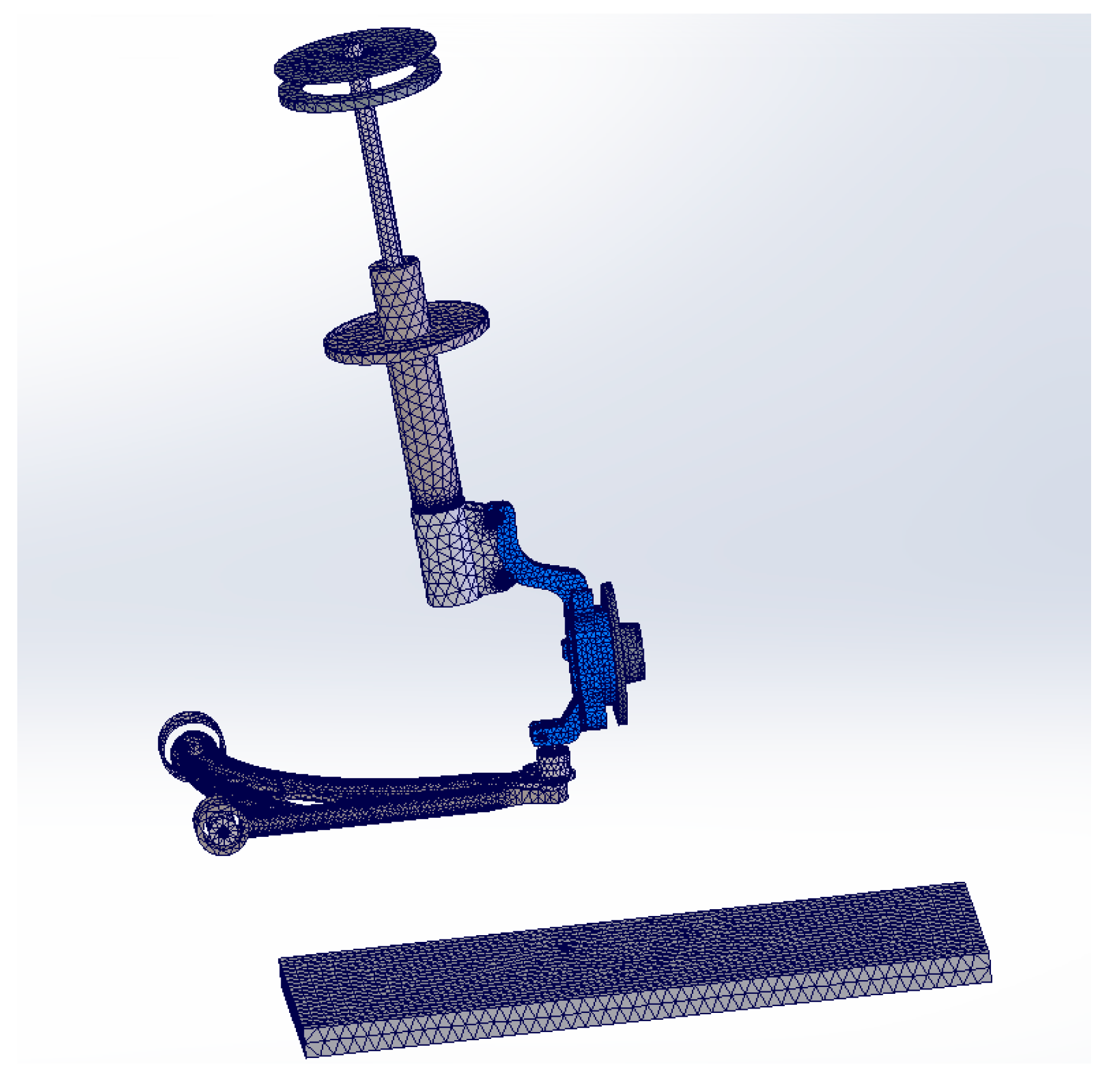
Frequency analysis of the suspension was performed and the geometric model was divided into finite elements. Figure 1 illustrates the three-dimensional blended curvature-based mesh, with a maximum size of 14 mm and a minimum size of 0.7 mm per finite element.
The natural frequencies of the suspension were also determined by an experimental study on an Audi passenger car with the tyres at pressures of 0.22 MPa in Case II. Experimental studies were conducted with the developed system described in [13,14,15] and the results were recorded. The test was performed five times for accuracy and reliability. The experimental data on the received acceleration and time signals of the sensor mounted on the body of the strut are used to conduct FRF analysis and locate the peak of the spectrum to identify the natural frequency.

3. Results and Discussion

The first natural frequency determined by the presented equations is 1.031 Hz.
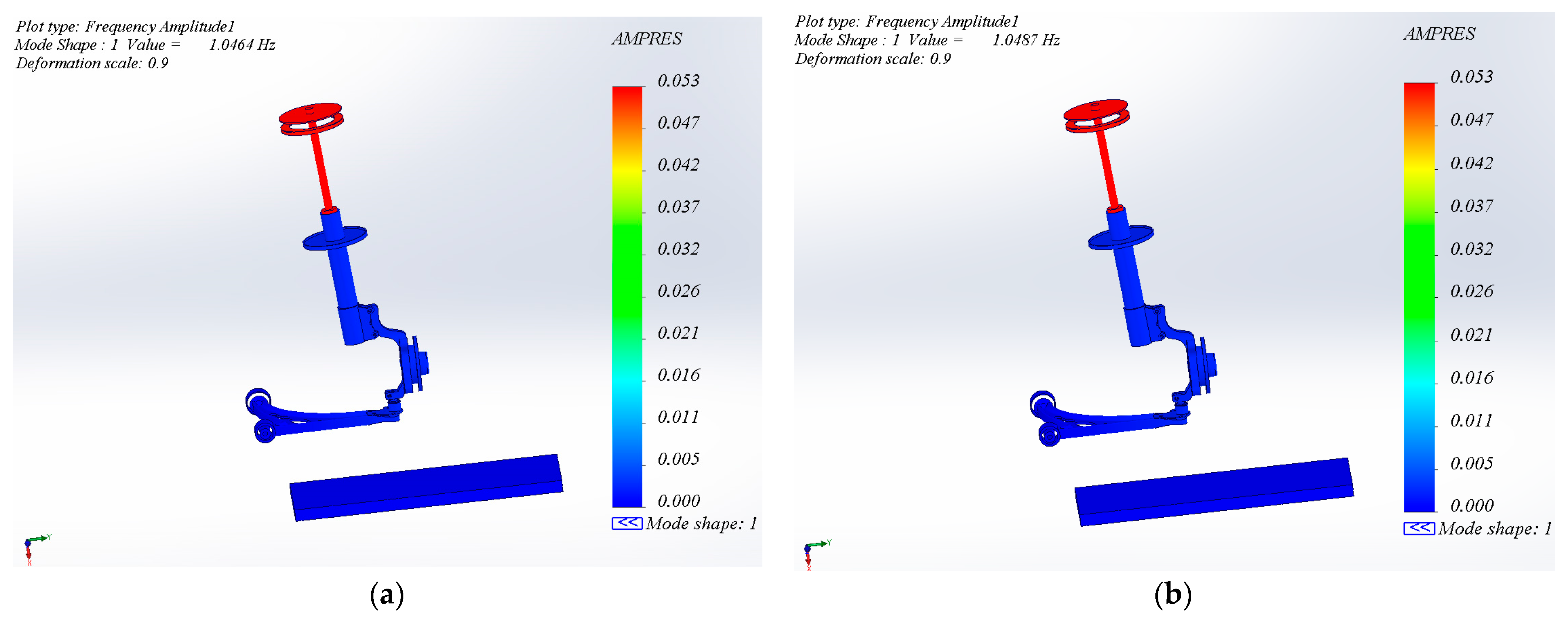
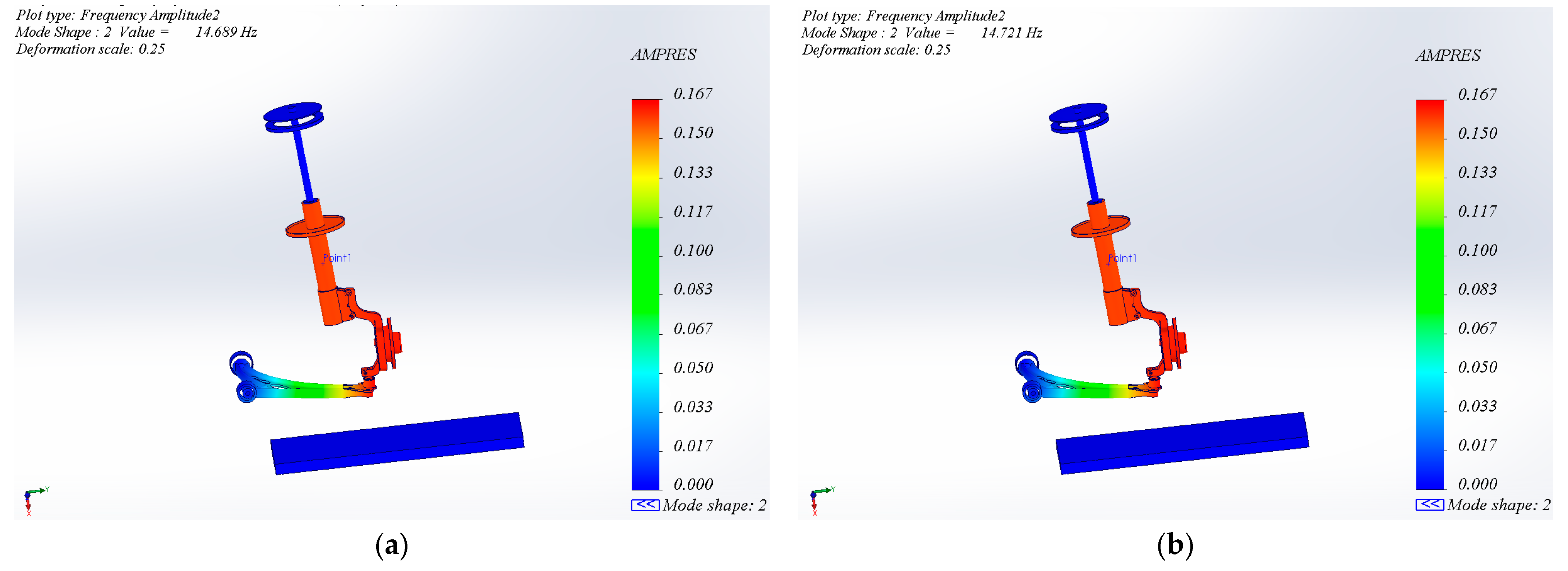
Figure 2 and Figure 3 illustrate the simulation results in Case I and Case II and the results of the first mode and second mode shapes of suspension, respectively. Table 1 shows the results of the six natural frequencies of suspension obtained by FEA for both cases.
From the obtained values of the natural frequencies, it can be seen that the first two natural frequencies are in the range from 0 to 15 Hz, corresponding to disturbances caused by the road, and the frequencies of the third–sixth modes can be considered as disturbances caused by the engine in the corresponding frequency range.
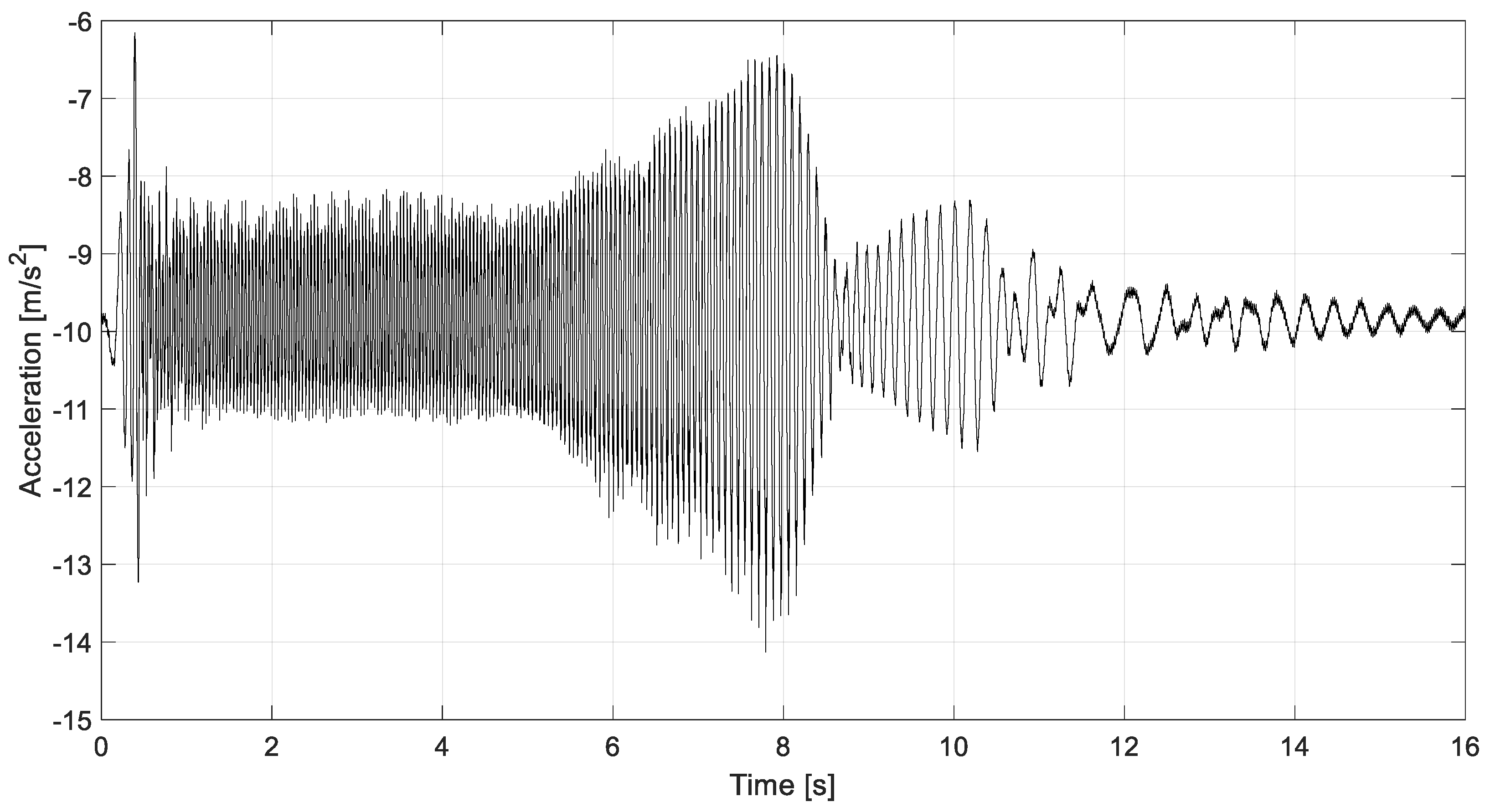
Figure 4 illustrates the obtained experimental results for acceleration and time in sensor 1 mounted on the body of the strut.
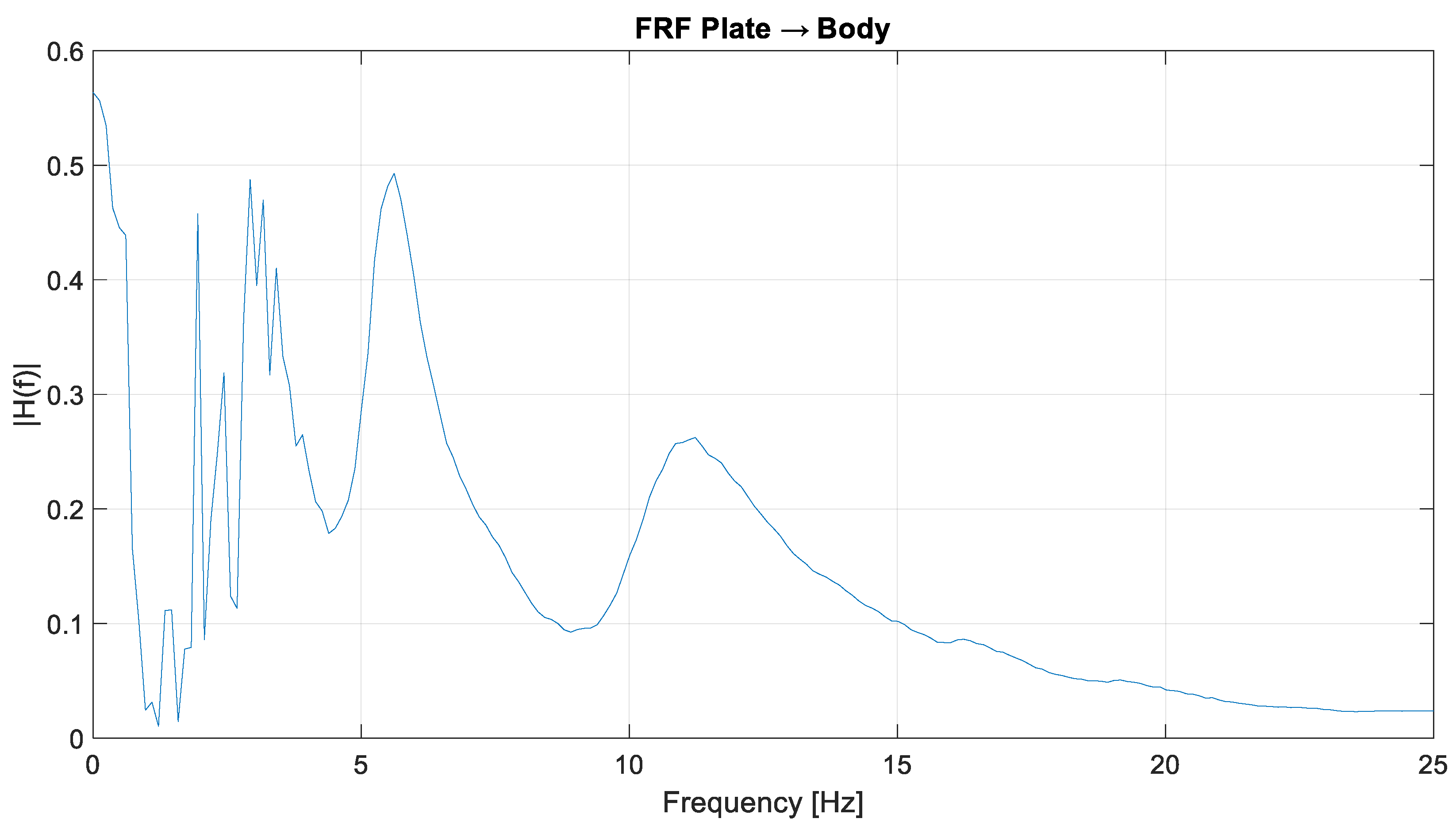
FRF analysis of the experimental data for acceleration and time was performed. Figure 5 shows the results for the natural frequencies.
Figure 5 shows that the first natural frequency is 5.61 Hz, and the second is 11.23 Hz. The lack of the required degree of coherence of the system at frequencies in the range of 0.85–3.05 Hz is evidence that the natural frequencies in this frequency range cannot be adequately accounted for and the natural frequency of the body may be lower than 5.62 Hz. The second natural frequency (11.23 Hz) is transmitted to the body by the unsprung masses (wheel, brake mechanism, arm, etc.) because this is their natural frequency, which is expressed the most strongly.
FRF analysis is better than FFT because in the shock absorber tester which used EUSAMA method [16], the so-called sweep is fast.
Table 2 presents the results for the natural frequencies obtained by formula, by FEA and experimentally (Case II).

4. Conclusions

The analyses conducted using various methods and tools for determining the natural frequencies allow us to make the following conclusions:
-
The obtained results of the first natural frequency by the formula and FEA are within the limits specified in 1–1.5 Hz and are comparable to those obtained in [4].
-
The results of natural frequencies of the suspension with two rubber bushings (Case I) and polyurethane and rubber bushings (Case II) obtained by FEA are almost the same.
-
In both cases, the first mode shapes obtained by FEA are of the same nature.
-
The values of the second natural frequency obtained by FEA and by FRF analysis are close.

Author Contributions

Conceptualization, S.T.; methodology, K.A. and S.T.; software, K.A. and S.T.; validation, S.T.; formal analysis, S.T.; investigation, K.A.; resources, K.A. and S.T.; data curation, K.A. and S.T.; writing—original draft preparation, K.A., S.T. and V.N.; writing—review and editing, S.T., K.A., and V.N.; visualization, K.A. and S.T.; supervision, K.A. and V.N.; project administration, K.A. and V.N.; funding acquisition, K.A. and V.N. All authors have read and agreed to the published version of the manuscript.

Funding

This research was funded by the European Regional Development Fund within the OP “Research, Innovation and Digitalization Programme for Intelligent Transformation 2021–2027”, Project CoC “Smart Mechatronics, Eco- and Energy Saving Systems and Technologies”, No. BG16RFPR002-1.014-0005.

Institutional Review Board Statement

Not applicable.

Informed Consent Statement

Not applicable.

Data Availability Statement

Data are contained within the article.

Conflicts of Interest

The authors declare no conflicts of interest.

References

  1. Georgiev, Z.; Kunchev, L. Study of the vibrational behaviour of the components of a car suspension. MATEC Web Conf. 2018, 234, 02005. [Google Scholar] [CrossRef] [Scilit]
  2. Sinapov, P.; Kralov, I.; Polihronov, G.; Ignatov, I.; Nedelchev, K. Experimental Study and Analysis of the Vehicle Self-Excited Friction Vibrations During Set-off. In Proceedings of the Scientific Conference on Aeronautics, Automotive and Railway Engineering and Technologies “BulTrans-2011”, Sozopol, Bulgaria, 27–30 September 2011; pp. 263–266. [Google Scholar]
  3. Dehbari, S.; Marzbanrad, J. Kinematic and Dynamic Analysis for a New MacPherson Strut Suspension System. Sci. J. Mech. Mech. Eng. 2018, 22, 1223–1238. [Google Scholar] [CrossRef] [Scilit]
  4. Aye, Y.; Win, H.; Swe, M.; Lat, K. Vibration Analysis of Suspension System for 3DOF Quarter Car Model with Tire Damping. Int. J. Mech. Eng. Robot. Res. 2024, 13, 196–204. [Google Scholar] [CrossRef] [Scilit]
  5. Barethiye, V.; Pohit, G.; Mitra, A. A combined nonlinear and hysteresis model of shock absorber for quarter car simulation on the basis of experimental data. Eng. Sci. Technol. Int. J. 2017, 20, 1610–1622. [Google Scholar] [CrossRef] [Scilit]
  6. Genov, J. Multi-criteria synthesis of frequency-modulated discrete control of semi-active vehicle suspension—Part 1: Analysis and control strategies. In Proceedings of the 8th International Scientific Conference “TechSys 2019”—Engineering, Technologies and Systems, Plovdiv, Bulgaria, 16–18 May 2019. [Google Scholar] [CrossRef] [Scilit]
  7. Sathishkumar, P.; Jancirani, J.; Dennie, J.; Manikandan, S. Mathematical modelling and simulation quarter car vehicle suspension. Int. J. Innov. Res. Sci. Eng. Technol. 2014, 3, 2347–6710. [Google Scholar]
  8. Paliwal, R.; Shrivastava, R. Design and FEA Simulation of Vehicle Suspension System by Using ANSYS. Smart Moves J. Ijoscience 2021, 7, 32–41. [Google Scholar] [CrossRef] [Scilit]
  9. Szczypinski-Sala, W.; Kot, A.; Hankus, M. The Evaluation of Vehicle Vibrations Excited with a Test Plate during Technical Inspection of Vehicle Suspension. Appl. Sci. 2023, 13, 11. [Google Scholar] [CrossRef] [Scilit]
  10. Marinescu, C.; Castravete, C.; Dumitru, N. Vibration study of a vehicle suspension assembly with the finite element method. IOP Conf. Ser. Mater. Sci. Eng. 2017, 252, 012030. [Google Scholar] [CrossRef] [Scilit]
  11. Bhandiagare, S.; Mali, T.; Tangadpalliwar, S.; Baskar, P. Analysis of effect of Polyurethane Bushing on stress distribution of Anti-Roll Bar. Int. J. Eng. Res. Gen. Sci. 2016, 4, 90–96. [Google Scholar]
  12. Duleba, B.; Greškovič, F.; Jachowicz, T. Possibility of manufacturing of race polyurethane bushings using rapid prototyping and prototype molds. Transf. Inovácií 2012, 24, 195–199. [Google Scholar]
  13. Ambarev, K.; Taneva, S. A Comparative Study of Vibrations in Front Suspension Components Using Bushings Made from Different Materials. Eng. Proc. 2025, 100, 42. [Google Scholar] [CrossRef] [Scilit]
  14. Ambarev, K.; Taneva, S. Comparison of vibrations in MacPherson suspension type components with different characteristics of vibration isolators. In Proceedings of the Youth Forums “Science, Technology, Innovation, Business” 2024, Plovdiv, Bulgaria, 21–22 November 2024; pp. 251–255. [Google Scholar]
  15. Taneva, S.; Ambarev, K. Study of the Vibrations of MacPherson Suspension Components. AIP Conf. Proc. 2025, 3274, 060006. [Google Scholar] [CrossRef] [Scilit]
  16. Dobaj, K. Simulation analysis of the EUSAMA Plus suspension testing method including the impact of the vehicle untested side. IOP Conf. Ser. Mater. Sci. Eng. 2016, 148, 012034. [Google Scholar] [CrossRef] [Scilit]
Figure 1. Computational mesh.
Engproc 150 00087 g001
Figure 2. The first mode shape: (a) Case I; (b) Case II.
Engproc 150 00087 g002
Figure 3. The second mode shape: (a) Case I; (b) Case II.
Engproc 150 00087 g003
Figure 4. Acceleration and time in sensor 1, mounted on the body of the strut.
Engproc 150 00087 g004
Figure 5. FRF analysis.
Engproc 150 00087 g005
Table 1. FEA natural frequencies.
Mode NumberNatural Frequencies [Hz] (Case I)Natural Frequencies [Hz] (Case II)
First1.04641.0487
Second14.68914.721
Third66.98566.988
Fourth67.18367.185
Five67.50167.502
Six115.450116.130
Table 2. Comparison of the natural frequencies results.
ParameterFormulaFEAExperimental
Natural frequencies of first mode [Hz]1.0311.04875.61
Natural frequencies of second mode [Hz]-14.72111.23
Disclaimer/Publisher’s Note: The statements, opinions and data contained in all publications are solely those of the individual author(s) and contributor(s) and not of MDPI and/or the editor(s). MDPI and/or the editor(s) disclaim responsibility for any injury to people or property resulting from any ideas, methods, instructions or products referred to in the content.