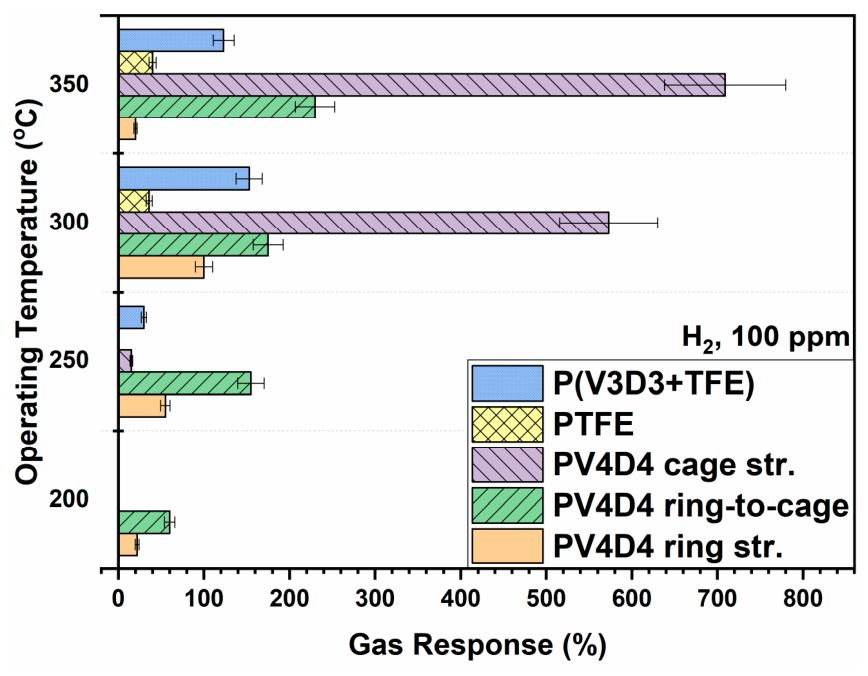
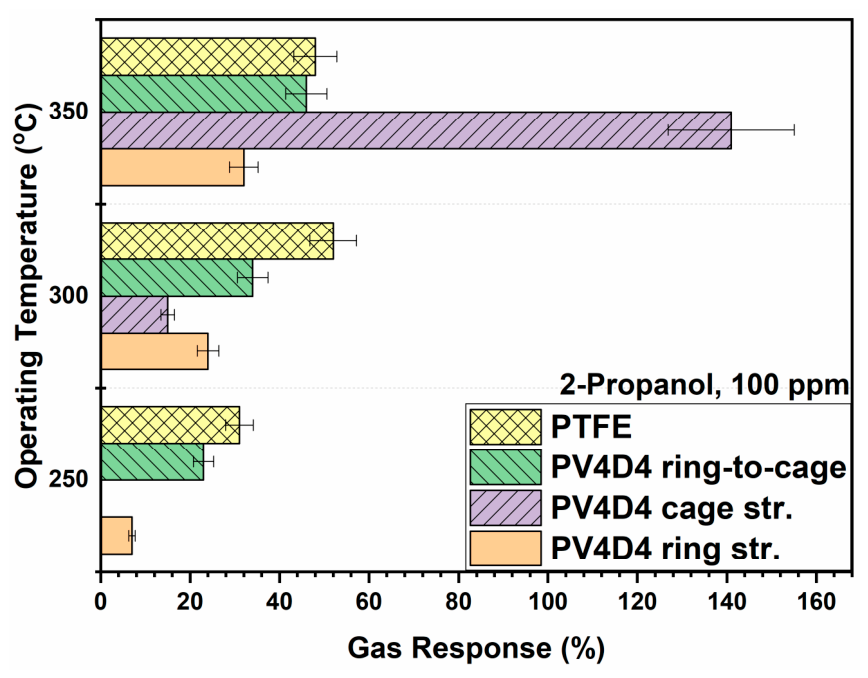
Enhancing the Potential of MOX-Based Gas Sensor Through iCVD Coatings for Biomedical Applications †


Abstract
1. Introduction
2. Gas Sensor Solutions
2.1. Gas Sensors
2.2. Improvement by Coatings
3. Discussion
4. Conclusions
Author Contributions
Funding
Institutional Review Board Statement
Informed Consent Statement
Data Availability Statement
Acknowledgments
Conflicts of Interest
References
- Kiss, H.; Örlős, Z.; Gellért, Á.; Megyesfalvi, Z.; Mikáczó, A.; Sárközi, A.; Vaskó, A.; Miklós, Z.; Horváth, I. Exhaled Biomarkers for Point-of-Care Diagnosis: Recent Advances and New Challenges in Breathomics. Micromachines 2023, 14, 391. [Google Scholar] [CrossRef] [Scilit] [PubMed]
- Zhou, S.; Yang, Y.; Zhang, X.; Zhang, T. Admission Fibrinogen-to-Albumin Ratio and Mortality in Older Adults Hospitalized with Pneumonia: A Retrospective Cohort Study. BMC Infect. Dis. 2026, 26, 327. [Google Scholar] [CrossRef] [Scilit] [PubMed]
- Yoon, S.H.; Eun, S. Neutrophil CD64 as a Prognostic Biomarker for Mortality in Sepsis: A Systematic Review and Meta-Analysis. Med. Intensiv. 2026, 50, 502251. [Google Scholar] [CrossRef] [Scilit]
- Cao, Z.; Chen, B.; Zhou, J.; Jin, J.; Abramov, D.; Chen, S.; Huang, P.; Zhou, J. Liver Fibrosis Biomarkers as a Prognostic Tool beyond the Defining Components in Cardiovascular-Kidney-Metabolic Syndrome. Am. J. Prev. Cardiol. 2026, 26, 101438. [Google Scholar] [CrossRef] [Scilit] [PubMed]
- Gao, Y.; Chen, B.; Cheng, X.; LiuD, S.; Li, Q.; Xi, M. Volatile Organic Compounds in Exhaled Breath: Applications in Cancer Diagnosis and Predicting Treatment Efficacy. Cancer Pathog. Ther. 2025, 3, 411–419. [Google Scholar] [CrossRef] [Scilit] [PubMed]
- Popov, T.A. Human Exhaled Breath Analysis. Ann. Allergy Asthma Immunol. 2011, 106, 451–456. [Google Scholar] [CrossRef] [Scilit] [PubMed]
- Ghosh, C.; Leon, A.; Koshy, S.; Aloum, O.; Al-Jabawi, Y.; Ismail, N.; Weiss, Z.F.; Koo, S. Breath-Based Diagnosis of Infectious Diseases: A Review of the Current Landscape. Clin. Lab. Med. 2021, 41, 185–202. [Google Scholar] [CrossRef] [Scilit] [PubMed]
- Brînză, M.; Schwäke, L. Hybrid Nanosensors for Biomedical Applications. In Proceedings of the Technical Scientific Conference of Undergraduate, Master and PhD Students, Universitatea Tehnică a Moldovei, 14–16 May 2025; Universitatea Tehnică a Moldovei: Chișinău, Moldova, 2025; Volume 2, pp. 290–294. [Google Scholar]
- Lupan, O.; Nagpal, R.; Litra, D.; Brinza, M.; Sugihara, M.; Ameloot, R.; Railean, S.; Ameri, T.; Adelung, R.; Schröder, S.; et al. Hybrid Nanomaterials for Biomedical Sensors. In 7th International Conference on Nanotechnologies and Biomedical Engineering. (ICNBME 2025); Sontea, V., Tiginyanu, I., Railean, S., Eds.; Springer: Cham, Switzerland, 2025; pp. 162–176. [Google Scholar]
- Lupan, O.; Brînză, M.; Ababii, N.; Strunskus, T.; Magariu, N.; Pauporte, T.; Adelung, R.; Faupel, F.; Schröder, S. Hybrid Nano-Materials for Sensors in Biomedical, Environmental And Industrial Applications. In Proceedings of the Electronics, Communications and Computing; ACM: New York, NY, USA, 2024; pp. 32–33. [Google Scholar]
- Lupan, O.; Brinza, M.; Schröder, S.; Ababii, N.; Strunskus, T.; Viana, B.; Pauporté, T.; Adelung, R.; Faupel, F. Sensors Based on Hybrid Materials for Environmental, Industrial and Biomedical Applications. In Proceedings of the 2024 IEEE 14th International Conference Nanomaterials: Applications and; Properties (NAP); IEEE: Piscataway, NJ, USA, 2024; p. MTFC09-1-4. [Google Scholar] [CrossRef] [Scilit]
- Paparella, R.; Panvino, F.; Pucarelli, I.; Tarani, L. Medical Gases as Emerging Regulators of Paediatric Endocrine and Neurodevelopmental Pathways: A Mini-Review. Acta Paediatr. 2026, 115, 791–796. [Google Scholar] [CrossRef] [Scilit] [PubMed]
- Viana, J.; Castro, C.; Leiva, V. Molecular Hydrogen and Kidney Diseases: A Scoping Review Based on Scientometry and Data Analytics. Med. Gas Res. 2026, 16, 161–168. [Google Scholar] [CrossRef] [Scilit] [PubMed]
- Jeyaraman, N.; Jeyaraman, M.; Ramasubramanian, S.; Murugan, S.; Nallakumarasamy, A.; Muthu, S. Molecular Hydrogen Therapy in Musculoskeletal Conditions: An Evidence-Based Review and Critical Analysis. World J. Orthop. 2026, 17, 111911. [Google Scholar] [CrossRef] [Scilit] [PubMed]
- Nong, Z.; Li, H.; Huang, H.; Huang, J. Research Progress on Small Intestinal Bacterial Overgrowth in Liver Cirrhosis: From Diagnosis via Methane and Hydrogen Breath Tests to Clinical Management. Front. Healthc. Technol. 2026, 3, 15–25. [Google Scholar] [CrossRef] [Scilit]
- Natella, F.; Devirgiliis, C.; Roselli, M.; Sette, S.; Del Bo’, C.; Cioffi, I.; Polito, A.; Canali, R. Biomarkers of Total Dietary Fiber Intake: A Challenge to Meet. Nutr. Rev. 2026, 84, 395–408. [Google Scholar] [CrossRef] [Scilit] [PubMed]
- Guan, M.; Chang, L. Biomarkers in Irritable Bowel Syndrome: Rationale and Practical Use. Gastroenterol. Clin. 2026, 55, 91–105. [Google Scholar] [CrossRef] [Scilit] [PubMed]
- Lu, M.; Chen, J.; Zhang, H.; Xu, J.; Li, X.; Hu, Y.; Liu, J.; Ai, C.; Shi, C.; Geng, G.; et al. A Randomized, Double-Blind, Placebo-Controlled Study to Evaluate the Safety, Pharmacokinetics and Ammonia-Lowering Effect of Rifaquizinone, an Intestinally Restricted Investigational Drug. Expert Opin. Investig. Drugs 2026, 35, 169–177. [Google Scholar] [CrossRef] [Scilit] [PubMed]
- Abufarhaneh, E.; Ibnawadh, S.; Wong, R.K.M. Using Breath Tests in Gastroenterology: Clear and Reliable Practitioner Guide in 2025. Saudi J. Gastroenterol. 2026, 1–10. [Google Scholar] [CrossRef] [Scilit] [PubMed]
- Paine, S.; Darji, M.; Gohil, K.; Manhas, A.; Mukherjee, K. Rational Design of PANI Sensors for Detection of Ammonia and Ethyl-Substituted Aliphatic Amines: A Dual Experimental-Theoretical Strategy. Precis. Chem. 2026, 4, 584–598. [Google Scholar] [CrossRef] [Scilit] [PubMed]
- Chan, M.-J.; Liau, S.-K.; Li, Y.-J.; Zan, H.-W.; Meng, H.-F.; Lai, C.-S.; Su, Y.-J.; Tian, Y.-C. Breath Ammonia Test for Chronic Kidney Disease Screening: Impact of Fasting on Diagnostic Accuracy. Clin. Kidney J. 2026, 19, sfag064. [Google Scholar] [CrossRef] [Scilit] [PubMed]
- Ahmad, W.; Tahir, M.; Bibi, B.; He, L.; Nisa, F.U.; Naseem, M.; Ma, Z.; Ghafar, I.A.; Kalsoom, T.; Ahmed, M.; et al. Dual Heterojunction Strategy on ZIF-8 for High-Performance Ammonia Sensor. Adv. Funct. Mater. 2026, 36, e74500. [Google Scholar] [CrossRef] [Scilit]
- Wang, B.; Ma, P.; Wang, J.; Ji, D.; Chang, Z.; Yu, H.; Lu, Y.; Yang, Q.; Yang, Y.; Tan, Y.; et al. A Fully Flexible Sensing Ionogel-Based Transistor With Gate-Induced Enhancement for Wearable Breath Monitoring. Adv. Funct. Mater. 2026, 36, e75082. [Google Scholar] [CrossRef] [Scilit]
- Checker, S.; Yadav, A.B.; Sivnath Reddy, G.V.; Checker, R. Advances in Volatile Organic Compounds-Based Biomarker Detection Using Nanomaterial-Integrated Sensor Platforms for Cancer Diagnosis. ACS Appl. Electron. Mater. 2026, 8, 2198–2224. [Google Scholar] [CrossRef] [Scilit]
- Hwang, S.; Chung, H. Comparison of Three Breath Sampling Methods for Volatile Organic Compounds Analysis in Healthy Adults: End-Tidal, Whole, and Continuous. Res. Sq. 2026. [Google Scholar] [CrossRef] [Scilit] [PubMed]
- Pan, A.; Xu, M.; Zhou, H.; Xu, H.; Wang, L.; Li, Y. Exhalation Metabolomics for Noninvasive Staging Biomarker Exploration in Silicosis. J. Breath Res. 2026, 20, 016003. [Google Scholar] [CrossRef] [Scilit] [PubMed]
- Li, P.; Cao, Z.; Xie, B.; Yang, G.; Ma, Y.; Wang, M.; Jia, S.; Chen, X.; Tong, Z. In Situ Synthesis of Au-ZnO on Composite Fibre for Wearable and High-Sensitivity Ammonia Sensing. IEEE Sens. J. 2026, 26, 11546–11554. [Google Scholar] [CrossRef] [Scilit]
- Ranganathan, N.; Geetha, J.; Krishnan, A.; Vickram, A.S.; Saravanan, A.; Chinnadurai, J.; Chen, Y.-H.; Chen, W.-C.; Wu, I.-C.; Ponnusamy, V.K.; et al. Breathomics in Diabetes Management: A Noninvasive Approach for Precision Health Monitoring. J. Diabetes Res. 2026, 2026, e7977153. [Google Scholar] [CrossRef] [Scilit] [PubMed]
- Han, R.; An, B.; Yang, Y.; Wu, Z.; Zhang, T.; Guo, L.; Wang, Q.; Zhang, Y.; Xie, E.; Wang, Y. Defect Engineered ZIF-67-Derived Co3O4 Nanostructures: Modulating Oxygen Vacancies and Co Coordination for Superior Ethanol Sensing. Appl. Surf. Sci. 2026, 727, 166077. [Google Scholar] [CrossRef] [Scilit]
- Olson, A. Unit Inconsistency in Forensic Blood and Breath Alcohol Reporting. Forensic Sci. Int. Synerg. 2026, 12, 100674. [Google Scholar] [CrossRef] [Scilit] [PubMed]
- Yamaguchi, A.; Kawai, M.; Nakata, H. Direct Electrochemical Sensing of Ethanol Gas by Utilizing Air/Water Interface at Platinum Nanohole Array Electrode. Anal. Sci. 2026, 42, 191–195. [Google Scholar] [CrossRef] [Scilit] [PubMed]
- Kamaljeet; Vijukumar, A.; Shahi, A.; Kumar, A.; Bhatia, R. AUTO-Brewery Syndrome and the Human Microbiome: Insights into Endogenous Ethanol Production and Human Diseases. Food Sci. Biotechnol. 2026. [Google Scholar] [CrossRef] [Scilit]
- Hsu, C.L.; Shukla, S.; Freund, L.; Chou, A.C.; Yang, Y.; Bruellman, R.; Raya Tonetti, F.; Cabré, N.; Mayo, S.; Lim, H.G.; et al. Gut Microbial Ethanol Metabolism Contributes to Auto-Brewery Syndrome in an Observational Cohort. Nat. Microbiol. 2026, 11, 415–428. [Google Scholar] [CrossRef] [Scilit] [PubMed]
- Hoxhaj, R.; Markley Webster, S.C. Glycemic Emergencies. Med. Clin. N. Am. 2026, 110, 445–465. [Google Scholar] [CrossRef] [Scilit] [PubMed]
- Brinza, M.; Schwäke, L.; Schröder, S.; Lupan, C.; Ababii, N.; Magariu, N.; Chiriac, M.; Faupel, F.; Vahl, A.; Lupan, O. Two-in-One Hybrid Sensor Based on PV4D4/AgAu/TiO2 Structure for Carbon Dioxide and Hydrogen Gas Detection in Biomedical and Industrial Fields. Biosensors 2025, 16, 5. [Google Scholar] [CrossRef] [Scilit] [PubMed]
- Wenzel, C.; Borgmann, S.; Flamm, B.; Kuhn, L.; Schumann, S.; Schmidt, J.; Spaeth, J.; Spassov, S. Continuous Carbon Dioxide Monitoring in the Exhaled Breath of Mechanically Ventilated Rats. Exp. Physiol. 2026, 111, 614–619. [Google Scholar] [CrossRef] [Scilit] [PubMed]
- Brinza, M.; Schröder, S.; Ababii, N.; Gronenberg, M.; Strunskus, T.; Pauporte, T.; Adelung, R.; Faupel, F.; Lupan, O. Two-in-One Sensor Based on PV4D4-Coated TiO2 Films for Food Spoilage Detection and as a Breath Marker for Several Diseases. Biosensors 2023, 13, 538. [Google Scholar] [CrossRef] [Scilit] [PubMed]
- Lupan, O.; Brinza, M.; Piehl, J.; Ababii, N.; Magariu, N.; Zimoch, L.; Strunskus, T.; Pauporte, T.; Adelung, R.; Faupel, F.; et al. Influence of Silsesquioxane-Containing Ultra-Thin Polymer Films on Metal Oxide Gas Sensor Performance for the Tunable Detection of Biomarkers. Chemosensors 2024, 12, 76. [Google Scholar] [CrossRef] [Scilit]
- Schröder, S.; Brinza, M.; Cretu, V.; Zimoch, L.; Gronenberg, M.; Ababii, N.; Railean, S.; Strunskus, T.; Pauporte, T.; Adelung, R.; et al. A New Approach in Detection of Biomarker 2-Propanol with PTFE-Coated TiO2 Nanostructured Films. In 6th International Conference on Nanotechnologies and Biomedical Engineering. (ICNBME 2023); Sontea, V., Tiginyanu, I., Railean, S., Eds.; Springer Nature: Cham, Switzerland, 2024; pp. 75–83. [Google Scholar] [CrossRef] [Scilit]
- Brinza, M.; Schwäke, L.; Zimoch, L.; Strunskus, T.; Pauporté, T.; Viana, B.; Ameri, T.; Adelung, R.; Faupel, F.; Schröder, S.; et al. Influence of P(V3D3-Co-TFE) Copolymer Coverage on Hydrogen Detection Performance of a TiO2 Sensor at Different Relative Humidity for Industrial and Biomedical Applications. Chemosensors 2025, 13, 150. [Google Scholar] [CrossRef] [Scilit]
- Schröder, S.; Magariu, N.; Strunskus, T.; Ababii, N.; Lupan, O.; Faupel, F. New Vapor Deposited Dielectric Polymer Thin Films for Electronic Applications. J. Eng. Sci. 2022, 29, 34–44. [Google Scholar] [CrossRef] [Scilit] [PubMed]
- Schröder, S.; Ababii, N.; Brînză, M.; Magariu, N.; Zimoch, L.; Bodduluri, M.T.; Strunskus, T.; Adelung, R.; Faupel, F.; Lupan, O. Tuning the Selectivity of Metal Oxide Gas Sensors with Vapor Phase Deposited Ultrathin Polymer Thin Films. Polymers 2023, 15, 524. [Google Scholar] [CrossRef] [Scilit] [PubMed]
- Brînză, M.; Lupan, C.; Schwäke, L.; Ababii, N.; Zimoch, L.; Sereacov, A.; Pauporté, T.; Schröder, S.; Adelung, R.; Faupel, F.; et al. Effect of PTFE Thickness on Gas Sensing Properties of TiO2/Pd-Doped ZnO Nanostructures. In 7th International Conference on Nanotechnologies and Biomedical Engineering. (ICNBME 2025); Sontea, V., Tiginyanu, I., Railean, S., Eds.; Springer: Cham, Switzerland, 2025; pp. 275–283. [Google Scholar] [CrossRef] [Scilit]
- Lupan, O.; Santos-Carballal, D.; Ababii, N.; Magariu, N.; Hansen, S.; Vahl, A.; Zimoch, L.; Hoppe, M.; Pauporté, T.; Galstyan, V.; et al. TiO2/Cu2O/CuO Multi-Nanolayers as Sensors for H 2 and Volatile Organic Compounds: An Experimental and Theoretical Investigation. ACS Appl. Mater. Interfaces 2021, 13, 32363–32380. [Google Scholar] [CrossRef] [Scilit] [PubMed]
- Lupan, O.; Postica, V.; Ababii, N.; Reimer, T.; Shree, S.; Hoppe, M.; Polonskyi, O.; Sontea, V.; Chemnitz, S.; Faupel, F.; et al. Ultra-Thin TiO2 Films by Atomic Layer Deposition and Surface Functionalization with Au Nanodots for Sensing Applications. Mater. Sci. Semicond. Process. 2018, 87, 44–53. [Google Scholar] [CrossRef] [Scilit]
- Lupan, O.; Schröder, S.; Abdollahifar, M.; Magariu, N.; Offermann, J.; Schwäke, L.; Brinza, M.; Zimoch, L.; Tugulea, V.; Strunskus, T.; et al. Polymer-Coated Cd-Doped ZnO Nanostructures for Dual Sensing of Volatile Organic Compounds and Battery Vapours. In 7th International Conference on Nanotechnologies and Biomedical Engineering. (ICNBME 2025); Sontea, V., Tiginyanu, I.R., Eds.; Springer: Cham, Switzerland, 2025; pp. 284–300. [Google Scholar] [CrossRef] [Scilit]
- Chakraborty, B.; Litra, D.; Mishra, A.K.; Lupan, C.; Nagpal, R.; Mishra, S.; Qiu, H.; Railean, S.; Lupan, O.; de Leeuw, N.H.; et al. Ultra-Selective Hydrogen Sensors Based on CuO–ZnO Hetero-Structures Grown by Surface Conversion. J. Alloys Compd. 2024, 1002, 175385. [Google Scholar] [CrossRef] [Scilit]
- Nagpal, R.; Lupan, C.; Schadte, P.; Birnaz, A.; Brinza, M.; Siebert, L.; Lupan, O. Study on Al2O3/ZnO Heterostructure Based UV Detection for Biomedical Applications. In Advances in Digital Health and Medical Bioengineering. (EHB 2023); Costin, H.N., Magjarević, R., Petroiu, G., Eds.; Springer: Cham, Switzerland, 2024; pp. 178–188. [Google Scholar] [CrossRef] [Scilit]
- Torkamani, R.; Aslibeiki, B.; Salari, S.; Azizi, H.; Peddis, D.; Sarkar, T. High-Performance Hydrogen Gas Sensor Based on Ag-Incorporated ZnO Nanoparticles. Sci. Rep. 2025, 15, 38390. [Google Scholar] [CrossRef] [Scilit] [PubMed]
- Jing, Y.; Luan, X.; Cui, L.; Lu, X.; Pan, Y.; Jiang, Y. Ag-Doped ZnO Nanocomposites for High-Performance Hydrogen Sensing: Synergistic Enhancement via Structural and Electronic Modulation. Int. J. Hydrogen Energy 2025, 165, 150839. [Google Scholar] [CrossRef] [Scilit]
- Yu, A.; Xun, H.; Yi, J. Improving Hydrogen Sensing Performance of TiO2 Nanotube Arrays by ZnO Modification. Front. Mater. 2019, 6, 70. [Google Scholar] [CrossRef] [Scilit]
- Yang, J.-E.; Kim, S.; Yoon, J.; Lee, J.; Park, I.-K.; Kim, K.-K. A UV-Photon-Energy-Integrated Gas Sensor Based on Pt-Nanoparticle-Decorated TiO2 Nanorods for Room-Temperature Hydrogen Detection. Chemosensors 2025, 13, 177. [Google Scholar] [CrossRef] [Scilit]
- Xiang, T.; Yi, J. Ultrasensitive and Selective Hydrogen Sensing of SnO2 Nanofibers Decorated with Pd Single Atoms. Sens. Actuators B Chem. 2024, 416, 136022. [Google Scholar] [CrossRef] [Scilit]
- Thathsara, T.; Harrison, C.J.; Hocking, R.K.; Shafiei, M. Enhanced Hydrogen Sensing Performance at Room Temperature Employing Photoactive Hybrid Pd Nanoparticle-Decorated SiO2@TiO2 Core–Shell Nanospheres. ACS Sens. 2025, 10, 8269–8285. [Google Scholar] [CrossRef] [Scilit] [PubMed]
- Yang, Y.; Fu, H.; Song, F.; Yu, S.; Tang, Z.; Zhang, K.; Li, Q.; Yang, C.; Zhang, L.; Wang, J.; et al. A High-Performance H2 Gas Sensor Based on PtO x and PdO y Co-Decorating WO3 Film. New J. Chem. 2025, 49, 5266–5278. [Google Scholar] [CrossRef] [Scilit]
- Sui, L.; Chen, W.; Long, X.; Liao, J.; Wang, S.; Wei, X. Ultrafine Pd Nanoparticles-Decorated TiO2 Three-Dimensional (3D) Hybrid Aerogel with Large Specific Surface Areas and Highly Interconnected Porous Networks for Hydrogen Sensing. Int. J. Hydrogen Energy 2024, 55, 855–863. [Google Scholar] [CrossRef] [Scilit]
- Motsoeneng, R.G.; Kortidis, I.; Ray, S.S.; Motaung, D.E. Designing SnO2 Nanostructure-Based Sensors with Tailored Selectivity toward Propanol and Ethanol Vapors. ACS Omega 2019, 4, 13696–13709. [Google Scholar] [CrossRef] [Scilit] [PubMed]
- Cai, X.; Hu, D.; Deng, S.; Han, B.; Wang, Y.; Wu, J.; Wang, Y. Isopropanol Sensing Properties of Coral-like ZnO–CdO Composites by Flash Preparation via Self-Sustained Decomposition of Metal–Organic Complexes. Sens. Actuators B Chem. 2014, 198, 402–410. [Google Scholar] [CrossRef] [Scilit]
- Das, P.; Mondal, B.; Mukherjee, K. Chemi-Resistive Response of Rutile Titania Nano-Particles towards Isopropanol and Formaldehyde: A Correlation with the Volatility and Chemical Reactivity of Vapors. Mater. Res. Express 2017, 4, 015503. [Google Scholar] [CrossRef] [Scilit]
- Dong, C.; Xing, X.; Chen, N.; Liu, X.; Wang, Y. Biomorphic Synthesis of Hollow CuO Fibers for Low-Ppm-Level n-Propanol Detection via a Facile Solution Combustion Method. Sens. Actuators B Chem. 2016, 230, 1–8. [Google Scholar] [CrossRef] [Scilit]
- Poloju, M.; Jayababu, N.; Manikandan, E.; Ramana Reddy, M.V. Enhancement of the Isopropanol Gas Sensing Performance of SnO2/ZnO Core/Shell Nanocomposites. J. Mater. Chem. C 2017, 5, 2662–2668. [Google Scholar] [CrossRef] [Scilit]
- Yin, Y.; Shen, Y.; Zhou, P.; Lu, R.; Li, A.; Zhao, S.; Liu, W.; Wei, D.; Wei, K. Fabrication, Characterization and n-Propanol Sensing Properties of Perovskite-Type ZnSnO3 Nanospheres Based Gas Sensor. Appl. Surf. Sci. 2020, 509, 145335. [Google Scholar] [CrossRef] [Scilit]
- Song, X.-Z.; Meng, Y.-L.; Chen, X.; Sun, K.-M.; Wang, X.-F. Hollow NiFe2O4 Hexagonal Biyramids for High-Performance n -Propanol Sensing at Low Temperature. New J. Chem. 2018, 42, 14071–14074. [Google Scholar] [CrossRef] [Scilit]



| Sensor Base | Nanoparticles | Concentration, ppm | Response (%) | OPT (°C) | Response/ Recovery (s) | REF |
|---|---|---|---|---|---|---|
| ZnO + 2% Ag | Ag | 250 | 4357 | 350 | — | [49] |
| ZnO + 1 at% Ag | Ag | 100 | 2200 | 300 | 6.6/— | [50] |
| TiO2 nanotuburi + ZnO | ZnO | 100 | 520 | 350 | 22/>2000 | [51] |
| TiO2 + AgAu NPs | AgAu | 100 | 300 | 350 | 0.7/1.5 | [35] |
| TiO2 + Pt NPs | Pt + UV | 1% (10,000 ppm) | 240 | Room Temperature (RT) | — | [52] |
| SnO2 nanofibre + Pd | Pd | 1000 | 224 | 300 | 8.4/— | [53] |
| Pd/SiO2@TiO2 | Pd + core-shell | 1000 | 2283 (S = 22.83) | 25 (RT) | 68/43 | [54] |
| WO3 + PtOx/PdOγ | Co PtOx + PdOγ | 100 | ~200 (estimated) | 110 | — | [55] |
| TiO2 aerogel 3D + Pd | Pd | 100 | 480 (S = 4.8) | 325 | <2/<22 | [56] |
| Sensor Base | Polymer | Concentration, ppm | Response | OPT (C) | REF |
|---|---|---|---|---|---|
| SnO2 | - | 40 | 20.1 Ra/Rg-1 | 75 | [57] |
| ZnO/CdO | - | 50 | 10.23 Ra/Rg | 248 | [58] |
| TiO2 | - | 200 | 1.68 Ra/Rg | 300 | [59] |
| CuO | - | 100 | 4.66 Ra/Rg | 200 | [60] |
| SnO2/ZnO | - | 500 | 1.99 Ra/Rg | 300 | [61] |
| ZnSnO3 | - | 10 | 10.3 Ra/Rg | 200 | [62] |
| NiFe2O4 | - | 20 | 6.51 Ra/Rg | 120 | [63] |
| TiO2 | PV4D4 (as grown) | 100 | 251% | 350 | [42] |
| TiO2 | PV4D4 (as grown) | 100 | 225% | 400 | [42] |
| TiO2 | P(V3D3 + TFE) | 100 | 64% | 350 | [40] |
| CuO | PV4D4 | 100 | ~64% | 300 | [42] |
| TiO2 | PV4D4 (as grown) | 100 | 251% | 350 | [42] |
Disclaimer/Publisher’s Note: The statements, opinions and data contained in all publications are solely those of the individual author(s) and contributor(s) and not of MDPI and/or the editor(s). MDPI and/or the editor(s) disclaim responsibility for any injury to people or property resulting from any ideas, methods, instructions or products referred to in the content. |
© 2026 by the authors. Licensee MDPI, Basel, Switzerland. This article is an open access article distributed under the terms and conditions of the Creative Commons Attribution (CC BY) license.
Share and Cite
Brînză, M.; Litra, D.; Crețu, V.; Pocaznoi, I. Enhancing the Potential of MOX-Based Gas Sensor Through iCVD Coatings for Biomedical Applications. Eng. Proc. 2026, 148, 12. https://doi.org/10.3390/engproc2026148012
Brînză M, Litra D, Crețu V, Pocaznoi I. Enhancing the Potential of MOX-Based Gas Sensor Through iCVD Coatings for Biomedical Applications. Engineering Proceedings. 2026; 148(1):12. https://doi.org/10.3390/engproc2026148012
Chicago/Turabian StyleBrînză, Mihai, Dinu Litra, Vasilii Crețu, and Ion Pocaznoi. 2026. "Enhancing the Potential of MOX-Based Gas Sensor Through iCVD Coatings for Biomedical Applications" Engineering Proceedings 148, no. 1: 12. https://doi.org/10.3390/engproc2026148012
APA StyleBrînză, M., Litra, D., Crețu, V., & Pocaznoi, I. (2026). Enhancing the Potential of MOX-Based Gas Sensor Through iCVD Coatings for Biomedical Applications. Engineering Proceedings, 148(1), 12. https://doi.org/10.3390/engproc2026148012