1. Introduction
Autonomous mobile robots are increasingly used in warehouses, hospitals, campuses, inspection routes, and smart city services, where safe navigation must be achieved under limited onboard energy resources [
1,
2]. Classical path planning methods usually formulate the problem as the search for a collision-free route between a start point and a target point, using geometric length, travel time, or grid traversal cost as the dominant criterion [
2,
3]. This view is appropriate for many navigation tasks, but it is incomplete for differential-drive robots because two trajectories with similar Euclidean length may require different levels of in-place rotation, heading correction, wheel-slip compensation, and motor effort.
For differential drive locomotion, the energetic burden of a route is shaped by both translation and rotation. A path that appears short in Cartesian space can contain abrupt heading changes that require stop-turn-start maneuvers or high angular-velocity commands. These maneuvers increase electrical demand, reduce tracking accuracy, and may amplify localization uncertainty near obstacles [
4,
5]. Therefore, energy-aware planning for this robot class should not only avoid collisions but also penalize accumulated rotational effort and concentrated turns.
Conventional graph search algorithms, especially A*, are widely used because they provide fast and reproducible collision-free routes when the environment can be discretized into an occupancy grid [
6]. Nevertheless, their standard implementation optimizes grid traversal cost and path length, whereas the energy implications of heading changes are usually considered only indirectly through post-processing, smoothing, or controller-level compensation. In dense urban settings with narrow passages and dead ends, this limitation becomes relevant because the planner may produce a safe and short path that still imposes unnecessary rotational effort on the robot. This observation motivates the explicit comparison with A* in the present study.
Metaheuristic algorithms have been used in diverse complex problems [
7,
8,
9], and can provide an alternative for continuous waypoint optimization in nonlinear and constrained spaces [
10,
11,
12]. Genetic Algorithms can preserve exploration through selection, crossover, and mutation, while Particle Swarm Optimization can refine waypoint coordinates through collective attraction toward personal and global best solutions [
13,
14,
15]. These mechanisms are attractive for energy-aware route planning because they can optimize nonconvex route quality metrics that combine distance, rotation, and clearance-related risk.
The contribution of this paper is a feasibility first energy-aware planning framework for differential drive robots in polygonal urban environments. The proposed method integrates: (i) a continuous waypoint representation with exact segment to polygon safety checks, (ii) an energy proxy composed of translational distance, cumulative rotation, squared rotation, and localization risk, (iii) a feasibility first dominance rule that avoids manually tuned collision penalty weights, (iv) a benchmark against A* in a dense scenario with narrow passages and a U shaped dead end, and (v) repeatability, ranking, weight sensitivity, and external perturbation analyses. The rest of the paper is organized as follows.
Section 2 presents the mathematical model and algorithms.
Section 3 reports and discusses the results.
Section 4 summarizes the main findings, limitations, and future work.
2. Methods
This section describes the environment model, the energy proxy, the constraint handling strategy, the A* baseline, and the continuous metaheuristic optimizers. The final experimental configuration was selected to address the requirements for benchmarking, scenario complexity, parameter reporting, sensitivity, and robustness.
2.1. Robot, Workspace, and Path Representation
The workspace is a two dimensional bounded map containing a set of polygonal obstacles . The start and goal positions are m and m, respectively. The mobile robot is represented by a circular footprint of radius m, and a safety clearance m is imposed around each obstacle. Therefore, a path segment is admissible only if its distance to every polygon is at least m.
A candidate route is represented as a polyline , where , , and the internal waypoints are optimization variables. The decision vector is , with each coordinate bounded by the workspace limits. This continuous encoding allows GA and PSO to refine route geometry beyond the fixed grid used by A*.
2.2. Energy Proxy and Physical Interpretation
For each segment
i, the translational length is
. The total path length is
The heading of segment
i is
, and the wrapped heading change is
Two rotational indicators are considered. The term
approximates the cumulative angular effort required by the differential drive system, while
penalizes concentrated turns more strongly than distributed smooth heading corrections. A clearance-dependent localization risk term is also included,
where
is the minimum distance between segment
and obstacle
, and
m is the nominal localization uncertainty. The final energy proxy is
The adopted coefficients are
,
,
, and
. This cost is an interpretable energy proxy rather than a calibrated electrical energy model in joules. Its purpose is to rank feasible trajectories according to translation, rotation, concentrated turning, and proximity risk. The value
was selected after a sensitivity analysis over
, reported in
Section 3.6.
2.3. Constraint Handling Through Feasibility First Dominance
The total constraint violation combines collision clearance, boundary compliance, and maximum turn feasibility. The collision component is
The boundary violation
penalizes waypoints outside
, and the turn violation
penalizes turns above
. The total violation is
A path is feasible when
. Candidate solutions are compared using a feasibility-first rule: a feasible solution dominates any infeasible solution; between two feasible solutions, the lower
is preferred; and between two infeasible solutions, the lower
is preferred. This rule reduces dependence on manually adjusted obstacle penalty coefficients.
2.4. A* Baseline
A* was implemented as a deterministic grid-based baseline. The workspace was discretized with a resolution of 0.10 m, obstacles were inflated through the robot radius and safety clearance, and an eight-connected neighborhood was used. The heuristic was the Euclidean distance to the goal. After the grid path was obtained, a shortcut smoothing step removed intermediate vertices when a direct line of sight preserved the required clearance. This baseline represents a classical, fast, and reproducible planner against which the energy-aware continuous optimizers can be compared.
2.5. GA and PSO Implementation
The Genetic Algorithm encodes each path as the decision vector . Tournament selection with tournament size 3 was used, crossover was performed as a convex combination of two parents, and mutation was applied using Gaussian perturbations with an initial scale equal to 8% of the coordinate range. The final GA configuration used a population of 80 individuals, 3 elite individuals, crossover probability , mutation probability , and 100 generations.
In PSO, each particle also represents the full waypoint vector. The velocity update used inertia
, acceleration constants
, and a maximum velocity equal to 20% of the coordinate range. The final swarm size was 80 particles and the number of iterations was 100. Both GA and PSO were seeded around the A* reference path to ensure feasible initial search regions while still allowing stochastic refinement of waypoint coordinates. Full parametrization of the algorithms and test scenario are presented in
Table 1.
2.6. Evaluation Metrics and Ranking
The evaluation considered the energy proxy , Euclidean distance , cumulative rotation , squared rotation , number of turns above , minimum clearance, feasibility rate, and runtime. For ranking, lower values were preferred for energy, distance, rotation, number of turns, and runtime, whereas higher values were preferred for clearance and success rate. The global ranking score was computed as the arithmetic mean of the metric ranks. This ranking does not replace the primary energy objective; instead, it provides a multi-criteria view of practical tradeoffs.
3. Results and Discussion
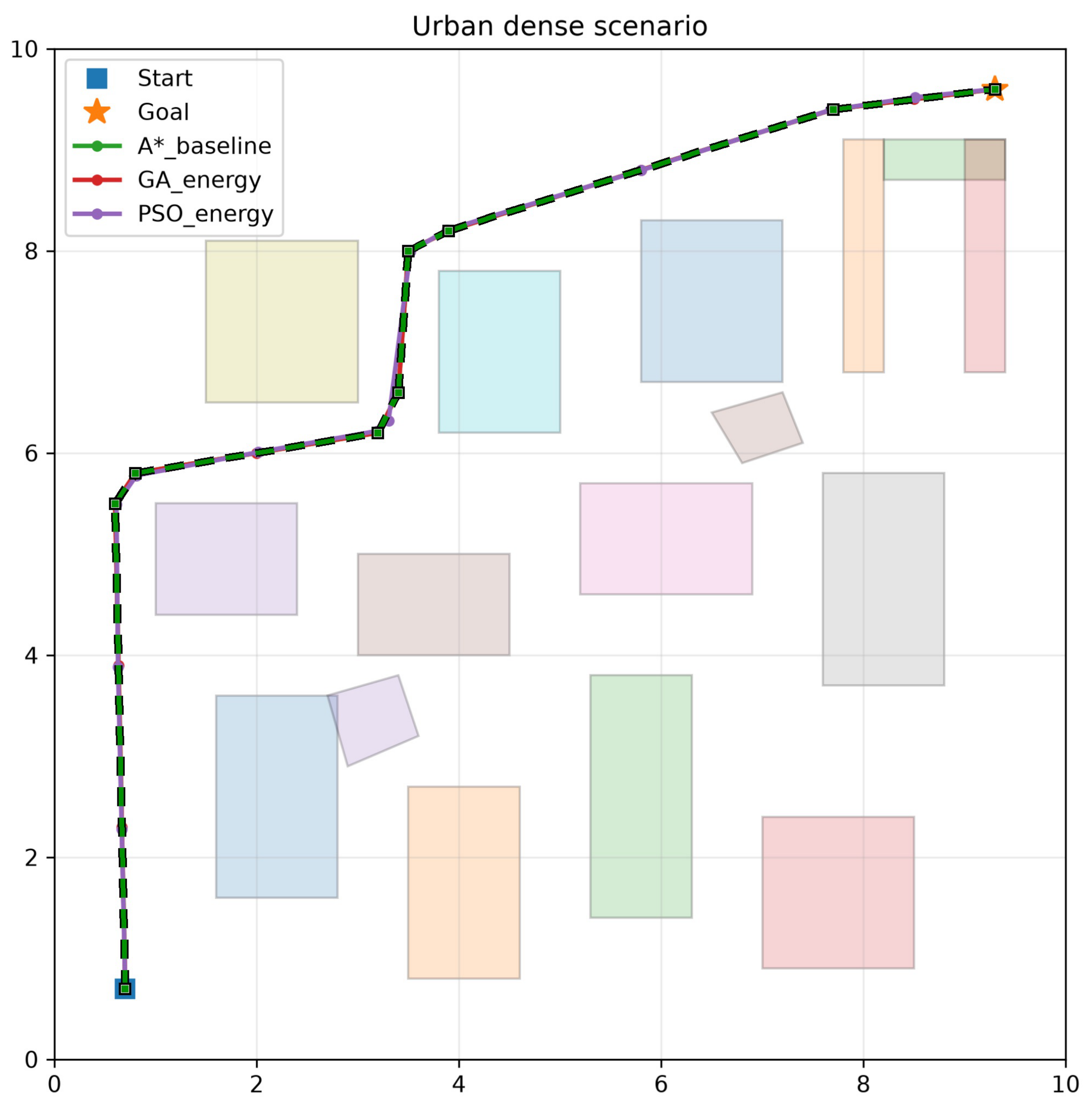
The experiments used the dense urban scenario shown in
Figure 1, composed of sixteen polygonal obstacles, including narrow passages, blocks, rotated polygons, and a U-shaped obstacle near the upper right part of the map. This scenario is more demanding than the original sparse environment because it forces the route planner to traverse constrained corridors and to balance length, rotation, and clearance.
3.1. Single Representative Comparison
Table 2 reports a representative run with seed 42. A* obtained an energy proxy of 18.645 and a runtime of 5.767 s. GA converged to a route with almost the same geometry as A*, with an energy proxy of 18.648 and a runtime of 183.938 s. PSO reduced the energy proxy to 18.458, corresponding to a 1.00% reduction relative to A*, and also reduced distance from 15.490 m to 15.435 m and rotation from 4.136 rad to 4.045 rad. The result confirms that the continuous waypoint optimizer can refine a feasible A* route, but it also shows a clear computational overhead.
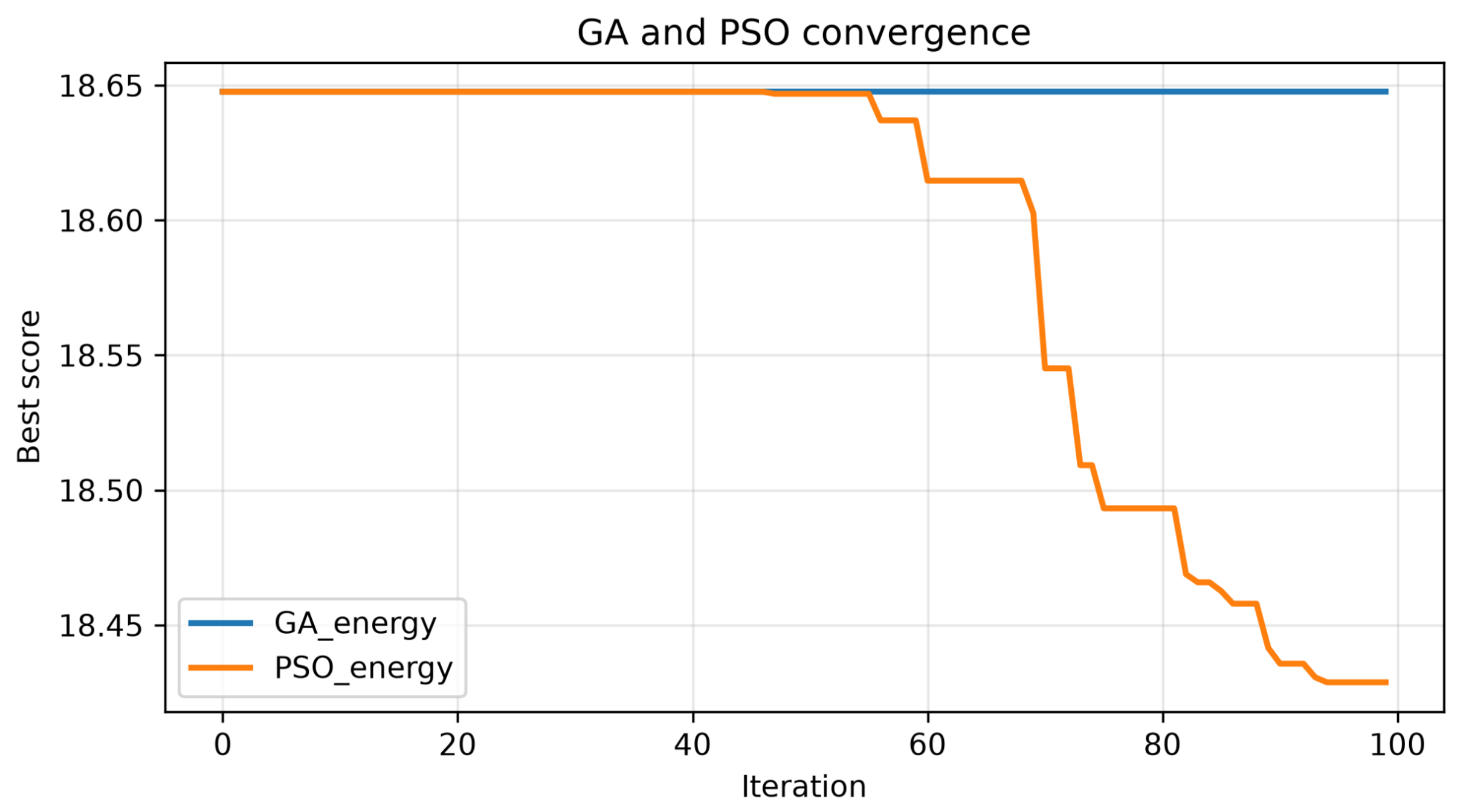
Figure 2 shows that GA rapidly stabilized near the seeded A* route and did not produce relevant improvement after the early iterations. PSO also remained nearly unchanged during the first half of the run, but after approximately iteration 55 it progressively reduced the best score and ended near 18.43. This pattern suggests that the PSO velocity update can perform delayed exploitation once a direction of improvement is found in the continuous waypoint space.
3.2. Repeatability over Ten Independent Runs
Table 3 summarizes the results over ten independent runsreal-timealgorithm. A* is deterministic and is repeated only for table symmetry. All methods achieved a 100% feasibility rate. PSO achieved the lowest mean energy proxy, 18.505, compared with 18.645 for A* and 18.645 for GA. The average reduction relative to A* was 0.75%. PSO also obtained the shortest distance, 15.445 m, and the lowest cumulative rotation, 4.079 rad, representing a 1.37% rotation reduction relative to A*. However, the average PSO time was 175.869 s, while A* required only 5.860 s. Therefore, PSO improves route quality but is not a direct replacement for A* when strict real time response is required.
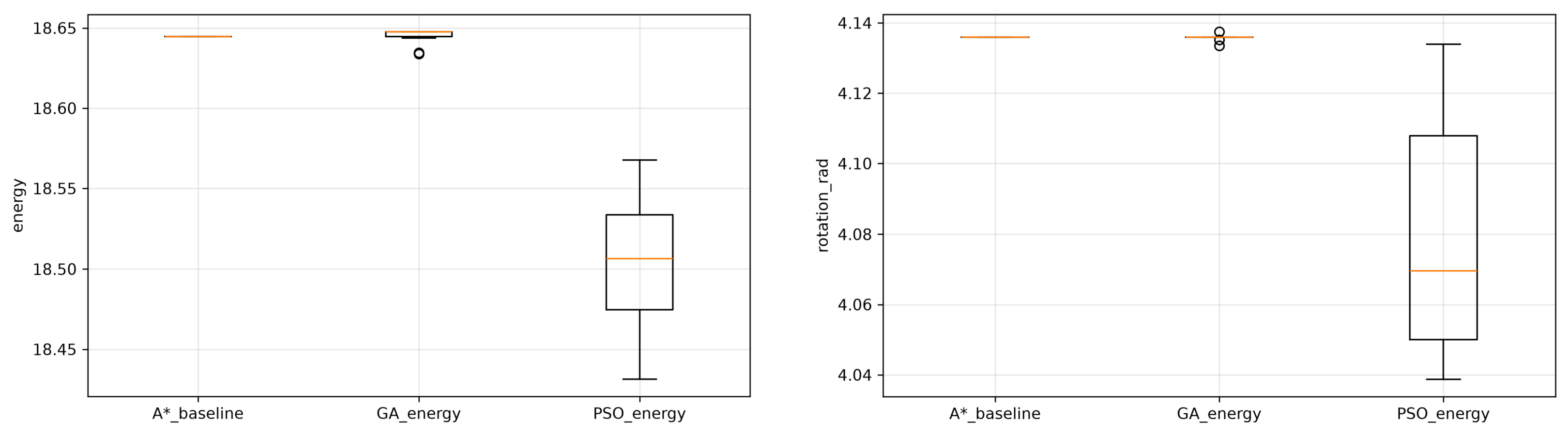
The boxplots in
Figure 3 confirm the deterministic character of A* and the near deterministic response of GA under the adopted seeding strategy. PSO exhibits a wider distribution because it explores more strongly around the A* reference path. This dispersion is not necessarily negative, since the best and average PSO solutions have lower energy and lower rotation than the other two alternatives.
3.3. Ranking Analysis
Table 4 presents a criterion-based ranking of the evaluated methods using the repeatability averages. For each performance criterion, the methods were assigned integer ranks, where rank 1 denotes the best method for that criterion, rank 2 the second-best method, and rank 3 the third-best method. Energy, distance, rotation, number of turns, and computation time were ranked in ascending order because lower values are preferred. Minimum clearance and success rate were ranked in descending order because larger clearance margins and higher feasibility rates are preferred. When two methods obtained the same value for a criterion, the same best available rank was assigned to both methods. This tie rule explains why A* and
both receive rank 1 for the number of turns, and why all methods receive rank 1 for success rate, since all of them achieved 100% feasible solutions.
The aggregate score was computed as the arithmetic mean of the seven criterion ranks,
where
is the aggregate rank score of algorithm
a,
is the number of ranking criteria, and
is the rank assigned to algorithm
a under criterion
j. Therefore, a lower value of
indicates better-balanced performance across all criteria. The final global rank was then obtained by ranking the aggregate scores in ascending order.
The ranking shows that PSO provides the best route-quality metrics, since it ranks first in energy, distance, and rotation. This confirms that PSO is the strongest alternative when the primary objective is to minimize the motion-related cost of the planned route. However, PSO receives lower ranks in number of turns, computation time, and clearance, which penalizes its aggregate score under the equal-weight ranking rule. A* obtains the best ranks in computation time and clearance, confirming its value as a fast and conservative classical planner. GA obtains the best aggregate score, , because it improves energy, distance, and rotation with respect to A*, keeps the same number of turns as A*, and avoids the larger time and clearance penalties observed for PSO. Thus, the ranking should not be interpreted as evidence of a single dominant method under all operating priorities. Instead, it quantifies the engineering tradeoff between route quality, computational burden, and safety margin.
3.4. Practical Significance and Computational Deployment
The computational results show that the proposed energy-aware refinement should not be interpreted as a direct replacement for A* in rapid replanning tasks. In the dense urban scenario, A* required an average computation time of 5.860 s, whereas GA and PSO required 174.574 s and 175.869 s, respectively. Therefore, the current GA and PSO implementations are approximately 30 times slower than A*. At the same time, PSO reduced the average energy proxy from 18.6446 to 18.5046, approximately 0.75%, while reducing the average path length from 15.4901 m to 15.4455 m and the average cumulative rotation from 4.1360 rad to 4.0794 rad. These gains are modest for a single route execution, but they can become significant when the same route is repeatedly executed by battery-constrained robots over long operating periods.
The practical value of the proposed method is therefore associated with supervisory or offline route refinement in structured environments where the map is known in advance, and the optimized route can be reused many times. Representative examples include autonomous mobile robots in warehouses, hospital logistics robots, airport service robots, industrial inspection platforms, agricultural monitoring robots, and security patrol robots that operate along repeated routes. In these scenarios, a route may be planned before a shift, mission, or service cycle, and then executed tens or hundreds of times. Under these conditions, even a small reduction in motion-related energy can translate into longer operating time, fewer charging interruptions, reduced battery cycling, and lower mechanical stress from unnecessary rotations. This interpretation is particularly relevant to differential-drive robots, where turn-intensive paths can increase wheel slip, tire wear, actuator effort, and localization uncertainty.
Based on these results, the recommended deployment strategy is hierarchical. A* should be retained as the primary planner for fast route generation, emergency replanning, and unexpected obstacle avoidance. The GA or PSO-based energy-aware module should operate as a supervisory refinement layer when enough computation time is available.
3.5. Computational Burden Reduction Strategies
Several implementation and structural strategies can reduce the computational burden observed in the current version. First, the search can be restricted to a corridor around the A* route rather than allowing each waypoint to move across the full map. This would reduce the feasible search space and decrease the probability of generating infeasible candidates. Second, the number of optimized waypoints can be made adaptive. Long nearly straight segments can be represented with few variables, whereas only geometrically complex regions near obstacles require additional degrees of freedom. Third, early stopping can be used when the best feasible cost does not improve by more than a prescribed tolerance during a fixed number of generations. Fourth, the population size can be decreased after convergence begins, which would preserve exploration during the first iterations while reducing repeated evaluations in the final refinement stage.
The highest computational cost in the current implementation is associated with repeated path evaluation, especially collision checking, clearance estimation, and constraint verification for all agents and all iterations. Therefore, additional acceleration can be obtained through vectorized distance calculations, spatial indexing of obstacles, caching of repeated segment evaluations, and parallel evaluation of individuals. These modifications are compatible with GA and PSO because each candidate path can be evaluated independently within each generation. A further reduction can be obtained through hybrid local refinement, where PSO or GA performs a limited global search initialized from A*, and a deterministic smoother then improves the best feasible route. This hybrid structure would retain the route-quality advantage of the energy-aware formulation while reducing the runtime penalty observed in the present experiments.
3.6. Sensitivity to the Rotational Weight
Table 5 presents the sensitivity analysis for the PSO planner. Because changing
changes the definition of the objective itself, the energy proxy values across rows should not be interpreted as direct energy savings. The relevant observation is the response of route geometry to the rotational weight. Increasing
from 0.0 to 0.6 reduced average cumulative rotation from 4.245 rad to 4.061 rad while maintaining a similar distance, near 15.44 m. The number of turns also decreased from 7.9 to 7.3. At
, the average number of turns decreased to 7.0, but cumulative rotation slightly increased to 4.076 rad. Therefore,
was retained as a balanced setting that minimizes rotation without producing the highest objective weight or excessive sensitivity.
3.7. External Perturbation Robustness
The external perturbation test evaluates the sensitivity of the representative planned routes to open-loop execution errors. Random waypoint perturbations with standard deviation m and deterministic bias terms m were applied to the internal waypoints of each route. The start and goal locations were kept fixed. For each perturbation condition, 100 perturbed trajectories were generated and evaluated using the same collision, clearance, and energy metrics used in the nominal planning problem. Therefore, the success rate represents the percentage of perturbed trajectories that remained feasible after the imposed execution error. These tests should be interpreted as open-loop robustness tests, not as closed-loop tracking experiments.
Table 6 reports the zero-bias cases, namely
, for three representative random perturbation levels. The rows with
correspond to the unperturbed reference trajectories, which is why the perturbation terms and the energy degradation are equal to zero. In this reference condition, all methods remain feasible, and their nominal clearance margins are preserved. When random waypoint noise of
m is introduced, the success rate decreases to 37% for A*, 32% for GA, and 17% for PSO. This reduction is expected because the dense scenario contains narrow corridors, and the nominal paths operate with clearance margins close to the imposed safety buffer. Under stronger perturbations,
m, feasible execution becomes rare for all methods, with success rates of 4%, 8%, and 4% for A*, GA, and PSO, respectively.
The complete perturbation dataset, including deterministic-bias cases, is reported in
Appendix A. Those additional cases are intentionally demanding because even a systematic displacement of 0.03 m can move a route segment across the safety margin in the narrowest passages. Consequently, the robustness analysis does not invalidate the global planner. Instead, it shows that the planned route should be executed with local feedback control, online clearance monitoring, and replanning triggers when the estimated tracking error approaches the available obstacle margin.
3.8. Practical Integration into a Robot Control Architecture
The proposed planner is intended as a global route-generation layer rather than a low-level motion controller. In a practical robot architecture, the perception module updates polygonal obstacle representations from lidar, depth cameras, or map data; the global planner computes a feasible waypoint route using A*, GA, or PSO depending on time availability; a local trajectory tracker converts waypoints into linear and angular velocity commands; and a safety supervisor monitors obstacle distance, localization confidence, and actuator limits. If the predicted clearance falls below a predefined threshold or if localization uncertainty increases, the supervisor should trigger replanning or switch to a conservative A* route. In this architecture, A* is suitable for fast replanning, while PSO is suitable when route quality is prioritized and sufficient computational time is available.
4. Conclusions
This paper presented an energy-aware route planning framework for differential drive mobile robots in dense polygonal urban environments. The formulation combines translational length, cumulative rotation, squared rotation, and localization risk in a single interpretable energy proxy, while safety is enforced using a feasibility-first dominance rule. The benchmark includes a deterministic A* baseline, a denser urban scenario with sixteen obstacles, ten independent runs, explicit ranking, rotational-weight sensitivity, and external-perturbation tests.
The results show that PSO provides the best route quality among the evaluated methods. Across ten runs, PSO obtained the lowest average energy proxy, 18.505, the shortest average distance, 15.445 m, and the lowest average cumulative rotation, 4.079 rad. These values improve the A* baseline by 0.75% in energy proxy, 0.29% in distance, and 1.37% in rotation. However, the computational cost of PSO is much higher than that of A*, with average times of 175.869 s and 5.860 s, respectively. Therefore, the results support the use of PSO for offline or supervisory route refinement, while A* remains preferable for rapid replanning.
The equal weight ranking produced a different interpretation: GA obtained the best aggregate score because it stayed close to the A* solution while slightly improving some quality metrics and avoiding the lowest clearance and longest runtime ranks assigned to PSO. This confirms that the best planner depends on the decision criterion. If route quality is dominant, PSO is preferable; if fast response and clearance are dominant, A* is preferable; and if balanced rank across the selected metrics is required, GA is competitive.
The external perturbation tests show that open-loop execution in narrow corridors is highly sensitive to deterministic bias and waypoint noise. For this reason, the proposed global planner should be integrated with closed-loop trajectory tracking, online clearance monitoring, and replanning triggers when the estimated tracking error approaches the available obstacle margin. The main limitation of the present study is the absence of physical prototype validation. Future work will therefore address two complementary directions. First, the computational implementation will be improved through corridor-constrained optimization around the A* reference route, adaptive waypoint selection, parallel objective evaluation, and online replanning integration, with the aim of reducing computational time while preserving the route-quality improvements observed in the dense urban benchmark. Second, the energy proxy will be calibrated against measured motor current and battery discharge, and the planner will be tested on a real differential-drive platform under localization uncertainty, actuator constraints, tracking errors, and dynamic obstacles.




 ,
,