Research Maturity of IOT-Based Energy Efficiency in Hospitality: A PRISMA Systematic Review †




Abstract
1. Introduction
- What measurable impacts and research-maturity levels characterize IOT-driven energy efficiency systems in real-world hotel operations?
2. Method
2.1. Research Design
2.2. Search Strategy and Databases
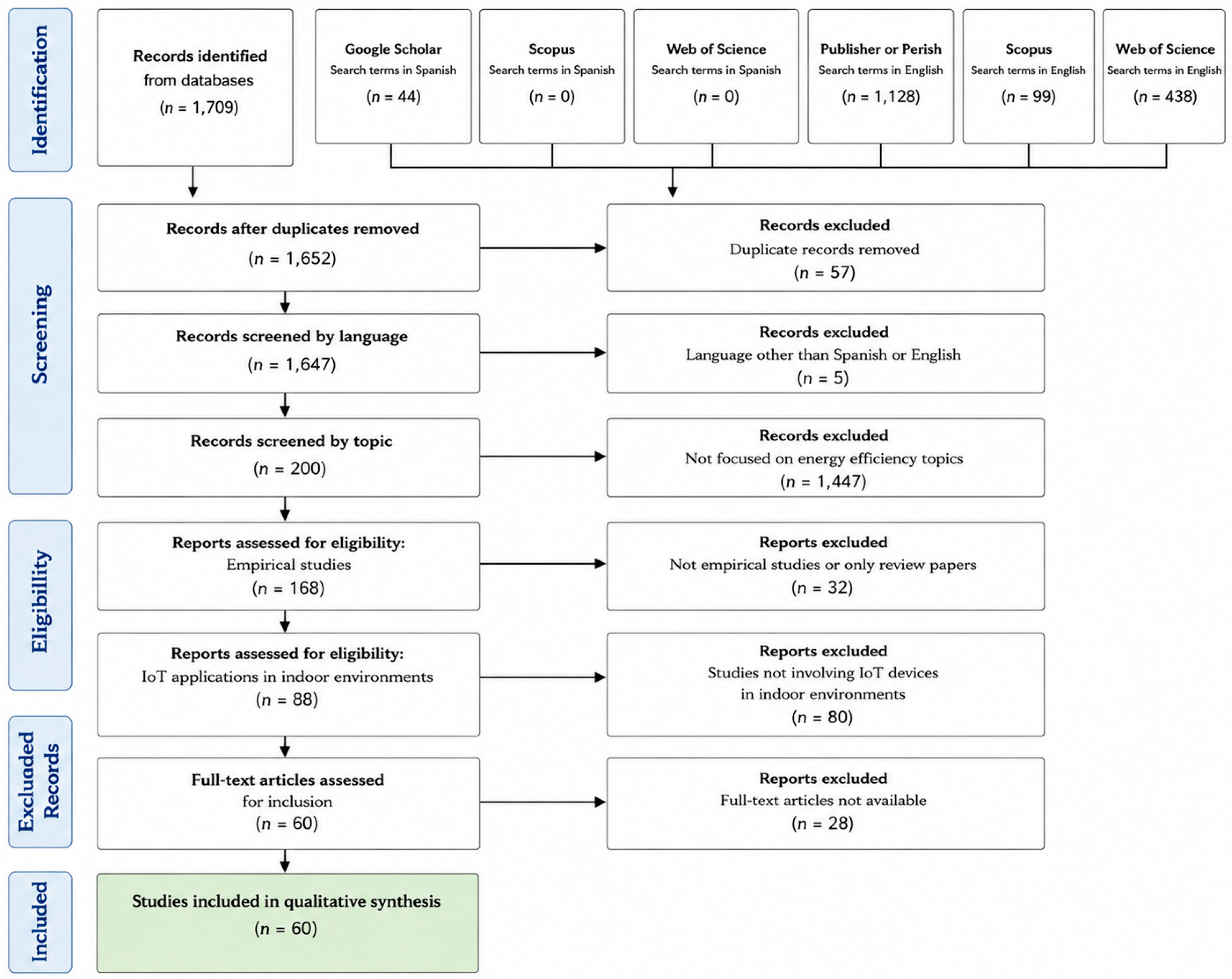
- Peer-reviewed and open-access articles.
- Focus on indoor hotel rooms or comparable building spaces.
- Evaluation of IOT or intelligent control systems.
- Quantitative reporting of energy, HVAC-related metrics.
- Evidence-based analysis (experiment, simulation, etc.)
- Duplicates or incomplete manuscripts.
- Non-English and non-Spanish languages.
- Articles lacking measurable indicators.
- Outdoor or non-comparable building contexts.
2.3. Research Maturity Assessment Framework
- (A)
- Conceptual Foundations
- Does the article clearly define the concepts of automation, Internet of Things (IOT), Industry 4.0, and energy efficiency?
- (B)
- IOT Technological Components
- Does the article clearly specify the IOT devices used in the study?
- Does the article identify the technological platform used to control or manage the IOT system?
- Does the article describe the algorithms, commands, or smart control scenarios enabling energy efficiency?
- (C)
- Methodology and Experimental Implementation
- Does the article clearly define the energy efficiency indicators used in the study?
- Was the research implemented in a real-world environment rather than only simulated or theoretically described?
- Does the article discuss operational or human limitations and propose directions for future research?
- 1—Not addressed or only indirectly mentioned.
- 2—Mentioned but insufficiently explained.
- 3—Clearly reported but lacking methodological or operational detail.
- 4—Clearly documented, methodologically detailed, and potentially replicable.
3. Results and Discussion
3.1. Indicators and Methodological Gaps in Literature
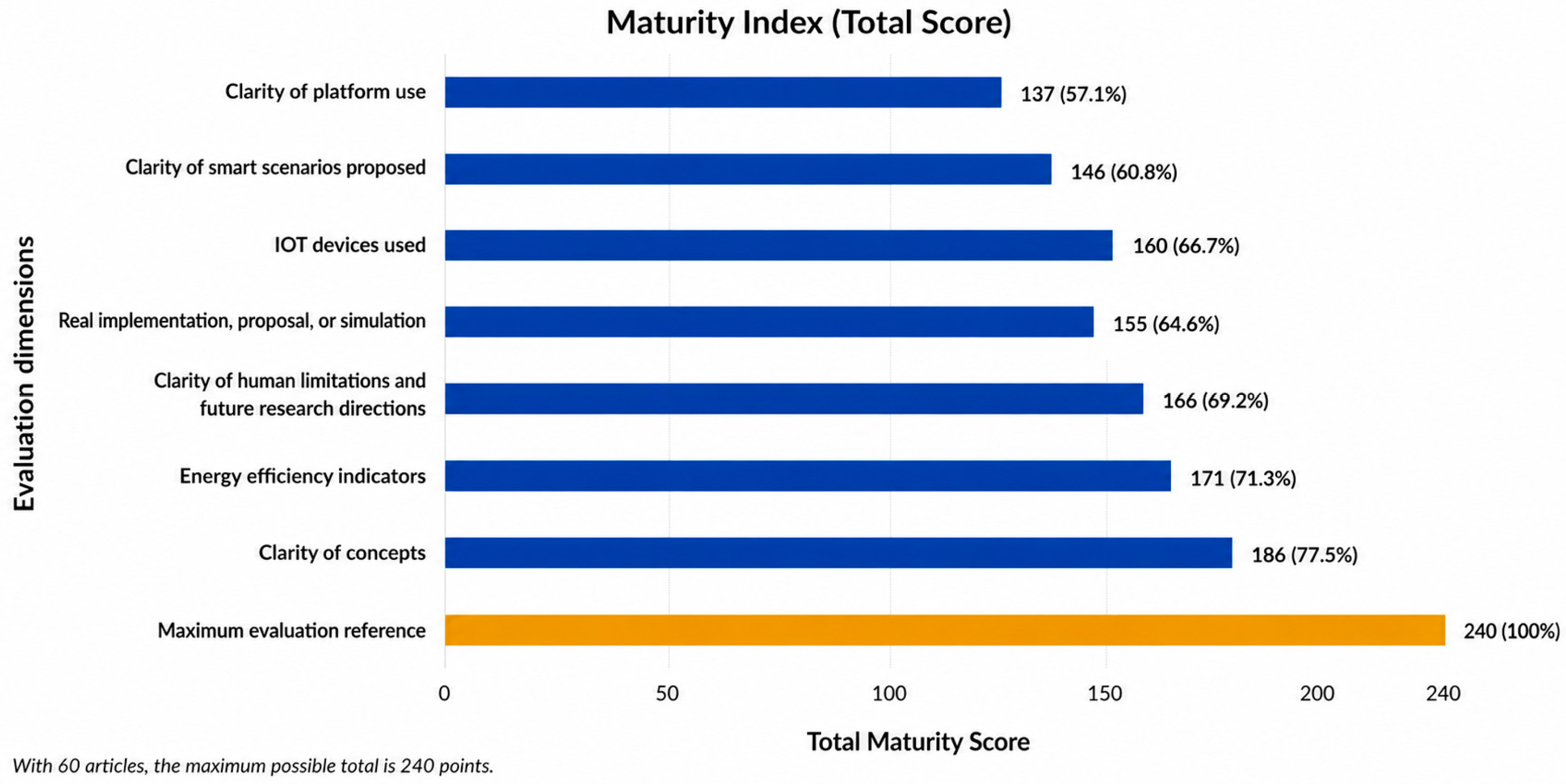
3.2. Research Maturity Assessment Results (RMA)
- Limited real-world validation;
- Inconsistent use of analytical indicators;
- Insufficient replicability of technological implementations;
- Limited reporting of methodological uncertainty;
- Minimal evaluation of long-term platform stability.
3.3. Technological Landscape of IOT in Hospitality
3.4. Hospitality-Focused Research
- Unpredictable guest behavior;
- Spatial variability;
- Issues of maintenance and long-term degradation;
- Actual occupancy fluctuations.
3.5. Operational Implications for Hotels
4. Conclusions and Future Research
- Standardization of energy and environmental indicators.
- Long-term empirical studies conducted in operational hotels.
- In-depth analysis of guest behavior.
- Predictive models based on real operational data.
- Comparative studies between technologies and architectures.
Author Contributions
Funding
Acknowledgments
Conflicts of Interest
Abbreviations
| IOT | Internet of Things |
| HVAC | Heating, Ventilation, and Air Conditioning |
| RMA | Research maturity assessment |
| PRISMA | Preferred Reporting Items for Systematic reviews and Meta-Analyses |
References
- Dominguez-Cid, S.; Ropero, J.; Barbancho, J.; Lora, P.; Cortes, J.; Leon, C. Cyber-Physical System for Predictive Maintenance in HVAC Installations in Hotels. In Proceedings of the 2022 International Conference on Electrical, Computer and Energy Technologies (ICECET), Prague, Czech Republic, 20–22 July 2022; pp. 1–8. [Google Scholar] [CrossRef]
- Gao, H.; Zhong, H.; Zou, L. Human-centric IoT control: A framework for quantifying the impact of occupant behaviour on energy efficiency in shared offices. J. Build. Eng. 2025, 108, 112784. [Google Scholar] [CrossRef]
- Martínez Ruiz, I.; Cano Suñén, E.; Marco Marco, Á.; Fernández Cuello, Á. IoB Internet of Things (IoT) for Smart Built Environment (SBE): Understanding the Complexity and Contributing to Energy Efficiency; A Case Study in Mediterranean Climates. Appl. Sci. 2025, 15, 1724. [Google Scholar] [CrossRef]
- Dinmohammadi, F.; Farook, A.M.; Shafiee, M. Improving Energy Efficiency in Buildings with an IoT-Based Smart Monitoring System. Energies 2025, 18, 1269. [Google Scholar] [CrossRef]
- Li, Y.; De La Ree, J.; Gong, Y. The Smart Thermostat of HVAC Systems Based on PMV-PPD Model for Energy Efficiency and Demand Response. In Proceedings of the 2018 2nd IEEE Conference on Energy Internet and Energy System Integration (EI2), Beijing, China, 20–22 October 2018; pp. 1–6. [Google Scholar] [CrossRef]
- Sayed, A.; Himeur, Y.; Bensaali, F.; Amira, A. Artificial intelligence with IoT for energy efficiency in buildings. In Emerging Real-World Applications of Internet of Things, 1st ed.; Verma, A., Verma, P., Farhaoui, Y., Lv, Z., Eds.; CRC Press: Boca Raton, FL, USA, 2022; pp. 233–252. [Google Scholar] [CrossRef]
- Aranda, J.; Mselle, B.D.; Cruz, J.; Rqiq, Y.; Longares, J.M. Empiric Results from the Successful Implementation of Data-Driven Innovative Energy Services in Buildings. Buildings 2025, 15, 338. [Google Scholar] [CrossRef]
- Franco, A.; Crisostomi, E.; Dalmiani, S.; Poletti, R. Synergy in Action: Integrating Environmental Monitoring, Energy Efficiency, and IoT for Safer Shared Buildings. Buildings 2024, 14, 1077. [Google Scholar] [CrossRef]
- García-Monge, M.; Zalba, B.; Casas, R.; Cano, E.; Guillén-Lambea, S.; López-Mesa, B.; Martínez, I. Is IoT monitoring key to improve building energy efficiency? Case study of a smart campus in Spain. Energy Build. 2023, 285, 112882. [Google Scholar] [CrossRef]
- Habibi, S. Micro-climatization and real-time digitalization effects on energy efficiency based on user behavior. Build. Environ. 2017, 114, 410–428. [Google Scholar] [CrossRef]
- Rinaldi, S.; Flammini, A.; Pasetti, M.; Tagliabue, L.C.; Ciribini, A.C.; Zanoni, S. Metrological Issues in the Integration of Heterogeneous Iot Devices for Energy Efficiency in Cognitive Buildings. In Proceedings of the 2018 IEEE International Instrumentation and Measurement Technology Conference (I2MTC), Houston, TX, USA, 14–17 May 2018; pp. 1–6. [Google Scholar] [CrossRef]
- Khan, Q.W.; Ahmad, R.; Rizwan, A.; Khan, A.N.; Lee, K.; Kim, D.H. Optimizing energy efficiency and comfort in smart homes through predictive optimization: A case study with indoor environmental parameter consideration. Energy Rep. 2024, 11, 5619–5637. [Google Scholar] [CrossRef]
- Berawi, M.A.; Kim, A.A.; Naomi, F.; Basten, V.; Miraj, P.; Medal, L.A.; Sari, M. Designing a smart integrated workspace to improve building energy efficiency: An Indonesian case study. Int. J. Constr. Manag. 2023, 23, 410–422. [Google Scholar] [CrossRef]
- Filimonau, V.; Magklaropoulou, A. Exploring the viability of a new ‘pay-as-you-use’ energy management model in budget hotels. Int. J. Hosp. Manag. 2020, 89, 102538. [Google Scholar] [CrossRef]
- Brik, B.; Esseghir, M.; Merghem-Boulahia, L.; Hentati, A. Providing Convenient Indoor Thermal Comfort in Real-Time Based on Energy-Efficiency IoT Network. Energies 2022, 15, 808. [Google Scholar] [CrossRef]
- Libralato, M.; D’Agaro, P.; Cortella, G. Development of an energy digital twin from a hotel supervision system using building energy modelling. J. Phys. Conf. Ser. 2023, 2600, 032014. [Google Scholar] [CrossRef]
- Li, W.; Koo, C.; Cha, S.H.; Lai, J.H.K.; Lee, J. A conceptual framework for the real-time monitoring and diagnostic system for the optimal operation of smart building: A case study in Hotel ICON of Hong Kong. Energy Procedia 2019, 158, 3107–3112. [Google Scholar] [CrossRef]
- Song, W.; Feng, N.; Tian, Y.; Fong, S. An IoT-Based Smart Controlling System of Air Conditioner for High Energy Efficiency. In Proceedings of the 2017 IEEE International Conference on Internet of Things (iThings) and IEEE Green Computing and Communications (GreenCom) and IEEE Cyber, Physical and Social Computing (CPSCom) and IEEE Smart Data (SmartData), Melbourne, Australia, 21–23 August 2017; pp. 442–449. [Google Scholar] [CrossRef]
- Rocha, F.; Dantas, L.C.; Santos, L.F.; Ferreira, S.; Soares, B.; Fernandes, A.; Cavalcante, E.; Batista, T. Energy Efficiency in Smart Buildings: An IoT-Based Air Conditioning Control System. In Internet of Things. A Confluence of Many Disciplines; Casaca, A., Katkoori, S., Ray, S., Strous, L., Eds.; Springer International Publishing: Berlin/Heidelberg, Germany, 2020; Volume 574, pp. 21–35. [Google Scholar] [CrossRef]
- Metallidou, C.K.; Psannis, K.E.; Egyptiadou, E.A. Energy Efficiency in Smart Buildings: IoT Approaches. IEEE Access 2020, 8, 63679–63699. [Google Scholar] [CrossRef]

Disclaimer/Publisher’s Note: The statements, opinions and data contained in all publications are solely those of the individual author(s) and contributor(s) and not of MDPI and/or the editor(s). MDPI and/or the editor(s) disclaim responsibility for any injury to people or property resulting from any ideas, methods, instructions or products referred to in the content. |
© 2026 by the authors. Licensee MDPI, Basel, Switzerland. This article is an open access article distributed under the terms and conditions of the Creative Commons Attribution (CC BY) license.
Share and Cite
D. Couturier, M.; Frausto-Martínez, O.; Borraz, J.C. Research Maturity of IOT-Based Energy Efficiency in Hospitality: A PRISMA Systematic Review. Eng. Proc. 2026, 147, 3. https://doi.org/10.3390/engproc2026147003
D. Couturier M, Frausto-Martínez O, Borraz JC. Research Maturity of IOT-Based Energy Efficiency in Hospitality: A PRISMA Systematic Review. Engineering Proceedings. 2026; 147(1):3. https://doi.org/10.3390/engproc2026147003
Chicago/Turabian StyleD. Couturier, Manuel, Oscar Frausto-Martínez, and Julisa Cabrera Borraz. 2026. "Research Maturity of IOT-Based Energy Efficiency in Hospitality: A PRISMA Systematic Review" Engineering Proceedings 147, no. 1: 3. https://doi.org/10.3390/engproc2026147003
APA StyleD. Couturier, M., Frausto-Martínez, O., & Borraz, J. C. (2026). Research Maturity of IOT-Based Energy Efficiency in Hospitality: A PRISMA Systematic Review. Engineering Proceedings, 147(1), 3. https://doi.org/10.3390/engproc2026147003