Design and Construction of an Integrated Electrodialysis System with Automated Control for Brackish Water Treatment †



Abstract
1. Introduction
- -
- Design Flow Rate: 10–50 L/h (Lab Scale);
- -
- Salt removal efficiency: to be evaluated experimentally, without a predetermined value;
- -
- Target energy consumption: <2 kWh/m3;
- -
- Inlet water: 1000–5000 mg/L (moderately brackish water);
- -
- Configuration: Recirculating Batch;
- -
- Current Density: 70–80% of Limit Current Density (LCD);
- -
- Stack configuration: 5–10 pairs of cells with commercial membranes.
2. Materials and Methods
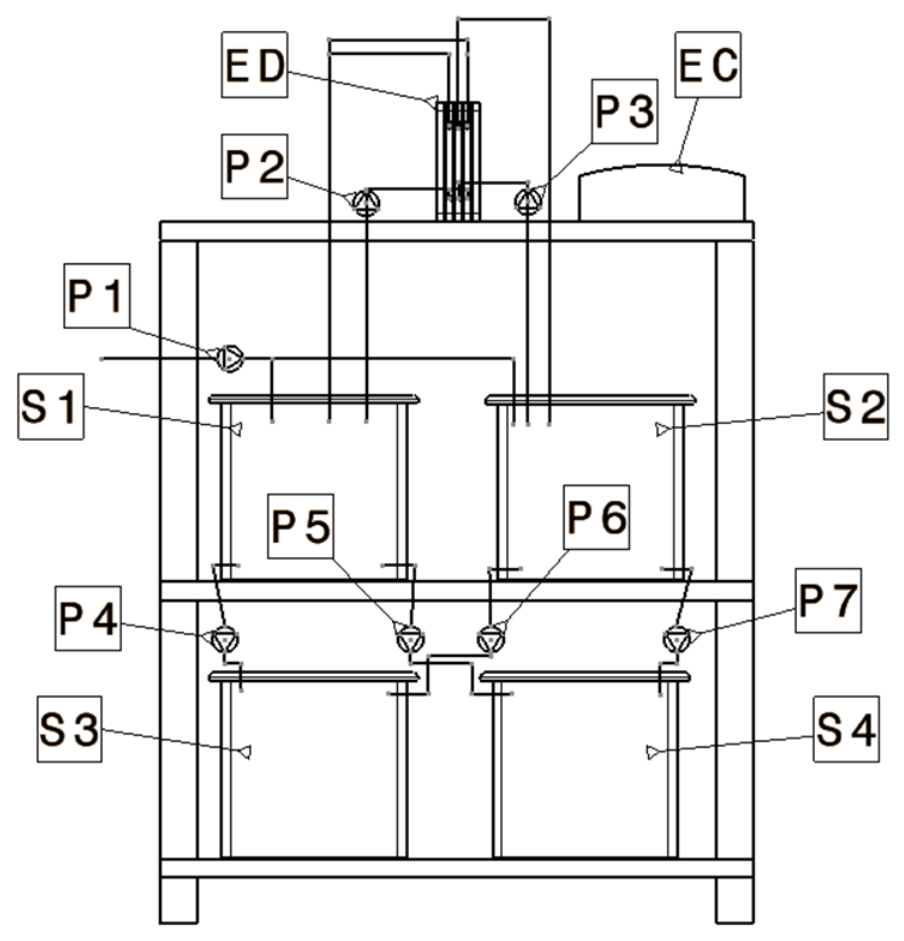
- Filling of the upper tanks (S1–S2) with brackish water;
- Power supply of the ED channels via dedicated pumps (P2–P3);
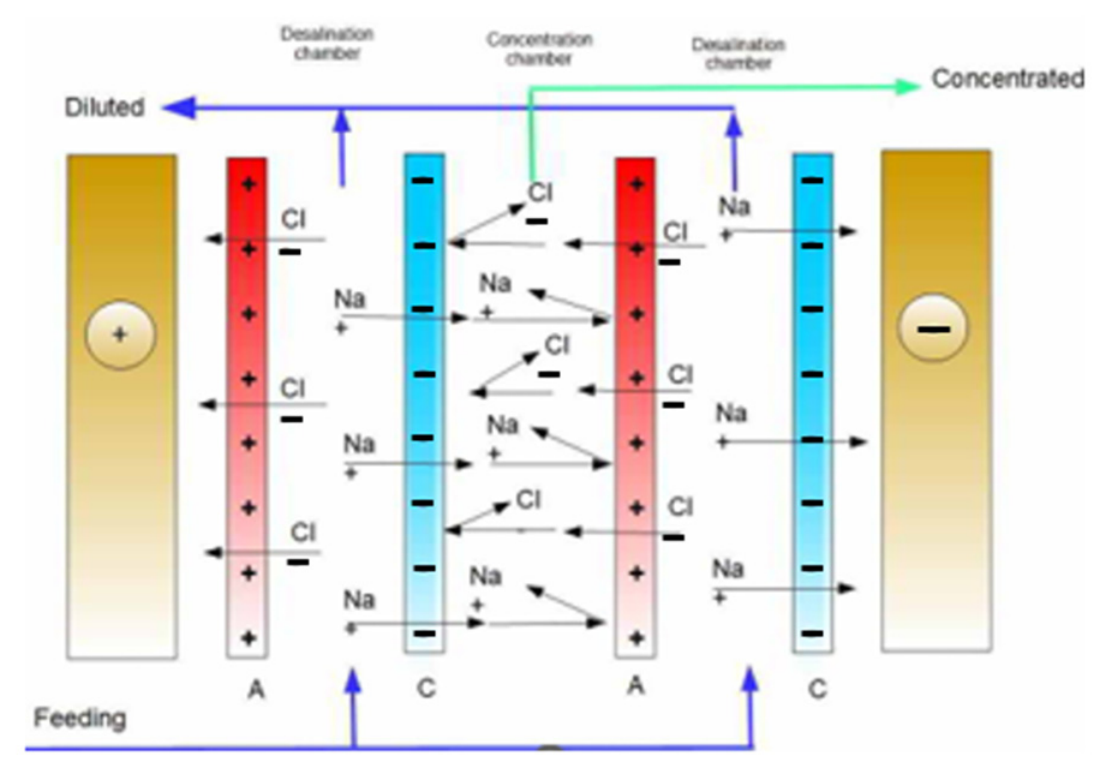
- Ion separation by electric field;
- Diluted and concentrated flow recirculation until desired thresholds are reached;
- Transfer of desalinated water and brine to the lower.
- -
- Desalinated flow (desalinated water)
- -
- Concentrated flow (brine)
- -
- Normal and reverse polarity operating cycles
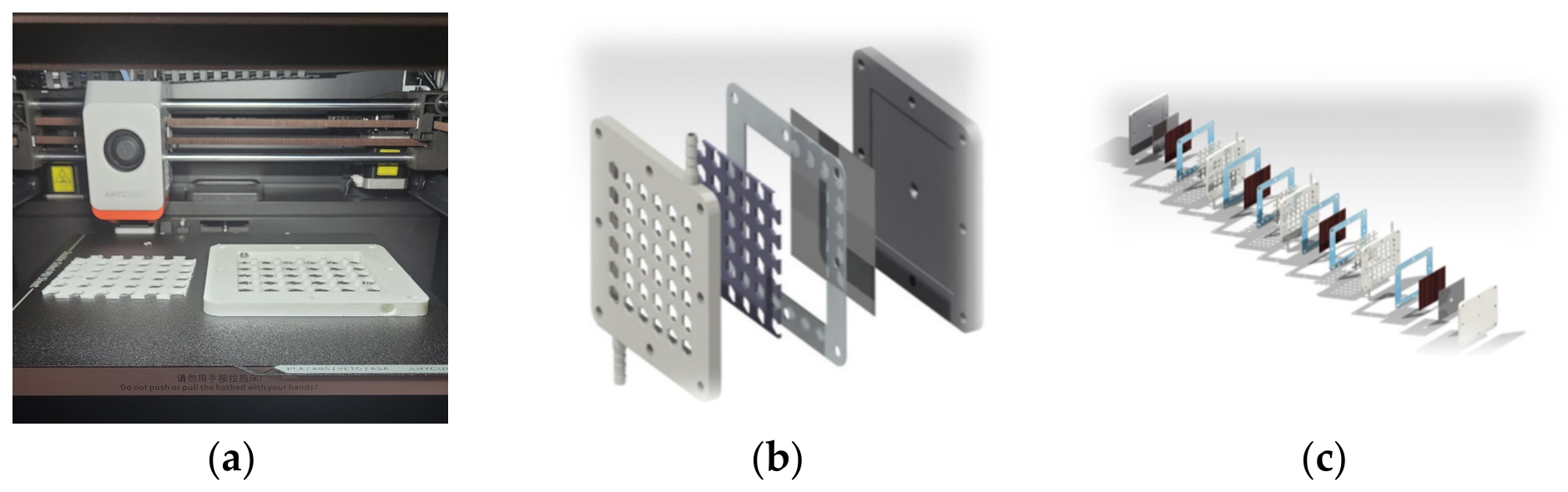
- Structural components: 3D printed with FDM technology with PLA (polylactic acid) filament, chosen for the balance between mechanical properties, ease of printing and sustainability
- Fill pattern: 20% cubic with three perimeter loops for robustness
- Sealing system: Manually cut silicone rubber sheet gaskets and silicone sealant for waterproofing the molded parts
- Pressing: Self-built metal frame for uniform force distribution
- Plumbing connections: Clear PVC pipes and barbette fittings
- Cation-exchange membranes (CEMs): allow the selective passage of positive ions;
- Anionic membranes (AEM): allow the selective passage of negative ions
- Installation of the terminal body and first electrode
- First membrane placement (anionic or cationic based on the polarity of the adjacent electrode)
- Alternation of membranes, gaskets and spacers according to the sequence: electrode → diaphragm → gasket → spacer
- Completion of the battery with the opposite electrode and the end body
- Compression by means of eight threaded rods with nuts and washers
- Installing the outer metal frame to stabilize the assembly
3. Experimental Setup and Results
- -
- Membrane type: two types of commercial ion-exchange membranes, TCEM8040 cation-exchange membranes and TAEM8040 anion-exchange membranes;
- -
- Effective membrane area: 0.0081 m2;
- -
- Number of membranes: two pairs of membranes;
- -
- Tank volume of 5 L and effective tank volume used equal to 2.5 L;
- -
- Flow rate: the pumps (powered at 24 V) had a rated flow rate of 2 L/min;
- -
- Voltage: 31 V;
- -
- Current: 0.051 A;
- -
- Operating current density: i = 6.37 A/m2;
- -
- Operating time: Approximately maximum 1.5–2 h per test.
4. Discussion and Conclusions
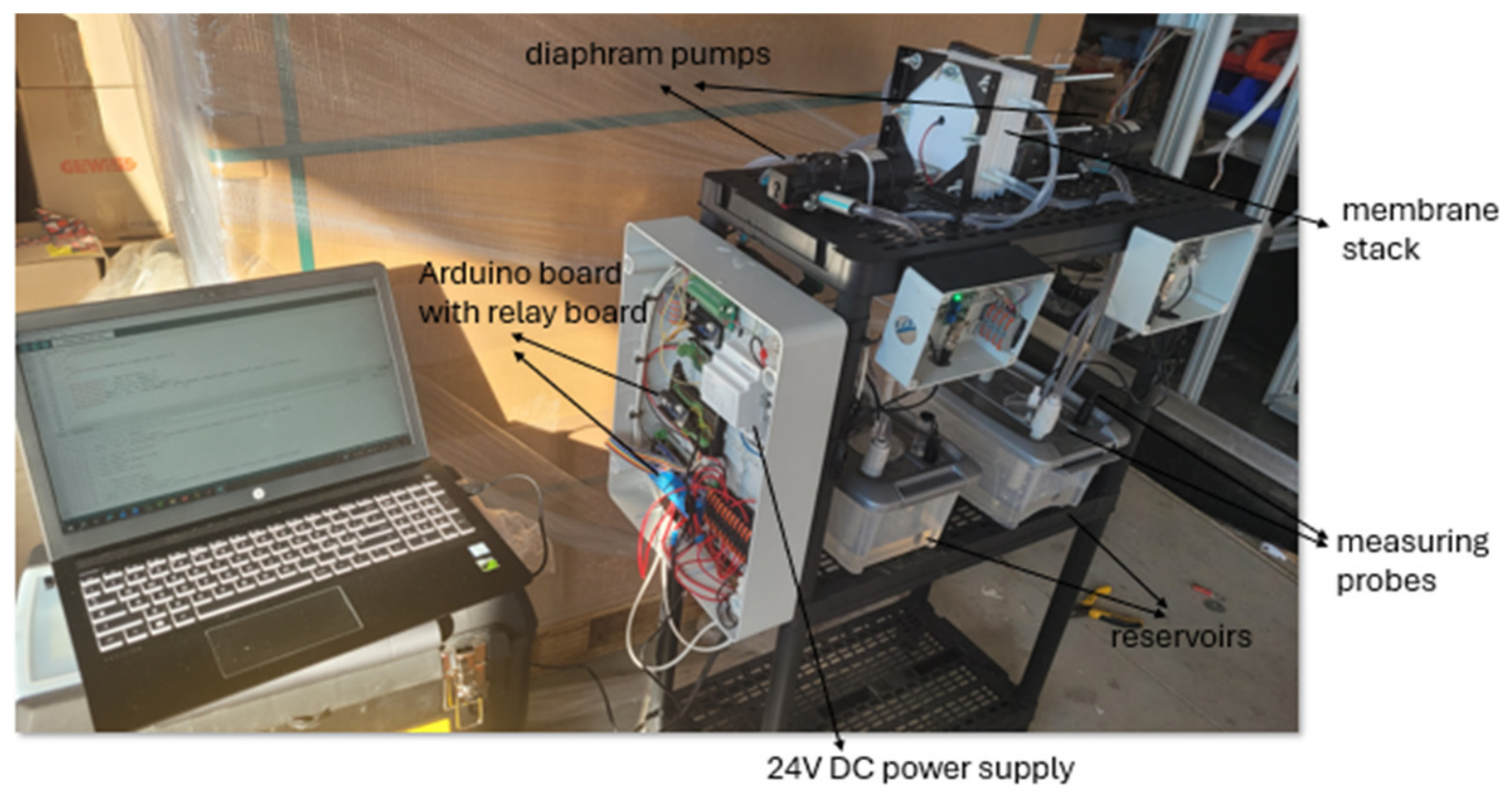
- Prototype realization: A laboratory-scale electrodialysis unit with a modular structure was designed and assembled, using accessible materials (PLA 3D printing, commercial membranes, galvanised steel electrodes) and reproducible technologies.
- Control system: A two-level automated system based on Arduino MKR WiFi 1010 has been developed, with a user interface for manual management and automatic cycles (normal/wash). Integration with AWS IoT Core and the MQTT protocol enabled real-time remote monitoring of pH, TDS, and voltage via Grafana dashboards.
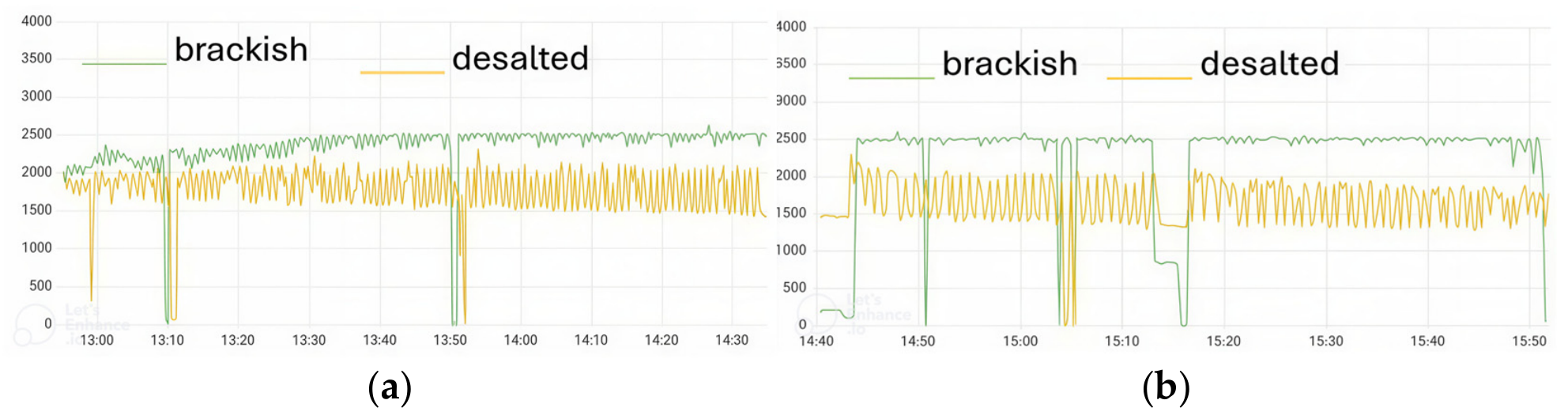
- Experimental validation: The device demonstrated salinity reduction capabilities on 2400 ppm and 1400 ppm NaCl solutions, with desalination rates of 10 ppm/min and 5 ppm/min, respectively. The measured specific energy consumption (3.2 kWh/m3) exceeds the target of 2 kWh/m3, highlighting the need for scale-up.
- Critical analysis: Post-experimental inspection revealed electrode oxidation, membrane deposits and structural failures in PLA spacers, providing valuable insights for future developments.
- Material replacement (titanium electrodes, engineering polymers);
- Redesign of the sealing and compression system;
- Implementation of adaptive control based on sensor feedback;
- Scale up to reduce specific consumption;
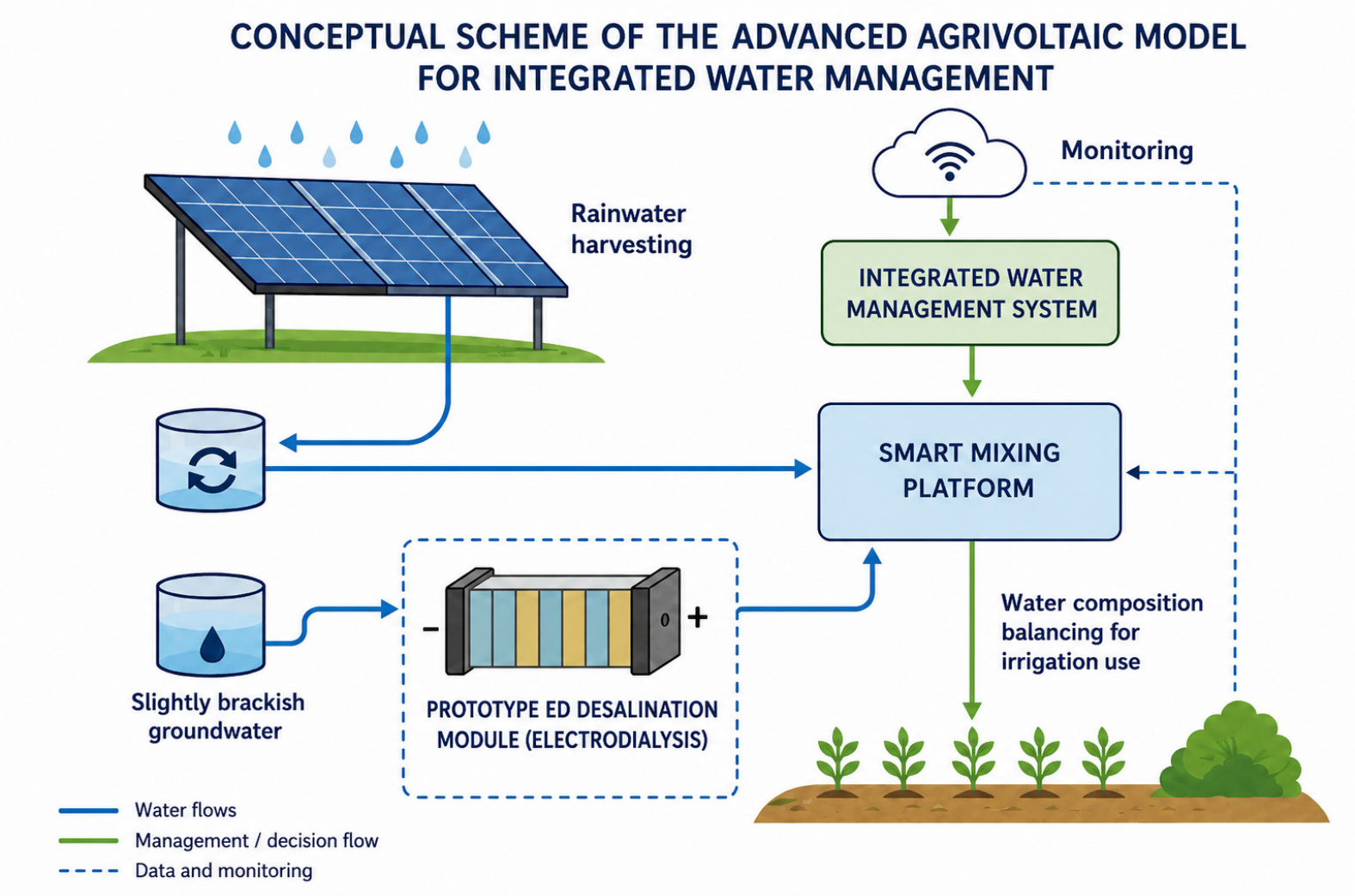
- Integration with renewable sources in an agrivoltaic context.
Author Contributions
Funding
Institutional Review Board Statement
Informed Consent Statement
Data Availability Statement
Acknowledgments
Conflicts of Interest
Abbreviations
| ED | Electrodialysis |
| TDS | Total Dissolved Solids |
| AWS | Amazon Web Service |
| PLA | Polylactic Acid |
| MQTT | Message Queuing Telemetry Transport |
References
- UNESCO World Water Assessment Program. Partnerships and Cooperation for Water; UNESCO World Water Assessment Program: Perugia, Italy, 2023. [Google Scholar]
- Shannon, M.; Bohn, P.; Elimelech, M.; Georgiadis, J.G.; Marinas, B.J.; Mayes, A.M. Science and technology for water purification in the coming decades. Nature 2008, 452, 301–310. [Google Scholar] [CrossRef] [Scilit] [PubMed]
- Elimelech, M.; Phillip, W.A. The Future of Seawater Desalination: Energy, Technology, and the Environment. Science 2011, 333, 712–717. [Google Scholar] [CrossRef] [Scilit] [PubMed]
- Al-Amshawee, S.; Yunis, M.Y.B.M.; Azoddein, A.A.M.; Hassel, D.G.; Dakhil, I.H.; Hasan, H.A. Electrodialysis Desalination for Water and Wastewater: A Review. Chem. Eng. J. 2020, 380, 122231. [Google Scholar] [CrossRef] [Scilit]
- Benvenuti, T.; Gally, C.; Bitencour, C.S.; Bernardes, A.M.; Ferreira, J.Z. Application of advanced oxidation processes and membrane technologies for tertiary treatment of domestic sewage. In Proceedings of the IIOA Conference & Exhibition, Swansea UK, 26–28 October 2016; Available online: https://www.researchgate.net/publication/309672883 (accessed on 30 June 2026).
- Greenlee, L.F.; Lawler, D.F.; Freema, B.D.; Marrot, B.; Moulin, P. Reverse osmosis desalination: Water sources, technology, and today’s challenges. Water Res. 2009, 43, 2317–2348. [Google Scholar] [CrossRef] [Scilit] [PubMed]
- Fritzmann, C.; Löwenberg, J.; Wintgens, T.; Melin, T. State-of-the-art of reverse osmosis desalination. Desalination 2007, 216, 1–76. [Google Scholar] [CrossRef] [Scilit]
- Wenten, I.G.; Khoiruddin, K. Reverse osmosis applications: Prospect and challenges. Desalination 2016, 391, 112–125. [Google Scholar] [CrossRef] [Scilit]
- Mahmood, S.; Mahmood, N.; Liaquat, M.U.; Ikhlaq, F.; Shehzad, H.; Yao, S. Electrodialysis for sustainable water desalination: Principles, applications, challenges, and future directions. J. Environ. Chem. Eng. 2026, 14, 121466. [Google Scholar] [CrossRef] [Scilit]
- Foorginezhad, S.; Zerafat, M.M.; Ismail, A.F.; Goh, P.S. Emerging membrane technologies for sustainable water treatment: A review on recent advances. Environ. Sci. Adv. 2025, 4, 530–570. [Google Scholar] [CrossRef] [Scilit]
- Kamalesh, R.; Karishma, S.; Saravan, A.; Yashikaa, P.R. Emerging breakthroughs in membrane filtration techniques and their application in agricultural wastewater treatment: Reusability aspects. Sustain. Chem. Environ. 2024, 8, 100183. [Google Scholar] [CrossRef] [Scilit]





| Test Name | Initial TDS Value [ppm] | Final TDS Value [ppm] | Desalination Percentage [%] | Operating Time [h] | Desalination Rate [ppm/min] |
|---|---|---|---|---|---|
| Test1 | 2200 (desalted) | ||||
| 2400 | 8.3 | 0.5 | 6.66 | ||
| 2570 (brackish) | |||||
| Test2 | 1020 (desalted) | ||||
| 1350 | 24.4 | 0.5 | 11 | ||
| 1400 (brackish) |
Disclaimer/Publisher’s Note: The statements, opinions and data contained in all publications are solely those of the individual author(s) and contributor(s) and not of MDPI and/or the editor(s). MDPI and/or the editor(s) disclaim responsibility for any injury to people or property resulting from any ideas, methods, instructions or products referred to in the content. |
© 2026 by the authors. Licensee MDPI, Basel, Switzerland. This article is an open access article distributed under the terms and conditions of the Creative Commons Attribution (CC BY) license.
Share and Cite
Esposito, M.; Giannoccaro, N.I.; Zito, F. Design and Construction of an Integrated Electrodialysis System with Automated Control for Brackish Water Treatment. Eng. Proc. 2026, 145, 7. https://doi.org/10.3390/engproc2026145007
Esposito M, Giannoccaro NI, Zito F. Design and Construction of an Integrated Electrodialysis System with Automated Control for Brackish Water Treatment. Engineering Proceedings. 2026; 145(1):7. https://doi.org/10.3390/engproc2026145007
Chicago/Turabian StyleEsposito, Marco, Nicola Ivan Giannoccaro, and Francesco Zito. 2026. "Design and Construction of an Integrated Electrodialysis System with Automated Control for Brackish Water Treatment" Engineering Proceedings 145, no. 1: 7. https://doi.org/10.3390/engproc2026145007
APA StyleEsposito, M., Giannoccaro, N. I., & Zito, F. (2026). Design and Construction of an Integrated Electrodialysis System with Automated Control for Brackish Water Treatment. Engineering Proceedings, 145(1), 7. https://doi.org/10.3390/engproc2026145007